
Trump Trade War Returns
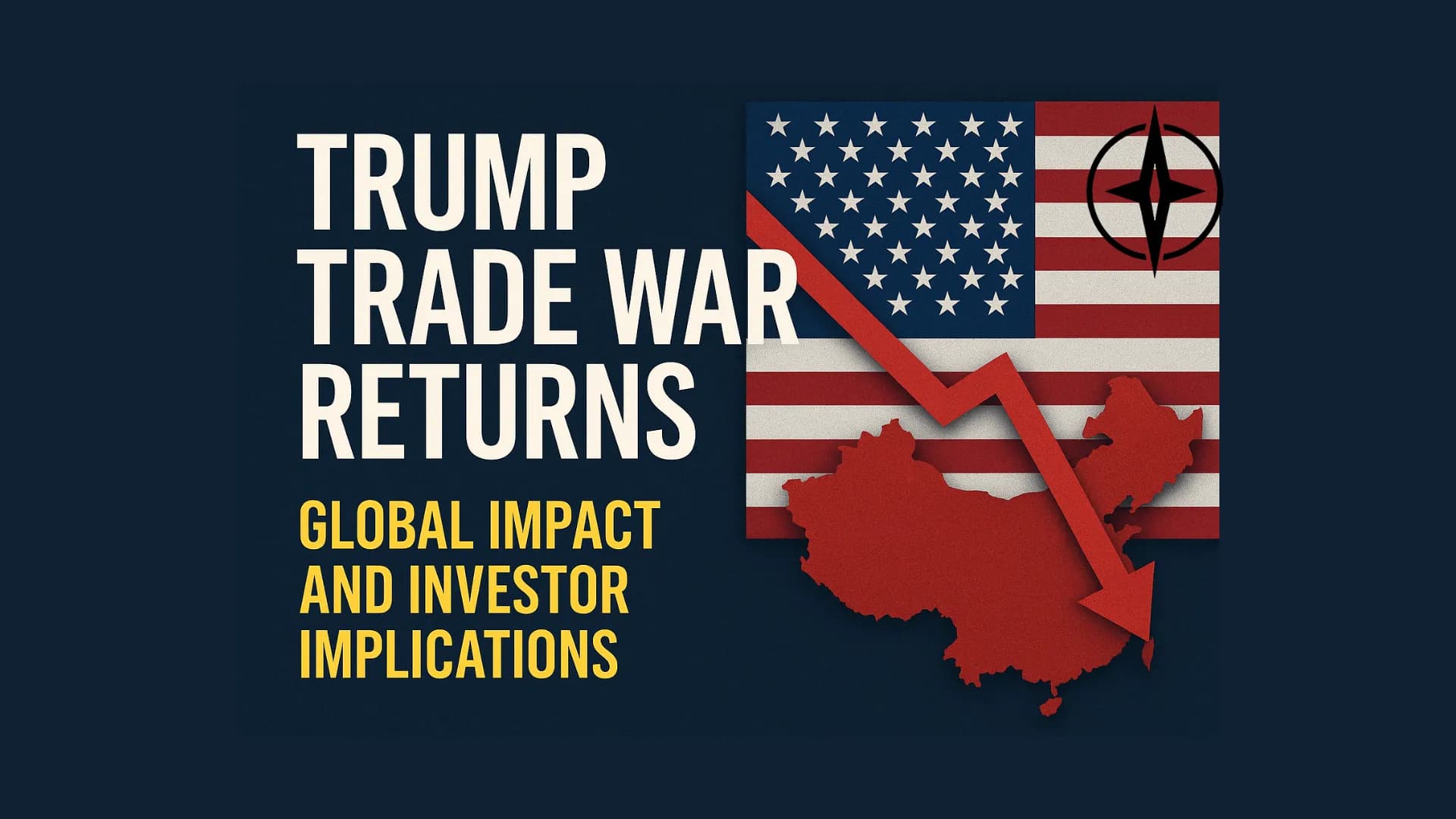
The Trump trade war is back. Here's how new tariffs, supply chain shifts, and protectionism are reshaping the global economy.
In this article
Trump Trade War Returns: Global Impact and Investor Implications
Tariffs are back, markets are rattled, and global trade is shifting again.
A Flashpoint for the Global Economy
On April 2, 2025, President Trump announced sweeping new tariffs on a wide range of foreign goods, targeting over $2 trillion in imports from countries including China, Vietnam, and Mexico. Branded as “Liberation Day,” the announcement reignited one of the most contentious economic strategies in modern U.S. history.
According to Bloomberg, this policy initiative aims to shield domestic industries, restore national manufacturing strength, and minimize dependency on foreign powers. In response, markets fell sharply. The Dow Jones shed over 1,600 points in a single session, while the VIX index spiked to its highest level since the height of the COVID-19 pandemic, reflecting a broad wave of uncertainty.
This is not a tactical move; it is a declaration of long-term strategic intent. As the White House reiterated in its official release on America First trade strategy, this protectionist push is designed to be structural. The administration sees it as part of a new economic doctrine that favors resilience over efficiency, autonomy over integration. The world is no longer flat. It’s fractured.
Protectionism Is No Longer the Exception
For decades, global trade operated under the assumption that interdependence breeds prosperity. That belief is now under siege. Countries are prioritizing sovereignty and security over supply chain optimization.
As noted by BBC News, the European Union, India, and Mexico are all revisiting trade relationships, and some have already begun implementing reciprocal measures. This momentum suggests we’re not looking at an isolated incident. We’re witnessing a rewiring of the global economic system.
Tariffs were once viewed as tools of the past, relics of pre-globalization policy. Today, they are becoming routine. This shift alters everything. When economic alliances are rewritten through political calculus, businesses can no longer rely on predictability.
For investors, volatility is no longer a cyclical feature, it is a baseline. Supply chains are being relocated, remapped, and rebuilt to prioritize control, even at the expense of cost.
Strategy’s model, detailed in our MicroStrategy stock analysis, is a prime example of financial architecture increasingly designed for volatile environments.
This macro shift is already showing up in corporate behavior. Many large firms, like NVDA, are announcing new U.S.-based facilities, even if they come with higher operating costs. Others are moving manufacturing to so-called “friendshoring” destinations: countries that are politically aligned but still offer labor cost advantages. In either case, the result is the same: a systemic retreat from globalization.
Sectors and Companies at the Center
Some sectors are emerging as relative winners in this new paradigm:
- U.S. manufacturing and industrial engineering firms with domestic infrastructure
- Logistics providers with the ability to rapidly adapt to disrupted routes
- Construction, steel, and transportation sectors tied to domestic investment
- Latin American and Southeast Asian exporters benefiting from nearshoring
Conversely, other sectors face mounting headwinds:
- Multinationals deeply reliant on Chinese supply chains or overseas assembly
- Firms operating on razor-thin margins that cannot absorb new tariff costs
- Agriculture and auto part exporters vulnerable to retaliatory trade actions
Nike, in particular, has been hit hard by tariff exposure — but as we explore here, that short-term volatility has created a number of long-term opportunities for patient investors.
Cybersecurity names like SentinelOne, asset-light, AI-native, and U.S.-focused, may offer a cleaner setup in this fragmented environment.
Investors Need a New Mental Model
Not every company will adapt. Some will lean on narrative instead of numbers, especially in high-concept sectors like quantum computing. In our QUBT short thesis, we examine how hype can break under macro pressure when companies lack real-world resilience or operational clarity.
Investing in 2025 requires a new framework. Traditional diversification strategies, once built on the assumption of open capital markets and interconnected growth, no longer fully apply. In an era where economic alliances are being redrawn and trade can be weaponized, resilience matters more than reach.
Investors should seek companies that:
- Operate within stable or politically aligned jurisdictions
- Have flexible, multi-regional supply chains
- Serve domestic or “protected” industries with tailwind policies
The return of tariffs doesn’t just alter the price of goods. It changes the investment landscape. Companies that cannot adapt to policy-driven environments will see valuation multiples contract. Those that can align with policy goals may be revalued upward as strategic assets.
The Northwise Take
At Northwise, we don’t view protectionism as a political blip. We see it as a structural reset. These developments aren’t just shifting market conditions; they’re reshaping how capital, labor, and innovation flow across the globe.
The return of tariffs, the repoliticization of supply chains, and the prioritization of domestic resilience over global efficiency all point to a new playbook. And that playbook rewards investors who can connect macro shifts to bottom-up positioning.
Protectionism isn’t something to fear. It’s something to understand, track, and integrate. This isn’t a headline. It’s a lens. And it’s one we explore deeply in our broader approach to financially aligned decision making.
Connecting the Dots
This shift is already reshaping how global firms are evaluated. Some examples are Amazon and Alibaba, which continues to play a pivotal role in how global investors interpret the intersection of trade, infrastructure, and geopolitical perception.
Its positioning within China’s national strategy and its investments in areas like logistics and cloud infrastructure reflect a different flavor of economic alignment, one rooted in long-term resilience rather than short-term export dependence.
This speaks directly to the ideas explored in our review of The Hundred-Year Marathon, which highlights how China approaches strategy through the lens of centuries, not election cycles.
Unlike the United States, where quarterly earnings and short-term sentiment often drive decision-making, China’s economic positioning reflects long-range planning, national cohesion, and generational patience.
Alibaba’s role in this macro picture illustrates how investing in Chinese infrastructure is not just a market story; it’s a geopolitical one. Its misunderstood position in the global trade narrative is a live case study of how protectionism, perception, and long-term planning intersect.
This Is Just the Beginning
What began as a political announcement has evolved into a market reality. Tariffs are not temporary friction points. They are signals of economic realignment. In the coming months and years, expect further rounds of tariffs, retaliatory measures, and restructured trade agreements. The global economy is being divided not by geography, but by ideology.
Investors who are paying attention won’t simply react. They’ll position. But the true effects of this new trade environment may take time to fully materialize.
Shifts in global supply chains, industrial policy, and economic alliances play out over quarters and years, not days and weeks. That means the most compelling opportunities may not appear immediately. They will unfold amid the noise, volatility, and short-term panic that tends to accompany periods of disruption.
For those willing to ignore the noise and focus on structural signals, this environment could offer deeply mispriced entry points across sectors and regions. It’s not just about avoiding risk.
There are also opportunities to enter great value companies that remain unaffected by the greater macro picture, like the Cheesecake Factory.
It’s about reading the map while others are watching the weather. Observing where supply chains relocate, which industries attract favorable regulation, and how capital reallocates across borders will remain core to our approach.
This is not financial advice. We are not financial advisors. Always do your own due diligence.

Celsius Stock Analysis: The Shelf Reset and the Second Growth Curve
Celsius stock analysis of the shelf reset, Alani growth, Pepsi economics and cash flow, with a 2030 model and a Premium valuation and entry-price framework.

Meta AI Spending: The Customer Is Already Here
Can Meta turn AI spending into shareholder returns? We model advertising, Muse, hardware, capital costs and cash flow through 2030, with a full valuation.

IREN Stock Dilution: Can the Build Reach Shareholders?
IREN stock analysis of AI growth, funding and dilution through 2030. Read our full valuation, 27 scenarios and price zones free. Excel model is Premium.
Northwise Portfolios
See how the research becomes real decisions
Reader discussion
Discuss the research
Create a Free account to join the discussion with a display name.
Create a Free Account
No comments yet. Start a thoughtful discussion.