
MicroStrategy Stock Analysis

MicroStrategy stock analysis exploring Strategy’s Bitcoin leverage, capital model, and what equity investors are really buying.
In this article
MSTR Stock Analysis: A Deep Dive into Strategy’s Bitcoin Bet
Why the company formerly known as MicroStrategy remains one of the most misunderstood and structurally fascinating plays in crypto today.
MicroStrategy Stock Analysis
Bitcoin is back in the headlines. With ETFs approved, capital flowing in from traditional finance, and volatility returning in waves, the 2025 crypto landscape looks nothing like the sluggish hangover of 2022–23.
But not every investor can (or wants to) hold spot Bitcoin. That leaves room for proxies, structures, and strategic vehicles, and none are as unique, or polarizing, as Strategy.

Formerly known as MicroStrategy, the enterprise software company made headlines in 2020 when it began aggressively acquiring Bitcoin under the leadership of Michael Saylor. But this wasn’t a simple treasury shift.
It was the beginning of an entirely new capital strategy: one that would transform the company’s purpose, public perception, and financial mechanics.
A Quick History: From Software to Spot BTC
MicroStrategy was founded in 1989 as a business intelligence software firm. For decades, it sold analytics tools to corporate clients and generated steady (if unremarkable) cash flows. But in 2020, amidst growing inflation fears and macro uncertainty, then-CEO Michael Saylor pivoted.
He saw Bitcoin as a long-duration treasury reserve asset and began converting the company’s balance sheet into BTC. What followed was an increasingly complex and bold play: issuing common stock, preferred shares, and convertible debt to finance further Bitcoin purchases.
In February 2025, the company rebranded as Strategy, a name change that formalized what the market already understood: this wasn’t a software company anymore.
What Strategy Actually Does
Since 2020, Strategy has systematically issued various forms of equity and debt to raise capital, using the net proceeds to purchase more Bitcoin. The company’s operations now serve primarily to increase Bitcoin holdings through financial engineering.
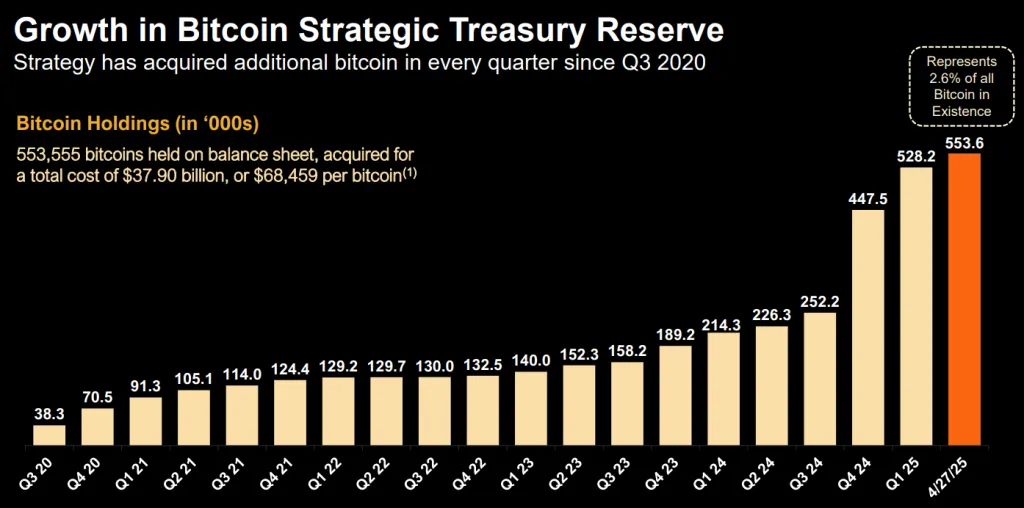
As of April 27, 2025, Strategy holds approximately 553,600 BTC, acquired at an average price of $67,766 per coin. This makes Strategy one of the largest public holders of Bitcoin.
Put simply, Strategy:
- Issues equity or convertible debt when investor interest is high.
- Uses proceeds to buy Bitcoin.
- Relies on share price volatility to enhance the appeal of convertible offerings.
It’s not a Bitcoin miner. It’s not a blockchain developer. Strategy is a financial conduit for Bitcoin exposure, one that actively arbitrages perception, volatility, and structural leverage.
BTC Yield: The Internal Benchmark
To measure this process, Strategy introduced a metric called BTC Yield, defined as:
The percentage change period-to-period of the ratio between the Company’s bitcoin holdings and its Assumed Diluted Shares Outstanding.
In simpler terms: Is the company acquiring more Bitcoin per share, or less? A positive BTC Yield means the company is successfully increasing BTC ownership faster than it’s diluting shareholders. When this ratio improves, it suggests that new capital raised (even if dilutive) is buying more BTC than it costs in equity terms.
Convertible Debt and the Power of Volatility
Strategy’s capital raise of choice has often been convertible debt , a hybrid instrument that functions like a bond but can convert into equity if certain conditions are met.
These instruments are uniquely sensitive to stock price volatility. Why? Because of something called convexity. Convexity causes convertible debt to behave differently than regular debt:
- When the stock price rises, the bond price typically increases faster than the stock.
- When the stock falls, the bond price typically decreases more slowly than the stock.
Volatility only amplifies this relationship, presenting an opportunity for convertible bond investors in the form of a delta-neutral strategy.
What is a Delta-Neutral Strategy?
A delta-neutral strategy, in this case, involves holding a long position in convertible debt while simultaneously shorting the company’s equity. The goal is to isolate the benefits of convexity while neutralizing directional exposure, gains or losses from the share price itself.
In essence, these investors don’t care if Strategy’s stock goes up or down. They care that it moves. The more volatile it is, the more convexity they can harvest.
What Institutional Investors Get Out of It
Some institutions can’t own Bitcoin directly due to regulation or internal mandate. For them, convertible debt from Strategy becomes a proxy, a way to gain economic exposure to Bitcoin without holding the asset itself.
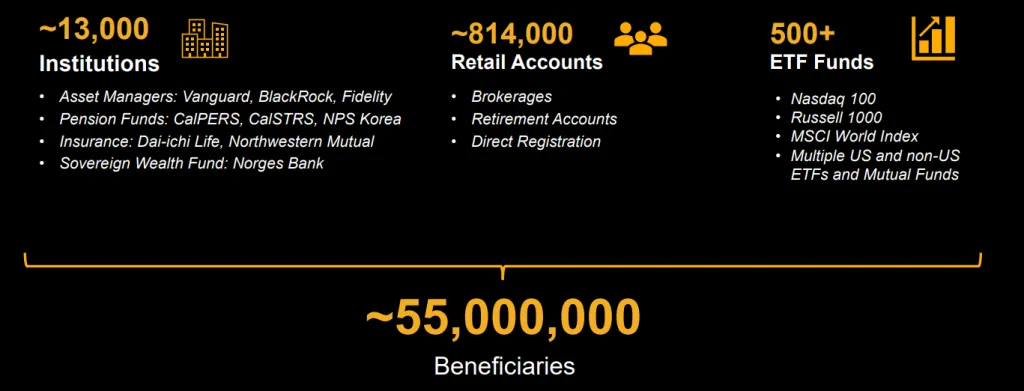
Others use the delta-neutral structure above to capture volatility premium, not Bitcoin upside. This turns Strategy’s capital raises into a magnet for institutional capital chasing structured risk.
What Common Shareholders Are Really Buying
Retail investors often treat Strategy as a leveraged Bitcoin play, and on some level, they’re right. But there’s a key distinction:
Buying Strategy equity does not give you immediate leverage. It gives you exposure to the potential for future leverage.
In fact, you’re paying a premium for the company’s ability to continually issue new debt or equity, use it to buy BTC, and thereby increase the value of your shares over time.
That premium typically correlates positively with sentiment; it grows during times of optimism and shrinks when pessimism prevails.
What Could Break the Flywheel
Strategy’s model has its limitations.
To start, the company is fully reliant on the ability to raise new capital, and investors to buy it. This concern is particularly important to consider as the global appetite for convertible debt is rather limited.
Additionally, as regulatory clarity around Bitcoin improves, companies may opt to skip a proxy for direct exposure to Bitcoin. This, of course, reduces demand for $MSTR. In addition to a potentially reduced demand, better clarity may also reduce volatility, thus making Strategy’s convertible debt less attractive for institutional investors.
Without volatility, and more directly, new capital, the premium for future leverage will collapse. The question is: will it happen when Bitcoin is worth $2 trillion, or $200 trillion?
The Northwise Take
Strategy is not a pure Bitcoin bet. It’s a bet on volatility and emotion.
Understanding the game it’s playing, exploiting sentiment and volatility to accumulate hard money, requires looking past headlines and into mechanics. This is not about belief in Bitcoin alone. It’s about understanding the vehicle you’re using to gain exposure.
We’re not necessarily bullish on Strategy.
In fact, for many investors, the cleaner and more cost-effective move may be to simply buy Bitcoin directly.
What common equity investors are really betting on isn’t just the price of Bitcoin. They’re also betting on:
- Strategy’s continued access to capital markets
- Persistent, heightened, volatility
The game ends when one of those legs breaks.
Until then, Strategy remains a live case study in how volatility, narrative, and financial architecture collide in a market that’s still writing its rules.

Celsius Stock Analysis: The Shelf Reset and the Second Growth Curve
Celsius stock analysis of the shelf reset, Alani growth, Pepsi economics and cash flow, with a 2030 model and a Premium valuation and entry-price framework.

Meta AI Spending: The Customer Is Already Here
Can Meta turn AI spending into shareholder returns? We model advertising, Muse, hardware, capital costs and cash flow through 2030, with a full valuation.

IREN Stock Dilution: Can the Build Reach Shareholders?
IREN stock analysis of AI growth, funding and dilution through 2030. Read our full valuation, 27 scenarios and price zones free. Excel model is Premium.
Northwise Portfolios
See how the research becomes real decisions
Reader discussion
Discuss the research
Create a Free account to join the discussion with a display name.
Create a Free Account
No comments yet. Start a thoughtful discussion.