
Why is QUBT Stock Falling?
Why is QUBT stock falling in 2026? Our bear thesis breaks down hype, dilution, and revenue valuation that doesn’t hold up. (Updated Dec 21, 2025)
In this article
Why is QUBT Stock Falling? The Gap Between Quantum Dreams and Dilutive Reality
When the story breaks down, the stock follows and QUBT’s story is full of holes.
(Updated Dec 21, 2025)
The Big Change: QUBT is No Longer Capital Restrained
In April 2025, our answer to the question: Why is QUBT falling? and bear case centered on an ugly mix: negligible revenue, heavy burn, and a business model that appeared to live on narrative oxygen. Since then, the company has materially altered one variable: liquidity.
By Q3 2025, QUBT reported $352.4M of cash and $460.6M of investments, then disclosed an additional $750M raised after quarter end, after raising $500M during the quarter. Management framed this as a liquid position of over $1.5B to fund its roadmap.
That is real balance sheet capacity. It also comes with a very obvious cost: shareholders just got hit with the type of dilution that can permanently cap upside if the underlying business does not mature quickly.
Revenue Improved, But The Core Problem Remains
The company’s Q3 2025 revenue was ~$384,000, up from $101,000 in Q3 2024, with gross margin improving to 33% (from 9%). Management attributed the increase to higher R&D services, custom hardware work, and beginning to recognize revenue tied to cloud access for its Dirac-3 optimization system.
This is directionally positive, but investors should keep their eyes open:
- $384K in quarterly revenue is still not a commercial business
- Q3 2025 operating expenses were $10.5M, nearly 27x revenue
So yes, the top line moved. The gap between the story and the income statement is still enormous.
The “Profit” Quarter Was Accounting, Not Operating Leverage
QUBT posted net income of $2.4M in Q3 2025. That sounds like a turning point until you read the driver: the release notes say it was primarily due to a $9.2M gain from mark-to-market derivative liability plus $3.5M of interest income.
This matters because it reinforces a point we raised in the original bear thesis: QUBT’s reported net results can be heavily distorted by non-operating items. In Q4 2024, the company’s net loss was also largely explained by a non-cash mark-to-market swing tied to warrant-related derivative liabilities.
If you want to track execution, you follow operating metrics and credible revenue, not headline EPS.
Foundry Claims Look More Substantive Than They Did In Early 2025
Our original thesis questioned whether the “foundry” narrative reflected real infrastructure or marketing. Since then, QUBT has provided more concrete detail, repeatedly referencing its Tempe, Arizona thin-film lithium niobate photonic chip foundry (Fab 1).
In Q3 2025, management said Fab 1 was focused on stabilizing production processes and ramping small-batch manufacturing to fulfill early customer orders, while planning for a larger Fab 2 concept.
That is meaningfully more substance than the earlier posture we critiqued. It still does not prove product market fit or real production capability, but it does reduce the probability that “foundry” is purely a phantom marketing asset.
Commercial Validation Is Still Thin, But A Notable Data Point Emerged
One of the better updates in Q3 2025 was management’s statement that QUBT received a purchase order from a top 5 U.S. bank for its quantum security solutions, described as the first U.S. commercial sale in that category.
That is the kind of customer reference we were looking for in April 2025.
The skeptical view is also straightforward: one sale does not establish a scalable business, and QUBT’s total revenue still implies these wins are early and small.
The Legal Overhang Has Not Disappeared
The securities lawsuit backdrop that existed around our original publication period remains part of the company’s perception problem. Multiple firms publicized class action activity around early 2025.
This is not a reason by itself to be bearish, but it does reinforce why QUBT needs unusually high transparency and third-party validation to earn institutional trust.
So What’s Our Updated Read
QUBT has improved its ability to survive and build. It has not yet proven it can commercialize.
- The balance sheet is dramatically stronger, but largely because of equity raises.
- The revenue base is still microscopic relative to spend.
- The foundry narrative has gained substance, but we still need evidence of repeatable customer demand and scaled economics.
- The headline profitability is not operating profitability, and investors should not confuse those two.
We are keeping the original bear thesis below because the central critique still holds: QUBT remains a company where valuation and narrative can move faster than verifiable business progress. The difference today is that the company now has the cash runway to attempt a real buildout, and dilution risk has become a defining part of the equation.
The Quantum Narrative vs the Business Reality (Original Thesis)
Quantum computing is one of the most exciting frontiers in technology. It has the potential to redefine computational capacity, transform cryptography, and unlock entirely new industries. But the gap between that potential and today’s investable reality is wide, and few companies illustrate that chasm more clearly than Quantum Computing Inc. (QUBT).
So, why is QUBT stock falling at unprecedented levels?
We’re not against QUBT because we doubt quantum computing’s long-term viability. We’re bearish because QUBT, in our view, has failed to demonstrate product credibility, financial viability, or a leadership structure capable of executing in this space.
While true innovation deserves patience, there’s a line between developing ambitious technology and simply failing to execute. The market may have once rewarded buzzwords; today, it demands fundamentals. And QUBT has very few.
This isn’t a critique of quantum as a concept. It’s a critique of a company leveraging the promise of quantum to mask a lack of traction. It’s important to distinguish between belief in an emerging field and blind trust in the players claiming to lead it.
Other players, such as IonQ prioritize realistic milestones and transparent communication with their investors.
The Financials: A Business in Reverse
Let’s start with the numbers. As of Q4 2024:
- Revenue: $62,000 (down 17.33% YoY)
- Operating Expenses: $8.95 million (up 35.80% YoY)
- Net Income: -$51.24 million (down 673.16% YoY)
- Net Profit Margin: -$82,640 (down 835.27%)
- EPS: -$0.10
- EBITDA: -$7.66 million (down 32.47%)
These are not the growing pains of a high-potential R&D firm. These are the burn patterns of a company with virtually no revenue traction and significant cost acceleration. Even among pre-commercial companies, it is rare to see such disproportionate losses against such negligible top-line output.
A company spending over $8 million in operating expenses to generate less than $100,000 in revenue isn’t investing; it’s incinerating. What makes this picture even more concerning is QUBT’s market cap of over $879 million, which implies a valuation more than 2356 times its trailing twelve-month revenue.
That level of disconnect between fundamentals and market expectations isn’t just speculative; it’s absurd.
From Bottled Drinks to Quantum Dreams
What’s more concerning than QUBT’s financials is the pattern of its identity shifts. The company was once a beverage distributor, then pivoted to energy solutions, and eventually rebranded as Quantum Computing Inc. to capitalize on one of the market’s most futuristic narratives.
This isn’t a pivot rooted in technological innovation. It’s opportunistic rebranding.
According to Iceberg Research, QUBT has repeatedly used press releases and vague product announcements to drive short-term attention without delivering verifiable progress. The Capybara Research report further emphasizes that QUBT lacks a defensible moat, verifiable commercial product, or institutional confidence.

In our view, this repeated rebranding to fit emerging trends, without commensurate execution, is one of the clearest signs of a company prioritizing perception over progress. It reflects not innovation, but opportunism.
When a company pivots from beverages to quantum computing, you have to ask: what’s the real product?
The Illusion of Progress: The Phantom Foundry
One of QUBT’s most aggressive claims has been the launch of its “quantum chip foundry.” According to Iceberg Research, not only is the company’s foundry operation unverifiable, but there is little to suggest that QUBT is manufacturing anything remotely close to commercially viable quantum chips.
In fact, the alleged foundry may amount to little more than leased space and marketing language, not functioning production infrastructure. When companies promise the most advanced computational breakthroughs in history, we expect to see more than investor-facing press releases.
Questionable NASA Partnership
Another example of QUBT’s promotional posturing is its much-touted partnership with NASA. On the surface, this sounds impressive, a quantum computing company collaborating with a leading government agency. But a closer look reveals how thin this claim actually is.
According to the Capybara Research report, this so-called partnership appears to be nothing more than a technical demonstration using an API, with no financial or contractual significance. QUBT never clarified the nature or scope of the engagement, yet consistently cited it in public statements as a marker of validation.
This kind of vague affiliation, unsupported by any substantial business or technology development, is a recurring theme in QUBT’s playbook. It reflects a strategy focused on leveraging credibility by association rather than building it through execution.
Dilution, Lawsuits, and Shareholder Value Destruction
Financial underperformance is one thing. Strategic shareholder dilution and legal overhang are another.
QUBT has regularly issued shares to finance operations, despite limited traction or market validation. This is not a growth-stage scaling story; it’s a repeated pattern of raising capital to extend runway without advancing deliverables.
Further clouding the picture is an ongoing securities fraud lawsuit, filed by the Schall Law Firm (and many others), alleging that QUBT misled investors about the scope and capabilities of its quantum development.
This isn’t a sector under scrutiny; it’s a company under fire. And the pattern of dilution further undermines shareholder value.
For early-stage tech companies, equity raises are common, but when they occur alongside continued cash burn and no meaningful proof of execution, they stop being a growth tactic and start becoming a red flag.
Why We’re Bearish
We believe QUBT is a clear example of narrative > numbers. QUBT offers little in the way of proven product, compelling metrics, or business model clarity.
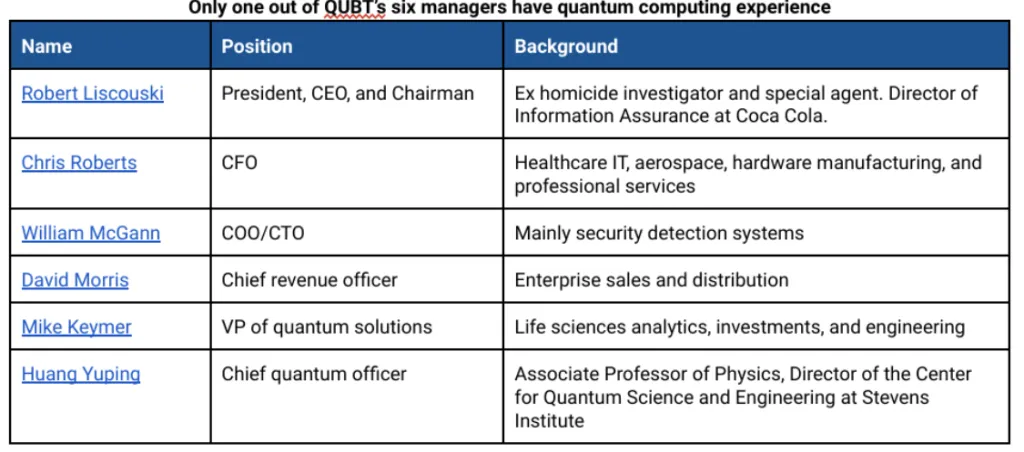
We’re not anti-quantum. We’re anti-speculation dressed as innovation. And unless this company can:
- Show meaningful, auditable revenue growth
- Demonstrate verified technology validated by independent third parties
- Attract long-term institutional capital
…we’ll continue to see this as a high-risk, low-integrity vehicle for hype.

Celsius Stock Analysis: The Shelf Reset and the Second Growth Curve
Celsius stock analysis of the shelf reset, Alani growth, Pepsi economics and cash flow, with a 2030 model and a Premium valuation and entry-price framework.

Meta AI Spending: The Customer Is Already Here
Can Meta turn AI spending into shareholder returns? We model advertising, Muse, hardware, capital costs and cash flow through 2030, with a full valuation.

IREN Stock Dilution: Can the Build Reach Shareholders?
IREN stock analysis of AI growth, funding and dilution through 2030. Read our full valuation, 27 scenarios and price zones free. Excel model is Premium.
Northwise Portfolios
See how the research becomes real decisions
Reader discussion
Discuss the research
Create a Free account to join the discussion with a display name.
Create a Free Account
No comments yet. Start a thoughtful discussion.