
IonQ Stock Price Prediction 2030
Our IONQ stock price prediction 2030 hinges quantum legitimacy. We discuss whether or not Quantum is a bubble, or if IONQ is the next NVDA.
In this article
IONQ Stock Price Prediction 2030: Is Quantum a Bubble?
A high-fidelity hardware lead today doesn’t guarantee a quantum monopoly tomorrow
The Quantum Opportunity
Quantum computing isn’t science fiction anymore. As governments and enterprises pour billions into long-horizon bets, the sector is shifting from theoretical physics to practical implementation.
The long-term goal is to build fault-tolerant machines capable of solving problems no classical system can touch. In materials science, cryptography, logistics, and advanced simulation, the upside could be immense.
But that future won’t arrive all at once. We’re still in the noisy intermediate-scale quantum (NISQ) era, where today’s systems are useful only in very specific workloads and require significant error management.
IonQ has established itself as a leader in this moment. It was the first pure-play quantum company to go public, and its trapped-ion approach continues to offer some of the highest qubit fidelity and coherence times in the field.
The company is selling access to its hardware through cloud providers, generating revenue today while most competitors are still buried in the lab. That visibility has drawn investors eager to own the category winner before the field matures.
But visibility is not victory.
Inside IonQ’s Technology Edge
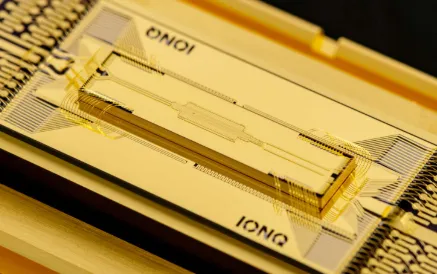
IonQ uses trapped-ion systems where individual ions are suspended and manipulated with lasers. This method allows for all-to-all connectivity, low error rates, and long coherence times.
These strengths give IonQ a quality edge over more established superconducting systems. With systems like IonQ Forte and IonQ Aria, the company has made commercial-scale machines available via Amazon Braket and Microsoft Azure Quantum.
The decision to go with trapped ions instead of superconducting or photonic qubits gives IonQ a real moat today. Its machines are not just functional but have real-world fidelity that surpasses many larger players. In an industry where technical results often outpace practical delivery, IonQ’s progress on hardware deployment sets it apart.
The question is whether this approach can scale. Trapped-ion systems remain difficult to expand to hundreds or thousands of qubits. Control complexity grows rapidly, and no one in the industry has cracked the full-scale roadmap yet. If scalability hits a wall, IonQ’s fidelity edge could be overtaken by more fault-tolerant or easier-to-manufacture architectures.
A Crowd of Giants Is Arriving
That threat isn’t hypothetical. Amazon, Microsoft, and Google have all announced next-generation quantum chips in the past year. Each one represents a different bet on the future of hardware.
Google’s Willow is a 105-qubit superconducting chip that has already demonstrated error-corrected scaling in lab environments. Amazon’s Ocelot uses bosonic cat qubits and aims to reduce error correction overhead by more than 90 percent. Microsoft’s Majorana 1 is pursuing topological qubits using novel materials, with the long-term goal of reaching millions of stable qubits on a single chip.
These projects are early. None are commercially deployed. But they are backed by infinite capital and integrated cloud platforms. If successful, they will displace the need for third-party hardware providers like IonQ. That possibility represents a long-term platform risk, especially because IonQ’s current go-to-market strategy depends on cloud partners who may be quietly building to replace them.
Today, IonQ benefits from access to Azure Quantum and Amazon Braket. Tomorrow, it may be competing with them.
Financials and the Implied Bet
IonQ reported $7.6 million in revenue last quarter and expects between $75 million and $95 million for the full year. That represents healthy growth from a low base, but the company still operates at a net loss of over $30 million per quarter. It recently raised more than $370 million in fresh equity and now holds $697 million in cash. At a burn rate near $36 million per quarter, the company has four to five years of runway.
Its current valuation is approximately $10 billion. That implies a price-to-sales ratio of more than 100 times forward revenue. It also suggests the market is pricing in a future where IonQ is not just a player, but the dominant provider of quantum compute infrastructure. Anything less could trigger a re-rating.
Management and Market Position
IonQ has positioned itself not just as a research-heavy hardware company, but as a strategic infrastructure player in the future of quantum computing. Its leadership team, led by CEO Peter Chapman and Chairman Niccolo de Masi, has consistently pushed the narrative that IonQ could become the “Nvidia of quantum”.
The high-performance layer that sits underneath the next generation of AI, logistics, cybersecurity, and materials innovation. The comparison is more than branding. Like NVIDIA, IonQ is attempting to dominate an essential compute layer by leading in technical execution and embedding itself early into cloud and developer ecosystems.

Where competitors often overpromise and underdeliver, IonQ’s cadence of announcements and technical results has been measured, credible, and independently verifiable. It continues to build strategic goodwill through collaborations with AWS, Microsoft, and DARPA, and has taken steps to extend its hardware roadmap without resorting to promotional hype.
Optionality and Asymmetric Upside
Despite the risks, IonQ has real levers beyond core compute. It recently acquired Capella Space, giving it a head start in quantum networking and quantum key distribution. It has participated in DARPA’s quantum benchmarking programs, building defense credibility. And it holds valuable IP in error correction and gate fidelity that could have licensing value even if trapped-ion systems do not scale.
There is also the wildcard of an acquisition. If a cloud provider like Amazon or Microsoft decides IonQ’s lead is too valuable to compete with, a buyout could materialize. But betting on M&A is not a thesis. It is a hedge.
IonQ also compares favorably to other publicly traded quantum names. In our Quantum Computing Inc. (QUBT) bear thesis, we outlined major concerns with transparency, capital discipline, and long-term viability. IonQ, by contrast, has delivered a clear product roadmap, consistent financial disclosures, and credible leadership. Its management team communicates with clarity, and its strategic vision feels grounded rather than promotional.
So Is IonQ Overvalued?
That depends entirely on your time horizon and your conviction in trapped-ion scalability. IonQ is the best-performing quantum company in the market today. It leads in fidelity, has real revenue, and is commercially live while its biggest rivals are still prototyping. That makes it investable in a way many quantum companies are not.
But the current valuation reflects not today’s fundamentals but a belief in long-term category dominance. That belief may prove right. It may also prove early.
So what does that mean for an IONQ stock price prediction in 2030? If IonQ maintains its technology lead and captures a significant share of commercial quantum workloads, a price target in the $60–$100 range is not unreasonable based on a 25–35x multiple on potential 2030 revenues of $1.5–2.5 billion. This assumes high-margin infrastructure-scale adoption.
On the other hand, if IonQ falls behind or becomes displaced by internal cloud hardware efforts, a retracement to sub-$5 levels would not be surprising. In that scenario, the company may need to pivot toward IP licensing or niche scientific applications.
The outcome will hinge on execution, capital discipline, and whether IonQ can turn its early access and fidelity advantage into long-term infrastructure entrenchment.
We believe IonQ sits at the intersection of deep tech execution and speculative infrastructure premium. The stock is richly priced, but not irrationally, assuming the company stays ahead of its platform partners and out-executes better-funded labs.
It’s too early to tell whether quantum computing as a whole will live up to its long-term promise or fall short of investor expectations. But among the pure-play quantum companies, IonQ is the clear investable leader. It has shown more discipline, execution, and transparency than its peers, and remains the best-positioned to build durable value if the sector proves real.

Celsius Stock Analysis: The Shelf Reset and the Second Growth Curve
Celsius stock analysis of the shelf reset, Alani growth, Pepsi economics and cash flow, with a 2030 model and a Premium valuation and entry-price framework.

Meta AI Spending: The Customer Is Already Here
Can Meta turn AI spending into shareholder returns? We model advertising, Muse, hardware, capital costs and cash flow through 2030, with a full valuation.

IREN Stock Dilution: Can the Build Reach Shareholders?
IREN stock analysis of AI growth, funding and dilution through 2030. Read our full valuation, 27 scenarios and price zones free. Excel model is Premium.
Northwise Portfolios
See how the research becomes real decisions
Reader discussion
Discuss the research
Create a Free account to join the discussion with a display name.
Create a Free Account
No comments yet. Start a thoughtful discussion.