
Is Google Stock a Buy?

Is Google stock a buy in 2025? We explore how AI is transforming Search, YouTube, Cloud, and Waymo and what the market is still missing.
In this article
Is Google Stock a Buy in 2025? Is AI the End of Google Search?
While others fear the end of Search, Alphabet is already monetizing what comes next.
Is Google Stock a Buy Right Now?
Alphabet just delivered one of its strongest quarters in years. Revenue is accelerating, margins are expanding, and for the first time ever, the company introduced a dividend. Despite this shift, the market still treats Alphabet like a legacy ad business rather than what it has become: a foundational AI infrastructure layer with consumer, enterprise, and physical platform extensions.
While many investors continue to debate whether generative AI threatens Google’s core business, we believe the exact opposite is true. AI is not eating search. It is enhancing it. And in the process, it is strengthening Google’s grip on global digital behavior.
The valuation still lags the reality. That disconnect is where opportunity lives.
Financial Strength Meets Strategic Discipline
Alphabet’s Q1 2025 results showed just how much strategic and financial ground the company has regained:
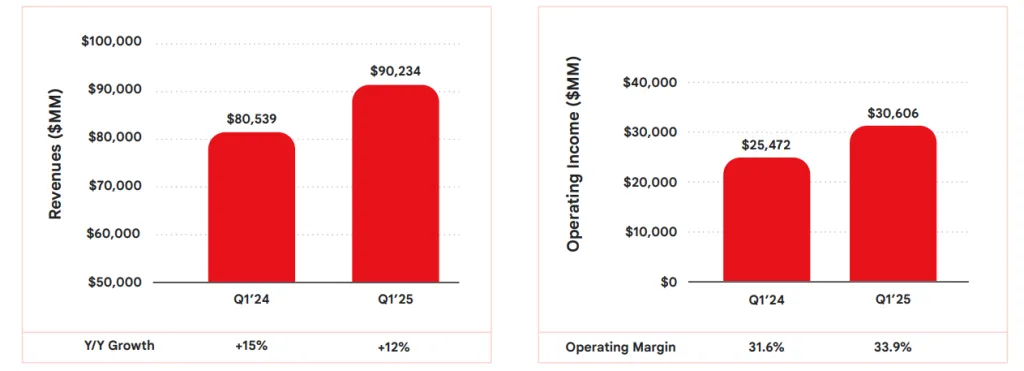
- Revenue: $90.2 billion (12% year-over-year increase)
- EPS: $2.81 (49% year-over-year increase)
- Operating Income: $30.6 billion (20% year-over-year increase)
- Operating Margin: 34%, up from 32% in Q1 2024
- Free Cash Flow: $19 billion
- Capital Expenditures: $17.2 billion
- Trailing Twelve Months Free Cash Flow: $74.9 billion
- Quarterly Dividend: $0.21 per share
In addition to reinstating cost discipline with a smaller workforce and leaner structure, Alphabet also initiated its first-ever quarterly dividend and authorized a $70 billion buyback program. This isn’t the behavior of a company under pressure. It is the playbook of a company in control.
Leadership That Builds Quietly
CEO Sundar Pichai rarely seeks the spotlight, but his impact is unmistakable. Under his leadership, Alphabet has evolved from sprawling experimentation to sharp operational focus without abandoning its core strength: the willingness to build infrastructure layers years before they matter to the market.
In 2025, Alphabet plans to invest approximately $75 billion in capital expenditures, with a majority of that spending focused on AI-related infrastructure. This includes datacenter expansion, custom TPUs, networking, and compute capacity to support model training and inference.

Pichai has framed this investment as critical to maintaining leadership in the foundational technologies that underpin both Alphabet’s products and the broader digital economy.
Whether it’s AI, Cloud, YouTube, or long-horizon bets like Waymo, Alphabet is no longer trying to do everything. It is now positioned to do fewer things with asymmetric leverage.
AI Is Not a Feature. It’s a Platform Shift.
Alphabet isn’t trying to sell AI features. It is embedding Gemini across its ecosystem, from Search and Ads to Gmail, Docs, Meet, and Cloud workloads. The result is not a flashy product demo. It is a deeply integrated AI layer that quietly enhances engagement, monetization, and retention across products already used by billions.
Crucially, Google is one of the few companies in the world with a multi-decade history of indexed web data, user queries, behavioral patterns, and contextual intent. That historical data trove is a structural advantage.

It gives Alphabet’s AI models a richer training environment, better grounding, and more actionable deployment across consumer and enterprise applications. In a world increasingly built on AI pattern recognition and predictive accuracy, Google’s long-term data flywheel gives it not just an edge, but a foundation no competitor can easily replicate.
Gemini now powers Search for more than 100 million users. Workspace tools are getting smarter, faster, and more sticky. Ads are becoming more targeted with less user friction. And on the enterprise side, Gemini is turning Google Cloud into a more defensible alternative to AWS for AI-native use cases.
Cloud: A Flywheel Finally Spinning
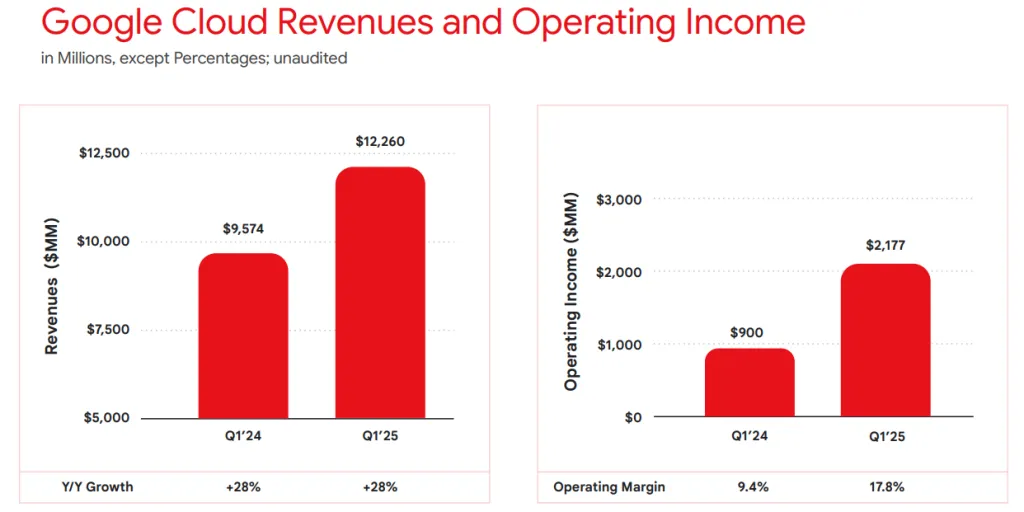
Google Cloud posted $12.3 billion in Q1 revenue, up 28% year-over-year, and is now sustainably profitable. That growth is accelerating not only because of the shift to cloud infrastructure but because Google is now monetizing its own AI stack through tools like Vertex AI, BigQuery, and Security AI Workbench.
Clients include household names like HSBC, Uber, GM, Shopify, and Mayo Clinic. These aren’t experiments. They are enterprise commitments. Cloud is no longer Alphabet’s question mark. It’s part of the answer.
The Truth About Search
The common bear case for Google is that generative AI will erode its search dominance. In practice, the opposite is happening. Google’s Search business remains the most resilient revenue engine in digital media. Early Gemini integrations are improving accuracy, speed, and monetization.
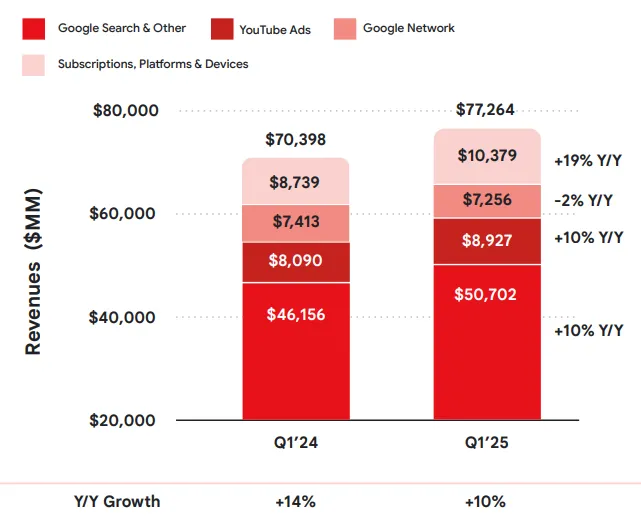
In Q1 2025, Search and Other revenue totaled $50.7 billion, growing 10% year over year. This marked the second straight quarter of reacceleration. Daily queries continue to climb, and mobile search usage has reached a multi-year high.
Gemini is not replacing queries. It is optimizing them. AI-powered answers now appear in more than 100 million daily searches, often alongside high-performing ad formats. Click-through rates are rising in commercial categories, and early data shows faster user resolution.
Search is not just a utility. It is a deeply ingrained behavior. Users stick with platforms that solve problems efficiently.
For advertisers, the value of Search has only grown. Gemini provides richer context and stronger signal density per query, enhancing ad relevance and conversion.
We believe the market continues to undervalue the combination of AI and behavioral data that Google brings to search. Usage is rising. Monetization is improving. And no other platform has the reach or training foundation Google commands.
YouTube: Still Misunderstood by the Market
YouTube generated $8.9 billion in ad revenue last quarter. Shorts views exceed 70 billion per day. Premium subscribers now surpass 100 million. It remains one of the top three streaming platforms in the United States.
Despite these metrics, YouTube continues to be valued as if it were a mature, ad-driven video site. In reality, it is an ecosystem. It spans creator monetization, streaming TV, music, and increasingly, live shopping and commerce integrations.

YouTube’s dominance in both short-form and long-form video positions it as one of the few platforms that commands sustained user attention across devices and demographics.
It is also a major beneficiary of Alphabet’s AI investment. Recommendations, copyright detection, and ad targeting are all increasingly powered by Gemini. This strengthens engagement while optimizing monetization without user fatigue.
If YouTube were valued independently, it would likely command a market cap between $475 billion and $550 billion, according to recent estimates based on its revenue and operating income trajectory. It now accounts for more than 12% of U.S. television usage. Yet within Alphabet, it continues to receive a blended multiple that ignores its scale, growth trajectory, and platform leverage.
We see YouTube as not just an undervalued asset, but a central pillar in Alphabet’s next decade of optionality.
Waymo: A Physical Bet on AI
Waymo, Alphabet’s autonomous driving unit, has transitioned from a speculative venture to a significant player in the self-driving industry. It currently operates fully autonomous ride-hailing services in cities like San Francisco, Phoenix, Los Angeles, and Austin, and is facilitating over 250,000 paid rides each week.

In October 2024, Waymo raised $5.6 billion in external funding, placing its valuation near $45 billion. Analysts project that with continued expansion, regulatory clarity, and product maturity, Waymo could be worth between $305 billion and $850 billion by 2030.
These estimates reflect not just the size of the autonomous transport opportunity but the lead Waymo holds in mapping, simulation, fleet safety, and real-world deployment.
Waymo’s technology also feeds into Alphabet’s broader ecosystem. Data from autonomous rides trains Gemini and improves services like Maps and Earth. The vehicles themselves can serve as surfaces for Google Ads, while also integrating YouTube and Google TV to capture attention in new consumer contexts.
International expansion is also underway, with early mapping work in Tokyo marking its first global step. As governments build policy frameworks and city infrastructure evolves to accommodate AV fleets, Waymo is poised to become a foundational asset in Alphabet’s long-term physical AI architecture.
Waymo also has a massive real world data and safety lead over robotaxi competitors such as Amazon Zoox and Tesla, who has yet to complete one autonomous robotaxis ride.
Waymo is not a bet on cars. It is a data and infrastructure asset that links Alphabet’s AI ambitions to the real world.
A Balance Sheet Built for Offense
Alphabet is sitting on more than $95.3 billion in cash and equivalents. Free cash flow last year exceeded $75 billion. Capital expenditures are ramping, with $75 billion planned for 2025 to support datacenter expansion, TPU deployment, and AI model training infrastructure.
This is not a defensive balance sheet. It is a springboard. With this kind of financial strength, Alphabet can act with strategic independence in ways few others can.
It can invest aggressively in emerging platforms like Gemini and Waymo without requiring external capital. It can outbid rivals in key acquisitions, scale infrastructure at speed, and sustain long-term R&D without short-term pressure.
In a capital-constrained environment, this kind of war chest becomes a competitive weapon. While others seek funding, Alphabet is deploying at scale. That capacity to move early, absorb risk, and build ahead of demand is a core reason why we believe the company will remain a central force in AI, cloud, and next-generation platforms.
What Happens If It Breaks Apart?
The DOJ continues to pursue antitrust action against Alphabet, targeting its search and advertising dominance. While this is often viewed as a risk, we see the potential breakup as more of a structural unlock than a threat.
Alphabet is a portfolio of self-reinforcing, high-margin platforms. If forced to spin out YouTube, Cloud, or Android, each would likely receive a standalone valuation far above the blended multiple applied today. Investors would also gain cleaner visibility into the growth rates, profitability, and capital allocation of each segment.
We do not think a breakup is necessary to realize upside. But we do believe it would remove the hidden discount currently embedded in Alphabet’s valuation. Institutional capital is increasingly modeling these parts separately, and that shift in perspective could begin to re-rate the stock, even without formal regulatory action.
So, Is Google Stock a Buy?
We believe it is. Alphabet remains one of the most structurally advantaged businesses in the world. It is not simply reacting to the AI wave. It is building the roads, data centers, and interfaces that define how AI is experienced and monetized.
Search is strengthening. YouTube is scaling. Cloud is profitable. Waymo is maturing. And Gemini is being deployed across every surface where Alphabet already holds distribution.
The balance sheet enables bold moves. The platforms are integrated. And the market continues to treat Alphabet as if it is reliant on a single engine.
Today, Alphabet trades at a forward price-to-earnings ratio of just 16.26. If the company were valued like Amazon, which currently trades at a forward P/E of 29.5, its market cap would be approximately $2.61 trillion.
At Meta’s multiple of 23.42, the implied valuation would still be around $2.08 trillion. Both scenarios represent meaningful upside from Alphabet’s current valuation of about $1.86 trillion.
And these estimates reflect only today’s earnings, not the compounded growth potential of Alphabet’s AI infrastructure, Cloud expansion, and platform leverage in the years ahead.
We believe the disconnect between perception and position is where opportunity lives. For long-term investors willing to tune out noise, this is one of the most attractively mispriced compounders in the market today.

Celsius Stock Analysis: The Shelf Reset and the Second Growth Curve
Celsius stock analysis of the shelf reset, Alani growth, Pepsi economics and cash flow, with a 2030 model and a Premium valuation and entry-price framework.

Meta AI Spending: The Customer Is Already Here
Can Meta turn AI spending into shareholder returns? We model advertising, Muse, hardware, capital costs and cash flow through 2030, with a full valuation.

IREN Stock Dilution: Can the Build Reach Shareholders?
IREN stock analysis of AI growth, funding and dilution through 2030. Read our full valuation, 27 scenarios and price zones free. Excel model is Premium.
Northwise Portfolios
See how the research becomes real decisions
Reader discussion
Discuss the research
Create a Free account to join the discussion with a display name.
Create a Free Account
No comments yet. Start a thoughtful discussion.