
Is Microsoft a Good Stock to Buy
Is Microsoft a Good Stock to Buy? They own LinkedIn, OpenAI, Xbox, Windows, Minecraft, Blizzard, Azure, Excel, PowerPoint, GitHub, Bing, +
In this article
Is Microsoft a Good Stock to Buy? LinkedIn, OpenAI, and Minecraft Make a Compelling Case
Microsoft is a story of strategic investments with the deliberate intention to build a sticky, robust, technological ecosystem. No matter which direction the world turns, they stand to benefit.
Microsoft’s Strategic Position
Microsoft stands as a global technology leader with a diversified portfolio encompassing cloud computing, productivity software, AI, gaming, and enterprise solutions.
Under CEO Satya Nadella’s leadership, the company has transformed into a cloud-first, AI-driven enterprise, consistently delivering robust financial performance and innovation.
With a market capitalization of approximately $2.9 trillion, Microsoft continues to be a dominant force in the tech industry.
As a whole, Microsoft is well-positioned to capitalize on several key trends. For example:
- Artificial Intelligence: The company’s AI initiatives, including Azure AI services and Copilot, align with the projected $15.7 trillion contribution of AI to the global economy by 2030.
- Cloud Computing: With Azure’s robust growth, Microsoft continues to be a leader in the cloud space, catering to the increasing demand for cloud solutions. They are building up the physical infrastructure (data centers) needed for global domination.
- Digital Transformation: Microsoft’s comprehensive suite of productivity tools supports organizations in their digital transformation journeys.
OpenAI, Microsoft’s Key To an AI Revolution
Microsoft’s strategic investment in OpenAI has positioned the company at the forefront of the artificial intelligence (AI) revolution, enabling it to integrate cutting-edge AI capabilities across its product and service offerings.
This partnership not only enhances Microsoft’s competitive edge but also opens new avenues for growth and innovation.
The Investment and Its Significance
Since its initial $1 billion investment in OpenAI in 2019, Microsoft has deepened its commitment, investing over $13 billion to date.
This substantial investment has secured Microsoft exclusive rights to OpenAI’s models, including GPT-4, and has integrated these models into Microsoft’s Azure cloud platform.
The collaboration has also led to the development of Azure OpenAI Service, allowing businesses to access OpenAI’s models through Microsoft’s cloud infrastructure.
Central Position in the Tech Ecosystem
At the 2025 Build conference, Microsoft showcased its leadership by unveiling collaborations with OpenAI, Nvidia, and xAI, highlighting its role in promoting AI services across the industry. Elon even spoke with Satya for a few minutes:

The integration of OpenAI’s models into Azure has attracted a wide range of developers and enterprises, further solidifying Microsoft’s position in the AI domain.
Leveraging AI Across Business Lines
Microsoft has effectively leveraged its investment in OpenAI to enhance various business segments:
- Productivity and Business Processes: The integration of AI into Microsoft 365 has led to the development of Copilot, an AI assistant that enhances productivity by automating tasks and providing intelligent suggestions. This has improved user experience and increased the value proposition of Microsoft’s productivity suite.
- Intelligent Cloud: Azure’s capabilities have been significantly enhanced through the incorporation of OpenAI’s models, offering advanced AI services to businesses. This has attracted a diverse clientele seeking scalable and powerful AI solutions.
- More Personal Computing: AI integration into Windows, Xbox and other personal computing products has led to more intuitive user interfaces and personalized experiences, setting Microsoft’s offerings apart in a competitive market.
Recent Developments and Future Outlook for OpenAI
While the partnership has been fruitful, recent developments indicate a dynamic relationship. OpenAI is reportedly seeking to reduce the revenue share paid to Microsoft by 2030, aiming for greater financial autonomy as it considers a potential IPO.
In response, Microsoft is renegotiating terms to protect its investment and ensure continued access to OpenAI’s technologies.
Despite these negotiations, Microsoft continues to diversify its AI partnerships, integrating models from other AI developers like Anthropic and xAI into its Azure platform. This strategy ensures that Microsoft remains at the cutting edge of AI innovation, regardless of the evolving dynamics with OpenAI.
Productivity and Business Processes Business Segment
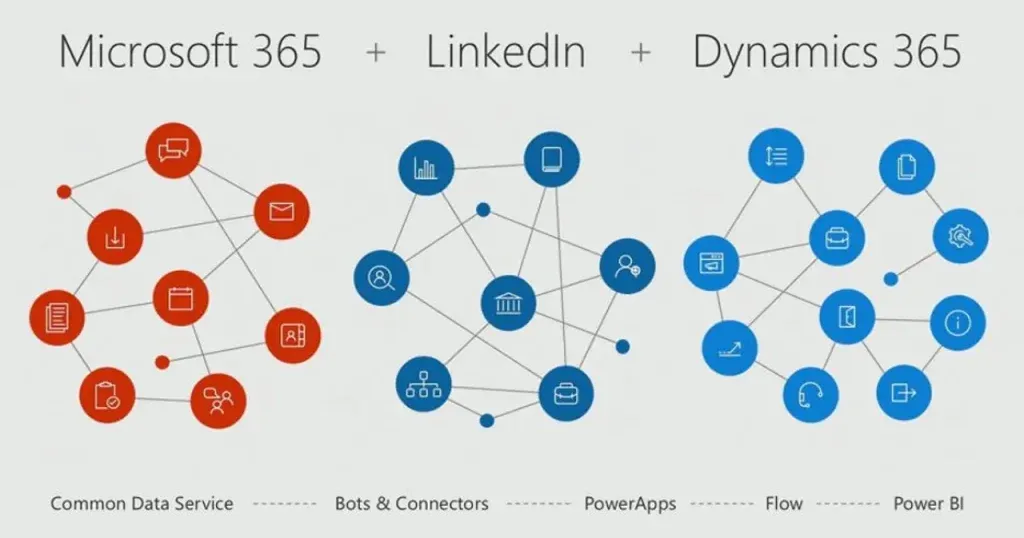
This segment, generating $29.9 billion in Q3 FY25, encompasses:
- Microsoft 365 Commercial: Revenue grew 12%, driven by a 7% increase in paid seats and higher revenue per user, aided by the adoption of Microsoft 365 Copilot.
- Microsoft 365 Consumer: Revenue increased 10%, with subscriber growth of 9% to 87.7 million, bolstered by a January price increase.
- LinkedIn: Revenue rose 7%, reflecting growth across all business lines despite a challenging hiring market.
- Dynamics 365: Revenue increased 16%, demonstrating strong demand for cloud-based business applications.
We are all familiar with how dominant Microsoft 365 is. Excel, Word, PowerPoint, Outlook, Access are all effectively synonymous with enterprise software on a global level. While LinkedIn is just as well-known as the rest, the success of the acquisition is very underappreciated.
A Transformative Acquisition
Microsoft’s acquisition of LinkedIn for $26.2 billion in 2016 stands as one of the most strategically successful tech deals of the past decade. Initially met with skepticism due to its high price tag, the acquisition has since proven to be a significant driver of growth and value for Microsoft.

In June 2016, Microsoft announced its intention to acquire LinkedIn for $196 per share, totaling $26.2 billion in an all-cash transaction.
At the time, this was Microsoft’s largest acquisition, aimed at integrating LinkedIn’s professional network with Microsoft’s productivity tools.
LinkedIn’s Growth Trajectory
Since the acquisition, LinkedIn has experienced substantial growth:
- Revenue Expansion: LinkedIn’s revenue has grown from approximately $2.3 billion in 2017 to $17.4 billion in the trailing twelve months as of Q3 FY25.
- User Base: The platform’s membership has surpassed 1.2 billion users, reflecting its global reach and relevance.
- Premium Subscriptions: Premium subscription revenue exceeded $2 billion in the past year, indicating strong demand for enhanced services.
Strategic Integration and Synergies
The acquisition has enabled Microsoft to integrate LinkedIn’s capabilities across its product ecosystem:
- Microsoft 365: LinkedIn data enhances Microsoft 365 applications by providing users with contextual information, improving productivity and collaboration.
- Dynamics 365: Integration with LinkedIn’s Sales Navigator enriches customer relationship management by offering deeper insights into prospects and clients.
- Azure: LinkedIn’s infrastructure benefits from Azure’s cloud services, ensuring scalability and reliability.
Microsoft’s acquisition of LinkedIn has not only paid off financially but has also strategically positioned the company at the intersection of professional networking and enterprise productivity. The integration has created a robust platform that continues to drive value across Microsoft’s suite of services.
This acquisition underscores the brilliance of CEO Satya Nadella and investors should not expect anything different going forward.
Windows, Search, and Gaming; The More Personal Computing Business Segment
This segment achieved $13.4 billion in revenue, up 6% year-over-year. Key components include:
- Windows OEM and Devices: Revenue increased 3%, reflecting steady demand despite market uncertainties.
- Search and News Advertising: Revenue excluding traffic acquisition costs grew 21%, driven by higher revenue per search and increased search volume.
- Gaming: Revenue rose 5%, with Xbox content and services revenue up 8%, highlighting the success of titles like Call of Duty and Minecraft.

The segment’s operating income increased 21%, demonstrating efficient cost management and strong demand across its offerings.
Minecraft: A Timeless, Expanding Platform
Much like LinkedIn, Microsoft made a strategic acquisition of Mojang, the studio behind Minecraft, for $2.5 billion in 2014.
This was one of the earliest signs of the company’s growing conviction in the long-term potential of gaming, not just as entertainment, but as a platform for education, creativity, and digital economies. A decade later, that bet has proven prescient.

Minecraft is not just the best-selling video game of all time, with over 300 million copies sold, it’s a cultural and generational phenomenon.
Its open-ended, sandbox-style gameplay has made it a staple in classrooms, a canvas for digital creators, and a gateway into game development and virtual collaboration.
Since being acquired by Microsoft, Minecraft has been:
- Integrated into the Microsoft ecosystem via Azure for multiplayer infrastructure and through educational editions linked to Microsoft 365.
- Used to showcase AI and Copilot tools for code generation, game asset creation, and content moderation.
- The foundation for new monetization models including marketplaces for creators, subscriptions, and realms hosting services.
The Next Evolution of Gaming
AI is poised to reshape how video games are built, played, and monetized, and Microsoft is at the center of this evolution.
- Game development: AI copilots can assist developers in generating game worlds, characters, dialogue, and code at unprecedented speed. For platforms like Minecraft, this means endless content creation—driven by users or AI agents.
- Player experience: AI-driven NPCs, personalized difficulty tuning, and dynamic storytelling will make games more immersive and adaptive.
- Modding and Creator economies: AI democratizes modding—letting anyone build with natural language. Microsoft’s ownership of Minecraft and Roblox-like environments positions it to benefit from this trend.
Cross-platform integration: AI tools embedded in Xbox, Windows, and Game Pass will help onboard, retain, and upsell players.
Strategic Value to Microsoft
Microsoft’s gaming division, particularly with its $68.7 billion acquisition of Activision Blizzard and its stewardship of platforms like Minecraft, is no longer just a consumer product unit.

It is a strategic pillar of Microsoft’s broader ambitions in:
- AI experimentation at scale
- Creator economies and digital goods
- Cloud services via Xbox Cloud Gaming and Azure
Gaming is expected to surpass $300 billion in global revenue by 2030, and Microsoft has arguably the most diversified, future-proof portfolio to lead this shift.
With AI amplifying the value of its gaming IPs, especially timeless, open platforms like Minecraft, Microsoft is not just playing games. It’s shaping the next era of interactive computing.
Intelligent Cloud
The intelligent cloud is the brain behind Microsoft, and likely the most covered business segment due to the extraordinary growth and future potential.
The segment reported $26.8 billion in revenue for Q3 FY25, a 21% increase year-over-year.
Azure’s revenue grew 33%, with AI services contributing significantly. The segment’s operating income rose 17%, underscoring the profitability of Microsoft’s cloud offerings.

While there is more to talk about here, we’ve intertwined the value this cloud segment brings to Microsoft throughout the writing. To learn more, check out Microsoft’s Intelligent Data Platform. We will now divert our focus to the core question: Is Microsoft a Good Stock to Buy?
FY25 Q3 Earnings (Reported April 30, 2025) Highlights
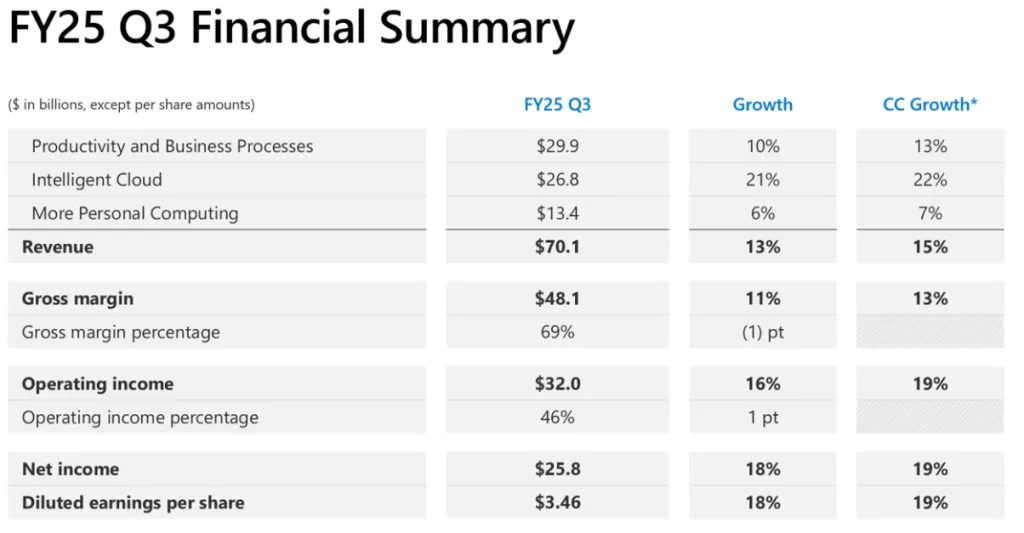
In Q3 FY25, Microsoft reported revenue of $70.1 billion, marking a 13% year-over-year increase. Net income rose to $25.8 billion, up 18%, with earnings per share at $3.46. Key drivers included:
- Intelligent Cloud: Revenue grew 21% to $26.8 billion, driven by Azure’s 33% growth, including 16 points from AI services.
- Productivity and Business Processes: Revenue increased 10% to $29.9 billion, with Microsoft 365 Commercial cloud revenue up 12% and LinkedIn revenue up 7%.
- More Personal Computing: Revenue rose 6% to $13.4 billion, with Search and news advertising revenue increasing 21% and Gaming revenue up 5%.
Valuation and Analyst Expectations
As of Mid-2025, Microsoft’s stock trades at approximately 32 times forward earnings, reflecting investor confidence in its growth prospects, particularly in AI and cloud computing.
Analysts project continued revenue growth, with expectations of reaching $548 per share by end of 2025, indicating a 31% increase from current levels.
The Northwise Take
We do not see these expectations as unreasonable. Furthermore, it is abundantly clear to us at Northwise that Microsoft is likely here to stay due to their strategic web of investments.
Not only do they have so many things going on, nearly all of their endeavors alone are big enough to be (highly profitable) members of the S&P 500. Note: we never even mentioned GitHub, Bing, Nuance, and so on, which are all part of Microsoft’s ecosystem. The ecosystem is insane.
Microsoft’s diversified business model, strong financial performance, and strategic investments in AI and cloud computing make it a compelling investment opportunity.
The company’s consistent revenue growth, robust margins, and commitment to innovation position it well for long-term success. Investors seeking exposure to a resilient and forward-looking technology leader should consider Microsoft as a valuable addition to their portfolios.
When asking the question “Is Microsoft a Good Stock to Buy?” it is important as an investor to determine if you think the expectations are reasonable, and if so, you must also consider if the potential upside justifies the risk.

Celsius Stock Analysis: The Shelf Reset and the Second Growth Curve
Celsius stock analysis of the shelf reset, Alani growth, Pepsi economics and cash flow, with a 2030 model and a Premium valuation and entry-price framework.

Meta AI Spending: The Customer Is Already Here
Can Meta turn AI spending into shareholder returns? We model advertising, Muse, hardware, capital costs and cash flow through 2030, with a full valuation.

IREN Stock Dilution: Can the Build Reach Shareholders?
IREN stock analysis of AI growth, funding and dilution through 2030. Read our full valuation, 27 scenarios and price zones free. Excel model is Premium.
Northwise Portfolios
See how the research becomes real decisions
Reader discussion
Discuss the research
Create a Free account to join the discussion with a display name.
Create a Free Account
No comments yet. Start a thoughtful discussion.