
NVDA Stock Forecast 2030
NVDA Stock Forecast 2030 explores infrastructure dominance, valuation upside, and why its $3T+ market cap may still be undervalued.
In this article
NVIDIA Deep Dive: From Graphics to Global Infrastructure
A long-view thesis on how NVIDIA became the substrate of modern compute, and why its valuation may still understate the scale of what it is building.
From Silicon to Substrate
NVIDIA’s market cap just crossed 3.2 trillion dollars. The numbers are historic, but they don’t tell the full story. We will in our NVDA stock forecast 2030.
This isn’t a company that stumbled into AI at the right time. It is a company that spent decades building the foundation beneath it. One layer at a time, often in the background, often ahead of demand.
What started as a gaming chipmaker is now the core infrastructure provider for a new kind of intelligence. Not infrastructure in the industrial sense, but the physical and digital substrate that powers training, inference, simulation, and intelligent systems.
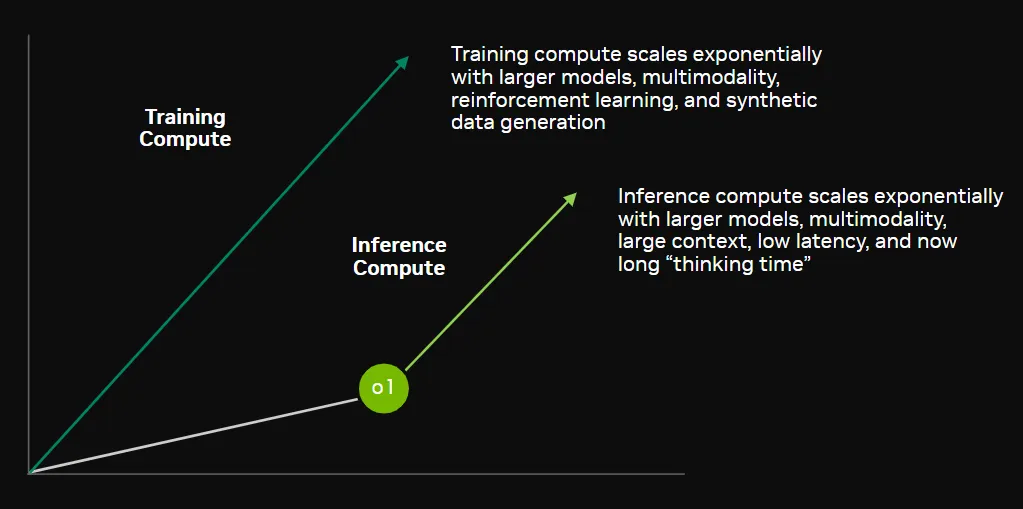
In 2025, NVIDIA sits at the center of the most important arms race in technology: the exponential scaling of compute. Intelligence is no longer built line by line. It is trained, refined, and deployed through models that demand extraordinary hardware and deeply integrated systems.
NVIDIA did not just anticipate this shift. It built for it.
To understand the company’s position today, and why we believe it remains misunderstood, we need to go back. Not to the headlines. To the architecture. To the decisions that set all of this in motion.
The Birth of a Category
In 1993, Jensen Huang co-founded NVIDIA with a vision that was specific but underestimated.
The goal was to accelerate graphics for personal computing, primarily for gaming.
At the time, the market for high-performance 3D graphics was niche. It would not remain that way.
The launch of the RIVA 128 in 1997 marked NVIDIA’s arrival, but it was the GeForce 256 in 1999 that changed the game. NVIDIA labeled it the world’s first GPU. More than marketing, it was a true architectural step forward. Fixed-function graphics pipelines gave way to programmable shading. That shift laid the groundwork for general-purpose compute, though few recognized it then.
Through the early 2000s, NVIDIA leaned into scale. The company survived brutal semiconductor cycles, outmaneuvered rivals like 3dfx, and out-executed ATI in both performance and branding. But the pivotal inflection point did not come from games. It came from physics.
In 2006, NVIDIA introduced CUDA: Compute Unified Device Architecture. It allowed developers to write code for GPUs using C. This was more than a software toolkit. It was a shift in how hardware could be used. Suddenly, the GPU was not just a graphics engine. It was a parallel compute machine.
Academic researchers were early adopters. So were quantitative hedge funds and biotech labs. The software was rough around the edges, but the potential was obvious to those who understood how compute bottlenecks were changing. AI researchers were among them, though it would take a few more years before deep learning and GPU acceleration collided at scale.
NVIDIA kept building. Kepler, Maxwell, Pascal. Each new generation improved performance and efficiency, but it also refined the programming model. CUDA matured. Developer momentum grew. By the time the AI community arrived in full force, NVIDIA had already built the tools.
When AlexNet won the ImageNet competition in 2012, it did so by training on GPUs. It was not an accident. It was the outcome of more than a decade of architectural groundwork.
By then, NVIDIA had quietly transitioned from a gaming company into something much harder to categorize. The market still saw graphics. The company had already moved on to infrastructure.
And it was just getting started.
From Graphics to AI Infrastructure
The early success of AlexNet was the spark, but the fuel had already been stacked. As researchers scaled neural networks, NVIDIA’s GPUs offered unmatched parallelism. TensorFlow and PyTorch, both emerging as dominant AI frameworks, were designed to work best on CUDA.
This convergence wasn’t accidental. NVIDIA’s developer relations, tooling ecosystem, and hardware-software integration had quietly made it the de facto standard. A model trained on anything else risked inefficiencies that researchers and practitioners couldn’t afford.
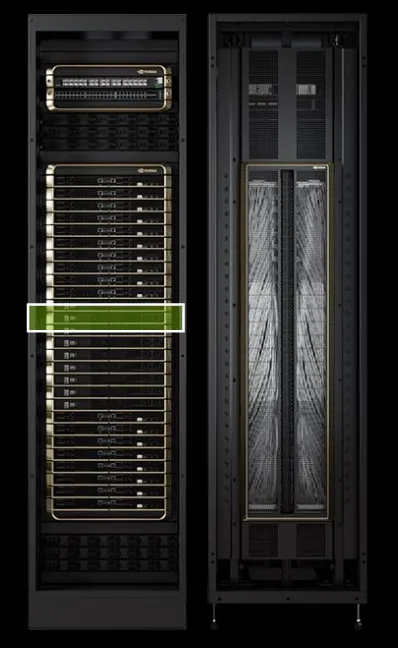
As interest in deep learning accelerated, NVIDIA began designing chips specifically for these workloads.
The introduction of Tensor Cores in the Volta architecture marked another inflection point.
Suddenly, the GPU was optimized not just for graphics and general compute, but for the matrix math at the heart of deep learning.
Volta, then Turing, then Ampere. Each generation layered more AI-specific performance, and each generation deepened the software stack.
Developers had better compilers, more advanced libraries, and deeper access to tools like cuDNN and TensorRT.
The company was not just shipping chips. It was standardizing how modern AI was built.
The Mellanox acquisition in 2020 further extended this strategy. NVIDIA was no longer just producing accelerators. It was building full data center systems, from silicon to interconnect to software. With InfiniBand and NVLink, NVIDIA could now shape how clusters communicated, not just how fast they could compute.
This vertical integration was a key step. It moved the company from component supplier to infrastructure provider. In retrospect, this is when NVIDIA stopped competing with other chipmakers and began competing with time.
By 2021, NVIDIA was already powering the most important training runs in the world. From OpenAI to Meta to countless sovereign AI labs, the path to performance ran through NVIDIA’s stack.
That was before Hopper. Before Blackwell. Before the explosion of generative models.
What had started as a graphics company had become something else entirely.
It had become the substrate.
NVIDIA’s Product Ecosystem (2025–2026)
NVIDIA’s ecosystem today reflects a company operating far beyond the identity of a chip designer. What it offers is an integrated, multi-layer platform that enables and monetizes every stage of the AI lifecycle: from raw compute to orchestration, deployment, and continuous retraining. Each layer is engineered to reinforce the next.
At the core sits the hardware. The Hopper architecture (H100) and Grace Hopper Superchip (GH200) dominate the current generation of training and inference at scale. These chips are now joined by the first deployments of the Blackwell line (B100 and B200), designed to meet the demands of trillion-parameter models and low-latency inference.
Blackwell’s architecture introduces second-generation Transformer Engine optimizations and supports a massive increase in memory bandwidth. Coupled with NVLink and NVSwitch, these components form the backbone of NVIDIA’s DGX systems, powering dense clusters used by Meta, Microsoft, and OpenAI.
Beyond the silicon, NVIDIA’s software stack remains its most underappreciated moat. CUDA has matured into a developer standard, while cuDNN and TensorRT offer plug-and-play acceleration for deep learning primitives.
Triton Inference Server, Modulus for physics-informed models, and NeMo for LLM training are examples of how NVIDIA owns not just the pipeline, but the tools that shape what gets built inside it.
DGX Cloud and NVIDIA AI Enterprise now offer these tools as a SaaS layer, providing hyperscalers and large enterprises with managed infrastructure and APIs. Whether training multi-modal foundation models or deploying custom inference endpoints, NVIDIA monetizes the workload.
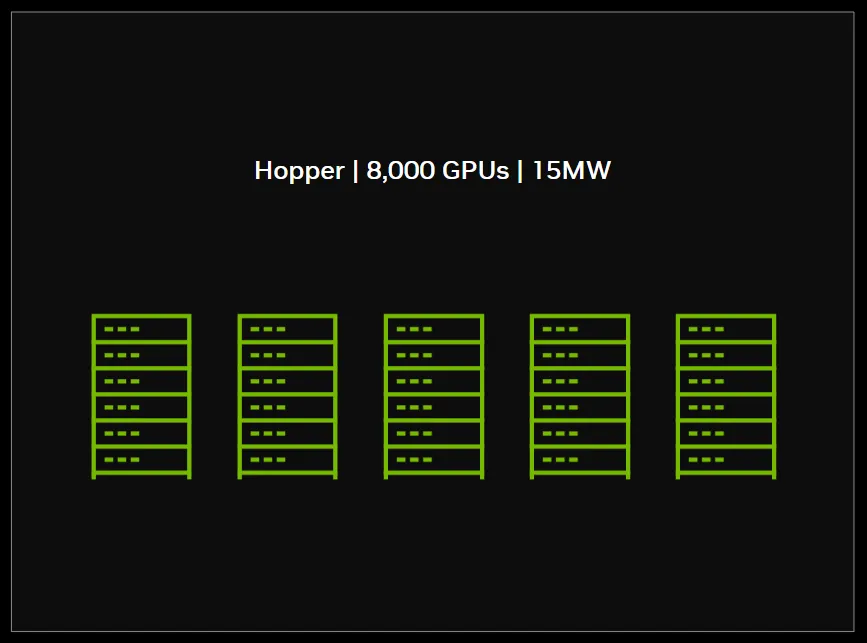
In networking, the 2020 Mellanox acquisition continues to pay dividends. InfiniBand and Ethernet solutions enable the low-latency data movement essential to multi-GPU compute clusters. BlueField DPUs, meanwhile, extend NVIDIA’s reach into programmable network security and infrastructure offload.
And at the edge, Jetson modules and DRIVE Orin power robotics, industrial automation, and autonomous vehicles. The Isaac platform integrates simulation and deployment, while DRIVE Thor is built for high-bandwidth, real-time inference in mission-critical environments like AV fleets.
This is no longer a company that builds chips. It builds full-stack AI infrastructure, from datacenter to edge. And in doing so, it continues to deepen its lock-in across industries.
Product Roadmap and Competitive Timelines
NVIDIA’s forward roadmap signals one thing clearly: this company is not standing still. Blackwell represents the high-volume product of 2025. Rubin, its next major architecture, is slated for release in the second half of 2026. Rubin Ultra, already confirmed, is targeted for 2027. These are not speculative launches. They are already in motion.
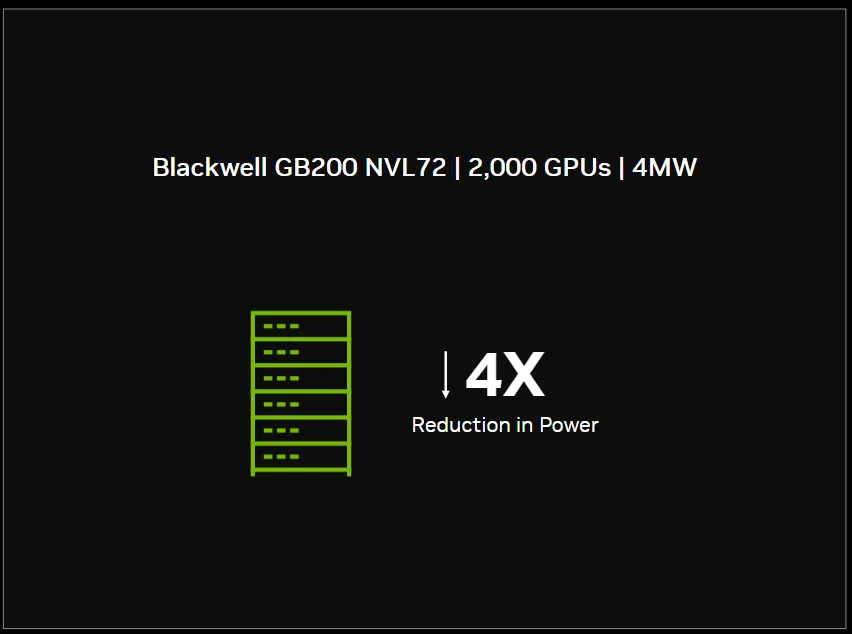
Blackwell’s rollout is being absorbed rapidly across hyperscalers and sovereign deployments. Its design focus leans on more than performance. It emphasizes energy efficiency, sparsity-aware training, and increased scalability in AI factories.
In parallel, AMD is moving quickly. MI300 is shipping into Meta and Microsoft. MI350, based on CDNA 4 and offering 288GB HBM3E, is expected mid-2025. MI400, targeting 2026, will leverage 3nm chiplets and even deeper memory hierarchies.
Intel’s Gaudi 3 enters the market in late 2025 with updated interconnects and support for generative AI workloads. Falcon Shores, its once-hyped hybrid platform, has been delayed beyond 2026.
Despite competition, NVIDIA retains key advantages. No other player combines general-purpose compute, AI-specific accelerators, deep learning software libraries, and end-to-end orchestration at this scale. Competitors are improving, but they are still patching together what NVIDIA has had integrated for nearly a decade.
Where others design chips, NVIDIA designs systems. And it does so on a cadence that continues to lead the market.
The Explosion of Compute
The acceleration of compute demand in AI is no longer linear. It is exponential and recursive. Models grow in scale, and with them, the datasets, training time, and infrastructure requirements compound. We are witnessing a transition from petascale to exascale to zettascale training clusters in real time.
This growth is not purely academic. It has economic implications. Inference costs are becoming the bottleneck in production AI systems, and developers are optimizing not just for accuracy, but for throughput and cost-efficiency at scale. NVIDIA is building systems for this reality, not for yesterday’s metrics.
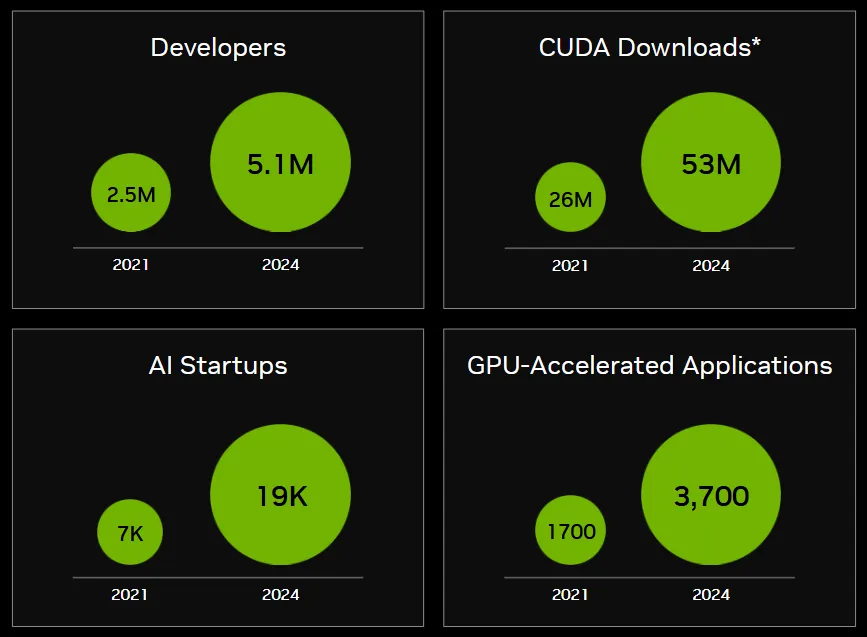
With the Blackwell platform and DGX Cloud deployments, NVIDIA is powering real-time learning systems that adapt, retrain, and self-optimize in production. This is no longer about static models. It is about living infrastructure. Every layer of NVIDIA’s stack,from the Transformer Engine to NeMo frameworks to NIM deployment APIs,is designed to compress this loop and accelerate iteration.
The complexity is now beyond the capacity of most enterprises to manage internally. That is why NVIDIA’s full-stack approach is so critical. It is not just about performance. It is about orchestration, reliability, and speed to deployment in a world where delays cost billions.
The compute curve is breaking. And NVIDIA is not trying to keep up. It is pulling the curve forward.
AMD and the Battle for AI Compute
AMD’s recent rise in the data center has been both real and overdue. MI300 is a legitimate product. MI350 will improve further. And MI400 is shaping up to be a credible next-generation response. AMD is executing well across multiple fronts, particularly in price-to-performance and memory bandwidth.

Where AMD shines is in design flexibility and memory architecture. With advanced packaging and chiplet scalability, AMD can offer dense compute at relatively lower power and cost per unit.
But beyond that, AMD’s open approach to its ecosystem stands in contrast to NVIDIA’s tightly integrated model.
While NVIDIA’s stack is deeper, AMD’s flexibility allows customers to avoid vendor lock-in and tailor deployments to specific needs. This is an increasingly attractive value proposition for hyperscalers looking to balance performance with optionality.
Moreover, AMD is showing early leadership in inference. As the AI market matures, inference workloads are expected to dwarf training workloads in volume and economic impact. AMD’s focus on efficient inference acceleration could give it disproportionate leverage in this emerging growth segment.
The competitive narrative should not be framed as a zero-sum game. The total addressable market for AI compute is expanding at an extraordinary pace. There is room for multiple giants. AMD’s success does not undercut the NVIDIA thesis. It reinforces the scale of the opportunity. In a market defined by abundance and acceleration, NVIDIA and AMD are not necessarily cannibalizing each other. They are co-architecting the next generation of infrastructure.
Custom Silicon and Vertical Threats
NVIDIA’s largest customers are now also its largest potential threats. Amazon, Google, Meta, and Microsoft are all investing heavily in custom silicon to reduce their dependence on NVIDIA. These chips, AWS Trainium and Inferentia, Google TPU, Meta MTIA, are optimized for internal workloads.
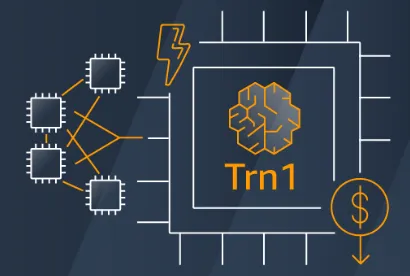
They are improving. They are cheaper. But they are also narrow. Most are focused on inference, not training. Most cannot match the flexibility or software support NVIDIA offers. And most rely on NVIDIA’s ecosystem at some point in the development cycle.
The risk is not that these alternatives will outperform. It is that they will fragment demand, limit pricing power, or replace NVIDIA in specific verticals. But so far, these efforts have reinforced the value of a unified platform. Customers building their own chips are also learning how hard it is to match NVIDIA’s full-stack execution.
Intel’s Gaudi 3 may become a value competitor. But it is still late to market, under-adopted, and trailing in ecosystem support. Falcon Shores, once seen as a wild card, is now delayed beyond 2026. The field remains open, but the barriers are high.
NVIDIA’s response has not been to slow down. It has been to out-integrate. While others try to displace one part of the stack, NVIDIA continues to absorb more of it.
Financial Architecture
NVIDIA’s fiscal year 2025 results challenge long-held ideas about how large companies should be valued.
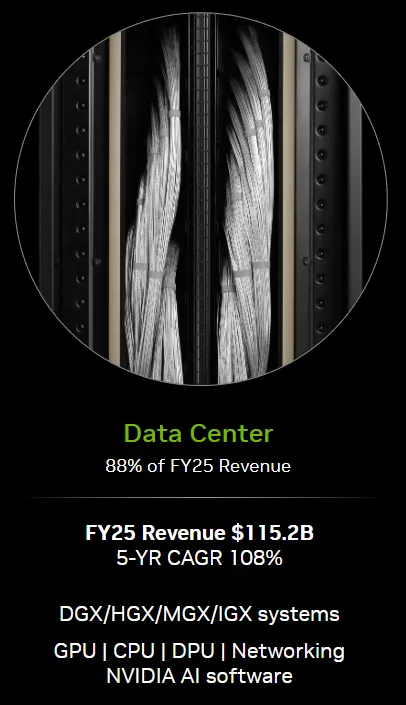
Despite surpassing a 3.2 trillion dollar market cap, the company is growing faster, earning more, and generating cash at a scale that breaks historical comps.
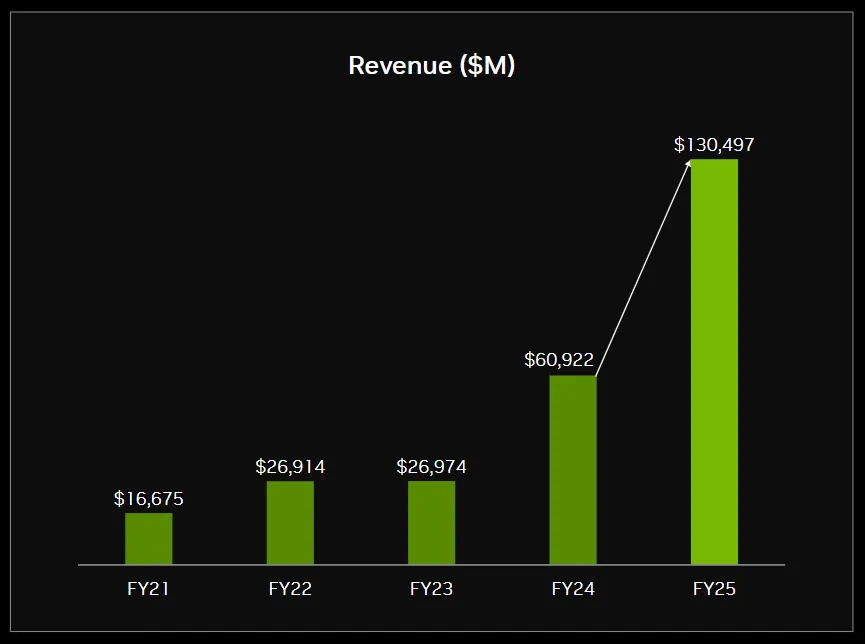
Some key figures from FY2025:
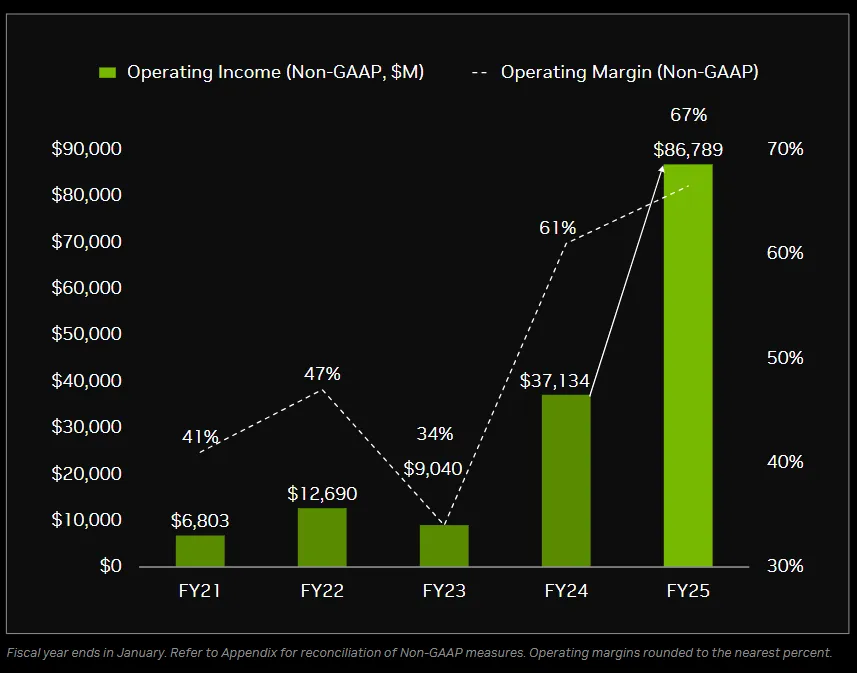
- Total revenue: $130.5 billion, more than double the previous year
- Q4 Data Center revenue: $35.6 billion, up 93 percent year-over-year
- GAAP net income: $72.9 billion, up 145 percent year-over-year
- Gross margin: 75.0 percent, despite scaling volume
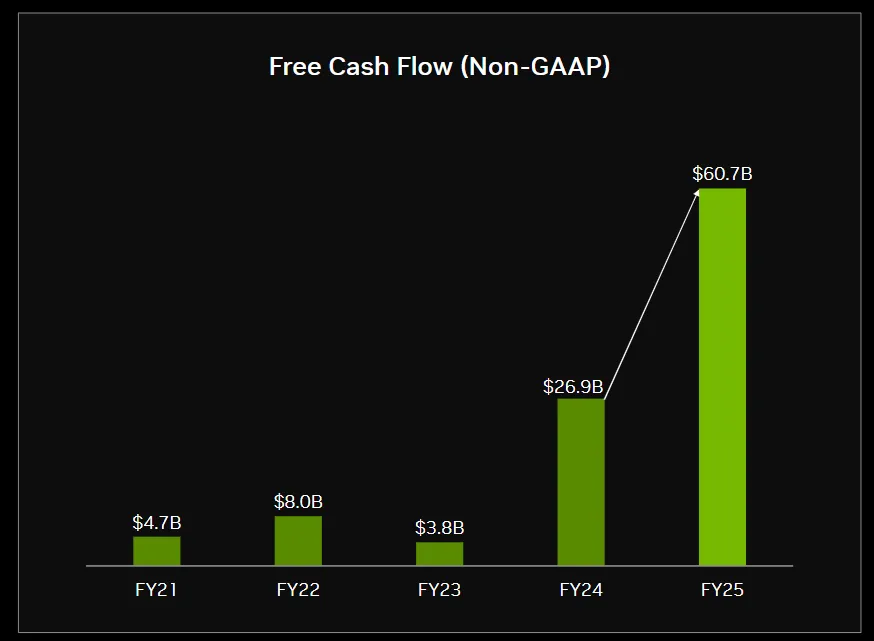
- Free cash flow: $60.85 billion, a 125 percent year-over-year increase
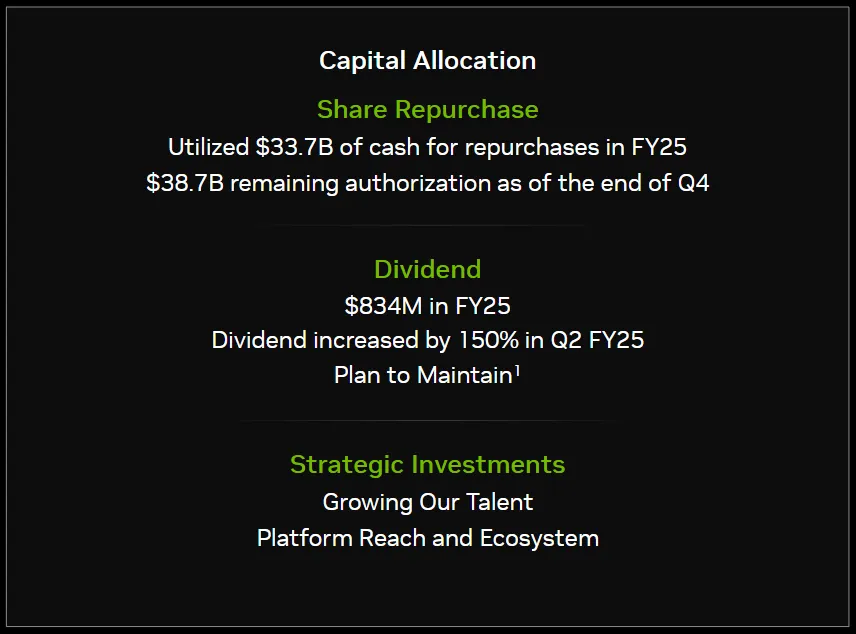
- Cash returned: $33.7 billion in buybacks and $834 million in dividends
- Cash on balance sheet: $43.2 billion
Traditional valuation metrics fall short here. NVIDIA is trading at approximately:
- 45x trailing earnings
- 31x forward earnings
- PEG ratio: approximately 0.68, signaling undervaluation relative to earnings growth
This is not just rare. It is unprecedented.
NVIDIA is demonstrating that a company can be massive, dominant, and still operate with the velocity and efficiency of a startup.
Its financials are not an outlier. They are a signal of structural transformation.
Rather than being priced for perfection, NVIDIA is arguably still trading below a fair multiple when adjusting for free cash flow, durable growth, and capital efficiency.
This is a company creating operating leverage from both hardware and software, growing into a role that has more in common with national infrastructure than legacy semiconductors.
In a market where many companies trade on speculation, NVIDIA continues to deliver execution and earnings power at a scale that remains difficult to fully model. It is, in effect, breaking how we historically conceive of value.
We are entering territory where conventional valuation frameworks no longer apply. There has never been a company that produces over 60 billion dollars in free cash flow, grows triple digits in enterprise segments, and operates with margins north of 75 percent while being central to a multi-decade infrastructure shift. That combination of scale, velocity, and importance has simply never existed before.
Valuing NVIDIA purely on a multiple of current earnings misses what it is becoming. The company is no longer just a business. It is a computational layer beneath a global transition. The market is only beginning to understand how to price that.
Risks and Reassessment Triggers
Every dominant platform carries inherent risks. For NVIDIA, the most obvious is regulatory. With dominance comes scrutiny, particularly around pricing, bundling, and fair access to critical infrastructure.
Export controls are another flashpoint. Restrictions on advanced GPU sales to China, the Middle East, or other strategic markets could impact short-term revenue and long-term growth. NVIDIA has responded with compliant alternatives, but geopolitical pressure remains a wildcard.
Customer concentration also poses risk. Should a hyperscaler defect to an internal stack or an open-source alternative reach escape velocity, demand patterns could shift rapidly. So far, there are few signs of that happening at meaningful scale.
The most important risk to monitor is developer mindshare. If CUDA or the NVIDIA software stack begins to lose traction with AI developers, the moat could erode over time. Today, there is no evidence of that. But the moment that changes, our thesis would need to be revisited.
The Real Wager
This is not a bet that NVIDIA is more than a chip company. That idea has already been absorbed by the market.
This is a wager that NVIDIA is becoming the substrate of the next era of digital life. An era defined not by software, but by systems that learn, reason, simulate, and act.
What oil was to the industrial age, compute will be to the AI age. NVIDIA is building the infrastructure to mine, transport, refine, and distribute it.
In that world, it is not just a supplier. It is the platform.
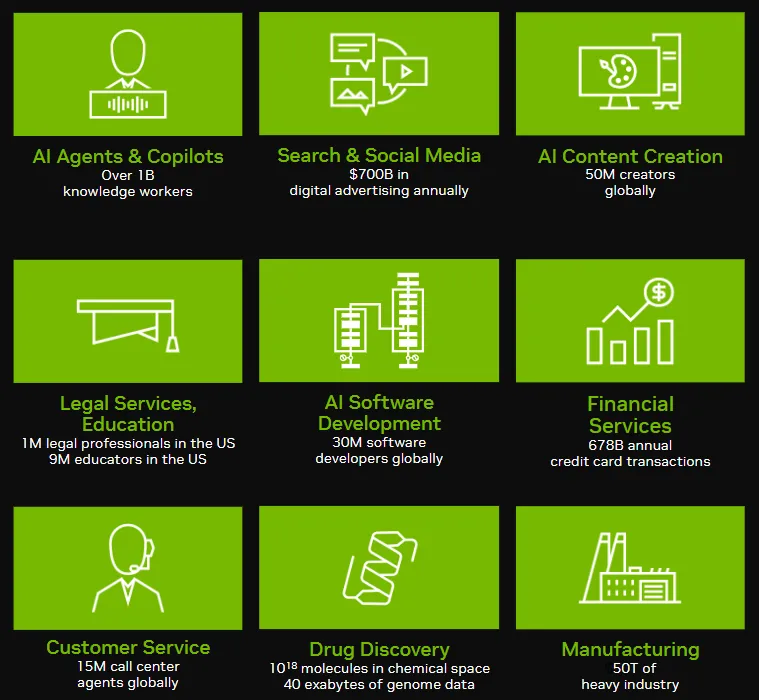
From a financial perspective, the upside remains significant. If NVIDIA were to grow revenue at a 25 percent compound annual rate over the next five years, a conservative assumption relative to its recent trajectory, it would exceed 400 billion dollars in annual revenue by 2030. If free cash flow margins hold between 45 and 50 percent, that would imply over 180 billion dollars in annual free cash flow.
Even applying a conservative 35 times free cash flow multiple, NVIDIA could warrant a valuation above 6 trillion dollars. At a higher multiple of 45 to 50, still defensible based on growth, margin durability, and infrastructure centrality, its valuation could stretch toward 8 or even 9 trillion dollars.
This is not a forecast. It is a lens through which to understand the scale and shape of what NVIDIA is becoming. Its combination of growth, profitability, and entrenchment is so rare that historical models struggle to capture it.
The upside case is not about momentum. It is about foundational positioning and unmatched leverage in a compute-constrained world.
The World is Changing and Nvidia is Building It
The future of compute is not incremental. It is exponential. And in that future, NVIDIA is not adapting to the curve. It is bending it.
This company is not just positioned to benefit from the next wave of AI. It is engineering the environment that makes that wave possible.
As intelligence becomes embedded in everything, from cloud systems to edge devices to autonomous machines, NVIDIA’s fingerprints will be everywhere. It is building not just the products of tomorrow, but the systems those products will rely on.
We believe NVIDIA is still misunderstood, not because its dominance is invisible, but because the market has not yet adjusted its mental models to account for this level of embeddedness, durability, and cash generation.
It is not just a story about growth or margins or technology. It is a story about foundational relevance in a world that will be increasingly defined by the scale and speed of computation.
The thesis is simple. The terrain is changing. And NVIDIA is laying the rails.
NVDA vs AMD
NVDA vs AMD explained through NVIDIA’s AI factory strategy, showing how system-level design matters as GPU performance gaps narrow.

Celsius Stock Analysis: The Shelf Reset and the Second Growth Curve
Celsius stock analysis of the shelf reset, Alani growth, Pepsi economics and cash flow, with a 2030 model and a Premium valuation and entry-price framework.

Meta AI Spending: The Customer Is Already Here
Can Meta turn AI spending into shareholder returns? We model advertising, Muse, hardware, capital costs and cash flow through 2030, with a full valuation.
Northwise Portfolios
See how the research becomes real decisions
Reader discussion
Discuss the research
Create a Free account to join the discussion with a display name.
Create a Free Account
No comments yet. Start a thoughtful discussion.