
AMD Stock Prediction 2025

Amd stock prediction 2025: We explore why AMD is more than a catch-up story—it's a misunderstood AI infrastructure play with long-term potential.
In this article
AMD Stock Prediction 2025: Why We Are Long Advanced Micro Devices
Leaning into leadership, leverage, and long-term edge in an AI-fueled world.
Why This AMD Stock Prediction Matters Now
There was a time when AMD was the punchline. For a generation of retail investors, the ticker symbol $AMD translated (half-jokingly, half-defeatedly) into “Advanced Money Destroyer.” That nickname was born from whiplash volatility, margin erosion, and years of feeling like the underdog.
But we think that narrative has expired.
This isn’t just about AMD catching up to Nvidia. It’s about AMD executing in a quieter, more scalable direction, especially in inference workloads, adaptive compute, and edge AI applications.

In an environment where most AI stock predictions center around training throughput and market flash, AMD is quietly building infrastructure that scales alongside demand.
And while most analysts’ AMD stock prediction 2025 are fixated on price targets and quarterly noise, ours is rooted in structural positioning and conviction. This isn’t about hype cycles or sentiment swings.
It’s about understanding the long-term drivers of compute demand and identifying where the market may be misreading business fundamentals. In our view, AMD’s runway is much longer than many investors are currently pricing in.
The Market’s View of AMD in 2025
Ask a mainstream analyst about AMD and you’ll likely hear a few familiar refrains: “they’re too far behind Nvidia,” “margin pressures will return,” “Intel is stabilizing.”
But these takes rarely move past the surface.
AMD’s valuation metrics are still weighed down by skepticism. Its stock doesn’t carry the narrative premium of Nvidia or the deep-income floor of a legacy player. And that’s exactly where opportunity can live.
This prediction is not about a short-term earnings beat. It’s about AMD’s emerging position as one of the few firms capable of delivering AI hardware outside of Nvidia’s vertical stack.
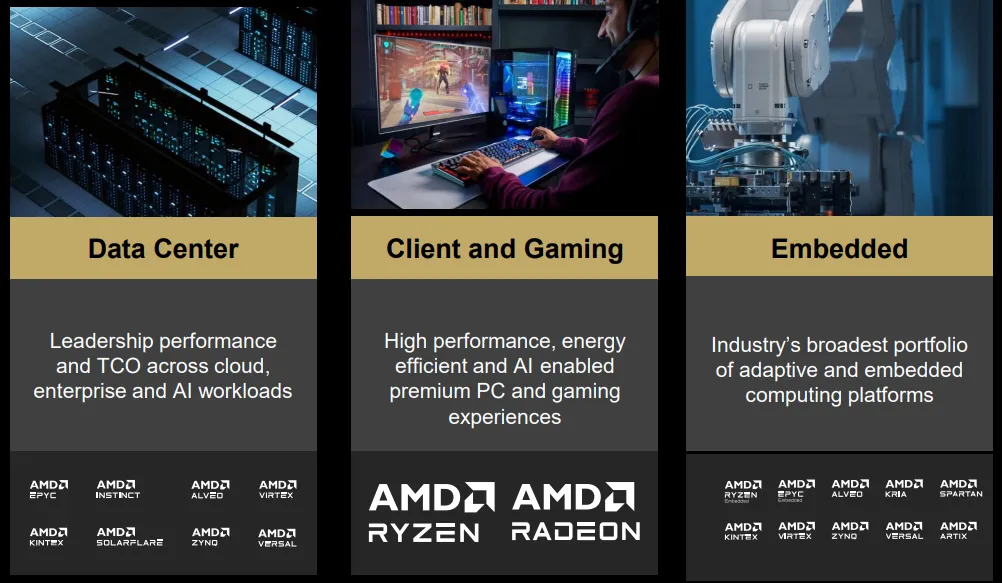
When you evaluate AMD’s strategy across data center workloads, embedded computing, and AI-adjacent applications, it becomes clear that the company isn’t playing catch-up; it’s carving out a parallel path.
More recently, that path has been tested by renewed geopolitical risk. In April 2025, the U.S. government imposed fresh export restrictions on advanced AI chips, including AMD’s upcoming MI308 series, targeted at China.
These controls, meant to limit Chinese military access to cutting-edge compute, have triggered an $800 million charge on AMD’s books related to inventory and purchase commitments.
China represented over 24% of AMD’s revenue in 2024. That’s not a small hit. But rather than derail the thesis, it sharpens it. We believe AMD’s diversification beyond training chips (into inference, edge computing, and embedded markets) puts it in a stronger position than some headline-grabbing competitors to weather these policy shifts.
As the market grapples with geopolitical crosswinds, we believe the long-term story remains intact, and mispricing persists. across data center workloads, embedded computing, and AI-adjacent applications, it becomes clear that the company isn’t playing catch-up; it’s carving out a parallel path.
Valuation Misunderstood: The Xilinx Distortion
A major reason AMD appears overvalued on traditional metrics? Its 2022 all-stock acquisition of Xilinx.
The purchase was strategically sound, expanding AMD’s capabilities in FPGAs, adaptive compute, and edge applications. But from an accounting perspective, it introduced billions in non-cash amortization and purchase-related intangibles, which suppressed GAAP earnings and inflated PE ratios.
This has led to headlines calling AMD “expensive” or “overhyped”, even as non-GAAP earnings reveal a very different story. On an adjusted basis, AMD has been trading at a normalized 20–30x forward earnings (now 18x forward earnings), in line with quality peers in the semi space.
The irony? Xilinx might end up being the thing that justifies a higher multiple long-term. Its technology opens up markets AMD had never meaningfully participated in before: aerospace, industrial, automotive compute, and embedded edge systems. These are durable, often high-margin verticals that diversify AMD’s revenue base.
What Sets AMD Apart in 2025
While Nvidia continues to dominate AI training infrastructure, AMD is positioning for the next frontier: AI inference at scale.
Its new MI300X chips offer:
- 30% more FP8 compute
- 60% more memory bandwidth
- Over 2x memory capacity compared to Nvidia’s H100
This matters. As models move from development to deployment, inference speed, memory capacity, and power efficiency become the battleground. AMD is building exactly for that transition.
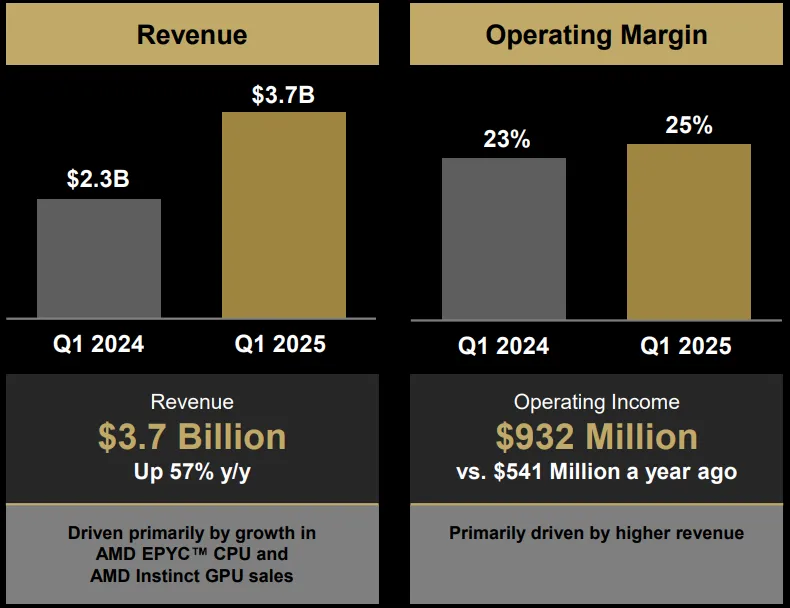
AMD Data Center Figures
Add in the Xilinx + Pensando integrations and you get a platform play: one that stretches from the cloud to the edge. That kind of range isn’t speculative. Combined with AMD’s disciplined execution, it represents an infrastructure stack optimized for real-world deployment, not just benchmark headlines.
This positioning gives AMD a multi-dimensional edge: competitive hardware, strategic acquisitions, and cross-sector relevance. And unlike some AI stories that are purely narrative-driven, AMD’s progress can be tracked through real wins and product rollouts.
Lisa Su: The Architect Behind the Turnaround
No discussion of AMD’s ascent would be complete without mentioning Dr. Lisa Su. Appointed CEO in 2014, Su didn’t just stabilize AMD, she redefined what the company was capable of. Under her leadership, AMD has grown from a balance sheet liability into a serious operator across high-performance computing, graphics, and now AI infrastructure.

She took AMD from an existential survival story to a deliberate, long-term compounder. Her approach has consistently favored strategic execution over promotional noise, and that’s part of what gives us confidence in the company’s direction through 2025 and beyond.
Su’s ability to integrate acquisitions like Xilinx, prioritize focused R&D, and bring products to market without succumbing to short-term pressure is rare in this space. Her leadership isn’t just effective; it’s responsible. And in a sector known for overpromising, that kind of stewardship matters.
It’s Not AMD vs. Nvidia
This isn’t a zero-sum game.
The AI accelerator market is expected to grow from $31.3 billion in 2025 to over $400 billion by 2027. And the data center TAM? It’s tracking toward $1 trillion by 2028.
Nvidia will continue to dominate training. But AMD has clear product-market fit in inference workloads, flexible compute, and adaptive architectures. There is room for multiple winners.
This also reduces thesis risk. You don’t need AMD to “beat” Nvidia. You need it to continue growing, winning enterprise and cloud inference business, and compounding its hardware plus IP strategy. From that lens, AMD becomes less of a speculative moonshot and more of a structurally mispriced compounding asset.
AMD Financials: Prediction Anchors
AMD commenced 2025 with robust financial results:
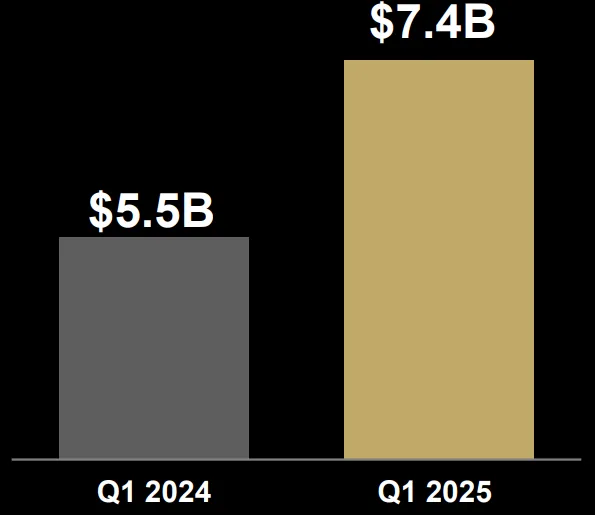
- Revenue: $7.44 billion, marking a 36% increase year-over-year.
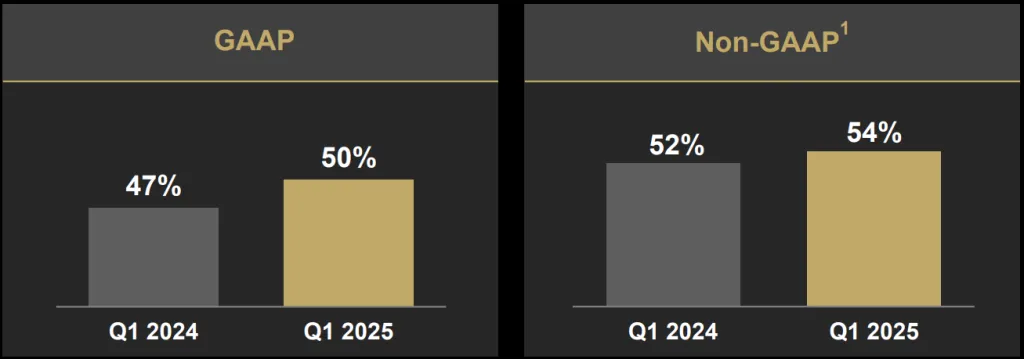
- Non-GAAP Gross Margin: 54%.
- Non-GAAP Operating Income: $1.78 billion.
- Non-GAAP Net Income: $1.57 billion.
- Non-GAAP Diluted EPS: $0.96.
Segment Highlights:
- Data Center Revenue: $3.7 billion, up 57% year-over-year, driven by strong sales of EPYC CPUs and Instinct GPUs.
- Client Revenue: $2.3 billion, a 68% increase year-over-year, fueled by demand for Ryzen processors.
- Gaming Revenue: $647 million, down 30% year-over-year, primarily due to decreased semi-custom revenue.
- Embedded Revenue: $823 million, a 3% decline year-over-year.
AMD projects Q2 2025 revenue of approximately $7.4 billion, plus or minus $300 million. The company anticipates a one-time $800 million charge related to new U.S. export restrictions, which is expected to reduce the non-GAAP gross margin to around 43%. Excluding this charge, the gross margin would be approximately 54%.
This isn’t a hype cycle. It’s a margin-expanding, product-ramping, ecosystem-deepening operation.
What stands out is not just the revenue growth, but the mix shift. AMD’s business is increasingly driven by high-value segments like data center and embedded, not just consumer CPUs or gaming chips. This evolution supports more stable margins and greater pricing power over time.
What We’re Watching Through 2025
As we look ahead, several signals will shape whether AMD’s thesis continues to play out the way we anticipate. First, MI300A/X adoption is key, especially among hyperscalers like AWS, Microsoft Azure, and Google Cloud.
Their purchasing decisions in 2025 will offer a clear signal of how AMD’s next-gen accelerators are competing in real-world environments.
Second, we’re tracking AMD’s ability to extend its reach into edge infrastructure and embedded systems through the Xilinx and Pensando integrations. These applications might not dominate headlines, but they could quietly drive durable, high-margin growth.
Third, Nvidia’s own strategy shift toward inference will matter. If Nvidia begins encroaching more aggressively on AMD’s lane, we’ll be looking closely at performance-per-dollar metrics and TCO (total cost of ownership) comparisons.
We’re also monitoring AMD’s software tooling maturity: a key piece of long-term competitiveness in the AI ecosystem. Without robust developer support, hardware advantages can be underutilized.
Finally, we’ll be watching how EPS stabilizes as Xilinx amortization tapers off, and whether institutional sentiment catches up with the true earning power of AMD’s operational business.
All of these factors feed directly into the durability of our conviction.
Our AMD Stock Prediction for 2025
This isn’t a prediction about AMD beating Nvidia. It’s a conviction that AMD no longer needs to. The market opportunity is vast, and the demand curves are multi-dimensional. AMD is not just catching up. It’s staking out a new position in the AI and adaptive compute landscape that doesn’t require direct comparison to legacy leaders.
As inference demand grows and edge workloads scale, AMD is positioned not as a secondary player, but as a diversified infrastructure provider in its own right. The financials support it. The roadmap supports it. And increasingly, the market is beginning to recognize it.
We’re long AMD in 2025 because the story is shifting from “catch-up” to structural edge.
AMD Revenue per Gigawatt: What the Hardware Is Worth
How much revenue can AMD earn per gigawatt? We examine GPU pricing, EPYC, Helios component content, delivery costs and the assumptions in our financial model.
AMD Stock Forecast 2030
This AMD Stock Forecast 2030 explores AMD's transition from a distant secondary supplier to an open compute superpower in Artificial Intelligence.
AMD Sovereign AI Infrastructure
AMD sovereign AI: live HUMAIN systems, future Saudi capacity, LUMI-AI procurement, Korea's partnership and the path from infrastructure plans to revenue.
Northwise Portfolios
See how the research becomes real decisions
Reader discussion
Discuss the research
Create a Free account to join the discussion with a display name.
Create a Free Account
No comments yet. Start a thoughtful discussion.