
NVDA vs AMD
NVDA vs AMD explained through NVIDIA’s AI factory strategy, showing how system-level design matters as GPU performance gaps narrow.
In this article
NVDA vs AMD: Why NVIDIA Is Moving Beyond GPUs
Why the AI accelerator market is shifting from chip dominance to full stack compute systems
Executive Framing
This piece is not a bet against NVIDIA, nor is it an argument that AMD is about to displace the market leader. NVIDIA remains the dominant supplier of accelerated computing, and the total AI infrastructure market is large enough that both companies can grow revenues materially over the next decade.
The question is narrower than that.
It is about where competitive pressure is now showing up, and how rational companies respond when the source of that pressure changes.
AMD does not need to outperform NVIDIA across every benchmark to matter. It only needs to be competitive enough, at scale, across a growing set of workloads, to reduce the degree of performance asymmetry that historically justified NVIDIA’s pricing power at the chip level. That threshold is no longer hypothetical. It is increasingly observable in training clusters, inference-heavy deployments, and cost-constrained environments outside the core hyperscalers.
As that gap narrows, the economics of value capture shift.
When accelerators become substitutable at the margin, the differentiator moves away from the individual chip and toward the system that determines how efficiently power is converted into usable compute over time. That includes networking topology, memory architecture, software compatibility, deployment speed, utilization rates, and lifecycle economics. These are not secondary considerations for large buyers. They are the decision surface.
NVIDIA’s recent emphasis on “AI factories” should be read through this lens. It is not a rhetorical repositioning and it is not a defensive reaction. It is a logical response to a market where maintaining dominance requires moving up the stack, not doubling down on a single component.
The rest of this article is an attempt to make that shift concrete, and to explain why AMD’s progress is not a threat to NVIDIA’s growth, but a catalyst for NVIDIA changing how it plays the game.
The Pressure Point
The narrowing is not showing up where most comparisons focus. Peak benchmarks still favor the incumbent, and absolute leadership at the chip level remains intact. The change appears instead in how large buyers evaluate deployments once systems reach meaningful scale.
As workloads have grown larger and more heterogeneous, the relevant unit of comparison has shifted. Procurement decisions increasingly happen at the rack and cluster level rather than around individual accelerators. Power availability, interconnect efficiency, memory behavior, and sustained utilization now carry as much weight as raw throughput. In that environment, recent platforms from the challenger have become viable across a broader set of configurations, particularly where density and cost sensitivity dominate the decision.
Inference has amplified this effect. It is no longer a marginal workload. Reasoning models, long-context systems, and agentic applications materially increase compute demand after training. That pushes buyers to optimize for throughput per dollar and per watt rather than theoretical peak performance. Once inference becomes the primary cost center, the performance gap that mattered most during the training-only phase becomes less decisive.
Software friction has also declined through AMD’s improving ROCm software. The existing ecosystem advantage remains real, but the marginal cost of experimenting outside it has fallen. Improving framework support, better tooling, and greater interoperability reduce the penalty for diversification. This does not eliminate lock-in, but it weakens it enough to influence procurement behavior. Buyers hedge exposure. They pressure pricing. They plan for optionality.
None of this implies a reversal of leadership. It implies a change in leverage.
When substitution becomes credible at the margin, pricing power at the component level becomes harder to sustain in isolation. The economics begin to favor whoever controls the surrounding system, because that system determines how efficiently capital, power, and silicon are converted into usable compute over time.
That is where the pressure now sits.
Why NVDA GPU Leadership Has a Ceiling
For most of the last decade, NVIDIA’s advantage was concentrated at the accelerator level. Performance leadership translated cleanly into pricing power because alternatives were either meaningfully slower, harder to deploy, or both. When the gap was wide, buyers optimized around it. The simplest decision was often the correct one.
That dynamic weakens as the gap narrows.
As accelerators converge on “good enough” across a broader range of workloads, the marginal value of another increment of peak performance declines. What replaces it is not indifference, but a different optimization problem. Large buyers begin to care less about which chip wins a benchmark and more about how reliably a system can be deployed, scaled, powered, cooled, and utilized over time. The decision shifts from engineering preference to operational economics.
This is not a criticism of NVIDIA’s position. It is a description of the ceiling inherent in component level dominance.
At scale, GPUs are no longer purchased in isolation. They are purchased as part of a fixed power envelope, a fixed footprint, and a fixed capital budget. Once those constraints bind, improving performance per accelerator matters less than improving performance per rack, per megawatt, and per dollar of deployed capital. The winner is not the chip with the highest peak metrics, but the system that extracts the most usable work from constrained resources.
That distinction becomes more important as deployments move beyond a small number of hyperscalers and into a wider set of buyers. Sovereign projects, enterprises, model builders, and specialized operators all face different constraints, but they share one common feature: none of them have excess power or excess capital to waste. Efficiency becomes the binding variable.
In that environment, leadership at the GPU level remains necessary but no longer sufficient. The economic surplus migrates toward whoever controls the surrounding architecture, because that architecture determines total cost of ownership, deployment velocity, and utilization over the system’s life.
This is the context in which NVIDIA’s strategy should be evaluated. Not as an attempt to defend a weakening position, but as an acknowledgment that the axis of competition is no longer confined to the accelerator itself.
Nvidia’s AI Factory Concept
At a practical level, an AI factory is not a metaphor and it is not a rebranding of a data center. It is a way of defining the unit of value being sold.
In a traditional procurement model, buyers evaluate components. GPUs are priced, compared, and deployed alongside networking, CPUs, memory, and storage that are sourced and integrated separately. Responsibility for making the system work efficiently sits largely with the customer. Performance issues, utilization gaps, and scaling friction are treated as operational problems rather than vendor liabilities.
The factory model inverts that relationship.
Under this approach, the product is the system itself. Accelerators, interconnects, memory hierarchy, power delivery, cooling, and software orchestration are designed together and delivered as a coherent unit. The buyer is no longer optimizing for the best individual part. They are optimizing for predictable output under real constraints. How many tokens per second can this installation produce, at what power draw, and with what utilization over its useful life.
This distinction matters because AI workloads are no longer tolerant of loose coupling. Training and inference both stress communication, memory locality, and synchronization in ways that make ad hoc integration costly at scale. As clusters grow, inefficiencies compound. Latency becomes throughput loss. Underutilization becomes stranded capital. Minor architectural mismatches turn into material economic penalties.
By treating the system as the product, responsibility shifts upstream. The vendor is no longer selling silicon and walking away. They are implicitly underwriting performance, efficiency, and deployability at the factory level. That allows value capture to move away from per-chip pricing and toward per-installation economics.
This is also why networking, software, and rack level design take on greater importance in this model. Once power and space are fixed, the limiting factor is how effectively the system moves data, schedules work, and keeps accelerators busy. The factory is judged not by peak specifications, but by sustained output over time.
Seen this way, the language change is not cosmetic. It reflects a change in what customers are actually buying, and in what vendors are being held accountable for delivering.
Why This Is Not Just Spin or Branding
If this were only a messaging shift, it would be difficult to reconcile with how revenue is actually being generated.
In the most recent quarter, NVIDIA reported $57 billion in total revenue, with $51 billion coming from data center alone, up 66% year over year. At that scale, incremental changes in product mix are reflecting how customers are choosing to deploy capital.
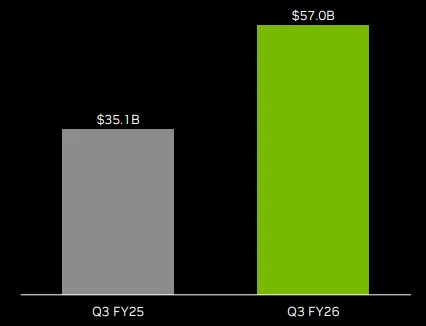
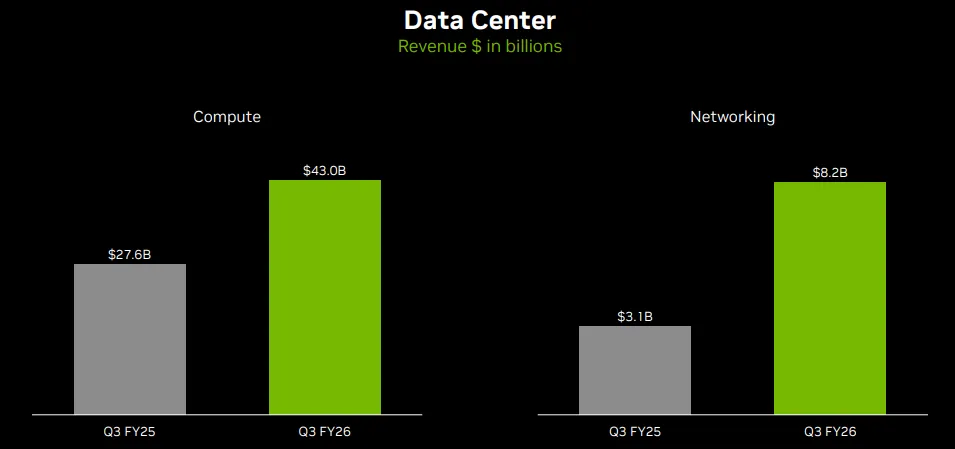
One of the clearest signals is the growing share of value NVIDIA captures beyond the accelerator itself. Networking revenue reached $8.2 billion, up 162 percent year over year, driven by NVLink, InfiniBand, and Spectrum X Ethernet. This is not consistent with a market where GPUs are purchased as standalone components. It points to deployments where system architecture and interconnect are integral to performance and therefore part of the core purchase.
Management’s own commentary reinforces this. On the call, NVIDIA explicitly framed its progress in terms of content per gigawatt, rather than per chip. Hopper-era deployments were described as carrying roughly $20 to $25 billion of NVIDIA content per gigawatt, while Grace Blackwell systems were characterized at approximately $30 billion or more per gigawatt, with Rubin expected to move higher again. That progression matters. It indicates that NVIDIA’s economic exposure scales with system density and power utilization, not just unit volume.
Customer behavior aligns with this shift. During the quarter, NVIDIA announced AI factory and infrastructure projects totaling approximately 5 million GPUs, spanning hyperscalers, sovereign buyers, enterprises, and supercomputing centers. Many of these deployments were described not as generic GPU installations, but as gigawatt-scale facilities where performance, efficiency, and utilization are tightly coupled to system design.
The revenue mix provides further confirmation. Growth in networking and system-level components has accelerated alongside accelerator sales, not lagged them. That is what one would expect if buyers were optimizing for delivered capacity under fixed power and space constraints, rather than for individual chip performance in isolation.
Taken together, these data points are difficult to explain as branding alone. They reflect a procurement environment where value is increasingly measured at the installation level, and where vendors are expected to deliver predictable output per megawatt, not just fast silicon. In that context, repositioning around factories rather than chips is not a narrative choice. It is a response to how the market is already behaving.
AMD’s Next Hill
The competitive opening for AMD does not sit at the very top of the performance curve. It sits in how AI workloads are evolving, and in who is paying for them.
Inference is the most obvious example. As reasoning models, long-context systems, and agentic workloads move from experimentation into production, the economics shift. Compute is consumed continuously rather than episodically. Cost per token and performance per watt begin to dominate peak throughput.
In that environment, absolute leadership matters less than predictable efficiency at scale. AMD’s positioning has leaned into this reality, prioritizing architectures and roadmaps that emphasize sustained throughput under power and cost constraints rather than chasing the highest possible benchmark result.
Sovereign deployments reinforce the same pattern. National and regional AI infrastructure projects operate under different constraints than hyperscalers. Power availability is fixed. Budgets are negotiated politically. Vendor concentration risk is actively managed.
In those settings, the ability to deploy competitive systems without full dependence on a single supplier carries real value. AMD does not need to displace the incumbent to benefit from this. It only needs to be viable enough to anchor diversification.
Edge and specialized workloads extend the logic further. As AI moves closer to the point of use, whether in industrial systems, regulated environments, or latency-sensitive applications, the economics fragment.
Large, tightly integrated clusters are not always the right answer. Smaller, more cost-efficient deployments become attractive, even if they sacrifice some peak performance. These are not fringe cases. They represent a growing share of real-world AI consumption.
This is where AMD’s strategy fits. It is not aimed at winning every tier of the market. It is aimed at expanding the set of workloads where substitution is credible and economically rational. Each additional workload that meets that threshold increases bargaining power for buyers and reduces the extent to which accelerator choice is a foregone conclusion.
That does not negate NVIDIA’s advantages. It changes how those advantages are monetized. As AMD widens the range of viable alternatives, the competitive pressure shifts upward, toward system design, integration, and delivered efficiency. AMD benefits from that shift even if it never becomes the dominant supplier, because the market stops being defined solely by the fastest chip.
The next hill, then, is not a single product cycle or benchmark win. It is the gradual normalization of choice in parts of the market where choice did not previously exist.
AI Market Structure, Not Market Share
The instinctive way to analyze competition in semiconductors is through share. Who ships more units. Who wins the socket. Who takes points quarter to quarter. That framework made sense when the market was constrained by demand for chips.
It makes less sense in a market constrained by power, capital, and deployment capacity.
The AI accelerator market is expanding fast enough that competitive pressure does not need to produce a zero-sum outcome to change behavior. Even conservative forecasts point to a multi-trillion-dollar infrastructure build by the end of the decade. Within that context, the more important question is not who gains or loses a few points of unit share, but where value accumulates as the market scales.
For NVIDIA, that value increasingly sits in systems rather than components. As deployments move toward fixed power envelopes and gigawatt-scale facilities, the economic bottleneck is no longer accelerator availability. It is efficiency per watt, utilization over time, and the ability to translate capital spend into sustained output. Capturing a larger share of the system bill matters more than defending every marginal chip sale.
For AMD, the opportunity is different but complementary. As the market broadens, not every buyer optimizes for the same objective. Some prioritize cost. Others prioritize vendor diversification. Others operate under regulatory or sovereign constraints that make single-supplier dependence unattractive. In those segments, being competitive enough expands the addressable market without requiring outright dominance.
This is why focusing on share alone misses the point. A modest redistribution of unit volume can coexist with meaningful revenue growth for both companies if the total market expands and the basis of competition shifts. NVIDIA can capture more value per deployment even as alternatives become viable. AMD can capture more deployments even without leading on absolute performance.
The structural outcome is not a clean handoff from one winner to another. It is a market where the axis of competition tilts upward. Chips still matter, but they no longer define the entire economic surface. Systems, integration, and lifecycle economics increasingly determine who captures the surplus.
Once that transition begins, share becomes an incomplete metric. The more revealing question becomes how much value each participant captures per unit of constrained resource, whether that resource is power, capital, or time.
That is the lens through which the rest of the modeling should be read.
Modeling the Shift
The core insight from our AI accelerator work is simple: the ceiling on AI growth is not demand, but physical capacity. Once you anchor the model to what the supply chain can actually produce, many conventional competitive narratives start to break down.
Our framework begins with wafer capacity. By 2030, global production of sub-3nm wafers is expected to reach roughly 24 million wafers per year, up from about 12 million in 2025, driven by expansions at TSMC, Samsung, and Intel. Even with more than $250 billion in global fab investment, leading-edge capacity remains structurally tight due to yield volatility and advanced packaging constraints.
After adjusting for yield losses and packaging bottlenecks, we estimate that each wafer produces roughly 100 usable AI accelerators. That places total annual output at approximately 7 million accelerators in 2025, rising to just over 21 million by 2030. These figures represent the physical upper bound of what the industry can deliver, not an aspirational demand forecast.
The next constraint is allocation. Based on foundry revenue mix and hyperscaler disclosures, our model assumes that about 60 percent of advanced-node wafer capacity is dedicated to AI and HPC workloads today, rising toward 70 percent by 2030 as inference and enterprise deployments scale. A ten-point swing in this assumption moves total market output by hundreds of billions of dollars, which is why capacity mix matters more than sentiment in this market.
Pricing follows constraint, not competition. Using a blended approach across GPUs and ASICs, we model NVIDIA’s average accelerator ASP rising from roughly $30,000 in 2025 to $38,000 by 2030, supported by system-level integration and software capture. AMD’s blended ASP grows from about $23,000 to $33,000 over the same period, reflecting broader deployment and cross-generational overlap rather than exclusivity. Custom ASICs remain lower, rising from approximately $9,000 to $14,000, as they strip out vendor software margins.
When these inputs are combined, the implications are difficult to ignore. Even under conservative assumptions, the market for AI accelerators used in training and inference expands from roughly $210 billion in 2025 to more than $1 trillion annually by 2030. When memory, networking, and host CPUs are included, the total AI compute stack reaches approximately $1.8 trillion, with accelerators accounting for about half of total spend.
This is where the competitive dynamics change. In our base case, NVIDIA’s share of accelerator revenue declines modestly from the low-80 percent range toward the low-60s by 2030, while AMD’s share rises into the mid-20s. Yet absolute revenue for both companies continues to grow materially because the market itself expands faster than share compresses. Competition redistributes margins, but it does not cap growth.
The model does not depend on AMD overtaking NVIDIA. It depends on capacity remaining constrained and system-level economics continuing to dominate. Under those conditions, NVIDIA’s strategy of capturing more value per deployment and AMD’s strategy of expanding the number of viable deployments can both succeed simultaneously.
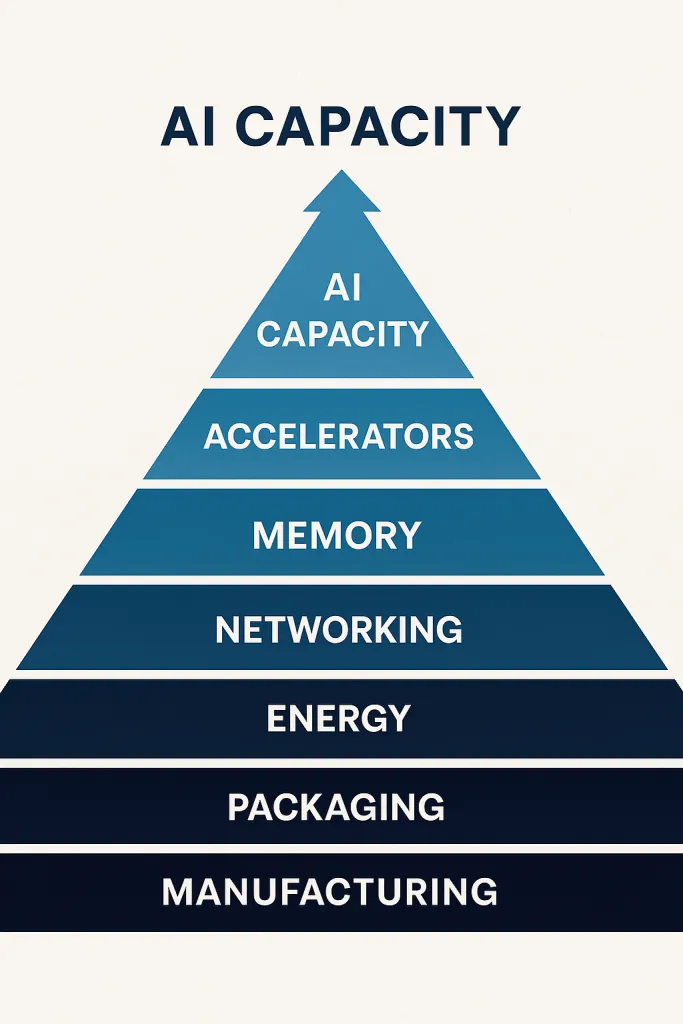
This is why framing the future as a zero-sum share battle misses the point. The math points to a market where value shifts upward in the stack, and where competition changes how revenue is captured, not whether it exists.
From a Breakout GPU to a System-Level Provider
For most of the last two years, NVIDIA’s growth story has been easy to summarize. A single product category moved from niche to indispensable, and the market repriced accordingly. That phase is largely complete.
What follows looks different.
As competition becomes credible at the accelerator level, the economic question shifts from who sells the fastest chip to who captures the most value from a fixed amount of power, capital, and deployed infrastructure. NVIDIA’s response has been to widen the surface area of what it sells. Not by abandoning GPUs, but by embedding them deeper into systems that are harder to disaggregate.
This is where the “AI factory” framing becomes concrete. In practice, it reflects a deliberate expansion of NVIDIA’s content per deployment. Earnings disclosures now consistently emphasize value per gigawatt, rack-scale architectures, and networking attach rates rather than unit shipments. That is not cosmetic language. It mirrors how large buyers are budgeting and how returns are increasingly measured.
Under this model, NVIDIA does not need to preserve exclusivity at the chip level to grow. It needs to ensure that as deployments scale, a growing share of the bill of materials flows through layers it controls. Networking, interconnect, software, and system integration all serve that purpose. Each one raises the switching cost of partial substitution while remaining compatible with a more heterogeneous accelerator landscape.
This is also why competitive pressure from AMD does not undermine the strategy. If AMD expands the set of viable deployments, total infrastructure build increases. NVIDIA benefits as long as it remains the default system architect for a large share of that build, even if not every accelerator carries its logo.
Seen this way, the strategic posture coming from NVIDIA looks less like a defensive reaction and more like a transition that was always coming. Breakout products create outsized growth, but they also compress future optionality. System-level businesses grow more slowly at the margin, but they compound over longer horizons because they scale with deployment complexity rather than component cycles.
That is the trade NVIDIA is making. It is accepting a world where alternatives exist in exchange for one where the unit of competition moves higher in the stack. The result is not the end of dominance, but a change in how dominance is expressed and monetized.
Understanding that distinction is critical before assessing whether the strategy succeeds or fails.
What Has to Be True for This Thesis to Break
The argument so far rests on structure, not sentiment. That makes it more durable, but not immune. There are clear points of failure, and they are worth stating plainly.
First, AMD has to continue converting technical parity into operational credibility. Closing the performance gap is necessary but not sufficient. If ROCm stalls, if software tooling fragments, or if large customers encounter friction at scale, AMD’s role risks remaining additive rather than substitutive. In that case, competition exists, but it does not meaningfully pressure system-level economics.
Second, NVIDIA’s ability to keep expanding content per deployment has limits. Networking, interconnect, and software capture only work as long as customers accept tighter integration as a net benefit. If hyperscalers or sovereign buyers decide that vertical depth constrains flexibility or negotiating leverage, they may intentionally tolerate lower efficiency in exchange for modularity. That would cap how much value NVIDIA can pull upward in the stack.
Third, the capacity assumptions embedded in the accelerator model matter. The thesis assumes that leading-edge supply remains structurally tight through the end of the decade. A faster-than-expected expansion in advanced packaging or a step-change in yield economics would weaken the leverage system vendors have over deployment design. In an environment of abundant supply, component pricing reasserts itself more aggressively.
Fourth, inference economics could surprise to the downside. If model efficiency improves faster than expected, or if demand skews heavily toward low-cost, latency-tolerant workloads, the market may favor simpler, cheaper accelerators over complex systems. That would compress the premium associated with tightly integrated architectures.
Finally, there is execution risk. NVIDIA is attempting to manage a far more complex business than it did during the breakout GPU phase. Coordinating silicon, systems, networking, software, and ecosystem investments at global scale leaves less room for missteps. Strategic clarity does not eliminate operational risk.
None of these invalidate the thesis today. But each represents a scenario where the competitive dynamic reverts toward components rather than systems. If that happens, the logic underpinning the “AI factory” strategy weakens, and the market will respond accordingly.
The point is not to predict failure. It is to define the conditions under which confidence should be revised.
Conclusion: Competition Without Capitulation
AMD is closing the gap. Not rhetorically, not hypothetically, but in ways that now matter operationally. Performance parity is no longer a forward-looking promise. It is already sufficient to expand the set of viable buyers, workloads, and deployment models. That alone changes the market.
At the same time, NVIDIA remains the dominant force in AI infrastructure. Scale, ecosystem depth, and execution still favor NVIDIA, and likely will for years. What is changing is not leadership, but strategy. As alternatives become credible, NVIDIA has little incentive to defend its position through aggressive pricing at the accelerator level. A pricing war would compress margins faster than it would suppress competition, and the company appears fully aware of that tradeoff.
Instead, NVIDIA is moving the locus of competition upward. By emphasizing systems, networking, software, and deployment economics, it is shifting the basis of value away from raw accelerator pricing and toward total cost, performance per watt, and integration. That is not an admission of weakness. It is a rational response to a market where exclusivity is giving way to abundance.
This is also why AMD’s progress does not imply NVIDIA’s decline. If AMD succeeds in broadening access to AI compute, the total market expands. More deployments, more inference, more sovereign and enterprise buildouts all increase the size of the pie. In that environment, NVIDIA benefits as long as it remains central to how large portions of that infrastructure are designed and operated, even if it does not supply every accelerator.
The framing matters. This is not a zero-sum contest for a fixed market. It is a transition from a breakout phase, where one product captured outsized rents, to a structural phase, where value compounds through systems and scale. Both companies are positioning accordingly. AMD by accelerating adoption and lowering barriers. NVIDIA by embedding itself deeper into the economics of deployment.
There is ample room for both to succeed. The more relevant question is not who wins, but how value is captured as AI infrastructure scales into a multi-trillion-dollar market. On that front, competition is no longer a threat to growth. It is the mechanism that enables it.
AMD Revenue per Gigawatt: What the Hardware Is Worth
How much revenue can AMD earn per gigawatt? We examine GPU pricing, EPYC, Helios component content, delivery costs and the assumptions in our financial model.
AMD Stock Forecast 2030
This AMD Stock Forecast 2030 explores AMD's transition from a distant secondary supplier to an open compute superpower in Artificial Intelligence.
AMD Sovereign AI Infrastructure
AMD sovereign AI: live HUMAIN systems, future Saudi capacity, LUMI-AI procurement, Korea's partnership and the path from infrastructure plans to revenue.
Northwise Portfolios
See how the research becomes real decisions
Reader discussion
Discuss the research
Create a Free account to join the discussion with a display name.
Create a Free Account
No comments yet. Start a thoughtful discussion.