
Airbnb Stock Forecast 2030

Our Airbnb stock forecast 2030 shows upside with strong platform growth, new experiences, and resilient profitability despite regulatory risks.
In this article
Airbnb Stock Forecast 2030: Outdated or a Sleeping Giant?
Why Airbnb’s misunderstood structure, regulatory headwinds, and resilient platform economics make it a contrarian play worth revisiting
The Setup: Why Airbnb, Why Now
Airbnb has grown into one of the most consequential disruptors in consumer travel. The company’s IPO hype, COVID shock, and subsequent rebound created whiplash for investors. As of September 2025, Airbnb holds a $75.8 billion market cap and trades around $123 per share. That is well below its euphoric 2021 peak but far above the 2022 trough that left many investors doubting its staying power.

The stock today is in an odd middle ground. It is not priced like a collapsing platform, but it is also not valued like a structurally compounding ecosystem. What is being missed is the balance between regulatory pressure, platform loyalty, and structural profitability.
These dynamics create an asymmetric setup heading into 2030. For investors looking at consumer resilience, our Costco thesis offers useful parallels.
History and Leadership
Airbnb was founded in 2008 by Brian Chesky, Joe Gebbia, and Nathan Blecharczyk. What began as a stopgap way to cover rent quickly for struggling artists, became a global template for peer-to-peer hospitality.
After securing seed funding from Y Combinator in 2009, Airbnb expanded internationally by 2011 and eventually raised billions in venture capital, reaching a $30 billion valuation by 2017.

Its December 2020 IPO, priced at $68 per share, more than doubled on day one and gave the company one of the largest valuations in software history.
Airbnb remains founder-led, with Chesky still serving as CEO and holding a meaningful stake. Founder-led firms often take a longer view on strategy, which matters when navigating regulatory battles and balancing investor expectations. Leadership continuity remains a key differentiator.
Current Position: Financial and Stock Performance
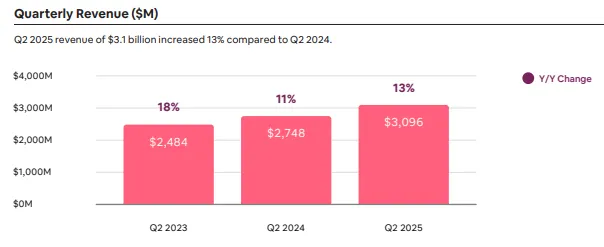
Airbnb’s Q2 2025 results reflected durable growth despite global volatility:
Metric | Q2 2025 Value | YoY Change | Notes |
|---|---|---|---|
Revenue | $2.15 billion | +12% | Driven by higher average daily rates (ADR) and international bookings. |
Net Income | $550 million | +15% | Adjusted EBITDA margin expanded to 32%, reflecting cost discipline. |
Gross Booking Value (GBV) | $18.9 billion | +10% | Core growth metric; includes host fees and services. |
Nights and Experiences Booked | 121 million | +9% | U.S./Canada up 8%, EMEA up 12%; Experiences segment grew 20%. |
ADR (Average Daily Rate) | $170 | +3% | Premium listings and dynamic pricing contributed. |
Active Listings | 8.1 million | +7% | Expansion in non-urban markets. |
In 2024, Airbnb delivered $11.1 billion in revenue and $1.6 billion in net income. Buybacks totaling $2 billion in 2025 further reinforced confidence in cash generation. For comparison, consumer-focused operators like Cheesecake Factory face valuation pressures even while generating steady cash flows. Airbnb’s margin profile shows the advantage of a capital-light, digital-first model.
At $123 per share, Airbnb has been flat in 2025 and lags the S&P 500. The multiple remains about 30x trailing earnings, a premium to Booking Holdings, though still reflecting investor hesitation around longer-term expansion.
Macro Tailwinds and Headwinds
Tailwinds
- Post-pandemic travel recovery has continued, supported by hybrid work and extended leisure trips.
- Growth in emerging markets, particularly in India and Southeast Asia, provides 20 percent plus expansion opportunities in key travel categories.
- Advances in artificial intelligence have strengthened personalization and pricing tools, boosting conversion and margins.
Headwinds
- Regulatory tightening has been persistent, with nearly half of major markets imposing restrictions or taxes.
- Housing concerns in major U.S. and European cities create political headwinds that may reduce supply in certain metros.
- Inflation and climate-related disruptions remain meaningful risks, curbing discretionary travel and forcing cancellations.
The contrarian view is that while regulations and housing backlash dominate headlines, the structural shift toward peer-to-peer travel is not reversing.
At worst, regulation may reshape margins rather than erase Airbnb’s long-term platform advantage. Investors who studied our PayPal forecast will recognize a similar pattern of short-term narrative dominating over structural fundamentals.
Competition
Company | Market Share (Rentals) | Strengths | Weakness | Key Difference from Airbnb |
|---|---|---|---|---|
Booking.com (Booking Holdings) | 25% | Vast hotel inventory (28M listings); strong in Europe/Asia. Revenue: $22B (2024). | Less focus on unique homes; higher fees. | Hotels vs. homes; Airbnb wins on authenticity. |
Vrbo (Expedia Group) | 15% | Vacation home specialist; 2M listings. Expedia total rev: $13B. | Slower innovation; U.S.-centric. | Whole-home focus, but Airbnb’s app/user base (4x larger) dominates. |
Expedia | 10% (OTA total) | Bundles flights/hotels; loyalty programs. | Fragmented rentals via Vrbo. | Broader travel vs. Airbnb’s niche depth. |
Emerging (e.g., Sonder, Trip.com) | 5-10% | Boutique hotels (Sonder); Asia focus (Trip.com). | Smaller scale; regional limits. | Niche plays; Airbnb’s network moat protects. |
Airbnb commands 40 percent share of global alternative accommodations. Its brand equity, repeat usage, and experiential moat remain critical differentiators against traditional OTAs.
Much like Nike has built compounding loyalty in athletic wear, Airbnb’s network of repeat guests represents a durable advantage the market may be underestimating.
Airbnb’s New Features: Experiences and Beyond
Airbnb is increasingly positioning itself as a full travel ecosystem rather than a single booking platform. The most significant new vertical is the Experiences platform, which connects guests with curated local activities.
These range from cooking classes and wine tours to outdoor adventures and cultural events. Experiences revenue grew 20 percent in Q2 2025, highlighting consumer demand for more integrated travel offerings.

The importance of this feature cannot be overstated. By layering activities on top of accommodations, Airbnb increases revenue per guest, deepens loyalty, and differentiates itself from competitors focused purely on lodging. Experiences also help shift the company narrative away from housing disruption and toward a more holistic travel brand.
Other platform additions include:
- AI-driven personalization that improves matching of travelers with hosts and activities.
- Optimized offerings for long-term stays and digital nomads.
- Host-side tools for pricing, insurance, and trust that reduce churn and strengthen supply.
Taken together, these innovations show Airbnb’s ability to adapt. They create new revenue streams, mitigate regulatory scrutiny, and offer optionality that the market is not fully valuing today.
This mirrors what we have explored in our Cheesecake Factory thesis, where overlooked optionality can meaningfully reshape long-term perception.
Airbnb Stock Forecast 2030: Valuation Scenarios
Scenario | 2030 Revenue | EBITDA Margin | EPS | P/E Multiple | Est. Market Cap | Implied Share Price (1.15B diluted shares) |
|---|---|---|---|---|---|---|
Bear | $18B | 25% | $4 | 20x | $100B | $175 |
Base | $25B | 30% | $6.50 | 25x | $200B | $350 |
Bull | $30B | 32% | $8 | 30x | $300B | $520 |
The base case represents 180 percent upside by 2030. Even the bear case suggests modest appreciation, while the bull case points to significant multiple expansion.
The opportunity comes down to whether Airbnb can sustain growth despite regulation and leverage new features like Experiences into meaningful additional revenue.
Risks Worth Respecting
- Regulatory clampdowns remain the most pressing risk, especially in Western urban markets.
- Economic sensitivity could weigh heavily in a downturn, with leisure accounting for the majority of bookings.
- Host churn could rise if platform fees increase without corresponding improvements in trust or service.
- Execution risk on new verticals like Experiences and long-term stays remains unproven at scale.
Airbnb is not risk-free, but its cash reserves, profitability, and buyback program give it downside protection compared to peers.
Northwise Conclusion
The market is treating Airbnb as if its growth story is fading. We see something different. A company that has matured into profitability, holds a sticky global network, and is expanding its offerings into activities and experiences that will deepen engagement.

At roughly $123 per share, Airbnb is not a distressed asset, but it remains structurally mispriced relative to its long-term potential. Our Airbnb stock forecast 2030 scenarios suggest $200 billion plus valuations are plausible even under moderate assumptions.
For long-term investors, the opportunity is to position with patience, respect the risks, and recognize that Airbnb may quietly compound toward outcomes the market has yet to model.

Celsius Stock Analysis: The Shelf Reset and the Second Growth Curve
Celsius stock analysis of the shelf reset, Alani growth, Pepsi economics and cash flow, with a 2030 model and a Premium valuation and entry-price framework.

Meta AI Spending: The Customer Is Already Here
Can Meta turn AI spending into shareholder returns? We model advertising, Muse, hardware, capital costs and cash flow through 2030, with a full valuation.

IREN Stock Dilution: Can the Build Reach Shareholders?
IREN stock analysis of AI growth, funding and dilution through 2030. Read our full valuation, 27 scenarios and price zones free. Excel model is Premium.
Northwise Portfolios
See how the research becomes real decisions
Reader discussion
Discuss the research
Create a Free account to join the discussion with a display name.
Create a Free Account
No comments yet. Start a thoughtful discussion.