
PayPal 2030 Strategic Forecast
This PYPL Stock 2030 Forecast evaluates Paypal's current market position, provides price targets and models Agentic commerce upside.
In this article
PYPL Stock 2030 Forecast: The Agentic Commerce Giant
PayPal is priced for death entering 2026. Our proprietary modeling tells a different story. We see PayPal primed to dominate an emerging AI Commerce Opportunity that few see coming.
Post-Earnings Update: What Changed After Q4 2025
This report has been updated following PayPal’s Q4 2025 earnings release and 2026 guidance reset. The core thesis remains intact. The timeline and earnings path do not.
PayPal’s February 2026 earnings release forced a material revision to our original 2030 forecast. Not because the long-term architecture we outlined was disproven, but because the funding and execution path required to reach it became more explicit and more costly in the near term.
Our original model assumed that PayPal’s branded checkout franchise would remain sufficiently stable to fund reinvestment while newer infrastructure-level opportunities scaled in parallel.
Q4 2025 demonstrated that assumption was too optimistic. Branded checkout growth slowed sharply during the most important commerce quarter of the year, and management responded by prioritizing reinvestment over near-term earnings continuity.
As a result, 2026 is now modeled as a deliberate trough year, not a continuation year. PayPal is choosing to absorb margin pressure and slower earnings growth in order to stabilize its consumer surface, accelerate biometric readiness, and rebuild checkout reliability before scaling the next phase of its infrastructure strategy.
This update reflects three core changes:
- Near-term earnings have been revised downward to reflect reinvestment, margin pressure, and execution risk in 2026.
- The recovery arc has been pushed to the right, with operating leverage now modeled primarily from 2027 onward.
- Long-term upside remains driven by the same structural forces, but the probability-weighted path is more uneven.
We are explicit in this revision about what we got right, what we got wrong, and why the thesis still holds.
Executive Summary
PayPal is no longer priced for stagnation. It is priced for structural failure. Our updated model disagrees, but no longer assumes a smooth path back to relevance.
PayPal enters 2026 with a valuation that implies terminal decline. The market is no longer debating whether growth will reaccelerate. It is questioning whether the company can defend its core franchise long enough to matter in the next phase of digital commerce.
Our revised view sits between those extremes.
PayPal is not a dying consumer wallet. It is also not yet a clean infrastructure compounder. It is a payments system in transition, choosing to sacrifice near-term margin stability in order to reestablish trust, reliability, and relevance at the checkout layer while positioning itself underneath the emerging agent-driven economy.
The most important update to this report is not a change in destination. It is a change in timing.
What we got right
We correctly identified that PayPal’s long-term value does not reside in app engagement or consumer branding alone. It resides in the global network of payment rails, risk engines, merchant integrations, and compliance infrastructure that sit beneath the interface.
We were directionally right that:
- PayPal is increasingly positioning itself as an infrastructure layer rather than a destination brand.
- Braintree remains the primary merchant gateway through which automated and AI-initiated transactions will flow.
- Venmo has evolved from a social utility into a monetizable consumer platform with rising revenue per active user.
- Agentic commerce is not a speculative edge case but a real distribution shift already forming inside major AI ecosystems.
Those elements remain intact. None were invalidated by the quarter.
What we got wrong
We overstated the near-term stability of branded checkout.
Q4 2025 made clear that PayPal’s core consumer surface is more fragile than our original base case assumed. Checkout growth decelerated sharply at the precise moment it was expected to perform best. That outcome forced management to confront a tradeoff we did not model aggressively enough: defend the core now, or risk long-term irrelevance later.
Management chose defense.
That choice introduces a real cost. It pulls earnings forward into reinvestment. It compresses margins temporarily. It increases execution risk. It also delays the point at which the infrastructure thesis expresses itself cleanly in reported results.
Our revised model reflects this reality.
The revised framing
PayPal’s transformation is no longer modeled as a smooth evolution. It is modeled as a two-phase process:
- 2026 as a reset year, characterized by reinvestment, margin pressure, slower EPS growth, and structural repair at the checkout and consumer experience layer.
- 2027 through 2030 as the leverage phase, contingent on successful stabilization, where operating efficiency, share count reduction, and infrastructure-driven volume reassert themselves.
The thesis remains intact because the assets that matter have not changed. What has changed is the acknowledgment that those assets cannot scale on top of a degraded consumer surface. The company is now explicitly paying to fix that.
Why the opportunity still exists
The market is pricing PayPal as if this reset represents permanent impairment. Our updated framework treats it as a costly but rational delay.
PayPal still controls:
- One of the most globally accepted payment and risk networks in digital commerce.
- A merchant infrastructure layer that sits directly in the path of automated transaction routing.
- A consumer network that, while under pressure, remains large, sticky, and increasingly monetized through Venmo and debit usage.
- A capital return engine capable of reducing share count meaningfully at current valuations.
Agent-driven commerce remains a structural call option layered on top of that base. It is not required for PayPal to survive. It is required for PayPal to re-rate.
The revised model reflects higher uncertainty, a longer runway, and a more uneven path. It also reflects a valuation that already assumes failure.
The gap between those two states remains the opportunity.
Table of Contents
Part I: The Architectural Foundation of PayPal
- 1.1 The Payments Engine Under the Surface
- The infrastructure the market underprices
- Trust as a functional input in automated commerce
- What changed in the revised model
- 1.2 Visual and Experience Modernization
- Surface repair as a strategic requirement
- Consistency over differentiation
- 1.3 The New Consumer Core: Venmo
- From social utility to monetized platform
- The monetization ladder and ARPA progression
- 1.4 Cross Platform Integration Between PayPal and Venmo
- From fragmentation to predictability
- Cultural distribution and surface area expansion
- 1.5 Braintree as Merchant Infrastructure
- The merchant rail beneath the interface
- Why Braintree matters more than revenue mix
- 1.6 PYUSD Stablecoin and Programmable Settlement
- Settlement infrastructure for automated flows
- PYUSD as a long-dated option
Part II: The Transformation Phase (2023–2027)
- 2.1 Margin Recovery
- From repair to reinvestment
- What was working
- Why 2026 is a trough year
- 2.2 Capital Returns as a Structural Driver
- Buybacks as the primary control mechanism
- Revised share count assumptions (2030)
- Downside protection through capital discipline
- 2.3 Merchant Ecosystem and Real World Distribution
- Connectivity over destination
- Why this matters in the reset phase
- 2.4 BNPL as a De-Risked Growth Driver
- From balance sheet risk to transaction layer
- Role in the revised framework
Part III: The Agentic Future and PayPal’s Billion User Distribution
- 3.1 AI Agents Will Reshape Global Payment Flows
- From human initiation to system initiation
- Integration as the source of flow
- 3.2 The Big Three Partnerships: OpenAI, Google, Claude
- OpenAI and ChatGPT
- Google and Gemini
- Anthropic and Claude
- The combined distribution layer
- 3.3 Why Agentic Commerce Functions as a Call Option
- Scale effects at low adoption levels
- Incremental TPV ranges and revenue translation
- Why the market misses the mechanism
- 3.4 API-Level Integration as the Enduring Advantage
- Default rails in automated workflows
- Persistence through performance
- 3.5 Perplexity AI and the Expansion of Discovery Surfaces
- Search as task execution
- Reinforcing the distribution thesis
Part IV: Secondary Growth Engines and Strategic Optionality
- 4.1 Retail Media and Small Business Ads
- Transaction data as advertising inventory
- Small business distribution advantage
- Margin characteristics and timing
- 4.2 Data Insights and Merchant Tools
- The payment moment as a data advantage
- Operational tools built on verified spend
- From insight layer to infrastructure layer
Part V: Financial Forecasting and 2030 Scenarios
- 5.1 Key Assumptions
- Revised core assumptions (Revenue, Margin, TPV, Take Rate, Share Count)
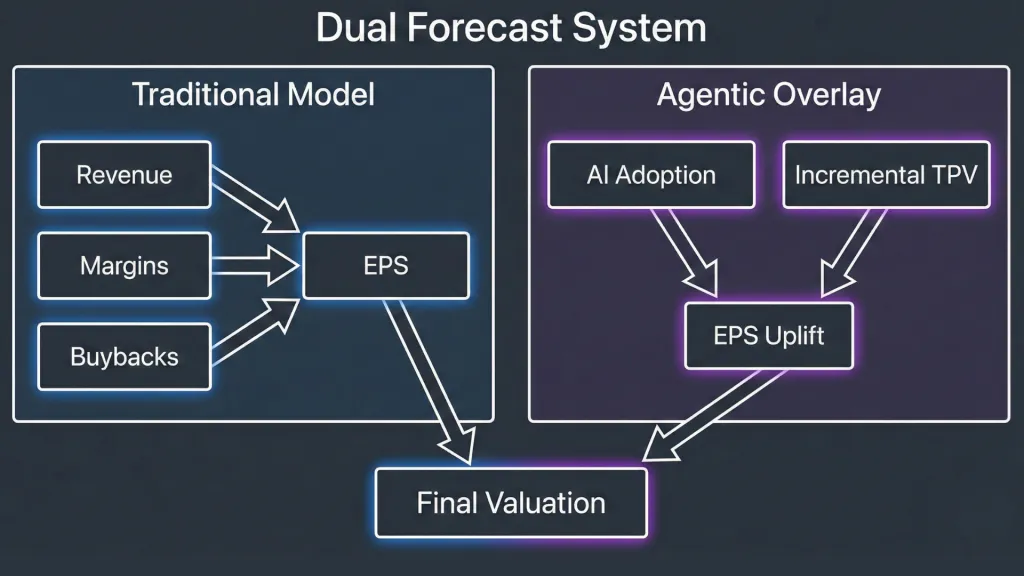
- 5.2 Why This Model Uses Two Forecast Systems
- Limits of linear forecasting
- Dual-system structure and purpose
- 5.3 Core 2030 Scenario Framework (Bear, Base, Bull)
- Scenario outputs and price ranges
- 5.4 The Agentic Ramp Model (Overlay)
- Inputs, adoption bands, and incremental TPV
- Revenue contribution and margin logic
- 5.5 Enhanced 2030 EPS and Price Targets
- Enhanced EPS by scenario and ramp
- Implied price targets by multiple bands
- 5.6 Why This Matters
- Architecture versus narrative
- 5.7 2030 Multiple Justification
- Bear multiple band
- Base multiple band
- Bull multiple band
- 5.8 Dividend Introduction and Long-Term Shareholder Return
- Capital allocation maturity
- Dividends as complement to buybacks
Part VI: Dividend Modeling Across 2030 Scenarios
- 6.1 Capital Return Philosophy and Payout Flexibility
- 6.2 Dividend Per Share Outcomes by Scenario
- 12% payout table
- 15% payout table
- 20% payout table
- 6.3 Dividend Yield Implications at Modeled Valuations
- Base case yield range
- Bull case yield range
- 6.4 Institutional Flow Implications of Dividend Initiation
- Dividend ETFs, quality allocators, dividend growth, multi-factor, international flows
- 6.5 Structural Role of the Dividend in Downside Scenarios
- 6.6 Dividend as Strategic Signal
- Infrastructure profile plus long-dated optionality
Part VII: The Strategic Floor
- 7.1 The Replacement Cost Paradox
- 7.2 Apple: The Vertical Integration Thesis
- 7.3 xAI and X: Bypassing the Licensing Moat
- 7.4 The Acquisition Math
- Net-cost framework (cash, FCF, effective purchase price)
- 7.5 The Asymmetric Floor in the 2030 Model
Part VIII: Margin of Safety and Portfolio Execution
- 8.1 The Intrinsic Margin of Safety
- 8.2 Portfolio Update: Northwise Project Execution
- 8.3 Strategic Buy Zones and Accumulation Framework
- 8.4 Total Return and Yield on Cost Analysis
- 8.5 The Risk-Reward Asymmetry
Part IX: Conclusion
- 9.1 Beyond the Legacy Narrative
- 9.2 The Value of Invisible Infrastructure
- 9.3 Distribution Through the AI Giants
- 9.4 Strategic Resilience and the M&A Floor
- 9.5 The Opportunity in the Disconnect
Part I: The Architectural Foundation of PayPal
1.1 The Payments Engine Under the Surface
The Infrastructure the Market Continues to Underprice
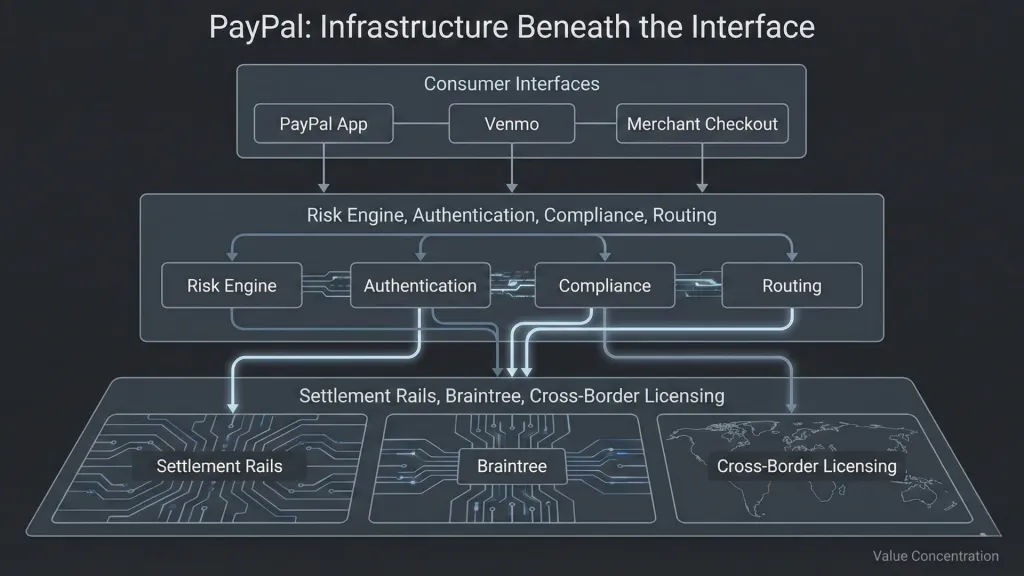
The public narrative treats PayPal as a simple consumer wallet. The actual business looks nothing like a wallet. Beneath the interface, PayPal operates a globally scaled payments system built around risk modeling, compliance infrastructure, merchant routing, and settlement logic.
This system has been trained on trillions of dollars of transaction flows across consumer and merchant environments and across hundreds of regulatory jurisdictions. These systems sit behind the interface and determine whether money moves, how it moves, and whether it clears at all. They are not features. They are authorization infrastructure.
There are very few companies with the regulatory reach, licensing footprint, and risk tooling required to operate at this level across borders and payment contexts. This remains the least visible and least valued part of PayPal’s business. It is also the part that matters most as commerce becomes less explicitly user driven.
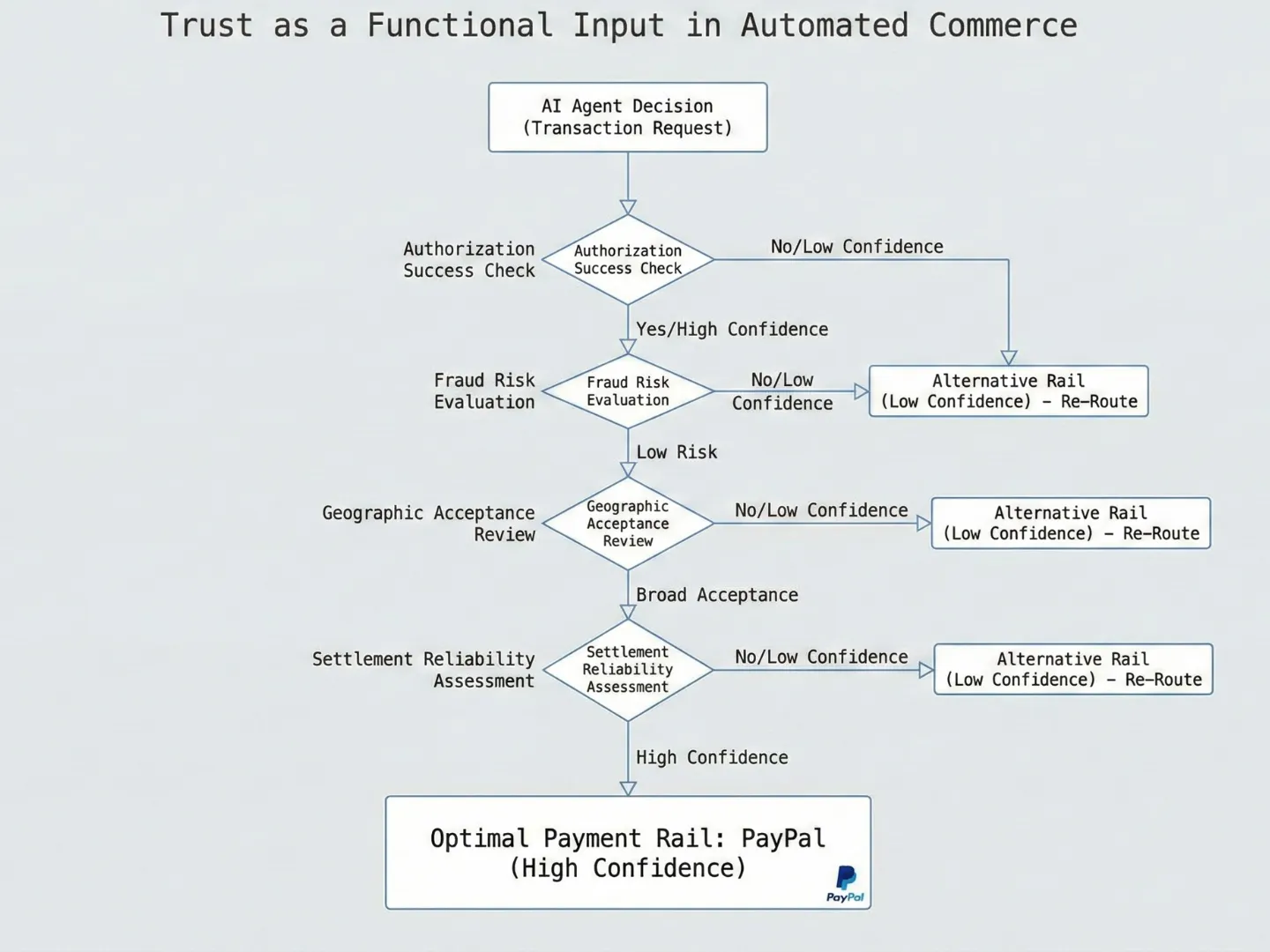
Trust as a Functional Input in Automated Commerce
As autonomous systems begin initiating transactions, trust becomes a functional input rather than a brand preference. Agents do not choose payment rails based on habit or aesthetics. They route transactions based on clearance probability, authentication reliability, geographic acceptance, and dispute resolution outcomes.
PayPal’s long operating history in fraud prevention, regulatory compliance, and global settlement gives it an advantage that remains difficult to replicate at scale. That advantage did not disappear with Q4 2025. What the quarter revealed instead was a growing disconnect between the strength of the underlying engine and the effectiveness of the consumer surface feeding it.
The weakness exposed was not architectural failure. It was surface execution.
What Changed in the Revised Model
Our original model assumed that branded checkout was sufficiently stable to fund reinvestment while the infrastructure thesis expressed itself gradually. That assumption proved optimistic. Checkout performance deteriorated faster than expected, forcing management to prioritize stabilization over margin continuity.
The revised framework separates these layers explicitly. The payments engine remains intact. The timeline for monetizing it has moved. PayPal is now reinvesting to realign its consumer surface with the demands of a system that must support both human-initiated and machine-initiated transactions. This suppresses near-term earnings but strengthens the probability that the infrastructure can scale later in the decade.
1.2 Visual and Experience Modernization
Surface Repair as a Strategic Requirement
PayPal and Venmo spent several years accumulating interface complexity and inconsistent user flows. That era is ending, but more slowly than originally modeled. Both brands are now operating on a cleaner design language intended to shorten user paths, reduce friction, and improve completion reliability.
This is not a cosmetic exercise. Payments are sensitive to micro-friction. One additional step or one inconsistent authentication flow materially reduces conversion. The modernization effort is designed to restore confidence at the surface layer so that the deeper infrastructure can express itself more reliably.
Q4 2025 made clear that this work is no longer optional. It is a prerequisite.
Consistency Over Differentiation
The new PayPal app removes clutter that accumulated over a decade of incremental feature expansion. Venmo’s interface has moved closer to mobile-native expectations, prioritizing speed and predictability over novelty. These changes are now explicitly tied to biometric readiness, passkey adoption, and faster authentication.
This matters for two reasons. First, it improves human checkout performance. Second, it prepares both brands for an agentic environment where automated systems require consistent behavior and clearly defined endpoints. AI agents cannot navigate ambiguity. A unified, predictable UX reduces integration complexity and raises authorization success.
The revised model treats 2026 as a surface repair year rather than a monetization year. The payoff from this work is pushed into the second half of the decade.
1.3 The New Consumer Core: Venmo
From Social Utility to Monetized Platform
Venmo has moved beyond its original role as a social payment utility. It is now one of PayPal’s most important consumer assets. Total actives are approaching 100 million, with more than 66 million monthly active users. More importantly, monetization has begun to scale.
Venmo generated approximately $1.7 billion in revenue in 2025, growing in the high-teens to low-twenties range. That growth is not driven by user acquisition. It is driven by deeper engagement and a structured monetization ladder that PayPal has begun to execute more consistently.
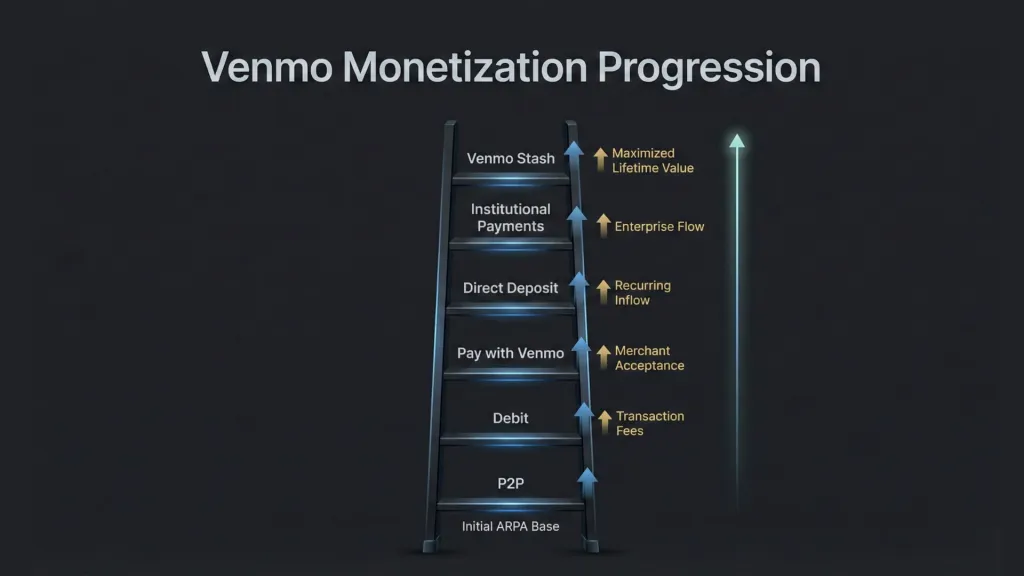
The Monetization Ladder
P2P creates the initial habit
Debit usage increases transaction frequency
Pay with Venmo moves users into merchant environments
Direct deposit and salary flows increase attachment
Institutional payments expand use cases
Venmo Stash reinforces debit behavior and repeat usage
Each step increases revenue per active account. Each step strengthens the link between consumer flows and merchant flows. This progression makes Venmo harder to displace and less dependent on marketing spend to sustain growth.
In the revised model, Venmo remains a stabilizing force during the 2026 reinvestment period rather than a primary offset to checkout weakness. Its role is durability, not acceleration.
1.4 Cross Platform Integration Between PayPal and Venmo
From Fragmentation to Predictability
For years, PayPal and Venmo operated as loosely connected products. Merchant acceptance was inconsistent. User flows were duplicated. This fragmentation diluted network effects and increased integration friction.
The company has shifted direction. PayPal and Venmo now share more checkout paths, merchant rails, and promotional infrastructure. PayPal branded checkout increasingly appears alongside Pay with Venmo, creating more predictable payment options for merchants and simpler routing for automated systems.
This integration does not eliminate competitive pressure, but it improves reliability and reduces cognitive load.
Cultural Distribution and Surface Area Expansion
Partnerships with the Big Ten and Big 12 embed Venmo into collegiate ecosystems where financial behaviors form early. These networks create recurring transaction flows tied to athletics, merchandise, and stipends.
PayPal’s partnership with Liverpool FC extends this strategy globally. Liverpool’s digital reach spans Europe, Asia, Africa, and North America. Embedding PayPal into merchandise, ticketing, and membership flows expands international surface area and reinforces brand familiarity.
These integrations do not drive immediate margin expansion. They increase long-term relevance and optionality, which becomes more important as payments are initiated through indirect channels.
1.5 Braintree as Merchant Infrastructure
The Merchant Rail Beneath the Interface
Braintree remains the most important part of PayPal that consumers rarely see. It serves as the routing and authorization backbone for many large merchants. In many cases, Braintree processes transactions before a user encounters any PayPal branding.
This infrastructure is central to PayPal’s position in an automated commerce environment. When AI systems initiate purchases, they require rails that support tokenization, fraud checks, geographic routing, and merchant connectivity. Braintree provides this functionality at scale.
Why Braintree Matters More Than Revenue Mix
The strategic value of Braintree lies less in its reported revenue and more in the merchant relationships and technical flexibility it controls. As commerce becomes increasingly automated, these rails become the default entry point for agent-initiated transactions.
In the revised model, Braintree remains a core asset, but its monetization is treated conservatively in the near term as PayPal prioritizes stability and merchant retention over aggressive pricing.
1.6 PYUSD Stablecoin and Programmable Settlement
Settlement Infrastructure for Automated Flows
PYUSD is one of the few stablecoins issued by a major payments platform. It is fully backed, transparent, and designed for integration rather than speculation. PYUSD gives PayPal a programmable settlement instrument that supports faster settlement, cross-border flows, and machine-to-machine payments.
This is not a growth product in the near term. It is an infrastructure option.
As transactions become more automated and potentially smaller in size but higher in frequency, settlement speed and cost efficiency matter. PYUSD reduces reliance on legacy card rails and introduces flexibility that traditional networks are not optimized to provide.
In the revised framework, PYUSD remains a long-dated option layered on top of the core system rather than a driver of the 2026 to 2027 earnings path.
Part II: The Transformation Phase (2023–2027)
2.1 Margin Recovery
From Repair to Reinvestment
PayPal’s margin story has shifted, but not in a straight line. The company spent much of the last five years contending with rising losses, product sprawl, inconsistent checkout pathways, and duplicated infrastructure. Early signs of improvement appeared through 2024 and early 2025 as transaction margin dollars stabilized and operating leverage began to reassert itself.
Q4 2025 forced a reassessment of that trajectory. Margin recovery did not stall due to structural weakness. It stalled because management chose to reinvest.
The current phase is no longer best described as expansion. It is a controlled reset intended to repair the consumer surface, accelerate biometric readiness, and stabilize branded checkout reliability before pursuing further operating leverage.
What Was Working
The margin improvements observed prior to Q4 were real. Simplification efforts reduced low-value features, tightened product scope, and standardized checkout flows. Cleaner routing improved authorization outcomes. Fraud losses declined as risk models and onboarding pipelines improved. These actions lifted margins without aggressive cost cutting.
Those gains did not disappear. They were deprioritized.
Why 2026 Is a Trough Year
The revised model explicitly treats 2026 as a margin trough. PayPal is absorbing pressure in transaction margin dollars and operating income in order to fund checkout remediation, merchant incentives, and user re-habituation. This temporarily suppresses reported profitability but increases the probability that margin recovery resumes from a more durable base.
In this framework, margin expansion is no longer front-loaded. It is conditional. Operating leverage is expected to reemerge only after surface stability improves, with 2027 acting as the earliest inflection window.
2.2 Capital Returns as a Structural Driver
Buybacks as the Primary Control Mechanism
PayPal has transitioned from growth capitalization to mature capital allocation. While the dividend initiation marks an important signaling shift, share count reduction remains the dominant lever shaping long-term earnings per share.
The company generates strong free cash flow relative to its market value. Even under conservative assumptions, that cash flow supports meaningful buybacks across the remainder of the decade.
Revised Share Count Assumptions
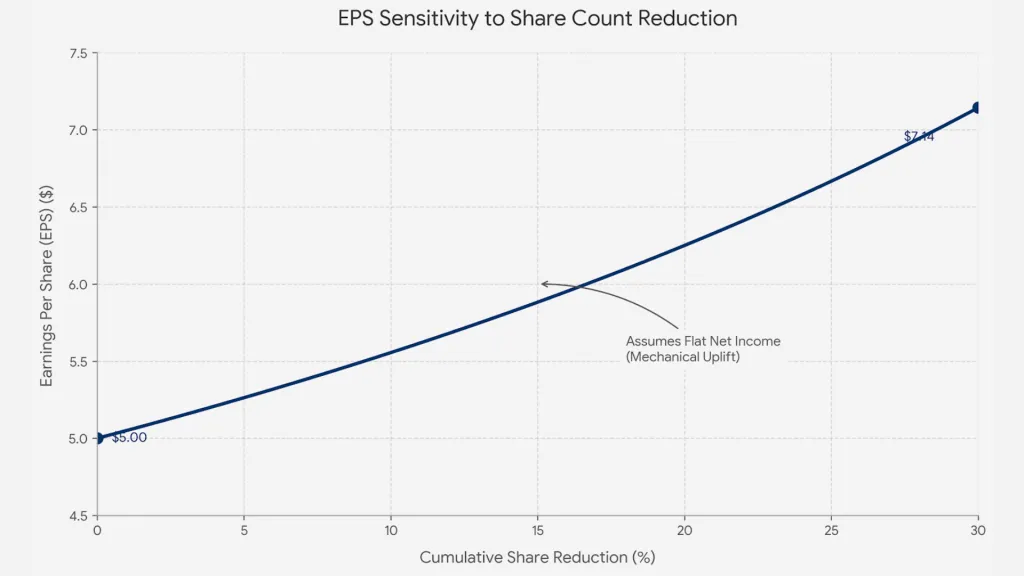
Our original model assumed cumulative share count reduction of roughly 12 to 20 percent by 2030. Post-correction, that range shifts upward.
At current valuation levels, buybacks become mechanically more powerful. If free cash flow remains near current levels and capital returns are prioritized, cumulative reduction in the range of 20 to 30 percent becomes plausible, with upside beyond that in prolonged valuation dislocation scenarios.
Downside Protection Through Capital Discipline
Capital returns act as a stabilizer in adverse outcomes. If revenue growth remains muted and margin recovery is delayed, buybacks absorb volatility and preserve earnings power. This materially changes the downside profile.
PayPal does not require aggressive top-line growth to compound shareholder value. It requires sustained free cash flow and disciplined capital deployment. Both remain intact despite the operational reset.
2.3 Merchant Ecosystem and Real World Distribution
Connectivity Over Destination
One of the most underappreciated aspects of PayPal’s transformation is the breadth of its merchant and platform integrations. The company maintains presence inside commerce environments that most competitors cannot access with comparable scale or flexibility.
These include:
TikTok Shop
Amazon and Amazon-affiliated merchant ecosystems
Google Shopping and Gemini surfaces
Tesla for energy and automotive payments
Large university and campus networks
Shopify-adjacent flows through Braintree integrations
These integrations embed PayPal into daily economic activity without requiring direct user intent. They also create discovery and execution pathways for AI-initiated commerce.
Why This Matters in the Reset Phase
During the 2026 reinvestment period, these merchant surfaces act as ballast. They preserve routing volume and relevance even as branded checkout undergoes remediation. Over time, they become the bridge between consumer rehabilitation and agent-driven transaction flow.
In the revised model, merchant ecosystem expansion is treated as a continuity mechanism rather than an immediate growth accelerator.
2.4 BNPL as a De-Risked Growth Driver
From Balance Sheet Risk to Transaction Layer
Buy Now, Pay Later previously introduced material balance sheet risk. That risk profile has changed. Partnerships with external funding providers allow PayPal to offload receivables and limit direct exposure to consumer credit cycles.
BNPL now operates primarily as a transaction layer rather than a lending product. Loss rates are contained. Funding costs are predictable. The economics shift away from credit risk toward volume and merchant integration.
Role in the Revised Framework
BNPL is no longer modeled as a growth catalyst. It is modeled as a supporting rail.
As installment options scale, BNPL increases checkout relevance, supports merchant acceptance, and reinforces consumer attachment without destabilizing the balance sheet. This makes it a cleaner contributor to long-term ecosystem strength, even if near-term financial impact remains modest.
Part III: The Agentic Future and PayPal’s Billion User Distribution
3.1 AI Agents Will Reshape Global Payment Flows
From Human Initiation to System Initiation
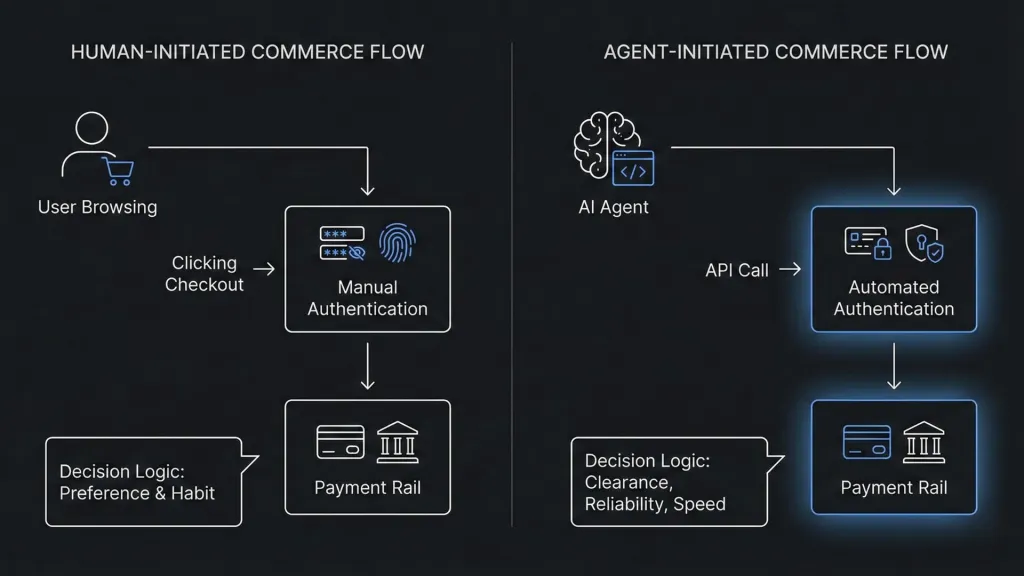
Commerce has historically been initiated by people. That constraint is weakening. AI agents are increasingly tasked with managing subscriptions, comparing prices, reordering consumables, booking travel, and routing bill payments. These workflows shift transaction initiation away from direct user action toward delegated execution.
As this transition progresses, payments move from a preference decision to an infrastructure decision. The system initiating the transaction selects rails based on clearance reliability, settlement success, fraud prevention, and geographic acceptance. These attributes determine whether a transaction completes without interruption.
PayPal operates one of the few global systems with a long record across each of these dimensions. Authorization success, dispute handling, and risk resolution become more important as transactions originate from automated workflows rather than manual inputs. In this environment, distribution emerges from integration rather than marketing exposure.
Integration as the Source of Flow
Agent-driven commerce alters how transaction volume is routed. When systems initiate payments, volume flows toward rails that are already embedded at the execution layer. As automated workflows scale, embedded infrastructure becomes the default path for settlement.
The market continues to frame PayPal through a consumer-choice lens. The agentic shift reframes routing logic around system-level performance. This change in flow dynamics underpins the agentic commerce thesis.
3.2 The Big Three Partnerships: OpenAI, Google, Claude
OpenAI and ChatGPT
OpenAI’s ChatGPT now reaches more than 800 million weekly active users. PayPal’s integration enables merchants to offer instant checkout within conversational sessions. An agent can evaluate options, surface recommendations, and complete transactions without the user opening a browser or external application.
This creates a new commerce funnel where discovery, comparison, and execution occur within a single interface. Even modest adoption at this scale introduces meaningful incremental transaction volume.
Google and Gemini
Google’s Gemini spans Search, Android, YouTube, and shopping surfaces, reaching more than 650 million monthly active users. These surfaces already dominate discovery across categories.
Integration with PayPal allows agents operating inside Gemini to complete purchases directly within these environments. As task execution becomes more common, PayPal functions as one of the primary settlement rails that translate intent into completed outcomes.
Anthropic and Claude
Anthropic’s Claude has gained traction among enterprise users building autonomous workflows. These environments require high-trust merchant connectivity, flexible routing, and compliance-aware execution.
This is where Braintree’s merchant infrastructure becomes increasingly relevant. Enterprise agents managing procurement, subscriptions, and invoicing operate at larger basket sizes and higher reliability thresholds. PayPal’s merchant rails support these requirements directly.
The Combined Distribution Layer
Across OpenAI, Google, and Anthropic, PayPal is embedded within systems that collectively reach more than one billion users. These integrations exist in environments where transactions are increasingly initiated by automated workflows rather than direct user interaction.
3.3 Why Agentic Commerce Functions as a Call Option
Scale Effects at Low Adoption Levels
The scale of existing AI platforms allows even limited adoption to produce meaningful outcomes. If a small percentage of users permit agents to execute payments, and those agents complete a modest number of transactions per month at typical consumer order values, incremental volume compounds quickly.
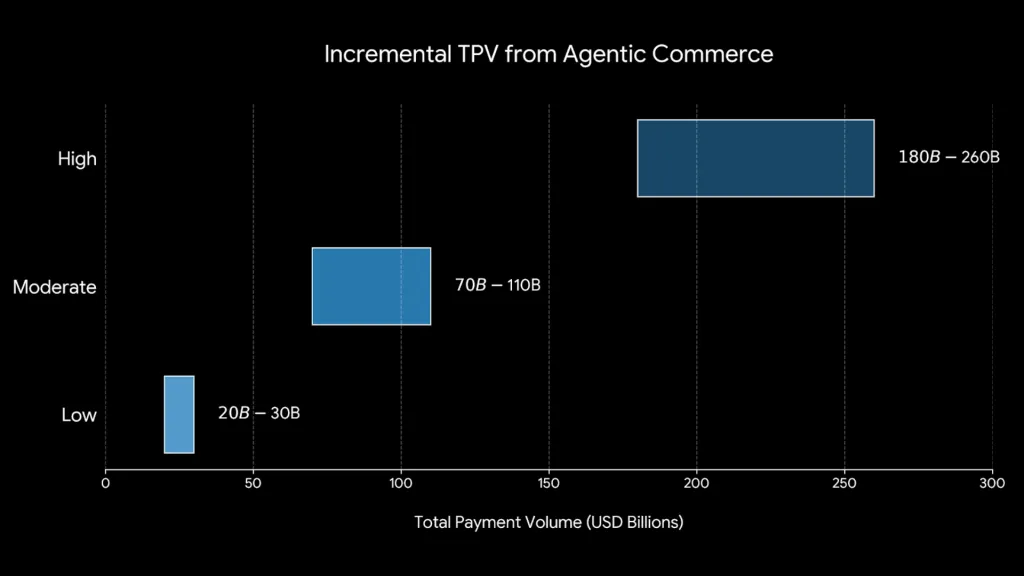
Our modeling framework estimates incremental total payment volume in the following ranges:
Low adoption: twenty to thirty billion
Moderate adoption: seventy to one hundred ten billion
High adoption: one hundred eighty to two hundred sixty billion
At blended take rates adjusted for infrastructure routing, this translates into hundreds of millions to several billion dollars of incremental revenue layered onto the existing system. These flows route across infrastructure that is already in place, which supports higher incremental margins.
Why the Market Misses This Mechanism
Most traditional models treat distribution as a function of user choice. Agentic commerce introduces a system-mediated layer that reallocates flow based on integration depth and execution reliability. This distinction creates a gap between reported fundamentals and emerging routing dynamics.
The optionality resides in that gap.
3.4 API-Level Integration as the Enduring Advantage
Default Rails in Automated Workflows
In an agent-driven environment, payment methods are selected at the API layer. Predictable endpoints for tokenization, authentication, routing, and dispute handling determine which rails are used repeatedly.
PayPal is already embedded at this level across major AI systems. Developers building agent workflows can deploy PayPal without extensive custom integration. Once embedded, switching costs emerge through operational dependency rather than contractual lock-in.
Persistence Through Performance
Automated systems prioritize stability. When a payment rail clears reliably, it remains in use. Performance degradation prompts reevaluation. This dynamic favors systems with global reach, regulatory depth, and consistent authorization outcomes.
PayPal’s architecture supports these requirements at scale. As agentic workflows expand, infrastructure-level positioning becomes increasingly durable.
3.5 Perplexity AI and the Expansion of Discovery Surfaces
Search as Task Execution
Perplexity AI has emerged as a fast-growing discovery platform where search, conversational response, and task execution converge. Its integration with PayPal enables autonomous shopping workflows that move directly from recommendation to purchase.
This matters because discovery surfaces increasingly double as execution environments. As users interact with systems that complete tasks rather than return links, settlement layers embedded within those systems gain relevance.
Reinforcing the Distribution Thesis
Perplexity’s adoption of PayPal reinforces a broader pattern. High-intent AI surfaces continue to adopt PayPal rails at the API level. Each integration expands the distribution layer through which agent-initiated transactions flow.
In the revised model, agentic commerce remains a long-duration driver rather than a near-term offset to the 2026 reset. Its value compounds as integration depth increases across platforms.
Part IV: Secondary Growth Engines and Strategic Optionality
4.1 Retail Media and Small Business Ads
Transaction Data as Advertising Inventory
Retail media has emerged as one of the highest-margin categories in digital commerce. Amazon built a retail media business approaching forty billion dollars in annual revenue by monetizing signals generated inside its own ecosystem. Meta followed a parallel path by converting behavioral data into performance advertising at global scale.
The common input across both models is first-party data tied directly to economic activity.
PayPal now sits on a comparable class of signals. The company observes transaction-level data across millions of merchants and hundreds of millions of consumers. This includes spending categories, purchase frequency, average ticket size, geographic concentration, and cross-platform behavior. These signals originate at the moment of payment, where intent resolves into verified spend.
For years, this dataset functioned primarily as an internal optimization tool. PayPal Ads represents an early step toward external monetization.
Small Business Distribution Advantage
For small and mid-sized merchants, PayPal Ads provides access to performance marketing without the operational complexity of large advertising platforms. Campaigns are informed by transaction-grade signals rather than inferred demographic proxies. This alignment improves targeting efficiency and raises conversion probability.
The distribution advantage lies in placement. PayPal sits at checkout. It observes conversion outcomes directly and can close the feedback loop between exposure, transaction, and repeat behavior. That position enables advertising products that emphasize efficiency over reach.
Margin Characteristics and Timing
Retail media carries a margin profile structurally superior to payments. It avoids card routing costs, fraud provisioning, and significant incremental infrastructure. PayPal already controls both sides of the marketplace and owns the checkout signal that anchors attribution.
In the revised model, PayPal Ads remains small through the reinvestment phase. Its contribution is optional rather than foundational. Adoption rates among merchants determine the slope. If uptake expands meaningfully in the second half of the decade, retail media becomes a high-margin layer that lifts blended profitability.
4.2 Data Insights and Merchant Tools
The Payment Moment as a Data Advantage
PayPal processes a large and diverse share of global commerce. The company observes the final stage of the transaction lifecycle. This position provides access to a dataset tied to verified spending rather than inferred intent.
These signals include:
- purchase frequency across categories
- real-world spend patterns
- evolving preferences across demographics
- device-level transaction behavior
- merchant-level conversion performance
- subscription renewal dynamics
- cross-platform commerce flow
Each signal reflects completed economic activity. Together, they form a high-integrity dataset with direct relevance to routing, optimization, and decision-making.
Operational Tools Built on Verified Spend
Merchant tools built on this data improve checkout performance, support benchmarking, strengthen fraud prevention, and inform routing decisions that raise authorization success. These products already contribute to ecosystem efficiency.
Their strategic value increases as commerce becomes more automated. AI-driven workflows require structured, reliable inputs to evaluate merchants, price execution, delivery reliability, and transaction success. Payment-verified data functions as a core input into that process.
From Insight Layer to Infrastructure Layer
As agentic systems scale, merchant data evolves from an optimization feature into infrastructure. Transaction history informs routing decisions and influences which merchants surface in automated workflows. In this context, PayPal’s dataset becomes embedded in the execution logic of commerce rather than remaining an analytical overlay.
The revised framework treats data-driven tools as a long-duration margin opportunity rather than a near-term revenue driver. If adoption accelerates alongside agentic commerce, margin profiles begin to resemble platform economics more than traditional payment processing.
Part V: Financial Forecasting and 2030 Scenarios
5.1 Key Assumptions
Framework Orientation
Our forecasting framework begins with observable operating realities at PayPal today. The company operates multiple revenue streams with different sensitivities to volume, margin, and capital allocation. No single catalyst is required for the model to function.
The revised framework explicitly incorporates a reinvestment and restructuring phase through 2026, followed by a conditional recovery phase beginning in 2027.
Revised Core Assumptions
Revenue CAGR (2026–2030)
Five to seven percent in the base case, reflecting slower branded checkout recovery, steady Braintree throughput, continued Venmo ARPA growth, and contained BNPL contribution. Upside scenarios extend higher only if checkout stabilization completes successfully.
Operating Margin
Expansion of 100 to 250 basis points by 2030, with 2026 modeled as a margin trough due to reinvestment. Margin recovery resumes as surface stability improves, routing efficiency increases, and higher-margin revenue streams gain mix.
Share Count Reduction
Cumulative reduction of 20 to 30 percent by 2030, supported by free cash flow generation and valuation-sensitive buybacks. Share reduction remains the most reliable EPS driver in the revised model.
TPV Growth
Low single-digit growth through 2026, followed by moderate acceleration as Venmo merchant penetration deepens, Pay with Venmo adoption increases, and early agent-initiated routing appears.
Take Rate Profile
Blended take rates remain structurally stable. Incremental upside from retail media and merchant tooling is modeled separately rather than embedded into core payment economics.
These assumptions establish a grounded earnings base before layering any agentic commerce contribution.
5.2 Why This Model Uses Two Forecast Systems
Limits of Linear Forecasting
Traditional fintech models rely on consumer adoption curves and linear volume extrapolation. That approach breaks down when transaction initiation shifts from human choice to system execution.
AI-driven workflows operate across platforms and contexts where user intent is abstracted. Volume routing responds to integration depth and performance rather than preference.
Dual-System Structure
The first system models PayPal’s 2030 outcomes using traditional inputs only. This produces Bear, Base, and Bull scenarios grounded in observable trends.
The second system overlays agentic commerce scenarios. It isolates incremental TPV, revenue, and EPS generated if automated systems begin initiating transactions at scale.
Why This Matters
Running two systems accomplishes three objectives:
- Preserves credibility by anchoring valuation in current fundamentals
- Quantifies optionality using explicit TPV and take-rate math
- Clarifies risk-reward by separating core recovery from long-duration upside
This structure avoids conflating narrative with valuation.
5.3 Core 2030 Scenario Framework (Bear, Base, Bull)
Bear Case
Northwise Premium
Choose how to continue with Northwise
Join Northwise Premium
Unlock the rest of this report, its complete valuation, the downloadable model, portfolios, and action framework.
Join Northwise PremiumCreate a Free Account
Continue across Free Northwise research, follow companies, save reports, and receive updates.
Create a Free Account
Celsius Stock Analysis: The Shelf Reset and the Second Growth Curve
Celsius stock analysis of the shelf reset, Alani growth, Pepsi economics and cash flow, with a 2030 model and a Premium valuation and entry-price framework.

Meta AI Spending: The Customer Is Already Here
Can Meta turn AI spending into shareholder returns? We model advertising, Muse, hardware, capital costs and cash flow through 2030, with a full valuation.

IREN Stock Dilution: Can the Build Reach Shareholders?
IREN stock analysis of AI growth, funding and dilution through 2030. Read our full valuation, 27 scenarios and price zones free. Excel model is Premium.
Northwise Portfolios
See how the research becomes real decisions
Reader discussion
Discuss the research
Premium access is required to join this report's discussion.
Join Northwise Premium
No comments yet. Start a thoughtful discussion.