
AAPL Stock Forecast 2030

AAPL stock forecast 2030 explores why even best-case outcomes may offer limited upside at today’s valuation and growth pace.
In this article
AAPL Stock Forecast 2030: Why Apple’s Upside May be Faltering
Apple is still dominant, but as innovation slows and valuation stays rich, even the best-case scenarios offer limited upside.
The Crown Is Intact, But the Clock Is Ticking
Apple isn’t going anywhere. It remains one of the most trusted, capital-efficient businesses on earth, with a consumer base spanning every continent and an unmatched brand in global tech. Its operating leverage and return on capital remain benchmarks for corporate performance. From its supply chain mastery to its seamless user experiences, Apple has earned its place at the top.
But at a $3 trillion valuation and a P/E ratio above 31, the question isn’t whether Apple will survive. It’s whether it can still grow meaningfully. The stock no longer trades on operational excellence alone. It is priced for consistent earnings expansion and product innovation that may no longer be structurally possible.
This aapl stock forecast 2030 doesn’t argue Apple is doomed. It examines whether the world’s most beloved brand is now just defending its crown, and what that means for investors seeking long-term upside in a market being rapidly redefined by AI, platform reinvention, and foundational infrastructure control.
Valuation & Financial Profile
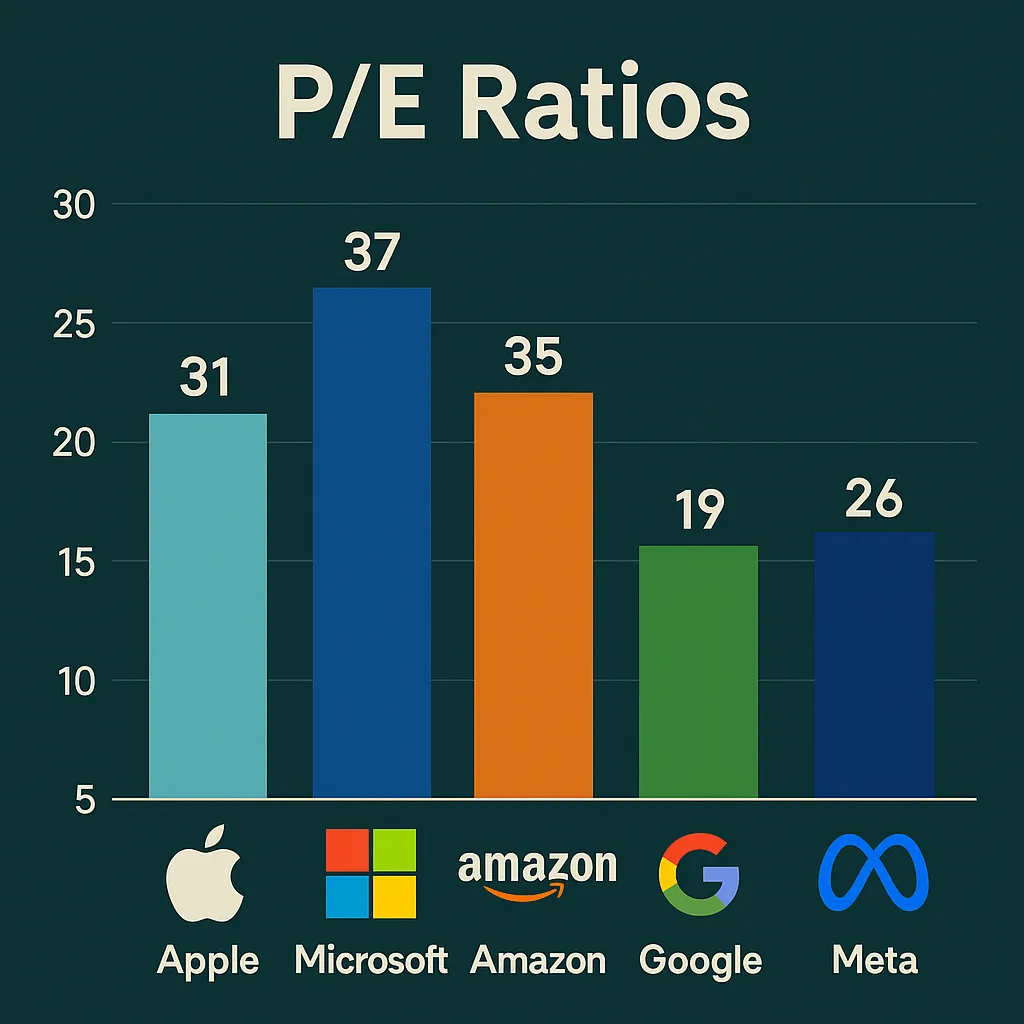
Apple’s fundamentals remain rock solid, but the market’s expectations are already pricing in perfection. Revenues are growing in the low single digits, yet Apple commands a multiple typically reserved for high-growth innovators. When compared to peers like Google, Amazon, Microsoft, or Meta, which operate at faster growth trajectories and trade at lower valuations, Apple’s pricing starts to look stretched. The stock has become more about capital preservation than compounding.
Company | Market Cap | P/E Ratio | Dividend Yield |
|---|---|---|---|
Apple | $3.00T | 31.37x | 0.52% |
Microsoft | $3.55T | 36.89x | 0.70% |
Amazon | $2.23T | 34.20x | – |
$2.03T | 19.00x | 0.50% | |
Meta | $1.72T | 26.65x | 0.31% |
Although the balance sheet is among the cleanest in the S&P 500, and cash flow generation remains strong, the risk lies in the market’s shifting narrative. Should Apple be grouped with consumer staples and utilities that return capital, or with growth platforms that expand capability and optionality? As interest rates fluctuate and investor sentiment changes, so too could Apple’s premium.
Product & Innovation Flywheel
Innovation has always been core to Apple’s identity, but the pace and ambition appear to be tapering. Rather than opening new categories or reimagining existing ones, Apple has focused on iterative upgrades. The iPhone remains the company’s centerpiece, but its revenue share highlights a broader concern. There has been no breakout successor product.
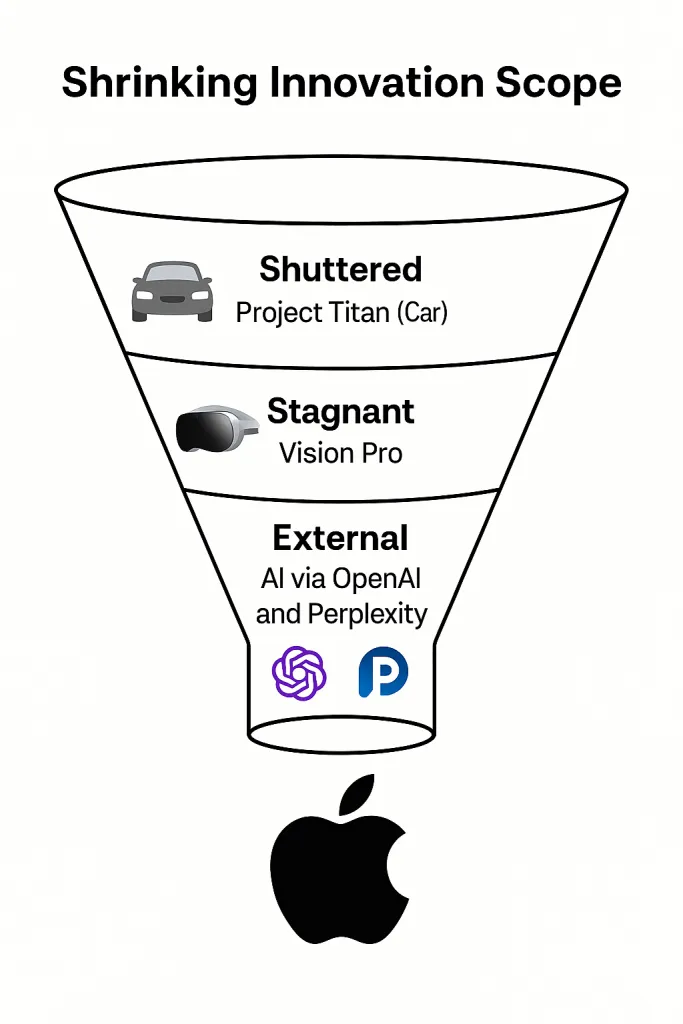
Vision Pro is a technological marvel, yet lacks clear product-market fit. Its current adoption curve is shallow, and developers have yet to rally around it. Apple Silicon has differentiated the Mac line, especially for creative professionals and power users, but has yet to make a material impact beyond Apple’s ecosystem.
In AI, Apple’s strategy is to integrate lightly rather than lead forcefully. Apple Intelligence is clean and well-designed, but largely built on licensed models and lacks a competitive moat.
Ultimately, Apple is still refining. But it is no longer redefining.
Ecosystem & Services Flywheel
Apple’s services business has long been the quiet engine of its margin story. High gross margins and recurring revenues make it attractive, and services now account for a larger slice of total profits than ever before. But there are warning signs on the horizon.
The Google Search agreement, reportedly worth $20 billion annually, has become a regulatory lightning rod. Any legal intervention that voids or restricts this deal would reduce Apple’s services revenue significantly. Additionally, App Store commissions and control are facing global scrutiny. Europe has already passed legislation that weakens Apple’s control, and the United States could follow.
Beyond legal risk, there is the risk of saturation. With over two billion active devices, Apple’s user base is massive, but growth is now coming from monetizing the same users more deeply, not expanding the base. That strategy has a ceiling.
Competitive Positioning
Apple remains peerless in hardware integration and user loyalty. But when it comes to platform strategy and AI capability, it is no longer the leader. Competitors are building foundational systems that will power the next decade of technology. Apple is integrating those systems, not originating them.
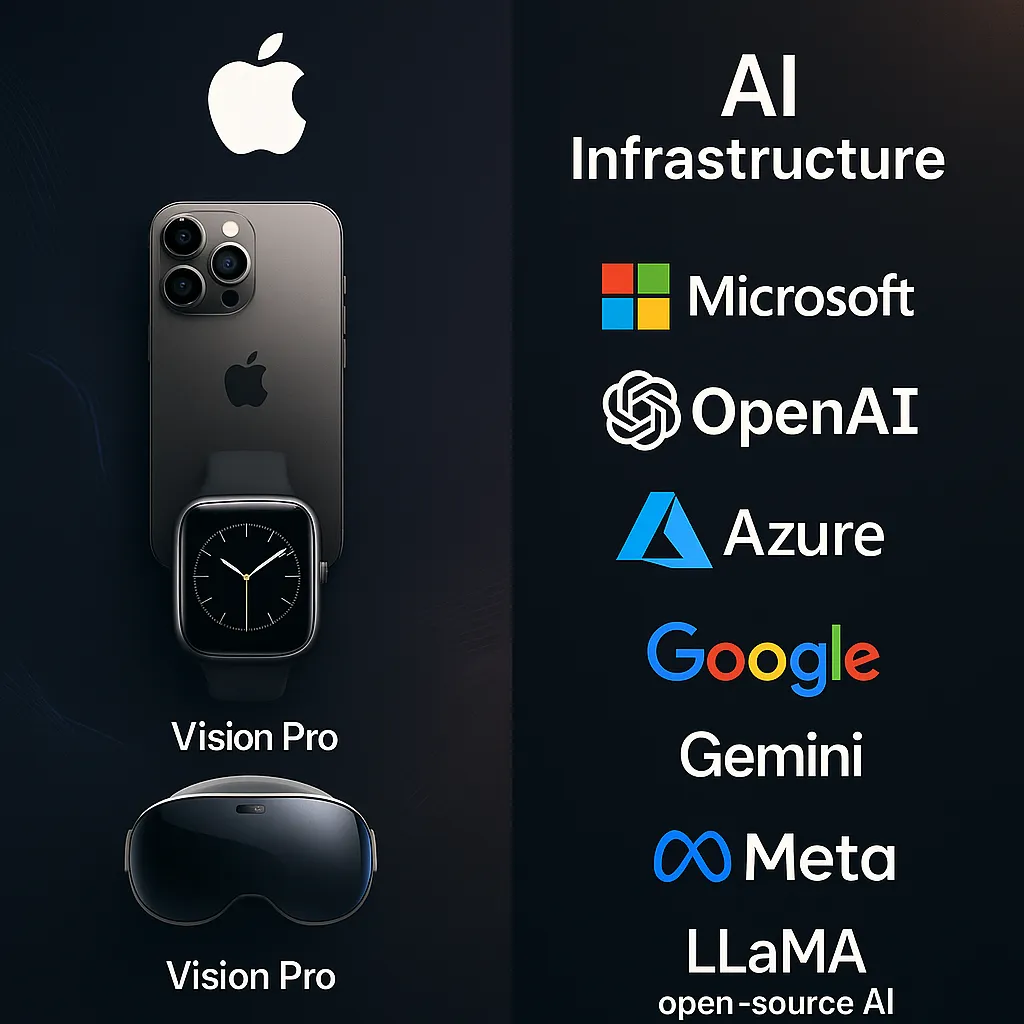
Microsoft has built the world’s most comprehensive AI-commercial stack through OpenAI and Azure. Google controls the discovery layer of the internet and owns vertically integrated AI models and infrastructure. Meta is pushing AI through both consumer and open-source channels with a long view on engagement and compute.
Apple’s advantage lies in brand, design, and privacy. But those are defensive traits. They may protect share, but they do not expand it. As software becomes smarter and more predictive, the company that owns the model and the training data will dictate value capture. Apple, for now, sits one layer removed.
Capital Allocation & Leadership
Apple’s capital return strategy has been a triumph. Buybacks have reduced the float substantially, supporting earnings per share and providing a floor during macro volatility. Its dividend, while modest, has grown consistently. This discipline is a key reason why Apple has become a favorite among institutions and sovereign wealth funds.
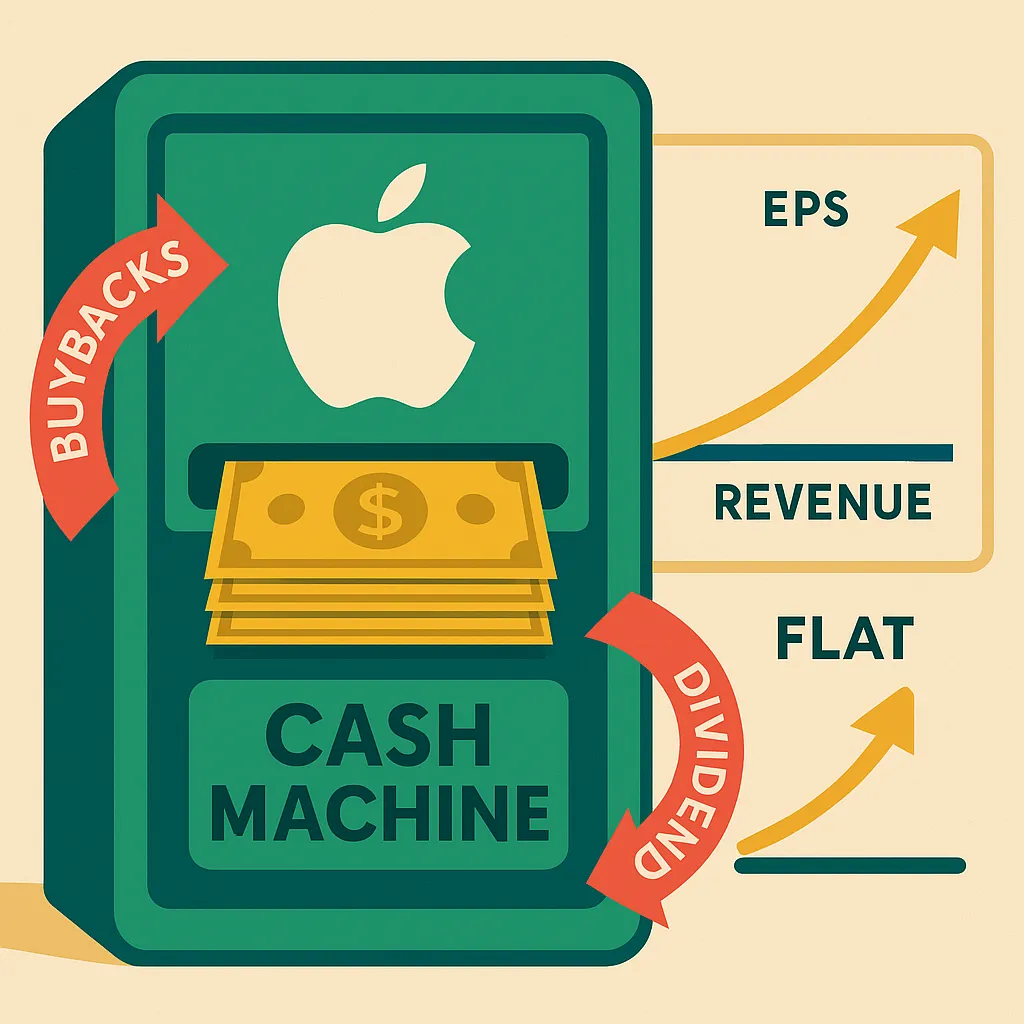
Yet there is a tradeoff. Apple has prioritized shareholder returns over transformative investment. While peers are building new infrastructure, launching foundational models, and acquiring moonshot capabilities, Apple has focused inward. R&D is lower as a percentage of revenue than many competitors. And while Apple’s leadership is stable and operationally world-class, it lacks the aggressive vision that characterized earlier chapters of the company’s history.
Tim Cook has optimized Apple. But optimization is not the same as invention.
Strategic Optionality & Future Vision
The company’s retreat from large-scale bets is also worth noting. Project Titan, once rumored to be Apple’s moonshot autonomous vehicle program, was formally shuttered in 2025. Its cancellation signaled a retreat from bold category creation. Vision Pro, while groundbreaking in some respects, has not emerged as the computing revolution it was once projected to be.
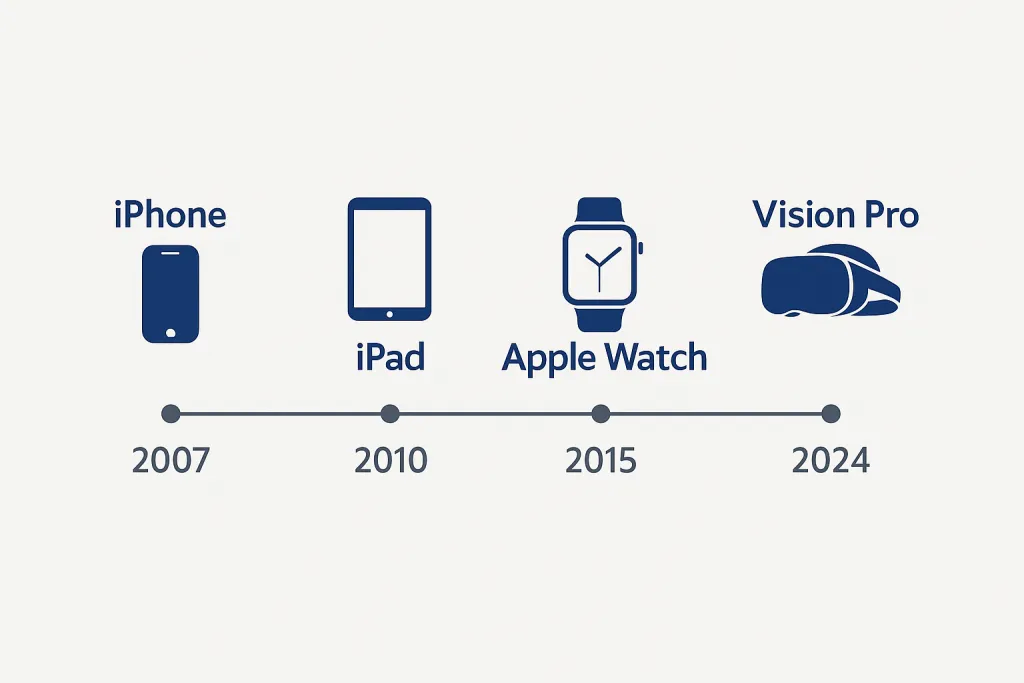
Apple’s focus on health and wellness, while promising, has not yielded meaningful new revenue streams. The Watch remains a wellness device, not a regulated medical platform. Services are growing, but AI ambitions are externally dependent. Apple does not have a cloud offering, a proprietary model architecture, or enterprise software with global reach.
In short, Apple is narrowing its aperture. The company is doubling down on user experience and privacy while letting others invest in the deep infrastructure that will define the next wave of computing. That strategic conservatism could prove costly if the future rewards platform ownership over integration.
AAPL Stock Forecast 2030
Case | EPS CAGR | 2029 EPS | P/E | 2029 Price | Est. Yield | Total Return CAGR |
|---|---|---|---|---|---|---|
Bull Case | 8% | $9.41 | 30x | $282.30 | ~0.6% | ~7.5% CAGR |
Base Case | 5% | $8.19 | 25x | $204.75 | ~0.6% | ~1.6% CAGR |
Re-Rating Case | 2% | $7.08 | 15x | $106.20 | ~0.6% | −9.6% CAGR |
Apple’s valuation outcomes hinge on whether it can grow earnings meaningfully while retaining a premium multiple. In the most optimistic case, investors are rewarded with mid-to-high single digit annual returns. This assumes steady services growth, margin resilience, and a multiple above 30. But even in this best-case outcome, Apple underperforms many younger, riskier peers.
The base case is more sobering. If EPS grows modestly and the market assigns a multiple closer to 25, returns drop to near-flat levels. The bear case, a re-rating to 15 times earnings, results in a 50 percent drawdown. Not due to failure, but simply due to perception shift.
Apple’s Growth Multiple Days May Be Numbered
Apple remains one of the highest-quality businesses in history. But its upside no longer matches its premium. The brand is intact. The cash machine is running. But innovation has slowed, and the reinvestment surface has shrunk.
With competitors chasing foundational AI, Apple risks becoming the most elegant layer atop someone else’s platform. And at 31 times earnings, the market is still pricing Apple for growth, not durability.
We would rather focus our investments in companies like Amazon that are rapidly redeploying capital into future business lines and innovations and are trading around the same PE as Apple today.
For our APPL Stock Forecast 2030 to be proven correct, Apple does not need to fail to disappoint. It only needs to stall.

Celsius Stock Analysis: The Shelf Reset and the Second Growth Curve
Celsius stock analysis of the shelf reset, Alani growth, Pepsi economics and cash flow, with a 2030 model and a Premium valuation and entry-price framework.

Meta AI Spending: The Customer Is Already Here
Can Meta turn AI spending into shareholder returns? We model advertising, Muse, hardware, capital costs and cash flow through 2030, with a full valuation.

IREN Stock Dilution: Can the Build Reach Shareholders?
IREN stock analysis of AI growth, funding and dilution through 2030. Read our full valuation, 27 scenarios and price zones free. Excel model is Premium.
Northwise Portfolios
See how the research becomes real decisions
Reader discussion
Discuss the research
Create a Free account to join the discussion with a display name.
Create a Free Account
No comments yet. Start a thoughtful discussion.