
Understanding Nebius: A Complete Guide to the Company
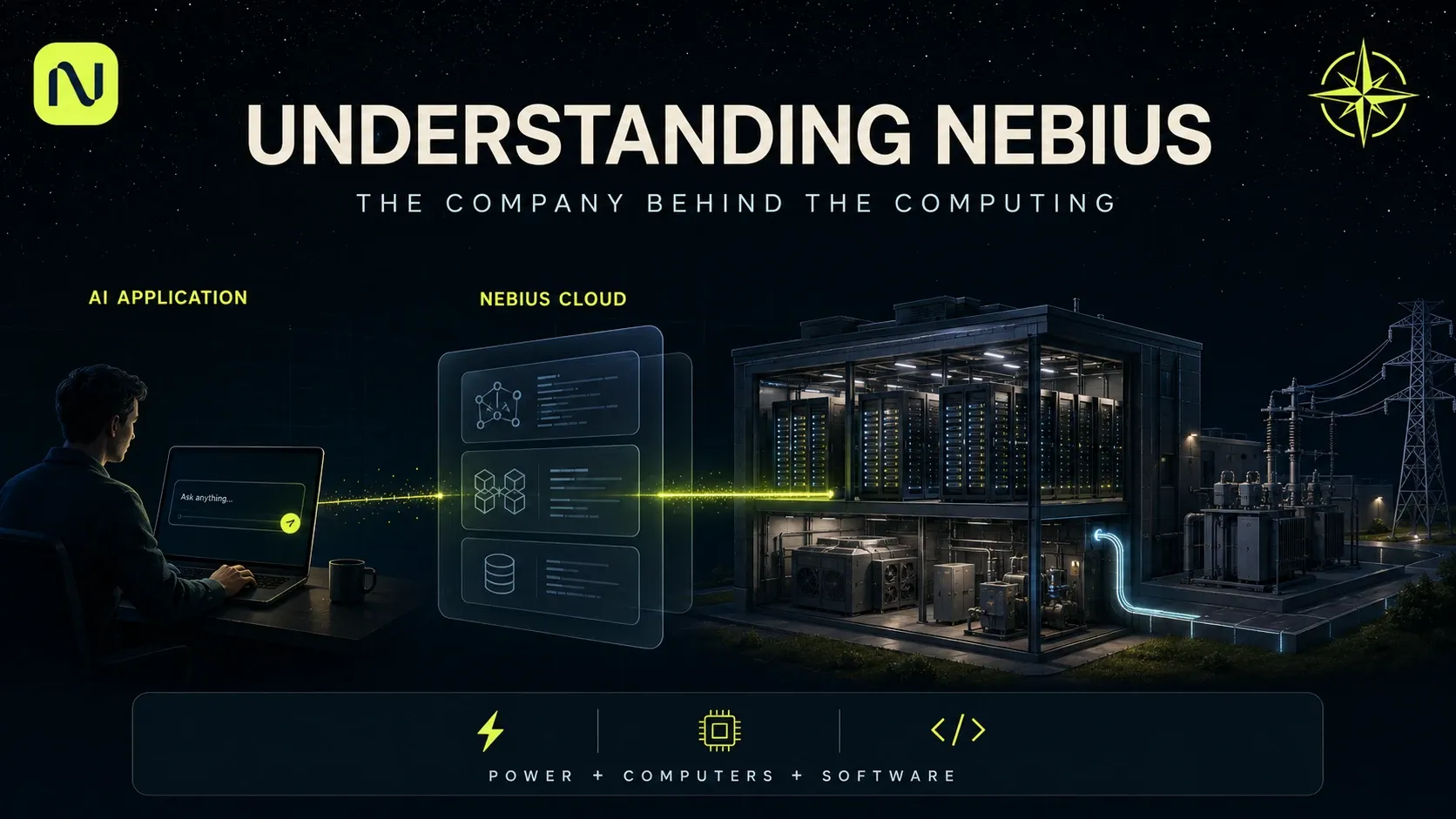
Understand Nebius from the ground up: its AI cloud, competitors, subsidiaries, funding, and growth opportunities. A complete NBIS guide with 14 illustrations.
In this article
Ask an AI assistant to explain a bill, help with a spreadsheet, or turn an idea into a video, and there is little in the experience to suggest an industrial operation. You enter a request, wait a moment, and decide whether the answer is useful. The room you are sitting in looks exactly as it did before.
Somewhere else, computers have gone to work. They draw electricity, exchange information, and produce heat that has to be removed. They sit inside a facility whose owner needed land, construction crews, electrical equipment, and permission to connect to a power network. Before your request arrived, someone had already spent money making that response possible. If the service becomes popular, someone will have to decide how much more to spend.
Nebius is building a business around those decisions. It supplies computing infrastructure and software to companies developing and running artificial intelligence, which puts it behind the applications most people encounter. Its customers may be training a new model, researching a medicine, producing video, or operating an AI system inside a financial institution. The work differs, but each customer needs dependable computers and a practical way to use them.
An NBIS share also represents interests in businesses beyond the core cloud, including ClickHouse, Avride, Toloka, and TripleTen. Their potential gives the group additional sources of upside and possible ways to fund its expansion. Understanding those businesses, and the difference between a valuable investment and cash available to spend, is part of understanding Nebius itself.
The discussion around Nebius often starts much further along. An investor encounters a billion-dollar contract, a campus measured in gigawatts, an argument about how long a GPU lasts, or a forecast for what the shares could be worth in 2030. Following the discussion requires knowledge from several industries at once. Knowing what a chip does will not explain a power agreement. Understanding revenue will not tell you who paid for the equipment that earned it. This guide connects those subjects in the order a new follower needs them, so the next announcement can fit into a business they already recognize.
Our detailed analysis is collected in NBIS Stock Forecast 2030: The Conversion Problem, the latest Northwise Nebius model report, dated August 29, 2026. It follows the company from individual sites through operating results, funding, and valuation. The guide you are reading supplies the background for that work. Links throughout lead to the relevant research when you want to investigate a subject further.
Find your way through the guide
Where to begin | What you will understand |
|---|---|
Nebius's origins, the computing it sells, and the people buying it. | |
Large customer contracts, NVIDIA, competitors, and the possibility of a durable advantage. | |
Power, facilities, Pennsylvania, the UK, and the European opportunity. | |
Pricing, ARR, construction costs, financing, profit, and equipment replacement. | |
How Nebius compares with hyperscalers, specialist AI clouds, and infrastructure developers. | |
Managed inference, tools, enterprise operations, and the possible expansion of the business. | |
ClickHouse, Avride, Toloka, TripleTen, acquisitions, and the choices they give the group. | |
Valuation, returns, and the arguments that could change our view. | |
A monitoring guide, further Northwise reading, and a glossary. |
A new name with an older engineering history
Nebius Group is headquartered in Amsterdam and listed on Nasdaq under the ticker NBIS. Its principal business is an AI cloud, meaning computing resources and related services that customers access over a network to develop and operate AI systems. The listed group also owns other businesses and investments. We will examine those separately once the main operation is familiar. Company overview
The company emerged from the restructuring of Yandex, the search and technology group co-founded by Arkady Volozh, who now leads Nebius. The Dutch parent completed the sale of its remaining interest in the Russian businesses in July 2024. Retained operations formed the basis of the business developed under the Nebius name. That separation matters when someone encounters the Yandex connection for the first time: the current investment follows what the retained organization built after the divestment. July 2024 transaction announcement
Starting again did not mean starting without experience. At launch, Nebius described a research and development organization of more than a thousand engineers and a plan to build infrastructure for AI developers. Volozh brought the experience of building and leading a large technology business, while the team brought knowledge of distributed computing: making many machines work together as a dependable service. Those capabilities are difficult to assemble quickly because they include lessons learned when systems fail, customers grow, and an apparently minor technical decision begins affecting an entire operation. Nebius's launch The new company still needed a commercial record of its own.
For a customer considering a large computing commitment, an experienced team is a reason to take a meeting. Delivering the promised service is what turns that meeting into a lasting relationship. For a lender, engineering credibility helps, but repayment needs assets and cash flows. For a shareholder, the founder's history can explain why the opportunity deserves attention without answering what price the shares are worth. We treat management's record as something that continues to accumulate through customer delivery, infrastructure development, and capital decisions. That also explains the changing emphasis in our research. Earlier Nebius work asked whether the company could secure the ingredients needed to become a serious provider. The current model devotes much more attention to what happens when those ingredients arrive at scale. Our June model report provides historical context for that progression; the August rebuild contains the more recent framework. Their dates matter because an older forecast belongs to the evidence and assumptions available when it was written.
Begin with the customer's problem
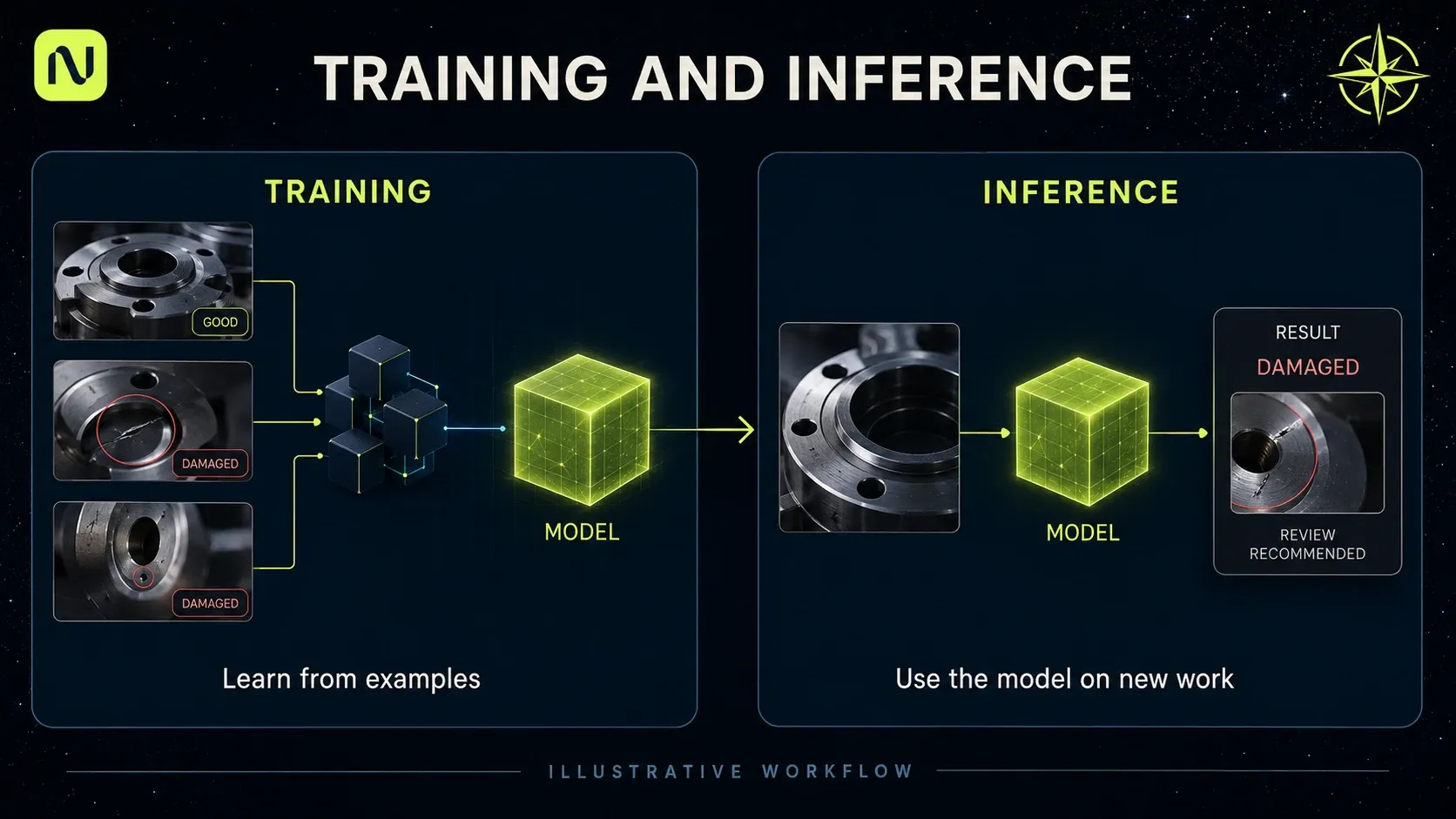
Imagine a small business developing software that inspects photographs of industrial machinery. A factory employee takes a picture of a damaged component, uploads it, and receives an assessment of what may be wrong. This is a hypothetical customer, introduced to make the commercial choices concrete.
The founders initially need enough computing to test whether their idea works. They have examples of damaged equipment, engineers developing the application, and a limited budget. Buying a large installation of expensive servers would commit money before they know whether factories want the service. Buying too little could leave the engineers waiting for experiments to finish or force them to redesign their work around inadequate equipment. Renting capacity gives them a way to proceed while learning how much they actually need. They still have to choose a provider, understand its charges, and make sure they can move their data into the environment where the work will happen.
Later, a manufacturer agrees to use the service across several plants. The problem changes. Engineers can tolerate a delayed experiment more easily than a production customer can tolerate an unreliable application. The founders now care about availability, response times, data protection, support, and the cost of every inspection. If the product sells for a few dollars per use, an unnecessarily expensive computing arrangement can consume much of the margin. If it occasionally stops working, the customer may lose confidence in the product regardless of how impressive the model appeared in a demonstration. A cloud provider serves this progression. It can offer access to individual machines, a dedicated group of machines, or a managed service that handles more of the operation. Cloud is the familiar name for accessing computing over a network; the equipment remains physical, somewhere in a building. Compute is shorthand for the processing resources doing the work.
Nebius's opportunity is to help a customer grow through these stages without making the customer become a data-center operator. The service has to earn its place through useful work completed at an acceptable cost and level of reliability. Looking at the business from this side makes the investment question more demanding than asking whether the company owns desirable chips. A customer purchases an outcome from an operating system of hardware, software, and people.
Training an AI and putting it to work
Training is the process through which a model learns patterns from data. In our machinery example, the developer might use photographs and known outcomes to improve the system's ability to recognize different kinds of damage. Developing a large general-purpose model from the beginning can require enormous computing resources, but many businesses start with an existing model and adapt it to a narrower task. Fine-tuning is one form of that adaptation: additional training intended to improve behavior for particular data or requirements. Inference is using a model to produce a result. When a factory employee uploads a new photograph and the service evaluates it, that is inference. A useful application can perform inference with a model someone else developed, which broadens the customer base beyond the laboratories producing the largest original models. The economics also shift as a project moves from development into repeated use. A training run may occupy a large cluster for a defined period. A production application needs a service that can handle requests reliably as they arrive, including the periods when usage rises unexpectedly. NVIDIA's training-to-inference discussion describes how the operating requirements can differ.
The distinction is helpful without being absolute. Developers continue testing and improving models after launch. They may run new evaluations, generate additional training examples, or adapt a model to a new customer. A successful product can therefore create repeated demand for both development work and everyday inference. An AI agent adds another layer. Instead of producing a single answer, software may call a model several times, search for information, use a tool, and check the result before completing a task. One customer request can create several pieces of computing work. For an infrastructure provider, that can increase the resources used per task, although better software and more efficient models can reduce the cost of each step. The commercial outcome depends on how those forces interact with the amount customers are willing to pay.
This is why we do not reduce the demand story to a count of chatbot users. The range of activities matters, as do their intensity, reliability requirements, and economics. More AI activity is promising for a computing provider when it becomes demand for services that can be delivered profitably.
What sits inside an AI computing cluster
The GPU, or graphics processing unit, is the component most often discussed. GPUs are suited to performing many calculations in parallel, a characteristic useful for modern AI. They sit inside systems that also contain processors for general-purpose work, memory, storage connections, and networking equipment. A server is one of those computers. A rack holds equipment inside the facility. A cluster connects computers so they can work together.
The connections are part of the product. If a training job is divided across many machines, those machines have to exchange information. Waiting for data can leave expensive chips underused. Storage must deliver the information quickly enough, and memory must accommodate the work being performed. A failure in one part of the installation can interrupt a task using many other parts. That is why a list of chip quantities gives only a partial description of what a customer can accomplish. The engineering task is to make the whole installation productive, recover from problems, and give the customer an environment it can operate without continually rebuilding the plumbing. NVIDIA's system configuration guidance reflects the importance of complete system design.
When Nebius announces capacity using Blackwell or Vera Rubin, it is naming an NVIDIA hardware generation. New generations can differ in performance, memory, networking, cooling requirements, power consumption, and price. A comparison needs to identify what is being counted. One rack may be much more expensive than another while also drawing more power and doing more work. Cost per rack, cost per megawatt, and cost per completed customer task can move by different amounts.
That final cost determines whether our factory-inspection customer can afford to serve another plant.
Our model therefore considers hardware within the facility where it will operate and the contracts it is expected to serve. A cheaper purchase can become an expensive decision if it produces less useful output from a scarce power connection. An expensive new system can also disappoint if its advantages do not translate into paying demand. Equipment quality and investment quality meet only after the work, price, and cost are considered together. The hardware sections of The Conversion Problem examine that relationship in the forecast.
The software that makes the machinery usable
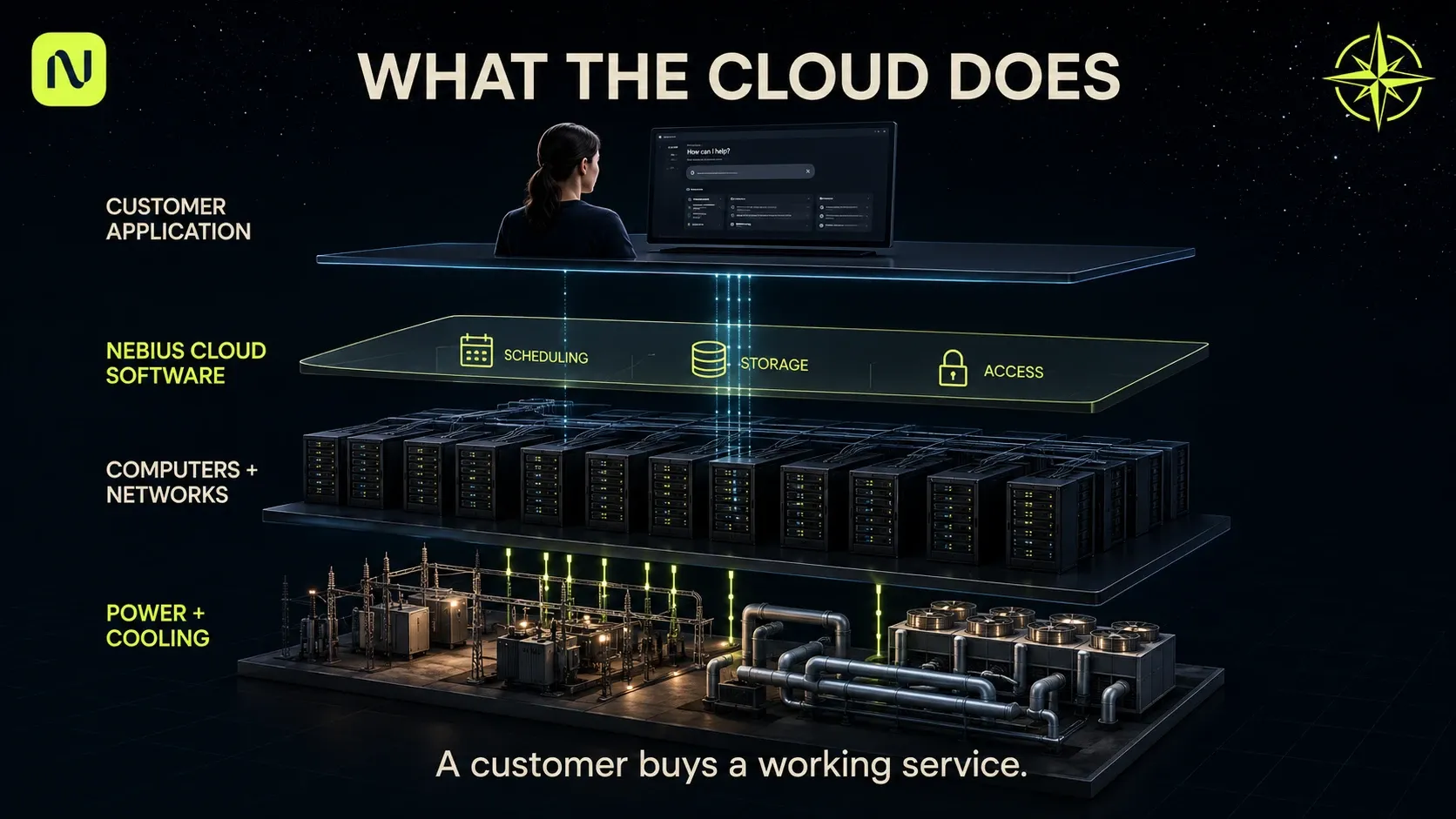
Our hypothetical customer does not want its engineers spending every morning deciding which machine should run a task or investigating why a storage connection failed. The more operating work the provider can handle well, the more time the customer can spend improving its product. That is where the cloud software enters the business. Nebius AI Cloud, also called Aether, is the platform through which customers use computing, storage, networking, and related services. Some of its work concerns orchestration, the process of coordinating resources and jobs. Other parts concern security, access, costs, and day-to-day operations. A developer needs to launch work, preserve data, see what has failed, and know who can change the environment. As a customer grows, requirements that seemed secondary during an experiment can become conditions of doing business.
The June 2026 Aether 3.6 release included developer improvements, spending controls, and security capabilities such as customer-managed encryption keys. An encryption key helps control access to protected data; giving a customer control over keys can be material to its security review. The release is an example of Nebius developing the operating environment around the machines. Aether 3.6 announcement
Token Factory offers a more managed route to using AI models. Nebius introduced it as an inference platform for deploying and optimizing open and custom models in production. A customer can use the service through an API, a defined way for one software system to make requests to another. The customer sends work through its application, and the provider handles more of the infrastructure serving the model. The name refers to tokens, the units into which language models break text for processing; a token might be a word, part of a word, or punctuation. Token Factory launch
Open models give customers access to model components they can run or adapt under the applicable license. The freedom and restrictions differ by model. Their relevance to Nebius is commercial: a company may want to select its model and retain more control over how it operates while purchasing infrastructure and support from a specialist. That creates a route to serve customers whose needs extend beyond access to one proprietary AI product. The product set has been widening. Nebius announced the Tavily acquisition agreement in February 2026 to add search capabilities for AI agents. Search can provide fresh external information to a system whose original training does not contain what happened this morning. That helps explain why a computing company would acquire software further up the customer's workflow. Tavily announcement
More products will make Nebius easier to misunderstand if every new name is treated as a separate investment thesis. We prefer to ask what customer problem a product solves, whether it increases usage or improves economics, and how it fits into the existing service. Product breadth becomes valuable through adoption. It also creates integration work and expenses, and a company can acquire useful technology without yet knowing how much profit it will contribute.
Who buys these services
Different customers value different parts of the offering. An AI laboratory may need a very large cluster to develop a model. A young application company may prioritize access and flexibility because its demand remains uncertain. An established enterprise may place greater weight on security, support, and predictable costs. Researchers can need substantial computing without having the staff or budget to build a permanent installation themselves. The UK provides concrete examples. Nebius's June 2026 update described Revolut using Token Factory for financial-crime agents and customer-support orchestration, and identified research-oriented customers including Prima Mente. Those examples demonstrate uses beyond a general-purpose chatbot. They do not, by themselves, disclose how much revenue each relationship contributes or establish that a particular workload runs at Harlow. UK customer and expansion update
For the customer, choosing a provider may involve a trial, performance tests, a security review, negotiations, and the work of moving an application into production. Winning a customer is therefore more than announcing that machines are available. Retaining one is more than making those machines fast. The provider must continue meeting the customer's requirements as the workload evolves and other suppliers make competing offers. A smaller initial relationship can become much more valuable if the customer succeeds, expands usage, and finds the operating environment dependable enough to remain.
This is one of the more attractive possibilities in the Nebius story. The company can grow by bringing more capacity online and by becoming more important to customers it already serves. Those routes reinforce each other when the service works well: more available capacity accommodates customer growth, and stronger relationships make future capacity easier to sell. They can also fail to reinforce each other. Building ahead of demand leaves idle equipment; winning demand faster than delivery can create frustrated customers.
A new route to enterprise customers
On September 8, Palantir named Nebius its preferred sovereign AI infrastructure partner. After integration, eligible Palantir customers are intended to access Nebius compute and inference within the Palantir environment. Source: Palantir and Nebius partnership announcement
For this guide, the development adds a distribution relationship alongside Nebius’s direct cloud and dedicated-capacity business. It does not establish a booked revenue amount, an installed cluster or utilization at a particular campus. The distinction between commercial access, a signed workload commitment and earned revenue remains central.
Why Microsoft and Meta buy outside capacity
Microsoft operates an enormous cloud business. Meta develops and runs major AI systems. Both have the resources to build infrastructure, so their willingness to buy from Nebius can initially seem puzzling.
Their size does not remove the practical constraints. They can want capacity in a location or on a timetable that their internal construction programs cannot satisfy. Buying externally can complement building internally, spread execution risk, or provide a particular configuration sooner. An outside provider earns its place when it can supply useful capacity on terms the customer considers worthwhile. That relationship can remain valuable for years without requiring the customer to give up its own infrastructure ambitions.
Nebius announced its Microsoft infrastructure agreement in September 2025. The company described the arrangement as supporting the expansion and financing of its cloud business. That establishes the two roles a major contract can play: creating future revenue and helping the provider obtain the resources required to deliver it. Microsoft agreement
The March 2026 Meta agreement has two components. One provides $12 billion of dedicated capacity over five years, with delivery beginning in early 2027. The other concerns up to $15 billion of additional available capacity: Nebius intends to sell that capacity to other customers, with Meta purchasing what remains under the arrangement. The headline of up to $27 billion combines those commitments. Reading the structure matters because it describes a different commercial arrangement from a single fixed annual order. Meta agreement
A financially strong customer can make a project easier to fund. Lenders can assess contracted payments alongside the equipment and other collateral, meaning assets that support repayment. The customer may also provide money in advance. In exchange, it can negotiate pricing, delivery schedules, priority, or other valuable terms. None of that is inherently good or bad for the provider. What matters is the return left after supplying what was promised. A large headline can describe an excellent contract or a demanding obligation with modest margins; size alone does not distinguish them.
Northwise views these relationships as an important route to scale. We also care about the development of the wider cloud business, because customer concentration gives a small number of buyers considerable influence. A hyperscaler, the term for a very large cloud operator, may be a customer in one context and a competitor in another. Nebius's long-term position would be stronger if many customers chose it for capabilities they continued to value after urgent supply shortages eased.
The companies competing for the same customer
Return to the founders building our machinery-inspection application. They have a working product, factories asking to try it, and a decision about where the next stage of computing will run. Nebius may be on their shortlist. So may a large cloud they already use, another specialist AI provider, or a service that lets them call a model without renting a cluster themselves. Each offer solves a slightly different problem, which is why a comparison based only on GPU prices can miss the decision the customer is making.
The competitive landscape has several overlapping parts.
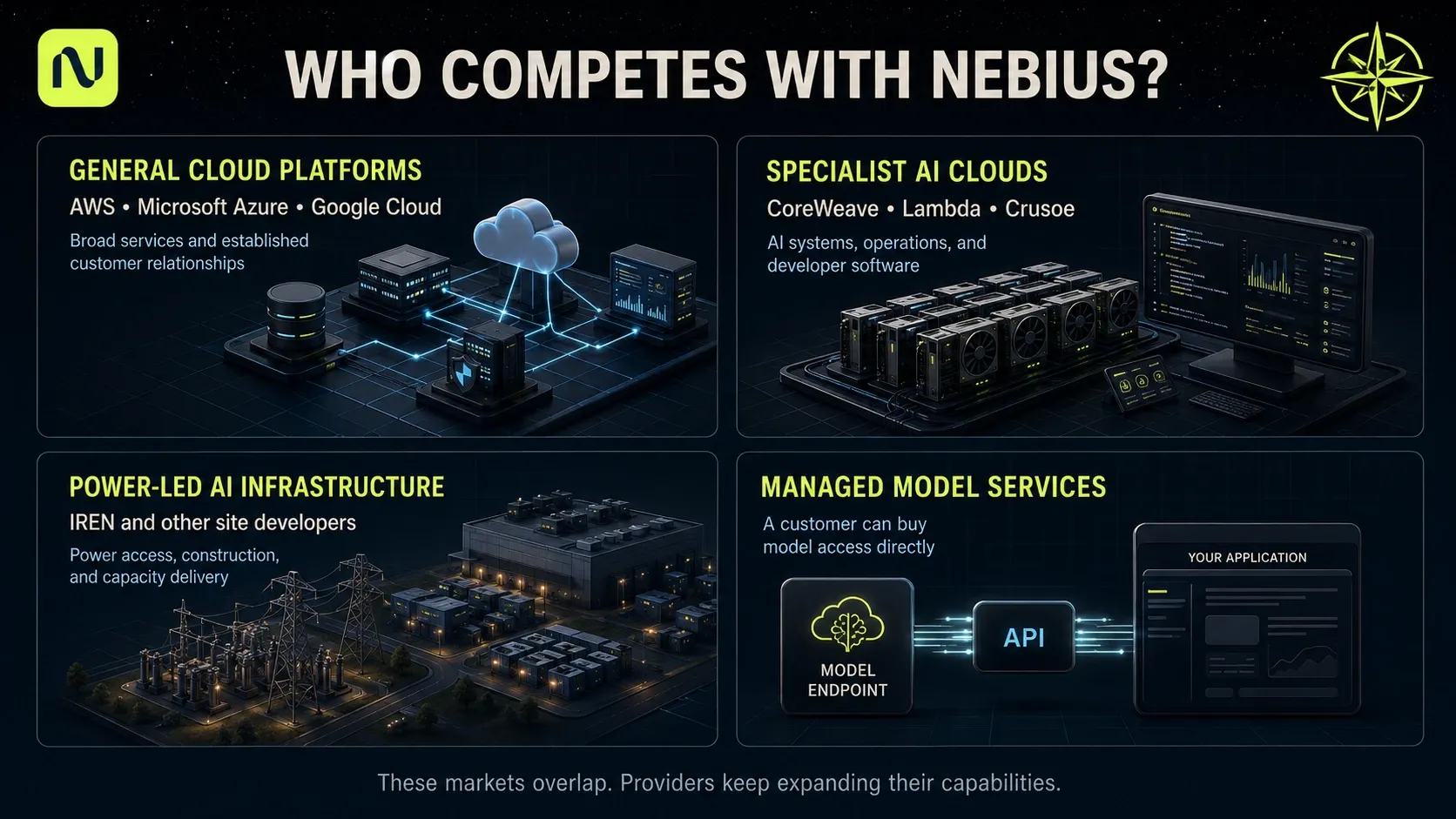
Amazon Web Services, Microsoft Azure, and Google Cloud bring broad portfolios of infrastructure, databases, security, developer tools, and commercial relationships. For an established company, keeping a new AI application near its existing data and internal systems can have real value. Its employees already know the environment. Procurement has approved the supplier. Security teams have reviewed the controls. Moving one demanding workload elsewhere may still make sense, but the specialist has to offer enough benefit to justify that additional relationship. These providers also sell managed model services. Amazon Bedrock, for example, gives developers access to foundation models and tools for building applications without managing the underlying infrastructure themselves. AWS service overview
Nebius does not need to replace every service that those companies provide. It needs to win a useful part of a customer's work. A company can keep its ordinary business systems on an established cloud while placing a demanding training or inference workload with a specialist. That makes the addressable opportunity larger than a simple all-or-nothing cloud migration, while also limiting how much of the customer's total technology budget Nebius initially receives.
CoreWeave is a closer comparison because it also combines large AI computing installations with a service designed around demanding AI workloads. Its position cannot be reduced to owning GPUs. CoreWeave's integration with Weights & Biases extends into the software used to develop, observe, evaluate, and improve models. Its March 2026 platform update included new model-development capabilities alongside newer hardware, and its August discussion described connecting training, inference, evaluations, and feedback. Nebius's move toward a broader operating platform therefore takes place against competitors pursuing similar customer relationships. CoreWeave platform update, CoreWeave's development workflow
Lambda and Crusoe add further competitive pressure. Lambda participates in both training and inference performance testing, while Crusoe offers infrastructure alongside managed inference and model customization. These are examples of a market in which specialist providers keep moving into adjacent services. A feature that differentiates one supplier today can become an expected part of the offering. That does not make software investment pointless. It means the advantage has to survive continued competition through performance, ease of use, customer trust, or economics that are difficult to reproduce. Lambda's published inference work, Crusoe's cloud services
IREN illustrates another route into the market. Its infrastructure footprint and development capabilities give it a position in securing power and delivering large installations. Its announced Microsoft agreement includes GPU cloud infrastructure, so describing it only as a landlord would understate the overlap with Nebius. The comparison depends on the particular offer: who supplies the machines, who operates them, how much software the customer receives, and which party bears the funding and replacement obligations. A megawatt sold with one set of responsibilities should not be compared directly with a megawatt sold under another. IREN's Microsoft agreement
Competitive route | What can attract the customer | What Nebius needs to demonstrate |
|---|---|---|
AWS, Microsoft Azure, and Google Cloud | Existing systems, broad services, procurement familiarity, and large operating platforms | Enough benefit in the chosen workload to justify using another provider |
CoreWeave and other specialist AI clouds | AI system performance, dependable capacity, engineering support, and development tools | Competitive delivery, useful software, and good economics for completed work |
Lambda and Crusoe | Focused AI offerings with increasingly broad training and inference services | A service customers prefer as their applications become more demanding |
IREN and other infrastructure developers | Power access, construction capability, and large capacity commitments | Delivery and returns measured on comparable responsibilities and power definitions |
Managed model services | Fast access to a capable model without operating the underlying environment | A compelling reason to choose Nebius's managed service or more direct control of computing |
These categories help organize the comparison; they are not permanent boundaries around the companies.
For our hypothetical customer, the most useful test is a trial using its actual photographs, models, and response-time requirements. How quickly does the work finish? How often does it fail? What happens when demand doubles? Can the engineers understand the bill and recover from an outage? The quoted hourly rate is only one input. A cheaper machine can produce a more expensive completed task if it spends time waiting for data or requires more engineering attention. A technically impressive platform can also lose if the customer cannot obtain capacity when it needs it.
The advantage we are looking for at Nebius is a combination that customers experience: systems that work well together, access to capacity, software that removes operating work, and support that makes expansion less difficult. Its European presence can matter to customers with regional requirements, although location by itself does not settle questions of jurisdiction, governance, or security. Its portfolio of businesses and investments can give management additional funding choices, which we examine later. Neither characteristic grants an automatic victory in a customer evaluation.
Competition also limits how much of an efficiency improvement Nebius can keep. If software lets a GPU serve more requests, the company might earn a better margin, lower prices to attract more work, or do some of each. Rivals improving at the same time can force more of the saving toward customers. We would look for evidence in customer retention, expansion, realized prices, and cash returns, rather than declare a durable advantage from a benchmark position alone. A provider can be excellent at engineering and still operate in a market where buyers capture much of the benefit.
In March 2026, NVIDIA and Nebius announced a partnership that included a $2 billion NVIDIA investment. It gives the strategic relationship tangible financial weight. Nebius still has to turn access to technology and capital into dependable service and attractive returns. NVIDIA partnership announcement NVIDIA occupies a different place in this discussion. It is a critical technology supplier and a strategic partner, while its products also help competing providers improve. The supplier's ecosystem can expand Nebius's opportunity and reduce the uniqueness of particular capabilities at the same time. The company-specific question is how effectively Nebius turns those shared building blocks into a service customers continue choosing.
The long journey from a site to a customer
Power is prominent in Nebius coverage because computing equipment cannot operate without it. A megawatt, abbreviated MW, measures a rate of supplying or using electricity. A gigawatt, or GW, is 1,000 MW. Energy measures electricity used over time: a facility drawing one megawatt for one hour consumes one megawatt-hour. A large power commitment tells you about potential operating scale, subject to what has been secured and delivered.
It does not tell you how much work is reaching customers today.
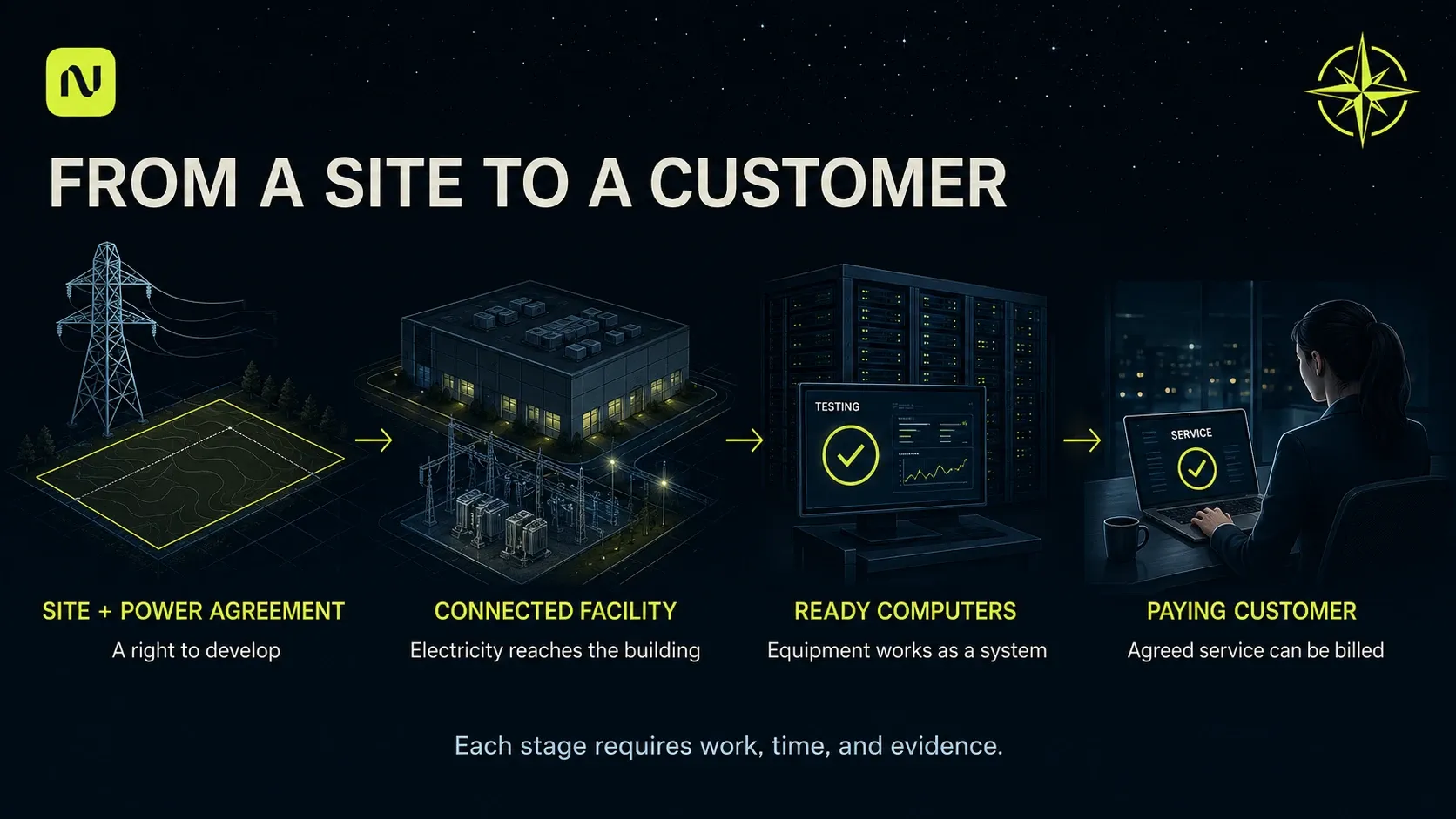
Imagine a developer announces a campus designed to support 100 MW. It may have control of the land and an agreement describing future power service. It still needs the relevant approvals, a completed facility, electrical infrastructure, and the equipment that will use the power. Some activities overlap, and the exact sequence differs by site, but progress in one area does not complete the others. A power agreement can coexist with an unfinished substation. An equipped building can still require testing. A functioning cluster can be awaiting customer onboarding.
This is the sequence our Nebius research follows:
What has been established | What the milestone contributes | What it does not establish on its own |
|---|---|---|
Site control and land-use permissions | A basis for pursuing development at a particular location. | A completed facility or available electricity. |
Power arrangements | An agreed or planned route to electrical service, subject to the terms and remaining work. | That the full amount is connected now. |
Facility and electrical delivery | Buildings and supporting systems reaching the required operating state. | A fully commissioned customer cluster. |
Installed and commissioned equipment | An integrated system that has been tested and made ready for its intended work. | That all capacity is occupied or billable. |
Customer service and acceptance | Delivery under the relevant commercial agreement. | The ultimate profitability of the contract. |
Commissioning is the testing and preparation that establishes whether systems work together as intended. It can involve electrical equipment, cooling, networking, software, and customer-specific requirements. The last stages matter financially because costs can start before revenue does. Equipment may already have been paid for; staff may be working; rent or interest may be accruing. A delay close to completion can therefore be expensive even if the remaining task sounds small compared with the construction already finished.
When a forecast refers to connected power, active IT power, or billable power, it is trying to distinguish stages in this process. The company's precise definitions need to be read alongside the model's definitions. Our latest model report explains how its capacity schedule converts site-level assumptions into revenue-producing equipment. It also keeps an explicit allowance for future capacity that has not yet been assigned to a named site. An unidentified future project should carry a different level of confidence from a documented facility nearing delivery.
Cooling, power, and the economics of a building
Electricity entering a data center supports more than the computers. Cooling systems remove heat, electrical equipment distributes power, and other systems keep the facility operating. IT power refers to the computing equipment itself. Total facility power includes supporting systems. Confusing those quantities can produce a misleading estimate of how much computing a location can support.
Power usage effectiveness, or PUE, compares total facility energy with the energy used by IT equipment over the same period. A PUE of 1.20 means the facility uses 1.20 units in total for every unit used by IT equipment. It describes infrastructure overhead. An annual measurement, design target, and snapshot at one operating load deserve different treatment. The Green Grid's PUE definition
Consider two otherwise comparable installations, each with 100 MW of available facility power. If they operated at power ratios corresponding to PUEs of 1.20 and 1.40, the implied IT allocations would be about 83.3 MW and 71.4 MW. These are illustrative calculations, not claims about Nebius sites. They show why efficiency affects how much computing can fit behind a given connection. They also show why an analyst should not subtract 20% from facility power when using a ratio of 1.20; the calculation is division by 1.20.
Cooling choices become more consequential as equipment becomes denser. Liquid cooling transfers heat using liquid within the cooling system, potentially close to the chips. Its design, water requirements, electrical consumption, and suitability for a specific building need to be assessed together. The phrase alone does not settle a site's environmental footprint. Nor does a statement about renewable electricity answer every question about transmission capacity, backup generation, water, or local effects.
Those issues enter the investment case through real obligations. Residents may ask about noise, traffic, utility costs, and the benefits the project will bring. Local authorities may impose conditions or require changes. Treating the community as an obstacle to be dismissed misses the operating reality: the company needs a facility that can coexist with its location for many years. Good execution includes choosing appropriate sites, explaining the project accurately, and meeting the requirements attached to approval.
Different ways to obtain a data center
Nebius can own a facility, commission a building from a specialist, or place its equipment in another operator's campus. Those arrangements change the upfront spending, the continuing obligations, and how much control the company has over future decisions.
Arrangement | Basic meaning | Economic consideration |
|---|---|---|
Owned greenfield | Develop a new facility on a new site. | Substantial development responsibility and capital, with direct control of the asset. |
Owned brownfield | Redevelop or expand an existing property or facility. | Potential advantages from existing infrastructure, alongside constraints inherited from the site. |
Build-to-suit | Another party develops a facility for the tenant's requirements. | Less direct construction funding in some structures, with significant lease or contractual obligations. |
Colocation | Use space and supporting infrastructure in another operator's facility. | A route to deployment that depends on the provider's available space, technical suitability, and contract terms. |
There is no universally best structure. An owned campus can give Nebius more freedom over electrical design, cooling, and equipment replacement, but it makes the company responsible for a large development program. A suitable existing facility may bring capacity to market sooner, which can be valuable when customer demand is immediate. It may also impose layout or cooling limitations that do not exist in a purpose-built campus. A forecast should reflect the particular property and contract rather than award a fixed advantage to ownership or leasing.
Leasing changes where costs appear. A lower capital-expenditure number can coexist with years of rent or lease obligations. Investors comparing two providers therefore need to look beyond which one reports less construction spending. The practical question is what it costs to obtain and operate equivalent useful capacity, including commitments that sit outside the most visible capex line.
This distinction is central to our site work. Pennsylvania tests a large owned development. Longcross and Harlow illustrate routes through established UK data-center operators. The properties sit within one corporate strategy, but they should not inherit the same assumptions simply because the same company will sell the computing.
Pennsylvania makes the development process visible
Nebius's Highridge project in Pennsylvania is a useful example of how a major plan becomes more credible in stages. Our September 3 update describes a proposed campus of up to 1.2 GW, with core land acquired and additional expansion land subject to an agreement of sale. The August 31 zoning decision extended the relevant overlay across the planned footprint, clearing a condition that mattered to the expansion. Closing on the remaining land and completing the later development and electrical work remained separate questions in that review. Northwise's Pennsylvania research
The distinction can sound fussy until you consider the alternative. If the expansion land cannot be used for the intended purpose, the maximum campus plan changes. Clearing that hurdle improves the route to the larger project. But a permitted use does not install transmission equipment, test a cooling system, or start a customer contract. Valuing the milestone requires understanding what it makes possible and what must still follow.
The size of the site makes sequencing important. A company rarely needs to finish an entire gigawatt-scale campus before serving its first customer. Development can proceed in phases as power, buildings, and equipment become ready. Each phase has a timetable and funding need. A first phase arriving on schedule can validate part of the plan without proving the rest will arrive on the original dates. Conversely, an issue affecting a later phase need not mean the earlier operating capacity has failed. Our Pennsylvania investigation also compares the company's account with land and utility evidence. The relevant question is whether independent records support the same location, scale, and timeline, and where the remaining gaps sit. Readers who want to understand why a township vote or a transmission presentation can matter to an AI investment will find the detailed sequence in Nebius Pennsylvania: The Full Highridge Footprint Clears Zoning.
The financial lesson applies well beyond Pennsylvania. Money committed too early can sit behind a delayed project. Equipment ordered too late can leave a finished facility unable to serve customers. Coordinating construction, hardware delivery, and contract timing is an operating skill with direct consequences for returns. It is one of the reasons we pay attention to management's repeated performance across sites rather than treating every campus announcement as an isolated success.
Harlow, Longcross, and the European customer
The UK offers a different view of the expansion. Our Longcross research examines Nebius's deployment at an established campus in Surrey. Harlow adds another location through Kao Data, which announced a 22 MW, ten-year agreement with Nebius in June 2026. The arrangement brings Nebius AI Cloud and Token Factory into facilities operated by Kao. Kao's Harlow announcement The interesting timing question at Harlow involves two buildings. Our later research connects disclosures about an existing building and a larger facility under development, identifying an inferred 4.4 MW allocation in the existing building within the 22 MW agreement. That interpretation could matter if some capacity reaches customers before the larger building begins service. The allocation is an inference from the evidence, and a precise September revenue start was not established in our September 5 review. Nebius Europe: Sovereign AI, Harlow and 2026 ARR
A small earlier deployment can matter without transforming the whole year's financial result. It can establish a customer relationship, bring forward some revenue, and demonstrate that a local service is available. Its financial contribution still depends on the equipment installed, the customer agreement, and when service begins. In a fast-growing company, these smaller deployments can be easy to overlook because the largest campus headlines dominate attention.
Geography also affects who can buy the service. A laboratory may want computing near an established research community. A business may need particular data-handling and administrative controls. Public institutions may care about the resilience of local computing capability and the development of domestic expertise. Sovereign AI is a broad term for efforts to retain greater control over AI infrastructure, data, and capabilities. The commercial opportunity is strongest where those preferences become specific procurement requirements that Nebius can meet.
A local address is one part of that assessment. Customers may also care about who administers the systems, who controls encryption keys, which contracts apply, and how dependent they remain on outside suppliers. The UK and EU have distinct policy and procurement frameworks, so a British facility should not automatically be treated as participating in an EU program. Our Europe and Harlow report develops the distinctions and the customer context in more detail. Nebius's wider European plans include an established Finnish presence and larger future developments. Its March 2026 Finnish announcement described a completed Mäntsälä expansion alongside a new project at Lappeenranta expected to begin serving customers in 2027. An operating facility and a future campus can both be strategically important while contributing to the business on different schedules. Finnish expansion announcement
The attraction for us is that infrastructure, customer control, and the software platform can support the same commercial proposition. Nebius has to turn that proposition into customer commitments and attractive economics in each market. A favorable policy discussion helps establish why the market might exist; it cannot supply the contract terms or commissioning date.
How a computing service earns revenue
Once equipment is ready, the economics depend on the arrangement through which a customer uses it. Some customers purchase flexible access and pay according to usage. Others reserve capacity for a defined period. A large dedicated deployment can involve a negotiated agreement with specific service, delivery, and payment terms. The provider's task is to assemble a mix of business that keeps capacity productive while earning enough to justify the assets and operating costs.
Contract duration changes the bargain. A customer willing to commit for years can give the provider more confidence in future payments, which may help support financing. In exchange, it may negotiate a lower price or other benefits. A customer with an urgent, short-lived need may pay more for immediate availability. The attractive price comes with less certainty about what happens when the short contract ends. Neither contract type should be assessed on price alone, because duration, customer quality, operating requirements, and payment timing all affect its value. Total contract value is the amount associated with an agreement over its stated term, subject to the conditions included in the disclosure. Annual contract value expresses a yearly amount. Revenue is what the company recognizes as it supplies the service under the applicable accounting treatment. Cash is what it has collected. A $1 billion agreement can involve several years of revenue, advances collected before delivery, and services that have not yet begun. Those quantities belong to one commercial relationship but answer different questions.
Our model follows capacity as it enters service under different contracts. A cohort is simply a group being tracked together, often equipment or agreements from the same period. If one group of capacity begins under a three-year contract and another under a six-month arrangement, they will face renewal decisions at different times. The price on a newly signed deal does not automatically reprice the older group. The contract framework in our latest model follows those differences through the forecast.
Consider a hypothetical provider with ten identical units of capacity. Nine are committed at $10 each per month, and the last sells at $20 because a customer needs it urgently. Total monthly revenue is $110, or $11 per unit. Valuing the whole installation at the newest $20 price would imply $200. The latest contract is encouraging evidence of what an available unit can earn; it does not rewrite the other nine agreements. If their renewals occur during a period of greater competition, they might never receive the same premium.
That is the reason we spend time on pricing across the fleet rather than extrapolating the most exciting deal. The company can benefit from strong marginal demand while still having a more ordinary average price. The reverse can happen during a slowdown, when older contracts protect revenue for a period even as new business becomes less attractive.
Revenue, ARR, and the month that changes the headline
Nebius defines ARR as annualized run-rate revenue, calculated by multiplying AI-cloud revenue in the last month of the quarter by twelve. It is a measure of the pace reached in that month. The definition appears in the Q2 shareholder letter.
Suppose an imaginary business earns $1 million in each month from January through November and $2 million in December. Its full-year revenue is $13 million. Annualizing December produces a $24 million run rate. The difference has a straightforward explanation: most of the year occurred before the business reached December's size. To earn $24 million over the next year, it would have to maintain that monthly pace throughout the period. ARR does not establish that it will.
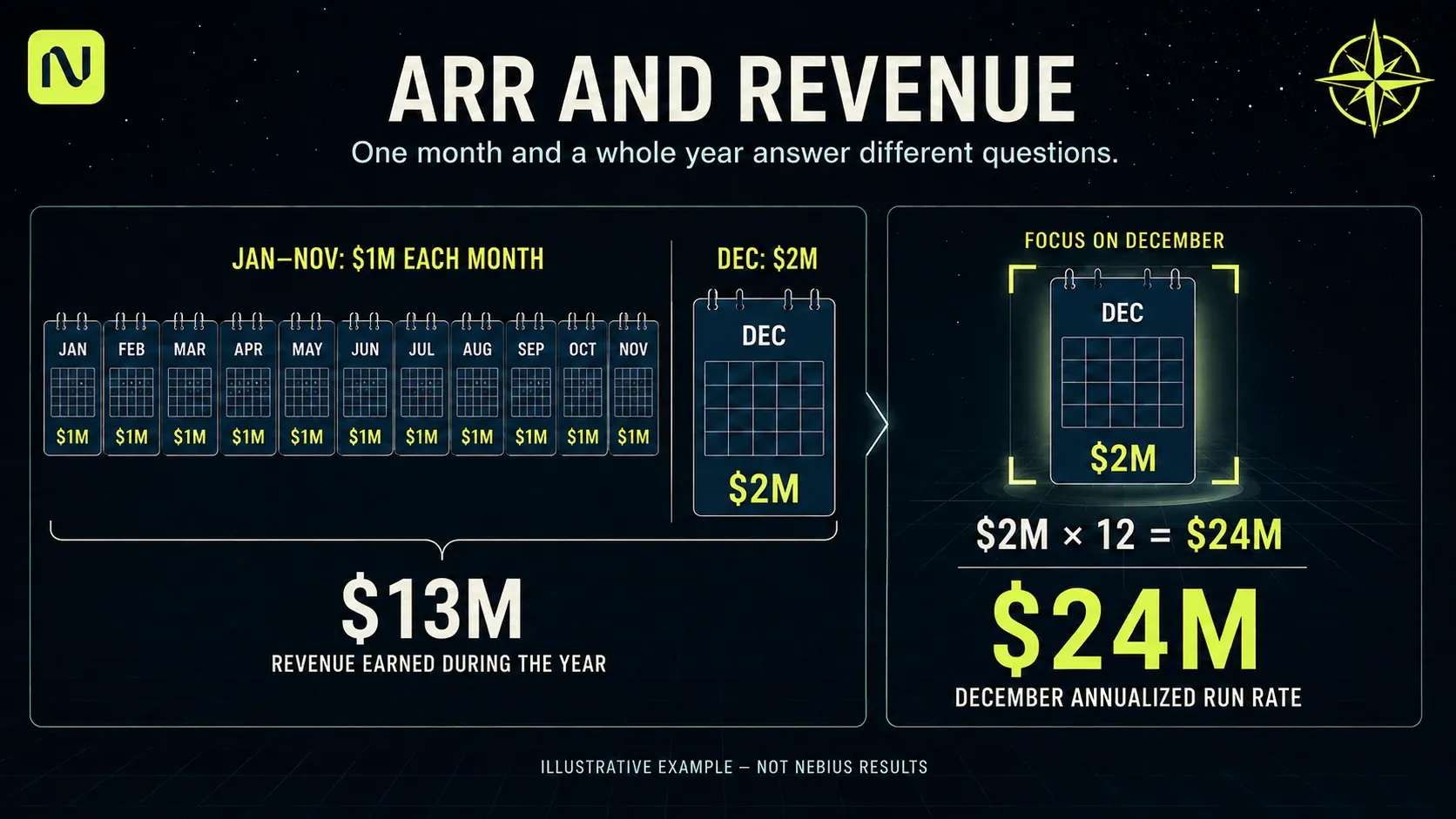
Fast infrastructure growth makes the timing especially consequential. A cluster entering service late in the year can make the year-end business look substantially larger without having contributed much to the year just completed. Similarly, a September start can affect third-quarter ARR while an October start falls into the fourth quarter. Those dates may describe very similar long-term projects, but they produce different reporting-period results.
Even a start inside September needs precision. If a hypothetical installation earns $3 million during a full thirty-day month and begins billing on September 25 at that same daily rate, six days contribute $600,000. Multiplying that amount by twelve gives a $7.2 million contribution to September-based ARR. A full month at the same rate would produce $36 million. The example assumes immediate full-rate billing and no earlier revenue. A gradual customer ramp or different contract treatment would change the result. This is the distinction explored in our Harlow timing analysis.
Here is the reported reference point for this edition:
Measure | Q2 2026 reference |
|---|---|
Group revenue for the three-month quarter | $582.3 million |
AI-cloud revenue for the quarter | Approximately $575 million |
AI-cloud ARR at the end of June | $3.0 billion |
AI-cloud adjusted EBITDA margin | Approximately 50% |
Management's year-end contracted-power target | 5 GW |
The table combines results, a run rate, an operating margin, and a future target. Contracted power refers to land and power commitments. It is a different stage from capacity already serving customers. Q2 shareholder letter
One more distinction matters when reading forecasts. An analyst may calculate a model's contract run rate using installed capacity and assumed pricing. That can help estimate the future, but it is not automatically identical to Nebius's reported last-month calculation. The bridge must allow for when service began, customer usage, interruptions, and the revenue recognized in the actual month. Similar labels can conceal different calculations.
Following one year through our model
The August 29 Northwise model gives these distinctions a concrete application. In its base case for the end of 2026, it assumes 900 MW of connected facility power. After accounting for commissioning readiness and facility overhead, it estimates roughly 580 MW of active IT power. Customer acceptance brings the estimate of billable IT power to approximately 522 MW. The model's average billable capacity across the year is about 287 MW because much of the year occurs before the newest capacity arrives. These are dated Northwise scenario outputs, not four separately reported company results.
The same modeled 2026 business | Capacity |
|---|---|
Connected facility power at year-end | 900 MW |
Active computing power at year-end | Approximately 580 MW |
Billable computing power at year-end | Approximately 522 MW |
Average billable computing power through the year | Approximately 287 MW |
Each step answers a question the previous number could not. The connection tells us what has reached the facility. Active IT power reflects the equipment ready to perform work after the modeled readiness and overhead adjustments. Billable power brings the customer into the calculation. The annual average introduces time. A reader comparing the 900 MW headline with the revenue earned during the entire year is therefore comparing a year-end facility measure with income produced by a much smaller average billable installation.
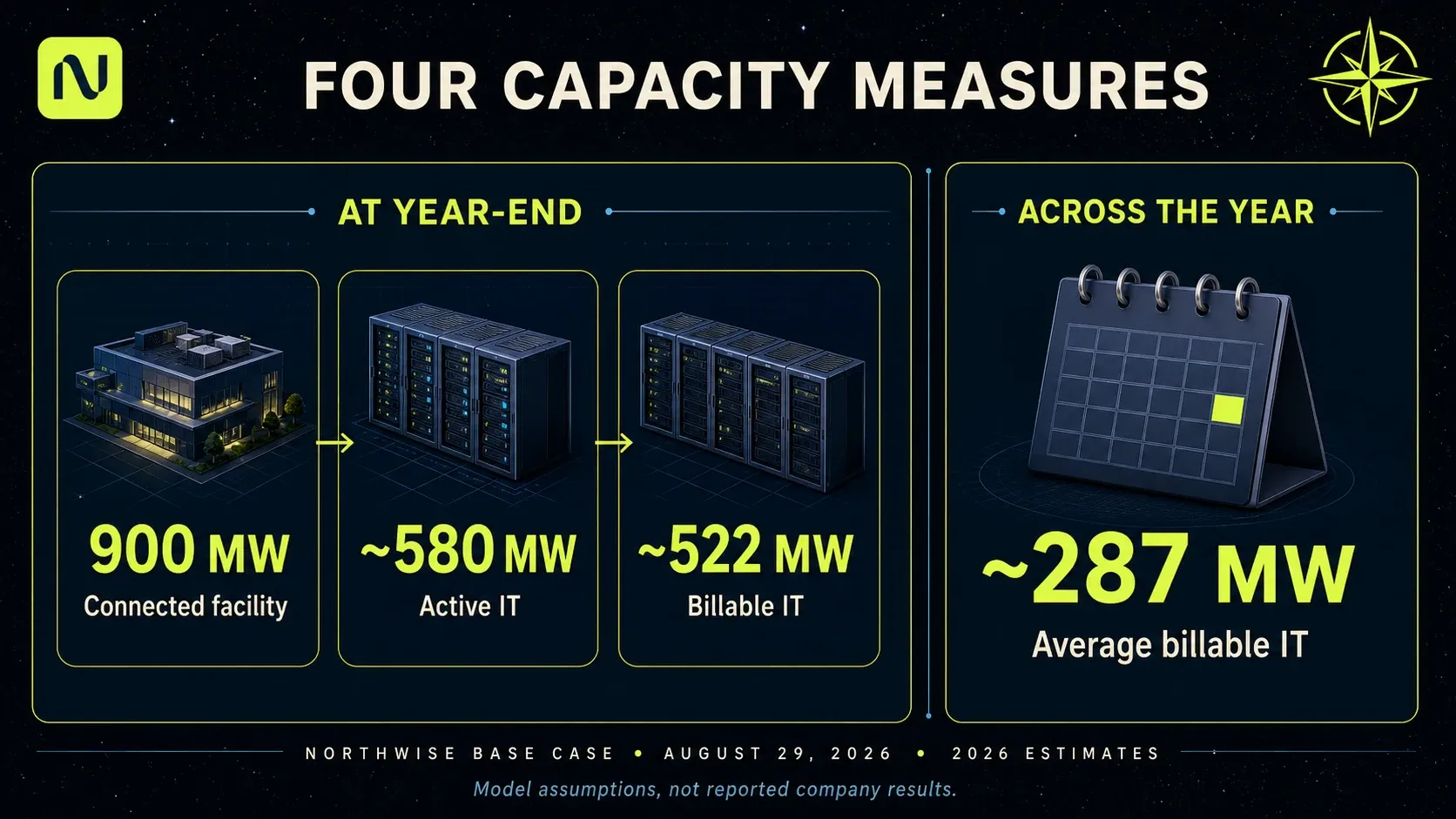
The denominator also changes the apparent price. Using an $8 billion annualized revenue assumption, dividing by 900 MW gives about $8.9 million per MW. Dividing by 522 MW gives approximately $15.3 million per MW. Both calculations use the same assumed revenue. The first relates it to facility power and the second to billable IT power. Neither calculation establishes what a particular customer pays for a specific hardware configuration; those terms still need separate evidence. But the example explains how two people can describe the same Nebius forecast with very different revenue-per-megawatt figures and mistakenly believe they disagree about pricing.
This is the work that sits underneath a model output. A change to a commissioning date can alter the annual average even if the year-end destination stays the same. A change to cooling efficiency can alter IT capacity without changing the power connection. A change to customer acceptance can reduce billable capacity without implying the machines have vanished. Once those relationships are familiar, a forecast becomes something the reader can interrogate. The useful question is which assumption changed and whether the evidence supports the new value.
What it costs to create that revenue
A new installation requires more than the quoted purchase price of a GPU. Equipment includes servers, networking, storage, and associated systems. The facility needs electrical distribution and cooling. Development may require land, site preparation, construction, and connections to external infrastructure. The company also has to integrate the parts, test them, and prepare the service for customers. Capital expenditure, generally shortened to capex, is spending on assets used by the business. It differs from an operating expense such as the cost of electricity consumed while running those assets. A company that buys a server records an asset and allocates its cost through accounting over time; it does not normally charge the entire purchase against the first month's revenue. The cash still leaves when payment is due, which is why an income statement cannot answer every question about funding.
Our machinery-inspection customer wants to pay for a functioning service. Nebius may need to commit substantial money months before that service begins. When several projects are under way together, the company can be paying for land at one site, construction at another, equipment at a third, and operating costs at a fourth. The total capital committed today is therefore supporting different stages of future revenue. Comparing all of it with one current month of sales can make a growing business look less productive than its completed projects eventually become. Assuming that all unfinished projects will become productive on schedule would make the opposite mistake.
The proper question is how each investment progresses toward earning a return. A delay matters partly because of how much money has already been committed and what obligations remain. A construction overrun matters partly because the customer price may already be fixed. A better contract can improve project economics, while a more demanding technical specification can increase the cost of serving it.
The August model report connects these decisions through its site schedule, hardware assumptions, and funding model. That is why changing one assumption can affect several outputs. Earlier capacity may bring revenue forward, but it can also require earlier equipment payments. Higher density may create more useful work within a facility while increasing the cooling or networking demands. A good forecast follows the consequences beyond the first favorable line.
Who provides the money
Nebius can fund growth using customer advances, cash generated by operations, borrowing, proceeds from selling assets, and new shares. These sources are related. A stronger customer contract may support a larger loan. A weak market for borrowing may make an asset sale more attractive. A higher share price can allow a company to raise the same money by issuing fewer shares.
The timing is as important as the total.
A customer prepayment is cash received before the corresponding service has been earned as revenue. Imagine a provider needs $100 million for an installation. A customer advances $40 million, lenders supply $40 million, and shareholders supply $20 million. All $100 million is available to buy assets, but the sources carry different claims. The lenders expect repayment and interest. The customer expects the agreed service. Shareholders own the residual interest after obligations are met. Saying that customers supplied part of the funding is economically meaningful; saying that the equipment therefore cost less would describe a different transaction.
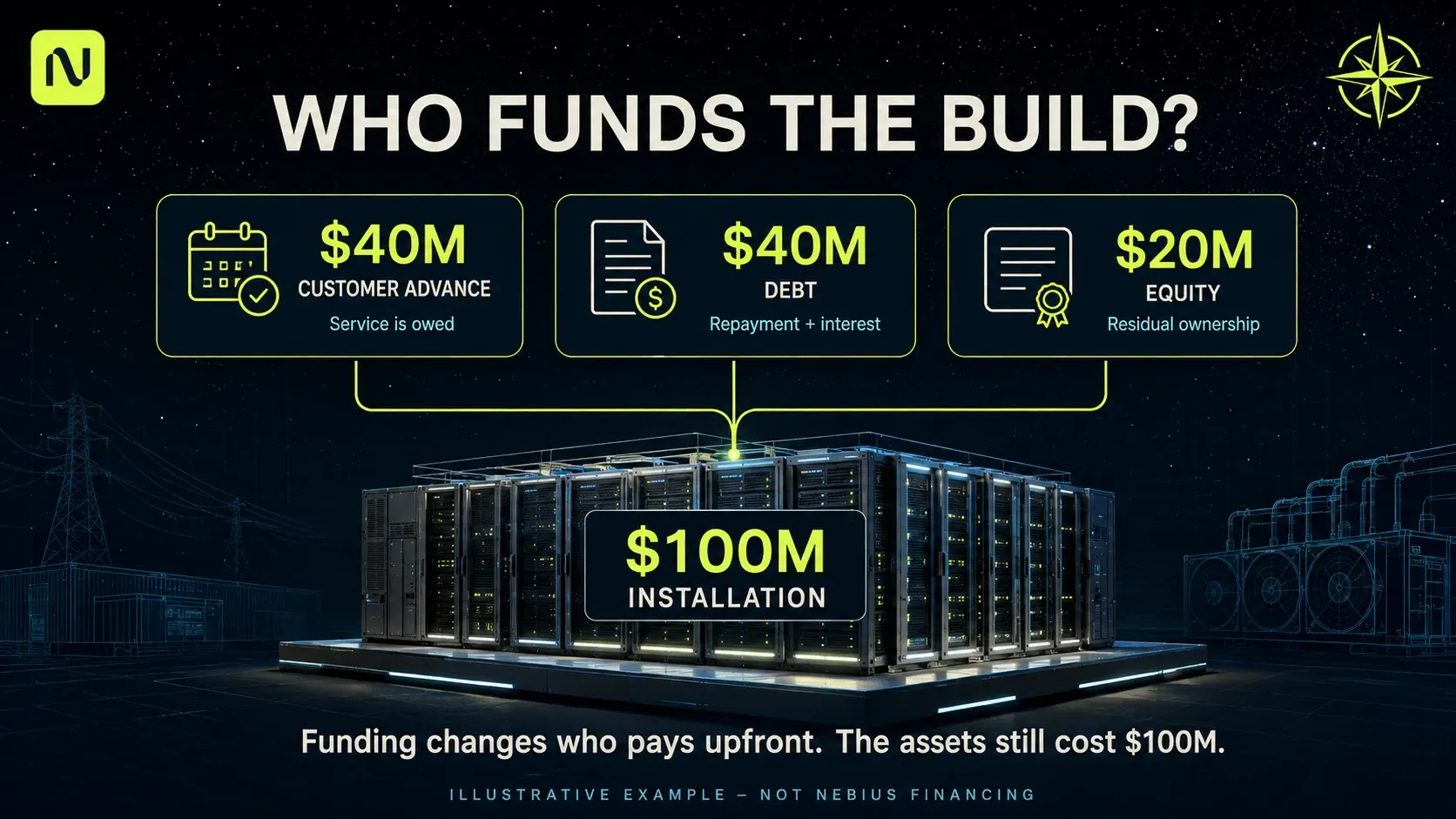
The unearned advance generally appears as deferred revenue, a liability reflecting service still owed. As service is provided, part of that liability is released into recognized revenue. The company must keep track of the cash already collected so the same advance is not counted again as new money when the revenue appears. Nebius said roughly 70% of Q2 deals included prepayments covering 50% to 60% of associated capex. Q2 shareholder letter
Prepayments can be valuable even though their economic cost is not written as an interest rate. A customer might receive a price concession or other favorable terms in exchange for advancing cash. To judge the arrangement, we would ideally compare it with the price and terms the same customer would have accepted without the advance. Public disclosures rarely supply that complete comparison. Our research therefore examines the trade-off rather than declaring customer money automatically free or automatically expensive.
Borrowing has its own constraints. An equipment-backed facility may depend on what lenders will advance against particular assets and contracted payments. If those assets become less valuable or the cash flows less dependable, borrowing capacity can fall. Interest rates can rise, and lenders may require more protection. A company cannot necessarily replace a lost source of customer funding with an unlimited amount of debt. Common equity absorbs another part of the funding need. Issuing shares sells additional ownership, reducing the percentage owned by each existing share. That dilution can be justified if the new capital creates enough value. The practical test is how the investment changes value per share after including the additional shares, not whether the company's revenue becomes larger.
Our financing work also allows management to respond. If funding becomes too expensive, a company can slow construction, prioritize stronger projects, sell an investment, or use a partner to fund infrastructure. Some commitments cannot be easily changed, which limits that flexibility. A realistic downside case should consider what management can actually do before assuming it continues every planned investment regardless of the cost.
Convertible notes and the share count
A convertible note begins as a debt instrument with terms that can allow or require conversion into shares or another form of settlement. The investor lends money and also receives exposure to the company's equity under the agreed conditions. That equity feature can allow the issuer to pay a lower cash interest rate than an otherwise comparable ordinary bond. The apparent saving is attached to another form of value given to the lender.
For common shareholders, conversion changes the ownership calculation. If a valuation assumes a note has converted into shares, it generally needs to include the resulting shares and remove the corresponding converted principal from debt. Keeping the full debt claim while also adding all the conversion shares can charge the same obligation twice. Assuming conversion removes every financing risk would create a different problem, because the actual terms and future share price determine what happens. A fully converted model is a scenario convention, not a statement that every note has already converted.
This is one reason the number of shares in a forecast may differ from the shares currently reported as outstanding. An analyst can include potential shares from convertible notes, employee awards, warrants (rights to buy shares on specified terms), and future equity raises. Fully diluted is the label commonly applied to a count that includes specified potential claims. The exact assumptions still need to be read; two forecasts can use the same label and include different instruments. The capital-structure work in The Conversion Problem follows those claims individually. A new follower does not need to memorize every security to understand why the exercise matters. Whatever value the operating business creates will be divided among the claims that exist at the time. A forecast using too few shares can make each share look more valuable without improving the underlying business at all.
Profit and cash tell different parts of the story
Revenue is the starting point, but it has many jobs to do. It must cover the service's operating costs, the economic consumption of equipment, financing costs, and taxes. The cash arriving from customers also has to meet bills whose payment dates may differ from when expenses appear in accounting.
EBITDA stands for earnings before interest, taxes, depreciation, and amortization. Depreciation allocates the cost of physical assets over time; amortization performs a similar role for assets such as certain acquired software and other intangible rights. EBITDA is useful for examining a level of operating performance before those charges. Adjusted EBITDA excludes additional items specified by the company, so its reconciliation should be read. Neither measure is a substitute for following what the business spends to acquire and replace assets. For a computing provider, expensive equipment is central to the service, which makes the costs excluded from EBITDA especially consequential.
An illustration helps place the measures beside each other. Consider an imaginary infrastructure business with the following annual results, all in millions of dollars:
Income-statement step | Amount |
|---|---|
Revenue | $100 |
Cash operating expenses | −$40 |
EBITDA, with no extra adjustments in this example | $60 |
Depreciation and amortization | −$25 |
Operating profit, also called EBIT | $35 |
Interest expense | −$10 |
Profit before tax | $25 |
Tax expense | −$5 |
Net income | $20 |
Assume every dollar of revenue is collected during the year, cash interest and taxes match their expenses, and there are no other timing differences. The business generates $45 million of operating cash after interest and taxes: $60 million less $10 million and $5 million. If it spends $80 million on assets, cash flow after capex is negative $35 million. It reports $20 million of net income while needing additional funding for its investment program. These are invented figures for teaching, not Nebius estimates.
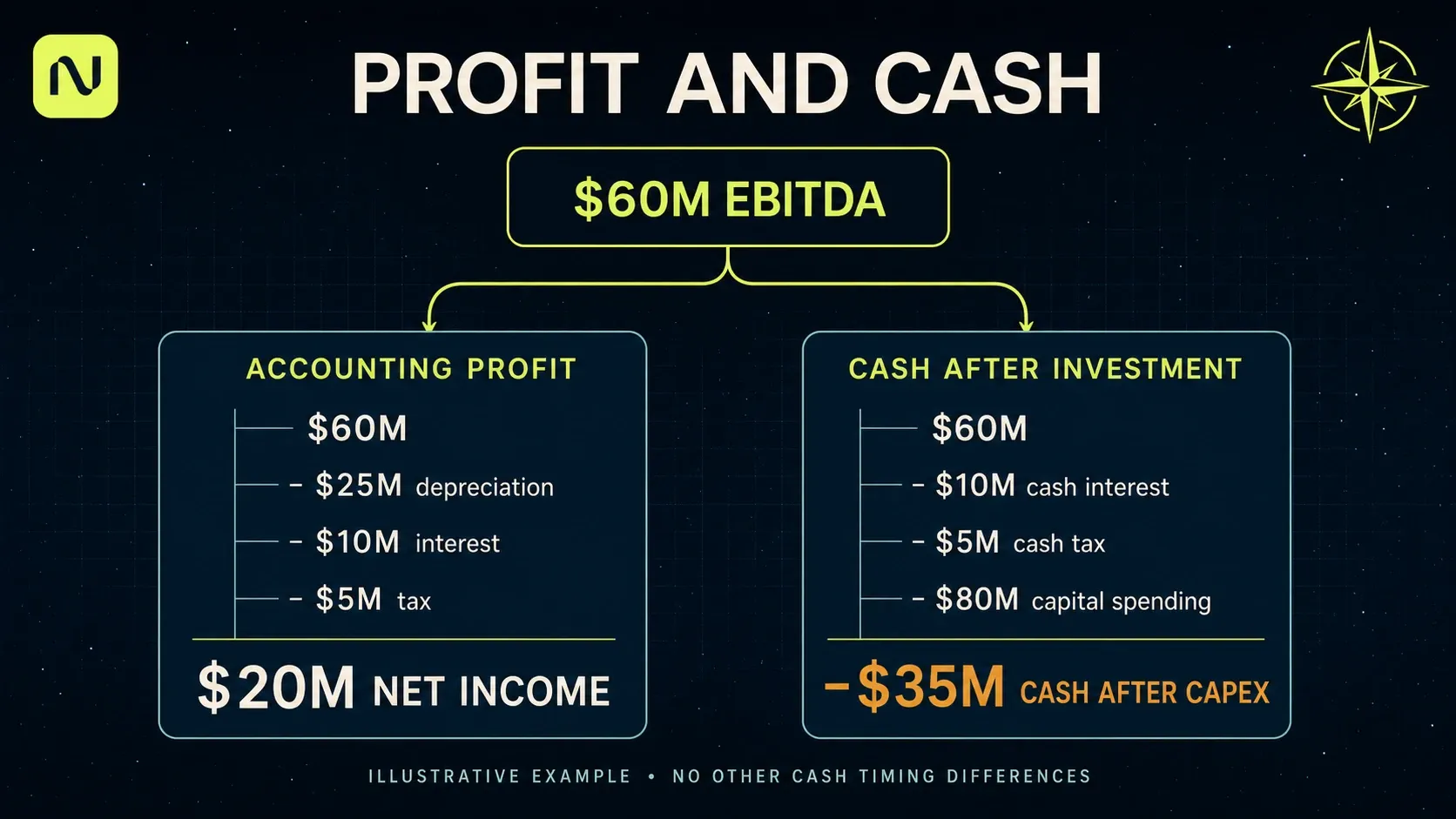
The purpose of the $80 million matters. If $70 million develops additional capacity and $10 million replaces existing assets, much of the cash outflow is an attempt to grow. That can be attractive when the new capacity earns an adequate return. It can also consume shareholder money if the projects disappoint. Calling the spending growth capex describes its purpose; it does not establish its quality. A business that must continually replace costly equipment also needs a credible estimate of the long-run spending required to preserve its earning power.
Our model uses a normalized replacement reserve to examine that recurring economic burden. Normalized means an estimate intended to represent a more typical ongoing requirement, rather than the exact spending in one particular year. The resulting owner-cash measure is a modeling construct. It does not claim to equal the free cash flow the company will report while it is still expanding rapidly.
This distinction allows two reasonable observations to coexist. A company can have attractive underlying project economics and still consume cash during a major build. It can also report a strong EBITDA margin while needing so much replacement capital and financing that little remains for shareholders. The investment analysis must determine which description better fits the business under plausible assumptions.
Why an advance can make cash flow look unusually strong
Customer prepayments add a timing effect to the cash-flow statement. A provider may collect money for future service during a quarter in which it recognizes relatively little revenue from that agreement. That cash can help finance equipment, but it comes with an obligation to deliver later. When the provider eventually earns the revenue, some of the customer cash may already have been collected and spent. Suppose a customer pays $12 million in advance for service that will be delivered evenly over twelve months. In the simplified example, the provider earns $1 million of revenue each month by fulfilling the agreement. It does not collect a fresh $1 million each time if the full amount was prepaid. The accounting records the work as it is performed while the cash arrived earlier. Actual agreements can have more complicated billing and performance terms, but the example shows why adding revenue to previously collected advances can overstate funds available for a future build.
This matters most when growth changes pace. During rapid expansion, new advances from new agreements may keep arriving. If new bookings slow, the business can still be busy supplying service under old contracts while receiving less new advance cash. The working-capital benefit may weaken at the same time management has substantial spending commitments. Working capital refers broadly to the operating balances created by timing differences among sales, collections, purchases, and payments.
The question is therefore how much cash the business generates from performing services, how much arrives early for future work, and how those patterns change under stress. Our model keeps customer funding within that sequence. It is a meaningful benefit when understood correctly and a source of false confidence when treated as if the same cash can finance construction and later be collected again.
What happens when the equipment gets older
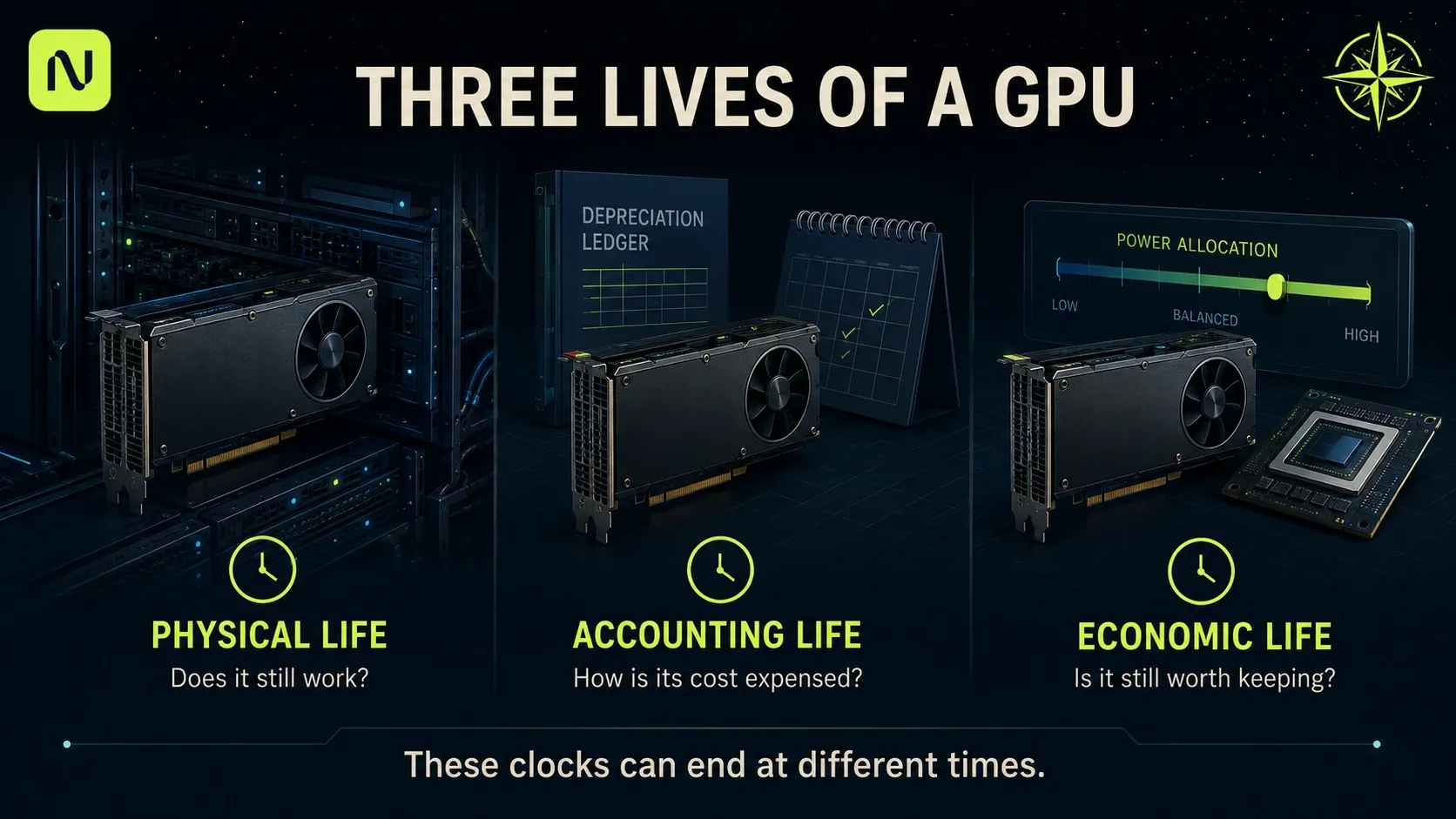
The facility and the computers inside it have different economic lives. Buildings and electrical infrastructure may support successive equipment generations. A particular accelerator faces newer alternatives, changing customer requirements, and a price that can decline as the market develops.
An older machine can still be useful.
That observation settles less than it first appears to. Continued usefulness does not establish its rental price, occupancy, maintenance burden, or return on the original purchase. A customer may happily use older equipment for a task that does not justify paying for the newest system. The provider then has a commercial market, but it must compare the revenue with the costs and alternatives. Our replacement analysis therefore separates the question of whether a machine works from the question of whether keeping it is the best use of the capital and power it occupies.
Accounting depreciation spreads an asset's depreciable cost over its estimated useful life. Consider a $100 machine with no assumed residual value. A five-year straight-line schedule, which allocates the cost evenly, records $20 of depreciation each year; a ten-year schedule records $10. Extending the schedule raises accounting profit in the earlier years without changing what was paid, how the machine performs, or what customers will pay to use it. The estimate should reflect expected usefulness, and changing it does not create cash by itself. Economic life concerns how long the asset remains worth operating under the relevant conditions. That can differ from the accounting estimate in either direction. A machine may remain profitable after it has been fully depreciated. It may also become economically unattractive before its carrying value has reached zero. Carrying value is the amount remaining on the balance sheet after the applicable accounting charges; it should not be confused with the cash a buyer would necessarily pay for the asset.
Power creates a further choice. Suppose old equipment generates $5 of annual cash contribution after its immediate operating costs. Keeping it looks sensible. If newer equipment could use the same scarce electrical capacity to generate enough additional contribution to justify its purchase, continuing to operate the old machine sacrifices an opportunity. The right comparison includes the cost of upgrading, the time and disruption required, expected future demand, and the value of the displaced work. A machine's continued operation is therefore not proof that it should retain its place indefinitely.
Our latest model examines equipment life and revenue retention separately. Revenue retention asks how much earning power an older generation preserves as it ages or renews contracts. A long useful life with sharply falling prices can produce a very different investment result from a shorter life with strong early returns. The hardware and replacement sections of the model report show why these assumptions belong together.
What an efficiency breakthrough could mean
A new model or chip that completes the same task with fewer resources can affect Nebius in several ways. Existing customers may need less computing for an unchanged volume of work. Lower costs may also make applications worthwhile that previously cost too much to operate. A customer can save money on each task and choose to perform many more tasks. The net effect depends on how demand responds, which is a commercial question rather than an automatic consequence of a technical benchmark. The provider's position matters too. If competition passes every efficiency improvement to customers through lower prices, the provider may need more volume to maintain revenue. If its software makes the whole service more useful, it may retain some of the value. If new hardware requires a costly upgrade before the old equipment has earned enough, the transition can be financially painful even when customers benefit.
Different kinds of accelerators also raise the question of who keeps the customer relationship. A provider capable of integrating useful new technology into a familiar service may have a route to remain relevant as the hardware changes. That route requires engineering, access to supply, and a workload for which the new system makes economic sense. Merely announcing support for another accelerator does not establish profitable adoption.
We treat this as a reason to examine the platform and the physical fleet together. Nebius's software could help it adapt to changing hardware, while its ownership of expensive equipment still exposes it to the economics of each generation. A strong technological development for AI can create winners and losers within the infrastructure industry at the same time.
Growing through other people's infrastructure
An owned campus requires Nebius to finance a substantial part of the physical operation. The partnership model it introduced in July 2026 offers another route: partners finance and own infrastructure, while Nebius supplies system architecture, cloud software, and access to customers. Infrastructure partnership announcement
This arrangement addresses a practical mismatch. A local infrastructure owner may have land, power, and money but lack a cloud platform and the commercial organization needed to attract computing customers. Nebius may see demand in a region without wanting to finance every asset itself. If the parties can agree on responsibilities and economics, their contributions can create an operating business that either would have difficulty building alone. The description asset-light refers to fewer assets being funded or owned by the company whose financial results we are examining. The equipment still exists and someone still bears its costs. The arrangement may let Nebius earn less revenue per unit of capacity while requiring much less capital of its own. A smaller share of revenue can be attractive when the associated investment and risk are also smaller. The correct comparison looks at the return on Nebius's contribution, its continuing obligations, and the durability of the relationship.
There are several details we would want to know before assigning substantial value. Who owns the customer contract? Who decides pricing? Who pays when equipment needs replacement or service levels are missed? How is revenue shared? Can the infrastructure owner change software providers? These terms determine whether the model creates a durable income stream or simply another way for Nebius to carry operating responsibilities.
Our current forecast includes scenarios for partner capacity and software-related income. They are estimates of what the business might develop, rather than evidence that the contemplated scale has already arrived. This remains one of the more consequential strategic questions because it could change how much shareholder capital future growth consumes.
How Nebius could capture more of the value around AI
A factory pays our hypothetical application company because it wants a useful assessment of a machine part. Between that payment and the electricity used to produce the assessment sit several businesses. Someone provides the computing. Someone develops or adapts the model. Software retrieves information, checks permissions, monitors performance, and connects the result to the factory's systems. People may review uncertain cases. The value stack is simply the collection of activities that makes the finished service possible, together with the money earned by the businesses performing them.
Nebius's opportunity is to become responsible for more of those activities where it can do them well.
The first route is to improve what it earns from the computing already being supplied. A customer renting a cluster takes on more responsibility for using it productively. A customer buying managed inference asks the provider to make a model available as a service. That shifts work toward Nebius: allocating resources, keeping response times acceptable, handling changing demand, and making efficient use of the machines. If Nebius can perform those tasks better than customers can perform them individually, there is value to divide between the provider and its customers. The company may earn more for the service while the customer spends less overall because it avoids operating complexity or wasted capacity.
Token Factory is an existing step in that direction. Its commercial purpose is to help customers deploy and operate models in production, rather than make each customer assemble the complete serving environment. Eigen AI and Clarifai strengthen the engineering around that offering. Improving how a model uses memory, how requests are scheduled, or how efficiently calculations run can change the amount of useful work obtained from a GPU. The acquisition announcements and technical integration describe capabilities being added. Whether those capabilities produce a lasting financial advantage still depends on the prices customers pay and the costs Nebius carries. Token Factory launch, Eigen AI announcement
The next route concerns the information and tools an AI system uses while working. A model may need current information from the web, a document in a customer's system, or access to another service. Tavily adds search infrastructure designed for AI applications. In our machinery example, an application might need to retrieve an up-to-date technical document before explaining a fault. A broader workflow could require checking the document's relevance and passing an uncertain assessment to a qualified person. Toloka's Tendem product introduces a related possibility for human expert involvement. Search and expert review solve different problems, and neither should be treated as a guarantee that an answer is correct. Together, they illustrate why demand can extend beyond the model call itself. Tavily's role in the platform, Tendem integration announcement
For Nebius, earning revenue from an additional tool is one potential benefit. Becoming harder to replace because customers rely on several useful services is another. The second benefit can support retention even when the individual tool is inexpensive. There is also a practical limit: customers may prefer independent components, or an alternative supplier may offer a better tool. A broader platform needs to make that choice easier for the customer through good integration, rather than assume that common ownership creates demand.
Enterprise operations offer a third route. An experiment can run with a small team and informal processes. A service used across a bank, manufacturer, or healthcare organization has to fit permission systems, spending controls, support arrangements, and the customer's own review procedures. Nebius's Aether releases already address parts of this work. Further progress could make it suitable for larger or more consequential applications, increasing the amount customers are willing to place on the platform. The commercial gain might appear through a larger computing commitment or stronger retention rather than a separately disclosed security-software fee.
That distinction matters when reading the financial results. A valuable software capability does not always produce a separate software revenue line. Sometimes it helps sell the underlying service.
Physical AI creates another area in which the company can package computing around a demanding workflow. Developing a robot requires training, simulation, data management, testing, and eventual deployment in the real world. Nebius's March 2026 NVIDIA collaboration described a cloud offering for that development lifecycle and named outside developers using its infrastructure. That is more concrete than inferring an entire robotics business from a trademark or from ownership of Avride. The wider opportunity is to supply tools and computing to many developers, including companies whose robots Nebius does not own. Physical AI platform announcement
Avride gives the group a separate interest in an autonomous-driving business. The cloud platform gives Nebius a way to serve the industry around it. Those exposures can develop together without being the same source of revenue.
Infrastructure partnerships extend the idea in another direction. Instead of funding every building and server required to enter a market, Nebius can contribute architecture, software, operations, and customer access alongside a partner supplying capital and infrastructure. The July 2026 partnership model is an announced route toward that outcome. A successful deployment could allow Nebius to earn from a wider footprint with less of its own capital tied up in the physical assets. The economics must be read from the contract: software fees, revenue sharing, operating costs, replacement responsibilities, and guarantees can produce very different returns. Infrastructure partnership model
Route to earning more | What already supports the idea | What would demonstrate further progress |
|---|---|---|
More useful work from each installation | Managed inference and the Eigen AI and Clarifai integrations | Better realized economics after customer pricing, support, and hardware costs |
More services used by the same customer | Token Factory, Tavily, and the planned deeper Tendem integration | Customers using several products and expanding their spending over time |
Larger enterprise commitments | Governance, access, spending controls, and operating features in Aether | Production deployments, retention, and profitable expansion beyond trials |
Industry-specific operating environments | The announced physical AI cloud offering and outside customer examples | Repeatable customer adoption with an attractive cost to serve |
Software and operations on partner infrastructure | The announced infrastructure partnership model | Signed economics and cash returns that justify Nebius's continuing obligations |
Our constructive view is that Nebius has several credible ways to become more valuable to customers as their AI work grows. That creates an opportunity for better economics than a business defined only by access to scarce machines. It is also a much harder company to build. Product integration takes engineers and management attention. More services create support obligations. Some acquisitions require cash and shares before the acquired capabilities produce measurable returns. Competitors are following similar paths.
We would therefore judge progress through customer behavior and financial results together. More products on a website are evidence of a broader offering. More customers using those products profitably would be evidence that Nebius is capturing more value. Our latest model report connects that possibility to the capital required and the value that could remain for shareholders.
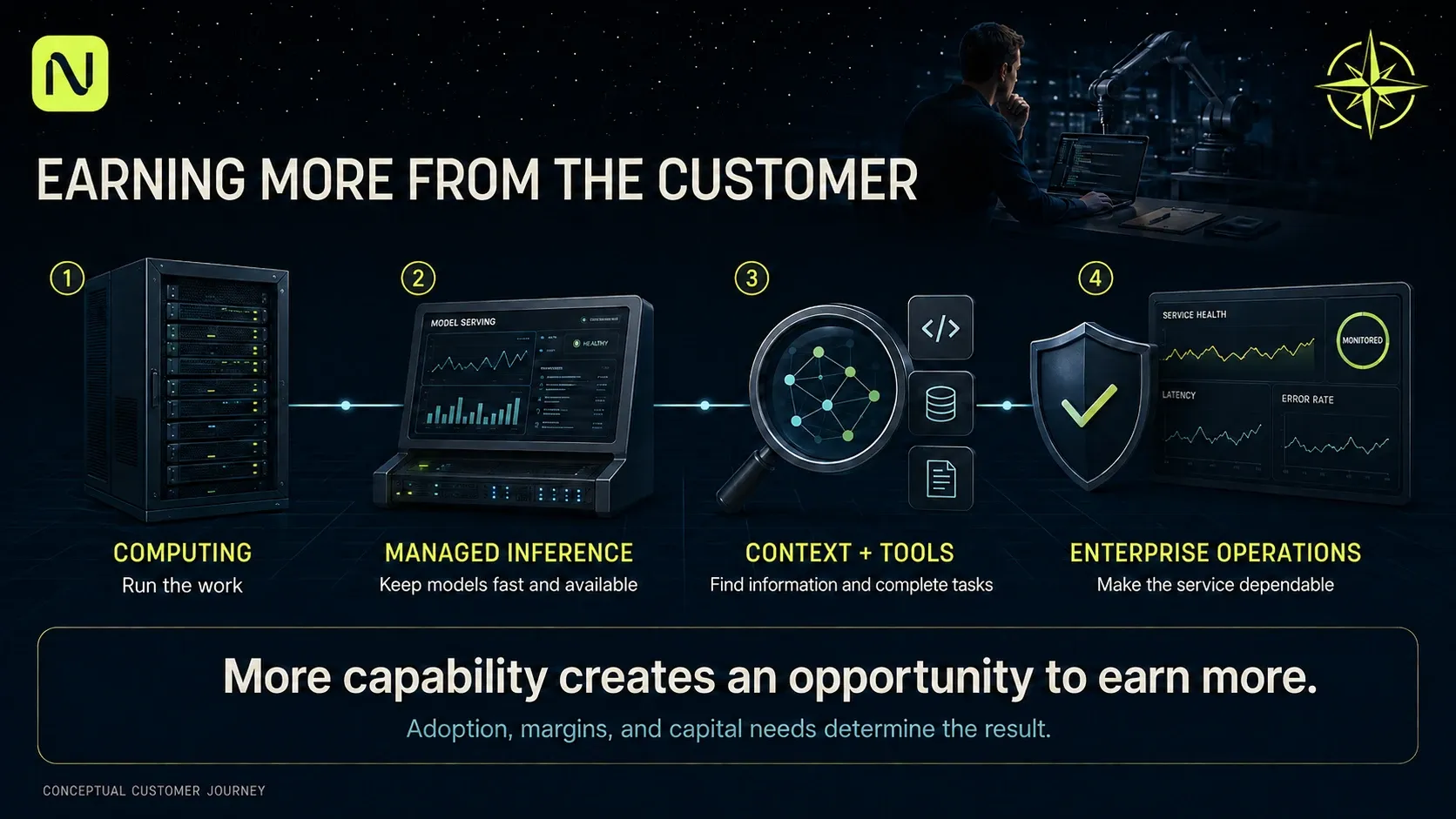
The businesses and investments behind an NBIS share
An NBIS share gives its owner exposure to more than the cloud business we have followed so far. Avride develops autonomous vehicles and delivery robots. TripleTen trains people for technical careers. Nebius also holds investments in ClickHouse and Toloka, businesses serving different parts of the data and AI market. These interests are an important part of our assessment of the company's upside and its ability to finance growth. A cloud provider with valuable assets outside the immediate construction program has choices that a provider dependent entirely on its next financing round may not have.
Understanding those choices starts with understanding what is owned.
A controlled subsidiary is a business whose financial results are generally combined with those of its parent under the applicable accounting rules. If other investors own part of it, their interest still has to be recognized. An equity investment can represent a substantial economic interest without giving the owner operational control. Its entire revenue does not become the investor's revenue. An acquired team or product integrated into the core cloud operation belongs in yet another part of the analysis: its value may appear through the economics of the platform rather than as a separate business that could readily be sold.
Nebius's Q2 2026 reporting identifies Avride and TripleTen as other businesses, and ClickHouse and Toloka as equity stakes. Tavily, Eigen AI, and Clarifai are discussed within the development of the AI platform. That is the structure used here. It prevents a common source of confusion: treating every name associated with Nebius as a wholly owned subsidiary, or adding every related company's revenue to the cloud forecast. Q2 2026 shareholder letter
Business or capability | What it does | How to think about the exposure |
|---|---|---|
Nebius AI Cloud and Token Factory | Computing infrastructure, cloud software, and managed inference | The main operating business |
Tavily | Search infrastructure for AI applications and agents | An acquired capability being integrated into the cloud platform |
Eigen AI and Clarifai | Model-serving and inference engineering | Acquired capabilities intended to improve platform performance and economics |
Avride | Autonomous driving and delivery robotics | An operating group business with its own commercialization and funding needs |
TripleTen | Technical education and workforce development | An operating group business whose outcomes depend on education, employment, and enterprise demand |
ClickHouse | Database software and services for rapid analysis of data | A significant minority equity investment |
Toloka, including Tendem | AI data, evaluation, and human expertise in AI workflows | An equity investment; Nebius relinquished majority voting control in 2025 |
The ownership descriptions deliberately follow the current disclosures rather than repeat an old percentage as though financing rounds could never change it. A historical stake, a fully diluted stake, voting power, and the economic interest held through different securities can all produce different numbers. The distinction is especially relevant when a business has employee awards, preferred shares, warrants, or instruments that may convert into shares later.
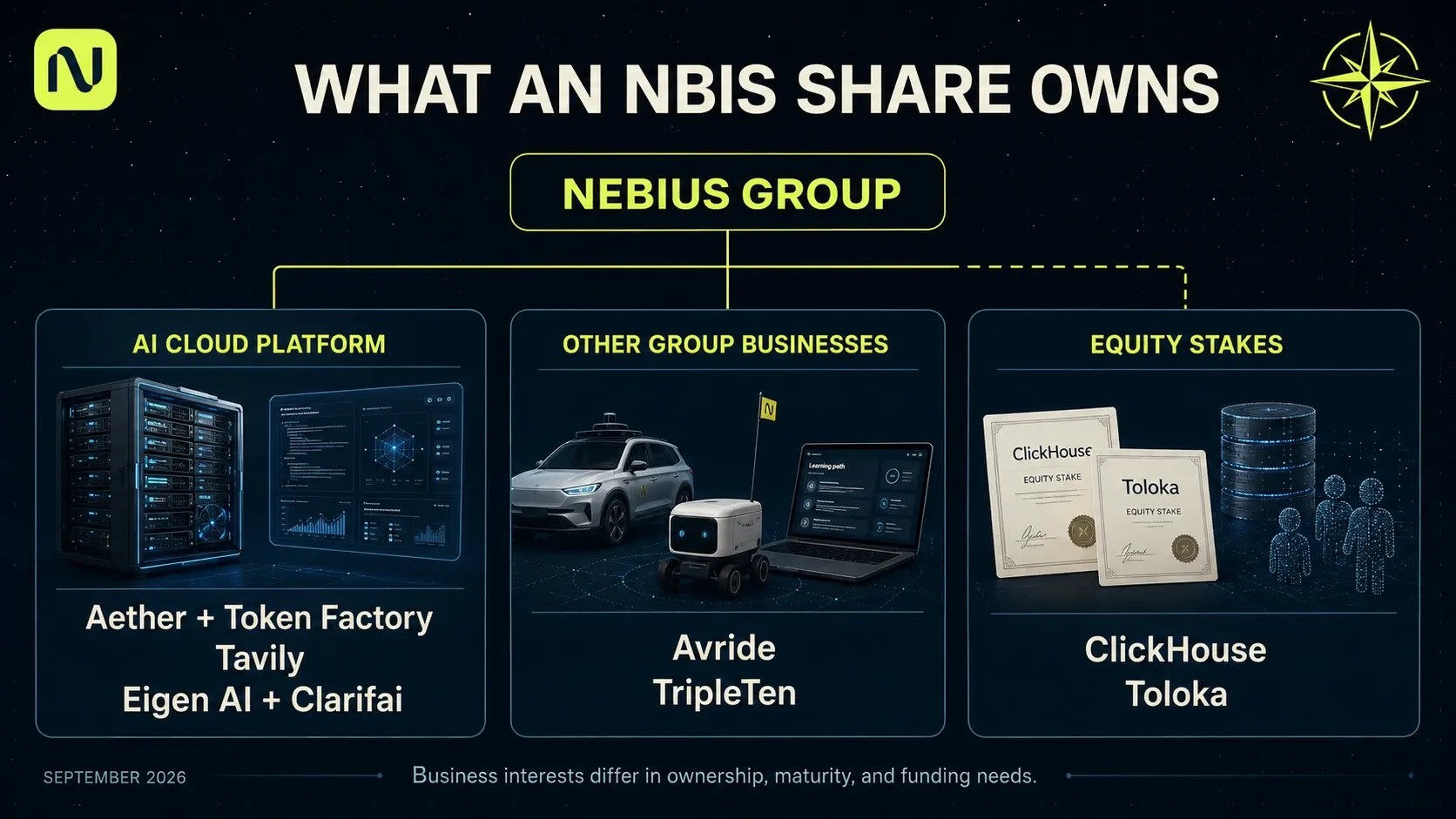
ClickHouse: a valuable business outside the cloud build
Imagine the machinery-inspection service has become popular. It now receives thousands of requests from different factories. Its engineers want to know which model produces the most disputed results, whether performance deteriorates at particular sites, and how costs change when usage rises. The information exists, but it arrives as a growing stream of records. A database built for rapid analysis lets the team ask questions across that stream while the service is still operating.
That is the kind of problem ClickHouse addresses. Its database stores and processes information in a way suited to analytical work, including examining large collections of events, measurements, and application activity. The open-source technology allows broad adoption, while the commercial cloud service gives customers a managed way to use it. The business sits close to a practical consequence of AI growth: more applications create more information about usage, behavior, reliability, and cost that someone needs to understand.
ClickHouse's January 2026 announcement described a $400 million Series D financing and expansion across analytics, observability, and AI infrastructure. It also announced the acquisition of Langfuse, which focuses on understanding and evaluating AI applications. These developments help explain the breadth of the opportunity. ClickHouse can serve companies using many different clouds and models, rather than depend only on the customers buying Nebius computing. ClickHouse financing and product announcement
For Nebius shareholders, that independence has value. They can benefit from a software business whose growth is not limited by the pace at which Nebius commissions its own data centers. A larger, successful ClickHouse could increase the value of Nebius's retained interest. A transaction could also create an opportunity to sell part of that interest. Neither outcome requires ClickHouse to become a captive internal database for the cloud operation.
The financing headline needs careful translation. The approximately $15 billion company valuation associated with the January 2026 round is not the value of Nebius's stake, and it is not money available in Nebius's bank account. The value attributable to Nebius depends on what securities it owns, the rights attached to them, dilution, and the price available in an actual transaction. The most recent group description confirms a significant minority interest; it does not justify carrying a historical ownership percentage forward without checking the relevant financing terms. Nebius's 2025 annual filing, including the January 2026 financing
A useful historical detail makes the accounting distinction concrete. In the May 2025 round, Nebius purchased $50 million of pre-funded warrants and recognized a $597.4 million upward revaluation of its investment. The valuation gain was not cash from selling the holding. A business can become more valuable while its owner contributes additional cash to it. That is why the cash-flow statement and the investment note need to be read alongside the income statement. 2025 investment disclosure
We regard ClickHouse as one of the clearest reasons to examine Nebius as a group. Its potential matters both to eventual shareholder value and to management's financing choices. The timing of those benefits remains separate from the cloud's construction deadlines. Our ClickHouse research goes further into the product, market, and strategic relationship. Its dated assumptions should be read alongside the newer financing disclosures and the current Nebius model.
Avride: exposure to AI working in the physical world
Avride turns the AI discussion into something a person can see on a street: a vehicle transporting a passenger or a small robot carrying a delivery. The business develops autonomous-driving technology for those applications. Its task includes perceiving the surroundings, anticipating what other road users may do, choosing an action, and operating safely enough to provide a dependable service. A demonstration can establish that a system works in a particular setting. A commercial business has to repeat that performance across many trips while covering the costs of vehicles, maintenance, support, insurance, and continued development.
The potential is substantial because transport is a service people already buy. Avride does not have to persuade customers that getting somewhere or receiving a delivery is useful. It has to make a new way of providing those services reliable, acceptable, and economical. Distribution partners matter because they can bring existing demand. A place inside a widely used ride-hailing or delivery application can give a technology developer access to customers without requiring it to build the whole consumer marketplace itself.
In October 2025, Avride announced strategic investments and other commitments of up to $375 million from Uber and Nebius. The wording describes a combined package with several components, rather than $375 million of cash paid to Nebius. It supports Avride's development and commercial expansion, and Nebius is one of the parties committing support. Avride financing announcement
By the Q2 2026 update, Nebius reported that Avride's AV-capable fleet exceeded 200 vehicles in May, that it had completed more than 60,000 commercial rides on Uber in Dallas, and that robot deliveries had passed 600,000 since inception. These are different measures of progress. A fleet count measures equipment. A commercial ride count shows use. Neither, on its own, establishes fully driverless operation or profitable unit economics. The same update discussed work toward operations without an onboard vehicle operator. Q2 operating update
For Nebius, Avride offers exposure to a business that could grow along a different path from rented computing. A successful autonomy platform might develop valuable technology, commercial relationships, and a service footprint of its own. Outside investment can help support that development and establish a transaction reference for the business. It can also dilute the parent's interest or carry rights that affect how value is divided. Avride should therefore be evaluated as a company with its own financing needs, not treated as a costless option simply because the cloud operation is larger.
There is a strategic connection to the cloud. Autonomous systems require substantial data processing, training, and simulation, and a group involved in both infrastructure and autonomy can develop useful experience. But a shared parent does not prove that all of Avride's computing spending becomes profitable external revenue for Nebius. Transactions inside a consolidated group are not new revenue earned from an outside customer. The wider cloud opportunity comes from serving other physical AI developers as well.
Our Avride and investment-portfolio analysis and robotics research provide the earlier framework. The latter was published before the March 2026 physical AI cloud announcement, so its discussion of missing product evidence belongs to that earlier date. New disclosures should update the assessment rather than be forced into an older description.
Toloka and Tendem: the work needed to make AI useful
A model learning to inspect machinery needs examples that mean something. A photograph labeled incorrectly can teach the wrong lesson. An ambiguous result may require someone with the right technical knowledge. An evaluation that rewards plausible language instead of a correct assessment can make a model look better than it is. More computing does not automatically fix these problems because the missing ingredient is often judgment about what the information represents.
Toloka operates in that part of the AI market. Its work includes data preparation, expert input, and evaluation used to develop and assess models. The commercial task is to organize the right expertise, produce dependable work at scale, and demonstrate that the resulting data or evaluation improves what the customer can build. The skill lies partly in the people doing the work and partly in the systems that recruit, coordinate, assess, and pay them. An expert network without consistent quality control is difficult to use; a sophisticated platform without access to appropriate expertise has the opposite problem.
In May 2025, Nebius announced an investment in Toloka led by Bezos Expeditions. Nebius said it would retain a significant majority economic stake while relinquishing majority voting control, and would stop consolidating Toloka's results. The Q2 2026 update continues to identify Toloka as an equity stake. The company can therefore remain economically important to an NBIS shareholder without its full revenue appearing in Nebius's reported group revenue. Toloka investment and governance announcement
Tendem is a product developed from Toloka's technology and expert community. It combines AI work with human participation in more complex tasks. The idea is easier to understand through an ordinary business assignment: software can gather information and prepare a draft, while a person with relevant expertise checks an uncertain point or completes a part that needs judgment. Making those handoffs dependable is itself a product. Tendem should not be counted as an additional independent Nebius subsidiary simply because it has a separate brand. Toloka's introduction to Tendem
In February 2026, Toloka and Nebius described plans to connect Tendem more deeply with the Nebius ecosystem. The announcement identified standalone availability and early access for its tool integration, with deeper Nebius integration planned. That gives the strategy a concrete direction without proving that every intended connection is already operating at scale. The customer benefit would be a simpler way for an AI workflow to request human help when appropriate. The business benefit would depend on adoption, the cost of the expert work, and the terms through which the companies share the economics. Integration announcement
Toloka also broadens the sources of potential value inside the group. Demand for better training data and evaluation can grow even when customers become more efficient with computing. The risks differ from those of a data center: customer concentration, expert availability, quality, pricing, and changes in how models are trained can matter more than the price of electrical equipment. Funding raised by Toloka can support its own development; a sale of part of Nebius's interest could provide parent-level cash under a different transaction. Our Toloka analysis examines the business in greater depth, including the relationship between expert work and more dependable AI applications.
TripleTen: the people needed to put new technology to work
Our hypothetical factory customer may buy access to an excellent AI application and still struggle to use it. Employees need to know which tasks it can handle, how to examine a result, and when to bring in a person. The supplier needs engineers and analysts who can work with the technology. Buying infrastructure is one part of adoption; building the skills around it is another.
TripleTen addresses the education side. Its programs prepare people for technical careers through structured learning and practical work. The economics begin with students or employers paying for education and continue through the cost of instruction, mentoring, acquisition, support, and the systems used to deliver the program. The value of the qualification depends on what graduates can do and whether those skills are useful in the labor market. Growth in enrollment can be encouraging while still leaving questions about completion, outcomes, refunds, and the cost of finding the next student.
The business is adapting to AI-related demand. Nebius's Q2 2026 update described a new AI Systems Engineering program, further development of enterprise offerings, and cost reductions that improved segment performance. Those changes offer a route beyond individual career changers toward companies trying to improve their own workforce's capabilities. They do not establish that every new AI course will attract customers or produce an attractive return. Q2 TripleTen update
We see a useful connection to the wider group. A cloud platform becomes more valuable when customers know how to use it, and enterprise training can help remove obstacles that hardware alone cannot address. TripleTen's technical education and the Nebius Academy initiative belong in that discussion. There is also a possible relationship with businesses that need technically capable people for data work and evaluation. These are opportunities to develop, rather than reasons to count the same student, contract, or expected revenue several times across the portfolio.
TripleTen's capital requirements differ from those of a GPU installation, but education still consumes money. Course development, instruction, marketing, and unsuccessful program launches all have costs. A weak technology hiring market can make prospective students more cautious about retraining. AI can create demand for new skills while changing the value of some older ones. The investment case depends on the business updating its programs and delivering outcomes people will continue paying for.
Its contribution to Nebius should be assessed at the appropriate scale. TripleTen need not become as large as the cloud business to be useful. It can contribute operating value, enterprise relationships, and potential strategic flexibility while remaining a smaller part of the group. Our TripleTen research examines the education model, workforce opportunity, and possible connections across the portfolio.
Tavily, Eigen AI, and Clarifai belong inside the platform story
These three names can appear beside the investment holdings in a discussion of Nebius, but their current strategic role is different. They strengthen the service Nebius is building. Treating them as a separate pile of assets while also giving the cloud forecast full credit for their contribution can overstate the value created by the acquisitions.
Tavily supplies search infrastructure designed for AI applications. A model may contain a great deal of learned information and still need access to something current or specific before it can complete a task. Tavily helps applications retrieve that information in a form they can use. Nebius announced the acquisition agreement in February 2026; the Q2 report described Tavily's first full quarter within the group. Its role extends the platform into work around the model rather than adding another fleet of GPUs. Acquisition announcement
Eigen AI works on making models run efficiently. The May 2026 agreement described consideration of approximately $643 million at signing, payable in cash and Nebius shares and subject to adjustments. That was an acquisition investment, not new financing received by Nebius. The intended return comes from stronger model-serving capabilities and a better customer proposition. Clarifai adds further inference engineering and production experience. Nebius's own explanation places both additions in a strategy to improve the software operating on its infrastructure. Eigen AI transaction terms, Nebius's software strategy
The distinction matters for both optimism and accounting. These acquisitions give Nebius more ways to improve its offering and potentially earn more from each installation or customer. They also required capital, issued shares, integration work, and continuing compensation. The benefit should emerge through the performance of the combined platform. A valuation that separately includes an acquired business needs to explain which cash flows were removed from the cloud forecast to avoid duplication.
Why the investment portfolio changes the funding choices
The investment holdings are one reason we believe Nebius has a stronger set of funding options than a neocloud whose resources are concentrated entirely in the next generation of computing assets. That is a statement about the range of choices available, rather than a claim that Nebius will always borrow more cheaply, avoid dilution, or be safer than every competitor under every condition. A rival can have excellent customer contracts, patient backers, a valuable power position, or stronger current cash generation. Those advantages deserve to be examined on their own terms.
Nebius brings an additional question to the financing discussion: what could it do with assets that sit outside the immediate cloud build?
Retaining an interest lets the group continue participating in the business's future value. Selling a portion can turn some of that value into cash that the parent can allocate elsewhere. Bringing outside capital into the business can help finance that business's growth, reducing the amount its parent might otherwise need to supply. A borrowing arrangement secured by an eligible holding is another possible route, where permitted and commercially available, although it adds interest, repayment obligations, and the risk attached to the collateral. These transactions solve different problems. A funding round at a subsidiary is not automatically a cash distribution to the parent, and an accounting revaluation is neither transaction.
Management has explicitly discussed using non-core stakes as funding sources over time. That supports treating the portfolio as part of the financing framework, rather than an unrelated appendix. It does not establish a binding timetable or a guaranteed price for a future sale. Nebius's statement on the role of non-core assets
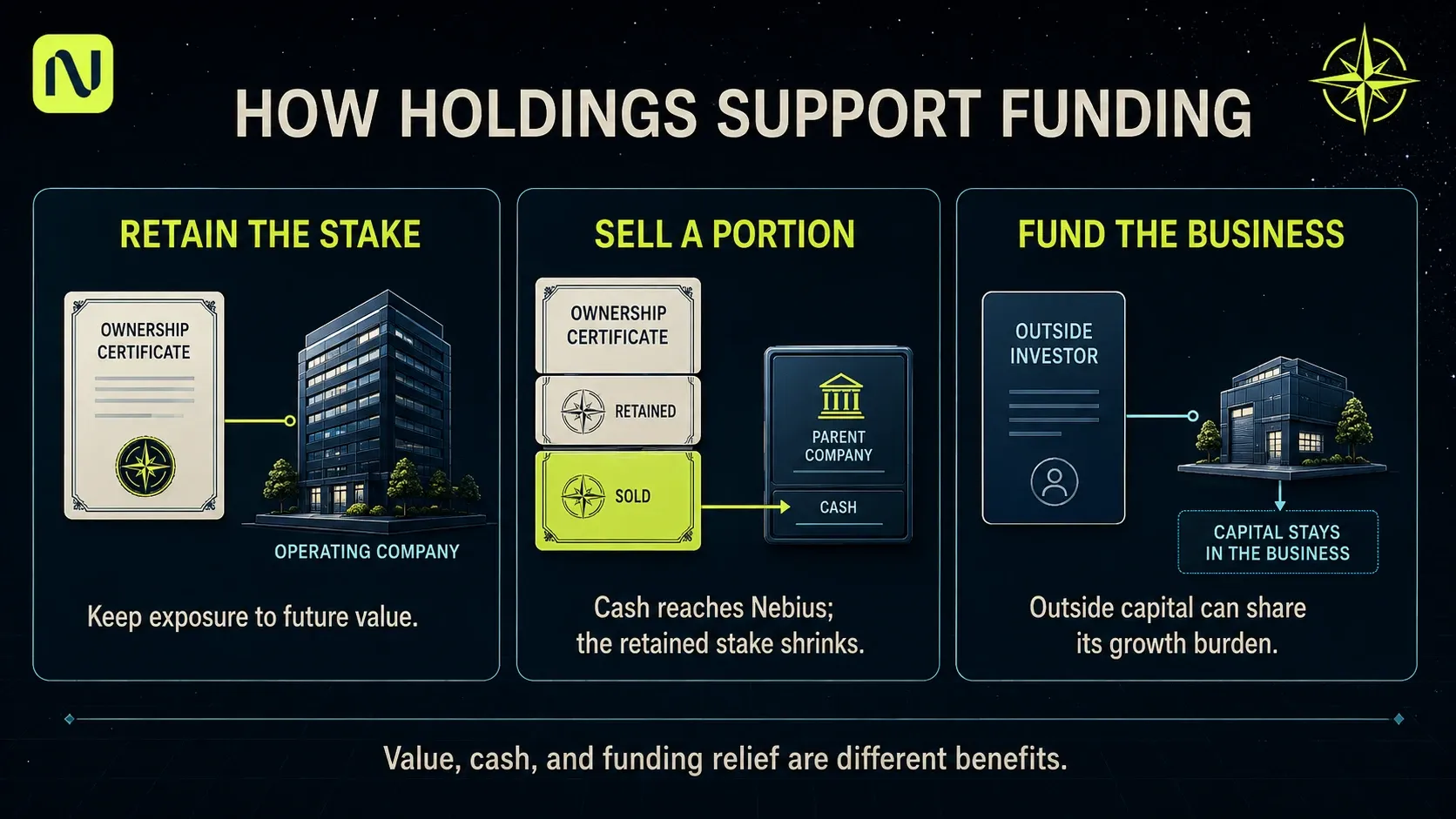
The practical advantage is flexibility over timing. Suppose a cloud project has an attractive expected return but the public share price is weak when construction bills arrive. A company with only one accessible funding route may have to accept unattractive terms, slow the project, or issue more shares. A company with a valuable, saleable interest elsewhere might have another choice. Having that choice can improve a negotiation even if management ultimately uses debt or equity. The strength of the option depends on whether a transaction can actually be completed within the period when the money is needed.
That last condition is why private investments should not be added to cash and described as though the entire sum were available tomorrow. Buyers may require a discount. Securities can have transfer restrictions, different rights, or obligations that affect the proceeds. Taxes and transaction expenses can reduce the amount reaching the parent. A market downturn can weaken both the share price of the cloud company and the valuation of its AI-related holdings, limiting diversification precisely when funding is difficult. The businesses can also need further investment of their own.
The value remains meaningful.
It simply has to be translated into the particular benefit being claimed. For long-term upside, the relevant question is what the retained ownership could be worth if the business succeeds. For a near-term funding plan, it is the net cash that can be realized on a credible timetable. For a subsidiary financing, it is how much development that capital supports and what rights Nebius retains afterward. Those are more useful questions than multiplying a headline private valuation by an old stake percentage and treating the answer as spendable cash.
Following a holding into the model without counting it twice
Imagine Nebius owns an investment interest worth $1 billion in a hypothetical transaction. It sells $300 million of that interest, before taxes and fees, and uses the proceeds toward cloud equipment. Immediately after the sale, it has a smaller retained interest and more cash. After buying the equipment, it has a smaller retained interest and more operating assets. The same $300 million has changed form. It has not become two separate benefits that can both be added in full to shareholder value.
The equipment might later create additional value by earning an attractive return. That is the investment case for redeploying the money. The forecast must show how that happens through future operations.
Our August 29 model report treats non-core assets as a potential source of funding and reduces the remaining sum-of-the-parts value for proceeds used. Sum of the parts means valuing the distinct interests within a group and assembling the amounts attributable to shareholders. It requires consistent ownership assumptions and a clear distinction between an asset retained at the end of the forecast and one sold during the period to help finance something else.
The same care applies to debt secured against a holding. The asset may remain on the balance sheet, but the borrowing adds a claim. It applies to outside investment in Avride or another business, where new capital can support growth while changing the parent's eventual share of the outcome. And it applies to businesses consolidated in Nebius's financial results: if their operating losses are already included in group expenses, a separate valuation should not deduct them again without explaining the adjustment.
This is why the subsidiaries and investments deserve space in an introduction. They change the opportunity and the financing choices. They also change what a careful reader has to reconcile. Understanding the cloud's revenue without understanding the ownership around it leaves out part of what an NBIS shareholder actually owns.
How the operating business becomes value per share
A company can grow substantially while disappointing its shareholders. Nebius makes that possibility visible because expansion can involve large amounts of customer funding, debt, leases, and new equity, alongside equipment that needs continued investment.
An investor begins by estimating the value of the operating business. Enterprise value is a common term for the value of the operations before allocating that value among financing claims. To reach equity value, an analyst adjusts for debt and other relevant obligations, available cash, and assets outside the operating valuation. Lease treatment must be consistent with how the operating earnings were measured. The remaining equity value is divided by the relevant share count. Each step requires definitions, because two plausible-looking calculations can value different sets of cash flows or subtract different claims.
The arithmetic of ownership is simple. An imaginary business with $1 billion of equity value and 100 million shares has $10 of value per share. If equity value doubles to $2 billion while the share count grows to 250 million, value per share becomes $8. The business is worth more in total, but the larger number of claims more than absorbs the increase. The example is not a forecast for Nebius; it explains why a revenue target cannot settle the investment case.
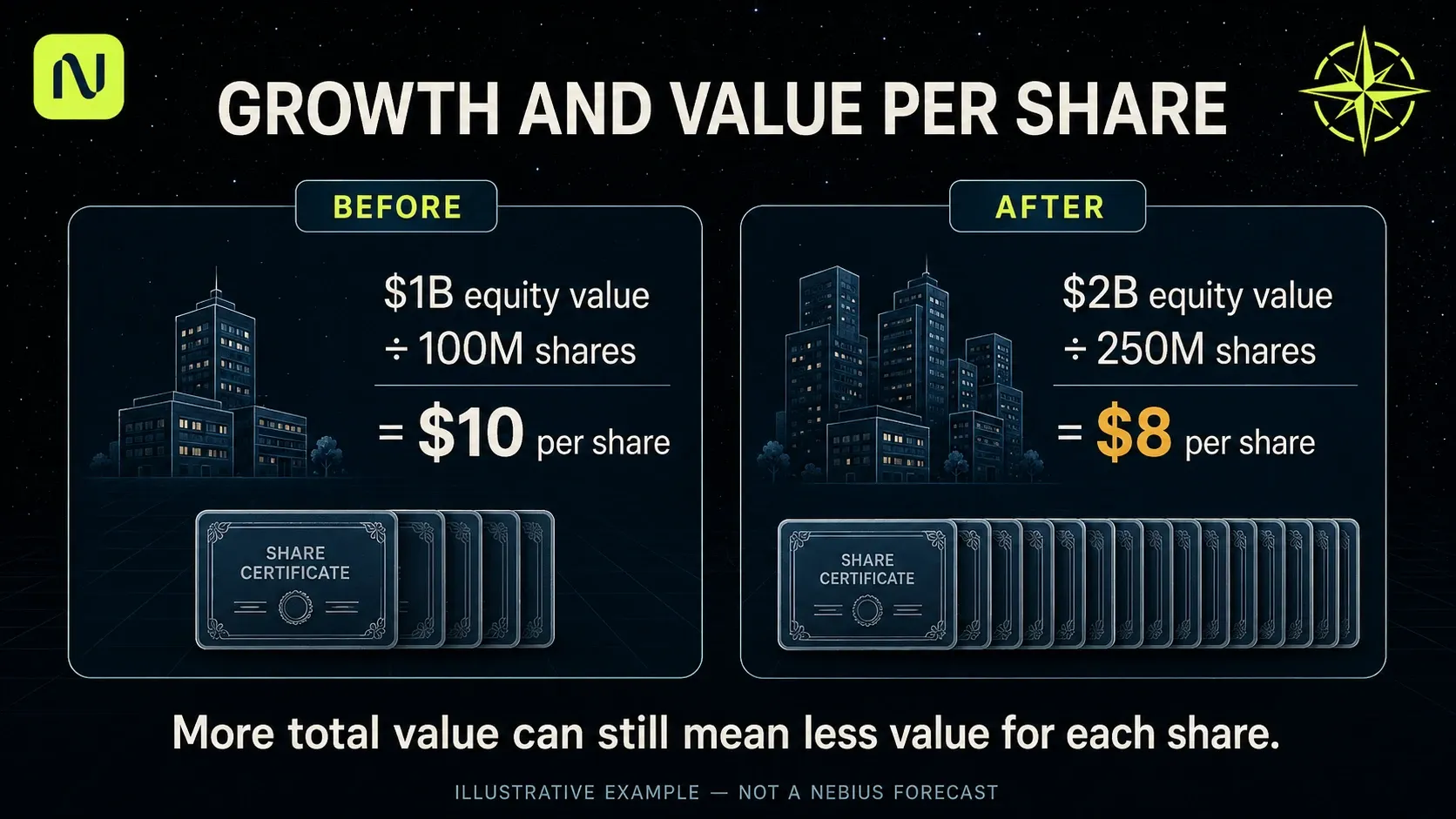
A valuation multiple expresses how much investors pay for a measure such as revenue, operating earnings, or cash flow. A high multiple can reflect expectations of rapid growth, durable profitability, or low risk. Whether those expectations are justified depends on the business. A company with a large replacement burden cannot automatically be valued like a software business requiring little incremental capital, even if both report strong EBITDA margins. If Nebius develops a larger profitable software and partnership business, the mix could change the appropriate comparison. The financial evidence has to establish that change.
Time creates another requirement. A dollar available several years from now is worth less today than an otherwise comparable dollar available immediately, because investors could use today's money elsewhere and because the future payment is uncertain. Discounting translates an estimated future value into a present value using a required return. A 2030 value per share and an estimate of value today answer different questions. Neither should be presented without its horizon and assumptions.
The latest Northwise model report contains the detailed scenarios, valuation methods, and capital-structure assumptions. It is the right place to examine the actual outputs. By this stage, the reason for starting with the customer and the facility should be clearer: the valuation is a conclusion drawn from how the whole business develops.
What a return-on-capital argument is really asking
Return on capital asks how much operating profit a business produces relative to the capital supporting it. The idea is intuitive: building something valuable requires earning enough to justify what was committed. The calculation becomes more difficult when a company is growing quickly, customers supply advances, and assets have been depreciated by different amounts.
Imagine a business produces $12 million of annual operating profit using average operating assets of $100 million. That is a 12% pretax return measured against those assets. If $40 million of the average asset base is financed by customer advances or other qualifying non-interest-bearing operating liabilities, an analyst using a net operating invested-capital definition might use $60 million as the denominator. The same $12 million then produces 20%. Both numbers can be calculated correctly if their definitions are stated. They describe different capital bases and should not be given interchangeable labels.
The customer money remains economically real. Deducting the liability in a net-capital measure does not make the assets disappear. It identifies the portion financed through operations rather than the debt and equity capital captured by that definition. The price the customer receives in exchange for advancing money remains relevant to the contract's profit. A convincing investment case should explain both the asset productivity and the funding benefit.
This is the substance beneath some of the debates we have addressed in our Nebius social writing. The disagreement can concern a real economic risk while a particular calculation still compares inconsistent quantities. Cumulative historical capex, net assets after depreciation, and average invested capital are different denominators. Accounting profit and profit after an estimated replacement reserve are different numerators. A useful comparison keeps them aligned and says whether it is before or after tax.
For a new follower, the most valuable habit is to ask what the fraction contains before accepting its conclusion. A low return may expose poor economics. It may also reflect money committed to projects that have not entered service. A high return may reflect strong operations, helpful customer funding, an optimistic accounting estimate, or a mix of the three. The task is to understand which explanation the evidence supports.
The opportunity and the ways it could disappoint
Northwise's constructive view begins with the possibility that AI becomes a larger part of everyday economic activity and that companies need capable providers to supply the computing behind it. Nebius brings systems engineering, a developing software platform, major customer relationships, and a growing infrastructure footprint to that market. If it delivers reliably, retains worthwhile contract economics, and finances the expansion well, those ingredients can build a business much larger than the one operating today.
The opportunity extends beyond the number of sites. A customer's successful application can become a recurring source of demand. A better managed service can make Nebius more important to that customer. Partners can add capacity that Nebius does not fund entirely itself. Over time, those relationships could improve how much revenue the company generates for each dollar of its own capital. That is an appealing direction of travel, provided the economics emerge in reported performance.
The downside does not require AI to disappear. Supply could grow faster than profitable demand. Customers could become more sensitive to costs or develop more capacity internally. Equipment could lose earning power faster than expected. A construction program could suffer repeated delays, leaving fixed obligations in place while revenue moves further into the future. A technically impressive platform could struggle to command a premium. The business might continue growing under any of those conditions while delivering substantially less value per share than an optimistic forecast assumes.
Several risks can arrive together. Weak renewal pricing reduces expected cash flow. That can make lenders less willing to finance equipment. More expensive funding can force a slower build or additional equity issuance. If the share price has also fallen, raising a given amount requires more shares. A downside case can therefore involve less expansion and more dilution at the same time. The relationship is more informative than applying the same percentage reduction to every forecast line.
We also need to remain willing to revise assumptions in the other direction. Better delivery, stronger customer retention, more favorable funding, or profitable partner deployments could improve the economics. A forecast should be an organized expression of the evidence and our judgment, with enough clarity that a reader can identify where they disagree. Our August model rebuild reflects that approach by connecting the physical and financial assumptions rather than treating a price target as a starting point.
What to watch as the company develops
Following Nebius becomes more manageable when new information is assigned to the question it helps answer. A product release may tell you about the service being offered. A customer agreement adds commercial evidence. A utility milestone concerns physical delivery. A capital raise changes the funding available and the claims on future value. Several of those may be favorable without resolving the others.
News or disclosure | The useful follow-up |
|---|---|
A new campus or power agreement | Identify the site, type of capacity, remaining approvals, and delivery timetable. |
Construction progress or equipment delivery | Establish what is ready, what is still being tested, and when customers can receive service. |
A new customer contract | Read duration, committed versus conditional capacity, delivery obligations, and payment terms. |
Higher prices on new deals | Ask how much capacity receives those prices and when the revenue begins. |
Rising ARR | Check the month being annualized and the revenue actually earned during the full period. |
Strong cash from operations | Examine customer advances and the service obligations still owed. |
New financing | Identify its cost, collateral, maturity, conversion terms, and effect on existing shareholders. |
Improved operating margins | Follow depreciation, equipment replacement, interest, taxes, and continuing investment needs. |
A new product or infrastructure partner | Look for adoption, contractual economics, and measurable contribution. |
A revised model or target price | Find the assumptions that changed and whether operating gains survive the financing and share-count calculation. |
At an earnings release, we would begin with actual delivery and customer activity, then examine pricing and the cash required to support the next stage. A strong quarter should be assessed alongside the obligations it creates. A weak quarter should be examined for whether a timing delay or a more lasting economic deterioration explains it. The difference affects how much of the future needs to be reconsidered.
Outside earnings, the most useful site updates establish a specific change in status. A photograph can show construction activity; a service announcement can show availability; recognized revenue can show commercial delivery. Each adds evidence at its own level. The same discipline applies to product launches and partnerships, where an announcement begins a line of inquiry that adoption and economics must complete.
The most encouraging pattern would be several parts of the business improving together: capacity reaching customers, customers expanding usage, contracts supporting attractive returns, and funding that preserves value per share. We would become more cautious if delays accumulated, renewal economics weakened, or the financing burden outran the earning power being created.
Continue with Northwise's Nebius research
The guide is intended to remain useful as those events arrive. The articles below let you move from the company-wide explanation into the evidence and assumptions behind individual subjects. Dates and access labels matter, particularly when following historical forecasts.
Northwise research | What to read it for |
|---|---|
Our latest model report, August 29, 2026: the capacity schedule, contract economics, funding, equipment replacement, and valuation. The site labels it Premium; access to the complete model and valuation follows that report's terms. | |
Nebius Pennsylvania: The Full Highridge Footprint Clears Zoning | A detailed example of land, zoning, utility evidence, and phased development. |
The European customer opportunity, Harlow's building-level evidence, and how delivery timing affects revenue and ARR. | |
Earlier site research on the UK operating footprint; read its dates alongside the newer Harlow work. | |
NBIS Stock Analysis: AVRIDE & Investment Portfolio Breakdown | Background on the group's other businesses and their strategic and funding roles. Current valuation assumptions belong to the latest model. |
The database business, its AI opportunity, and why the investment matters to Nebius. | |
Expert data, evaluation, and the role of people in more dependable AI. | |
Technical education, workforce development, and the smaller operating business. | |
Earlier analysis of the robotics opportunity; read alongside the March 2026 physical AI platform announcement. | |
The June report, useful for tracing the development of the research. Its forecasts should retain their original date. |
You can follow a company without beginning with a view on its share price. The first task is to understand what it does for a customer and why that service might remain useful. For Nebius, the next tasks lead through buildings, electricity, software, contracts, and financing. Those are the means by which the company turns a technical capability into a business.
The investment question comes at the end of that journey. After the customer has received the service, the equipment has been paid for, and the other claims have been met, what value remains for each share? That is the question our models investigate, and it is the one that keeps the expanding Nebius story connected to its owners.
Common questions about Nebius
What does Nebius do?
Nebius supplies computing infrastructure and software for developing and running AI. Customers use its services to train models, run inference, and manage demanding computing work. The listed group also owns businesses and investments outside the core AI cloud.
What does NBIS mean?
NBIS is Nebius Group's stock ticker on Nasdaq. Buying a share gives an investor an interest in the listed group, including its economic interests in other businesses. It does not create direct ownership of shares in ClickHouse or another portfolio company.
Is Nebius a chip manufacturer?
Nebius integrates computing equipment, networking, storage, and software into a service. NVIDIA is an important technology supplier and strategic investor. The two companies occupy different roles in delivering AI computing to a customer.
Who competes with Nebius?
The alternatives depend on the workload. They include AWS, Microsoft Azure, Google Cloud, specialist providers such as CoreWeave, Lambda, and Crusoe, and infrastructure businesses such as IREN where their offerings overlap. A customer can also choose a managed model service instead of renting a cluster directly. The competition chapter explains how to compare these choices.
Does Nebius own ClickHouse and Toloka?
Nebius holds equity interests in both. Its current reporting describes ClickHouse as a significant minority investment and Toloka as an equity stake following the loss of majority voting control in 2025. Ownership economics and operating control are different questions. Neither company's entire revenue should simply be added to Nebius AI Cloud revenue.
How can the other businesses help fund the cloud?
A sale of part of a holding could deliver cash to Nebius, subject to the terms, taxes, and costs. Outside investment into a business can help fund that business's development. Retaining the stake preserves exposure to future value. A higher private valuation on its own does not deliver cash to the parent.
Why can ARR be much larger than annual revenue?
Nebius defines its annualized run-rate revenue using the last month's AI-cloud revenue multiplied by twelve. If December is much larger than earlier months, that annualized pace can exceed the revenue actually earned during the year. It is a snapshot of the pace at that point, with no guarantee that the next twelve months will repeat it.
Where is Northwise's latest Nebius model?
The current report linked by this guide is NBIS Stock Forecast 2030: The Conversion Problem, published August 29, 2026. It contains the detailed scenarios connecting capacity, revenue, financing, replacement spending, and shareholder value. The report's Premium access terms apply to its complete model and valuation work.
Terms to return to
These definitions collect the language introduced in the guide. They are a reference for later reading; the chapters explain why each term matters.
Term | Meaning in this guide |
|---|---|
Accelerator | Hardware designed to perform particular computing tasks efficiently; GPUs are one type. |
Active IT capacity | Operating computing equipment, with the precise measure depending on the disclosure or model. |
AI cloud | Computing resources and services offered over a network for developing and operating AI. |
API | A defined interface through which software requests information or work from another system. |
ARR | Nebius's annualized run-rate revenue: last-month AI-cloud revenue multiplied by twelve. |
Asset-light | A structure in which the company funds or owns fewer underlying assets; another party still provides them. |
Billable capacity | Capacity earning payment under the relevant service agreement; model definitions must be checked. |
Build-to-suit | A facility developed by another party to meet a tenant's requirements. |
Capex | Capital expenditure on assets used by the business. |
Cloud | Computing resources accessed over a network, backed by physical infrastructure. |
Cluster | Connected computers organized to work together. |
Cohort | A group tracked together, such as capacity entering service in the same year. |
Collateral | Assets or rights that support a lender's claim. |
Colocation | Use of another operator's data-center space and supporting infrastructure. |
Commissioning | Testing and preparation to establish that systems operate as intended. |
Compute | The processing resources that perform computing work. |
Contracted power | Land and power commitments for capacity, as defined in the relevant disclosure. |
Convertible note | Debt with terms that provide for conversion or equity-linked settlement. |
Deferred revenue | A liability for customer payment received before the corresponding revenue is earned. |
Depreciation | Accounting allocation of an asset's depreciable cost over its estimated useful life. |
Dilution | Reduction in an existing holder's ownership percentage when additional shares are issued. |
EBITDA | Earnings before interest, taxes, depreciation, and amortization. |
Enterprise value | A valuation of operations before allocating value among financing claims, under the chosen method. |
Equity value | Value attributable to shareholders after the relevant adjustments and obligations. |
Fine-tuning | Additional training to adapt a model to particular data or requirements. |
Free cash flow | A cash-flow measure after capital spending; definitions and exclusions vary. |
Fully diluted shares | A share count including the potential claims specified by the calculation. |
GPU | Graphics processing unit, a type of chip used for parallel computing, including AI. |
GW | Gigawatt; 1,000 megawatts. |
Hyperscaler | A very large cloud operator. |
Inference | Using a model to produce a result. |
IT power | Power used by computing equipment, distinct from supporting facility systems. |
MW | Megawatt; a unit of power. |
MWh | Megawatt-hour; a unit of energy. |
Neocloud | A broad industry label for a newer cloud provider focused on AI. |
Orchestration | Coordination of computing resources and work. |
Prepayment | Money a customer pays before the corresponding service is delivered. |
PUE | Total facility energy divided by IT-equipment energy over the same period. |
Replacement reserve | A modeled allowance for recurring economic spending needed to sustain equipment productivity. |
Revenue recognition | Recording revenue as contractual performance is satisfied under the applicable accounting treatment. |
Token | A unit a language model uses to process text, such as a word, word fragment, or punctuation. |
Training | The learning process used to develop or adapt a model. |
Utilization | How much of an available resource is used; physical usage and billable usage can differ. |
Working capital | Operating balances arising from differences in the timing of sales, collections, purchases, and payments. |
Consolidation | Combining the financial results of controlled businesses under the applicable accounting rules. |
Minority interest | An ownership stake representing less than half of an entity's equity; voting rights and control can differ. |
Non-cash revaluation | A change in an investment's reported value that does not itself deliver sale proceeds. |
Sum of the parts | Valuing distinct interests in a group and combining the amounts attributable to its shareholders. |
Edition basis: company disclosures through Q2 2026, relevant subsequent announcements, and Northwise research reviewed through September 6, 2026. Hypothetical examples are identified as illustrations. Management targets, reported results, Northwise inferences, and forecast assumptions are distinct. Linked historical reports retain their own dates.
Nebius Asset-Light Business Model: The Cloud Someone Else Pays to Build
How Nebius can earn cloud fees on partner-owned GPUs. Explore owner economics, Palantir, cash flow and our 2030 asset-light scenarios in this free report.
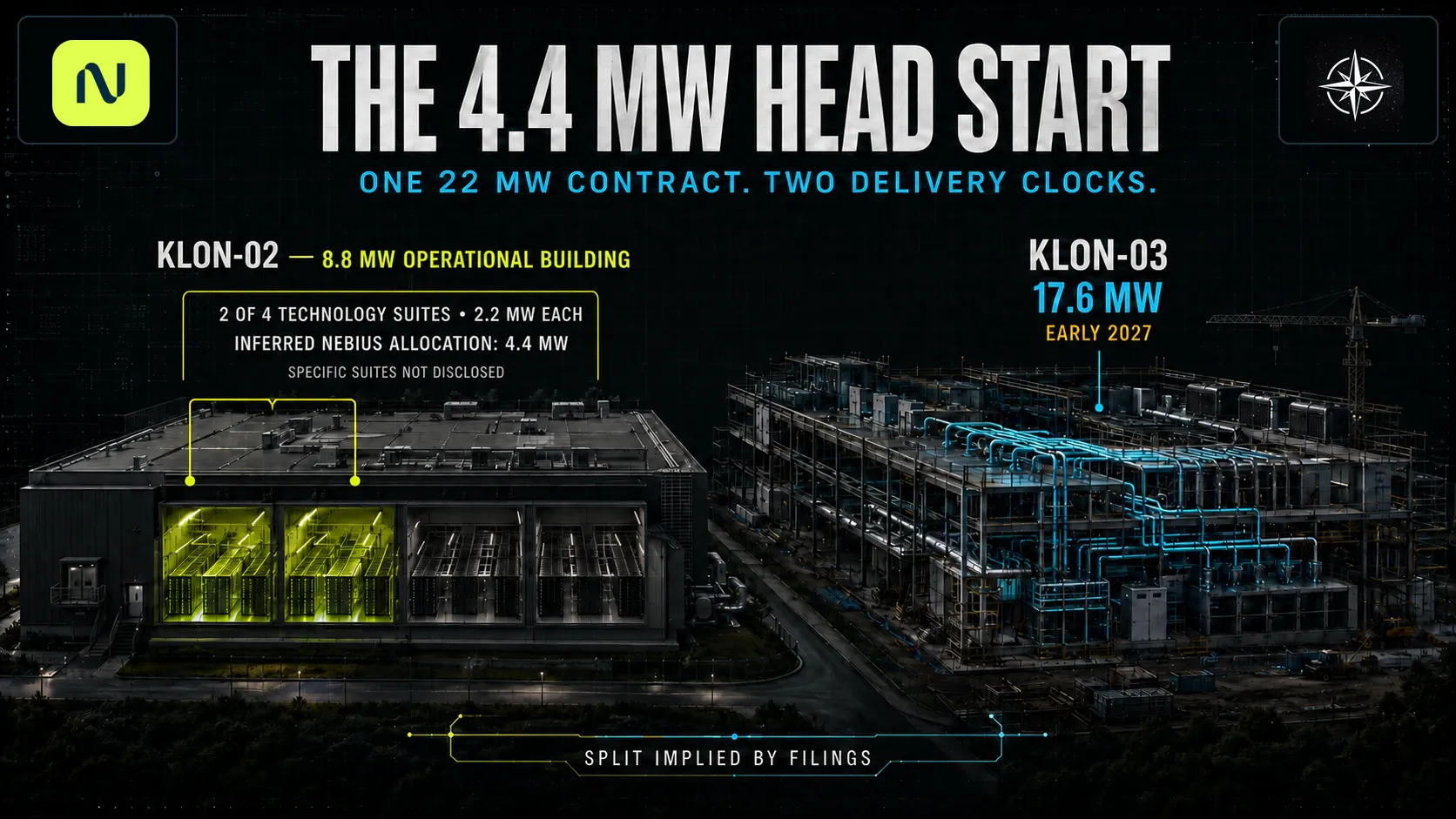
Nebius in Europe: Sovereign AI, UK Expansion and Harlow
How European AI sovereignty supports Nebius’s UK expansion, where Harlow fits, and what its potential 4.4 MW deployment could add to Q3 revenue and 2026 ARR.
NBIS Stock Forecast 2030: The Conversion Problem
A ground-up Nebius model rebuild after Q2 2026, covering AI factory economics, capital structure, valuation scenarios, and the NBIS stock forecast to 2030.
Northwise Portfolios
See how the research becomes real decisions
Reader discussion
Discuss the research
Create a Free account to join the discussion with a display name.
Create a Free Account
No comments yet. Start a thoughtful discussion.