
Analyzing Nebius’s Investments

NBIS stock analysis on Nebius’s investments, including how ClickHouse, Avride, & other investments shape liquidity, valuation, and optionality.
In this article
NBIS Stock Analysis: Strategic Asset Allocation and Investment Portfolio Breakdown
How Nebius Group’s investments reshape its capital structure, execution flexibility, and long-term AI infrastructure strategy
I. Reframing Nebius Within the AI Infrastructure Landscape
Nebius Group is usually analyzed through a narrow operational lens. Most discussions focus on GPU procurement, data center construction, and the race to scale AI compute capacity across Europe and the United States. That perspective captures an important part of the business, but it leaves out a structural feature that materially changes how Nebius should be understood as a public company.
Nebius is building AI infrastructure while also holding significant investments in several standalone technology businesses. These investments are not side projects or legacy leftovers. They are operating companies with independent customers, external investors, and, in some cases, clear paths to liquidity. They sit alongside the core AI cloud business and meaningfully influence how Nebius can fund growth and manage risk.
This distinction matters because AI infrastructure is constrained less by demand than by capital and timing. GPU clusters, power contracts, and data center builds require large commitments well before revenue is fully realized. Companies without flexibility are often forced into dilution, expensive debt, or restrictive partnerships to keep pace. Nebius approaches the same constraints from a different position.
Its investments in businesses such as ClickHouse, Avride, Toloka, and TripleTen introduce practical optionality into the model. These holdings can be monetized, partially sold, borrowed against, or simply held while the core AI cloud scales. Even when they remain untouched, they change how Nebius negotiates with hardware vendors, power providers, and financing partners. The presence of valuable investments reduces the likelihood that growth must be financed under pressure.
This NBIS stock analysis starts from that reality. Nebius is not building AI infrastructure on a blank balance sheet. It is doing so with a portfolio of valuable investments in the background. Understanding how those investments came to exist, what they are worth, and how they interact with the core business is essential to evaluating both the downside protection and the strategic flexibility embedded in the stock.
II. Corporate Genealogy and the Logic Behind Nebius’s Investment Portfolio
The existence of Nebius’s investment portfolio is not accidental, nor is it the result of opportunistic dealmaking after the company became independent. It is the product of a deliberate selection process that took place during the separation from Yandex, when management had to decide which businesses could operate credibly, competitively, and globally outside of the Russian market.
The Yandex breakup was a forced restructuring under geopolitical pressure, with strict constraints around jurisdiction, data sovereignty, and customer perception. In that environment, most assets were divested outright. The businesses that remained with Nebius shared a common set of characteristics that made them viable outside the Yandex ecosystem.
Each retained company possessed globally relevant intellectual property, served international customers, and operated with technical and commercial independence from Russia-based infrastructure. These were not subsidiaries dependent on Yandex traffic, data, or distribution. They were businesses that already competed, or could compete, on their own merits in Western markets.
ClickHouse fits this profile as a database system adopted by global enterprises and open-source developers. Avride qualified due to its international R&D footprint and partnerships with Western automotive and mobility platforms. Toloka and TripleTen met the threshold through their customer bases, talent networks, and operational structures that extended well beyond any single geography.
Just as important as what was retained is what was not. Nebius did not attempt to preserve a tightly integrated conglomerate. It did not force these businesses into a vertically unified operating model. Instead, it allowed them to remain structurally separate, with their own management teams, capitalization tables, and growth trajectories. That decision preserved their strategic value rather than diluting it.
From an investment perspective, this matters because it explains why these holdings are economically meaningful today. These are not internal tools whose value is contingent on the success of the AI cloud business. They are standalone companies with external validation, third-party investors, and, in some cases, market-implied valuations that can be referenced independently of Nebius’s own share price.
The result is a company that emerged from the Yandex separation with two parallel realities. On one side sits a capital-intensive AI infrastructure business scaling GPU clusters and power capacity. On the other sits a portfolio of investments that carry their own momentum, optional liquidity, and strategic relevance. The decision to retain these businesses preserved flexibility at a moment when flexibility was scarce.
That context sets up the correct analytical lens. Nebius should be evaluated as a company whose equity reflects both an execution-driven infrastructure build and a portfolio of investments that influence how that execution is financed, paced, and de-risked over time.
Next, we’ll formalize that lens and explain why a sum-of-the-parts framework is the most useful way to think about NBIS stock from here.
III. Why a Sum-of-the-Parts Lens Matters for NBIS Stock
Nebius Group presents a valuation challenge that traditional operating metrics struggle to capture. The company combines a capital-intensive AI infrastructure build with a portfolio of meaningful technology investments, each carrying its own economics, growth profile, and sources of value. Evaluating these pieces as a single operating stream obscures how value is created and where risk truly resides.
A sum-of-the-parts framework provides a clearer view. It allows the AI cloud business and the investment portfolio to be assessed on their own terms, rather than forcing both into a blended multiple that fits neither. This matters because the drivers of value creation differ meaningfully across the business. Infrastructure performance depends on utilization, power costs, and capital efficiency. The investments depend on adoption, strategic partnerships, and private market valuations.
When these elements are separated conceptually, the structure of NBIS stock becomes easier to understand. A portion of the company’s equity reflects exposure to the execution of the AI cloud buildout. Another portion reflects ownership in late-stage technology businesses whose value evolves independently. The interaction between these two layers shapes both the upside profile and the downside protection embedded in the stock.
This distinction carries practical implications for risk assessment. Investors often associate AI infrastructure with high dilution risk due to the scale of capital required to deploy GPUs and secure long-term power capacity. Nebius approaches that challenge with an additional set of financial tools. The presence of valuable investments introduces flexibility around timing and financing that changes how growth can be funded across market cycles.
It also affects how volatility should be interpreted. Movements in NBIS stock reflect not only changes in expectations for AI compute demand, but also shifts in private market sentiment around assets like ClickHouse and Avride. Those assets can appreciate or mature on timelines that diverge from the infrastructure build, creating periods where the underlying value of the company evolves even when near-term operating metrics remain noisy.
Viewed through this lens, NBIS functions as a layered equity. The infrastructure business provides exposure to the expansion of AI compute capacity. The investment portfolio provides balance sheet strength, strategic leverage, and optional liquidity. Together, they form a structure that resists simple classification and rewards a more granular approach to valuation.
With that framework in place, the analysis can turn to the most financially significant investment in the portfolio: ClickHouse, and its role in shaping both the valuation floor and the strategic flexibility of NBIS stock.
IV. ClickHouse: The Financial Anchor Inside the NBIS Investment Portfolio
A. Technical Foundation and Market Position
ClickHouse is a column-oriented database built for analytical workloads at extreme scale. Its design prioritizes speed, efficiency, and real-time insight, characteristics that trace back to its original role handling large-scale analytics inside Yandex. By storing data by columns rather than rows, ClickHouse reads only the information required to answer a query, allowing it to process billions of rows per second on relatively standard hardware.
This architecture has proven especially effective in modern observability and AI-adjacent workloads. Distributed systems, cloud-native applications, and large models generate continuous streams of logs, metrics, and traces that require constant interrogation rather than periodic analysis. ClickHouse has gained adoption precisely because it supports that real-time analytical posture at a cost profile that scales.
As AI workloads expand, this positioning becomes increasingly relevant. Training, inference, and application deployment generate dense operational data that must be monitored, queried, and understood in near real time. ClickHouse sits directly adjacent to those workflows, operating as a core analytics layer within many AI-driven systems.
B. Ownership Structure, Valuation, and Financial Weight
ClickHouse operates as an independent company with its own management team and a substantial external investor base. Nebius Group N.V. owns approximately 28% of ClickHouse on a fully diluted basis, a stake that carries meaningful financial weight at current private market valuations.
In its most recent funding round, ClickHouse was valued at approximately $15b, reflecting strong enterprise adoption, accelerating revenue growth, and sustained demand for real-time analytics infrastructure. At that valuation, Nebius’s 28% ownership corresponds to an implied stake value of roughly $4.2 billion.
That figure is material in the context of NBIS stock. It represents a sizable portion of Nebius’s overall market capitalization and exists independently of the performance or near-term economics of the AI cloud business. The value of this stake is anchored in ClickHouse’s own operating momentum, customer base, and future liquidity prospects rather than the success or failure of Nebius’s GPU deployments.
The ownership structure also matters. Nebius does not control ClickHouse operationally, which allows the company to remain a neutral analytics platform across cloud providers and enterprise environments. At the same time, a 28% position is large enough to function as a strategic financial asset rather than a passive venture exposure.
C. Strategic and Capital Implications for NBIS Stock
Within this NBIS stock analysis, ClickHouse serves three distinct roles.
First, it establishes a valuation foundation. A stake worth roughly $4.2 billion in a late-stage, globally adopted software company introduces a tangible asset floor beneath an otherwise capital-intensive infrastructure story. That foundation reshapes how downside risk should be evaluated.
Second, it provides capital flexibility. A stake of this size can be partially monetized through secondary transactions, structured into financing arrangements, or potentially used as collateral. Each pathway offers different trade-offs, but all reduce reliance on forced equity issuance during periods of heavy capital spending.
Third, it creates strategic adjacency. ClickHouse’s role in analytics and observability places it close to the workloads that run on AI infrastructure. As compute usage scales, so does the need to analyze system behavior, performance, and outputs. That proximity reinforces the relevance of the investment even without formal integration.
Taken together, ClickHouse functions as the financial anchor of Nebius’s investment portfolio. Its scale, valuation, and liquidity profile materially influence how Nebius can pace capital deployment, manage risk, and fund its AI infrastructure ambitions over time.
V. Avride: Physical AI Optionality Embedded in NBIS Stock
A. Dual-Modality Autonomous Strategy
Avride represents Nebius’s exposure to physical AI systems, where software intelligence is paired directly with real-world deployment. The company operates across two modalities: autonomous passenger vehicles and last-mile delivery robots. Both are built on a shared autonomy stack that includes perception, sensor fusion, mapping, and motion planning.
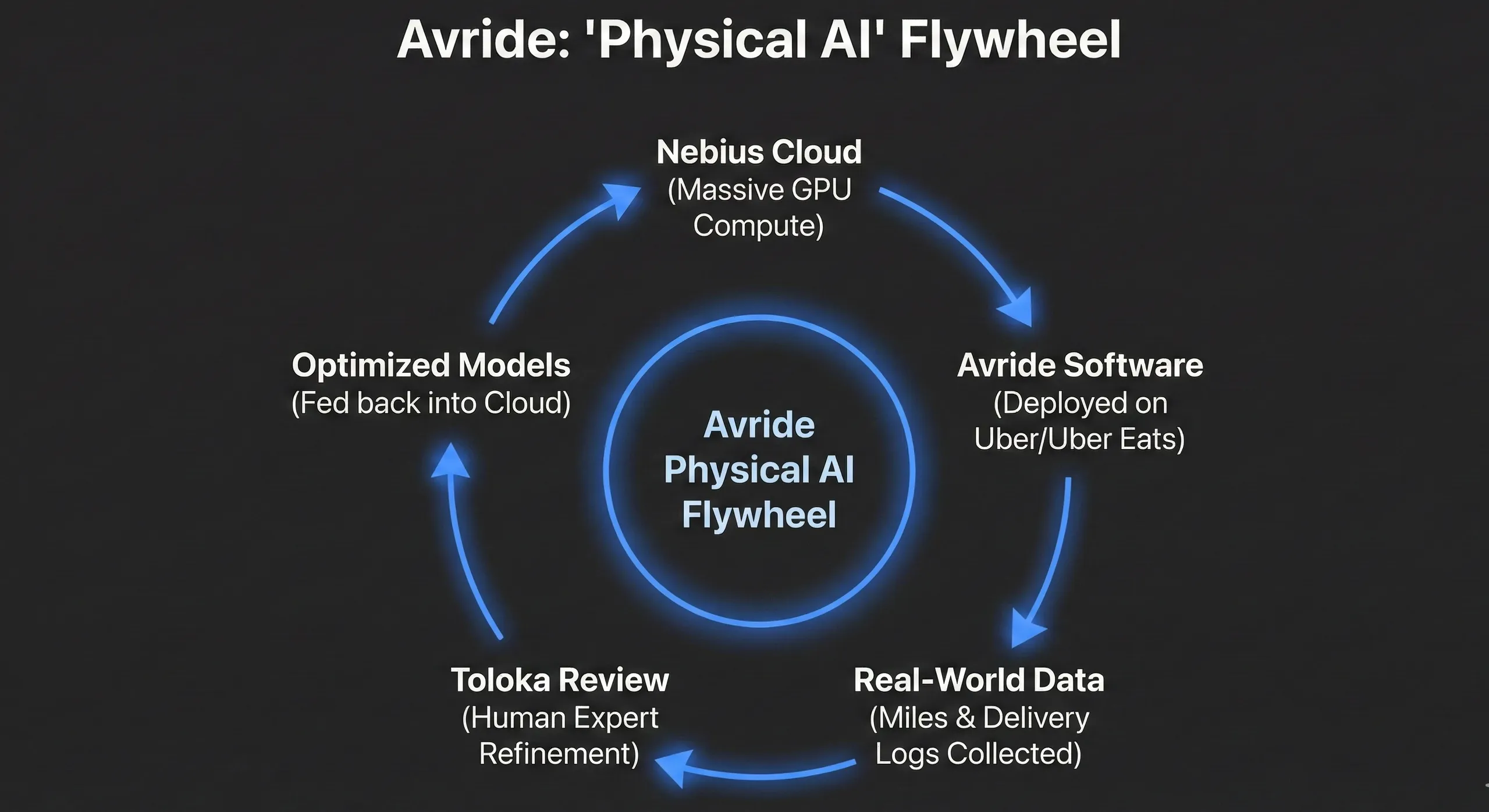
This shared architecture has practical implications. Autonomy development is capital intensive, and duplicating core software across vehicle types compounds cost without adding capability. Avride’s approach spreads R&D investment across multiple deployment paths, improving capital efficiency while expanding the surface area for commercialization. Delivery robots provide a lower-speed, lower-regulatory environment for refinement and iteration, while robotaxis target a much larger economic prize over a longer timeline.
From an operational standpoint, this structure creates optionality around pacing. Progress in one modality informs the other, and revenue-generating deployments in delivery can coexist with longer-cycle validation in passenger transport. The result is a business that advances autonomy capabilities without relying on a single binary outcome.
B. Distribution and Commercial Validation Through Uber
The strategic inflection point for Avride came with its partnership and investment from Uber Technologies. Autonomous vehicle technology has historically struggled less with technical feasibility than with distribution. Building a capable system is only one part of the equation. Access to consistent demand, real-world operating data, and a trusted consumer interface determines whether autonomy becomes a commercial product or remains an extended pilot.
Uber solves that distribution problem. Through the partnership, Avride’s robotaxis are scheduled to launch on the Uber platform in Dallas, while its delivery robots are already integrated into Uber Eats operations in select markets. This provides immediate demand liquidity, operational feedback, and a direct path to revenue generation without requiring Avride to build its own consumer network.
For valuation, this matters materially. Autonomous vehicle businesses without distribution face long timelines and uncertain unit economics. A platform partner with global reach compresses that uncertainty. The Uber relationship anchors Avride’s commercialization strategy in an existing ecosystem, reducing customer acquisition risk and improving the credibility of its deployment roadmap.
C. Ownership, Valuation, and Strategic Weight for NBIS Stock
Following its most recent funding round, Avride carries an estimated post-money valuation of approximately $2.7–$2.8 billion. Nebius Group N.V. retains roughly 83% ownership of the company, implying a stake value of approximately $2.2–$2.3 billion at current marks.
That scale places Avride alongside ClickHouse as one of the two largest financial assets within the Nebius investment portfolio. The difference lies in profile rather than magnitude. ClickHouse provides maturity and liquidity potential. Avride provides asymmetric upside tied to the adoption of physical AI systems.
From a capital allocation perspective, the Uber partnership alters the burden of funding. External capital and strategic alignment reduce the need for Nebius to serve as the sole financier of Avride’s development. That shift allows Nebius to retain control and upside while directing more of its own capital toward AI infrastructure deployment.
Within this NBIS stock analysis, Avride functions as a long-duration option embedded in the equity. Its value does not need to be realized in the near term to matter. The presence of a controlling stake in a commercially aligned autonomous mobility platform expands Nebius’s strategic surface area while preserving balance sheet flexibility. The upside is meaningful, the timelines are extended, and the risk is partially externalized through partnership.
With ClickHouse anchoring value and Avride providing asymmetric exposure to physical AI, the analysis can now turn to the supporting investments that reinforce Nebius’s position across the AI stack, beginning with Toloka and its role in data and model training infrastructure.
VI. Toloka AI: The Data Layer Asset
A. Business Model Evolution
Toloka operates within the data layer of the AI stack, a segment whose economics have shifted materially with the rise of generative models. The company’s business model evolved in response to that shift.
Toloka initially scaled as a crowdsourcing platform, optimized for high-volume annotation tasks such as image classification and basic labeling. That model emphasized throughput and cost efficiency. As generative AI systems became more complex, demand moved toward higher-skill human input, including contextual judgment, domain expertise, and structured evaluation.
Toloka adapted by repositioning itself around expert-in-the-loop workflows. Today, the platform focuses on reinforcement learning from human feedback, model evaluation, and complex annotation tasks performed by vetted specialists rather than anonymous contributors. This aligns Toloka’s revenue base with the economics of GenAI training, where marginal improvements in model quality carry outsized value relative to raw data volume.
As a result, Toloka’s demand profile scales with model sophistication rather than dataset size. That places it closer to the core training loop of advanced AI systems than to commoditized data services.
B. Deconsolidation and Governance Reset
Nebius’s restructuring of Toloka centered on governance and market access rather than operational performance. In 2025, Toloka raised approximately $72 million in external capital, led by Bezos Expeditions, with participation from senior technology executives.
As part of that transaction, Nebius Group N.V. ceded voting control while retaining a majority economic interest. This shift allowed Toloka to present as an independent, neutral data services provider to Western enterprises and research organizations, where governance clarity and jurisdictional separation influence procurement decisions.
The change also altered Nebius’s financial presentation. Toloka was deconsolidated and is now accounted for under the equity method, removing its operating costs and margin profile from Nebius’s consolidated EBITDA. This separation improves transparency by isolating infrastructure economics from services-based revenue while preserving Nebius’s exposure to Toloka’s upside.
Analyst estimates place the implied value of Nebius’s retained economic stake at approximately $400–$500 million, based on the post-money valuation associated with the funding round. That valuation exists independently of Nebius’s AI cloud execution.
C. Strategic Capital Involvement and Capital Efficiency
The involvement of Bezos Expeditions carries weight beyond the dollar amount invested. Strategic capital at this level performs a signaling function in enterprise AI markets, validating governance standards, operational independence, and long-term viability.
For Toloka, that validation supports customer acquisition and partnership discussions in environments where trust and neutrality are prerequisites. For Nebius, the transaction improves capital efficiency. Toloka can fund its growth through external capital aligned with its operating model, while Nebius preserves balance sheet capacity for GPU deployment, power procurement, and infrastructure build-out.
In portfolio terms, Toloka functions as a capital-light AI asset with an estimated stake value approaching half a billion dollars. It compounds alongside model adoption and increasing training complexity, while drawing minimally on the same capital pool required for compute expansion.
VII. TripleTen: Human Capital Infrastructure
A. Operating Model and Growth Profile
TripleTen operates as a workforce reskilling platform focused on software engineering, data science, analytics, and quality assurance roles. The business is structured around intensive bootcamp-style programs combined with career placement support, targeting adult learners seeking entry or transition into technical roles.
TripleTen has demonstrated meaningful scale. In the first nine months of 2024, the platform enrolled approximately 10,000 students, with reported enrollment growth exceeding 100% year over year in key markets including the United States and Latin America. Revenue growth has tracked enrollment expansion, supported by partnerships that provide tuition financing and broaden addressability.
From a capital standpoint, the model is structurally different from Nebius’s infrastructure business. TripleTen requires investment in curriculum development, instructors, and student support rather than hardware or physical assets. Capital intensity remains low, with growth funded primarily through operating cash flow and modest working capital requirements rather than long-duration capital commitments.
Nebius Group N.V. owns 100% of TripleTen, giving it full economic exposure and strategic discretion over the asset.
B. Strategic Fit Within the AI Ecosystem
TripleTen’s relevance lies in its position relative to AI adoption rather than AI development itself. As AI infrastructure, analytics platforms, and data tools scale, demand increasingly shifts toward practitioners capable of deploying, operating, and integrating those systems into real-world workflows.
Workforce capacity has emerged as a persistent constraint. Infrastructure can be deployed faster than talent can be trained. TripleTen addresses that imbalance by expanding the supply of engineers, analysts, and technical operators who form the downstream user base for AI infrastructure and analytics platforms.
From Nebius’s perspective, this creates ecosystem alignment rather than operational dependence. TripleTen does not need to integrate directly with the AI cloud business to contribute value. Growth in AI adoption expands demand for technical training, while expansion of trained talent increases the addressable market for infrastructure and analytics services. The linkage is indirect but economically coherent.
The asset also contributes revenue diversification. Education and training demand follows different cycles than GPU deployment or enterprise infrastructure spending, reducing correlation across Nebius’s revenue sources.
C. Monetization Optionality
TripleTen offers flexibility in how value can ultimately be realized. As a wholly owned subsidiary with a service-based revenue model, it can continue operating as a cash-generating business, supporting group-level liquidity without additional capital requirements.
Alternatively, the platform remains a viable candidate for a spin-off or strategic sale. The edtech and workforce training space has seen consolidation, particularly for scaled platforms with strong placement outcomes and international reach. A transaction of that nature would provide another non-dilutive capital source should Nebius choose to redeploy resources toward infrastructure expansion.
While TripleTen’s implied valuation is less visible than that of ClickHouse or Avride, conservative estimates place its standalone value in the low hundreds of millions of dollars, based on enrollment scale, growth rates, and comparable transactions in the sector. The precise figure matters less than the structural role it plays: a low-capital, independently monetizable asset that broadens Nebius’s balance sheet without competing for infrastructure funding.
Within the broader portfolio, TripleTen functions as human capital infrastructure. It expands the labor pool required to support AI adoption while offering Nebius revenue diversification and long-term monetization flexibility.
VIII. Capital Allocation Synthesis: Quantifying the Investment Layer
Nebius’s investment portfolio is best understood by aggregating scale before drawing conclusions. The individual assets differ in maturity and liquidity, but together they form a material layer of value beneath the operating AI infrastructure business.
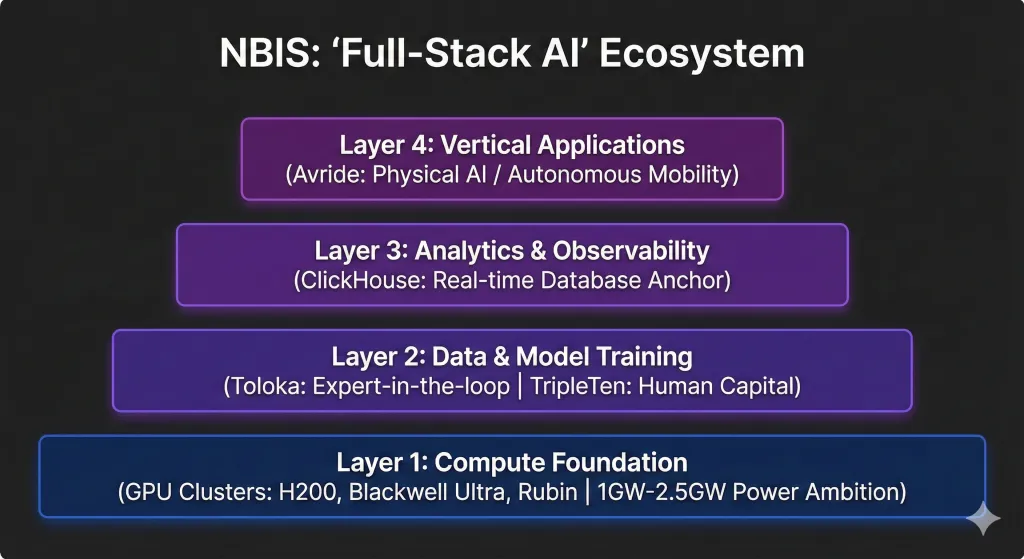
Based on disclosed ownership stakes and recent private market valuations, the portfolio can be approximated as follows:
- ClickHouse
Nebius owns approximately 28% on a fully diluted basis.
Most recent valuation: $15 billion
Implied Nebius stake value: ~$4.2 billion - Avride
Nebius owns approximately 83% following the Uber-led financing round.
Post-money valuation: ~$2.7–$2.8 billion
Implied Nebius stake value: ~$2.2–$2.3 billion - Toloka
Nebius retains a majority economic interest following deconsolidation.
Capital raised: ~$72 million, led by Bezos Expeditions
Analyst-implied valuation: ~$600–$700 million
Implied Nebius stake value: ~$400–$500 million - TripleTen
Nebius owns 100%.
Enrollment scale: ~10,000 students (first 9 months of 2024)
Conservative implied valuation based on edtech comparables: ~$200–$300 million
Aggregated conservatively, these investments represent approximately:
$7.5–$8.0 billion of implied equity value
This figure excludes Nebius’s reported cash balance and reflects only the value of operating businesses held outside the core AI infrastructure segment.
Against a current market capitalization of approximately $27.8 billion, the investment portfolio alone accounts for roughly:
27%–29% of NBIS’s total equity value
That proportion exists independently of GPU utilization, power capacity deployment, or near-term infrastructure margins. It is value derived from ownership in late-stage technology businesses whose economics and timelines differ materially from data center buildouts.
This framing clarifies how capital allocation functions in practice. The AI infrastructure business consumes capital through GPU procurement, power contracts, and facility construction. The investment portfolio offsets that consumption by providing optional liquidity, balance sheet depth, and financing flexibility. Some assets offer near-term monetization potential, others provide long-duration upside, and several require minimal incremental capital to compound value.
Importantly, this layer does not need to be actively monetized to influence outcomes. Its presence reshapes financing decisions, improves negotiating posture with vendors and lenders, and reduces the probability that infrastructure growth must be funded through unfavorable equity issuance.
In effect, NBIS stock represents ownership in two overlapping structures: an AI infrastructure operator scaling compute capacity, and a portfolio of investments that already accounts for a meaningful share of the company’s market value. Understanding how those two layers interact is central to assessing both risk and return.
IX. Funding the 1 GW Compute Ambition
Nebius’s stated objective to scale toward approximately 1 gigawatt (GW) of AI compute capacity places it among a small group of infrastructure operators attempting to build at hyperscale rather than incrementally. Reaching that level of capacity requires multi-year capital commitments across GPUs, power contracts, and physical infrastructure, with spending front-loaded well ahead of steady-state utilization.
At current industry benchmarks, a 1 GW AI footprint implies several billion dollars of cumulative capital expenditure. High-end GPU clusters alone represent hundreds of millions of dollars per deployment phase, while long-term power agreements and data center construction lock in additional obligations that extend years into the future. In this phase of growth, balance sheet capacity matters more than near-term margins. The ability to commit credibly and early often determines access to hardware, power density, and favorable contract terms.
Nebius approaches this buildout with a different capital profile than many AI infrastructure peers. Companies such as CoreWeave or Lambda Labs have relied heavily on structured debt, asset-backed financing, and repeated equity injections to fund GPU expansion. That model can scale quickly, but it ties growth to debt servicing capacity and exposes operators to refinancing risk if utilization or pricing compresses.
By contrast, Nebius enters the compute ramp with a balance sheet supported by $7.5 – $8 billion in investment assets alongside a substantial cash position. That depth allows capital commitments to be paced with greater discretion. GPU orders can be placed without immediate recourse to equity markets. Power contracts can be secured on longer tenors. Facility buildouts can be sequenced based on demand visibility rather than financing pressure.
This flexibility extends into vendor negotiations. Hardware suppliers and power providers assess counterparty risk when allocating scarce capacity. A company that can demonstrate balance sheet strength, asset backing, and optional liquidity presents as a lower-risk long-term partner. That posture influences allocation priority, delivery schedules, and pricing dynamics, particularly in constrained markets for advanced GPUs and high-density power.
The interaction between capital depth and execution discipline becomes especially important as scale increases. Early infrastructure deployments often tolerate inefficiencies. At the gigawatt level, small differences in financing cost, contract structure, or utilization assumptions compound into material differences in returns. The ability to absorb timing mismatches without forcing capital raises preserves optionality and reduces the likelihood of value-destructive decisions.
In practical terms, Nebius’s investment portfolio does not fund the compute ramp directly. It supports the conditions under which that ramp can occur. It lowers financing risk, strengthens negotiating leverage, and allows management to align capital deployment with operational readiness rather than market sentiment.
With the mechanics of the compute ambition established, the next step is to formalize the portfolio structure in a consolidated view. The following section presents an asset-by-asset valuation matrix to summarize ownership, scale, liquidity, and strategic relevance across the portfolio.
X. NBIS Portfolio Valuation Matrix
The table below consolidates Nebius’s major investment holdings, summarizing ownership, implied value, liquidity profile, and strategic role within the broader company structure. Valuations reflect recent private market transactions and conservative analyst estimates rather than optimistic forward projections.
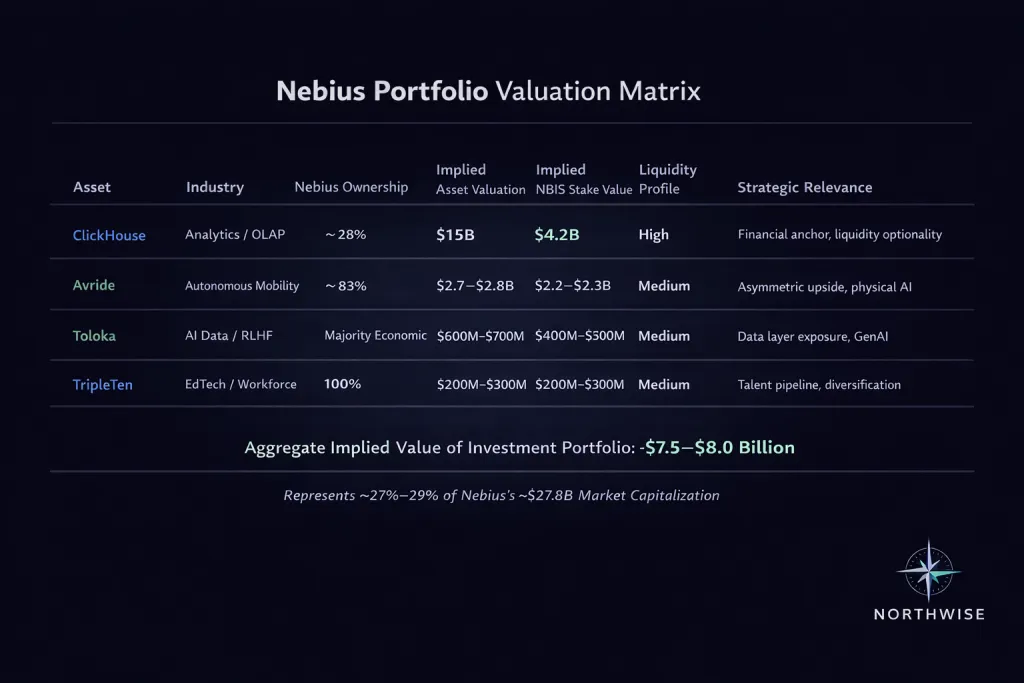
This portfolio layer exists alongside Nebius’s core AI infrastructure business and reported cash balance. On a standalone basis, the investments account for approximately 27%–29% of Nebius’s ~$27.8B market capitalization, before assigning any value to future infrastructure cash flows or compute margins.
Two structural features stand out when viewed in aggregate:
First, liquidity is tiered. ClickHouse provides the clearest and most immediate liquidity pathways. Avride carries longer-duration optionality tied to execution milestones. Toloka and TripleTen sit in the middle, capital-light and monetizable without urgency.
Second, capital demands are asymmetric. None of these assets compete directly with the AI infrastructure business for large capital commitments. Their value compounds primarily through execution, adoption, and market positioning rather than balance sheet consumption.
This matrix clarifies the role of the investment portfolio within NBIS stock. It is not ancillary. It represents a material, independently valued layer of the equity that influences financing risk, downside protection, and strategic flexibility.
With the structure now explicit, the final step is to address where this framework could fail and what would change the market’s perception of NBIS stock over time.
XI. NBIS Stock Risk Factors and Failure Modes
Nebius’s structure reshapes how risk is distributed across the business rather than eliminating it outright. The combination of a capital-intensive AI infrastructure build, a large cash position, and a portfolio of private technology investments narrows certain downside scenarios while introducing constraints tied to valuation, liquidity timing, and execution at scale. The company’s Q3 2025 financials clarify where those pressures could surface.
Private Market Valuation Compression
A meaningful portion of Nebius’s implied asset backing rests on private market valuations rather than continuously priced public markets. ClickHouse, Avride, and Toloka are valued based on recent funding rounds that reflect prevailing capital conditions and investor appetite. Changes in those conditions could compress implied values even if the underlying businesses continue to operate and grow.
This risk is structural rather than operational. The assets would remain intact, but the market’s willingness to ascribe premium valuations could fluctuate independently of Nebius’s AI infrastructure progress. Given that these investments collectively account for approximately $7.5-$8 billion, or roughly 27-29% of Nebius’s ~$27.8 billion market capitalization, a broad re-rating would affect perceived equity backing without altering day-to-day operations.
Liquidity Timing and Mismatch Risk
As of the most recent quarter, Nebius reported approximately $4.9 billion in cash and cash equivalents, providing substantial near-term flexibility. However, the investment portfolio itself does not function as instant liquidity. Converting equity stakes into deployable capital requires secondary transactions, structured financings, or public market exits, each of which depends on counterparties and timing.
The risk lies in mismatch rather than scarcity. Capital needs tied to GPU procurement, power contracts, or facility construction can arise on compressed timelines. Portfolio assets may retain value while remaining illiquid in the moment they are needed. This dynamic does not undermine the balance sheet, but it places a premium on sequencing and advance planning.
Execution Risk at Infrastructure Scale
Nebius’s AI infrastructure business remains in an investment phase. Q3 2025 results showed rapid revenue growth alongside continued operating losses, reflecting the front-loaded nature of data center and GPU deployment. Scaling toward gigawatt-level capacity requires sustained capital outlay before utilization and operating leverage fully materialize.
Execution risk concentrates around timing and utilization. Delays in customer onboarding, slower-than-expected ramp rates, or shifts in GPU pricing could extend the period during which infrastructure assets operate below steady-state economics. The presence of cash and investments reduces financing pressure, but it does not eliminate the operational complexity of building and running AI infrastructure at scale.
Avride-Specific Execution and Regulatory Risk
Avride introduces a distinct category of long-duration risk. Autonomous mobility systems face regulatory approval processes, safety validation requirements, and deployment timelines that extend beyond traditional software adoption cycles. Commercial outcomes depend on real-world performance in tightly controlled environments.
While strategic partnerships reduce some commercialization risk, the valuation of Avride remains sensitive to execution milestones that unfold over years rather than quarters. Progress that falls short of expectations would affect the implied value of Nebius’s controlling stake without immediately impacting the core infrastructure business.
Residual Geopolitical and Perception Risk
Despite its international structure and the divestiture of Russia-based assets, Nebius continues to operate under heightened scrutiny in certain markets. Governance clarity, data neutrality, and jurisdictional transparency influence enterprise procurement decisions, particularly in regulated industries and public sector environments.
Steps such as Toloka’s deconsolidation and governance reset were designed to address these concerns, but perception evolves over time rather than through single transactions. Any erosion of trust could lengthen sales cycles or limit addressable markets even if technical capabilities remain competitive.
Balance Sheet Composition and Leverage Sensitivity
Nebius carries long-term liabilities alongside its cash reserves, reflecting commitments tied to infrastructure expansion. While the balance sheet remains well-capitalized, the coexistence of debt obligations and ongoing operating losses increases sensitivity to credit conditions over time. Rising financing costs or tighter lending environments would elevate the importance of disciplined capital sequencing.
Synthesis of Failure Modes
The most meaningful risks for NBIS stock emerge through interaction rather than isolation. Valuation compression could narrow asset-backed financing options. Liquidity timing mismatches could force less favorable funding decisions. Execution delays could extend loss-making phases. Perception risk could constrain growth at the margin.
Taken together, these factors define the boundaries of the investment case. Nebius’s structure reduces the probability of forced outcomes, but it does not remove the need for sustained execution, careful sequencing, and favorable market conditions. Understanding where flexibility ends and constraint begins is essential to evaluating both the downside and the durability of the long-term opportunity.
XII. Conclusion: What the Market Is Missing
Nebius is often framed as a capital-intensive AI infrastructure company racing to scale compute capacity in a competitive market. That framing captures the operational ambition, but it misses the balance sheet architecture supporting it.
When the numbers are assembled in full, the structure looks materially different from a typical neocloud operator.
As of the most recent quarter, Nebius reported approximately $4.9 billion in cash and cash equivalents. Alongside that cash position sits an investment portfolio with an estimated implied value of $7.5 – $8 billion, derived from:
- A ~28% stake in ClickHouse, worth approximately $4.2 billion
- An ~83% stake in Avride, worth approximately $2.2–$2.3 billion
- A majority economic interest in Toloka, estimated at $400–$500 million
- 100% ownership of TripleTen, conservatively estimated at $200–$300 million
Combined, cash plus investments total roughly $12.5–$13 billion.
Against a current market capitalization of approximately $27.38 billion, this means ~47% of NBIS’s equity value is supported by cash and strategic equity stakes alone, before assigning any value to the AI infrastructure business, future compute revenues, or operating leverage.
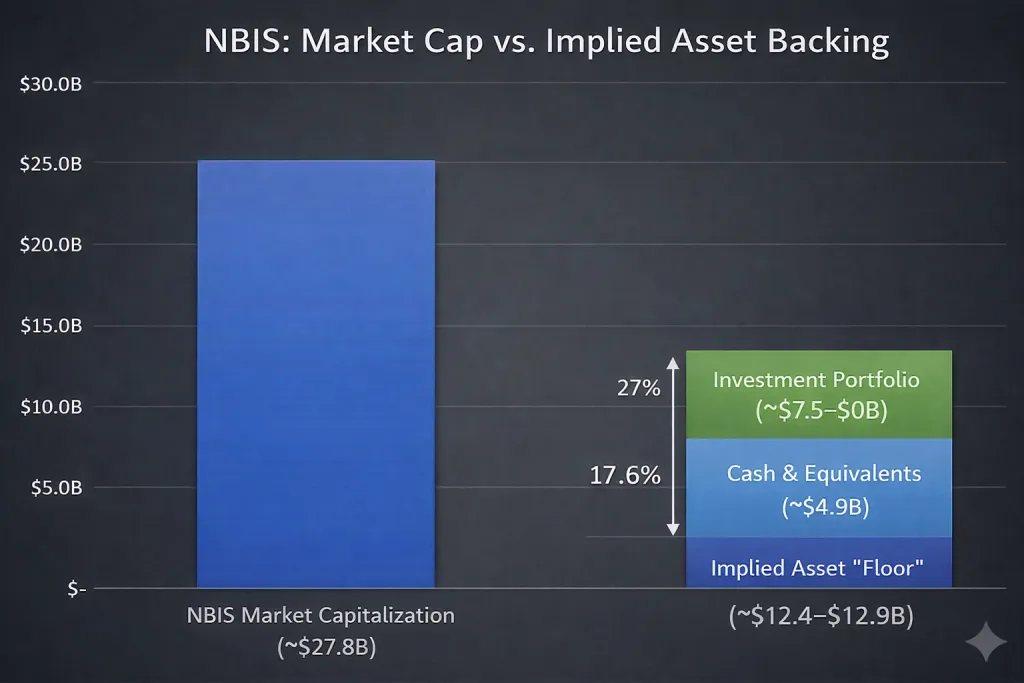
That ratio is uncommon among emerging AI infrastructure players. Many neocloud competitors operate with limited cash buffers and rely heavily on secured debt, lease financing, or continuous equity issuance to fund GPU deployment. Their survival through a down cycle depends on capital markets remaining receptive and utilization ramping on schedule.
Nebius operates with a wider margin of error.
The cash balance provides immediate liquidity. The investment portfolio provides layered optionality. Late-stage assets such as ClickHouse offer potential secondary liquidity or IPO pathways. Stakes like Avride introduce longer-duration upside while remaining external to core infrastructure funding needs. Capital-light businesses such as Toloka and TripleTen compound value without consuming meaningful balance sheet capacity.
This combination does not eliminate execution risk, but it changes the consequences of missteps. Delays in utilization, pricing pressure, or slower demand absorption do not automatically force dilution or distressed financing. The company retains multiple avenues to raise liquidity, borrow against assets, or simply wait through adverse conditions while continuing to build.
In practical terms, NBIS is not priced as an asset-backed AI infrastructure platform. It is priced primarily as a growth-stage compute operator, with limited recognition of the balance sheet depth and strategic flexibility embedded in the equity.
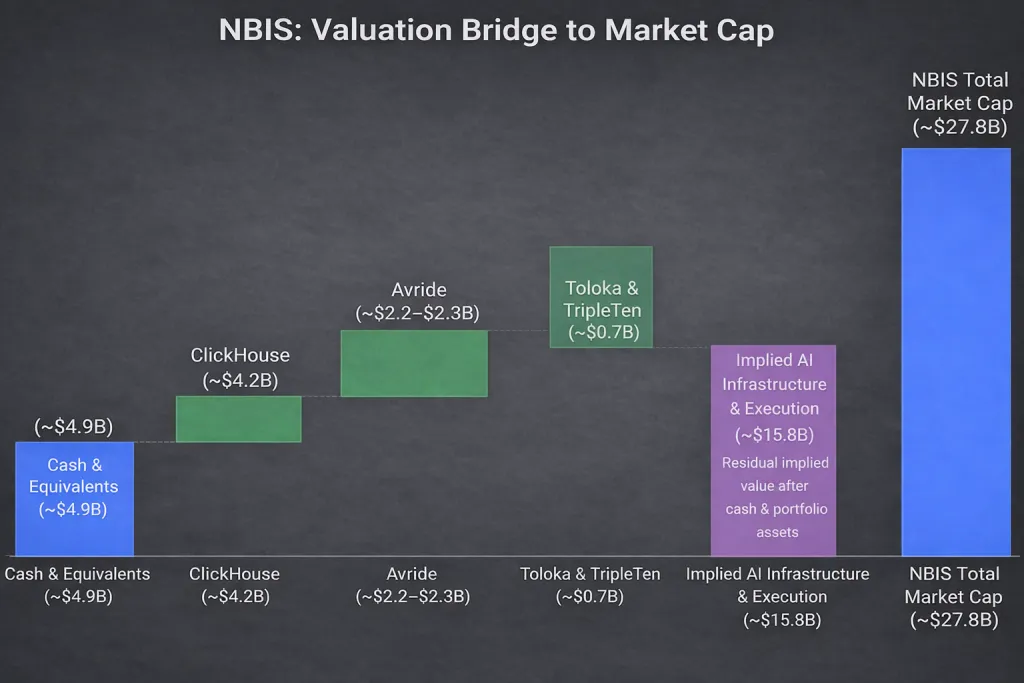
What the market is missing is not the ambition of the compute ramp. It is the degree of structural resilience supporting it.
That resilience creates a higher effective floor, a longer runway through cyclical downturns, and more control over when and how capital decisions are made. For long-horizon investors, those characteristics often matter as much as peak-cycle margins or headline capacity targets.
NBIS ultimately represents a hybrid profile: a hyperscale AI infrastructure build layered on top of a balance sheet that already carries meaningful, independently valued assets. As those assets mature, monetize, or simply remain intact through the buildout, the disconnect between structure and perception becomes harder to ignore.
That disconnect is where the opportunity resides.
Understanding Nebius: A Complete Guide to the Company
Understand Nebius from the ground up: its AI cloud, competitors, subsidiaries, funding, and growth opportunities. A complete NBIS guide with 14 illustrations.
Nebius in Europe: Sovereign AI, UK Expansion and Harlow
How European AI sovereignty supports Nebius’s UK expansion, where Harlow fits, and what its potential 4.4 MW deployment could add to Q3 revenue and 2026 ARR.
NBIS Stock Forecast 2030: The Conversion Problem
A ground-up Nebius model rebuild after Q2 2026, covering AI factory economics, capital structure, valuation scenarios, and the NBIS stock forecast to 2030.
Northwise Portfolios
See how the research becomes real decisions
Reader discussion
Discuss the research
Create a Free account to join the discussion with a display name.
Create a Free Account
No comments yet. Start a thoughtful discussion.