
Nebius in Europe: Sovereign AI, UK Expansion and Harlow
How European AI sovereignty supports Nebius’s UK expansion, where Harlow fits, and what its potential 4.4 MW deployment could add to Q3 revenue and 2026 ARR.
In this article
For the wider site network, explore the Nebius data center overview and its links to individual site studies.
Europe wants more of the intelligence running its banks, laboratories and public services to be built and operated closer to home. That creates an opening for Nebius, whose European expansion combines large computing campuses with local access to the software and infrastructure customers need to put AI into everyday use.
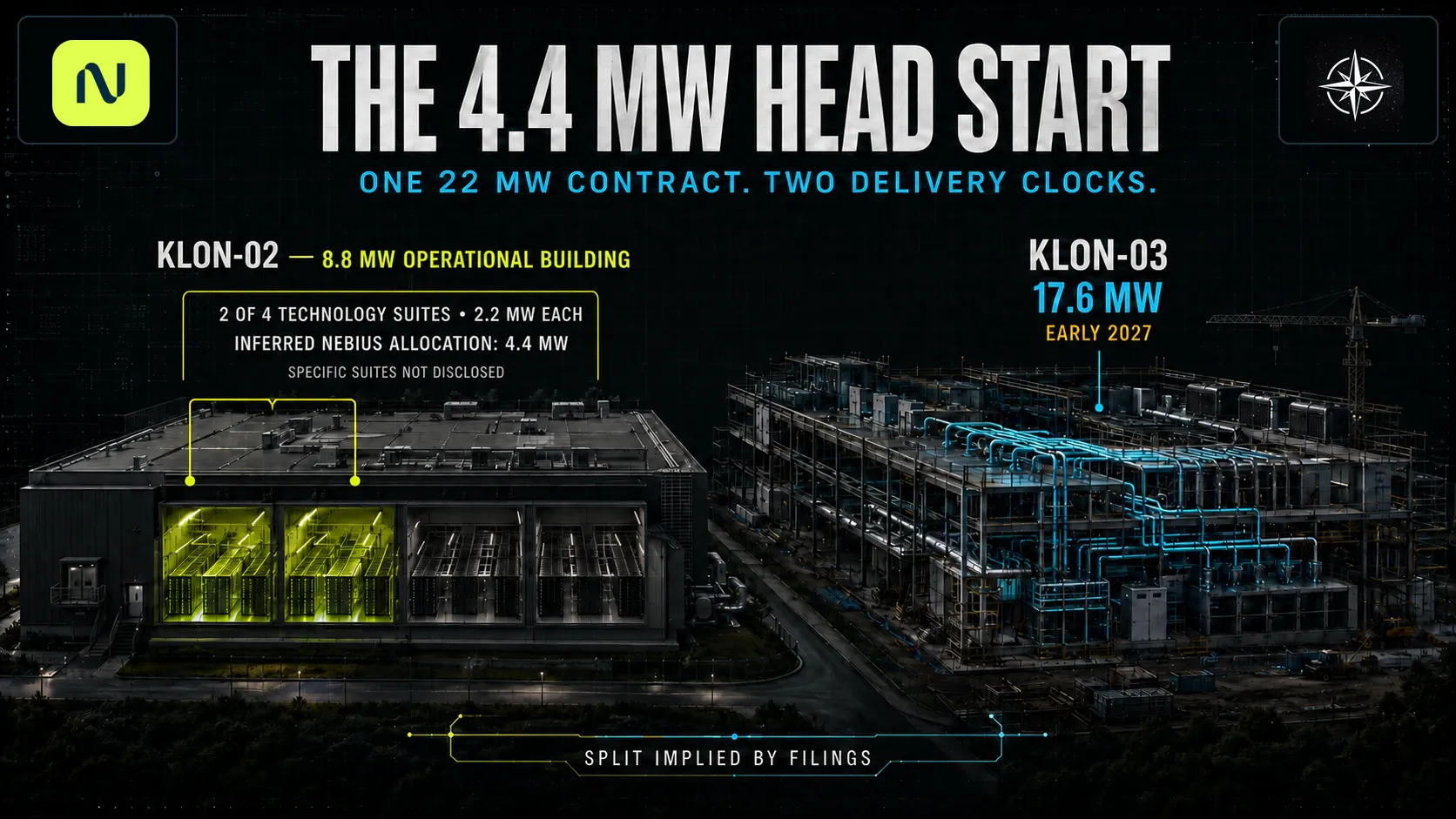
Harlow, northeast of London, brings that opportunity into focus. Nebius has agreed to take 22 MW at a campus operated by Kao Data as part of its wider £1.7 billion UK investment. The facilities will host Nebius AI Cloud and Token Factory, its service for running AI models in production. Public disclosures also point to an earlier deployment inside an existing building, potentially allowing some capacity to earn revenue before the larger facility next door opens in 2027. Kao’s contract announcement connects the commercial purpose to the physical site.
Our interest is how these pieces fit together. Sovereignty can help create a market for local AI services. Nebius needs to win those customers, deliver their compute and earn an adequate return on the capital required. Harlow offers a relatively small, observable example of that process at a consequential moment in the company’s 2026 revenue ramp.
Why Europe wants more control over AI
An AI system used to investigate financial crime or develop medicines becomes part of an organisation’s operating infrastructure. Its owner needs dependable access to computing capacity, control over sensitive data and a practical way to change models or suppliers. As usage grows, those decisions influence operating costs, intellectual property and resilience to disruption.
For governments, the question extends to where expertise, investment and future industrial value accumulate. A country with excellent AI researchers still needs infrastructure on which they can train models and build businesses. European policy increasingly treats that infrastructure as part of economic competitiveness and national resilience. The European Commission’s AI Continent Action Plan links computing investment to industrial adoption, skills and security. Its proposed June 2026 sovereignty package adds a framework for assessing cloud and AI sovereignty, alongside measures intended to ease data-centre deployment and expand open software.
Public procurement is beginning to give that ambition a commercial mechanism. The EuroHPC call launched on July 30 seeks consortia to build and operate up to seven AI Gigafactories in EU countries. Authorities would purchase computing time, providing an anchor customer for privately led facilities. Submissions close on November 12, with selection expected in early 2027 and operations expected within 18 months of selection. The Commission describes up to €10 billion of public support intended to unlock at least €20 billion of private investment.
That is a potentially valuable source of future demand for the industry. An award to Nebius, or participation by one of its campuses, would require a specific disclosure before entering our forecasts. The programme’s timetable also places it well beyond the immediate Harlow earnings question.
Sovereignty has several layers. Data residency concerns where information is stored and processed. Operational control concerns who can administer the system, hold encryption keys and maintain service. Legal control concerns the organisations and jurisdictions involved. A local data centre addresses the first layer; the others depend on the service design, contracts and customer’s requirements. GDPR permits international transfers through mechanisms including adequacy decisions and appropriate safeguards, as the European Data Protection Board explains. It therefore does not compel every European workload onto a European-owned cloud.
The UK belongs in the same regional investment discussion, with its own policies and procurement rules. Harlow supplies domestic British capacity. It should be assessed separately from an EU facility applying to a programme that requires an EU location.
Nebius has more to offer than a local address
Nebius enters this market with an Amsterdam headquarters, operating infrastructure and an AI platform built around training and inference. Its European footprint spans different stages of development. The March announcement of Lappeenranta described a completed expansion at Mäntsälä, a second Finnish campus expected to start serving customers in 2027, and a substantial project near Lille in France.
Location | Disclosed scale | Role in the European expansion |
|---|---|---|
Mäntsälä, Finland | Expanded to 75 MW | Established operating base; facility capacity should be distinguished from customer utilisation |
Lappeenranta, Finland | Up to 310 MW | Large future campus, with first customer capacity expected in 2027 |
Near Lille, France | 240 MW when fully deployed | Additional planned scale inside the EU |
United Kingdom | 65 MW at full ramp in 2027 | Local market expansion across the four-site programme described in June |
Sources: Nebius’s Finnish expansion disclosure and UK investment announcement. These are facility and programme figures at different stages of delivery, so adding them would give a misleading picture of capacity earning revenue today.
The software matters to the sovereignty case. Nebius AI Cloud 3.6 introduced customer-managed encryption keys, cryptographic erasure and additional identity and access controls. Token Factory’s launch disclosure described zero-retention inference in EU or US data centres. These capabilities give procurement and security teams concrete features to assess when deciding whether a workload can move onto the platform.
We see a commercial tailwind through two routes. Customers that prefer local processing can become accessible as Nebius adds suitable regions and services. Customers already using the platform can expand from experiments into production applications, increasing the amount of compute they consume. Open models add another reason to consider the service: an enterprise can select and adapt a model while buying the infrastructure and operational support needed to run it.
There is also a route through local infrastructure owners. Under the partnership model announced in July, partners finance and own facilities and hardware, while Nebius supplies architecture, software and access to customers. We see a possible fit with regional operators and national AI projects that want local ownership alongside an established cloud platform. Each arrangement would still need to satisfy its particular sovereignty requirements. Harlow’s disclosed colocation agreement should continue to be analysed on its own terms.
Competition will share in this demand. NVIDIA’s European infrastructure announcement names providers including Mistral AI, Nscale and Domyn alongside Nebius. Nebius also remains dependent on NVIDIA technology and a global hardware supply chain. Its opportunity rests on delivering a service European customers want at a price and level of reliability that can win against those alternatives.
The UK expansion already has customers behind it
Nebius established its first UK deployment in November 2025. Its launch announcement identified Basecamp Research and Prima Mente among the early partners. Both work in life sciences, where large proprietary datasets and repeated training experiments create a practical need for dependable compute. Their participation gives substance to the argument for local infrastructure.
The facility is at Ark Data Centres’ Longcross campus in Surrey, covered in our earlier UK research. Data Center Dynamics’ reporting from the launch described a 16 MW deployment, an initial 4,000 B300 GPUs and a further 3,000 planned. Nebius itself confirmed the UK launch and the customer relationships. We use Longcross as evidence that the company had an operating British presence before the June expansion, while keeping campus capacity separate from the amount of equipment actually serving customers.
June’s investment announcement added three sites to that existing deployment and described 65 MW at full ramp in 2027. Kao explicitly placed Harlow within the programme. At 22 MW, Harlow accounts for roughly 34% of that stated total. The remaining 43 MW is simply the programme balance; the announcement provides insufficient detail to assign every megawatt to individual sites. Britain’s government independently included the approximately £1.7 billion commitment in its London Tech Week investment summary.
Nebius’s June customer update also described Revolut using Token Factory for financial-crime agents and customer-support orchestration. Prima Mente was identified as a customer supported by the UK Sovereign AI Fund. The government’s £500 million Sovereign AI initiative aims to help strategically important British AI businesses scale. Supporting those businesses can create additional demand for their compute suppliers, although neither the fund nor these customer examples establishes a Harlow-specific revenue commitment.
Harlow’s emphasis on inference fits this customer base. Training develops a model; inference runs it when an application needs an answer or a decision. Once an AI application becomes part of daily operations, usage can recur across many business processes. The value of a British deployment then comes from meeting customers’ location, performance and service requirements as their applications grow.
Inside Harlow’s 22 MW agreement
Kao owns and operates the Harlow campus. Nebius brings the computing hardware and cloud services that customers purchase. Two building names explain the timing opportunity: KLON-02 is an existing data centre, and KLON-03 is the larger building being developed beside it.
Kao’s campus inventory lists KLON-02 at 8.8 MW and KLON-03 at 17.6 MW. The second building has been operational since November 2023. The new third building is designed for liquid cooling and higher equipment density. Infratil, Kao’s majority owner, said in its May 2026 results that KLON-03 capacity would come online from early 2027.
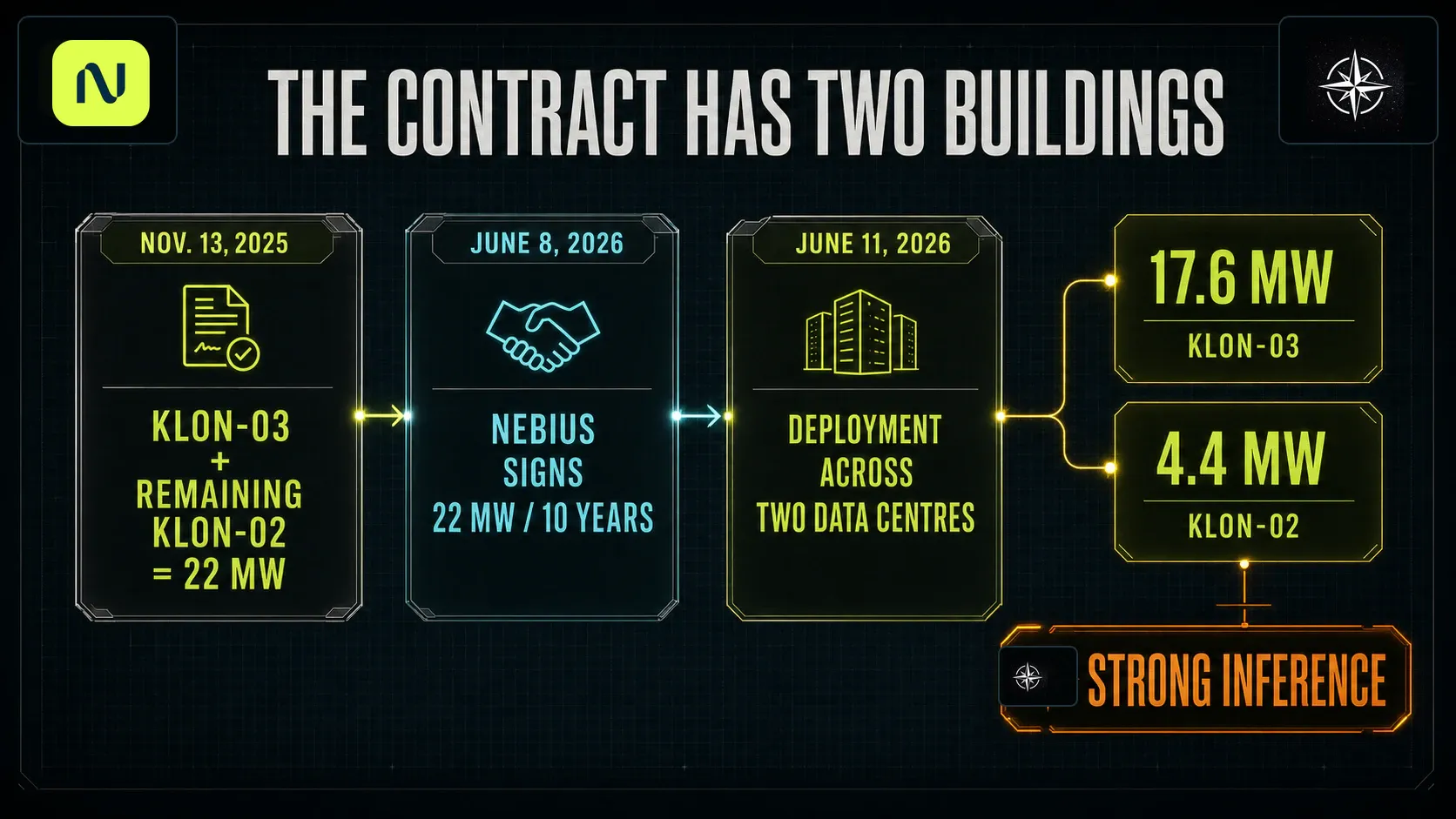
The reason we believe Nebius also has space in the existing building comes from disclosures published several months apart. Infratil’s November 2025 presentation combined KLON-03 with remaining capacity in KLON-02 to arrive at 22 MW. Its FY2026 annual report subsequently described a 10-year agreement for that amount with an international neocloud provider. Kao named Nebius in June, and founder David Bloom said the deployment would span two data centres.
Subtract the new building’s 17.6 MW from the agreement’s 22 MW and 4.4 MW remains. Kao describes KLON-02 as four technology suites, while engineering partner JCA specifies 2.2 MW per suite. The remainder fits two suites exactly.
Harlow component | Our reading of the allocation | Delivery evidence |
|---|---|---|
Existing KLON-02 building | Inferred 4.4 MW, equivalent to two 2.2 MW suites | Building operational; Nebius-specific activation date remains undisclosed |
New KLON-03 building | Likely 17.6 MW allocation to Nebius | Capacity expected online from early 2027 |
Combined contract | Confirmed 22 MW for 10 years | Two-building deployment confirmed; exact customer allocation inferred |
This is a strong building-level inference with a useful commercial implication. An existing facility can shorten the work required before deployment, allowing a smaller cluster to reach customers while construction continues next door. Customer fit-out, cooling compatibility, power delivery and commissioning still determine how much of that advantage Nebius can capture.
What the installation evidence tells us about Q3
In the interview published on July 28, Kao CEO Spencer Lamb said the company was delivering against the Nebius agreement as Nebius installed hardware at the campus. The wording establishes physical activity by publication. It leaves the building, equipment mix, power status and installation start date unspecified. The discussion also covers KLON-03’s cooling redesign, so assigning all activity to the inferred 4.4 MW requires an additional assumption.
Andrey Korolenko’s general deployment guidance provides a way to test the timing. On the November 2025 earnings call, he described roughly six to twelve weeks from connected power and the start of GPU deployment to revenue generation. Using July 28 as a hypothetical starting point gives September 8 through October 20. That interval crosses the quarter boundary; the actual Harlow start could have been earlier or later.
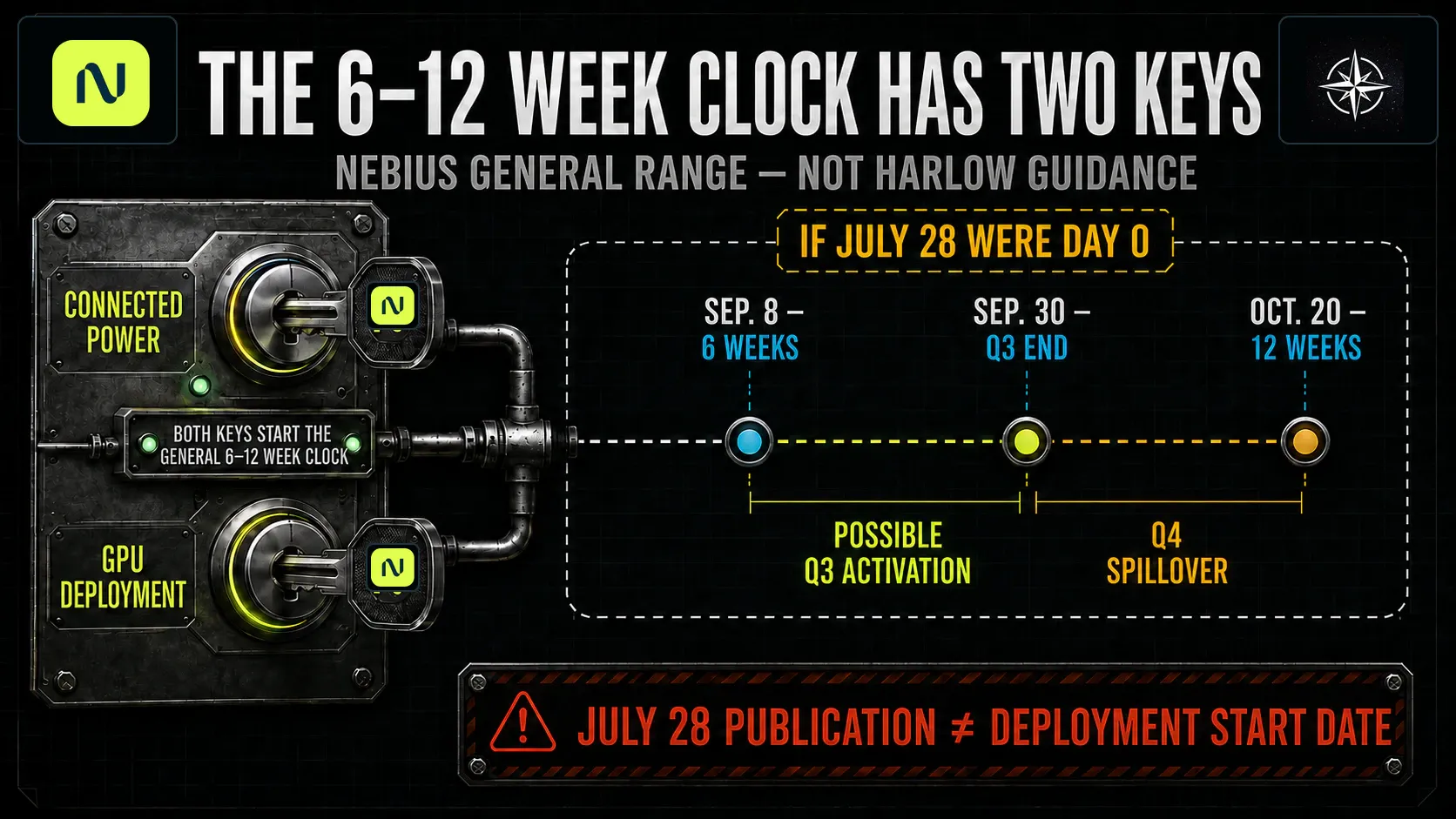
Our review through September 5 found a credible route to a 2026 deployment, with insufficient site-specific evidence to forecast a September billing date. Confirmation of a handed-over suite or connected power would narrow the uncertainty. Customer acceptance and the start of revenue recognition would settle the earnings question. Hardware arriving at an operating campus is an encouraging step within that sequence.
How a September launch would enter revenue and ARR
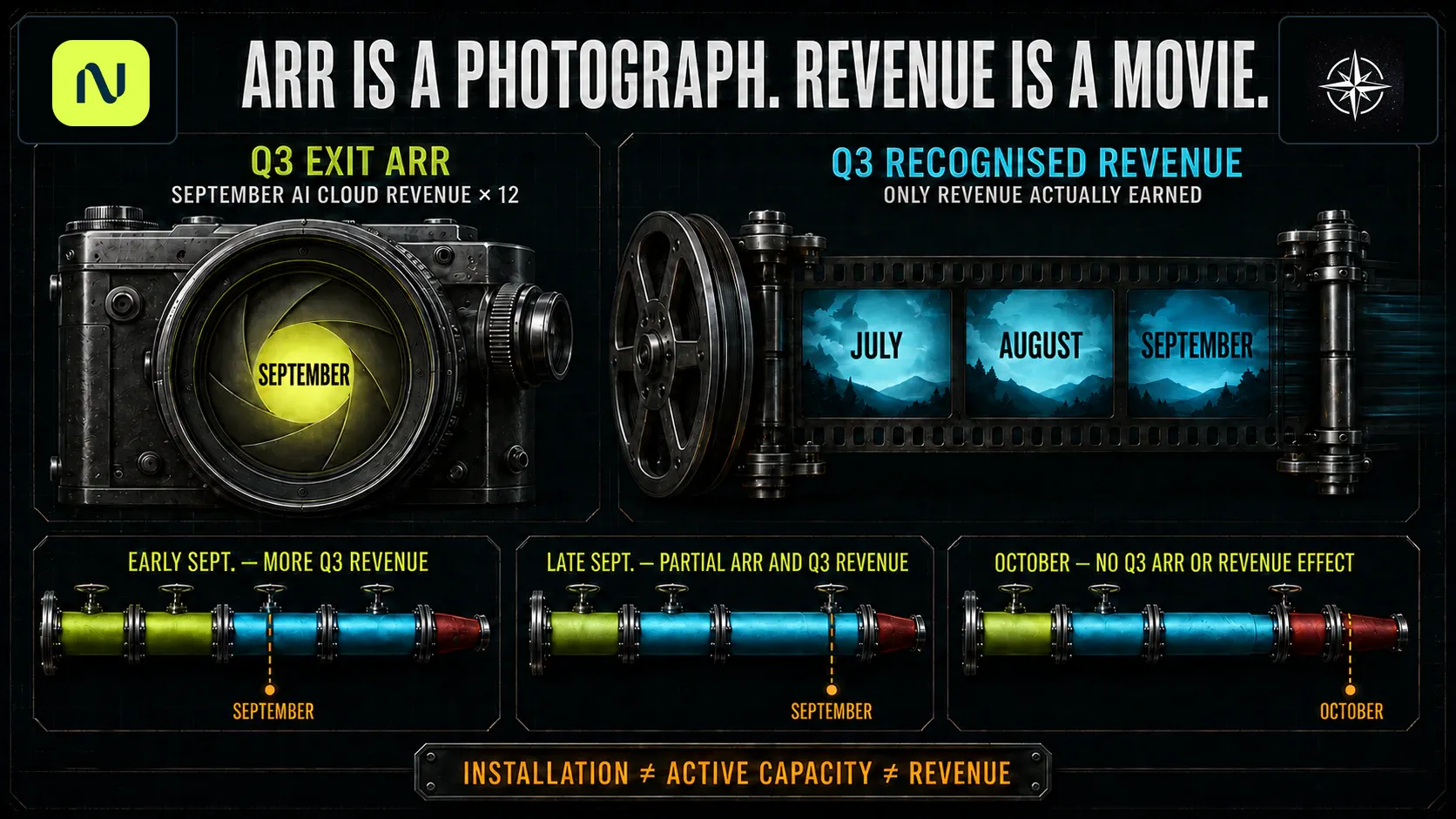
Nebius defines annualised run-rate revenue, or ARR, as AI-cloud revenue in the quarter’s final month multiplied by twelve. September therefore determines Q3 exit ARR, while all revenue earned during July, August and September contributes to the quarterly income statement. The definition appears in the Q2 shareholder letter.
This calculation uses the revenue recognised during the month. If billing starts on September 25, the six remaining days contribute to September’s result. Multiplying those six days by twelve still leaves a much smaller figure than annualising a full month at the same daily rate. An October start contributes to Q4 and can still support December’s exit ARR if the capacity remains occupied.
The economic reference points also need care. Nebius’s Q2 letter described a 2026 base of approximately $12 million of annual contract value per MW and $20 million to $25 million per MW on four landmark deals. Applied mechanically to 4.4 MW, these produce $52.8 million, $88 million and $110 million of annual contract value. Harlow’s customer pricing, equipment and utilisation remain undisclosed, making these comparison cases rather than estimates for the site.
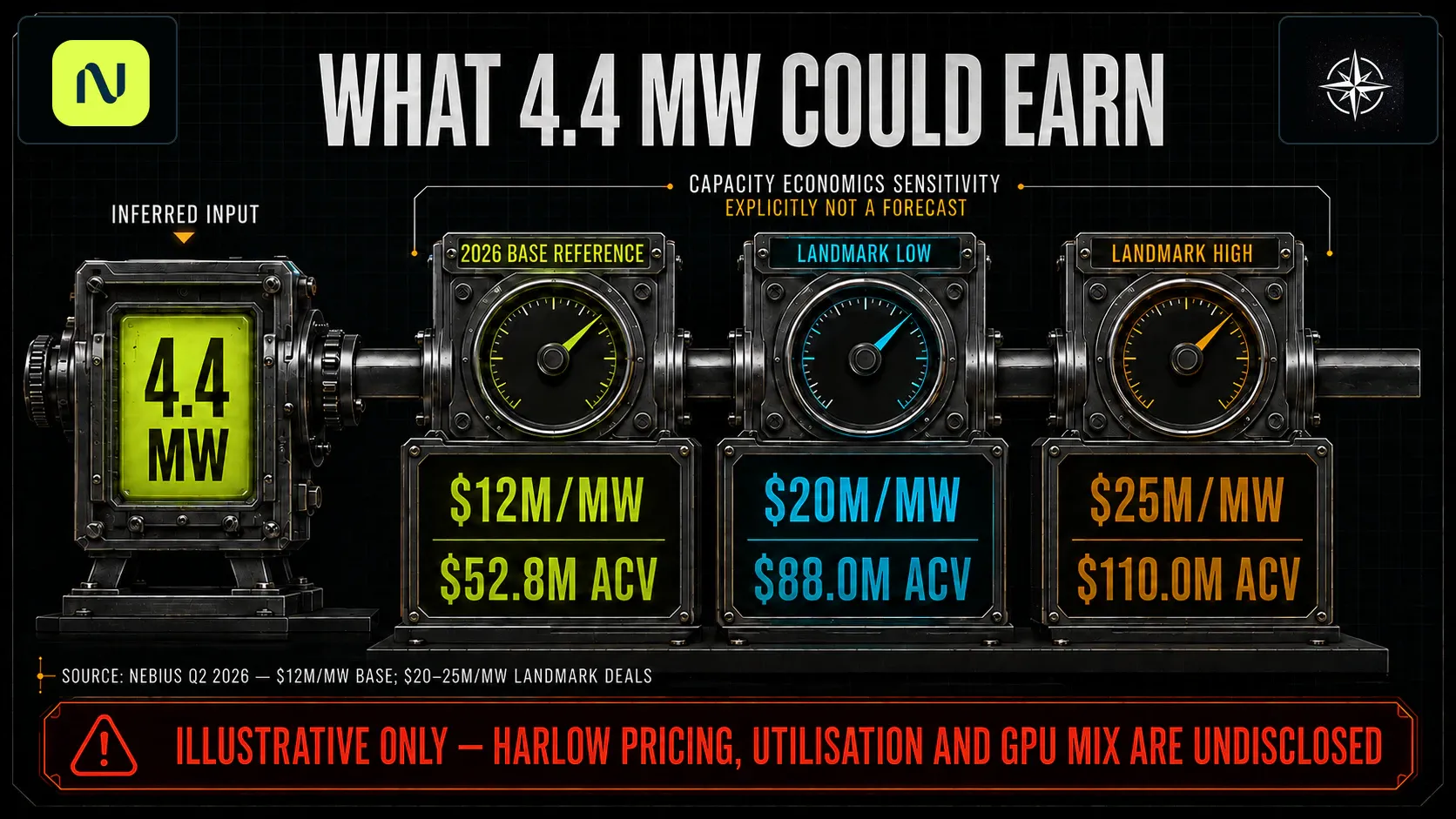
For a transparent timing illustration, assume the entire 4.4 MW eventually recognises $52.8 million a year, equivalent to $4.4 million in a full month. Assume billing begins at that rate immediately, with no ramp, and use a 30-day September. These are deliberately simple Northwise assumptions. They allow the reader to see the effect of timing without pretending to know the site’s eventual contract terms.
Hypothetical billing start | September days billed | Harlow Q3 revenue | Harlow contribution to Q3 exit ARR |
|---|---|---|---|
September 8 | 23 | $3.37M | $40.48M |
September 15 | 16 | $2.35M | $28.16M |
September 25 | 6 | $0.88M | $10.56M |
October 1 | 0 | $0 | $0 |
Calculation: $4.4 million × billed days ÷ 30 for September revenue; multiply that result by twelve for exit ARR. Q3 revenue equals September revenue here because every scenario assumes no earlier Harlow revenue. A deployment delivering half that assumed revenue rate would halve both columns. A gradual customer ramp would also reduce them. Actual recognition follows the service contract and accounting treatment.
The physical units deserve equal attention. Kao’s building ratings describe IT capacity. Nebius’s connected-power targets and our model’s billable-IT calculations use different stages of the infrastructure. The table assumes the full inferred 4.4 MW becomes revenue-producing at the selected yield; it does not establish a conversion between all reported MW measures. Hardware mix, commissioning and customer acceptance have to be reconciled before those figures enter a detailed forecast.
How much could Harlow change the 2026 target?
Nebius carried forward its target of $7 billion to $9 billion in year-end ARR and $3.0 billion to $3.4 billion of full-year group revenue. The ranges are set out in the Q1 shareholder letter, with full-year guidance reaffirmed in Q2. June exit ARR reached $3 billion, equivalent to about $250 million of AI-cloud revenue for that month. The scale of the remaining increase is substantial.
Year-end ARR outcome | Required December AI-cloud revenue | Increase from June’s approximately $250M |
|---|---|---|
$7B | $583.3M | $333.3M per month |
$8B midpoint | $666.7M | $416.7M per month |
$9B | $750.0M | $500.0M per month |
Northwise calculations divide each ARR target by twelve. At the illustrative $52.8 million annual rate, Harlow’s smaller tranche would contribute $4.4 million in a full December, approximately 1.1% of the monthly increase needed to reach the midpoint. Its annualised contribution would equal 0.66% of an $8 billion exit rate. Even the higher $110 million comparison represents about 1.4% of that midpoint. Harlow can help execution at the margin; the wider fleet must deliver most of the increase.
Full-year revenue has a separate hurdle. Nebius reported $981.3 million of first-half group revenue, leaving about $2.02 billion to $2.42 billion to earn in the second half to reach guidance. Under our timing illustration, an October 1 start followed by three full months at $4.4 million would add $13.2 million in 2026. A September 8 start followed by the same Q4 would add approximately $16.57 million. The earlier start adds $3.37 million to annual revenue, while both cases reach the same December run rate if their performance converges by then.
Those figures cannot simply be added to company guidance. The Harlow agreement was public in June and management reaffirmed the outlook in August. Its internal plan may already include some Harlow contribution. An incremental upside call requires evidence that commissioning, utilisation or pricing is better than the assumptions embedded in that plan. We have no public site-by-site guidance bridge with which to make that comparison.
The same restraint applies to earnings per share. Facility rent, energy, personnel, depreciation and financing costs affect the profit from a new cluster. Some costs can arise before customer revenue begins. Nebius’s Q2 results included substantial depreciation and amortisation and a net loss from continuing operations despite strong revenue growth. Site-specific costs and billing terms would be needed to estimate Harlow’s contribution to profit; applying a group or segment margin to a few hypothetical days of revenue would create false precision.
What would strengthen the investment case
The most useful next disclosure would identify Nebius’s allocation in the existing building and quantify the capacity ready for customers. An availability announcement tied specifically to Harlow, or a customer workload identified at the site, would establish commercial progress. Management attribution to ARR or recognised revenue would provide the clearest financial evidence. The checklist below concerns the September outcome; a later start can still matter for the year-end ramp.
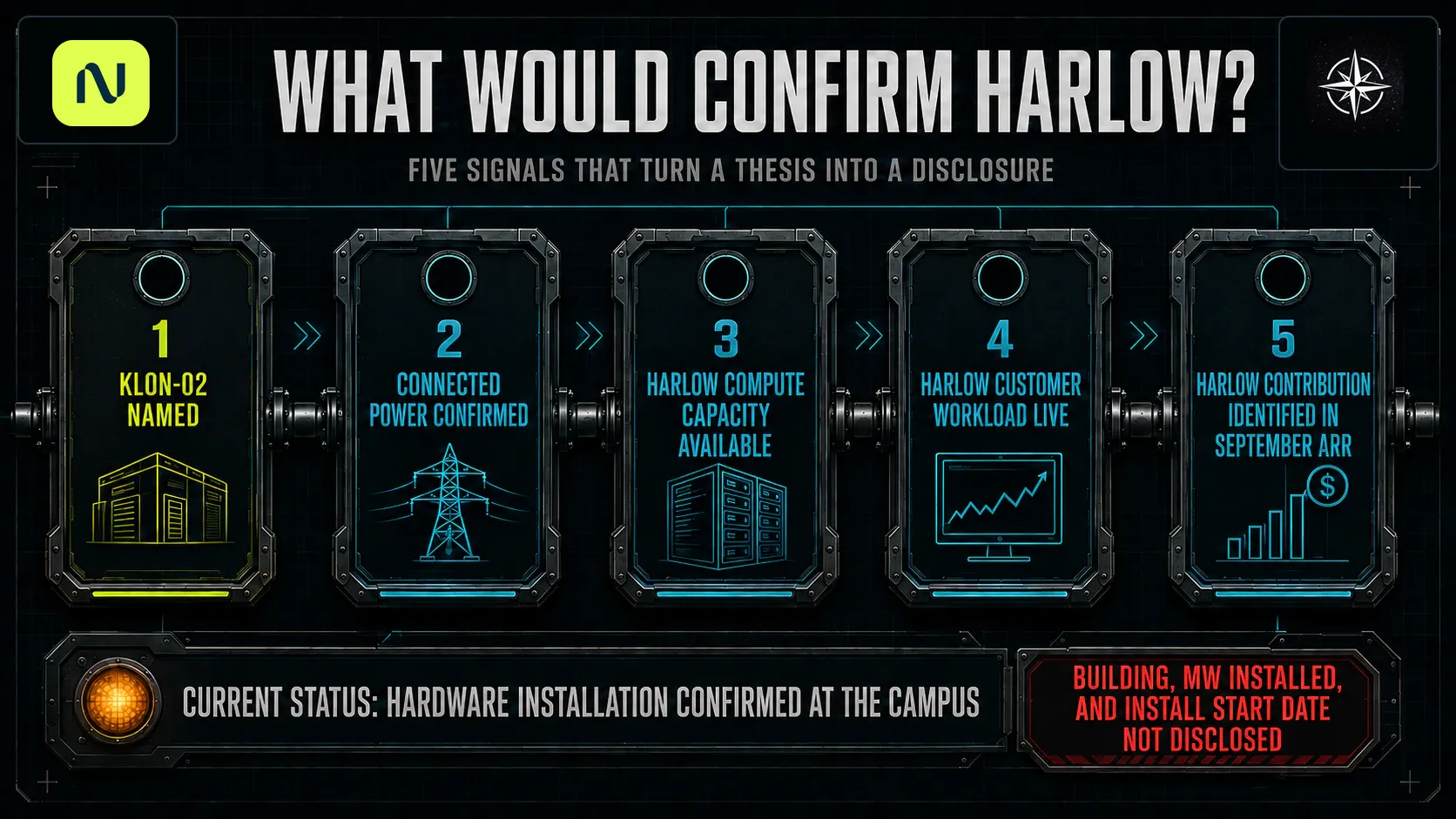
There are also reasons the opportunity could take longer to develop. Existing buildings can require significant customer-specific electrical and cooling work. Cluster commissioning and onboarding can delay billing after equipment installation. Sovereign customers may have lengthy procurement and security reviews, and rival providers are expanding their own local offerings. A favourable policy environment can improve the addressable market while these practical constraints continue to govern delivery.
The Northwise view
Europe’s sovereignty ambitions strengthen the strategic case for Nebius because the company can offer local capacity, customer control and a platform that serves both model development and production use. The UK provides an early commercial example: an established deployment, named customers and a wider investment programme into which Harlow fits. Finland and France give the company room to expand that approach across the region as larger facilities arrive.
Our current Nebius model evaluates the capacity that reaches customers, the economics attached to each deployment and the capital required to deliver it. Harlow belongs within that framework. We retain early 2027 as the disclosed starting period for KLON-03, track the inferred 4.4 MW in KLON-02 as potential 2026 capacity, and await commercial evidence before assigning it a site-specific revenue contribution. Any later inclusion must reconcile with the UK capacity already represented in the aggregate plan.
September would bring some revenue forward and provide earlier evidence of execution. An autumn launch could still build a useful December contribution. Beyond the quarter, Harlow’s larger value is the chance to establish customer relationships that expand as more UK capacity becomes available. If Nebius can make local AI infrastructure dependable and commercially attractive, Europe’s desire for greater control can translate into sustained demand across its network. Harlow is one of the places where that proposition now has to earn its way into the numbers.
Research updated September 5, 2026. Source acknowledgement: @ai_canaries surfaced the July Kao interview used in the Harlow investigation. The building allocation and financial scenarios above are Northwise analysis of the linked disclosures.
Nebius Asset-Light Business Model: The Cloud Someone Else Pays to Build
How Nebius can earn cloud fees on partner-owned GPUs. Explore owner economics, Palantir, cash flow and our 2030 asset-light scenarios in this free report.
Understanding Nebius: A Complete Guide to the Company
Understand Nebius from the ground up: its AI cloud, competitors, subsidiaries, funding, and growth opportunities. A complete NBIS guide with 14 illustrations.
NBIS Stock Forecast 2030: The Conversion Problem
A ground-up Nebius model rebuild after Q2 2026, covering AI factory economics, capital structure, valuation scenarios, and the NBIS stock forecast to 2030.
Northwise Portfolios
See how the research becomes real decisions
Reader discussion
Discuss the research
Create a Free account to join the discussion with a display name.
Create a Free Account
No comments yet. Start a thoughtful discussion.