
Nebius Pennsylvania: The Full Highridge Footprint Clears Zoning
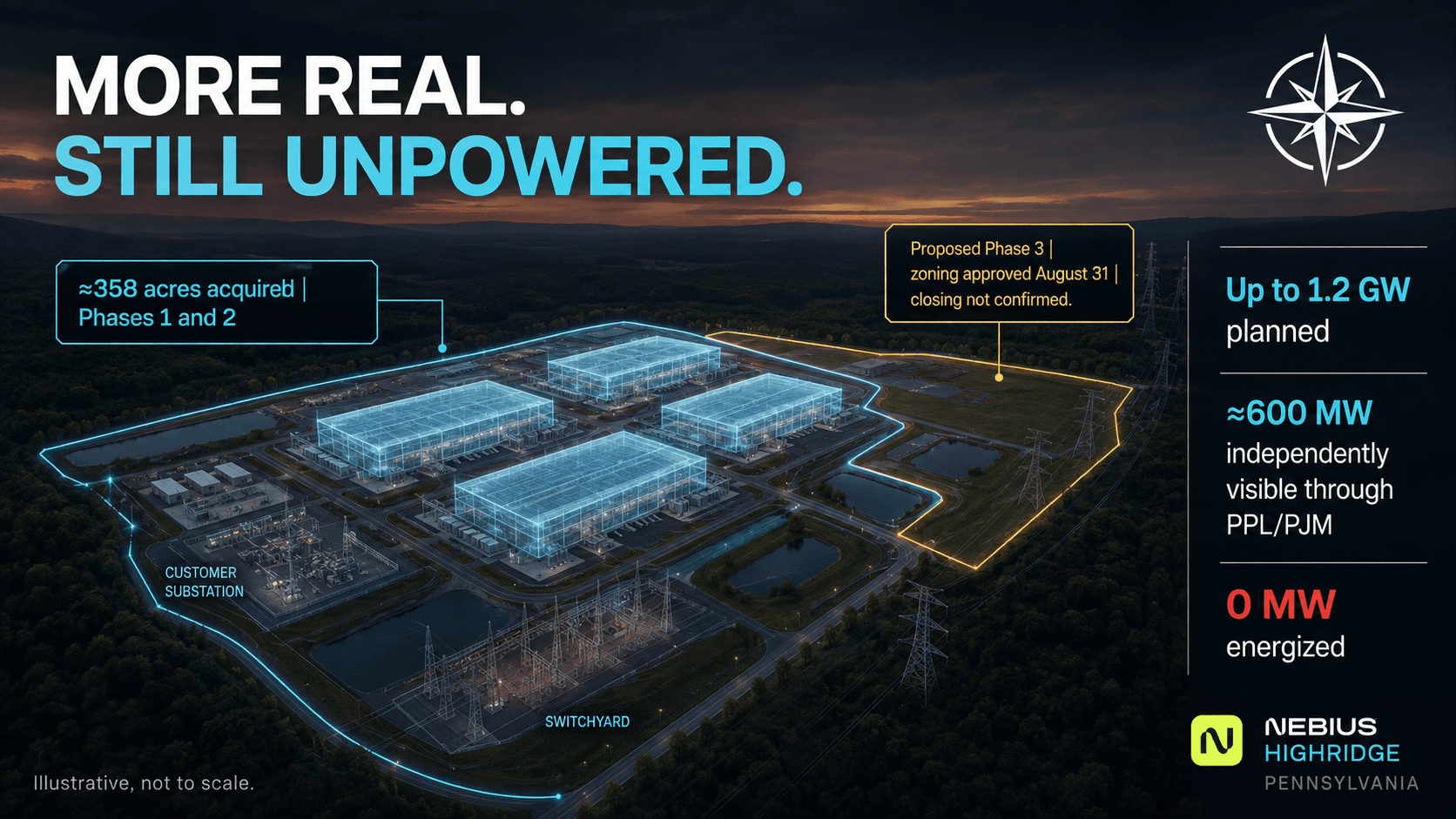
Nebius has cleared the zoning gate for the full planned Highridge footprint. The back half is more credible, but final land, development, and grid approvals still separate 1.2 GW from reality.
In this article
For the wider site network, explore the Nebius data center overview and its links to individual site studies.
Butler Township has now approved the zoning expansion Nebius needed to pursue the full Highridge campus. That is a real entitlement milestone. It is not a building permit, an electrical approval, or an energized megawatt. The second half of the project moved forward this week. It did not suddenly become finished.
Update: September 3, 2026: On August 31, Butler Township approved Ordinance 2026-2, expanding the Data Center Overlay across the additional SEDCO-owned land Nebius needs for the maximum Highridge footprint. The measure passed 2-1. Supervisors also unanimously approved Ordinance 2026-3, lowering the data-center noise limit from 75 dBA to 65 dBA at the property line and requiring good-faith negotiations toward a Community Benefits Agreement during land-development review. The votes clear the local zoning condition attached to Nebius’s agreement to acquire the expansion land, but they do not constitute final land-development approval or authorize construction.
This update also resolves an ambiguity in the original report. County parcel reporting indicates that a Nebius subsidiary acquired 3 core parcels totaling roughly 358 acres for $187.5 million in April 2026. The additional SEDCO parcels are under an agreement of sale and were the subject of the August 31 overlay expansion. The original version was correct to question whether the $187.5 million transaction covered the full 600-acre concept, but later leaned too far by describing all of the land as assembled and closed. The cleaner conclusion is that the core site is owned, the expansion footprint is now properly zoned, and closing on the remaining land has not yet been publicly confirmed.
The 1.2 GW Nebius Pennsylvania Headline and What Exists Today
Nebius disclosed its Pennsylvania project in May 2026 as its second owned gigawatt-scale AI factory in the United States, alongside the 1.2 GW campus underway in Independence, Missouri. The maximum Highridge plan spans roughly 600 acres inside Highridge Business Park in Schuylkill County, sits in PPL Electric Utilities territory, and connects to the PJM grid.
The company has continued growing around the project. After Q2 2026, Nebius raised its year-end contracted-power target to 5 GW and said it expects to begin deploying more than 1 GW of capacity per year in 2027. Highridge is one of the owned campuses expected to carry that expansion.
No operating HPC capacity has been reported for Highridge in the sources reviewed.
The August 31 vote changes the land-use position. It does not establish commissioned computing capacity.
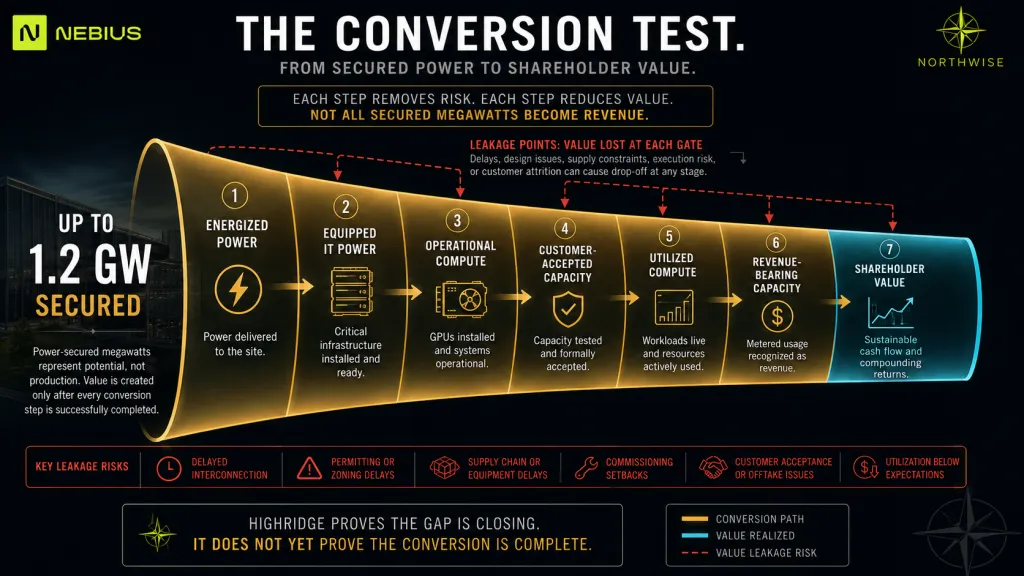
Nebius can place 1.2 GW in an investor presentation today. Billing a single Pennsylvania GPU still requires a long sequence of physical gates that only move in one direction.
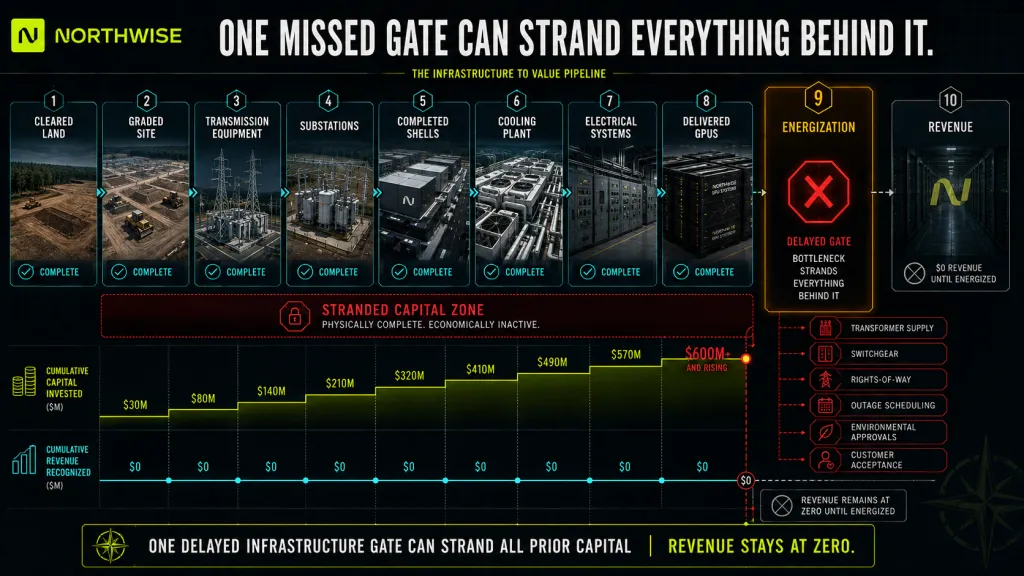
Site control leads to zoning, zoning to land-development approval and environmental permits, permits to site work, site work to transmission and substation construction, transmission to energization, energization to commissioned cooling and electrical systems, commissioning to installed GPUs, GPUs to customer acceptance, and acceptance to utilization. Revenue arrives at the end. Each stage can slip independently, and a delay at any point strands every dollar committed to the stages before it.
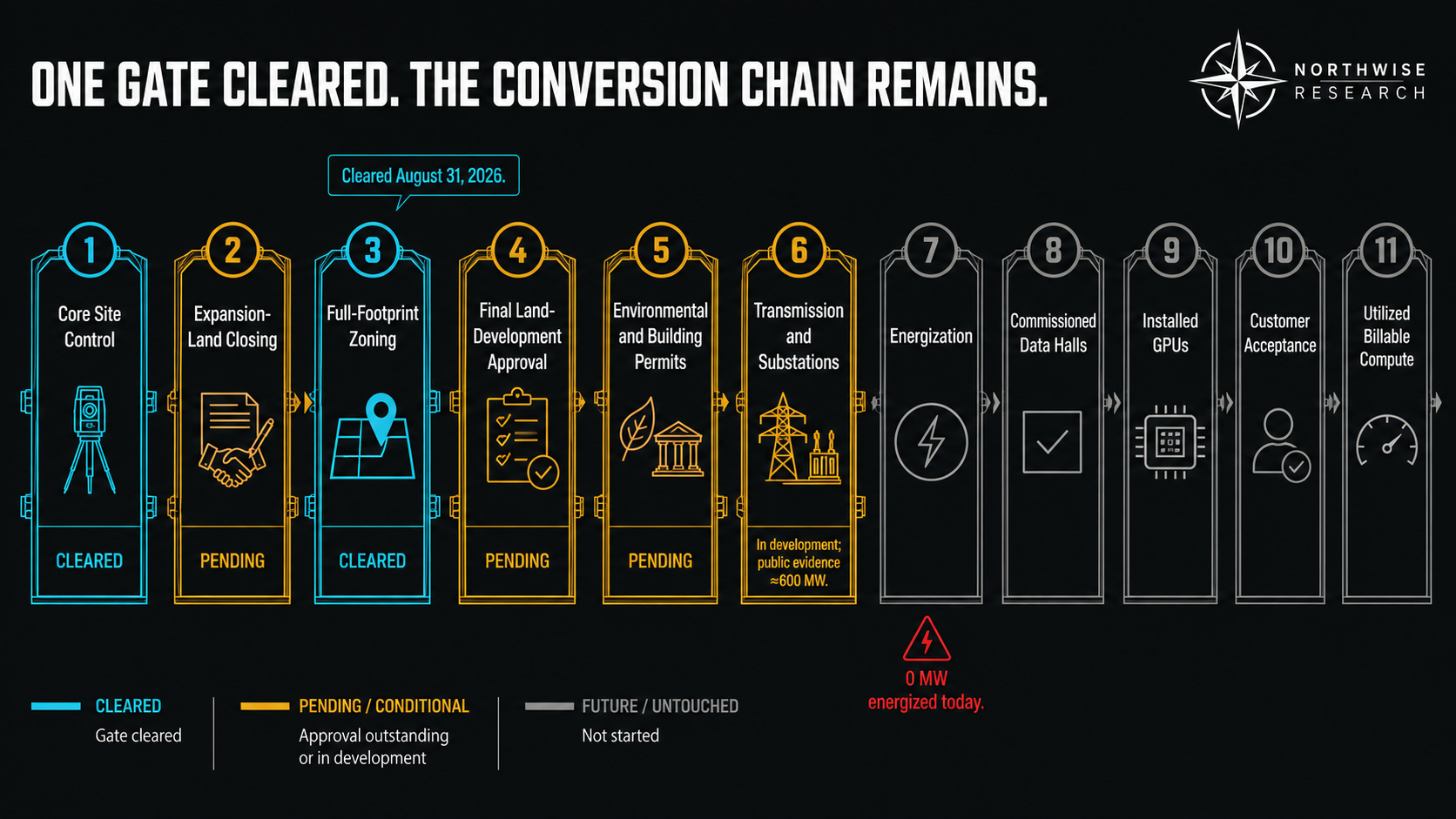
Here is where the Pennsylvania project sits after the August 31 approvals.
Stage | Highridge status |
|---|---|
Maximum planned utility capacity | Up to 1.2 GW |
Core land | Roughly 358 acres acquired across 3 parcels |
Expansion land | Additional SEDCO parcels under agreement of sale; zoning condition cleared; closing not publicly confirmed |
Data Center Overlay | Approved across the planned full footprint |
Final land-development approval | Pending |
Independently documented grid pathway | Approximately 600 MW through the surfaced PPL and PJM record |
Utility infrastructure | Under development |
Energized power | 0 MW |
Equipped IT power | 0 MW |
Operational compute | 0 MW |
Billable revenue capacity | 0 MW |
Nebius’s published ramp targets remain 260 MW by October 2027, roughly 660 MW by January 2029, and more than 1 GW by November 2029, with up to 1.2 GW at full buildout. The company has not placed a public completion date on the final increment from more than 1 GW to 1.2 GW.
Two shortcuts now dominate discussion of Highridge. The first treats the township vote as approval of the entire 1.2 GW project, which confuses zoning with construction and grid delivery. The second dismisses it as procedural noise, which ignores that the full footprint depended on this exact decision. Both readings are lazy. The approval is meaningful because it removes a real failure point, and limited because several harder gates remain.
What Highridge Is and Why Schuylkill County
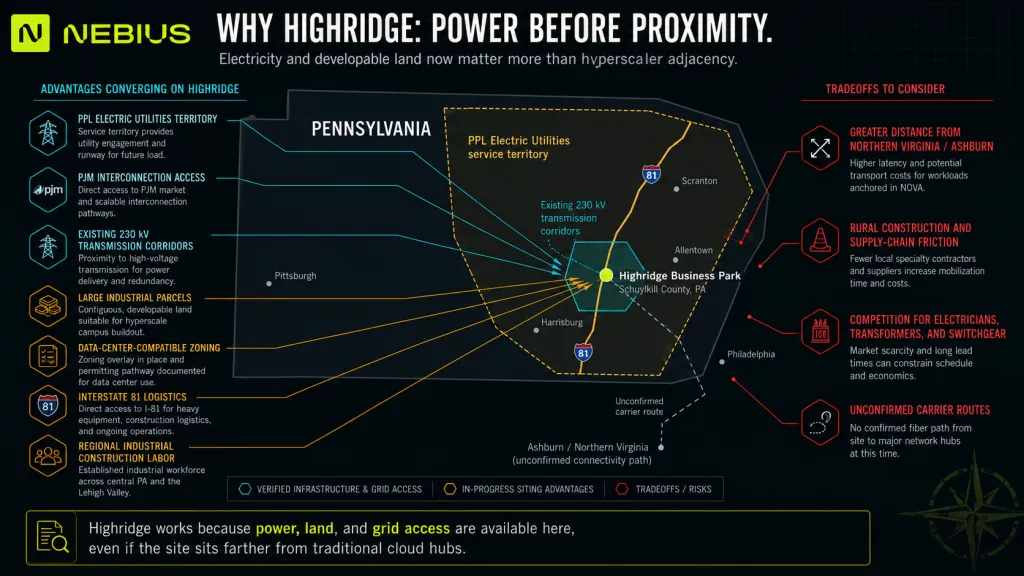
Highridge Business Park sits near the Interstate 81 interchange at Gordon Mountain Road, spanning Butler, Cass, and Foster Townships, with the Nebius development concentrated on Butler-side parcels. The park already houses operations for Walmart, Wegmans, Lowe’s, Tyson Foods, and JELD-WEN, along with a travel plaza and proximity to Schuylkill Regional Airport. Nebius is not dropping a hyperscale campus into the middle of a residential subdivision. It is adding a very large electrical load to a corridor already organized around industry, trucking, and parcels measured in the hundreds of acres.
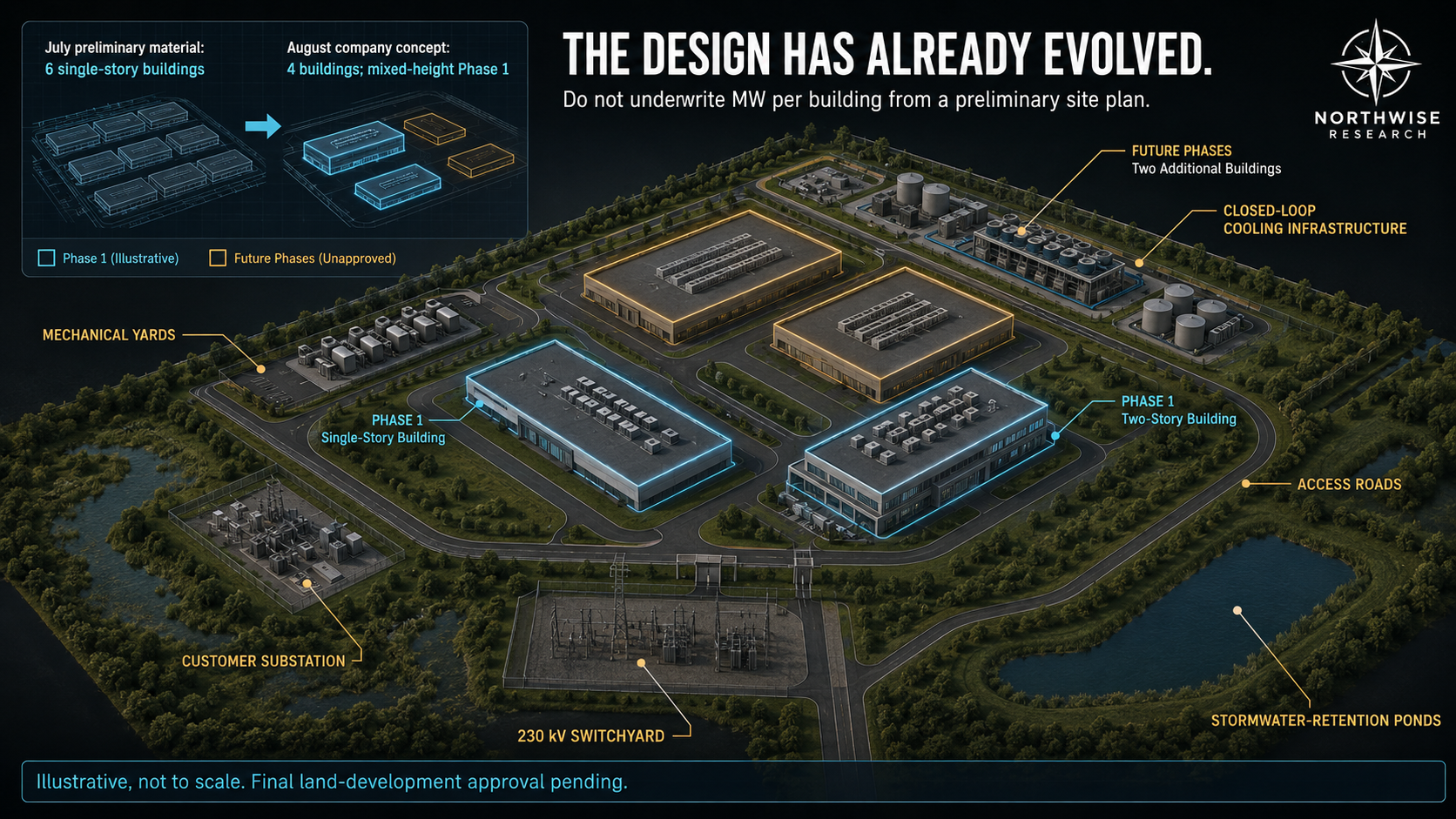
The maximum planned footprint runs to just under a square mile. The design has already evolved. Preliminary material presented in July described 6 single-story data center buildings. Nebius’s August 6 open-house presentation instead describes a 4-building design, and its draft Phase 1 site plan shows 2 initial buildings, one labeled as single-story and the other as 2-story, together with a customer substation, switchyard, access roads, wetlands, and multiple water-retention ponds.
That change is not automatically a red flag. Designs move before land-development approval, particularly when operators are optimizing electrical blocks, density, grading, wetlands, cooling, and construction sequence. It does mean that neither 4 buildings nor 6 should be converted into a precise megawatt-per-building assumption. The current plan is still a plan.
Three characteristics separate Highridge from most capacity Nebius has used to date. The campus is purpose-built for accelerated compute rather than converted from a conventional warehouse. It is designed at gigawatt scale. And Nebius intends to own and operate it directly rather than placing a third-party data center operator between the company and the physical asset.
The siting logic starts with electricity. Schuylkill County offers PPL service territory, PJM interconnection, transmission corridors, large industrial parcels, direct highway access, and established economic-development support. None of that makes the region a premier cloud market in the conventional sense. It makes the region buildable at a moment when power and land have become scarcer inputs than proximity to Ashburn.
There is a certain symmetry to the location. Schuylkill County built its economy on anthracite coal, and gigawatt-scale digital infrastructure arriving on the same ground represents a direct handoff from one energy-intensive industrial base to another. Penn State Schuylkill, the Schuylkill Technology Center, local community colleges, and the existing industrial construction trades provide a plausible labor pipeline. Nebius has discussed workforce-development partnerships, but the scale and structure of those programs remain to be established.
The tradeoffs are real. Highridge sits farther from Northern Virginia than the established East Coast cluster, which lengthens some network routes, and rural construction logistics add friction. Competition for electricians, transformers, switchgear, and transmission crews has intensified across Pennsylvania as data center demand has grown. Highridge draws from the same constrained pool as every other large project in the region.
Secondary research asserts specific fiber-corridor advantages and low-latency paths into Ashburn. We continue to treat those as plausible geography until carrier routes are separately confirmed.
Land, Zoning, and the Entitlement Position
The land record is now considerably clearer than it was when this report was first published.
The parcel history runs through the Schuylkill Economic Development Corporation and NorthPoint Development. NorthPoint’s vehicle, NP Highridge Park LLC, held key Butler parcels following a reported March 2025 purchase from SEDCO for approximately $6 million. County parcel reporting indicates that a Nebius subsidiary then purchased 3 parcels totaling roughly 358 acres from NorthPoint for $187.5 million in April 2026.
Those 358 acres appear to comprise the core tract Nebius maps as Phases 1 and 2. The maximum roughly 600-acre campus also depends on additional SEDCO-owned land around the Walmart distribution center, which Nebius’s August presentation maps as proposed Phase 3. Nebius entered an agreement of sale for that land contingent on expansion of the township’s Data Center Overlay, making that contingency the central issue in the August 31 vote.
Ordinance 2026-2 added all of parcel 04-09-0037.001 and part of parcel 04-09-0037.000 to the Data Center Overlay within the Interchange I-1 district, excluding the portion identified as Lot 1 in the Woodland Conservation district. The ordinance passed 2-1. It gives Nebius a zoning framework under which it can submit the full plan and appears to satisfy the zoning condition attached to the expansion-land agreement. It does not prove the land has closed.
Ordinance 2026-3 passed unanimously and changed the operating framework itself. The maximum data-center noise level fell from 75 dBA to 65 dBA at the property line, and any developer must pursue good-faith negotiations toward a Community Benefits Agreement during land-development review. That agreement is not finished, and “good faith” is not the same thing as a guaranteed outcome. The ordinance nevertheless turns community commitments from optional public relations into part of the formal approval process.
The township did not approve the campus for construction on August 31. Nebius must still submit a land-development plan, proceed through Butler Township Planning Commission review, obtain approval from the Board of Supervisors, and secure the remaining building, fire, environmental, and other regulatory approvals. Zoning answers where and under what rules the use may occur. It does not approve the final engineering.
This distinction matters because the vote is both more and less significant than the phrase “second half approved” suggests. It is more significant than a routine variance because the maximum site depended on land that was not inside the overlay. It is less significant than project approval because every actual building, road, pond, berm, substation, and construction phase remains subject to detailed review.
Permitting has advanced further than an early reading of the project suggested. Pennsylvania DEP records from June 2026 list permit PAD540030, a Chapter 102 Individual NPDES permit, issued to Highridge DC Propco LLC in Butler Township. A greenfield campus of this scale cannot move dirt without stormwater and earth-disturbance controls, so this is a meaningful gate cleared.
The permit’s lineage adds something. Research traces PAD540030 back to the pre-Nebius Highridge development under NorthPoint, which suggests the data center inherits at least part of the environmental groundwork completed for the broader business park. Beginning from an existing permit file can compress timeline in a way that rarely appears in headline coverage.
It should not be stretched farther than the record allows. Public evidence does not yet establish whether existing permit coverage fully captures the newly overlaid Phase 3 parcels or whether amendments and additional approvals will be required. Water-obstruction and encroachment approvals, wetlands and water-quality permits, final delineations, endangered-species screening, building permits, fire review, and the final land-development approval remain open diligence items. One parcel in the development area carries a FEMA B/X designation implying moderate flood hazard, though a single parcel says little about roughly 600 acres, and county mapping shows wetlands and soils features that could complicate grading, utility routing, or transmission alignment.
The entitlement position is now strong enough to take seriously and unfinished enough to keep underwriting.
The Power Pathway
Nebius has announced up to 1.2 GW for Pennsylvania under a dedicated Energy Service Agreement with PPL, with phased delivery beginning in 2027. That is the company’s account of the project. The more interesting evidence arrives from PJM, which documents the same load from an independent direction and without any obligation to Nebius investor relations.
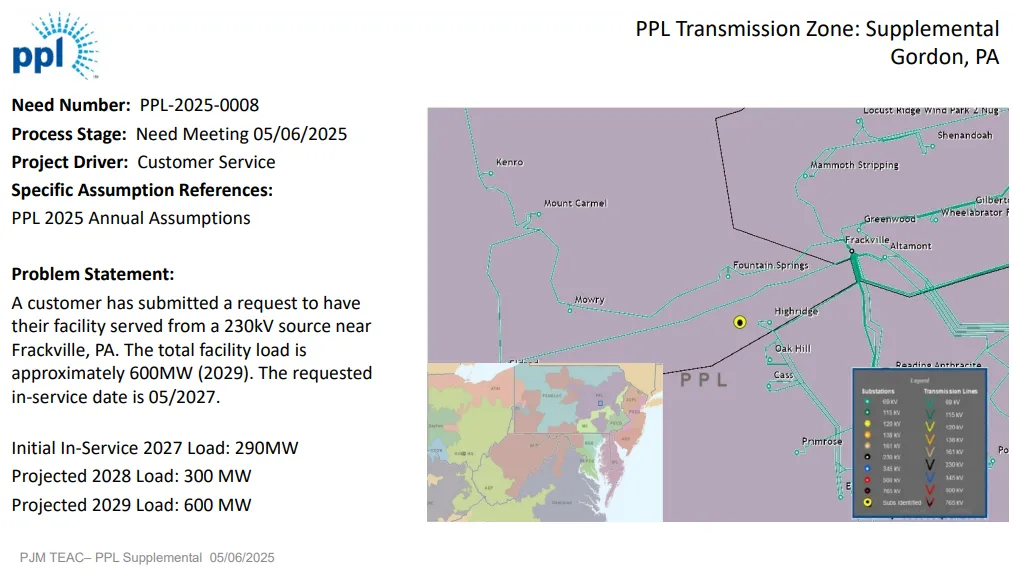
PJM records include queue item PPL-2025-0008, a customer service request located in Gordon, Pennsylvania near Frackville, requesting 230 kV service with a May 2027 in-service date. The requested facility load ramps from 290 MW in 2027 to 300 MW in 2028 and 600 MW in 2029, with PJM describing total facility load around 600 MW by the end of that period.
Set against the company’s targets, the overlap is close enough to be difficult to dismiss.
Milestone | Nebius target | PJM customer request |
|---|---|---|
2027 | 260 MW by October | 290 MW |
2028 | Not separately specified | 300 MW |
Early 2029 | 660 MW by January | 600 MW during 2029 |
Late 2029 | More than 1 GW by November | Not documented |
Full build | Up to 1.2 GW | Not documented |
Location, scale, and timing all align. Neither Nebius, PPL, nor PJM has publicly named the customer in the Gordon request, which makes it strongly consistent with Highridge and almost certainly associated with the project, short of formal identification.
The physical work behind that request is substantial. The pathway requires a new Gordon-area 230 kV switchyard, transmission-yard construction, customer connection lines, and upgrades around Frackville, Eldred, and Sunbury. PPL has separately described plans to rebuild approximately 37 miles of the existing Sunbury-Frackville 230 kV transmission line to support rising demand including a new customer facility, and research references 2 new 230 kV connections tied to the Butler-area load.
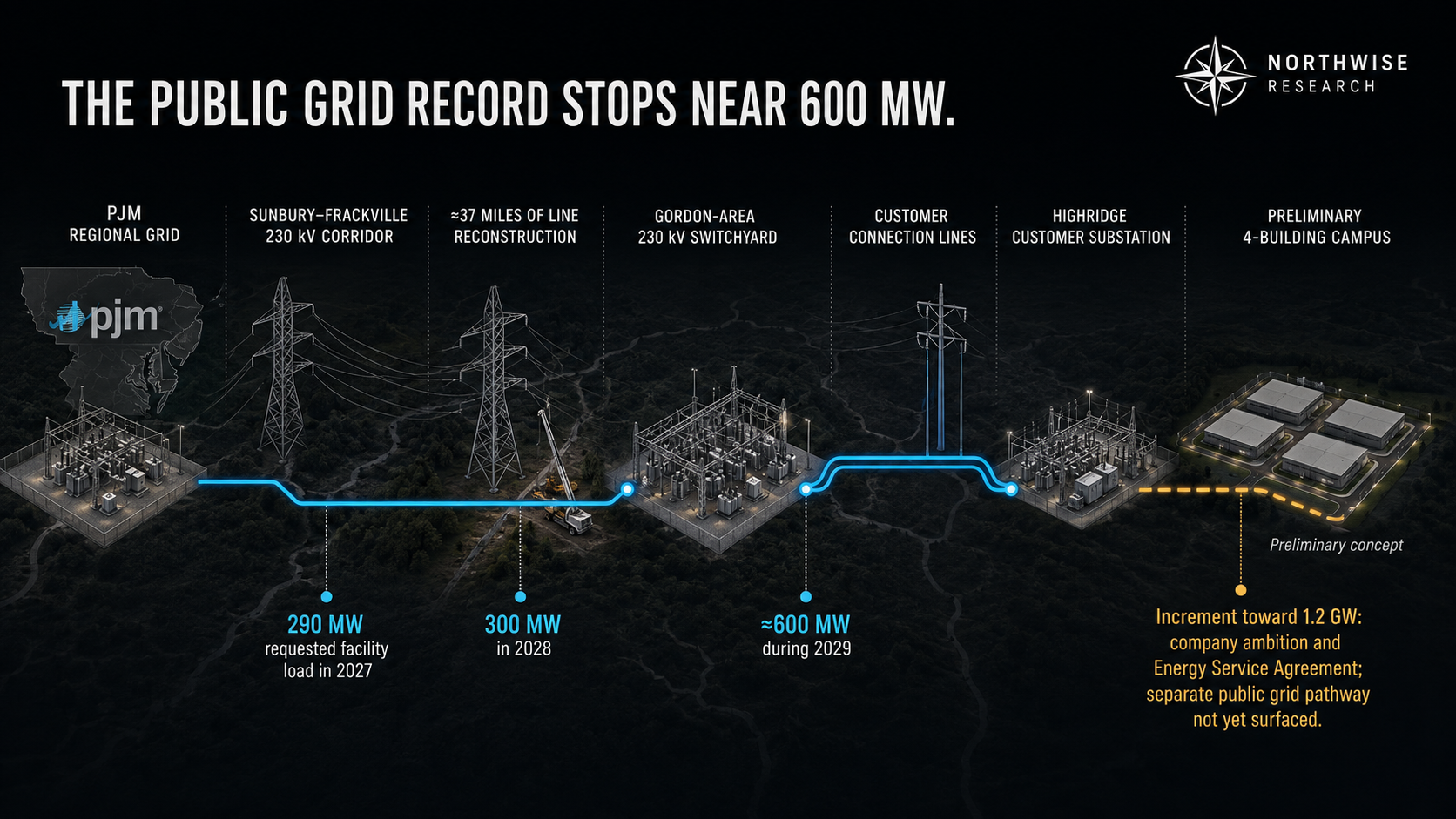
The PJM solution discussed during project development carried an estimated transmission cost near $231.65 million. That number is worth sitting with. Delivering electricity to Highridge costs more than the underlying land, and utilities do not develop regional transmission at that scale against a casual expression of interest.
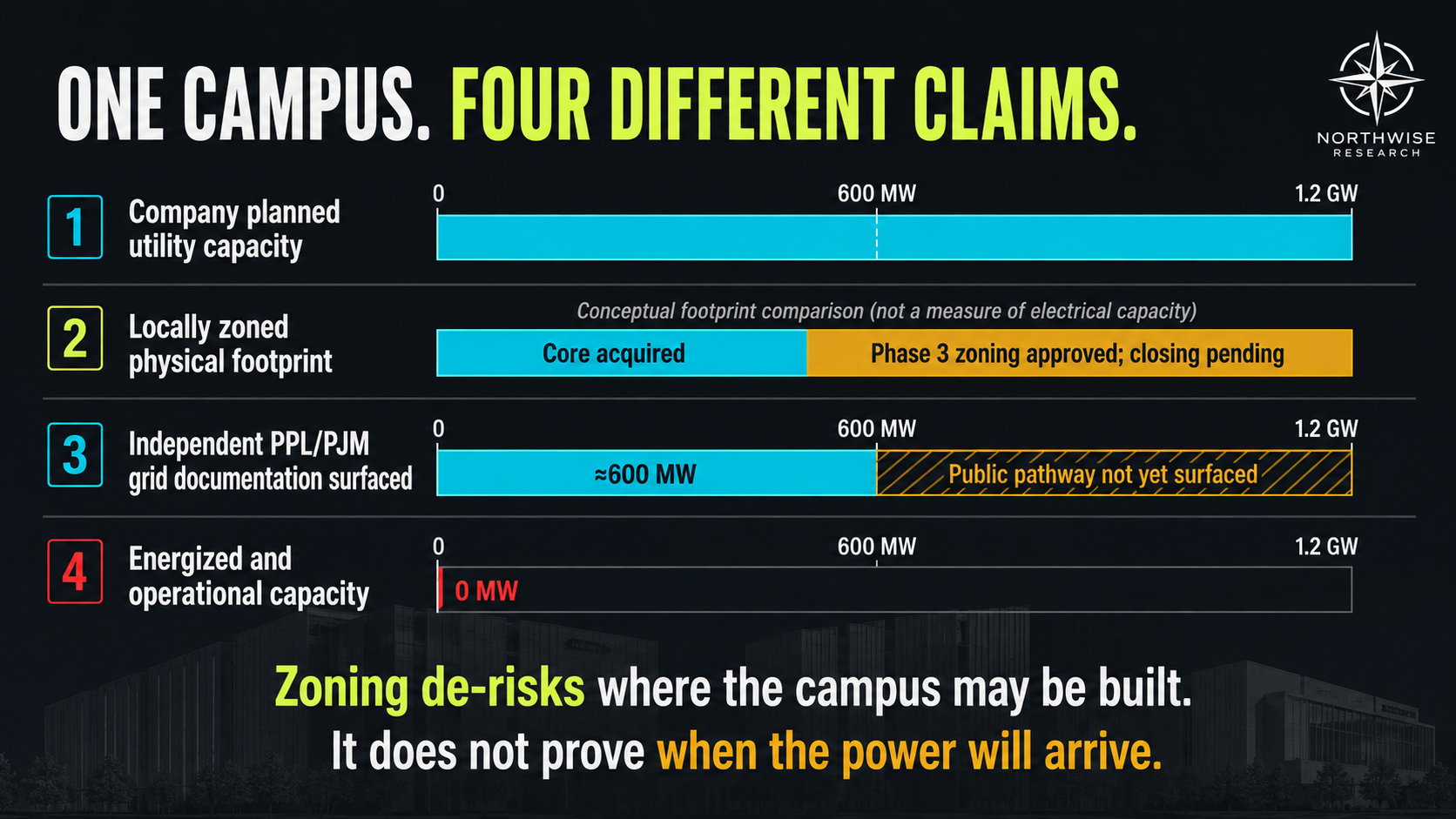
The August 31 decision does not add a single megawatt to this record. It was a land-use approval, not a PPL engineering milestone or PJM transmission authorization. The full 1.2 GW may sit inside Nebius’s Energy Service Agreement, but the independent public grid evidence surfaced to date still reaches only roughly half of that amount.
The Record Predates the Announcement
Nebius disclosed the Pennsylvania project in May 2026. The Gordon load request reached PJM’s advisory committee on May 6, 2025, a full year earlier.
The subsequent land and zoning record now fills in the rest of the sequence.
Date | Event | Where it was visible |
|---|---|---|
March 2025 | NorthPoint vehicle reportedly acquires key Butler parcels from SEDCO for approximately $6 million | County property records |
May 2025 | PPL brings a 600 MW Gordon load request to PJM’s advisory committee | PJM TEAC filing |
September 2025 | Butler Township rezones relevant land and creates a Data Center Overlay | Township ordinances |
April 2026 | Nebius subsidiary reportedly acquires 3 core parcels totaling roughly 358 acres for $187.5 million | County parcel records and local reporting |
May 2026 | Nebius publicly discloses the Pennsylvania project | Company disclosure |
June 2026 | Chapter 102 NPDES permit issued to Highridge DC Propco LLC | Pennsylvania DEP records |
July 2026 | Nebius identifies 2 additional SEDCO properties needed for the maximum footprint | County presentation and local reporting |
August 6, 2026 | Nebius maps Phases 1 and 2 on the core tract and proposed Phase 3 on the expansion tract; presentation shows a 4-building design | Company open-house materials |
August 18, 2026 | Overlay and noise ordinances are discussed and tabled | Butler Township hearing |
August 31, 2026 | Township approves the overlay expansion 2-1 and the stricter noise/CBA ordinance unanimously | Butler Township vote and local reporting |
By the time Nebius disclosed Highridge, the core land had been acquired, the township had already created a data-center framework, and the utility had carried a 600 MW request into PJM’s regional planning process. What remained unresolved was not whether the opening tract existed. It was whether Nebius could secure the additional land and zoning required for the maximum footprint.
That question has now moved forward. The zoning condition has been cleared. The remaining land still needs to close, and the full plan still needs land-development approval.
The record remains useful well beyond this project. Utility filings and municipal ordinances are public, searchable, and often far ahead of corporate disclosure. Anyone underwriting AI infrastructure can watch grid and zoning paperwork rather than waiting for an investor presentation to explain what happened a year earlier.
The sequence also puts a clock on the near term. PPL requested a May 2027 in-service date in May 2025. Nearly 16 months of that original 24-month window have now elapsed. Nebius targets 260 MW by October 2027, roughly 5 months after the requested utility date, leaving a plausible interval for energization, commissioning, GPU installation, and customer acceptance. The dates fit together. That does not guarantee that the work will.
The Back Half Cleared Zoning. It Has Not Cleared the Grid
Walking the record through in sequence still produces a hierarchy across the campus, but the back half now carries more evidence than it did at initial publication.
The opening phase of roughly 260 MW to 290 MW retains the strongest visibility. Nebius has published an explicit target, PJM documents a closely matching load request, the 2027 timeline is consistent across both sources, and a real grid project is being developed to serve it. The core land is acquired, the relevant zoning is in place, and stormwater permitting has advanced.
The 600 MW to 660 MW threshold remains materially supported. PJM explicitly models approximately 600 MW by 2029, Nebius targets roughly 660 MW around the start of that year, and the transmission work required to deliver that load has published scope.
The final increment toward 1.2 GW now has a stronger land-use record. Nebius has mapped the expansion area as proposed Phase 3, entered an agreement to acquire it, secured the overlay expansion required to pursue the maximum site, and published a current 4-building concept together with a target above 1 GW by November 2029. That is no longer just a company commitment attached to an unzoned map, but it is still not an independently documented second 600 MW electrical project.
Evidence layer | First roughly 600 MW | Increment toward 1.2 GW |
|---|---|---|
Core land ownership | Roughly 358 acres acquired | Expansion land under agreement; closing not publicly confirmed |
Data-center zoning | Approved | Approved on August 31, 2026 |
Site design | Draft Phase 1 plan and opening phases identified | Proposed Phase 3 and current campus concept identified |
Independent grid documentation | Approximately 600 MW visible through PPL/PJM | No separate public pathway surfaced beyond approximately 600 MW |
Final land-development approval | Pending | Pending |
Energized capacity | 0 MW | 0 MW |
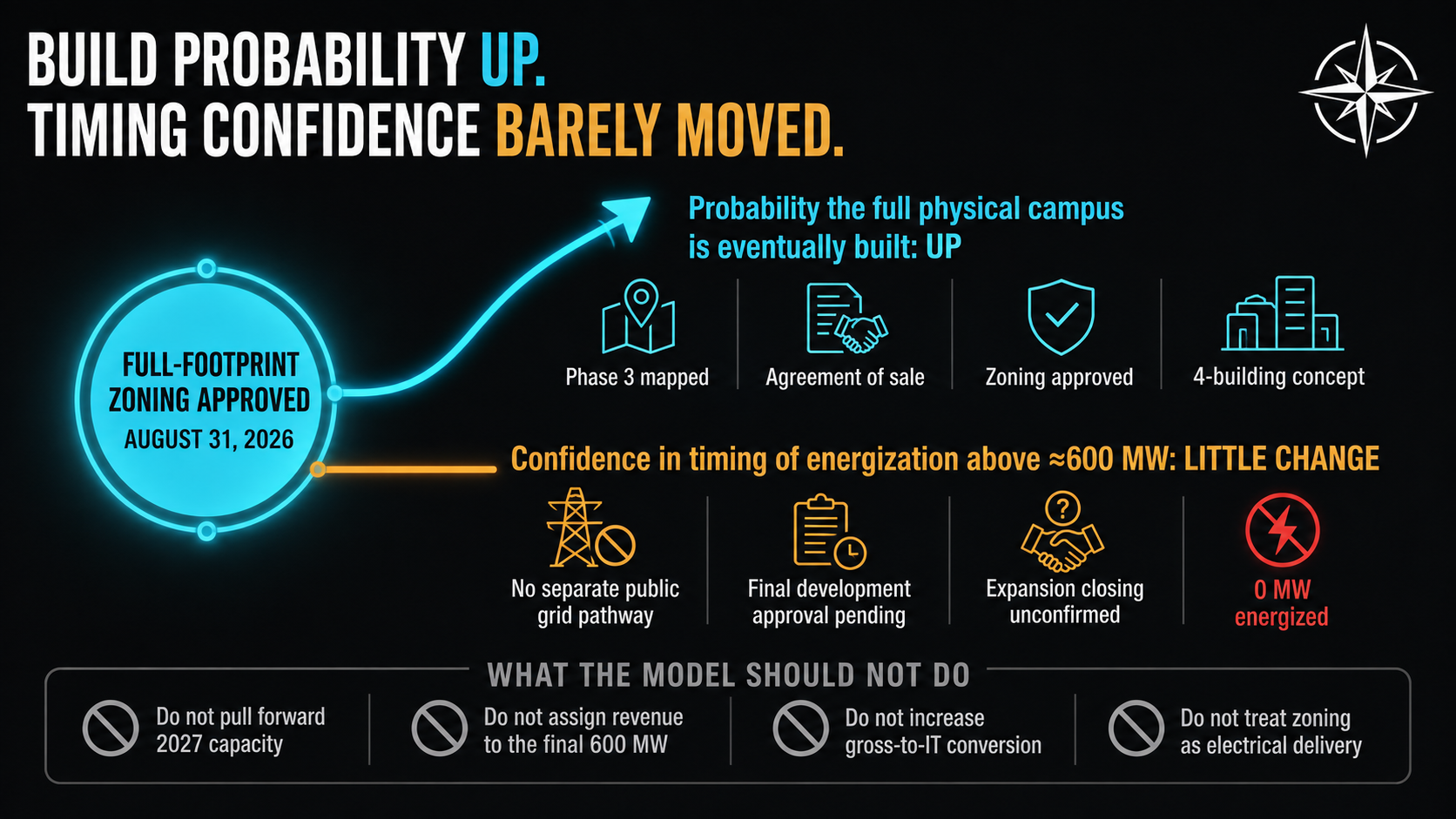
The model implication is straightforward. The August 31 vote should increase confidence that Nebius can physically pursue the full campus footprint. It should not pull forward the 2027 ramp, increase gross-to-IT conversion, assign revenue to the final 600 MW, or erase the need for a separately visible grid pathway.
In other words, the probability of the back half being built has improved more than the probability of the back half being energized on a specific date. That is the distinction the model needs to preserve.
Design, Cooling, and Local Constraints
Nebius’s current concept describes a facility purpose-built for accelerated compute: a 4-building campus on roughly 600 acres, substantial substation and switchyard infrastructure, closed-loop liquid cooling, acoustic mitigation, stormwater retention, battery storage, and power density far beyond a conventional warehouse.
The design is not final. Earlier July material referenced 6 single-story buildings. The company’s August deck changed that to 4 buildings, while the draft Phase 1 plan shows one single-story building and one 2-story building. That evolution removes any basis for treating the original building count, floor count, or implied capacity per shell as settled.
Several technical details circulating in secondary research still go beyond what has been established for the site. Rack densities in the 40 kW to 100 kW range, overhead busway configurations, InfiniBand fabric, specific cold-plate layouts, generator count and fuel type, and a 1.15 site PUE are all plausible expectations for a modern AI campus. None is a confirmed Highridge specification.
Cooling strategy is clearer. Nebius describes air-cooled and closed-loop liquid systems designed to recycle water onsite and minimize ongoing consumption. At the August 31 hearing, SEDCO’s president presented approximately 37,000 gallons per day as the proposed water requirement and said the Mount Laurel water system has capacity of roughly 1.6 million gallons per day.
That is the first concrete daily figure in the public record, but it is not yet a complete water model. The disclosure does not define whether 37,000 gallons covers steady-state make-up water, initial system fill, construction demand, peak conditions, all phases, or only the current design. Nebius still has not published a site WUE, a final water balance, or a site PUE.
Noise requirements have tightened. The governing property-line cap is now 65 dBA rather than 75 dBA. Nebius presented a preliminary internal sound study estimating approximately 60 to 63 dBA at the campus property line and 34 to 40 dBA at nearby residential property lines toward Gordon. That places the high end of the company estimate only 2 dBA below the new limit. Residents also questioned whether an A-weighted standard adequately captures low-frequency sound and pressed the township to consider dBC measurements.
The company may ultimately meet the ordinance through quieter fans, sound walls, equipment placement, terrain buffering, setbacks, and operating controls. The current study is still an internal estimate based on a design that has not received final approval. Acoustic compliance should be treated as an engineering requirement, not a solved talking point.
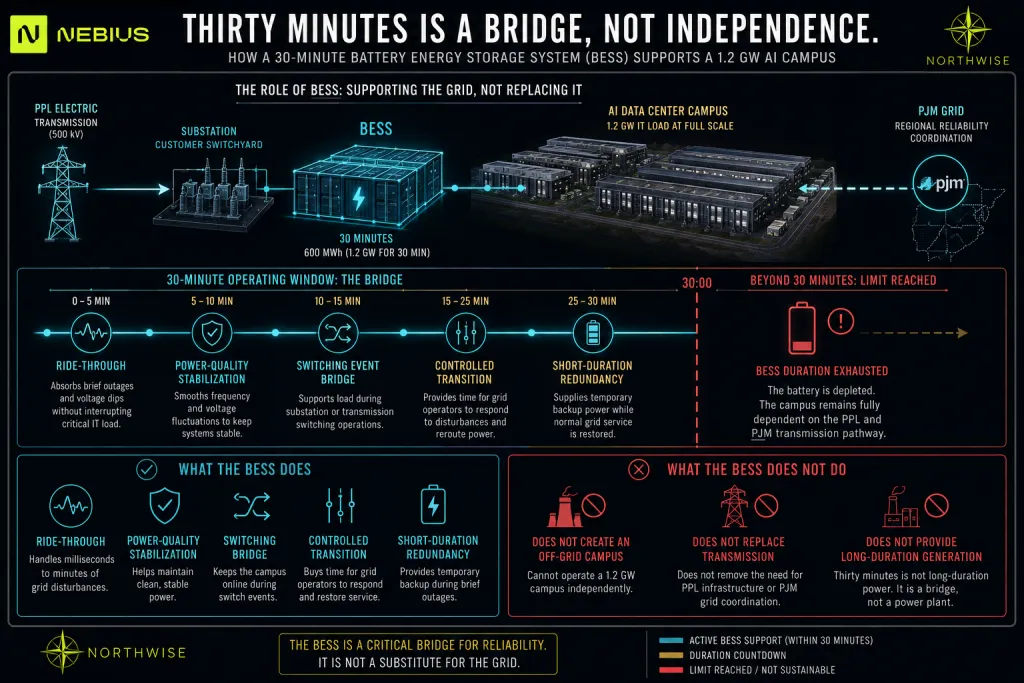
The backup architecture is also more defined. Nebius says the campus will include a Battery Energy Storage System capable of roughly 30 minutes of backup or redundant power. Company representatives have also confirmed that backup generators are planned for outages, while stating that the campus will not use on-site generation as its regular source of electricity.
Thirty minutes of storage supports ride-through, power quality, switching events, and controlled transitions. It does not create an off-grid campus. Backup generators do not change the fundamental dependence either. Highridge’s normal operations remain tied to the PPL and PJM pathway, which concentrates execution risk on transmission delivery in a way that behind-the-meter generation would not.
Who Uses the Capacity
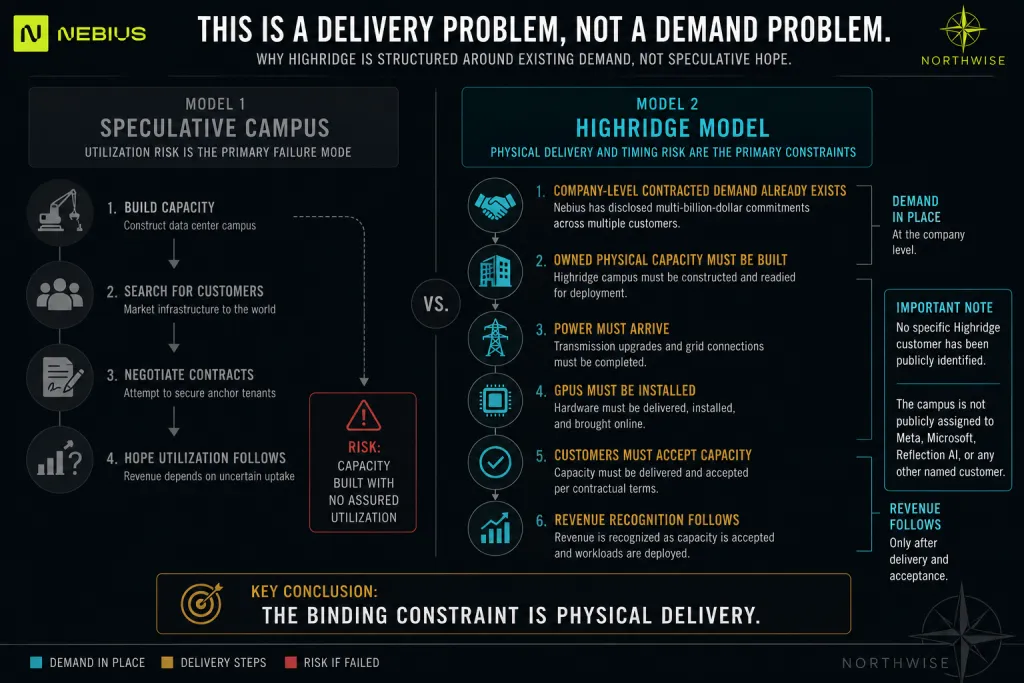
No Highridge customer has been publicly identified, and any analysis assigning the Pennsylvania campus to a named counterparty remains inference.
At the company level, demand is not the weak link. Nebius has relationships with hyperscale, AI-native, enterprise, and quantitative customers, including Meta, Microsoft, Reflection AI, and Cohere. The Meta agreement alone is worth up to approximately $27 billion across 5 years. After Q2, Nebius said it had more than $40 billion of customer commitments, could sell its entire 2027 capacity on current terms, and had raised its 2026 contracted-power target to 5 GW.
Capacity of that magnitude has to be physically delivered somewhere, and Nebius needs large owned footprints to fulfill it. Connecting any specific contract directly to Highridge would still outrun the evidence.
The campus could serve large-scale model training, fine-tuning, high-throughput inference, reserved-capacity commitments, and general Nebius AI Cloud demand. Those describe intended uses, not a disclosed customer assignment.
The distinction shapes the risk profile. Nebius is not obviously searching for a tenant to justify an empty speculative campus. The more immediate question is whether physical infrastructure arrives in time to monetize demand already under contract. That is a delivery problem, and delivery problems fail differently than demand problems.
They can also become demand problems later. Contracts have schedules, acceptance conditions, performance requirements, and customer alternatives. A delayed campus does not preserve contracted economics forever simply because a customer once signed.
Ownership, Missouri, and the Capital Question
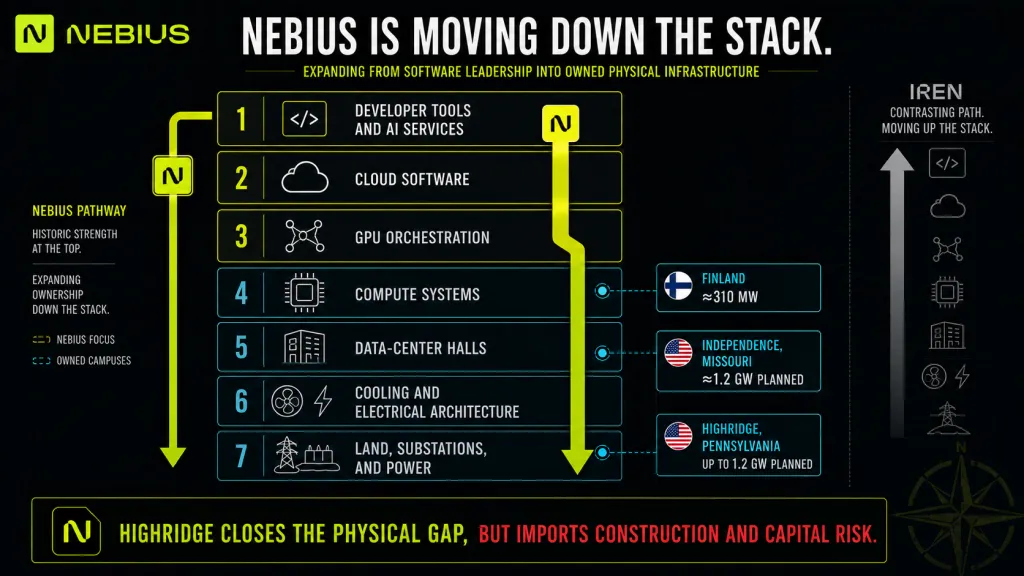
Nebius entered the AI infrastructure cycle strong on the software side and thin on the physical side. It had a mature cloud platform, deep engineering heritage, GPU orchestration capability, developer tooling, and customer relationships. What it lacked relative to power-first competitors was owned infrastructure at scale.
Our existing framework on the sector holds that IREN owns more of the physical layer, Nebius owns more of the software layer, and both are moving toward the middle. Highridge is Nebius moving toward the physical side at a scale that changes the company’s structural position.
Nebius describes Highridge as a facility it will design, build, own, and operate. The parcel record requires slightly more precision. The core roughly 358-acre tract appears acquired. The expansion tract is still reported as SEDCO-owned under an agreement of sale whose zoning condition has now been cleared. Planned ownership is not identical to completed ownership.
The broader owned footprint includes Independence, Missouri at approximately 1.2 GW planned, Pennsylvania at up to 1.2 GW, and a 310 MW location in Finland. Missouri broke ground in May 2026 and appears physically further along. The 2 U.S. campuses together represent 2.4 GW of planned owned AI-factory capacity, a hyperscale footprint by any reasonable definition.
Ownership buys control over deployment schedule, electrical architecture, cooling design, rack density, and hardware-refresh cadence, which compounds across a decade of GPU generations. It also imports capital intensity, construction exposure, permitting risk, community obligations, and grid dependency that a leasing model pushes onto somebody else. Highridge tests whether Nebius can carry that burden repeatedly across multiple concurrent gigawatt projects without the schedule or shareholder economics breaking.
Capital is where the test gets expensive. Nebius spent approximately $5.7 billion on capex in Q2 2026 alone, primarily on GPUs, related hardware, and data-center expansion, and reaffirmed its full-year guidance after the quarter. The company has not published a reconciled Pennsylvania-specific project budget.
A state representative supporting the project cited an estimated $11 billion to $15 billion investment during the August 31 hearing. That figure is directionally plausible for a campus combining civil infrastructure, electrical systems, networking, and GPUs, but it is not the same thing as formal Nebius project guidance and should not be entered into a model as though it were.
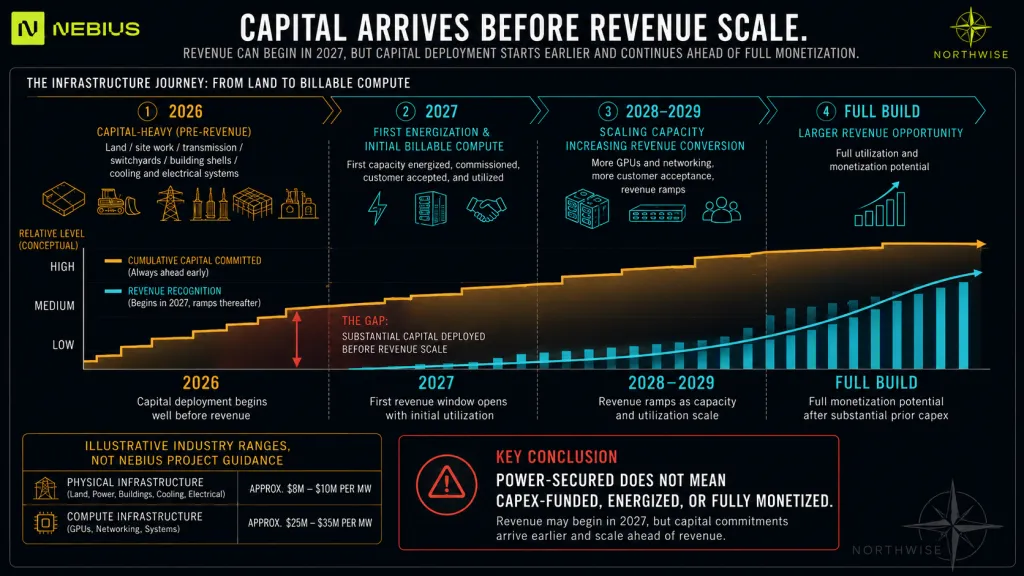
Industry benchmarks give a sense of scale without pretending to precision. Physical infrastructure for AI campuses can run into the high single-digit millions of dollars per MW before compute, while current-generation GPU systems can add several times that amount. Applied across 1.2 GW, the result lands in the tens of billions. That is why gigawatt announcements are capital events long before they are real-estate events.
Nebius’s funding position has improved materially. In Q2, roughly 70% of new deals included customer prepayments covering 50% to 60% of associated capex. The company expects more than $9 billion of customer prepayments in 2026, raised a $775 million secured facility backed by deployed GPU infrastructure and contracted cash flow, and has continued using equity financing alongside debt and operating cash flow.
Those channels reduce the amount of uncommitted corporate capital required to fund growth. They do not make the build free. A customer prepayment is cash received against a delivery obligation, not a magic wand that turns substations into revenue. The arrangement improves financing only if Nebius brings the promised capacity online and earns attractive returns after all associated costs.
The campus is power-contracted and nowhere close to capex-free. Owning infrastructure improves long-run unit economics only when construction can be funded without destroying shareholder economics and when energization keeps pace with spending.
What Can Break the Ramp
Transmission timing remains the highest-impact risk on the board. PPL’s work is a real project with published scope, but 230 kV schedules are exposed to permitting, right-of-way acquisition, construction sequencing, outage windows, transformer availability, and switchgear lead times. Rebuilding 37 miles of line is a linear construction project across populated terrain. Those do not compress gracefully when something goes wrong.
Long-lead equipment supply compounds the risk. High-voltage transformers and switchgear remain constrained, and a campus can be physically impressive while still unable to energize. Shells, cooling systems, and electrical plant are sunk capital producing nothing until power arrives.
The August 31 approval removes one back-half risk and exposes the next ones. Nebius must close on the expansion land, submit a final land-development plan, pass Planning Commission and supervisor review, determine whether existing environmental permits must be amended, negotiate toward a Community Benefits Agreement, and obtain building and fire approvals. None is as existential as a zoning denial would have been. None is automatic.
Full 1.2 GW delivery still depends on transmission capacity and grid work beyond what public PJM documentation currently covers. The local government can approve land for a data center. It cannot manufacture a second 600 MW transmission pathway by ordinance.
Community response has moved from background noise into a more concrete execution variable. Roughly 25 people attended the August 31 hearing, with residents pressing on noise, water, stormwater, power costs, emergency response, and impacts on neighboring Gordon. One resident threatened litigation if the ordinance passed. A threat is not a filed case, but it is more than theoretical opposition.
The stricter 65 dBA limit and required CBA process may improve the project’s durability by addressing concerns early. They can also add design cost, operating constraints, negotiation time, and potential points of dispute. Community engagement is not separate from execution at this scale. It is part of execution.
Water and stormwater remain diligence items rather than obvious blockers. The reported 37,000-gallon daily requirement is small relative to the stated Mount Laurel system capacity, and closed-loop cooling reduces ongoing consumption. The campus sits above neighboring communities, however, and runoff risk depends on final grading, impervious surface, ponds, wetlands, and maintenance rather than a single average water-use number.
Capex sequencing introduces a tension with no clean solution. Nebius must order GPUs far enough ahead to fill halls on schedule and late enough to avoid hardware depreciating in a warehouse. Committing compute too early against a slipping site pushes equipment into service later in its economic life, degrading returns on the single most expensive component of the build. Large customer commitments sharpen this further by making contract timing and capacity readiness mutually dependent.
The absence of disclosed PUE and WUE targets still limits what can be modeled. Without those figures, gross site MW cannot be translated into net IT MW with precision, which constrains any revenue-density estimate built on the campus.
What to Watch and What Remains Unknown
The project produces testable evidence on a predictable cadence, and each year answers a different question.
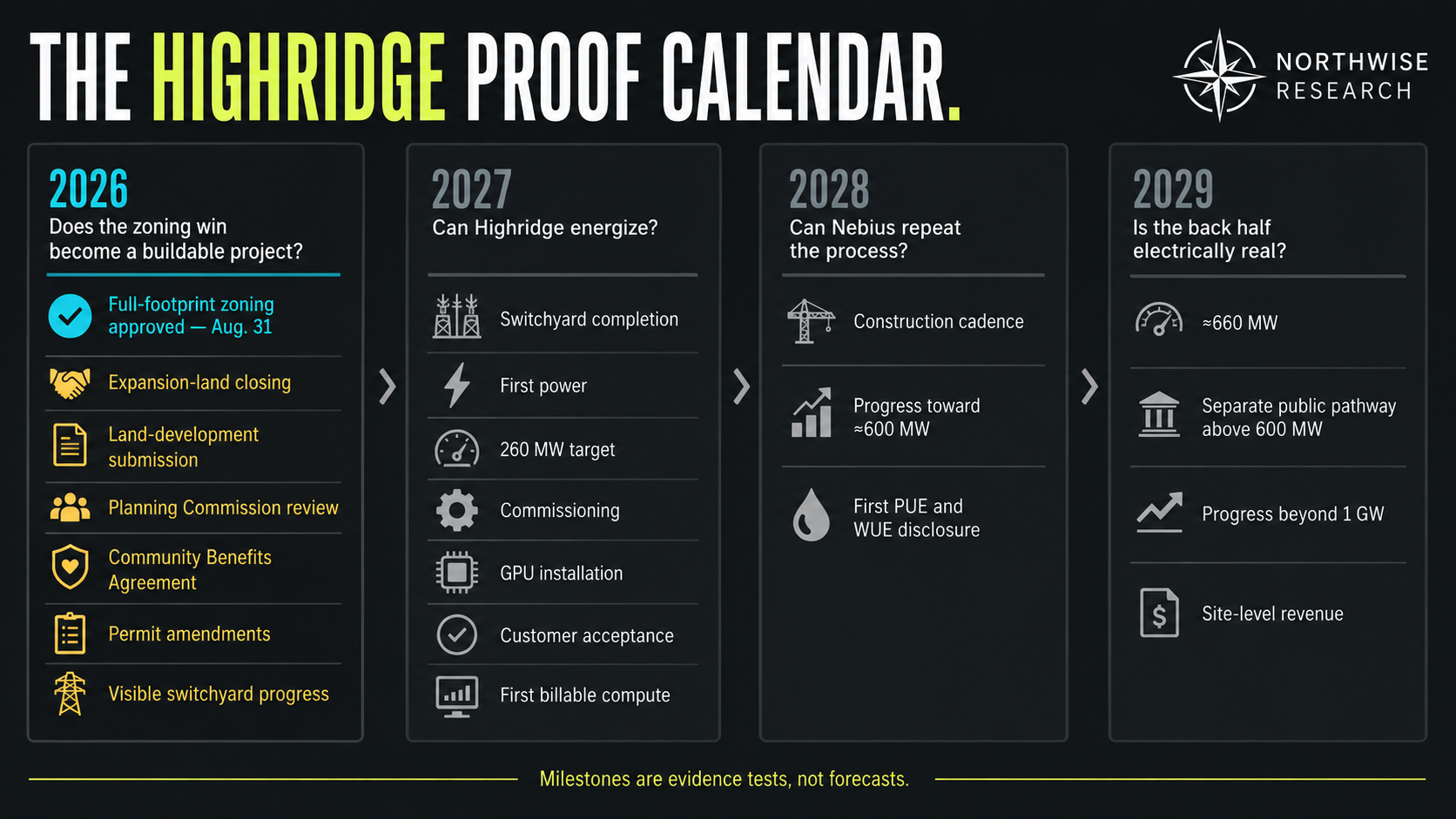
Year | Signals to track | What confirmation would establish |
|---|---|---|
2026 | Recorded closing of the additional SEDCO parcels; final parcel map; land-development submission; confirmed 4-building or revised design; Planning Commission progress; Community Benefits Agreement negotiations; permit amendments; PPL right-of-way progress; visible switchyard work | That the full locally zoned footprint is becoming an approved and buildable project rather than remaining an entitlement option |
2027 | Switchyard completion; first energization; 260 MW confirmation; first shell delivery; commissioning; GPU installation; customer acceptance; first billable compute | That Nebius can convert an owned site into revenue-bearing capacity on the stated schedule |
2028 | Repeatable construction cadence; progress toward the 600 MW threshold; disclosed PUE and WUE; evidence that later electrical phases are advancing | That the opening phase was a process rather than a one-off |
2029 | Approximately 660 MW delivered; a separately visible pathway above 600 MW; progress beyond 1 GW; site-level revenue contribution | That the full-footprint zoning win is being converted into back-half power and operating capacity |
Several developments would qualify as red flags: failure to close the expansion land after the zoning condition was cleared, material delay in submitting the land-development plan, a 260 MW target pushed to the right, switchyard or transmission delays, a reduced site footprint, removal of the 1.2 GW target from company materials, inability to satisfy the 65 dBA standard without redesign, a stalled CBA process, GPU commitments running well ahead of hall readiness, or equity financing required merely to keep existing construction moving.
The land questions are narrower now. We know the $187.5 million transaction appears to cover roughly 358 acres rather than the entire maximum campus, and we know SEDCO still holds the expansion property under an agreement of sale. What remains unknown is the purchase price and closing date for that land, the precise acreage that will transfer, whether every mapped Phase 3 area is included, and how the final parcel configuration interacts with wetlands, stormwater controls, and permit boundaries.
The power questions remain more consequential. What additional transmission work carries Highridge from the visible approximately 600 MW pathway to 1.2 GW? Has PPL already engineered later phases under the same Energy Service Agreement, or does the remaining capacity require separate regional upgrades that have not yet entered the public record? Does the more-than-1-GW November 2029 target refer to utility-delivered power, commissioned gross data-center capacity, or usable IT load?
The design questions matter for any serious model. No EPC contractor has been named, vertical construction has no confirmed start date, and shell-by-shell delivery dates remain unpublished. The building count changed from 6 to 4 before formal land-development review. Target PUE, target WUE, rack density, launch GPU generation, network fabric, generator architecture, and gross-to-IT conversion remain undisclosed.
The commercial questions follow from there. Nobody outside the company knows who takes the first 260 MW, what capex per MW will run for either infrastructure or compute, how much customer prepayment is attached specifically to Highridge, what contractual remedies apply if capacity is late, or how quickly acceptance follows energization.
The Conversion Test
Highridge became materially more credible on August 31. Butler Township approved the Data Center Overlay expansion Nebius needed to pursue the full planned footprint, tightened the operating rules, and created a formal path into land-development review. The proposed back half is no longer sitting outside the zoning framework, which is the proper bullish conclusion.
The proper discipline is that zero MW still operates today. The expansion land has not been publicly confirmed as closed. The final site plan has not been approved. The current design has already changed. The surfaced PJM record still documents approximately 600 MW rather than the full 1.2 GW. Full delivery requires years of capital and execution across multiple concurrent campuses.
The August 31 vote converted Phase 3 from a zoning contingency into a locally authorized data-center use. It did not convert it into a deed, a final site plan, a building permit, a transformer, or a powered hall.
Value does not accrue to shareholders because Nebius controls a 1.2 GW headline. It accrues when those megawatts travel the full conversion chain and emerge as utilized compute at attractive revenue density. The township just cleared one important gate on that chain. The next proof points are closing the land, approving the plan, building the electrical pathway, and energizing the first phase.
Highridge is more real this week. It is not complete. That difference is not hedging. It is underwriting.
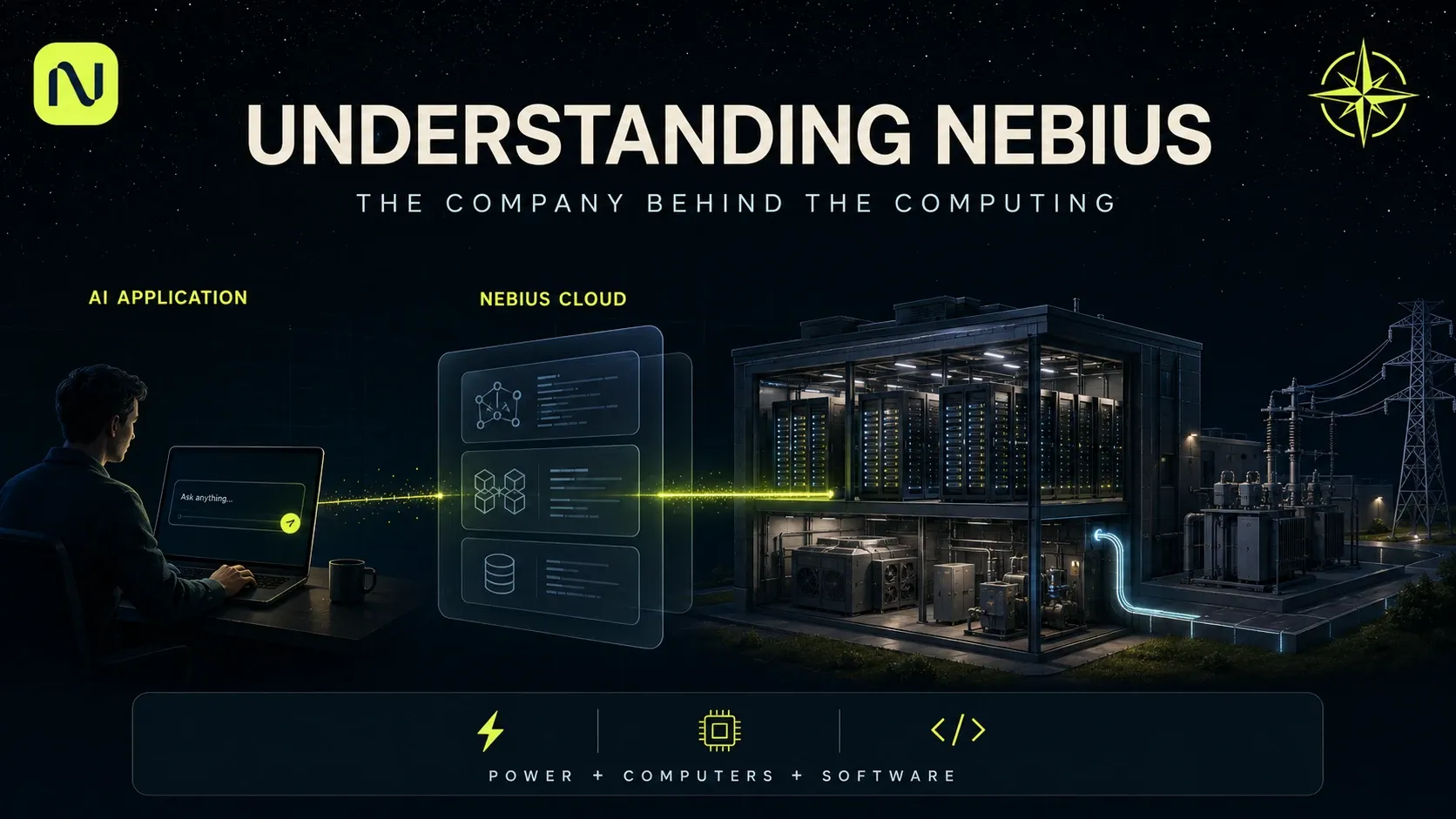
Understanding Nebius: A Complete Guide to the Company
Understand Nebius from the ground up: its AI cloud, competitors, subsidiaries, funding, and growth opportunities. A complete NBIS guide with 14 illustrations.
Nebius in Europe: Sovereign AI, UK Expansion and Harlow
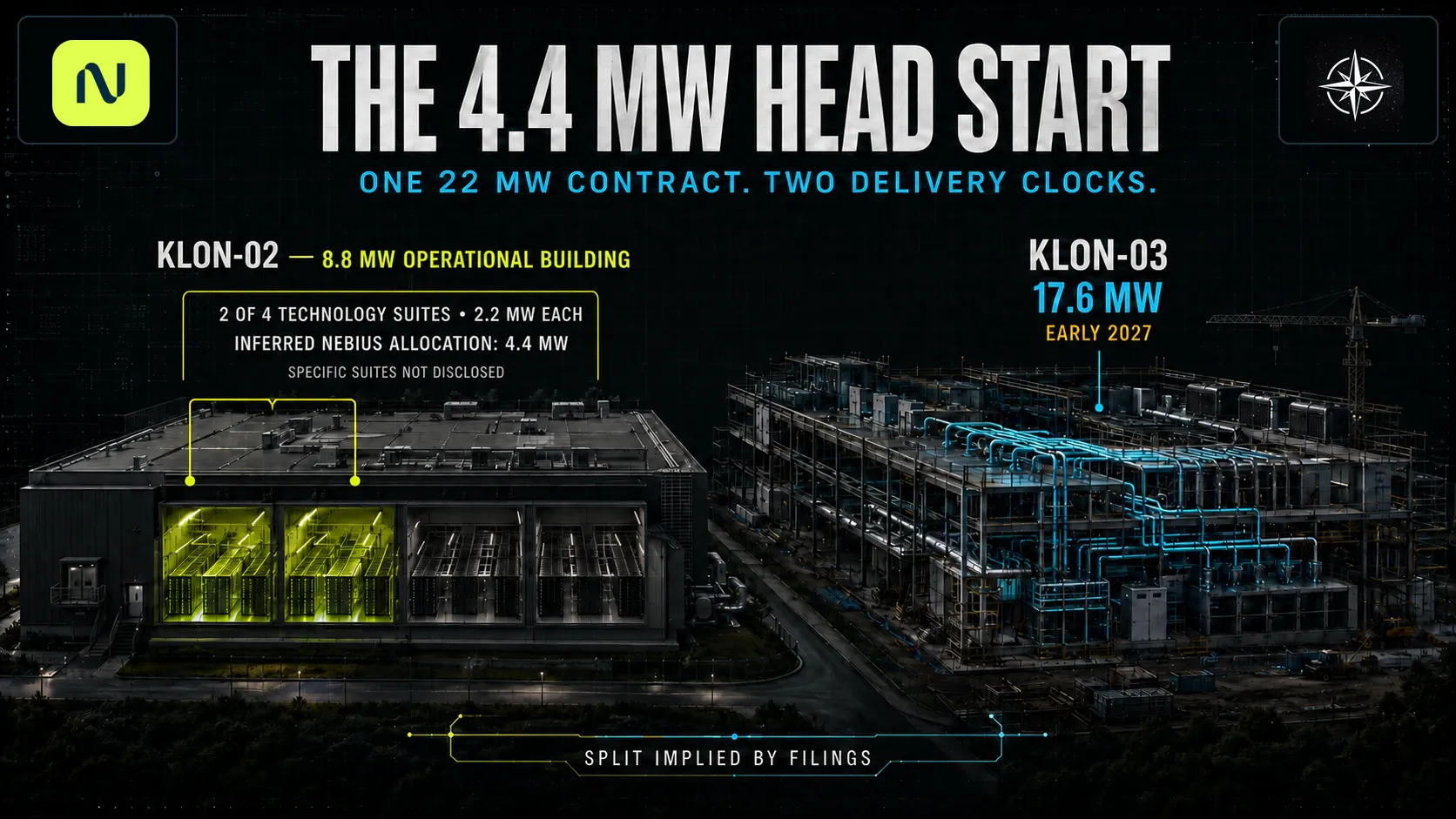
How European AI sovereignty supports Nebius’s UK expansion, where Harlow fits, and what its potential 4.4 MW deployment could add to Q3 revenue and 2026 ARR.

NBIS Stock Forecast 2030: The Conversion Problem
A ground-up Nebius model rebuild after Q2 2026, covering AI factory economics, capital structure, valuation scenarios, and the NBIS stock forecast to 2030.
Northwise Portfolios
See how the research becomes real decisions
Reader discussion
Discuss the research
Create a Free account to join the discussion with a display name.
Create a Free Account
No comments yet. Start a thoughtful discussion.