
Nebius TripleTen Analysis
Nebius TripleTen shows how Nebius is building the human infrastructure of AI through talent, training, and ecosystem support.
In this article
Why Nebius TripleTen may be a more important strategic asset inside Nebius than the market currently understands, with implications for talent, enterprise adoption, and full-stack AI ecosystem value.
1. Nebius, TripleTen, and the Human Layer of AI Infrastructure
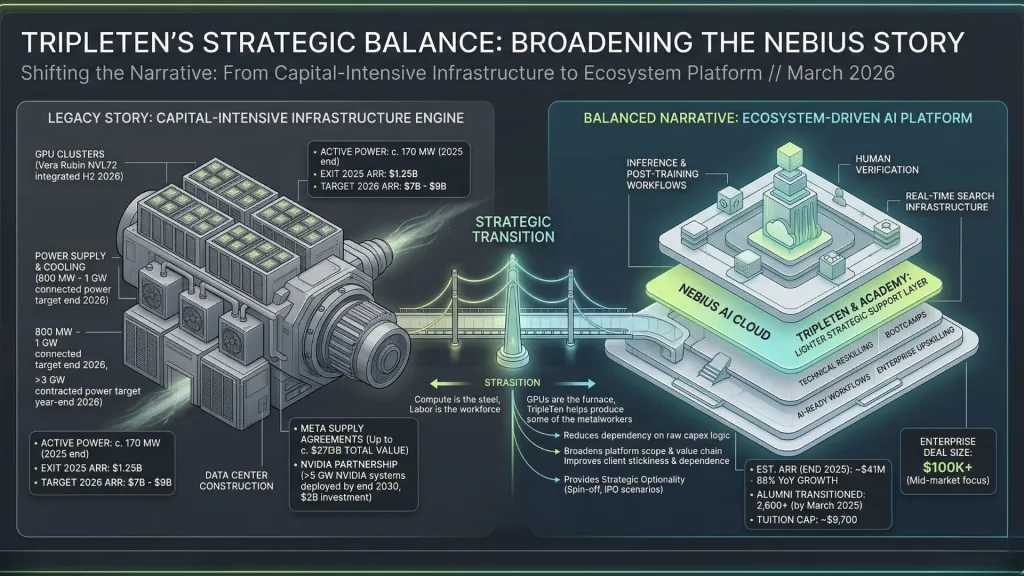
The Nebius story has moved materially since the earlier version of this section. By February 2026, the company reported $228M of Q4 2025 group revenue, with core AI business revenue up 802% year over year to $214M. It exited 2025 with $1.25B of ARR, above prior guidance of $900M to $1.1B, and management reiterated a target of $7B to $9B of ARR by the end of 2026. On the infrastructure side, Nebius ended 2025 with roughly 170 MW of active power, ahead of its prior 100 MW target, while guiding toward 800 MW to 1 GW of connected power by the end of 2026 and more than 3 GW of contracted power by year-end 2026.
The commercial backdrop has also become much larger. In November 2025, Nebius disclosed an initial Meta agreement worth approximately $3B over 5 years. That relationship expanded meaningfully on March 16, 2026, when Nebius announced a new long-term Meta infrastructure supply agreement with a contract value of up to approximately $27B. Under that deal, Nebius will provide $12B of dedicated capacity over 5 years across multiple locations, with delivery beginning in early 2027, and Meta also committed to purchase additional available compute capacity up to $15B over the same period across certain upcoming Nebius clusters.
A few days earlier, on March 11, 2026, NVIDIA announced a strategic partnership with Nebius and said it would invest $2B in the company. The partnership goes beyond capital. NVIDIA said the relationship is meant to help Nebius deploy more than 5 GW of NVIDIA systems by the end of 2030, spanning AI factory design, inference infrastructure, fleet management, and early adoption of future NVIDIA platforms. Nebius had already announced in January that it would be among the first cloud providers to offer NVIDIA Vera Rubin NVL72 in the U.S. and Europe starting in H2 2026, integrating it across both Nebius AI Cloud and Nebius Token Factory.
Taken together, these developments sharpen the central point. Nebius is no longer just an ambitious neocloud with theoretical upside. It is becoming a scaled AI infrastructure platform with much larger contractual visibility, far deeper strategic alignment with NVIDIA, and a more credible path toward global capacity leadership.
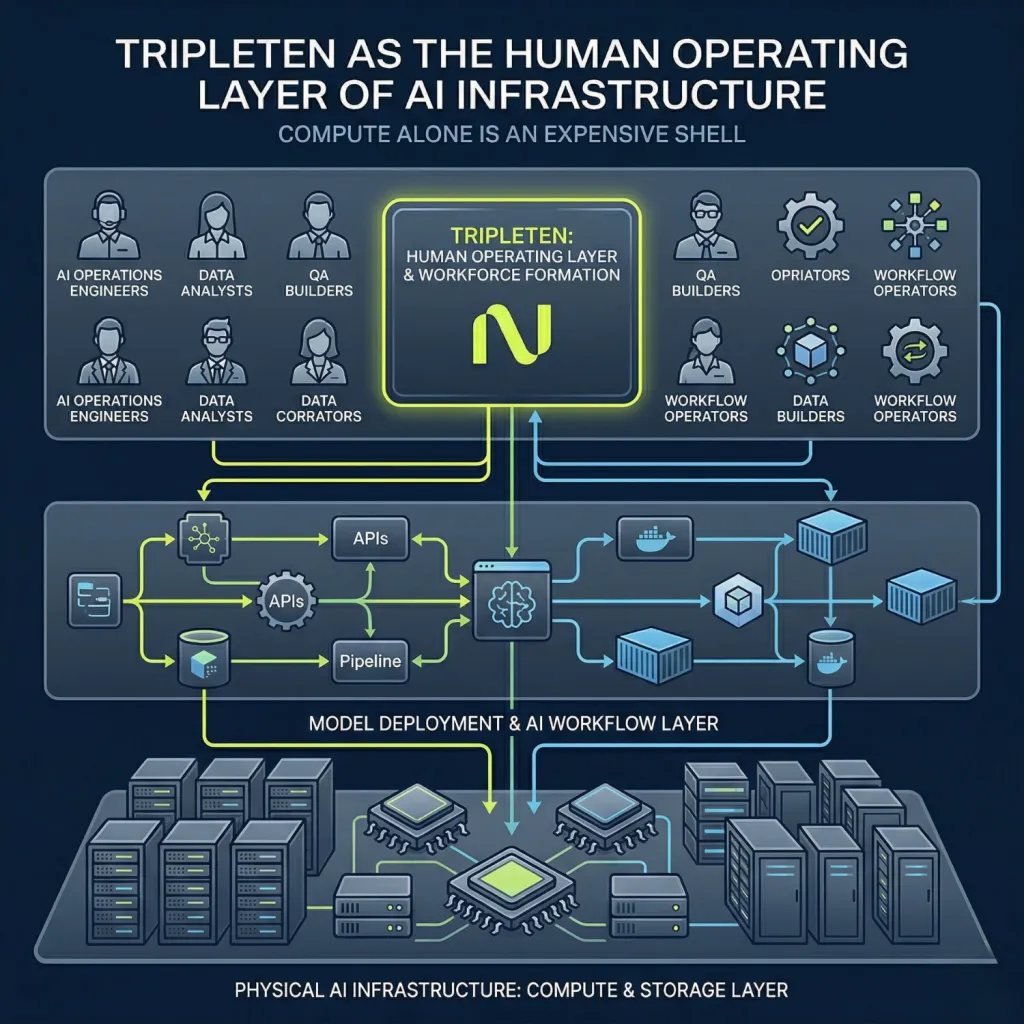
That makes the discussion around TripleTen more important, not less. Once the physical layer begins to harden, the next bottleneck becomes easier to see. Enterprises still need trained operators, implementers, AI-literate managers, workflow builders, and technically capable teams that can carry these systems from rented compute into useful production environments. Compute is the steel of the new factory. Labor is still the workforce that keeps the factory from becoming an expensive shell.
TripleTen’s role inside the broader Nebius ecosystem
Inside that broader system, TripleTen occupies a role that can look small on a surface read and strategically important on a deeper one. Nebius has increasingly assembled a layered stack. The core AI Cloud business supplies the compute layer.
Token Factory extends the platform into managed inference and post-training workflows. Tavily, announced in February 2026, adds real-time search infrastructure for AI agents. Toloka and Tendem contribute human verification, evaluation, and data workflow capabilities. Avride pushes the group into robotics and autonomy. TripleTen sits in a different part of the machine. It is the human capital and reskilling layer, which is easier to dismiss until you look at where enterprise AI deployments actually stall.
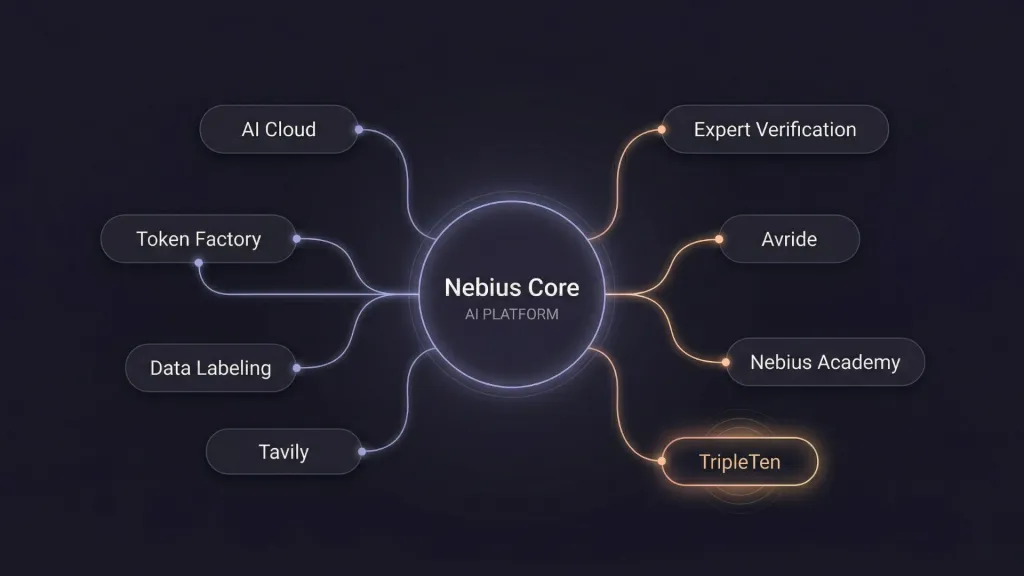
That role becomes easier to understand when viewed against the way Nebius itself now describes the business. Nebius presents its platform as spanning the AI journey from data and model training to production runtime and deployment.
A company trying to own more of the deployment stack benefits from having assets that do more than sell raw compute. TripleTen broadens the group into technical education, workforce preparation, and enterprise upskilling, areas that can deepen customer relationships without requiring the same level of capex intensity as data center construction. In portfolio terms, TripleTen is one of the few Nebius assets that can compound through people rather than power.
The asset still has real operating traction of its own. TripleTen reached an estimated $41M ARR by the end of 2025, with roughly 88% year-over-year growth, while prior 2024 bookings and enrollment growth ran near 300% year over year. By March 2025, more than 2,600 alumni had transitioned into new roles, and roughly 80% of graduates reportedly entered with zero prior coding experience.
Those numbers do not place TripleTen anywhere near the scale of Nebius Cloud, which is now measured in billions of prospective ARR, but they do suggest the business has moved beyond the stage of being dismissed as a decorative side asset. It is small, but small and irrelevant are not synonyms. In corporate ecosystems, some assets matter less for size than for the pressure they relieve elsewhere.
TripleTen’s place inside the Nebius ecosystem
Segment | Primary function | Strategic role inside Nebius |
|---|---|---|
Nebius AI Cloud | GPU-as-a-Service, AI infrastructure, regulated cloud | Core revenue engine and physical compute layer |
Token Factory | Managed inference and post-training workflows | Expands Nebius beyond raw compute into AI production workflows |
Toloka / Tendem | Data labeling, expert verification, human-in-the-loop workflows | Reliability, evaluation, and supervised AI operations |
Avride | Autonomous systems and robotics | Application layer for compute and autonomy |
TripleTen | Technical reskilling, bootcamps, AI-ready workforce training | Human capital funnel, enterprise upskilling, labor layer for AI adoption |
Why this asset matters in an AI market shaped by both compute and labor constraints
The market still talks about AI mainly through hardware scarcity. That is fair as far as it goes. Power is scarce. advanced systems are scarce. high-density capacity is scarce. The past few months have reinforced that reality rather than weakened it. Nebius is signing multi-year infrastructure agreements at multi-billion-dollar scale, partnering directly with NVIDIA on next-generation platform rollouts, and planning around a capacity roadmap measured in gigawatts.
The narrower and more practical observation is that capable labor is scarce too. Companies can buy or lease AI infrastructure faster than they can retrain managers, analysts, engineers, QA teams, and operators to work productively inside AI-native systems. That creates a choke point in the middle of the value chain. Money and hardware pour in at the top, but adoption narrows where organizations lack people who can actually implement the tools. TripleTen matters at that exact pinch point. It helps supply the technicians, junior builders, workflow operators, and AI-literate talent base that can make infrastructure spend usable rather than merely impressive.
This logic becomes more relevant as Nebius broadens from cloud supply into full-stack enablement. The company’s NVIDIA partnership explicitly spans AI factory architecture, inference, production software, and fleet management, which signals a commercial ambition larger than bare metal leasing alone. The same is true of the Meta relationship, where Nebius is moving into long-duration capacity commitments tied to next-generation deployments beginning in 2027.
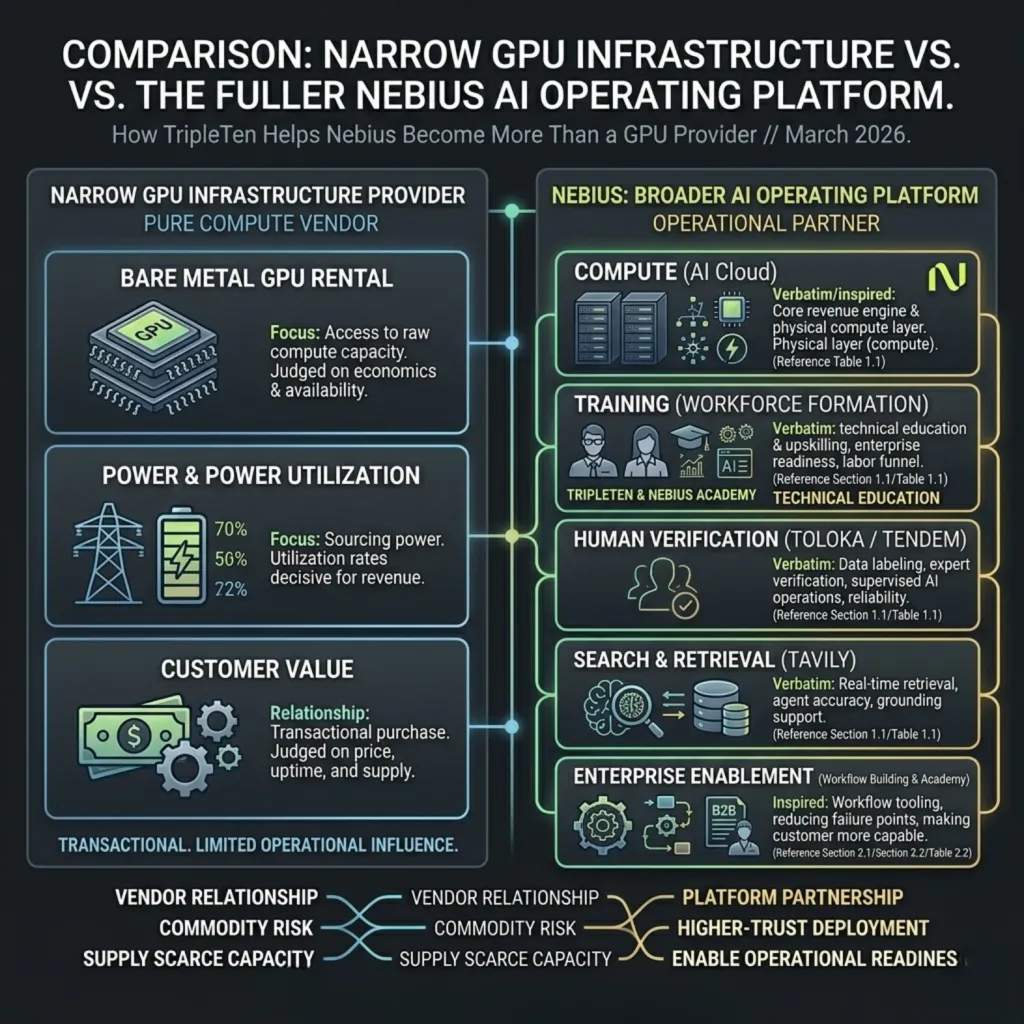
The deeper Nebius moves into being a strategic AI platform provider, the more valuable it becomes to own assets that help customers build operational readiness around that infrastructure.
In a market defined by a race to deploy physical AI infrastructure, TripleTen gives Nebius exposure to the less visible side of the buildout: the formation of human capability around the machines. The GPUs may be the furnace. TripleTen helps produce some of the metalworkers. Not all of them, and not at infinite scale, but enough to matter if the bottleneck shifts from access to compute toward the ability to use it well.
TripleTen indicators that support strategic relevance
Metric | Figure | Why it matters |
|---|---|---|
Alumni transitioned into new roles by March 2025 | 2,600+ | Shows real placement traction and employability outcomes |
Graduates with zero prior coding experience | 80% | Expands the addressable labor funnel beyond existing engineers |
Estimated ARR by end of 2025 | ~$41M | Establishes scale with room for further growth |
Full-year growth | 88% YoY | Signals strong momentum relative to many EdTech peers |
Q3 2024 bookings / enrollment growth | ~300% YoY | Suggests accelerated demand during platform expansion |
Approximate tuition cap | ~$9,700 | Supports accessibility and broader market reach |
Enterprise deal size for Academy motion | $100K+ | Points to credible B2B monetization and ecosystem fit |
The wider AI market is increasingly defined by two parallel races. One race is to energize enough compute. The other is to produce enough capable people around that compute. Nebius is visibly competing in the first race. TripleTen gives it a live position in the second.
Table of Contents
- Nebius, TripleTen, and the Human Layer of AI Infrastructure
1.1 TripleTen’s role inside the broader Nebius ecosystem
1.2 Why this asset matters in an AI market shaped by both compute and labor constraints - Nebius Group Context and Why TripleTen Exists Inside This Portfolio
2.1 Nebius as a neocloud and AI infrastructure company
2.2 The strategic logic of owning education, data, and application layer assets alongside cloud infrastructure - The Origins of TripleTen and the Post-Yandex Transition
3.1 From Yandex Practicum to TripleTen
3.2 Rebranding, restructuring, and the clean break from Russian operations - Leadership, Organization, and International Operating Structure
4.1 Executive leadership and educational direction
4.2 Regional structure across the U.S. and Latin America - TripleTen’s Product Model and AI-Ready Curriculum
5.1 The work-simulated learning platform
5.2 Dot and the integration of AI into the student experience
5.3 Core program tracks and the shift toward AI-ready workflows - Growth, Revenue Model, and Operating Metrics
6.1 Enrollment growth and revenue trajectory
6.2 Tuition structure, affordability, and payment flexibility
6.3 Placement outcomes and operating efficiency - Nebius Academy and the Enterprise Training Opportunity
7.1 The move from B2C education into B2B upskilling
7.2 Enterprise use cases and client examples
7.3 How Nebius Academy supports AI adoption inside organizations - Strategic Synergies Across the Nebius Ecosystem
8.1 TripleTen as a talent funnel for Toloka and Tendem
8.2 How training, data, and infrastructure reinforce one another
8.3 Why this helps Nebius become more than a GPU provider - Valuation, Market Positioning, and Strategic Optionality
9.1 How TripleTen compares with legacy EdTech peers
9.2 The range of possible valuation outcomes
9.3 Spin-off, IPO, or retained asset scenarios - Risks, Constraints, and What Could Go Wrong
10.1 Dependence on the tech hiring cycle
10.2 Execution risk at the parent company level
10.3 Regulatory and geopolitical overhangs - Why TripleTen May Matter More to Nebius Than It First Appears
11.1 The human bottleneck in AI deployment
11.2 Why TripleTen strengthens Nebius’s full-stack positioning
11.3 How this asset may improve customer stickiness and ecosystem depth - How TripleTen Changes the Shape of the Nebius Story
12.1 Why this business supports a capital-intensive infrastructure narrative
12.2 The importance of pairing compute capacity with trained operators and implementers
12.3 Where TripleTen fits in the long-term architecture of the Nebius platform - What TripleTen Could Mean for NBIS Shareholders
13.1 Why public markets may underappreciate small but strategic subsidiaries
13.2 How TripleTen could contribute disproportionate value relative to its current revenue base
13.3 What would need to happen for investors to fully recognize that value - What to Watch Going Forward
14.1 Signals that TripleTen is becoming more central to Nebius strategy
14.2 Indicators of stronger monetization through Nebius Academy and ecosystem integration
14.3 The milestones that could change the valuation conversation
2. Nebius Group Context and Why TripleTen Exists Inside This Portfolio
TripleTen makes more sense once Nebius is understood as a company solving for bottlenecks rather than a company selling a single product. The infrastructure business gets the attention, which is fair. It is the largest engine, the most visible engine, and the part of the story most easily mapped to revenue ramps, customer announcements, and power capacity. Still, Nebius is building toward something broader than leased compute. The portfolio increasingly suggests a company that wants exposure to the full chain of AI deployment, including the points where adoption usually slows down after the hardware is already in place.
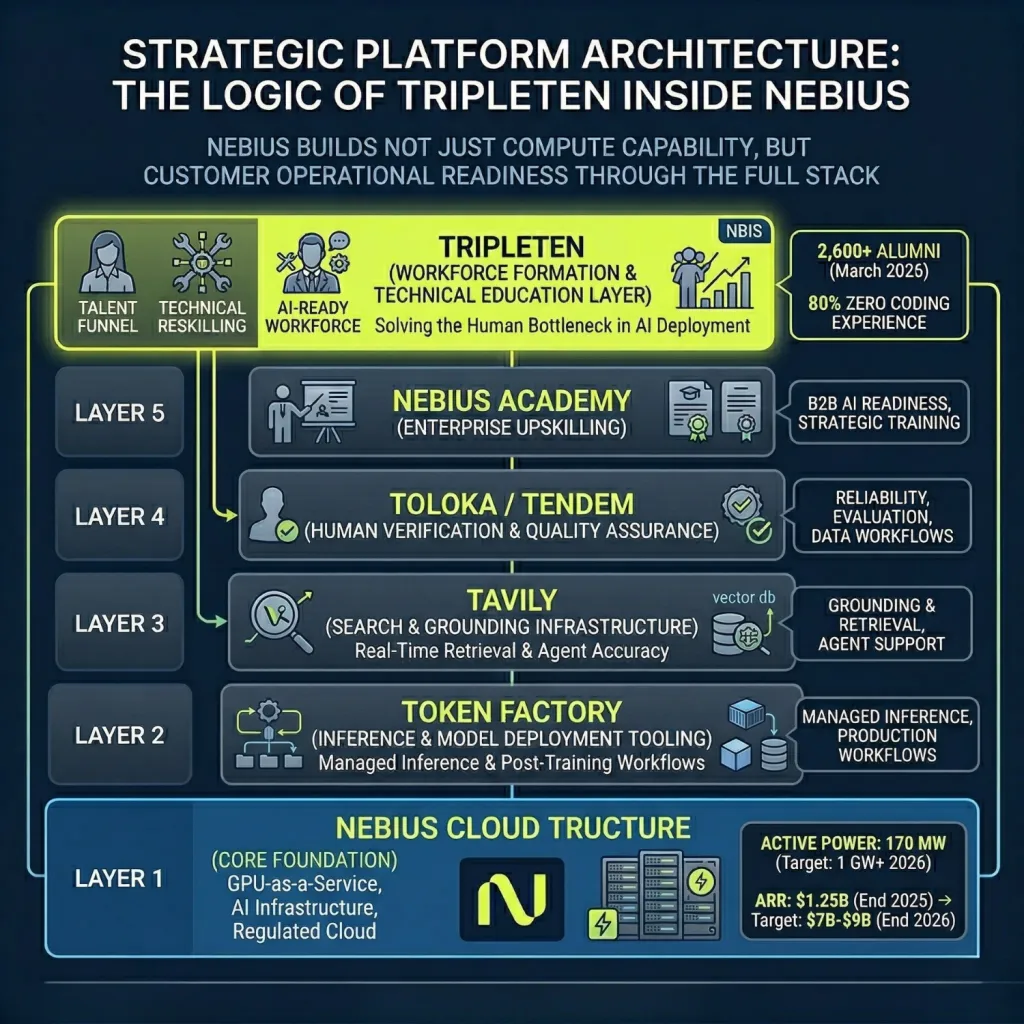
A narrow bare metal infrastructure company can win by supplying scarce capacity. A broader AI platform tries to do something harder. It tries to make the customer more capable after the infrastructure arrives. That requires more than servers and networking. It requires workflow tooling, retrieval systems, reliability layers, and trained people who can work around the stack. TripleTen belongs to that last category. It exists inside Nebius because the company is gradually organizing itself around the practical realities of AI deployment rather than the simpler story of compute scarcity alone.
There is also a portfolio logic at work. Businesses built around data center expansion are heavy, expensive, and operationally unforgiving. They require land, power, hardware, construction, cooling, and long planning cycles. By contrast, education software, enterprise training, and adjacent labor enablement can expand with a much lighter footprint.
That does not make them easy. It does make them structurally different. When a company combines hard infrastructure with lighter operating assets, it creates more ways to compound value around the same customer relationship. TripleTen helps Nebius do that. It widens the company’s relevance without asking it to build another physical campus every time it wants to deepen engagement.
Nebius as a neocloud and AI infrastructure company
The term neocloud only has value if it describes a real strategic difference. In Nebius, that difference comes down to specialization. Traditional hyperscalers are broad utility platforms. They are built to serve thousands of workloads across almost every category of enterprise IT. Nebius is being shaped around a narrower and more demanding problem set: AI training, inference, model deployment, and the production systems forming around those workloads.
That specialization changes what the company needs to own. A general cloud provider can stay relatively abstract. It can offer compute, storage, and tooling, then let the customer assemble the rest. Nebius is moving in the opposite direction. It is trying to reduce the number of pieces the customer needs to stitch together alone. That is why the portfolio has expanded upward from infrastructure into adjacent layers that make the system more usable.
The strategic logic of owning education, data, and application layer assets alongside cloud infrastructure
Owning adjacent businesses next to cloud infrastructure gives Nebius three advantages.
The first is problem coverage. AI adoption breaks in different places depending on the customer. One company lacks internal technical talent. Another lacks reliable data labeling and verification. Another struggles with retrieval, grounding, or agent supervision. Another wants to push AI into applied systems such as autonomy. Nebius now has assets that touch several of those weak points. That means it can meet the customer closer to the actual failure point rather than forcing every problem through a pure compute sale.
The second is relationship depth. Infrastructure alone can create a transactional relationship, even when the contract is large. The more a company becomes part of training, implementation, supervision, or workflow design, the harder it becomes to replace on a simple price comparison. This does not make the customer captive. It does create more connective tissue. TripleTen contributes to that by addressing a problem many enterprises discover late: buying AI infrastructure is faster than building an AI-capable organization around it.
The third is economic balance. Cloud infrastructure can scale into enormous revenue, though it does so with enormous demands on capital. Adjacent businesses such as education, reskilling, enterprise training, and software layers can grow on a different cost structure.
TripleTen fits especially well inside that framework. It gives Nebius a way to participate in workforce formation, enterprise readiness, and technical skill development, all of which sit closer to the human layer of AI adoption. Toloka and Tendem deal with judgment, evaluation, and reliability. Tavily deals with retrieval and grounding. Avride pushes into applied autonomy. TripleTen deals with a different constraint altogether: the shortage of people who can actually work inside these new systems once they arrive.
Why these adjacent assets belong next to cloud infrastructure
Asset type | Constraint addressed | Role inside the broader platform |
|---|---|---|
Technical education and upskilling | Weak enterprise readiness and AI labor shortages | Expands customer capability around AI adoption |
Human verification and data workflows | Reliability, evaluation, and edge-case judgment | Supports higher-trust deployment environments |
Search and grounding infrastructure | Real-time retrieval and agent accuracy | Improves usefulness of AI systems in production |
Applied application layer assets | Downstream deployment into real-world systems | Extends infrastructure value into operating use cases |
Seen this way, TripleTen is not a random appendage inside the Nebius portfolio. It is one answer to a real deployment constraint. Nebius appears to be building a portfolio where different subsidiaries absorb different forms of friction across the AI stack. The cloud handles compute. The surrounding assets handle some of the messier parts that begin after compute is secured. That architecture is more ambitious than a straightforward infrastructure rollup, and it is the main reason TripleTen belongs in the story at all.
3. The Origins of TripleTen and the Post-Yandex Transition
TripleTen did not begin as an isolated startup built to chase the coding bootcamp wave. Its roots sit inside the engineering culture of the old Yandex ecosystem, which matters for understanding both how the platform was built and why it looks different from many education peers.
Before it became TripleTen, it was Yandex Practicum, a product designed around a practical problem that large technology companies know well: strong technical talent is expensive, unevenly distributed, and rarely available in the exact form needed. The platform emerged as a way to train people through applied work rather than abstract instruction, with a structure meant to resemble actual technical tasks instead of passive course consumption.
That starting point gave the business a different DNA from much of the broader bootcamp market. Many EdTech platforms were built around content delivery. Practicum was built closer to a talent formation system. One model mainly sells lessons. The other tries to produce job-ready output. That helps explain why TripleTen later leaned so heavily into project-based learning, work simulation, externships, mentorship, and career transition support. Those elements were not bolted on later as marketing accessories. They were closer to the original operating logic.
The post-Yandex transition changed the platform’s context, though it did not erase that inheritance. In fact, the separation made the inherited strengths more visible. Once the business was removed from the shadow of the old Yandex structure, what remained was a technical training company with real product scaffolding, international ambition, and an operating model designed for skill conversion rather than content accumulation. The rebrand mattered, though the deeper continuity sat in the underlying approach.
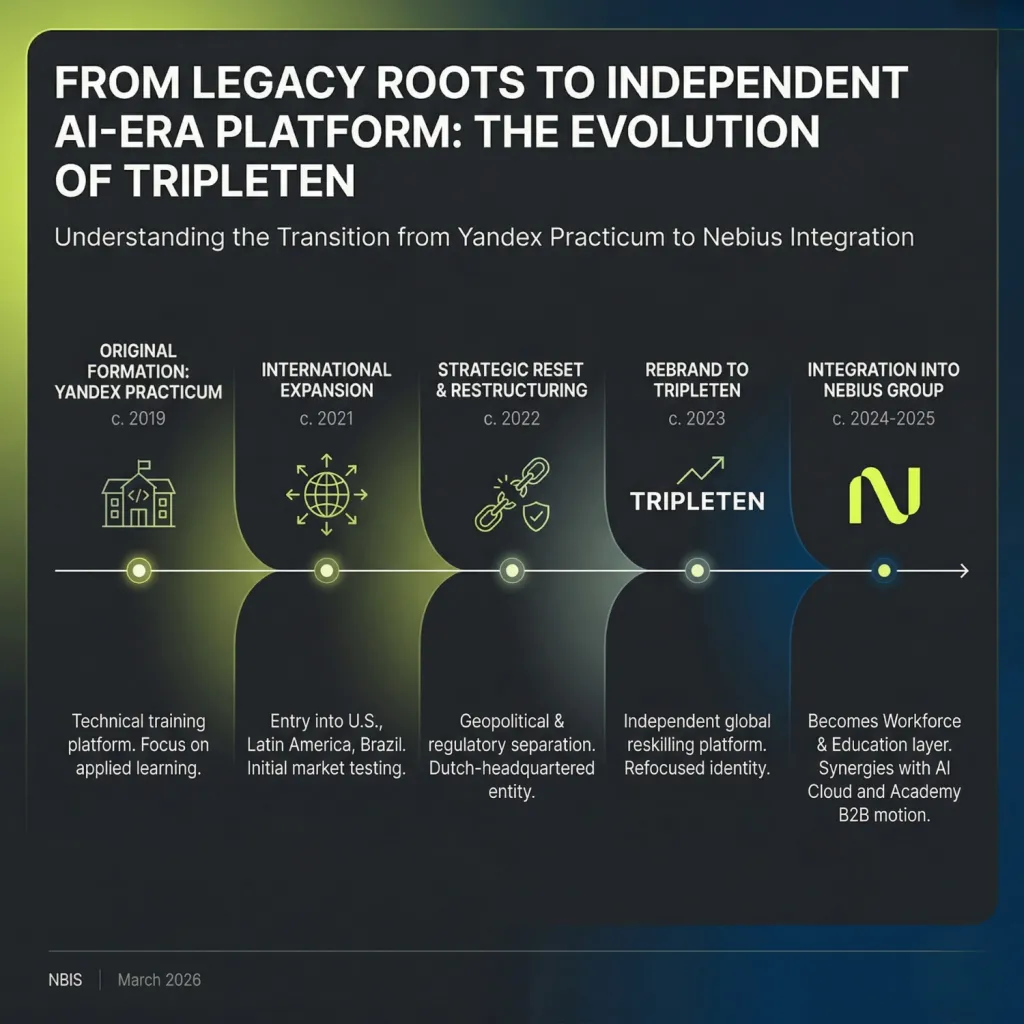
From Yandex Practicum to TripleTen
Yandex Practicum was conceived during a period when software development, analytics, and machine learning talent were already in structural shortage. The platform was developed inside a company known for strong engineering standards, which shaped both the curriculum philosophy and the product experience.
Technical education often breaks at the transfer point between knowledge and execution. People can understand concepts and still struggle when asked to apply them in live conditions. Practicum’s answer was to narrow that gap directly. The platform emphasized learning by doing, which sounds simple until you realize how much harder it is to build. A passive course can scale by publishing more content. A work-simulated platform has to create an environment that behaves enough like the real world to produce useful habits rather than temporary comprehension.
This foundation helps explain TripleTen’s later appeal to career switchers and non-traditional students. By March 2025, more than 2,600 alumni had reportedly transitioned into new roles, and about 80% of graduates entered with zero prior coding experience. Those outcomes point to a platform built less for polishing elite talent and more for converting raw potential into employable capability. That is a harder product to build and, if it works, a more strategically useful one.
The eventual program mix also reflects those origins. TripleTen did not stay confined to a single coding path. It expanded across software engineering, data analytics, machine learning, cybersecurity, QA, UX/UI design, and AI automation. That breadth makes more sense when viewed through the Practicum lens. The original goal was not only to teach syntax. It was to prepare people for participation in technical work. Once that is the mission, the curriculum can move with the labor market rather than staying anchored to a single discipline.
Rebranding, restructuring, and the clean break from Russian operations
The shift from Yandex Practicum to TripleTen was shaped by more than branding preferences. It was part of a wider corporate and geopolitical rupture that forced international assets associated with Yandex to separate from Russian operations after the invasion of Ukraine in 2022.
As sanctions risk, reputational risk, and regulatory scrutiny intensified, the old structure became increasingly unworkable for businesses that needed to operate freely in Western markets. A platform trying to grow in the United States, Latin America, and other international regions could not carry that baggage indefinitely and still expect trust from partners, employers, and customers.
The rebrand to TripleTen was therefore a strategic reset as much as a name change. It created distance from the Yandex label while preserving the technical infrastructure, educational product, and operating talent that had already been built.
In practical terms, this allowed the company to continue expanding internationally without forcing every prospective partner to solve the political question before they could even evaluate the business itself. For an education platform tied to career outcomes, that mattered enormously. Students do not enroll to become case studies in geopolitical ambiguity. They enroll to change their economic trajectory.
The organizational separation reinforced that reset. TripleTen emerged as a Dutch-headquartered entity with a distributed workforce that included substantial presence in the United States and Israel. That structure supported the broader effort to establish the business as part of the international asset base that would eventually sit under Nebius. Western hiring partners, enterprise clients, and local operators needed confidence that the business could function without the constant overhang of legacy Russian exposure.
This is where the phrase "clean break" becomes important, though it should be used carefully. No corporate restructuring fully deletes origin. History remains history. What the restructuring did accomplish was separation of control, jurisdiction, and future operating identity. That gave TripleTen room to present itself as a global reskilling platform rather than an international extension of a politically compromised brand. In effect, the company kept the engine and replaced the chassis around it.
That transition also helps explain why TripleTen now reads differently from many bootcamps built from scratch in the West. It combines inherited engineering discipline with a later-stage international repositioning. One side of the business came from a technically demanding product culture. The other side was forged under pressure, with the company forced to prove it could stand on its own in new markets and under new ownership logic. Businesses that survive that kind of passage often come out leaner and clearer about what they actually are.
Phase | Identity | Core characteristic | Strategic significance |
|---|---|---|---|
Original formation | Yandex Practicum | Internal and external technical training platform built around applied learning | Established product rigor and engineering-first curriculum design |
Expansion phase | International Practicum growth | Broader reach into the U.S. and Latin America | Tested the model outside its original market context |
Restructuring phase | Separation from legacy Yandex structure | Reorganization amid geopolitical and regulatory pressure | Enabled continued access to Western markets and partnerships |
Rebranded phase | TripleTen | Independent global reskilling platform under international structure | Preserved operating strengths while reducing legacy brand overhang |
The result is a company whose origins still matter, though in a more useful way than the market may assume. TripleTen inherited product rigor, technical seriousness, and a learning architecture shaped by real engineering needs. The restructuring then forced the business to prove it could survive outside its original institutional home. That combination explains much of what TripleTen is today: not a generic bootcamp with a new logo, but a rebuilt platform carrying older technical roots into a different geopolitical and commercial era.
4. Leadership, Organization, and International Operating Structure
TripleTen’s operating structure reflects the kind of business it is trying to be. This is not a loose content platform with a brand layered over outsourced instruction. It is a vocational system that has to coordinate curriculum, student support, mentorship, job outcomes, product design, and regional go-to-market execution at the same time. That requires leadership with both educational and operating discipline. In practice, TripleTen appears to have been built with that balance in mind.
The company’s leadership bench combines several different functions that matter for a reskilling platform. One group is responsible for commercial scale and market expansion. Another shapes pedagogy and curriculum quality. Another manages the scientific and technical backbone that keeps the platform from drifting into shallow credentialism.
In technical training businesses, growth can arrive faster than rigor. Once that happens, the brand begins to hollow out from the inside. TripleTen’s structure suggests an effort to avoid that trap by keeping educational direction tied to leaders with deep domain experience rather than treating curriculum as a marketing wrapper.
It also helps explain why the company has been able to stretch across multiple geographies without becoming incoherent. Education businesses often break when they expand internationally. The product becomes too centralized to adapt locally or too fragmented to preserve standards. TripleTen appears to be trying to hold the center while still giving regional leadership enough authority to respond to labor market differences. That is not glamorous work, though it is the kind of structure that determines whether a reskilling platform becomes durable or just briefly visible.
Executive leadership and educational direction
At the top of the business is CEO Ilya Zalessky, whose background spans more than 13 years in mobile services and more than 7 years in EdTech leadership. That combination is worth noting. TripleTen is not only an education company. It is also a product company. Students experience it through software, structured workflow, and repeated interaction with a digital environment that has to do more than deliver lessons. A leader with operating history in mobile and services is naturally better positioned to treat the platform as a live system rather than a static course catalog.
Supporting that commercial and product orientation is a more explicitly academic layer. Elise Deitrick, the company’s Chief Product Officer, has been associated with work around student self-efficacy in coding bootcamps, which fits the platform’s emphasis on accessibility for non-traditional entrants. That matters more than it sounds.
A large share of TripleTen’s value proposition rests on helping people with limited technical background move into employable roles. That challenge is partly curricular and partly psychological. It requires the platform to reduce drop-off, build confidence, and maintain forward momentum through difficult material. A product leader focused on those dynamics is central to whether the model holds.
The academic backbone runs deeper through Elena Bunina, Head of Science and Education, whose background includes more than 25 years of teaching data analysis and mathematics. That kind of technical leadership is one reason TripleTen reads differently from many bootcamps that lean heavily on branding, urgency, and short-cycle outcomes. A platform can promise career transformation in a few lines of copy. It still needs someone to ensure the learning path actually develops usable competence. Bunina’s role appears to anchor that side of the business.
The research also points to Rachel, the Chief Strategy Officer, who oversees strategic alliances and longer-term roadmap decisions. In a company operating across multiple regions and trying to expand its relevance from B2C reskilling into broader enterprise and ecosystem roles, that strategic layer becomes increasingly important. A training platform that sits inside a wider Nebius portfolio has more optionality than a standalone bootcamp, though it also has more ways to drift. Someone has to connect day-to-day execution with the longer arc of where the business is supposed to fit.
Leader | Role | Background from research | Strategic contribution |
|---|---|---|---|
Ilya Zalessky | CEO | 13+ years in mobile services, 7+ years in EdTech leadership | Oversees scale, product-market fit, and operational execution |
Elise Deitrick | Chief Product Officer | EdTech and student self-efficacy focus | Shapes learning experience, retention, and product design |
Elena Bunina | Head of Science & Education | 25+ years in math and data analysis education | Maintains technical rigor and academic structure |
Rachel | Chief Strategy Officer | Strategic planning and alliances | Guides expansion priorities and long-term business direction |
Taken together, the leadership structure suggests a company trying to balance three things at once: growth, educational credibility, and market relevance. That is harder than it looks. Many bootcamps can achieve one of those for a period. Few can hold all three without the seams showing. TripleTen’s leadership architecture appears designed to keep the platform from becoming either too academic to scale or too commercial to trust.
Regional structure across the U.S. and Latin America
The regional structure is just as important as the executive bench. TripleTen is not selling the same exact outcome in every market. The core product may be similar, though the surrounding labor conditions are not. Hiring pathways, employer demand, income levels, financing sensitivity, and student expectations vary materially between the United States, Latin America, and Brazil. A centralized structure with no local leadership would struggle to adapt to those differences. TripleTen’s organizational design seems to recognize that.
In the United States, Eugene Lebedev leads TripleTen USA. His background from the Practicum era in marketing and strategy lines up with the company’s challenge in that market. The U.S. is both the largest and most competitive arena for this kind of platform. It has deep demand for technical upskilling, though it also has a crowded education landscape, high customer acquisition costs, and a labor market that can swing quickly between scarcity and skepticism. A local leader in that context is not there to translate the website. He is there to help calibrate positioning, partnerships, and student-market fit in a far more contested environment.
In Latin America and Brazil, Natalia Moiola leads the regional effort. That matters for a different reason. The opportunity in Latin America is not simply a smaller version of the U.S. market. It is a structurally different market with different income profiles, growing technical hubs, and strong demand for upward mobility through digital work.
Cities like Mexico City and other regional tech centers can produce large pools of motivated learners, though affordability, financing design, and local employer pathways matter more acutely there. Regional leadership helps the platform adapt pricing, support systems, and go-to-market strategy without losing the broader operating framework.
TripleTen has a distributed team of about 200 professionals, primarily based in the United States, supporting curriculum development, career coaching, and operational functions. That scale is useful context. TripleTen is not running on a skeleton crew.
A business with roughly 200 professionals around the student and platform experience sits in an intermediate zone between startup improvisation and large institutional bureaucracy. Big enough to support specialization. Small enough that leadership choices still shape the operating culture directly.
Region | Leadership | Strategic function |
|---|---|---|
United States | Eugene Lebedev | Drives market positioning, student acquisition, and expansion in the most competitive bootcamp market |
Latin America and Brazil | Natalia Moiola | Adapts pricing, support, and growth strategy to local labor market conditions |
Distributed core team | Approximately 200 professionals, primarily U.S.-based | Supports curriculum, coaching, platform operations, and learner outcomes |
This international structure matters for Nebius as well. A company like TripleTen becomes more strategically useful when it can operate across several labor markets rather than drawing talent from only one. Workforce formation is rarely a local problem in AI. It is a cross-border one. Different regions offer different cost structures, learner funnels, and employer ecosystems. A platform with credible regional execution can act more like a network than a single school.
That may ultimately be the most important takeaway from the organizational design. TripleTen is being run less like a media-style education brand and more like an operating business with local nodes. The central leadership holds product standards and strategic direction. Regional leadership adapts execution to the realities of specific labor markets. For a company trying to convert technical education into real employment outcomes, that is probably the only structure that makes sense.
5. TripleTen’s Product Model and AI-Ready Curriculum
If the earlier sections explain why TripleTen exists inside Nebius, this section explains how the platform is actually built. That matters more than the category label. Plenty of education businesses can describe themselves as technical reskilling platforms. Far fewer can create an environment that consistently moves people from low familiarity to usable competence. TripleTen’s product appears designed around that harder task.
That distinction matters in 2026. The labor market is already saturated with generic information. Anyone can watch tutorials, read docs, and ask a model to explain syntax. The scarce thing is not exposure to knowledge. The scarce thing is structured development that helps people turn fragments into working capability. TripleTen’s product logic appears built around that gap. It is trying to function less like a library and more like a flight simulator. The point is not only to study the controls. The point is to spend enough time inside the cockpit that the motions become usable under pressure.
The work-simulated learning platform
The foundation of TripleTen’s model is a proprietary learning environment built around applied tasks. Instead of placing lectures at the center and projects at the edge, the platform appears to invert that structure. Students move through work-like assignments that require them to write code, manipulate data, test outputs, debug mistakes, and complete practical deliverables in a sequence that mirrors job preparation more closely than passive study.
That matters for a simple reason. Technical education often breaks at the transfer layer. People can understand a concept in isolation and still freeze when asked to do something with it. A work-simulated platform narrows that distance. It turns learning into a sequence of actions rather than a pile of explanations. That does not make the path easy. It makes the difficulty more honest.
TripleTen also seems to combine that product environment with a broader support architecture that includes mentors, tutors, code reviews, externships, and career coaching. Those features are expensive compared with a stripped-down content platform, though they are also more aligned with the actual problem the customer is trying to solve. Most students are not paying for knowledge in the abstract. They are paying to change their trajectory. A platform that wants to support that change has to do more than publish material and step aside.
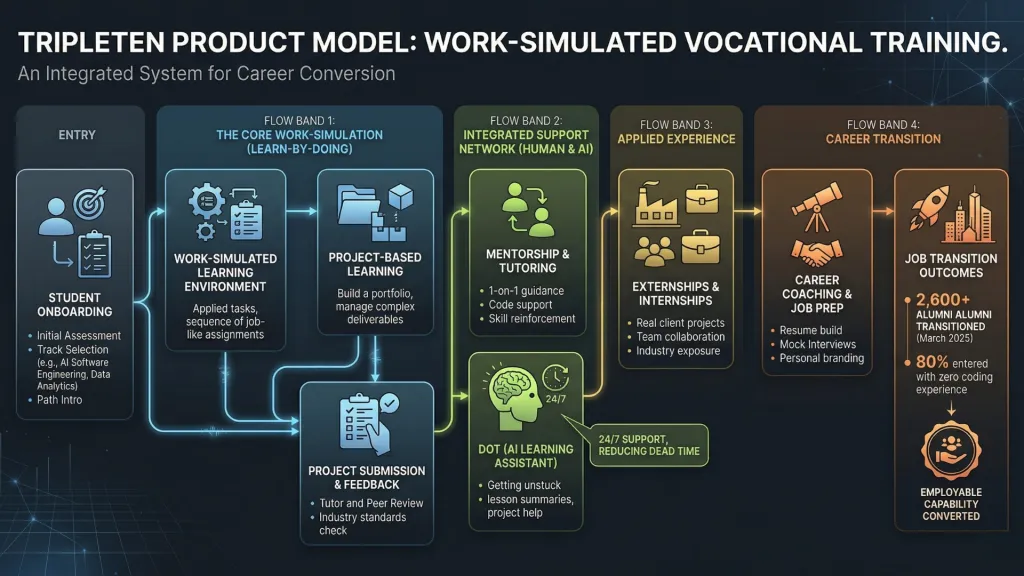
The numbers from the research help show the scale of this model. TripleTen reached an estimated 13,000 or more students by FY 2025 after reporting roughly 10,000 enrollments over the first 9 months of 2024, up from about 3,300 in the comparable earlier period. At the same time, bookings and student enrollments in Q3 2024 reportedly grew about 300% year over year. That kind of growth would be difficult to sustain if the platform were only a thin front-end brand with weak instructional scaffolding underneath it.
Dot and the integration of AI into the student experience
A major update to the platform came through Dot, TripleTen’s AI learning assistant, which was upgraded in 2025 and positioned as a 24/7 support layer for students. On the surface, that may sound like a standard feature for the current cycle. In practice, the usefulness depends on how the assistant is integrated into the learning flow. A generic chatbot inside an education product is mostly decoration. An embedded assistant that summarizes lessons, helps students get unstuck, supports project work, and reduces dead time between confusion and progress can materially change completion dynamics.
That is the more interesting role Dot seems to play. It helps TripleTen scale support without forcing every question through a fully human bottleneck. In a high-touch learning model, service intensity is both a strength and a constraint. Students benefit from responsiveness, though the platform cannot expand indefinitely if every moment of friction requires a staff member. Dot appears to function as a pressure-release valve inside that system. It catches routine issues, accelerates clarification, and keeps the learning rhythm moving, while human support remains available for higher-value intervention.
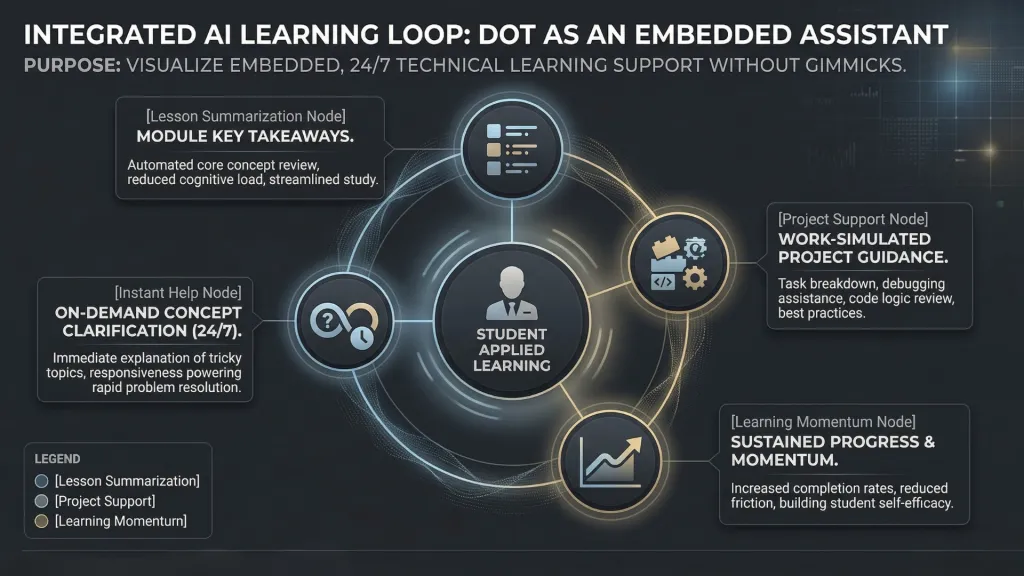
This is also where TripleTen becomes more aligned with the actual shape of AI-era work. The point is not only to teach students about AI as a topic. The platform is teaching them inside an environment where AI is already part of the process. That mirrors what is happening across technical roles more broadly. Engineers, analysts, designers, QA teams, and operations staff are increasingly expected to work with AI tools as companions, copilots, or acceleration layers inside normal workflows. TripleTen is effectively moving that adaptation upstream into education.
There is a second-order benefit here as well. Dot helps close the gap between accessibility and rigor. A platform serving large numbers of career switchers has to reduce unnecessary friction without reducing standards into mush. AI assistance can help if it is used to support movement rather than replace thinking. In that sense, Dot is less like an answer sheet and more like guardrails on a mountain road. The student still has to drive. The platform is simply making it less likely that every sharp turn becomes a crash.
TripleTen product and operating metrics
Metric | Figure | What it suggests |
|---|---|---|
Graduates with zero prior coding experience | 80% | Platform is designed for career switchers, not just pre-qualified technical users |
Alumni transitioned into new roles by March 2025 | 2,600+ | Indicates real conversion from training into employment outcomes |
Q3 2024 bookings and enrollment growth | ~300% YoY | Strong demand and scaling momentum |
Students enrolled, first 9 months of 2024 | ~10,000 | Shows increasing throughput through the platform |
Comparable earlier enrollment base | ~3,300 | Highlights the sharp expansion trajectory |
Estimated FY 2025 student count | 13,000+ | Suggests the model is reaching meaningful scale |
Dot assistant availability | 24/7 | Reduces support latency and increases platform responsiveness |
Core program tracks and the shift toward AI-ready workflows
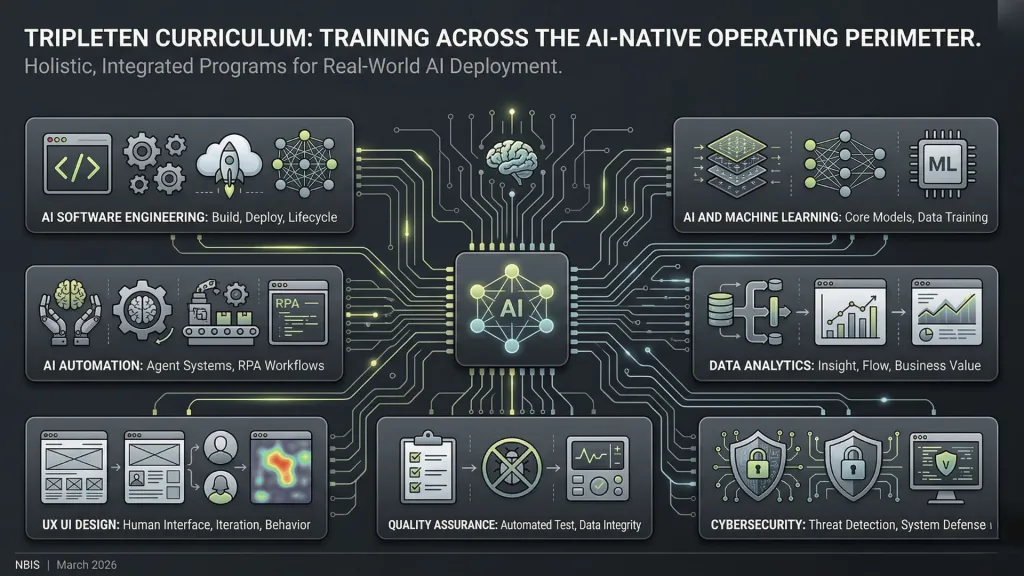
TripleTen’s curriculum footprint has widened in step with the labor market. The platform currently offers 7 primary tracks, each increasingly shaped by AI-native or AI-assisted workflows rather than older siloed job definitions. Those tracks include AI Software Engineering, AI & Machine Learning, Data Analytics, Cybersecurity, Quality Assurance, UX/UI Design, and AI Automation.
That mix is revealing. It shows that TripleTen is not only training for code-heavy developer roles. It is training across the operating perimeter of modern technical work. The inclusion of AI Software Engineering and AI & Machine Learning is expected. The inclusion of QA, design, cybersecurity, and analytics is equally important. AI is not changing one job family. It is changing the workflow surface across many job families at once.
The naming changes matter too. AI & Machine Learning was formerly Data Science, which reflects a broader shift in how employers are thinking about the work. The market is asking for people who can design, use, govern, and deploy model-assisted systems in business environments, not only people who can perform classical modeling in a vacuum.
AI Automation, launched as a standalone program in 2025, pushes even further in that direction by focusing on AI agents and robotic process automation workflows. That looks less like a traditional bootcamp track and more like a curriculum built for the next layer of enterprise demand.
Each of the program categories also appears to have been updated to reflect AI-assisted tooling inside the role itself:
Program track | Curriculum direction implied by research | Relevance to the 2026 labor market |
|---|---|---|
AI Software Engineering | Building applications with AI as a coding partner | Matches developer workflows that increasingly combine human and model output |
AI & Machine Learning | Designing, training, and deploying models | Targets the growing need for applied ML capability |
Data Analytics | Turning raw data into business insight with AI-assisted workflows | Expands analyst roles into AI-enhanced decision support |
Cybersecurity | Preparing for Security+ with AI-related cyber tools and risks | Reflects how AI is reshaping both defense and threat surfaces |
Quality Assurance | AI-powered testing automation | Aligns with faster software release cycles and automated testing environments |
UX/UI Design | AI-assisted prototyping and product design | Connects design roles to AI-enabled creation tools |
AI Automation | AI agents and RPA workflows | Directly targets emerging enterprise automation demand |
The result is a curriculum strategy aimed less at yesterday’s technical labor market and more at the one now forming. That matters for Nebius as well, even before getting into the deeper synthesis later in the piece. A company with exposure to AI infrastructure benefits from owning a training platform that is not simply producing generic junior developers. It benefits more from a platform producing workers who are already acclimated to AI-assisted environments, model-adjacent workflows, and cross-functional technical execution.
That is what makes the product model strategically interesting. TripleTen is not only teaching technical content. It is teaching people how to work in the kind of environment that AI deployment is creating. The labor market increasingly wants operators who can move with the tools rather than freeze in front of them. TripleTen’s curriculum appears built around that reality.
6. Growth, Revenue Model, and Operating Metrics
TripleTen becomes easier to place inside the Nebius portfolio once the operating profile is separated from the narrative label. The word bootcamp tends to flatten everything into one bucket, which hides the more relevant question: what kind of business is this actually becoming? The answer from the research is fairly clear. TripleTen is developing into a higher-growth, asset-light training platform with a widening student base, expanding revenue, and a business model designed to reach customers who are priced out of more traditional technical education paths.
That operating profile matters for two reasons. First, it gives Nebius exposure to a segment with very different economics from AI infrastructure. Cloud capacity requires land, power, hardware, cooling, and time. TripleTen grows through curriculum, sales, student support, financing access, and placement credibility. Second, it gives the platform a practical test of whether the product is solving a real market need. Enrollment growth, tuition design, and job outcomes are where the theory meets the ground. If students are not coming in, if they cannot afford the program, or if they do not convert into real roles, the strategic story breaks quickly.
The research suggests the opposite. TripleTen appears to be gaining traction across each of those dimensions at once. Enrollment accelerated sharply. Revenue and ARR expanded at a pace well above more mature EdTech peers. Pricing remained below much of the bootcamp market. Financing options widened the addressable pool. Placement outcomes remained meaningful even in a more difficult hiring environment. Taken together, the picture is less of a niche education brand and more of a vocational platform trying to industrialize technical career transition at scale.
Tuition structure, affordability, and payment flexibility
TripleTen’s pricing model is one of the more strategically important parts of the business. The platform’s tuition is capped at around $9,700, which places it well below many traditional bootcamps charging roughly $16,000 to $21,000. That gap materially changes who can enter the funnel.
A lower tuition point widens the market in several directions. It makes the platform easier to justify for career switchers who cannot absorb a large upfront educational gamble. It lowers the psychological barrier for students with uncertain confidence in their technical aptitude. It also makes the economics more workable in regions where purchasing power is lower or wage progression is more gradual. In practical terms, pricing is part of the product here. A reskilling platform cannot claim accessibility while charging like a luxury import.
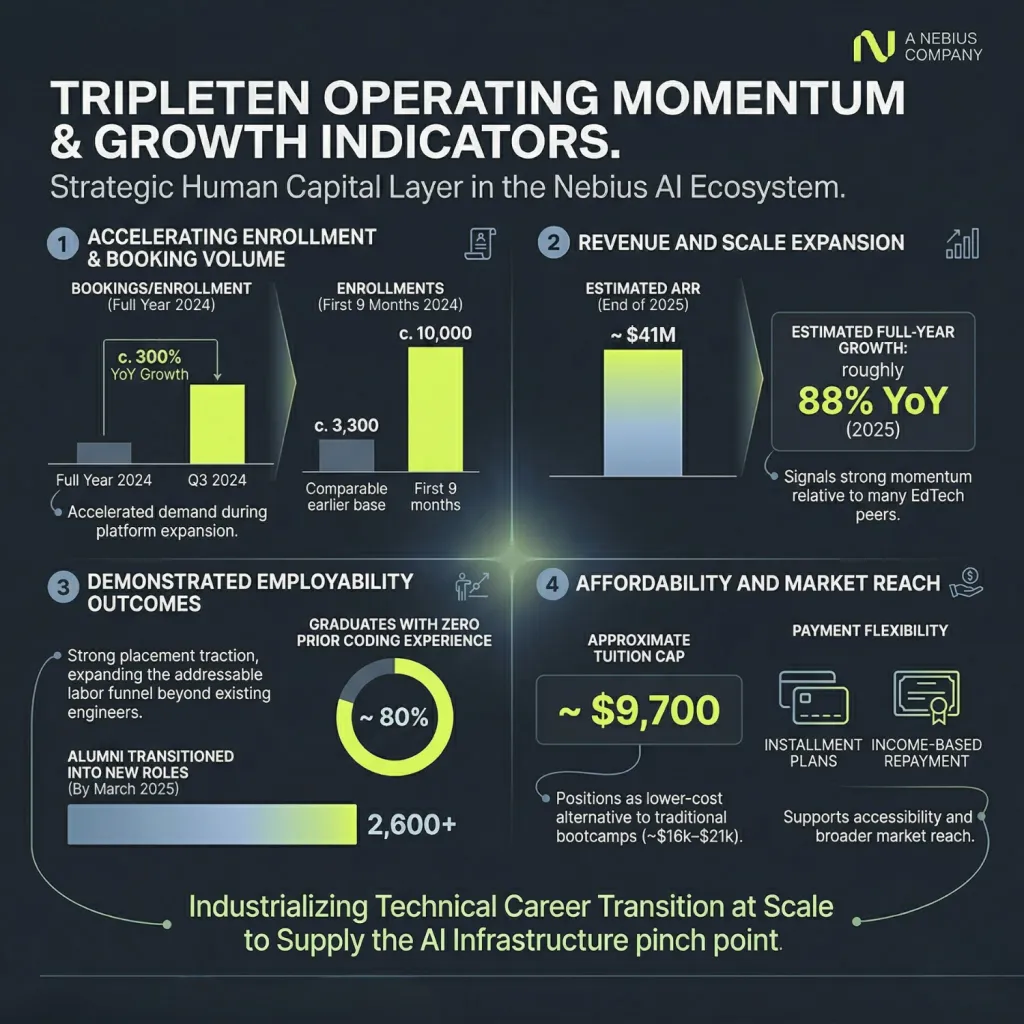
The payment structure reinforces that approach. TripleTen offers installment plans through Lumion and income-based repayment through Edly, giving students more than one way to finance the transition. That expands the addressable market further by reducing the need for immediate full-payment capacity. It also aligns the platform more closely with the economic reality of many learners, especially those coming from non-technical fields or entering from lower-income starting points.
This is where the business model gets more interesting than the average bootcamp template. Lower tuition could easily imply weaker monetization, though that does not have to be true if the platform can sustain acquisition efficiency and scale volume. The research suggests TripleTen’s customer acquisition costs are often fully covered by initial student payments, which would be a meaningful sign of efficiency if sustained. That means the platform may be able to recover acquisition spend early rather than waiting for long-tail economics to rescue the model later.
Pricing and access model
Component | Figure / structure from research | Strategic effect |
|---|---|---|
Tuition cap | ~$9,700 | Broadens affordability and widens top-of-funnel access |
Traditional bootcamp comparison | ~$16,000 to $21,000 | Positions TripleTen as a lower-cost alternative |
Installment financing | Lumion | Reduces upfront payment burden |
Income-based repayment | Edly | Makes enrollment more feasible for career switchers |
CAC coverage dynamic | Often covered by initial student payments | Suggests attractive acquisition efficiency if maintained |
In a category where many providers struggle to balance access, pricing power, and outcome quality, this structure gives TripleTen a useful position. It is not the prestige-priced option trying to screen for already advantaged students. It is built more like a volume-oriented conversion platform with outcome-driven economics. That matches the broader operating logic described earlier in the piece.
Placement outcomes and operating efficiency
Placement outcomes are the part of the model that matter most and age worst if they are weak. Marketing can hide a lot for a while. Job outcomes eventually drag everything back to reality. On that front, the research presents a business with meaningful, though not flawless, conversion performance.
By March 2025, more than 2,600 alumni had transitioned into new roles. Placement rates in the research range from 63% to 87%, with the more tempered framing landing around 63% within 10 months in a market-adjusted environment. That range is important. It suggests the company has experienced both stronger and more normalized outcome periods, which is what a grounded reader would expect in a labor market that has swung materially over the last few years.
The more useful interpretation is not that every student is guaranteed a clean path into tech. That would be brochure fiction. The useful interpretation is that TripleTen has still produced meaningful job transitions at scale even after the market became harder. A weaker labor market tends to expose fragile training businesses quickly. If placement remains credible during that phase, the signal is stronger than if the same outcomes were produced only during a hiring frenzy.
There is also an efficiency angle here. TripleTen appears to be built around a support-heavy model, though one increasingly aided by platform design and AI assistance. Dot reduces support latency. Structured learning environments reduce drift. Financing expands access. Career services and coaching help push students across the final gap into employability. Together, those features suggest a business trying to make the funnel work end to end rather than simply maximize enrollment and let the back half sort itself out.
Outcomes and efficiency indicators
Metric | Figure | Reading |
|---|---|---|
Alumni transitioned into new roles by March 2025 | 2,600+ | Demonstrates real labor market conversion at scale |
Placement rate range cited | 63% to 87% | Indicates meaningful but variable outcomes depending on market conditions |
Market-adjusted placement view | ~63% within 10 months | More conservative and likely more durable benchmark |
Prior coding experience among graduates | 80% entered with zero coding background | Suggests the platform is converting new entrants rather than merely refining existing talent |
Support model | Mentorship, coaching, externships, AI assistant | Points to an end-to-end operating model rather than content-only delivery |
The operating picture that emerges is fairly coherent. TripleTen appears to be growing quickly, monetizing through relatively accessible pricing, and still producing enough outcome evidence to support the expansion. That does not remove risk. Placement sensitivity remains tied to the broader tech hiring cycle, and fast growth can stress quality if the system outscales its own support structure. Even so, the current profile is more substantial than the bootcamp label suggests.
Inside Nebius, that matters. A platform with real enrollment momentum, a $41M annualized revenue run rate, flexible payment infrastructure, and measurable placement traction offers something different from the rest of the portfolio. It brings a lighter, more human-centered business model into a group otherwise dominated by physical infrastructure and capital intensity. In a portfolio sense, TripleTen is not carrying the same weight as the cloud. It is carrying a different type of weight.
7. Nebius Academy and the Enterprise Training Opportunity
TripleTen becomes more strategically interesting once the business is viewed beyond consumer reskilling alone. The B2C engine matters. It builds the brand, widens the learner funnel, and proves that the curriculum can move people into technical work. The enterprise layer changes the ceiling. Nebius Academy is where TripleTen begins to shift from a student product into an organizational capability product, which is a very different category with a very different revenue profile.
Many companies have already moved past curiosity and into a more uncomfortable stage where leadership knows AI will alter workflows, though internal teams are still unevenly prepared to use it. Some firms have tools without process. Others have pilots without adoption. Others have executive interest without enough technical fluency in the middle of the organization to make the effort stick. Enterprise training exists to solve that gap. It helps translate AI from a boardroom priority into something teams can actually execute.
For Nebius, this opens a more layered commercial path. A company can enter the ecosystem through education, cloud, data workflows, or search infrastructure, then expand into adjacent services as needs become clearer. That is part of what makes Academy more than a side initiative. It is one of the few places where human capability formation can become directly monetized at the enterprise level rather than only through individual tuition.
The move from B2C education into B2B upskilling
The move from consumer training into enterprise training is not just a channel expansion. It changes what the product is being asked to do. In B2C, the platform is helping an individual cross a career threshold. In B2B, the platform is helping a company increase internal readiness, reduce friction around AI deployment, and upgrade the operating capacity of existing teams. The customer stops being one learner and becomes an organization with budget, workflow constraints, management layers, and measurable adoption goals.
That can be a better business if executed well. Enterprise customers typically buy in larger contract sizes, renew based on organizational utility rather than personal motivation, and can open the door to longer strategic relationships. The research indicates that Nebius Academy has targeted mid-market companies with roughly 500 to 5,000 employees, with senior account executives pursuing deal sizes of $100,000 or more. That is a meaningful jump from consumer tuition economics. One enterprise deal can equal the revenue of a large block of individual enrollments.
It also changes the kind of value the platform provides. A consumer-facing program sells career progression. An enterprise program sells internal capability. That can include AI literacy for managers, technical skill development for engineering teams, structured training around model deployment, or guided learning for functions trying to adapt to AI-assisted workflows. The platform is no longer only producing talent for the market. It is helping companies upgrade the talent they already have.
This is one reason Nebius Academy fits naturally inside the broader Nebius portfolio. The cloud business may be selling access to infrastructure. The Academy helps ensure that the customer has people capable of using that infrastructure well. In a market where adoption often lags behind enthusiasm, that linkage can become commercially valuable.
Enterprise use cases and client examples
The research points to several client examples that help clarify how Nebius Academy is being used in practice. These examples are useful not only as logos on a slide but as signals of what the product is actually solving for.
Naranja X used an AI for Managers program aimed at strengthening decision-making and shaping an AI-ready internal culture. That suggests a use case above the purely technical layer. Many organizations do not fail at AI because the executive team lacks interest. They fail because management lacks enough fluency to allocate resources, evaluate tradeoffs, and govern new workflows with confidence. Training managers is often less glamorous than training engineers, though it can have a wider effect on the pace of adoption.
Exness appears to have used guided technical practice to upskill 2 key teams in AI capabilities with more personalized support. That points toward a use case where targeted technical groups, rather than the whole company, are being prepared for role-specific application. This is often how enterprise transformation actually happens. Not through one giant training wave, but through concentrated improvements in the teams closest to implementation.
GuruDev Capital used a 12-week machine learning immersion in which professionals deepened expertise in machine learning and large language models while beginning to build AI agents. That is a stronger example of the platform moving beyond introductory literacy into applied technical development. It shows the Academy can operate further up the skill curve when needed.
Slingshot AI used foundation LLM training focused on fine-tuning and inference for psychology-oriented language model use cases. That example matters for a different reason. It suggests the Academy can support domain-specific AI adoption rather than only generic AI awareness. Once training becomes tailored to an organization’s actual operating problem, the value proposition improves materially.
Nebius Academy enterprise examples
Client | Program referenced in research | Reported use case |
|---|---|---|
Naranja X | AI for Managers | Strengthened decision-making and helped shape an AI-ready culture |
Exness | Guided technical practice | Upskilled 2 teams in AI capabilities with personalized support |
GuruDev Capital | 12-week ML immersion | Deepened ML and LLM expertise and supported early AI agent building |
Slingshot AI | Foundation LLM training | Supported fine-tuning and inference for specialized model use cases |
These examples show that Academy is not limited to a single training shape. It can serve managerial education, team-level technical upskilling, deeper applied machine learning work, and domain-specific model development. That flexibility is important. Enterprise AI adoption rarely arrives in one standard format. Different customers enter from different points of maturity, and the training provider has to meet them where the friction actually sits.
How Nebius Academy supports AI adoption inside organizations
The deeper strategic importance of Nebius Academy lies in what it does for implementation. AI adoption inside organizations often fails in predictable ways. Leadership overestimates readiness. Teams underestimate workflow change. Technical groups build prototypes that do not survive contact with operations. Managers struggle to govern what they do not fully understand. In that environment, training is not ornamental. It is part of the conversion layer between technical possibility and organizational use.
Academy helps reduce that gap by creating a structured path for teams to become more competent around AI. That can take several forms. It can improve baseline literacy for managers so decisions become more grounded. It can upskill technical teams so deployment is less dependent on a handful of specialists. It can help organizations move from experimenting with models to building repeatable internal workflows. It can also support a cultural shift by giving teams a clearer shared language around what AI is actually useful for.
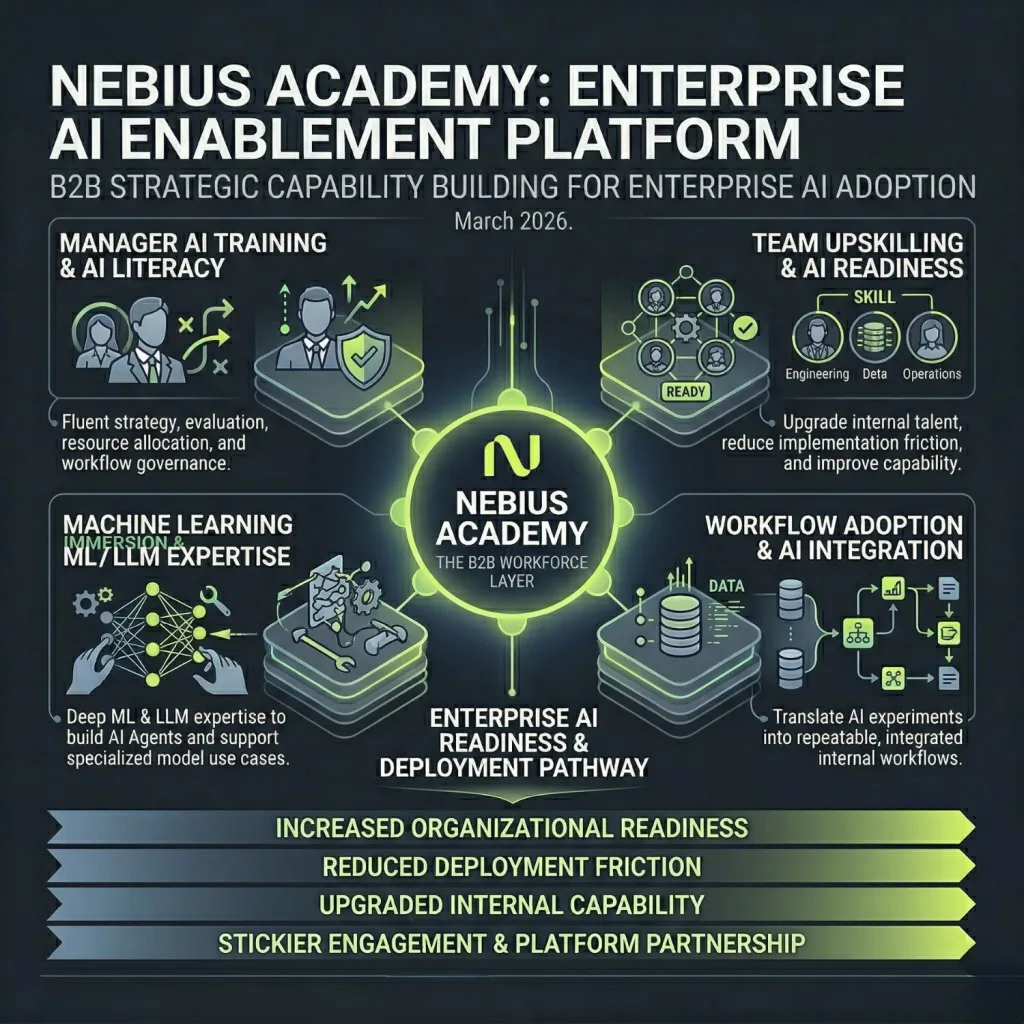
There is a commercial implication here as well. A cloud provider that only sells infrastructure risks becoming interchangeable over time, especially if raw compute becomes more abundant and customers begin comparing price and availability more aggressively. A provider that also helps customers build operational capability around that infrastructure has a stronger claim on the relationship. The value moves from access alone toward enablement. That tends to produce stickier engagement.
Nebius Academy therefore strengthens the portfolio in at least 3 ways.
First, it expands monetization beyond individual tuition into larger enterprise contracts.
Second, it creates a bridge between the educational layer and the infrastructure layer, helping Nebius participate in the labor side of AI deployment rather than only the machine side.
Third, it improves ecosystem coherence. The platform starts to look less like a group of separate assets and more like a system where infrastructure, training, and operational support reinforce one another.
Dimension | Why it matters |
|---|---|
Revenue mix | Adds a B2B path with larger contract sizes and different customer behavior than B2C tuition |
Customer readiness | Helps organizations build the skills needed to use AI systems more effectively |
Ecosystem fit | Creates a natural bridge between TripleTen, Nebius Cloud, and the broader deployment stack |
Relationship depth | Makes Nebius more useful to customers beyond infrastructure access alone |
Strategic positioning | Supports the shift from vendor relationship toward platform partnership |
A useful way to think about Academy is as the organizational counterpart to TripleTen’s consumer business. TripleTen helps individuals cross into technical work. Academy helps firms upgrade the teams they already have. One builds new entrants. The other retrains incumbents. Together they give Nebius exposure to both sides of the same labor problem.
That matters in an AI market where the shortage is no longer only chips, power, and capacity. The shortage increasingly includes people who know how to manage, build, supervise, and operationalize the tools once they arrive. Nebius Academy does not solve that problem on its own. It does give Nebius a live position inside it, and that position is worth more than a generic training label would suggest.
8. Strategic Synergies Across the Nebius Ecosystem
The real strategic case for TripleTen begins to sharpen once it is placed next to the rest of the Nebius portfolio rather than evaluated as a standalone education asset. On its own, TripleTen can be understood as a growing reskilling platform with solid economics and useful exposure to the AI labor market. Inside Nebius, it starts to do something more interesting. It becomes part of a broader system where different subsidiaries help solve different constraints across the AI stack.
A portfolio of unrelated assets is just a holding structure with better branding. A portfolio where the pieces strengthen one another can support better customer outcomes, deeper commercial relationships, and a more durable competitive position. Nebius appears to be aiming for the second category.
The cloud business supplies compute. Toloka and Tendem support judgment, verification, and human oversight. TripleTen helps produce and train some of the people who can operate in between those layers. The result is less like a bag of adjacent companies and more like a set of interlocking tools built around the problem of AI deployment.
That matters commercially as well. The more Nebius can connect infrastructure, human reliability, and workforce preparation, the less the company looks like a pure seller of raw capacity. Capacity is important and currently scarce, though scarcity alone is a fragile moat if the market eventually becomes more crowded. Synergies across the portfolio give Nebius more ways to stay useful after the GPU contract is signed.
TripleTen as a talent funnel for Toloka and Tendem
One of the clearest synergy paths in the research is the connection between TripleTen and the Toloka / Tendem side of the portfolio. Tendem is built around a hybrid model in which AI agents can escalate ambiguous or higher-stakes tasks to verified human experts. The logic is fairly simple. Software can handle a large portion of the workflow, though there are still moments where accuracy, judgment, or contextual interpretation require a person. Tendem turns that person into an integrated step inside the system rather than an external patch.
That is where TripleTen becomes a reskilling platform with rigorous project work, technical screening, and real-world externships can become a natural supply source for the kind of human talent Tendem needs. TripleTen graduates may not all flow directly into that network, though the overlap is real. The company is already training students in areas such as software engineering, analytics, machine learning, QA, and AI automation, all of which map well onto workflows where human review, data work, or supervised judgment still matter.
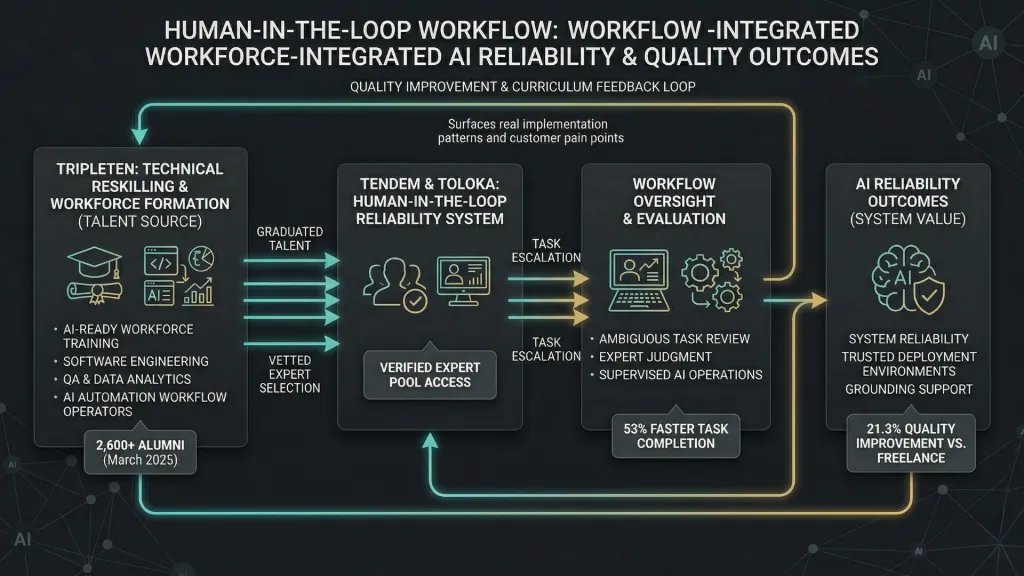
This helps Nebius in two ways. First, it improves quality control around the human layer. A verified expert network is more valuable when talent has been shaped by a known training process rather than gathered from a loose marketplace. Second, it creates a more closed-loop system inside the portfolio. TripleTen is not only educating people for the broader market. It can also help feed capability into a Nebius-owned reliability layer.
The research suggests Tendem’s architecture delivered 53% faster task completion and a 21.3% improvement in quality versus more traditional freelance or crowdsourced approaches. Whether those exact figures hold at larger scale is a later question. The structural point already holds. Human expertise is more valuable when it is organized, validated, and integrated directly into the workflow. TripleTen gives Nebius a more credible way to source part of that expertise.
How training, data, and infrastructure reinforce one another
The more interesting synergy is not any single handoff between subsidiaries. It is the way the layers can reinforce one another over time.
Infrastructure without trained operators can lead to underused capacity. Training without real market application can drift into theory. Human review networks without technical scaffolding can become messy and inconsistent. Nebius has pieces that can help address each of those weaknesses. TripleTen helps prepare people. Toloka and Tendem help structure human input and evaluation. Nebius Cloud provides the physical compute layer where AI systems are trained, deployed, and run.
That interaction can create a flywheel if executed well. A company enters through one part of the stack, then finds value in adjacent parts. An enterprise may begin with training through Nebius Academy, then later need infrastructure. Another may begin with infrastructure, then realize it lacks internal readiness and seek training support. A team building agents may need search, inference, and human verification. In each case, the surrounding assets make the core relationship more valuable.
This also improves product feedback. A training business exposed to real-world implementation challenges can surface where teams actually struggle. A human review layer can reveal where models still break in practice. A cloud platform can see which workloads are gaining traction. If those signals are shared across the portfolio, Nebius gets a better view of how enterprise AI adoption is happening on the ground rather than only how it is described in conference slides. That kind of internal visibility can be strategically useful. It gives the company more chances to build around real friction instead of imagined demand.
A simpler way to say it is that Nebius has pieces on three important sides of the same triangle. TripleTen addresses workforce formation. Toloka and Tendem address human reliability and judgment. Nebius Cloud addresses machine infrastructure. If those three points connect cleanly, the system becomes much more useful than any single point on its own.
TripleTen synergy paths across the Nebius stack
TripleTen function | Connected Nebius asset | Synergy created |
|---|---|---|
Technical reskilling | Toloka / Tendem | Creates a potential supply of trained experts for human-in-the-loop workflows |
Enterprise upskilling through Academy | Nebius AI Cloud | Helps customers build internal capability around AI infrastructure adoption |
Curriculum tied to AI workflows | Token Factory and broader deployment tooling | Prepares workers for environments shaped by inference, agents, and production AI systems |
Externships and project work | Broader product ecosystem | Can surface real implementation patterns and customer pain points |
Why this helps Nebius become more than a GPU provider
This is where the strategic importance becomes clearest. GPU providers can generate strong growth during periods of supply scarcity. The challenge comes later. Over time, customers begin to compare more aggressively on price, availability, service quality, compliance, and deployment support. The risk is that the provider becomes a landlord with expensive tenants and limited control over what happens inside the building.
Nebius appears to be trying to avoid that outcome. The company is building around compute, though it is also building above compute. TripleTen is part of that effort. It helps Nebius participate in the workforce side of AI deployment. Toloka and Tendem help it participate in the reliability side. Search and inference tools pull the company further into live production workflows. Taken together, these layers shift Nebius away from the narrow identity of a capacity vendor and closer to the role of an AI operating partner.
That shift matters for customer stickiness. A client renting GPUs can leave when another provider offers better economics. A client relying on infrastructure, training, workflow support, and human oversight is attached through more than one thread. That does not make churn impossible. It does make the relationship more embedded and the switching decision more complicated.
It also matters for how the market may eventually value the company. Pure infrastructure businesses are often judged on utilization, capex intensity, pricing, and contract visibility. Those metrics will remain central for Nebius. A company with credible workflow, training, and human reliability layers may also earn a different kind of strategic premium if investors come to view the business as a fuller AI platform rather than a narrower compute intermediary.
If Nebius only offered | Customer relationship would center on | With ecosystem synergies, the relationship expands toward |
|---|---|---|
Raw compute capacity | Access, pricing, uptime, and supply | Adoption, workflow integration, and operational capability |
GPU infrastructure | Hardware and deployment economics | Human readiness, reliability, and longer-term platform dependence |
Cloud resources alone | Transactional infrastructure purchase | Multi-layer operating relationship across people, systems, and workflows |
The key point is not that TripleTen transforms Nebius by itself. It does not. The cloud remains the core engine. The point is that TripleTen helps the rest of the system do more. It gives Nebius a position inside a different constraint, one that becomes more visible as the physical AI buildout matures. In that sense, TripleTen functions less like a side business and more like connective tissue. It links the machine layer to the human layer, which is often where enterprise AI efforts either begin to compound or quietly fall apart.
9. Valuation, Market Positioning, and Strategic Optionality
TripleTen is difficult to value cleanly, which is usually where the opportunity begins and the hand-waving begins right after. The problem is category fit. If the market treats TripleTen as a standard bootcamp or legacy EdTech platform, the business will screen as small, cyclical, and exposed to the hiring market. If the market treats it as a higher-growth AI-enablement asset sitting inside a broader infrastructure ecosystem, the framing changes materially. The revenue base is still modest, though the strategic role, growth rate, and optionality begin to matter more than the label on the box.
That tension sits at the center of the valuation debate. TripleTen reached an estimated $41M annualized revenue run rate by the end of 2025, with roughly 88% year-over-year growth. Q3 2024 bookings and enrollment growth were reported at about 300% year over year.
Those are not the operating metrics of a mature, low-growth education platform. At the same time, the business is still small enough that public markets could easily ignore it or force it into the wrong comparison set. That is why market positioning matters so much here. TripleTen is not large enough to force the narrative on its own. It still has to be interpreted.
Inside Nebius, that interpretation matters for a second reason. The group is now being valued primarily through AI cloud infrastructure, capacity deployment, contract scale, and long-term compute economics. TripleTen will not drive the Nebius equity story in the way the Meta agreement, the NVIDIA partnership, or the power ramp will. What it can do is create hidden value, strategic flexibility, and an additional route for monetization that does not require another data center or another billion dollars of capex. In a capital-hungry company, those things deserve more respect than they usually get.
How TripleTen compares with legacy EdTech peers
The easiest valuation mistake is to compare TripleTen only with legacy EdTech names and stop there. Those businesses are useful reference points, though they are not a perfect fit. Mature platforms such as Udemy and Coursera operate at much larger scale, broader category exposure, and different business maturity. They also carry the baggage of being widely recognized as EdTech, which tends to compress the imagination of the market. Once a company is placed in that bucket, investors begin to focus on slower growth, margin pressure, and susceptibility to AI disruption.
TripleTen’s research profile looks different. The company is smaller, growing faster, more vocationally concentrated, and more directly linked to AI-era workforce formation than legacy course platforms built around broad digital learning catalogs. It also sits inside a wider Nebius ecosystem that touches infrastructure, agent workflows, data operations, and enterprise AI adoption. That does not make TripleTen immune to the same pressures facing other education platforms. It does mean the comparison should be handled carefully.
Udemy was estimated around $790M in annual revenue with an approximately $1.8B valuation and a B2B mix near 48%, while Coursera was around $758M in revenue before the merger context referenced in the research. Chegg and 2U are generally described as challenged, with AI disruption and debt pressure undermining the older EdTech model. TripleTen, by contrast, is estimated at roughly $41M of revenue, though growing about 88% year over year and increasingly tied to enterprise upskilling and AI-readiness rather than broad course consumption.
That does not mean TripleTen deserves a software fantasy multiple on command. It does mean the older comp set can understate what kind of asset this is. A legacy education company often sells content access. TripleTen is trying to sell labor conversion, technical readiness, and increasingly enterprise AI capability. That is a different job to perform in the economy. It is closer to a vocational operating layer than to a passive learning marketplace.
EdTech peer comparison from the research
Company | Estimated annual revenue | Valuation | Observed market position |
|---|---|---|---|
TripleTen | ~$41M | $200M to $800M | High-growth technical reskilling platform with AI workforce relevance |
Udemy | ~$790M | ~$1.8B | Larger scaled platform with strong B2B presence |
Coursera | ~$758M | ~$1B | Broad online learning platform with weaker profitability profile |
Chegg | ~379M (Declining rapidly) | $50m | Pressured by AI disruption |
2U / edX | N/A | Private Transition Post Chapter 11 Filing | Burdened by weaker balance sheet dynamics |
The point is not that TripleTen should automatically be valued above these businesses on a revenue basis. The point is that it should not be lazily dropped into the same basket and called a day. It is smaller than the scaled incumbents, faster-growing than most of them, and more tightly linked to the AI labor transition that many legacy EdTech models are struggling to adapt to.
The range of possible valuation outcomes
From roughly $200M on the conservative end to as much as $800M on the bullish end. That range is large, though the reasons for the spread are understandable. TripleTen sits at the intersection of two valuation frameworks that produce very different answers.
The lower end reflects a plain-vanilla education framing. At approximately $41M of revenue, a $50M valuation implies about 5x revenue. That kind of multiple would assume the market views TripleTen as a small EdTech asset with cyclical hiring exposure, uncertain margin durability, and limited strategic premium. It is a defensible floor if sentiment is cold, if execution weakens, or if the company is valued by buyers who care more about traditional education economics than ecosystem relevance.
The upper end reflects a very different view. At $800M, TripleTen would trade closer to about 20x revenue. That kind of valuation only makes sense if the market is willing to treat the business as a high-growth AI-enablement platform with strategic value beyond direct tuition economics. In that framing, the business is being valued partly on growth, partly on enterprise optionality, and partly on the role it plays inside a broader AI stack where labor, readiness, and implementation remain scarce.
Most realistic outcomes probably sit between those poles. The midpoint implied by the research, around $500M, would place TripleTen at a little over 12x revenue on the current ~$41M run rate. That is still a meaningful valuation for an education-related business, though it is less aggressive than the bull case and more consistent with a company that has both strong growth and unresolved scaling questions.
TripleTen Valuation Ranges
Scenario | Implied valuation | Approximate revenue multiple on ~$41M ARR | What the market would likely be assuming |
|---|---|---|---|
Conservative | $200M | ~5x | Small EdTech asset with small premium and cyclical risk |
Midpoint | $500M | ~12x | High-growth platform with some strategic premium and optionality |
Bullish | $800M | ~19.5x | AI-enablement asset with strong enterprise relevance and ecosystem value |
Inside Nebius, even the midpoint case is meaningful. If Nebius is trading around a $29B market value, then a $500M TripleTen valuation would represent roughly 1.7% of that total. On one level, that sounds small. On another, that is precisely why it can be underappreciated. Assets that account for a low single-digit share of enterprise value often receive very little standalone attention, especially when the parent story is dominated by infrastructure deployment and contract headlines. The market usually notices them later, once a monetization event forces the issue.
There is also asymmetry in how that value is perceived. TripleTen does not need to become a dominant portion of Nebius to matter. It only needs to provide enough additional value, optionality, or strategic leverage that the group looks more resilient and more flexible than a pure infrastructure business. In that sense, the absolute number is only part of the story. The type of value matters too.
Spin-off, IPO, or retained asset scenarios
TripleTen’s optionality is where the valuation discussion becomes more strategic. Nebius is in a phase where capital allocation matters enormously. The company is scaling infrastructure aggressively, managing contract delivery against a very large future opportunity set, and operating in a part of the market where timing and funding can change the competitive map quickly. In that environment, non-core does not necessarily mean unimportant. It often means monetizable.
A retained-asset scenario is the default case. Under this outcome, Nebius keeps TripleTen inside the portfolio as a strategic support layer for workforce formation, enterprise training, and ecosystem breadth. That path makes sense if management believes the cross-portfolio synergies are worth more than a near-term liquidity event. It also preserves the ability to integrate TripleTen more closely with Nebius Academy, Tendem, and the broader enterprise enablement motion. The tradeoff is that public markets may continue to overlook the asset and assign it little explicit value.
An IPO scenario would change that. If TripleTen were taken public as a separate company, Nebius could crystallize value, reduce part of the conglomerate discount, and potentially raise non-dilutive capital for the parent through a partial sale. This as a plausible option, especially in a market where the backlog of private growth companies may eventually reopen the listing window. A public listing would force the market to value TripleTen on its own terms rather than as a footnote inside a much larger AI infrastructure story.
A spin-off scenario is different again. Under a distribution or spin-off, Nebius could place TripleTen shares directly into the hands of NBIS holders or otherwise separate the business structurally while preserving strategic relationships. That route could highlight the subsidiary’s value without necessarily optimizing for immediate cash proceeds. It would be a cleaner signal to shareholders, though less helpful if the parent’s primary objective is funding aggressive infrastructure expansion.
There is also a hybrid possibility where Nebius retains operational alignment while selling a minority stake through a private or public transaction. That could bring in capital, establish an external mark on the asset, and still preserve the strategic relationship. For a company with large capital needs, that kind of partial monetization can be more attractive than a full separation.
Strategic paths for TripleTen inside Nebius
Scenario | What happens | Main benefit to Nebius | Main tradeoff |
|---|---|---|---|
Retained asset | TripleTen remains fully inside the group | Preserves ecosystem synergy and strategic flexibility | Market may continue to underwrite little standalone value |
Partial IPO or minority sale | Nebius sells a minority stake while retaining control | Raises capital and establishes an external valuation mark | Less strategic freedom than full ownership |
Full IPO | TripleTen lists as a standalone company | Unlocks value and may reduce conglomerate discount | Public separation can weaken internal integration over time |
Spin-off / distribution | TripleTen is structurally separated for shareholders | Surfaces hidden value directly to NBIS holders | Generates less direct cash for Nebius infrastructure funding |
The most important point here is that TripleTen gives Nebius options. In a company with large infrastructure ambitions and high capital intensity, optionality itself has value. A retained asset can support ecosystem depth. A partially monetized asset can help fund growth. A standalone public asset can surface value the market previously ignored. Those paths are not equally likely, and they do not need to be. The presence of multiple plausible paths is already meaningful.
That is what makes TripleTen more interesting than its size would suggest. Small subsidiaries are often ignored until they become either a problem or a source of cash. TripleTen has a chance to become neither. It can remain strategically useful inside the group while also preserving a future route to monetization or value realization if Nebius ever needs to pull that lever. In a business this capital-hungry, that kind of flexibility is worth more than the headline revenue figure alone suggests.
10. Risks, Constraints, and What Could Go Wrong
The strategic case for TripleTen is real, though the risk case is just as necessary if the goal is to understand the asset rather than admire it. TripleTen sits in a part of the market where optimism can outrun operating reality very quickly. Reskilling businesses are exposed to labor market conditions, consumer confidence, financing availability, and outcome credibility all at once.
Inside Nebius, those risks are then layered on top of a parent company pursuing an unusually aggressive infrastructure expansion under ongoing geopolitical scrutiny. That combination creates a more complicated risk profile than the word education would normally imply.
The cleanest way to think about it is to separate the risks into 3 buckets. The first bucket sits inside TripleTen itself and revolves around hiring demand, placement rates, and the durability of student economics.
The second sits at the parent-company level and has more to do with Nebius’s ability to execute its broader buildout without creating stress that ripples across the portfolio.
The third sits outside both businesses and includes regulation, politics, and reputational overhang from the group’s origins. None of these risks automatically break the story. All of them can weaken the value of the asset if conditions move the wrong way.
This section matters for another reason. TripleTen is easy to like conceptually. It sounds balanced, human-centered, and strategically useful inside a portfolio otherwise dominated by heavy infrastructure. That makes it exactly the kind of asset people can start treating too gently. A useful hedge can still disappoint. A smart-looking portfolio component can still lose strategic relevance if the surrounding environment changes. The discipline here is to ask where the pressure points really are before later deciding how much credit the asset deserves.
Dependence on the tech hiring cycle
The most direct risk to TripleTen is the tech job market itself. A reskilling platform lives or dies by the relationship between training and employability. If companies are hiring, placement narratives strengthen, student confidence improves, and the tuition equation feels easier to justify. If hiring weakens, the entire model becomes harder to sustain. That is true even if the curriculum is solid. Timing still matters.
This is the core fragility of the category. TripleTen can train people well and still face weaker demand if employers pull back on junior hiring, compress team sizes, or rely more heavily on existing employees plus AI tools. That last point matters especially in this cycle.
AI is creating demand for new technical skills, though it is also changing how much entry-level labor companies think they need. A platform that helps produce AI-ready workers could benefit from the shift or find that the bottom rung of the ladder is becoming narrower at the same time.
Placement data already hints at that sensitivity. The research cites placement outcomes ranging from 63% to 87%, with the more tempered reading closer to 63% within 10 months in a market-adjusted setting. That range is not necessarily a red flag by itself. It does show that outcomes move with the environment.
If the labor market weakens meaningfully, the lower end of that range can become more relevant, and the business starts facing pressure from multiple angles at once. Prospective students become more cautious. Existing students may take longer to place. Marketing efficiency may weaken. Refund or guarantee structures become more expensive.
The other issue is signal decay. Reskilling platforms need outcomes strong enough to keep the next cohort believing the product is worth the cost and effort. Once that belief weakens, the funnel can deteriorate quickly. These businesses do not usually fail in dramatic fashion first. They fail quietly through weaker conversion, weaker retention, weaker placement, and eventually weaker trust. That is the slow leak risk in TripleTen.
Execution risk at the parent company level
TripleTen does not operate in isolation, and that is both part of the upside and part of the risk. Nebius is pursuing one of the most ambitious infrastructure expansions anywhere in the AI market. That creates strategic excitement, though it also raises the chance that management attention, capital allocation, and market perception are dominated by the core cloud business. In a company moving this fast, smaller subsidiaries can benefit from ecosystem relevance while still getting squeezed by the priorities of the main event.
That matters in several ways. First, if Nebius encounters delays, funding stress, customer concentration issues, or execution problems in the infrastructure buildout, the market may compress the valuation of the whole group regardless of how TripleTen is performing on its own. In that scenario, the subsidiary is not judged as a separate business. It gets pulled into the gravity of the parent. Strong student growth and a healthy B2B training motion would not fully offset a broader collapse in confidence around the Nebius platform.
Second, the parent’s capital needs can affect what happens to TripleTen directly. If Nebius remains well funded and in control, it can keep TripleTen as a strategic asset and allow the business to compound inside the ecosystem. If capital conditions tighten or the company decides it needs to simplify, TripleTen could face a sale, partial monetization, or strategic repositioning on terms that are driven more by parent-level necessity than by the subsidiary’s best long-term setup. An asset that looks strategically valuable in a stable environment can become a financing lever in a stressed one.
Third, integration itself carries risk. The case for TripleTen improves when it is connected to Academy, Toloka, Tendem, and the broader Nebius enablement stack. That only works if those linkages remain operationally meaningful rather than aspirational. A lot of corporate synergy stories sound terrific right up until the actual teams have to work together. If the internal handoffs are weak, if the enterprise motion never scales cleanly, or if the human-capital layer stays more adjacent than integrated, then some of the strategic premium attached to TripleTen starts to thin out.
A simple way to frame this is that TripleTen can be right on the merits and still be mismanaged in the context. Subsidiaries do not only succeed or fail based on their own product. They also succeed or fail based on how intelligently the parent uses them.
Regulatory and geopolitical overhangs
The third risk bucket is harder to model and easier to underestimate. TripleTen’s transition away from the Yandex identity and into the Nebius structure was designed to create a clean operational break from Russian exposure. That was strategically necessary and commercially useful. It also does not mean the issue disappears forever.
The overhang here is less about daily operations and more about trust, review, and perception. Education businesses depend on students, employers, enterprise partners, and sometimes regulators feeling comfortable that the platform is stable, legitimate, and free of unresolved political baggage.
TripleTen has clearly moved a long way in establishing itself as an international business with a new identity and structure. Even so, legacy perception can return as a source of friction if the broader political environment worsens or if regulators decide to look more closely at companies with any connection to that older institutional lineage.
This risk is especially important for a business operating in the United States and Latin America while sitting inside a public company with large strategic relevance to AI infrastructure. Once a group begins signing major contracts, working closely with global technology leaders, and participating in critical AI buildout, the threshold for scrutiny tends to rise. That does not mean TripleTen becomes the direct target of that scrutiny. It does mean the environment around the parent can become more sensitive, and subsidiaries inside the portfolio do not stand entirely outside that shadow.
There is also the more ordinary regulatory risk facing education businesses themselves. Training platforms can come under pressure over marketing language, outcome claims, financing practices, and refund or guarantee structures, especially if macro conditions worsen and students become less satisfied with placement timing. TripleTen may be better positioned than weaker peers if its outcomes remain credible, though the category as a whole is never far from regulatory or reputational review when labor markets soften.
Risk map for TripleTen inside Nebius
Risk area | What could go wrong | Why it matters |
|---|---|---|
Tech hiring cycle | Slower junior hiring, weaker placement rates, lower student confidence | Damages conversion economics and weakens the core value proposition |
AI-driven labor compression | Employers use AI to flatten entry-level demand | Reduces the size of the market TripleTen is helping students enter |
Parent-company execution | Nebius faces delays, funding pressure, or cloud execution issues | Subsidiary value can be overshadowed by parent-level stress |
Strategic reprioritization | TripleTen is sold, spun, or repositioned due to capital needs | Changes the asset’s trajectory for reasons unrelated to product quality |
Weak internal integration | Academy, Tendem, and cloud synergies do not scale meaningfully | Reduces the strategic premium attached to the business |
Geopolitical overhang | Legacy concerns resurface in key markets or under regulatory review | Can create friction with partners, customers, and public perception |
Education-sector scrutiny | Marketing claims, financing design, or placement narratives face pressure | Raises compliance and reputational risk in a cyclical category |
The broader point is straightforward. TripleTen is a useful asset, though it is not a risk-free one and definitely not some magical ballast that stabilizes the whole Nebius story. It is still tied to labor markets, still exposed to category skepticism, still dependent on execution, and still living inside a parent company making very large bets in a politically sensitive part of the technology stack.
That is part of what makes the asset interesting rather than obvious. TripleTen is not valuable because it is clean, simple, or invulnerable. It is valuable if it can keep growing and stay strategically useful despite those pressures. The next question is whether the market is giving it enough credit for that possibility, or still treating it as a side business that matters less than it probably does.
11. Why TripleTen May Matter More to Nebius Than It First Appears
Northwise Premium
Choose how to continue with Northwise
Join Northwise Premium
Unlock the rest of this report, its complete valuation, the downloadable model, portfolios, and action framework.
Join Northwise PremiumCreate a Free Account
Continue across Free Northwise research, follow companies, save reports, and receive updates.
Create a Free Account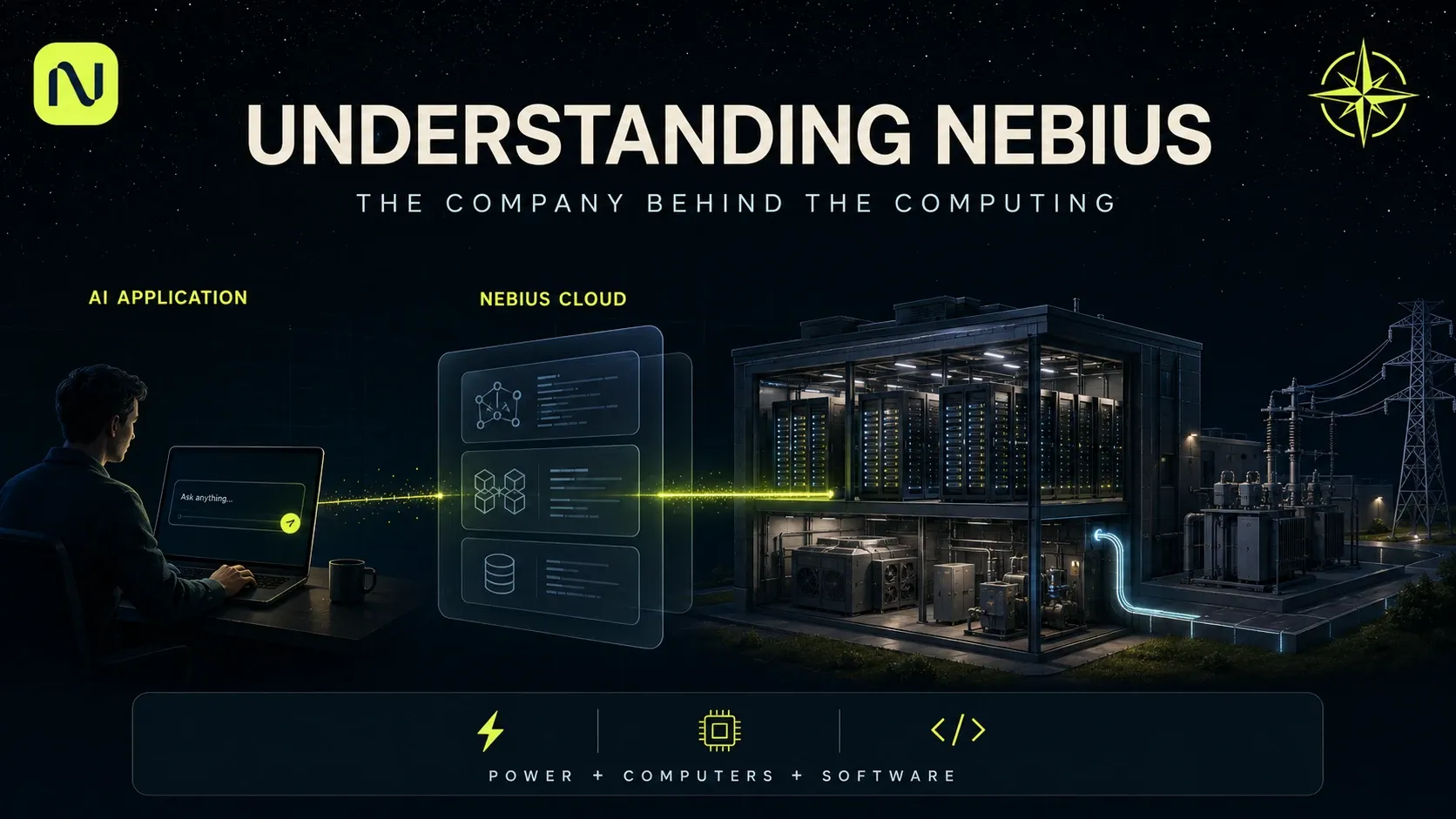
Understanding Nebius: A Complete Guide to the Company
Understand Nebius from the ground up: its AI cloud, competitors, subsidiaries, funding, and growth opportunities. A complete NBIS guide with 14 illustrations.
Nebius in Europe: Sovereign AI, UK Expansion and Harlow
How European AI sovereignty supports Nebius’s UK expansion, where Harlow fits, and what its potential 4.4 MW deployment could add to Q3 revenue and 2026 ARR.
NBIS Stock Forecast 2030: The Conversion Problem
A ground-up Nebius model rebuild after Q2 2026, covering AI factory economics, capital structure, valuation scenarios, and the NBIS stock forecast to 2030.
Northwise Portfolios
See how the research becomes real decisions
Reader discussion
Discuss the research
Premium access is required to join this report's discussion.
Join Northwise Premium
No comments yet. Start a thoughtful discussion.