Beyond Neocloud: A New Map of AI Infrastructure
Northwise proposes nine AI infrastructure categories, comparing Nebius, CoreWeave, IREN, GPU renters and hosts by software, financing and commoditization risk.
In this article
Northwise proposes nine categories for AI infrastructure and reserves “neocloud” for capacity-led businesses. The framework separates the value of scarce GPUs from the value of the software, operations and physical assets built around them, and it places Nebius well apart from the GPU renters it has been trading alongside.
Between the October 6 and November 6 closes, Nebius fell 48.2%. CoreWeave fell 49.4%, IREN 47.6% and Cipher 57.8%. Over the same stretch, QQQ lost 13.6%.
Those four companies sell different things. One runs a multi-region AI cloud with its own inference platform. One built a large contracted GPU deployment business. One is a power and data center developer partway through becoming a cloud, and one leases powered buildings to tenants who bring their own compute.
For much of the month, their shares moved like one trade.
The label running through the coverage was “neocloud.” Elon Musk warned of “guppy-level death and consolidation” across the group. A November 5 Motley Fool article described CoreWeave and Nebius as suppliers of “only raw GPU power.” Both companies already operate cloud software that customers run in production, and a raw-GPU description leaves that out entirely.
We think the vocabulary has fallen behind the businesses. Northwise is proposing a narrower definition of neocloud, along with eight surrounding categories that describe the rest of the AI cloud economy. A useful label should tell an investor what a company sells, which obligations it carries, and what is likely to stay valuable once equivalent compute becomes easier to buy.
We would reserve neocloud for businesses that procure GPU capacity and monetize access to it, where capacity delivery remains the principal customer proposition. Their economics run through procurement cost, utilization, realized rental rates, contract structure and the balance of GPU supply and demand.
None of this implies weak engineering. Building and operating a large cluster involves hard problems in networking, cooling, scheduling and failure recovery, and the best capacity providers solve them well. The line we are drawing concerns the scope of the customer relationship, and where durable economic value comes from once scarcity fades.
Current industry usage is broader. Microsoft and Cisco both define neocloud in ways that include software-rich AI clouds. Our concern is that one word now covers businesses whose long-term returns need different explanations, and the distinction gets lost when investors assess them as one group.
Others have started drawing lines too. VanEck’s November 4 analysis split the sector into powered-shell providers, GPU-rental providers and hyperscalers, a useful first cut. The Northwise framework goes further inside the provider bucket, separating software depth, operating geography, development stage and the question of who actually owns each economic obligation.
The selloff behind the label
The chronology shows how a financing concern at one company became a sector story.
On October 13, Musk responded “Yikes” to a chart of CoreWeave bond yields. By October 14, coverage was linking that credit stress to selling in Oracle, DigitalOcean, TeraWulf and Hut 8. The same day, Gartner forecast that more than 80% of neocloud providers would cease independent operations by 2030, citing cost pressure and insufficient differentiation. Loss of independence includes acquisition, so the forecast describes consolidation as much as failure, and its own reasoning puts differentiation at the center of who survives.
Musk widened his warning on October 25, predicting extensive failures and consolidation while allowing that some providers would survive. Reuters reported premarket declines the next morning across CoreWeave, Nebius, IREN, Applied Digital, TeraWulf and Core Scientific. Late October added Microsoft capex below consensus, with part of the shortfall tied to delayed third-party capacity, and a Wall Street Journal report on tightening credit that included a shelved Nebius high-yield offering. Nebius said asset-backed financing remained available.
On November 5, Bloomberg reported tighter Microsoft oversight of Nebius, IREN and Nscale projects over delivery and cost concerns. CNBC followed on November 6 with a report that Microsoft was reviewing its partner roster. Several November stories recirculated Musk’s October comments alongside fresh company news.
Whether a project arrives on schedule, whether an unsecured bond can be sold at an acceptable yield, and whether a company has lost access to capital altogether are three different problems with three different answers. The stocks fell together even though those problems require separate analysis.
The comparison below tracks Nebius, CoreWeave, IREN, Cipher, TeraWulf and KEEL as the six-company portfolio. DigitalOcean and the market benchmarks are separate comparisons.
Monthly and weekly adjusted-price returns
Company or benchmark | Proposed category or role | October 6 to November 6 | October 30 to November 6 |
|---|---|---|---|
Nebius, NBIS | AI-native Hyperscaler | -48.2% | -16.0% |
CoreWeave, CRWV | AI-native Hyperscaler | -49.4% | -15.4% |
IREN | Emerging AI-native Hyperscaler | -47.6% | -9.6% |
Cipher, CIFR | HPC Infrastructure and Hosting | -57.8% | -10.2% |
TeraWulf, WULF | HPC Infrastructure and Hosting | -24.0% | -3.1% |
KEEL | HPC Infrastructure and Hosting | -46.1% | -9.2% |
DigitalOcean, DOCN | GP Cloud Provider; separate comparison | -44.7% | -19.2% |
Six-company portfolio | Initial equal weights in each window | -45.5% | -10.6% |
QQQ | Nasdaq-100 ETF | -13.6% | -5.0% |
SPY | Broad US equity ETF | -5.6% | -2.7% |
NVIDIA, NVDA | AI hardware supplier | -22.0% | -8.8% |
Returns use adjusted closing prices. The portfolio starts each window equally weighted and is not rebalanced.
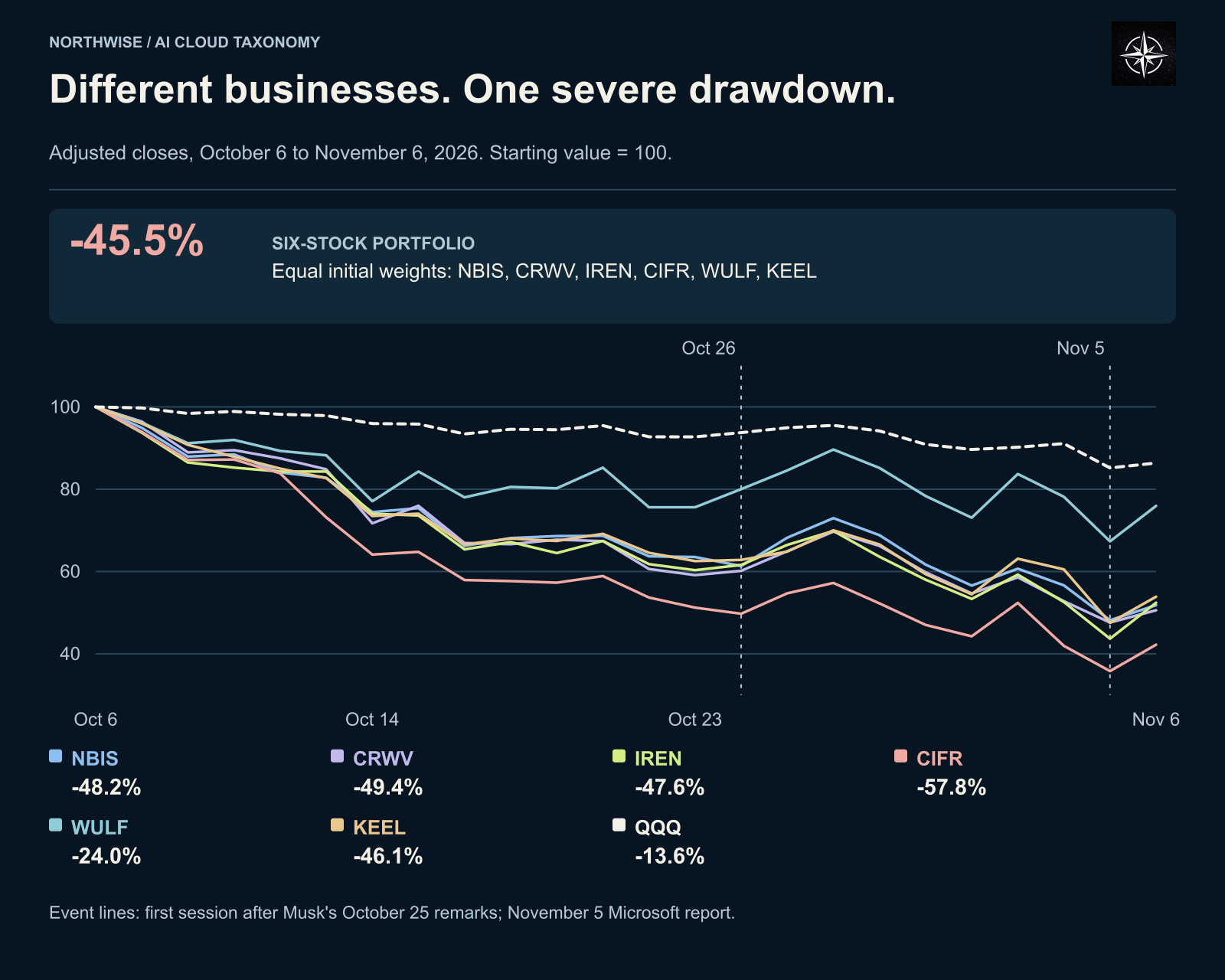
The headline explanation runs into a timing problem. By October 23, two days before Musk’s main warning, the six-company portfolio was already down 37.9%. On October 26, the session Reuters flagged for premarket declines, four of the six stocks closed higher and the equal-weighted group gained 0.6%. Musk’s comments belong in the account, though they cannot explain losses that came first.
The co-movement itself was extreme. Across the month’s 23 trading sessions, the average daily return correlation among the 15 stock pairs was 0.89, and Nebius and CoreWeave moved together at 0.92. Over a longer 120-session window the average was 0.75, and it held at 0.65 after removing each stock’s measured exposure to the S&P 500 and NVIDIA. Substantial shared movement remained after those two controls.
Observed and controlled daily-return correlations
Window ending November 6 | Average pair correlation | After SPY and NVIDIA controls | After QQQ and NVIDIA controls |
|---|---|---|---|
60 trading sessions | 0.81 | 0.71 | 0.67 |
120 trading sessions | 0.75 | 0.65 | 0.61 |
Correlations cover the 15 pairs among the six stocks. The 120-session window runs from May 19 through November 6. The adjusted figures remove each stock’s measured exposure to the two benchmarks using separate regressions.
Some differentiation survived. Over those 120 sessions, Nebius correlated with CoreWeave at 0.84 and with IREN at only 0.65, and Cipher with TeraWulf at 0.86, a pattern consistent with some differentiation between platforms and hosts despite the shared selloff.

The final week compressed everything. From the November 3 close to the November 5 close, the six-company portfolio lost 23.6%. On November 5 alone, Nebius fell 14.9%, IREN 17.0% and Cipher 14.6%, on a day when QQQ dropped 6.5%. All six rebounded on November 6, IREN by roughly 20%, despite another negative Microsoft headline.
The selloff unfolded alongside rate concerns, technology selling, customer concentration and financing pressure. The shared drawdown is clear; price data cannot assign each headline a share of it. Businesses with different products and obligations were falling together while coverage described them with one word.
Nine categories for the AI cloud economy
The categories describe what a business sells, how far its operations reach and how developed its platform is. A disciplined landlord can earn better returns than an ambitious cloud, and a focused inference provider can build an excellent business without ever becoming a hyperscaler.
Nine proposed categories for AI infrastructure
Northwise category | Technical and commercial boundary | Principal placements |
|---|---|---|
Hyperscalers | Established global, general-purpose cloud ecosystems with broad production services and substantial operating scale | AWS, Microsoft Azure, Google Cloud, Oracle OCI |
GP Cloud Providers | Broad general-purpose computing, storage, networking and application services at smaller scale or with a narrower regional/customer focus | DigitalOcean, OVHcloud, Scaleway, Vultr, Sakura |
AI-native Hyperscalers | An integrated AI infrastructure and software platform, operating across major world regions with demonstrated large-scale delivery | Nebius, CoreWeave |
Full-stack AI Clouds | Provider-controlled infrastructure integrated with a coherent production AI cloud; hyperscaler scale and maturity assessed separately | Lightning AI, Together AI, Crusoe Cloud; additional candidates assessed below |
Emerging AI-native Hyperscalers | A demonstrated transition toward that global integrated model, with material platform integration, adoption or geographic deployment still unfinished | IREN; Nscale's broader platform transition is a qualified candidate |
Neoclouds | Merchant or managed GPU capacity as the principal product, without an established broad integrated cloud relationship at the relevant business line | Fluidstack's capacity business; Nscale's infrastructure contracts; capacity-led businesses discussed below |
AI Software and Inference Specialists | Model execution, optimization, deployment and developer workflows as the principal product | Fireworks, Baseten, Modal, fal, DeepInfra, Hugging Face, Replicate within Cloudflare |
Compute Marketplaces | Discovery, matching, provisioning or distribution of capacity supplied by other operators | Vast.ai, Hydra Host/Brokkr, TensorDock within Lightning; Runpod's Community Cloud component |
HPC Infrastructure and Hosting | Power, land, buildings, fitted data halls and facility operation supplied to compute operators | WULF, CIFR, CORZ, Galaxy's Helios, APLD, HUT, RIOT, KEEL, with mixed businesses separated |
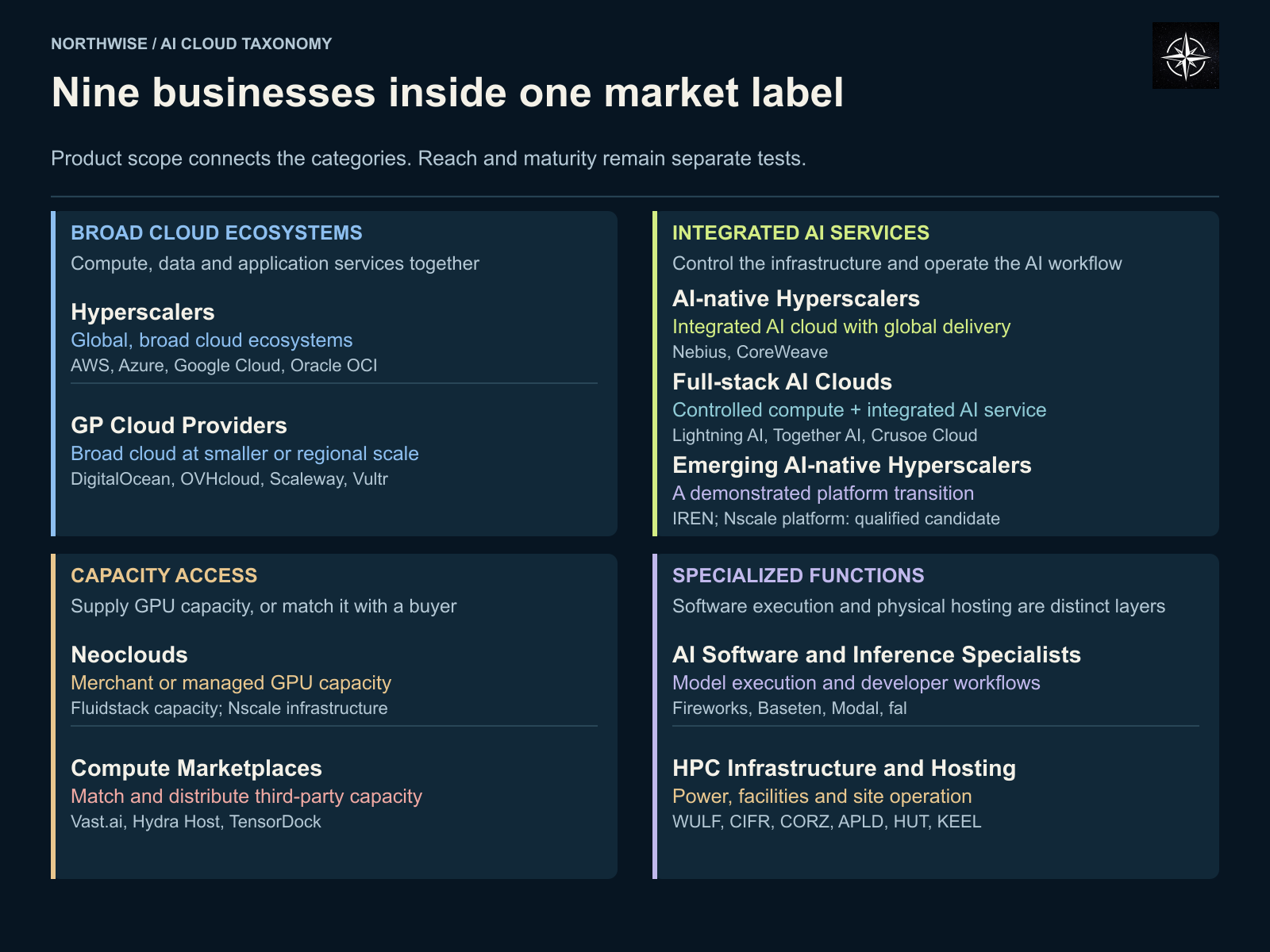
A single corporate group can occupy several rows. A dedicated Nebius deployment for one anchor customer carries capacity-contract economics, even though the parent operates an AI-native cloud. Crusoe’s cloud and its campus-development business belong in separate rows, and SpaceX touches at least four. We classify business lines first and assign the parent afterward.
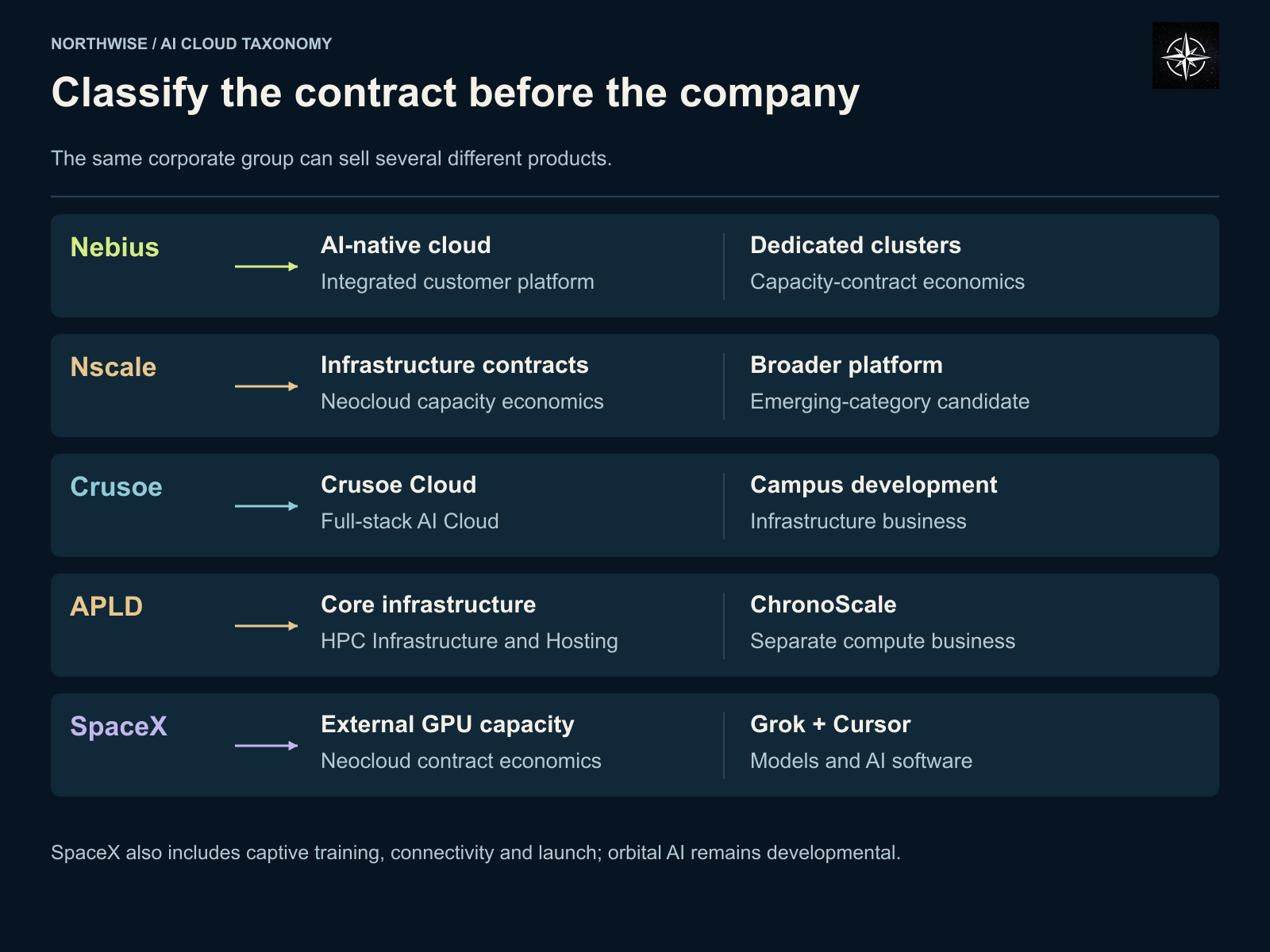
“Emerging” describes a development path. IREN is building toward a global, integrated cloud, with real assets and contracts behind the expansion. Lightning and Together already operate more developed customer platforms.
The technical cutoff
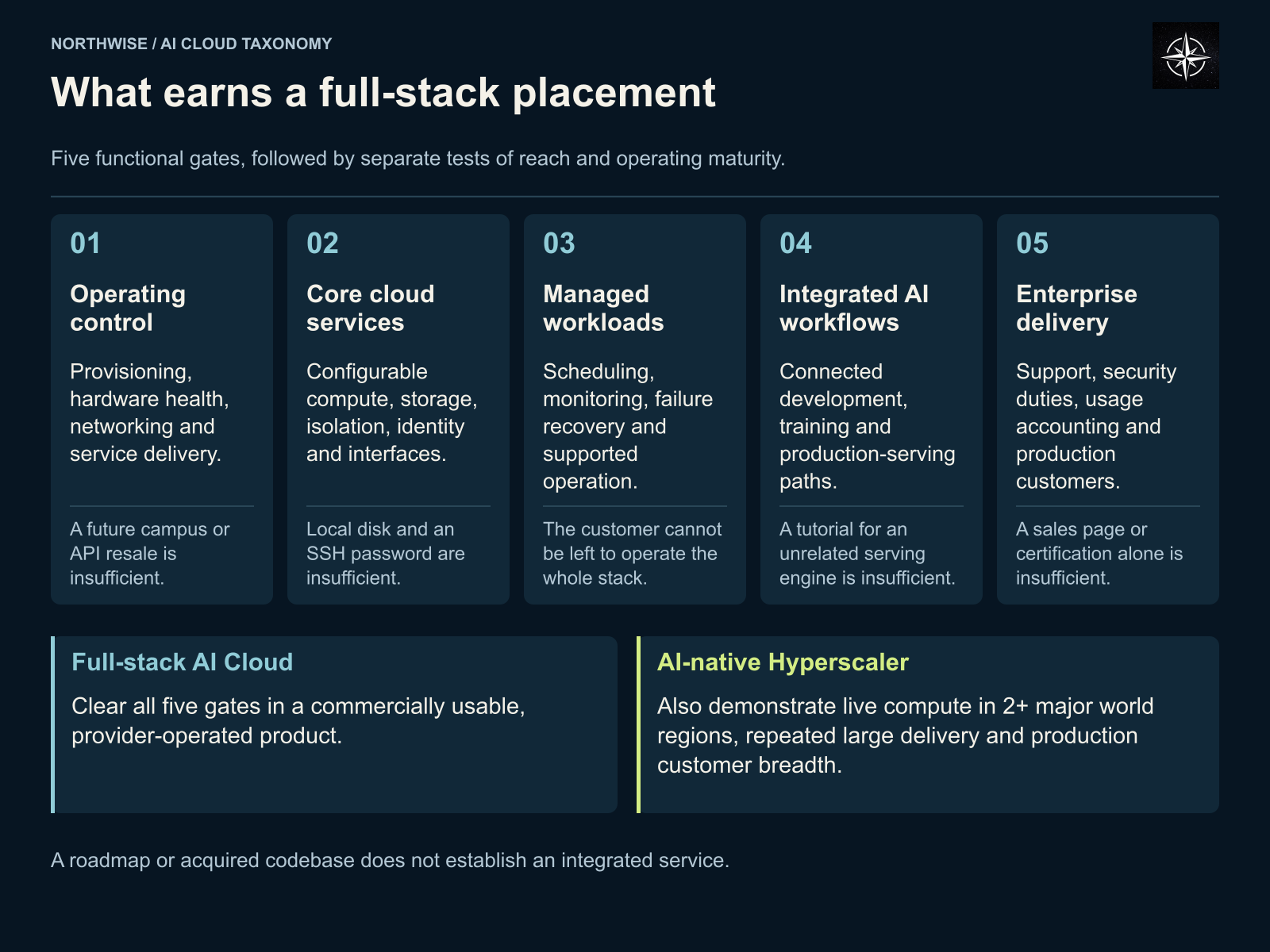
A category is only useful if another analyst can check the placement. We propose five functional gates, each of which must exist in a commercially usable product.
Five functional requirements for a full-stack AI cloud
Required capability | What qualifies | What does not establish it |
|---|---|---|
Operating control of compute | A provider-operated fleet or contractually controlled capacity, with responsibility for provisioning, hardware health, networking and service delivery | Reselling an API or advertising a future campus |
Core cloud services | Configurable compute, persistent storage, network isolation, identity and access controls, and supported provisioning interfaces | Local disk and an SSH password alone |
Managed workload operation | Scheduling or orchestration, monitoring, failure recovery and supported operation of customer workloads | A customer installing and maintaining the whole operating stack |
Integrated AI workflows | Supported development/training and production-serving paths connected through a coherent account, data and operations environment | A tutorial explaining how to install an unrelated serving engine |
Enterprise delivery | Documented support, security responsibilities, service commitments, usage accounting and evidence of production customers | Certifications or an enterprise sales page without an operating service |
Kubernetes, Slurm, open-source serving engines and third-party storage can all be components of a qualifying cloud when the provider integrates and operates them as an accountable service.
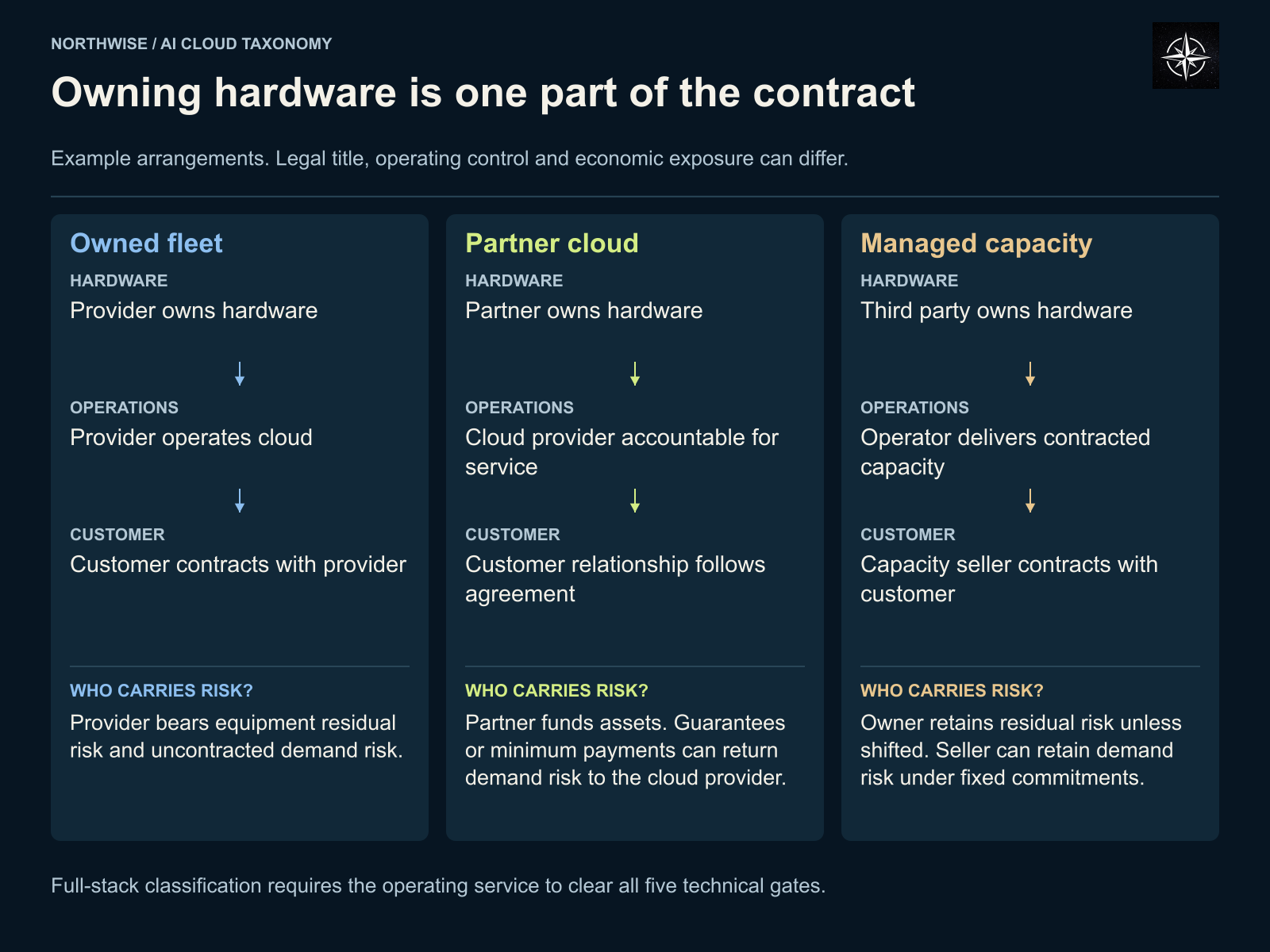
Hardware ownership needs the same precision. Legal title, operational control and economic exposure are three separate things. A provider can lease a building and operate its own GPUs, operate partner-owned hardware under a service agreement, or sell access while another party bears most of the hardware risk. Each arrangement can support a real cloud product, and each produces different capital needs.
AI-native Hyperscaler status adds reach and delivery history. Our proposed floor is live compute in at least two major world regions, across multiple operating sites, with disclosed service availability. Sales offices, network points of presence and planned campuses do not count. We also require repeated large deployments and production customers beyond a single captive relationship.
We deliberately avoid a single GPU-count or megawatt cutoff. A giant dedicated training installation can hold more equipment than a smaller cloud without offering anything resembling a cloud product. Delivered capacity, deployment history, customer breadth and operating maturity are assessed together.
Every company in the framework carries three separate assessments: what operates today, what earns revenue today, and what is being built next. Keeping them apart stops an acquisition from becoming instant platform maturity, and stops a large infrastructure contract from erasing software that customers actually use.
Hyperscalers and GP Cloud Providers
AWS, Azure, Google Cloud and Oracle place AI infrastructure inside broad ecosystems of databases, storage, identity, security and applications. Moving a workload off one of them can mean moving its data, permissions and connected applications, and the breadth gives AI deployments a route into existing enterprise budgets. Scale also has costs, and narrower competitors regularly win on deployment speed or engineering attention.
GP Cloud Providers keeps the general-purpose distinction without placing every broad cloud beside AWS. DigitalOcean, OVHcloud, Scaleway, Vultr and Sakura sell ordinary compute, storage, networking and application services alongside GPU products. Their defenses tend to be simplicity, developer distribution, regional presence and data residency, with purchasing scale and financing capacity as the usual constraints. Adding GPUs deepens an existing cloud relationship without changing the category.
Neoclouds and capacity economics
The narrower neocloud starts with a transaction: secure computing capacity, then sell access at an attractive return. Supply constraints create the opening. The operator may secure GPUs earlier, find available power, assemble a working cluster faster, or accept commitments a customer would prefer to keep off its own balance sheet.
Scarcity tends to migrate before it disappears. A particular GPU may become easy to buy, and power, interconnection, liquid-cooled space or experienced operating teams can stay tight.
The vulnerability appears when customers can obtain equivalent useful work from several suppliers and switching costs little. Competition then pushes returns toward the combined cost of hardware, power, facilities, financing and operations. A capacity provider needs a lasting cost or execution advantage, a protected contract, or a broader service relationship to hold its economics above that floor.
Within the category we see three subtypes. Merchant GPU providers carry the most utilization and repricing risk, and contracted capacity providers secure customer commitments before or alongside deployment. Managed capacity operators run infrastructure, sometimes on customer-owned equipment, and may earn a management fee without the residual-value exposure a merchant carries. The contract decides the risk.
Fluidstack is a strong managed-capacity example. Its Anthropic agreement involves custom data center delivery, and its SemiAnalysis ClusterMAX Gold rating reflects serious cluster engineering. We place its capacity-delivery business in neoclouds. A broader cloud classification would require an integrated customer service across all five gates.
Nscale is the harder case, and a good test of whether the framework is honest. Its September filing says infrastructure accounts for the vast majority of total contract value, much of it under multiyear take-or-pay agreements. Its documentation also shows identity controls, storage, private networking, managed Kubernetes and inference, so a no-software description would be wrong.
We split the company. Nscale’s contracted infrastructure fits neocloud capacity economics. Its broader platform is a qualified candidate for the emerging category, with more than 50,000 deployed GPUs across six data centers in five countries as of October. The next test is adoption of its unified customer product and integration of Anyscale if the planned transaction closes.
Lambda and TensorWave sit in managed capacity for now. Lambda’s managed Kubernetes, persistent storage and cluster operations are real, though its inference API is winding down. TensorWave pairs AMD infrastructure with managed Kubernetes, Slurm and observability, and needs broader identity and integrated-service evidence to clear the full gate set.
The same rule applies at the top of the market. Nebius and CoreWeave both hold dedicated-capacity contracts that carry neocloud economics. Their parent placements rest on the additional platform evidence around those contracts.
Full-stack AI Clouds
Lightning AI, Together AI and Crusoe Cloud show why “software company” and “GPU renter” are inadequate alternatives.
Lightning’s completed combination with Voltage Park brought a large owned hardware base into a developer platform: more than 36,000 GPUs across seven US sites, integrated at the level of physical networking, virtualization and fleet scheduling. A shared Drive connects its Studios, Jobs, Deployments and Pipelines. The opportunity is converting developer familiarity into paid, durable production usage, and operating the integrated fleet reliably enough to keep it.
Together operates its own infrastructure layer. Its GPU clusters include managed Kubernetes, optional Slurm and persistent shared volumes, with identity and project controls extending across clusters, endpoints, models and files. Its enterprise inference expansion with IBM shows another route, pairing a customer-facing platform with partner-supplied infrastructure, which widens supply and raises questions about margins, minimum commitments and service consistency.
Crusoe Cloud combines GPU and CPU infrastructure with identity, networking, storage, orchestration and managed inference. Managed inference reached general availability in November 2025 and object storage followed in April 2026, and the Base44 case study documents production adoption.
Crusoe also operates in both the US and Europe, which clears our geographic floor on its own. Our open question is the scale and maturity of its delivered customer cloud, assessed separately from campus development. Its large campus developments, including the 900 MW Abilene project for Microsoft, belong in the infrastructure analysis until capacity is delivered and the customer relationship is clear.
Two further names sit at the edge of this row. Verda connects GPU and CPU instances, clusters, persistent storage and serverless containers, with inference in preview and object storage in beta. Runpod is a mixed platform: its Community Cloud is a marketplace, and Secure Cloud and serverless are fuller cloud services carrying some beta labels.
Provisional placements and unresolved evidence
Company or business | Working placement | Reason and unresolved cutoff |
|---|---|---|
Lambda | Managed-capacity neocloud business; broader platform classification provisional | Managed Kubernetes, persistent storage and cluster operations are real. Its inference API is winding down, so an old endpoint catalog cannot establish a current integrated serving product. A supported managed-serving route could still meet the test without a token API. |
TensorWave | Managed-capacity business; provisional neocloud placement pending the complete functional test | AMD infrastructure plus managed Kubernetes, Slurm and observability provides meaningful software depth. Broader customer-account, identity and integrated service evidence needs to establish the complete gate set. |
Verda | Full-stack AI Cloud candidate | Its catalog connects GPU/CPU instances, clusters, persistent storage and serverless containers. Inference is explicitly preview and object storage beta; maturity should remain visible. |
Runpod | Mixed platform: Community Cloud marketplace; Secure Cloud and serverless are fuller cloud services | Pods, persistent storage, clusters and serving make a marketplace-only label inadequate. Enterprise organization features and some storage functions carry beta labels, requiring a product-specific assessment. |
Nebius and CoreWeave
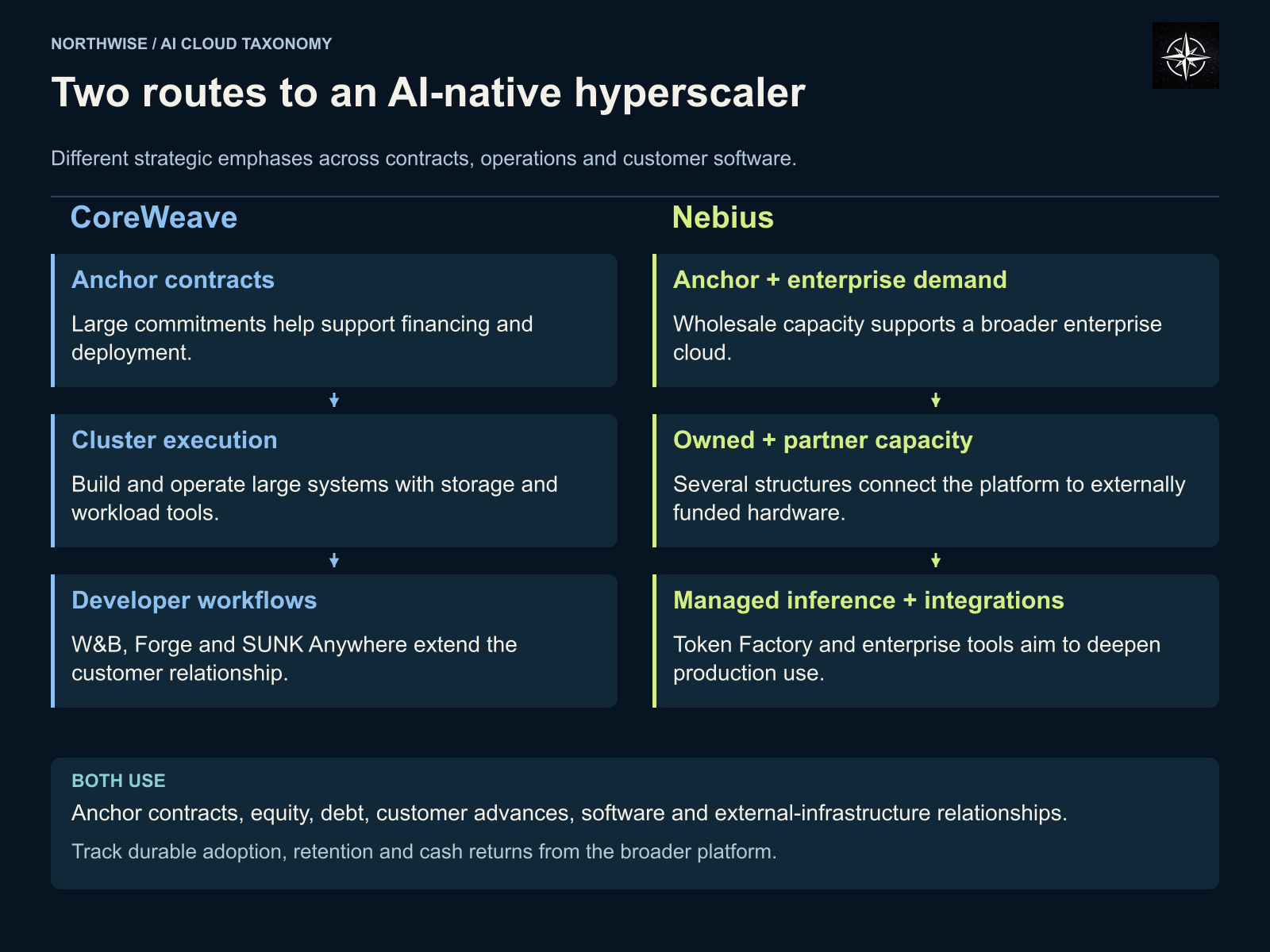
Nebius and CoreWeave both clear the integrated-platform test. Their software is operating, customers are using it, and their infrastructure reaches well beyond one domestic market. The useful comparison is how each turns those capabilities into a business.
Nebius and CoreWeave strategic comparison
Dimension | Nebius | CoreWeave |
|---|---|---|
Principal strategic emphasis | Integrated enterprise cloud and inference, supported by anchor capacity contracts | Large contracted deployments, combined with an expanding developer and model platform |
Software relationship | Core cloud, managed orchestration, Token Factory and enterprise integrations | CKS, SUNK, storage, W&B and Forge |
Route beyond owned hardware | Infrastructure partners own and fund assets under several commercial arrangements | SUNK Anywhere and developer tools extend across external infrastructure |
Funding approach | Equity, accreting convertibles, secured facilities, customer advances and potential portfolio options | Contract-supported facilities, corporate funding, convertibles, equity and customer advances |
Potential defense against capacity competition | Enterprise integration, efficient serving, operational quality and platform distribution | Cluster execution, developer workflows, performance and repeatable large-scale financing |
Central proof still needed | Material platform monetization and partner economics beyond headline capacity growth | Broader customer economics and software adoption alongside a concentrated contracted base |
Both companies have software, dedicated-capacity obligations, enterprise ambitions and several sources of capital.
CoreWeave’s founders, Michael Intrator and Brian Venturo, came from a natural-gas hedge fund, and Venturo spent years as the company’s chief technology officer. That financial background is consistent with the company's emphasis on structured capital. It says nothing about a lack of engineering depth.
CoreWeave’s expansion follows a recognizable sequence: win a customer commitment, finance the deployment against it, deliver the equipment, then operate the cluster. Its Q2 filing shows committed arrangements at 98% of revenue, with the three largest customers at 36%, 26% and 10%. Those figures describe purchasing structure and concentration, and say nothing on their own about how much of that revenue is bare-metal rental.
Nebius uses anchor contracts too. In March, management described Microsoft and Meta as buying basic infrastructure and running their own stacks, with their credit and contractual cash helping finance the broader multi-tenant cloud.
What customers get beyond GPUs
The Nebius service catalog spans GPU virtual machines, Kubernetes, Soperator-managed Slurm, several storage types, virtual networks, identity, secrets, MLflow and serverless AI services. Its region matrix lists nine public regions across six countries, with Iceland restricted to existing deployments and some observability functions still in preview. Our Nebius software stack analysis develops the customer-use case behind these services.
Adoption evidence goes beyond a catalog. Revolut uses Token Factory for financial-crime agents and for an orchestrator handling more than 1 million support tickets a month, and Nebius reported that Token Factory inference workloads more than tripled during Q2. Nebius has yet to disclose Token Factory’s revenue or absolute workload volume.
The integrations show how Nebius intends to win enterprise workloads. Its LangChain arrangement links Token Factory inference and Nebius-owned Tavily search with LangChain orchestration and LangSmith evaluation, giving a customer most of what a production agent needs. Palantir has named Nebius a preferred infrastructure partner, opening a route into enterprise and sovereign budgets once integration completes, and the Inferize acquisition adds cold-start optimization to the serving stack. Compatible interfaces lower adoption friction and also make leaving easier, so the economic test is operational performance.
The CoreWeave documentation is just as substantial. It covers CKS, networking, storage, identity, fleet observability, SUNK, inference and managed post-training, with enterprise controls that include federated identity, automated user provisioning, private networking and customer-key encryption for object storage. Forge, launched in September, connects development, evaluation, production monitoring and model improvement using Weights & Biases, OpenPipe and marimo, with Canva and MasterClass named as users and some components still in preview.
SUNK Anywhere is the closest analogue to the Nebius partner strategy. It extends CoreWeave’s Slurm operation across other clouds and customer infrastructure, letting CoreWeave keep a software relationship when the workload runs elsewhere. Its object storage, with local NVMe caching, addresses a practical and expensive problem: GPUs sitting idle while they wait for data. CoreWeave also reported nine European data centers across five geographies in October.
A software moat need not show up as a software invoice. Nebius lists managed Kubernetes and Soperator as free, charging for the underlying compute and storage. Software can protect compute demand or lower the cost of delivering it, and adding a separate software premium on top of revenue that already contains those benefits would count the same economics twice.
Who owns the assets and the customer
Our case for Nebius rests on the number of ways it can earn from a customer beyond GPU scarcity. Customers increasingly buy an operating environment from it: managed infrastructure, efficient inference, integrations, support and a route into enterprise workflows. When the hardware underneath changes generation, that environment carries over.
The infrastructure-partner model announced in July pushes the idea further. Partners finance and own facilities and hardware, and Nebius supplies architecture, hardware design, software, sales and service-level responsibility. Arrangements can involve licensing, commissions, revenue sharing or committed capacity. The structure separates owning the physical asset from owning the customer relationship, which can give Nebius a broader commercial role than earning a spread on rented capacity. The Nebius asset-light business model analysis examines the partner economics in detail.
If a regional owner can supply power and capital while Nebius supplies the cloud and the demand, Nebius can expand its platform with far less incremental balance sheet than a fully owned buildout. Its earnings would then draw on more sources than the spread on company-owned GPUs.
The model has conditions. A partner must earn an acceptable return after depreciation, financing and power, or it will sell capacity directly or choose another software layer. A committed-capacity arrangement with take-or-pay terms can leave Nebius paying even if demand disappoints. The launch announcement did not quantify deployed partner capacity or fee revenue, and the company as a whole remains heavily invested in owned and colocated infrastructure.
CoreWeave has its own case, built on large-scale execution, storage engineering and a growing developer relationship through SUNK, Weights & Biases and Forge. We see CoreWeave's contracted deployment engine as the more established part of its investment case, while our Nebius thesis places greater weight on future platform monetization.
The risks to this view are concrete. Nebius carries large dedicated-capacity commitments, heavy financing needs and real delivery risk, and Microsoft’s reported oversight of its projects has to be examined directly. The confirmation we are looking for is equally concrete: material enterprise and inference monetization, repeat customers, partner deployments that pay, and attractive returns after the cost of replacing hardware.
Financing the strategy
A frontier lab may reserve a huge cluster for five years. An enterprise may want a shorter commitment, and a developer may want capacity for an afternoon. A provider’s ability to finance each kind of promise decides which customers it can serve.
Both Nebius and CoreWeave use equity, convertibles, secured facilities and customer prepayments, so a story of “CoreWeave uses debt, Nebius uses creative financing” misses most of the overlap. The meaningful differences sit in collateral, recourse, maturity, amortization and customer credit.
Selected disclosed financing arrangements
Disclosed financing | Terms relevant to the comparison | What the headline leaves out |
|---|---|---|
$775 million; deployed GPUs and investment-grade customer cash flows; SOFR + 2.50%; October 2030 maturity | Financing an operating contracted asset differs from funding uncontracted construction | |
$3.5 billion capacity; initial Term SOFR + 2.75%, increasing under stated terms; 364-day maturity | A relatively low spread can coexist with near-term refinancing exposure | |
$8.5 billion capacity; March 2032 maturity; floating spread SOFR + 2.25%; parent recourse limited to specified bad acts | Facility-level credit quality does not describe every obligation of the parent | |
$2.6 billion capacity; September 2031 maturity; SOFR + 5.50%; full parent guarantee | Underlying customer terms average roughly three years; re-leasing economics and amortization must be examined | |
$5.75 billion gross closing: $3.45 billion at 0.50% due February 2030 and $2.30 billion at 4.50% due February 2034; redemption amounts accrete to 110% and 125%, respectively | Cash coupon understates financing economics; conversion and associated exchanges affect shares | |
$4.2 billion; 2.875% coupon; April 2033 maturity; capped calls cost $566.2 million | Gross principal overstates deployable proceeds; dilution protection has limits and a cash cost |
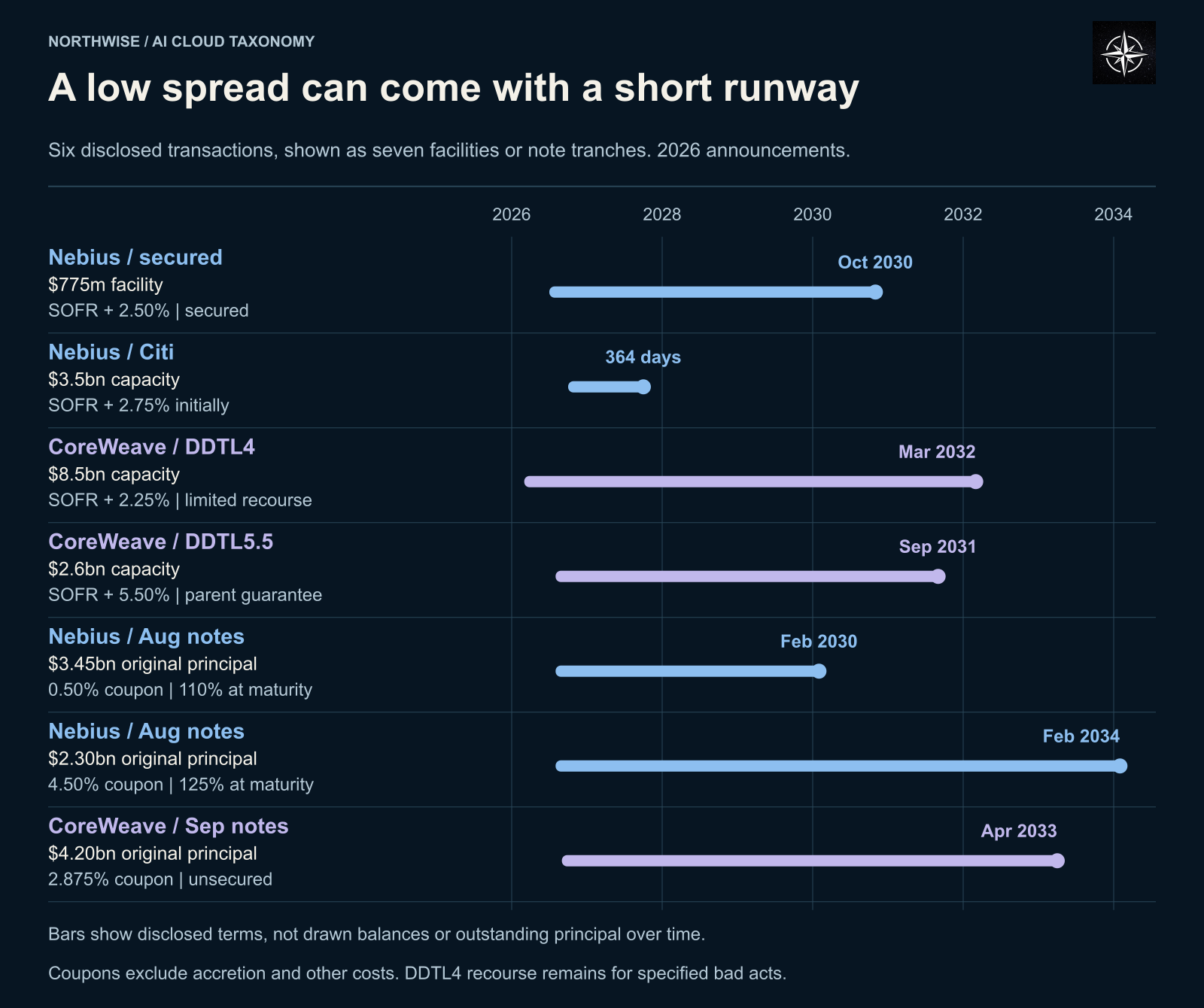
CoreWeave’s August facility shows the tradeoff clearly. Financing that runs past roughly 3-year customer terms lets CoreWeave offer shorter commitments, which broadens its customer base and preserves repricing opportunities. It also leaves CoreWeave exposed to demand and pricing after those contracts end. The loan amortizes monthly after its commitment period, but the full schedule is private, leaving the principal balance at customer expiry unclear.
Nebius’s March agreement with Meta adds flexibility of a different kind. It combines $12B of dedicated orders with up to $15B tied to specified capacity not sold to third parties over five years. The backstop supports expansion and keeps the option to find other buyers.
Equity has played a similar role at both. NVIDIA invested $2B in each, and CoreWeave paired a $1B Jane Street equity investment with a separate $6B compute commitment. Nebius also raised $4.3375B in March convertibles that accrete to 120% of principal, and sold 12.7 million shares through its ATM program for about $2.8B through June.
These financing instruments create different obligations. Facility capacity is not drawn cash, and a low coupon on an accreting note is not a low cost of capital. Customer advances fund future delivery obligations and cannot be counted again as future collections. A ClickHouse revaluation is a paper gain, and financing raised at Avride is not automatically unrestricted parent cash. Any sale, distribution or borrowing against subsidiary assets needs its own cash and ownership bridge.
The June balance sheets show the scale involved. CoreWeave reported $35.551B of gross debt principal, with $4.413B due in the rest of 2026 and $6.184B in 2027, plus $16.319B of operating lease liabilities and $35.5B of undiscounted payments on leases not yet commenced. Nebius held $8.042B of cash and another $1.056B restricted, and generated $4.504B of first-half operating cash flow, including customer advances, against $8.130B of capital purchases.
Reported profitability needs the same care. CoreWeave produced $1.51B of Q2 adjusted EBITDA alongside $640M of net interest expense and a $626M net loss. Nebius reported a 49.7% cloud adjusted EBITDA margin, and the group still posted an operating loss. Neither metric measures the cash left after infrastructure investment, financing and replacement spending.
Capital access is an advantage when it lets a provider deliver earlier or win contracts competitors cannot finance, and it amplifies mistakes just as readily.
IREN and the emerging category
IREN belongs in the emerging category. Its ambition is backed by concrete assets, contracts and software investment, and its integrated customer platform is still less established than those of Nebius or CoreWeave.
Its starting advantage is infrastructure control: IREN develops data centers, secures power, deploys GPUs and signs customers against that capacity. Its cloud offering includes dedicated GPU clusters, bare-metal access, storage, private tenant networking and InfiniBand, and its NVIDIA agreement explicitly includes Mirantis orchestration and cluster management.
The Mirantis acquisition, completed in August, adds software and operating expertise. Mirantis continues serving its existing customers as a subsidiary. For IREN, the task is turning that capability into an integrated cloud product with recurring production use.
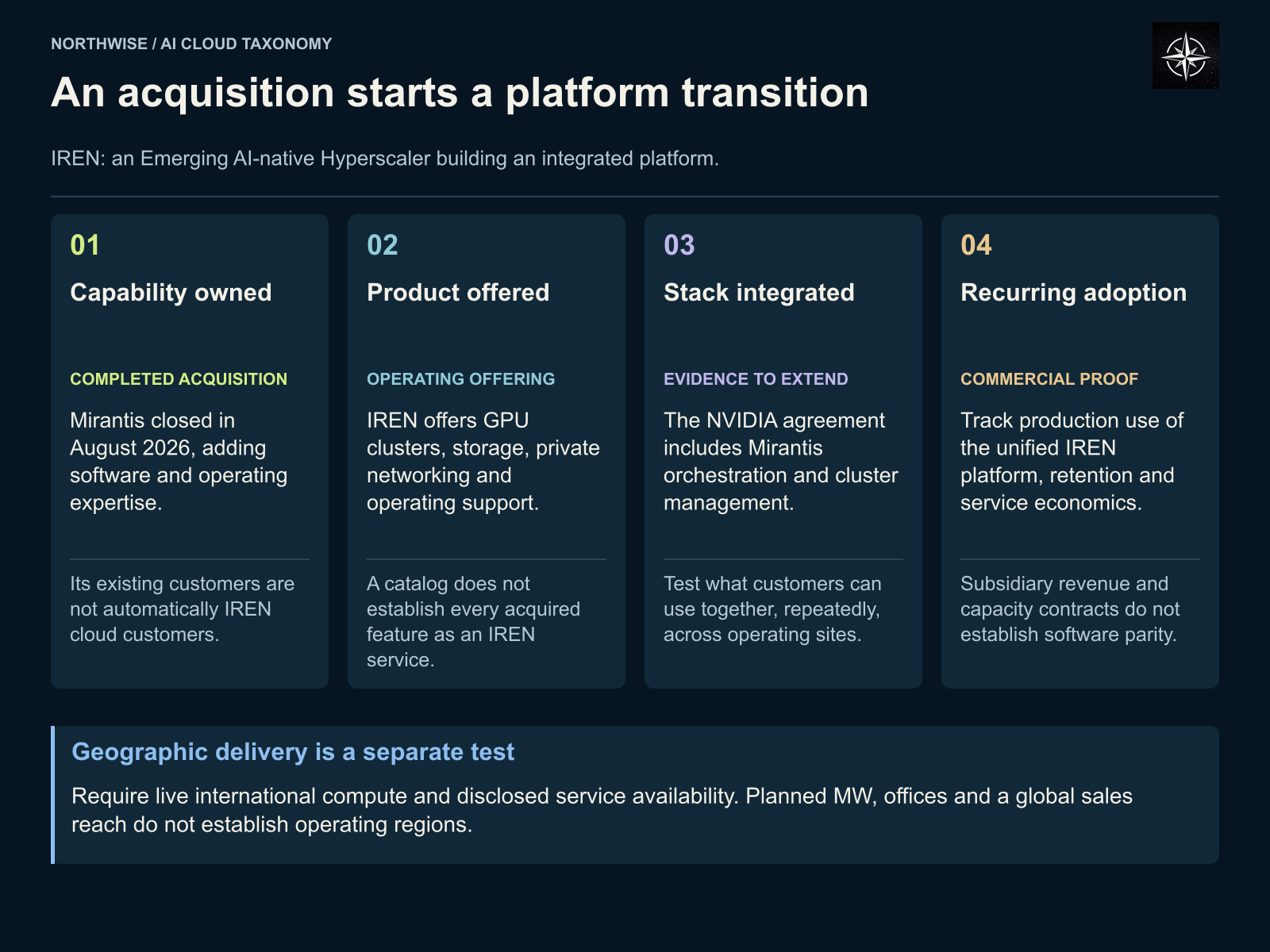
The Q1 FY27 filing reflects that stage. The $135M AI Cloud Services line combines infrastructure with Mirantis subscriptions and services, whose contribution management does not expect to be material to FY27 results. The quarter also included $65M of AI Cloud lease revenue.
Recent contracts argue against treating GPU commoditization as finished. IREN reported higher revenue per IT megawatt on newly signed 3- and 5-year contracts, a post-quarter 5-year agreement with substantial GPU-capex prepayment, and a short-duration deal at a much higher annualized rate. Those deals involve different terms and possibly different hardware, so none of them reprices the installed fleet.
IREN’s fully funded claim covers the initial roughly 0.3 GW program, subject to financing conditions, and that program’s target date has moved into early 2027. The larger pipeline, including the Badajoz campus in Spain targeting initial capacity in 2028, does not inherit that status. IREN can graduate to AI-native Hyperscaler when it demonstrates the operating stack, global delivery and customer adoption required of everyone else. Our IREN funding and dilution analysis traces the capital needed to turn the pipeline into operating capacity.
AI Software and Inference Specialists
Fireworks, Baseten, Modal, fal, DeepInfra, Hugging Face and Replicate sell higher in the workload. A Fireworks or Baseten customer buys a working model deployment with performance, scaling and operations included. Modal sells a programmable execution environment, fal focuses on media generation, Hugging Face adds model distribution, and Replicate now operates inside Cloudflare.
Software specialists also buy hardware. DeepInfra describes owning infrastructure, and hosted inference providers routinely buy GPUs or sign minimum commitments with suppliers. The moat question is whether a specialist can keep delivering the required output at an attractive cost and stay embedded in the customer’s application, against competition from hyperscalers, model developers and customers running open-source serving stacks themselves. Cheaper compute can help this category, unless a provider is locked into expensive capacity while its output prices fall.
Compute Marketplaces
Compute marketplaces such as Vast.ai, Hydra Host’s Brokkr, TensorDock and Runpod’s Community Cloud match buyers with capacity owned by others. The core financial question is who bears inventory risk. A marketplace collecting a fee on third-party supply has little residual exposure. One guaranteeing supplier payments or holding reserved capacity takes some of it back. Network effects are possible, and thin take rates and fragmented hardware limit them.
HPC Infrastructure and Hosting
HPC Infrastructure and Hosting covers a different product altogether: facilities in which somebody else’s compute runs. We see three subtypes here as well.
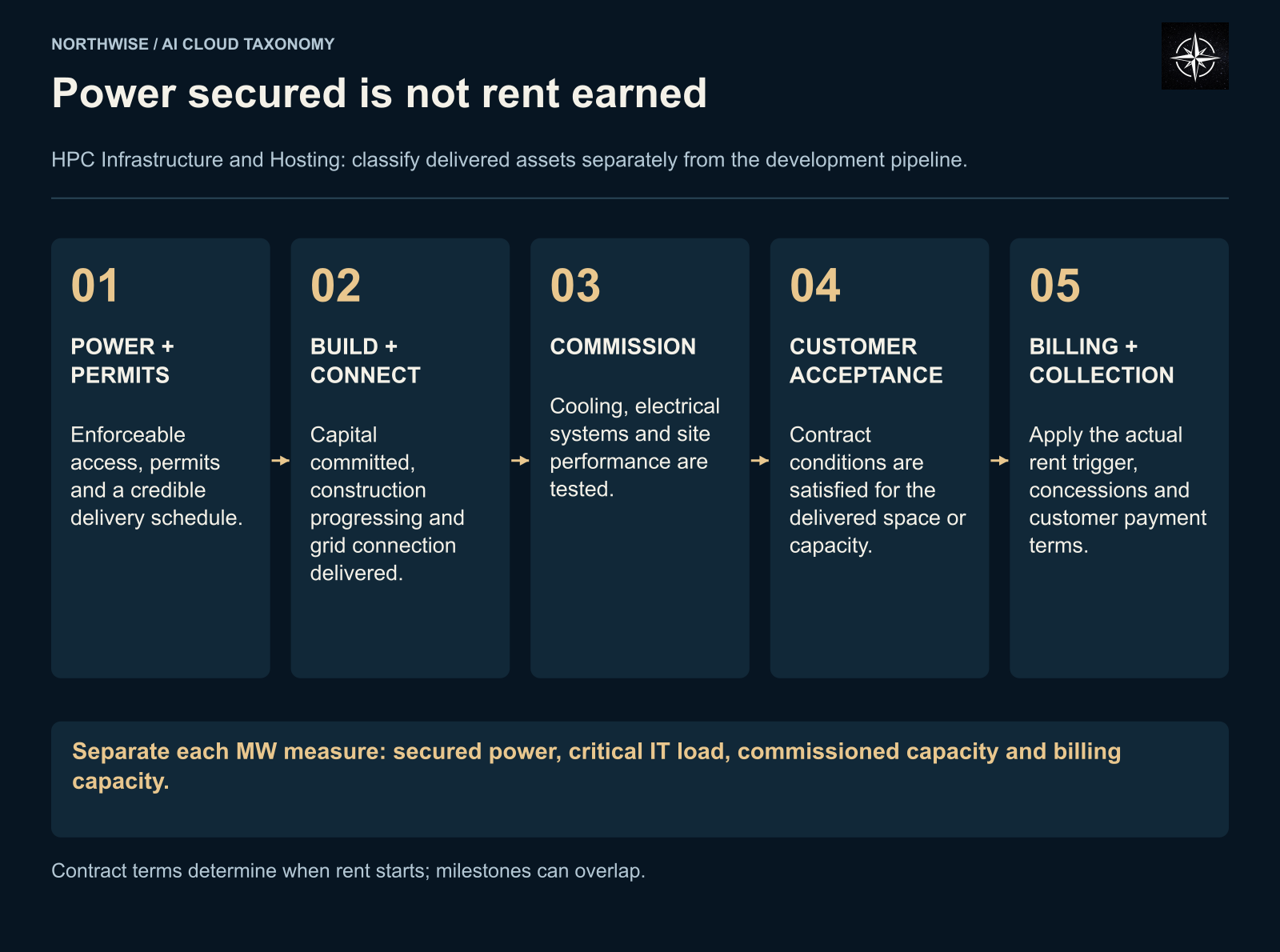
Powered land and development offers a path to a future facility. Managed shells and fitted hosting supply a building with specified power, cooling and operating scope. Operating colocation provides commissioned capacity under lease and service arrangements.
The current filings show how far apart those stages are. TeraWulf reported 102 MW of operating, revenue-generating critical IT capacity at September 30, with 401 MW of Anthropic leases not yet commenced. Cipher reported its first HPC lease revenue after rent began at Black Pearl, with more halls still scheduled, and Core Scientific reported 485 billing MW. KEEL reported no revenue-generating HPC capacity in service at quarter end. Our Cipher data center analysis follows the company-specific delivery and rent milestones.
When the tenant owns the GPUs, the host avoids accelerator resale and refresh risk. It keeps construction, financing, tenant-credit and re-leasing risk, and specialized buildings may need investment to accommodate the next hardware generation. Power and finished facilities may stay scarce well after GPUs become easy to buy, and the evidence for that moat is enforceable power, permits, completed construction and accepted capacity.
Several hosts are mixed businesses that need separate entries: APLD alongside its roughly 96%-owned ChronoScale compute arm, HUT with Highrise AI, Galaxy’s Helios inside a broader group, and Bitdeer with its AI cloud activity. RIOT already delivers 25 MW to AMD, with a new 910 MW Corsicana powered-land lease targeting 2027 and 2028.
Hosts and clouds do share one legitimate link. When CoreWeave’s credit came under pressure, concern spread to its landlords’ bonds as well. Different business models can carry the same tenant, and tenant exposure is a fair reason for some co-movement.
SpaceX spans several businesses
SpaceX is now a meaningful supplier of external AI compute. Its Q3 filing records the February acquisition of xAI, the August acquisition of Cursor, and third-party cloud revenue beginning in Q2. Anthropic’s May agreement covered Colossus 1 capacity of more than 300 MW and 220,000 GPUs.
SpaceX business lines
SpaceX activity | Treatment in the Northwise framework |
|---|---|
Dedicated third-party GPU capacity | Neocloud capacity-contract economics at the business-line level |
Grok APIs and enterprise offerings | Model and inference services, with frontier-model economics in addition to serving economics |
Cursor and related applications | AI software and application relationships |
Captive model training | Internal infrastructure consumption, separate from external cloud sales |
Starlink and launch | Adjacent connectivity and launch businesses |
Orbital AI plans | Development-stage infrastructure, pending delivered and billable service |
The contract terms show why headline totals need close reading. Anthropic’s amended registration statement describes potential payments of up to $120.5B through 2029, reaching roughly $3.1B a month after full delivery. Initial noncancelable periods end in January and March 2027, after which either party can cancel on 90 days’ notice. The total is a ceiling, and well short of firm backlog.
The public documentation centers on model APIs and enterprise features. We have not found a general cloud offering that combines configurable compute, storage, private networks and orchestration across two major world regions. Starlink coverage and global API access do not meet that test.
The financing picture needs the same discipline. SpaceX announced a commitment to a roughly $40B GPU finance lease in October, subject to closing conditions, with tranches of about 5 to 5.25 years, equipment delivery in the first half of 2027 and the rate still unset. Q3 Connectivity operating income was $2.367B against $16.444B of SuperIntelligence capital spending. Connectivity contributes earnings, but those figures do not establish how much cash it supplies to the AI buildout. The 1.7 GW of nameplate compute measures installed capacity, and says nothing about utilization or accepted billable load.
Musk’s warning reads differently in that light. It came from a participant that already sells external AI compute and was arranging its own large equipment financing, and his pessimism about competitors is a forecast like any other.
What commoditization would change
The long-term commoditization thesis is conditional. More supply can erode scarcity premiums, though aggregate demand, power constraints, hardware transitions and workload growth can prevent a simple decline in returns. Recent contract pricing at both IREN and CoreWeave shows stronger pricing and expanding capacity coexisting.
The pressure would surface differently by business. For a capacity merchant, it shows up in renewal pricing and utilization, and for an inference provider, in falling prices per useful response. For a host, it may arrive years later through lease renewals or lower rents on new developments.
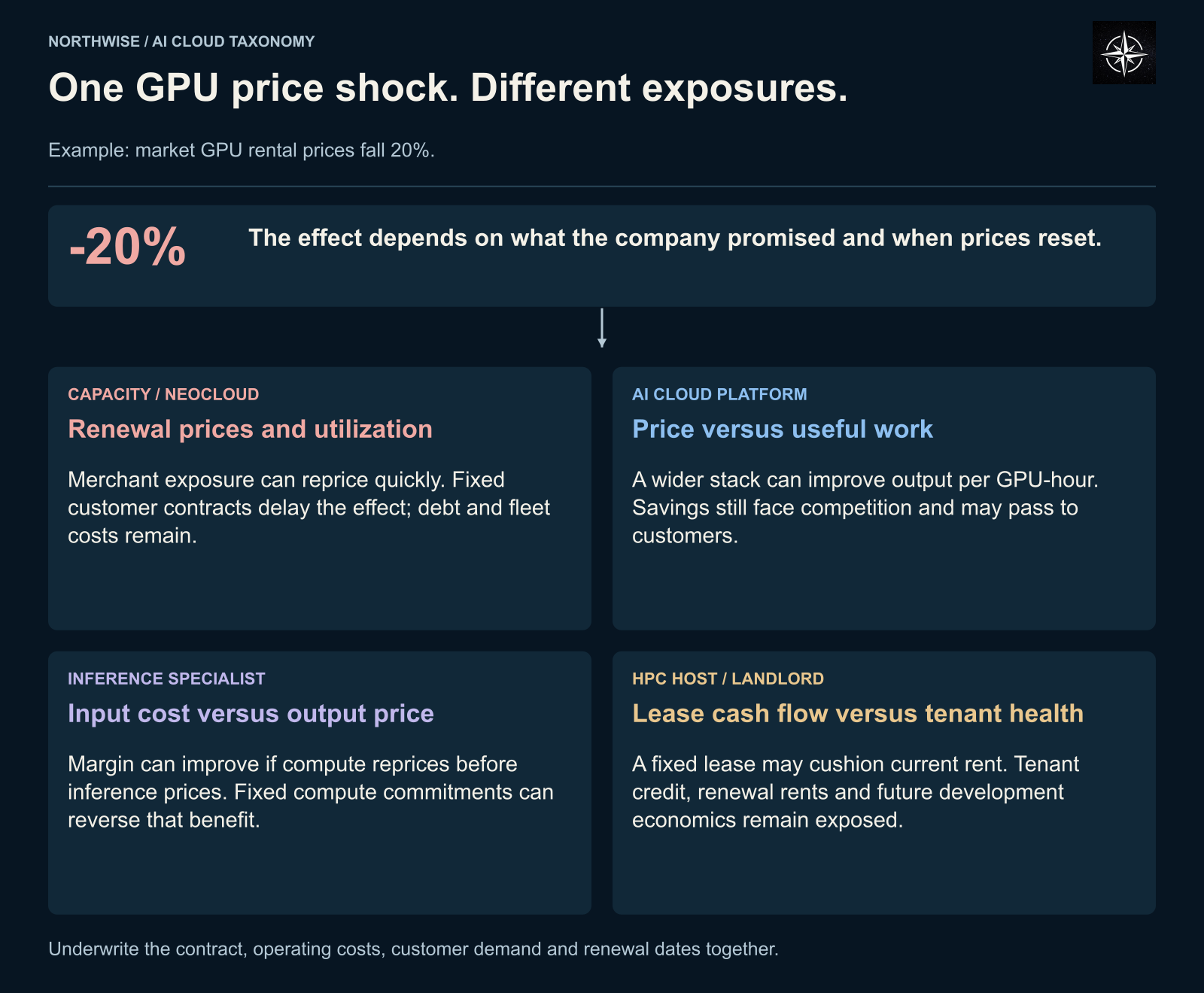
Software also changes the unit of competition. A GPU hour is an input; the customer ultimately wants a completed training run, a model response within a latency target, or a reliable production workflow. Better scheduling, recovery, caching and serving produce more usable output from the same hardware.
For example, if a provider improves useful output per hour by 30% and cuts the customer’s price per unit of output by 10%, revenue per fully utilized hour still rises 17%, since 1.30 multiplied by 0.90 equals 1.17. The customer pays less for each result, and the provider earns more from the hardware.
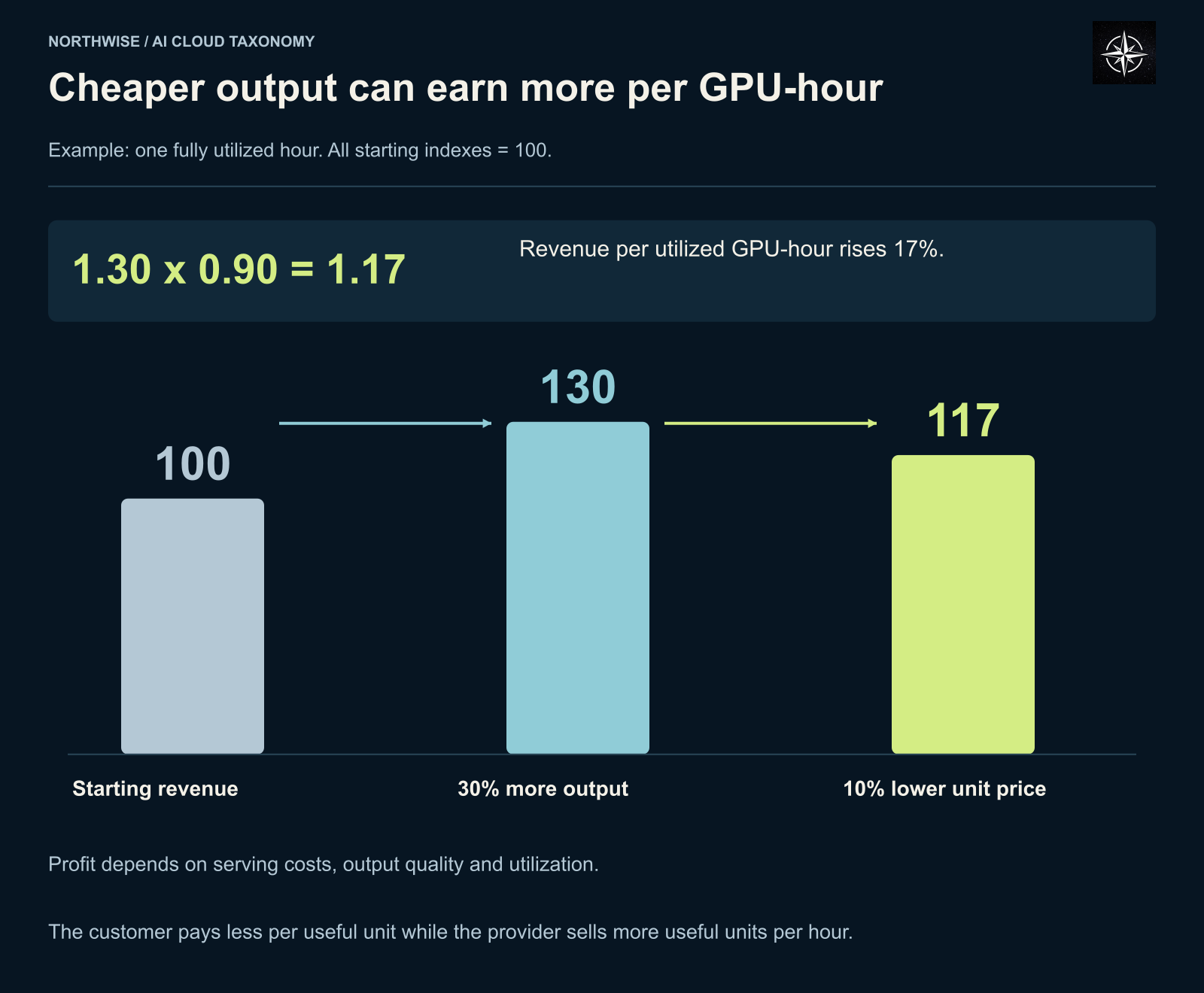
Lower cost per token and higher revenue per megawatt can therefore move together. CoreWeave reported roughly $40M of annualized revenue per MW on some 3- to 6-month agreements in September. Revenue per megawatt shifts with hardware generation, workload mix and service scope, which makes it a poor proxy for the rental price of an unchanged GPU.
Model the obligations behind the category
For modeling, the framework points to a few consistent rules. Secured power, a commissioned building, installed GPUs, customer acceptance and recognized revenue are separate milestones, and capacity should enter revenue only once delivered and accepted. Existing capacity should be allocated to signed commitments before any remaining supply is priced, and equity should be issued in a model at the time and price capital is actually needed. Model customer contract expiry, debt repayment, accounting depreciation and the hardware's profitable operating life separately.
Economic tests by business model
Business model | Most relevant economic tests |
|---|---|
Hyperscalers and GP Cloud Providers | Customer expansion, service mix, capital productivity, distribution and the cost of operating the ecosystem |
AI-native Hyperscalers and Full-stack AI Clouds | Useful work delivered, platform adoption, retention, contract mix, replacement economics and funding |
Emerging AI-native Hyperscalers | Delivery milestones, integration, customer conversion, financing availability and dilution before maturity |
Neoclouds | Purchase cost, billable utilization, realized rates by contract cohort, customer credit and residual value |
AI Software and Inference Specialists | Output quality, cost per useful result, customer retention, serving margins and underlying capacity commitments |
Compute Marketplaces | Transaction liquidity, take rate, supplier quality, repeat usage and retained inventory risk |
HPC Infrastructure and Hosting | Accepted capacity, rent commencement, tenant credit, construction returns, refinancing and re-leasing |
The strongest defense against commoditization combines customer value with capital discipline. A widely used platform funded on terms that consume its returns can create customer value without creating shareholder value, and a focused capacity business with excellent procurement and conservative commitments can outperform both.
What would change our classifications
A framework is only credible if companies can graduate, stay specialized or move backward, and if it says in advance what would change a placement.
For Nebius and CoreWeave, the tests are platform monetization, customer diversification and cash generation through contract renewal and hardware replacement, with anchor contracts and financing underwritten on their own terms. For IREN, the next evidence is an integrated product running at operating sites, production use of the managed stack and delivered international capacity. For Nscale, Lambda, TensorWave, Verda and Runpod, further product documentation and production evidence can settle the provisional boundaries, and a company that clears the same gates should receive the same classification whatever its origins.
For the hosts, rent commencement, accepted capacity, financing and tenant performance say far more than whether the market happens to call them neoclouds that week. For SpaceX, the external compute business warrants direct underwriting, and orbital plans should earn their place as infrastructure is delivered.
AI demand can support many different businesses, and competition and capital intensity will distribute the returns unevenly. The owner of a scarce GPU, the operator of a useful cloud, the developer of a serving engine and the owner of a powered building all benefit from the same demand, and they keep that benefit for different reasons. Over a long enough horizon, those reasons are what the stocks will be priced on.
The questions that decide durable returns are who controls the customer relationship, who supplies the capital, which obligations survive a slowdown, and what stays valuable when equivalent compute becomes easy to buy. On those questions, we see Nebius much further from the commodity end of the market than a broad neocloud label suggests.
IREN Stock Forecast 2027: The Year the Megawatts Come Due
IREN stock forecast 2027: examine AI capacity, contract pricing, capex and dilution, with Premium valuation scenarios and an editable financial model.

NBIS CLT1 South Carolina Data Center
Inside Nebius CLT1 in Moore, South Carolina: site history, 50 MW IT contract, power, proposed layout, moratorium risks, funding and delivery schedule.
NBIS Stock Forecast 2027: The Price of Scarce Compute
NBIS stock forecast 2027: examine Nebius capacity, Rubin pricing, cash flow, financing and valuation scenarios, with an editable model for Premium members.
Northwise Portfolios
See how the research becomes real decisions
Reader discussion
Discuss the research
Create a Free account to join the discussion with a display name.
Create a Free Account
No comments yet. Start a thoughtful discussion.