
AMD Stock Forecast 2040
AMD Stock Forecast 2040 explores how the OpenAI deal and surging AI demand could make AMD the next multi-trillion-dollar superpower.
In this article
AMD Stock Forecast 2040: The Path to Multi-Trillion Dollar Upside
AMD’s 6-gigawatt OpenAI partnership marks a turning point in the AI hardware race. With deepening alliances across Meta, Oracle, and new adopters like IREN, AMD is cementing its place as the second true compute superpower alongside NVIDIA.
2030 to 2040: The Next Era of Compute Expansion
Our AMD Stock Forecast 2030 outlined how AMD’s architectural focus, cost discipline, and data center leadership positioned it to challenge NVIDIA’s dominance in AI infrastructure.
This new 2040 forecast extends that logic forward. With the OpenAI partnership and expanding adoption from hyperscalers, AMD now has a visible pathway to become a multi-trillion-dollar compute platform by the end of the next decade.
The Macro Context: The Compute Age
We are entering a new industrial epoch defined by the global race for compute. The world’s largest companies and governments are now competing for FLOPs in the same way nations once competed for oil. AI training, inference, and simulation workloads are scaling faster than transistor density itself.
Compute demand could grow ten to twentyfold this decade, while supply remains bound by advanced packaging and power constraints. In this environment, AMD’s efficiency, chiplet modularity, and cost-performance edge make it an indispensable supplier for hyperscalers that need scale without destroying margins.
The OpenAI Partnership: A Structural Inflection Point
AMD and OpenAI recently announced strategic partnership to deploy 6 gigawatts of AMD GPUs. This deal changes everything for AMD.
The OpenAI deal is not a marketing announcement; it is a structural re-rating event. OpenAI will deploy up to six gigawatts of AMD Instinct GPUs, beginning in 2026, across multiple generations starting with the MI450. The deal could generate a hundred billion dollars in cumulative revenue and anchors AMD’s visibility through the decade.
The equity component makes it even more strategic: OpenAI received warrants for up to 160 million AMD shares at $0.01, vesting only when deployments and performance milestones are achieved, including AMD stock crossing the $600 threshold.
This is compute-for-upside, not equity-for-cash. AMD only dilutes if it executes, and OpenAI only benefits if AMD delivers and scales. It is one of the smartest incentive alignments in modern technology, effectively binding the world’s leading AI lab to AMD’s success.
Expanding Adoption: Oracle, Meta, xAI, and Emerging Buyers
AMD’s ecosystem now spans the industry’s most influential compute buyers:
- Oracle: Already deploying AMD’s Epyc CPUs and Instinct GPUs at scale. Reports show nearly $100 million in losses from renting NVIDIA GPU clusters, highlighting the economic case for AMD’s lower-cost architecture.
- Meta: Integrating AMD accelerators into its Llama AI training infrastructure to diversify from NVIDIA dependency.
- xAI (Elon Musk): Reportedly evaluating AMD GPUs for next-generation model training, underscoring AMD’s presence in frontier AI.
- Iris Energy (IREN): Emerging infrastructure players are adopting AMD GPUs for AI diversification. IREN’s expansion from bitcoin mining into AI compute exemplifies how AMD’s economics and accessibility open the market to new entrants.
These partnerships all reinforce one theme: AMD is no longer optional. The OpenAI deal and Oracle’s margin struggles signal to hyperscalers that AMD’s mix of performance, cost efficiency, and availability is the sustainable alternative.
The Market Realignment Moment
2025 represents the point where demand for compute outgrew single-supplier economics. NVIDIA’s pricing model, while powerful, has strained cloud profitability. AMD’s architecture now represents both performance and relief. Hyperscalers and small players alike don’t want AMD to succeed: they need it to.
Rack-Scale Solutions: From Components to Turnkey Capacity
AMD’s next leap is vertical integration. Its new rack-scale solutions, launching from 2026 onward, bundle Epyc CPUs, Instinct GPUs, high-bandwidth memory, and Infinity Fabric interconnects into unified systems.
These racks reduce integration time, maximize utilization, and cut deployment costs for AI data centers. For hyperscalers like Oracle and Meta, it solves the challenge of renting compute profitably.
Rack-scale systems make AMD infrastructure plug-and-play, allowing clouds to scale faster and at lower cost than with NVIDIA’s bespoke configurations. They transform AMD from a chip supplier into a system provider capable of capturing recurring revenue through full-rack deployments.
AMD vs NVDA: Technical Differentiators
AMD’s technical edges are now economically decisive:
- Memory bandwidth: Superior HBM capacity enables larger batch sizes and higher throughput.
- Process leadership: Two-nanometer nodes improve power efficiency and transistor density, outpacing NVIDIA’s Hopper architecture.
- Chiplets: AMD’s modular design is its defining advantage. Unlike NVIDIA’s monolithic GPUs, AMD builds compute products from smaller chiplets connected through advanced packaging.
Why it matters:
- Smaller dies yield better, lowering cost per good chip.
- AMD can mix compute, cache, and I/O chiplets to customize each SKU for training, inference, or fine-tuning.
- Reusing proven chiplets shortens design cycles and speeds iteration.
- Modular SKUs enable right-sizing for inference, driving a lower cost per token and better ROI for AI service providers.
Reports suggest NVIDIA’s investment in Intel may be tied to interest in Intel’s buried chiplet technology. If true, it signals NVIDIA’s recognition of AMD’s architectural edge. Such a move would highlight NVIDIA’s concern over AMD’s momentum and its need to access similar packaging IP to stay competitive.
Software and Ecosystem Maturity: ROCm’s Catch-Up
For years, AMD’s weakness was software. That gap is narrowing quickly. ROCm now supports major frameworks like PyTorch and TensorFlow, and OpenAI’s partnership ensures rapid kernel optimization for AMD’s hardware.
ROCm’s open-source nature aligns with the broader industry’s shift away from proprietary CUDA ecosystems, giving AMD increasing parity in developer adoption.
Furthermore, AMD’s decision to implement its partners (META, OpenAI, and others) into its design process allows for constant circular feedback from customers that continue to help AMD improve ROCm iteratively.
The Economics of Differentiation: Price, Power, Performance
AI compute success hinges on efficiency rather than just peak speed. While official pricing for AMD’s MI450 and NVIDIA’s Blackwell GPUs has not been disclosed, analyst modeling and hyperscaler estimates suggest that AMD’s 2-nanometer architecture and rack-level system design could deliver a total cost advantage of roughly 25 to 40 percent per unit of delivered compute once both products reach mature deployment.
The underlying factors driving that advantage include:
- Process efficiency: AMD’s transition to TSMC’s 2 nm node improves performance per watt relative to NVIDIA’s 3 nm Blackwell chips.
- Memory density: Higher-capacity HBM4 memory and better memory bandwidth enable more work per GPU, improving throughput and reducing cluster count.
- Yield and packaging: AMD’s chiplet design increases yields and lowers cost per transistor.
- Rack integration: Pre-validated rack solutions cut deployment and networking costs at the system level.
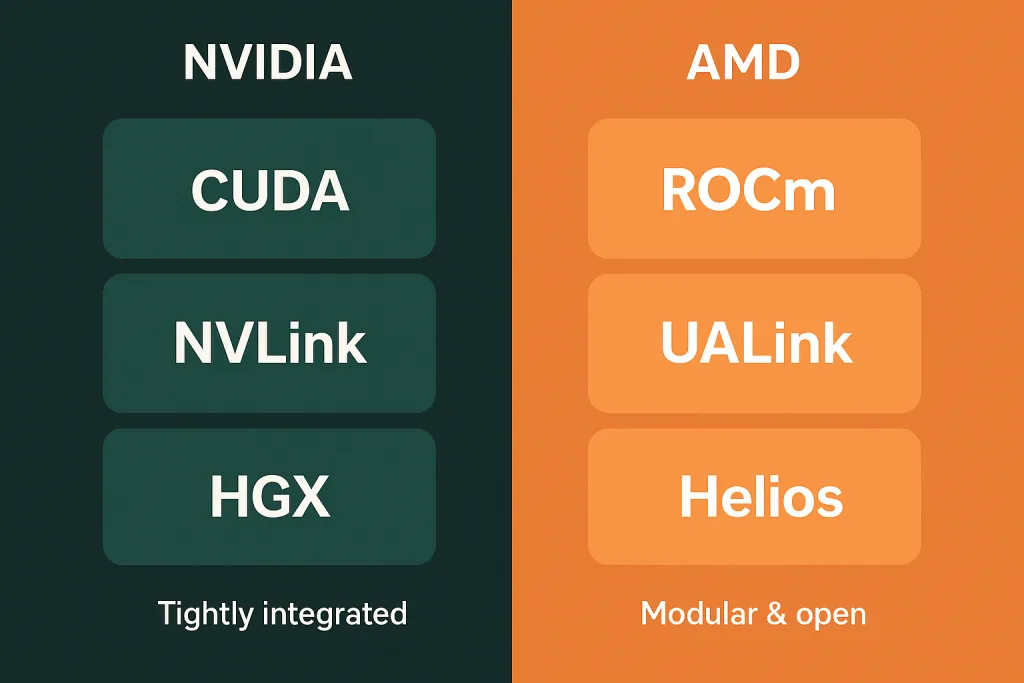
Industry research supports this direction:
- Raymond James (Aug 2025): Forecasts MI450 achieving similar or better performance than Blackwell at meaningfully lower TCO due to design efficiency.
- Morgan Stanley (Sep 2025): Projects 20–30 percent lower power and packaging cost per delivered FLOP for AMD versus NVIDIA.
- TrendForce (Jul 2025): Estimates a 25 percent or greater per-rack efficiency advantage for AMD’s 2 nm GPUs by 2027.
Combined, these data points reinforce AMD’s economic leverage in hyperscale environments. For companies like Oracle and Meta, such cost structure improvements are pivotal for restoring profitability in AI cloud operations.
AMD Leadership and Culture: Execution as an Edge
Under Lisa Su, AMD has demonstrated a rare blend of engineering precision, strategic restraint, and visionary leadership that few companies in the semiconductor industry can match.
Since assuming leadership in 2014, Su has orchestrated AMD’s turnaround from near insolvency to one of the most dominant forces in global compute. Her approach emphasizes deep technical credibility balanced by fiscal discipline. She executes not only to roadmap targets but with an acute understanding of market timing and investor confidence.

Su’s leadership has created a culture that combines technical excellence with commercial awareness. She has empowered engineering teams to innovate around chiplet modularity and process leadership while keeping the organization lean and capital efficient.
This culture allows AMD to move quickly, focus on the highest-value opportunities, and avoid the bureaucratic drag that often slows larger peers. She is known internally for maintaining a hands-on understanding of core technology, setting a tone of accountability that permeates every division.
The results of her tenure are reflected in AMD’s partnerships and brand credibility. Strategic alliances with hyperscalers such as Microsoft, Oracle, and OpenAI are a direct consequence of AMD’s reliability under Su’s direction.
Investors and customers alike perceive AMD as a consistent executor with strong returns on invested capital, and Su’s continuity in leadership remains one of the company’s greatest strategic assets.
The Compute Supply Chain: Energy, Foundries, and Scale
Power, HBM supply, and foundry capacity now define the competitive edge in AI compute. AMD’s long-term partnerships with TSMC, OpenAI, and major memory suppliers secure allocation well into the 2030s, ensuring that it can meet the surging demand for high-performance GPUs and CPUs.
These deep relationships reduce exposure to the bottlenecks that have constrained competitors and position AMD to maintain delivery consistency.
A new layer of cooperation is also reshaping the industry’s supply chain dynamics. Both AMD and NVIDIA have entered partnerships with Intel to leverage Intel Foundry Services (IFS) for advanced packaging and additional wafer capacity.
For AMD, this collaboration offers diversification and redundancy: critical insurance as TSMC faces tight capacity across multiple process nodes. For NVIDIA, the partnership appears tied to accessing Intel’s packaging and chiplet IP, possibly to narrow AMD’s architectural lead.
These developments mark a pragmatic shift from traditional rivalry to strategic coexistence. The semiconductor ecosystem is consolidating around shared manufacturing ecosystems that prioritize redundancy and geopolitical stability. AMD’s willingness to collaborate where it enhances reliability underscores its pragmatic management style under Lisa Su.
Risks and Cyclicality
AMD’s rise will face natural cycles:
- AI capital expenditures fluctuate after major buildouts.
- Advanced packaging and memory remain bottlenecks.
- ROCm must continue closing the developer gap with CUDA.
- NVIDIA will counter with new architectures and pricing.
- Execution missteps could delay large-scale contracts.
Despite these risks, AMD’s modular cost structure and growing partnerships provide a durable base.
From Chip Vendor to Compute Utility
AMD’s transformation from chip vendor to compute utility is now quantifiable. As AI infrastructure compounds, EPS growth accelerates far beyond traditional semiconductor cycles.
The following tables model three long-term scenarios based on AMD’s expected revenue and earnings trajectory through 2040. Each incorporates the OpenAI partnership, new rack-scale deployments, and AMD’s expanding share of global compute demand.
Bear Case
Growth assumptions: 30% → 20% → 12%
EPS growth: 35% → 20% → 12%
P/E: 35× → 28× → 25×
Year | Revenue ($B) | EPS ($) | EPS CAGR | P/E | Price ($) | Market Cap ($T) |
|---|---|---|---|---|---|---|
2030 | 130 | 21.0 | +35% | 35× | 735 | 1.18T |
2035 | 325 | 52.0 | +20% | 28× | 1,456 | 2.33T |
2040 | 575 | 91.5 | +12% | 25× | 2,288 | 3.66T |
Commentary:
In the bear case, AMD compounds steadily even amid competitive and cyclical pressures. By 2040, EPS and share price still achieve powerful compounding, reflecting the durability of AMD’s role in global compute infrastructure.
Base Case
Growth assumptions: 40% → 25% → 18%
EPS growth: 45% → 25% → 15%
P/E: 50× → 37× → 32×
Year | Revenue ($B) | EPS ($) | EPS CAGR | P/E | Price ($) | Market Cap ($T) |
|---|---|---|---|---|---|---|
2030 | 185 | 38.2 | +45% | 50× | 1,910 | 3.06T |
2035 | 565 | 116.5 | +25% | 37× | 4,306 | 6.89T |
2040 | 1,155 | 234.6 | +15% | 32× | 7,507 | 12.01T |
Commentary:
The base case reflects AMD’s full execution across the OpenAI partnership, rack-scale growth, and expanding GPU market share.
By 2040, AMD reaches a $12 trillion valuation, representing one of the greatest compounding stories of the modern era. EPS growth, buybacks, and consistent demand for AI capacity drive its rise to compute utility status.
Bull Case (Theoretical Goldilocks Scenario)
Growth assumptions: 50% → 30% → 23%
EPS growth: 55% → 30% → 18%
P/E: 70× → 45× → 38×
Year | Revenue ($B) | EPS ($) | EPS CAGR | P/E | Price ($) | Market Cap ($T) |
|---|---|---|---|---|---|---|
2030 | 270 | 57.7 | +55% | 70× | 4,039 | 6.46T |
2035 | 1,005 | 214.3 | +30% | 45× | 9,643 | 15.43T |
2040 | 2,795 | 493.0 | +18% | 38× | 18,734 | 29.97T |
Commentary:
The theoretical upside case envisions AMD as the defining comeback compute company of the century. By 2040, it could command nearly $30 trillion in market capitalization, rivaling the scale of the global energy industry.
This outcome assumes near-total execution, continued market expansion into agentic AI, robotics, and autonomous compute, and AMD’s dominance in every layer of performance hardware.
The Drivers of Exponential AI Demand
AI demand is unlikely to plateau. Several powerful technological trends are combining to multiply global compute requirements at a rate that continues to surprise even the most optimistic forecasters.
If you want to see where we see AI total addressable market heading by 2030, as a 1.8 Trillion dollar market opportunity, check out our new cornerstone framework: AI Accelerator Market Forecast 2030
AMD’s diversified architecture and position across the compute stack place it directly in the path of this demand explosion.
Agentic AI Systems
The next generation of AI will be populated by autonomous, goal-driven agents. These systems will manage tasks, coordinate with other agents, and make decisions across digital and physical domains.
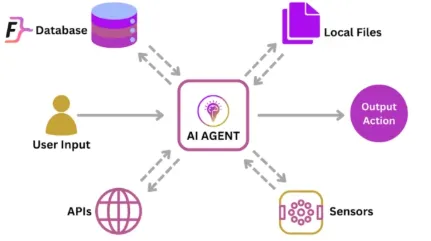
Unlike static models, they require continuous reasoning, dense memory, and sustained inference workloads. Each agent compounds global compute requirements. AMD’s modular chiplets and high-bandwidth designs make it well positioned to serve this transition.
AI and Robotics Integration
Robotics represents the next expansion of AI. From humanoid assistance to autonomous logistics and industrial robotics, these systems depend on real-time inference and localized training.
AMD’s low-power CPU-GPU combinations and chiplet flexibility allow for efficient edge and embedded computing, ensuring it benefits from both datacenter and device-level growth.
The Rise of Inference Workloads
The world’s AI usage is shifting from model training to constant inference. As AI becomes embedded in workflows, entertainment, design, and manufacturing, the majority of compute consumption will come from inference rather than training.
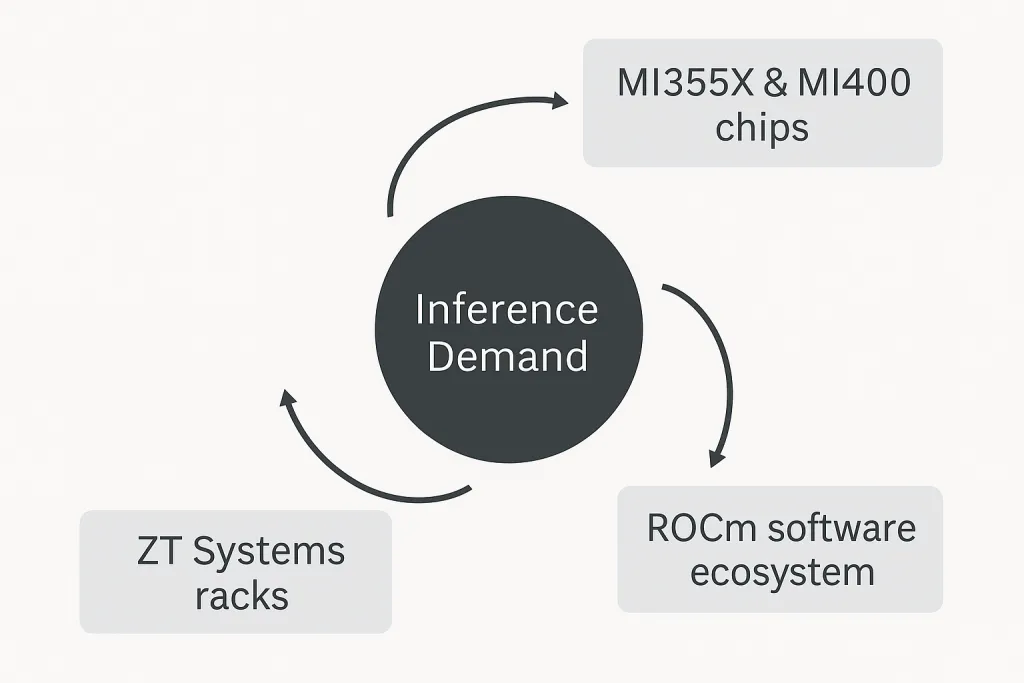
Every interaction with a virtual assistant or software agent draws GPU cycles. AMD’s rack-scale architecture enables efficient scaling for these always-on environments.
Embedded AI in Everyday Devices
AI will soon be everywhere from vehicles and homes to medical devices and industrial equipment. Each smart device requires localized inference, creating a mesh of compute across the physical world. AMD’s CPUs and GPUs will anchor this distributed intelligence layer, connecting billions of devices back to the cloud.
Unknown Frontiers and Exponential Innovation
Perhaps the most compelling argument for unbounded compute demand is that we cannot predict all the use cases to come. Entire new industries will arise from agentic AI, synthetic biology, creative automation, and cognitive modeling.
Each breakthrough generates further need for compute. AMD’s scalable architecture ensures it can evolve with these advances.
The Structural Outcome
Compute growth will not be linear; it will compound. Each application of AI begets more applications, all dependent on GPU capacity. AMD’s leadership in chiplet design, power efficiency, and vertical integration make it a structural beneficiary of this exponential era.
By 2040, compute will be as essential as energy. AMD’s combination of OpenAI’s multi-gigawatt demand, Oracle’s economic alignment, chiplet modularity, and rack-scale integration give it leverage across every layer of the AI stack. AMD has evolved from challenger to co-leader, positioned to become one of the next multi-trillion-dollar companies of the modern era.
AMD Revenue per Gigawatt: What the Hardware Is Worth
How much revenue can AMD earn per gigawatt? We examine GPU pricing, EPYC, Helios component content, delivery costs and the assumptions in our financial model.
AMD Stock Forecast 2030
This AMD Stock Forecast 2030 explores AMD's transition from a distant secondary supplier to an open compute superpower in Artificial Intelligence.
AMD Sovereign AI Infrastructure
AMD sovereign AI: live HUMAIN systems, future Saudi capacity, LUMI-AI procurement, Korea's partnership and the path from infrastructure plans to revenue.
Northwise Portfolios
See how the research becomes real decisions
Reader discussion
Discuss the research
Create a Free account to join the discussion with a display name.
Create a Free Account
No comments yet. Start a thoughtful discussion.