
BMNR Stock Forecast 2030

BMNR stock forecast 2030 explores Ethereum’s rise, BMNR’s 5% supply goal, the upside potential, and our valuation forecasting.
In this article
BMNR Stock Forecast 2030: Ethereum’s MicroStrategy Moment
A deeper look at BMNR’s accumulation model, Ethereum’s role as global financial infrastructure, and the asymmetric opportunity embedded in its structure.
What is BMNR?
BMNR is a publicly traded Ethereum treasury vehicle that has embraced an aggressive mandate: raise capital through the equity markets, convert that capital into ETH, and provide investors with a liquid, regulated way to access Ethereum at scale.
The company is not operating like a traditional business with revenue streams, product lines, or legacy operations. Instead, it functions as a balance sheet entity designed to accumulate ETH and create equity market access for those who cannot or will not hold ETH directly. This strategy is straightforward but carries profound implications. BMNR is positioning itself as the Ethereum analog to MicroStrategy’s Bitcoin bet, which has become synonymous with Bitcoin exposure.
As of September 2025, BMNR has established itself as the largest ETH treasury in the world. It holds more than 2.15 million ETH, with $10 billion in combined crypto and cash reserves. Importantly, the company has secured authorization for a $24.5 billion at-the-market equity program, giving it tremendous optionality to scale its holdings further.
By combining aggressive capital raising with opportunistic buyback programs, BMNR has created a structure that can expand or contract share count based on market conditions, all while continuing to accumulate ETH.
What is Ethereum?
Ethereum is the world’s leading smart contract platform, and it represents a fundamental building block of modern digital infrastructure. Unlike Bitcoin, which primarily operates as a static store of value, Ethereum is both a digital currency and a programmable network that powers decentralized applications, tokenized assets, and stablecoins.

It is simultaneously money, collateral, and infrastructure. ETH is used to pay transaction fees, to stake and secure the network, and to participate in a growing universe of decentralized finance.
Ethereum’s design allows it to function as both a settlement layer and a compute layer. It is where stablecoins settle, where tokenized treasuries live, and where decentralized lending and exchanges operate. Importantly, Ethereum is productive collateral.
Through proof-of-stake, ETH can generate native yield while securing the network. This introduces compounding characteristics into ETH’s profile that Bitcoin does not possess. Ethereum’s unique blend of utility and scarcity makes it a candidate to become the backbone of financial transactions worldwide.
Ethereum vs. Bitcoin: The Backbone Debate
Bitcoin is pristine collateral. Its value lies in scarcity and security. It is digital gold, designed to exist as a store of value outside traditional systems. Ethereum is fundamentally different. It is programmable money and an active infrastructure layer. While Bitcoin’s role is defensive, Ethereum’s role is functional. The debate is not which asset is “better” but which asset becomes more entrenched in the plumbing of the global financial system.
Ethereum already processes trillions of dollars in settlement volume annually, much of it tied to stablecoins that function as digital representations of the US dollar. Layer 2 solutions are rapidly scaling throughput and reducing costs, making ETH rails competitive with existing financial networks.
The more assets, applications, and financial flows that settle on Ethereum, the stronger its network effects become. BMNR is, in essence, a leveraged bet that Ethereum will emerge not just as an alternative asset, but as the backbone of financial infrastructure.
The Structural Mispricing of BMNR
Markets continue to misprice BMNR because they frame it only as an ETH proxy. This is the same kind of misunderstanding we have highlighted in other investment theses, such as our IREN Forecast. In BMNR’s case, the focus is solely on its ETH stack, while the optionality embedded in its capital structure is overlooked.

BMNR’s equity is not just ETH exposure. It is a capital-structure machine with the ability to issue equity into strong demand, buy back shares when trading below NAV, and maintain a cycle of expanding ETH per share.
This is not being valued appropriately. Where many see dilution risk, those who understand see a mechanism for compounding NAV per share. The misunderstanding creates opportunity, and BMNR’s execution on this strategy could deliver returns that far outpace ETH itself.
BMNR’s Strategic Playbook and Flywheel
BMNR’s flywheel is straightforward yet powerful. It issues equity when market demand is strong and converts those proceeds directly into ETH. This expands the treasury and increases NAV. As NAV grows, more investors become attracted to the equity as a regulated way to hold ETH, which increases liquidity and market depth. The stronger equity base then allows BMNR to issue additional capital at favorable terms, further compounding its ETH stack.
This cycle mirrors how Amazon quietly built AWS and later Project Kuiper, or how Tesla scaled its Megapack business. Each began as a misunderstood side play but evolved into hidden infrastructure flywheels that transformed their parent companies. BMNR is attempting the same process in finance: using capital-market levers to systematically build one of the largest ETH treasuries in the world, while compounding NAV through structural design.
The Buyback Lever as Optionality
BMNR’s $1 billion stock repurchase authorization is one of its most underappreciated strategic tools. The buyback allows BMNR to shrink share count when its equity trades below NAV. This is particularly powerful in volatile markets, where discounts to NAV often emerge. By repurchasing stock in those conditions, BMNR supports NAV, reduces float, and increases ETH per share for remaining shareholders. It is an anti-cyclical mechanism that improves shareholder outcomes precisely when sentiment is weakest.
On the flip side, BMNR can issue equity during periods of optimism, expanding its treasury when the market is willing to pay premiums. This dual capability creates a structural advantage. Few other equity vehicles in history have operated with this kind of reflexive playbook. Over time, the buyback lever could prove just as valuable as the accumulation of ETH itself, because it ensures that BMNR’s equity remains tightly tethered to NAV while retaining upside from narrative-driven premiums.
Notable Participants: Tom Lee and Cathie Wood
Tom Lee, founder of Fundstrat, is more than a figurehead at BMNR. He is the company’s chairman and its most visible strategist. His commentary has directly shaped BMNR’s public narrative, and he has been explicit about the ambition to capture a meaningful share of ETH’s supply.

Lee brings not only credibility but also a deep understanding of how to manage capital-market psychology. Unlike MicroStrategy, which was powered almost entirely by Michael Saylor’s singular voice, BMNR benefits from Lee’s capital markets experience and broader coalition building.

Cathie Wood, through ARK Invest, has become a meaningful shareholder of BMNR. ARK’s ongoing purchases of BMNR across its ETFs add legitimacy and visibility to the story. The participation of an institution like ARK signals to investors that BMNR is not just a speculative vehicle but an emerging proxy for ETH exposure at scale. Together, Tom Lee and Cathie Wood give BMNR a credibility profile that few crypto-related equities have ever achieved.
BMNR vs. Holding ETH Directly
For many investors, the decision is not whether to buy ETH or BMNR, but why BMNR might be preferable. The case for BMNR lies in its structure. Holding BMNR shares gives investors liquidity in public equity markets, tax treatment advantages in certain jurisdictions, and optionality from capital-market actions such as buybacks and issuances. BMNR can also benefit from premiums above NAV, which ETH itself cannot offer.

The tradeoff is the risk of dilution and the reliance on management execution. Investors must trust BMNR’s leadership to balance equity issuance and buybacks in a way that maximizes ETH per share. While direct ETH ownership offers simplicity, BMNR offers structural leverage. It is not just exposure to ETH, but exposure to a vehicle designed to outperform ETH through financial engineering.
BMNR vs. MicroStrategy
BMNR and MicroStrategy share obvious DNA. Both are public companies transformed into crypto balance-sheet conduits. Both rely on capital-market access to expand their treasuries. Both provide investors with a regulated, liquid way to hold crypto through equity markets. The parallels are direct, which is why BMNR is frequently referred to as Ethereum’s MicroStrategy.
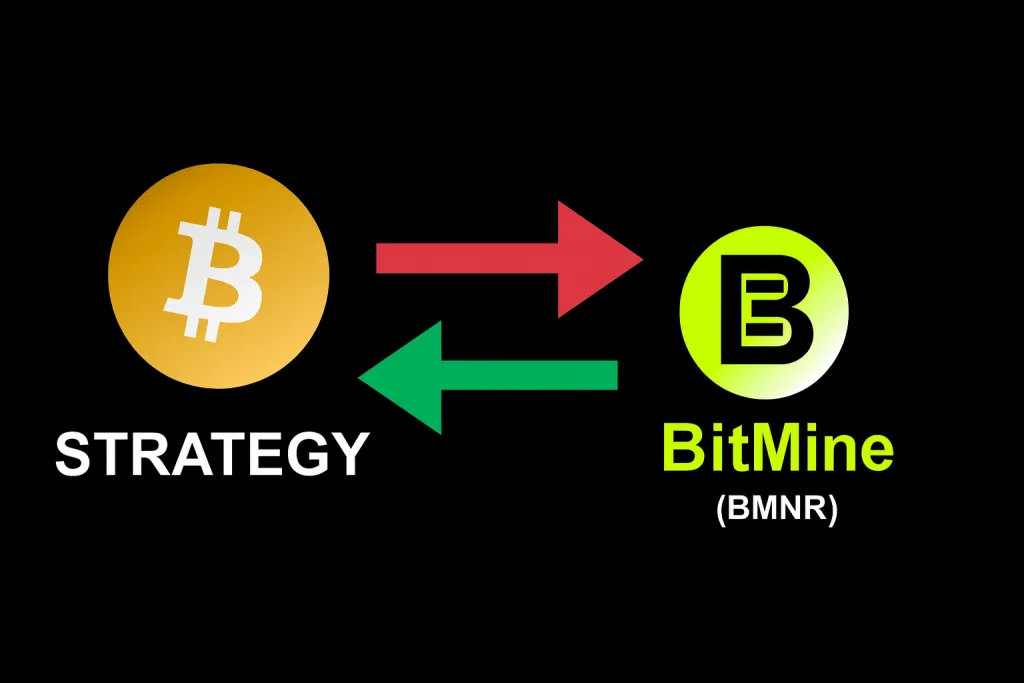
The differences, however, are crucial. Ethereum has functional utility, while Bitcoin is purely a store of value. BMNR uses equity ATMs and buybacks, while MicroStrategy leaned heavily on convertible debt. BMNR’s leadership is a coalition of respected voices like Tom Lee and Cathie Wood, while MicroStrategy’s rise was driven almost entirely by Michael Saylor’s singular conviction. The structural setup is similar, but the underlying asset and the style of execution are different. These differences may prove decisive in determining long-term outcomes.
BMNR’s Holdings and Positioning (Sept 2025)
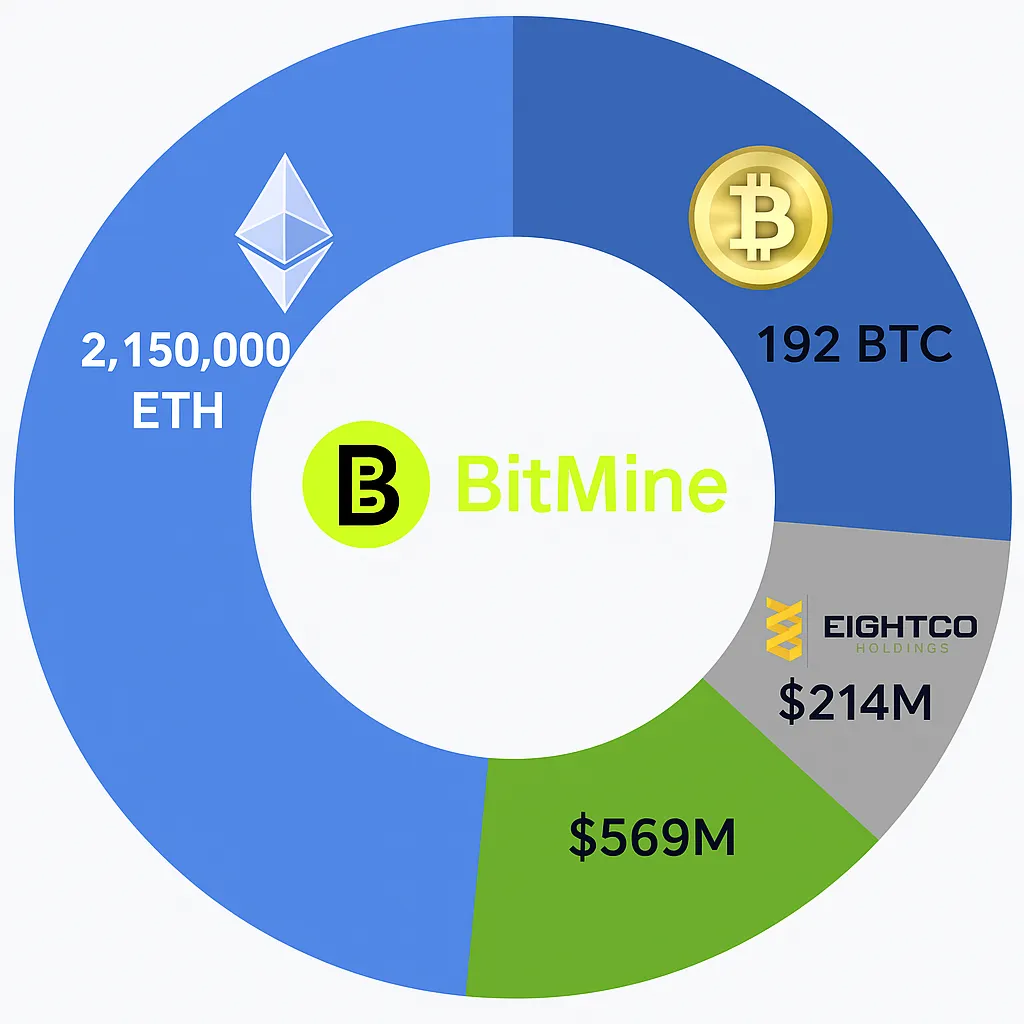
BMNR’s position as of September 2025 is striking. It holds 2.15 million ETH, making it the largest Ethereum treasury globally. Combined with cash and other crypto reserves, total holdings exceed $10 billion.
The company has also authorized a $24.5 billion at-the-market equity program, giving it enormous firepower to expand its holdings further. Finally, BMNR has a $1 billion buyback authorization, giving it the ability to support NAV and compress discounts in weak markets.
This combination of holdings and financial levers places BMNR in a unique position. It is not just sitting on ETH. It is actively managing capital to increase ETH per share, defend NAV, and build structural leverage. No other public company is attempting this playbook with Ethereum. The scope and scale of BMNR’s ambition make it one of the most interesting equity stories of the next decade.
Valuation Today: NAV and Premium
At an ETH spot price of $4,632, BMNR’s 2,151,676 ETH stack is worth nearly $10.0 billion. Adding in 192 BTC valued at about $22 million, a $214 million equity stake in Eightco, and $569 million in cash, the company’s total NAV comes to roughly $10.8 billion. The key question for investors is how the equity trades relative to this NAV.
Historically, vehicles of this type can swing between discounts and premiums depending on sentiment. However, with BMNR’s $1 billion buyback program in place, sustained deep discounts are unlikely. A structural premium of 10 to 30 percent is reasonable, which implies a current equity value in the range of $11.9 to $14.0 billion.
2030 Scenario Mapping: ETH Price → BMNR Share Price
For these projections we assume BMNR executes on its stated goal of owning roughly 5% of Ethereum’s total supply by 2030. With Ethereum’s circulating supply projected near 118 million ETH, this would give BMNR a treasury of about 5.9 million ETH, nearly triple its current holdings. The valuations below are based on this 5% supply assumption.
- Bear Case: ETH $5,000
NAV ~$29.5B ETH-only. With cash and a 15% premium, BMNR equity value is $34–38B. Implied share price: $125–140. - Conservative Case: ETH $10,000
NAV ~$59B. With premium, BMNR equity value is $70–80B. Implied share price: $260–300. - Base Case: ETH $15,000
NAV ~$88.5B. With premium, BMNR equity value is $105–120B. Implied share price: $390–440. - Bull Case: ETH $30,000
NAV ~$177B. With premium, BMNR equity value is $210–240B. Implied share price: $780–900. - Explosive Case: ETH $50,000
NAV ~$295B. With premium, BMNR equity value is $350–400B. Implied share price: $1,300–1,500. - Crazy Upside Case: ETH $100,000
NAV ~$590B. With premium, BMNR equity value is $700–800B. Implied share price: $2,600–3,000.
Regulatory and Structural Risks
The largest risk BMNR faces is regulatory. Ethereum’s classification as a security or commodity remains unsettled, and the arrival of ETH ETFs could reduce the structural value of BMNR’s wrapper. Execution missteps in managing equity issuance could also harm ETH per share. Governance decisions around staking or treasury policy present additional risks. Finally, volatility in ETH itself remains the single biggest determinant of BMNR’s valuation.
Global Adoption Tailwinds
Ethereum is already a critical part of global financial infrastructure. Stablecoins settled on Ethereum rival Visa in annual volume. Tokenized treasuries are beginning to migrate on-chain. Decentralized finance continues to grow. Ethereum’s network effects are strengthening, and its role in financial markets is expanding. For BMNR, this creates a structural tailwind. The more entrenched Ethereum becomes, the more valuable BMNR’s treasury becomes.
This dynamic mirrors what we have seen in other misunderstood infrastructure plays. Amazon Zoox is not just a rideshare company, but a bet on autonomous mobility infrastructure. Eos Energy is not just a battery company, but a solution to grid reliability. In the same way, Ethereum is not just a cryptocurrency, but the settlement layer of the future. BMNR is the liquid equity vehicle that captures this transformation.
The Narrative Premium
Numbers matter, but narratives drive multiples. Tesla was rewarded with a valuation far above its fundamentals because it told the story of a new energy system. MicroStrategy was rewarded for becoming synonymous with Bitcoin. BMNR has the opportunity to become the equity story of Ethereum. As the largest ETH treasury in the world, with capital-market levers to expand its holdings, BMNR is uniquely positioned to capture both NAV growth and narrative-driven premiums.
Investors should not underestimate the value of narrative. In frontier markets, story and perception can be worth as much as balance-sheet math. BMNR’s narrative premium could be a defining feature of its long-term trajectory.
BMNR’s Ability to Stake Ethereum
One of BMNR’s most compelling future levers is the ability to stake Ethereum. By participating in Ethereum’s proof-of-stake consensus, BMNR could convert its massive ETH treasury into productive collateral. Staking would generate native yield, typically in the range of 3 to 5 percent annually, which could be reinvested to purchase additional ETH or used to fund buybacks. This would add an organic compounding layer to BMNR’s strategy that Bitcoin treasuries like MicroStrategy cannot match.

The ability to stake also aligns BMNR with Ethereum’s security model, making it more than a passive holder. Over time, as staking infrastructure matures and regulatory clarity improves, BMNR could emerge not just as an ETH proxy but as an active participant in the network’s economic engine. This structural advantage differentiates BMNR from other crypto-related equities and enhances its long-term asymmetry.
BMNR’s Recent Investment in OCTO
In addition to building the world’s largest ETH treasury, BMNR has begun to make targeted strategic investments. One notable example is its recent investment in OCTO, a company positioned at the intersection of blockchain infrastructure and enterprise adoption. While details remain limited, the move signals that BMNR is willing to allocate capital beyond pure ETH accumulation when the opportunity aligns with its core thesis.

The OCTO investment reflects a broader strategic vision: BMNR is not only building exposure to ETH but also exploring adjacencies that could amplify Ethereum’s role as global financial infrastructure. If OCTO succeeds in driving institutional adoption of blockchain applications, BMNR could benefit indirectly, reinforcing its treasury’s value.
This willingness to deploy capital into strategic bets shows that BMNR’s management team is thinking several steps ahead, much like how Tesla used energy products to complement its automotive business or how Amazon built Kuiper alongside AWS.
Conclusion
BMNR is Ethereum’s MicroStrategy moment. It offers a public-market wrapper on ETH with structural levers that can expand NAV per share through issuance and buybacks. The company is already the largest Ethereum treasury in the world, and its capital-structure playbook positions it to grow even larger.
If Ethereum consolidates its role as the backbone of financial transactions worldwide, BMNR could become one of the most asymmetric equity vehicles of this cycle. The upside scenarios stretch into the hundreds of billions. For long-term investors who understand both the asset and the structure, BMNR represents an extraordinary opportunity.

Celsius Stock Analysis: The Shelf Reset and the Second Growth Curve
Celsius stock analysis of the shelf reset, Alani growth, Pepsi economics and cash flow, with a 2030 model and a Premium valuation and entry-price framework.

Meta AI Spending: The Customer Is Already Here
Can Meta turn AI spending into shareholder returns? We model advertising, Muse, hardware, capital costs and cash flow through 2030, with a full valuation.

IREN Stock Dilution: Can the Build Reach Shareholders?
IREN stock analysis of AI growth, funding and dilution through 2030. Read our full valuation, 27 scenarios and price zones free. Excel model is Premium.
Northwise Portfolios
See how the research becomes real decisions
Reader discussion
Discuss the research
Create a Free account to join the discussion with a display name.
Create a Free Account
No comments yet. Start a thoughtful discussion.