
What is BITF Stock
From Bitfarms to Keel: the five development locations, current commercial stage, Moses Lake equipment progress and the funding questions ahead.
In this article
BITF was the ticker associated with Bitfarms. The company now trades as Keel Infrastructure under KEEL and is developing North American HPC campuses. Readers arriving through the older BITF article should start with that changed identity and business model.
Keel's immediate challenge is to convert power positions and construction preparation into signed, financeable leases. A development pipeline is not yet a portfolio of operating AI rental assets. The Keel Data Center Tracker helps separate those stages across the named sites.
From mining to infrastructure development
The August operating update reported completion of US Bitcoin-mining decommissioning and active negotiations at the three priority sites. It did not announce an executed HPC anchor lease for those developments.
That distinction changes how the company should be evaluated. A campus can have usable power, equipment commitments and interested customers while its future rent remains uncontracted. The next commercial step matters because it can determine the building design, funding structure and delivery timetable together.
Keel's stated business is developing and owning data centers and energy infrastructure. The former article's assumption that the Washington programme established a fully owned GPU cloud was too strong. A contract for the supporting infrastructure does not establish who buys or operates the computing equipment.
The five development locations
Location | Role in the current portfolio | Site study |
|---|---|---|
Moses Lake, Washington | Near-term HPC development | |
Sharon, Pennsylvania | Near-term HPC development | |
Panther Creek, Pennsylvania | Near-term HPC development | |
Scrubgrass, Pennsylvania | Longer-term development and expansion potential | |
Sherbrooke, Quebec | Proposed consolidation and relocation of existing capacity |
The linked studies explain each site's reported capacity, dependencies and reviewed source dates. They also separate legacy energy or mining capacity from proposed IT load. The Sherbrooke project must not be counted as an entirely new block of power on top of the same existing capacity being transferred.
Moses Lake's equipment progress
Keel reported acceptance of its first Vertiv modules in the August update. Its capital-development materials describe a $128 million Vertiv agreement for critical infrastructure. That figure does not prove an all-in GPU-fleet budget.
On September 9, PowerSecure announced an agreement to design and deliver a modular standby-power solution for Moses Lake, including a design for peak shaving. The announcement identifies a supplier and intended function. It does not disclose completed commissioning, a new tenant or an additional block of contracted campus MW.
Equipment progress is meaningful because long lead times can constrain delivery. It still needs to be followed through installation, testing and customer acceptance.
Liquidity and the funding question
The August release reported approximately $819 million of liquidity as of August 7: $698 million of unrestricted cash and $121 million of unencumbered Bitcoin. The quarter included a $458 million convertible financing. Those are dated company figures, not today's cash balance.
More liquidity gives the developer time to negotiate and prepare sites. It does not mean the whole advertised pipeline is fully funded. Construction funding can depend on the tenant, the lease terms, the allocation of equipment spending and the lenders' requirements.
Shareholders also need to account for the financing instrument. Cash raised through a convertible improves the immediate funding position while creating future repayment or dilution considerations. Reporting only the cash benefit would leave out part of the transaction.
The questions that now matter
The first is commercial: which sites secure binding customers, for what capacity, term and delivery conditions? The second is execution: which permits, utility works and equipment packages remain before construction and commissioning? The third is financial: what capital must Keel provide, and how much cash can ultimately reach common shareholders?
The distinction between gross electrical power and critical IT load runs through all three. Applying a rental price per IT MW directly to gross campus power can overstate revenue. Applying one pilot project's cost across every site can conceal different scope and customer responsibilities.
The current model and the historical examples
For the valuation analysis published today, read Keel Stock Forecast 2030: Price of Patience. It is a separate dated model report with its own assumptions and access boundary. The Keel company page collects the remaining research.
The original article's illustrative calculations are retained below for historical continuity. They should not be treated as updated estimates, disclosed rental prices or evidence that Keel owns a GPU cloud. In particular, the Washington infrastructure contract does not validate the old owned-compute assumption.
Historical calculations retained from the original study
The following limited examples are preserved from the original publication. Their assumptions and outputs have not been revised. They are not current operating measurements, a new Northwise forecast or a statement of current contracted prices. The factual discussion above uses the latest reviewed evidence.
The original Washington examples assume ownership of GPUs and use $128 million as their cost anchor. That interpretation is not supported by the critical-infrastructure contract described above. The examples are retained exactly as historical calculations, including their former BITF name, old capacity totals and then-current assumptions; they must not be used as current forecasts.
The problem starts with capex. The company’s clearest disclosed HPC/AI build is the Washington pilot: 18 MW tied to a fully funded $128M project. That works out to about $7.1M per MW. At that pace, the math changes fast.
AI capacity built | Implied capex at $7.1M per MW |
|---|---|
18 MW | $128M |
50 MW | $355M |
100 MW | $711M |
250 MW | $1.78B |
500 MW | $3.56B |
1 GW | $7.11B |
That is why one investor can look at the stock and see a cheap option, while another sees an undercapitalized development story. A 50 MW outcome is within reach with outside help. A 250 MW outcome already points to a very different financing structure. A multi-gigawatt outcome belongs in a separate category entirely.
Revenue assumptions also move the valuation a lot. A useful benchmark comes from wholesale colocation pricing. CBRE reported average asking rates of about $196.25 per kW per month in primary U.S. markets during H2 2025. Annualized, that works out to roughly $2.355M of revenue per MW per year. BITF will not necessarily get that exact number at every site, in fact it may get much higher by owning the GPUs, though it gives a workable reference point for scenario building.
Using that benchmark:
Monetized AI capacity | Illustrative annual revenue |
|---|---|
18 MW | $42M |
50 MW | $118M |
100 MW | $236M |
250 MW | $589M |
A simple way to see the problem is to map three different outcomes.
Model | Comparable frame | What BITF would be monetizing | Capex burden | Revenue potential per MW | Financing need |
|---|---|---|---|---|---|
Power / land / shells | Closer to CIFR | Powered land, site readiness, shell capacity, long-term leases | Lowest of the three | Lowest | High, but more realistic |
Hybrid infrastructure | Closer to IREN | Shell economics plus selected deeper infrastructure exposure | Middle | Middle | Large |
Full-stack AI platform | Closer to NBIS | Power, sites, owned clusters, operating layer, customer workloads | Highest by far | Highest | Massive |
The shell case is the easiest place to start.
In that version, BITF prepares the site, secures the power, gets the campus ready, and signs a long-term customer that funds most of the expensive compute layer. The company is earning value through speed to power, permitting, land control, and development execution rather than through owning the GPUs itself.
That produces one kind of financial picture.
Illustrative shell-style picture
Assume BITF gets a 100 MW site ready and leased under a shell-style model.
The company still has to spend meaningful capital on land, substations, cooling, utilities, and construction. The exact figure will vary a lot by site and by customer structure, so the point here is directional. If readers assume a shell-style development cost of roughly $3M to $7M per MW, 100 MW points to a capital range of about $300M to $700M.
Illustrative shell case | Low | High |
|---|---|---|
Capacity | 100 MW | 100 MW |
Capex per MW | $3M | $7M |
Total capex | $300M | $700M |
Revenue model | Lease / shell / site payments | Lease / shell / site payments |
Financing burden | Significant | Significant |
That is still a large number for BITF. It is also a number the market can at least imagine being funded through a mix of site-level financing, partner capital, sale-leaseback structures, or customer support.
Now compare that to the owned compute case.
Washington is the company’s clearest disclosed AI build. It is an 18 MW conversion tied to a fully funded, binding $128M agreement and management has said the site is being developed around owned GPU infrastructure rather than as a pure shell lease. That is about $7.1M per MW before readers even start layering in the much larger capital needs that come with scaling that model more broadly.
That picture looks very different.
Illustrative owned-GPU picture
Assume BITF tries to scale toward 100 MW while owning the compute layer.
Washington already gives readers a hard anchor of roughly $7.1M per MW on the first 18 MW build. That should not be treated as a shell benchmark. It belongs to a much more capital-intensive model. Once readers imagine scaling that type of build, the capital requirement rises quickly.
Illustrative owned-GPU case | 18 MW | 100 MW |
|---|---|---|
Known project cost anchor | $128M | — |
Implied cost per MW from Washington | $7.1M | $7.1M |
Implied build cost at same pace | $128M | $711M |
Compute ownership | Yes | Yes |
Financing burden | Large | Very large |
From there, the math splits into two very different pictures.
Picture 1: shell-style development
In a shell-style path, the company prepares the land, power, utilities, cooling, and site infrastructure, then leases the site or powered shell to a larger customer. This is still expensive. It is just more financeable than owning the compute layer.
A reasonable illustrative range for shell-style development is about $3M to $7M per MW.
Shell-style development need | $3M per MW | $5M per MW | $7M per MW |
|---|---|---|---|
430 MW secured power | $1.29B | $2.15B | $3.01B |
2.2 GW total pipeline | $6.6B | $11.0B | $15.4B |
Even the low end of the secured-power buildout is well above current liquidity. The full pipeline sits in a completely different capital category.
Picture 2: owning the compute layer
The second path is much heavier. In this version, BITF does not stop at site preparation. It also owns the AI infrastructure placed inside those sites.
Washington is useful here as a real anchor. The company’s first 18 MW AI project carries a disclosed $128M funding package, or about $7.1M per MW. That already points to significant capital intensity, and Washington should not be treated as a shell example. It is part of a much deeper infrastructure approach.
Once readers move beyond one pilot and imagine a broader owned-compute strategy, the capital requirement rises sharply. A simple illustrative range of $15M to $25M per MW is enough to show the difference.
Owned-compute development need | $15M per MW | $20M per MW | $25M per MW |
|---|---|---|---|
430 MW secured power | $6.45B | $8.60B | $10.75B |
2.2 GW total pipeline | $33.0B | $44.0B | $55.0B |
That is the point where the current balance sheet stops being the main funding source and starts looking like a small down payment on a much larger ambition.
KEEL Stock Forecast 2030: The Price of Patience
KEEL’s 2030 forecast follows five AI infrastructure sites through construction, tenant acceptance, debt, dilution and the cash left for shareholders.
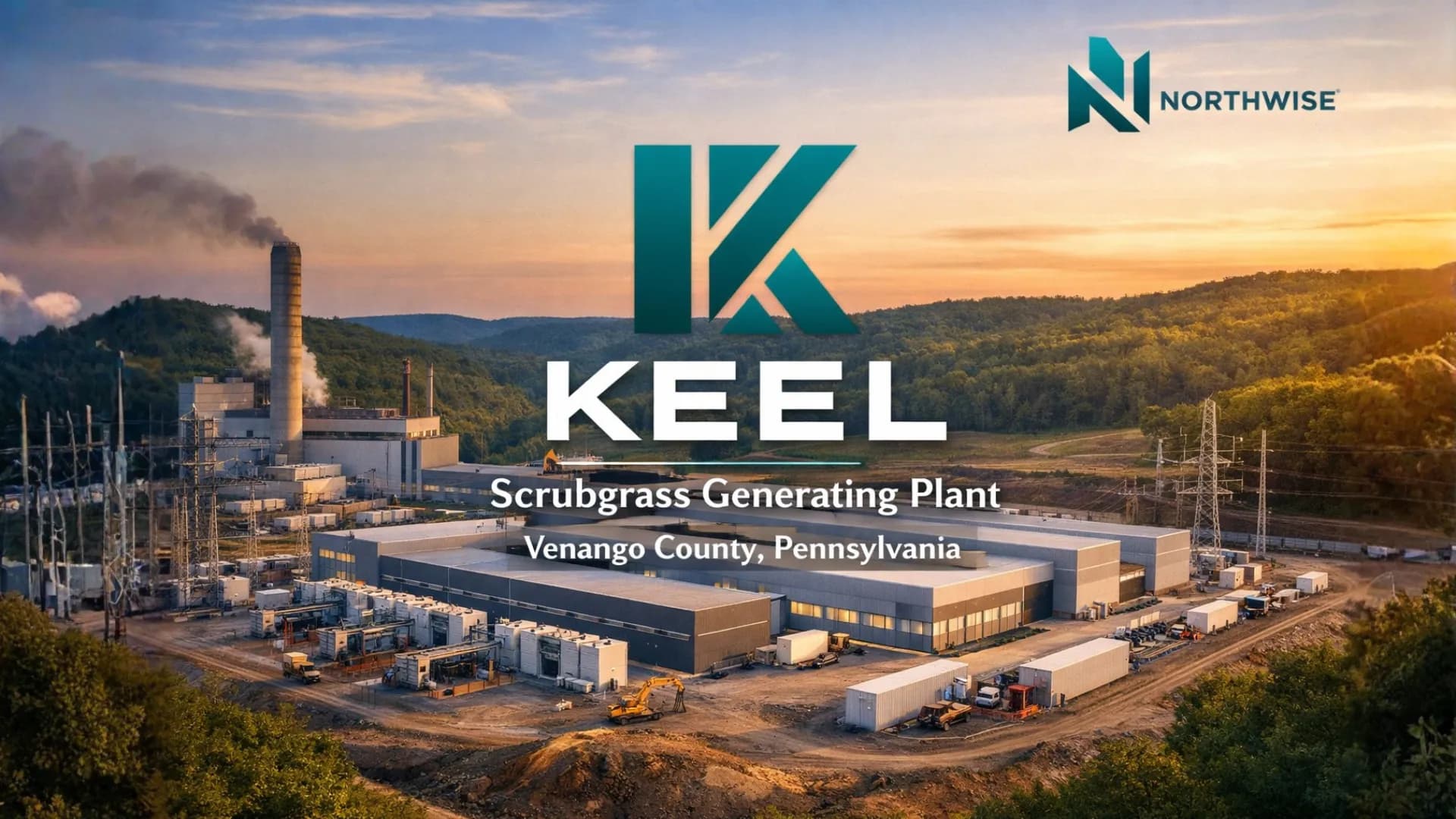
KEEL Scrubgrass Site Analysis
Scrubgrass: legacy generation, the potential 1.3 GW campus and the power, environmental and commercial work still required.
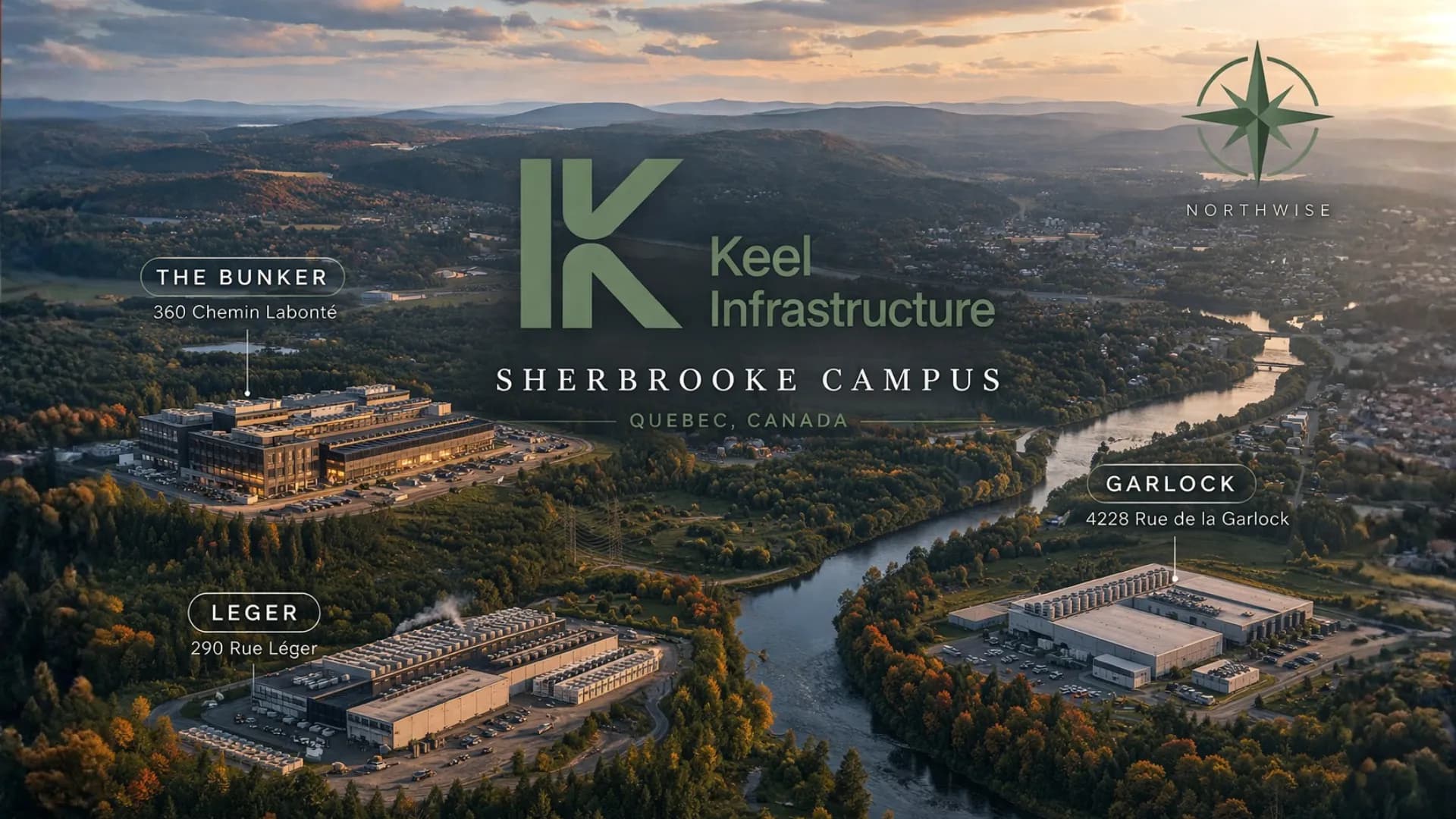
KEEL Sherbrooke Data Center
Sherbrooke: the conditional consolidation of existing 96 MW into one planned AI campus, land conditions and 2028 service target.
Northwise Portfolios
See how the research becomes real decisions
Reader discussion
Discuss the research
Create a Free account to join the discussion with a display name.
Create a Free Account
No comments yet. Start a thoughtful discussion.