
Spotify Stock Forecast
Spotify stock forecast 2030 explores why the market still undervalues Spotify’s shift from distributor to platform and its monetization potential.
In this article
Spotify Stock Forecast 2030: Platform Potential Still Mispriced
The market still sees Spotify as a music app. We see it as the emerging infrastructure layer for the global audio economy.
Where Spotify Stands Today
Spotify continues to be framed as a music distributor. Analysts still anchor their models to licensing costs, monthly active users, and the growth of paid subscribers.
But Spotify has quietly outgrown the bounds of that narrative. Beneath the surface is a structurally evolving business, one that is shifting from distribution to infrastructure. Spotify is laying the groundwork to become the audio layer of the internet.
With the right execution, its business model will look less like a streaming service and more like a platform. The market hasn’t caught up to that transition.
Spotify is now operating at the intersection of consumer engagement, creator empowerment, and scalable monetization. Unlike music labels or hardware companies, it is building a flywheel that pulls creators, advertisers, and audiences into one ecosystem.
The more time users spend inside that ecosystem, whether listening to a podcast, browsing live events, or purchasing audiobooks, the more diversified and margin-friendly Spotify’s revenue becomes.
This Spotify stock forecast is not about a subscription service. It is about a platform.
Backstory and Leadership
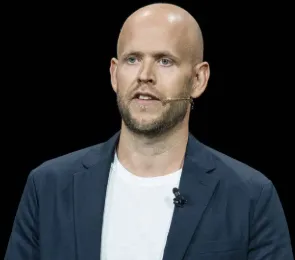
Spotify was founded in 2006 in Sweden with a simple but ambitious goal: create a legal alternative to piracy. Daniel Ek, who still serves as CEO, launched Spotify on a freemium model that gave users free access to music while monetizing through advertising and premium subscriptions.
It worked. Spotify scaled across Europe and entered the U.S. market in 2011. In 2018, it went public through a direct listing. By 2020, it had begun to expand beyond music licensing into exclusive content and platform features.
Over the past five years, Spotify has transformed from a music app into a multi-dimensional audio service. Between 2020 and 2023, it signed exclusive podcast deals with Joe Rogan, Call Her Daddy, and other top creators. These signings gave Spotify more control over where and how its users spend time.
In 2024, the company reached consistent profitability. In 2025, it launched full audiobook integration, opened up video podcasting monetization to creators, and expanded global advertising infrastructure through programmatic partnerships with firms like Google’s DV360 and LiveRamp.
Daniel Ek has made clear that Spotify is not trying to build a traditional content company. His vision is to create the global operating system for audio: a toolset, a distribution system, and a monetization engine all in one. That shift is now underway and a key part of our Spotify stock forecast.
The Core Business in 2025
As of Q1 2025, Spotify has 678 million monthly active users and 268 million premium subscribers. The company generated €4.19 billion in revenue in the quarter, up 15 percent year over year. Gross margins reached 31.6 percent. Free cash flow came in at €534 million. This marked the first full year of sustainable profitability for the company.

Spotify’s business remains concentrated in premium subscriptions, which account for about 90 percent of its revenue. But the company’s ad-supported segment is expanding quickly and carries higher incremental margins.
More importantly, the infrastructure to support ad revenue is starting to mature. With a functioning ad tech stack, growing programmatic demand, and a sizable global user base, Spotify is now beginning to benefit from real operating leverage. The company is scaling, and it is doing so without expanding its cost base at the same pace.
From Distribution to Platform
Spotify is no longer just a streaming company. It is evolving into a multi-sided audio platform. The Spotify Audience Network (SPAN) is becoming a global advertising engine.
Its creator tools, including Anchor and Megaphone, give podcasters a one-stop hub for distribution, analytics, and monetization. Audiobooks now live inside the core app, with in-app purchases enabled on iOS following Apple’s rule change.
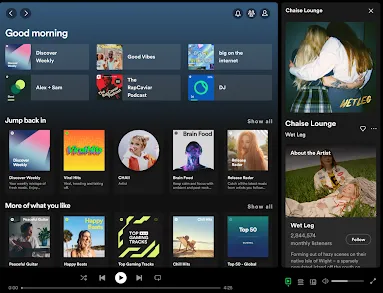
Spotify is also building infrastructure around live events, ticketing, and video podcasts. These are not gimmicks. They are vertical expansions that increase engagement and enable new forms of monetization.
The more Spotify owns the end-to-end relationship between creators and consumers, the more platform-like its business becomes.
What began as a play to aggregate licensed content has turned into a blueprint for an infrastructure layer. The more content that is created, hosted, and monetized directly on Spotify’s stack, the greater the leverage over its unit economics.
As users interact with a growing number of services, beyond just streaming music, the total addressable market for Spotify’s platform compounds over time. Their shift to diversify revenue is critical to our Spotify stock forecast.
The Royalty Ceiling
Roughly 70 percent of Spotify’s music revenue still goes back to rights holders. These licensing obligations are fixed and significant. They limit gross margin expansion and create a ceiling on profitability. This is one of the main reasons the market continues to view Spotify through a distribution lens.
By contrast, YouTube and other ad-first platforms generate higher-margin revenue through owned infrastructure and direct creator monetization. For Spotify to be valued in that same category, it must shift time and revenue away from licensed music and toward its own platform economics.

That means increasing ad-supported listening, growing audiobooks and live content, and creating monetization layers for creators.
Spotify’s upside is not about more users. It’s about better mix. The company has to control more of its margin stack and reduce its reliance on licensing. Every additional minute spent on owned content is a minute where Spotify controls both the experience and the economics.
Key Deals and Platform Signals
Our Spotify stock forecast heavily involves Spotify’s investment beyond music licensing.
Spotify’s renewed Joe Rogan deal in 2024 marked a turning point. The show remains exclusive to Spotify for full episodes but now syndicates clips through YouTube. This hybrid strategy reflects confidence in Spotify’s platform but also an awareness that discovery still happens elsewhere.

Other exclusive content, including Call Her Daddy, Dax Shepard, and Emma Chamberlain, continues to drive daily retention. In early 2025, Spotify opened its Partner Program for video podcasts, allowing creators to monetize their content directly on the platform.
On the ad side, Spotify expanded its network through integrations with Google’s DV360 and LiveRamp. These deals allow advertisers to target Spotify listeners with greater precision using existing programmatic infrastructure.
This is not a content company playing catch-up. It is a platform stitching itself into the digital ad ecosystem.
These moves signal something important. Spotify isn’t trying to control content. It is trying to own the rails through which all audio flows. That is the more durable play.
The Competitive Landscape
Spotify operates in a noisy category, but few of its competitors are building the same infrastructure stack.
YouTube remains its most credible threat. Its recommendation engine, search dominance, and creator ecosystem make it a powerful force in audio.
Apple Music offers strong product polish but lacks creator monetization and ad infrastructure. Amazon Music has voice-driven usage and bundles well with Prime but sees low daily engagement.
TikTok controls music discovery but doesn’t own long-form consumption. Podcast networks and audiobook platforms remain fragmented. None have Spotify’s vertical integration.
Spotify’s edge is not just distribution. It’s the ability to own both the audience and the infrastructure. When a user listens to a podcast, attends a live event, and makes a payment, all within the same stack, the platform becomes more than a product. It becomes embedded infrastructure.
What Needs to Happen Next
Spotify’s margin profile will only change if the company executes on a few critical fronts:
- Monetize creators directly through subscriptions, tipping, and advanced tooling.
- Scale the Spotify Audience Network globally and deepen its programmatic reach.
- Build a unified Spotify identity system to support commerce and payment infrastructure across all experiences.
- Grow verticals like audiobooks and live events to raise average revenue per user and lower customer acquisition cost.
- Invest in AI to support ad targeting, creator tooling, and personalized experiences.
Each of these unlocks incremental margin while improving user retention and are critical to our Spotify stock forecast. Done together, they compound the value of the platform and widen the gap between Spotify and its peers. Done together, they compound the value of the platform and widen the gap between Spotify and its peers.
Valuation: Today vs 2030
As of May 2025, Spotify trades at a $134 billion market cap with an enterprise value of $127.5 billion. Its EV/Revenue multiple is 6.97, EV/EBITDA is 61.2, and its forward P/E sits at 61. These reflect a profitable company still in transition.
To project a 2030 Spotify stock forecast valuation, we start with Spotify’s current quarterly revenue of €4.19 billion and annualize it to roughly €16.8 billion. Assuming a 12 percent annual growth rate, Spotify could generate between €30 billion and €35 billion in revenue by 2030.
If gross margins continue improving and the company reduces reliance on licensing, we estimate EBITDA and free cash flow margins could reach 20 to 25 percent.

That implies:
- EBITDA: €6 to €8.75 billion
- Free Cash Flow: €6 to €8.75 billion
Applying modest platform-aligned multiples:
- EV/FCF (25x) = $165 to $206 billion
- EV/Revenue (10x) = $330 billion
- EV/EBITDA (20x) = $132 to $154 billion
- EBITDA: €6 to €8.75 billion
- Free Cash Flow: €6 to €8.75 billion
Applying modest platform-aligned multiples:
- EV/Revenue (10x) = $330 billion
- EV/EBITDA (20x) = $132 to $154 billion
- EV/FCF (25x) = $165 to $206 billion
We use these EV-based metrics because they better reflect operational scale and cash efficiency without distortion from accounting or tax variables. They also match the valuations of companies like Meta and Alphabet during their platform phases.
This points to a Spotify stock forecast of 2x to 2.5x upside from today’s value if Spotify delivers on its strategic transition.
Spotify could outperform these numbers and see an increased market cap to show for it. However transition and execution risks remain and we prefer to evaluate our base cases under conservative assumptions.
The Northwise Take on Spotify
Spotify is potentially mispriced because the market still sees distribution. We see infrastructure.
This is a company with global reach, a scalable audience, and a monetization model that is still in transition. If it can shift its economics toward platform dynamics, the business will compound in ways that are not yet reflected in its valuation.
The story is not about more users or more streams. It is about changing what those streams are worth and a greater mix of profits.
The next five years will determine whether Spotify becomes the audio layer of the internet or remains a high-volume, low-margin middleman. We’re betting on the former.

Spotify Stock Forecast 2030
Our Spotify Stock Forecast 2030 models subscriber growth, pricing power, AI strategy, margins, valuation, price targets, risks, and SPOT stock buy zones.

Celsius Stock Analysis: The Shelf Reset and the Second Growth Curve
Celsius stock analysis of the shelf reset, Alani growth, Pepsi economics and cash flow, with a 2030 model and a Premium valuation and entry-price framework.

Meta AI Spending: The Customer Is Already Here
Can Meta turn AI spending into shareholder returns? We model advertising, Muse, hardware, capital costs and cash flow through 2030, with a full valuation.
Northwise Portfolios
See how the research becomes real decisions
Reader discussion
Discuss the research
Create a Free account to join the discussion with a display name.
Create a Free Account
No comments yet. Start a thoughtful discussion.