
Spotify Stock Forecast 2030

Our Spotify Stock Forecast 2030 models subscriber growth, pricing power, AI strategy, margins, valuation, price targets, risks, and SPOT stock buy zones.
In this article
This Spotify Stock Forecast 2030 examines whether pricing power, AI-driven productivity, and creator monetization can push Spotify beyond management’s long-term targets.
1. Executive Summary
Spotify spent most of its public life as an argument about operating leverage. The bulls insisted it would arrive. The bears doubted it ever could. That argument is now settled in the financial statements.
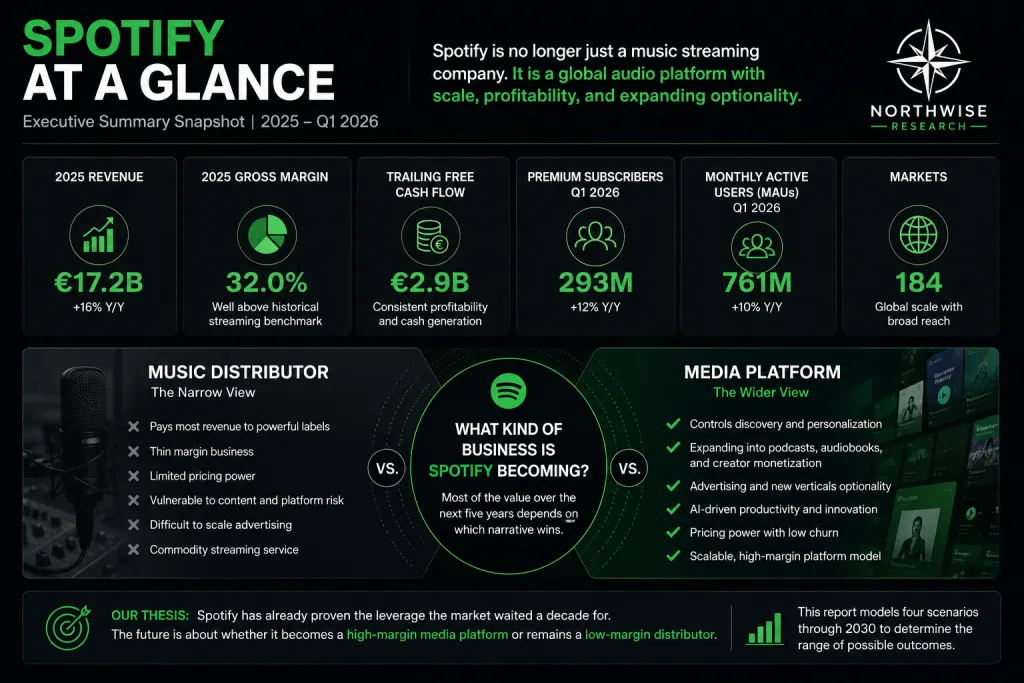
The company finished 2025 with 17.2B euros in revenue, a 32% full-year gross margin, and 2.9B euros in trailing free cash flow, and it entered 2026 producing operating profit on a consistent basis. The leverage the market waited a decade to see is no longer theoretical.
What replaced that debate is a harder one. Investors have stopped asking whether Spotify can make money and started asking what kind of business it is turning into. Read narrowly, Spotify is a music distributor that hands most of its revenue to a few powerful labels and keeps a thin slice. Read more widely, it is a media platform that increasingly controls discovery, personalization, creator monetization, advertising, audiobooks, and now licensed generative audio. Almost all of the value created over the next five years hangs on which of those two descriptions proves closer to the truth.
Spotify formally established the following targets at its May 21, 2026 Investor Day:
- Revenue growth: Mid-teens annual revenue CAGR through 2030.
- Gross margin: 35%–40%
- Operating margin: Above 20%
Our judgment is that Spotify earns a place on the Northwise research watchlist with its business quality largely settled and valuation discipline as the binding constraint. The company is strong enough operationally to support a base case near management's stated 2030 framework. The current evidence does not yet justify placing an outsized probability on the most optimistic outcomes.
It helps to also be precise about where the bear case actually lives. Most of it rests on events that have not happened. Labels could recapture the pricing gains Spotify has taken. AI could flood the catalog with low-quality content. YouTube could take paid share. Advertising could stay weak. The co-CEO structure could blur accountability. Subscriber growth could stall.
Each of those risks belongs in the model, and we weight every one of them. None of them should anchor the base case while the observable company keeps adding subscribers, raising prices without visible churn, and expanding margins. A risk that has not yet shown up in the operating results is a reason for conditionality, not for treating the downside as the central path.
The list of things Spotify has already proven runs longer than its skeptics tend to allow. The subscription product is deeply habitual. Price increases have gone through without mass churn. Premium subscribers reached 293 million by the first quarter of 2026 and continue to grow. Gross margin has climbed well above the music-streaming ceiling analysts treated as structural for years. Podcasts reached profitability after a costly investment cycle. Free cash flow scales, operating expenses have grown more slowly than gross profit, and new verticals have deepened engagement instead of merely adding cost.
The honest counterweight is just as specific. Advertising has not become a scaled growth engine despite hundreds of millions of free users. Audiobooks+ shows early traction toward roughly 100M dollars in annualized revenue, though it stays small against the whole. Creator memberships and licensed generative media are real but not yet financially material. Spotify has shown it can expand margin, not that a 40% gross margin holds. AI product revenue is mostly optionality today. The company remains dependent on a handful of rights holders, and the new leadership structure has not yet been tested by a serious strategic setback.
From there we model four operating paths through 2030.
The bear case has Premium growth slowing while staying positive, modest pricing, weak advertising, and gross margin reaching only the floor of management's range.
The base case approximates the framework itself: mid-to-high single-digit subscriber growth, steady ARPU gains, gross margin near 38%, and operating margin above 22%.
The bull case asks pricing, advertising, and new monetization to compound together, lifting gross margin above 40% and operating margin into the mid-20s.
The exceptional case asks Spotify to become a dominant creator and generative-media platform, a low-probability outcome we carry for completeness.
The full operating model and the probability framework follow below. At a share price near 468 dollars, the qualitative read is that Spotify offers a reasonable long-duration entry that's not quite yet a deep-value opportunity, with the return profile improving meaningfully on weakness. The probability-weighted 2030 target, the present-value ladder, and the defined buy, hold, and trim zones sit in the premium section.
For portfolio purposes, Spotify is best understood as a quality-growth compounder with platform optionality. It suits long-duration quality-growth books, consumer-platform allocations, AI application-layer baskets, and barbell structures that pair profitable growth against cheaper value. It fits poorly in income or deep-value mandates, in portfolios that need near-term multiple support, and in books already crowded with consumer subscription names.
2. The Historical Crucible
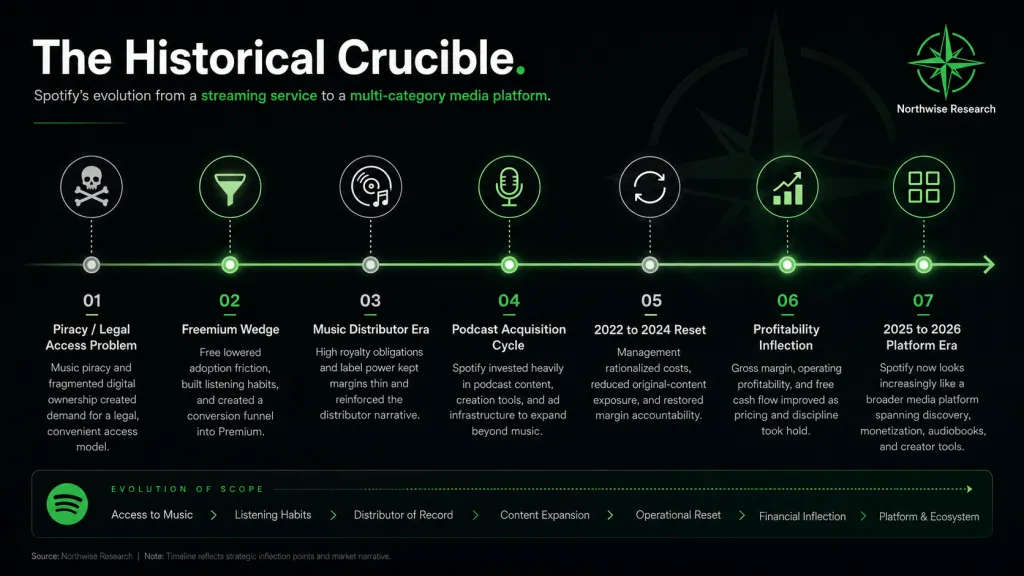
To understand why the margin debate carries so much weight, it helps to return to the problem Spotify was built to solve. Music piracy was everywhere, digital ownership was fragmented, and the major labels needed a legal channel that consumers would actually use. Listeners had already shown they wanted access over ownership, and artists needed global distribution even while the economics stayed contested. Spotify's original value was never cheap music. It was instant legal access paired with a convenience that piracy could not match on reliability or breadth.
The Free tier was the wedge that made all of this work. It handed users a legal alternative to piracy, lowered acquisition friction, trained listening habits, and built a funnel into Premium. It also generated behavioral data before any money changed hands and let Spotify establish itself in markets where paid adoption was thin. Free has always carried two jobs at once, as an advertising product and as a customer-acquisition system, and the pull between maximizing ad revenue and protecting Premium conversion still runs through the business today.
The early economics, though, were brutal. High royalty obligations, minimum guarantees, concentrated label bargaining power, low launch pricing, heavy acquisition spending, and thin differentiation beyond discovery combined to cap gross margin somewhere in the mid-20s. That cap hardened into a belief, and the belief shaped how the market valued Spotify for most of its public life. Unwinding it is a large part of the present opportunity.
The podcast era was Spotify's first serious attempt to escape that cap. The logic held together on paper. Podcasts offered proprietary content, advertising economics that looked better than music, and a route toward a creator platform less beholden to the labels. Anchor supplied creation tools, Megaphone supplied advertising infrastructure, and exclusive deals with Gimlet, The Ringer, and others promised differentiation.
However, the execution proved expensive. Owned content did not scale cleanly, the advertising systems stayed fragmented, creator economics resisted standardization, and production and talent costs ran hot. By 2022 the market had begun to wonder whether management had lost its spending discipline. The assets that survived turned out to be the infrastructure, Anchor and Megaphone, not the costly exclusive shows.
The correction that followed was deliberate. Spotify cut its workforce, rationalized products, pulled back on original content, moved toward open distribution, leaned into creator tools, and reintroduced margin accountability. Pricing rose, and projects without measurable returns lost their funding. We read this stretch as a strategic correction, not an abandonment of the creator-platform ambition, since the tooling and distribution layers came through intact while only the unprofitable content bets were cut loose.
The result shows up plainly in the financials. Spotify moved from growth at the expense of margin toward sustained operating profitability, expanding gross margin, strong free cash flow, and more disciplined investment. The point worth holding onto is that the current economics were built through both cost discipline and durable product improvement. They are not merely the residue of layoffs, since gross margin and pricing power have continued to improve well after the cost actions were complete.
3. Spotify's Business Architecture
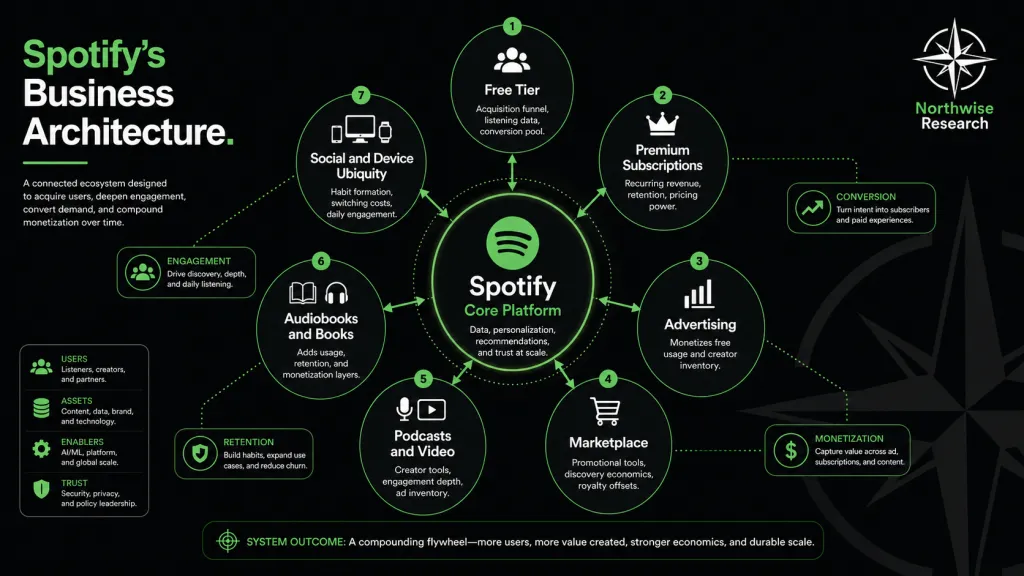
Layered on top of that history is a business with more moving parts than its single subscription line suggests, and the parts interact in ways the headline numbers obscure.
The Free tier remains the foundation. It is the top of the acquisition funnel, a global data engine, a habit builder, an advertising surface, a conversion pool, and a defense against listeners defaulting to YouTube. Its central tension never resolves: extracting advertising revenue from Free pulls against preserving the incentive to convert to Premium. Spotify has historically settled that tension in favor of conversion, which is one reason advertising stays under-scaled to this day.
Premium subscriptions sit at the center of the economics, and the structure is more intricate than a single price. Individual, Duo, Family, Student, prepaid, telecom-bundled, and partner-distributed plans layer over regional pricing and promotional trials. That structure shapes ARPU, churn, household retention, payment economics, acquisition cost, and geographic mix all at once. A household on a Family plan behaves nothing like an individual subscriber in a high-priced market, which is why reported ARPU can move for reasons that have little to do with underlying pricing power, a distinction that becomes important when we model pricing later.
Advertising spans music audio, display, and video, podcast sponsorships, programmatic podcast inventory, the automated ad exchange, creator campaigns, and promotional tools. The infrastructure to monetize Free at scale already exists. The demand and pricing to fill it have not yet followed, which keeps advertising strategically important and financially under-proportionate to the size of the audience it serves.
A separate economic layer runs through Marketplace, the set of programs such as Discovery Mode, Marquee, and Showcase aimed at artists and labels. Its effect shows up mostly through royalty offsets and promotional spending instead of as a clean standalone segment. These programs carry their own controversy, since surfacing artists in exchange for reduced royalties can resemble pay-to-play discovery, a tension worth tracking as the programs grow into the margin story.
Podcasts and video form a three-sided structure of consumer distribution, creator and publisher tools, and advertising and membership monetization. Video reshapes Spotify's position against YouTube by adding inventory and improving creator retention, at the cost of higher delivery expense. The strategic value increasingly sits in owning the tools and the distribution, not the shows themselves.
The books layer extends the same logic into a new medium through bundled listening hours, the Audiobooks+ add-on, higher-hour tiers, Family and Student extensions, author tools, digital narration, Page Match, and Bookshop.org integration. Books can lift lifetime value long before they become a large revenue line, since added hours deepen engagement and feed the recommendation engine more signal to work with.
Underneath all of it run the features that make leaving inconvenient. Social tools such as Jam, collaborative playlists, shared listening, and fan communities embed the product in group behavior and raise switching costs. Device ubiquity across phones, cars, speakers, televisions, consoles, wearables, and desktops compounds the effect. Neither is a traditional moat on its own. Together they make Spotify the path of least resistance across a user's entire day, which supports retention more reliably than any single feature could.
4. User Growth, Engagement, and Global Penetration
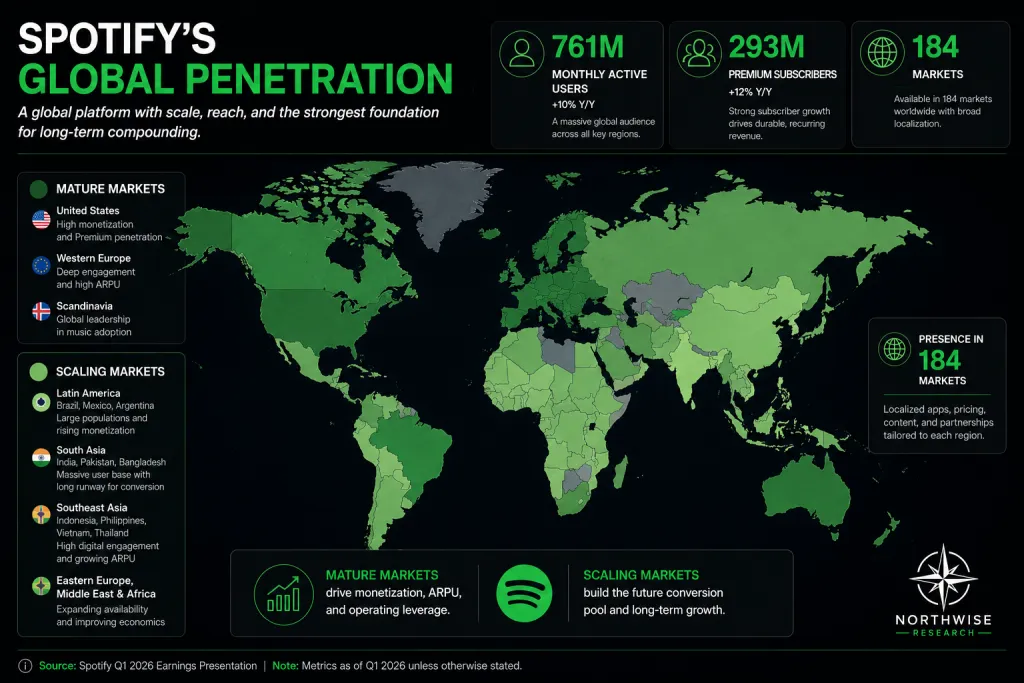
That architecture rests on a scale few media businesses ever reach. As of the first quarter of 2026, Spotify carried more than 761 million monthly active users and 293 million Premium subscribers across 184 markets, with the Free base in the hundreds of millions and growth continuing in mature and developing markets alike. The scale is the raw material for everything downstream: conversion, advertising inventory, and negotiating leverage with rights holders.
The growth story splits cleanly along the line between mature and scaling markets, and the two raise different questions. In the United States, Western Europe, and Scandinavia, the relevant issues are how much penetration remains, whether household plans can extend growth past individual saturation, how much ARPU can come from pricing, and whether add-ons can lift revenue once subscriber growth slows. Saturation also raises the quieter question of whether churn rises as the easiest customers are already won, which is why management commentary on retention deserves close reading.
Brazil, Mexico, India, Southeast Asia, Eastern Europe, the Middle East, and Africa drive raw user scale and build the conversion pools of the future. They also dilute reported ARPU, since pricing in these markets sits well below mature-market levels. That dilution is a sign of healthy expansion, not weakness, even as it complicates any simple reading of blended ARPU. These markets do more than add users. They strengthen Spotify's leverage with global labels and expand both advertising inventory and cultural data.
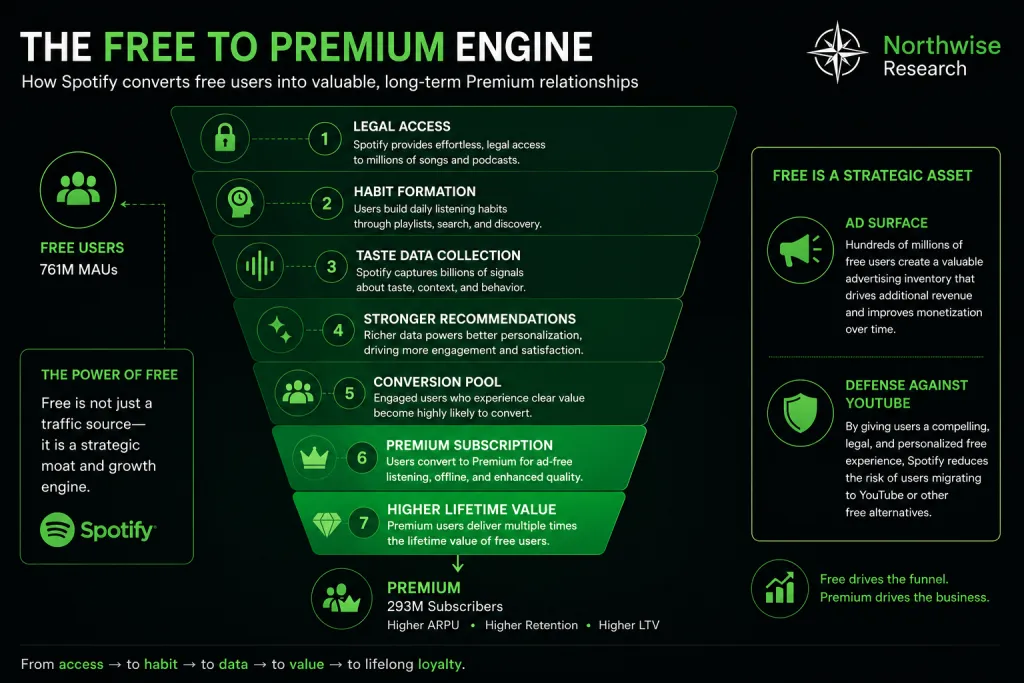
Conversion and churn are where the disclosure runs thin, so we infer rather than observe. Spotify does not publish full cohort conversion data, which leaves us reading regional subscriber growth, promotional activity, payment partnerships, engagement trends, tenure, plan mix, and reactivation behavior. The evidence for strong retention is circumstantial but consistent. Minimal visible reaction to price increases, long-tenured accounts, multi-device usage, accumulated playlists, household plans, and social features all point toward high switching costs. Reported subscriber growth can still conceal reactivation and churn dynamics, so the model treats retention as a monitored variable instead of a settled fact.
One framing deserves to be kept out of the model entirely. Management has described a long-term north star of one billion subscribers alongside 100 billion dollars in revenue. That is a destination, not a 2030 forecast, and we exclude it from the base case. The earlier ambition of one billion users was a reach figure. The newer framing around one billion paying relationships is far more demanding, and treating it as a model input would overstate the credible path.
What we do model is the subscriber base itself, expressed as annualized growth paths rather than precise point forecasts.
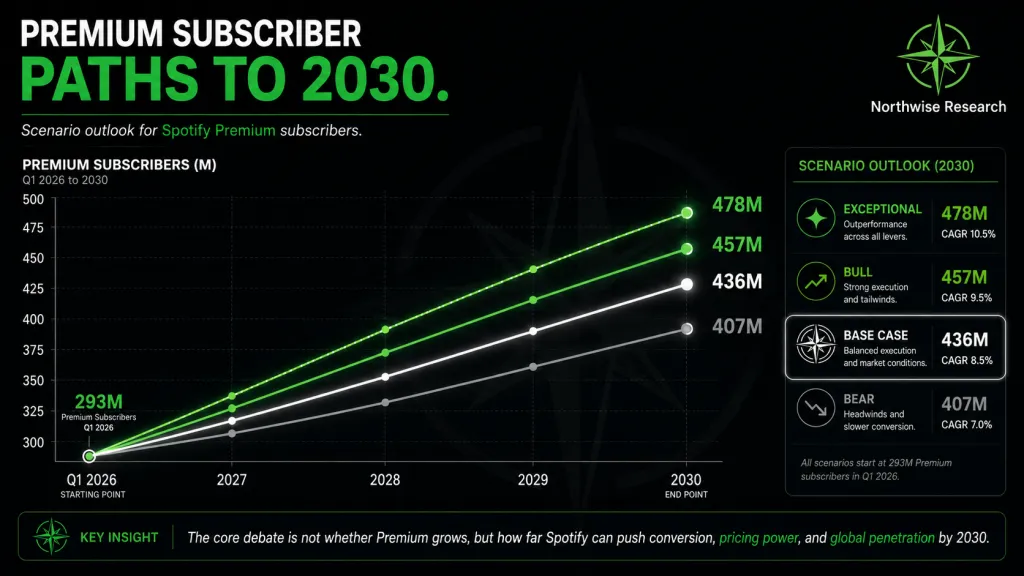
Scenario | Premium Subscriber CAGR | 2030 Premium Subscribers |
|---|---|---|
Bear | 7.0% | 407M |
Base | 8.5% | 436M |
Bull | 9.5% | 457M |
Exceptional | 10.5% | 478M |
5. Premium Subscription Economics and Pricing Power
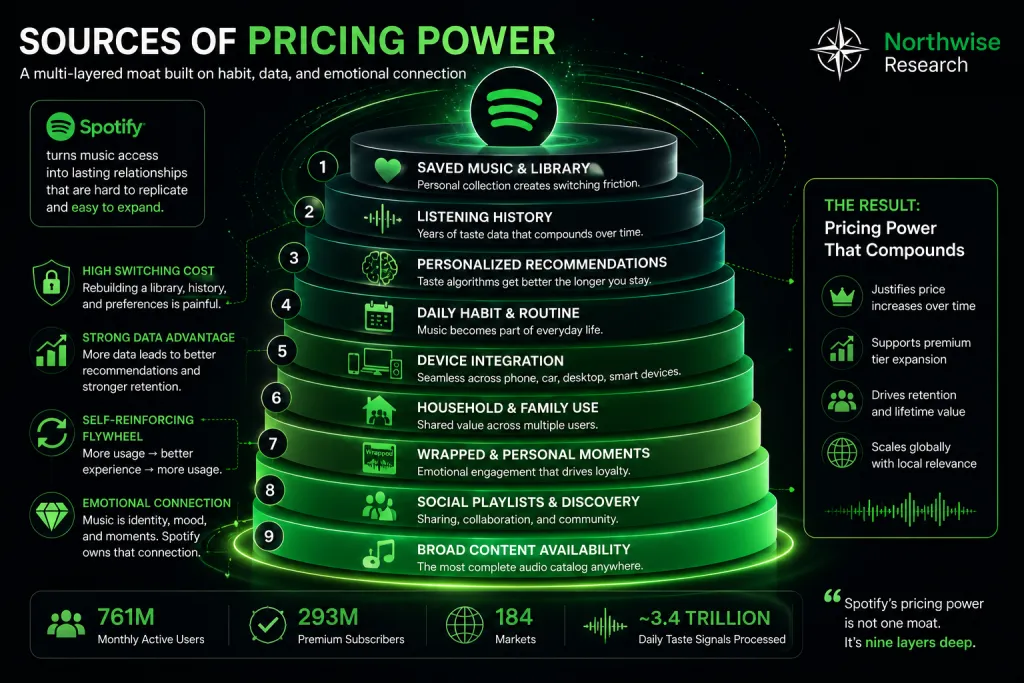
Subscriber counts only matter alongside what each subscriber pays, and Spotify's pricing power is more durable than its history of restraint suggests. That power comes from accumulation, not from any single feature. Years of saved music, long listening histories, personalized recommendations, daily habit, device integration, household usage, a familiar interface, the annual Wrapped ritual, social playlists, and broad availability combine into a product that is genuinely inconvenient to leave. Measured against the hours of monthly use it supports, the subscription stays inexpensive, which leaves room for further increases.
The recent behavior bears this out. After years of holding prices flat, Spotify has taken more frequent actions, sequenced by geography and plan, and reported minimal churn and stronger lifetime value afterward. The pattern suggests the company spent years pricing below what the product could support, which is the more attractive starting point for a forward model.
The catch is that higher prices do not flow cleanly to Spotify's margin. Each increase also raises payments to labels, publishers, songwriters, collecting societies, and audiobook publishers. Gross-margin expansion therefore depends on how much of each price increase Spotify retains after those obligations, which is why pricing power and margin durability cannot be analyzed apart from each other. The licensing structure in the next section sets the ceiling on what pricing alone can achieve.
Reported ARPU is a noisy way to see any of this. Foreign exchange, emerging-market mix, Family and Duo plans, Student pricing, promotions, partner distribution, and prepaid accounts all distort the headline figure, which can fall in a given quarter even as underlying pricing rises, simply due to faster growth in lower-priced markets. We focus instead on constant-currency underlying ARPU and model its growth as follows.
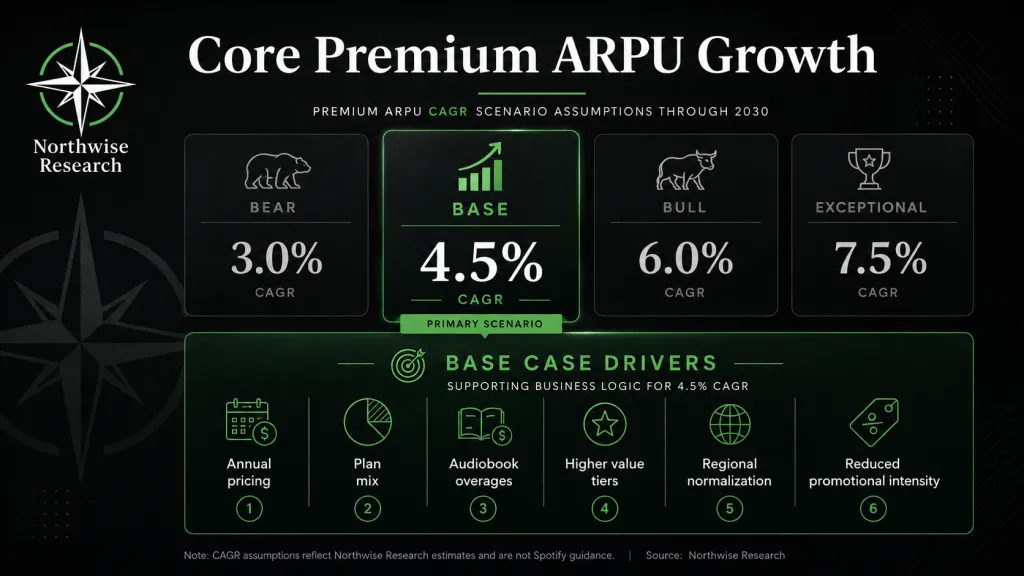
Scenario | Core ARPU CAGR |
|---|---|
Bear | 3.0% |
Base | 4.5% |
Bull | 6.0% |
Exceptional | 7.5% |
The base case asks for nothing aggressive. It can be reached through ordinary annual pricing, better plan mix, audiobook overages, higher-value tiers, regional normalization, and reduced promotional intensity. Mid-single-digit ARPU growth set against high-single-digit subscriber growth produces a Premium revenue engine that, on its own, carries Spotify close to its entire revenue framework.
The more interesting economics live in the add-on layer, where incremental revenue can arrive at better margins. AI remix tools, reserved concert tickets, higher audiobook allowances, podcast memberships, premium creator access, merchandise, fan clubs, and higher-quality audio each carry content and rights costs that are often lower or shared differently from standard Premium. We treat this as a genuine opportunity, not a base-case certainty, given how early most of these products still are.
6. Music Licensing, Rights Holders, and Margin Durability
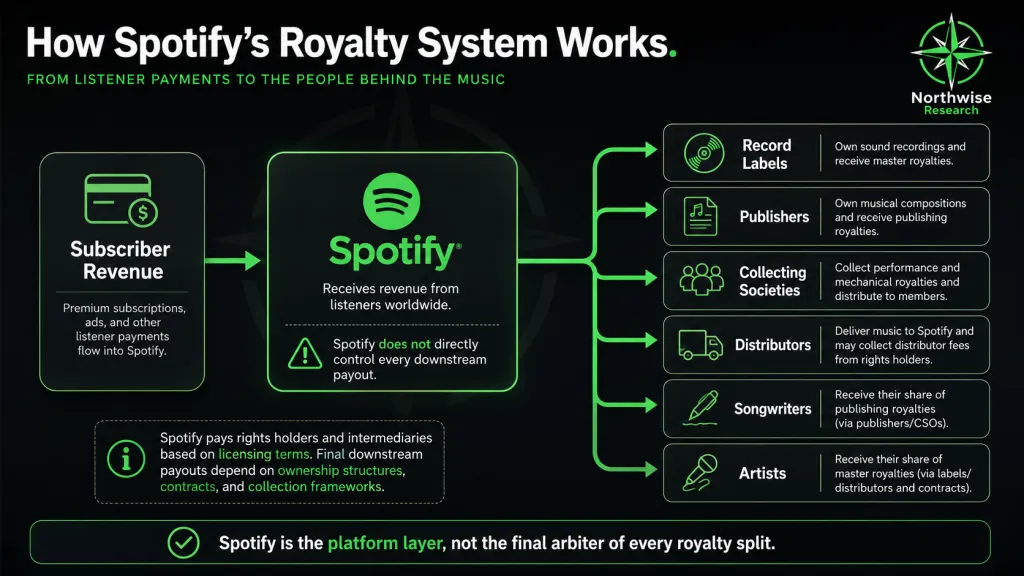
The licensing system is where Spotify's margin is ultimately decided, and it is worth understanding the mechanics before judging the risk. Subscription revenue flows from Spotify to record labels, publishers, collecting societies, distributors, songwriters, and artists through a layered set of agreements. Spotify does not directly determine how every downstream dollar reaches an individual artist, a frequent source of public criticism that is, in practice, a function of label and publisher contracts and not Spotify's own payout choices.
Power in that system is concentrated. Universal Music Group, Sony Music, Warner Music Group, Merlin, and the major publishers control catalog Spotify cannot afford to lose. Spotify's counterweight is its global listener scale, subscriber relationships, discovery influence, promotional tools, user data, and growing creator infrastructure. The labels hold essential catalog, control of major artists, concentrated ownership, the ability to demand guarantees, most-favored-nation protections, and political and creator influence. The relationship is mutually dependent and perpetually renegotiated, which is the structural reason margin durability can never be treated as fully settled.
Two contractual features sharpen the risk. Minimum guarantees can pressure margins if subscriber growth slows, advertising weakens, consumption shifts, or contract assumptions prove too optimistic, and many agreements are short enough that Spotify re-enters negotiation regularly. We therefore avoid assuming current economics persist unchanged through 2030.
The mechanical royalty rate set by the U.S. Copyright Royalty Board adds another variable, since decisions after the current rate period could move publishing costs in either direction. Most-favored-nation provisions then restrict differentiated deals, raise the cost of concessions, and reduce Spotify's ability to play one label against another.
Marketplace works in the opposite direction, lowering net content cost or creating higher-margin promotional services. The two forces partly offset, and the net effect on margin is one of the harder things to forecast with any precision.
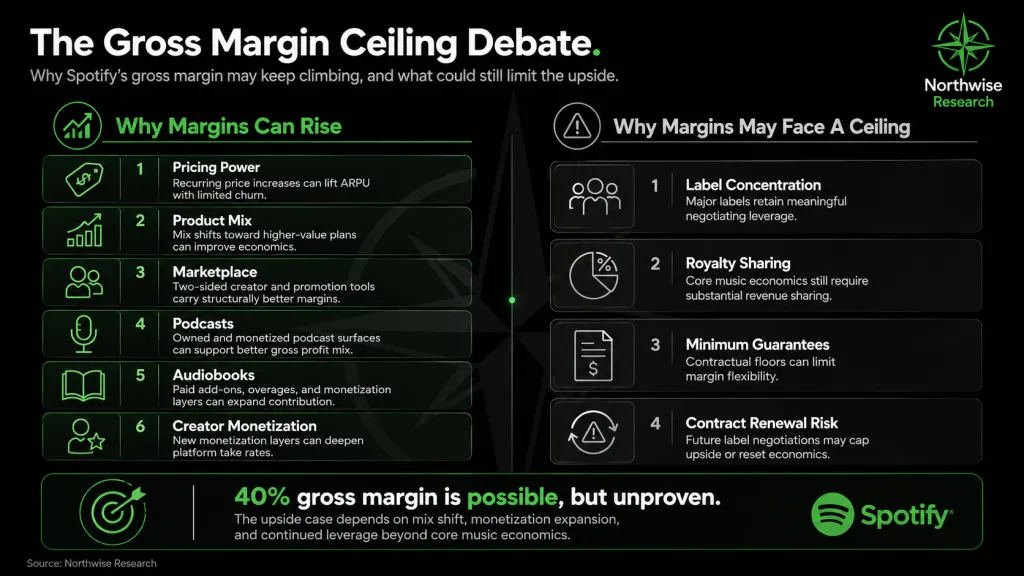
All of which returns to the central question: can Spotify clear the traditional margin ceiling through pricing and product mix, or do the labels capture most of the incremental economics? The evidence so far says Spotify can expand margins even with label concentration, since gross margin has already climbed past levels many assumed were structural limits. The upper end of management's range, near 40%, remains unproven, and we treat it as an outcome to be earned, not assumed.
The most credible near-term AI risk attaches here as well, and it is not the one most people name. The threat is not that machines write better songs than humans. It is that synthetic catalog flooding, fraudulent streams, bot activity, artist impersonation, and metadata manipulation dilute the royalty pool, raise detection costs, and erode listener trust and supplier relationships.
Spotify has responded with AI labeling, spam filtering, and disclosure standards, and has removed large volumes of fraudulent content. The threat sits on the trust layer of the business, which is harder to quantify than a pricing variable and therefore enters the model through the structural downside overlay rather than as a single line item.
7. Advertising and the Free-Tier Monetization Problem
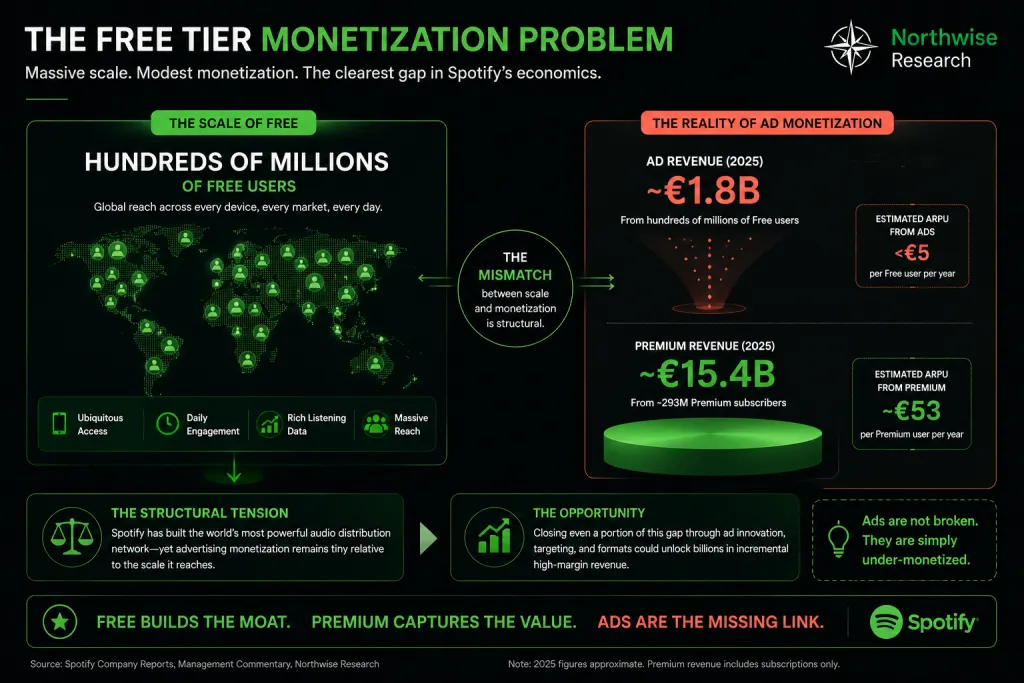
If licensing is the ceiling on margin, advertising is the largest hole in the revenue story, and it has stayed open long enough to deserve honest treatment. Spotify carries hundreds of millions of Free users, and advertising still contributes a small share of revenue, roughly 1.8B euros in 2025 against 15.4B euros from Premium. This is the clearest structural weakness in the model, and it has persisted long enough that we treat improvement as a hope, not a base-case certainty.
The causes are well understood and reinforcing. Fragmented podcast inventory, weak pricing, poor sell-through, limited direct-sales capacity, inconsistent measurement, advertiser preference for visual formats, and competition from Google, Meta, Amazon, and YouTube for the same budgets all weigh on the line. Low-value emerging-market inventory compounds the problem, since much of the Free audience sits in markets where ad rates are thin.
Underneath the weakness sit two competing readings of what Free is even for. The funnel view holds that Free exists to build habit, drive conversion, and keep listeners from defaulting to YouTube, with ad revenue secondary. The business view holds that hundreds of millions of users with valuable intent and taste data should produce meaningful revenue, and that audio inventory is simply under-monetized. Both can be true at once, and the base case does not require Spotify to resolve the tension through extraordinary advertising execution. That restraint keeps the thesis from depending on its weakest historical area.
The most credible path forward runs through the Spotify Ad Exchange, which aims to improve inventory utilization through automated buying, lower sales friction, and better targeting. Spotify can offer advertisers context around mood, genre, activity, time of day, device, and podcast interest, though privacy constraints and the temptation to overstate the uniqueness of that targeting both warrant caution. The exchange is the most plausible route to scaling advertising without a proportional increase in direct-sales headcount.
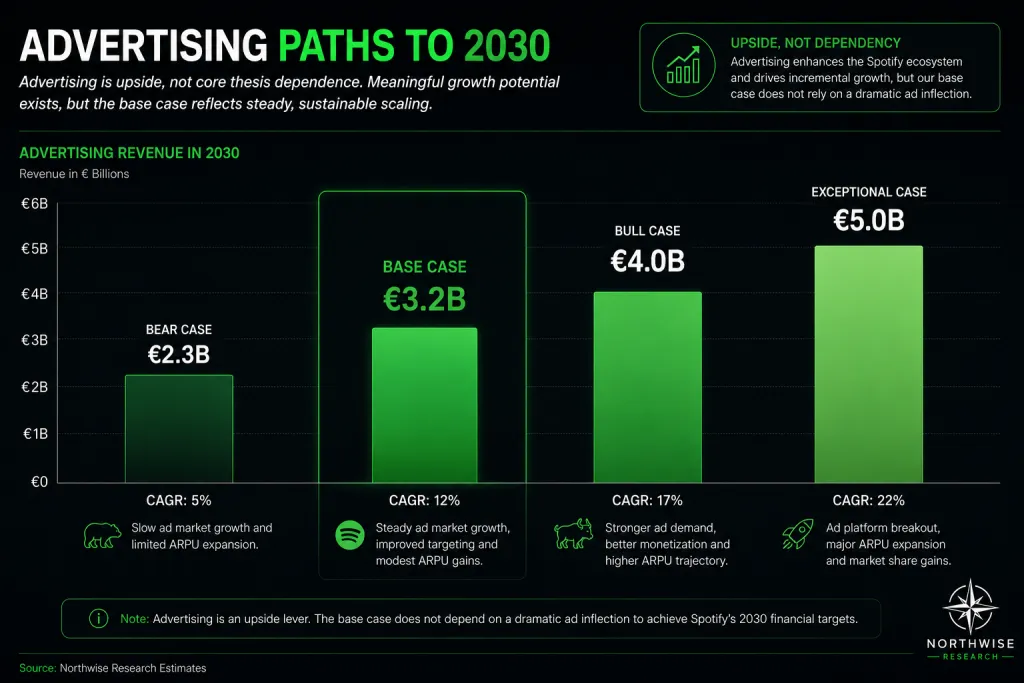
We size the line conservatively across scenarios.
Scenario | Advertising CAGR | 2030 Advertising Revenue |
|---|---|---|
Bear | 5% | 2.3B euros |
Base | 12% | 3.2B euros |
Bull | 17% | 4.0B euros |
Exceptional | 22% | 5.0B euros |
Advertising margin can improve through programmatic scale, better pricing, higher sell-through, owned tools, automated production, and video and creator inventory. We still treat it as the least proven major driver, and the base case leans on Premium, not on an advertising inflection.
8. Podcasts, Video, and the Creator Platform
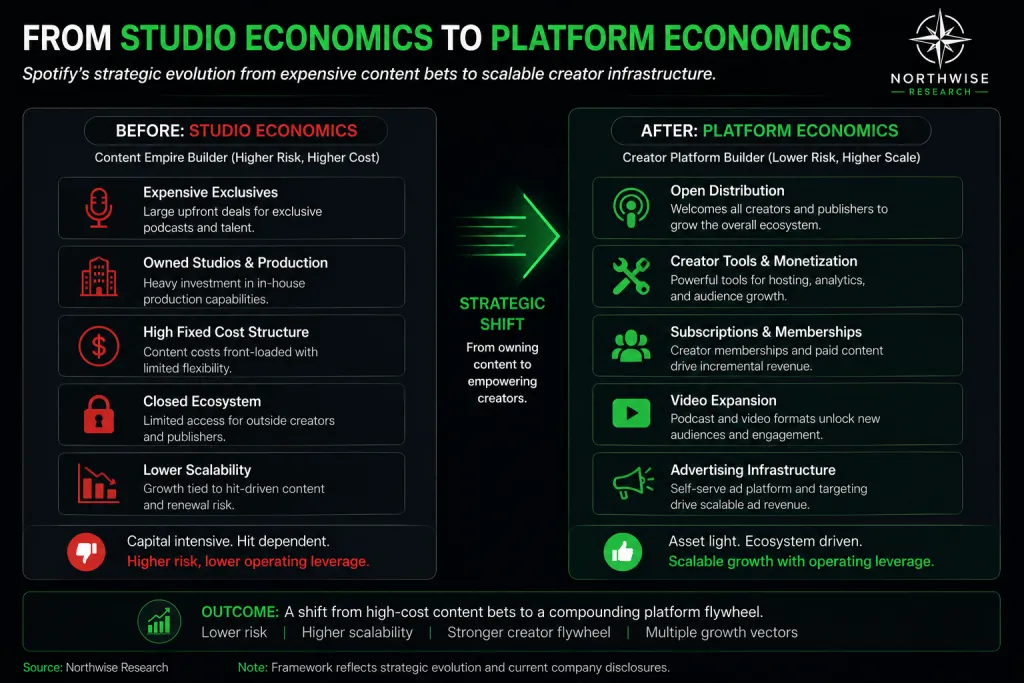
The creator platform carries a similar shape to advertising: a sound strategy that cost too much in its first form and grew more attractive once Spotify stopped trying to own the content. The original goals were to own differentiated content, build discovery and hosting, develop advertising technology, create creator tools, and reduce dependence on music. The strategy worked in part. The expensive part, owned studios and large exclusive guarantees, did not scale cleanly, while the infrastructure of Anchor for creation and Megaphone for advertising proved far more durable than the content library.
The pivot moved Spotify from heavy exclusive spending and large upfront guarantees toward open distribution, creator tools, performance-based payouts, advertising infrastructure, and memberships. The platform economics beat the studio economics, since they scale with creators instead of with Spotify's own production budget.
Management's claim that podcasts reached profitability is meaningful and deserves careful reading at the same time. The relevant questions are whether the figure includes acquisition amortization, whether shared platform costs are allocated, whether creator payouts are fully captured, and whether the result is contribution margin or operating profit. We accept the direction of travel while reserving judgment on the precise level until disclosure improves.
From that base, Spotify is building toward a credible creator economy through the Spotify Partner Program, video podcasts, and the new Memberships product, which lets podcasters earn recurring revenue directly from their most dedicated listeners. Video carries weight here, since podcast consumption is increasingly visual, YouTube holds strong creator distribution, and video adds advertising inventory even as it raises delivery costs.
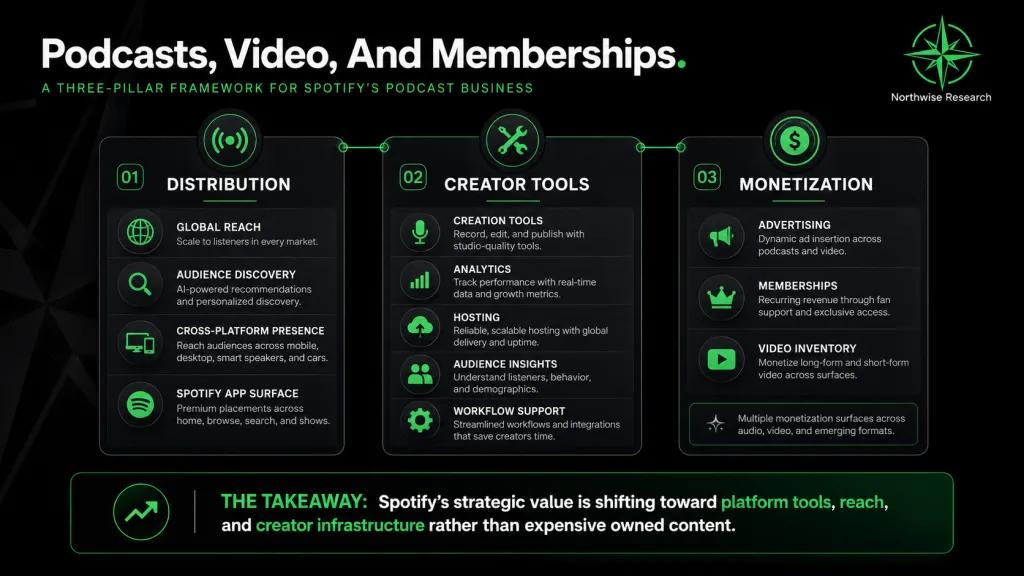
Memberships carry weight as higher-margin recurring revenue that reduces dependence on advertising and builds a defense against Patreon, YouTube, and direct distribution. Whether Spotify can hold creators against those alternatives is still being decided, and it is one of the live questions the bull case depends on.
AI tools sit alongside this as a reinforcing layer rather than a separate business. Translation, dubbing, summaries, clips, search, chapters, and personalized or automated production can widen the audience for a given show and lower production friction. They strengthen the platform position more than they create a standalone revenue line, so we treat them as engagement and cost levers, not a monetization stream of their own.
9. Audiobooks, Books, Add-Ons, and Commerce
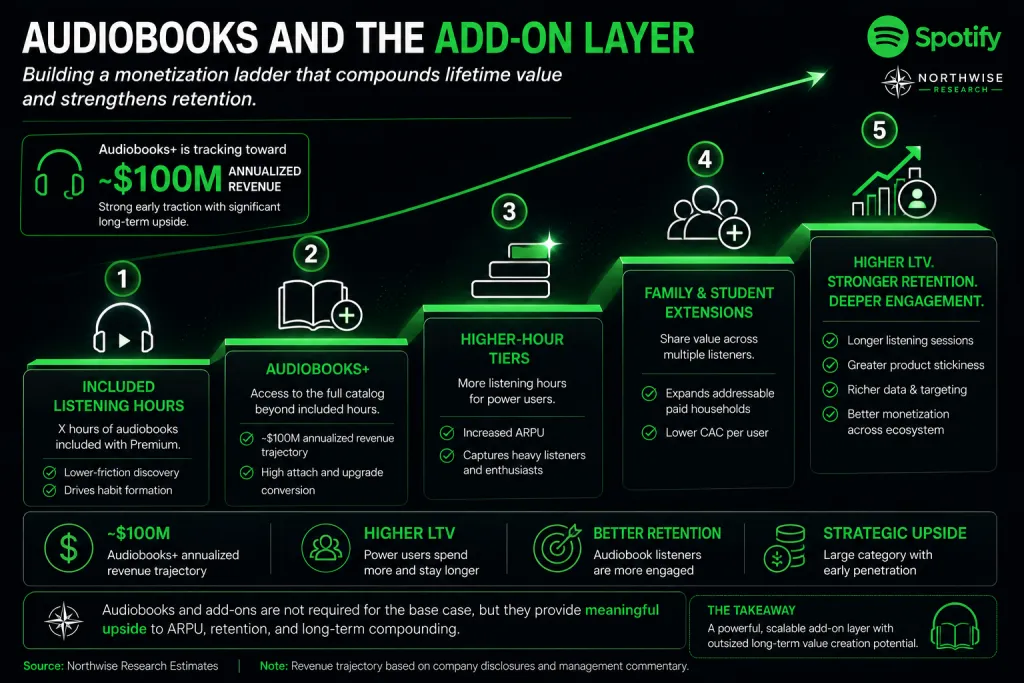
Audiobooks extend the same platform logic into the largest adjacent media category, and the strategic case currently runs ahead of the revenue. Audiobooks increase time spent, add pricing layers, expand the addressable market, improve retention, and diversify Spotify beyond music. They also feed the discovery engine, since a listener's audiobook behavior adds signal to the recommendation system.
The mechanics involve a real trade-off. Bundling audiobook hours into Premium raises publisher payments and introduces consumption variability, offset by improved lifetime value and conversion into paid overages. The Audiobooks+ add-on is tracking toward roughly 100M dollars in annualized revenue, with room to extend through higher-hour tiers and Family and Student variants. The figure is small against group revenue. The growth rate and the margin profile are what make it worth tracking.
One causal question deserves discipline. Audiobooks+ customers appear to carry higher lifetime value, and the reason is not yet clear. The product may improve retention, or the most loyal users may simply be the ones most likely to buy it. We avoid assuming correlation proves causation, since the distinction changes how much credit the product deserves in the model.
Against Audible, Apple Books, Google, and libraries, Spotify's edge is discovery and bundling, drawn from music taste, podcast interests, author preferences, listening context, and completion behavior. Audible's edge is category depth and a base of dedicated audiobook buyers. The two can coexist, with Spotify likely winning the casual and bundled listener and Audible holding the heavy consumer.
Beyond books lies the superfan economy, where spending per user runs far higher than a standard subscription. Reserved concert tickets, artist merchandise, fan access, memberships, event promotion, and live audio all point in that direction, and Spotify has begun reserving tickets for superfans and exploring concert livestreaming. These are early and unproven, so we size them conservatively. Taken together, the new monetization layers model as follows.
Category | Bear | Base | Bull | Exceptional |
|---|---|---|---|---|
Audiobooks and books | 0.35B euros | 0.90B euros | 1.30B euros | 1.80B euros |
AI and creator tools | 0.10B euros | 0.70B euros | 1.30B euros | 2.40B euros |
Memberships and premium video | 0.15B euros | 0.40B euros | 0.60B euros | 0.90B euros |
Tickets, commerce, and other | 0.20B euros | 0.60B euros | 0.80B euros | 1.40B euros |
Total new monetization | 0.80B euros | 2.60B euros | 4.00B euros | 6.50B euros |
Podcast advertising stays in the advertising line, Marketplace benefits are modeled in gross margin, and standard Premium price increases stay in ARPU. The table is built to avoid double counting those drivers anywhere else in the model.
10. AI, Personalization, and the Generative Media Opportunity
AI runs through every section above, so it is worth stating our central judgment directly: AI is more likely to be a net positive for Spotify than an existential threat. The company can benefit as an AI power user, a recommendation platform, a creator-tool provider, a licensed generative-media interface, and an advertising-automation platform, without needing to build frontier infrastructure. The real risk sits on the trust and disintermediation side, not on whether AI can generate audio.
The asset that grounds that judgment is behavioral. Spotify's Large Taste Model is built on roughly 3.4 trillion daily taste signals drawn from listening history, skips, saves, replays, completion rates, playlist behavior, time of day, device, geography, social context, and cross-format consumption. General models can be rented or accessed through open ecosystems. The taste graph and the distribution sitting on top of it cannot be replicated by a competitor that lacks the same engagement base.
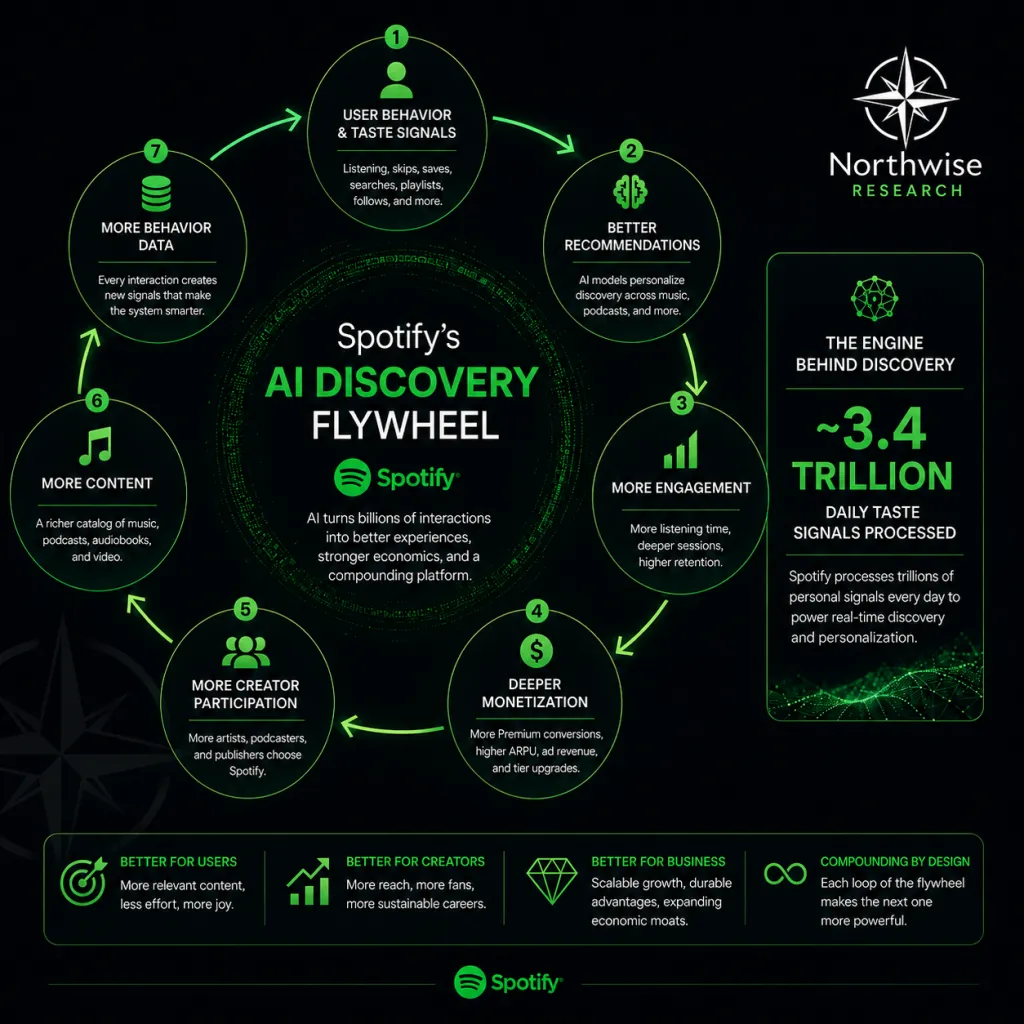
That asset also frees Spotify from depending on a single frontier supplier. It can self-host smaller models, combine open embeddings and retrieval with proprietary ranking, choose different models for different workloads, and avoid frontier-scale training costs. We do not assume a specific infrastructure supplier, since the company has not committed to one and the workload mix favors flexibility.
The product surface already reflects the strategy, with AI DJ, prompted playlists, conversational discovery, and personalized briefings, and more to come across adaptive audio, education, and search. The financial benefit shows up indirectly through ARPU durability, subscriber growth, gross margin, and operating leverage, not as a large standalone AI revenue line.
At Spotify's scale, small improvements in churn compound into meaningful value, which is the most reliable way AI helps the model. The same logic applies inside the organization, where AI-assisted coding, testing, localization, support automation, moderation, fraud detection, ad creation, and data analysis should appear as slower operating-expense growth instead of assumed mass layoffs. We model the benefit as operating leverage, which is both more conservative and more consistent with how the company has described it.
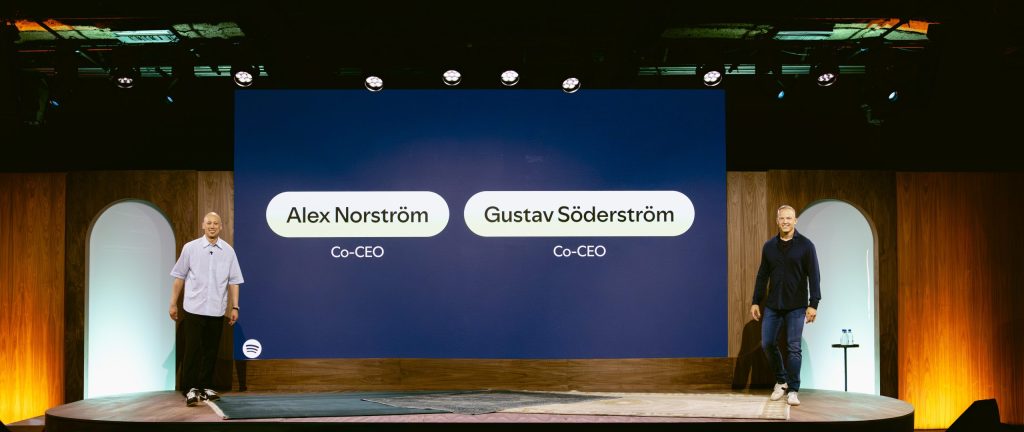
The most consequential AI development moved from concept toward reality in May 2026, when Spotify and Universal Music Group announced landmark recorded-music and publishing licensing agreements enabling a tool that lets Premium users create covers and remixes of songs from participating artists and songwriters. The feature launches as a paid add-on, participation is opt-in, and participating artists and songwriters share in the revenue. UMG Chairman and CEO Lucian Grainge appeared alongside co-CEO Alex Norstrom at Spotify's investor day to announce it, a signal that both companies treat it as a core initiative and not an experiment.
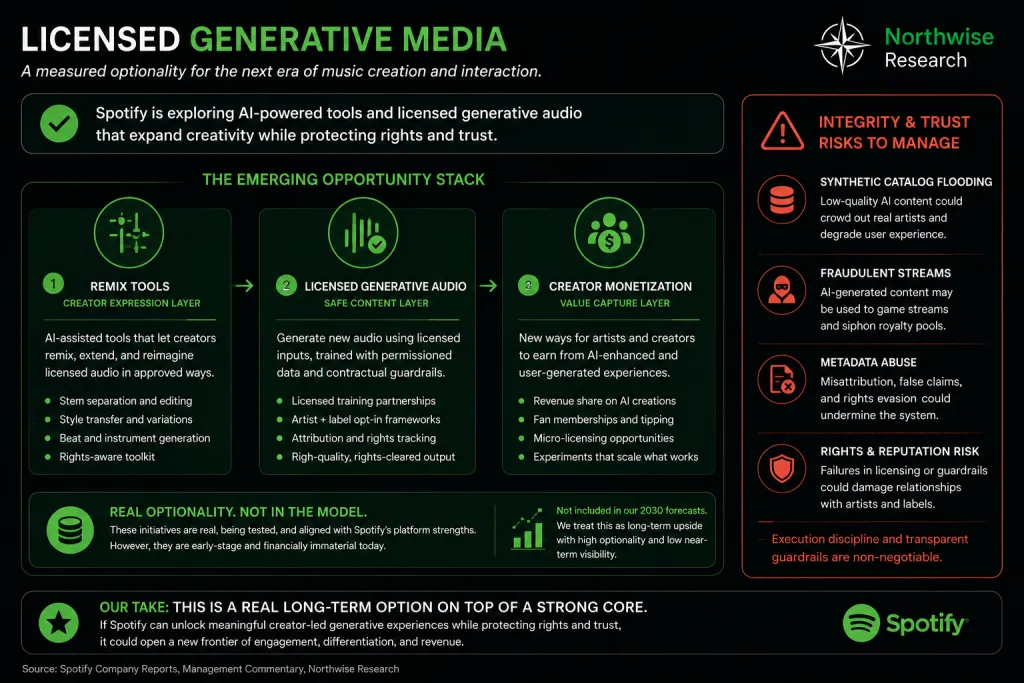
We read this as early but real, and structurally important well beyond its near-term revenue. It establishes a consent-based template built on artist participation, rights-holder approval, attribution, compensation, and paid consumer access, which turns the most contentious part of AI music into a licensed product. The economics are not yet disclosed and no launch date is confirmed, so we keep it as upside instead of building it into the base case. Its larger value is that it positions Spotify as the licensed interface for generative audio at a moment when the rest of the industry is still litigating the question.
That positioning matters most against the two risks that do carry weight. The first is catalog pollution, where fake artists, unauthorized uploads, and fraud degrade recommendations and listener trust. The second, and the more strategically serious, is that a system-level agent from Apple, Google, OpenAI, or Amazon comes to own the user relationship and treats Spotify as a background catalog provider. Spotify's defense against both is to remain the owner of the taste graph and the interface, which is the deeper reason the Large Taste Model and the consumer relationship sit so close to the center of the long-term thesis.
11. Competitive Landscape
Spotify competes on several fronts at once, and the threats are uneven enough that lumping them together obscures more than it reveals.
Apple Music draws strength from the Apple ecosystem, device integration, the Apple One bundle, deep financial capacity, a premium customer base, and spatial audio. Set against Spotify it carries a weaker discovery identity, less platform neutrality, a weaker Free funnel, less creator infrastructure, and less cross-device independence. It is a durable competitor for Apple-centric users and a limited threat to Spotify's broader base.
YouTube Music is the serious long-term concern. Its Free video funnel, creator ecosystem, user-generated content, global reach, bundled YouTube Premium, music videos, podcasts, and cultural discovery are difficult to match. Spotify's defense is a better dedicated listening experience, a deeper taste graph, playlist identity, device ubiquity, a focused audio product, and a large paid base. The contest is real, and we treat YouTube paid-share gains as a medium-probability, high-impact risk.
Amazon Music competes on different terms. The Prime subsidy, Alexa, commerce integration, devices, and a tolerance for low margins give it reach, while music sitting outside its core product leaves engagement less culturally central and discovery and brand identity weaker. It pressures pricing at the margin more than it threatens Spotify's core users.
Around those three sit the regional and direct-to-fan players. Tencent Music, NetEase Cloud Music, JioSaavn, Gaana, Anghami, Boomplay, and various telecom bundles compete in specific geographies and often shape local pricing and partnerships. Separately, Patreon, Substack, artist websites, fan clubs, and Discord compete for the direct creator-to-fan relationship. Spotify's creator products exist in part to reduce the incentive for creators to move that relationship elsewhere, which is the competitive purpose behind Memberships and the Partner Program.
The newest category is the AI-native one. Suno, Udio, and various generative and personalized-audio startups represent a genuinely different kind of competitor. The threat is lower if Spotify owns the interface and the licensing framework, which is part of what the UMG agreement is designed to secure. An AI-native creation tool without licensed catalog and distribution faces a much harder path than its technology alone suggests.
Step back from the individual rivals and the moat comes into focus. It does not come from exclusive catalog, since the major catalog is available to every large platform. It comes from habit, personalization, scale, global neutrality, device distribution, social identity, creator tools, and discovery trust. That combination is harder to attack than any single feature, and it is the foundation of the pricing power the rest of the model relies on.
12. Leadership and Management Credibility
A model this dependent on execution has to take a view on the people executing, and Spotify's leadership changed shape at the start of 2026. Daniel Ek did not leave. He moved from CEO to Executive Chairman and kept responsibility for long-term strategy, capital allocation, regulatory engagement, major acquisitions, and the most consequential strategic decisions. We read the transition as a delegation of daily execution, not a surrender of control, which carries implications for both accountability and continuity.
The structure he handed down splits the company along its two hardest problems. Co-CEO Alex Norstrom owns the commercial side: subscribers, pricing, advertising, content economics, partnerships, markets, payments, customer service, and monetization. The question his mandate has to answer is whether Spotify can earn substantially more from the audience it already has, and his appearance alongside UMG's CEO to announce the AI licensing deal reflects how central the rights-holder relationship is to that job.
Co-CEO Gustav Soderstrom owns product and technology: engineering, product, AI, recommendation, design, data, generative media, social products, and creator tools. His mandate has to answer whether Spotify can stay meaningfully better than platforms offering the same catalog, and the Large Taste Model and the generative-media surface sit squarely inside his remit.
The pairing fits the problem more closely than a co-CEO structure usually does. Spotify faces two distinct strategic challenges, building differentiated products and monetizing them profitably, and the structure assigns each to an executive with the relevant background. Both leaders held substantial operating responsibility as co-presidents before the formal transition, a stretch that overlapped with cost discipline, margin expansion, pricing actions, podcast rationalization, cash-flow growth, and product acceleration. The arrangement is therefore less of a leap than it appears, since the working relationship and the results predate the titles.
The risk is equally real. Divided accountability, overlapping responsibilities, Ek's continued authority, and founder voting control can create a situation where no single person clearly owns a failed strategic project. We hold this as a governance concern that enters the model through the structural downside overlay, not the operating drivers, since its effect would surface in decision quality over time rather than in any single quarter.
That reading shapes how we treat the 2030 framework itself. Spotify has generally guided well on Premium subscribers, gross margin, and quarterly revenue, and less reliably on advertising timelines and long-range monetization claims. Experienced teams often introduce long-range frameworks after sentiment has weakened, with targets strong enough to restore confidence yet conservative enough to be exceeded through ordinary execution.
Spotify entered its May 2026 investor day with the stock down roughly a quarter on the year, which fits the pattern. We do not claim management is deliberately sandbagging. The more defensible reading is that the framework represents a credible floor set under new leadership, possibly engineered as a multiyear beat-and-raise architecture. That reading places the base case near the framework and reserves the bull case for genuine outperformance, with the evidence updating the weights each quarter.
13. Financial Foundation and the 2030 Model
Everything to this point describes how the business works. The model turns that description into numbers, and it starts from a 2025 baseline strong enough to make the framework credible. Spotify finished 2025 with 17.186B euros in total revenue, of which 15.391B euros came from Premium and 1.795B euros from advertising on a reclassified basis.
Full-year gross margin was 32.0%, operating margin was 12.8%, and trailing free cash flow reached 2.9B euros. The fourth quarter showed the trajectory clearly, with gross margin at 33.1%, operating income of 701M euros ahead of guidance, a record 38 million MAU additions, and 9 million net subscriber additions. The year demonstrated that the company can meet or exceed its own guidance across users, margin, and cash flow at the same time.
The first quarter of 2026 confirmed the level instead of introducing a new one. Revenue was 4.533B euros at a 33.0% gross margin, operating income was 715M euros for a 15.8% operating margin, and free cash flow was 824M euros, with Premium subscribers at 293 million and MAUs at 761 million. Spotify is already operating near the mid-teens operating margin, which is the floor of its 2030 framework and not a distant target.
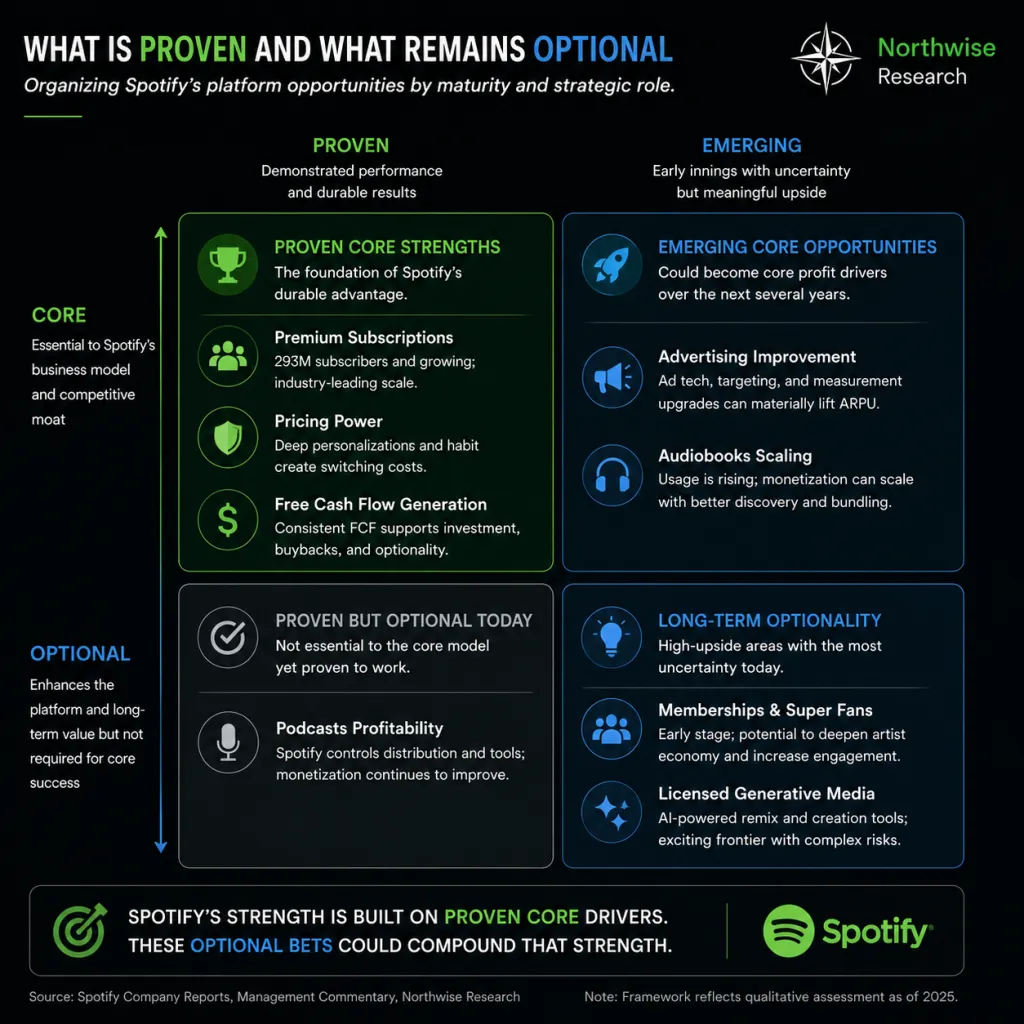
That framework, laid out at the company's first investor day since 2022, calls for a mid-teens revenue CAGR, gross margin between 35% and 40%, operating margin above 20%, and strong free-cash-flow growth through 2030. The same event introduced the Large Taste Model, the Studio by Spotify Labs preview, podcaster Memberships, expanded Audiobooks+, and the UMG generative-media agreement, alongside the longer-term north star of one billion subscribers and 100 billion dollars in revenue.
We read the framework as a credible floor due to what the company has already achieved: a 33% quarterly gross margin, a mid-teens quarterly operating margin, demonstrated pricing power, substantial free cash flow, podcast profitability, Marketplace growth, and audiobook expansion.
The remaining work of sustaining subscriber growth, raising ARPU, improving advertising, managing label negotiations, scaling add-ons, and keeping the product differentiated is real but incremental, not speculative. We therefore place the base case around the midpoint of the revenue range, the middle of the gross-margin range, and slightly above the minimum operating-margin target, with the bull case reserved for outcomes that exceed the framework in more than one category at once.
The path from a 32% gross margin toward 38% in the base case is built from identifiable drivers, each one a line we can monitor in the quarterly results.
Driver | Approximate Contribution |
|---|---|
Pricing and improved music economics | +1.5 pts |
Marketplace and promotional services | +1.2 pts |
Podcast and video profitability | +0.8 pts |
Advertising yield and automation | +0.7 pts |
Audiobooks and add-on mix | +0.8 pts |
Cloud, delivery, and product efficiency | +0.5 pts |
Other mix improvements | +0.5 pts |
Total | +6.0 pts |
This is an analytical bridge, not disclosed company guidance. Operating-expense leverage works the same way, with the ratio declining from roughly 19% in 2025 toward 15.5% by 2030, modeled as gradual leverage instead of abrupt cost cuts.
Driver | Approximate Contribution |
|---|---|
Revenue scale over fixed costs | -1.4 pts |
Engineering and AI productivity | -0.8 pts |
Marketing leverage | -0.8 pts |
Support and G&A automation | -0.7 pts |
Total | -3.7 pts |
Free cash flow benefits from low capital intensity and a net-cash balance sheet, and it moves with working-capital timing, royalty payment timing, social charges tied to equity value, stock-based compensation, leases, taxes, and content commitments. We avoid assuming every year converts operating income into cash as strongly as the best recent quarters, since those timing items can swing meaningfully from period to period.
On capital allocation, the strong balance sheet supports strategic acquisitions, buybacks that offset stock-based compensation, and eventual excess-capital returns, though we do not assume aggressive net share reduction in the base case, which keeps the per-share model honest about dilution.
With the conventions set, the model uses 2025 as the base year and forecasts through 2030. Operating figures are in euros, valuation is in U.S. dollars, and we convert at 1 euro to 1.10 dollars. The share-price reference is approximately 468 dollars. We assume a 20% tax rate and do not allow excess cash to compound indefinitely.
Marketplace benefits are carried in gross margin, podcast advertising stays in the advertising line, core Premium pricing stays in ARPU, and new monetization is modeled separately to avoid double counting any single driver. The driver assumptions from the free section assemble into a single revenue picture across the four scenarios.
Metric | Bear | Base | Bull | Exceptional |
|---|---|---|---|---|
Premium Subscriber CAGR | 7.0% | 8.5% | 9.5% | 10.5% |
Core ARPU CAGR | 3.0% | 4.5% | 6.0% | 7.5% |
Premium Revenue CAGR | 10.2% | 13.4% | 16.1% | 18.8% |
2030 Premium Revenue | 25.0B euros | 28.8B euros | 32.3B euros | 36.3B euros |
Advertising CAGR | 5.0% | 12.0% | 17.0% | 22.0% |
2030 Advertising Revenue | 2.3B euros | 3.2B euros | 4.0B euros | 5.0B euros |
New Monetization | 0.8B euros | 2.6B euros | 4.0B euros | 6.5B euros |
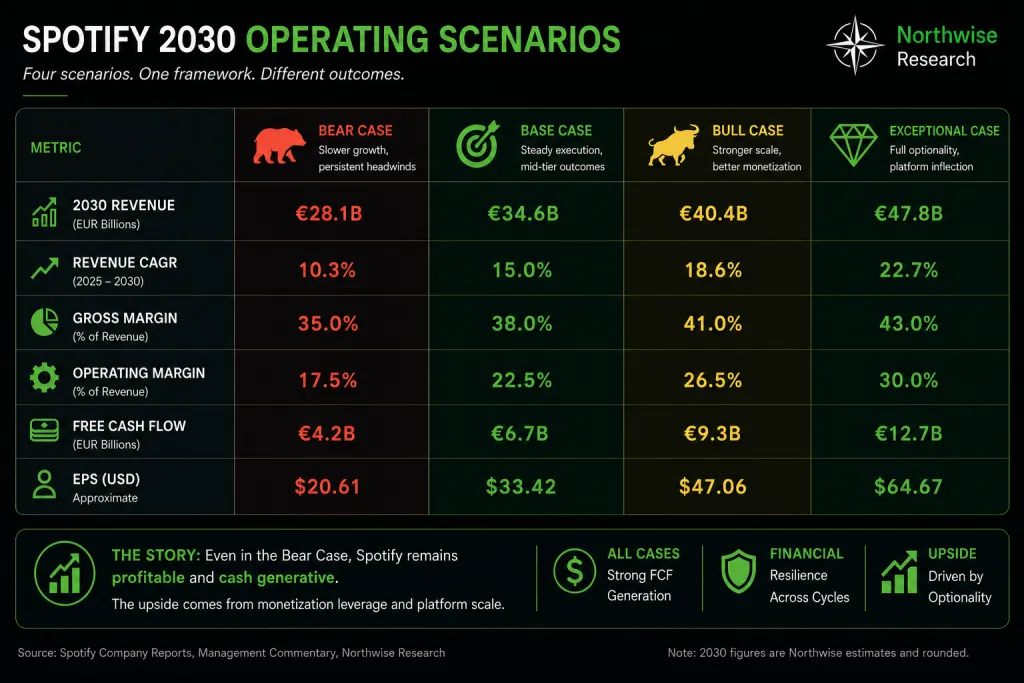
Total 2030 Revenue | 28.1B euros | 34.6B euros | 40.4B euros | 47.8B euros |
Total Revenue CAGR | 10.3% | 15.0% | 18.6% | 22.7% |
The base case sits near the midpoint of management's mid-teens revenue framework. The bear case still grows at a low-double-digit rate, a reflection of how habitual the core product has become even under disappointing assumptions. The bull and exceptional cases require the secondary engines of advertising and new monetization to compound alongside Premium, an outcome we treat as possible but unproven. Carrying those revenue paths through to margin and earnings produces the following.
Metric | Bear | Base | Bull | Exceptional |
|---|---|---|---|---|
Gross Margin | 35.0% | 38.0% | 41.0% | 43.0% |
Operating Expense Ratio | 17.5% | 15.5% | 14.5% | 13.0% |
Operating Margin | 17.5% | 22.5% | 26.5% | 30.0% |
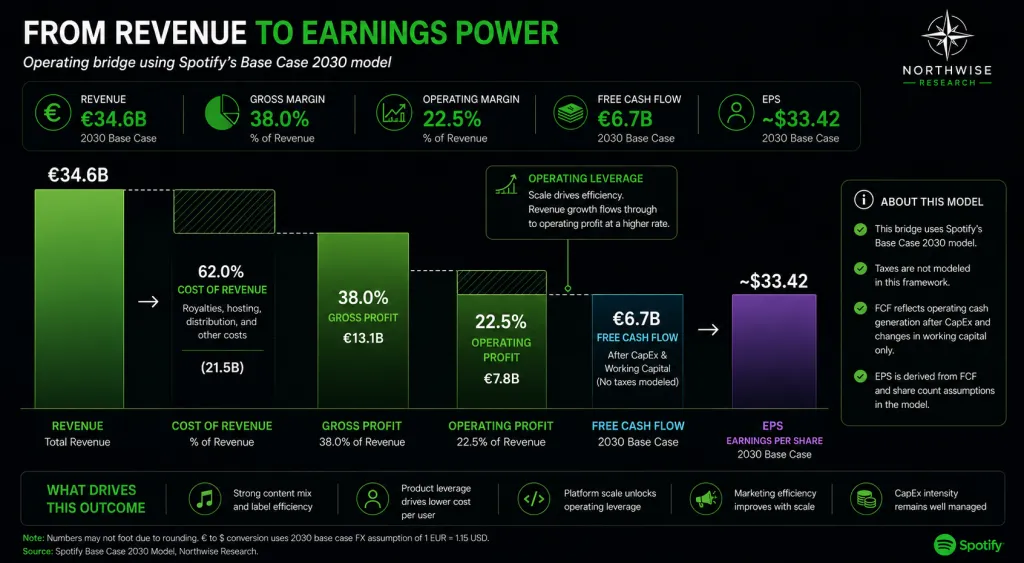
Operating Income | 4.9B euros | 7.8B euros | 10.7B euros | 14.3B euros |
FCF Margin | 15.0% | 19.5% | 23.0% | 26.5% |
Free Cash Flow | 4.2B euros | 6.7B euros | 9.3B euros | 12.7B euros |
Diluted Shares | 210M | 205M | 200M | 195M |
Approximate USD EPS | $20.61 | $33.42 | $47.06 | $64.67 |
Retained Net Cash | 8.0B euros | 9.0B euros | 10.5B euros | 12.0B euros |
The earnings build holds the share count roughly flat in the base case, which keeps the per-share figures honest about ongoing stock-based compensation. Each scenario tells a coherent story.
In the bear case, Premium growth slows but stays positive, ARPU growth is modest, advertising stays weak, and new products remain small, leaving gross margin at the bottom of the framework and operating margin below target. Spotify remains a sound business that generates limited shareholder return.
In the base case, Premium subscribers grow at 8.5% and core ARPU at 4.5%, advertising improves while staying secondary, and new monetization contributes 2.6B euros, lifting gross margin to 38% and operating margin to 22.5%, which lands Spotify approximately on its framework.
In the bull case, pricing and product mix outperform, advertising compounds in the high teens, and AI, audiobooks, creator tools, and commerce contribute materially, moving gross margin above 40% and operating margin into the mid-20s, which would make the framework look conservative in hindsight.
In the exceptional case, Spotify becomes a dominant creator and generative-media platform, high-value add-ons reach the mainstream, advertising scales, AI lowers operating intensity, and revenue grows above 20% through 2030. We carry that final path for completeness and assign it a low probability.
14. Evidence-Based Scenario Probabilities
A compelling narrative pulls toward high bull probabilities the evidence has not earned, so we force each probability to come from measurable operating drivers. The weights then move when the business moves, not when sentiment does. We run the drivers as distributions around central assumptions, with standard deviations that reflect how uncertain each input is.
Driver | Central Assumption | Standard Deviation |
|---|---|---|
Premium Subscriber CAGR | 8.5% | 1.8 pts |
Core Premium ARPU CAGR | 4.2% | 1.3 pts |
Advertising CAGR | 11.5% | 4.5 pts |
New Monetization in 2030 | 2.2B euros | 1.3B euros |
2030 Gross Margin | 38.2% | 1.7 pts |
2030 Operating Expense Ratio | 15.5% | 1.2 pts |
The drivers do not move independently, and the correlations carry real weight. Faster subscriber growth carries a slight negative correlation with ARPU, since the incremental users tend to come from lower-priced markets. Higher ARPU supports gross margin. Stronger new monetization lifts both revenue and mix. Advertising growth improves revenue without automatically producing software-like margins. Gross-margin expansion and operating leverage are related, though they are not the same variable, and we model them separately. With those relationships in place, we define a center for each scenario across revenue CAGR, gross margin, and operating margin, then assign each simulated outcome to the nearest center across all three metrics.
Scenario | Revenue CAGR | Gross Margin | Operating Margin |
|---|---|---|---|
Bear | 11.0% | 35.0% | 17.0% |
Base | 15.0% | 38.0% | 22.5% |
Bull | 18.0% | 41.0% | 26.5% |
Exceptional | 20.5% | 43.0% | 30.0% |
The raw operating simulation, before any structural overlay, concentrates heavily in the base case.
Scenario | Raw Probability |
|---|---|
Bear | 10.8% |
Base | 72.6% |
Bull | 16.3% |
Exceptional | 0.3% |
That simulation captures the operating drivers but misses discontinuous events, so we overlay an 8% structural downside and a 2% structural upside, allocating the remaining 90% according to the raw simulation. The downside covers a major licensing reset, regulatory intervention, AI disintermediation, a product-trust failure, an acquisition mistake, or leadership dysfunction. The upside covers a creator-platform breakout, a licensed generative-media success, an advertising inflection, or larger-than-expected pricing power. The overlay produces the weights we publish.
Scenario | Final Probability |
|---|---|
Bear | 18% |
Base | 65% |
Bull | 15% |
Exceptional | 2% |
These weights are a function of the assumptions, and they move materially when those assumptions change. Under conservative assumptions, the bear and base cases split most of the weight, with the bull near 2% and the exceptional near zero.
Under the current evidence, the raw simulation places roughly 11% on the bear, 73% on the base, 16% on the bull, and under 1% on the exceptional before the overlay. Under optimistic assumptions, the bull can rise above 50% and the exceptional toward 8%. We publish the current-evidence weights and update them as the operating data arrives.
We will not lift the bull case higher until the evidence supports Premium subscriber growth near 9% to 10%, core ARPU growth near or above 5%, advertising growth in the mid-teens, new monetization approaching several billion euros, gross margin visibly moving toward 40%, and an operating-expense ratio approaching 15% or lower.
Until those signals appear together, the base case holds the majority of the weight. Each quarter we revisit the weights using Premium subscriber growth, constant-currency ARPU, advertising growth, gross margin, the operating-expense ratio, Audiobooks+ adoption, AI and creator monetization, churn commentary, licensing developments, and capital-allocation decisions, and the discipline is to explain why a probability changed so the framework stays anchored to evidence as the story develops.
15. Risk and Quarterly Monitoring
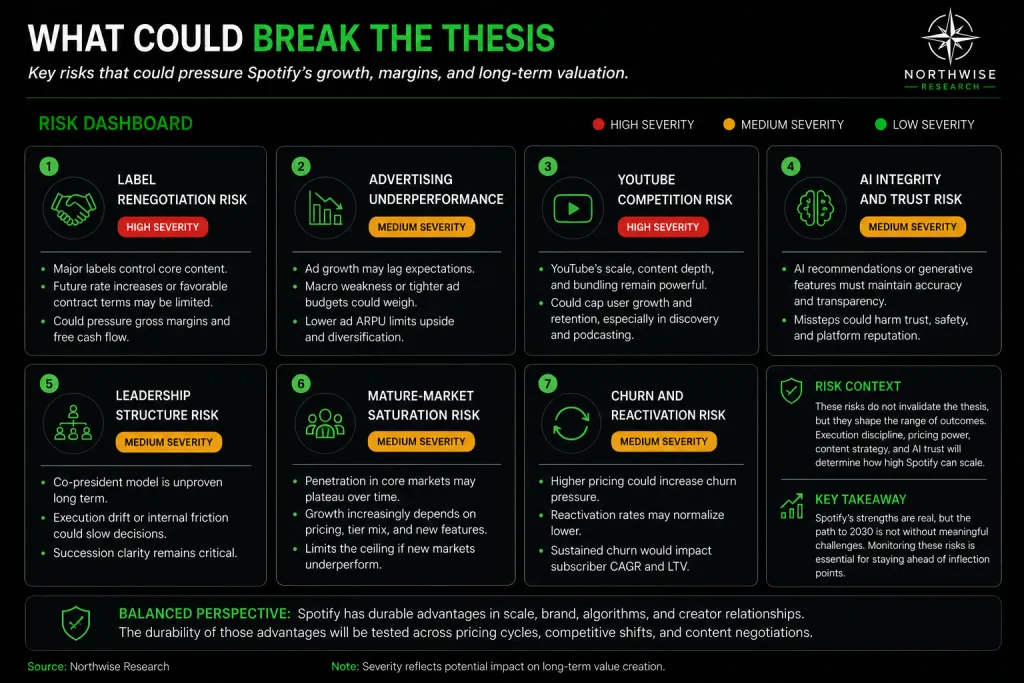
Risk in this thesis is not a vague disclaimer appended at the end. Each risk enters the model in a defined place, which is what keeps the analysis honest, and the matrix below maps every one of them to its treatment.
Risk | Probability | Impact | Model Treatment |
|---|---|---|---|
Subscriber growth slowdown | Medium | High | Bear subscriber CAGR |
Pricing causes churn | Low to Medium | High | ARPU and subscriber sensitivity |
Label renewal pressure | Medium | High | Lower gross margin |
Advertising remains weak | High | Medium | Bear and base ad assumptions |
AI content pollution | Medium | Medium to High | Structural downside overlay |
External AI disintermediation | Low to Medium | High | Tail-risk overlay |
YouTube share gains | Medium | High | Subscriber and engagement sensitivity |
Audiobooks fail to scale | Medium | Low to Medium | New monetization sensitivity |
Creator tools fail | Medium | Medium | Lower bull probability |
Co-CEO accountability failure | Low to Medium | Medium | Structural downside overlay |
Acquisition mistake | Medium | Medium | Lower cash and higher expenses |
Regulatory intervention | Low to Medium | High | Tail-risk overlay |
FX volatility | High | Medium | Conservative FX assumption |
Multiple compression | Medium | High | Exit-multiple sensitivity |
Stock-based compensation | Medium | Medium | Flat share count in base |
Three of these deserve to be pulled out of the list and held up to the light. Label renewal pressure is the clearest threat to the gross-margin thesis, since the entire margin-expansion case depends on Spotify retaining a meaningful share of each price increase, and the metric to watch is gross margin against the bridge laid out earlier.
Weak advertising is the highest-probability risk, though its impact stays contained given how little the base case leans on an advertising inflection. External AI disintermediation is the lowest-probability and highest-consequence risk, since a system-level agent that owns the user relationship would erode the value of everything beneath it, which is precisely why ownership of the taste graph and interface sits at the center of the long-term thesis.
The risks express themselves quarter to quarter through a set of triggers, and watching them is how the framework stays current. The thesis strengthens when Premium subscriber growth holds above 8%, constant-currency ARPU holds above 4%, gross margin moves toward 35% and then 37%, operating margin holds above the mid-teens, advertising returns to double-digit growth, Audiobooks+ adoption accelerates, AI products improve engagement, Memberships launch successfully, Marketplace gross profit keeps growing, pricing holds without churn, the share count stabilizes, management raises the long-range targets, and free cash flow stays strong after normalization.
It weakens on the mirror image: subscriber growth falling toward the mid-single digits, ARPU softening despite price increases, churn rising materially, gross margin stalling below 35%, operating expenses outgrowing gross profit, advertising staying flat after platform investment, AI degrading recommendations, labels securing substantially worse economics, acquisitions reviving capital-allocation concerns, co-CEO responsibilities blurring, YouTube taking material paid share, or management lowering the 2030 framework.
Compressed into a scorecard, the signals sort into clear bands each quarter.
Metric | Bull Signal | Base Signal | Bear Signal |
|---|---|---|---|
Premium Subscriber Growth | Above 9% | 7% to 9% | Below 7% |
Constant-Currency ARPU | Above 5% | 3% to 5% | Below 3% |
Advertising Growth | Above 15% | 8% to 15% | Below 8% |
Gross Margin | Above path | On path | Below path |
Operating Expense Ratio | Falling quickly | Gradual decline | Flat or rising |
New Monetization | Material growth | Early progress | Minimal traction |
Churn Commentary | Stable | Mixed | Deteriorating |
Capital Allocation | Disciplined | Neutral | Aggressive or unclear |
Everything to this point describes the business, assembles the operating model, weights the scenarios, and lays out the signals worth tracking. The work that remains turns that framework into a price.
The premium section runs the valuation across four methods and four scenarios, blends them into a probability-weighted 2030 target, discounts that target into a present-value ladder, and sets the specific buy, hold, and trim zones against today's share price.
Northwise Premium
Choose how to continue with Northwise
Join Northwise Premium
Unlock the rest of this report, its complete valuation, the downloadable model, portfolios, and action framework.
Join Northwise PremiumCreate a Free Account
Continue across Free Northwise research, follow companies, save reports, and receive updates.
Create a Free Account
Spotify Stock Forecast
Spotify stock forecast 2030 explores why the market still undervalues Spotify’s shift from distributor to platform and its monetization potential.

Celsius Stock Analysis: The Shelf Reset and the Second Growth Curve
Celsius stock analysis of the shelf reset, Alani growth, Pepsi economics and cash flow, with a 2030 model and a Premium valuation and entry-price framework.

Meta AI Spending: The Customer Is Already Here
Can Meta turn AI spending into shareholder returns? We model advertising, Muse, hardware, capital costs and cash flow through 2030, with a full valuation.
Northwise Portfolios
See how the research becomes real decisions
Reader discussion
Discuss the research
Premium access is required to join this report's discussion.
Join Northwise Premium
No comments yet. Start a thoughtful discussion.