
PLTR Stock Analysis

PLTR stock analysis examining Palantir’s business momentum, valuation risk, and why the stock could crater even if fundamentals remain strong.
In this article
PLTR Stock Analysis: Power, Price, and the Limits of Certainty
This PLTR Stock analysis examines Palantir Technologies at a moment where business execution is accelerating even as valuation assumptions leave little room for error. It evaluates the conditions under which the current price can be sustained, and the risks that emerge if those conditions weaken.
Framing the Problem for Palantir
Palantir Technologies currently occupies a position that resists simple interpretation. The business is improving in ways that are difficult to dispute. Revenue growth has accelerated, margins have expanded, and the company has transitioned into sustained profitability. These developments reflect real operating progress rather than narrative reframing or accounting adjustments.
At the same time, the stock price embeds expectations that extend far beyond near term performance. Palantir is not being valued solely as a fast growing software company. It is being valued as infrastructure, with an implied role at the center of enterprise decision making and national security systems over a long horizon.

Both conditions can coexist. Strong execution does not preclude overextension in price, and elevated valuation does not imply weakness in the underlying business. The analytical challenge is not determining whether Palantir is executing well, but assessing whether the market’s assumptions around durability, scale, and inevitability are proportionate to what can be substantiated today.
This analysis proceeds from that tension. Rather than arguing toward a definitive outcome, it examines the structure of Palantir’s business, the sources of its recent momentum, and the constraints imposed by valuation. The objective is not to resolve uncertainty, but to identify where it resides and why it matters.
What Has Changed in the PLTR Business
Palantir’s current position cannot be understood without acknowledging a genuine shift in how the business operates. For much of its public history, growth was accompanied by skepticism around scalability, margin durability, and the degree to which revenue was tied to labor intensive deployments. That framing no longer fully applies.
The recent phase of execution reflects a business that has moved meaningfully toward repeatable software economics. Revenue growth is no longer dependent on bespoke implementations alone, and margin expansion suggests that incremental revenue is arriving with less incremental cost. This matters not because it guarantees future outcomes, but because it changes the range of plausible ones.
The distinction is subtle but important. A business that improves through efficiency gains and product standardization creates optionality. A business that improves only through increased effort eventually encounters limits. Palantir appears to be transitioning from the latter toward the former, a transition we will be monitoring closely in this PLTR stock analysis.
From Services Heavy Deployments to Scalable Software
Historically, Palantir’s platforms required deep involvement from internal teams to deliver value. Deployments were often complex, time consuming, and tightly coupled to specific customer environments. This limited throughput and made growth appear constrained by human capital rather than demand.
That model has evolved. Recent deployments emphasize faster time to value, standardized workflows, and reusable components that reduce marginal effort per customer. While services remain part of the offering, they no longer appear to define the cost structure in the same way.
This shift does not eliminate execution risk. It does, however, suggest that Palantir’s growth is becoming less linear with headcount and more aligned with software leverage. For valuation purposes, that distinction carries weight.
Why Recent Momentum Looks Structurally Different
Momentum alone is not new for Palantir. What differentiates the current period is the combination of growth and profitability arriving simultaneously. In software, these forces often trade off. Here, they have reinforced one another.
The underlying driver appears to be broader adoption of platforms that move beyond analysis and into execution. When software becomes embedded in operational workflows rather than advisory contexts, switching costs rise and usage expands more naturally over time. That dynamic can support both growth and margin expansion, at least for a period.
Still, structural improvement should not be conflated with permanence. Momentum driven by early adoption can look durable before it is tested across cycles. The key question is not whether Palantir has improved its business model, but whether the current configuration can sustain its performance as scale increases and competitive responses intensify.
Understanding Palantir’s Role in Enterprise and Government Systems
Palantir’s positioning differs from that of most enterprise software vendors not because it analyzes data more effectively, but because it governs how decisions are executed once analysis is complete. This distinction matters in environments where the cost of error is high and accountability cannot be abstracted away.
Rather than acting as a layer that produces insights for human interpretation, Palantir’s platforms increasingly sit between data and action. They translate information into operational decisions while preserving auditability, permissions, and traceability. In both enterprise and government contexts, this shifts the software from a discretionary tool to an enabling constraint.
The relevance of this role becomes clearer as organizations attempt to deploy artificial intelligence in production environments. Models that generate outputs without context or control introduce risk. Systems that bind those outputs to real world assets, rules, and accountability structures reduce it. Palantir’s value proposition rests in this binding function.
Palantir Ontology as an Execution Layer
At the center of Palantir’s architecture is its ontology, which maps an organization’s physical and logical assets into a unified operational model. This allows software to reason about the world as it exists, rather than as an abstract dataset in our PLTR stock analysis.
The practical effect is that decisions made within the platform remain anchored to defined objects, relationships, and constraints. Actions can be simulated, authorized, and reviewed before they occur. For organizations considering automated or semi automated decision making, this structure provides a level of control that generic analytics tools do not offer.
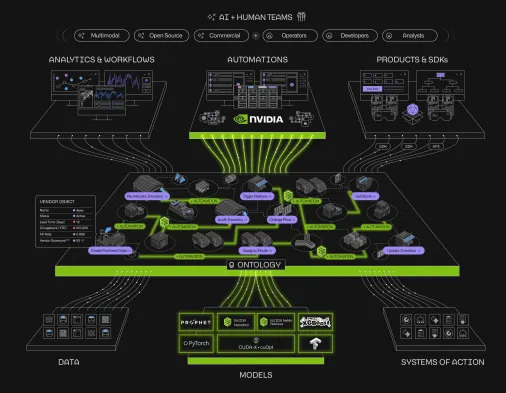
PLTR Ontology Q3 Report
Importantly, this approach also shapes how artificial intelligence is deployed, including through partners like NVDA. Instead of allowing models to operate freely, the ontology limits the scope of action to what has been explicitly defined. This reduces the risk of unintended behavior and aligns system outputs with organizational policy.
Why Trust, Governance, and Control Matter at Scale
As software moves closer to execution, the importance of governance increases. In low stakes environments, errors can be tolerated or corrected after the fact. In high stakes environments, they cannot.
Palantir’s roots in government and defense shaped its emphasis on permissioning, audit trails, and controlled access. These features are not cosmetic. They determine whether software can be trusted to operate inside critical systems.
For enterprise customers, this trust component becomes more valuable as artificial intelligence is embedded deeper into workflows. Boards and regulators care less about novelty and more about responsibility. Software that cannot explain how decisions were made or who authorized them becomes difficult to deploy at scale.
This focus on control can slow adoption at the margin, but it also creates barriers once systems are in place. Whether those barriers translate into long term durability depends on how broadly this architecture becomes embedded across organizations.
Commercial Momentum and Its Open Questions
Commercial adoption has become the most visible driver of Palantir’s recent reacceleration. In the most recent quarter, commercial revenue totaled approximately $695 million on a trailing basis, representing a growing share of overall revenue. The acceleration has been heavily concentrated in the United States, where commercial momentum has materially reshaped the company’s growth profile.
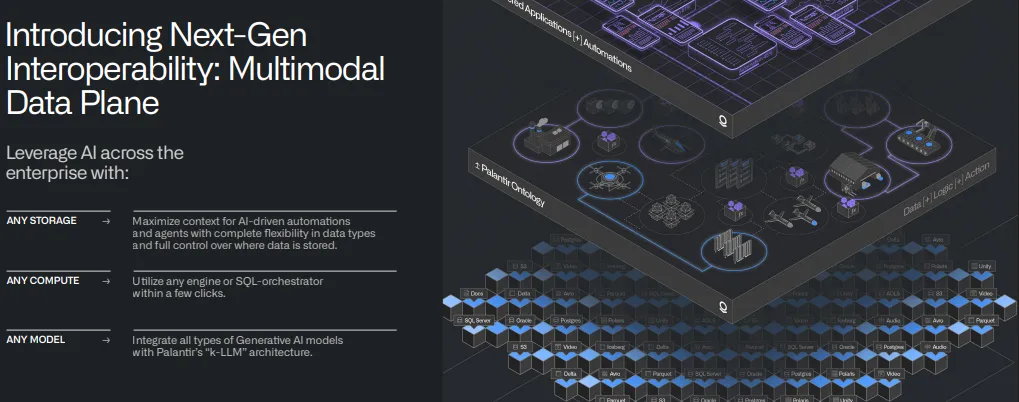
PLTR Multi-Modal Interoperability Q3 Report
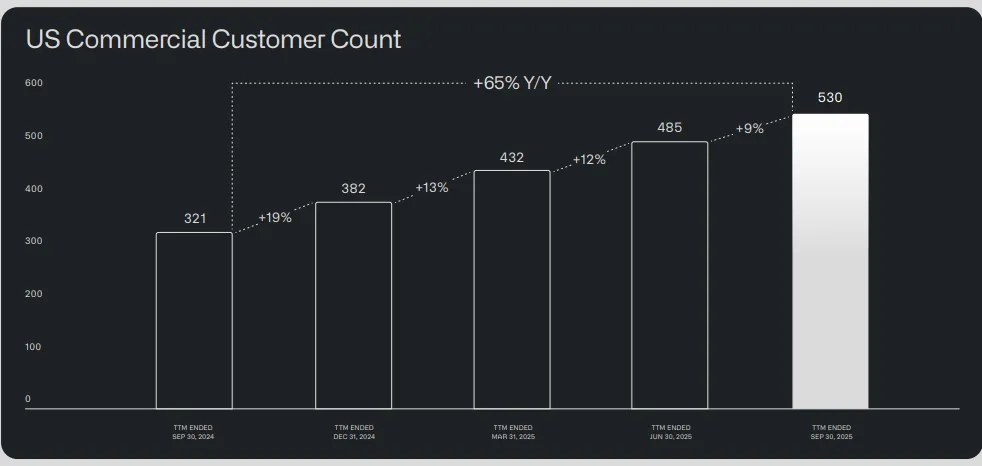
In the latest reported quarter, United States commercial revenue reached $397 million, representing year over year growth of approximately 121 percent. This rate of expansion materially exceeded growth in both the government and international segments. At the same time, total commercial customer count increased by roughly 50 percent year over year, indicating that growth was not driven solely by expansion within a narrow set of large accounts.
Growth at this pace and scale is difficult to ignore. It also raises the threshold for what must continue to hold in order for current expectations to remain intact.
PLTR Deal Expansion and Customer Breadth
Commercial growth has been accompanied by a clear shift in deal composition. During the quarter, Palantir reported more than 200 active commercial deals exceeding $1 million in total contract value, alongside a growing number of contracts above $5 million and $10 million. This distribution suggests that deployments are expanding beyond limited pilots and into broader operational use.
Importantly, customer growth has remained strong alongside rising deal sizes. This reduces the likelihood that results are being driven by a small number of outsized contracts. Instead, the data points toward wider adoption across organizations, at least within the domestic market.
The implication is not that every commercial deployment will scale indefinitely, but that Palantir’s traction is no longer confined to experimental or narrowly scoped use cases.
What We Can Infer About Palantir’s Durability
Palantir does not disclose traditional cohort metrics such as net dollar retention, which limits direct measurement of durability. However, several proxies provide partial insight. Remaining deal value associated with commercial customers increased sharply year over year, reaching approximately $3.6 billion, indicating that future revenue commitments are building alongside recognized revenue.
The company also reported total contract value signed of approximately $1.3 billion during the quarter, the highest quarterly figure to date, with a significant portion attributable to commercial customers. This suggests a willingness among customers to commit beyond initial deployments, even in a cautious spending environment.
Faster deployment cycles appear to be contributing to this momentum. Management has emphasized that customers are moving from initial engagement to production use more quickly than in prior periods. While this compresses sales cycles and supports near term growth, it also introduces the possibility that some demand is being pulled forward.
What Remains Unverified
Despite strong headline figures, important questions remain unresolved for our PLTR stock analysis. The earnings reports do not disclose renewal rates, long term expansion behavior, or how commercial customers behave under sustained cost pressure. Without this information, it is difficult to determine how much of the current growth reflects durable integration versus early stage enthusiasm.
There is also a notable geographic imbalance. International commercial revenue growth has remained modest relative to the United States, reinforcing the view that Palantir’s commercial success is currently concentrated in markets where regulatory, cultural, and institutional alignment is strongest.
As a result, commercial momentum strengthens the case for relevance and product market fit while simultaneously increasing sensitivity to any future deceleration. At current valuation levels, the market is not only rewarding growth, but implicitly assuming its persistence.
Government Revenue as Foundation, Not Guarantee
Government revenue remains the stabilizing layer beneath Palantir’s commercial acceleration. It provides scale, credibility, and a degree of predictability that many enterprise software companies lack. At the same time, the nature of government contracting introduces constraints that are often overlooked when the segment is treated as utility like or perpetual.
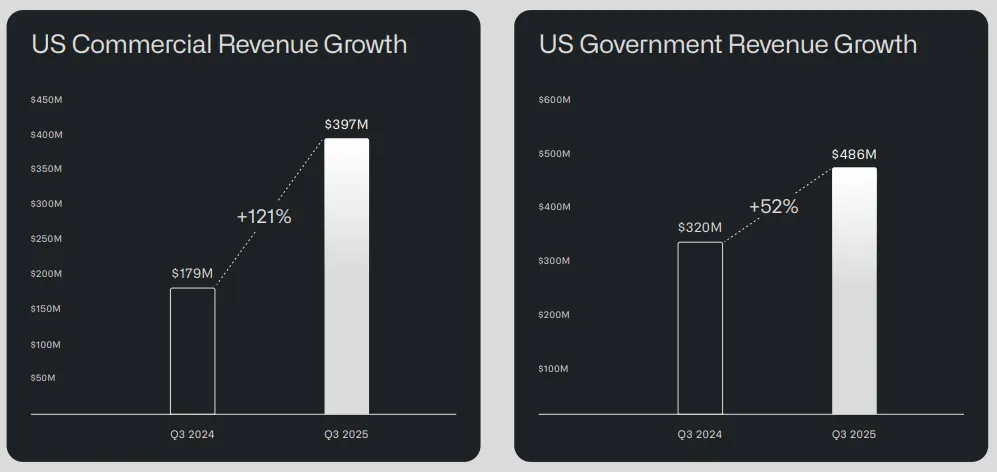
PLTR Revenue Growth Q3 Earnings
In the most recent quarter, government revenue totaled approximately $486 million, representing year over year growth of roughly 52 percent. This marked a meaningful reacceleration relative to prior periods and brought total government revenue to just over $1.9 billion on a trailing basis. The magnitude of this segment matters not only for revenue mix, but for how the market interprets Palantir’s long term role within public sector systems.
The key distinction is that government revenue supports durability, but it does not eliminate volatility.
Consolidation Versus Program Dependency
A growing portion of Palantir’s government business is tied to enterprise style agreements rather than isolated program wins. The U.S. Army’s enterprise agreement, often cited as a potential $10 billion opportunity over a multiyear horizon, reflects this shift toward consolidation. Importantly, this figure represents a contractual ceiling rather than guaranteed backlog.
In practice, revenue recognition under such agreements depends on program level adoption, budget approvals, and execution timelines. While consolidation increases strategic relevance, it does not convert discretionary spend into automatic annuities. The filings make clear that many government contracts remain subject to modification or termination for convenience.
This structure introduces a different kind of risk. Palantir may become more embedded in government systems over time, yet still experience uneven revenue recognition across quarters. At elevated valuation levels, even temporary dislocations can matter.
Visibility, Budget Risk, and Contract Structure
As of the most recent filing, remaining performance obligations totaled approximately $2.6 billion, with about 44 percent expected to be recognized within the next twelve months. This provides a measure of near term visibility, but it also highlights the limits of long duration certainty.
Remaining performance obligations reflect only non cancelable commitments. They do not capture the full scope of potential future work under expandable or usage based arrangements. As a result, they understate upside while also constraining downside protection.
Budget dynamics add another layer of uncertainty. Continuing resolutions, shifting defense priorities, or delays in program authorization can defer spending even when strategic intent remains intact. Palantir’s exposure to these dynamics has increased as government revenue has grown faster and larger.
The government segment therefore functions as an anchor rather than a guarantee. It grounds Palantir’s relevance and provides ballast during periods of commercial volatility, but it does not remove sensitivity to execution timing or political processes.
Profitability, Capital Discipline, and Shareholder Economics
Palantir’s recent operating performance has altered a long-standing critique of the business. Profitability is no longer theoretical or adjusted into existence. It is present in reported results and increasingly central to how the company is being valued. This shift strengthens the quality of the business while simultaneously raising the bar for capital discipline.
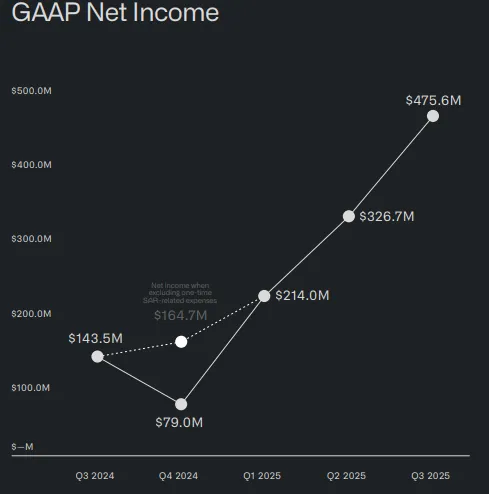
PLTR Net Income Q3 Report
In the most recent quarter, Palantir reported operating income of approximately $393 million on a GAAP basis, translating to an operating margin of roughly 33 percent. Net income totaled approximately $476 million, reflecting a net margin near 40 percent. Gross margin remained above 80 percent, reinforcing that recent growth is arriving with software like economics rather than services intensity.
These figures matter because they change the discussion. Palantir is no longer being asked when profitability will arrive. It is being assessed on how sustainable and scalable that profitability proves to be.
Palantir Margin Structure and Operating Leverage
The current margin profile suggests that incremental revenue is being absorbed with relatively limited incremental cost. Sales efficiency has improved, implementation overhead appears to be flattening, and fixed costs are being leveraged across a larger revenue base.
This operating leverage creates convexity. When growth and margins expand together, earnings scale quickly. In the most recent quarter, Palantir generated adjusted operating income of approximately $601 million, implying an adjusted operating margin above 50 percent. Combined with year over year revenue growth exceeding 60 percent, this produced a Rule of 40 score well above 100 percent.
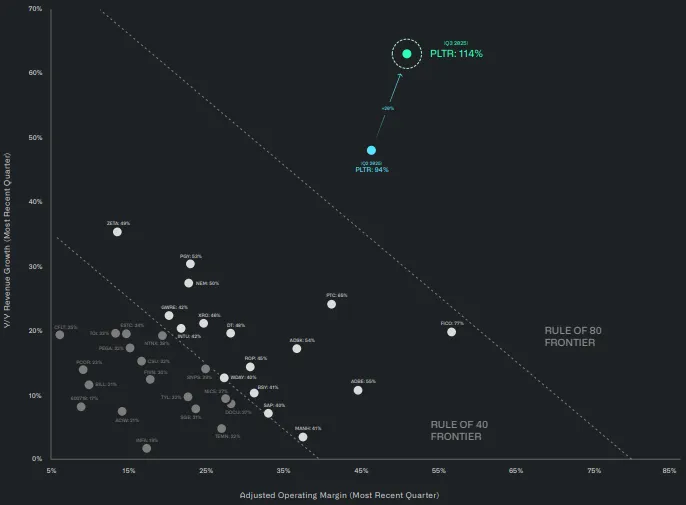
PLTR Rule of 40 Q3 Report
That combination is rare, particularly at Palantir’s scale. It supports the argument that the business model has reached a more efficient phase of its evolution.
At the same time, margin expansion at this pace is unlikely to be linear. As the company grows, competitive pressure, pricing dynamics, and incremental investment in sales and support may temper further gains. The question is not whether margins will retreat, but where they ultimately stabilize.
Stock Based Compensation and Capital Allocation Tradeoffs
Stock based compensation remains a central consideration in evaluating per share economics. In the most recent quarter, stock based compensation totaled approximately $172 million, representing roughly 14 percent of revenue. This marks a significant improvement from earlier years, when stock based compensation exceeded revenue, but it remains material.
Palantir has begun to offset dilution through share repurchases. As of the most recent filing, the company had repurchased approximately $56 million of stock year to date under a $1 billion authorized program. While symbolically important, this level of buyback activity does not yet fully neutralize dilution from ongoing equity compensation.
The result is a mixed signal for our PLTR stock analysis. The business is generating ample cash, with adjusted free cash flow of approximately $540 million in the quarter, but capital allocation remains conservative. Management appears focused on maintaining flexibility rather than aggressively returning capital to shareholders.
For a company valued on long duration earnings power, this balance matters. Profitability strengthens the case for durability, but per share outcomes will depend on how effectively cash generation translates into share count discipline over time.
PLTR Valuation as a Constraint on Outcomes
At current levels, Palantir’s valuation exerts as much influence on potential outcomes as the underlying business itself. The company is no longer priced for improvement alone. It is priced for endurance, scale, and a degree of inevitability that leaves little room for deviation.
With a market capitalization of approximately $462 billion, Palantir trades at more than 100 times trailing twelve month revenue and well over 400 times trailing earnings. Even allowing for continued growth and further margin expansion, these multiples embed assumptions that extend several years into the future.
Valuation at this magnitude does not require perfection, but it does require consistency. Small changes in growth trajectories, margin ceilings, or competitive dynamics can have outsized effects on expected returns.
What the Current Price Implies
To justify the present valuation under more conventional long term multiples, Palantir would need to generate net income on the order of $15 to $20 billion annually. At a net margin of approximately 40 percent, this would imply annual revenue approaching $40 to $50 billion.
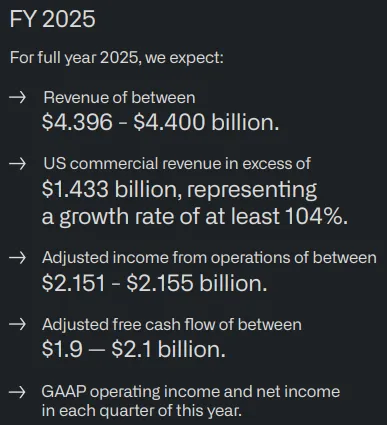
PLTR FY 2025 Guidance Q3 Earnings
For context, Palantir’s trailing revenue is approximately $4.4 billion. The gap between current scale and implied future scale is not insurmountable, but it is substantial. It requires sustained high growth for many years, alongside margins that remain near the upper bound of enterprise software economics.
The market appears to be assuming that Palantir will not only grow rapidly, but also maintain pricing power and structural differentiation as its customer base expands. These assumptions may prove correct. They are also tightly coupled to the company’s ability to remain embedded in mission critical workflows rather than discretionary analytics budgets.
Why Execution Alone May Not Be Sufficient
Strong execution reduces risk. It does not eliminate valuation sensitivity. Even if Palantir continues to deliver revenue growth above 30 percent and operating margins above 30 percent, the stock could experience prolonged periods of stagnation if multiples compress toward historical norms.
This dynamic is not hypothetical. Software companies that grow into their valuations often do so through years of sideways price action rather than dramatic declines. In such scenarios, the business compounds while the stock does not.
At more moderate valuation levels, this risk would be tolerable. At current levels, it becomes central. The distribution of outcomes is skewed, with upside dependent on exceptional execution and downside exposed to relatively modest disappointment.
Valuation, in this case, does not invalidate the business. It constrains the range of favorable outcomes for shareholders entering at present prices.
The PLTR Bull Case: Conditions Required for the Market’s Assumptions to Hold
The bullish interpretation of Palantir rests less on near term performance and more on the durability of its role within complex systems. At the current valuation, incremental improvement is insufficient. The market is implicitly underwriting a future in which Palantir becomes embedded deeply enough that displacement is rare and expansion is structural.
For this case to hold, several conditions must persist simultaneously.
First, commercial momentum must translate into long lived integration rather than episodic adoption. The recent acceleration in United States commercial revenue, which reached approximately $397 million in the most recent quarter with growth of roughly 121 percent year over year, needs to evolve into sustained expansion across customer cohorts. Early deployments must lead to broader organizational dependence, increasing contract scope and renewal depth over time.
Second, Palantir’s ontology driven architecture must remain differentiated as artificial intelligence moves from experimentation to execution. The value proposition depends on Palantir acting as a control layer rather than a feature layer. If enterprises continue to require a governed environment to deploy agentic systems at scale, the platform’s emphasis on permissioning, auditability, and real world modeling supports durable pricing power.
Third, government revenue must continue to consolidate rather than fragment. With trailing government revenue exceeding $1.9 billion and year over year growth accelerating above 50 percent, Palantir has reestablished momentum in a segment often viewed as mature. For the bull case to persist, enterprise agreements must expand into broader system adoption, allowing Palantir to capture a growing share of defense and intelligence software budgets over time.
Fourth, margin structure must remain near current levels. Gross margins above 80 percent and operating margins in the low to mid 30 percent range provide the operating leverage necessary to scale earnings rapidly. Sustaining these margins as revenue grows would allow net income to compound disproportionately relative to revenue.
Finally, competitive pressure must remain contained. Large platform providers will continue to improve their offerings, but the bull case assumes that governance, trust, and operational control remain difficult to replicate within bundled solutions. If Palantir retains its position as the preferred system for high stakes deployment, switching costs rise in ways that reinforce long term durability.
Under these conditions, Palantir begins to resemble infrastructure rather than software. The valuation, while demanding, becomes more defensible if earnings power expands toward the levels implied by the current price.
The PLTR Bear Case: Where the Structure Shows Fragility
The bear case for Palantir does not require a breakdown in execution or a reversal in business quality. It rests on the possibility that the assumptions embedded in the current valuation prove too optimistic relative to what the business can sustain over time.
The first point of fragility lies in growth durability. United States commercial revenue growth of approximately 121 percent year over year reflects exceptional early momentum, but rates at this level are inherently difficult to maintain as scale increases. Even a deceleration toward growth in the 30 to 40 percent range, while strong in absolute terms, would represent a meaningful disappointment relative to market expectations.
Second, expansion dynamics remain unverified. While deal sizes are increasing and customer counts are rising, Palantir does not disclose net dollar retention or long term cohort behavior. Without this visibility, it is difficult to assess whether early deployments lead to persistent expansion or plateau after initial integration. At current valuation levels, uncertainty around expansion rates carries disproportionate weight.
Third, competition does not need to displace Palantir outright to pressure outcomes. Large platform providers can introduce solutions that are not equivalent, but sufficient. If governance and orchestration capabilities become bundled into broader enterprise ecosystems, pricing power may erode at the margin. In that scenario, Palantir remains relevant, but less singular.
Government revenue introduces a different form of risk. With quarterly government revenue of approximately $486 million and growth reaccelerating above 50 percent, expectations around stability have risen. However, government contracts remain subject to program timing, budget approvals, and political processes. Any delay in funding or shift in priorities could create near term volatility that the stock price is poorly positioned to absorb.
Finally, valuation itself magnifies these risks. With the stock trading at more than 100 times trailing revenue and well over 400 times trailing earnings, the margin for error is narrow. Multiple compression does not require bad news. It can occur simply through the passage of time if growth moderates faster than earnings expand.
In this scenario, Palantir could continue to improve as a business while delivering limited or negative returns to shareholders entering at current prices. The bear case is not collapse. It is normalization.
Positioning the Stock Without Forecasting Outcomes
This analysis leads to a conclusion that is more practical than predictive. Palantir can remain a strong and improving business while still being an unforgiving stock at current levels. At a market capitalization of approximately $460 billion, the stock price embeds assumptions that leave little margin for deviation, even if execution remains sound.
The most important implication is asymmetry. Under a range of plausible conditions, including slower commercial expansion, competitive convergence, or a reassessment of long duration growth assumptions, the stock price could decline materially without any fundamental deterioration in the business. A drawdown on the order of fifty percent is not difficult to envision in such a scenario, driven primarily by multiple compression rather than operational failure.
This risk does not negate Palantir’s long term prospects. The company has established itself as a relevant and increasingly profitable platform in both enterprise and government environments. Its emphasis on control, governance, and execution positions it well as organizations attempt to deploy artificial intelligence in production settings. Those strengths remain intact even under less favorable market conditions.
The tension lies in timing and price, not trajectory. For shareholders entering at current levels, returns are likely to be dictated as much by changes in market expectations as by continued business progress. For those with longer horizons or more flexible entry points, the underlying company may remain attractive even if the stock experiences significant volatility along the way.
The appropriate posture, therefore, is clarity rather than conviction. Palantir’s future as a business appears durable. The stock, however, is priced such that outcomes depend heavily on how quickly that durability is proven and how much patience the market is willing to extend while it is.
Palantir Stock Price Prediction 2030
Palantir Stock Price Prediction 2030: A story of foresight, conviction, and grit. How Palantir is revolutionizing the operating system of the world.

Celsius Stock Analysis: The Shelf Reset and the Second Growth Curve
Celsius stock analysis of the shelf reset, Alani growth, Pepsi economics and cash flow, with a 2030 model and a Premium valuation and entry-price framework.

Meta AI Spending: The Customer Is Already Here
Can Meta turn AI spending into shareholder returns? We model advertising, Muse, hardware, capital costs and cash flow through 2030, with a full valuation.
Northwise Portfolios
See how the research becomes real decisions
Reader discussion
Discuss the research
Create a Free account to join the discussion with a display name.
Create a Free Account
No comments yet. Start a thoughtful discussion.