
Palantir Stock Price Prediction 2030
Palantir Stock Price Prediction 2030: A story of foresight, conviction, and grit. How Palantir is revolutionizing the operating system of the world.
In this article
Palantir Stock Price Prediction 2030: “Vaporware” or the Future of AI?
A story of foresight, conviction, and grit. How Palantir is revolutionizing the operating system of the world.

Palantir is notorious for being a hard-to-understand company to those of us on the outside. To best understand the rise of the company, the investor hype around the stock, PLTR, and where the company may be headed, it is best to look at their journey step by step.
This article takes a chronological approach to unpack what makes Palantir unique, how its product offering has evolved, and why its future as both a company and a stock is worth watching.
2003: The Origins of Palantir
Founded in Palo Alto, in 2003, Palantir Technologies began as a mission-driven company aimed at leveraging technology to enhance national security while simultaneously reducing violations of privacy and other social liberties.
The name Palantir comes from the seeing stones in J.R.R. Tolkien’s The Lord of the Rings. These stones, also known as Palantíri were magical orbs that allowed users to see across great distances and gain insight into unfolding events.

Palantir sought to help the government see clearly through massive amounts of complex data and make better, faster decisions. The goal was to bring hidden truths to light with the initial focus on developing software to assist U.S. intelligence agencies in counterterrorism and anti-fraud efforts.
Palantir’s leadership combines visionary thinking with diverse expertise, driving the company’s innovative approach to data analytics and artificial intelligence.
The company was founded by 5 people:

Alex Karp (CEO): A philosopher by training, Karp emphasizes ethical considerations in AI deployment and advocates for a “warrior culture” within the company to tackle complex challenges.
Peter Thiel (Chairman): A co-founder of PayPal and early investor in Facebook, Thiel brings strategic foresight and a strong network in Silicon Valley.
Learn more about Peter Thiel


Joe Lonsdale (Co-founder): A serial entrepreneur and investor, Lonsdale contributed to Palantir’s early growth and product development.
Learn more about Joe Lonsdale
- Stephen Cohen (President): Instrumental in the technical development of Palantir’s platforms, ensuring scalability and adaptability across sectors
- Nathan Gettings (Co-founder): a software engineer and data architect best known for helping design the original technical framework behind Palantir’s Gotham platform.
2005: Validation Through In-Q-Tel Investment
In 2005, Palantir secured early funding from In-Q-Tel, the venture capital arm of the CIA. This milestone was far more than a financial endorsement, it served as a critical validation of Palantir’s mission to revolutionize data-driven decision-making in defense and intelligence.
- In-Q-Tel’s backing signaled strong alignment between Palantir’s technology and the needs of the U.S. national security community.
- This investment enabled Palantir to deepen development of its flagship Gotham platform, designed to help intelligence analysts detect patterns and threats in complex, siloed datasets.
- The relationship also opened doors to initial government contracts, helping to establish Palantir’s reputation as a trusted, mission-critical software provider in classified environments.
The In-Q-Tel investment cemented Palantir’s early identity as a company built for high-stakes national security use cases, an identity that still shapes its ethos today.
2008: Launch of Palantir Gotham, The Intelligence Backbone
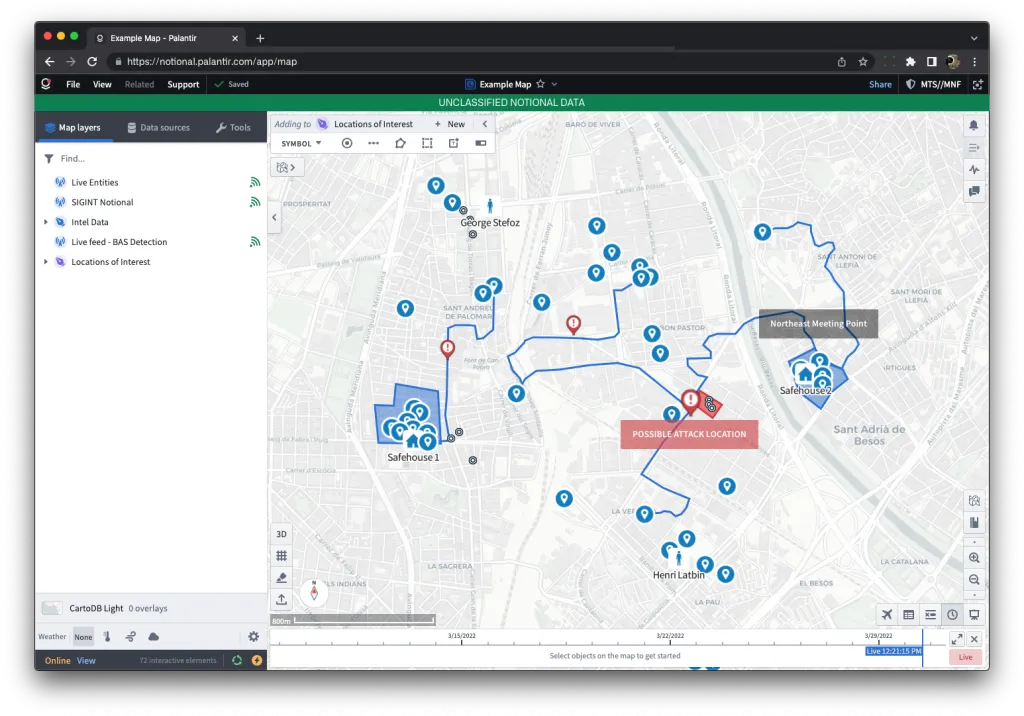
In 2008, Palantir officially launched Palantir Gotham, a software platform purpose-built for defense and intelligence agencies grappling with overwhelming amounts of fragmented data. Gotham became the cornerstone of Palantir’s government business and was quickly adopted by high-profile agencies including the CIA, NSA, Department of Defense, and FBI.
- Gotham offered secure, real-time data integration and analysis, allowing users to unify disparate sources of information, structured and unstructured, into a single operational picture.
- Intelligence analysts used Gotham to connect dots across complex datasets, supporting missions from counterterrorism and cyber defense to military logistics and financial fraud investigations.
- The platform’s usability and transparency stood out in a sector dominated by black-box software, enabling decision-makers to trace the logic behind AI-driven insights, a critical feature in high-stakes environments.
Learn more about Gotham
By embedding itself into some of the most secure and mission-critical agencies in the U.S. government, Gotham not only proved Palantir’s technical capabilities but also set the tone for the company’s role as a strategic, high-trust partner in the global intelligence community.
2010–2013: Palantir’s Strategic Breakout
Between 2010 and 2013, Palantir’s technology gained widespread adoption across U.S. military and intelligence agencies, solidifying its reputation as a mission-critical tool during one of the most pivotal periods in U.S. defense and domestic operations.
- In the wars in Iraq and Afghanistan, Palantir’s Gotham software helped military analysts track insurgent networks, predict IED placements, and map terrorist activity with unprecedented speed and precision.
- Soldiers and analysts on the ground praised the software for real-time decision support and saving lives, often choosing Palantir over legacy government-built alternatives.
- On the domestic front, Palantir played a key role in the aftermath of the 2008 financial crisis, supporting U.S. agencies in detecting complex financial fraud.
- It was instrumental in helping regulators and law enforcement analyze suspicious trading, detect Ponzi schemes, and uncover mortgage fraud.
- Palantir’s platform also exposed rampant healthcare billing fraud, enabling the Department of Health and Human Services (HHS) and other agencies to flag billions of dollars in false Medicare and Medicaid claims.
This period marked Palantir’s transformation from a promising startup into a critical infrastructure provider across both national security and civil governance, earning trust in domains where failure was not an option.
2016: Commercial Expansion and the Birth of Foundry and the Ontology
In 2016, Palantir took a major strategic leap beyond its government roots with the launch of Palantir Foundry, a data integration and operational intelligence platform tailored for commercial enterprises.
- Foundry enabled companies in sectors like energy, pharmaceuticals, logistics, and finance to harness and operationalize their data in real time.
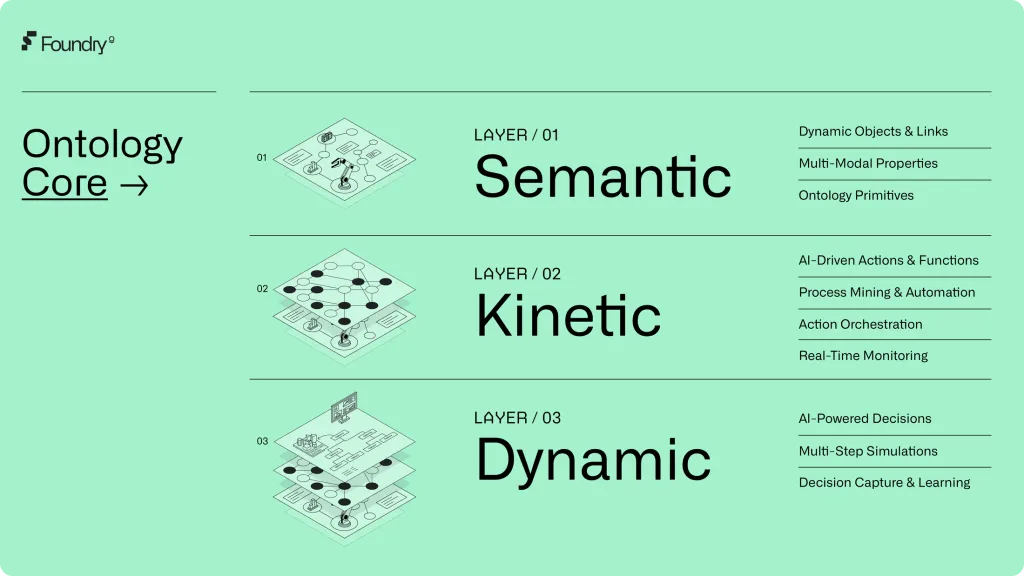
- This platform introduced the Palantir Ontology: a breakthrough in enterprise software architecture.
- It allowed users to create a digital twin of their business, mapping core concepts (e.g., customer, order, shipment) across siloed systems.
- The ontology provided a shared language and semantic layer, enabling seamless collaboration across business functions and data domains.
- The ontology allows companies to integrate data, logic, and actions. It forms the digital foundation, the ‘laws of physics’ of a company and how it operates.
Learn more about Ontology
- This shift marked Palantir’s evolution from a defense-focused software firm to a multi-industry operating system for modern enterprises.
- Foundry’s modular design also paved the way for custom workflows, low-code application development, and integration with third-party tools, making it flexible for both frontline employees and data scientists.
The commercial pivot began a new era of accelerated adoption that would continue to scale in the years ahead.
2019: Apollo Launches: Powering Secure, Scalable Software Deployment
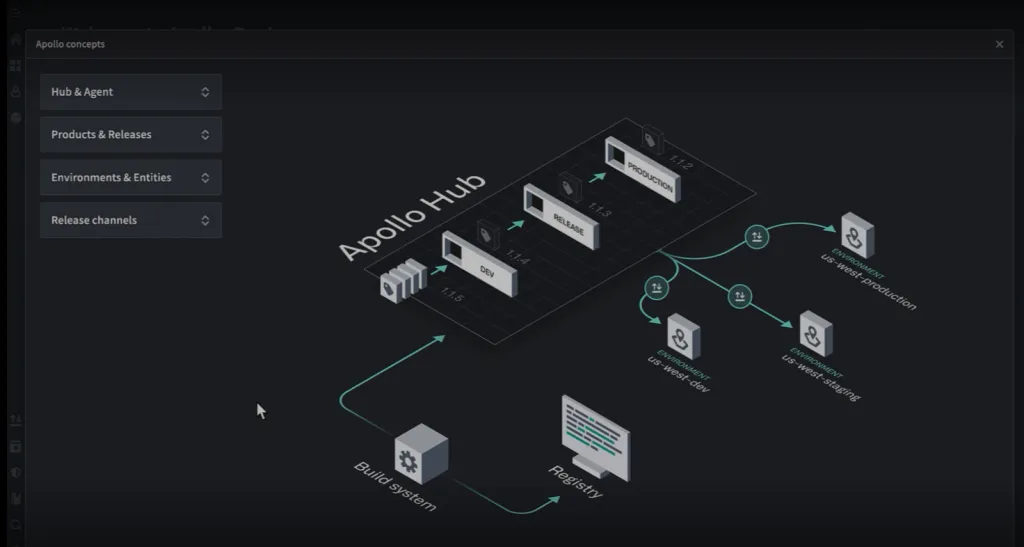
In 2019, Palantir launched Apollo, its proprietary continuous delivery and infrastructure management platform. Designed to solve one of the biggest challenges in enterprise software (secure and seamless deployment across complex environments) Apollo became a critical pillar of Palantir’s long-term product strategy.
- Apollo enables automated, real-time updates and maintenance of Palantir Gotham and Foundry across a wide range of customer environments:
- Cloud, on-premises, hybrid, and air-gapped networks.
- Operates even in disconnected, adversarial environments like combat zones or intelligence field offices.
- It empowers Palantir to ship code daily to secure systems without requiring direct access to those environments, a key differentiator from other enterprise software vendors.
- Apollo was instrumental in:
- Supporting U.S. Army operations, where Foundry is used to make mission-critical decisions in the field.
- Enabling Palantir to serve government, defense, and healthcare clients with stringent data security and compliance requirements.
- The system essentially acts as a “control tower” for software delivery, managing deployments across hundreds of environments simultaneously with minimal human intervention.
Learn more about Apollo
Apollo strengthened Palantir’s position as a mission-critical infrastructure provider, capable of operating in settings where traditional cloud vendors cannot.
2020–2021: Public Debut and Expanding Influence
Palantir’s transition from a secretive defense contractor to a publicly traded enterprise software powerhouse began in earnest during 2020–2021, a period marked by transformative growth, high-profile partnerships, and global visibility.
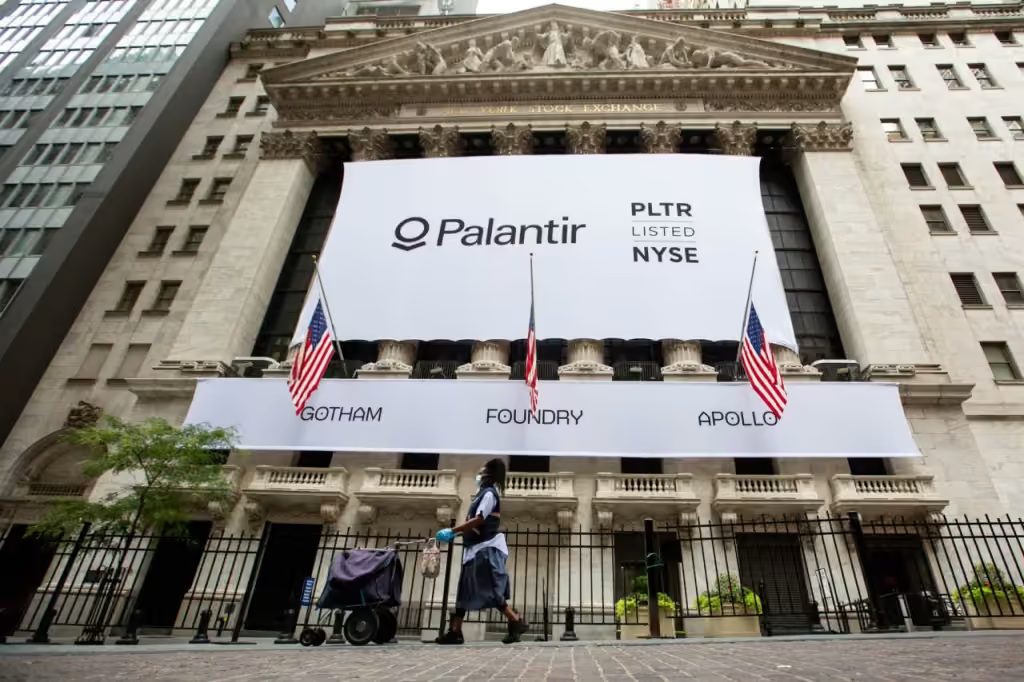
- September 30, 2020: Palantir went public via a direct listing on the New York Stock Exchange under the ticker PLTR. Initial valuation hovered around $21 billion.
- Massive wins in the public sector, reinforcing Palantir’s role as a mission-critical government contractor:
- U.S. Army: Multi-year contracts for battlefield decision platforms.
- CDC & FDA: Leveraged Palantir software for real-time health surveillance and vaccine distribution.
- NIH & HHS: Managed COVID-related data integration and response coordination.
- U.S. Space Force: Used Gotham for space domain awareness.
- Foundry gained traction in the commercial world, entering and growing in industries beyond its traditional defense clientele:
- BP: Used Foundry to unify global energy data and optimize operations.
- 3M, Merck, and Ferrari: Deployed Foundry for manufacturing optimization, supply chain intelligence, and R&D.
- This marked a strategic pivot, proving Palantir’s software had widespread applicability in Fortune 500 environments.
- Pandemic response solidified Palantir’s relevance:
- Foundry became an essential platform for real-time pandemic logistics and decision-making.
- Helped public institutions and corporations manage testing, hospitalization, supply chains, and vaccine deployment.
- Palantir reflects on the COVID-19 pandemic.
This era validated Palantir’s unique ability to deliver insights and operational intelligence in high-stakes, fast-changing environments, be it war zones, hospital networks, or global corporations. It also laid the foundation for broader commercial adoption and long-term platform stickiness.
2022–2023: The Birth of AIP
These two years marked a major strategic turning point for Palantir, from a primarily government-focused firm to a commercial AI platform leader. While still deeply embedded in defense and public sector work, Palantir began laying the foundation to become the operating system for enterprise AI.
Key Developments:
- Commercial Expansion Accelerates
Palantir began scaling its U.S. commercial business in earnest: - Hired a dedicated salesforce and expanded its deployment strategist team focused on private sector clients.
- Added dozens of forward-deployed engineers to support commercial customer onboarding and solution building.
- Reorganized internal go-to-market efforts, signifying a shift from reactive to proactive commercial sales.
- Foundry Gaining Traction as a Digital Transformation Standard
- Foundry increasingly viewed by clients as foundational infrastructure, not just another analytics or BI tool.
- Adopted across industries like healthcare, manufacturing, energy, and financial services to replace fragmented data stacks and build “digital twins” of businesses.
- Enabled data fusion, simulation, and operational decision-making at scale, creating real-world impact and long-term stickiness.
- Launch of AIP (Artificial Intelligence Platform)
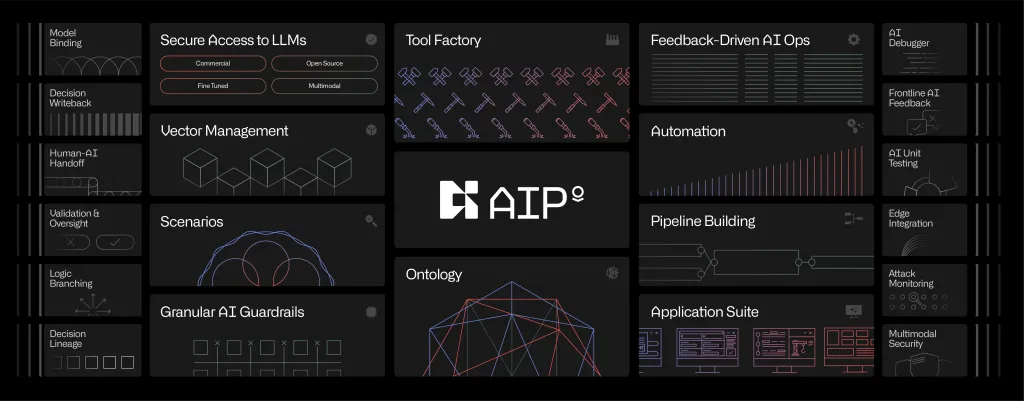
In response to the generative AI boom, Palantir launched AIP: - A secure interface between LLMs and enterprise systems, allowing language models (e.g., GPT-4) to safely interact with sensitive business logic and real-world workflows.
- Designed to abstract complexity: AIP shields end users and engineers from the intricate web of model orchestration, retrieval, governance, and execution.
Learn more about AIP
- AIP Bootcamps: A Go-to-Market Flywheel
- Introduced a unique strategy to accelerate AIP adoption, AIP Bootcamps:
- Short, collaborative build sessions (often 1–5 days) where client teams work with Palantir engineers to build real AI agents using their actual systems and data.
- Demonstrated instant utility, which drove executive buy-in and conversions.
- Hundreds of bootcamps completed in a matter of months, rapidly expanding the top-of-funnel pipeline.
- Launch of the AIP Developer Platform
- Empowered customers and partners to build AI-native applications using their own ontologies and data pipelines.
- Positioned Palantir as not just an application vendor, but a platform company, enabling entire ecosystems of developers to leverage its secure data infrastructure.
- Commercial Growth Begins to Inflect
- U.S. Commercial business showed accelerating revenue growth.
- Explosive interest in AIP across industries, from insurance underwriting to logistics to healthcare diagnostics.
- Generated excitement from clients looking to leapfrog slow-moving digital transformations by going straight to AI-native architectures.
Together, these developments set the stage for Palantir’s next S-curve: becoming the trusted AI backbone for both government and global enterprise.
2023–2024: Institutional Recognition and Warp Speed Growth
- S&P 500 Inclusion: Palantir’s addition to the S&P 500 marked a significant milestone, boosting the company’s visibility and credibility among institutional investors. This inclusion often attracts large passive funds and broadens the shareholder base, increasing demand for the stock.
- Consistent GAAP Profitability: After years of investing heavily in growth and technology, Palantir began reporting consistent GAAP profitability, reflecting improved operational efficiency and sustainable cash flow generation.
- Commercial Revenue Milestone: The company’s U.S. commercial segment crossed the $1 billion annualized revenue run-rate, underscoring rapid adoption beyond government clients and validating Palantir’s expansion into the private sector.
- AIP Deployment Across Industries: Palantir’s Artificial Intelligence Platform (AIP) accelerated adoption across dozens of new industries, becoming the AI partner of choice for highly regulated and mission-critical sectors such as healthcare, finance, energy, and manufacturing. This broadened footprint is key to Palantir’s long-term growth story.
- Warp Speed: Palantir launched “Warp Speed,” a targeted program to accelerate digital transformation and operational intelligence in manufacturing. This initiative leverages Foundry and AIP to optimize production processes, reduce downtime, and enhance supply chain resilience, helping manufacturers achieve next-level efficiency and agility.
Q1 2025: Where We Are Today
Palantir’s product suite has evolved to address the needs of both governmental and commercial clients, reflecting its adaptability and commitment to solving complex data challenges.
Current offerings:
- Gotham: Designed for government agencies, providing tools for intelligence analysis, counterterrorism, and defense operations.
- Foundry: Tailored for commercial enterprises, enabling data integration, analysis, and decision-making across industries. Creates a digital twin of an organization’s operations, incorporating data, logic, and workflows.
- Apollo: A continuous delivery system that manages and updates software across various environments, ensuring reliability and compliance. Supports rapid deployment of updates and new features, enhancing agility.
- Artificial Intelligence Platform (AIP): Introduced to accelerate enterprise AI adoption, offering tools for building and deploying AI models within organizations. Built atop Foundry, it leverages existing data infrastructures to deploy AI models effectively.
Financial Highlights (Q1 2025):
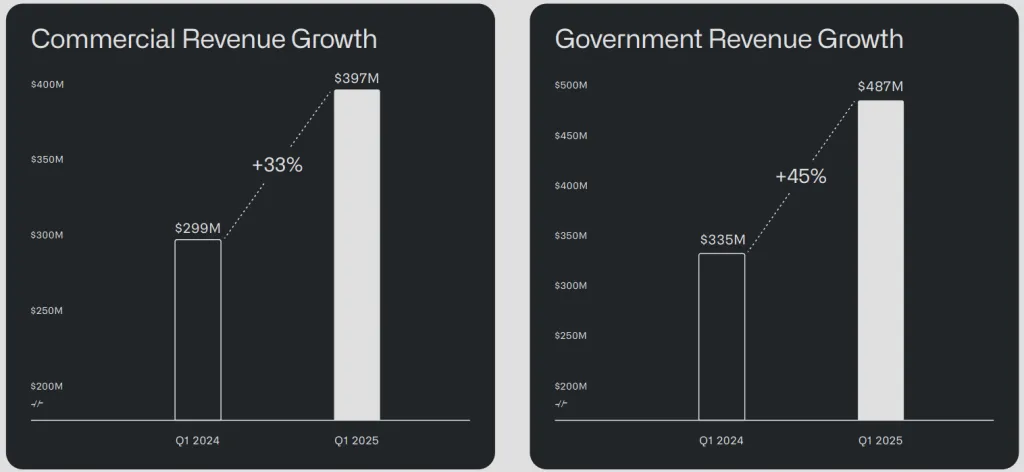
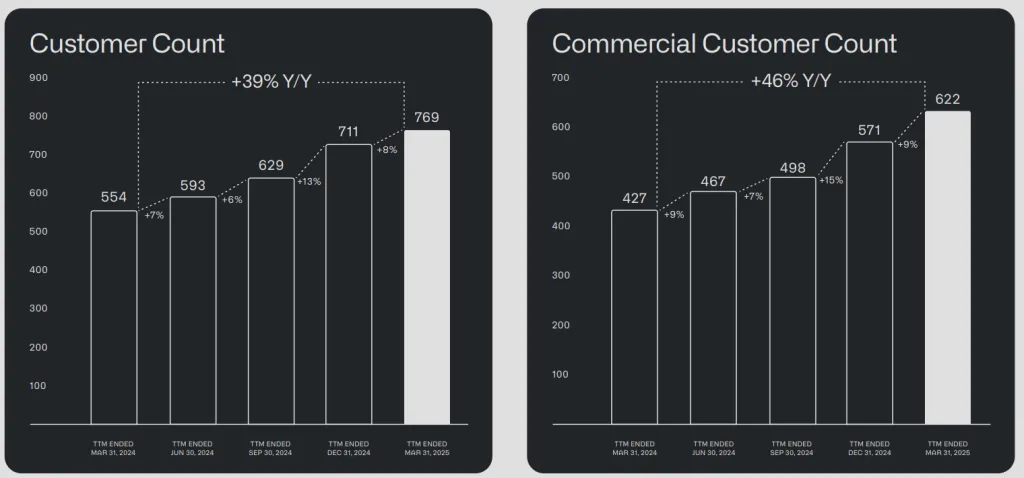
- Total revenue reached $884 million, a 39% year-over-year increase.
- U.S. revenue grew by 55% year-over-year, totaling $628 million.
- U.S. commercial revenue surged by 71% year-over-year to $255 million.
- Achieved a Rule of 40 score of 83%.
- Adjusted earnings per share stood at $0.13, up from $0.08 the previous year.
- Raised full-year 2025 revenue guidance to $3.89–$3.90 billion, representing a 36% year-over-year growth.
- Continued investment in AI platforms and expansion of client base.
Navigating Uncertainty with Promising Potential
Renowned, yet controversial, investor Cathie Wood views Palantir as a transformative force in enterprise AI. She believes Palantir could dominate the enterprise AI landscape, challenging traditional tools like Microsoft Excel.
She also highlights Palantir’s integration of AI into business operations as a competitive advantage. Betting on her conviction, Palantir is a core holding in her investment firm’s, ARK Invest, portfolio.
While specific Palantir stock price predictions for 2030 vary, Palantir’s trajectory suggests substantial growth potential. We focus on the business more than the stock, and when it comes to Palantir, we are bullish.
At Northwise, we typically prefer not to provide explicit future stock predictions, but to equip our readers with the necessary information to come up with their own. So ask yourself, what is your Palantir stock price prediction for 2030?
To help better address this question, we have laid out some, but not all, of the key catalysts Palantir has going forward.
Key Catalysts for Palantir’s Future Growth
- Commercial Market Expansion: Continued rapid adoption of Foundry and AIP in U.S. and international commercial sectors (energy, pharma, finance, manufacturing, logistics), especially as digital transformation accelerates.
- Artificial Intelligence Platform (AIP) Adoption: AIP acts as a game-changer, enabling enterprises to safely integrate AI and LLMs (like GPT-4) into their workflows, which can create massive operational efficiencies and new use cases.
- Foundry Becoming a “Standard” Digital Operating System: Increasingly, companies may require Foundry expertise when hiring, turning Palantir’s software into a critical business infrastructure and raising switching costs.
- Government Contract Growth & Expansion: Deepening and broadening government relationships (U.S. Army, Space Force, CDC, intelligence agencies), and potentially expanding to new governmental agencies or foreign governments.
- International Commercial Growth: Accelerating Foundry and AIP penetration beyond the U.S. market, especially in Europe, Asia, and emerging markets.
- “Warp Speed” Manufacturing Initiative: Driving rapid digital transformation in manufacturing and supply chains, creating tangible cost savings and efficiencies that can lead to upsells and long-term contracts.
- AI-Driven Workflow Automation & Security: Palantir’s edge in securely connecting and automating complex data flows in regulated industries offers a moat that competitors will struggle to replicate.
- Ecosystem & Developer Community Growth: Expansion of the Palantir AIP Developer Platform and bootcamps to empower clients and third-party developers to build custom AI workflows, increasing platform stickiness.
- Increasing Profitability and Cash Flow Generation: Continued improvement in margins and free cash flow to fund innovation, reduce dilution, and increase shareholder returns.

PLTR Stock Analysis
PLTR stock analysis examining Palantir’s business momentum, valuation risk, and why the stock could crater even if fundamentals remain strong.

Celsius Stock Analysis: The Shelf Reset and the Second Growth Curve
Celsius stock analysis of the shelf reset, Alani growth, Pepsi economics and cash flow, with a 2030 model and a Premium valuation and entry-price framework.

Meta AI Spending: The Customer Is Already Here
Can Meta turn AI spending into shareholder returns? We model advertising, Muse, hardware, capital costs and cash flow through 2030, with a full valuation.
Northwise Portfolios
See how the research becomes real decisions
Reader discussion
Discuss the research
Create a Free account to join the discussion with a display name.
Create a Free Account
No comments yet. Start a thoughtful discussion.