Nebius OXAGON Data Center in Saudi Arabia
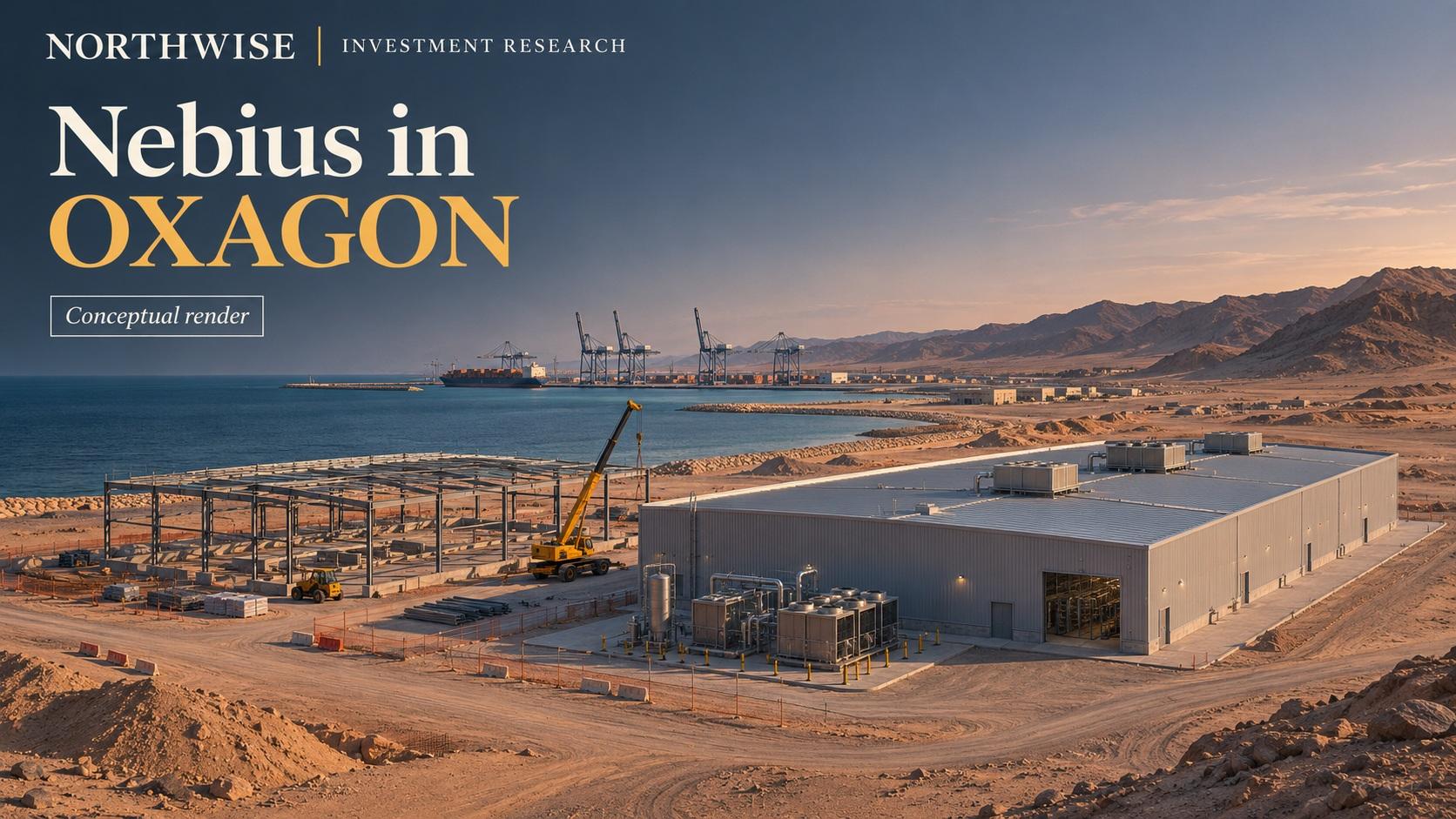
Nebius could anchor a Saudi campus built to sell computing power abroad.
In this article
Six weeks after breaking ground on Saudi Arabia’s Red Sea coast, HUMAIN and DataVolt named the customer they wanted in the first halls. Under an October framework, Nebius could take up to 50 MW of the first 100 MW under construction. The partners target a phased start from Q4 2027. HUMAIN’s CEO, Tareq Amin, called Nebius its “first customer.” The companies signed a preliminary framework and have yet to disclose the size of the opening delivery. October framework announcement
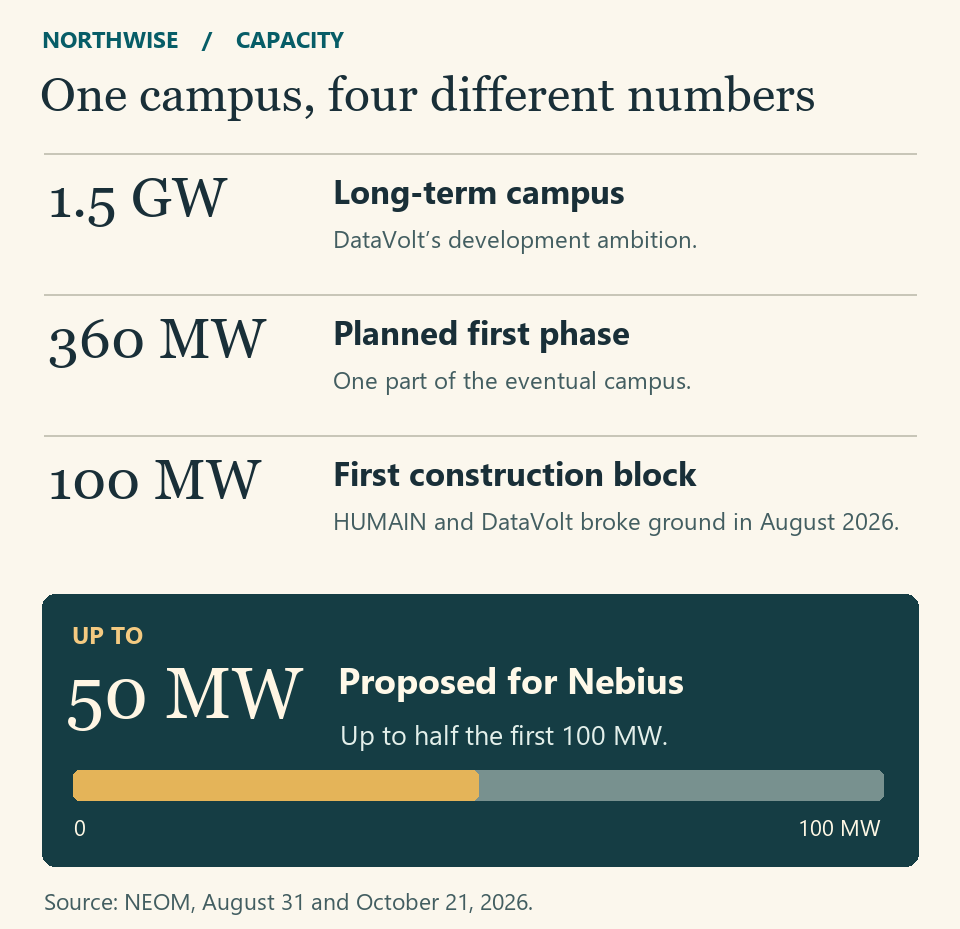
DataVolt wants to sell the computing power produced on this coast abroad. Before Nebius entered the picture, DataVolt CEO Rajit Nanda set a 1.5 GW target for the entire OXAGON campus by 2032. Nebius would be its first anchor. If its cloud customers fill those first halls, it could make a case for taking more space. Anything beyond the proposed 50 MW would need a further agreement. Nanda’s original campus plan, p. 36 · Nanda on exporting compute · October tenant framework
The port came first
Long before anyone proposed an AI campus here, ships called at Duba. The Saudi Ports Authority transferred the port to NEOM in 2022. In May 2023 it took the name Port of NEOM, and CMA CGM added a regular container call. OXAGON is the industrial city growing around that port, in northwestern Saudi Arabia across the northern Red Sea from Egypt. Heavy equipment already has a way in. NEOM’s account of the port transfer and shipping service
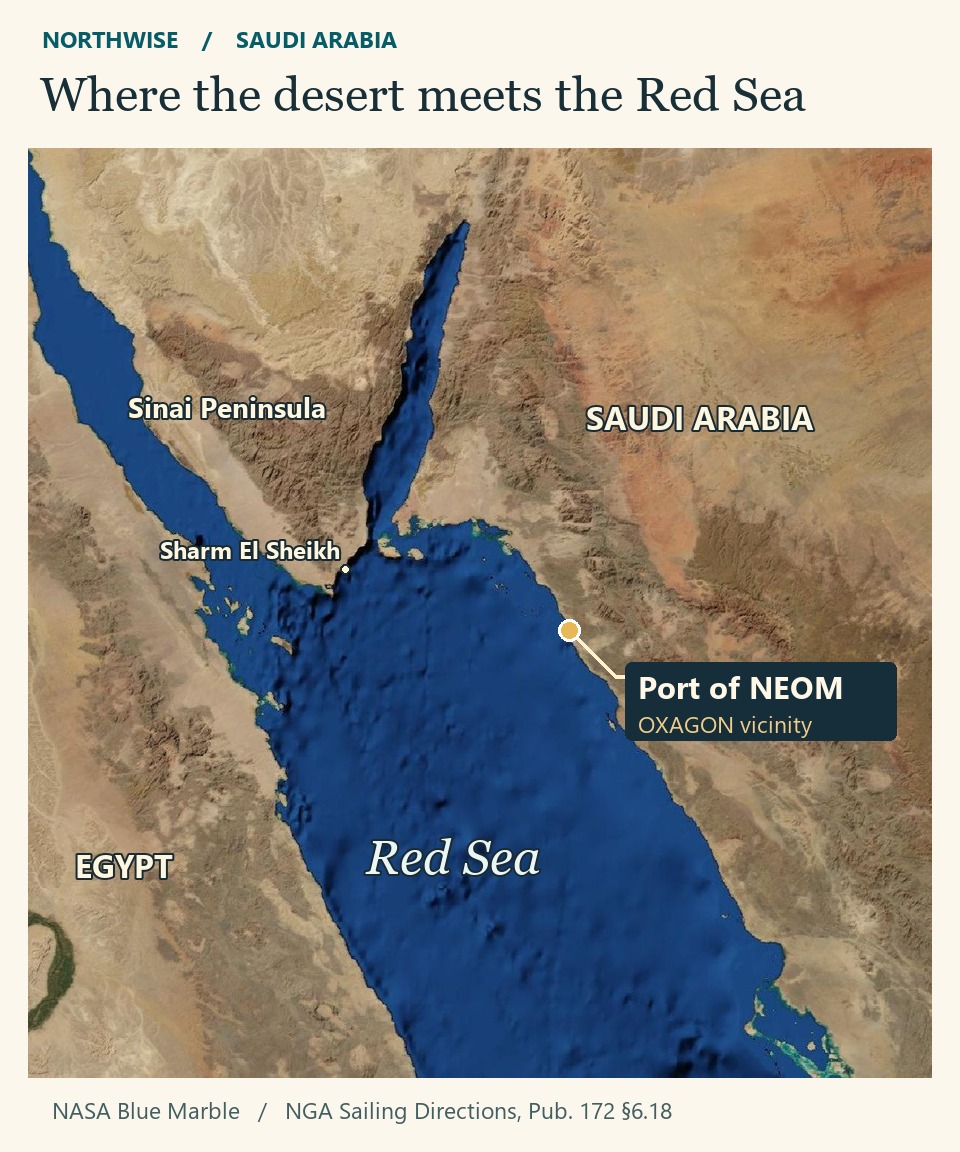
The dot locates the port. The data center parcel has not been publicly identified. NASA Blue Marble imagery · U.S. sailing directions, section 6.18
The ships explain how equipment gets in. The subsea cables explain how a Saudi facility can serve a customer abroad. In 2024 Mobily and Telecom Egypt chose Duba and Sharm El Sheikh as landing points for a cable between the two countries, with a route onward through Egypt toward Europe. A customer could train a model on servers in Saudi Arabia while its engineers remain overseas. Nebius has yet to identify the carriers that would serve its halls. Telecom Egypt and Mobily announcement
How a 1.5 GW plan became a 50 MW opportunity
In February 2025, DataVolt and NEOM announced a land agreement. OXAGON would lease the land to DataVolt and provide infrastructure support. DataVolt proposed an initial $5 billion investment in the first phase of a campus that could eventually reach 1.5 GW. That investment belongs to DataVolt’s development plan. Nebius entered the story more than a year later. NEOM and DataVolt land agreement
By August 2026, HUMAIN, the Saudi Public Investment Fund’s AI company, had joined DataVolt. The two broke ground on land OXAGON had already zoned for industry. When Nebius appeared six weeks later, the partners offered it space in the building they had just started. Groundbreaking announcement · Proposed Nebius allocation
The original road to 1.5 GW
In winter 2025, Nanda laid out DataVolt’s three-phase plan for the site in an interview with The Tech Capital. The first 300 MW in 2028 would establish the campus. Adding 600 MW in 2030 would bring it to 900 MW. A final 600 MW in 2032 would take the site to 1.5 GW. Nanda had customers across the Red Sea in mind. The servers would do the work in Saudi Arabia and send the results to Africa over subsea cables. DataVolt CEO interview, pp. 36 and 37
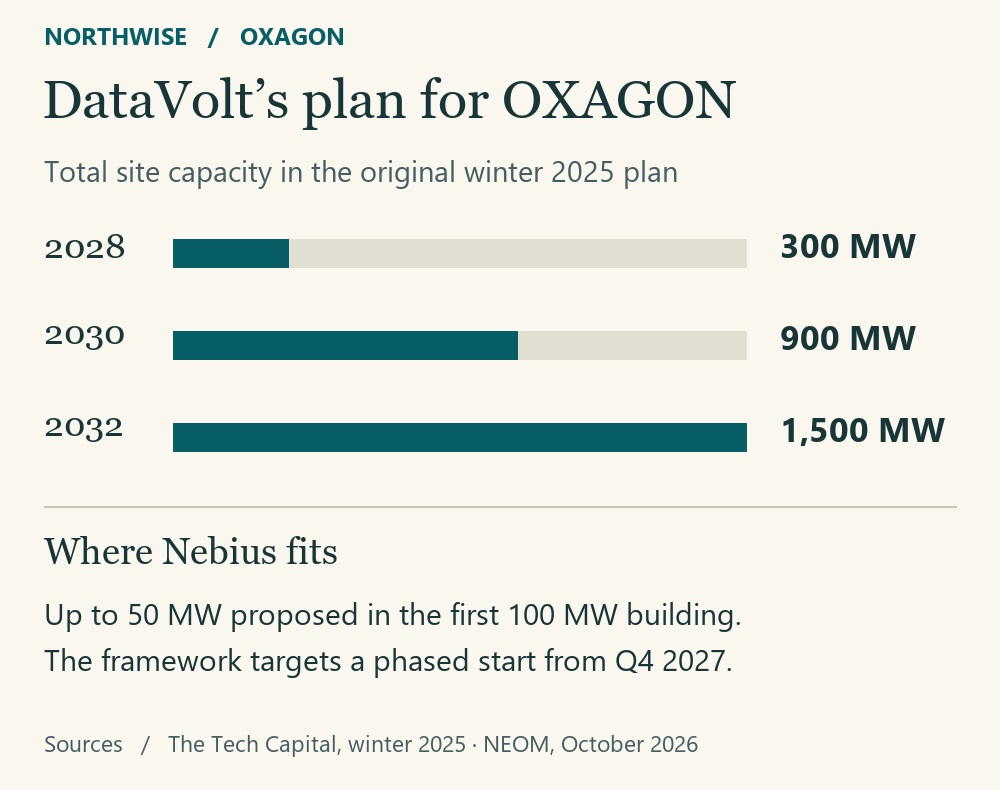
The bars show the whole site in DataVolt’s 2025 plan. The separate October 2026 framework places Nebius in the first building, with up to 50 MW proposed. Original campus plan, p. 36 · Nebius framework
At the 2026 groundbreaking, the partners kept the 1.5 GW goal and raised the opening phase to 360 MW. Crews were building the first 100 MW, which the partners expected to have available in 2028. That leaves 260 MW elsewhere in phase one and 1,140 MW beyond it. The partners have yet to say how they would divide those 1,140 MW or whether 2030 and 2032 still hold. August groundbreaking
The cost of filling those halls could exceed the cost of building them. In his original plan, Nanda described about $5 billion for first-phase energy and data center infrastructure and envisaged another $10 billion for computing equipment. By September 2026 he put the cost of the initial 100 MW facility at about $1 billion and said financing was close. A binding order from Nebius would give lenders a named buyer for part of that first building. The October framework leaves the financing of the GPUs open. Original investment plan, p. 36 · Nanda on financing the first building · October framework
How DataVolt plans to run a data center on the Red Sea
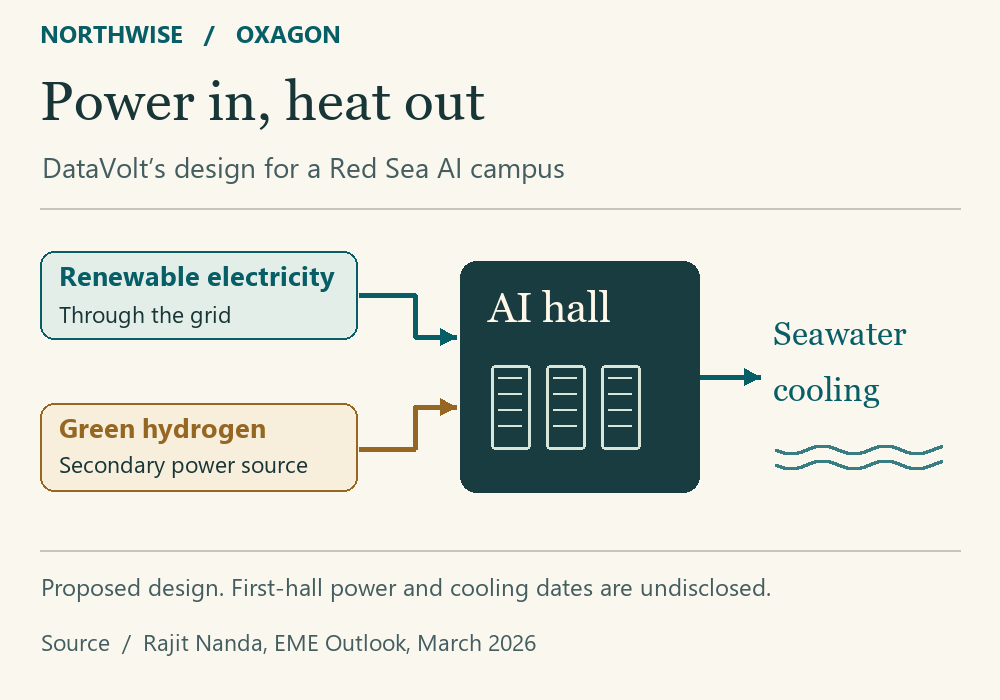
In the 2025 interview, Nanda said DataVolt was in advanced talks with NEOM’s utility for renewable power. He described hydrogen-fueled turbines that could run when renewable output fell short. In March 2026 he again described dedicated renewable electricity through the grid, green hydrogen as a secondary source and seawater cooling. The coast gives the project somewhere to shed the heat its GPUs produce. A signed power agreement naming the megawatts and delivery dates would tell us how much of the next build the utility can serve. Original utility discussions, p. 36 · Nanda’s March account of the design
What can open in 2027?
At the August groundbreaking, the partners targeted 2028 for availability of the first 100 MW. In early September, Nanda described a more aggressive 13-month construction timetable for the facility, which would put completion around October 2027. The October framework then gave Nebius customers their own milestone. The partners expected the proposed allocation to start coming online in phases from Q4 2027. August host schedule · September CEO interview · October tenant schedule
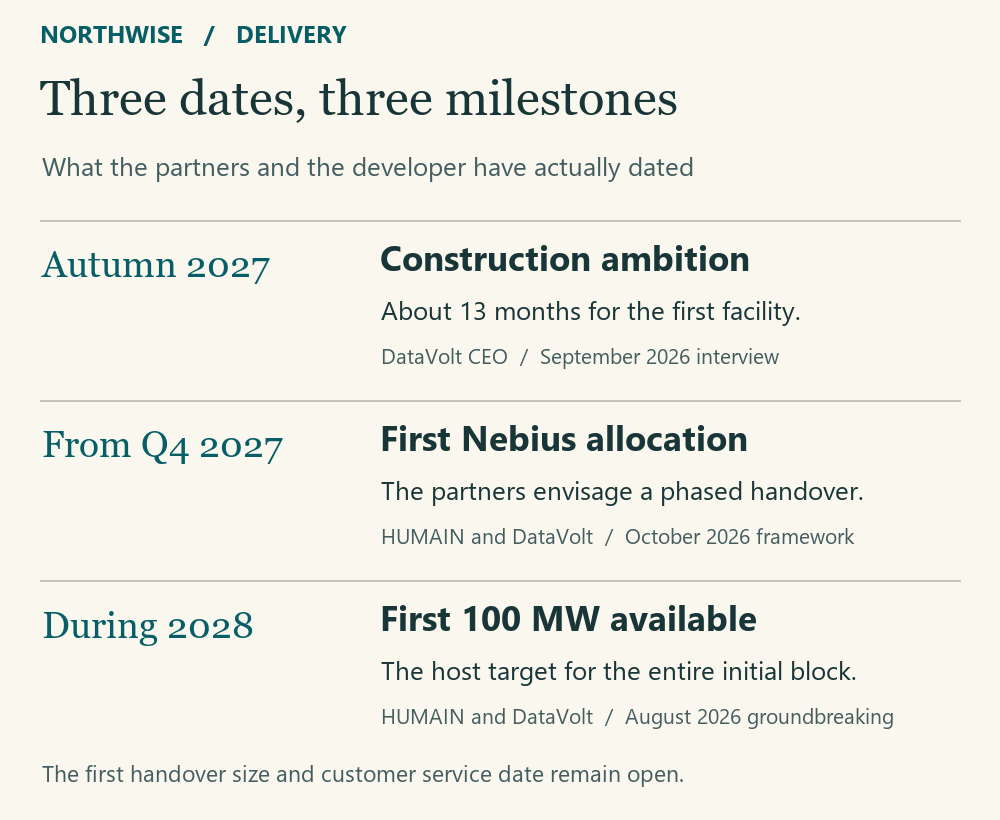
A staged handover could reconcile those dates. Once the hosts can supply power and cooling to one hall, Nebius could start deploying the NVIDIA systems envisioned in the agreement while construction continues elsewhere. For a cloud customer, the milestone is a working cluster that can accept a job. As of November 23, the partners have reported construction and a proposed allocation. The first energized hall, its size and the first customer workload are still ahead of the public record.
Where OXAGON fits in the Nebius buildout
In its November shareholder letter, Nebius said owned sites would provide the majority of its new capacity in 2027. Its list included Missouri, Alabama and two Finnish sites. OXAGON gives the company a way to enter another market while those campuses rise. HUMAIN and DataVolt already have land and a construction project. Nebius is expected to deploy NVIDIA systems and sell compute through its cloud. The published framework leaves the hardware financing and the identities of the eventual cloud customers open. Nebius Q3 shareholder letter · Partners’ description of the deployment
Vineland explains the cost of handing over that part of the job. In New Jersey, the host began retiring an interim power source before its replacement was ready to carry the full load. Nebius moved the remaining Microsoft deliveries to Q2 2027. At OXAGON, that same handoff between the building operator and the cloud operator will govern when a first customer can run a workload. Northwise Vineland site report
South Carolina gives investors a benchmark for what a more concrete Saudi schedule could look like. At CLT1, Nebius has a signed hosting agreement and AIB has dated two 25 MW halls, one for Q4 2027 and one for Q1 2028. At OXAGON, the whole proposed allocation is capped at the same 50 MW, and the size of the first handover is still open. Northwise CLT1 site report
Could OXAGON become a major Nebius hub?
Yes. The strongest argument is who each side brings to the table. DataVolt wants international buyers for the compute produced here. Nebius already sells an AI cloud internationally and needs more sites where it can deploy it. If customers fill the first Saudi cluster, Nebius goes into the next negotiation with evidence of demand, engineers who have commissioned a hall on this site, and a working installation the developers can show lenders and prospective customers. A new tenant would have to build that operating relationship from scratch.
At the full proposed 50 MW, Nebius would occupy half the first building and about 14% of the planned 360 MW first phase. The next 260 MW gives the partners room to expand with Nebius, sign other tenants or do both. The public framework gives Nebius no disclosed expansion option or priority claim on those halls. DataVolt and HUMAIN’s construction plan · Terms announced for Nebius
For 2027, the news to watch is a binding initial offtake and a first powered hall with a stated size. For the longer-term hub thesis, watch who signs for the next hall. A second Nebius reservation against customer demand would tell us more about its future in Saudi Arabia than another increase in the developer’s headline campus size.
Follow the Saudi project on the Northwise data center tracker and compare its timetable with the other sites in the Nebius data center hub.

Nebius India Data Centers
Nebius plans to open its first two Asia-Pacific data centers in India in 2027.

Nebius 2027 Revenue and Capex Forecast: The Megawatt Calendar
Our Nebius 2027 forecast follows each site from power to customer acceptance, then traces revenue, capex, customer advances and borrowing to per-share value.
Nebius Alberta Data Center
Nebius plans 100 MW across Alberta campuses. Follow the path to first delivery in 2027 through Alberta power, permits, and the Brooks-area filings.
Northwise Portfolios
See how the research becomes real decisions
Reader discussion
Discuss the research
Create a Free account to join the discussion with a display name.
Create a Free Account
No comments yet. Start a thoughtful discussion.