
Jumia Stock Forecast 2030
Jumia stock forecast 2030: Can Africa’s e-commerce pioneer return to growth by focusing on logistics, fintech, and rural access?
In this article
Jumia Stock Forecast 2030: Can Africa’s E-Commerce Survivor Stage a Comeback?
After a spectacular rise, Jumia’s fall was almost inevitable. But its recent pivot is less about reclaiming hype and more about learning how to endure.
Updated 2030 Forecasting
This was our original coverage of Jumia that led to an over 430% return in 2025. If you are interested in our Jumia coverage, we recommend reading our original thoughts here and then taking a look at our updated Jumia forecasting in 2026. Significant details have changed and our 2030 numbers have become much clearer.
The First African Tech Unicorn
Jumia’s story began with breathtaking ambition. Founded in 2012 by Rocket Internet-backed founders Sacha Poignonnec and Jeremy Hodara, the company set out to become the “Amazon of Africa.”
For a while, it worked. In 2019, Jumia became the first African tech company to list on the NYSE, reaching a market cap north of $4 billion. Investors saw scale, a massive untapped consumer base, and first-mover advantage.
But beneath the narrative, cracks were forming. Questions arose about order reporting. Infrastructure limitations proved tougher than expected. Costs ballooned, user growth plateaued, and the business began burning cash. By 2022, Jumia was no longer a unicorn. It was a cautionary tale.
Francis Dufay and the Rebuild Era
Appointed CEO in late 2022, Francis Dufay brought more than a decade of inside experience and a pragmatist’s mindset. His leadership has been shaped by the on-the-ground realities of building e-commerce in places where roads are unreliable and trust is hard to earn.

Dufay immediately cut fat: exiting underperforming markets like South Africa and Tunisia, slashing overhead, and prioritizing core categories. Instead of chasing top-line growth, he focused on operational discipline. By Q4 2024, Jumia had narrowed its operating loss to $17.3 million, with its liquidity position stabilized at $134 million.
Jumia’s Geographic Footprint
Jumia currently operates in 11 African countries, with the majority of its order volume and infrastructure concentrated in Nigeria, Egypt, Morocco, Kenya, and Ivory Coast. While the company has exited several non-strategic markets such as South Africa and Tunisia, its ongoing presence spans both Anglophone and Francophone regions.
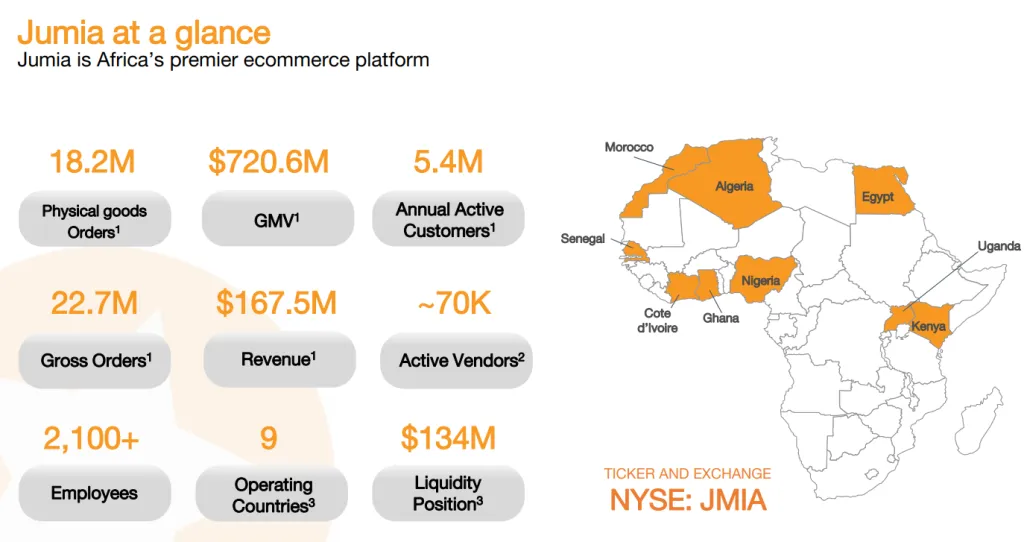
Nigeria remains Jumia’s largest and most mature market, followed by Egypt where it has expanded aggressively in payments and fintech. Kenya and Morocco serve as key operational hubs for East and North Africa respectively, and Ivory Coast acts as a growth engine for Francophone West Africa.
Rather than chase expansion for its own sake, Jumia has shifted toward deepening its presence in the markets where it has competitive infrastructure and brand equity. This means focusing on logistics density, regional warehousing, and local supplier networks that improve delivery times and reduce cost-to-serve.
Betting on the Upcountry: Logistics Beyond the Capital
In one of the most telling data points from its Q4 2024 report, Jumia revealed that 56% of orders came from outside major capital cities.
That’s not an accident. Under Dufay, Jumia is doubling down on “upcountry” logistics, serving secondary cities and rural markets with limited infrastructure but fast-growing demand. These regions represent both friction and opportunity: consumers are less digitally native and far less served by global competitors.
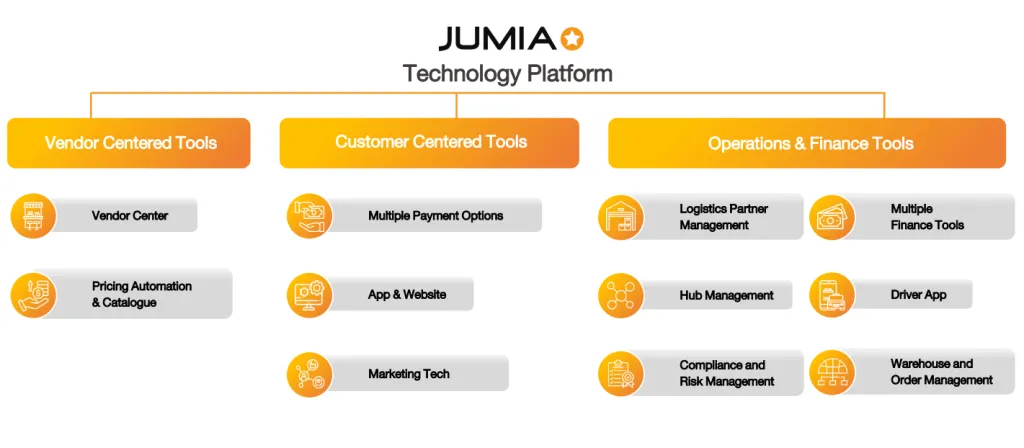
Jumia’s plan includes warehouse upgrades, agent-driven delivery networks, and infrastructure-light logistics that blend technology with local muscle. It’s a playbook tailored to fragmentation, not scale. If it works, it could be one of the most defensible wedges in emerging market e-commerce.
A Moat Forged in Friction
Jumia’s real advantage isn’t its tech. It’s its scar tissue.
Over more than a decade, the company has adapted to realities few competitors understand: inconsistent power, dozens of payment systems, informal addresses, mobile-first access, and regulatory landmines.
This deep operational muscle, built not in labs but in Lagos and Abidjan, is its moat. From hybrid logistics models to localized payment options, Jumia knows how to deliver goods in places where Amazon would need years just to map the streets.
And trust? It matters even more in low-trust environments. Jumia has spent a decade building brand familiarity where few tech brands have lasting resonance. That’s not just brand equity. That’s insulation.
Financials in Focus
On the surface, Jumia’s top-line numbers show contraction. But those figures mask a more nuanced reality. For companies operating in regions with high inflation and volatile currencies, like Nigeria and Egypt, nominal USD results can distort the actual pace of business activity.
That’s where constant currency metrics come in. As noted in Jumia’s Q4 2024 earnings report, these adjustments are essential for understanding real operational momentum in markets affected by devaluation and macro instability.
- Q4 2024 Revenue: $45.7 million, down 23% YoY, but just -2% in constant currency.
- FY 2024 Revenue: $167.5 million, down 10% YoY, but +17% constant currency.
- Q4 GMV: $206.1 million, down 12% YoY, but up 13% constant currency.
- FY 2024 GMV: $720.6 million, down 4% YoY, but up 28% constant currency.
- Operating Loss: $17.3 million in Q4; full-year loss before tax projected at $65–70 million for 2025, a 28–33% YoY improvement.
- Cash & Equivalents: $134 million as of December 31, 2024.
The company is still far from profitability, but the trajectory is improving. Guidance for 2025 includes 15–20% growth in physical goods orders and a 10–15% GMV increase. These goals are ambitious but realistic in the context of recent restructuring.
JumiaPay: Fintech Built for the Fragmented
JumiaPay has become more than a payment processor, and it’s also key to our Jumia stock forecast 2030. It functions as a financial infrastructure layer for digitally underserved consumers. From utility payments and airtime top-ups to merchant checkout, JumiaPay is tailored to markets where banking access is limited and mobile-first behavior is the norm.
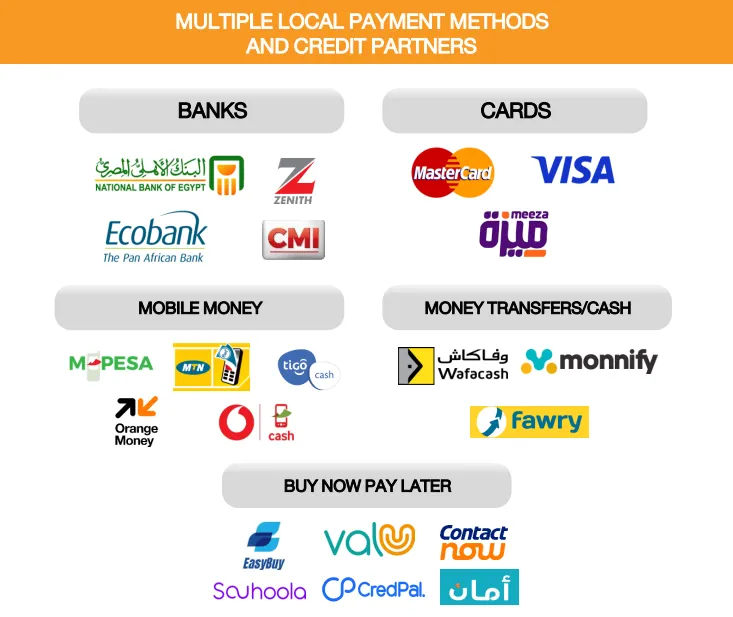
Launched in multiple African countries, JumiaPay allows customers to transact securely via biometric login, OTPs, and instant refunds. It has also expanded into merchant services, offering payment gateways and transaction analytics. In Nigeria and Egypt, JumiaPay operates with banking partnerships and regulatory licenses, acting as a true digital wallet.
In 2024, Jumia introduced “Buy Now, Pay Later” options via partnerships with Easybuy and CredPal. This gives consumers credit access where traditional banks fall short. It’s a bold step toward enabling broader e-commerce adoption across income segments.
Strategic Partnerships: Scaling Through Leverage
Jumia has made clear it doesn’t intend to build everything in-house. Instead, it’s tapping into partner ecosystems to scale strategically.
A prime example is its 2023 retail partnership with Starlink. Through this collaboration, Jumia began distributing satellite internet kits across Nigeria and other markets. The objective is to enable rural and remote connectivity, not just for e-commerce, but for entire communities. For a company leaning heavily into secondary cities, this alignment with Starlink’s infrastructure goals is both practical and symbolic.
Other partnerships span fintech, logistics, and telecom. Jumia is increasingly positioning itself as a distribution and trust layer for global tech entering African markets.
The Competitive Threat
The e-commerce battlefield is shifting.
Amazon has begun inching into North Africa. Global players like Shein and Temu are compressing shipping times to under two weeks. Local competitors like Takealot and Konga hold key footholds.
But these threats are mostly clustered in wealthier or more urbanized segments. Jumia is placing its chips elsewhere: on the 800 million+ people outside Africa’s capital cities who still need access, delivery, and trust.
Execution risk remains high. But so does asymmetric upside.
What Jumia Needs to Prove
To move from a stabilization phase into long-term growth, Jumia will need to demonstrate more than just cost-cutting and logistical reach. It must prove that its current markets can produce consistent unit economics that scale. That means increasing repeat purchase behavior, expanding its merchant base, and optimizing last-mile delivery in cost-effective ways.

Another critical step is deepening JumiaPay penetration across its existing customer base. Financial inclusion remains one of Africa’s largest structural opportunities. If Jumia can become the trusted intermediary not only for goods but also for payments, it could unlock high-margin services that compound on top of its core platform.
Finally, Jumia must show discipline with capital. The company can’t afford to burn through its current cash reserves without meaningful improvements in contribution margin and top-line growth. Each quarterly result will need to show progress on both efficiency and reach.
Execution remains the story. If Jumia continues to build slowly, intentionally, and with clarity, its comeback story could become one of the most interesting tech recoveries in frontier markets.
Final Thoughts
Jumia’s future won’t be defined by a return to hyper-growth. It will be defined by whether it can become boring in the best way: stable, local, profitable.
The company is no longer trying to be the Amazon of Africa. It’s trying to be Jumia, and that might be its best shot yet.
At Northwise, we believe this is the type of story that gets mispriced. Many investors overlook companies like Jumia because the numbers are messy, the path to profitability is nonlinear, and the markets they serve are fundamentally harder to operate in. But that complexity is precisely where the moat exists.
If Jumia can build durable infrastructure, deepen financial and consumer trust, and do it all while staying lean, the payoff could be disproportionately large. This isn’t a bet on e-commerce margins improving next quarter. It’s a bet that operational resilience and local knowledge still matter, and in Jumia’s case, might be enough to outlast the noise.
There still remains the long term possibility of Jumia one day deserving a multi tens of billion dollar market cap, but the path forward remains murky. Jumia’s ability to execute on it’s new identity, stave off well-funded competitors, and the overall growth in African GDP will determine the Jumia story of the next decade.

Jumia Stock Forecast 2030: The Business Beyond Breakeven
Explore Northwise’s Jumia stock forecast for 2030: country growth, unit economics, cash flow, dilution and three valuation scenarios, with a financial model.
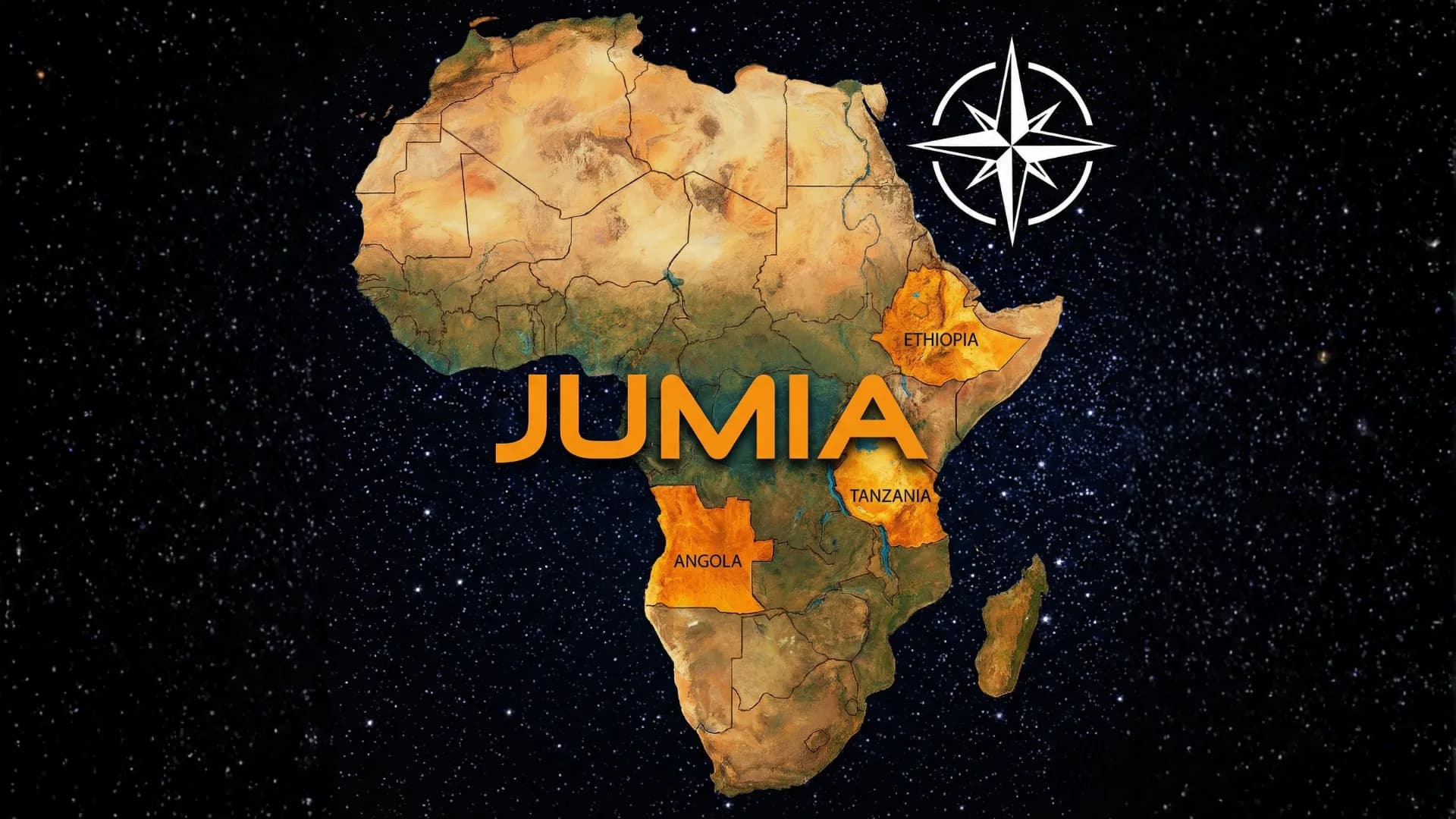
Where Will Jumia Expand Next?
Where will Jumia expand next after profitability? We examine Tanzania, Angola, and Ethiopia as post-2027 growth options.

Jumia Uganda
Jumia Uganda: a growing revenue contribution from a smaller base, customer retention and the economics of expanding delivery coverage.
Northwise Portfolios
See how the research becomes real decisions
Reader discussion
Discuss the research
Create a Free account to join the discussion with a display name.
Create a Free Account
No comments yet. Start a thoughtful discussion.