
Berkshire Hathaway Stock Forecast 2030

Berkshire Hathaway stock forecast 2030 explores post-Buffett leadership, valuation, and how Berkshire may evolve over the next five years.
In this article
Berkshire Hathaway Stock Forecast 2030: Is BRK a buy in 2025?
A generational American compounder entering a post Buffet era
A Pillar of American Capitalism
Berkshire Hathaway is more than a company. It is a case study in financial discipline, compounding, and culture.
From its early days as a failing textile mill to becoming a nearly trillion-dollar conglomerate, Berkshire’s rise is unmatched in the annals of American business. But 2025 marks a true inflection point.

Warren Buffett, the man synonymous with the company, has announced he will step down at the end of the year. The question is no longer how Berkshire got here. It’s where it goes next in a world without Buffett at the helm.
A Brief History of Berkshire: From Mill to Empire
When Buffett took control in 1965, Berkshire Hathaway was a struggling mill with few prospects. What followed was a transformation few could have foreseen.
Buffett began using the company as a vehicle to allocate capital across insurance, manufacturing, retail, and more. The key innovation was float. By building a dominant insurance business, Buffett gained access to low-cost capital that could be reinvested in high-return assets.
From GEICO and See’s Candies to MidAmerican Energy and BNSF Railway, Berkshire became a decentralized empire built on long-term trust and autonomy. Berkshire’s identity became synonymous with long-duration thinking, trust in managers, and unyielding discipline.
The Current State of Berkshire in 2025
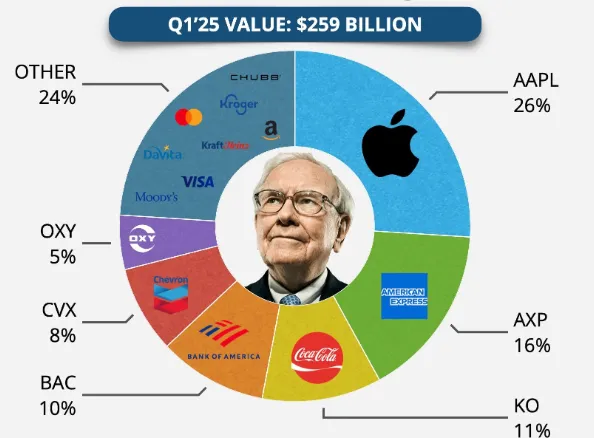
Today, Berkshire operates more like a sovereign wealth fund than a traditional conglomerate. It owns over 60 operating companies and holds a $260 billion public equity portfolio, with Apple making up over 25 percent of that exposure.
The company’s financial strength is not just robust, but uniquely positioned for flexibility, long-term stability, and conservative growth. Here are a few key highlights from Q1 2025:
- Operating earnings: Over $9.6 billion in the quarter, reflecting strength across insurance, energy, and manufacturing.
- Cash and equivalents: $342 billion, one of the largest corporate cash positions in the world.
- Equity portfolio: Valued around $260 billion, with Apple constituting over 25 percent of the total.
- Free cash flow: Continued generation of substantial free cash flow, reinforcing Berkshire’s ability to act opportunistically.
Despite macro uncertainty, the firm remains committed to conservative positioning and capital flexibility. Berkshire’s scale, liquidity, and operating breadth give it unmatched resilience in a volatile global environment.
The Post-Buffett Era: Who is Greg Abel?
Greg Abel, the soft-spoken Canadian who built Berkshire Hathaway Energy into a core operating pillar of the business, is now the heir apparent. While Buffett has not yet stepped down, his planned departure at the end of 2025 sets the stage for a major transition.

Abel embodies many of Buffett’s values: operational discipline, a hands-off approach with managers, and a laser focus on long-term value. But unlike Buffett, Abel comes from an operating background rather than a capital allocation one.
His appointment signals a continuation of Berkshire’s decentralized operating model, but with an increased emphasis on performance from the businesses themselves. Analysts believe Abel is well-suited to preserve Berkshire’s culture while also modernizing it for the decades ahead.
Valuation Today: Misunderstood or Fully Priced?
Berkshire currently trades at a modest premium to book value and a forward price-to-earnings ratio that underestimates the quality of its cash flows. The market continues to discount its conglomerate structure, complexity, and perceived reliance on Buffett.
But this narrative misses the mark. The sum-of-the-parts value likely exceeds current market cap by a significant margin, and Berkshire’s cash position provides a rare form of embedded optionality. Compared to peers, it is both cheaper and safer.
While it is not a typical high-growth compounder, Berkshire’s earnings base is incredibly durable and cash-rich.
Buybacks, Cash, and Optionality
Berkshire’s share repurchase framework has always been guided by intrinsic value, not Wall Street pressure. But a growing segment of investors are beginning to speculate that the company’s $342 billion cash pile may play a more aggressive role in the coming years.
With large acquisitions proving difficult due to size, valuation, and regulatory hurdles, Berkshire’s capital discipline may increasingly point toward one of the most tax-efficient and shareholder-aligned options remaining: materially larger buybacks.
This is not a certainty, but the setup is notable. With shares trading at a modest premium to book but still arguably below intrinsic value, Berkshire is in a position to retire meaningful amounts of stock without sacrificing liquidity or long-term optionality.
If Greg Abel and the capital allocators see fewer external deployment opportunities, we believe a shift toward accelerated buybacks could occur, especially in periods of broader market volatility.
The key is patience. Berkshire does not time markets, but it does act decisively when opportunities arise. In a post-Buffett era, the firm’s approach may still honor past discipline while embracing a more active posture in returning capital to long-term shareholders.
Looking Ahead: What Might Berkshire Look Like in 2030?
A conservative base case assumes Berkshire grows operating earnings by 6 percent annually and retires 2 percent of shares per year through buybacks. If this plays out, shareholders could see mid-to-high single digit annualized returns with low risk.
In a bull case, Berkshire uses market dislocations to deploy capital aggressively, pushing valuation toward $1.8 trillion. In a bear case, slowdowns in the equity portfolio or underperformance from key holdings like Apple could limit upside but still preserve capital through defensive earnings and balance sheet strength.
With over $342 billion in dry powder, Berkshire remains uniquely positioned to take advantage of financial distress, market volatility, or dislocation across asset classes. That optionality is not easily priced into a DCF or multiple.
A New Chapter: Tech Curiosity in a Post-Buffett Berkshire
For decades, Berkshire avoided technology investments. Buffett openly admitted he didn’t understand the space. That caution protected shareholders from the dot-com crash, but it also left opportunity on the table.
In recent years, however, Berkshire has quietly shifted. The Apple position was the first sign. The Amazon investment was the second. And the stake in Nubank confirmed the change. These moves weren’t just stock picks. They were indicators of evolving conviction.
Nubank is a digital-first fintech in Latin America. It represents everything Buffett once avoided: emerging markets, technology, early-stage growth. Yet Berkshire invested over $1 billion before its IPO. This was not a bet on hype. It was a bet on infrastructure, scalability, and the democratization of financial access.
Nubank is now a publicly traded company with over 100 million users and strong growth across Brazil, Mexico, and Colombia. In a post-Buffett era, with Todd Combs and Ted Weschler gaining influence, we expect to see more investments like Nubank: capital-efficient, tech-forward businesses with durable moats.
Berkshire is unlikely to chase speculative growth, but its definition of a quality compounder is evolving.
Risks and Structural Headwinds
The main risks are structural. Berkshire’s size makes it difficult to outperform meaningfully. As the company grows, the universe of potential investments shrinks. This limits the ability to compound capital at historically high rates.
There is also the risk of further regulatory pressure. Calls to break up large conglomerates could become more common, especially if Berkshire continues to grow in political or financial influence. Any legislative changes that impact capital gains tax treatment or holding company structures could reduce Berkshire’s strategic flexibility.
Another material risk is concentration in the equity portfolio. Apple alone represents over 25 percent of Berkshire’s public equities. While it has been a successful investment, this type of exposure introduces single-company risk that could affect valuation if sentiment or fundamentals turn.
The departure of Buffett may introduce a period of multiple compression. Some investors may exit based on sentiment alone, requiring time for Greg Abel and the internal team to rebuild market confidence. During this transition, market participants may become more critical of Berkshire’s capital allocation or operating results.
Berkshire’s decentralized model, while a strength, could pose operational challenges if the pace of technological change accelerates. Subsidiaries operate with significant autonomy, which may limit the company’s responsiveness in fast-changing environments.
Lastly, the company’s conservative nature, while appealing in downturns, may create performance drag during high-growth cycles. In a market environment increasingly driven by innovation narratives, Berkshire could lag more speculative benchmarks over shorter windows.
Despite these risks, the company’s internal durability, balance sheet strength, and earnings diversity provide meaningful protection. Berkshire may not be immune to turbulence, but it is one of the few large-cap firms positioned to remain resilient regardless of market regime.
Berkshire as an Alternative to Bonds
In a world where interest rates remain volatile and traditional fixed income yields have struggled to keep pace with inflation, some institutions are beginning to view Berkshire Hathaway as a defensive equity anchor.
With a fortress balance sheet, stable cash flows, and a diversified base of high-quality operating businesses, Berkshire offers characteristics that resemble fixed income but with added upside.
Its cash flow yield, strong investment-grade credit profile, and countercyclical capital allocation make it especially appealing to conservative allocators. Pension funds and endowments have historically used Berkshire as an equity substitute when bond markets were unattractive.
As of Q1 2025, Berkshire generated over $9 billion in quarterly operating earnings with over $340 billion in cash, a level of safety and liquidity rare in the equity universe. For investors seeking capital preservation with optionality, Berkshire increasingly sits in the conversation as an alternative to traditional bond allocations.
The Institutional Ownership Shift
The departure of Warren Buffett at the end of 2025 is likely to reshape the ownership profile of Berkshire stock. While Buffett attracted millions of loyal retail shareholders who admired his philosophy and communication style, the next chapter may bring increased institutionalization.
With a more operational CEO in Greg Abel and a structurally simplified capital return strategy, large asset managers may see Berkshire as a scalable, low-volatility core equity holding.
The transparency of its quarterly operating results, the consistency of its reinsurance and utility cash flows, and the growing possibility of regular buybacks may all appeal to pension funds and sovereign wealth funds. In short, Berkshire may become less of a Buffett stock and more of an institutional compounder.
The Culture Moat: Why No One Can Copy Berkshire
What truly sets Berkshire apart is not just its businesses or capital. It is the culture.
Berkshire has built a trust-based ecosystem where subsidiary managers operate autonomously, compensation is rarely stock-based, and bureaucracy is virtually nonexistent. This level of decentralization would collapse in most firms. But at Berkshire, it functions because of a shared philosophy: integrity, accountability, and long-term orientation.
It is not replicable through software or strategy decks. The reason Berkshire works is because of who it attracts and how it operates. There are no flashy executive perks. There is no quarterly earnings management. And there are no stock splits to engineer retail interest.
The culture moat is subtle but profound. It protects the business from fads, from excessive risk-taking, and from the dilution of standards. As Berkshire transitions leadership, this cultural continuity may prove more important than any one asset or investment.
The Quiet Giant Still Compounds
Berkshire is not flashy. It will not deliver triple-digit returns. But it will protect capital, grow steadily, and provide asymmetric outcomes in bear markets.
Its cash position is an asset, not a liability. Its culture is unmatched. And its next chapter may be more dynamic than the market expects.
The combination of managerial trust, financial strength, and conservative stewardship is rare. In a time of style drift, speculative mania, and thematic turnover, Berkshire remains one of the few compounders still playing the long game.
With a strong base of operating earnings, ongoing share repurchases, and one of the deepest benches in corporate America, Berkshire is built to last.

Celsius Stock Analysis: The Shelf Reset and the Second Growth Curve
Celsius stock analysis of the shelf reset, Alani growth, Pepsi economics and cash flow, with a 2030 model and a Premium valuation and entry-price framework.

Meta AI Spending: The Customer Is Already Here
Can Meta turn AI spending into shareholder returns? We model advertising, Muse, hardware, capital costs and cash flow through 2030, with a full valuation.

IREN Stock Dilution: Can the Build Reach Shareholders?
IREN stock analysis of AI growth, funding and dilution through 2030. Read our full valuation, 27 scenarios and price zones free. Excel model is Premium.
Northwise Portfolios
See how the research becomes real decisions
Reader discussion
Discuss the research
Create a Free account to join the discussion with a display name.
Create a Free Account
No comments yet. Start a thoughtful discussion.