SOFI Q4 2025 Earnings

SOFI Q4 2025 earnings reports Friday premarket (Jan 30, 2026). We outline the key numbers, risks, and signals that matter heading into the call.
In this article
SoFi Q4 2025 Earnings: What to Watch Before Friday’s Premarket Call
We’re treating this print as a balance sheet and narrative checkpoint, with clear metrics that decide whether the December raise earns its keep.
SoFi Q4 2025 Earnings Timing and Market Expectations
SoFi will report Q4 and full-year 2025 earnings on Friday, January 30, 2026, with the press release expected around 7:00 AM ET and the conference call scheduled for 8:00 AM ET, ahead of the market open. This premarket timing matters. It gives management a full trading session to shape price discovery and leaves little room for ambiguity if numbers or guidance disappoint.
This earnings print carries more weight than a typical quarterly update. SoFi is entering the call with GAAP profitability already established, consensus expectations tightly clustered, and a capital structure that changed meaningfully just weeks ago. The December 2025 equity raise reset how investors interpret every headline number in this report, from EPS to tangible book value per share.
Market expectations heading into the print are unusually sensitive due to three overlapping dynamics:
- A compressed margin for error. Consensus Q4 revenue sits just below $1.0B, implying year-over-year growth near 33%, while EPS expectations already assume dilution from roughly 57.75M new shares issued in December. Any miss here is harder to explain away.
- An unresolved capital allocation narrative. The $1.5B raise is still an open question in investor models. Without clarity, the stock trades with an overhang regardless of operational execution.
- Elevated positioning risk. Short interest remains near 9.4% of float, and options pricing implies a meaningful post-earnings move. The setup is asymmetric in both directions.
From a structural perspective, this is less about whether SoFi “beats” consensus and more about whether management can reconcile bank-like balance sheet discipline with tech-like growth expectations. The timing of the call ensures that investors will immediately anchor to guidance and capital commentary, not just backward-looking results.
This framing is important. The market already knows SoFi can generate quarterly profits. What it has not decided is whether those profits compound efficiently without repeated dilution, or whether the company is still transitioning between operating identities.
Q4 2025 Consensus Estimates and the Margin for Error
Heading into the print, sell-side expectations for SoFi’s fourth quarter reflect a business that has stabilized into profitability but is still being graded on growth efficiency. Consensus adjusted net revenue for Q4 2025 sits at approximately $982 million, implying ~33% year-over-year growth and positioning the company just shy of the psychologically important $1.0B quarterly revenue threshold.
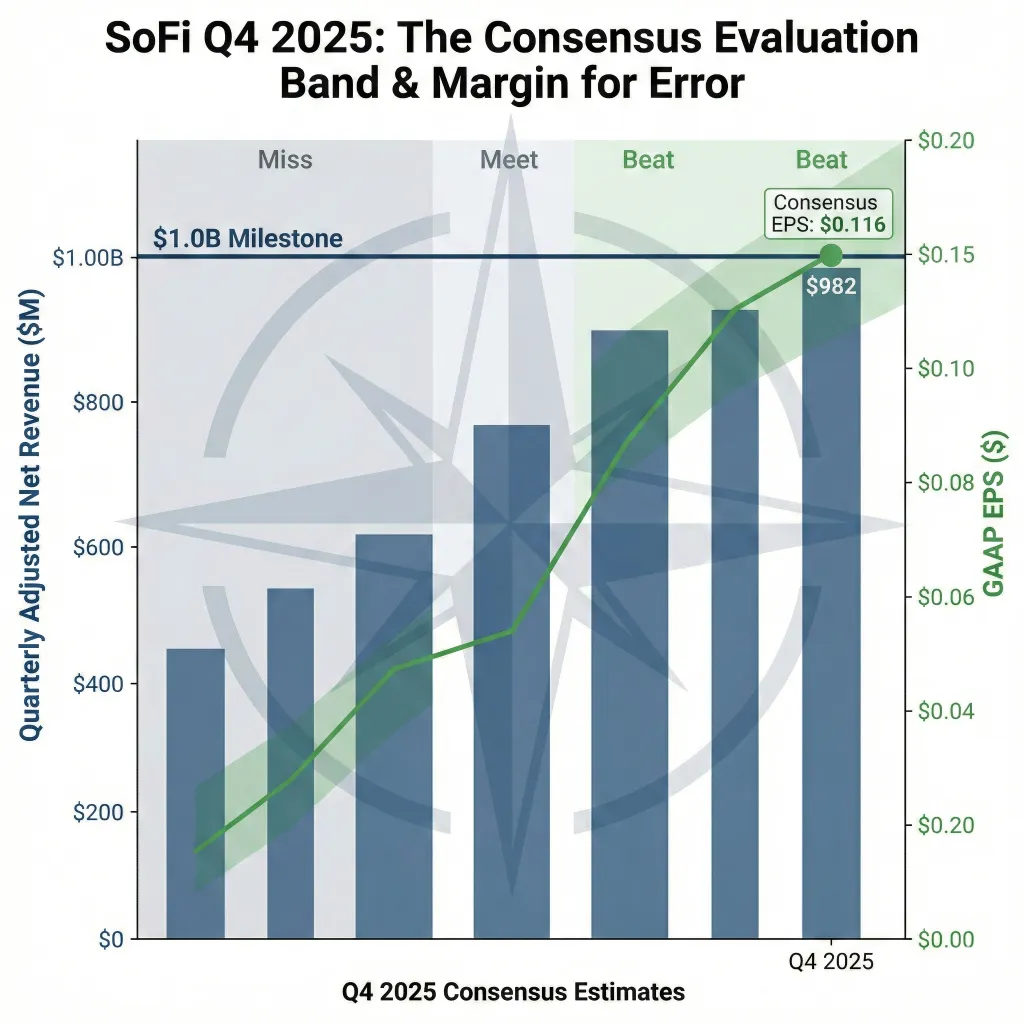
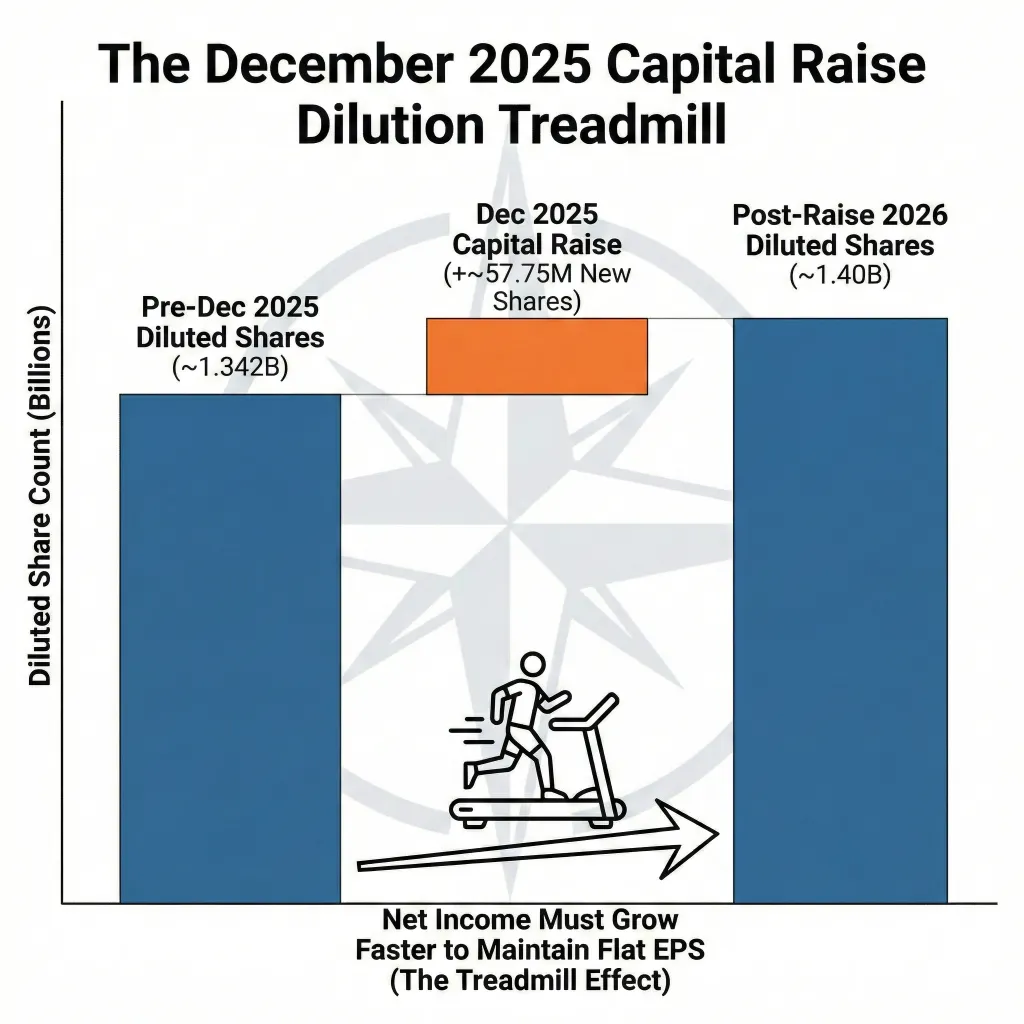
On the earnings side, GAAP EPS consensus is roughly $0.116, up more than 130% year over year, but this headline number masks an important complication. The December 2025 equity offering increased SoFi’s share count by approximately 5–6%, meaning that net income must grow materially faster just to hold EPS flat on a per-share basis. In other words, a modest EPS beat does not necessarily signal operational outperformance.
Adjusted EBITDA expectations for the quarter cluster in the $280–290 million range, which is consistent with management’s full-year guidance of approximately $1.035 billion in EBITDA for FY 2025. That guidance effectively requires Q4 to be the strongest quarter of the year across revenue, contribution profit, and cash generation. There is little slack left in the model.
From a modeling perspective, this creates a narrow evaluation band:
- Revenue below $970 million would raise questions about demand durability across lending and financial services.
- Revenue above $1.0 billion would represent more than a symbolic milestone. It would validate scale economics and reinforce the multi-year operating leverage thesis outlined in our December model.
- EPS below $0.11 would suggest dilution overwhelmed income growth.
- EPS above $0.12, given the higher share count, would imply stronger-than-expected net income conversion.
Investors should also contextualize these numbers against the company’s FY 2026 consensus outlook, which currently assumes ~$4.55 billion in revenue and ~$1.25 billion in adjusted EBITDA. Any Q4 commentary that pressures those assumptions, even subtly, will matter more than a penny-level EPS variance.
The core issue is not whether SoFi delivers growth, but whether it delivers growth that scales cleanly through the capital structure it now has. This quarter sits at the boundary between those two interpretations, which is why the margin for error is so thin.
The December 2025 Capital Raise and What Investors Need to Hear
The $1.5B equity raise executed in December 2025 is the single largest interpretive variable hanging over this earnings report. It reframed SoFi’s capital structure at the exact moment the company crossed into sustained GAAP profitability, which is why it still dominates investor conversations weeks later.
Mechanically, the raise added approximately 57.75M new shares, increasing the share count by roughly 5–6%. The deal priced near $27.50, and the stock sold off just over 6% on the announcement, not due to liquidity stress, but due to uncertainty. Investors were forced to re-underwrite the business without a clear map for how that capital improves long-term returns on equity.
From a balance sheet perspective, the move materially boosts SoFi’s Tier 1 capital position and pushes pro forma tangible book value toward ~$8.5B. That matters in two ways. First, it gives SoFi room to expand its loan book without approaching regulatory constraints. Second, it preemptively insulates the company from tightening capital standards implied by the Basel III Endgame framework, even if those requirements eventually cascade downward to smaller banks.
What investors need from this call is not reassurance that the balance sheet is “strong.” That is already evident. What they need is specificity around capital deployment.
There are only a few pathways where this raise becomes accretive rather than dilutive:
- Balance sheet expansion with retained loans. Holding incremental personal and student loans generates recurring net interest income that compounds over time. Retaining an additional $5B in loans could plausibly require $500–750M of regulatory capital. The raise meaningfully increases that capacity.
- High-return fee infrastructure. If capital is used to accelerate the Loan Platform Business or deepen Galileo enterprise integrations, returns show up through ROE rather than leverage.
- Targeted acquisitions. Fintech valuations remain compressed. Any M&A must clearly improve unit economics or distribution, not just broaden product scope.
What would be poorly received is a continuation of generic language around “optionality” without a timeline or return framework. Investors are already modeling scenarios where future dilution becomes normalized. This call is management’s opportunity to cut that branch off early.
The December raise effectively pulled forward a question that would otherwise emerge in 2026: can SoFi compound capital internally, or will it rely on periodic equity issuance as growth accelerates? The answer does not need to be final this quarter, but it does need to be directional.
Credit Quality Checkpoint Heading Into 2026
If this quarter breaks, it is far more likely to break on credit than on product adoption.
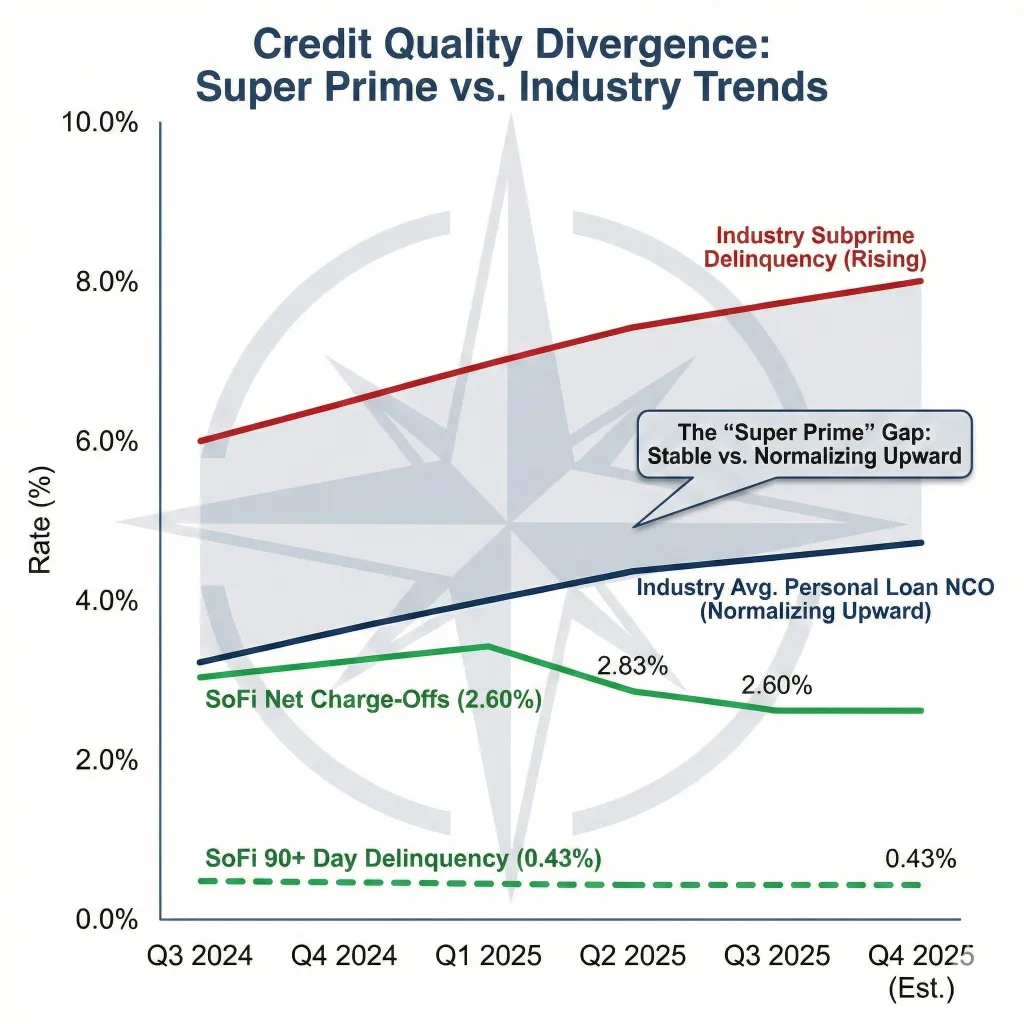
SoFi’s lending engine is built around a very specific borrower profile, the “Super Prime” customer with a weighted average FICO above ~740 and reported incomes above $150K. The bullish version of that positioning is straightforward. In a consumer environment where stress is rising in the lower FICO bands, a lender concentrated in the top tier should see stable loss performance and better pricing power.
The Q3 datapoints were supportive. SoFi reported personal loan net charge offs of 2.60%, down from 2.83% in the prior quarter, and 90 day delinquency held flat at 43 bps. That is a meaningful divergence versus the broader consumer credit tape, where delinquencies have been normalizing upward, particularly in subprime.
Q4 is the quarter that tests whether those numbers were structural or simply early cycle luck.
Holiday spend, seasonal borrowing, and payment fatigue tend to show up here. Investors should anchor to a simple set of questions when reading the print and listening to the call:
- Do net charge offs remain contained near the Q3 level of 2.60%, or do they reverse upward? A small move is not catastrophic in isolation, but the market will treat an inflection as signal, especially with the stock priced for clean execution.
- Does delinquency remain anchored near 43 bps, or do we see early deterioration? This is one of the fastest ways confidence leaks out of the model.
- Does management language shift from “credit tiering works” to “credit is normalizing”? The latter is often the first step toward a lower multiple.
This is also where the December capital raise quietly feeds back into the story. If SoFi intends to retain more loans on balance sheet, the market is going to demand evidence that credit performance remains durable while scale increases. A lender can either run fast or run conservative. Running fast and conservative at the same time is the full promise of the Super Prime thesis, and Q4 is a real checkpoint.
Lending Segment Mix and the Loan Platform Business
The lending segment is still the economic engine, but the way SoFi chooses to run that engine matters more now than it did a year ago. The market is no longer underwriting SoFi as a pure growth lender. It is underwriting SoFi as a capital allocator with two competing ways to monetize originations.
Path 1 is retention. Hold more loans on balance sheet, compound net interest income, and turn deposits into a durable funding advantage. This is the higher long-term earnings power path, but it consumes regulatory capital and puts credit performance under a microscope.
Path 2 is distribution. Originate loans and sell them through the Loan Platform Business, take fees, reduce balance sheet intensity, and improve ROE optics. This path is structurally lower risk for shareholders in a credit downturn, but it can cap the long-duration earnings stream that comes from holding prime loans over their life.
The key point is that SoFi has already been leaning into the capital light approach. In Q3 2025, fee based revenue tied to this platform activity grew roughly 50% year over year, and management has been explicit that institutional appetite for yield has been strong. That creates a setup where Q4 can show excellent headline performance while still leaving the market uncertain about what the business is trying to become.
What we need from Q4 is clarity on three items:
- Sold versus retained mix. If retained volume rises meaningfully, investors will immediately cross check that decision against credit metrics and capital ratios. If sold volume dominates, investors will want proof that the platform is scaling in a way that does not simply replace one form of revenue with a lower quality substitute.
- Unit economics. The print should let us triangulate whether origination fees and servicing economics are expanding, not just volumes. If revenue grows while contribution profitability compresses, the market reads that as mix deterioration.
- How this ties to the December raise. If the company raised $1.5B largely to expand loan retention capacity, then the mix should begin to reflect that intent. If the mix does not move, investors will reasonably ask why dilution was necessary in the first place.
This is one of the places where our December model framing stays useful. The compounding story depends on SoFi converting deposits into high quality earning assets without letting credit costs drift. The platform story depends on SoFi proving it can scale distribution economics without becoming a commoditized originator.
Deposit Growth and Net Interest Margin Sensitivity
Deposits are the quiet constraint underneath every bullish scenario for SoFi. Without sustained deposit growth at reasonable cost, neither balance sheet expansion nor loan retention scales cleanly, regardless of how strong origination demand looks on the surface.
Coming out of Q3 2025, SoFi reported nearly $25B in total deposits, up sharply year over year, with deposit growth functioning as the primary funding source for its lending book. Management has consistently emphasized that deposits are structurally cheaper and more flexible than warehouse facilities, and that framing remains correct. The question entering Q4 is how sensitive that advantage is as the rate environment evolves.
SoFi has been paying roughly 4.0–4.5% APY on savings products to attract and retain depositors. In a stable to gradually easing rate environment, this creates a potential margin expansion lever. As benchmark rates drift lower, deposit pricing can follow with a lag, while yields on existing loans remain fixed or reprice more slowly. That spread behavior is what ultimately drives net interest margin.
For Q4, there are three concrete metrics investors should anchor to:
- Deposit growth trajectory. A move toward $27–28B in deposits would signal that SoFi continues to convert member growth into balance sheet capacity. Slowing materially below that range would raise questions about saturation or rate sensitivity.
- Funding mix. Continued reliance on deposits over external financing confirms that the bank charter is functioning as intended.
- Early margin commentary. Management does not need to report a large NIM expansion this quarter, but any indication that funding costs are stabilizing or beginning to ease matters for 2026 earnings power.
The December capital raise increases the importance of this section. Capital without deposits does not compound efficiently. Deposits without capital cap growth. SoFi now has both, which means execution rather than structure becomes the gating factor.
Galileo and the Technology Platform Narrative Test
The technology platform remains the most debated part of the SoFi story, not because it lacks revenue, but because it carries valuation weight disproportionate to its current scale. Galileo and Technisys are the reason SoFi is still discussed as a hybrid rather than a bank, and Q4 is another test of whether that framing remains intact.
In Q3 2025, the platform delivered ~12% year over year revenue growth, while enabled accounts declined roughly 1% to 157.9 million. Management attributed the contraction to deliberate client pruning, emphasizing higher quality enterprise relationships over low value fintech volume. That explanation is directionally reasonable, but it only works if revenue per account and contribution margins continue to rise in parallel.
The margin side has held up. Contribution profit margin reached ~32% in Q3, reflecting operating leverage from enterprise contracts and reduced support burden from churned clients. What the market still needs to see is stabilization on the account base itself, or at minimum a credible bridge to renewed growth.
Q4 commentary matters more than the absolute number this quarter. Investors should listen for three specific signals:
- Account stabilization. Flat enabled accounts would already represent an improvement from Q3. Another sequential decline would extend skepticism around Galileo’s growth ceiling.
- Enterprise conversion visibility. Management has cited several Tier 1 wins, but the market wants timelines. Revenue acceleration without clarity on rollout schedules weakens the infrastructure narrative.
- Revenue per account expansion. If total platform revenue grows while accounts stabilize or modestly decline, the quality over quantity thesis holds. If both stall, valuation pressure follows.
Two partnerships loom especially large in this discussion. The Southwest Airlines Rapid Rewards debit card validates Galileo’s embedded finance use case with a consumer brand of real scale. The AWS Partner Network integration opens a distribution channel that could materially change enterprise pipeline dynamics, but only if conversions begin to show up in reported numbers.
This section does not need to resolve whether Galileo becomes a Stripe or Adyen scale business. It does need to show that the platform is not structurally shrinking. If Q4 demonstrates revenue resilience with early signs of account stabilization, the technology multiple remains defensible. If not, investors will increasingly default to a bank-centric valuation framework.
Financial Services Segment and Fee-Based Revenue Momentum
If lending provides the earnings floor, the Financial Services segment increasingly determines how durable those earnings look through a cycle.
By Q3 2025, this segment had crossed an important threshold. Financial Services generated $307 million in contribution profit, operating at a ~54% margin, transforming what was once a customer acquisition cost center into a primary profit driver. That shift materially changes how investors should think about SoFi’s earnings mix.
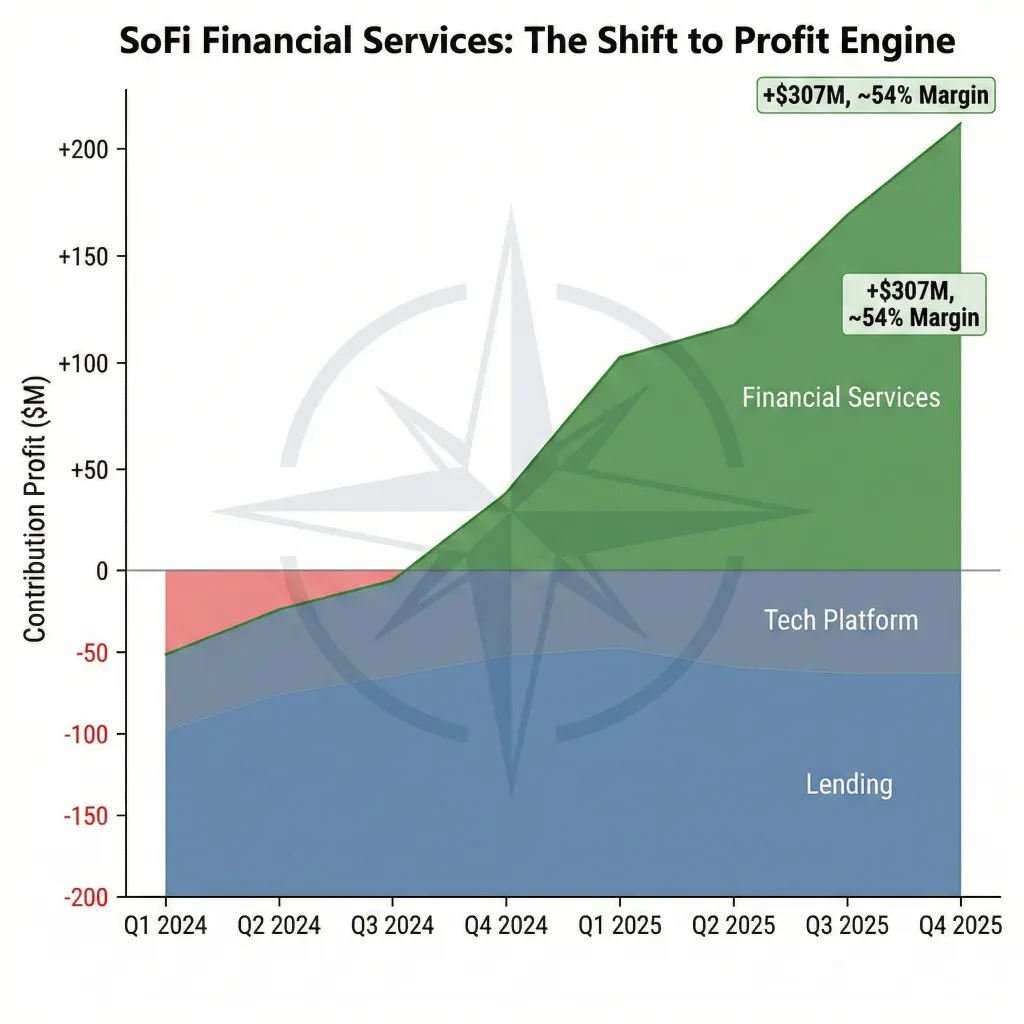
The mechanics here are straightforward but powerful. Checking and savings products pull in low cost deposits. Those deposits fund loans internally, reducing reliance on external financing. At the same time, interchange fees, brokerage revenue, advisory fees, and card economics add a layer of fee-based income that carries no credit risk and minimal capital requirements.
Two Q4 datapoints matter most:
- Contribution profit sustainability. The market wants confirmation that margins north of 50% are not a one-quarter anomaly. Any slippage would be interpreted as competitive pressure or promotional re-acceleration.
- Fee-based revenue growth. In Q3, non interest income tied to Financial Services grew roughly 50% year over year to $409 million. That growth rate does not need to persist indefinitely, but a sharp deceleration would reintroduce concerns about monetization depth.
This segment also quietly absorbs volatility elsewhere in the model. If loan growth slows or credit costs rise modestly, fee income can still compound without incremental balance sheet risk. That characteristic is part of why the market tolerates a higher multiple here than it would for a traditional regional bank.
SoFi Invest plays an outsized role in this discussion. Brokerage activity, advisory engagement, and the integration of crypto trading directly influence fee growth potential in 2026. While assets under management updates are often buried in commentary, they provide one of the cleanest signals of whether the ecosystem is deepening or merely expanding at the top of the funnel.
At a structural level, Financial Services is where the super app thesis either earns credibility or erodes quietly. Q4 does not need to show explosive growth. It does need to show that profitability here is repeatable and still improving at the margin.
Crypto, Stablecoins, and Optionality Beyond Banking
This is the section where SoFi’s upside narrative stretches furthest from traditional banking, and where execution risk is the least forgiving. The market does not need crypto to justify today’s valuation, but it is increasingly embedding optionality around it into longer-term expectations.
SoFi has already laid the groundwork. Crypto trading is being relaunched directly inside the app, reintroducing a high-margin transaction revenue stream that disappears entirely in bear markets and reappears quickly when sentiment turns. The timing matters. Crypto asset prices rebounded meaningfully in late 2025, and retail engagement historically follows price, not the other way around. Even modest trading volumes can meaningfully lift non-interest income given fee economics.
The larger strategic lever is the planned SoFi USD stablecoin, targeted for launch in the first half of 2026. This is not a marketing feature. It is a balance sheet and infrastructure product.
A bank-issued stablecoin changes the trust equation. Unlike non-bank issuers, SoFi operates under a national bank charter with direct regulatory oversight. That structure allows SoFi to issue a fully reserved digital dollar while holding the backing assets in Treasuries or cash equivalents. The economics are simple and unusually clean. $1B in stablecoin float at a 4–5% yield translates to $40–50M in annual income with minimal operating cost and no credit exposure.
More important than the yield is positioning. Management has framed the stablecoin not just as a consumer wallet feature, but as infrastructure for other fintechs and enterprises. If executed, this places SoFi closer to a settlement layer than a front-end app. That framing pulls Galileo, Technisys, and Financial Services into a single vertical stack.
The market will not price this fully until there is regulatory clarity and a concrete launch timeline. What investors should listen for on this call is tone and specificity. Clear milestones, scoped rollout plans, and early partner interest support the optionality thesis. Vague ambition without operational detail does the opposite.
Crypto does not need to be a core earnings driver in 2026 to matter. It only needs to be credible enough that investors treat it as a free call option rather than a distraction. Q4 commentary sets that baseline.
Valuation Framing After Earnings
Once the numbers are out, the market’s reaction will have less to do with absolute performance and more to do with which valuation framework investors default to coming out of the call.
At current levels, SoFi trades in a narrow corridor between two identities. On a forward basis, the stock is valued at roughly 46x 2026 consensus EPS of ~$0.58, a multiple that would be indefensible for a traditional bank but still within range for a platform business sustaining mid-20% revenue growth. On a balance sheet basis, pro forma tangible book value sits near ~$8.5B, placing the stock at approximately 3.8x tangible book.
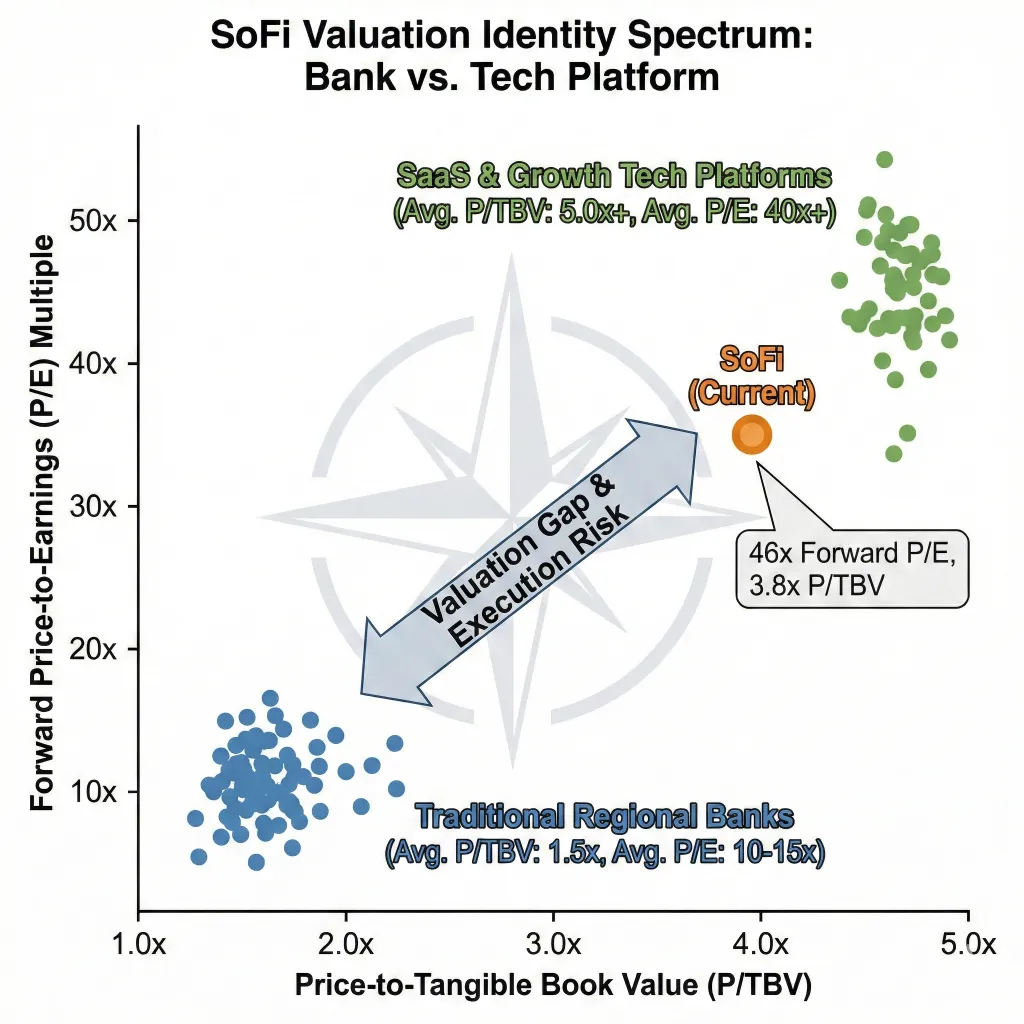
That spread only holds if execution remains clean.
A strong earnings report will not expand the multiple on its own. Expansion only occurs if the call reinforces three ideas simultaneously: credit discipline remains intact, capital deployment improves future ROE rather than diluting it, and non-lending revenue continues to scale with operating leverage. If those conditions are met, the premium multiple remains tolerable as a function of compounding rather than speculation.
The downside scenario is more mechanical. If revenue growth shows early deceleration, if Galileo fails to stabilize, or if capital allocation remains vague, the market will default to a bank-like framing. In that case, even modest compression carries asymmetric downside. A shift toward 15–20x earnings or 2.0–2.5x tangible book would imply a materially lower equity value, regardless of ongoing profitability.
This is why guidance matters more than the quarter itself. Investors will triangulate forward revenue growth, EBITDA margins, and capital usage to decide whether a 46x multiple is being earned or merely tolerated.
What Would Change Our View After This Call
This earnings report does not need to settle the long-term debate around SoFi. It does need to narrow the range of plausible outcomes. There are a small number of signals that would meaningfully alter how we underwrite the business heading into 2026, and they are more structural than emotional.
On the positive side, conviction would strengthen if we see confirmation across three dimensions at once. First, credit metrics remain contained, with personal loan charge-offs holding near the 2.6% level and delinquency rates showing no holiday-driven slippage. That would reinforce the Super Prime thesis as something durable rather than cyclical luck. Second, capital deployment becomes directional. Management does not need to announce a transaction, but it does need to articulate how the December capital raise feeds into retained loan growth, platform expansion, or other high-ROE uses over the next 12–18 months. Third, non-lending revenue continues to scale, particularly within Financial Services and the technology platform, supporting the idea that earnings quality is improving alongside growth.
Conversely, our view would shift if weakness appears in areas that compound rather than isolate. A meaningful uptick in delinquencies would force a reassessment of balance sheet growth assumptions. Continued erosion in Galileo enabled accounts without offsetting revenue acceleration would weaken the platform narrative. Vague or non-committal answers around capital allocation would extend the dilution overhang into 2026 models, even if near-term results are solid.
What matters most is consistency. The stock can tolerate one soft data point. It cannot tolerate multiple signals pointing toward a bank-like growth profile while still trading at a technology-weighted multiple.
Where This Fits Into Our Long-Term SoFi Model
Our current SoFi model is anchored to a post-profitability baseline, not a turnaround narrative. The December update fixed three variables that now frame how we interpret this earnings call: share count reality, earnings durability, and the range of plausible valuation outcomes.
Share count is no longer a moving target.
Following the late-2025 equity raise, our model assumes 1.40B diluted shares in 2026 and 1.48B diluted shares by 2030, explicitly incorporating ongoing stock-based compensation without relying on buybacks or optimistic dilution offsets. That removes a major source of silent assumption drift.
Earnings, not revenue, now drive the model.
For 2026, our scenarios assume the following net income outcomes:
- Bear: $0.65B
- Base: $0.90B
- Bull: $1.20B
These are not growth-at-any-cost projections. They assume operating leverage from Financial Services, continued fee mix expansion, and credit losses remaining structurally contained rather than improving indefinitely.
Applied to those earnings, the valuation framework intentionally compresses over time:
- 2026 multiples: 35x (bear), 45x (base), 60x (bull)
- 2030 multiples: 17x (bear), 30x (base), 42x (bull)
The result is a probability-weighted 2026 price target of ~$34, with scenario outputs of $16 (bear), ~$29 (base), and ~$51 (bull). Importantly, the base case carries the majority weight (55%), reflecting execution that is already visible rather than aspirational.
This earnings call directly updates the inputs, not the structure.
- If Q4 confirms deposit growth toward ~$27–28B, retained lending assumptions remain intact.
- If personal loan charge-offs hold near ~2.6%, the earnings path does not require upward loss revisions.
- If Financial Services contribution margins stay above 50%, EBITDA margin expansion toward ~30% remains viable.
- If Galileo revenue grows without further enabled-account erosion, the platform multiple remains embedded rather than stripped out.
Notably, the base case does not require crypto or stablecoin success. Digital assets are treated as upside optionality. Even $1B of stablecoin float producing $40–50M in annual income sits in the bull case, not the base. That asymmetry is intentional.
Where this earnings report matters most is trajectory validation. The stock currently trades at roughly 46x forward earnings, which only makes sense as a transitional multiple. Our model assumes that multiple compresses as earnings scale, not expands indefinitely. The compounding comes from earnings growth overwhelming multiple compression, not avoiding it.
If management demonstrates discipline around capital deployment, preserves credit quality, and continues shifting revenue toward fee-based streams, the model holds. If growth converges toward bank-like rates while capital usage remains opaque, the model breaks at the valuation layer, not the operating layer.
That distinction is critical.
This quarter does not decide whether SoFi is viable. It decides whether the market can continue underwriting SoFi as a platform in transition, rather than a lender that has already peaked.
That is the lens through which this earnings call should be read.

SoFi Stock Analysis: The Bank Behind the Everything App
Our SoFi stock analysis tests lending, deposits, credit losses and dilution across 162 scenarios, with a detailed valuation and editable investment model.

SoFi Stock Forecast 2030
SoFi stock forecast 2030 using book value, EPS, growth, margin, valuation, risk, and buy-zone analysis for long-term investors.
Sofi Stock Price Prediction
SoFi stock price prediction for 2026: why we believe this full-stack fintech could double as it builds a sticky, profitable platform. (Updated Dec 2025)
Northwise Portfolios
See how the research becomes real decisions
Reader discussion
Discuss the research
Create a Free account to join the discussion with a display name.
Create a Free Account
No comments yet. Start a thoughtful discussion.