
SoFi Stock Forecast 2030

SoFi stock forecast 2030 using book value, EPS, growth, margin, valuation, risk, and buy-zone analysis for long-term investors.
In this article
A refreshed Sofi Stock Forecast 2030 Model built around revenue growth, EPS power, book value compounding, and premium platform valuation.
1. Executive Summary
SoFi no longer needs to prove it can survive. That debate is settled. The company is profitable, growing at a high rate, and showing that its member base, deposit engine, and product ecosystem can compound together rather than separately. The story has moved on, and the report needs to move with it.
The business has spent the better part of a decade migrating away from its origin as an online student-loan refinancer. It now operates as a diversified digital financial platform with a national bank charter, a fast-growing deposit base, expanding fee-based revenue, and an enterprise technology layer underneath the consumer brand. Lending, deposits, brokerage, payments, credit, and banking infrastructure increasingly live inside a single relationship rather than as separate product lines.
The most recent data supports a constructive read. In Q1 2026, SoFi delivered roughly 41% adjusted revenue growth, record loan originations, 35% member growth, strong net interest income growth, and continued fee-based revenue expansion. A business growing at that rate is difficult to model conservatively without inventing a deceleration the numbers have not yet shown.
None of that removes the risks. SoFi is a financial company, and credit quality, funding costs, loan-sale execution, interest rates, capital requirements, regulation, and consumer health all sit inside the model as live variables. The strongest version of this thesis is not that the risks are gone. It is that the risks are increasingly measurable, while the compounding profile remains underappreciated by a market still anchored to the lender framing.
That sets up the question this report is built to answer. The market is not really debating whether SoFi grows. It is debating how SoFi should be valued by 2030: as a volatile online lender, as a digital bank, or as a premium financial platform. The answer determines whether the market applies bank-like multiples, fintech-platform multiples, or a premium price-to-book framework closer to higher-quality financial compounders. The remainder of this report works toward that answer, and toward a valuation architecture capable of holding it.
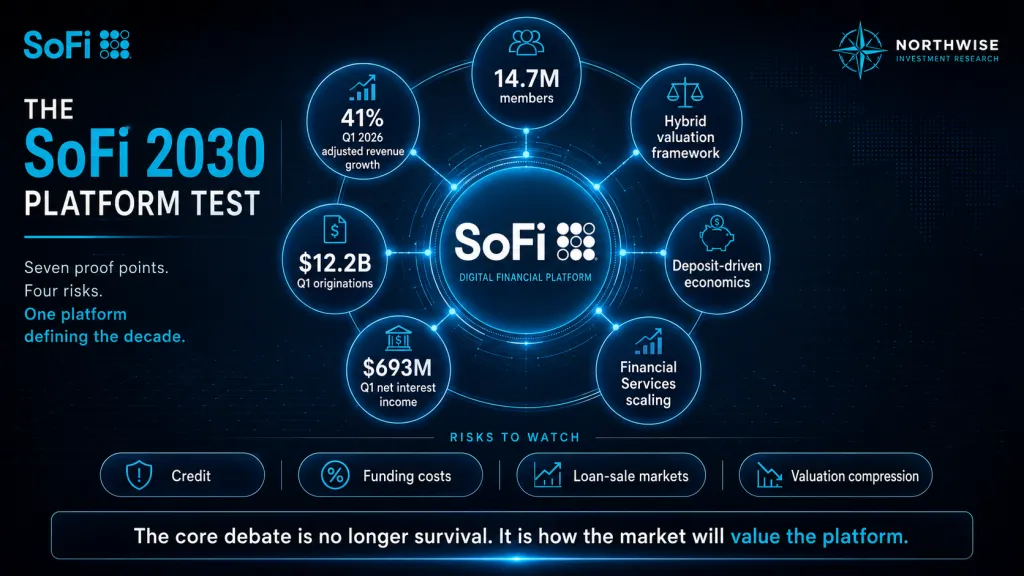
Table of Contents
1. Executive Summary
2. Why This Refresh Is Needed
2.1 What the Prior Report Got Right
2.2 What the Prior Report Underweighted
2.3 Why the Model Should Not Move Lower After Bullish Data
2.4 The New Central Question
3. SoFi's Current Operating Position
3.1 From Student Loan Refinancer to Digital Financial Platform
3.2 The Bank Charter as a Structural Inflection
3.3 The One-Stop Financial Services Strategy
3.4 Why SoFi Is No Longer a Pure Lending Story
4. 2025 and Q1 2026 as the New Baseline
4.1 Full-Year 2025 Baseline
4.2 Q4 2025: The First Billion-Dollar Revenue Quarter
4.3 Q1 2026: Record Revenue, Members, and Originations
4.4 Why Static Guidance Does Not Equal Weakening Fundamentals
4.5 What Has Improved Since the Prior Report
5. Member Growth and Product Density
5.1 14.7M Members and the Scale Curve
5.2 Product Growth and Cross-Sell Evidence
5.3 Why Product Density Matters More Than Member Adds Alone
5.4 The Lifetime Value Argument
5.5 How SoFi's Customer Base Compares to Traditional Banks
6. Lending: Still the Earnings Engine, But No Longer the Whole Thesis
6.1 Personal Loans
6.2 Student Loans
6.3 Home Loans and Home Equity
6.4 Loan Platform Business and Private Credit Sensitivity
6.5 Origination Growth Versus Balance Sheet Risk
6.6 Credit Performance and Net Charge-Offs
6.7 Why Lending Supports the Platform Rather Than Defines It
7. Deposits, Funding Cost, and the Bank Charter Advantage
7.1 Deposit Growth as the Core Funding Layer
7.2 Why Deposit Funding Improves Unit Economics
7.3 Net Interest Income Growth
7.4 Spread Stability Under Higher-for-Longer Rates
7.5 Deposit Franchise Value and Book Value Compounding
7.6 What Would Pressure the Deposit Thesis
8. Financial Services: The Platform Monetization Layer
8.1 Revenue Growth in Financial Services
8.2 Fee-Based Revenue as a Quality Upgrade
8.3 The Components of Fee Revenue
8.4 Cross-Sell as the Operating Leverage Mechanism
8.5 Why Financial Services Supports a Higher Multiple
8.6 Where Financial Services Still Needs Proof
9. Technology Platform: Optionality, Stabilizer, or Drag?
9.1 Galileo and Technisys Overview
9.2 Technology Platform Enabled Accounts
9.3 Growth Challenges and Platform Volume Weakness
9.4 Why the Technology Platform Still Matters Strategically
9.5 What Would Restore Confidence
9.6 How Much Value Should Be Assigned to This Segment
10. Management and Strategy
10.1 Anthony Noto's Leadership Record
10.2 Insider Ownership and the Recent Stock Purchase
10.3 Conservative Guidance Philosophy
10.4 Noto's View of Legacy Bank Constraints
10.5 The 5x Book Value Debate
10.6 How Management Wants the Market to Reframe SoFi
10.7 Execution Culture and Product Velocity
11. New Product Vectors and Optionality
11.1 Crypto Re-Entry
11.2 SoFiUSD and Stablecoin Infrastructure
11.3 Business Banking
11.4 International Payments and Settlement
11.5 Private Market Access
11.6 AI-Driven Financial Guidance
11.7 How Much Optionality Belongs in the Core Model
12. Macro Backdrop
12.1 Interest Rates and the Fed
12.2 Consumer Credit Health
12.3 Student Loan Repayment Normalization
12.4 Credit Card Debt and Personal Loan Demand
12.5 Housing and Mortgage Rate Pressure
12.6 Why Macro Is a Constraint, Not a Thesis Breaker
13. Risk Framework
13.1 Credit Risk
13.2 Funding Cost Risk
13.3 Loan Sale and Private Credit Market Risk
13.4 Regulatory Risk
13.5 Dilution and Stock-Based Compensation
13.6 Technology Platform Underperformance
13.7 Competition
13.8 Valuation Risk
13.9 What Would Break the Thesis
14. Why the Valuation Framework Must Be Hybrid
14.1 Why EPS Alone Is Incomplete
14.2 Why Book Value Alone Is Incomplete
14.3 Why Price-to-Book Matters for Financial Platforms
14.4 Why Noto's Amex Comparison Deserves Serious Treatment
14.5 How the Hybrid Model Reduces Valuation Error
15. The Refreshed 2030 Operating Model
15.1 Starting Baseline
15.2 Revenue Growth Assumptions
15.3 Margin Assumptions
15.4 Share Count Assumptions
15.5 EPS Outcomes
15.6 Book Value Per Share Outcomes
15.7 Scenario Summary
16. 2030 Valuation Framework
16.1 EPS-Based Valuation
16.2 Book-Based Valuation
16.3 Blended Scenario Targets
16.4 Probability Weighting
16.5 Updated Probability-Weighted 2030 Fair Value
16.6 Comparison to the Prior Report
17. Present Value and Action Zone Framework
17.1 Discount Rate Selection
17.2 Present Value Sensitivity
17.3 Scenario Present Values
17.4 Accumulation Zones
17.5 Hold Zone
17.6 Trim Zone
17.7 Sell Zone
17.8 How to Use the Framework
18. Northwise Positioning and Final Judgment
18.1 Current Northwise Positioning
18.2 Why We Continue to Hold Shares
18.3 When We Would Add
18.4 When We Would Reduce
18.5 Final Northwise View
18.6 Closing Conclusion
2. Why This Refresh Is Needed
2.1 What the Prior Report Got Right
The prior SoFi report was directionally correct on the points that mattered most. It identified that SoFi had exited the fragile profitability phase. It flagged Financial Services as the segment most likely to reframe the business. It recognized that the bank charter was improving funding economics, that incremental margins were becoming visible, and that the company deserved scenario-based valuation rather than a single near-term earnings estimate.
That work has aged well. The thesis pointed at the right structural shifts before they fully showed up in the reported numbers. The case for a refresh is not that the prior report was wrong. It is that the world supplied new evidence and a sharper central question.
2.2 What the Prior Report Underweighted
The prior report leaned almost entirely on EPS and price-to-earnings multiples. That choice underweighted several things that have since become harder to ignore.
It underweighted book value compounding and price-to-book as a valuation lens, which is the standard way the market values regulated financial institutions. It underweighted management's own implied valuation logic and the chance that SoFi eventually trades closer to premium financial companies rather than generic banks. It underweighted the durability of growth visible in Q4 2025 and Q1 2026, the significance of 35% member growth at a 14M-plus base, the scale of fee-based revenue growth, and the strategic value of newer product vectors such as stablecoin infrastructure, digital assets, and business banking.
2.3 Why the Model Should Not Move Lower After Bullish Data
The prior report modeled a probability-weighted 2030 value of roughly $79 before this latest run of evidence arrived. A refresh that mechanically lowers that value would need fundamentals to have deteriorated. They did not.
Since the prior model, Q4 2025 crossed $1B in adjusted quarterly revenue. Q1 2026 delivered roughly $1.1B in adjusted revenue. Members reached 14.7M. Originations reached $12.2B. Guidance stayed conservative, but the business did not slow in any material way, and CEO Anthony Noto bought roughly $1M of stock after the post-earnings selloff.
There is a useful distinction here. Conservative modeling is a discipline worth keeping. Refusing to update assumptions after a run of positive data is a different thing, and it is not conservatism. It is staleness wearing conservatism's clothes. This refresh rejects artificial conservatism while keeping the genuine kind.
2.4 The New Central Question
The old question was whether SoFi could become sustainably profitable. The reported numbers have answered it.
The question worth spending a report on now is narrower and more interesting. Will the market value SoFi as a volatile online lender, a digital bank, or a premium financial platform? That single question drives the multiple the market eventually applies, and it is the bridge into the hybrid EPS-and-book-value framework this report is built around.
3. SoFi's Current Operating Position
3.1 From Student Loan Refinancer to Digital Financial Platform
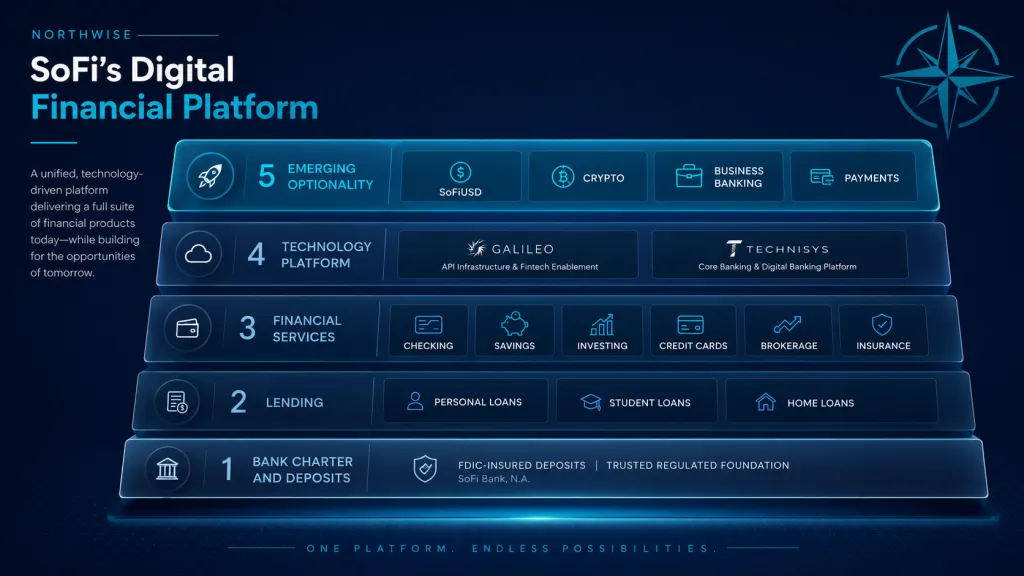
SoFi began as a student-loan refinancing company aimed at high-income, high-credit-quality borrowers. From that wedge it expanded into personal loans, home loans, deposits, investing, credit cards, insurance referrals, brokerage, payments, and enterprise technology infrastructure.
The result is a company that now spans both consumer finance and the fintech infrastructure that sits behind other financial products. The name still evokes student loans for many investors. The operating reality has moved well past that.
3.2 The Bank Charter as a Structural Inflection
The bank charter is the single change that reshaped the funding structure most. It gives SoFi access to lower-cost deposits, which reduces reliance on warehouse lines and capital-markets funding and improves net interest economics across the lending book.
The charter cuts both ways, and the report treats it honestly. It increases regulatory oversight, which is a real constraint and, separately, a credibility signal. It also matters for the valuation argument developed later, given that SoFi now builds equity value through retained earnings and balance-sheet growth, which is precisely the kind of compounding a book-value framework is designed to capture.
3.3 The One-Stop Financial Services Strategy
SoFi's stated ambition is to become the primary financial relationship for its members. The product surface now includes checking and savings, personal loans, student loans, home loans, credit cards, investing and brokerage, financial planning, insurance referrals, crypto and stablecoin products, payments and money movement, business banking, and the Galileo and Technisys technology infrastructure.
The strategic logic is that a unified product surface lets SoFi capture a rising share of each member's financial life over time. The relationship deepens as a member moves from a single product toward a full financial stack.
3.4 Why SoFi Is No Longer a Pure Lending Story
Lending remains central to earnings, and this report does not pretend otherwise. The refinement is in how the pieces relate to each other.
Lending funds member acquisition and generates the bulk of near-term earnings. Deposits lower the cost of that lending. Financial Services raises product density and adds fee-based revenue. The Technology Platform adds enterprise optionality. Newer vectors such as digital assets and business banking widen the long-term product map. The earnings engine is still lending, but the valuation question increasingly turns on everything built around it.
4. 2025 and Q1 2026 as the New Baseline
4.1 Full-Year 2025 Baseline
The model anchors to 2025 as the last fully reported year and to Q1 2026 as the most recent evidence of trajectory. The headline 2025 figures: revenue of roughly $3.61B, net income of roughly $481M, total assets of roughly $50.66B, total equity of roughly $10.49B, year-end members of 13.7M, and technology platform enabled accounts of roughly 128M.
Those figures establish the starting scale. The 2026 guide then serves as the near-term revenue and EPS anchor, which the later model builds from rather than around.
4.2 Q4 2025: The First Billion-Dollar Revenue Quarter
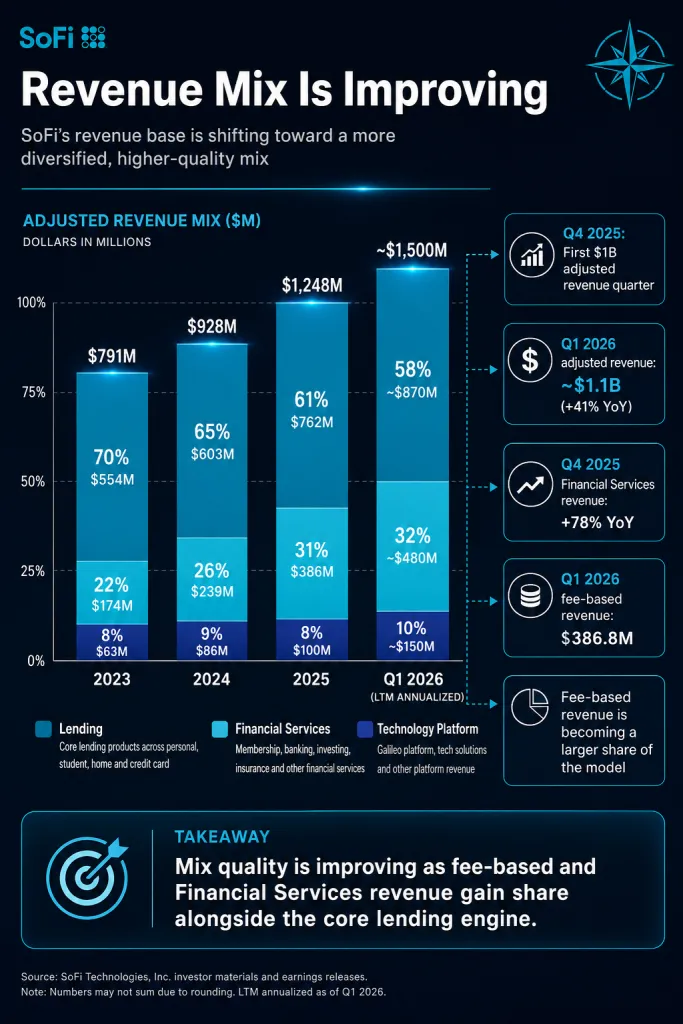
Q4 2025 was the quarter SoFi crossed into a new revenue tier. Adjusted net revenue reached roughly $1.01B, up 37% year over year, with adjusted EPS of $0.13. Members reached 13.7M after adding 1M in the quarter, and the company sold 1.6M products, up 37%, with 40% of new products coming from cross-selling to existing members.
The lending detail was strong. Total originations reached $10.5B, split across $7.5B in personal loans, $1.9B in student loans, and $1.1B in home loans. Fee-based revenue reached $443M, up more than 50%, and Financial Services revenue reached $456.7M, up 78%.
Read together, the quarter showed two things. SoFi had reached a materially larger quarterly revenue scale, and the growth was no longer dependent on lending alone. Financial Services was accelerating and cross-sell was visibly working.
4.3 Q1 2026: Record Revenue, Members, and Originations
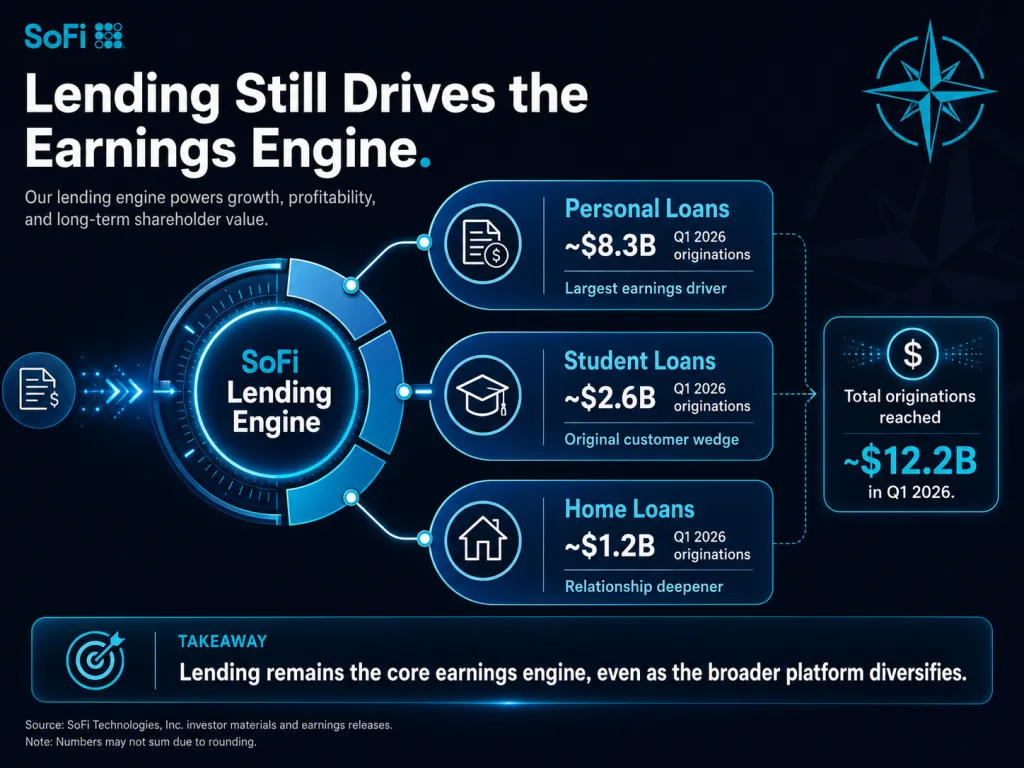
Q1 2026 extended the trend. Adjusted revenue reached roughly $1.1B, up 41% year over year, with EPS of $0.12 against $0.06 a year earlier. Members reached 14.7M, up 35%. Total originations reached $12.2B, up roughly $1.7B sequentially from Q4's $10.5B.
The origination mix told its own story. Personal loans reached roughly $8.3B, student loans more than doubled to roughly $2.6B, and home loans reached roughly $1.2B. Net interest income reached $693M, up 39%. Fee-based revenue reached $386.8M, up 23%. Full-year 2026 guidance was maintained at roughly $4.66B in revenue and $0.60 in EPS. Personal-loan annualized net charge-offs improved by 28 basis points year over year, per MarketWatch reporting.
This is not the quarter of a business decelerating toward maturity. The investor frustration that followed was tied to unchanged full-year guidance, not to weak reported results.
4.4 Why Static Guidance Does Not Equal Weakening Fundamentals
The stock sold off after Q1 due to SoFi holding full-year guidance steady despite the upside in the quarter. The interpretation of that decision is where the analysis lives.
A static guide after a strong quarter can mean one of two things. Management may see deterioration ahead, or management may be declining to overpromise into a volatile macro environment. The available evidence points toward the second. Noto told Reuters that the health of SoFi's consumer base remained strong, that record loan growth continued, and that the company expected strong demand into Q2. Credit performance met expectations, and point-of-sale debit spending remained healthy.
The conservative reading would only become wrong if future quarters show actual softness. As of the latest data, the guidance posture looks like discipline rather than a warning.
4.5 What Has Improved Since the Prior Report
The cumulative change since the prior model is meaningful. Revenue has run ahead of the old trajectory. Member growth has stayed high. Originations have set new records. Financial Services growth has remained strong, and fee-based revenue has continued to scale. Management increased its own ownership through an open-market purchase. Digital assets and stablecoin optionality expanded materially. And the book-value lens, underweighted in the prior report, has become more directly relevant as retained earnings and deposit growth compound the equity base.
5. Member Growth and Product Density
5.1 14.7M Members and the Scale Curve
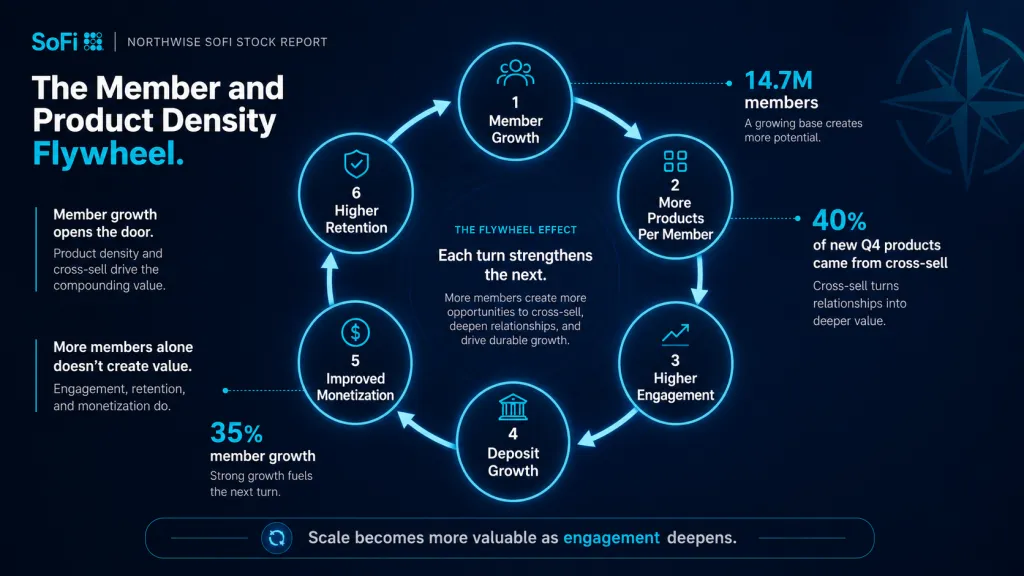
SoFi reached 14.7M members in Q1 2026, up 35% year over year, after ending Q4 2025 at 13.7M and adding roughly 1M members in each of the two most recent quarters. The relevant point is the base from which that growth is occurring.
A 35% growth rate off a small base is common and fragile. A 35% growth rate at nearly 15M members reflects a company still scaling like a high-growth platform rather than settling into the slow accretion of a mature bank. The durability of that rate is the variable to watch.
5.2 Product Growth and Cross-Sell Evidence
Q4 2025 supplied the clearest cross-sell evidence to date. SoFi added 1.6M products, up 37%, and 40% of those new products came from existing members rather than new ones.
That ratio is the operational proof behind the one-stop platform thesis. Cross-sell lowers the acquisition cost per product, raises lifetime value per member, improves retention, and feeds both fee-based revenue and book value growth. The strategy stops being a slide and starts being a number once cross-sell carries that share of new products.
5.3 Why Product Density Matters More Than Member Adds Alone
Raw member additions get the headlines, but product density is the monetization variable. A member holding only a checking account is a low-revenue relationship. A member holding checking, savings, direct deposit, a personal loan, brokerage, insurance, and a credit card is a far more valuable one.
Product density is therefore the bridge between growth and profitability. It is where member count converts into revenue per member, and it is the metric that most directly supports the platform framing developed later in this report.
5.4 The Lifetime Value Argument
SoFi's model depends on acquiring members relatively early in their financial lives and expanding product usage as income, savings, borrowing, and investing needs grow. The structure resembles a digital bank, a brokerage, a credit platform, and a payments platform layered into one interface.
The long-term value comes from capturing a larger share of wallet over time. The argument holds only if SoFi keeps members long enough and broadens their product usage fast enough for that share to compound. The cross-sell data is the early support for that path, though it remains a multi-year proof rather than a finished one.
5.5 How SoFi's Customer Base Compares to Traditional Banks
Traditional banks hold large customer bases on top of fragmented, decades-old technology. SoFi holds a smaller base on a unified digital product surface. The upside is not that SoFi will soon rival JPMorgan or Bank of America in deposits. That framing sets an unrealistic bar and misses the point.
The upside is that SoFi can win profitable, digitally native customers with far less branch infrastructure and far more product integration, then deepen those relationships at a lower marginal cost than a legacy bank can. The advantage is structural rather than scalar.
6. Lending: Still the Earnings Engine, But No Longer the Whole Thesis
6.1 Personal Loans
Personal loans remain the largest origination category. They reached roughly $8.3B in Q1 2026, up from roughly $7.5B in Q4 2025, where they grew 43% year over year. They drive a large share of revenue and profitability, and they also carry the most visible credit-cycle risk in the book.
The honest framing treats personal loans as both an engine and an exposure. SoFi's underwriting, its higher-income customer base, and its deposit-funded structure make the risk more manageable than the lender framing assumes. They do not make it disappear, given that the loans are unsecured and sensitive to unemployment.
6.2 Student Loans
Student loan originations reached roughly $2.6B in Q1 2026, more than double Q4 2025's roughly $1.9B, where they grew 38% year over year. Student loans remain strategically important as the product tied to SoFi's original high-income, high-credit-quality wedge.
The macro context deserves care. Student-loan delinquencies have risen sharply across the broad market as pandemic-era reporting protections ended. That broad distress does not map cleanly onto SoFi's refinanced borrowers, who are typically not representative of the wider federal-borrower population. The normalization still shapes borrower psychology and the overall credit environment, so it stays in view even where it does not directly threaten SoFi's book.
6.3 Home Loans and Home Equity
Home loan originations reached roughly $1.2B in Q1 2026, up from roughly $1.1B in Q4 2025, where they nearly doubled year over year. Home lending remains smaller than personal loans, but it broadens the product surface and deepens the financial relationship.
The macro caveat is straightforward. Mortgage rates remain elevated and housing affordability is constrained, so home-loan growth is likely to stay lumpy. Home-equity products can offset some purchase-mortgage weakness, though the segment is unlikely to drive the model on its own.
6.4 Loan Platform Business and Private Credit Sensitivity
The loan platform business deserves its own attention as a genuine risk rather than a footnote. In Q1 2026, platform volume reportedly fell sequentially to around $3B, below analyst expectations, with MarketWatch linking the softness partly to weakness in private credit markets.
The mechanism matters. The loan platform business adds capital-light fee revenue by originating loans for third-party buyers, which means it depends on institutional demand for SoFi-originated paper. When private credit markets tighten, that demand softens and the fee revenue can disappoint. The model should not assume loan-sale channels are always open at favorable prices, and this dependency is one reason the bear case retains weight.
6.5 Origination Growth Versus Balance Sheet Risk
It helps to separate what happens to a loan after it is originated. Loans retained on the balance sheet generate net interest income and consume capital. Loans sold to third parties generate fee revenue and depend on capital-markets demand.
More retention can lift net interest income at the cost of higher balance-sheet intensity and capital consumption. More sales can lift fee revenue at the cost of dependence on buyer appetite. Reading origination growth without tracking this split overstates how clean the growth is.
6.6 Credit Performance and Net Charge-Offs
The Q1 2026 credit data was reassuring on the margin. Personal-loan annualized net charge-offs improved by 28 basis points year over year, per MarketWatch reporting, and Noto told Reuters that credit performance met expectations.
That said, the report avoids overstating it. Credit can look stable until it does not. SoFi's unsecured personal loans are not immune to a downturn, and consumer credit stress is rising in parts of the economy. Improving charge-offs in a steady environment are evidence, not a guarantee about the next recession.
6.7 Why Lending Supports the Platform Rather Than Defines It
Lending is still where most of the near-term earnings come from. The long-term multiple, though, depends on whether lending becomes one part of a broader financial relationship rather than the sole profit engine.
If SoFi remains, in the market's eyes, a lender that also offers other products, it earns a lender's multiple. If lending becomes the highest-margin layer inside a deeper member relationship that also produces deposits, fees, and engagement, the company earns a different kind of recognition. The segment data developed next is what moves that judgment.
7. Deposits, Funding Cost, and the Bank Charter Advantage
7.1 Deposit Growth as the Core Funding Layer
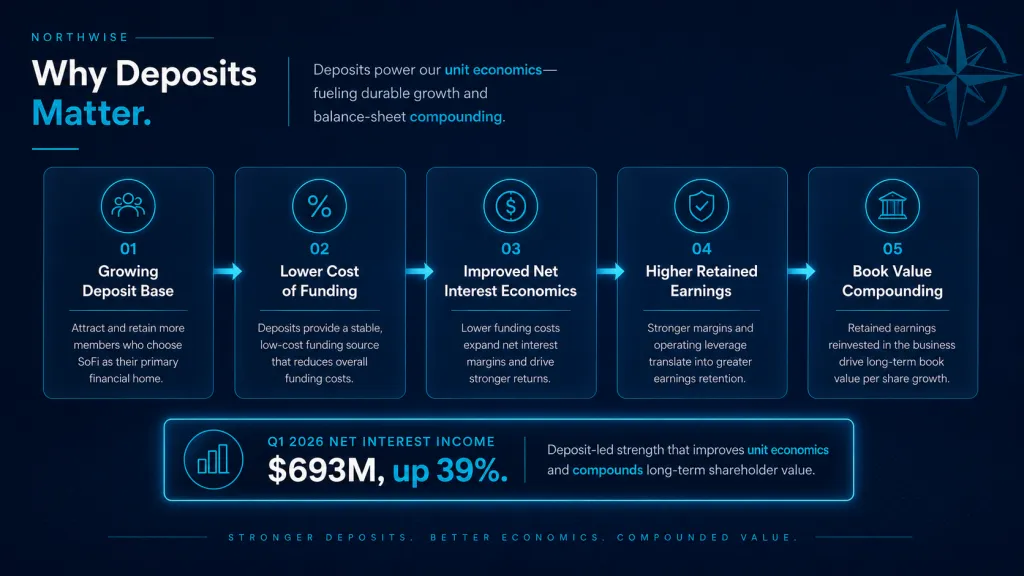
Deposits are the structural advantage the bank charter created. They reduce reliance on wholesale funding, improve lending economics, and deepen member relationships by pulling primary banking activity onto the platform.
Deposit growth has been one of the more consistent parts of the SoFi story since the charter, expanding steadily as the bank pulls primary banking activity onto the platform. The trajectory matters more than any single quarter's level, given that deposit scale is what allows SoFi to fund a growing earning-asset base cheaply.
7.2 Why Deposit Funding Improves Unit Economics
Deposit funding supports lower funding costs than warehouse or capital-markets funding, a more stable net interest margin, higher retained earnings, balance-sheet growth, and book value compounding. Each of those feeds the next.
The chain is the point. Cheaper funding raises net interest margin, higher margin lifts retained earnings, retained earnings grow the equity base, and a larger equity base supports more earning assets. That loop is what a book-value framework is built to measure, and it is largely invisible to a pure EPS lens.
7.3 Net Interest Income Growth
Net interest income reached $693M in Q1 2026, up 39%. That growth is doing real work, given that it supports both near-term EPS and the book value compounding described above.
Even as fee revenue becomes more important to the valuation story, the deposit-funded lending engine remains core to the economics. Net interest income is the part of the model least dependent on capital-markets conditions, which gives it a stabilizing role the loan platform business lacks.
7.4 Spread Stability Under Higher-for-Longer Rates
Higher rates cut in mixed directions. On the supportive side, they lift loan yields and the yield on cash and floating-rate assets, and they raise the value of a low-cost deposit franchise for a company that manages funding costs well. On the pressuring side, they raise borrower costs, increase the risk of credit stress, weigh on mortgage affordability, and push up deposit beta as savers demand higher yields.
The net effect depends on execution. A deposit franchise that holds funding costs down while asset yields stay elevated benefits from the environment. One that has to keep raising APYs to retain deposits sees the margin advantage erode. This is a management-quality variable as much as a macro one.
7.5 Deposit Franchise Value and Book Value Compounding
This subsection is the bridge into the valuation argument. If deposits keep growing, SoFi can scale earning assets. If net income is retained rather than paid out, book value per share rises. If return on equity improves as the platform matures, the market can justify a higher price-to-book multiple.
That sequence is the mechanical reason a book-value framework belongs in the model. A company building equity value through retained earnings and a growing deposit-funded balance sheet is compounding in a way that earnings multiples alone tend to under-capture.
7.6 What Would Pressure the Deposit Thesis
The deposit story is not unconditional. Intensifying deposit competition, the need to hold APYs high to attract balances, rising deposit beta, customer churn, regulatory capital constraints, and weakening consumer liquidity would each pressure it. The most likely path to disappointment is a funding-cost squeeze in which SoFi has to overpay for deposits to keep growing, which would compress the margin advantage the charter is supposed to provide.
8. Financial Services: The Platform Monetization Layer
8.1 Revenue Growth in Financial Services
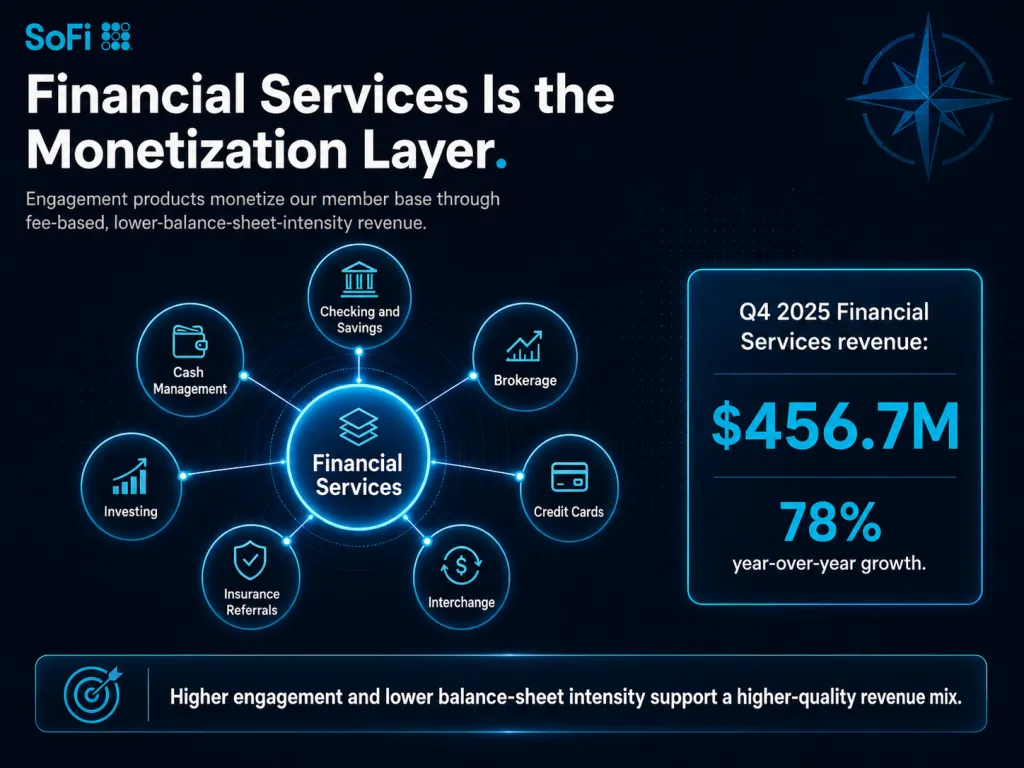
Financial Services revenue reached $456.7M in Q4 2025, up 78% year over year. That is one of the most important bullish data points in the entire report.
The segment's acceleration is what supports the shift away from pure-lending optics. It shows the platform monetizing engagement and cross-sell rather than relying on origination growth alone, and it validates the strategic logic that the rest of the thesis rests on.
8.2 Fee-Based Revenue as a Quality Upgrade
Fee-based revenue reached $443M in Q4 2025, up more than 50%, and $386.8M in Q1 2026, up 23%. The Q1 growth rate slowed relative to Q4, which is worth noting plainly rather than smoothing over.
The dollar base remains substantial, and some of the quarter-to-quarter movement appears tied to platform volume and loan-sale dynamics rather than to weakening underlying demand. Fee revenue is a quality upgrade due to being less balance-sheet intensive than retained lending, but its lumpiness is real and the model treats it as such.
8.3 The Components of Fee Revenue
Financial Services fee revenue draws from interchange, brokerage, credit cards, insurance referrals, loan referrals, cash management, small-business products, payments, and, over time, crypto and digital assets. The breadth is part of the appeal, given that no single line carries the segment.
The strategic value sits in interchange and engagement-linked revenue, which scale with member activity rather than with balance-sheet capacity. Those lines are the most platform-like part of SoFi's economics and the most supportive of a premium multiple.
8.4 Cross-Sell as the Operating Leverage Mechanism
The real operating leverage in the model comes from selling more products to existing members. Cross-sell lowers incremental acquisition cost, raises revenue per member, generates more data per member, increases switching costs, improves underwriting, and supports retention.
Those benefits compound on each other. Better data improves underwriting, better underwriting supports more product offers, more products raise switching costs, and higher switching costs improve retention. Cross-sell is the mechanism that turns member growth into margin expansion rather than just larger scale.
8.5 Why Financial Services Supports a Higher Multiple
Financial Services revenue tends to be less balance-sheet intensive than retained lending, more repeatable, more platform-like, more tied to engagement, and therefore more supportive of a premium multiple. As its share of the total rises, the quality of SoFi's revenue mix improves.
That mix shift is central to the valuation debate. A business where fee and engagement revenue carry a growing share of the total earns a different multiple than one whose growth depends on putting more loans on the balance sheet.
8.6 Where Financial Services Still Needs Proof
The segment still has to answer real questions. Can fee revenue hold up if lending markets tighten? Can brokerage and investing scale enough to matter at the consolidated level? Can credit card economics improve without taking on too much credit risk? Can interchange grow meaningfully as debit and credit usage rises? Can digital assets become material rather than remaining optionality?
None of those is resolved yet. The Q1 fee-revenue deceleration is a reminder that the segment's growth is not a straight line, and the report keeps those open questions in the risk framework rather than assuming them away.
9. Technology Platform: Optionality, Stabilizer, or Drag?
9.1 Galileo and Technisys Overview
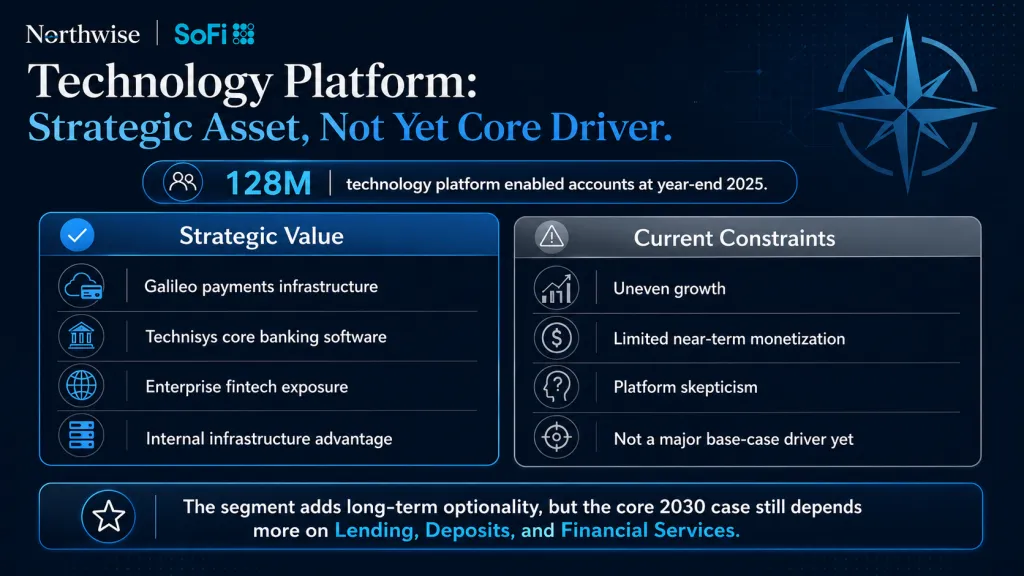
The Technology Platform is built on two acquisitions. Galileo is a payments and banking infrastructure platform that supports card issuing, digital banking, payment processing, and account management for other companies. Technisys is a core banking software platform whose value lies in modern, unified bank infrastructure.
Together they give SoFi an enterprise fintech layer that sits underneath its own consumer products and, in principle, underneath other companies' products as well. The strategic idea is that SoFi both uses and sells the rails it runs on.
9.2 Technology Platform Enabled Accounts
The platform supported roughly 128M enabled accounts at year-end 2025. That is a large number, though enabled-account count is a weaker signal than revenue growth and margin contribution.
Account count shows reach. It does not show monetization. The segment's value depends on how much revenue and margin those accounts generate, which is where the recent data has been less encouraging.
9.3 Growth Challenges and Platform Volume Weakness
Q1 2026 was a soft quarter for the platform-related business, and the report keeps two distinct things separate. The Technology Platform is Galileo and Technisys. The loan platform business is the loan-sale and fee-revenue channel discussed in Section 6.4. They are different, and blurring them overstates or understates the problem.
The relevant weakness in Q1 was in the loan platform business, where volume fell sequentially to around $3B amid private credit softness. The Technology Platform itself has faced uneven growth for longer, which is the segment-level concern that has weighed on how much value the market assigns here.
9.4 Why the Technology Platform Still Matters Strategically
Even with uneven near-term growth, the Technology Platform gives SoFi enterprise fintech exposure, banking-as-a-service infrastructure, payments infrastructure, potential operating leverage, and a point of differentiation from consumer-only digital banks.
The strategic case is that owning the infrastructure lowers SoFi's own costs and creates a second, enterprise-facing revenue stream. The case has not yet been proven through accelerating segment growth, which keeps it closer to optionality than to a load-bearing part of the thesis.
9.5 What Would Restore Confidence
Confidence in the segment would return with accelerating revenue growth, new enterprise wins, improved margins, tighter integration between Galileo and Technisys, clearer evidence that SoFi's own products benefit from owned infrastructure, and more concrete use cases tied to stablecoin or payments rails. Until several of those appear, the segment is best treated as a strategic asset whose value is not yet visible in the numbers.
9.6 How Much Value Should Be Assigned to This Segment
The refreshed model does not lean on a Technology Platform reacceleration. The base case assumes a moderate contribution, the bear case assumes continued drag or only modest growth, and the bull case assumes improved growth and stronger infrastructure recognition. Treating the segment as upside rather than as a core driver keeps the model honest given how uneven its recent performance has been.
10. Management and Strategy
10.1 Anthony Noto's Leadership Record
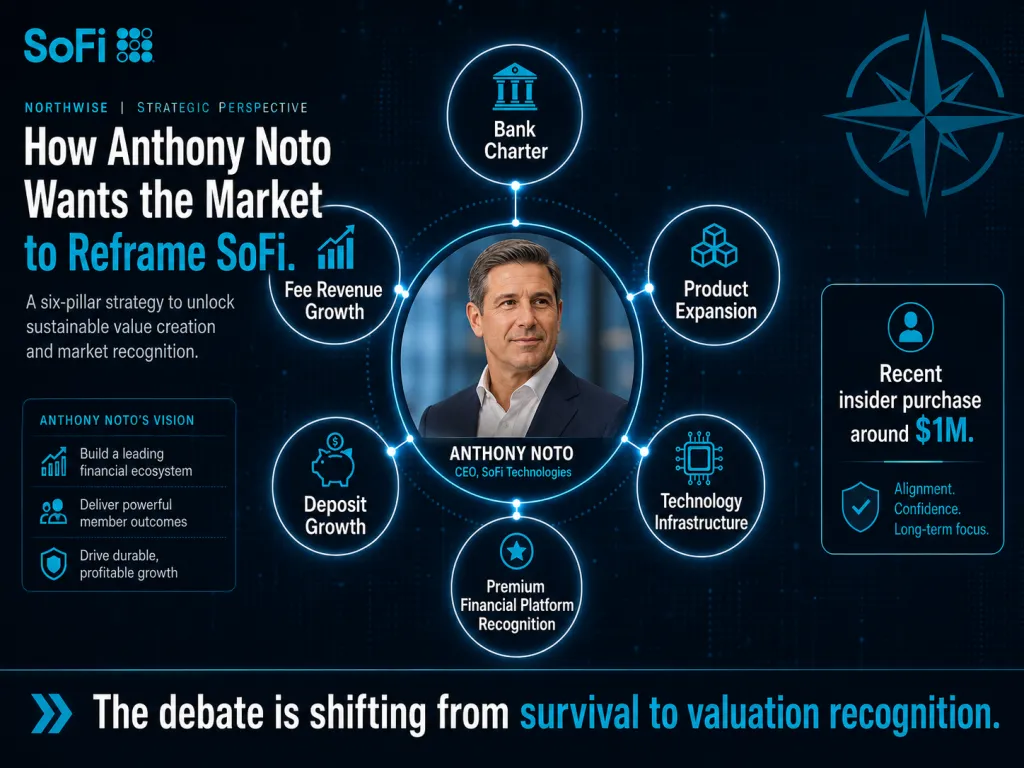
Anthony Noto has led SoFi since 2018, with prior roles as a Goldman Sachs executive, CFO of the NFL, and COO of Twitter. Under his tenure SoFi secured the bank charter, acquired Galileo and Technisys, and expanded the product surface from a lending-centric fintech into a broader financial platform.
That record is central to SoFi's strategic credibility. The transformation has been long and has largely tracked the strategy management laid out, which is part of why the execution-quality variable carries weight in the valuation argument.
10.2 Insider Ownership and the Recent Stock Purchase
In March 2026, Noto bought roughly $1M of SoFi stock at around $17.88 per share, holding roughly 11.7M shares directly afterward and standing as the largest individual shareholder. The purchase came after the post-earnings selloff.
The report treats this as alignment rather than as proof. An open-market purchase signals that management's incentives sit alongside shareholders' at current prices. It does not validate the thesis on its own, and it should be weighted accordingly.
10.3 Conservative Guidance Philosophy
Management held 2026 guidance steady despite Q1 upside, which frustrated investors looking for a raise. The more useful read is that conservative guidance can be rational in a volatile macro environment, and that management appears to prefer underpromising around uncertainty rather than flowing every quarter's upside straight into the annual guide.
That philosophy has a cost in the form of periodic selloffs when expectations run ahead of the guide. It also builds credibility over time if the company tends to clear its own bar, which the recent quarters suggest it has.
10.4 Noto's View of Legacy Bank Constraints
Noto has argued, in comments to Reuters, that legacy banks are constrained by fragmented, decades-old systems. That view supports the structural differentiation case at the center of the bull thesis.
The argument is that SoFi runs on a more unified digital stack, which should translate into lower cost, faster product velocity, and tighter integration across products. Whether that advantage shows up durably in returns is the open question, but the structural logic is sound.
10.5 The 5x Book Value Debate
Management has pointed toward a future in which SoFi trades closer to a premium financial multiple, with an American Express comparison serving as the reference point for what high-quality financial-platform recognition can look like. We treat the roughly 5x book figure as directional rather than as a precise target, useful for what it signals about ambition rather than as a number to anchor on.
As analysis, the idea is worth taking seriously without accepting it as a base case. Price-to-book depends on return on equity, growth, risk, and earnings durability. A generic bank does not earn a 5x book multiple. A high-return, high-growth, premium financial platform can. The relevant question is whether SoFi's returns and growth migrate toward that profile over time, and the report places that recognition in the bull case rather than the base case.
10.6 How Management Wants the Market to Reframe SoFi
Management wants SoFi viewed as a full-service financial platform, a digital-first bank, a diversified fee-and-lending business, a product innovation leader, and a company taking share from legacy banks. That is the frame the company is arguing for in every release and call.
The market has not yet fully accepted that frame, which is the gap the thesis is built around. The valuation outcome depends substantially on whether the reported numbers eventually force the reframing that management is asking for.
10.7 Execution Culture and Product Velocity
SoFi keeps shipping. Recent additions span new banking products, crypto re-entry, stablecoin infrastructure, business banking, private market access, payments capabilities, and AI-driven financial tools. That cadence supports the platform thesis by continually widening the product surface members can adopt.
Product velocity is a double-edged signal. It demonstrates execution and broadens the long-term opportunity, and it also raises the number of products that have to prove out before they justify the value the bull case assigns them.
11. New Product Vectors and Optionality
11.1 Crypto Re-Entry
SoFi re-entered crypto after regulatory conditions shifted, restoring a feature that adds engagement and monetization potential. It also reintroduces regulatory and reputational complexity, given how quickly the rules around digital assets can change.
11.2 SoFiUSD and Stablecoin Infrastructure
SoFi launched SoFiUSD in December 2025 and, by late May 2026, made it available directly to nearly 15M customers through the app, with reported support for Ethereum and Solana. Per WSJ reporting, the stablecoin market stood at roughly $318B, with SoFiUSD around $100M shortly after launch. SoFi has indicated plans to allow conversion into interest-bearing, FDIC-insured bank deposits and to launch SoFiUSD on the Bullish exchange by late June.
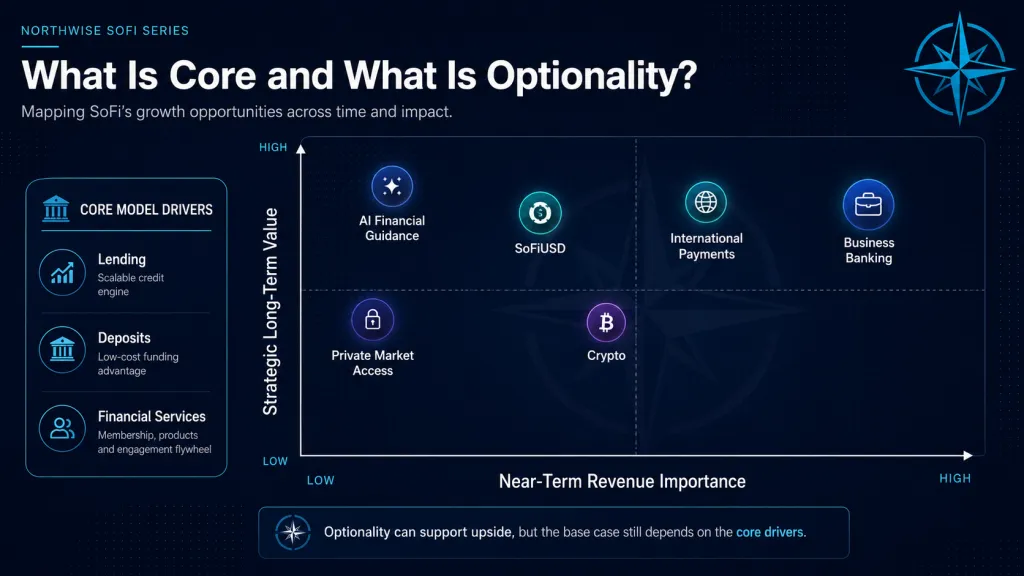
This sits as optionality rather than a core 2030 driver. Its strategic value would rise if stablecoin utility scales across consumer deposits, remittances, business banking, and settlement, which is why the bull case can assign it some weight while the base case does not lean on it.
11.3 Business Banking
SoFi announced a business banking product in April 2026, designed to let businesses manage fiat and crypto banking, hold deposits, move funds, and settle transactions. The potential lies in a new deposit base, small-business banking, payments, stablecoin utility, and cross-border settlement.
It is early, and the segment's contribution to the 2030 model is modest in the base case. The strategic logic, a wider deposit and payments surface that compounds the franchise, is more interesting than the near-term numbers.
11.4 International Payments and Settlement
SoFi Pay was reportedly active in more than 30 countries by year-end 2025, supporting the money-movement and settlement layer. That reach is a building block for the payments and stablecoin ambitions rather than a material revenue line on its own today.
11.5 Private Market Access
Private market access can raise engagement and differentiate SoFi Invest, supporting brand and product density. It is unlikely to be material in the base model, and the report treats it as a contributor to the platform narrative rather than a driver of the valuation.
11.6 AI-Driven Financial Guidance
AI tools such as Cash Coach function as a retention and engagement layer rather than a direct revenue driver. The report folds them into the broader product-velocity and financial-operating-system narrative without modeling explicit revenue from them.
11.7 How Much Optionality Belongs in the Core Model
The core model rests on lending, deposits, Financial Services, the Technology Platform, and operating leverage. The optionality layer, stablecoin, crypto, business banking, private markets, AI tools, and international payments, sits outside the base case. The base case does not depend on any of it, while the bull case allows moderate recognition for the vectors most likely to scale. That separation keeps the optionality from quietly inflating the central forecast.
12. Macro Backdrop
12.1 Interest Rates and the Fed
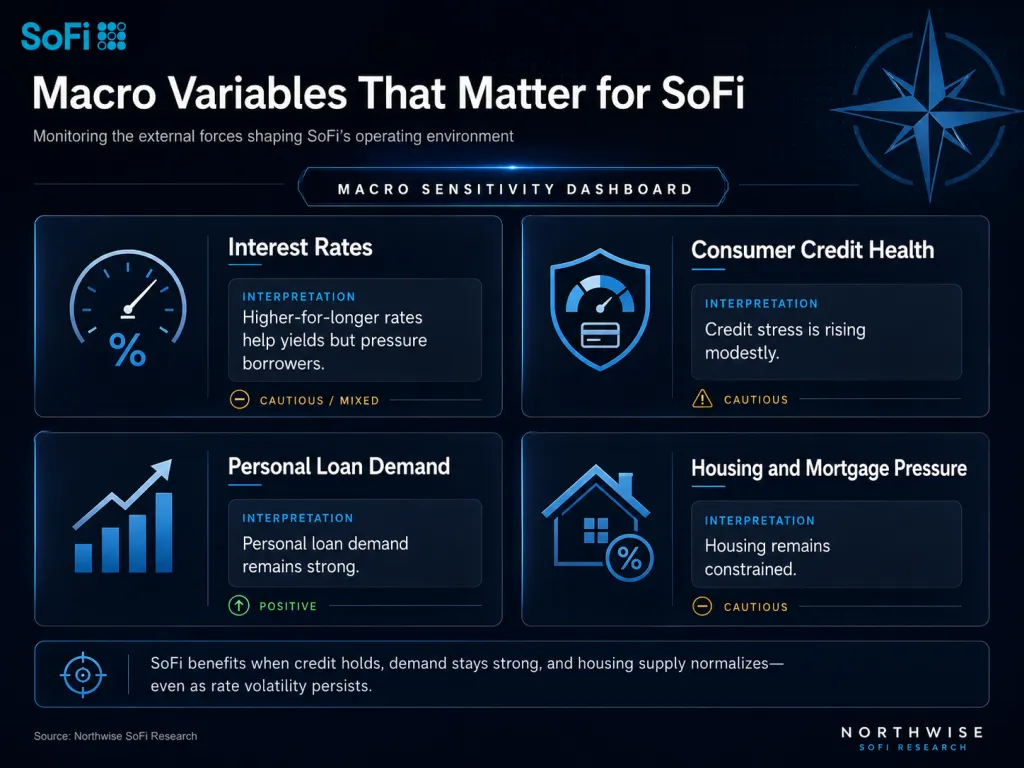
The Fed funds target sits around 3.5% to 3.75%, with inflation risks still elevated and rate cuts far from guaranteed. As of late May 2026, market expectations leaned toward higher-for-longer or even the possibility of hikes.
For SoFi, higher rates support asset yields while pressuring borrowers and raising deposit costs. The model does not assume a rapid return to the zero-rate environment that powered the prior fintech cycle, given that such an assumption would do too much of the work on its own.
12.2 Consumer Credit Health
NY Fed data showed household debt reaching $18.8T in Q4 2025, with total delinquencies worsening modestly and roughly 4.8% of loans in some form of trouble. Mortgage delinquencies rose but remained historically manageable, while student-loan distress was elevated due to reporting normalization.
Consumer credit risk is real and rising at the margin. SoFi's customer base appears stronger than the broad lower-income credit cohorts, which moderates the exposure, though it does not eliminate it.
12.3 Student Loan Repayment Normalization
Student-loan delinquency data is distorted by the end of pandemic-era protections, so broad-market distress does not map directly onto SoFi's refinanced borrowers. The normalization still affects borrower psychology and credit conditions across the system, which is why it stays in the macro picture even where its direct impact on SoFi is limited.
12.4 Credit Card Debt and Personal Loan Demand
TransUnion data showed unsecured personal loan balances reaching a record $276B in 2025, up 10%, with the number of consumers carrying such loans rising to 26.4M. Much of that demand came from credit card consolidation and cost-of-living pressure.
For SoFi, this cuts two ways. It supports demand for personal loans, which feeds origination growth. It also raises the importance of disciplined underwriting, given that demand driven by financial strain is precisely the kind that requires careful credit selection.
12.5 Housing and Mortgage Rate Pressure
Mortgage rates remain elevated, so home-loan growth is likely to stay lumpy. Home-equity products may help offset weakness in purchase mortgages, though housing is unlikely to be a swing factor in the model either way.
12.6 Why Macro Is a Constraint, Not a Thesis Breaker
Macro can slow originations, pressure credit quality, and compress the valuation multiple. What it does not do, on its own, is break the thesis, provided member growth, deposit growth, cross-sell, and profitability stay intact. The distinction is between a headwind that slows the compounding and a shock that ends it, and the current backdrop reads as the former.
13. Risk Framework
13.1 Credit Risk
Credit risk is the most important fundamental risk in the model. Unsecured personal loans are sensitive to unemployment and consumer stress, and credit can appear healthy until it turns. A genuine recession would test SoFi's underwriting in a way the recent benign environment has not.
13.2 Funding Cost Risk
Deposit beta could rise, and SoFi may need to keep APYs elevated to attract and retain deposits. That would pressure net interest margin and erode part of the funding advantage the bank charter is meant to provide.
13.3 Loan Sale and Private Credit Market Risk
Institutional demand for SoFi-originated loans can weaken, as the Q1 2026 platform volume softness showed. When it does, fee revenue becomes lumpy and a capital-light growth channel disappoints. This dependency keeps the bear case relevant even when the consumer business looks healthy.
13.4 Regulatory Risk
SoFi is a regulated bank, and digital assets and stablecoins add regulatory complexity on top of that. Changes such as credit card rate caps or broader consumer-finance regulation could reshape the economics of key products. Regulation is both a constraint on growth and a source of unpredictable, discrete risk.
13.5 Dilution and Stock-Based Compensation
Dilution remains a real drag on per-share value. The prior report assumed share count rising toward 1.48B by 2030, which may prove too punitive as profitability improves and issuance moderates. The refreshed model is less punitive but still conservative on this point, given that stock-based compensation continues to weigh on shareholders even as the business scales.
13.6 Technology Platform Underperformance
Galileo and Technisys could fail to reaccelerate. If Technology Platform growth stays weak, the market is likely to assign the segment little strategic value, which removes one of the bull case's supporting pillars.
13.7 Competition
SoFi competes across an unusually wide field. The list includes JPMorgan, Bank of America, Capital One, and American Express in banking and credit; Chime, Robinhood, Nubank, Block's Cash App, and PayPal's Venmo in consumer fintech; Coinbase in crypto; and Schwab and Fidelity in investing. Competing on that many fronts at once is itself a risk, given that SoFi rarely holds the dominant position in any single category.
13.8 Valuation Risk
Even with strong execution, the stock can underperform if purchased at too high a multiple. High-growth financials are sensitive to rate expectations and risk appetite, and a multiple that compresses can offset years of fundamental progress. This is the risk the action-zone framework later in the report is designed to manage.
13.9 What Would Break the Thesis
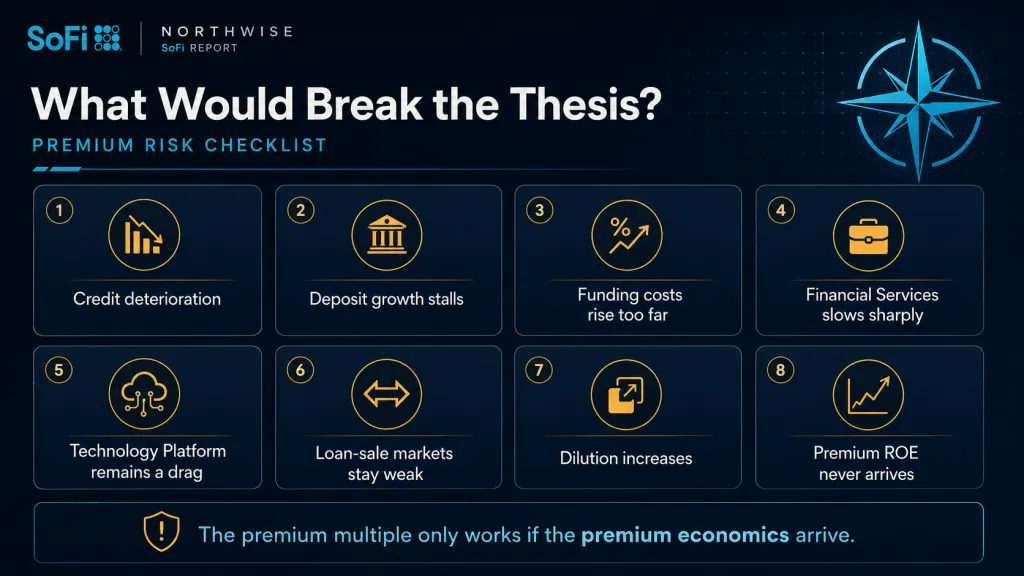
The thesis weakens materially if several of the following occur together. Member growth falls below roughly 20% without offsetting monetization. Credit losses rise well above expectations. Deposit growth stalls or becomes too expensive. Financial Services growth slows sharply. The Technology Platform continues to drag without strategic evidence. Loan-sale markets stay impaired for multiple quarters. Dilution accelerates. Regulators restrict key growth products. Or, most fundamentally, SoFi fails to earn premium return on equity over time.
The single most important failure mode is the last one. The premium-platform case ultimately rests on SoFi earning premium returns. Without that, the book-value re-rating does not arrive, and the company settles into a bank-like multiple regardless of how large it grows.
14. Why the Valuation Framework Must Be Hybrid
14.1 Why EPS Alone Is Incomplete
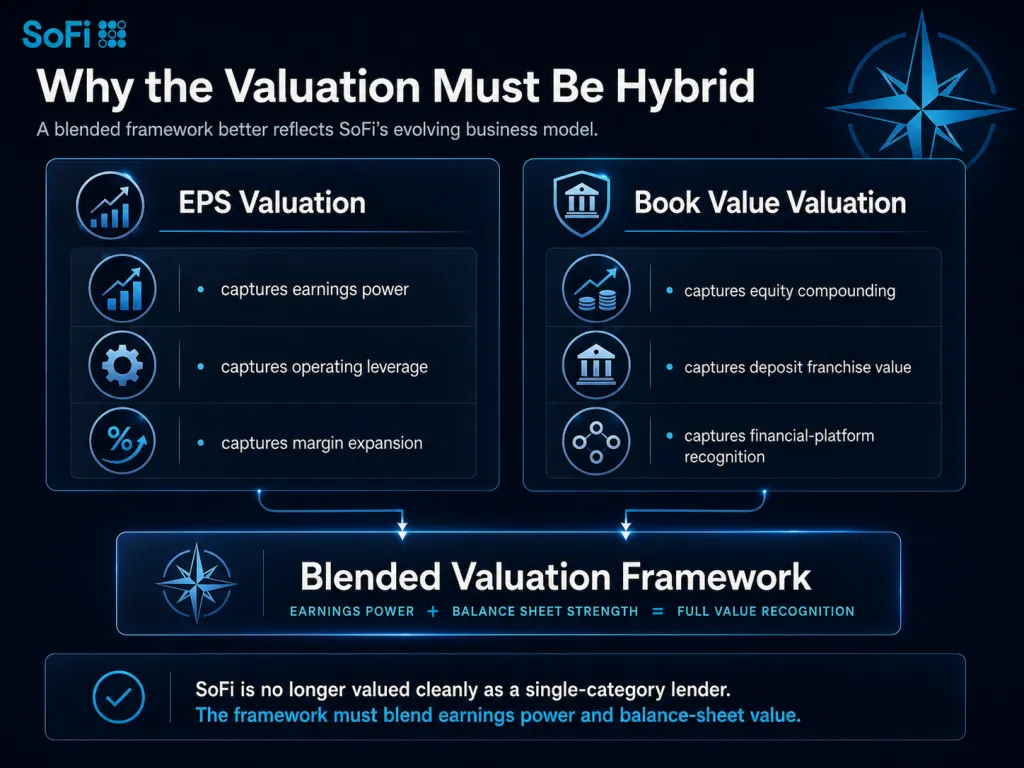
An EPS-and-multiple framework captures revenue growth, margins, share count, profitability, and operating leverage. It is the natural lens for a platform or software business, and it is where the prior report spent most of its effort.
What it under-captures is balance-sheet compounding, deposit franchise value, the valuation norms that govern financial institutions, book value growth, and return-on-equity-driven re-rating. For a company that builds equity value through retained earnings and a growing deposit-funded balance sheet, those omissions are not minor.
14.2 Why Book Value Alone Is Incomplete
A pure book-value framework captures equity capital, retained earnings, balance-sheet compounding, and the valuation base the market applies to financial institutions. It is the natural lens for a bank.
What it under-captures is fee-based revenue, Technology Platform optionality, product velocity, growth that occurs off the balance sheet, and the operating leverage building inside Financial Services. For a company that is partly a platform, a book-only lens misses the parts of the business that most justify a premium.
14.3 Why Price-to-Book Matters for Financial Platforms
For financial companies, price-to-book is often the central valuation metric, given that book value approximates the equity capital that supports earning assets. The multiple the market assigns to that book value encodes its judgment about quality.
A company trading at 1x book is being valued as a commodity financial or a low-return bank. A company trading at 3x to 5x book is being valued as a premium financial compounder, with the multiple reflecting higher return on equity, stronger growth, more durable franchise value, or higher-quality earnings. Where SoFi eventually sits on that range is the entire valuation debate compressed into one number.
14.4 Why Noto's Amex Comparison Deserves Serious Treatment
The American Express comparison is worth engaging rather than dismissing, and worth keeping out of the base case rather than accepting at face value. American Express earns a premium financial multiple due to a strong brand, a high-quality customer base, attractive returns, durable fee income, and deep customer relationships. SoFi is not American Express today.
The relevant question is one of direction rather than current state. If SoFi keeps compounding members, deposits, fee revenue, and return on equity, the market may begin applying a premium-financial-platform framework rather than a generic-bank framework. That migration is what the bull case represents. It is a credible upside scenario, not a starting assumption, which is why this report assigns the premium-recognition outcome to the bull case and holds the base case to a more defensible multiple.
14.5 How the Hybrid Model Reduces Valuation Error
The hybrid model guards against two opposite mistakes. The first is valuing SoFi only on EPS and ignoring the book value compounding that the deposit franchise and retained earnings are driving. The second is valuing SoFi only on book and ignoring the platform growth, fee revenue, and operating leverage that earnings multiples are built to capture.
By blending an earnings lens with a book-value lens, the model captures both the platform and the financial institution inside the same company. That is the reason a single-metric framework, of either kind, is likely to misprice SoFi, and the reason this refresh rebuilds the valuation architecture rather than the underlying business case.
The remainder of this report is reserved for Northwise premium members. What follows is the refreshed 2030 operating model, the scenario targets, the probability weighting, the present value math, the buy, hold, trim, and sell zones, and our current positioning and final judgment.
Northwise Premium
Choose how to continue with Northwise
Join Northwise Premium
Unlock the rest of this report, its complete valuation, the downloadable model, portfolios, and action framework.
Join Northwise PremiumCreate a Free Account
Continue across Free Northwise research, follow companies, save reports, and receive updates.
Create a Free Account
SoFi Stock Analysis: The Bank Behind the Everything App
Our SoFi stock analysis tests lending, deposits, credit losses and dilution across 162 scenarios, with a detailed valuation and editable investment model.

SOFI Q4 2025 Earnings
SOFI Q4 2025 earnings reports Friday premarket (Jan 30, 2026). We outline the key numbers, risks, and signals that matter heading into the call.
Sofi Stock Price Prediction
SoFi stock price prediction for 2026: why we believe this full-stack fintech could double as it builds a sticky, profitable platform. (Updated Dec 2025)
Northwise Portfolios
See how the research becomes real decisions
Reader discussion
Discuss the research
Premium access is required to join this report's discussion.
Join Northwise Premium
No comments yet. Start a thoughtful discussion.