
Sofi Stock Price Prediction
SoFi stock price prediction for 2026: why we believe this full-stack fintech could double as it builds a sticky, profitable platform. (Updated Dec 2025)
In this article
SoFi Stock Price Prediction 2026: Why We’re Long SOFI
Why this misunderstood fintech may be one of the best compounders of the decade
(Updated Dec 21, 2025)
Sofi Return Since Coverage Initiation (148.09%)
From Thesis to Execution: What’s Changed
Since April, the most important change is not narrative but confirmation. SoFi has continued to operate as a vertically integrated financial platform that is increasingly comfortable generating earnings while still expanding its ecosystem.
The company has now logged multiple quarters where profitability, member growth, and product expansion coexist. That combination was central to our earlier conviction and remains the clearest signal that SoFi is no longer in a prove it phase. It is in an execution phase.
This matters because the market often treats digital finance platforms as trade offs. Growth or discipline. Scale or earnings. SoFi is showing that this framing is outdated.
Member growth has remained productive, not cosmetic
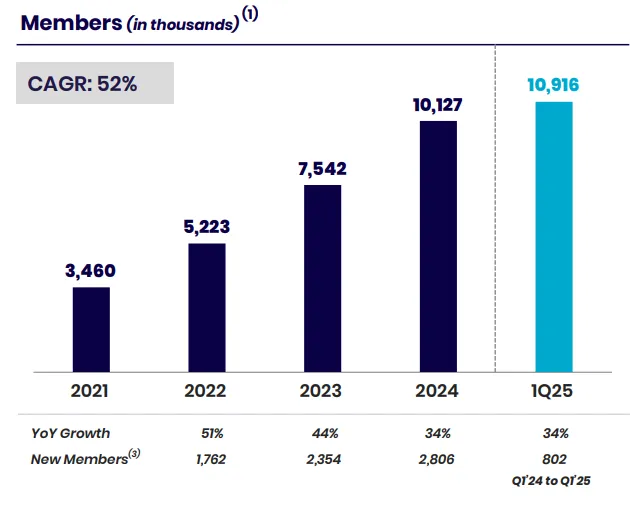
Since April, SoFi has continued to add members and products at a pace that reinforces the underlying flywheel rather than diluting it. Growth has not been driven by single product promotions or short term incentives. It has been driven by deeper engagement across banking, lending, investing, and financial services.
This is a subtle but important distinction. Product density is doing more work than headline user growth. That dynamic supports margin durability over time and reduces reliance on any single revenue line.
Financial Services is behaving like a core business, not an experiment
One of the quieter developments over the back half of 2025 has been the continued maturation of SoFi’s Financial Services segment. This part of the business increasingly functions as the connective tissue of the platform rather than a loss leader.
As attach rates improve and deposit based relationships deepen, the economics of this segment look less like a startup build out and more like a scalable operating unit. That shift strengthens the overall earnings profile and lowers long term dependency on credit cycle timing.
Technology Platform continues to validate the infrastructure thesis
Galileo and Technisys remain central to the long term margin argument, even if they rarely dominate headlines. Through 2025, the Technology Platform has continued to demonstrate relevance both internally and externally.
The strategic importance here is not just revenue contribution. It is optionality. Owning infrastructure gives SoFi leverage across cycles, partners, and regulatory regimes that pure front end fintechs do not have.
This remains one of the most underappreciated aspects of the SoFi story.
Crypto re-entry and SoFiUSD clarify strategic intent
Two developments since April deserve to be framed carefully rather than sensationally.
First, SoFi’s return to crypto functionality reflects a more stable regulatory posture following its bank charter transition. This is not a speculative pivot. It is a controlled re entry into an asset class that many members already expect as part of a modern financial platform.
Second, the introduction of SoFiUSD signals a broader ambition. Issuing a dollar denominated digital instrument through a regulated bank entity positions SoFi closer to financial infrastructure than consumer app experimentation.
Taken together, these moves reinforce a consistent theme. SoFi is building regulated rails first, then layering products on top.
What has not changed
Despite operational progress, market perception remains uneven. SoFi is still frequently discussed through short term lenses such as rate sensitivity, lending exposure, or sentiment around fintech multiples.
Those factors matter tactically. They do not define the long run structure of the business.
The gap between what the company is building and how it is framed remains the core opportunity and the core risk.
Where this analysis goes next
This update is not meant to replace our original April thesis. It is meant to re anchor it.
Our newest SoFi work extends this analysis into a full 2026 through 2030 operating and valuation framework, incorporating updated assumptions around earnings power, margin structure, and platform scale.
Readers looking for forward modeling, scenario analysis, and a clearer view of what success or failure looks like over the next several years should continue there.
The original April 2025 thesis remains below for historical context.
Betting on the Underdog (Our Original Thesis)
SoFi’s long road to credibility is why we’re paying attention now.
April 2025 has brought renewed volatility to markets. The reintroduction of trade tariffs under the Trump administration has rattled investor sentiment, particularly across interest-rate-sensitive sectors like fintech. But we believe dislocations like this are precisely when the most compelling opportunities arise.
SoFi Technologies (SOFI) is not a momentum story. It’s a business model story, a profitability story, a compounding story. And in a market increasingly driven by noise, SoFi’s signal is getting stronger. We believe this is a company being valued on yesterday’s assumptions despite building for tomorrow’s economy.
Full Stack, Full Vision
SoFi’s vertical integration isn’t just unique; it’s the core of its moat.
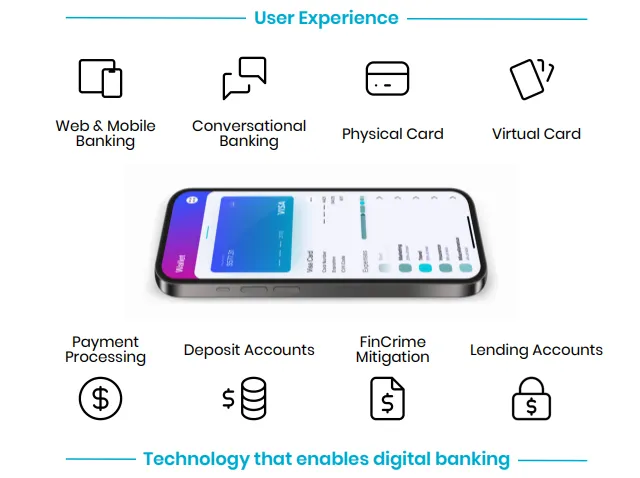
Most financial platforms rent the infrastructure they run on. SoFi owns it. The acquisitions of Galileo and Technisys were not headline-grabbing moves; they were foundational. These layers give SoFi end-to-end control over user experience, data flow, and, crucially, cost.
As highlighted by App Economy Insights, this vertical integration is rare in fintech and provides a structural margin advantage. It also makes SoFi more adaptable, enabling them to innovate internally rather than depend on third-party vendors.
This full-stack approach positions SoFi as more than a bank or a neobank. It is a technology platform with banking capabilities: a distinction that matters as the industry matures.
Product Ecosystem: Sticky by Design
The real strength lies in member engagement and cross-product adoption.
SoFi’s growth isn’t just about adding users. It’s about building deeper relationships with those users over time. In Q1 2025, SoFi reported 2.9 million cross-buying products, up 41% year-over-year. Just as telling, 44% of new members adopted more than one product, a strong signal of ecosystem depth.
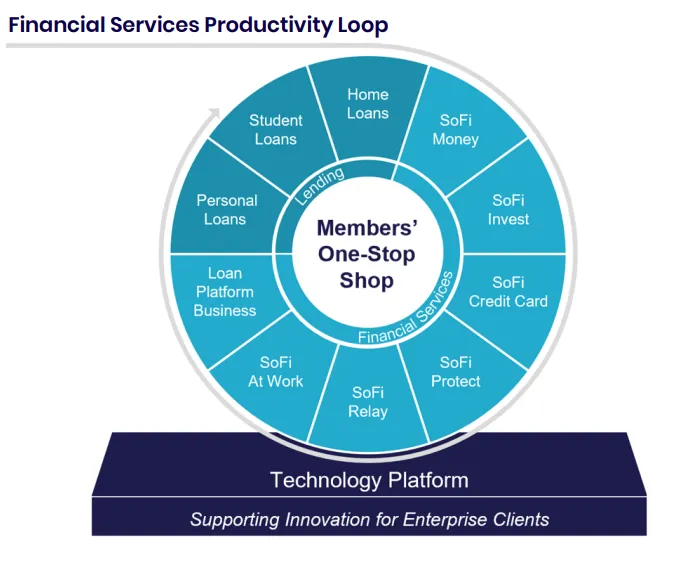
Financial services products, including SoFi Invest, SoFi Credit Card, and others, grew 65% year-over-year. These aren’t siloed offerings. They reinforce one another. A member who starts with a student loan refinance might later open a brokerage account, apply for a credit card, or move cash into a high-yield savings account—all inside the same platform.
That kind of stickiness compounds. It increases lifetime value, reduces churn, and builds a network of multi-product members who are harder to poach and more valuable to serve.
Betting on the Builder
Anthony Noto may be the most underappreciated operator in fintech.
Leadership matters, especially during periods of uncertainty. Anthony Noto’s track record, spanning Goldman Sachs, the NFL, and Twitter, demonstrates both operational depth and strategic clarity.

According to Quartr, Noto brings a bias for execution and long-term alignment rarely found in growth-stage fintechs. He is not trying to ride market cycles; he is building through them.
That mindset has shaped SoFi’s disciplined growth: from reaching GAAP profitability to strengthening core unit economics. In a sector where storytelling often overshadows strategy, Noto is focused on delivering durable results.
The Fundamentals Are Quietly Getting Loud
SoFi’s Q1 2025 results reinforce our thesis. The company reported:
- Net income of $71 million, its sixth consecutive profitable quarter
- Adjusted EBITDA of $144 million
- Revenue of $772 million, up 37% year-over-year
The lending business continues to anchor profitability, but the financial services and technology segments are scaling fast. These segments now account for 41% of total revenue, up from 33% a year ago.
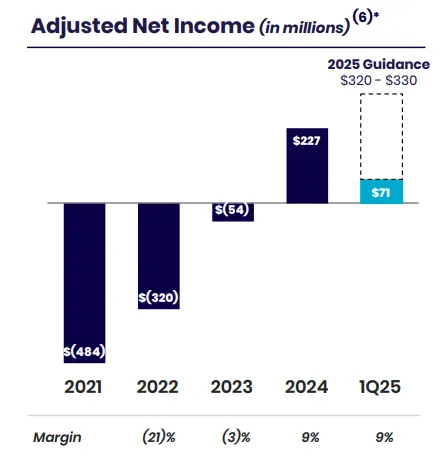
Meanwhile, SoFi’s efficiency ratio continues to improve, and management reaffirmed full-year profitability guidance. management reaffirmed full-year profitability guidance.
Macro Noise, Real Opportunity
Tariffs and volatility may accelerate rate cuts and benefit SoFi’s model.
April’s macro volatility stems largely from uncertainty surrounding trade and policy. But we believe this environment may ultimately prove constructive for SoFi. If the Federal Reserve moves to cut rates to stabilize markets, SoFi’s lending margins could improve, particularly in personal and student loan segments.
Furthermore, SoFi’s diversified model, spanning lending, financial services, and tech, offers greater resilience than single-line fintechs. The company is not dependent on any one revenue stream, which gives it optionality and staying power.
Our Price Outlook: 2025–2027
Why we believe SOFI could double from here.
At $10.73 per share, we view SoFi as undervalued relative to its long-term potential. Assuming continued profitability, modest multiple expansion, and earnings growth, a 2025 price target in the $18–$25 range appears reasonable.
This would place SoFi in line with peers on a price-to-earnings basis while still allowing for upside as investor perception improves. As fundamentals compound and macro headwinds stabilize, we believe the market will begin to reprice execution over skepticism.
Risk Factors & Red Flags
No position is without risk. Here’s what we’re watching:
- Regulatory uncertainty: As a bank and lender, SoFi remains exposed to evolving financial regulation.
- Credit quality: An economic slowdown could increase default risk, particularly in personal loans.
- Execution risk: Integrating Galileo and Technisys at scale requires continued investment and operational precision.
These risks are real. But we believe SoFi is better positioned than most of its peers to navigate them.
What This Position Represents
Why we’re willing to hold SoFi despite the noise.
This is not a short-term trade. It is a long-term position based on fundamental conviction. SoFi is building a differentiated platform with strong unit economics, operational leadership, and a proven flywheel effect across its ecosystem.
We expect volatility; but we also expect value to follow clarity. And few fintechs today offer the kind of structural clarity SoFi is demonstrating.

SoFi Stock Analysis: The Bank Behind the Everything App
Our SoFi stock analysis tests lending, deposits, credit losses and dilution across 162 scenarios, with a detailed valuation and editable investment model.

SoFi Stock Forecast 2030
SoFi stock forecast 2030 using book value, EPS, growth, margin, valuation, risk, and buy-zone analysis for long-term investors.

SOFI Q4 2025 Earnings
SOFI Q4 2025 earnings reports Friday premarket (Jan 30, 2026). We outline the key numbers, risks, and signals that matter heading into the call.
Northwise Portfolios
See how the research becomes real decisions
Reader discussion
Discuss the research
Create a Free account to join the discussion with a display name.
Create a Free Account
No comments yet. Start a thoughtful discussion.