
Robinhood Stock Forecast 2025

Robinhood stock forecast 2025: A long thesis on HOOD’s profitability, product strategy, and why we believe it's building financial infrastructure.
In this article
Robinhood Stock Forecast 2025: Why We’re Long HOOD
From meme stock to modern infrastructure, a thesis on trust, transformation, and the pipes of retail finance.
What If Robinhood Wasn’t the Joke?
The market loves to laugh at fallen names. Robinhood became a symbol of 2021 excess, meme-fueled speculation, and retail chaos.
It was the punchline of every meme stock story, the scapegoat for regulators and the media alike. But what if that narrative has expired, and what’s left underneath is one of the most important fintech platforms of the decade?
This isn’t a Robinhood stock forecast 2025 in the traditional sense. We’re not here to map a target price or bet on a quarter.
This is a thesis about infrastructure, user evolution, and positioning. It’s about how a brand that once captured Gen Z’s first trade might evolve into the place they manage their long-term wealth. And how the system that critics dismissed as unserious might quietly grow up alongside its users, quietly becoming one of the most important retail finance engines in the U.S.
Robinhood Premium Strategic Forecast 2030
- A complete 2030 strategic roadmap for Robinhood, showing how the company evolves from a trading app into a global financial operating system with banking, advisory, RIA custody, lending, and cross-border settlement infrastructure.
- Full valuation framework with core and tokenization-adjusted models, including revenue, EPS, and price targets across Bear, Base, Bull, and High-Tokenization scenarios, supported by institutional-grade charts and scenario analysis.
- A detailed breakdown of the global tokenization rail, Bitstamp integration, and EU settlement pathway, outlining the structural optionality that could redefine Robinhood’s long-term earnings power and create asymmetric upside for investors.
From Flash to Friction: The Arc of Public Perception
Robinhood’s journey since its IPO has been volatile. It experienced euphoric highs, meme-driven rallies, and a wave of public skepticism. Initially seen as a poster child for retail speculation, it later became a target for regulatory and media scrutiny.
As sentiment soured, so did the stock. From its initial $38 IPO price to trading under $10, it became a cautionary tale in record time.
But through the noise, Robinhood kept building. While many dismissed it as a flash in the pan, Robinhood shifted course, from attention-grabbing trades to embedded, intentional infrastructure. The narrative broke. The platform didn’t. And that divergence matters.
Profitability and the Numbers That Matter
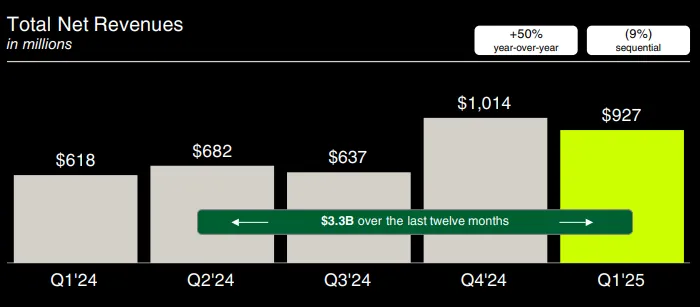
Robinhood followed up its first full year of profitability in 2024 with a breakout Q1 2025 earnings report. Key highlights included:
- Net income of $336 million, up 114% year over year
- Total net revenue of $927 million, up 50% year over year
- Monthly active users at 14.4 million
- Assets under custody of $221 billion
- Net deposits of $18.0 billion, with a 37% annualized growth rate
Segment-level revenue performance was also strong:
- Options trading revenue: $240 million (up 56%)
- Equity trading revenue: $56 million (up 44%)
- Cryptocurrency revenue: $252 million (more than doubled and will likely continue to grow at a rapid pace due to their acquisition of Bitstamp)
This is no longer a story of early-stage speculation. It’s a case of operational maturity, consistent execution, and infrastructure taking shape underneath a misunderstood brand.
HOOD is no longer a speculative play. It’s a business with margin, cash, and momentum. And importantly, it’s demonstrating discipline, managing cost while continuing to ship.
Product Momentum: The Real Thesis
Robinhood isn’t being priced as an innovation engine, but that’s exactly what it’s becoming.
Over the past year, the platform has expanded far beyond trading. Robinhood is methodically building a full-stack financial platform that aligns with how the next generation earns, saves, and invests.
Cortex + Strategies
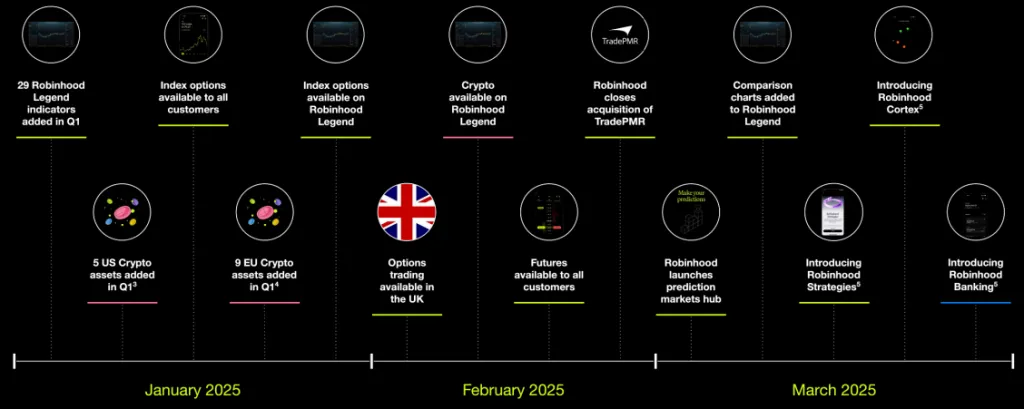
With the launch of Cortex, Robinhood introduced a custom recommendation engine that builds long-term investing plans based on user goals, risk tolerance, and preferences. What makes Cortex significant isn’t just automation; it’s AI.
The system adapts over time to user behavior, helping investors refine their allocation without overcomplication. It’s not simply suggesting strategies; it’s learning what kind of investor someone is.
Their new “Strategies” feature includes pre-built portfolios aligned with themes, income needs, or sector views. These tools cater to users who want to invest intentionally but don’t want to become full-time portfolio managers.
This is Robinhood moving toward advisory territory, without the legacy costs or friction. It’s a step toward long-term asset management, and potentially a wedge into higher AUC per user.
Robinhood Banking
With 5% APY for Gold members, paycheck deposits, debit access, and early direct deposit, Robinhood has quietly entered the neobank arena.
The company is also layering in vertical integration with its newly launched Robinhood Gold Card, a credit product offering 3% cash back across all categories.
These offerings reposition Robinhood as not just a brokerage but a central hub for day-to-day financial activity. They are now where money enters the system, not just where it’s deployed.
Futures Access
Their launch of 24/6 futures trading gives retail users simplified access to macro instruments, a key step toward bridging speculative interest and global asset exposure.
Engagement is already strong, building a new moat in an area few traditional brokerages serve well. Alongside record-breaking options engagement, including $240 million in Q1 revenue from options trading, Robinhood is becoming the go-to retail platform for both equity and macro tools.
Prediction Markets Hub
Robinhood’s new Predictions feature is a portal to bets on sports, politics, and economic outcomes. While light in revenue impact, it’s deeply revealing in terms of user engagement.
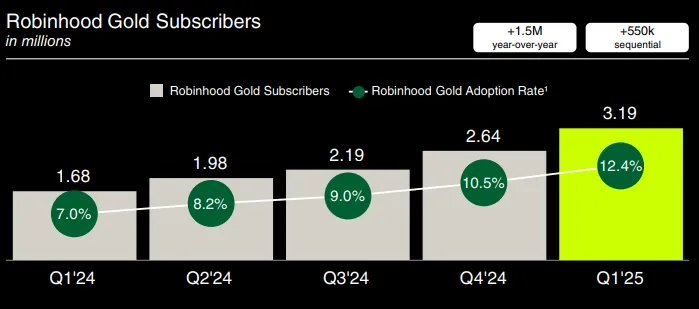
The platform is thinking about time on platform, behavioral finance, and sentiment-transforming engagement into stickiness. With Gold subscriptions now surpassing 3.2 million members (up 90% YoY), Robinhood is clearly succeeding in building durable relationships that extend beyond trading.
Robinhood’s product strategy is no longer reactive. It’s structured, paced, and diversified. And the market isn’t fully pricing that in.
Competition and What Analysts Still Miss
Robinhood operates in a competitive space that includes not only legacy players like Fidelity, Schwab, and Vanguard, but increasingly aggressive moves by giants like JPMorgan.
In 2025, JPMorgan introduced major upgrades to its self-directed investing tools, adding fractional shares, advanced screeners, and personalized insights aimed squarely at retail users. More importantly, its Kinexys blockchain platform is positioning the bank to challenge younger platforms on both accessibility and infrastructure.
These moves signal that Robinhood is no longer competing just with other apps. It’s being taken seriously by the institutions it once aimed to disrupt.
Still, trust remains the core battleground. While traditional firms are trusted by retirees, Robinhood resonates with a younger cohort that values speed, simplicity, and seamless digital experiences. Their financial behavior is shaped by interface and convenience, not advisors or branches.
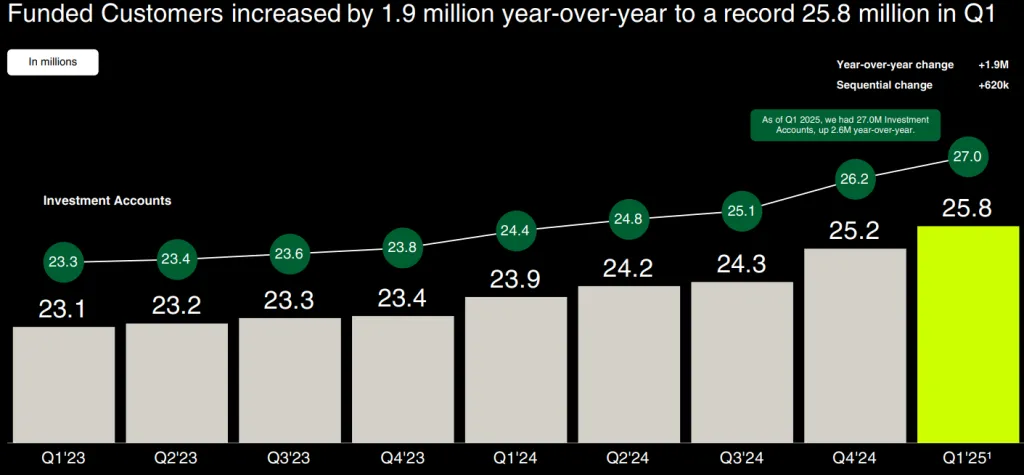
Their UX isn’t a bonus; it’s the moat. Their user base isn’t a weakness; it’s the most important financial cohort in the world over the next two decades. That user base is maturing. Their incomes are rising. Their deposits are growing. And their financial complexity is increasing.
Our Lens: What We’re Actually Betting On
We’re not betting on Q2 earnings or option volumes. We’re betting on a generation growing into their financial lives, and Robinhood growing with them.
If their users’ deposits grow, their income increases, and their complexity rises, Robinhood becomes a default operating system for modern wealth-building.
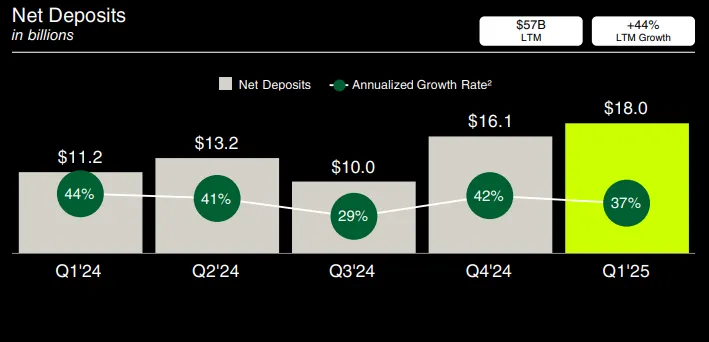
This is not just a company riding retail attention. It’s a platform that is evolving alongside the behavior, psychology, and needs of its cohort.
That psychology matters. Finance isn’t just about numbers. It’s about trust, access, and experience. Robinhood is playing that game, and doing it well.
The platform wins not by encouraging more trades, but by embedding itself into more parts of a user’s financial life.
Its growing ecosystem is designed to deepen engagement and meet users at every financial touchpoint, from brokerage accounts to credit rewards, from recurring deposits to macro exposure.
What Could Undermine the Thesis
This isn’t a forever hold, beyond our stock forecast for 2025. Our conviction is grounded in structure, product velocity, and user behavior, but it has limits.
If Robinhood’s product cadence stalls, if it starts reacting instead of innovating, or if its core users begin graduating to platforms that serve them better, we’d take a harder look.
We’re also watching the regulatory environment closely. If Robinhood fails to evolve its revenue model in response to changing rules-especially around payment for order flow or futures-that would signal a weakening thesis.
And finally, trust: not the brand trust of headlines or Reddit threads, but the behavioral trust built through product experience. If that breaks, the moat does too.
We believe platforms must earn their place, and re-earn it continuously. Robinhood is doing that now. But our conviction only stays intact if that continues.
What’s Changed Since We First Published
When we first published this thesis in April 2025, Robinhood was trading around $42. As of this writing, it’s up over 58%.
Q1 2025 earnings reinforced the thesis: accelerating profitability, expanding user growth, and consistent execution across product verticals. While the stock has rallied sharply from its lows, we believe this is only the early innings of a broader structural shift.
The platform is still misunderstood by many, and the narrative is only just starting to catch up to the fundamentals.
Robinhood’s Blockchain Expansion in Europe
Robinhood is extending its reach beyond U.S. borders through blockchain-based innovation. In early 2025, the company announced plans to offer tokenized U.S. equities to European customers using blockchain networks like Solana and Arbitrum.
This initiative reflects a strategic shift from speculative crypto exposure toward blockchain as financial infrastructure. By leveraging decentralized networks, Robinhood aims to lower settlement friction, improve access, and extend its ecosystem to a global audience.
While still in early stages, the move reinforces Robinhood’s willingness to innovate beyond domestic borders and legacy rails. It also opens a new chapter in the company’s ambition to become a foundational layer of modern finance.
Owning the Rails
We’re not here to defend Robinhood’s past. We’re here to underwrite its future.
Robinhood may not be in favor with the market today. But the infrastructure is there, the product roadmap is unfolding, and the user base is expanding in both size and sophistication.
This isn’t a short-term story. It’s a structurally misunderstood platform that’s being priced like a fad, despite growing into a foundational fintech engine.
Robinhood’s long-term success isn’t tied to a single feature; it’s tied to a layered ecosystem that meets users where they are and grows with them. From investing to banking, futures to sentiment-based predictions, it is creating a financial stack for the modern participant.
Where We See This Going
The business model is now visibly changing. Transactional revenues are being supported-and eventually may be eclipsed-by banking, advisory-lite tools, and recurring user behavior. It’s not just about how many users log in. It’s about how many touchpoints they trust.
We’re watching whether Robinhood continues to innovate and expand its platform to meet the growing needs of its users. That includes building meaningful AI tools, not just marketing them. Cortex is an early example. The question is whether it evolves into a real driver of utility.
Ultimately, Robinhood is competing not on legacy, but on relevance. And in a financial world where so much still caters to an older paradigm, they’re one of the few building forward.
That mispricing is why we hold it.

HOOD Stock Forecast: Can Robinhood Keep the Wealth?
Our Robinhood (HOOD) stock forecast examines earnings, customer wealth, valuation and growth through 2030. Read the report and explore the complete workbook.

Robinhood Strategic Forecast 2030
HOOD stock forecast 2030 analyzing Robinhood’s shift into tokenization, banking, and advisory to capture the generational wealth transfer.

How Does Robinhood Make Money?
How Robinhood makes money: Q2 2026 revenue categories, trading mix, interest sensitivity, Gold, advisory and bank-partner services.
Northwise Portfolios
See how the research becomes real decisions
Reader discussion
Discuss the research
Create a Free account to join the discussion with a display name.
Create a Free Account
No comments yet. Start a thoughtful discussion.