
Robinhood Strategic Forecast 2030

HOOD stock forecast 2030 analyzing Robinhood’s shift into tokenization, banking, and advisory to capture the generational wealth transfer.
In this article
Hood Stock Forecast 2030 analyzing Robinhood’s transformation from a trading-first application into a broader financial platform built around deposits, advisory assets, global liquidity infrastructure, and emerging digital settlement rails.
1. Executive Summary
Robinhood has entered a different phase of its corporate development. The company that originally disrupted retail brokerage by eliminating commissions is now expanding across a much broader surface of financial services. Brokerage and trading remain central to customer engagement, but the platform is increasingly built around deposits, advisory assets, credit products, subscription revenue, and global exchange infrastructure. The result is a business that resembles a unified financial platform rather than a narrow trading application.
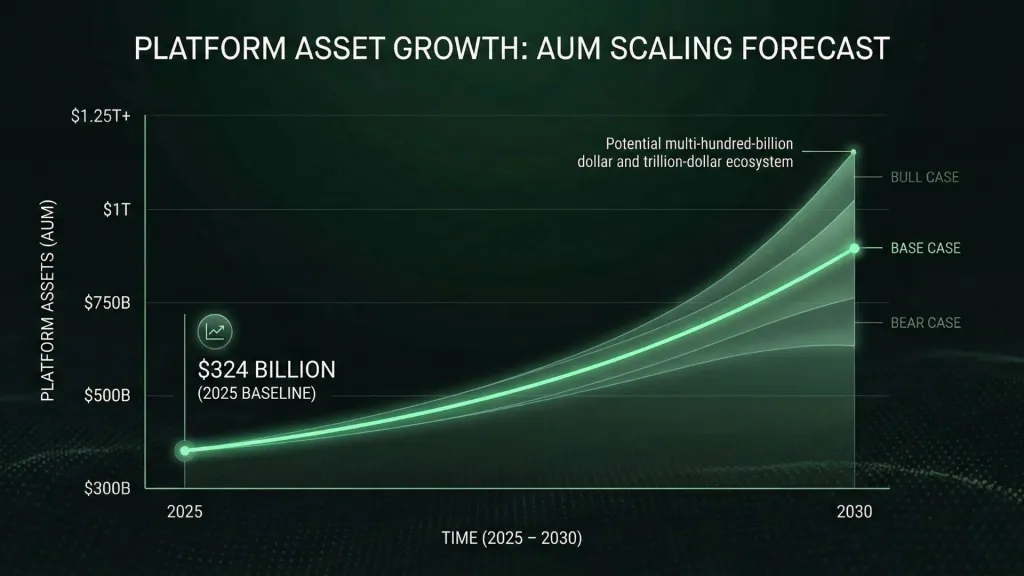
The company’s financial results during 2025 reinforced this transition. Robinhood generated record annual revenue of $4.5 billion and diluted earnings per share of $2.05 while continuing to expand platform assets, deposits, and subscription penetration. Platform assets reached $324 billion, net deposits totaled $68 billion for the year, and Robinhood Gold subscribers grew to 4.2 million. These figures reflect more than cyclical trading strength. They indicate deeper customer relationships as users increasingly manage a larger share of their financial lives within the platform.
Product expansion has accelerated alongside this financial growth. Robinhood has widened its ecosystem across retirement accounts, advisory services, banking features, credit products, premium cards, prediction markets, and global crypto infrastructure. The addition of custodial accounts, trust accounts, family account tools, and expanded advisory capabilities further shifts the platform toward long-duration financial relationships rather than isolated trading activity.
At the same time, the company has begun establishing the infrastructure that could support a broader role in global financial markets. The Bitstamp acquisition provides international exchange and custody capabilities. Prediction markets are evolving into a distinct engagement engine with billions of event contracts traded. Tokenized equities are expanding across European markets. New ventures around exchange infrastructure and private market access suggest management intends to own more of the financial stack rather than remain limited to brokerage distribution.
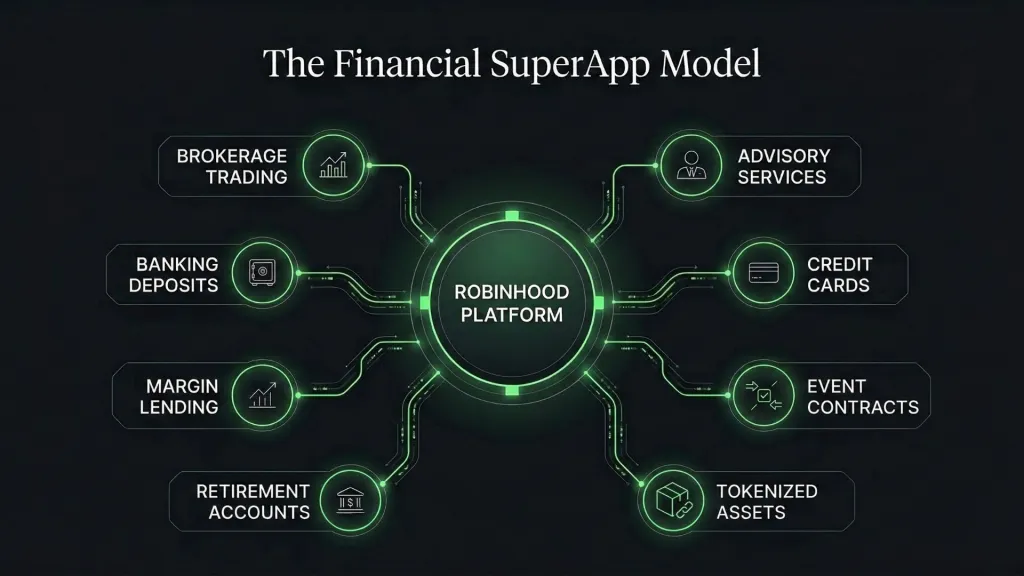
Taken together, these developments indicate that Robinhood is attempting to build what management describes as a financial superapp. The long-term vision is a unified system where customers can trade, save, borrow, invest for retirement, manage family accounts, access advisory portfolios, participate in global digital markets, and interact with emerging financial infrastructure through a single platform.
Understanding whether this transformation succeeds is central to evaluating Robinhood’s long-term investment potential.
1.1 The Core Thesis
The central thesis of this report is that Robinhood is evolving from a transaction-driven brokerage platform into a multi-layer financial ecosystem capable of compounding revenue and earnings across several independent engines.
Historically, the company’s revenue profile was closely tied to trading activity, particularly options and crypto markets. While those categories remain important, the business is increasingly supported by more durable revenue streams such as net interest income, advisory assets, subscription products, and credit services. These categories behave differently from transaction revenue because they grow alongside customer deposits and long-term financial activity.
The expansion of Robinhood Gold illustrates this shift. Subscription penetration has increased materially, creating a recurring revenue layer that sits on top of the core brokerage experience. Advisory products such as Robinhood Strategies are beginning to capture managed assets that compound over time. Retirement accounts introduce long-duration capital that tends to remain within a platform for decades rather than months. Banking and credit features further extend the financial relationship between the company and its customers.
Trading still plays a critical role within this ecosystem. Active trading drives engagement, increases deposits, and accelerates product adoption across the broader platform. However, the long-term economics of the company increasingly depend on the depth of each customer relationship rather than the volume of individual trades.
If this model continues to develop successfully, Robinhood may gradually resemble a unified financial platform built around customer lifetime value rather than a brokerage dependent on trading cycles.
1.2 What Has Changed Since the Prior Report
Several developments since the prior version of this report materially strengthen the long-term thesis.
First, the company delivered its strongest financial year to date. Revenue reached $4.5 billion in 2025, representing substantial year-over-year growth. Platform assets climbed to $324 billion and net deposits reached $68 billion. The scale and persistence of deposit inflows suggest that Robinhood is capturing a growing share of customer assets rather than simply facilitating trading activity.
Second, subscription adoption accelerated meaningfully. Robinhood Gold subscribers reached 4.2 million, reinforcing the company’s ability to monetize its user base beyond transaction fees. Premium card products and expanded membership benefits further increase the role of subscriptions within the platform’s revenue structure.
Third, the advisory and retirement segments expanded rapidly. Retirement assets under custody more than doubled year over year to approximately $26.5 billion. Robinhood Strategies has continued to scale its managed asset base and funded customer count. These developments suggest that Robinhood is beginning to capture a share of long-term wealth accumulation rather than only transactional trading behavior.
Fourth, prediction markets emerged as a major engagement category. Billions of event contracts were traded during 2025, and the company has begun building dedicated infrastructure through its Rothera venture and the acquisition of MIAXdx. These developments signal that prediction markets may evolve into a distinct revenue category within the broader platform.
Fifth, global infrastructure initiatives expanded. Bitstamp’s institutional trading volumes have grown significantly since the acquisition closed in mid-2025. Robinhood has also expanded its stock token offerings in Europe and begun pursuing acquisitions that support international market entry, including transactions aimed at expanding its presence in Asia.
Finally, product expansion across family finance introduced a new strategic dimension. Custodial accounts, trust accounts, and family portfolio tools position Robinhood to capture financial activity across multiple generations rather than individual accounts alone. These features directly connect the platform’s growth strategy with the long-term transfer of wealth occurring over the coming decades.
Collectively, these developments reinforce the argument that Robinhood’s business model is expanding across several independent financial categories rather than remaining concentrated in trading activity.
1.3 Why the Market May Still Be Misclassifying Robinhood
Despite these developments, the market continues to evaluate Robinhood primarily as a cyclical retail brokerage. This perception has historical roots. The company’s early growth was strongly associated with retail trading surges, meme stock volatility, and cryptocurrency cycles. Those dynamics created significant revenue fluctuations that reinforced the perception that Robinhood’s earnings were inherently unstable.
However, the composition of the company’s revenue and customer activity is gradually changing. Net interest income has become a substantial contributor as deposits and margin balances expand. Subscription products are adding recurring revenue. Advisory and retirement assets introduce longer duration capital flows. Banking features increase deposit stickiness. These developments shift the company toward a more balanced revenue mix.
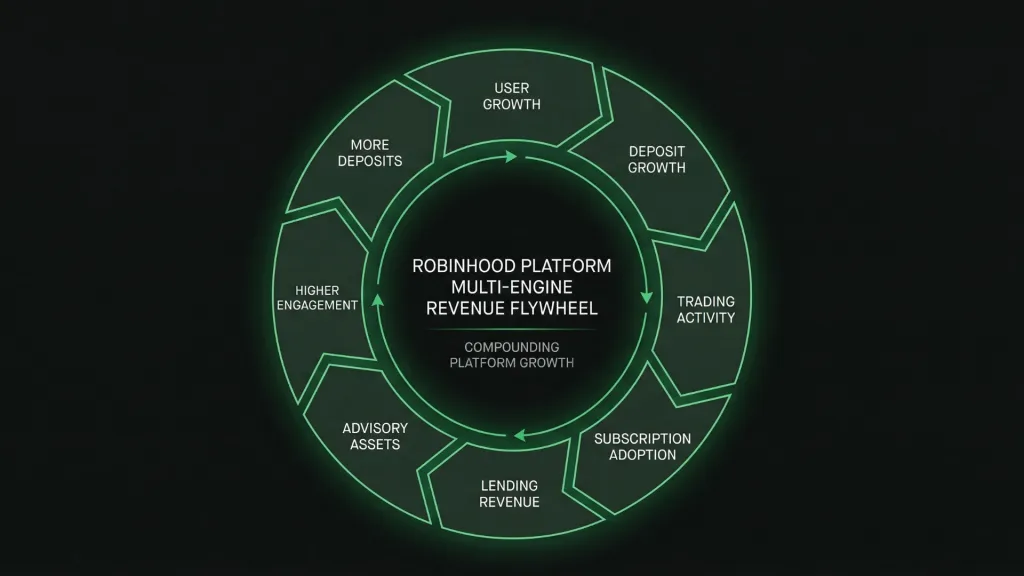
The market’s classification problem may therefore stem from a lag between how Robinhood historically generated revenue and how the platform is now evolving. Investors who continue to view the company exclusively through the lens of trading cycles may underestimate the long-term economic potential of the broader financial ecosystem the company is building.
At the same time, it is important not to overstate the transition. Trading activity still represents a meaningful portion of revenue, and the company remains exposed to market volatility and retail participation cycles. The key question is not whether Robinhood has eliminated this cyclicality, but whether the growing share of recurring and asset-based revenue can gradually reduce its influence on long-term earnings.
1.4 The Central Question for 2030
The central question facing investors is whether Robinhood can successfully transition from a trading-driven fintech platform into a durable financial ecosystem with multiple compounding revenue engines.
If the platform continues capturing deposits, expanding advisory assets, scaling subscription products, and integrating global exchange infrastructure, its long-term earnings potential could be substantially larger than what traditional brokerage comparisons imply. Under this scenario, Robinhood may evolve into a platform that combines brokerage services, banking functionality, advisory portfolios, digital asset markets, and emerging financial infrastructure within a single unified system.
Alternatively, the transition could stall if trading activity remains the dominant driver of revenue and the newer product categories fail to reach meaningful scale. In that outcome, the company would likely remain a highly successful trading platform but would struggle to achieve the valuation characteristics typically associated with broader financial institutions.
The purpose of this report is to evaluate which of these paths appears more probable based on current evidence, financial performance, product expansion, and the structural trends shaping the financial industry over the remainder of the decade.
Table of Contents
Executive Summary
1.1 The Core Thesis
1.2 What Has Changed Since the Prior Report
1.3 Why the Market May Still Be Misclassifying Robinhood
1.4 The Central Question for 2030
Company Overview
2.1 From Retail Broker to Financial Platform
2.2 Revenue Structure and Business Segments
2.3 Customer Base and Platform Engagement
2.4 Competitive Landscape
2.5 Strategic Position in the Global Fintech Ecosystem
Leadership and Strategic Direction
3.1 Vlad Tenev’s Product Philosophy
3.2 The Financial SuperApp Vision
3.3 Capital Allocation and Share Repurchases
3.4 Cultural DNA and Product Velocity
3.5 What Leadership Behavior Signals About the Next Five Years
The Robinhood Product Ecosystem
4.1 Brokerage and Trading Core
4.2 Robinhood Gold and the Premium Monetization Layer
4.3 Banking, Cash Management, and Deposit Growth
4.4 Margin Lending and Credit Expansion
4.5 Retirement Accounts and Long Duration Assets
4.6 Robinhood Strategies and Digital Advisory
4.7 Family Finance: Custodial and Trust Accounts
4.8 Premium Consumer Finance: Gold Card and Platinum Card
4.9 Cortex and the AI Layer
4.10 Portfolio Overview and the Unified Financial Interface
Transformation Into a Financial SuperApp
5.1 Why Robinhood Is No Longer Just a Trading App
5.2 The Shift Toward Multi Engine Monetization
5.3 Expanding Wallet Share Across Customer Financial Lives
5.4 Demographics and the Great Wealth Transfer
5.5 Household Finance and Intergenerational Accounts
5.6 Product Density and Lifetime Value Expansion
5.7 Operating Leverage and Platform Economics
Core Growth Engines
6.1 Net Deposits and Platform Asset Growth
6.2 Robinhood Gold Subscriber Expansion
6.3 Retirement and Advisory Asset Growth
6.4 Banking Deposits and Cash Sweep Economics
6.5 Margin Expansion and Lending Revenue
6.6 Equities, Options, and Short Selling Activity
6.7 Crypto Trading and Global Liquidity
6.8 Prediction Markets and Event Contracts
6.9 International Expansion and Product Localization
6.10 Tokenized Assets and Global Settlement Infrastructure
6.11 Private Market Access and Robinhood Ventures
Global Infrastructure and Strategic Optionality
7.1 Bitstamp and Global Liquidity Infrastructure
7.2 Institutional Crypto Markets and Cross Border Settlement
7.3 Europe and the Expansion of Stock Tokens
7.4 Indonesia and Asian Market Entry
7.5 Rothera, MIAXdx, and the Exchange Stack
7.6 Owning More of the Financial Infrastructure Layer
7.7 What a Global Robinhood Could Look Like by 2030
Financial Performance and Current Baseline
8.1 2025 Financial Performance
8.2 Q4 2025 Operating Snapshot
8.3 January 2026 Early Operating Data
8.4 Revenue Mix and Business Quality
8.5 Margin Profile and Operating Expense Structure
8.6 Profitability Inflection and Earnings Power
8.7 What the Updated Baseline Means for Future Growth
Risks and Structural Constraints
9.1 Trading Cyclicality and Retail Activity Risk
9.2 Regulatory and Legal Exposure
9.3 Execution Risk Across Rapid Product Expansion
9.4 Credit Risk and Fraud Loss Exposure
9.5 Competitive Pressure Across Financial Services
9.6 International Expansion Risk
9.7 Tokenization and Prediction Market Regulatory Risk
9.8 Valuation Risk and Multiple Compression
9.9 Key 12 Month Catalysts
Financial Forecasting and Scenario Modeling
10.1 Forecasting Methodology
10.2 Core Revenue Drivers Through 2030
10.3 Bear Case Assumptions
10.4 Base Case Assumptions
10.5 Bull Case Assumptions
10.6 Margin Expansion and EPS Forecast
10.7 Capital Allocation and Share Count Impact
10.8 Valuation Framework
10.9 Probability Weighted Price Target
Valuation and Present Value Analysis
11.1 Valuation Framework
11.2 2030 Price Targets Across Scenarios
11.3 Discounted Present Value Calculations
11.4 Buy Range
11.5 Hold Range
11.6 Trim Range
11.7 Sell Range
Portfolio Allocation and Positioning
12.1 Where Robinhood Fits in the Northwise Portfolio
12.2 Role Within a Fintech and Financial Infrastructure Allocation
12.3 Position Sizing Philosophy
12.4 Portfolio Risk Considerations
Final Assessment
13.1 The Long Term Investment Case
13.2 What Must Go Right
13.3 What Would Break the Thesis
13.4 The 2030 Outlook
13.5 Summary Judgment
2. Company Overview
Robinhood today sits in a very different position than the company many investors still picture. What began as a mobile brokerage designed to remove trading commissions has expanded into a financial platform spanning deposits, advisory assets, lending products, subscriptions, global crypto infrastructure, and new financial markets such as prediction contracts. The architecture resembles a widening ecosystem rather than a single service.
The scale of that ecosystem is now visible in the company’s operating data. Robinhood ended 2025 with 27.0 million funded customers and 28.4 million investment accounts. Platform assets reached $324 billion, representing one of the largest pools of retail-controlled capital within a single digital platform. Net deposits totaled $68.1 billion during the year, an amount equal to more than one fifth of total platform assets added within twelve months.
These figures illustrate a platform that increasingly behaves like a financial hub rather than a trading interface. Deposits arrive from payroll, asset transfers, and retirement contributions. Trading activity continues to generate engagement. Advisory and subscription products convert that engagement into recurring revenue. Credit and margin lending extend the financial relationship even further.
A useful way to think about the platform is as a financial city rather than a single building. Brokerage remains the central plaza where activity gathers, though new districts continue to emerge around banking, advisory, and global infrastructure. Each additional layer attracts more activity while reinforcing the value of the whole system.
2.1 From Retail Broker to Financial Platform
Robinhood’s early success came from redesigning brokerage around simplicity and accessibility. By eliminating trading commissions and building a mobile-first experience, the company lowered the barrier to entry for millions of new investors.
The company’s growth during the past several years reflects a broader evolution beyond that initial mission. Customers who once used the application primarily for trading increasingly keep savings, retirement accounts, and long-term investments within the platform.
Platform expansion can be seen clearly in the growth of key operating metrics.
Table 2.1 Robinhood Platform Scale
Metric | Latest Reported |
|---|---|
Funded Customers | 27.0 million |
Investment Accounts | 28.4 million |
Platform Assets | $324 billion |
Net Deposits (2025) | $68.1 billion |
Net Deposits (Q4 2025) | $15.9 billion |
Average Revenue Per User | $191 |
Deposits and assets matter more than user counts alone. When a platform consistently attracts new assets, it signals increasing trust and deeper financial relationships. Net deposits of $68 billion during 2025 represent one of the strongest indicators of Robinhood’s expanding role in customer financial lives.
The addition of retirement accounts, advisory services, credit products, and premium memberships further shifts the platform toward a broader financial model. Customers often begin their relationship through trading, though many gradually migrate toward saving, investing, and long-term planning tools.
This progression mirrors the natural lifecycle of personal finance. Younger investors initially focus on trading and experimentation. As income grows, attention turns toward retirement, credit management, and wealth accumulation. Robinhood’s expanding product ecosystem increasingly supports that lifecycle inside a single platform.
2.2 Revenue Structure and Business Segments
Robinhood’s revenue now comes from several major categories that together create a diversified financial model.
Transaction-based revenue remains a significant contributor. Equities, options, futures, crypto trading, and prediction markets all generate transaction activity across the platform. Options trading in particular continues to represent one of the most active segments.
At the same time, other revenue streams have expanded rapidly.
Table 2.2 Robinhood Revenue Drivers
Revenue Source | Key Indicators |
|---|---|
Transaction Revenue | $776M in Q4 2025 |
Net Interest Revenue | $411M in Q4 2025 |
Other Revenue | $96M in Q4 2025 |
Annual Revenue (2025) | $4.5B |
Net Income (2025) | $1.9B |
Diluted EPS (2025) | $2.05 |
Net interest income has become particularly important as deposits, margin balances, and securities lending activity expand. Interest revenue grew 39 percent year over year in the fourth quarter of 2025, reflecting higher balances and increasing financial activity across the platform.
Subscription revenue also contributes to the evolving revenue structure. Robinhood Gold membership reached 4.2 million subscribers during 2025, representing one of the fastest growing segments of the business. Subscription models introduce a recurring revenue component that behaves differently from trading income, offering greater stability across market cycles.
Advisory and retirement products represent another emerging segment. Robinhood Strategies manages approximately $1.5 billion in assets across more than 250 thousand funded customers. Retirement accounts now hold $26.5 billion in assets under custody, demonstrating how the platform is capturing long-term investment capital alongside trading activity.
These different revenue streams form a layered economic structure. Transaction activity generates engagement, deposits create interest income, subscriptions add recurring revenue, and advisory services capture long-duration assets. Together they resemble the diversified economics of a financial platform rather than a single-service brokerage.
2.3 Customer Base and Platform Engagement
The scale of Robinhood’s customer base remains one of the company’s defining strengths. Millions of investors entered financial markets for the first time through the platform, particularly younger investors who previously faced high barriers to participation.
Today the customer base has matured alongside the platform itself. Many early users now manage savings, retirement contributions, and long-term investments through the same application where they once executed their first trades.
Table 2.3 Engagement and Activity Metrics
Activity Metric | Latest Data |
|---|---|
Equity Notional Trading Volume | $710B |
Options Contracts Traded | 659M |
Crypto Notional Volume | $82B |
Event Contracts Traded (2025) | 12B+ |
Cash Sweep Balances | $32.8B |
Margin Book | $16.8B Q4 2025 |
Margin Book | $18.4B January 2026 |
Trading continues to generate substantial activity across the platform. Equity notional trading reached $710 billion during 2025 while options contracts traded totaled 659 million. These volumes highlight how Robinhood maintains a strong presence among active retail traders.
Prediction markets have also become a major engagement engine. More than 12 billion event contracts were traded during 2025 alone. This category introduces an entirely new form of market participation that operates alongside traditional financial instruments.
Beyond trading, engagement increasingly appears through deposits and asset growth. Cash sweep balances reached $32.8 billion while margin lending expanded to more than $18 billion by early 2026. These figures suggest that users are integrating the platform into daily financial behavior rather than using it solely for periodic trading activity.
An analogy may help illustrate the difference. Traditional brokerages resemble highways where investors briefly enter to execute trades before returning elsewhere. Robinhood increasingly resembles a city where users spend more of their financial lives. Savings accounts, retirement portfolios, credit tools, and advisory services all exist within the same environment.
2.4 Competitive Landscape
Robinhood competes across several distinct segments of the financial industry. Traditional brokerage firms such as Charles Schwab, Fidelity, and Vanguard dominate long-term investing and retirement assets. Digital banks compete in deposits and payments. Cryptocurrency exchanges operate global digital asset markets. Fintech startups attempt to integrate multiple services into unified platforms.
Few institutions, however, operate across all of these areas simultaneously.
Traditional brokerages possess scale and long-standing customer trust though often move slowly when introducing new technology-driven products. Digital banks excel in payments and deposits yet rarely provide deep trading infrastructure. Crypto exchanges dominate digital asset trading while offering limited integration with traditional investment products.
Robinhood occupies a unique intersection of these markets. The platform combines retail trading infrastructure, subscription products, advisory services, banking features, and global crypto capabilities within a single application. This breadth allows the company to compete across several categories simultaneously rather than relying on a single financial service.
Competition remains intense, though the company’s ability to integrate these services inside a unified digital environment represents a meaningful strategic advantage.
2.5 Strategic Position in the Global Fintech Ecosystem
Robinhood’s strategic position is shaped by two structural shifts occurring across financial services.
The first shift involves the digitization of financial interaction. Mobile applications increasingly serve as the primary interface through which individuals manage savings, investments, and financial planning. Robinhood’s technology-driven design aligns closely with this trend.
The second shift involves the convergence of financial services categories that historically operated separately. Brokerage, banking, payments, lending, and digital asset markets are gradually blending into broader financial ecosystems.
Robinhood’s architecture reflects this convergence. The platform integrates trading, deposits, advisory services, credit products, and digital asset markets within a single system. Each additional product expands the number of financial activities customers can perform without leaving the platform.
Global infrastructure initiatives may further extend this reach. The Bitstamp acquisition provides access to international crypto trading and custody infrastructure. European stock tokens introduce cross-border asset access. Expansion into regions such as Asia signals management’s ambition to scale the platform internationally.
Viewed from this perspective, Robinhood’s long-term strategy resembles the development of a financial operating environment rather than a single financial product. The next stage of the company’s evolution depends on whether this ecosystem can continue expanding while maintaining strong customer engagement and financial performance.
3. Leadership and Strategic Direction
Robinhood’s strategic trajectory reflects a leadership approach that blends product-driven experimentation with a long-term ambition to build a comprehensive financial platform. Since the company’s founding in 2013, management has repeatedly introduced new categories of financial services while maintaining a technology-centric operating model.
Leadership decisions during the past several years illustrate a clear pattern. Instead of focusing solely on brokerage activity, the company has expanded into advisory portfolios, deposits, credit products, global crypto infrastructure, prediction markets, and subscription services. Each addition extends the economic scope of the platform while increasing the number of financial activities customers can perform inside a single environment.
The leadership team has consistently framed this expansion as the natural evolution of a digital financial ecosystem. Trading activity initially draws users to the platform. Over time, those same users begin storing deposits, managing retirement accounts, borrowing against portfolios, and subscribing to premium financial tools.
Seen through this lens, leadership strategy resembles the gradual construction of a financial operating system. Individual products serve as modules that increase the functionality of the platform while reinforcing engagement across the entire ecosystem.
3.1 Vlad Tenev’s Product Philosophy
Vlad Tenev’s background in mathematics and software engineering has heavily influenced Robinhood’s product philosophy. The company approaches financial services with the mindset of a technology platform rather than a traditional financial institution.
The earliest example of this philosophy was the elimination of commission fees on equity trading. At the time Robinhood launched, many brokers charged roughly $7 to $10 per transaction. Removing those fees forced the broader brokerage industry to abandon commission-based pricing within several years.
This approach to product design has continued across other areas of the platform. Instead of building isolated financial tools, Robinhood typically integrates new services directly into the core application. Advisory portfolios, banking features, subscription services, and prediction markets all operate within the same user interface.
The resulting experience resembles a software ecosystem. Each product strengthens the overall platform while expanding the number of financial activities users can perform without leaving the application.
Another defining aspect of the company’s product philosophy involves accessibility. The platform emphasizes intuitive design and simplified financial tools intended to reduce friction for new investors. Over time, however, additional capabilities such as margin lending, options trading, and advisory services have broadened the platform’s appeal to more experienced investors as well.
3.2 The Financial SuperApp Vision
Robinhood’s leadership increasingly describes the company’s long-term goal as building a financial superapp. The concept involves consolidating multiple financial services into a single platform where individuals can manage most aspects of their financial lives.
The current platform already spans a wide range of financial categories. Brokerage services remain the foundation of the ecosystem. Advisory portfolios, retirement accounts, banking features, credit products, and global crypto markets extend the platform into adjacent areas of financial services.
The introduction of family financial tools, custodial accounts, and trust accounts illustrates how the platform is beginning to support entire household financial relationships rather than individual accounts. These capabilities allow users to manage multiple family members’ investments and savings from a single interface.
Premium membership programs also reinforce the superapp strategy. Robinhood Gold has expanded to more than 4.2 million subscribers, reflecting strong adoption of subscription-based financial services within the platform. The launch of premium credit products and additional membership benefits further integrates spending, saving, and investing behavior.
One way to visualize the superapp strategy is to imagine the platform functioning as a financial command center. Instead of moving between different institutions to manage deposits, investments, retirement accounts, and credit products, users interact with a unified system that organizes these financial activities in one place.
3.3 Capital Allocation and Share Repurchases
Robinhood’s capital allocation decisions provide insight into how leadership views the company’s long-term financial trajectory.
The company initiated a share repurchase program during 2024 and subsequently expanded the authorization to $1.5 billion. Since the program began, the company has repurchased approximately 22 million shares for roughly $910 million.
Table 3.1 Share Repurchase Activity
Metric | Amount |
|---|---|
Repurchase Authorization | $1.5B |
Total Shares Repurchased | ~22M |
Capital Returned | ~$910M |
Average Repurchase Price | ~$40.64 |
These repurchases carry two strategic implications. First, the buybacks signal confidence from leadership regarding the long-term value of the company. Repurchasing shares at an average price near $40 while the company’s market capitalization approaches $69 billion reflects management’s view that the business possesses significant long-term earnings potential.
Second, repurchases reduce the total share count, which increases earnings per share if the company continues to expand its profitability. This mechanism allows leadership to return capital to shareholders while maintaining flexibility to invest in platform growth.
Balancing reinvestment and shareholder returns often signals a transition toward a more mature phase of corporate development. Robinhood continues to invest heavily in product expansion and international infrastructure while simultaneously returning capital through buybacks.
3.4 Cultural DNA and Product Velocity
Robinhood’s internal culture emphasizes rapid product development and continuous experimentation. The company frequently releases new financial tools and features at a pace more commonly associated with technology firms than with traditional financial institutions.
This product velocity is visible in the range of initiatives launched during the past several years. The platform has expanded into advisory services, subscription memberships, prediction markets, banking products, premium credit cards, and global crypto infrastructure within a relatively short timeframe.
Table 3.2 Major Product Initiatives
Initiative | Strategic Objective |
|---|---|
Robinhood Gold Expansion | Subscription revenue and premium engagement |
Robinhood Strategies | Managed portfolios and advisory assets |
Prediction Markets Hub | High-frequency engagement category |
Banking and Cash Sweep | Deposit growth and interest income |
Platinum Credit Card | Expansion into consumer finance |
Stock Tokens in Europe | International trading access |
Bitstamp Integration | Global crypto exchange infrastructure |
This pattern of product experimentation serves two purposes. First, it allows the company to explore emerging financial categories that may become meaningful revenue drivers in the future. Second, it increases the overall functionality of the platform, encouraging users to keep more financial activity within the ecosystem.
A helpful analogy is the development cycle of modern software platforms. New features are released continuously, user feedback shapes future updates, and the platform evolves over time through incremental improvements rather than a single large transformation.
3.5 What Leadership Behavior Signals About the Next Five Years
Leadership behavior often reveals more about a company’s future than formal strategic statements.
Several patterns emerge from Robinhood’s recent decisions.
The first involves expanding wallet share across the financial lives of existing customers. Products such as retirement accounts, advisory portfolios, credit tools, and family financial features indicate a focus on deepening relationships rather than simply increasing the number of users.
The second pattern involves expanding infrastructure capabilities. Investments in crypto exchange infrastructure, prediction markets, and international trading platforms suggest an ambition to participate more directly in global financial market infrastructure.
The third pattern involves disciplined capital allocation. The share repurchase program demonstrates management’s willingness to return capital to shareholders while continuing to fund long-term platform expansion.
Taken together, these signals suggest that leadership views Robinhood as entering a new stage of development. The next phase of the company’s evolution will depend less on rapid user acquisition and more on increasing the economic value generated from each customer relationship.
If this strategy succeeds, the platform could gradually transform from a brokerage application into a broader financial ecosystem capable of supporting multiple long-term revenue engines.
4. The Robinhood Product Ecosystem
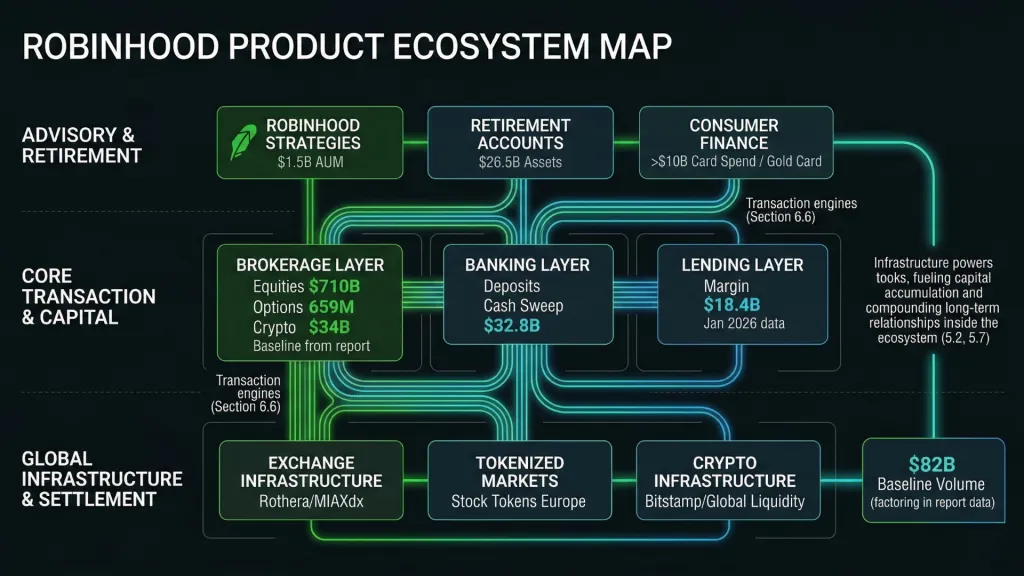
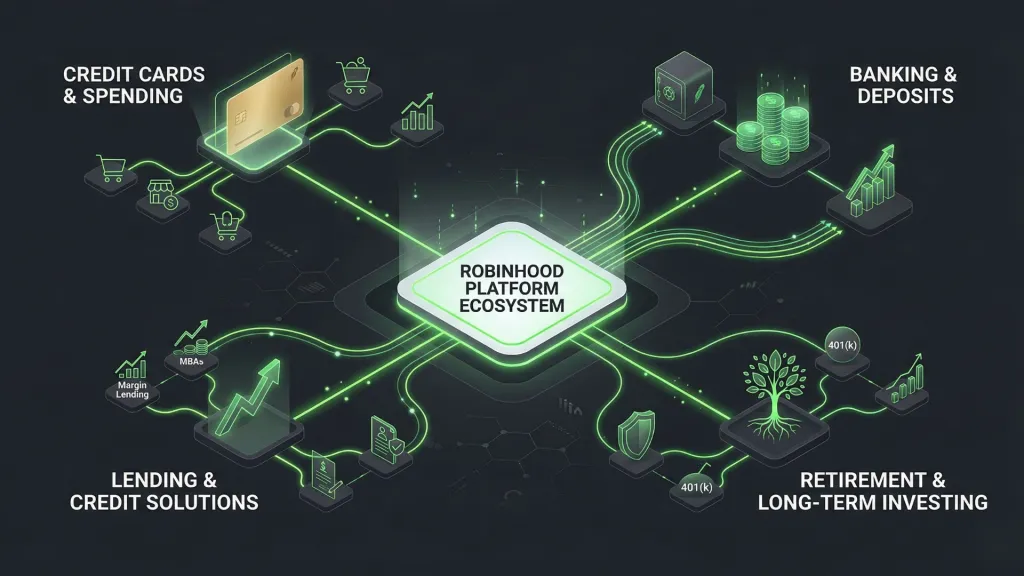
Robinhood’s platform has gradually evolved into a multi-layer financial ecosystem. Brokerage services remain the foundation, though the surrounding architecture now includes subscription products, deposits, credit balances, advisory services, retirement accounts, and consumer finance tools. Each layer expands the number of financial activities users can perform inside the platform while reinforcing the economic relationship between the company and its customers.
The ecosystem behaves much like a financial stack. Trading generates engagement. Deposits create interest income. Subscriptions monetize active users. Credit products increase capital activity. Advisory and retirement services anchor long-duration assets. Consumer finance tools extend the platform into everyday financial behavior.
Rather than operating as a single product, Robinhood increasingly functions as a financial environment where different services interact with each other. The economic structure of the platform reflects this architecture.
4.1 Brokerage and Trading Core
Brokerage services remain the center of the ecosystem. Trading across equities, options, crypto, and event contracts continues to generate the majority of platform engagement.
Equity trading volume reached approximately $710 billion during 2025. Options activity remains one of the most active segments of the platform with roughly 659 million contracts traded during the year. Options trading contributes significantly to transaction revenue due to the higher frequency of trades and greater use of margin.
Cryptocurrency markets also represent an important activity layer. Combined crypto trading volume reached roughly $82 billion during 2025 when including both the Robinhood application and institutional flows through Bitstamp.
Prediction markets have emerged as a new engagement category. Customers traded more than 12 billion event contracts during 2025. These markets allow users to take positions on real-world outcomes such as economic indicators, elections, and sports results.
Taken together, these trading categories create a dense network of activity across the platform. Each market attracts different types of participants while reinforcing overall engagement.
4.2 Robinhood Gold and the Premium Monetization Layer
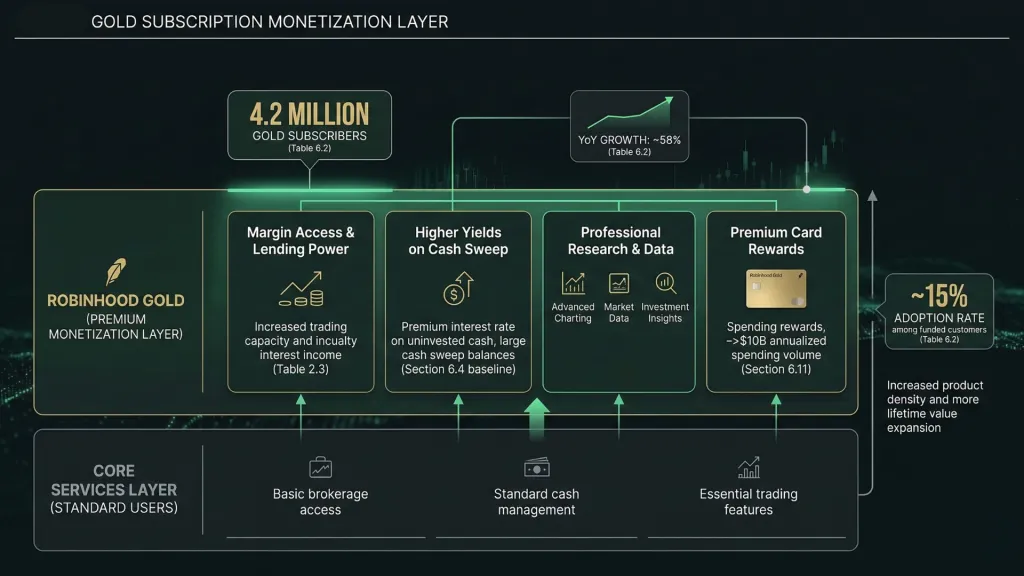
Robinhood Gold functions as the platform’s primary subscription layer. The membership program bundles premium financial tools including margin access, higher cash interest rates, professional market data, and advanced platform features.
Gold subscriptions have expanded rapidly and now exceed 4.2 million members. Adoption rates have continued to rise as additional products integrate with the subscription tier.
Subscription revenue introduces a recurring income stream that differs from transaction-based revenue. While trading activity may fluctuate with market conditions, subscription revenue tends to remain stable across market cycles.
Gold membership also acts as the gateway to several other premium services within the ecosystem. Features such as enhanced banking tools, credit card products, and specialized financial insights increasingly integrate with the Gold tier.
Within the broader platform architecture, Gold serves as the premium layer where the most engaged users migrate over time.
4.3 Banking, Cash Management, and Deposit Growth
Cash management features represent an increasingly important component of the ecosystem. These services allow customers to hold uninvested cash balances directly within the platform while earning interest.
Cash sweep balances have grown to approximately $32.8 billion. These deposits represent capital that customers have chosen to keep within the platform rather than transferring to external banking institutions.
Deposits serve several strategic functions. First, they generate interest income through securities lending and short-term investment activity. Second, they deepen customer relationships by anchoring financial liquidity within the ecosystem.
Deposit growth also stabilizes revenue during periods of lower trading activity. Trading volumes often fluctuate with market sentiment, though deposit balances tend to remain comparatively stable over longer periods.
As this layer expands, the distinction between brokerage and banking begins to blur. Customers increasingly use the platform to manage both investments and liquid savings.
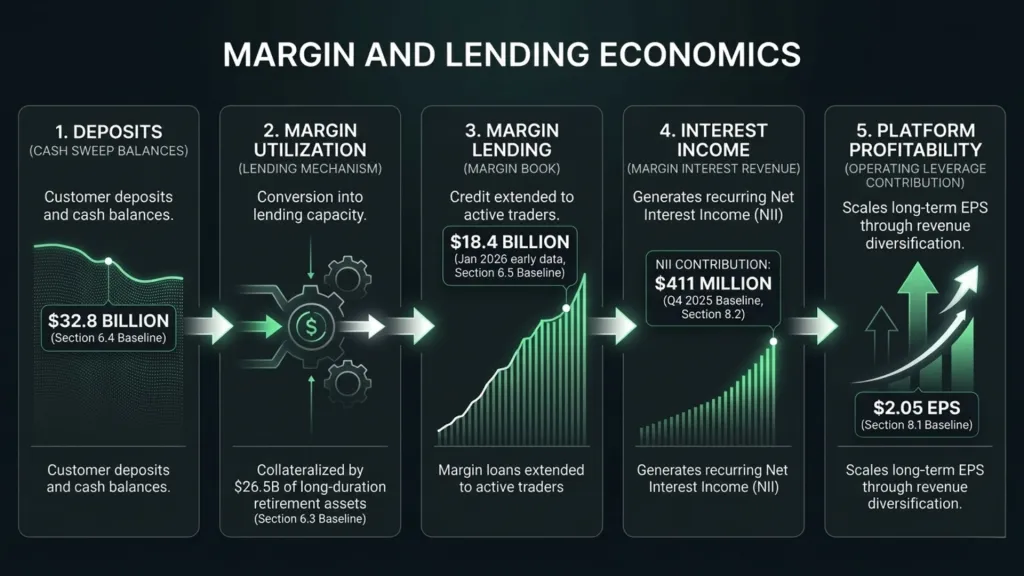
4.4 Margin Lending and Credit Expansion
Margin lending represents one of the most profitable services within the platform. Margin allows investors to borrow against their portfolios in order to increase purchasing power for investments.
Robinhood’s margin book reached approximately $16.8 billion at the end of 2025 and expanded to roughly $18.4 billion by early 2026.
Margin lending produces interest income while simultaneously increasing trading activity. Borrowed capital frequently returns to the platform through additional market positions.
Credit services expand the economic footprint of the platform by transforming it into both an investment venue and a lending institution. As margin balances grow, the platform begins to resemble a hybrid between a brokerage and a digital bank.
Margin lending functions somewhat like leverage within a mechanical system. When used responsibly it increases efficiency and activity. When applied excessively it introduces additional financial risk. Managing that balance will remain an important aspect of the platform’s long-term stability.
4.5 Retirement Accounts and Long Duration Assets
Retirement accounts represent one of the most strategically important additions to the platform ecosystem.
Assets within retirement accounts typically remain invested for decades rather than moving frequently between institutions. These long-duration balances provide stability and deepen long-term customer relationships.
Robinhood’s retirement platform now holds approximately $26.5 billion in assets across roughly 1.8 million funded retirement accounts.
These accounts represent a shift in the platform’s evolution. Early growth centered around active trading among younger investors. The expansion of retirement assets suggests that many of those investors are now accumulating long-term wealth within the platform.
From a strategic perspective, retirement assets function as the long-term capital base of the ecosystem.
4.6 Robinhood Strategies and Digital Advisory
Robinhood Strategies represents the platform’s digital advisory service. The product offers professionally managed portfolios designed to automate asset allocation and long-term investment management.
Assets managed within Robinhood Strategies have grown to approximately $1.5 billion across more than 250 thousand funded customers.
Digital advisory services introduce recurring fee revenue while expanding the platform’s reach into wealth management. For users, the service simplifies portfolio management by automating asset allocation and rebalancing decisions.
For the platform, advisory assets represent durable capital that tends to remain invested for long periods of time. These balances increase platform assets while generating predictable revenue streams.
Advisory services also broaden the platform’s appeal beyond active traders. Investors seeking automated portfolio management can now remain within the same ecosystem rather than migrating to external advisory platforms.
4.7 Family Finance: Custodial and Trust Accounts
Robinhood has recently expanded into family financial management through custodial accounts and trust structures. Custodial accounts allow parents or guardians to invest on behalf of children while maintaining legal oversight of the assets until the child reaches adulthood.
Trust accounts extend these capabilities to estate planning structures such as revocable living trusts. These accounts enable trustees to manage portfolios within the platform while preserving the legal framework of the trust.
Family financial tools broaden the platform’s scope from individual investors to household financial relationships. Parents can establish accounts for children while managing their own brokerage, retirement, and advisory accounts inside the same ecosystem.
The long-term importance of this category may extend beyond organic adoption. U.S. policymakers have explored using private financial platforms to administer new government-funded investment accounts for children under a program sometimes referred to as “Trump Accounts.” The initiative proposes a $1,000 government seed investment for every child born between 2025 and 2028.
Such a program could potentially affect roughly 25 million families. Financial institutions designated to administer the accounts would act as custodians responsible for managing the investments over time.
Robinhood has reportedly prepared internally in case it is selected as one of the participating platforms. If implemented at scale, initiatives of this type could introduce millions of new investment accounts into the U.S. financial system.
Custodial accounts therefore carry strategic significance beyond their immediate balances. They position the platform at the earliest stage of the investment lifecycle, where accounts are created during childhood and potentially remain active for decades.
4.8 Premium Consumer Finance: Gold Card and Platinum Card
Robinhood has begun expanding into consumer credit through premium card products integrated directly into the platform ecosystem.
The Robinhood Gold Card already counts more than 700 thousand cardholders and generates over $10 billion in annualized spending volume.
The recently introduced Platinum Card represents a higher-tier offering. The card carries an annual fee of approximately $695 and includes travel rewards, dining benefits, wellness memberships, and premium financial perks.
Consumer credit products extend the platform into everyday financial activity. Instead of interacting with the platform only during investment decisions, customers begin using the ecosystem during daily spending behavior.
Credit cards function as frequent touchpoints between the user and the platform. When integrated effectively with brokerage accounts and deposits, spending data can reinforce engagement across the entire financial ecosystem.
4.9 Cortex and the AI Layer
Robinhood Cortex represents the artificial intelligence layer embedded within the platform. The system analyzes portfolio activity, market conditions, and financial data in order to provide contextual insights for users.
Cortex functions primarily as a decision-support system rather than an automated trading engine. The system can highlight portfolio trends, identify unusual market activity, and generate summaries of financial developments relevant to individual portfolios.
Artificial intelligence increasingly serves as the coordination layer for complex digital platforms. Within a financial ecosystem containing trading, deposits, credit balances, and advisory assets, users require tools capable of synthesizing large amounts of information.
Cortex acts as a digital research assistant integrated directly into the platform environment. Instead of consulting multiple external research tools, users receive contextual insights alongside the portfolios they manage.
4.10 Portfolio Overview and the Unified Financial Interface
The portfolio overview represents the interface where the entire ecosystem converges. The dashboard aggregates brokerage positions, retirement accounts, advisory portfolios, deposits, credit balances, and subscription services into a single view.
Users can also link external financial accounts from other institutions. This capability allows the platform to display a broader overview of an individual’s financial life even when certain assets remain outside the ecosystem.
The unified interface functions as the command center of the platform. Rather than interacting with separate financial services, users view their financial position through a consolidated dashboard.
As additional services integrate into the ecosystem, the interface increasingly resembles the dashboard of a financial operating system. Brokerage, banking, credit, and advisory services converge into a single coordinated view of personal finance.
5. Transformation Into a Financial SuperApp
Robinhood’s strategic evolution during the past several years reflects a broader transition occurring across the financial industry. Digital platforms are increasingly consolidating multiple financial services into unified ecosystems that combine brokerage, banking, credit, advisory services, and payments.
This transition has gradually reshaped Robinhood’s economic model. The company originally generated the majority of its revenue from trading activity. Today the platform generates revenue across several distinct engines including subscriptions, interest income, advisory services, and consumer finance products.
The platform now supports over 27 million funded customers and manages more than $324 billion in platform assets. Net deposits alone reached approximately $68 billion during 2025, illustrating how users are increasingly moving larger portions of their financial lives into the ecosystem.
Rather than operating as a single-service brokerage, Robinhood increasingly resembles a financial hub where multiple services interact within a unified platform.
5.1 Why Robinhood Is No Longer Just a Trading App
Robinhood’s identity as a trading application still influences how many investors perceive the company. Trading remains a central component of the platform, though the surrounding ecosystem has expanded significantly.
The company now operates across several financial categories including deposits, credit products, retirement accounts, advisory services, subscriptions, and consumer finance tools. Each category generates economic activity that extends beyond traditional brokerage services.
Customer engagement metrics illustrate this diversification. Equity trading volume exceeded $700 billion during 2025 while options trading reached hundreds of millions of contracts. At the same time, cash sweep balances approached $33 billion and margin balances expanded beyond $18 billion.
These figures demonstrate that the platform now captures both investment activity and financial liquidity. Users increasingly treat the platform as a primary financial interface rather than a trading tool used intermittently.
5.2 The Shift Toward Multi Engine Monetization
Robinhood’s economic structure now operates through several independent revenue engines.
Transaction-based revenue remains significant, generating roughly $776 million during the fourth quarter of 2025. This category includes trading across equities, options, crypto markets, and prediction contracts.
Interest income represents another major revenue driver. Net interest revenue reached approximately $411 million during the same quarter as deposits and margin balances expanded.
Subscription revenue forms a third engine. Robinhood Gold membership now exceeds 4.2 million subscribers and continues to expand as premium features integrate with the broader platform.
Advisory services and managed portfolios contribute additional recurring income through asset management fees. Consumer finance products such as credit cards introduce yet another economic layer tied to spending activity.
Together these engines form a diversified financial model. If one segment experiences cyclical weakness, other segments can continue generating revenue. This diversification reduces the platform’s dependence on trading activity alone.
5.3 Expanding Wallet Share Across Customer Financial Lives
One of the central objectives of the superapp strategy involves increasing the share of each customer’s financial activity captured within the platform.
Instead of relying solely on acquiring new users, the platform aims to deepen relationships with existing customers by expanding the number of financial services they use.
Deposits provide a clear example of this strategy. Cash balances held within the platform have grown to more than $30 billion. Margin balances and advisory assets add additional layers of financial activity.
Credit card spending also contributes to wallet share expansion. The Robinhood Gold Card now serves more than 700 thousand users and generates over $10 billion in annualized spending.
As additional services integrate into the platform, users begin interacting with the ecosystem across multiple financial activities including saving, investing, borrowing, and spending.
The cumulative effect resembles the expansion of a financial footprint. Each additional service increases the portion of the customer’s financial life that flows through the platform.
5.4 Demographics and the Great Wealth Transfer
Demographic trends may amplify the long-term potential of this model. Younger investors represent a large portion of Robinhood’s customer base, many of whom entered financial markets for the first time through the platform.
Over the coming decades a substantial generational wealth transfer is expected to occur as assets pass from older generations to younger heirs. Estimates commonly place the scale of this transition in the tens of trillions of dollars across the United States alone.
Platforms with strong engagement among younger investors may capture a meaningful portion of this capital as it transfers between generations.
The presence of retirement accounts and advisory services within the platform further strengthens this positioning. Assets that begin as small investment accounts can gradually evolve into substantial long-term portfolios as investors accumulate wealth throughout their careers.
5.5 Household Finance and Intergenerational Accounts
The expansion of family financial tools represents another step in Robinhood’s transition toward a full financial ecosystem.
Custodial accounts allow parents to invest on behalf of children, creating investment accounts that may remain active for decades. Trust accounts enable families to manage estate planning structures directly within the platform.
Policy initiatives may further expand this category. U.S. policymakers have explored the possibility of creating government-seeded investment accounts for children, potentially introducing millions of new accounts into the financial system.
If financial platforms such as Robinhood participate in administering these accounts, the ecosystem could gain access to a new generation of investors at the earliest stage of their financial lives.
Intergenerational accounts therefore serve as a bridge between present financial activity and future wealth accumulation.
5.6 Product Density and Lifetime Value Expansion
Product density refers to the number of financial services used by each customer within the platform.
A user who only executes occasional trades generates limited economic value. A user who maintains deposits, subscribes to premium services, holds a retirement account, uses advisory tools, and spends through a credit card represents a far more valuable long-term relationship.
Robinhood’s expanding ecosystem increases the number of potential interactions between customers and the platform. Each product introduces new revenue streams while strengthening engagement.
The lifetime value of each customer therefore expands as additional services are adopted. Instead of generating revenue from a single financial activity, the platform gradually captures multiple aspects of the customer’s financial behavior.
This dynamic resembles the growth of a dense urban environment. The more infrastructure and services available within the system, the more economic activity flows through it.
5.7 Operating Leverage and Platform Economics
Digital financial platforms benefit from operating leverage once core infrastructure has been built.
Software systems that support tens of millions of users can often scale additional services without proportional increases in operating costs. As new products integrate into the ecosystem, incremental revenue can grow faster than operating expenses.
Robinhood’s financial results during recent years suggest this dynamic beginning to emerge. Revenue expanded significantly while operating expenses grew at a slower pace.
This widening gap between revenue growth and cost growth represents one of the defining economic characteristics of successful digital platforms.
As additional financial services integrate into the ecosystem, operating leverage may continue to expand. The same infrastructure that supports brokerage services can also support advisory accounts, credit products, deposits, and subscription services.
The long-term economic potential of the platform therefore depends on the continued expansion of these integrated services within a unified financial environment.
6. Core Growth Engines
Robinhood’s growth is driven by several reinforcing economic engines operating across the platform. These engines extend beyond traditional brokerage activity and increasingly resemble the revenue architecture of a diversified financial platform.
Trading activity still attracts users and generates engagement, though the surrounding ecosystem now produces additional growth through deposits, subscriptions, advisory assets, credit balances, and international market expansion.
Each engine contributes to the broader system. Deposits increase interest income. Subscriptions introduce recurring revenue. Lending products expand capital activity. Advisory and retirement accounts anchor long-term assets. Trading and new market categories sustain engagement.
Taken together, these engines create a multi-layer growth framework where the platform expands through both user activity and asset accumulation.
6.1 Net Deposits and Platform Asset Growth
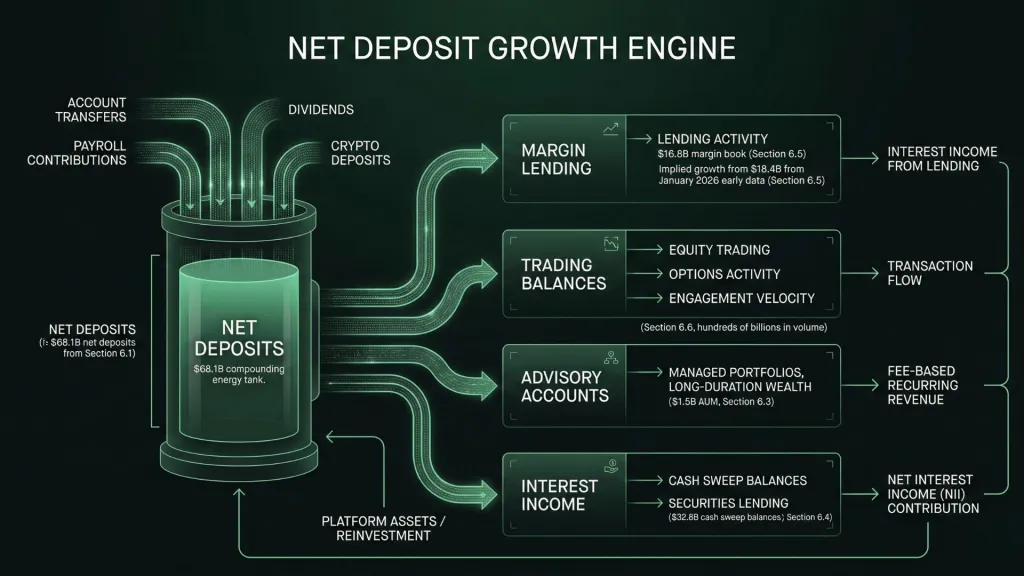
Net deposits represent one of the most important indicators of platform momentum. Deposits measure the flow of new capital entering the ecosystem through account transfers, payroll contributions, and investment inflows.
Robinhood generated approximately $68.1 billion in net deposits during 2025. Fourth quarter deposits alone totaled roughly $15.9 billion.
Platform assets reached approximately $324 billion by the end of the year, reflecting the combined effects of deposits and market appreciation.
Table 6.1 Platform Asset Growth
Metric | Latest Value |
|---|---|
Total Platform Assets | $324B |
Net Deposits (2025) | $68.1B |
Net Deposits (Q4 2025) | $15.9B |
Annual Deposit Growth Rate | ~35% |
Deposits represent the raw fuel of the platform ecosystem. Capital entering the platform can flow into multiple products including trading accounts, advisory portfolios, retirement funds, and margin collateral.
Consistent deposit growth signals increasing customer trust and deeper financial relationships.
6.2 Robinhood Gold Subscriber Expansion
Subscription growth represents another major expansion engine.
Robinhood Gold now exceeds 4.2 million subscribers. Adoption rates have increased steadily as the subscription integrates with other financial services such as margin lending, credit cards, advanced analytics, and higher cash interest rates.
Gold subscriptions introduce predictable recurring revenue that stabilizes the company’s economic profile.
Table 6.2 Subscription Growth
Metric | Value |
|---|---|
Gold Subscribers | 4.2M |
YoY Growth | ~58% |
Gold Adoption Rate | ~15% of funded customers |
Subscriptions also strengthen customer engagement. Gold members tend to interact with more services across the platform, increasing overall product density.
6.3 Retirement and Advisory Asset Growth
Long-duration assets represent another important growth engine.
Retirement accounts within the platform now hold approximately $26.5 billion in assets across roughly 1.8 million funded accounts.
Robinhood Strategies, the platform’s digital advisory product, manages approximately $1.5 billion in assets across more than 250 thousand customers.
Table 6.3 Long Duration Assets
Product | Assets |
|---|---|
Retirement Accounts | $26.5B |
Retirement Accounts (Funded) | 1.8M |
Robinhood Strategies AUM | ~$1.5B |
Strategies Customers | ~250K |
These assets typically remain invested for many years, producing stable fee income and strengthening long-term customer retention.
In platform economics, long-duration assets function like ballast in a ship. They stabilize the system even when shorter-term trading activity fluctuates.
6.4 Banking Deposits and Cash Sweep Economics
Cash sweep balances have expanded into a substantial component of the platform’s financial architecture.
Customer cash balances held within the platform reached approximately $32.8 billion. These funds are automatically swept into partner banks and short-term financial instruments.
Table 6.4 Cash Sweep Deposits
Metric | Value |
|---|---|
Cash Sweep Balances | $32.8B |
Interest Revenue Contribution | Major driver |
Cash deposits generate interest income through securities lending and investment activity. These balances also deepen customer relationships by anchoring liquidity within the ecosystem.
Deposits therefore represent both a revenue driver and a retention mechanism.
6.5 Margin Expansion and Lending Revenue
Margin lending represents one of the most profitable components of the platform.
Margin balances reached approximately $16.8 billion at the end of 2025 and expanded to roughly $18.4 billion by early 2026.
Table 6.5 Margin Lending Growth
Metric | Value |
|---|---|
Margin Book (Q4 2025) | $16.8B |
Margin Book (Jan 2026) | $18.4B |
YoY Growth | ~113% |
Margin lending generates interest income while simultaneously increasing trading activity across the platform.
Borrowed capital frequently returns to the ecosystem through additional market positions, creating a feedback loop between lending and trading activity.
6.6 Equities, Options, and Short Selling Activity
Trading activity remains the engine that originally powered Robinhood’s growth.
Equity trading volume reached roughly $710 billion during 2025. Options trading accounted for approximately 659 million contracts traded.
Short selling functionality was introduced more recently and has already generated billions of dollars in trading volume as users adopt the new feature.
Table 6.6 Trading Activity
Metric | Value |
|---|---|
Equity Trading Volume | $710B |
Options Contracts | 659M |
Short Selling Activity | Billions in notional volume |
Trading activity plays a dual role within the ecosystem. It generates transaction revenue while also serving as the primary engagement driver that attracts new users to the platform.
6.7 Crypto Trading and Global Liquidity
Cryptocurrency markets represent another major trading category within the ecosystem.
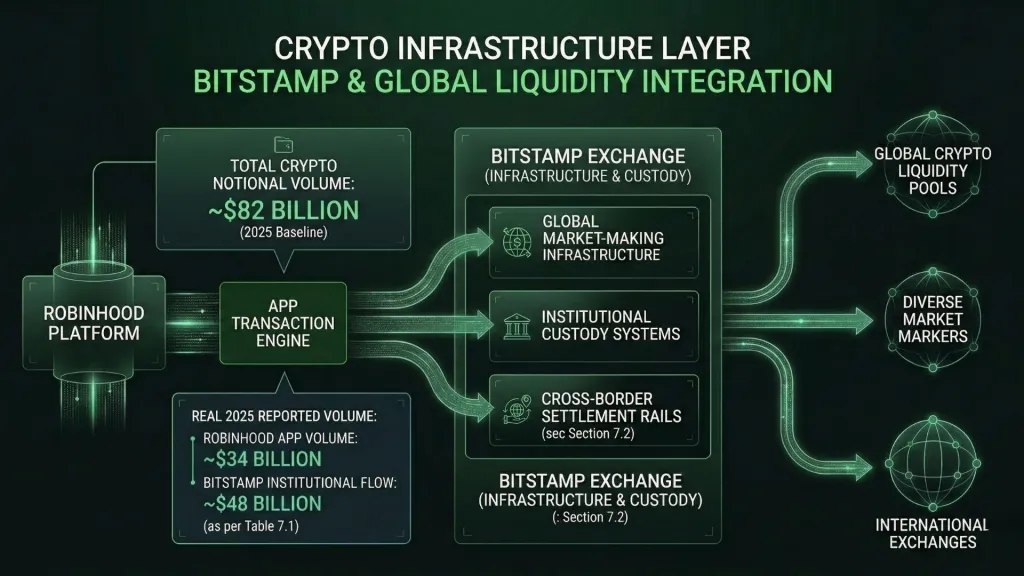
Total crypto trading volume reached approximately $82 billion during 2025. Bitstamp institutional flows accounted for roughly $48 billion of this volume while the Robinhood application contributed about $34 billion.
Table 6.7 Crypto Trading Activity
Metric | Value |
|---|---|
Total Crypto Volume | $82B |
Bitstamp Volume | $48B |
Robinhood App Volume | $34B |
The acquisition of Bitstamp significantly expands Robinhood’s presence in global crypto markets by adding institutional trading infrastructure and international liquidity pools.
This infrastructure provides a foundation for further expansion into global digital asset markets.
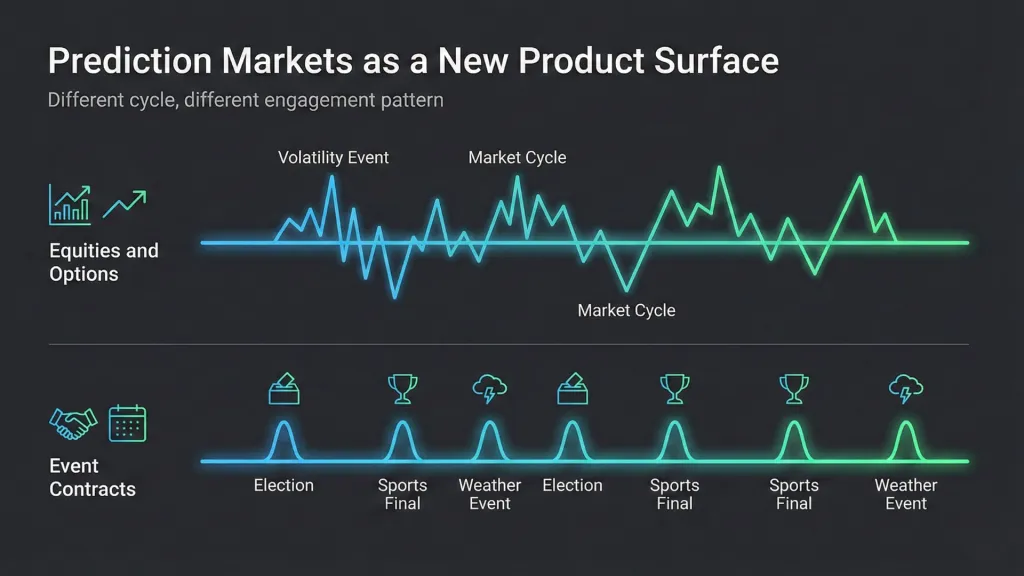
6.8 Prediction Markets and Event Contracts
Prediction markets have emerged as one of the most unique growth engines within the platform.
Users traded more than 12 billion event contracts during 2025. Activity continued accelerating into early 2026 with approximately 3.4 billion contracts traded in January alone.
Table 6.8 Prediction Market Activity
Metric | Value |
|---|---|
Event Contracts (2025) | 12B+ |
Event Contracts (Jan 2026) | 3.4B |
Prediction markets allow users to take positions on real-world events ranging from economic indicators to sports outcomes.
These markets introduce a new category of financial activity that sits somewhere between trading, forecasting, and entertainment.
6.9 International Expansion and Product Localization
International expansion represents another important growth vector.
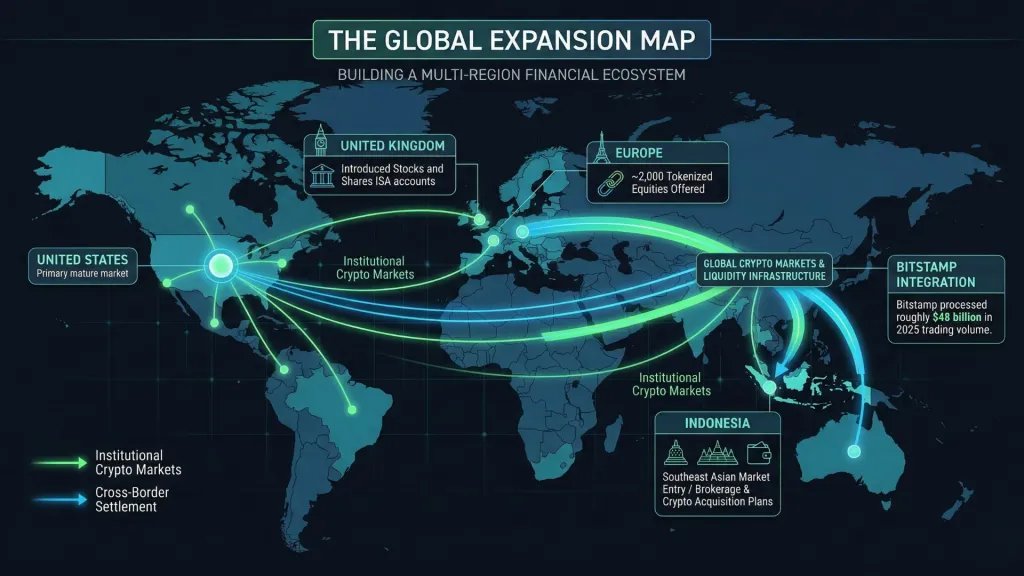
Robinhood has begun expanding product offerings across Europe and Asia. In the United Kingdom, the platform introduced stocks and shares ISA accounts, enabling tax-advantaged investing for local users.
The company also announced plans to acquire brokerage and crypto firms in Indonesia, marking an expansion into Southeast Asian markets.
Localized products allow the platform to adapt to regional financial regulations and tax structures while extending the global footprint of the ecosystem.
6.10 Tokenized Assets and Global Settlement Infrastructure
Tokenized assets represent an emerging frontier for the platform.
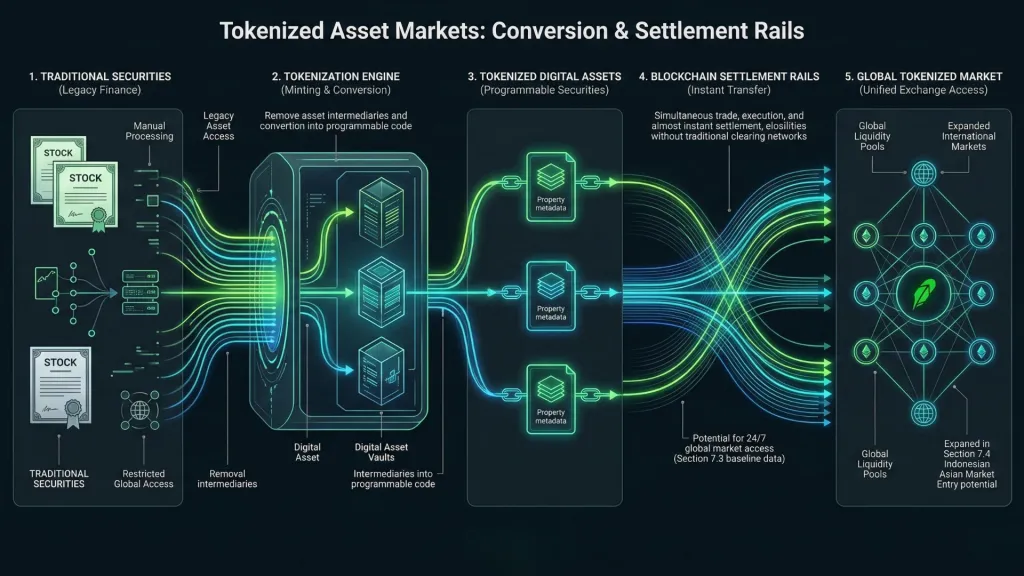
Robinhood has expanded its stock token offerings in Europe to approximately 2,000 tokenized securities. These tokens represent digital representations of publicly traded equities that can be traded on blockchain-based infrastructure.
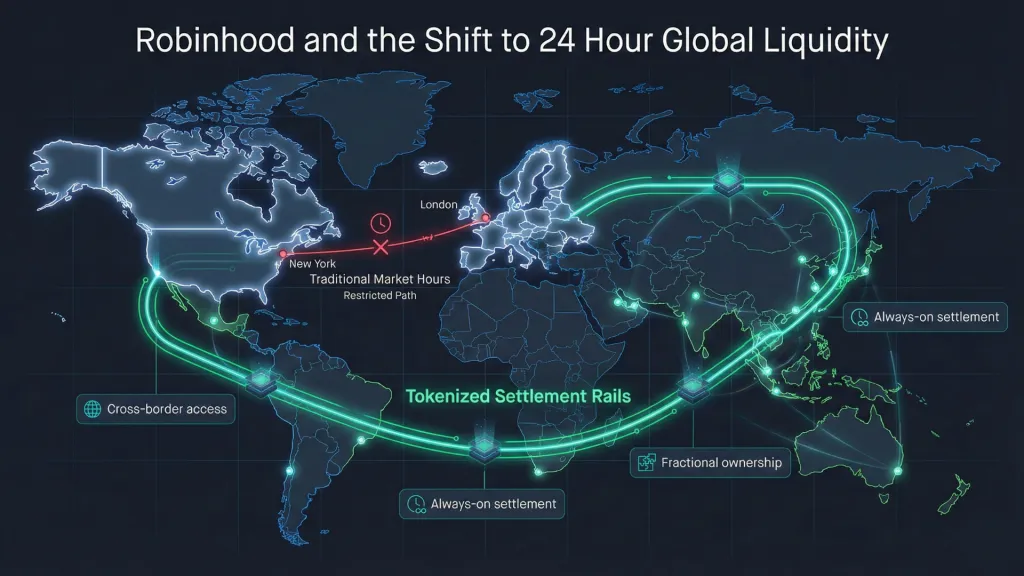
Tokenization may gradually reshape the global settlement infrastructure of financial markets. Traditional securities settlement often requires multiple intermediaries and can take several days to finalize transactions.
Tokenized securities have the potential to settle transactions almost instantly while enabling global trading access.
Robinhood’s early participation in tokenized markets positions the platform within this evolving infrastructure layer.
6.11 Private Market Access and Robinhood Ventures
Robinhood has also begun expanding access to private markets.
Robinhood Ventures launched Robinhood Ventures Fund I, a closed-end investment vehicle designed to provide retail investors with exposure to a portfolio of private companies.
The fund raised approximately $658 million through its initial offering, with potential expansion to roughly $705 million if additional share allocations are exercised.
Table 6.9 Robinhood Ventures Fund I
Metric | Value |
|---|---|
Initial Fund Size | $658M |
Potential Fund Size | ~$705M |
Structure | Closed-End Fund |
Private market access represents another step toward building a comprehensive financial ecosystem. Historically, exposure to venture capital and private equity markets has been restricted primarily to institutional investors and high-net-worth individuals.
By introducing vehicles such as Robinhood Ventures Fund I, the platform attempts to broaden access to these asset classes for retail investors.
In the context of the broader ecosystem, private market products extend the platform’s reach from public markets into earlier stages of the capital formation cycle.
7. Global Infrastructure and Strategic Optionality
One of the least understood aspects of Robinhood’s evolution involves the company’s gradual movement into financial market infrastructure. For much of its history the platform functioned primarily as a brokerage interface connecting retail investors to existing exchanges, clearing systems, and trading venues. That structure placed Robinhood at the edge of the financial system rather than at its core.
Recent strategic decisions suggest a different trajectory. Through acquisitions, partnerships, and new product launches, the company has begun positioning itself closer to the underlying infrastructure that powers global financial markets. This shift introduces strategic optionality that extends beyond brokerage revenue alone.
Infrastructure businesses often possess different economic characteristics than brokerage platforms. Exchanges, clearinghouses, and settlement systems tend to exhibit strong network effects, recurring revenue streams, and high operating leverage once scale is achieved. By participating more directly in these layers, Robinhood potentially captures value not only from trading activity but from the plumbing of financial markets themselves.
The initiatives discussed below represent early steps toward that direction.
7.1 Bitstamp and Global Liquidity Infrastructure
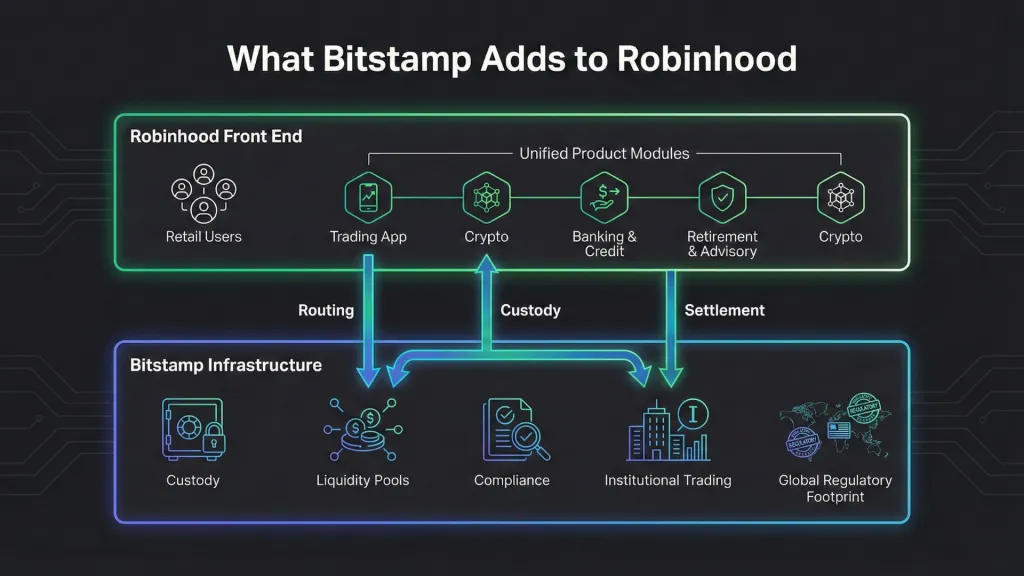
The acquisition of Bitstamp marked one of the most important infrastructure moves in Robinhood’s history. Bitstamp is one of the longest operating cryptocurrency exchanges globally and provides institutional trading infrastructure across multiple jurisdictions.
Bitstamp processed roughly $48 billion in trading volume during 2025. When combined with trading volume generated directly through the Robinhood application, total crypto activity across the ecosystem reached approximately $82 billion.
Table 7.1 Crypto Liquidity Infrastructure
Metric | Value |
|---|---|
Total Crypto Trading Volume | ~$82B |
Bitstamp Institutional Volume | ~$48B |
Robinhood App Crypto Volume | ~$34B |
Bitstamp contributes several capabilities that extend beyond trading volume alone. The exchange operates institutional custody systems, market-making infrastructure, and global liquidity connections across multiple digital asset markets.
These systems effectively serve as the underlying rails that enable cryptocurrency markets to function. By integrating Bitstamp into its broader ecosystem, Robinhood gains access to institutional-grade infrastructure rather than relying solely on third-party exchanges.
This integration may also strengthen Robinhood’s global trading capabilities as crypto markets continue expanding internationally.
7.2 Institutional Crypto Markets and Cross Border Settlement
Digital asset markets represent one of the few financial sectors where settlement infrastructure remains relatively open to technological innovation.
Traditional securities settlement often requires several intermediaries and may take multiple days to finalize transactions. Blockchain-based settlement systems allow transactions to settle far more quickly while enabling cross-border asset transfers without relying on traditional clearing networks.
Institutional crypto markets increasingly function as global liquidity hubs where capital can move across jurisdictions more easily than through conventional financial systems.
By integrating Bitstamp’s institutional trading infrastructure, Robinhood positions itself closer to these liquidity networks. This positioning may allow the company to participate more directly in cross-border settlement flows as digital asset markets mature.
From a strategic perspective, the infrastructure surrounding crypto markets resembles an early-stage financial highway system. Companies that establish positions within the foundational layers of that infrastructure may benefit as the broader ecosystem expands.
7.3 Europe and the Expansion of Stock Tokens
Robinhood has also begun experimenting with tokenized securities within European markets.
The platform has expanded its stock token offering to approximately 2,000 tokenized equities. These tokens represent digital representations of publicly traded shares that can be traded on blockchain infrastructure.
Tokenization introduces several potential advantages compared with traditional securities trading. Digital tokens may allow faster settlement, broader global access, and continuous market operation across time zones.
Table 7.2 Tokenized Securities Expansion
Metric | Value |
|---|---|
Tokenized Equities Offered | ~2,000 |
Primary Market | Europe |
While tokenized markets remain relatively small compared with traditional exchanges, they represent an emerging category of financial infrastructure. Robinhood’s participation in this space positions the company within the early stages of that evolution.
Over time, tokenized assets could expand beyond equities to include bonds, commodities, and other financial instruments.
7.4 Indonesia and Asian Market Entry
Robinhood’s international ambitions extend beyond Europe and crypto markets. The company has announced plans to acquire a brokerage and cryptocurrency firm in Indonesia as part of its expansion into Southeast Asia.
Indonesia represents one of the largest emerging digital financial markets in the world, with a population exceeding 270 million people and rapidly growing internet adoption.
Entry into Southeast Asian markets may provide access to a large population of younger investors who are increasingly comfortable with mobile financial platforms.
International expansion also diversifies the platform’s geographic footprint. While the United States remains Robinhood’s core market, global expansion may gradually transform the platform into a multi-region financial ecosystem.
7.5 Rothera, MIAXdx, and the Exchange Stack
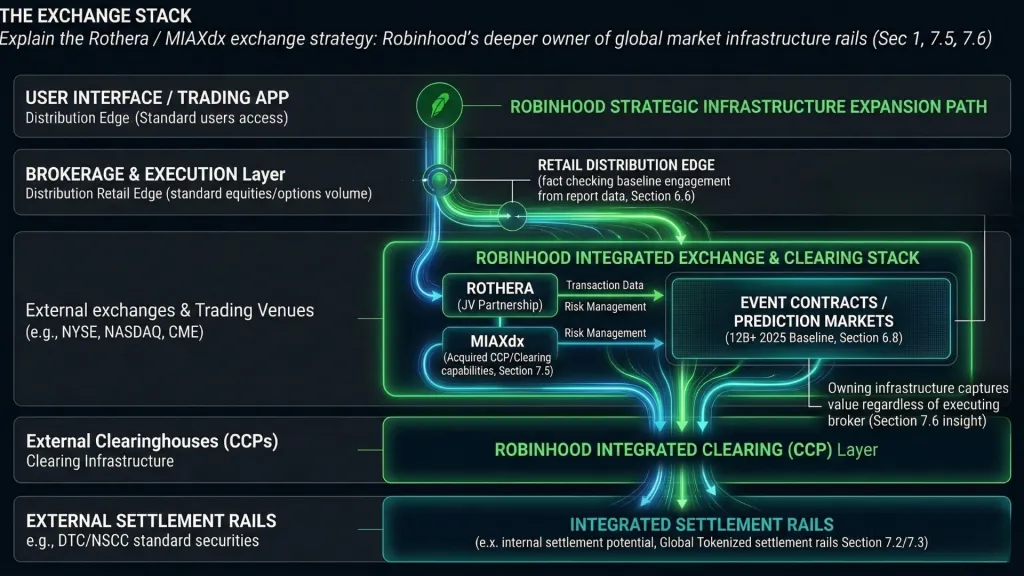
Another infrastructure initiative involves Robinhood’s partnership with Susquehanna International Group through a joint venture known as Rothera.
Rothera recently acquired MIAXdx, a derivatives exchange operator. The goal of the joint venture is to build an independent exchange and clearinghouse capable of supporting prediction markets and event contracts.
Prediction markets already represent a rapidly growing category within the Robinhood ecosystem. Customers traded more than 12 billion event contracts during 2025 alone.
Table 7.3 Prediction Market Infrastructure
Metric | Value |
|---|---|
Event Contracts Traded (2025) | 12B+ |
January 2026 Contracts | ~3.4B |
Owning part of the exchange infrastructure supporting these markets introduces an additional revenue layer. Exchanges generate fees from trading activity, clearing services, and market data.
Participation in the exchange stack therefore allows Robinhood to capture value not only from users trading on the platform but also from the infrastructure supporting those trades.
7.6 Owning More of the Financial Infrastructure Layer
Historically, Robinhood functioned primarily as a gateway connecting retail investors to external market infrastructure. Trades executed on the platform ultimately flowed through exchanges, clearinghouses, and liquidity providers operated by other institutions.
Recent strategic initiatives suggest a gradual shift toward owning more of that infrastructure directly.
Bitstamp provides global crypto exchange infrastructure. Rothera and MIAXdx introduce exposure to derivatives exchange operations. Tokenized securities experiments position the platform within emerging settlement technologies.
Infrastructure ownership introduces several potential advantages.
First, it allows the company to capture additional revenue streams tied to market activity. Exchanges and clearinghouses often generate fees regardless of which broker executes the trade.
Second, infrastructure businesses benefit from network effects. As more participants connect to an exchange or settlement network, the value of the platform increases.
Third, infrastructure assets often possess durable competitive advantages due to regulatory licensing, capital requirements, and technological complexity.
These characteristics make financial infrastructure one of the most economically attractive layers of the financial system.
7.7 What a Global Robinhood Could Look Like by 2030
If these infrastructure initiatives continue expanding, the platform could evolve significantly by the end of the decade.
A global Robinhood ecosystem might combine several layers of financial activity operating within a unified platform.
Retail investors could trade equities, options, crypto assets, and event contracts through the application interface. Advisory services, retirement accounts, and deposits would anchor long-duration assets within the system.
Behind the scenes, infrastructure layers such as crypto exchanges, tokenized settlement networks, and derivatives trading venues could power the underlying market activity.
In this scenario, Robinhood would no longer function solely as a brokerage interface. Instead the platform would operate simultaneously as a broker, exchange participant, infrastructure provider, and financial operating environment.
The strategic importance of the initiatives described in this section lies in their potential to move the company closer to that infrastructure layer of the global financial system.
8. Financial Performance and Current Baseline
Robinhood’s financial profile has changed materially over the past several years. Earlier phases of the company’s growth were characterized by volatile revenue tied heavily to trading cycles. The current financial structure shows a more diversified model supported by subscriptions, interest income, advisory assets, and expanding platform engagement.
The results reported for 2025 provide the clearest baseline for evaluating the company’s future trajectory. Revenue growth accelerated while profitability expanded significantly. Platform assets, deposits, and subscription adoption all reached new highs.
These figures establish the starting point for evaluating the company’s long-term earnings potential.
8.1 2025 Financial Performance
Robinhood delivered record financial results during 2025. Total revenue reached approximately $4.5 billion, representing year-over-year growth of roughly 52%.
Net income for the year totaled approximately $1.9 billion while diluted earnings per share reached $2.05. Profitability expanded as the platform’s revenue mix diversified beyond transaction activity.
Adjusted EBITDA reached approximately $2.5 billion during the year, representing roughly 76% growth compared with the previous year.
Table 8.1 Full Year 2025 Financial Results
Metric | 2025 Result |
|---|---|
Total Revenue | $4.5B |
Net Income | $1.9B |
Diluted EPS | $2.05 |
Adjusted EBITDA | $2.5B |
Total Operating Expenses | $2.38B |
Revenue expansion outpaced expense growth during the year. Operating expenses increased approximately 25% while revenue expanded more than twice as fast.
This widening gap between revenue and expense growth reflects the beginning of operating leverage within the platform.
8.2 Q4 2025 Operating Snapshot
The fourth quarter of 2025 provides a detailed snapshot of the platform’s operating momentum entering the current year.
Quarterly revenue reached approximately $1.28 billion, representing roughly 27% growth compared with the same quarter of the previous year.
Transaction-based revenue totaled approximately $776 million. Interest income contributed roughly $411 million while other revenue sources added approximately $96 million.
Net income during the quarter reached approximately $605 million while diluted earnings per share totaled $0.66.
Table 8.2 Q4 2025 Operating Snapshot
Metric | Q4 2025 |
|---|---|
Total Revenue | $1.28B |
Transaction Revenue | $776M |
Net Interest Revenue | $411M |
Other Revenue | $96M |
Net Income | $605M |
Diluted EPS | $0.66 |
The composition of revenue during the quarter illustrates the diversification of the company’s economic model. Transaction revenue remains significant, though interest income and other services now represent meaningful portions of total revenue.
8.3 January 2026 Early Operating Data
Early operating data from January 2026 suggests that platform activity remained strong entering the new year.
Net deposits during January reached approximately $4.5 billion. This represents an annualized growth rate of roughly 17% relative to total platform assets at the end of 2025.
Trading activity also remained elevated across multiple categories. Equity trading volume reached approximately $227 billion during the month while options trading totaled roughly 200 million contracts.
Table 8.3 January 2026 Operating Data
Metric | January 2026 |
|---|---|
Net Deposits | $4.5B |
Equity Trading Volume | $227B |
Options Contracts | 200M |
Crypto Volume | $22.9B |
Event Contracts | 3.4B |
These early indicators suggest that engagement across the platform continues to remain strong across both trading and deposit activity.
8.4 Revenue Mix and Business Quality
Robinhood’s revenue structure now reflects a combination of several financial engines.
Transaction revenue remains an important component of the business. This category includes trading activity across equities, options, cryptocurrencies, and event contracts.
Interest income has become another major contributor as deposits and margin balances expand. Cash sweep balances, margin lending, and securities lending all contribute to interest revenue.
Subscription services and premium features represent an additional revenue stream. Robinhood Gold membership continues expanding while additional premium financial tools integrate with the platform.
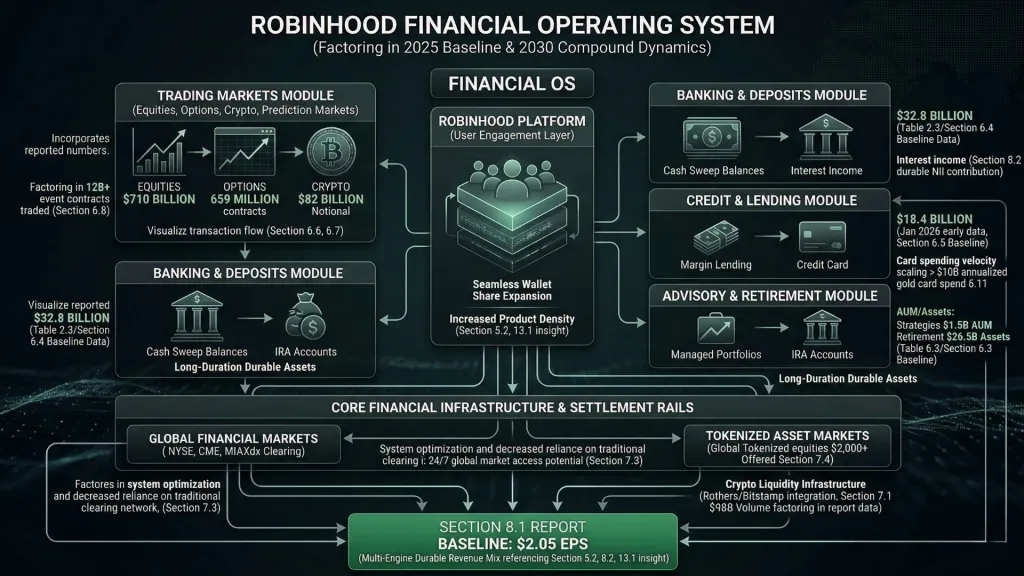
Table 8.4 Revenue Composition (Q4 2025)
Revenue Category | Amount |
|---|---|
Transaction Revenue | $776M |
Interest Revenue | $411M |
Other Revenue | $96M |
The diversification of revenue streams improves the quality of the company’s earnings. Revenue generated from subscriptions, deposits, and advisory services tends to be more stable than revenue tied purely to trading activity.
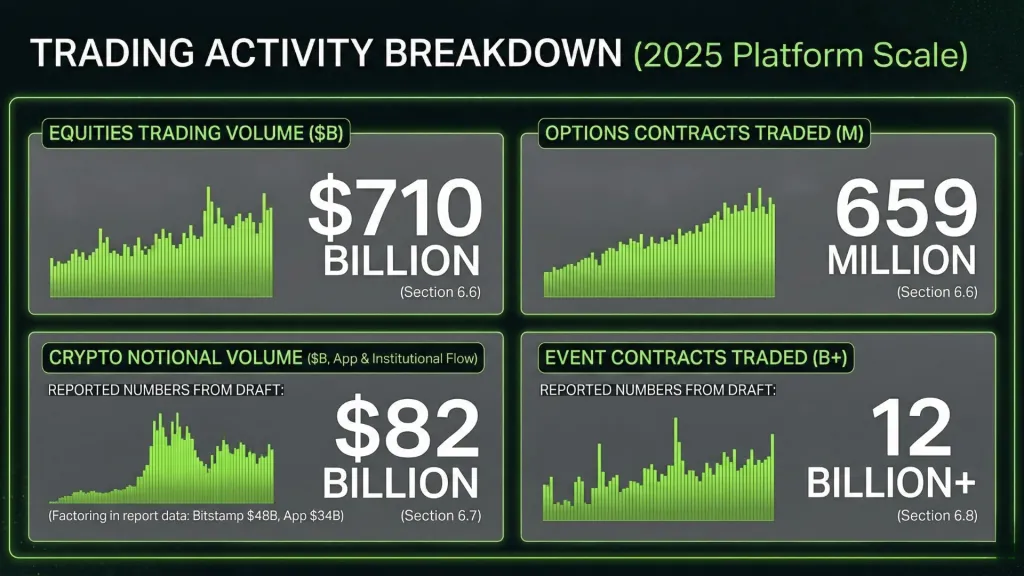
8.5 Margin Profile and Operating Expense Structure
The company’s cost structure remains heavily oriented toward technology infrastructure, marketing, and product development.
Total operating expenses during 2025 reached approximately $2.38 billion. Adjusted operating expenses and share-based compensation totaled roughly $2.27 billion.
Management has indicated that operating expenses will increase to between approximately $2.6 billion and $2.725 billion during 2026 as the company invests in product expansion, international growth, and integration of recent acquisitions.
Table 8.5 Expense Structure
Metric | Value |
|---|---|
Operating Expenses (2025) | $2.38B |
Adjusted Operating Expenses | $2.27B |
2026 Expense Guidance | $2.6B – $2.725B |
Despite these increases, revenue growth has begun to outpace expense growth. This dynamic represents one of the defining characteristics of digital platform economics.
8.6 Profitability Inflection and Earnings Power
Robinhood’s profitability profile has improved significantly in recent years.
The company generated approximately $1.9 billion in net income during 2025. Earnings per share reached $2.05 while adjusted EBITDA exceeded $2.5 billion.
These results suggest that the platform has crossed an important profitability threshold. The combination of strong revenue growth and moderate expense growth indicates the beginning of meaningful operating leverage.
Digital financial platforms often experience this type of inflection once they achieve sufficient scale. Fixed infrastructure costs remain relatively stable while additional revenue flows through the system at higher margins.
If this pattern continues, earnings growth may accelerate as the platform expands.
8.7 What the Updated Baseline Means for Future Growth
The financial results reported for 2025 establish an updated baseline for evaluating the company’s future potential.
The platform now generates billions of dollars in annual revenue while maintaining strong profitability and expanding operating leverage. Platform assets exceed $300 billion while deposits and subscriptions continue to grow.
This baseline changes the analytical framework for evaluating the company.
Earlier debates about Robinhood often focused on whether the business could become sustainably profitable. That question appears largely resolved based on recent financial performance.
The more relevant question now concerns the scale of the company’s future earnings power. If the platform continues expanding deposits, subscriptions, advisory assets, and global infrastructure, the economic profile of the business may evolve significantly over the remainder of the decade.
9. Risks and Structural Constraints
Despite strong growth across several areas of the platform, Robinhood’s long-term trajectory remains subject to a number of structural risks. Some of these risks are cyclical in nature, tied to market activity and retail trading participation. Others involve regulatory oversight, competitive dynamics, or execution challenges as the company expands into new financial categories.
Understanding these constraints is essential when evaluating the company’s future earnings potential. Many of the initiatives described in earlier sections carry meaningful upside, though they also introduce new sources of uncertainty.
9.1 Trading Cyclicality and Retail Activity Risk
Retail trading activity tends to move in cycles. Periods of rising markets and strong volatility often lead to elevated trading volumes, while quieter market environments can reduce engagement.
Transaction-based revenue remains an important component of Robinhood’s financial model. During the fourth quarter of 2025, transaction revenue totaled approximately $776 million. A sustained slowdown in trading activity could therefore impact revenue growth.
Trading volumes illustrate the scale of this activity. Equity trading volume reached roughly $710 billion during 2025 while options trading totaled approximately 659 million contracts.
Retail activity tends to increase during periods of market excitement and decline during extended periods of stability. This cyclicality introduces variability into transaction-driven revenue streams.
The expansion of deposits, subscriptions, and advisory assets may reduce this sensitivity over time, though trading activity will likely remain a meaningful driver of engagement within the ecosystem.
9.2 Regulatory and Legal Exposure
Financial platforms operate within one of the most heavily regulated industries in the global economy. Brokerage services, lending products, digital asset markets, and derivatives trading each fall under separate regulatory frameworks.
Robinhood’s expansion into new financial categories increases the number of regulatory agencies and compliance regimes the company must navigate.
Prediction markets represent one example. Event contracts traded through the platform fall under the jurisdiction of the Commodity Futures Trading Commission. The creation of a new exchange infrastructure through the Rothera joint venture introduces additional regulatory oversight related to derivatives markets.
Crypto markets also remain subject to evolving regulatory frameworks across multiple jurisdictions. As the platform expands internationally, compliance requirements may become increasingly complex.
Regulatory developments can influence both product availability and operating costs.
At Northwise, we see the deregulation agenda of the current administration as a favorable environment for expansion. If Robinhood is able to solidify its business segments in these emerging grey markets during the next 3 years, it may help it write the rules that govern the sectors' regulation moving forward.
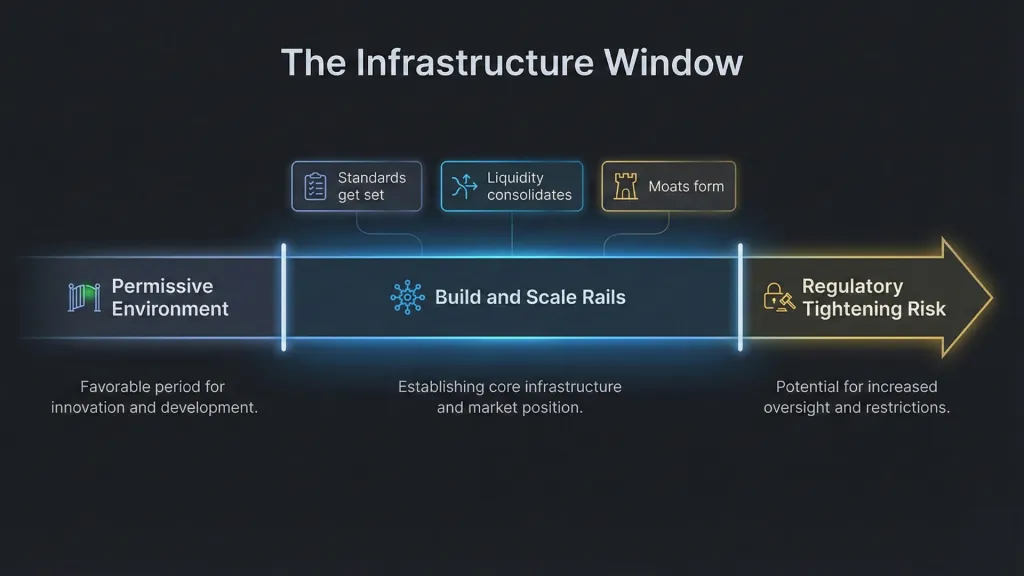
9.3 Execution Risk Across Rapid Product Expansion
Robinhood has launched a large number of products over a relatively short period of time. These initiatives include advisory services, banking features, credit cards, prediction markets, global crypto infrastructure, and tokenized securities.
Rapid product expansion creates execution risk. Each new service requires operational infrastructure, regulatory compliance, customer support, and technology integration.
Maintaining product quality while expanding the platform ecosystem requires careful coordination across engineering, compliance, and product teams.
If execution challenges arise, the platform’s reputation with users could be affected.
9.4 Credit Risk and Fraud Loss Exposure
As the platform expands into lending and credit services, financial risk exposure increases.
Margin lending represents a significant component of the platform’s financial activity. Margin balances reached roughly $18.4 billion by early 2026. During periods of market stress, margin positions may experience forced liquidations that can generate losses if collateral values decline rapidly.
Consumer credit products introduce additional exposure to default risk. Fraud prevention and credit underwriting therefore become increasingly important operational functions as the platform expands its lending footprint.
Financial institutions often devote substantial resources to risk management infrastructure in order to mitigate these exposures.
9.5 Competitive Pressure Across Financial Services
Robinhood operates in several highly competitive sectors of the financial industry.
Traditional brokerage firms such as Charles Schwab and Fidelity manage trillions of dollars in client assets and possess strong brand recognition. Digital banking platforms compete for deposits and payment activity. Cryptocurrency exchanges compete for digital asset trading volume.
Large technology companies may also enter certain financial categories over time.
Competition can influence pricing, product development, and customer acquisition costs.
Robinhood’s strategy of integrating multiple financial services into a unified platform may provide differentiation, though competition across individual product categories remains significant.
9.6 International Expansion Risk
International expansion introduces additional operational complexity.
Entering new regions requires compliance with local regulatory frameworks, adaptation of product offerings, and establishment of regional infrastructure.
For example, Robinhood’s planned entry into Southeast Asian markets through Indonesia exposes the platform to regulatory environments that differ substantially from those in the United States and Europe.
Currency volatility, regional market conditions, and geopolitical factors may also influence international growth initiatives.
Successfully navigating these variables requires careful coordination between global strategy and local market expertise.
9.7 Tokenization and Prediction Market Regulatory Risk
Several of Robinhood’s newer initiatives operate within regulatory environments that are still evolving.
Tokenized securities represent a relatively new category of financial instruments. Regulatory frameworks governing the issuance and trading of tokenized assets continue to develop across different jurisdictions.
Prediction markets and event contracts face similar regulatory scrutiny. The classification of these products may vary depending on the structure of the contracts and the jurisdiction in which they are offered.
Changes in regulatory interpretations could influence the availability of these markets or impose additional compliance requirements.
9.8 Valuation Risk and Multiple Compression
Robinhood currently trades at a market capitalization near $69 billion. Investor expectations embedded within this valuation assume continued growth across deposits, subscriptions, trading activity, and new product categories.
If revenue growth slows or profitability fails to expand as expected, valuation multiples could compress.
Technology-driven financial platforms often experience significant changes in valuation during shifts in investor sentiment. Market expectations therefore represent an additional risk factor when evaluating the company’s long-term investment profile.
9.9 Key 12 Month Catalysts
Several developments over the next twelve months may influence Robinhood’s trajectory.
Continued growth in Gold subscriptions and platform deposits will provide signals regarding customer engagement. Expansion of advisory assets and retirement accounts will indicate progress toward building long-duration financial relationships.
Integration of Bitstamp and expansion of global crypto liquidity infrastructure may influence the company’s position within digital asset markets.
Regulatory progress related to prediction markets and tokenized securities could also shape the platform’s ability to expand into new financial categories.
Finally, international expansion initiatives in Europe and Southeast Asia may determine whether the company successfully transitions from a primarily domestic platform into a broader global financial ecosystem.
These catalysts will help determine how rapidly the platform’s ecosystem continues expanding over the coming years.
10. Scenario Modeling: Hood Stock Forecast 2030
10.1 Forecasting Methodology
The forecasting framework reflects the structural transformation underway at Robinhood. The company is evolving from a transaction-driven brokerage platform into a multi-engine financial ecosystem combining trading activity, deposits, credit products, advisory assets, subscription services, and emerging global market infrastructure.
The model therefore separates Robinhood’s growth drivers into several economic layers.
Core financial platform
- trading activity across equities, options, crypto, and event contracts
- subscription revenue from Robinhood Gold
- interest income generated from deposits and margin lending
- advisory and retirement assets
Financial services expansion
- credit card spending and lending products
- household finance and custodial accounts
- international market expansion
Infrastructure optionality
- tokenized securities
- global crypto exchange infrastructure
- derivatives exchanges and event contract venues
- private market access
Unlike earlier versions of the model, tokenization is no longer isolated as a separate model. Instead it is integrated as a contributor to the platform’s long-term infrastructure economics.
The forecasting horizon extends through 2030 in order to capture the full effect of operating leverage and ecosystem expansion.
10.2 Core Revenue Drivers Through 2030
Several structural drivers support the revenue model.
Growth Engine | Economic Effect |
|---|---|
Net Deposits | platform asset growth |
Gold Subscriptions | recurring monetization |
Interest Income | margin and cash sweep economics |
Advisory Assets | fee-based recurring revenue |
Credit Products | consumer finance expansion |
Trading Activity | engagement and transaction revenue |
Crypto Infrastructure | global liquidity flows |
Tokenization | settlement and trading rails |
Deposits represent the most important underlying variable. Capital entering the ecosystem can flow into multiple revenue-generating activities including advisory portfolios, margin collateral, cash sweep deposits, and trading balances.
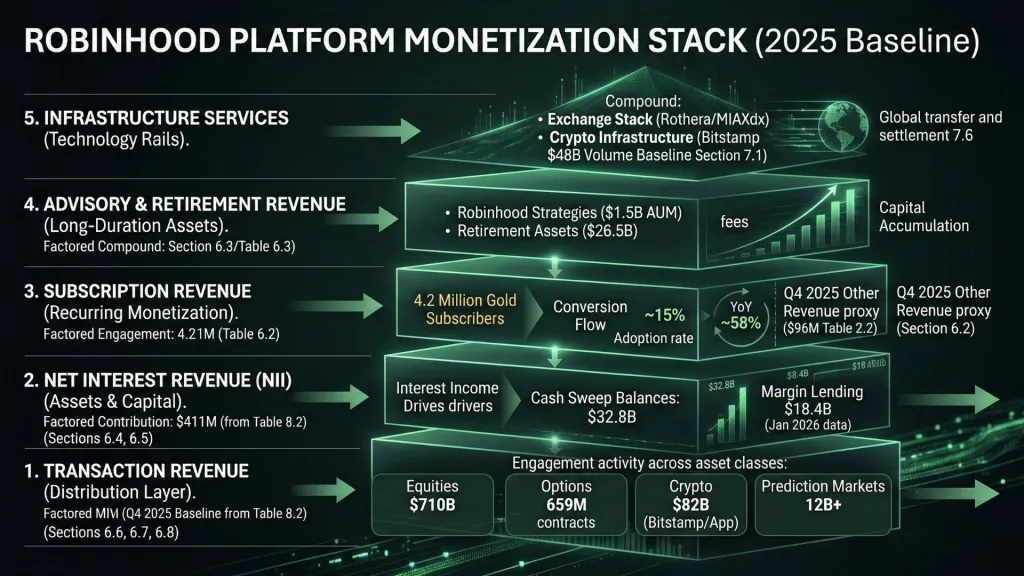
10.3 Bear Case Assumptions
The bear scenario assumes that the platform continues expanding but faces slower adoption across several new product lines.
Key assumptions
- deposit growth moderates
- subscription adoption stabilizes near 20%
- trading activity fluctuates with market cycles
- international expansion remains gradual
- tokenized markets remain niche
Bear revenue forecast
Northwise Premium
Choose how to continue with Northwise
Join Northwise Premium
Unlock the rest of this report, its complete valuation, the downloadable model, portfolios, and action framework.
Join Northwise PremiumCreate a Free Account
Continue across Free Northwise research, follow companies, save reports, and receive updates.
Create a Free AccountThis is not financial advice. We are not financial advisors. Always conduct your own due diligence before investing.

HOOD Stock Forecast: Can Robinhood Keep the Wealth?
Our Robinhood (HOOD) stock forecast examines earnings, customer wealth, valuation and growth through 2030. Read the report and explore the complete workbook.

How Does Robinhood Make Money?
How Robinhood makes money: Q2 2026 revenue categories, trading mix, interest sensitivity, Gold, advisory and bank-partner services.

Bitstamp By Robinhood
Robinhood has officially completed its acquisition of Bitstamp, a pivotal move that broadens their reach and signals serious intent to win in crypto.
Northwise Portfolios
See how the research becomes real decisions
Reader discussion
Discuss the research
Premium access is required to join this report's discussion.
Join Northwise Premium
No comments yet. Start a thoughtful discussion.