
Zeta Stock Forecast 2030
ZETA Stock Forecast 2030 model covering growth, FCF, dilution, privacy risk, valuation zones, and Zeta’s AI platform debate.
In this article
ZETA Stock Forecast 2030: A research framework testing whether Zeta is a durable AI marketing platform or an adtech/data business trading at the right discount.
Executive Summary
Zeta Global is one of the more difficult public companies to classify cleanly. Its revenue contains elements of marketing cloud software, customer data infrastructure, adtech activation, AI workflow tooling, and campaign services. That ambiguity has created both the opportunity and the risk that define the equity today.
The bullish argument is straightforward. Zeta finished 2025 with $1.31 billion in revenue, 30% top-line growth, $279 million in adjusted EBITDA, and $165 million in free cash flow. Forward 2026 guidance now sits at roughly $1.76 billion in revenue and $231 million in free cash flow. Management is targeting $2.3 billion of revenue and $371 million of free cash flow by 2028. GAAP net income turned positive in Q4 2025. If those trends hold, the equity may be undervalued relative to the cash it generates by 2030.
The bearish argument is equally clear. Zeta carries a meaningful dilution history, material stock-based compensation, acquisition-assisted growth, political revenue noise, and an unresolved overhang from the November 2024 Culper Research short report and the related class action. If the market continues to classify Zeta as an adtech and data business rather than enterprise software, valuation upside may stay capped regardless of operating performance.
Our model treats Zeta conservatively. We do not grant pure SaaS multiples. We haircut growth quality, incorporate dilution, and stress test privacy and macro outcomes. Free cash flow rather than adjusted EBITDA anchors the valuation work, since stock-based compensation and dilution still represent real owner-level costs.
The result is a company that appears investable at the right price, but not yet a top-tier clean compounder. The current working conclusion: attractive enough for a starter position at discounted levels, not strong enough yet for heroic sizing, and dependent on continued proof in margin expansion, dilution discipline, and Athena monetization.
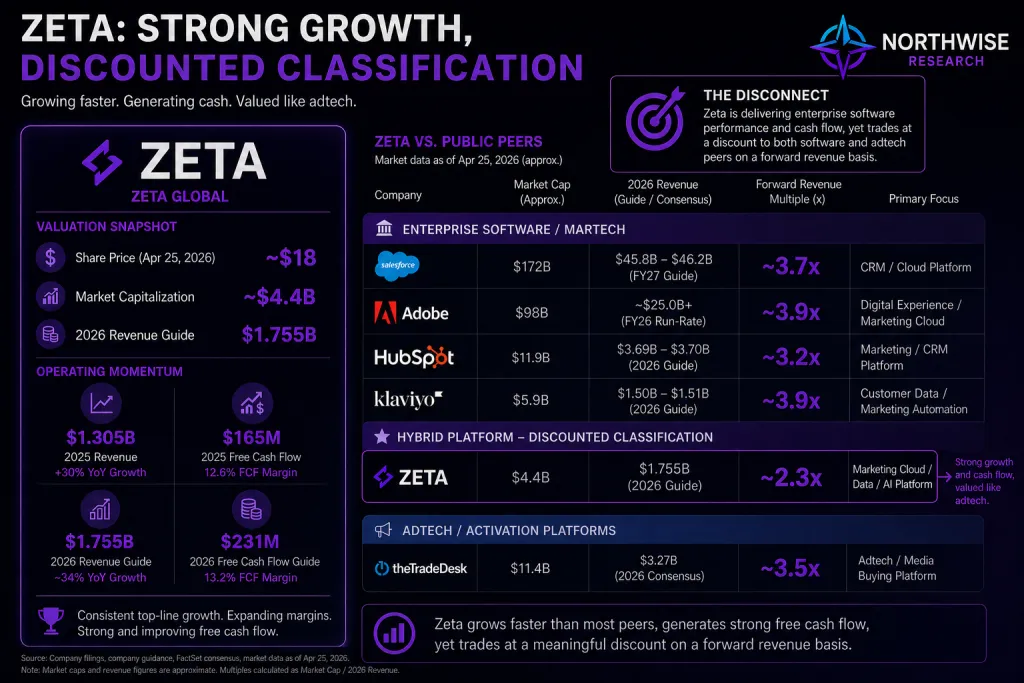
Table of Contents
- Executive Summary
1.1 Core Investment Judgment
1.2 What the Market Is Mispricing
1.3 Summary of Bear, Base, and Bull Outcomes - The Starting Question: AI Marketing Cloud or Adtech in Better Clothes?
2.1 The Core Valuation Debate
2.2 Why Classification Drives Multiples - What Zeta Actually Sells
3.1 Core Product Overview
3.2 Who Buys Zeta
3.3 Where Zeta Sits in the Stack - Zeta’s History and Platform Evolution
4.1 Founding and Leadership
4.2 IPO to Present
4.3 Acquisition Strategy
4.4 Enterprise Migration - Business Model and Revenue Quality
5.1 Recurring Revenue Components
5.2 Usage and Campaign Revenue
5.3 Political Revenue Noise
5.4 Revenue Quality Framework - Competitive Positioning
6.1 Versus Salesforce and Adobe
6.2 Versus HubSpot, Braze, and Klaviyo
6.3 Versus The Trade Desk
6.4 Versus In-House Teams - The Data Question: Moat or Liability?
7.1 Proprietary Data Claims
7.2 Short Seller Allegations
7.3 Zeta Rebuttal
7.4 Regulatory and Reputation Risk - Athena and AI Optionality
8.1 What Athena Claims to Solve
8.2 OpenAI Partnership
8.3 What Proof We Need
8.4 How We Value Athena - Financial Quality Review
9.1 Revenue Growth
9.2 Margin Profile
9.3 Free Cash Flow Quality
9.4 SBC and Dilution - Customer Quality and Retention
10.1 Enterprise Expansion
10.2 Net Revenue Retention
10.3 Gross Retention Gap
10.4 Why Customers Leave - Management and Capital Allocation
11.1 What Management Gets Credit For
11.2 Where Skepticism Remains - 2030 Forecast Methodology
12.1 Baseline Inputs
12.2 Why We Use Free Cash Flow
12.3 Why We Do Not Use SaaS Multiples
12.4 Scenario Construction - Bear Case Scenario
13.1 Growth Assumptions
13.2 Margin Assumptions
13.3 Dilution Assumptions
13.4 Narrative Outcome - Base Case Scenario
14.1 Growth Assumptions
14.2 Margin Assumptions
14.3 Dilution Assumptions
14.4 Narrative Outcome - Bull Case Scenario
15.1 Growth Assumptions
15.2 Margin Assumptions
15.3 Dilution Assumptions
15.4 Narrative Outcome - Stress Tests
16.1 Recession Scenario
16.2 Privacy Crackdown Scenario
16.3 No Re-Rating Scenario
16.4 Dilution Drift Scenario
16.5 Athena Failure Scenario - What Breaks the Thesis
17.1 Operating Breakpoints
17.2 Financial Breakpoints
17.3 Strategic Breakpoints - What Would Make Us More Bullish
18.1 Financial Proof
18.2 Product Proof
18.3 Market Reclassification - Premium Section Begins
19.1 What the Premium Section Answers
19.2 Why Framework Alone Is Not Enough - Bear / Base / Bull Price Targets
20.1 Bear Case Output
20.2 Base Case Output
20.3 Bull Case Output
20.4 Probability-Weighted 2030 Value - Present Value Framework
21.1 Discount Rate Selection
21.2 Present Value Outputs
21.3 Which Rate Applies - Buy / Accumulate / Hold / Trim / Sell Zones
22.1 Strong Buy Zone
22.2 Accumulate Zone
22.3 Hold Zone
22.4 Trim Zone
22.5 Sell or Avoid Zone
22.6 Current Position in Zones - Positioning View
23.1 Watchlist, Starter, or Full Position
23.2 Conditions for Position Graduation
23.3 Conditions for Position Reduction
23.4 Role in a Northwise Portfolio - Final Northwise Conclusion
24.1 Current Verdict
24.2 Key Signals We Are Watching
24.3 Final Risk-Reward Summary
2. The Starting Question: AI Marketing Cloud or Adtech in Better Clothes?
2.1 The Core Valuation Debate
Zeta closed 2025 with $1.305 billion in revenue, 30% reported growth, and $165 million of free cash flow. The 2026 guide calls for roughly $1.76 billion in revenue and $231 million of free cash flow. Management's 2028 model points to $2.3 billion of revenue and $371 million of free cash flow at a 16% margin. By any reasonable yardstick, the operating story has worked.
The stock has only partially responded. ZETA trades near $18 today against an average sell-side target of $29, having recovered roughly 25% from its early-2026 lows in the low-to-mid teens but still well below its 52-week high of $25 and its November 2024 pre-Culper levels above $36.
A clean enterprise software business growing 25% to 30% with expanding free cash flow margins typically trades at 8 to 12 times forward revenue. Zeta trades closer to 2 times. Either the market is mispricing a marketing cloud platform that is quietly compounding, or the market is correctly identifying a hybrid business whose revenue quality, dilution, and data exposure justify a discounted multiple.
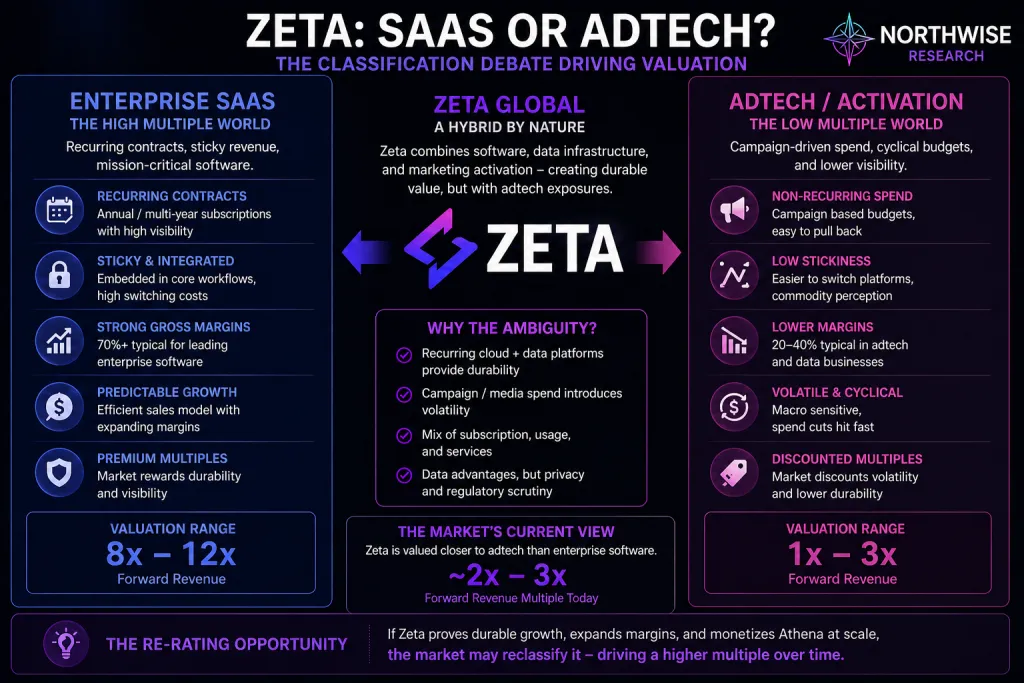
That gap is not a rounding error. It is the entire equity thesis. The free cash flow generation is sufficient to deliver a respectable absolute return even if the multiple never re-rates. The asymmetric upside, however, depends on whether the market eventually changes its mind about what kind of business Zeta is.
2.2 Why Classification Drives Multiples
Public-market valuation is largely a classification exercise. Customer data platforms, marketing clouds, and SaaS workflow tools earn premium multiples due to recurring contract structures, low cyclical sensitivity, and predictable expansion economics. Adtech and data businesses earn lower multiples due to campaign volatility, regulatory exposure, and weaker net retention dynamics.
Zeta sits inside both buckets simultaneously. A subscription-style platform fee anchors many enterprise relationships. Layered on top is a meaningful flow of campaign-driven, usage-based, and political-cycle-dependent revenue. The same dollar of EBITDA looks materially different depending on which bucket the analyst chooses to apply.
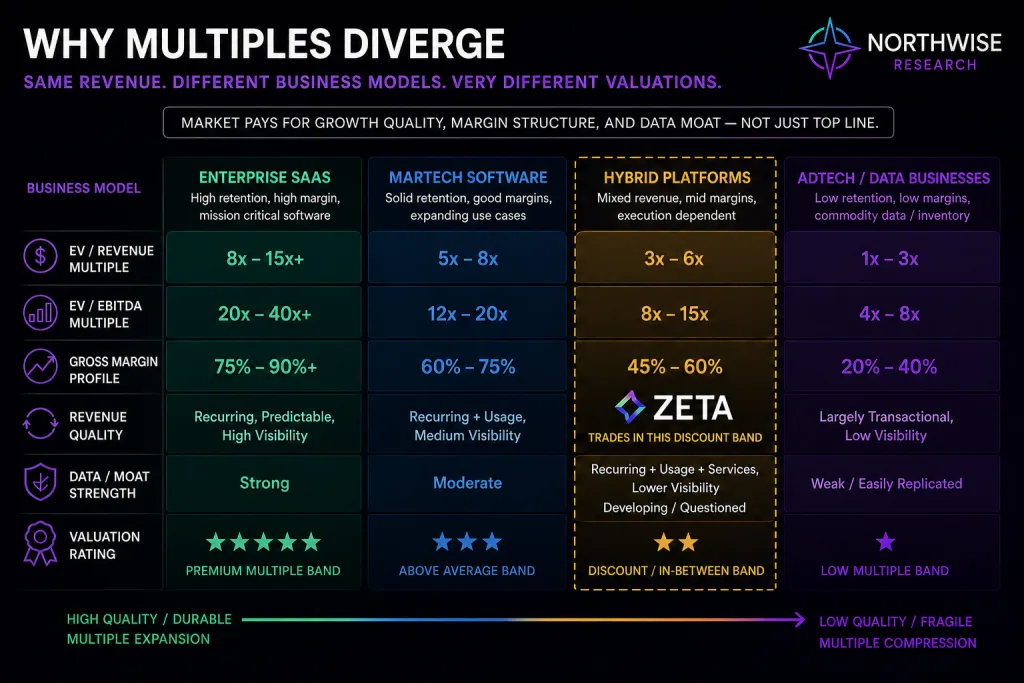
The classification problem is also self-reinforcing. Sell-side coverage tends to bucket Zeta with The Trade Desk, LiveRamp, and other data-and-activation businesses. The comparable set produces lower median multiples. The lower median multiples justify the lower target prices.
The lower target prices anchor investor expectations. The cycle continues until something forces a reclassification. That something is usually a combination of organic growth durability, retention disclosure, and a clean AI software product attached to recurring revenue. Whether Zeta delivers that combination by 2030 is the central question this report works through.
3. What Zeta Actually Sells
3.1 Core Product Overview
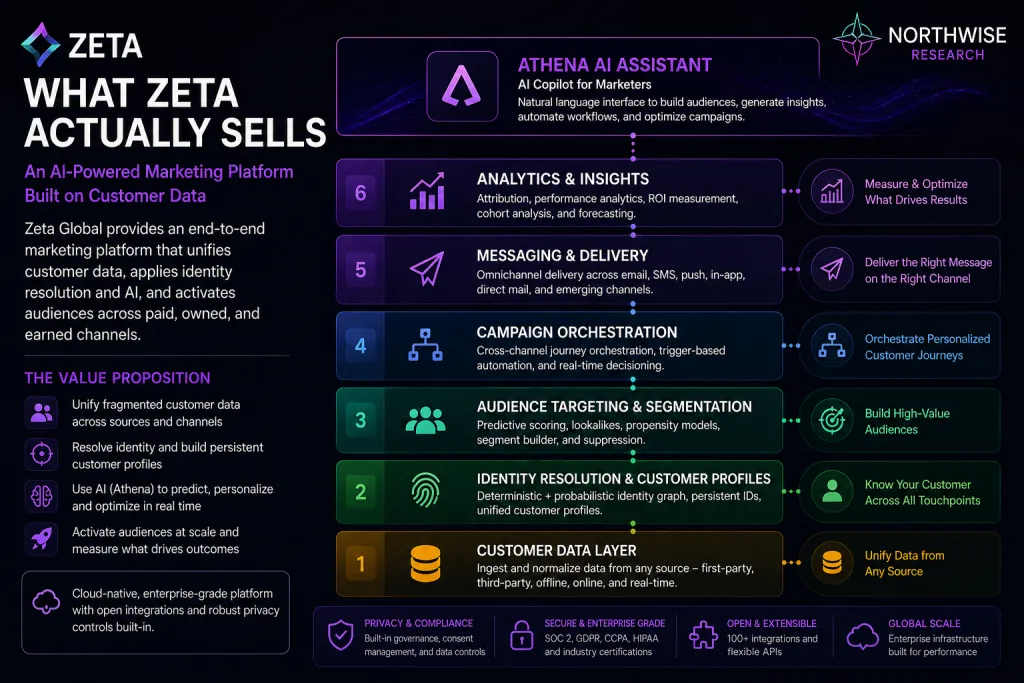
The Zeta Marketing Platform is an integrated system for finding customers, targeting them, acquiring them, retaining them, and re-engaging them across digital channels. The product surface includes customer data activation, identity resolution, audience targeting, campaign orchestration, email and messaging delivery, loyalty mechanics, and direct advertising activation. Athena, the company's AI interface, sits across the platform as a workflow layer for marketers building campaigns and interpreting outcomes.
In plain language, Zeta sells the machinery a large company needs to figure out which customer to talk to, what to say, where to reach them, and whether the message worked. The platform is engineered to compress what used to be a stack of three or four vendors into a single workflow, with the data layer, the activation layer, and the analytics layer running on shared infrastructure rather than stitched together with integrations.
The integration story matters more than it sounds. Marketing teams consistently report that the largest hidden cost in their stack is the engineering time required to connect a customer data platform to an email vendor to a programmatic buyer to an analytics tool. Zeta's pitch to enterprise buyers is that owning more of the stack reduces that cost, accelerates time-to-campaign, and produces measurable lift on acquisition and retention metrics.
3.2 Who Buys Zeta
The buyer base skews toward large enterprise marketing organizations. Customer acquisition teams use Zeta to identify and convert new prospects. Retention teams use it to expand share of wallet inside the existing book. Agencies sometimes deploy it on behalf of brand clients. Political and advocacy buyers use it during election cycles, generating roughly $15 million of disclosed political revenue in the 2026 guide.
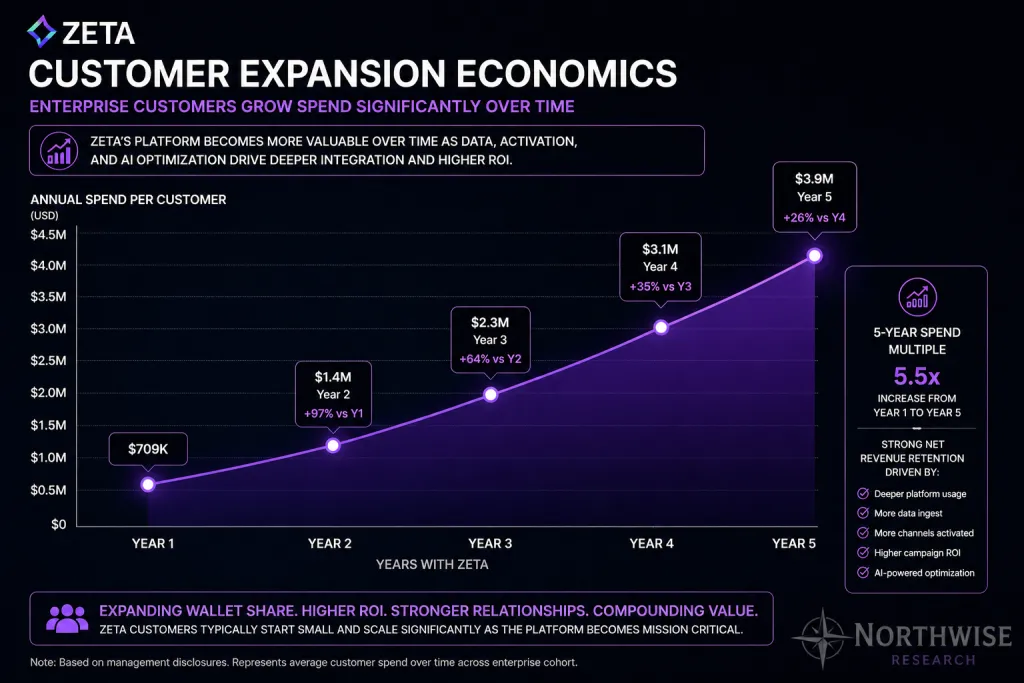
The economic shape of the customer base is more telling than the headcount. New customers in their first year on the platform averaged $709,000 of spend in 2025. Customers in the five-year cohort averaged $3.9 million, with 39% ARPU growth across that group. Multi-use case adoption rose 80% year over year, and management has stated that multi-use case relationships drive roughly five times the spend of single-use case relationships.
Those numbers describe a business that lands an account, embeds across more workflows over time, and grows wallet share materially as the relationship matures. They also describe a business that is highly dependent on enterprise sales execution. A single Fortune 500 logo at $3 million of annual spend matters more than dozens of mid-market accounts. The customer concentration risk that comes with that shape is real, even if Zeta has not disclosed enough granularity to size it precisely.
3.3 Where Zeta Sits in the Stack
Classifying Zeta against established software taxonomies is genuinely difficult. The platform contains pieces of a marketing cloud, with campaign management and journey orchestration. It contains pieces of a customer data platform, with identity resolution and data activation. It contains pieces of an adtech activation layer, with programmatic delivery and connected TV. It contains pieces of a CRM-adjacent workflow tool, with audience management and segmentation. And it increasingly contains pieces of an AI marketing assistant, with Athena.
That breadth is part of the bull case. A buyer evaluating Salesforce Marketing Cloud, Segment, The Trade Desk, and a separate AI tool can replace four vendors with one Zeta contract. The pitch is faster, cheaper, and more measurable. When it works, it works well, which is why the five-year cohort spends $3.9 million on average.
The breadth is also why the market has refused to assign a clean software multiple. Buyers do not always know what they are buying. Public investors face the same problem. A platform that does six things adjacent to marketing software cannot be valued cleanly against any single peer. Until Zeta produces clean, repeatable disclosures that force a reclassification, the multiple stays compressed.
4. Zeta's History and Platform Evolution
4.1 Founding and Leadership
Zeta was co-founded in 2007 by David Steinberg and John Sculley, the former Apple CEO. Steinberg continues to run the company today and remains the dominant operational and narrative force. He is high-energy, promotional, and measurably effective at landing enterprise customers. The voice of the company reflects that, for better and for worse. Investor communications often carry a tone closer to a sales kickoff than an institutional research call. The operating results, however, have generally backed up the rhetoric, which is the only reason the rhetoric is tolerated.
Christopher Greiner, the CFO, plays the more analytical counterweight role. His commentary on dilution, stock-based compensation, free cash flow conversion, and GAAP profitability has become the more reliable input for serious investors. The Steinberg-Greiner pairing has been stable for years and is responsible for the financial discipline that has emerged since 2023.
4.2 IPO to Present
Zeta went public in June 2021 at $10 per share, raising $215 million. The first three years of public life were difficult. The stock spent extended periods well below the IPO price, weighed down by GAAP losses, dilution, and skepticism about whether the platform claim was real or marketing.
The operating curve, however, kept advancing. Revenue grew from roughly $470 million in 2021 to $1.305 billion in 2025. Free cash flow margin expanded from negative to 12.6%. Adjusted EBITDA margin reached 21.4% in 2025. The company strung together 18 consecutive beat-and-raise quarters through Q4 2025.
Then in November 2024, Culper Research published a short report titled Zeta Global Holdings Corp (ZETA): Shams, Scams, and Spam, alleging that Zeta sourced data from a network of consent farms and engaged in revenue round-tripping with those data partners. The stock declined 37% in a single session. A securities class action followed within weeks. Zeta issued a detailed rebuttal arguing the report was riddled with factual errors, including misidentification of the company's auditor, and demonstrating that the partners Culper highlighted represented less than 3% of revenue and less than 1% of data assets. The legal overhang remains live.
The recovery from late 2024 through 2025 was driven by continued operating execution, the closing of the Marigold Enterprise Business acquisition, and the gradual rotation of investor attention back to the financial trajectory. The stock has not, however, returned to its pre-Culper levels.
4.3 Acquisition Strategy
Zeta has used acquisitions deliberately as a platform-building tool rather than as a financial engineering shortcut. LiveIntent, acquired in late 2024, expanded the email and identity infrastructure and added a meaningful publisher network. The Marigold Enterprise Business acquisition, which closed in late 2025, added approximately $190 million of annualized enterprise software revenue and tilted the consolidated mix slightly toward subscription characteristics. Smaller bolt-ons have filled out adjacent capabilities in CDP, data science, and creative tooling.
The strategic logic has been consistent: buy what fills a gap, integrate quickly, retain the customer base, and convert as much of the acquired revenue as possible to platform-style economics over time. By that standard, the acquisition program has worked. Marigold customers are migrating onto the integrated platform faster than initial guidance assumed. LiveIntent's identity assets are now embedded in Zeta's broader graph.
The cost of the strategy is visible in the share count. Acquisition consideration has historically included stock components, which contributed to the elevated dilution profile through 2024. The company has now committed to 3% to 4% net dilution in 2026 with continued reduction beyond, which would mark the end of the heavy acquisition-driven share issuance cycle if the trajectory holds.
4.4 Enterprise Migration
The most important strategic shift over the past three years has been the deliberate migration upmarket. Zeta now reports a growing population of $1 million-plus customers and a meaningfully expanded footprint inside the largest brand marketers. Five-year cohort customers average $3.9 million in annual spend. Multi-use case adoption is compounding at 80% year over year. The pipeline attributable to Zeta Live and CES customer events reached record levels in 2025, with $39 million already closed and over 200 opportunities totaling $130 million in pipeline.
This pattern matters because enterprise revenue is stickier, larger, and more durable than mid-market campaign work. Procurement cycles are longer, but contract sizes are bigger and switching costs are higher once the platform is embedded across multiple workflows. If the migration sustains, the revenue base earns higher quality over time without requiring any single product reclassification.
The migration also changes the competitive dynamic. At the mid-market level, Zeta competes with HubSpot, Klaviyo, Braze, and a long tail of point solutions. At the enterprise level, Zeta competes primarily with Salesforce Marketing Cloud, Adobe Experience Cloud, and in-house builds. The margin profile, retention dynamics, and multiple Zeta deserves all skew higher in the enterprise comparable set than in the mid-market set.
5. Business Model and Revenue Quality
5.1 Recurring Revenue Components
Most large Zeta accounts operate on multi-year platform agreements with committed minimums. These contracts behave more like enterprise software arrangements than campaign retainers. Customers commit to a baseline platform fee and consume additional capacity as their marketing activity scales. The base layer is contractually durable, the expansion layer scales with usage, and the renewal cycle is generally measured in multiple years rather than single years.
This is the part of the business that supports a software multiple. The Marigold Enterprise Business acquisition tilted the mix further in this direction by adding subscription contracts that operate cleanly on annual or multi-year structures. As the Marigold base integrates onto the broader Zeta platform, the share of revenue with software-like characteristics is rising.
5.2 Usage and Campaign Revenue
A significant portion of revenue scales with campaign volume. When customers run more outbound activity, send more messages, activate more audiences, or push more spend through Zeta-managed channels, revenue rises. When budgets compress, usage revenue compresses with it.
Direct revenue, which represents Zeta-managed activation across owned channels, made up 74% of revenue in 2025. Indirect revenue, flowing through partner channels, made up the balance. The growth of social and connected TV activation has been a meaningful contributor to direct revenue and a modest drag on consolidated gross margin, since those channels operate below the corporate average.
The behavior of usage revenue is what pulls Zeta's multiple toward the adtech end of the spectrum. A software contract that locks in $2 million of annual revenue regardless of customer activity deserves a higher multiple than a contract that locks in $400,000 of platform fees plus $1.6 million of variable usage that depends on the customer's marketing budget cycle. The dollars look the same in a single quarter. The terminal multiple does not.
5.3 Political Revenue Noise
Political candidate revenue is a recurring source of analytical friction. The 2026 guide assumes $15 million of political revenue, phased through the year with $7 million of that recognized in the first half. In 2024, political revenue was substantially larger due to the U.S. presidential cycle, which makes year-over-year comparisons through 2025 and 2026 require careful handling.
Management consistently breaks out organic growth excluding political and acquired revenue, which is the cleanest read on underlying momentum. The 2026 guide implies 20% to 21% growth on that basis, against 35% reported growth. The 1,500 basis point gap between reported and adjusted growth is the political-and-acquisition adjustment, and any forward modeling that treats reported growth as the underlying trend overstates the durable trajectory by a meaningful margin.
Political revenue is not bad revenue. It is high-margin and demonstrates that the platform performs in high-pressure activation environments. It is, however, episodic, and any modeling that treats $15 million of 2026 political revenue as a recurring base will produce inflated 2030 estimates.
5.4 Revenue Quality Framework
Our framework separates Zeta revenue into four buckets:
Component | Behavior | Multiple Implication |
|---|---|---|
Subscription platform fees | Recurring, contracted, sticky | Software-like |
Usage and campaign revenue | Cyclical, budget-sensitive | Adtech-like |
Political revenue | Episodic, every two to four years | Discounted |
Acquired revenue | Initial high mix, gradually integrated | Mixed |
The blended quality of those buckets, and the trajectory of the mix, ultimately decides whether Zeta deserves software multiples or stays trapped in the adtech bucket. The encouraging trend is that the subscription share is rising as Marigold integrates and as platform contracts grow. The persistent drag is that usage revenue remains a substantial component of the base, and political revenue still distorts the headline.
A fair forward read assumes that roughly 55% to 65% of revenue can be classified as platform-quality, with the remainder spread across usage, political, and transition-state acquired revenue. That mix, applied to consolidated free cash flow, drives the multiple range used later in the model.
6. Competitive Positioning
6.1 Versus Salesforce and Adobe
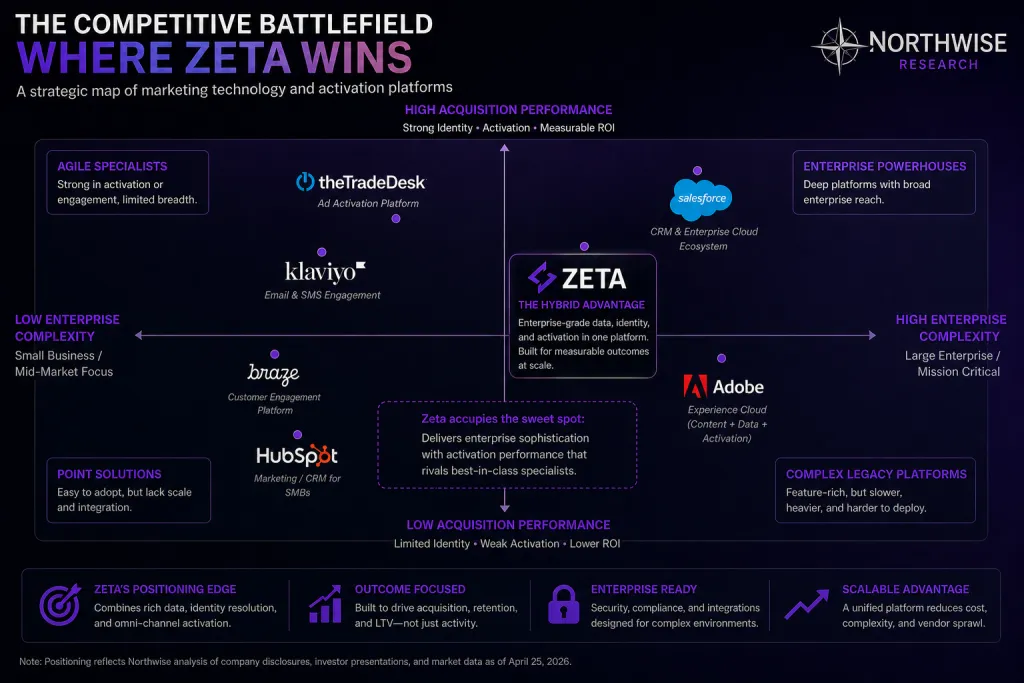
Salesforce Marketing Cloud and Adobe Experience Cloud are the entrenched incumbents in enterprise marketing software. Both sell broader suites with deeper general-purpose CRM and creative tooling, longer customer relationships, and stronger procurement defaults inside large IT organizations. Both also carry the slowness and integration debt that comes with twenty-year-old product portfolios assembled through acquisition.
Zeta wins against Salesforce and Adobe in three specific scenarios. First, when the buyer prioritizes acquisition outcomes over CRM workflow, Zeta's identity and activation depth tends to outperform. Management has cited share gains specifically from Adobe inside performance-oriented marketing departments. Second, when the buyer wants integrated AI workflow rather than bolt-on AI features, Athena's cross-platform design is harder for the incumbents to replicate quickly. Third, when the buyer values speed of deployment and measurable ROI over suite breadth and enterprise standardization, Zeta's smaller footprint becomes a feature rather than a limitation.
Zeta loses against Salesforce and Adobe in scenarios where suite consolidation, IT relationships, or contractual entrenchment dominate the decision. A Fortune 100 company already running Salesforce CRM with a multi-year enterprise agreement is unlikely to add Zeta as a primary marketing platform. The competitive battlefield is therefore less about pure product superiority and more about which workflow the customer chooses to build their marketing function around.
6.2 Versus HubSpot, Braze, Klaviyo
HubSpot, Braze, and Klaviyo are cleaner software stories than Zeta. Their revenue carries more recurring characteristics, their customer bases are simpler, and their products are easier to classify. They also serve different buyers. HubSpot dominates mid-market inbound marketing. Braze owns mobile messaging and lifecycle engagement at scale. Klaviyo dominates direct-to-consumer email and SMS for e-commerce brands.
Zeta competes with these companies less directly than the surface-level product overlap suggests. Zeta tends to land in larger, more complex enterprise environments where data activation across channels, identity resolution, and acquisition economics matter more than mid-market workflow simplicity. A direct-to-consumer brand on Shopify will choose Klaviyo. A Fortune 500 retailer with thirty channels and a hundred million customer records will at least consider Zeta.
The implication for the competitive moat is that Zeta is not directly competing with the cleaner SaaS comparables that the market uses to set martech multiples. The peer set most relevant to Zeta is enterprise marketing software at scale, which is closer to Salesforce and Adobe than to Klaviyo and Braze. The market often forgets this when assigning multiples.
6.3 Versus The Trade Desk
The Trade Desk is the public market's purest expression of independent programmatic advertising infrastructure. Its revenue is overwhelmingly tied to advertising spend that flows through its bidding platform. The take rate is modest, the gross margin profile is high, and the business is a clean play on the open internet's ad supply chain.
Zeta is closer to a marketing cloud than a demand-side platform. It owns more of the workflow, more of the data, and more of the activation, with less dependence on open-internet programmatic bidding. The Trade Desk is essentially a buying engine. Zeta is a buying engine plus a CDP plus a campaign management platform plus an identity layer plus an AI assistant.
Despite the structural difference, the public market has historically pulled Zeta's multiple toward The Trade Desk's adtech bucket rather than toward Salesforce's enterprise software bucket. This is a category error. The Trade Desk and Zeta should not trade at similar multiples on similar revenue, because the underlying revenue is doing different things. Whether the market eventually corrects this category error is the central re-rating question for Zeta over the next several years.
6.4 Versus In-House Teams
The most underappreciated competitor is the in-house data and marketing engineering team at the buyer. Large enterprises increasingly possess the technical capability to build pieces of an identity and activation stack internally. A Fortune 100 retailer with a 200-person engineering team can build a customer data platform, an audience builder, and a campaign orchestration layer if it chooses to.
Zeta's pitch is that buying is faster, more measurable, and more capable than building, particularly when AI workflow tooling like Athena reduces the labor cost of running campaigns. The pitch generally lands. Build-versus-buy economics for marketing infrastructure favor buying when the platform is meaningfully ahead of what an internal team can ship in twelve to eighteen months.
In-house build remains a real long-duration competitive risk. It is also, paradoxically, the competitor most likely to lose to AI-enabled platforms over the next decade, since enterprise IT teams tend to be slower to ship, harder to staff, and more political to fund than vendor product teams. The in-house build threat is therefore a tax on Zeta's pricing power rather than a structural ceiling on the business.
7. The Data Question: Moat or Liability?
7.1 Proprietary Data Claims
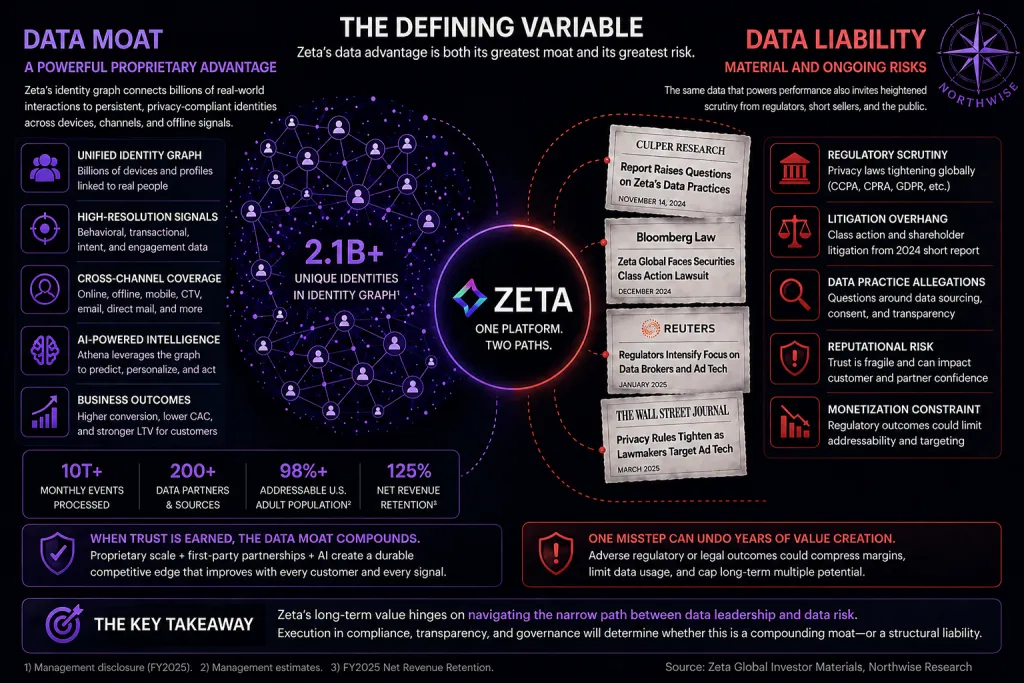
Zeta has long described its data assets as a competitive moat. The company maintains an identity graph it claims spans more than 240 million U.S. consumers with billions of behavioral signals. These signals power audience construction, identity resolution, and modeling outputs that drive campaign performance. The data layer feeds the activation layer, which is what allows Zeta to compress the marketing stack into a single platform.
If the data infrastructure is genuinely proprietary, defensible, and consent-compliant, it represents a real moat. Identity resolution is hard. Building a graph of 240 million consumers with reliable behavioral signals takes years of partner relationships, signal capture, and quality control. A competitor cannot replicate it overnight, even with substantial capital.
If, however, the data is partially sourced from third parties under fragile consent arrangements, the moat is weaker and the regulatory exposure is greater. The unresolved question of which version of that picture is closer to reality is what makes the data layer the most consequential single variable in the equity thesis.
7.2 Short Seller Allegations
On November 13, 2024, Culper Research published Zeta Global Holdings Corp (ZETA): Shams, Scams, and Spam. The report alleged two principal problems with the data and revenue picture. First, it claimed Zeta had formed two-way contracts with third-party consent farms in which Zeta acted as both supplier and buyer of consumer data, which Culper argued raised concerns about revenue round-tripping. Second, it claimed Zeta had spun up its own network of sham websites, including fake job boards and fake sweepstakes pages, designed to harvest consumer information under false pretenses.
Culper estimated that the consent farm revenue had driven a substantial share of Zeta's reported growth and adjusted EBITDA over the prior two years and argued that regulatory action could materially impair the business. Zeta's stock declined 37% on the day of the report. A securities class action followed within weeks. A separate class action complaint related to data collection practices was filed in August 2025.
The Culper report is now part of the public record on Zeta. Whether the specific allegations prove legally significant or not, the report shaped how the institutional investor community thinks about Zeta's data assets. That framing has not fully reversed.
7.3 Zeta Rebuttal
Zeta responded with a detailed point-by-point rebuttal within 24 hours, followed by a more comprehensive presentation a week later. The rebuttal argued that the report was riddled with factual errors. It noted that the report misidentified Zeta's auditor, miscalculated key financial metrics by hundreds of millions of dollars, and relied on questionable sources.
On substance, Zeta stated that the data partners Culper highlighted, Apptness and ArcaMax, collectively represented less than 3% of revenue in the trailing twelve months and less than 1% of data assets, with both contributions trending down. Digital Media Solutions, which Culper portrayed as a material partner, generated less than 0.1% of Zeta's revenue. Kubient, another entity flagged by Culper, had not been a material counterparty and the relationship had ended before the IPO.
Zeta also addressed the round-tripping allegation directly. Management stated that the audit committee is briefed quarterly on relationships with customers who are also vendors, that aggregate revenue from such relationships is insignificant, and that Deloitte issued unqualified opinions on both the financial statements and internal controls. The company has continued to win and renew large enterprise customers through 2025 and into 2026, which functions as indirect rebuttal: enterprise procurement scrutinizes data practices closely before signing seven-figure contracts, and the renewal pattern would have broken if procurement teams concluded that the consent flows were illegitimate.
7.4 Regulatory and Reputation Risk
The legal and regulatory question now sits at two levels. The narrow level concerns the specific Culper allegations and the related class action. Litigation of this kind tends to resolve through settlement rather than dismissal even when the underlying claims are weak, which means a financial impact in the low tens of millions is plausible regardless of the merits. That is a manageable cost.
The broader level concerns the regulatory environment for first-party data activation. Multiple new state privacy laws took effect in January 2026, with additional rules including California data broker provisions becoming effective mid-2026. The deprecation of third-party cookies, while a long-term tailwind for first-party data platforms, creates near-term signal loss across the broader ecosystem.
The interpretation that matters for the equity is the multiple effect rather than the legal effect. Even if no enforcement action ever lands, persistent regulatory scrutiny and headline risk can keep institutional buyers from paying software multiples for Zeta. The data question is therefore primarily a multiple question. The Culper report did not break the business. It did, however, lengthen the time horizon over which the market is willing to grant Zeta a software classification, which is the same as compressing the present value of the equity.
8. Athena and AI Optionality
8.1 What Athena Claims to Solve
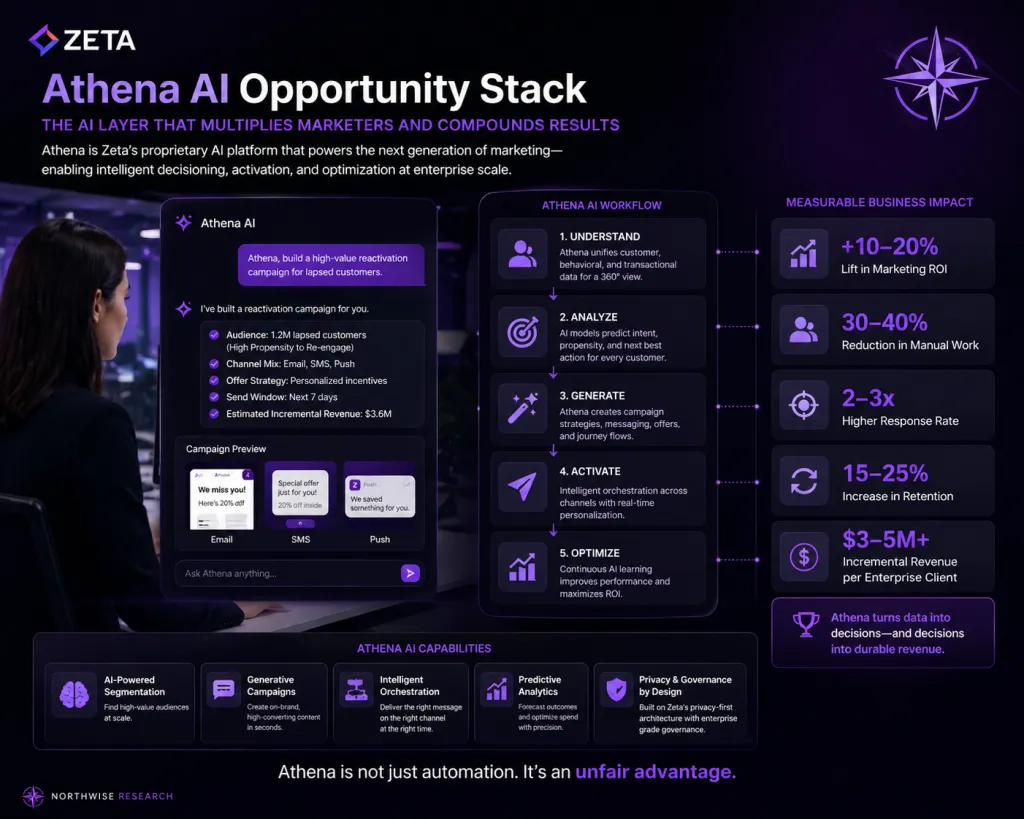
Athena is Zeta's AI interface across the marketing platform. Management positions it as a conversational layer for campaign creation, audience interpretation, and workflow automation. The pitch includes faster campaign launches, lower service intensity, smarter audience recommendations, and eventually agentic execution of marketing tasks where Athena builds, launches, and optimizes campaigns with limited human input.
General availability is targeted for the end of March 2026. Until that point, Athena has been deployed selectively across enterprise customers with engineering support from Zeta's services organization. The general availability milestone is significant because it converts Athena from a deployment-by-deployment custom rollout into a standard product offering that any enterprise customer can adopt without bespoke implementation.
8.2 OpenAI Partnership
Athena is built with an OpenAI relationship for foundational model capability. The strategic value of the partnership is access to frontier model performance and the implicit endorsement that comes with being one of OpenAI's named enterprise application partners. Zeta is referenced in OpenAI's enterprise marketing materials, which provides distribution-side benefit during sales cycles where buyers want comfort that the AI layer is built on a credible foundation.
The risk is dependence. Zeta does not control the pricing, alignment, or roadmap of the underlying model. If model costs decline as expected through 2027 and 2028, the dependency becomes economically benign. If model access becomes contested or expensive, Athena's unit economics suffer. The exposure is bounded by the fact that Zeta could reasonably substitute alternative models if costs shifted unfavorably, but the substitution would not be costless and would extend the product roadmap by several quarters.
8.3 What Proof We Need
For Athena to deserve real value in the model, several proof points must arrive over the next four to six quarters. Attach rates need to be disclosed. Customer wins explicitly tied to Athena need to appear in earnings narrative with revenue weight. Net revenue retention should rise rather than stay flat. Service intensity should decline, which would show up as expanding gross margin on the services line and reduced headcount per dollar of revenue. Onboarding timelines should compress. Campaign performance lift should be measurable in disclosed customer cases. Pricing power should follow.
So far, the evidence is suggestive but not conclusive. Management cites Athena adoption in customer narratives and in the earnings prepared remarks. Multi-use case adoption, which Athena is designed to accelerate, did grow 80% year over year in 2025. Service intensity has been improving. None of these data points, however, is yet specific enough to underwrite a meaningful Athena premium in the 2030 model. The general availability launch in March 2026 is the gating event for the next wave of disclosure.
8.4 How We Value Athena
Across our scenarios, Athena receives no value in the bear case. The product ships, generates short-term narrative attention, and fails to produce measurable retention, attach, or pricing impact. Multiple expansion does not arrive on the back of AI optionality.
Athena receives modest credit in the base case, primarily through margin expansion of roughly 100 to 200 basis points over the period and slightly improved net retention. This is the outcome consistent with a useful but not transformational AI workflow tool, which is roughly the central tendency of how AI features have actually played out across enterprise software through 2025 and 2026.
Athena receives meaningful credit in the bull case, where it drives both operating margin expansion of 300 to 400 basis points and a multiple re-rating that moves Zeta from the adtech bucket toward the enterprise AI software bucket. In that outcome, Athena is the catalyst that resolves the classification problem.
This treatment intentionally avoids paying for Athena before the proof exists. Most of the equity value in the model comes from the underlying business compounding free cash flow. Athena's role is to either deliver upside through reclassification or fail quietly without breaking the rest of the thesis.
9. Financial Quality Review
9.1 Revenue Growth
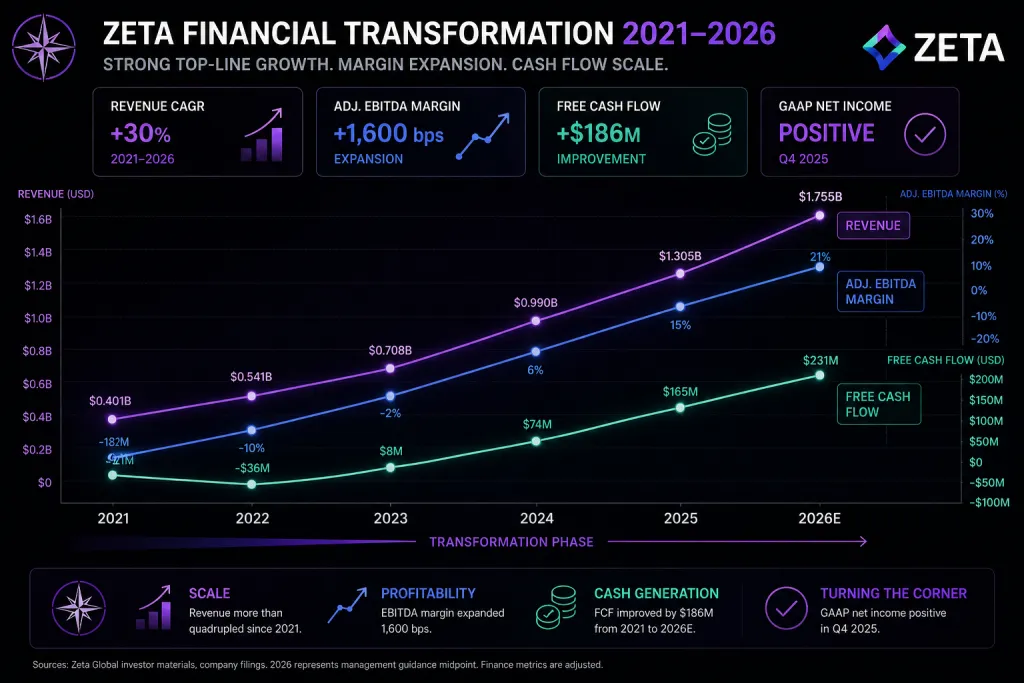
2025 revenue of $1.305 billion grew 30% year over year, or 27% excluding acquisitions and political revenue. 2026 guidance sits at roughly $1.755 billion at the midpoint, representing 35% reported growth and 20% to 21% growth excluding political and Marigold contributions. Management has now strung together 18 consecutive beat-and-raise quarters, which is meaningful evidence of internal forecasting discipline regardless of whether the beats are heroic in size.
The reported headline overstates organic momentum. Adjusted growth in the 20% range remains attractive but not exceptional, and it is the right anchor for forward modeling. Investors who use the 35% reported figure as the trend rate will produce 2030 estimates that are roughly 30% to 40% too high.
The trajectory is also reasonably credible against management's longer-term targets. The 2028 model implies revenue growth of approximately 15% per year from 2026 to 2028 on the reported base, which decomposes to high-teens organic growth plus residual acquisition contribution. That is consistent with the historical pattern and with the size of the addressable market in enterprise marketing software.
9.2 Margin Profile
Adjusted EBITDA margin moved from approximately 19% in 2024 to 21.4% in 2025 and is guided to roughly 22.2% in 2026. The 2028 target implies a 25% adjusted EBITDA margin. Gross margin sits in the low 60s, with some downward pressure from the growth of social and connected TV activation, which operates below the corporate average.
Operating leverage is real. Sales productivity improves as the platform deepens within existing customers, which is what the multi-use case adoption growth captures. Services intensity declines as Athena and product maturity reduce the implementation labor required per dollar of revenue. Platform infrastructure scales sub-linearly with revenue. Each of these effects is small in any single quarter and meaningful when compounded over four years.
The risk to the margin trajectory is mix-driven rather than cost-driven. If usage revenue grows faster than subscription revenue, gross margin pressure increases. If indirect revenue grows faster than direct revenue, the same dynamic plays out at a different layer of the income statement. The margin path therefore depends partly on the revenue mix shift, not just on operational efficiency.
9.3 Free Cash Flow Quality
Free cash flow expanded from a 9.2% margin in 2024 to 12.6% in 2025 and is guided to 13.1% to 13.3% in 2026. The 2028 model target is approximately $371 million of free cash flow at a 16% margin, representing 65% conversion of adjusted EBITDA. This is the single most important trajectory in the equity story.
The conversion ratio matters as much as the absolute margin. A business that converts 65% of adjusted EBITDA to free cash flow has a meaningfully cleaner financial profile than one converting 40%. The improvement in conversion has been driven by reduced cash outlays for acquisitions, lower interest expense, and disciplined working capital management. The trajectory implies that Zeta is gradually behaving more like a free cash flow compounder and less like a growth-investment vehicle.
If the margin expansion holds through 2030, the company can compound owner cash without relying on multiple expansion. If it stalls, the equity loses one of its main supports. The free cash flow path is more important to the 2030 outcome than any single qualitative narrative about the business.
9.4 SBC and Dilution
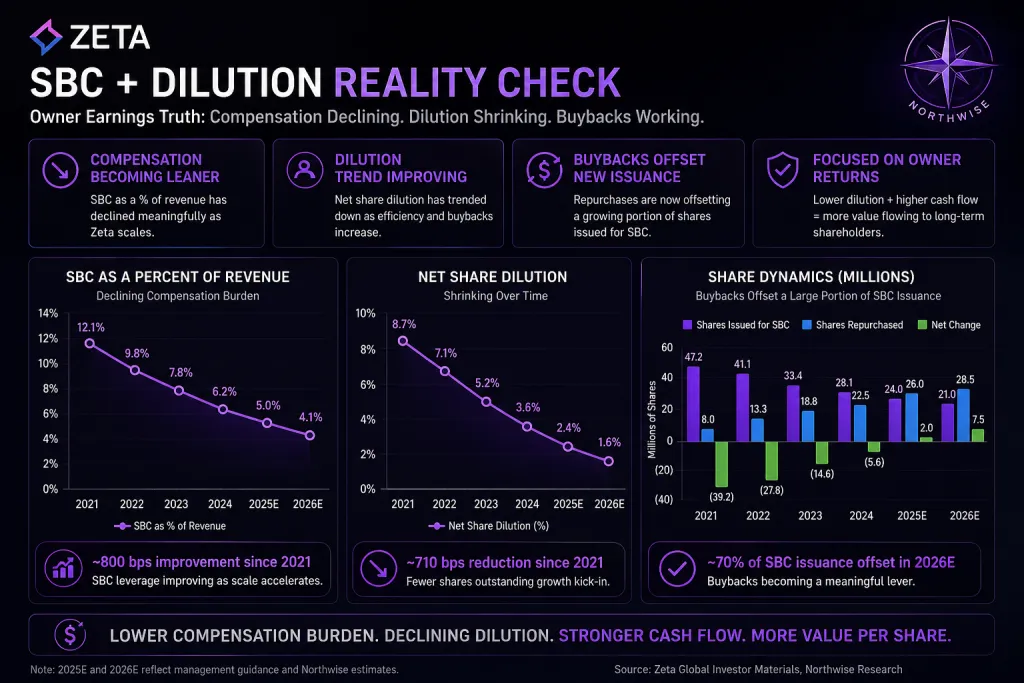
Stock-based compensation as a percentage of revenue improved from 19% in 2024 to 14% in 2025. Management has guided to further reduction in 2026. Net dilution in 2025 was 4.3%, or 2.2% excluding the Marigold acquisition. The 2026 target is 3% to 4% net dilution, with continued reduction beyond.
The buyback program has been active. Zeta repurchased 7.9 million shares for $120 million in 2025 and an additional 1.5 million shares for $25 million in the first six weeks of 2026. The current authorization had $139 million remaining as of the Q4 2025 report. Repurchases offset dilution but do not eliminate the dilution drag on per-share compounding. A business with 4% net dilution and a 5% buyback yield has effectively flat share count, but it is consuming all of its repurchase capacity to stand still rather than retiring shares net of issuance.
The honest read is that SBC and dilution are improving materially, that the trajectory is credible, and that the absolute level remains higher than clean software peers. This is one of the genuine reasons the multiple has stayed compressed, and it is also one of the reasons we use free cash flow rather than adjusted EBITDA in the model. EBITDA understates the cost of equity issuance. Free cash flow does not.
10. Customer Quality and Retention
10.1 Enterprise Expansion
Zeta has added a meaningful population of $1 million-plus customers over the past three years. The five-year cohort now averages $3.9 million in annual spend with 39% ARPU growth in 2025. Multi-use case adoption rose 80% year over year. The pipeline attributable to Zeta Live and CES customer events reached record levels.
These numbers describe a customer base that is moving up the spend curve as it ages, which is the most favorable retention signal a platform business can produce. A new customer that grows from $709,000 in year one to $3.9 million by year five has effectively expanded its commitment by 5.5x over the period. That kind of expansion is not consistent with adtech behavior, where revenue tends to oscillate with campaign budgets rather than compound with platform depth.
10.2 Net Revenue Retention
Reported net revenue retention has run near 120%. That figure is healthy, particularly for a hybrid platform with material usage and political revenue components. It supports the claim that customers expand their relationship with Zeta over time and that the average customer is worth more in year three than in year one.
The 120% NRR is also a useful sanity check on the cohort spend data. If the five-year cohort averages $3.9 million versus $709,000 in year one, the implied annualized expansion rate is consistent with mid-teens NRR plus mid-single-digit logo-level retention contribution. The two data points line up roughly, which is the kind of internal consistency that should give investors more confidence in both numbers.
10.3 Gross Retention Gap
The disclosure gap that limits confidence is gross retention. NRR alone cannot distinguish between a base of 100 customers in which all 100 retain and most expand, versus a base of 100 customers in which 90 retain, 10 churn, and the remaining 90 expand fast enough to push the headline above 100%. Both pictures produce similar NRR. They imply very different things about the durability of the platform and the cost of replacing churned revenue.
Software companies that take retention seriously generally disclose gross retention alongside NRR. Zeta has not. The absence of consistent gross retention disclosure is a fair reason for the market to discount the platform claim until that data is shared. If gross retention is in the high 90s, Zeta's platform claim looks much stronger. If gross retention is in the high 80s, the picture changes meaningfully and the multiple compression starts to make more sense.
This is one of the disclosures we are watching most closely over the next two to four quarters.
10.4 Why Customers Leave
The reasons enterprise customers leave Zeta, when they do, generally include suite consolidation onto Salesforce or Adobe during enterprise license negotiations, in-house rebuilds during budget tightening cycles, privacy or compliance concerns surfaced through procurement reviews, poor campaign performance for a specific use case, integration complexity with internal data systems, and procurement-driven vendor rationalization in cost-cutting environments.
The list is unremarkable. Every enterprise software company faces the same set of churn drivers. What matters is the rate, the trend, and the slope. The cohort expansion data the company does disclose suggests the trend is favorable, with longer-tenure customers spending more rather than less. The absence of clean gross retention disclosure leaves the rate unverifiable. Until that gap closes, our model treats retention as a probability distribution rather than a fixed input.
11. Management and Capital Allocation
11.1 What Management Gets Credit For
The Steinberg-Greiner pairing has delivered on a long sequence of operational commitments. Revenue growth has compounded above 25% organically. Free cash flow has accelerated. Adjusted EBITDA margin has expanded year over year for three consecutive years. GAAP profitability has crossed into positive territory. Stock-based compensation as a percentage of revenue has declined materially. The 18-quarter beat-and-raise streak through Q4 2025 is real evidence of forecasting discipline rather than narrative manipulation.
The Marigold acquisition was structurally additive and was integrated faster than initial guidance suggested. The buyback program has been active during periods when the equity has been under pressure, which is the correct counter-cyclical capital allocation behavior for a company whose management genuinely believes the equity is mispriced. Greiner's commentary on dilution targets and free cash flow conversion has been measurably more disciplined over the past 18 months than it was earlier in the public life of the company, which suggests an internal cultural shift toward shareholder-aligned metrics.
11.2 Where Skepticism Remains
The communication style remains promotional. Steinberg's earnings tone is closer to a sales kickoff than a research call, which produces ongoing friction with institutional investors who prefer measured commentary. The disclosure gaps around gross retention, Athena attach rates, and the precise organic-versus-acquired growth bridge are larger than they should be for a company at this revenue scale.
Acquisition cadence still drives a meaningful share of reported growth, even though organic momentum has improved. Stock-based compensation is declining but remains elevated relative to peers like Klaviyo or Braze, which run SBC closer to 10% of revenue. The Culper response, while detailed and credible, has not fully resolved the institutional investor overhang on data practices. Zeta has done much of the work required to rebuild trust. The work is not finished.
Net assessment: management deserves credit for execution. The trust premium, however, is not yet fully earned. The investor relations function deserves slightly less benefit of the doubt than the operating team.
12. 2030 Forecast Methodology
12.1 Baseline Inputs
The model anchors on 2026 guidance: $1.755 billion in revenue, $231 million in free cash flow, 13.2% free cash flow margin. The starting share count is approximately 245 million on a forward diluted basis, accounting for the 240.6 million reported as of October 2025 plus expected 2026 issuance net of buyback activity. Adjusted growth excluding political and Marigold contributions is approximately 20%, which we use as the conservative growth anchor for forward scenarios.
The 2028 management target of $2.3 billion in revenue and $371 million in free cash flow serves as a directional check on plausibility, not as a guaranteed waypoint. Forward forecasting beyond 2028 requires extending the trajectory through 2030 with explicit assumptions about how growth, margin, dilution, and multiple evolve as the business matures.
12.2 Why We Use FCF
Free cash flow captures the owner-level value of the business after stock-based compensation, capital expenditure, and working capital effects. Adjusted EBITDA overstates owner economics for any business with material SBC, since the EBITDA line treats stock issuance as a non-cash item that does not actually exist for the purposes of valuing the equity. The shareholder ultimately bears the cost of share issuance through dilution, regardless of how the income statement presents it.
Zeta's SBC, while declining, remains too large to ignore at 14% of revenue in 2025. Free cash flow, which captures the cash generation of the business net of capital outlays, is therefore the cleanest valuation anchor. A business that generates $231 million of free cash flow with 4% net dilution is a different business than one generating the same EBITDA with 1% net dilution. The model needs to capture that distinction, and free cash flow does it cleanly.
12.3 Why We Do Not Use SaaS Multiples
A clean enterprise SaaS company growing 25% with 25% free cash flow margin and 1% to 2% dilution can reasonably trade at 25x to 35x free cash flow. Zeta does not yet meet those qualifications. Revenue mix includes campaign and political components. Gross retention disclosure is incomplete. Privacy overhang persists from the Culper litigation. Dilution is improving but remains above clean software norms. Athena is unproven economically.
Until those gaps close, applying a SaaS multiple would prepay for an outcome that has not arrived. The model uses lower multiples that reflect classification ambiguity. If the gaps close, the multiples migrate upward over time. If the gaps persist, the multiples stay compressed. The asymmetry of the model is asymmetric in part because of this assumption: we are not paying today for software multiples that may or may not materialize, which means the upside scenario delivers genuine multiple expansion rather than simply confirming an assumption already baked into the price.
12.4 Scenario Construction
The model uses three scenarios across revenue CAGR, free cash flow margin, dilution, and exit multiple. Each scenario is internally consistent. The bear case combines slower growth with lower margin, higher dilution, and a discounted multiple. The base case combines durable mid-teens growth with moderate margin expansion, declining dilution, and a partial software re-rating. The bull case combines high-teens growth with full margin expansion, dilution discipline below 2%, and a meaningful multiple re-rating toward enterprise software peers.
Probability weighting reflects current evidence rather than aspiration: 30% bear, 50% base, 20% bull. The bear weight is non-trivial because the structural risks around classification, retention disclosure, and privacy are real. The bull weight is bounded because the proof points required for the bull case have not yet arrived. The base case carries the largest weight because the operating trajectory is healthy enough to support continued compounding even without a full reclassification.
13. Bear Case Scenario
13.1 Growth Assumptions
Revenue grows at a 9% CAGR from 2026 through 2030. Organic momentum slows from the current 20% range to high single digits as enterprise budgets tighten, privacy frictions slow new logo acquisition, and acquisition contribution fades. The 2028 management target of $2.3 billion is missed by a low single-digit percentage. The five-year cohort expansion dynamic continues, but new logo acquisition slows enough to drag headline growth below the trend.
The bear growth path is not catastrophic. It is consistent with a business that retains and modestly expands its existing customer base while struggling to add new logos at the pace required to compound. This is a plausible outcome if the privacy overhang lengthens enterprise procurement cycles or if Athena fails to differentiate the product enough to win competitive RFPs.
13.2 Margin Assumptions
Free cash flow margin holds near 13% through 2030. Operating leverage stalls as higher data sourcing costs, persistent service intensity, and incremental compliance investment offset the gains from platform scale. Adjusted EBITDA margin holds in the low 20s but does not advance toward the 25% management target. Gross margin remains under modest pressure from the continued growth of social and connected TV activation.
The flat margin profile is the more important constraint than the slower revenue growth. A business that grows 9% with flat margins does not compound free cash flow meaningfully. The bear case is fundamentally a compounding failure rather than a growth collapse.
13.3 Dilution Assumptions
Net dilution remains near 4% annually through the period. Buybacks continue at the current pace but cannot fully offset SBC issuance because the equity does not re-rate, which means each repurchase dollar retires fewer shares than it would at a higher multiple. Share count expands by approximately 17% over the four-year period despite ongoing buyback activity.
The dilution drift in the bear case is the second compounding failure. A business that grows free cash flow at low single-digit rates while expanding share count at 4% per year is not creating per-share value at all. The bear case essentially deletes the per-share compounding story.
13.4 Narrative Outcome
The market keeps Zeta inside the data-risk adtech bucket. Athena adds narrative value but does not produce measurable financial uplift. The Culper overhang lingers, kept alive by ongoing class action proceedings and incremental privacy regulation. The platform continues to grow, but the equity is valued like a marketing services and data business with cyclical revenue characteristics.
Free cash flow per share compounds slowly. The multiple stays compressed. The stock works as a cigar-butt-style cash flow holding rather than a compounder. The total return is modest at best, and concentrated risk in the position is not justified.
14. Base Case Scenario
14.1 Growth Assumptions
Revenue grows at a 14.5% CAGR from 2026 through 2030. Organic growth holds in the low to mid teens through the period, supported by continued enterprise customer expansion and multi-use case adoption. Marigold and other acquired revenue is fully integrated by 2027 and contributes a stable base rather than a transition-state mix. The 2028 management target of $2.3 billion is met within a range, with full-year revenue landing slightly above $2.3 billion at the midpoint of the case.
The base growth path is consistent with the company executing on its current trajectory without major disappointment and without a transformational catalyst. It is the most probable outcome given the operating evidence through Q4 2025 and the visibility into 2026.
14.2 Margin Assumptions
Free cash flow margin expands from 13% to roughly 18% by 2030. Operating leverage shows up cleanly as platform scale economics outpace incremental sales and services investment. Athena contributes modestly through reduced service intensity and modest pricing power, adding roughly 100 to 200 basis points of margin over the period. Adjusted EBITDA margin trends toward the mid 20s, broadly consistent with management's 2028 target.
The margin path is the most consequential piece of the base case. Each 100 basis points of free cash flow margin expansion adds approximately $30 to $35 million of free cash flow at the 2030 revenue scale. The compounding effect of margin expansion plus revenue growth is what drives the case.
14.3 Dilution Assumptions
Net dilution declines to 3% in 2026, 2.5% in 2027 and 2028, and 2% by 2030. Buybacks continue throughout the period and become more effective as the equity gradually re-rates. Stock-based compensation as a percentage of revenue declines further as the company matures and as the equity's higher absolute price reduces the share count required to deliver a given dollar of compensation expense.
By 2030, share count is roughly flat to modestly higher than the 2026 starting point, depending on the buyback authorization renewal cadence. The per-share compounding picture is materially better than the bear case.
14.4 Narrative Outcome
The market grants partial software credit. Zeta is no longer treated as adtech but is not yet treated as a clean enterprise SaaS platform. The multiple expands modestly from current levels but does not reach the high-quality martech software comparable set. Free cash flow per share compounds at a healthy rate, and the equity becomes a respectable medium-conviction position.
The base case is not a thrilling outcome. It is, however, a reasonable risk-adjusted outcome consistent with a business that executes on its plan without a transformational reclassification. Most equity investments work or fail at this level of operating performance rather than at the bear or bull extremes.
15. Bull Case Scenario
15.1 Growth Assumptions
Revenue grows at a 20% CAGR from 2026 through 2030. Organic growth sustains in the high teens through the period, supported by Athena-driven new logo acquisition, accelerating enterprise consolidation toward integrated AI-enabled marketing platforms, and continued depth within existing customer relationships. The 2028 management target is exceeded by a meaningful margin, with revenue tracking toward $2.5 billion or more in 2028.
The bull growth path requires Athena to function as a genuine commercial accelerant rather than a workflow improvement, and it requires the broader enterprise software market to consolidate around AI-native platforms in a way that benefits Zeta directly. Both are plausible but neither is guaranteed.
15.2 Margin Assumptions
Free cash flow margin expands to roughly 24% by 2030, in line with high-quality martech software peers. Adjusted EBITDA margin moves toward 28%. Athena reduces service intensity, lifts retention, and supports moderate pricing power, contributing 300 to 400 basis points of margin over the period. Gross margin stabilizes in the mid 60s as direct revenue mix continues to shift toward high-margin platform fees.
The bull margin path is what produces the most dramatic free cash flow generation. At 24% free cash flow margin on $3.6 billion of revenue, the company would generate over $850 million of annual free cash flow, against roughly $231 million today. The compounding effect of margin plus revenue growth is the dominant lever in the bull case.
15.3 Dilution Assumptions
Net dilution declines below 2% annually within two years and toward 1% to 1.5% by 2030. Buybacks accelerate as cash flow grows and as the equity re-rates higher, which makes each repurchase dollar more efficient at retiring shares. Stock-based compensation as a percentage of revenue trends toward high single digits.
By 2030, share count is meaningfully lower than the 2026 starting point, with net buyback retiring roughly 5% to 8% of shares cumulatively over the period. The per-share compounding effect is dramatic, and the equity behaves like a true software compounder rather than a hybrid.
15.4 Narrative Outcome
The market reclassifies Zeta as a scaled AI-enabled enterprise marketing software platform. Privacy overhang fades as the regulatory environment stabilizes, Zeta's first-party data positioning becomes clearer relative to third-party-cookie-dependent peers, and the Culper litigation resolves without material financial or reputational damage. The multiple re-rates toward high-quality martech software comparables.
Free cash flow per share compounds rapidly. The equity becomes a top-tier holding for investors who positioned during the 2025 to 2026 reclassification window. The total return is meaningfully higher than the base case and justifies sizing the position accordingly.
16. Stress Tests
16.1 Recession Scenario
A meaningful U.S. recession compresses marketing budgets across the customer base. Sales cycles extend by three to six months. New logo acquisition slows. Usage and campaign revenue declines disproportionately because it is more directly tied to discretionary marketing spend than subscription platform fees.
The 2030 outcome migrates toward the lower end of the bear case rather than the base case. Revenue growth slows by an additional 300 to 500 basis points across the recession year and the year following. Free cash flow margin compresses by 100 to 200 basis points as operating leverage reverses. Recovery into the base case is plausible but takes 18 to 24 months from trough.
The recession stress is the most ordinary and most probable of the stress scenarios. It does not break the equity thesis, but it delays it.
16.2 Privacy Crackdown Scenario
Aggressive new federal privacy legislation, or a substantial enforcement action against a major data partner in the marketing technology ecosystem, raises data sourcing costs and lengthens enterprise procurement cycles. Multiple compression persists. Athena's economics are partially impaired by additional compliance overhead. The Culper litigation gains momentum if the regulatory environment shifts in ways that lend credibility to the underlying allegations.
The privacy stress is the most equity-impactful of the stress scenarios. It does not necessarily affect the operating business in the near term, but it caps the multiple at adtech levels indefinitely. Even if free cash flow grows as planned, the equity does not re-rate. Total return is mediocre.
16.3 No Re-Rating Scenario
The business performs in line with the base case operationally. Revenue compounds at 14% to 15%. Free cash flow margin reaches 18%. Dilution declines toward 2%. Athena ships and produces measurable but modest improvement. None of these are catalytic enough to force a market reclassification. The market continues to apply adtech multiples even as the underlying revenue mix shifts toward subscription characteristics.
In this scenario, investors earn the cash compounding return but receive no benefit from re-rating. Total return becomes adequate but not exceptional. The bull case is foreclosed without any single failure point being identifiable. The thesis still works on per-share free cash flow, but the asymmetric upside disappears.
16.4 Dilution Drift Scenario
Stock-based compensation declines slower than guided. Net dilution stays near 4% across the period rather than declining toward 2%. Per-share value compounds at a meaningfully slower rate than the operating business. The buyback program runs at the current pace but cannot offset the issuance.
This stress matters because it would essentially nullify the per-share compounding case even if revenue and free cash flow grow as planned. Total return becomes unattractive on a per-share basis. The equity underperforms even with respectable headline operating metrics. Watching the dilution trajectory is therefore one of the most important ongoing diligence tasks for the position.
16.5 Athena Failure Scenario
Athena ships in March 2026, generates short-term narrative attention, and then fails to produce measurable retention, attach, or pricing impact through 2027 and 2028. Customer adoption is broad but shallow. Service intensity does not decline. Net retention does not rise. Pricing power does not emerge. The product is useful but not differentiating.
In this scenario, multiple expansion does not arrive. Athena adds no value to the model beyond its contribution to general operating efficiency, which is small. The equity defaults toward the base case operationally but loses the bull case upside entirely. The bear case probability rises from 30% toward 35% to 40%.
17. What Breaks the Thesis
17.1 Operating Breakpoints
The thesis breaks operationally if organic growth falls below low double digits on a sustained basis. Sustained means more than two consecutive quarters of decelerating growth at the adjusted level, not a single quarter of weakness. A year of high single-digit organic growth with no catalyst for re-acceleration would force a re-evaluation of the entire base case.
Multi-use case adoption stalling is the second operating breakpoint. The current 80% year-over-year growth rate is what supports the platform claim. If that growth rate compresses below 30% to 40% within twelve months, the platform-deepening story is meaningfully weaker, and the five-year cohort expansion economics start to look less reliable.
Five-year cohort ARPU expansion decelerating sharply is the third operating breakpoint. The 39% growth in that cohort in 2025 is what underwrites the long-term per-customer value claim. If cohort ARPU growth falls below 15% to 20%, the platform is behaving more like a static vendor and less like a compounding software relationship.
Large enterprise customers churning or materially reducing spend would be the fourth breakpoint. Zeta does not disclose customer concentration in detail, but the size of the largest customers is meaningful enough that two or three departures could create a noticeable revenue gap. Public departure announcements would also damage the platform claim in a way that lingers beyond the immediate revenue impact.
17.2 Financial Breakpoints
Free cash flow margin stalling below mid-teens for more than two years would break the base case. The model relies on continued margin expansion as a primary driver of equity value. Stagnant margin removes that lever.
Stock-based compensation remaining elevated relative to free cash flow is the second financial breakpoint. If SBC stays above 12% of revenue while free cash flow margin sits at 15%, SBC is consuming most of the cash generation and the equity has limited capacity to compound on a per-share basis. The current trajectory, with SBC declining toward 10% of revenue, is necessary for the per-share thesis.
Net dilution staying above 4% annually is the third. Combined with elevated SBC, persistent dilution would essentially eliminate the per-share compounding case regardless of how strong the headline operating metrics look.
The buyback program slowing or terminating without offsetting SBC issuance is the fourth. The current buyback pace is what holds the share count roughly flat against ongoing dilution. If management redirects capital toward acquisitions or other uses without sustaining the repurchase activity, the share count expansion accelerates and the per-share economics weaken.
17.3 Strategic Breakpoints
Privacy concerns escalating into a regulatory action that limits Zeta's ability to source or activate data is the most consequential strategic breakpoint. A specific FTC action, a state attorney general enforcement, or a court ruling that constrains the operating model would force a structural rethink of the thesis. The probability of this is not zero, particularly given the active class action and the post-Culper regulatory environment.
Athena failing to ship credibly or failing to demonstrate measurable customer or margin impact within 18 months of general availability is the second strategic breakpoint. Athena does not need to be transformational for the base case to hold, but it does need to be commercially functional. If the March 2026 launch fails to produce measurable customer adoption metrics by mid-2027, the AI optionality is effectively zero and the bull case is foreclosed.
Enterprise procurement beginning to flag Zeta over data practices on a systematic basis would be the third. If Zeta starts losing competitive RFPs specifically due to data sourcing concerns, the procurement-level damage from the Culper episode is more lasting than currently appears. This would show up in disclosed customer commentary, in slowing new logo acquisition, and in lengthening sales cycles. We are watching for any of these signals.
A major customer publicly leaving the platform with stated reasons would be the fourth. Public departures are rare and damaging beyond their direct revenue impact because they signal to the procurement community that Zeta is not a safe choice.
If two or more of these breakpoints arrive together, the bear scenario becomes the base scenario, and our position view tightens accordingly.
18. What Would Make Us More Bullish
18.1 Financial Proof
Organic growth sustaining above 15% after 2026 would be the first piece of financial proof that pulls us toward the bull case. The 2026 guide implies 20% adjusted growth. If that holds through 2027 and 2028 rather than decelerating, the underlying business is stronger than the base case assumes.
Free cash flow margin moving cleanly toward 18% to 20% by 2028, ahead of management's longer-term schedule, would be the second. Margin expansion ahead of guidance is the most reliable signal that operating leverage is real and that the business is approaching the financial profile of an enterprise software peer.
Net dilution dropping below 2% annually within 18 months would be the third. The stated 2026 target is 3% to 4%. Beating that target meaningfully would suggest that the cultural shift on shareholder-aligned metrics is more durable than the guide implies.
Stock-based compensation continuing to decline as a percentage of revenue, ideally toward 10% by 2028, would be the fourth. SBC at 10% of revenue is roughly the threshold at which the equity stops being penalized for dilution drag in valuation comparisons.
18.2 Product Proof
Athena producing measurable attach rates, retention lift, and ROI improvement in disclosed customer cases would be the most direct product proof. If Zeta begins disclosing Athena attach rates above 50% within 12 months of general availability, with associated lift in net revenue retention or service margin, the AI optionality earns real value in the model.
Multi-use case adoption continuing to compound at meaningful rates would be the second. If the 80% year-over-year growth rate sustains through 2026 and 2027, the platform-deepening story is verified and the cohort expansion economics earn higher confidence.
Service intensity declining materially, visible through expanding services gross margin or reduced service revenue mix, would be the third. AI workflow tooling that actually works should reduce the labor cost of running campaigns, which would show up cleanly in the margin profile within four to six quarters.
Implementation timelines compressing would be the fourth. If new enterprise customers can be onboarded in weeks rather than months, the sales cycle accelerates, the customer acquisition cost declines, and the platform earns higher quality on its existing infrastructure.
18.3 Market Reclassification
Sell-side analysts beginning to treat Zeta as enterprise software rather than adtech in their comparable selection would be the most direct sign of market reclassification. The current peer sets used in major sell-side reports skew toward The Trade Desk and LiveRamp. If those peer sets shift toward HubSpot, Klaviyo, and Braze, the multiple framework changes and the equity re-rates.
Privacy concerns fading as regulatory scrutiny resolves, the Culper class action settles or is dismissed, and Zeta's first-party data positioning becomes legible relative to third-party-cookie-dependent peers would be the second. The multiple compression from the Culper episode is real and partly removable as the legal and regulatory overhang resolves.
The multiple expanding toward martech software comparables, even gradually, would be the third. A 50% expansion in the forward free cash flow multiple from current levels would by itself contribute meaningful equity upside even without operational over-performance.
Independent customer advocacy rising, in the form of public case studies, industry awards, and analyst recognition that positions Zeta alongside enterprise software incumbents rather than adtech specialists, would be the fourth. Reputation in enterprise software is partly built through procurement-level perception, and that perception shifts slowly but durably when the evidence accumulates.
If the financial proof, the product proof, and the market reclassification arrive together, the bull scenario becomes the base scenario, and the equity earns top-tier conviction.
19. Premium Zeta Stock Forecast 2030 Sections Begin
The free section above lays out the framework, the financial profile, the competitive picture, the data and AI debates, and the full set of scenario assumptions, stress tests, and breakpoints. What it does not include is the part that turns the framework into a decision.
The Northwise premium section answers the questions a serious investor actually needs answered before sizing a position. What does the model produce as actual 2030 price targets across the bear, base, and bull cases? How much is the equity worth today under different required-return hurdles, given the classification, dilution, and privacy risks the free section catalogues? At what specific share price ranges does Zeta become a genuine buy, an accumulate, a hold, a trim, or a sell? How should a serious investor size the position relative to the rest of a portfolio?
The premium section moves from framework to verdict. It includes the full numerical model output, the present value calculations across multiple discount rates, the actionable buy and trim zones, the position sizing logic, and Northwise's final conclusion on whether Zeta belongs as a starter position, a full position, or a watchlist name.
Premium subscribers receive the full library of Northwise theses, including the deep modeling work behind every name we cover. The framework above is designed to support independent thinking. The verdict is designed to support a decision.
Northwise Premium
Choose how to continue with Northwise
Join Northwise Premium
Unlock the rest of this report, its complete valuation, the downloadable model, portfolios, and action framework.
Join Northwise PremiumCreate a Free Account
Continue across Free Northwise research, follow companies, save reports, and receive updates.
Create a Free Account
Celsius Stock Analysis: The Shelf Reset and the Second Growth Curve
Celsius stock analysis of the shelf reset, Alani growth, Pepsi economics and cash flow, with a 2030 model and a Premium valuation and entry-price framework.

Meta AI Spending: The Customer Is Already Here
Can Meta turn AI spending into shareholder returns? We model advertising, Muse, hardware, capital costs and cash flow through 2030, with a full valuation.

IREN Stock Dilution: Can the Build Reach Shareholders?
IREN stock analysis of AI growth, funding and dilution through 2030. Read our full valuation, 27 scenarios and price zones free. Excel model is Premium.
Northwise Portfolios
See how the research becomes real decisions
Reader discussion
Discuss the research
Premium access is required to join this report's discussion.
Join Northwise Premium
No comments yet. Start a thoughtful discussion.