
Which Stocks Benefit from Venezuela Reopening

Which stocks benefit from Venezuela reopening? A second-order view on why Fintechs may actually beat out Oil and Energy.
In this article
The market is focused on oil. The more durable opportunity sits in how capital, commerce, and financial trust re-form after isolation.
Why Venezuela Is Being Repriced
Market repricing around Venezuela reflects a shift in assumptions about capital permissibility rather than any resolution of political durability. Price action is responding to the possibility that capital can enter, operate, and exit without being structurally impaired, even if governance outcomes remain unresolved.
That adjustment explains why early repricing concentrated in energy. Oil production operates with limited reliance on domestic institutional repair. Export revenues clear externally. Contractual frameworks can function under partial normalization. Firms such as Chevron, Exxon Mobil, and ConocoPhillips have prior exposure to Venezuela and internal models that already incorporate political volatility, regulatory intervention, and uneven enforcement. Incremental changes in access alter feasibility without requiring a reassessment of long-duration risk.
Public signaling around American corporate participation compresses perceived policy uncertainty further. Expectations adjust ahead of deployment. Markets respond to probability shifts rather than realized outcomes. The resulting repricing occurs even as operational timelines remain uncertain.

What this repricing does not address is how value behaves once production resumes. Extraction reintroduces capital into the domestic economy through wages, supplier payments, service contracts, and royalty flows. At that stage, value remains inside the system rather than clearing immediately through export channels. The constraints governing extraction differ materially from those governing circulation.
Venezuela’s domestic banking system continues to function within parameters shaped by prolonged distortion. Institutions such as Banco de Venezuela, Banesco, and BBVA Provincial operate with balance sheets, compliance structures, and correspondent relationships formed under capital controls, inflationary pressure, and regulatory intervention. These institutions can support localized activity but face limitations when tasked with absorbing cross-border flows, multi-currency demand, and expanding private-sector settlement.
As capital accumulation shifts from external clearance to internal settlement, financial intermediation becomes the binding constraint. Cash storage degrades under scale. Informal rails fragment under volume. Legacy banks struggle to reconcile domestic fragility with international flow requirements. The market has begun pricing the reactivation of production capacity. It has not yet priced the mechanisms through which capital remains, moves, and compounds once activity resumes.
That unresolved layer defines the conditions for second-order repricing as normalization progresses.
Energy Capital and the Limits of First-Order Repricing
Energy attracts capital early in reopening scenarios due to its narrow dependency set. Production assets are discrete, export-oriented, and legible to external markets. Revenue clears through offshore channels. Legal exposure is bounded by contract structure rather than domestic financial integrity. These characteristics allow firms such as Chevron, Exxon Mobil, and ConocoPhillips to re-engage before broader institutional repair occurs. Oilfield service providers including SLB and Halliburton follow as activity resumes.
This dynamic explains the speed of the initial repricing. Energy economics are observable. Output volumes, pricing sensitivity, and margin exposure can be modeled with limited reliance on domestic behavioral assumptions. As expectations shift around access and permissions, prices adjust quickly.
What constrains the durability of this repricing is scope. Energy exposure concentrates value creation at the point of extraction. It scales with barrels, contracts, and pricing assumptions rather than with internal economic activity. Expansion in household consumption, merchant formation, and private-sector services does not materially alter production economics once feasibility is established.
As production resumes, capital begins to accumulate beyond extractive assets. Wages are paid locally. Suppliers invoice domestically. Contractors settle accounts inside the economy. Royalty streams introduce recurring inflows that remain resident rather than clearing immediately through export channels. At this stage, the system encounters constraints unrelated to output capacity.
Energy capital initiates reopening. It does not resolve settlement. The mechanisms that determine how capital is stored, converted, and redeployed emerge only after production normalizes. Those mechanisms depend on financial trust, payments infrastructure, and cross-border interoperability rather than extraction efficiency.
Market attention thins as constraints shift from contractual to infrastructural. Energy remains easy to price because its variables are visible. Capital circulation resists immediate modeling because it depends on adoption, confidence, and adjacency. The first phase of repricing reflects the reactivation of production. The next phase depends on where capital resides once activity compounds.
Capital Settlement and the Structure of Domestic Intermediation
As production normalizes and energy-linked capital enters the economy, the locus of constraint shifts from feasibility to settlement. Wages, supplier payments, service contracts, and royalties increase the volume of capital that remains resident rather than clearing externally. At that point, the system’s ability to intermediate flows becomes determinative.
Venezuela’s domestic banking sector continues to operate, but its structure reflects years of adaptation to distortion rather than expansion. Institutions such as Banco de Venezuela, Banesco, and BBVA Provincial have been shaped by capital controls, inflationary balance sheets, limited correspondent access, and regulatory intervention. Their operating models prioritize containment and compliance within a constrained environment. Scale, cross-border interoperability, and multi-currency functionality remain secondary.
These characteristics impose limits as capital circulation increases. Domestic banks can process local transactions and maintain basic deposit functions. They struggle to intermediate flows that extend beyond national boundaries or require stable currency conversion. As remittance volumes rise and private-sector activity expands, friction accumulates at points of settlement rather than production.
Cash-based solutions degrade under volume. Informal rails fragment as transaction counts increase. The absence of reliable custody, payments, and conversion mechanisms introduces leakage and delay. These frictions do not prevent activity, but they shape where capital chooses to reside and how frequently it turns over.
Settlement constraints also affect confidence. Capital that cannot move predictably remains short-duration. Wages are withdrawn quickly. Balances are minimized. Long-term financial relationships fail to form. The result is an economy that produces and transacts without accumulating institutional depth.
This phase of reopening rarely attracts immediate market attention. Its variables are behavioral rather than contractual. Adoption, trust, and usage patterns determine outcomes over time. The energy trade captures the resumption of output. Settlement determines whether value compounds inside the system or remains transient.
The structure of domestic intermediation therefore becomes the binding variable once production resumes.
Informal Finance, Crypto, and the Integration Problem
Years of monetary instability and capital controls did not eliminate financial activity inside Venezuela. They redirected it. Households, merchants, and small businesses adapted by operating outside formal banking channels, constructing parallel systems oriented around cash, informal credit networks, and crypto-denominated rails.
Crypto adoption expanded less as a speculative preference and more as a functional response. Stablecoins became transactional instruments. Wallets replaced accounts. Informal exchanges substituted for correspondent banking. These systems persisted because they solved immediate problems: value preservation, cross-border transfer, and transaction finality in an environment where domestic institutions could not reliably provide them.
This parallel infrastructure now represents both an asset and a constraint. Economic activity already flows through nontraditional rails. Remittances clear through informal networks. Merchants price goods using implicit FX conversion. Balances are held outside the banking system. Any reopening process must account for these behaviors rather than assume reversion.
Legacy Venezuelan banks are poorly equipped to integrate this activity. Their systems were designed for containment within regulated boundaries rather than absorption of external flows. Compliance frameworks emphasize restriction. Core banking architecture lacks interoperability with digital wallets, crypto settlement, and high-frequency microtransactions. The result is a gap between where activity occurs and where formal institutions can engage.
This mismatch affects normalization dynamics. Capital entering through energy and foreign investment encounters an economy where financial behavior has already adapted away from banks. Reintermediation requires systems capable of bridging informal and formal rails without disrupting usage patterns. Institutions unable to accommodate these flows risk remaining peripheral even as activity increases.
Integration failure carries second-order effects. Informal systems retain velocity but limit accumulation. Balances remain short-duration. Credit formation remains fragmented. Trust consolidates around tools rather than institutions. The financial system functions, but it does not deepen.
Reopening therefore does not begin from a blank slate. It begins from an ecosystem shaped by workarounds. The capacity to integrate informal finance into scalable, regulated infrastructure becomes a defining variable in determining where capital ultimately settles.
Where the Market’s Attention Thins
The persistence of informal finance changes the shape of a reopening. Activity does not snap back into legacy institutions. It continues along the rails that proved reliable under constraint. Capital entering the system therefore encounters an economy that already transacts, prices risk, and stores value outside the formal perimeter.
This creates a misalignment in market attention. Investors gravitate toward sectors where reopening effects are legible and modelable. Energy fits that profile. Large platforms with clear near-term execution paths fit it as well. What receives less attention are systems that matter only once capital begins to circulate repeatedly rather than enter episodically.
The opportunity set narrows at this point. Institutions designed for containment struggle to reintermediate informal flows. Systems built for speculative transfer struggle to support durable economic relationships. What remains are platforms capable of absorbing activity that already exists, formalizing it gradually, and scaling once trust and infrastructure rebuild.
These platforms are not obvious reopening trades. Their relevance emerges through behavior rather than policy. They benefit from normalization without depending on immediate institutional repair. The market tends to recognize them late, after patterns become visible in usage rather than headlines.
It is within this gap that second-order beneficiaries begin to form. Not as first responders to reopening, but as systems positioned to organize economic activity once capital remains in motion.
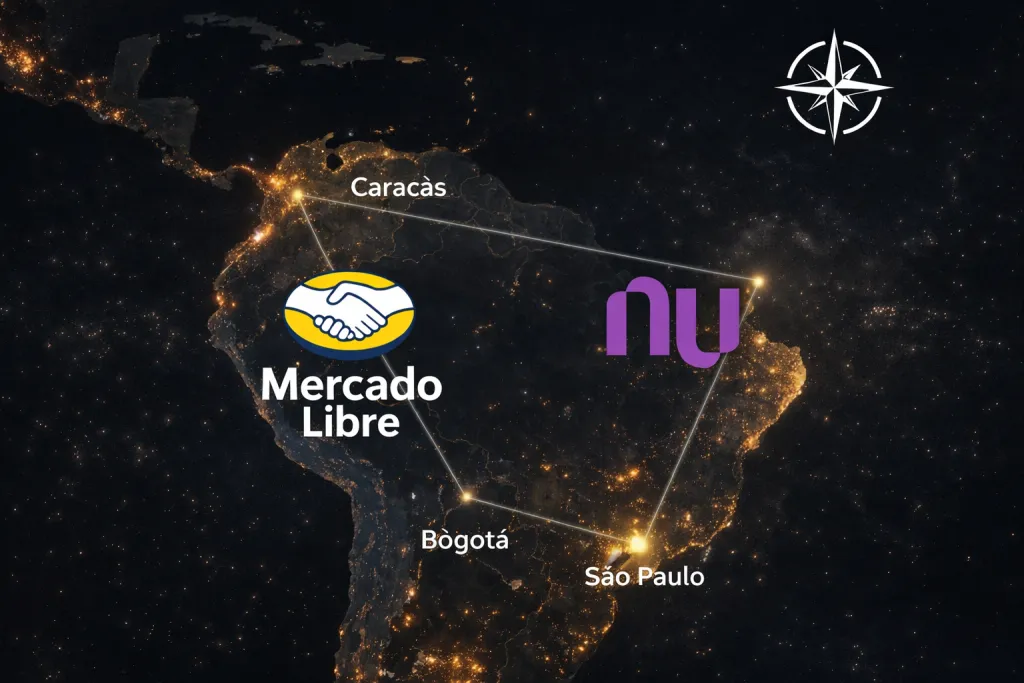
Within that narrowing, two platforms stand out. Both operate at scale across Latin America. Both have been built for environments where formal financial systems lag behavior rather than define it. Neither requires immediate institutional repair to become relevant, but both compound as trust and infrastructure re-form.
One sits at the intersection of commerce, payments, and logistics, positioned to formalize activity once transactions begin to consolidate. The other operates closer to the balance sheet, aligned with populations that already manage money outside traditional banking and with corridors that matter when cross-border flows re-emerge.
These platforms do not respond first to reopening. They become visible once capital stays.
MercadoLibre and the Scale of Commercial Re-Entry
Venezuela’s reopening, if sustained even partially, reintroduces an economy of meaningful scale into the regional system. The country remains home to roughly 28 million people, with a population profile skewed toward urban density, mobile usage, and informal commerce. Years of isolation compressed consumption rather than eliminated it. Demand persisted, but expression shifted into fragmented and inefficient channels.
The magnitude of that latent demand matters. A reopening does not require a return to prior GDP levels to reshape regional commerce. Even modest normalization introduces incremental volume across categories where availability, logistics, and payments were previously constrained. Household goods, electronics, apparel, and cross-border purchases re-enter consumption baskets quickly once access improves. These categories align directly with digital marketplaces rather than physical retail expansion.
MercadoLibre’s positioning reflects this alignment. The platform has scaled across Latin America by operating in environments where infrastructure gaps, currency instability, and trust deficits are the norm rather than the exception. Its operating model does not assume seamless logistics or uniform banking penetration. It assumes fragmentation and builds around it.
That adaptability becomes relevant in Venezuela’s context. Commerce will not restart evenly. Activity will concentrate in corridors, cities, and cross-border channels before broad domestic depth returns. MercadoLibre’s network effects emerge precisely under those conditions. Merchants gain access to demand beyond local reach. Consumers gain access to supply that bypasses domestic scarcity. Payments and escrow mechanisms provide structure where bilateral trust remains weak.
The platform’s payments layer further extends this advantage. In markets where cash dominates and formal banking participation remains low, digital payments gain traction when tied directly to transactional utility rather than abstract financial products. MercadoLibre’s payments function integrates naturally with commerce activity, allowing adoption to follow usage rather than regulation.
Logistics completes the loop. Delivery reliability remains a gating factor in early-stage normalization. MercadoLibre’s experience coordinating third-party logistics and adapting fulfillment models across uneven geographies positions it to absorb incremental volume without requiring full infrastructure rehabilitation. Scale follows predictability. Predictability precedes trust.
This does not imply immediate penetration or linear growth. Integration remains gradual. Trust rebuilds transaction by transaction. Infrastructure constraints limit early throughput. The opportunity emerges through accumulation rather than acceleration. As activity formalizes, repeat behavior compounds. Addressable market expansion becomes visible before revenue density does.
MercadoLibre’s relevance in a reopening Venezuela therefore stems from fit rather than timing. The platform matches the shape of the problem: a large population with suppressed but persistent demand, operating in a system transitioning from informal exchange toward structured commerce. Its advantage lies in absorbing that transition without requiring it to resolve first.
Why Venezuela Matters for Mercado Libre
The significance of Venezuela for MercadoLibre is not confined to incremental users or near-term revenue contribution. It lies in the way a reopened Venezuelan market integrates into MercadoLibre’s existing geographic footprint. The platform already dominates commerce flows across South America. Venezuela re-enters not as an isolated node, but as a missing link within a contiguous regional system.
Geographic adjacency matters in platform economics. Cross-border commerce scales more efficiently when demand and supply exist within overlapping logistics corridors, cultural familiarity, and currency pathways. Venezuela shares a long land border with Colombia, one of MercadoLibre’s established growth markets, and sits within reach of northern Brazil’s commercial flows. A normalized corridor between these markets increases transaction density without requiring proportional increases in fixed infrastructure.
That density effect is where the tailwind emerges. Even modest reopening allows Venezuelan consumers to participate in regional commerce rather than purely domestic exchange. It allows merchants to access demand beyond national boundaries. It introduces bidirectional flows that increase utilization across the network rather than adding a standalone geography that must be built independently.
From a systems perspective, this alters the shape of MercadoLibre’s addressable market. The platform’s value does not scale linearly with population count alone. It scales with connectivity between markets. Venezuela’s reintegration expands the reachable surface area of existing users in Colombia and Brazil, increasing transaction frequency and cross-border volume without requiring new customer acquisition at the same marginal cost.
This is why the opportunity resists simple modeling. Venezuela does not need to contribute outsized gross merchandise value to matter. Its reopening can improve unit economics elsewhere in the system by increasing utilization of payments, logistics, and merchant tooling across adjacent regions. These effects compound quietly and appear downstream in engagement metrics rather than headline revenue.
In that sense, Venezuela represents a potential system-level tailwind rather than a discrete growth initiative. The platform benefits less from immediate penetration and more from the reactivation of a regional loop that has remained partially severed. Market attention tends to focus on countries as standalone opportunities. Platform economics respond to how those countries reconnect.
That reconnection is what makes Venezuela different from a greenfield expansion. It re-enters a network that already exists.
Nubank and the Reintermediation of Capital
As activity formalizes and commerce begins to consolidate, the limiting factor shifts again. Transactions that were previously episodic begin to repeat. Balances persist longer. Households and merchants require a place for money to reside between uses. At that point, the problem is no longer access to goods or transfer rails. It is financial residence.
This is the layer where Venezuela’s legacy banking system remains most constrained. Institutions such as Banco de Venezuela, Banesco, and BBVA Provincial were shaped by years of capital controls, inflationary balance sheets, and regulatory intervention. Their architecture reflects survival under distortion rather than expansion under normalization. Interoperability with informal rails remains limited. Multi-currency functionality remains constrained. Cross-border settlement remains fragile.
The informal systems that filled this gap during isolation solved for immediacy, not durability. Crypto wallets and cash networks enabled value transfer and preservation, but they do not support scalable credit formation, consumer protection, or long-duration balance storage. As capital circulation increases, these systems begin to show their limits. Velocity remains high, but accumulation stalls.
Nubank’s relevance emerges precisely at this point. The platform was built for populations operating outside traditional banking, where trust in incumbents is low and usage precedes regulation. Its operating model assumes fragmented financial behavior and works inward from payments, deposits, and basic financial tools rather than outward from legacy branch infrastructure.
This matters in Venezuela’s context. Reopening does not erase informal behavior. It creates pressure to integrate it. Systems capable of absorbing existing usage patterns without forcing immediate behavioral change become the natural landing zone for capital seeking durability. Nubank’s design aligns with that requirement.
Geographic Adjacency, Demographics, and Why Nubank Fits This Moment
Venezuela’s demographic profile closely resembles the environments where Nubank has already scaled. The population remains young, mobile-first, and accustomed to managing money digitally outside formal institutions. Financial exclusion is not theoretical. It is lived behavior. That similarity reduces the need for behavioral translation. Nubank does not need to invent new use cases. It needs to recognize familiar ones.
Geography reinforces this alignment. Venezuela shares a long and economically meaningful border with Colombia, where Nubank has already invested in infrastructure, regulatory navigation, and market understanding. A normalized Venezuela–Colombia corridor increases remittance volume, merchant activity, and cross-border settlement demand. These flows do not originate at banks. They originate with households and small businesses operating across borders.
Nubank is already positioned within those corridors. Its infrastructure exists nearby. Its compliance frameworks have been built for environments where financial systems are uneven and trust must be earned incrementally. Expansion does not require speculative greenfield investment. It requires extension along paths that already exist.
This adjacency also matters economically. Capital entering Venezuela through energy investment, trade, and remittances does not remain static. It seeks accounts, payment rails, and conversion mechanisms that can operate across borders without friction. Traditional Venezuelan banks struggle here. Informal systems solve only part of the problem. Nubank sits between them, capable of formalizing behavior without demanding immediate institutional perfection.
In that sense, Nubank’s opportunity is not defined by timing headlines or discrete market entry. It is defined by structural fit. The platform aligns with the demographic reality, the geographic layout, and the financial behavior that reopening reactivates. As capital stays longer and moves more frequently, the demand for durable financial residence increases.
This is the layer the market has not fully engaged with yet. Not because it is small, but because it only becomes visible once reopening moves beyond production and into circulation.
Timing, Revenue Formation, and the Shape of Nubank’s Upside in Venezuela
Nubank’s exposure to a reopening Venezuela would not express itself immediately through headline growth metrics. The earliest effects would appear in usage rather than revenue. Account openings, payment activity, and remittance-linked flows tend to precede meaningful balance formation. This sequencing matters when interpreting timelines.
Initial adoption would likely concentrate in transactional products. Payments, transfers, and basic deposit functionality absorb activity first as households and small businesses seek stability for recurring cash flows. These behaviors increase engagement and data density without immediately expanding margins. Top-line contribution remains modest in early phases, but operating leverage begins to form beneath the surface.
As balances persist longer, revenue quality changes. Deposit stickiness improves funding economics. Interchange and payment-related income scales with transaction frequency. Cross-border activity introduces FX and remittance-related fee layers. These effects compound gradually rather than appearing as step changes. Nubank’s historical growth across Brazil, Mexico, and Colombia followed a similar pattern: usage first, monetization later, margin expansion last.
Bottom-line implications emerge further downstream. Customer acquisition costs in reopening environments tend to be structurally lower due to unmet demand and limited incumbent competition. Operating expenses scale with infrastructure that is already largely built. As a result, incremental revenue carries higher marginal contribution once products mature. This dynamic favors platforms with pre-existing regional infrastructure and regulatory experience.
Timelines therefore compress unevenly. Adoption can move quickly once trust forms. Revenue follows with lag. Profitability responds later still, driven by balance durability rather than transaction spikes. Market narratives tend to focus on entry announcements or early user metrics. The more consequential effects surface quietly through improving unit economics and retention profiles over time.
This is why Nubank’s opportunity resists clean modeling in the early stages. The economic impact does not hinge on immediate market penetration or aggressive expansion. It hinges on whether reopening conditions allow financial behavior to transition from velocity-driven to residence-driven. Once that transition occurs, revenue depth increases without proportional increases in cost.
In that sense, the significance of Venezuela for Nubank is not defined by near-term contribution. It is defined by how reopening alters the slope of existing growth engines. Even incremental integration can extend the platform’s compounding period by expanding corridors where Nubank already operates efficiently.
Where the Venezuela Stock Opportunity Really Lies
Market reactions to reopening events tend to cluster around what can be identified immediately. Production capacity, sanctions relief, and headline beneficiaries attract attention first. These effects are legible, modelable, and quickly incorporated into prices. By the time they dominate coverage, expectations have already adjusted.
What takes longer to surface are the systems that matter once activity persists. Capital entry is visible. Capital residence is not. The transition from episodic flows to recurring circulation introduces constraints that do not register in initial repricing. Payments reliability, balance durability, cross-border settlement, and trust formation operate beneath the headline layer, shaping outcomes over time rather than at announcement.
Venezuela’s potential reopening follows this pattern. Energy reactivation captures the first phase. Commerce formalization follows as activity consolidates. Financial residence emerges last, once money begins to stay rather than move through. Each phase narrows the opportunity set further, favoring platforms aligned with behavior rather than policy.
MercadoLibre and Nubank sit downstream from the initial trade. Their relevance does not depend on immediate normalization or rapid execution. It depends on whether economic activity reconnects across borders, whether informal behavior begins to formalize, and whether capital seeks durable infrastructure rather than temporary workarounds. These conditions develop gradually, often after market narratives move on.
This is where second-order repricing tends to accumulate. Not in the assets most closely associated with reopening, but in the platforms that quietly organize what follows. The market rarely ignores these opportunities permanently. It recognizes them late, once usage patterns harden and unit economics become visible.
By then, the opportunity set has already shifted.

Celsius Stock Analysis: The Shelf Reset and the Second Growth Curve
Celsius stock analysis of the shelf reset, Alani growth, Pepsi economics and cash flow, with a 2030 model and a Premium valuation and entry-price framework.

Meta AI Spending: The Customer Is Already Here
Can Meta turn AI spending into shareholder returns? We model advertising, Muse, hardware, capital costs and cash flow through 2030, with a full valuation.

IREN Stock Dilution: Can the Build Reach Shareholders?
IREN stock analysis of AI growth, funding and dilution through 2030. Read our full valuation, 27 scenarios and price zones free. Excel model is Premium.
Northwise Portfolios
See how the research becomes real decisions
Reader discussion
Discuss the research
Create a Free account to join the discussion with a display name.
Create a Free Account
No comments yet. Start a thoughtful discussion.