
Snowflake Sovereign Intelligence Thesis

Snow stock forecast 2030: Snowflake is evolving from a cloud data warehouse into a governed AI data platform as enterprise AI drives rising data consumption.
In this article
Snowflake built its reputation as a cloud data warehouse. The harder question for the next five years is whether AI turns enterprise data from something queried occasionally by analysts into something queried constantly by software, and whether Snowflake becomes one of the governed environments that work runs through. Our SNOW stock Forecast 2030 seeks to answer that question and what valuation it could lead to.
1. Executive Summary
For most of its public life, Snowflake was understood as a cloud data warehouse. That description was accurate. Companies were centralizing structured data so that human analysts could query it, build dashboards, and report on the business. Snowflake did that better than almost anyone, and the market valued it accordingly.
The pattern of demand underneath that story is now changing. Human analysts query data periodically, during working hours, in bounded amounts. AI copilots and agents can query data continuously, and they are only useful when they can reach the context that lives inside a company's scattered systems. That shift moves governed enterprise data from a reporting asset toward an operating surface, and Snowflake sits directly in that layer.
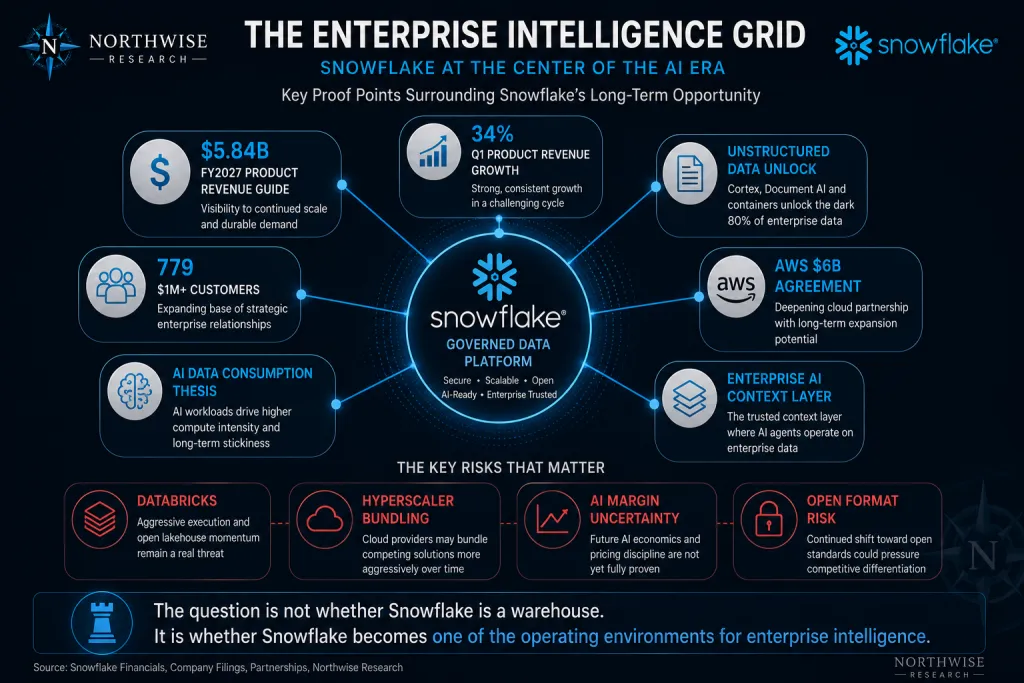
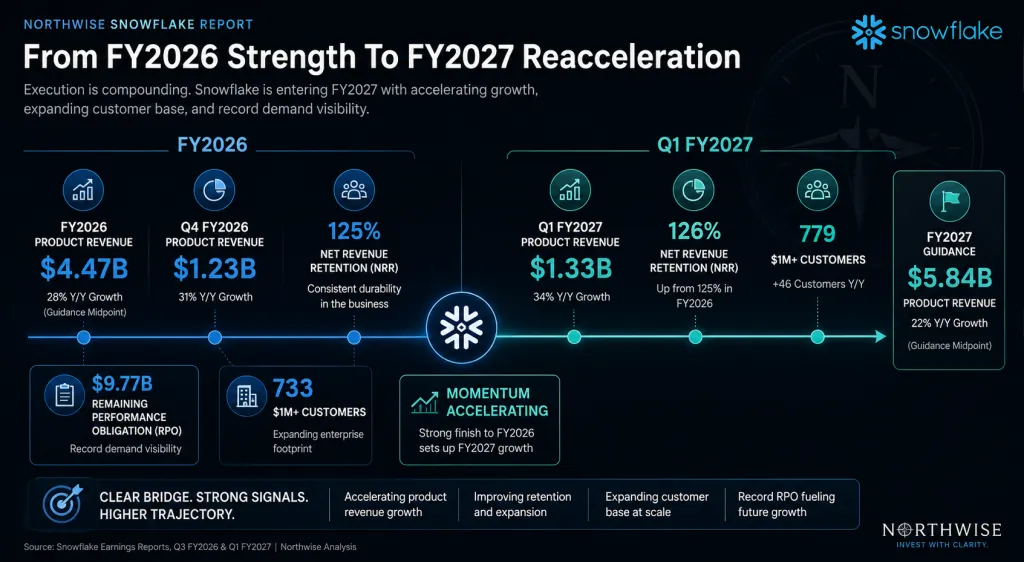
The most recent results give the view more support than it had a quarter ago. First-quarter fiscal 2027 product revenue reached $1.33 billion, up 34% year over year, the strongest sequential dollar growth in the company's history. Management raised full-year fiscal 2027 product revenue guidance to $5.84 billion and tied the strength to both the core platform and its AI capabilities.
The large-customer base grew to 779 accounts spending more than $1 million on a trailing twelve-month basis, a net addition of 46 in the quarter. Alongside the print, Snowflake signed a $6 billion, five-year commitment with AWS, its largest infrastructure agreement to date, aimed squarely at AI and agentic workloads.
The stock reacted in two stages. It jumped roughly 36% on the earnings beat and the AWS news, then drifted back with the broader market to close near $235. That pullback looks more like market beta than damage to the thesis.
None of this makes Snowflake a safe holding. Databricks is growing faster off a comparable revenue base. The hyperscalers are partners and competitors at the same time. The margin profile of AI workloads remains underdisclosed, and the stock has already rerated from its lows. The case is attractive if the base case holds, and the rest of this report is about testing whether it does.
The core conclusion is narrow on purpose. Snowflake does not need to own every model or every workflow to win. It needs to become one of the trusted control planes where enterprise data becomes usable by AI, safely and at scale. How much of that workflow it will win is the core question of what our model intends to answer.
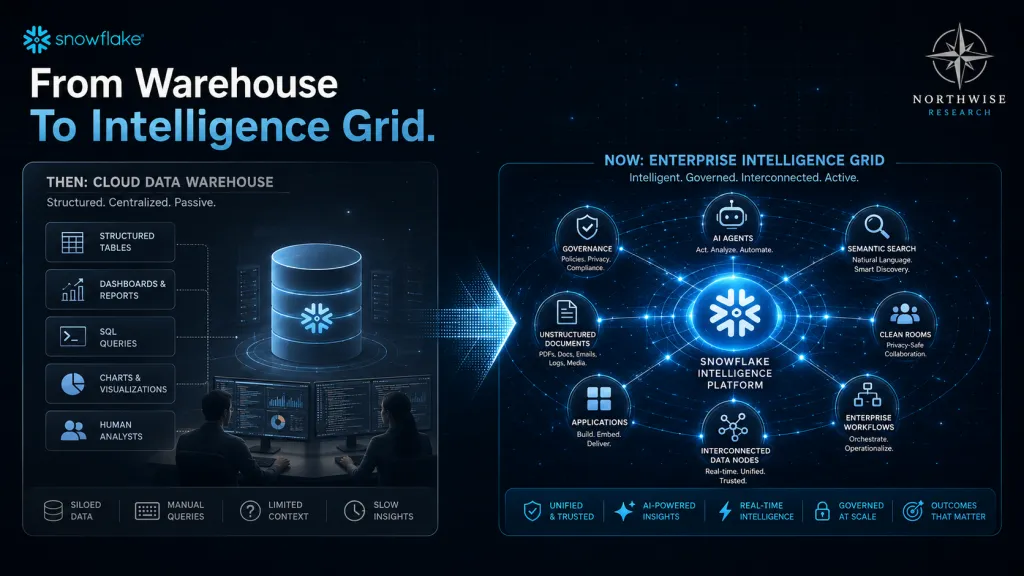
Table of Contents
- Executive Summary
- Core Investment Judgment
- What Snowflake Is and Why It Matters
- How the Consumption Model Works
- Why the Market Misunderstood the Business
- The Thesis Pivot: Storage Is Not the Prize
- Why AI Creates a Data Explosion
- The Non-Human Customer and the Agentic Consumption Curve
- The Dark Data Unlock
- Snowflake's Product Stack
- The AI and Developer Layer
- Clean Rooms, Advertising, and Data Collaboration
- Marketplace, Native Apps, and Application Platform Optionality
- Strategic Partnerships: The Intelligence Stack
- Leadership: From Slootman to Ramaswamy
- Financial Foundation and Recent Results
- The Post-Earnings Rally and Narrative Reset
- Competitive Landscape
- What the Market Is Still Missing
- What Would Break or Strengthen the Thesis
- Premium Model Preview
- Valuation and Action Framework
- Portfolio Role
- Final Assessment
2. Core Investment Judgment
We are bullish, and we are not blindly bullish. The recent quarter strengthens the thesis, and the rerating raises the burden of proof.
At $235, Snowflake no longer trades in the deeply pessimistic zone it occupied before the quarter. It also does not trade at a price that already assumes the company wins the AI data platform war. On our read, the stock sits below a revised base-case value and well above a distressed bear case, which is a reasonable place to accumulate a high-quality business that still has something to prove.
The judgment rests on a short chain of claims. Snowflake benefits when enterprise data consumption grows. AI increases the amount and frequency of that consumption. Enterprises need governance in place before they will run AI on sensitive data, and Snowflake has a credible platform for governed AI data work. The first-quarter results suggest the shift is starting to appear in the financials. Databricks keeps the thesis from being obvious. Valuation discipline keeps it honest.
The goal of this report is not to prove that Snowflake will dominate the AI era. It is to determine whether the probability-weighted opportunity remains attractive after the market's post-earnings reset, and what price compensates an investor for the risk that the company falls short.
3. What Snowflake Is and Why It Matters
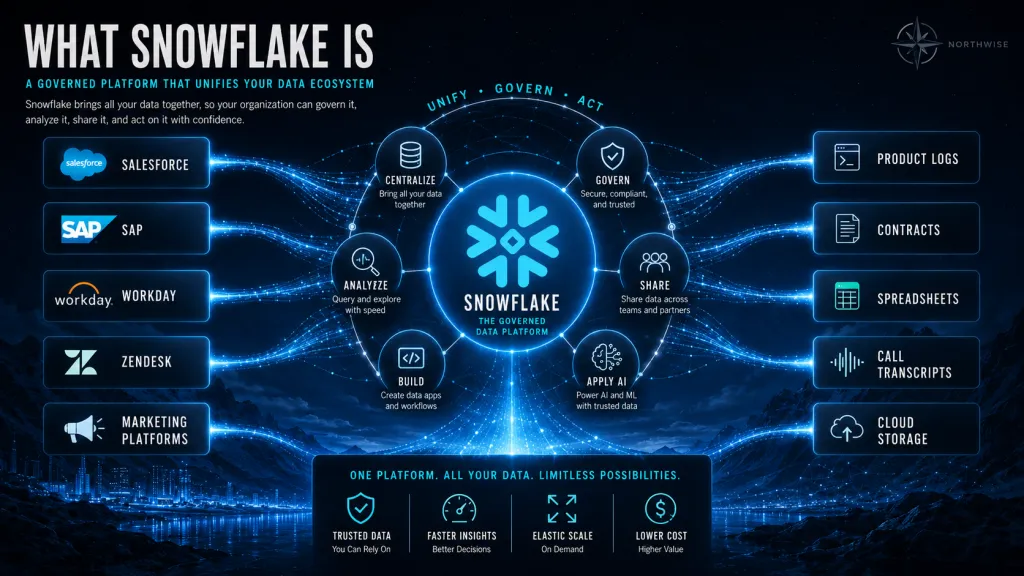
Start from zero. Snowflake is a cloud-based data platform that helps organizations centralize, organize, secure, govern, analyze, share, and increasingly apply AI to their data. It runs on AWS, Azure, and Google Cloud, and customers do not install or manage any hardware.
The problem it addresses is that large companies do not have one clean pool of information. Their data is scattered across many systems. Customer relationships live in Salesforce. Finance, procurement, and supply chain live in SAP. Employee data sits in Workday. Payments run through Stripe or internal billing. Support tickets accumulate in Zendesk or ServiceNow. Product usage, marketing campaigns, logs, contracts, call transcripts, and spreadsheets each live somewhere else again.
Each system is useful on its own. Decisions require connecting them. A sales leader needs usage data, billing status, engagement, support history, and renewal timing in one place. A supply chain manager needs supplier records, inventory, invoices, logistics, and demand forecasts together. The work of joining that information safely is harder than it sounds, and it is the work Snowflake is built for.
In the old pattern, humans inspected data through dashboards and reports. In the emerging one, AI systems need to retrieve, analyze, and act on data across departments. Snowflake serves as an environment where companies can bring data together or reach data where it already lives, enforce access rules, and run analytics or AI workloads under control.
A useful way to picture it is less a storage locker and more an air traffic control system for enterprise data. It governs what data can move, who can access it, which rules apply, and what work can run on top. A handful of terms recur throughout this report. A data warehouse stores structured data and runs analytics on it. A data lake holds large volumes of raw data more cheaply and flexibly. A lakehouse tries to combine the two. A query is a request to the platform. Compute is the processing power that runs queries, transformations, and AI functions. Governance is the set of rules deciding who can touch what, under which conditions, with what audit trail. Unstructured data is everything that does not fit neatly into rows and columns: documents, emails, images, transcripts, contracts.
The reason this layer matters more in an AI world is straightforward. AI is only useful to an enterprise if it can reach the right data safely. Without clean, connected, governed data, an enterprise AI system is a capable assistant locked outside the building.
4. How the Consumption Model Works
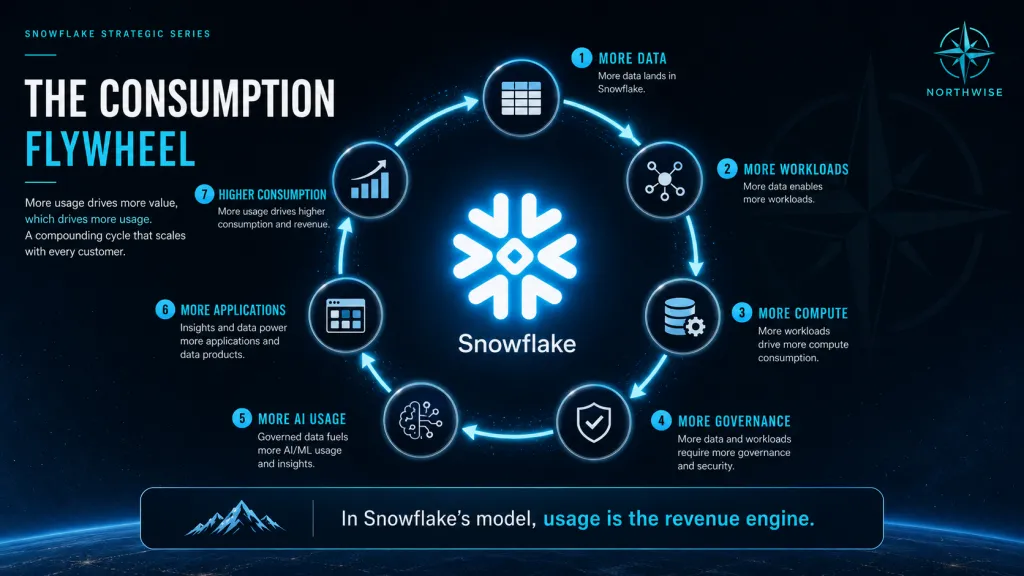
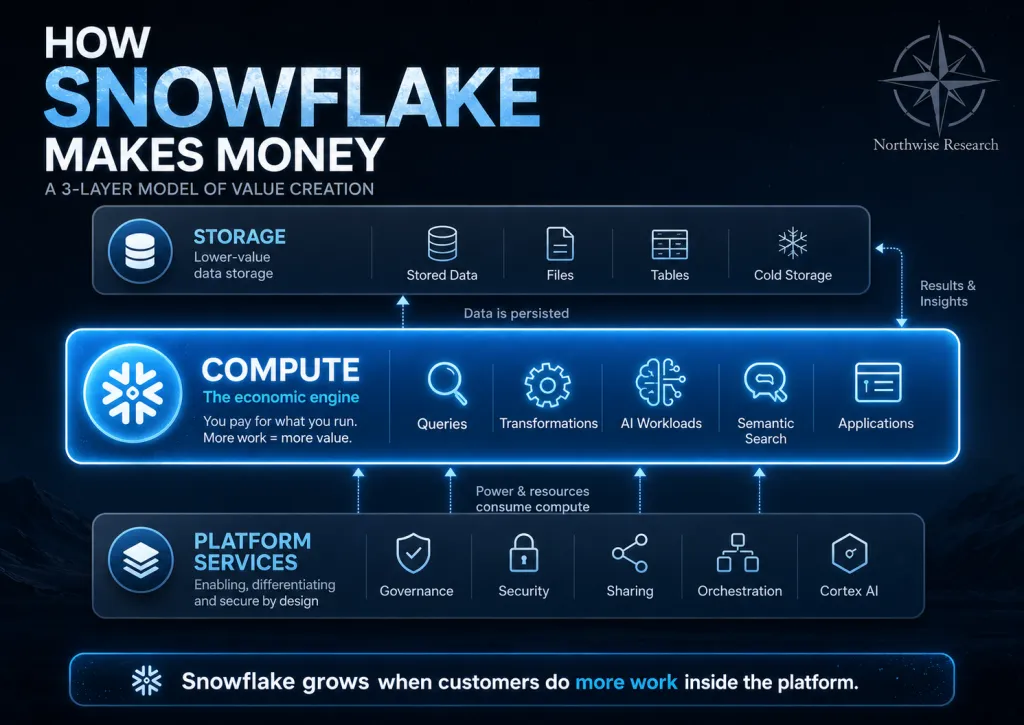
Snowflake makes money primarily through consumption. Customers use the platform, burn credits, and pay based on activity. This is the single most important thing to understand about the business, since the valuation depends on usage rather than on seats sold.
Revenue arrives in three broad layers. Storage is the first, and it is the least interesting: customers pay to store data, the margins are lower, and the economics are increasingly commoditized. Compute is the second and the important one: customers pay when they run workloads, which now span queries, transformations, pipelines, analytics, AI operations, semantic search, and application logic. Platform services are the third: governance, orchestration, metadata, security, sharing, and AI capabilities that make the platform more valuable and tend to pull more compute through it.
A seat-based software company grows when more people buy licenses. Snowflake grows when customers do more work inside the platform. That difference is the source of both the upside and the risk.
The upside is that existing customers can expand a great deal without Snowflake signing a single new logo, and AI workloads can lift usage without a matching increase in headcount. As more departments and more workloads move onto the platform, and as sharing, collaboration, and applications create new surfaces for activity, consumption can compound.
The risk is the mirror image. Consumption can be optimized. Customers can tune inefficient queries, cap budgets, and push back when cloud bills climb. Snowflake has to prove that AI workloads carry attractive margins rather than simply generating activity. Usage growth and profitable usage growth are not the same thing, and the gap between them is where a consumption model can disappoint.
A few metrics carry most of the signal. Product revenue is the core top line. Net revenue retention shows how much existing customers spend relative to a year earlier; a figure well above 100% means they are expanding. Remaining performance obligations capture contracted future revenue and hint at demand visibility. The count of customers above $1 million in trailing product revenue shows enterprise depth. Product gross margin and free cash flow margin show whether the activity is profitable. An AI revenue run rate, when disclosed, shows whether AI features are becoming real paid usage rather than experiments.
In the warehouse era, consumption came from analysts, dashboards, pipelines, and data teams. In the era now arriving, a growing share may come from AI systems, agents, semantic queries, and unstructured processing. The entire thesis turns on whether AI increases the amount of useful, paid work inside the platform faster than customers optimize the waste out of it.
5. Why the Market Misunderstood the Business
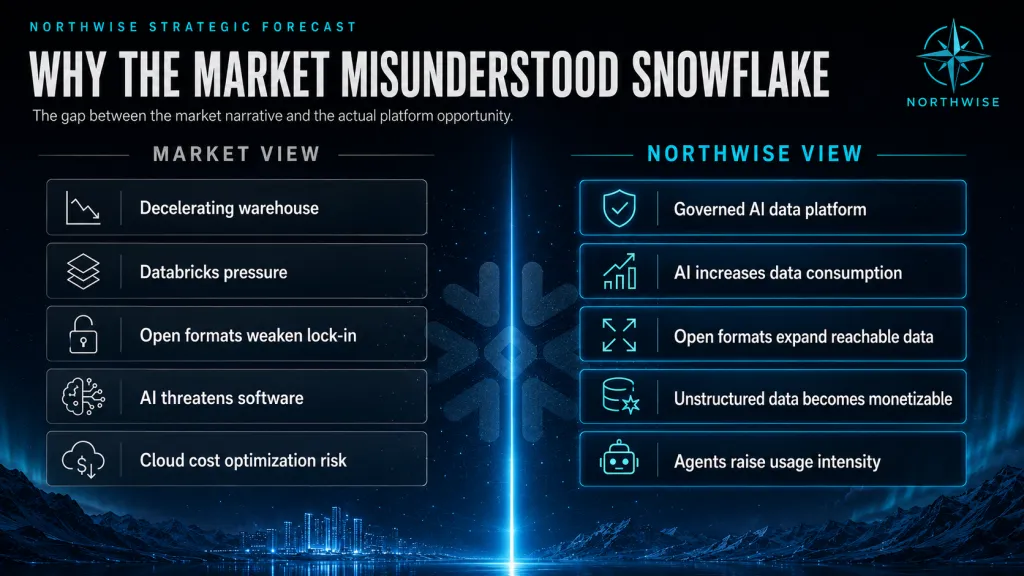
The opportunity exists in part because the bear case had real evidence behind it, and we should not pretend otherwise. Snowflake was a pandemic-era cloud winner whose growth decelerated from its early hypergrowth. The stock looked expensive on most conventional measures. Databricks appeared to hold stronger AI and developer momentum. Open table formats threatened the economics of proprietary storage. Cloud-native competitors looked good enough for many buyers. And AI itself was widely feared as a destroyer of software margins.
Every one of those points was grounded in something true. Growth did slow. Databricks did gain prominence. Customers did scrutinize cloud costs. Open formats did reduce lock-in. AI did introduce genuine uncertainty about future software pricing.
The error was narrower than the bear case assumed. The market confused a maturing first act with the end of the story. While investors debated whether Snowflake could keep charging to store data, the platform's role was quietly widening. Governed data became more valuable as AI arrived, not less. Enterprise data stayed fragmented. Large customers kept expanding. Unstructured data opened a new surface of workloads. Agentic patterns raised the potential frequency of queries. The leadership transition pointed the company toward AI-native execution, and partnerships with AWS, OpenAI, Anthropic, and SAP strengthened its relevance.
Mispricing tends to live exactly there, in the space between a question that is reasonable and a question that is complete. The market was asking whether Snowflake could keep selling storage. The more useful question is whether Snowflake can become one of the places where enterprise intelligence runs.
6. The Thesis Pivot: Storage Is Not the Prize
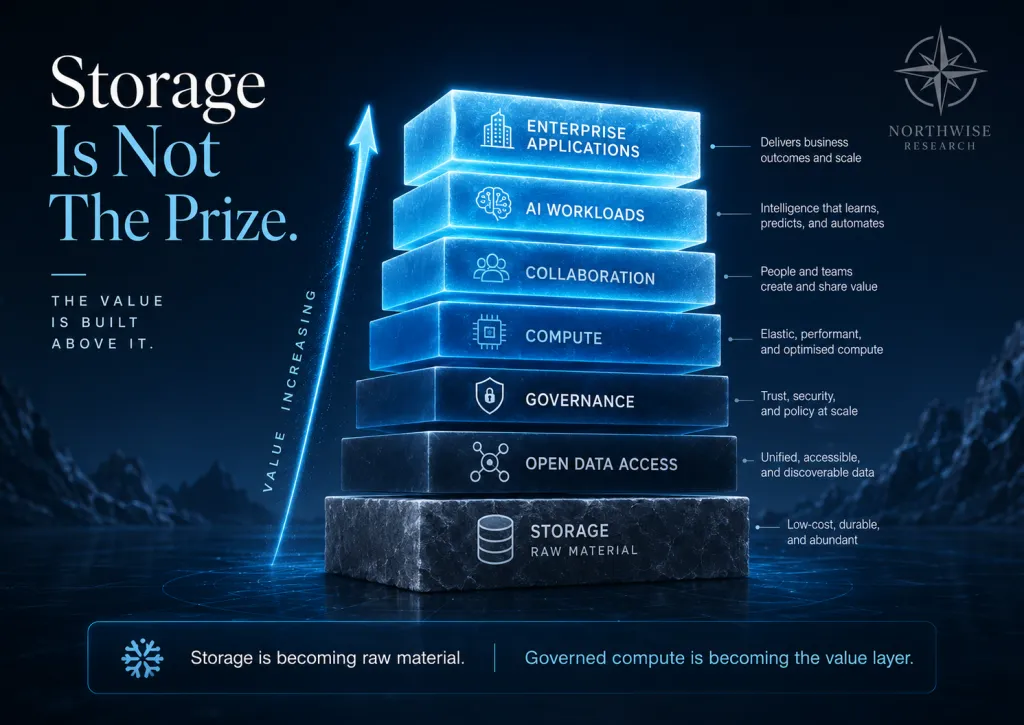
The strategic shift at the center of this report is the move from storage toward governed compute and execution. Snowflake does not need to own every byte of enterprise data to win. It can win by becoming one of the trusted environments where that data is governed, connected, queried, and used by AI.
In the original model, customers brought data into the warehouse, stored it, queried it, and built dashboards on top. In the model taking shape, data lives across warehouses, object stores, open table formats, data lakes, applications, and multiple clouds. The platform that wins may be the one that can govern and compute across that messier reality rather than the one that holds the most data.
A few concepts make this concrete. Apache Iceberg is an open table format that lets data sit in a more interoperable way. Polaris is Snowflake's open catalog effort built around Iceberg, designed to ease lock-in concerns. External volumes let Snowflake work with data stored outside its native environment. Zero-copy sharing lets data be shared without duplicating it. Together these allow companies to collaborate on data while keeping control, permissions, and governance intact.
There is a bear reading and a bull reading of all this, and both hold. The bear reading is that open formats weaken Snowflake's storage lock-in and make it easier for customers to move workloads elsewhere. The bull reading is that open formats expand the universe of data Snowflake can reach and compute on. The question that decides the outcome is whether Snowflake's compute, governance, collaboration, and AI layers become valuable enough to offset the weaker grip on storage.
Storage is becoming the raw material. Governed compute is becoming the value layer. If a retailer keeps its data in cloud object storage, Snowflake may still query it, govern it, combine it with partner data, and run AI workflows over it. Owning the useful work can matter more than owning the bytes. The risk is symmetrical: if customers use open formats to run more of that work on Databricks, BigQuery, or Microsoft Fabric, Snowflake loses leverage rather than gaining reach. The open strategy is a trade, not a surrender, and the trade only pays off if Snowflake earns its place in the broader ecosystem.
7. Why AI Creates a Data Explosion
This is the load-bearing argument of the report, so it is worth making carefully. AI does not eliminate the need for enterprise data infrastructure. It increases the need for connected, governed, queryable, and secure data.
The common misconception is that AI will replace enterprise software tools and shrink demand for the platforms underneath them. The flaw in that view is that AI models are only useful when they have context, and in an enterprise, context comes from data. A general model can write a clean paragraph. It cannot tell a finance team why receivables are deteriorating unless it can reach billing data, customer records, payment history, contracts, the sales pipeline, and the company's own assumptions and policies.
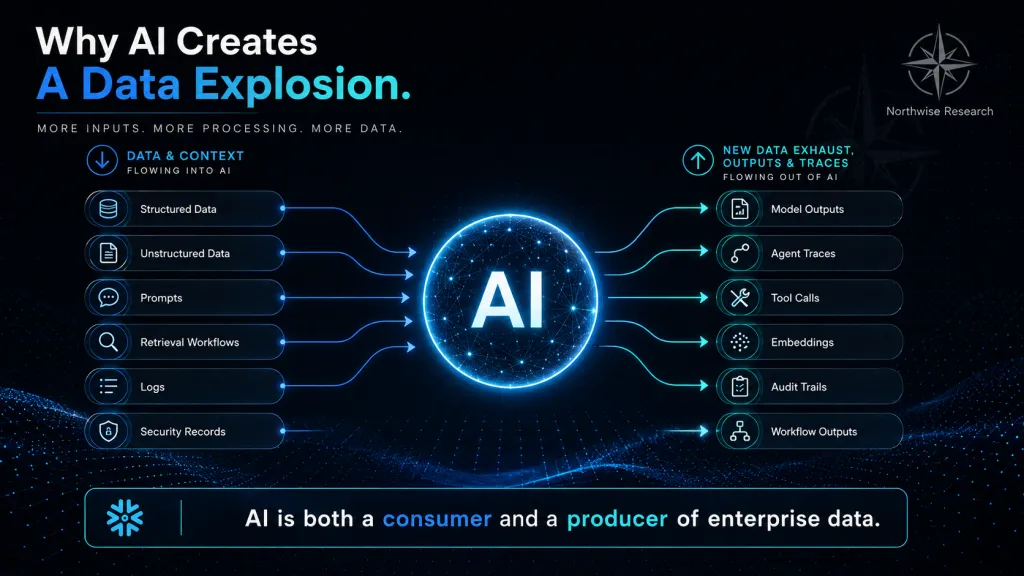
To do useful work inside a company, an AI system needs proprietary data, current and historical data, structured and unstructured data, access permissions, audit trails, retrieval systems, and a way to monitor its own outputs. All of that has to live somewhere governed.
AI also produces data as a byproduct of operating. Prompts, model responses, agent traces, tool calls, retrieval logs, evaluation results, compliance records, security logs, embeddings, and vector indexes all accumulate. At the same time, AI consumes data heavily: it retrieves documents, scans tables, searches logs, compares historical trends, interprets unstructured text, and triggers downstream workflows. It is both a consumer and a producer at once, which is why its arrival tends to raise data volume rather than lower it.
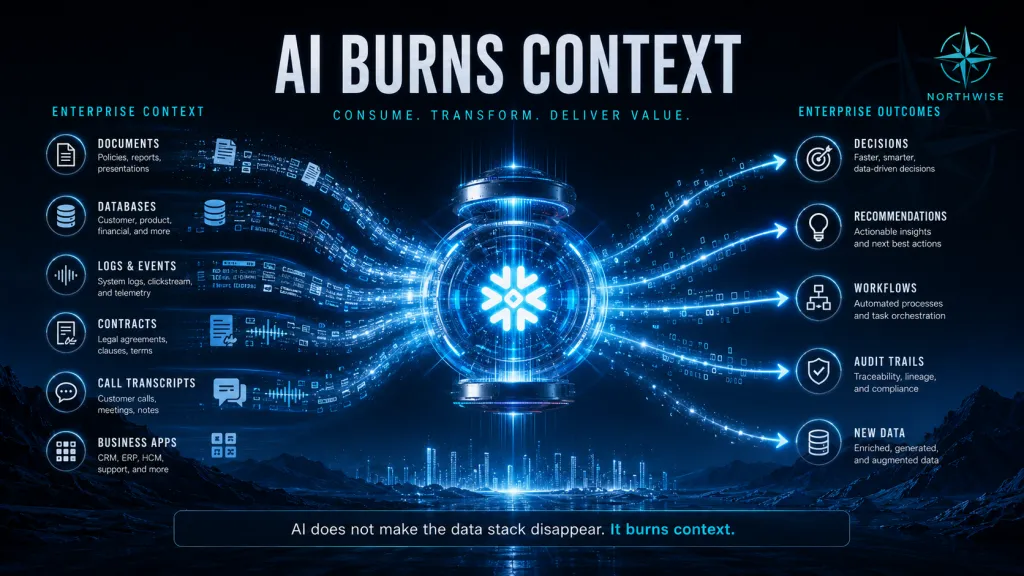
The implication for Snowflake follows directly. If companies want AI to operate safely on enterprise data, they need a platform that can bring that data together, enforce rules, run queries, audit activity, and host AI functions. Snowflake is one of the few public companies positioned squarely in that layer.
The technical reality reinforces the point. AI workloads are often heavier than traditional analytics, since they involve semantic operations, model calls, retrieval, summarization, and unstructured interpretation. A dashboard might run a handful of queries. An agent might run many background operations to answer a single business question. The widely discussed AI infrastructure story is not only about GPUs and data centers. It is also about the surge of enterprise data work those models set in motion, and that surge is where Snowflake's opportunity sits.
8. The Non-Human Customer and the Agentic Consumption Curve
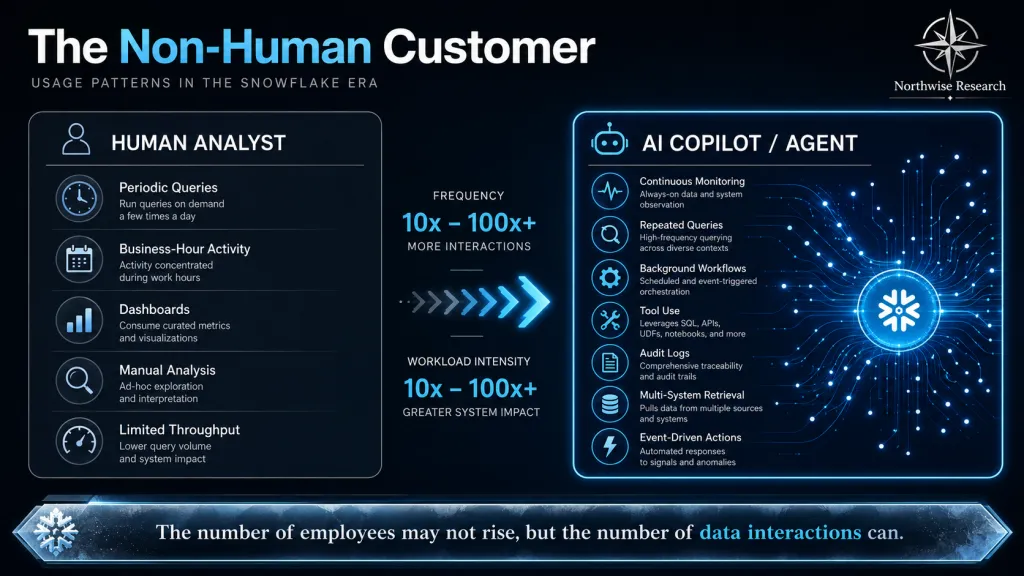
Snowflake has historically monetized humans querying data. AI introduces a different kind of customer: software that can query, retrieve, and reason over data continuously, without waiting for a person to ask.
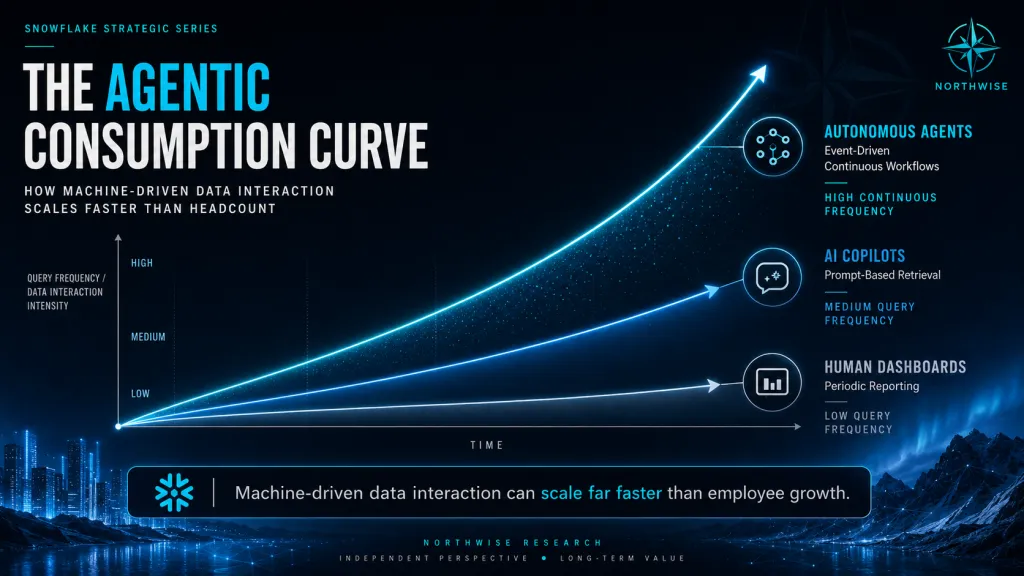
The contrast in behavior is what changes the growth curve. A human analyst works during business hours, runs periodic reports, asks a bounded number of questions, and interprets the results by hand. An AI copilot assists employees through the day, retrieves records, summarizes trends, and surfaces anomalies, though it still waits for human prompts. An AI agent operates on events rather than requests. It monitors data, pulls context from several systems, recommends or takes actions, and leaves behind audit and workflow records, often running in the background with no person directly involved.
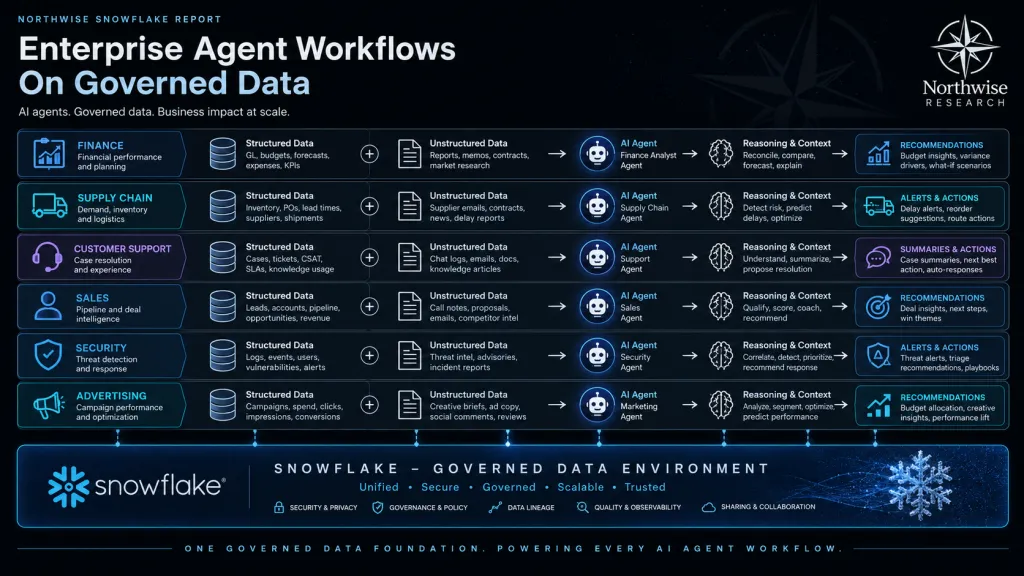
A company may never hire more analysts and still deploy thousands of AI workflows that touch data constantly. A supply chain agent might watch supplier delays, check inventory, compare demand forecasts, and flag risk. A finance agent might review receivables, reconcile invoices against contracts, and prepare variance explanations. A support agent might read tickets, pull usage data, and summarize account history. A security agent might monitor logs and access patterns and build audit trails as it goes. Each of these draws on structured and unstructured data, permissions, retrieval, and compute, and if that work happens inside Snowflake, usage intensity rises.
Snowflake's recent moves point in this direction. Its agreement to acquire Natoma, an enterprise Model Context Protocol platform for AI agents, is aimed at letting companies connect AI securely to the tools and data agents need, and at extending governance to the actions those agents take rather than only to the data they read. Governing what an agent does, not just what it sees, is a natural extension of the platform's core promise.
One caveat belongs here and should not be buried. Not all agentic consumption will be high margin. Model inference and semantic processing can be expensive, and heavy usage that does not convert into attractive product revenue and free cash flow would undercut the thesis rather than confirm it. The non-human customer is a logical extension of enterprise AI, not a science fiction premise, but its value to Snowflake depends on the economics of the work, not just the volume.
9. The Dark Data Unlock
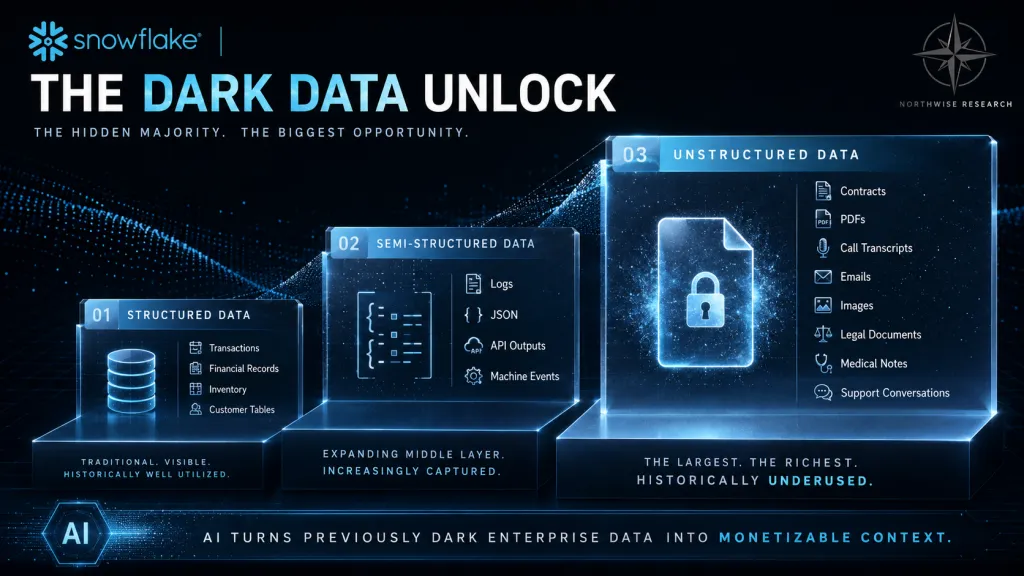
Most enterprise knowledge does not live in clean rows and columns. It lives in contracts, PDFs, emails, call transcripts, images, claims files, technical manuals, and meeting notes. AI gives companies a practical way to use that material, and Snowflake can benefit if it becomes a governed place to process it.
It helps to separate three kinds of data. Structured data is the tidy stuff: transactions, customer records, inventory, payments. Semi-structured data covers logs, JSON, API outputs, and machine-generated events. Unstructured data is everything textual or visual that resists tabular form. Traditional analytics tools were built for the first category. A dashboard can show revenue by region with ease. It cannot read fifty thousand contracts, interpret repair logs, or make sense of support call transcripts.
AI changes what is possible here. Models can summarize, classify, extract, search, compare, and reason over documents and text, which turns previously dark data into usable business context. A manufacturer can mine maintenance logs and supplier records to anticipate failures. A healthcare organization can connect clinical notes, claims, and treatment history while preserving access rules. A bank can analyze call transcripts, fraud investigations, and loan documents together. An insurer can work across claims notes, adjuster reports, and policy documents. A retailer can combine reviews, service chats, loyalty data, and purchase history.
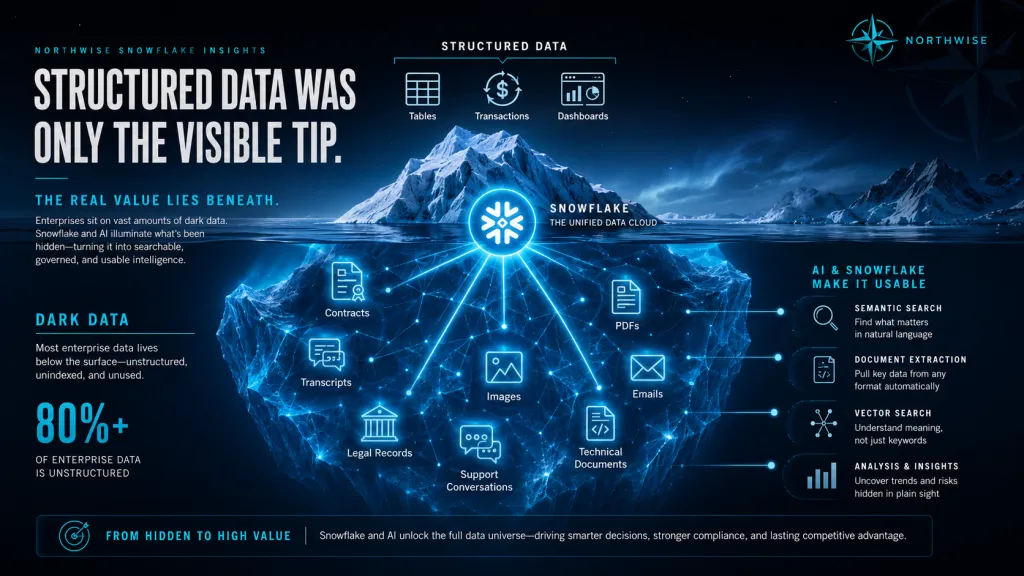
Snowflake's role appears wherever that unstructured data is stored, referenced, governed, indexed, queried, or analyzed through the platform. Its Cortex AI suite supports this work directly, with document extraction and parsing functions, vector search, and semantic operations that run inside the governed environment. The strategic point is the size of the surface: Snowflake is competing not only for the data companies already analyze, but for the far larger pool of data they could never practically analyze before.
The honest framing keeps this in the upside column rather than the base. Unstructured processing is expensive. Data quality is uneven. Governance is harder when the inputs are messy. Hallucinations carry real consequences in regulated settings, and customers may run these workflows in Databricks, Microsoft, Google, or specialized tools instead. The dark data unlock is one of the larger upside vectors in this report, and it remains emerging rather than proven.
10. Snowflake's Product Stack
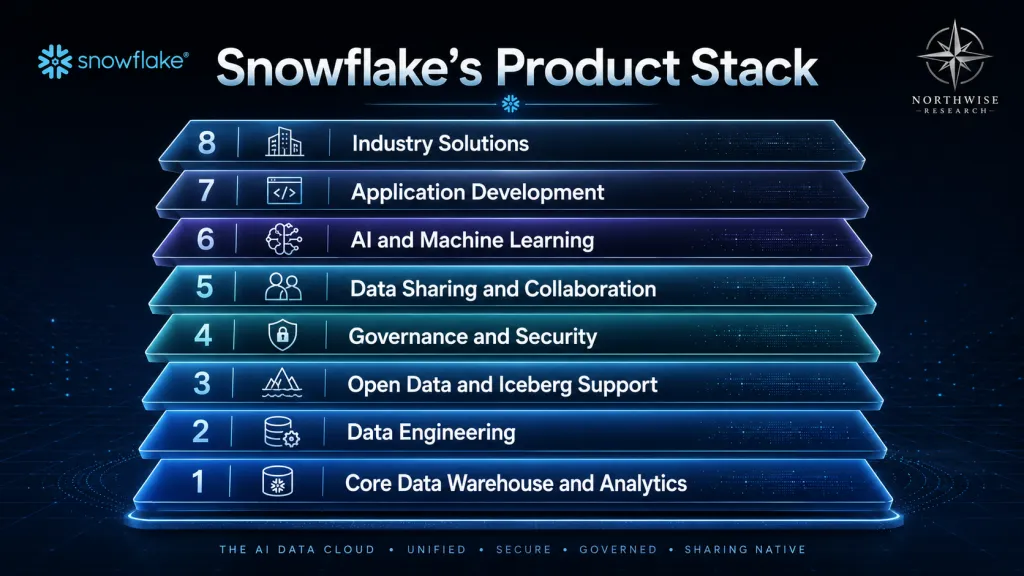
It is easier to assess Snowflake as a layered platform than as a single product, since the layers differ sharply in maturity.
The foundation is the core data warehouse and analytics layer: SQL queries, dashboards, business intelligence, and structured analytics. This is the mature heart of the business. Above it sits data engineering, where pipelines, transformations, and developer workloads in Snowpark turn raw data into usable data. A third layer handles data lake and open data support through Apache Iceberg, the Polaris catalog, and external volumes, letting Snowflake work with data beyond its native storage.
Governance and security form the layer that makes the rest usable in an enterprise: role-based access, masking, audit trails, lineage, and policy enforcement, unified under Snowflake Horizon. Data sharing and collaboration come next, spanning secure sharing, the Marketplace, data clean rooms, and zero-copy sharing.
The AI and machine learning layer, organized under Cortex AI, includes Snowflake Intelligence, Cortex AISQL, Cortex Search, document processing, vector search, and integrations with frontier models from OpenAI and Anthropic. Application development sits on top, through Streamlit, the Native App Framework, and Snowpark Container Services.
Industry solutions for financial services, healthcare, retail, media, and the public sector wrap the whole stack in domain-specific form.
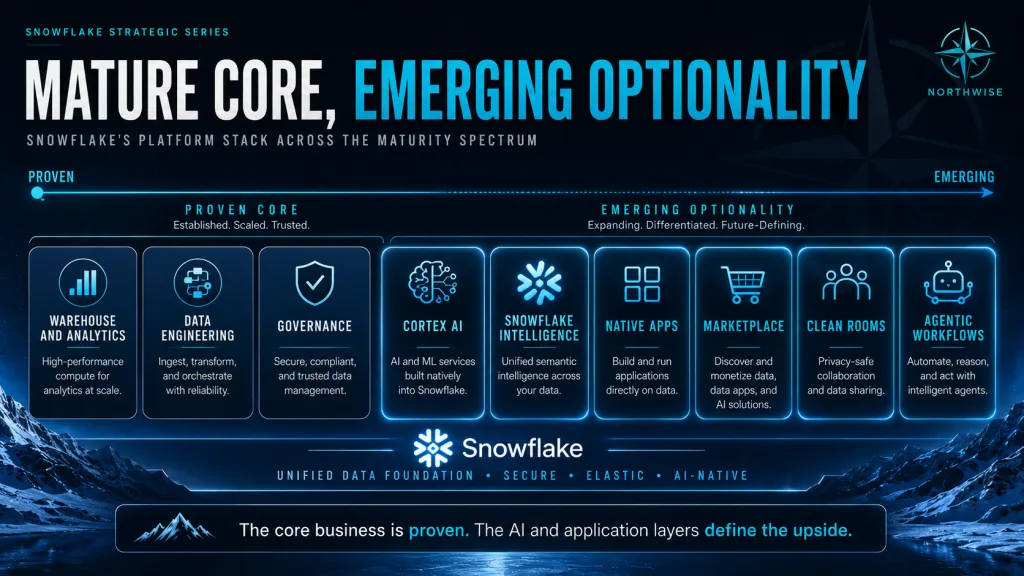
The useful discipline is to hold the maturity differences in mind. Core warehouse and analytics are proven and profitable. The AI and application layers are earlier and less certain. Clean rooms and advertising are optionality rather than established revenue. Simple comparisons of warehouse versus lakehouse tend to miss this, since the real ambition is to become a full data operating environment rather than to win a single category.
11. The AI and Developer Layer
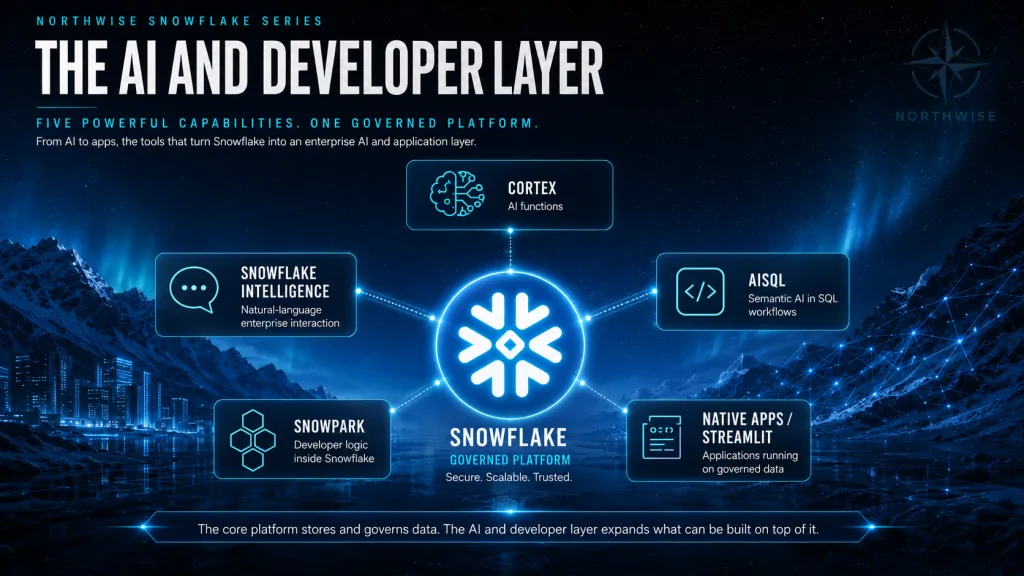
The AI and developer products are where Snowflake's next act is being built, so they deserve more than a list.
Cortex AI is the umbrella. It gives customers AI functions and model access inside Snowflake's governed environment, which lets companies apply AI to their data without shipping sensitive information into disconnected systems. Cortex can support summarization, classification, sentiment analysis, translation, document extraction, vector search, and natural-language analysis. Its investment significance is simple: it can raise compute intensity as customers move semantic and unstructured workloads onto the platform. Its risk is equally simple: it has to convert from experimentation into paid production usage.
Snowflake Intelligence is the natural-language and agentic interface for working with governed data. Instead of asking a data team to build a report, a business user can ask why margins fell in a region, which customers are most at risk of churn, or which contracts renew in the next ninety days, and get an answer drawn from governed company data. If adoption holds, it turns Snowflake into a more direct interface for enterprise decision-making rather than a back-end queried by specialists. Natural-language interfaces are easy to overhype, so the test remains whether usage becomes real and recurring.
Cortex AISQL, now generally available, brings AI-powered semantic operations into SQL itself. Since SQL is the working language of enterprise data, embedding AI functions into it, through operations that classify, extract, summarize, or analyze content as part of a normal query, makes AI feel like an extension of the data platform rather than a separate tool. The cost question follows close behind, since semantic queries can be heavier to run, and Snowflake has to manage performance and price.
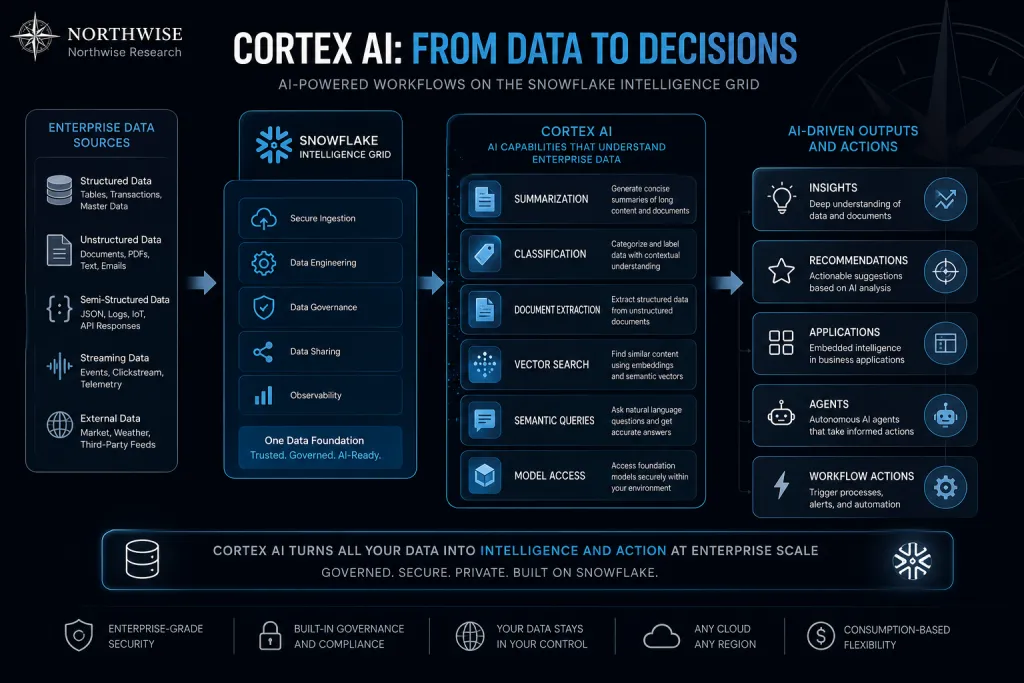
Cortex Code, launched in late 2025 and expanded through 2026, is a data-native AI coding agent that helps people build pipelines, analytics, and applications with awareness of a company's own data context. Snowpark lets developers use Python and other languages to build pipelines, applications, and machine learning workflows inside Snowflake, bringing code to the data rather than moving data out. Snowpark Container Services extends that to containerized applications and AI workloads running next to governed data. The Native App Framework and Streamlit let developers and partners build applications on top of Snowflake data without exporting it.
Taken together, this layer is the bridge between the warehouse Snowflake was and the intelligence grid it is trying to become. Databricks still holds stronger mindshare among data scientists and ML engineers, which is the gap Snowflake is working to close.
12. Clean Rooms, Advertising, and Data Collaboration
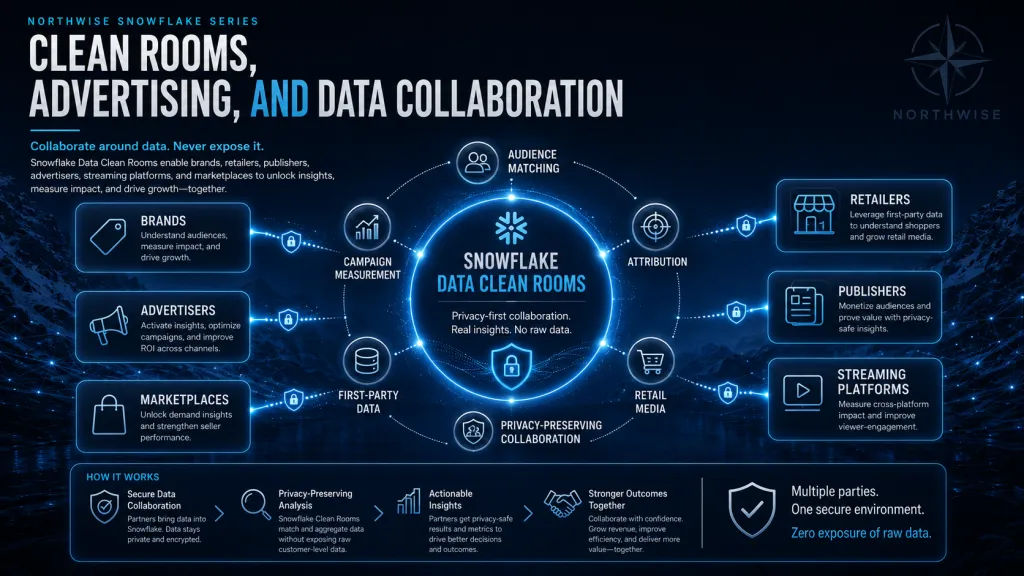
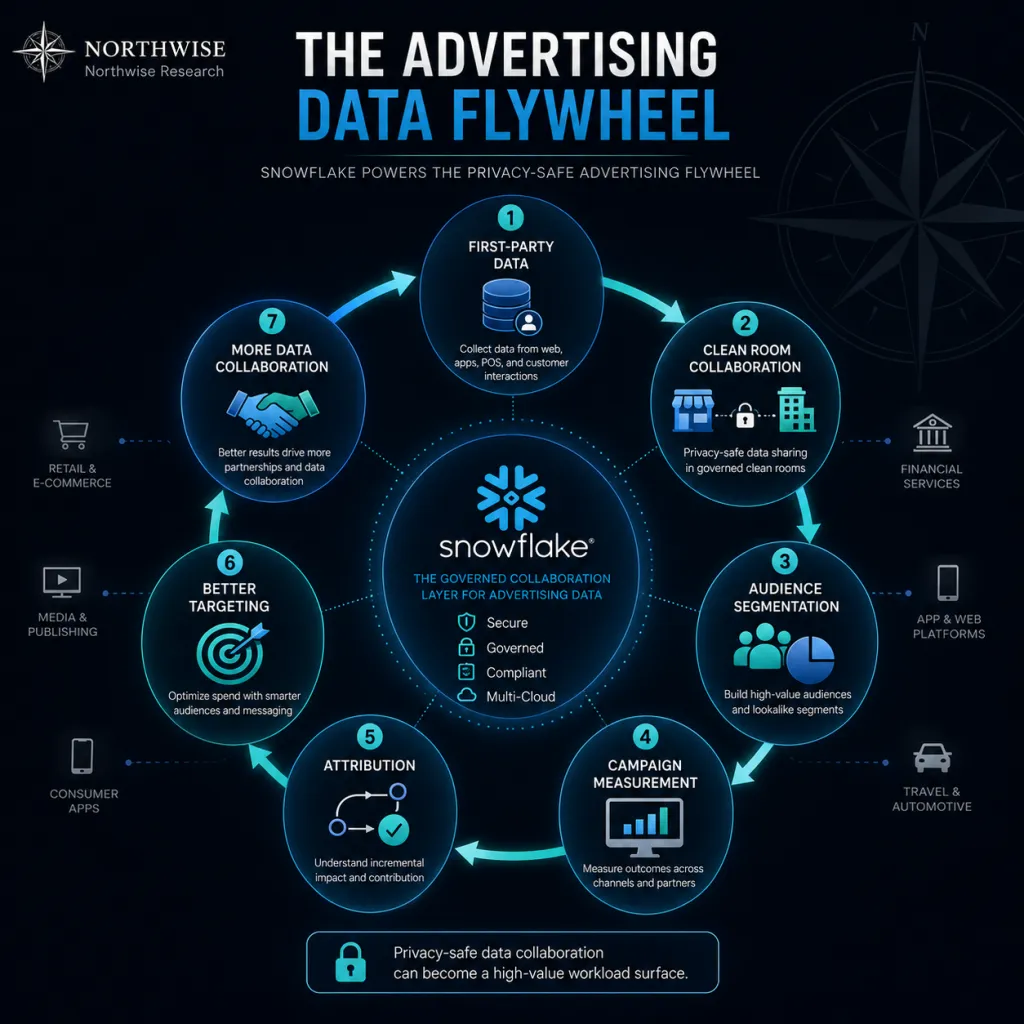
Advertising is one of the clearest illustrations of why enterprises need secure data collaboration, which is why it earns a section of its own even though it is not the core of the thesis.
The digital advertising ecosystem has moved away from easy third-party tracking toward first-party data. Retailers, media companies, streaming platforms, brands, and publishers each hold valuable data, and privacy rules make raw sharing risky. A retailer knows who bought a product. A brand knows its campaign spend. A publisher knows audience engagement. Each holds part of the truth, and none can simply hand its raw customer data to another company.
A data clean room is a controlled environment where parties collaborate on data without exposing the underlying customer-level records. Snowflake's Data Clean Rooms, built on the Samooha technology it acquired and now fully integrated under Horizon governance, support audience analysis, campaign measurement, retail media analytics, and partner workflows.
Use cases run from retail media networks and audience matching to privacy-preserving measurement, cross-channel attribution, and publisher-advertiser collaboration. Snowflake's earlier investment in OpenAP, where it became the first non-television investor and helped build a cross-publisher clean room on its Media Data Cloud, shows the same idea applied to the television advertising market.
AI extends this surface naturally. Agents could generate audience segments, compare campaign performance, recommend spend, summarize lift, and coordinate clean-room workflows, all on governed data. The reason this stays in the optionality column rather than the base case is that adoption and monetization remain early, and the competition is formidable.
Google, Meta, Amazon, and Disney run their own clean-room systems, advertisers may prefer direct platform tools, measurement budgets are cyclical, and activation often happens outside Snowflake. The value of the category is that it demonstrates how Snowflake can monetize governed collaboration beyond internal analytics. It is a meaningful expansion vector, not the engine.
13. Marketplace, Native Apps, and Application Platform Optionality
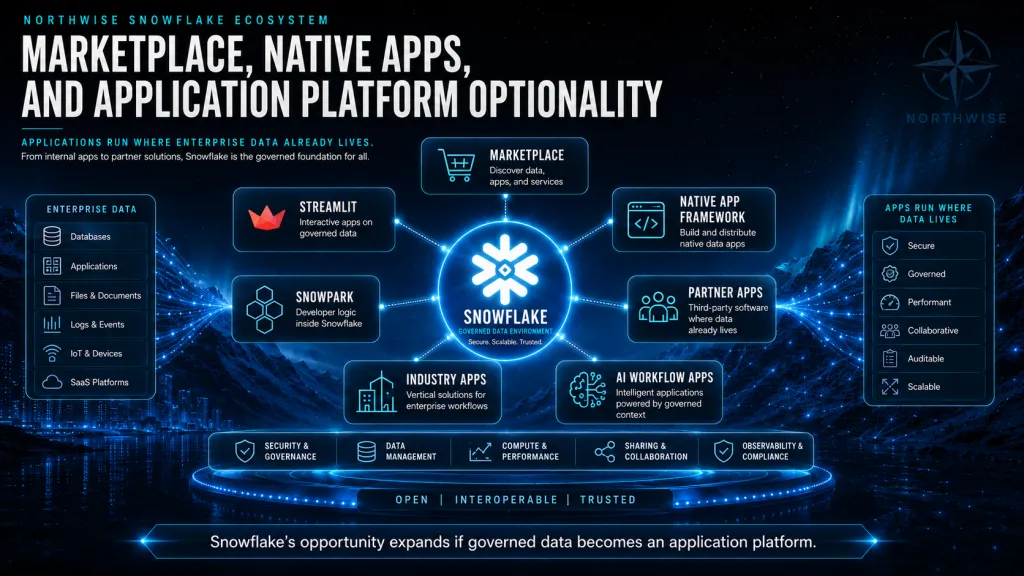
If applications can run where governed data already lives, Snowflake becomes more than a query engine. It becomes an application platform, and that is a different and larger kind of business.
The building blocks are Streamlit, the Native App Framework, Snowpark, Snowpark Container Services, the Marketplace, and the partner-built applications that sit on top of them. The reason this is more than a feature is that enterprises hesitate to move sensitive data into third-party applications. If an application can run inside or adjacent to Snowflake, a vendor can deliver functionality without extracting raw data, which removes one of the largest barriers to enterprise software adoption.
The examples are concrete. A healthcare application can run analytics on clinical and claims data without exporting patient records. A financial risk application can analyze transactions, exposure, and compliance records inside the customer's governed environment. A retail merchandising application can combine sales, inventory, pricing, and customer data. A cybersecurity application can work across logs, identity data, and security signals. An AI decision application can pair Snowflake data with model reasoning to produce recommendations for a workflow.
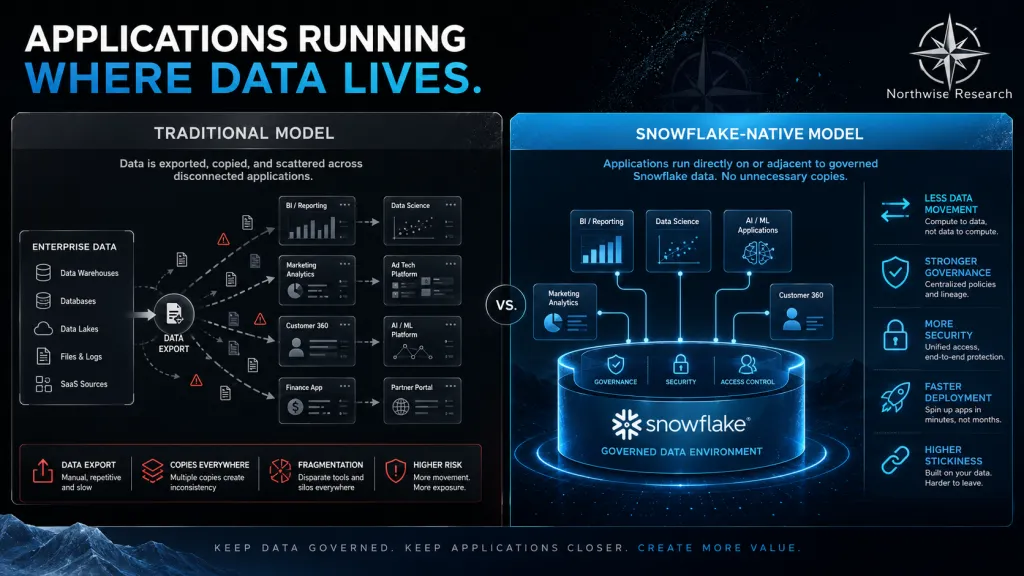
Monetization can come from more compute, Marketplace fees, a broader partner ecosystem, deeper stickiness, and vertical adoption. Software ecosystems tend to strengthen when third parties build on them, the way Salesforce did in CRM and ServiceNow did in IT workflows, and Snowflake is attempting a similar move around data and AI applications. The risks are real: developer adoption is not guaranteed, Databricks remains strong with data scientists, Microsoft can bundle competing tools, Marketplace revenue may stay small, and enterprise procurement is slow. This layer is not yet core to the model. It widens the company's long-term optionality and the number of ways it can monetize governed data.
14. Strategic Partnerships: The Intelligence Stack
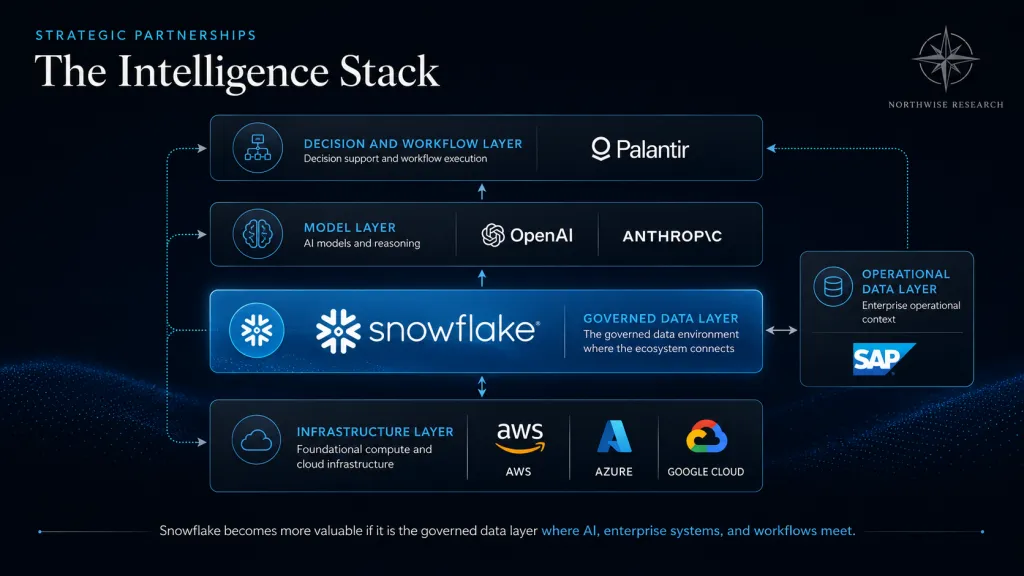
Snowflake's partnerships read less like a logo collection and more like a deliberate stack. The company is not trying to build every model, application, or workflow itself. It is trying to be the governed data environment where those layers meet.
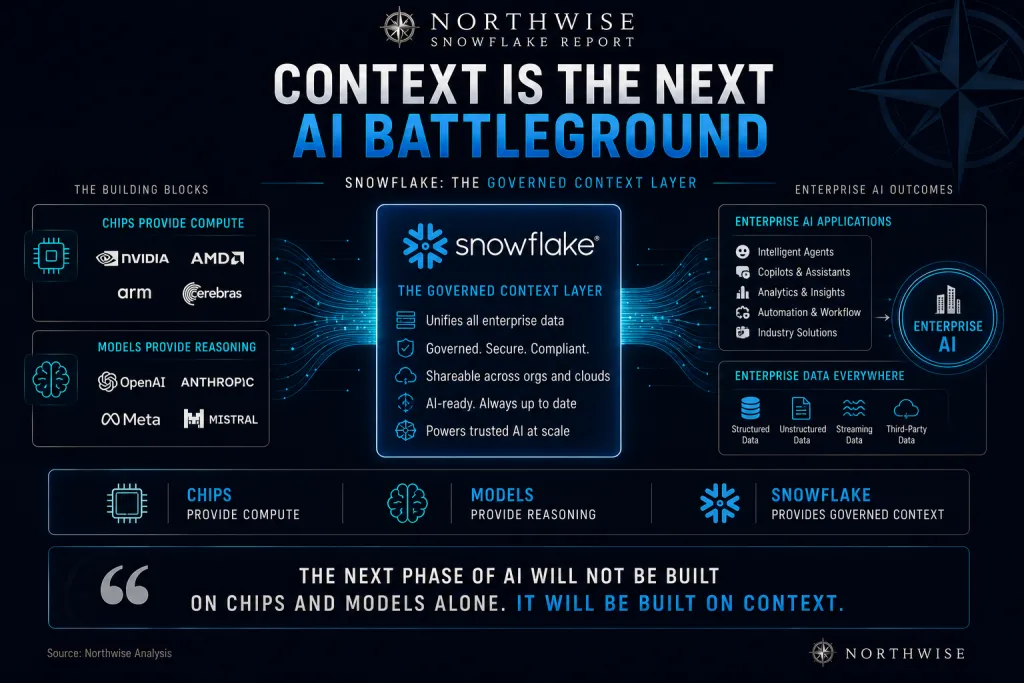
At the infrastructure layer, the $6 billion, five-year AWS commitment is the headline. It is Snowflake's largest infrastructure agreement to date, it expands the use of Amazon's Graviton processors and GPUs for generative and agentic workloads, and it arrives as Snowflake's lifetime AWS Marketplace sales pass $7 billion. The relationship signals that AWS sees Snowflake as strategically useful rather than purely competitive, and it gives Snowflake scale to move customers from AI experimentation into production. The tension is that AWS competes through Redshift and its own analytics and AI services, so the right framing is that Snowflake remains multi-cloud while AWS becomes increasingly central to its AI scaling path.
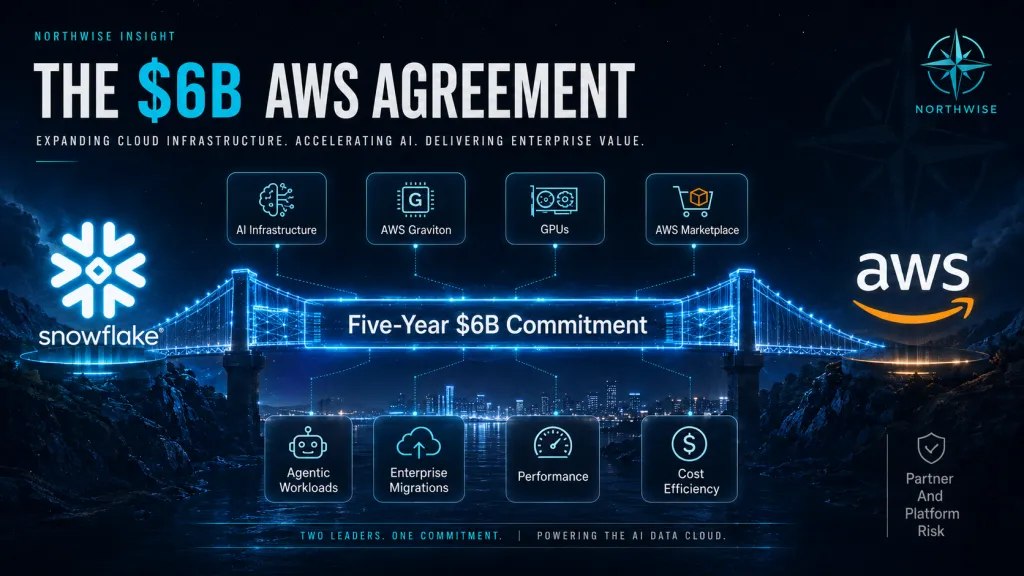
At the model layer, the OpenAI partnership is a multi-year agreement worth $200 million that makes OpenAI models natively available within Cortex AI across all three major clouds, pairing leading models with Snowflake's data context and governance. The Anthropic partnership brings Claude models into Snowflake's AI products, which strengthens Snowflake's standing with enterprises that weight reasoning quality, coding, and safety heavily. Neither model provider is exclusive to Snowflake, and both partner widely, so the advantage is the governed environment around the models rather than the models themselves.
At the operational data layer, SAP holds some of the most critical data in the enterprise world: finance, procurement, supply chain, inventory, and planning. Snowflake's SAP partnership, now generally available, gives it a bridge into that operating core, which is exactly the context an AI system needs to reason about inventory, working capital, or supply chain risk. SAP will also build its own AI and data capabilities, so Snowflake has to stay complementary and clearly valuable.
At the decision layer, Palantir provides workflow, ontology, and decision tooling while Snowflake provides the data foundation underneath, a pairing that fits defense, manufacturing, energy, logistics, healthcare, and finance. The risk is that Palantir captures the visible workflow layer and the customer relationship while Snowflake remains infrastructure beneath it. Across all of this, Snowflake's neutrality across AWS, Azure, and Google Cloud is valuable to large enterprises whose data spans clouds, even though every one of those clouds is also a competitor.
15. Leadership: From Slootman to Ramaswamy
Leadership transitions matter most when a company is changing what it does, and Snowflake is changing what it does.
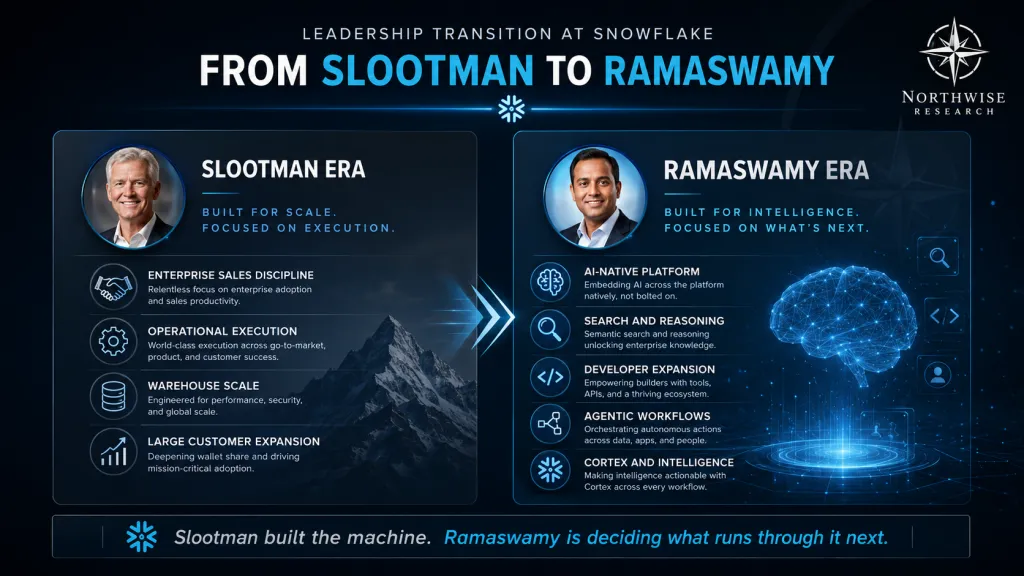
Frank Slootman built the enterprise sales machine. He gave Snowflake operational discipline, scaled it into one of the major software companies of the cloud era, and earned the trust of large customers through execution and sales productivity. That work is the reason there is a platform worth repositioning at all.
Sridhar Ramaswamy is running a different phase. A former Google search and ads leader who built Neeva, the AI search company Snowflake acquired, he brings product and AI depth rather than a pure go-to-market archetype. Under his direction Snowflake has pushed toward AI, semantic search, natural-language interfaces, developer tooling, and agentic workflows. The shorthand is that Slootman built the machine and Ramaswamy is deciding what runs through it next.
The next phase asks for more than sales execution. It asks for product velocity, AI credibility, developer adoption, model partnerships, and the ability to turn AI demonstrations into production workloads. The evidence so far is encouraging: the Snowflake Intelligence rollout, the expansion of Cortex, the OpenAI and Anthropic partnerships, the deepened AWS relationship, the raised fiscal 2027 guide, and management's choice to tie demand explicitly to AI. The risks attach to the same ambition. Product velocity can become product sprawl. AI-native messaging can outrun monetization. Developer adoption can lag Databricks. And Ramaswamy still has to prove he can steer a large public software company through a competitive platform war while keeping enterprise trust intact. The transition raises the probability that Snowflake can execute the AI pivot. Proof still has to come through sustained product revenue growth, AI monetization, margin resilience, and customer expansion.
16. Financial Foundation and Recent Results
This is the bridge between the qualitative thesis and the model that follows, so it is worth being precise about what the numbers prove and what they do not.
The baseline going into the year was already healthy. Full-year fiscal 2026 product revenue reached $4.47 billion, up 29%. Fourth-quarter product revenue was about $1.23 billion, net revenue retention sat around 125%, and remaining performance obligations stood at $9.77 billion. The company counted 733 customers above $1 million in trailing product revenue. None of that looked like a business becoming irrelevant.
The first quarter of fiscal 2027, reported in late May 2026 for the period ended April 30, strengthened the picture. Product revenue was $1.33 billion, up 34% year over year and the strongest sequential dollar gain in the company's history. Net revenue retention rose to 126%. The large-customer base grew to 779 accounts above $1 million, a net addition of 46 in the quarter and 29% growth year over year. Remaining performance obligations were $9.21 billion, up 38%. Management raised full-year fiscal 2027 product revenue guidance to $5.84 billion and guided second-quarter product revenue to roughly $1.415 billion to $1.420 billion, tying the strength to both the core platform and AI capabilities.
What the results establish is bounded but real. Snowflake is not a decelerating warehouse. Core enterprise demand is strong, large-customer expansion is healthy, and AI is starting to shape both guidance and management commentary. The pre-earnings pessimism was too severe.
What the results do not establish matters just as much. They do not prove that AI revenue becomes a multi-billion-dollar line quickly, that AI workloads carry high margins, that Snowflake beats Databricks, that 30%-plus product growth can persist indefinitely, or that the stock is cheap at any price. The most important data going forward remains monetized consumption, gross margin, free cash flow, and large-customer expansion. The quarter improved the evidence and, in doing so, raised the burden of proof for the bull case.
17. The Post-Earnings Rally and Narrative Reset
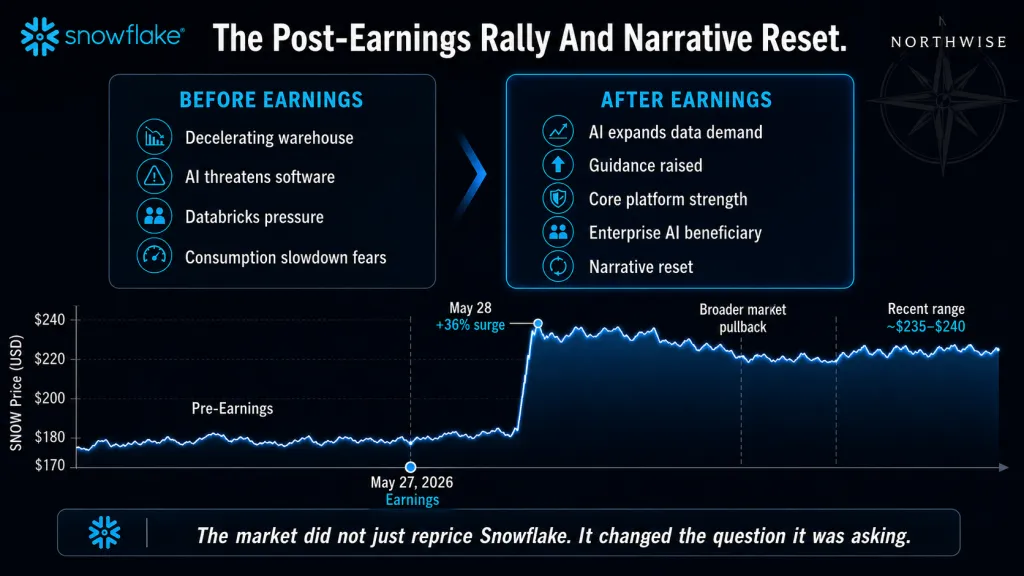
The stock's move tells you as much about sentiment as about fundamentals. Snowflake reported a strong quarter, raised guidance, and announced the large AWS commitment. The shares jumped roughly 36% on the print, then gave much of the enthusiasm back as the broader market sold off, closing near $235.
What changed was not one quarter of results but the frame investors were using. Before earnings, the prevailing story held that AI might erode software economics, that data warehouses were maturing, that Snowflake was losing momentum, that Databricks was the more exciting platform, and that consumption growth and margins were both at risk. After earnings, a different story gained ground: that AI may expand data infrastructure demand, that consumption software can benefit from AI rather than suffer from it, and that enterprise data platforms may become more important as models proliferate.
A narrative reset of that kind is more durable than a single beat, and it is also where investors tend to overshoot in the short term. A better thesis does not suspend valuation discipline. At $235, Snowflake has left the deeply misunderstood zone it occupied before the quarter, and it remains attractive if the base case is correct. The open question is whether the rerating has run ahead of the evidence or merely caught up to it, and that is precisely the question the model is built to answer.
18. Competitive Landscape
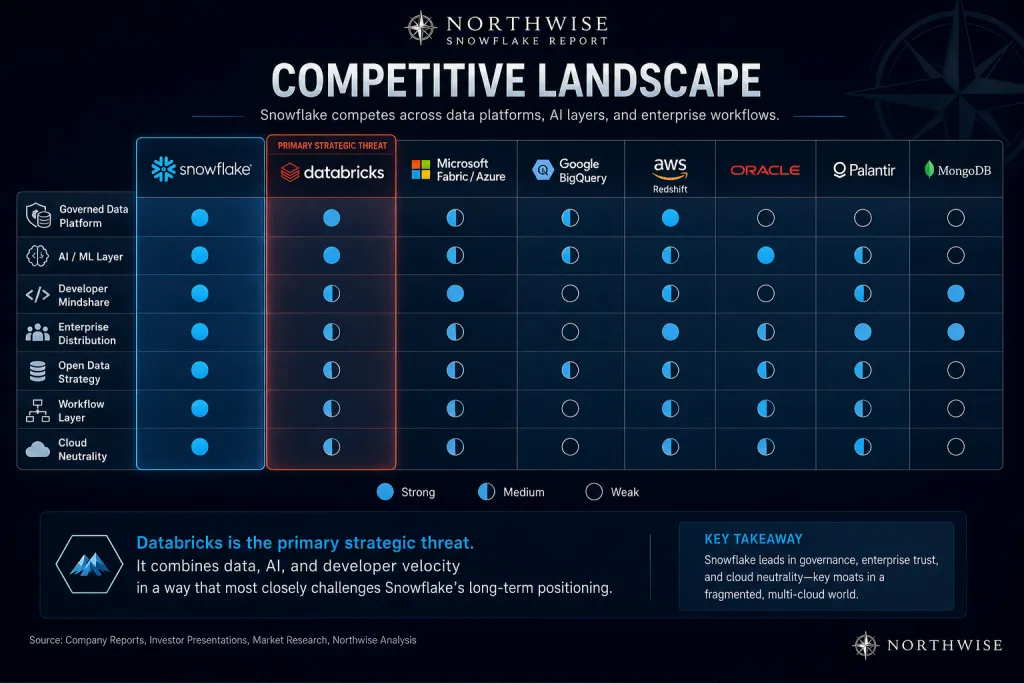
This is the part of the report that should make a holder uncomfortable, since the market is large and crowded, and the same size that creates the opportunity attracts serious competition.
Databricks is the central threat. It has reached a $5.4 billion annualized revenue run rate, growing more than 65% year over year, with roughly $1.4 billion of that from AI products and net revenue retention above 140%. It carries strong credibility in developer tooling, data engineering, machine learning, and the open lakehouse, backed by Unity Catalog, its MosaicML acquisition, and agent tooling, and it sits behind a private valuation near $134 billion with an S-1 expected in the second half of 2026.
The danger to Snowflake is that Databricks owns the AI engineering layer while Snowflake holds enterprise analytics, governance, and business-user workflows. The more constructive read is that Databricks growing this fast validates the size of the prize. Both readings are correct at once, which is the uncomfortable part: the category is becoming extremely valuable, and Snowflake does not win it by default.
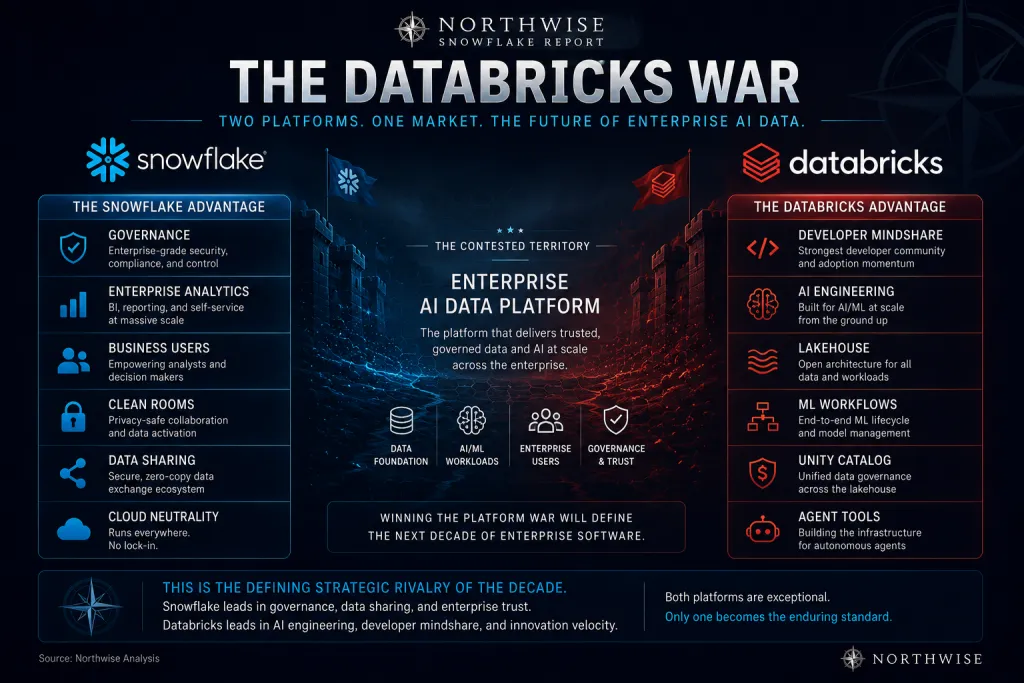
Microsoft is dangerous in a different way. Through Fabric, Azure, Power BI, Microsoft 365, and Copilot, it can package good-enough data and AI tooling into broader enterprise contracts backed by deep CIO relationships and enormous distribution. Snowflake's counter is neutrality, best-of-breed performance, cross-cloud consistency, and depth on specialized data workloads.
Google BigQuery brings strong cloud-native analytics, Gemini integration, and a heritage in search and ads data, and Snowflake again leans on neutrality and its enterprise data positioning. AWS Redshift and native AWS analytics can keep workloads inside the Amazon ecosystem on cost and proximity, though the $6 billion partnership suggests cooperation still carries value, and Snowflake can serve customers who want best-of-breed infrastructure running on AWS rather than the default tools.
Oracle defends core enterprise database workloads through its database heritage, ERP adjacency, and OCI growth, while Snowflake offers a modern cloud-native, multi-cloud alternative. Palantir can own the workflow and decision interface above Snowflake, leaving Snowflake as the foundation beneath multiple operational systems.
MongoDB anchors application and operational data with strong developer adoption, and some AI applications may be built directly on operational databases rather than analytical platforms, where Snowflake counters with enterprise-wide analytics, governance, and large-scale cross-system processing. Datadog is not a competitor but a useful read-through: its AI-driven demand supports the broader idea that AI increases data volume, telemetry, and system complexity across the stack.
The market is enormous, and it is not empty. The opportunity is large because the problem is large, and the risk is large for the same reason.
19. What the Market Is Still Missing
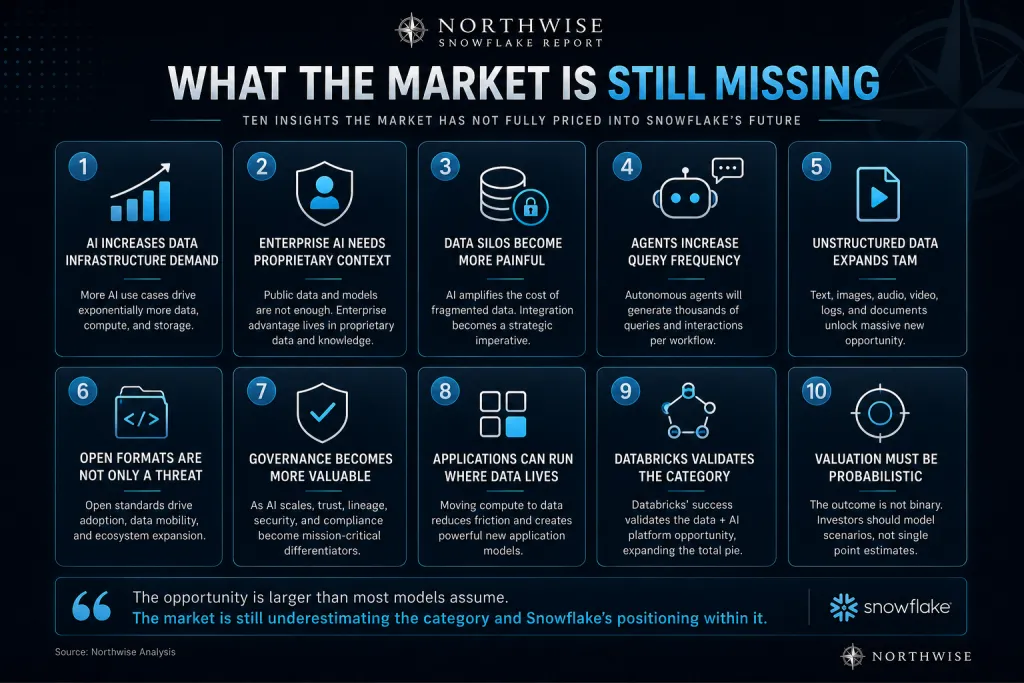
Pulling the argument together without restating all of it, the gap between consensus and our view comes down to a few connected points.
AI increases the need for enterprise data infrastructure rather than reducing it, since models are useless without proprietary context, and that context lives across fragmented systems that require connection, governance, access control, and auditability. Snowflake's consumption model can benefit from non-human query demand, and unstructured data expands the workload universe it can reach.
Open formats are not only a threat; handled well, they enlarge the pool of data Snowflake can compute on. Clean rooms and advertising show how valuable governed collaboration can become, and applications running on governed data could deepen the ecosystem.
The leadership transition is strategically meaningful rather than cosmetic, since Ramaswamy is repositioning the company for AI-native workflows rather than managing a warehouse in decline. Databricks is not evidence that Snowflake is doomed; it is evidence that the AI data platform market is becoming extremely valuable.
And the right way to value Snowflake is probabilistic, with real downside if AI monetization disappoints and real upside if agentic consumption scales. The market has begun to understand Snowflake differently. It is still early in understanding what happens when AI makes enterprise data active rather than passive.
20. What Would Break or Strengthen the Thesis
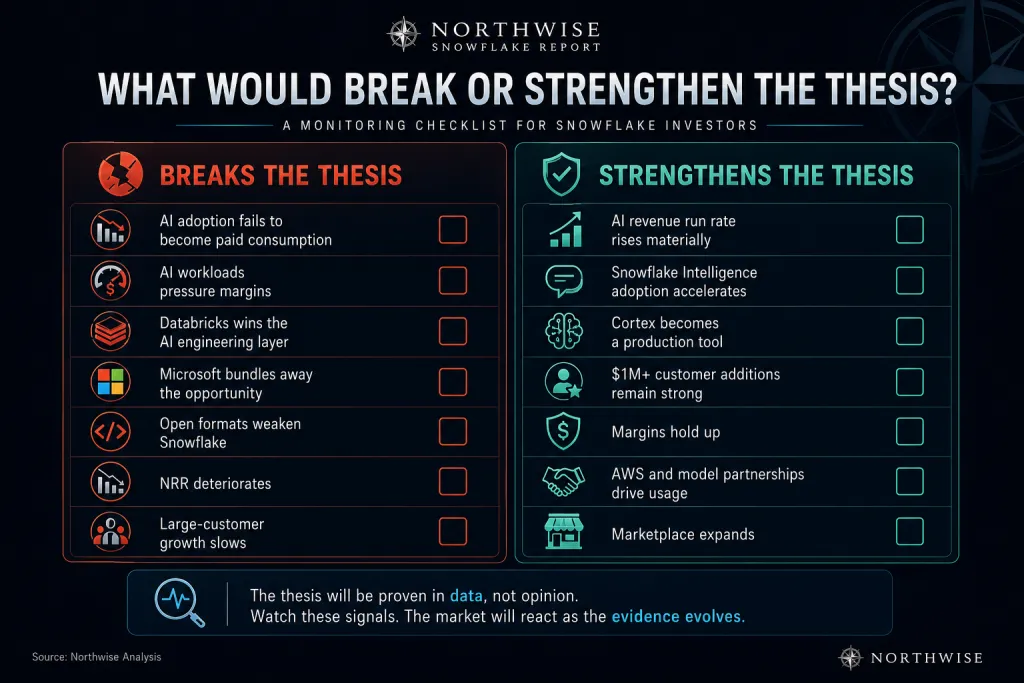
A thesis is only useful if you know what would change your mind, so here is the monitoring framework in both directions.
The thesis breaks if AI adoption fails to become paid consumption, with customers experimenting on Snowflake's AI tools without generating material revenue.
It weakens if AI workloads pressure margins, with inference and infrastructure costs eroding gross margin and free cash flow.
It is undermined if Databricks wins the AI engineering layer outright, if Microsoft bundles the opportunity away through Fabric and Copilot, or if open formats let customers move compute off Snowflake faster than they expand its reach.
Deteriorating net revenue retention, slowing growth in the $1 million customer base, or weakening remaining performance obligations would each signal the same underlying problem.
Governance friction that keeps enterprises stuck in pilots, product sprawl that confuses customers, stock-based compensation that prevents growth from reaching per-share value, and a valuation that prices the bull case before the base case is proven would all do damage.
The thesis strengthens on the mirror-image signals.
A clearly disclosed AI revenue run rate growing well beyond the prior $100 million mark would lift confidence materially.
Accelerating Snowflake Intelligence adoption, Cortex moving from experimentation to daily production use, and growing AISQL adoption would all show AI becoming real usage.
Continued strong additions to the large-customer base, stable or rising net revenue retention, and resilient product gross margins would confirm the economics.
Tangible benefits from the AWS relationship, measurable enterprise adoption flowing from the OpenAI and Anthropic partnerships, deeper operational workflows from the SAP integration, traction in clean rooms, and a growing Native App and Marketplace ecosystem would each add weight.
And Databricks validating the category while both companies grow would confirm that the market is large enough for more than one winner.
21. Premium Model Preview
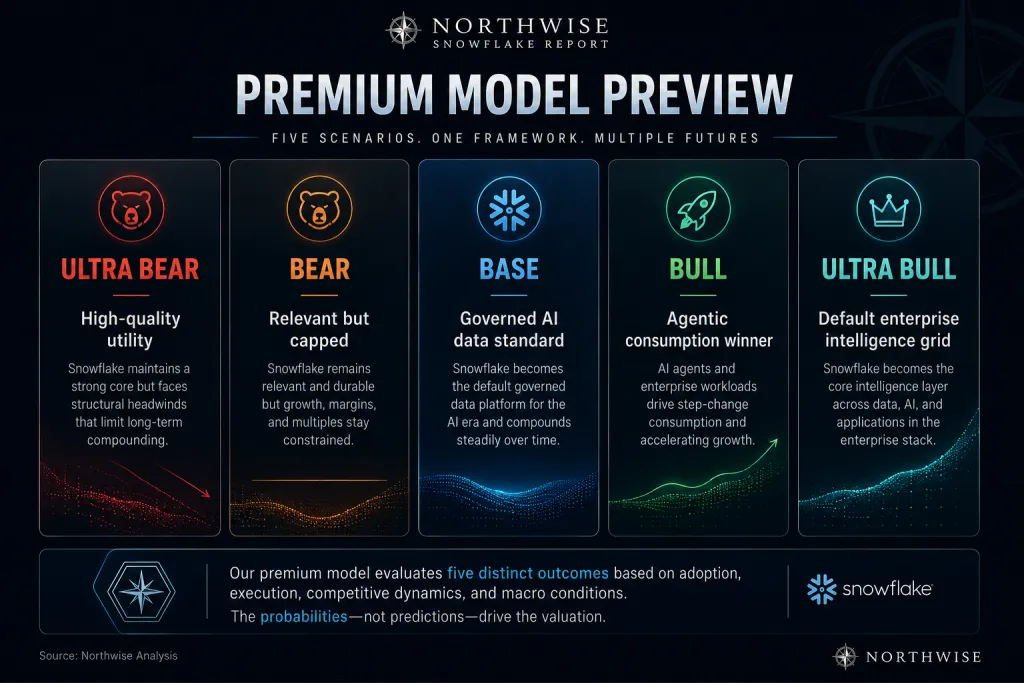
The qualitative evidence supports an upgraded model. It does not support an undisciplined one. The central case improves after the first quarter of fiscal 2027, and the most optimistic outcome should still carry a low probability.
The model is built from a small number of moving parts. Fiscal 2027 product revenue guidance sets the starting point, and revenue is forecast forward through fiscal 2031. Each scenario applies a different product revenue growth rate. Free cash flow margin expands or compresses with scale, AI cost, and competitive pressure.
Share count enters the picture because stock-based compensation can dilute owners over time. Exit free cash flow multiples reflect the quality and durability of each outcome. Probability weights keep any single extreme from dominating, and present-value discounting translates the fiscal 2031 figure into a value an investor can compare against today's price.
Five scenarios span the range of plausible futures.
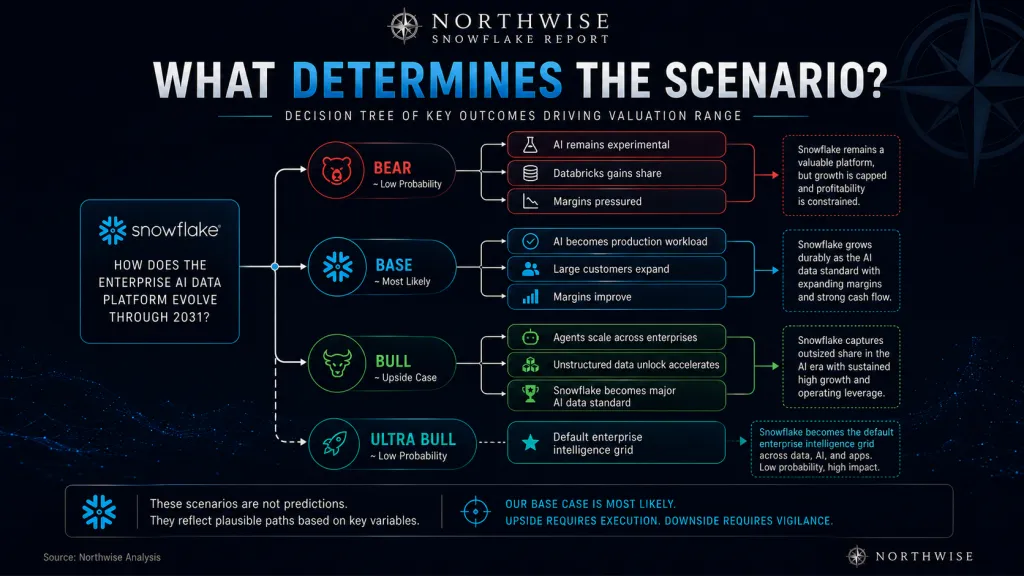
In the ultra bear case, Snowflake becomes a high-quality but slower-growing analytics utility, with AI adoption that exists without generating enough profitable consumption.
In the bear case, it stays relevant while Databricks, Microsoft, open formats, and cost optimization cap growth and margins.
In the base case, it becomes one of the enterprise standards for governed AI data workflows, compounding product revenue at an attractive rate as margins expand with scale.
In the bull case, agentic workflows lift consumption intensity meaningfully and Snowflake becomes one of the dominant platforms for governed enterprise AI.
In the ultra bull case, it becomes a default governed execution layer for enterprise intelligence across major clouds and industries, an outcome that is possible without being something the model should lean on.
The model does not ask what Snowflake could be in a perfect world. It asks what each world is worth, how likely each one is, and whether the stock compensates an investor today.
Everything up to this point is the part of our work we are comfortable publishing in the open. It explains how the business runs, where the demand comes from, who threatens it, and what would confirm or break the case.
What it leaves out is the part that takes the most work and carries the most responsibility, which is the numbers themselves. The sections that follow contain the full five-scenario model, the probability weights behind each outcome, the weighted fair value those scenarios produce, the present value of that figure across three discount rates, and the specific price ranges where we would buy, hold, trim, or step away.
Premium members also receive our running portfolio, updated each week, where positions like this one are sized, tracked, and revised as the evidence changes.
The free research is meant to help you understand the business. The premium research is meant to be acted on.
Northwise Premium
Choose how to continue with Northwise
Join Northwise Premium
Unlock the rest of this report, its complete valuation, the downloadable model, portfolios, and action framework.
Join Northwise PremiumCreate a Free Account
Continue across Free Northwise research, follow companies, save reports, and receive updates.
Create a Free Account
SNOW Stock Forecast 2030: The Business Behind Enterprise AI
Northwise’s SNOW stock forecast for 2030 examines enterprise AI, consumption growth, margins and dilution, with a downloadable Snowflake FY31 model.

Celsius Stock Analysis: The Shelf Reset and the Second Growth Curve
Celsius stock analysis of the shelf reset, Alani growth, Pepsi economics and cash flow, with a 2030 model and a Premium valuation and entry-price framework.

Meta AI Spending: The Customer Is Already Here
Can Meta turn AI spending into shareholder returns? We model advertising, Muse, hardware, capital costs and cash flow through 2030, with a full valuation.
Northwise Portfolios
See how the research becomes real decisions
Reader discussion
Discuss the research
Premium access is required to join this report's discussion.
Join Northwise Premium
No comments yet. Start a thoughtful discussion.