
SNOW Stock Forecast 2030: The Business Behind Enterprise AI

Northwise’s SNOW stock forecast for 2030 examines enterprise AI, consumption growth, margins and dilution, with a downloadable Snowflake FY31 model.
In this article
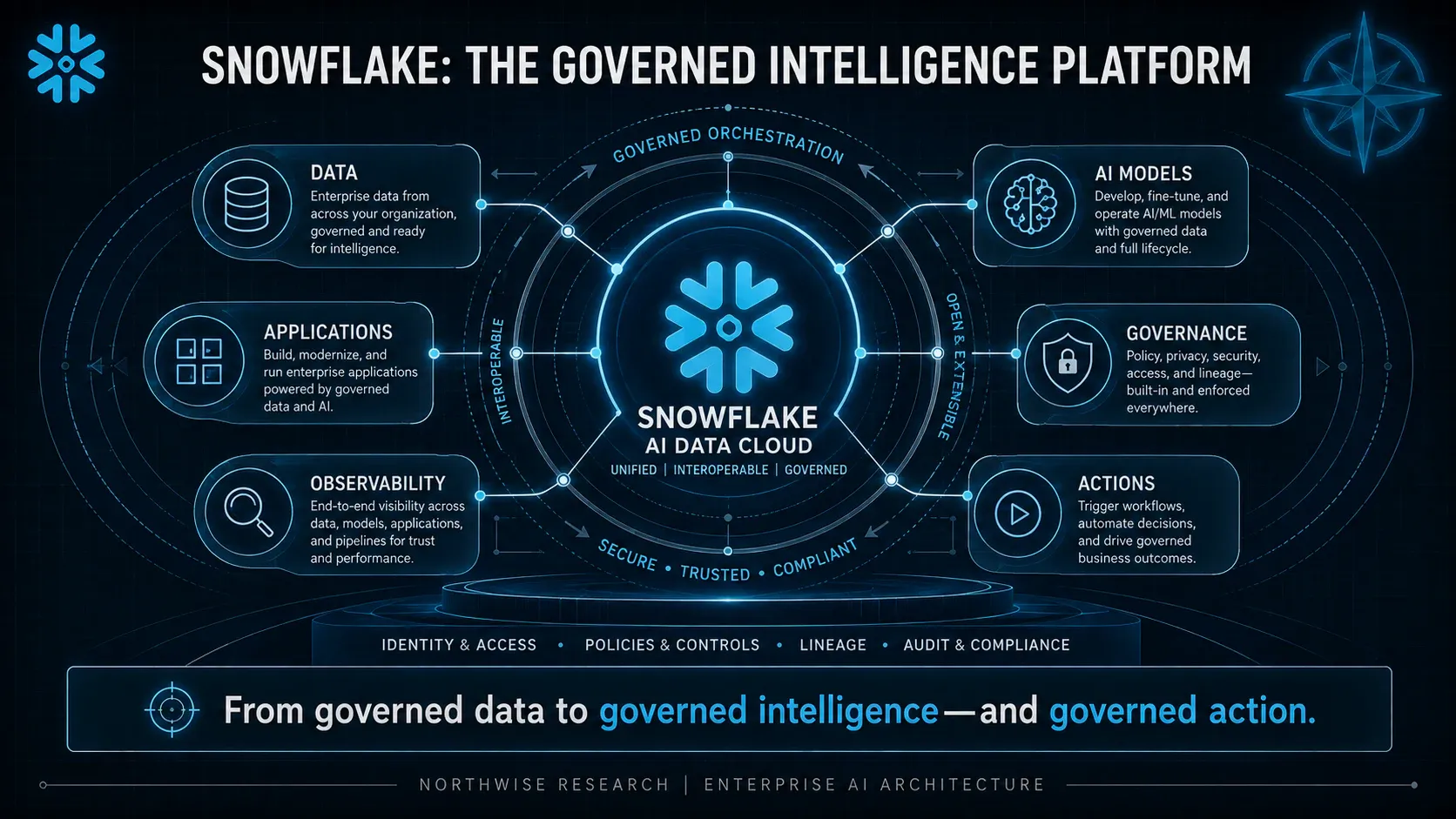
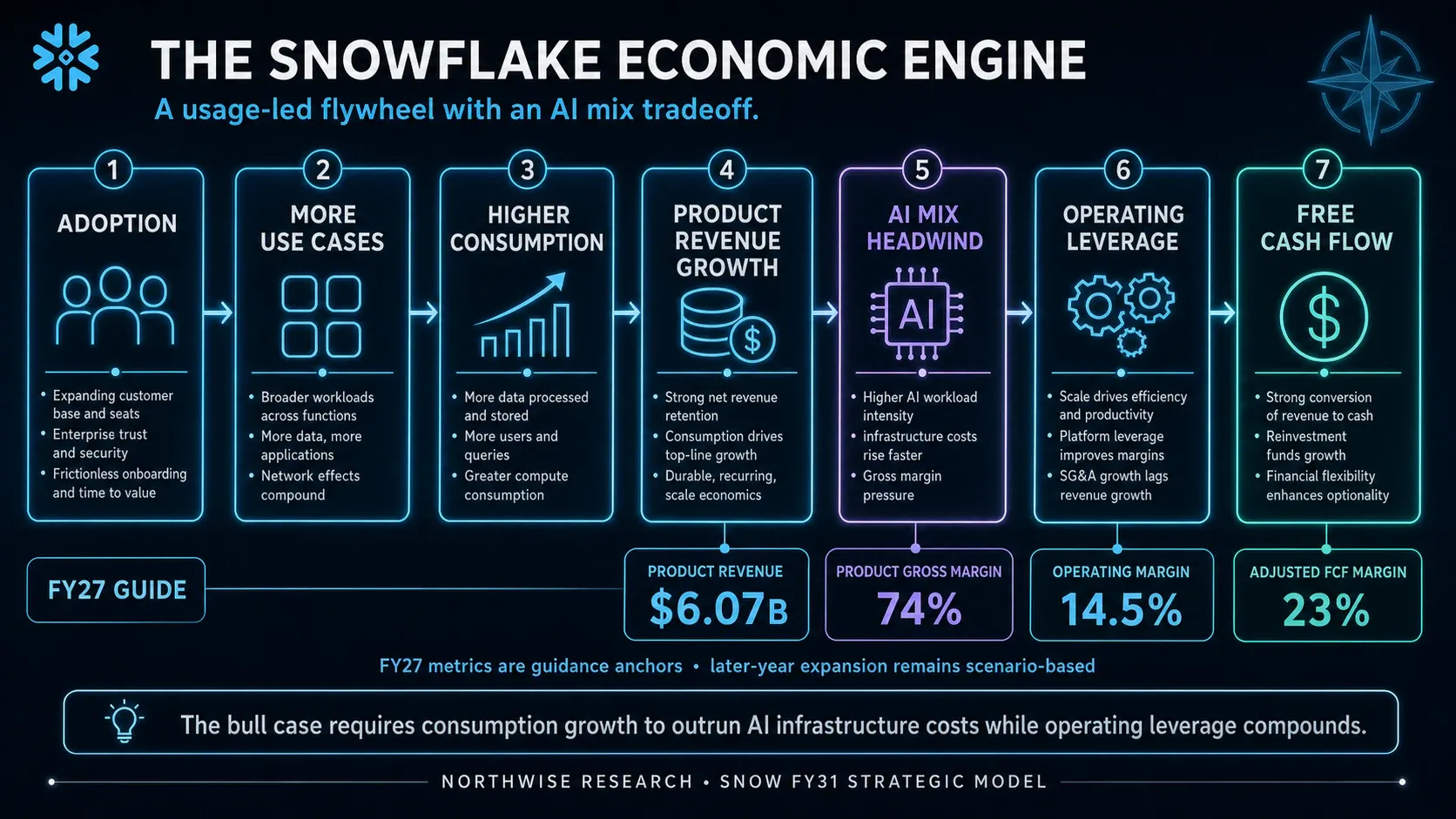
Snowflake is helping customers finish migrations, build applications, and put more of their information to work. Our revised forecast follows that expansion through the products, competitive decisions, cloud costs, and shareholder economics that will determine what the company becomes.
A network equipment manufacturer is moving a legacy Teradata system onto Snowflake in less than three quarters. Management says a comparable migration would previously have taken two to three years. The customer was not named, and the contract value was not disclosed, but the time saved explains something important about Snowflake’s AI strategy. A company that finishes its migration sooner can begin running production workloads sooner. Its engineers can move on to the next project instead of spending another year translating old code and checking that the replacement works. Snowflake’s coding tools are helping remove a constraint that has always stood between a signed agreement and a larger customer relationship.
That is a more useful starting point for this investment than another prediction about how many AI agents the world might eventually deploy. Snowflake already has customers, data, permissions, contractual commitments, and workloads that matter to large organizations. Its newer products are changing how easily those customers can use the platform and how many people can participate. Engineers are getting help with migrations and pipelines. Business teams can ask questions without commissioning a new dashboard. Documents that were difficult to analyze can be processed alongside the records already in the warehouse. Some of the resulting work can run automatically.
We expect this to extend Snowflake’s growth well beyond the runway implied by its original analytics business.
The disagreement is over how much of that opportunity Snowflake will earn. Databricks is pursuing many of the same customers with considerable momentum. Microsoft can place competing capabilities inside software enterprises already buy. Cloud providers and model developers collect part of every dollar Snowflake earns from AI, and employees continue receiving substantial equity compensation. A successful product strategy therefore needs a financial account of who gets paid along the way.
Our original Sovereign Intelligence thesis, published in December 2025, argued that Snowflake’s opportunity lay in the governed use of enterprise data as software began doing more of the analysis. The latest evidence supports that direction. It also requires changes to the economics: current AI workloads carry lower contribution margins, and controlling dilution will consume more cash than our earlier terminal share assumptions acknowledged. The forecast presented here reflects both developments.
Contents
1. Where Snowflake Fits Inside a Company
Snowflake sells the software companies use to organize, process, analyze, govern, and share their information. It runs on AWS, Microsoft Azure, and Google Cloud. Customers use the service without having to manage the physical servers underneath it, although they still need people who understand their data and the business using it. The company became known for its cloud data warehouse, which brings information from different systems into an environment suited to analysis.
The word warehouse makes the work sound more passive than it is. An enterprise does not get much value from placing a second copy of its records somewhere else. Those records have to be organized, checked, connected, updated, and made available to the people who need them. Sales might record a customer one way, billing another, and support a third. A report that combines the systems has to resolve those differences before anyone can trust the answer. Data engineers build the pipelines that move and transform the information. Analysts query it, often using SQL, the standard language for working with databases. Other teams then turn the results into forecasts, dashboards, or applications.
This is why installing an AI assistant does not eliminate the need for a data platform. The assistant still needs reliable information about the company it is supposed to help.
A general model can explain inventory management. It cannot know whether a particular supplier is late, whether the inventory count includes returned merchandise, or whether a purchase commitment has been amended unless the relevant records are available. An answer can sound perfectly reasonable while combining information from different dates or using the wrong definition of an apparently simple business term. Snowflake’s established work around data preparation, access, and governance becomes directly relevant when companies try to connect models to their operations. Its product materials now place enterprise data and context alongside model choice, applications, and agent controls.
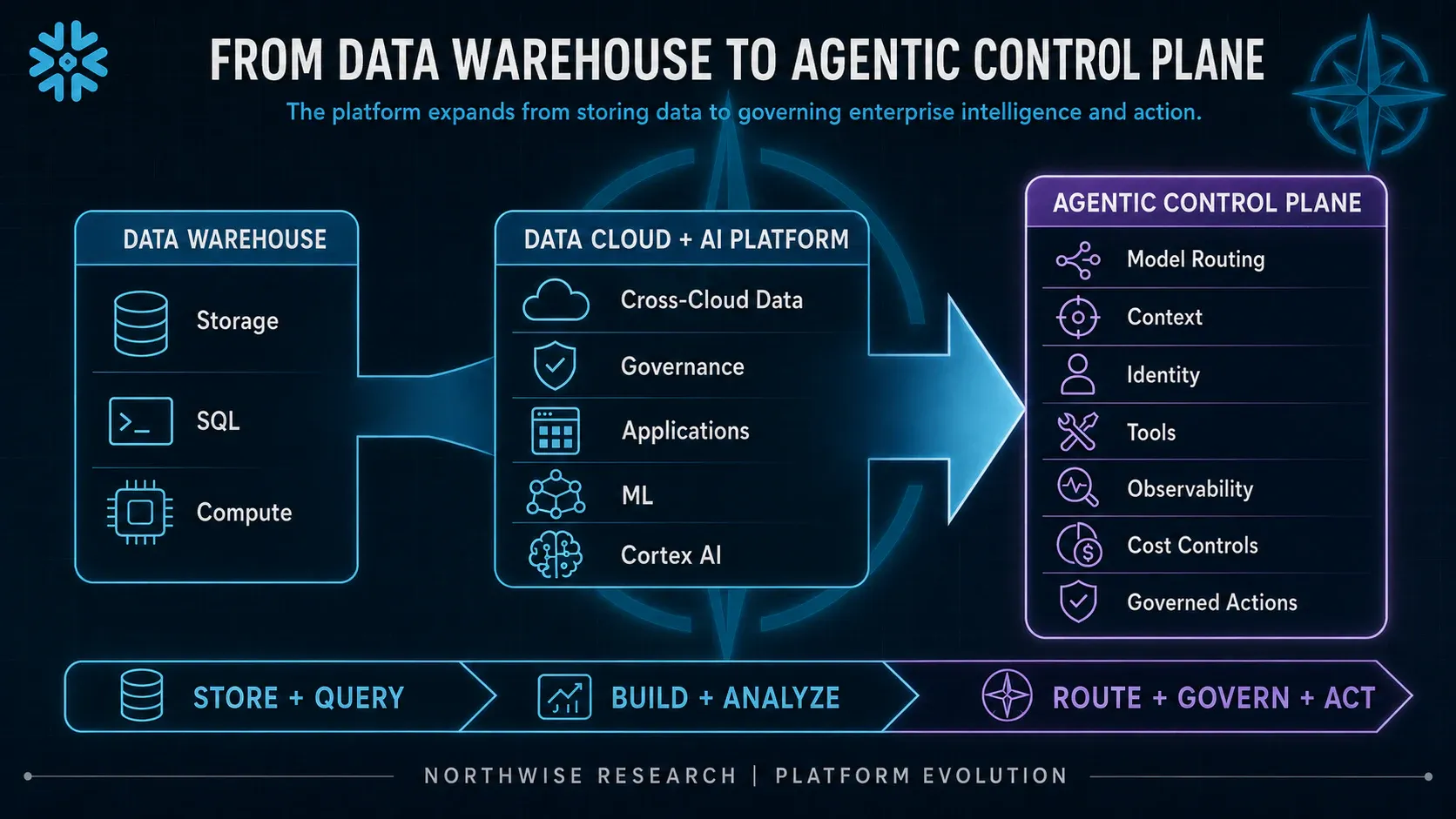
There are several architectures for doing this work. A data warehouse is organized primarily for analytical queries. A data lake holds a wider variety of raw information, commonly in cloud object storage. A lakehouse attempts to combine the flexibility of the latter with capabilities associated with the former. These categories have become less useful as strict descriptions of competing companies because the major platforms increasingly offer overlapping functions. Snowflake’s business now includes data engineering, machine learning, applications, transactions, collaboration, and AI services in addition to the warehouse.
Our interest is in the amount of useful work Snowflake can attract across that broader environment. The installed warehouse gives the company an existing commercial relationship and a substantial base of information over which to sell new services. It does not guarantee that the new work stays there. Customers can keep their records in Snowflake and choose another vendor for a particular model, application, or development project.
That leaves Snowflake with a recognizable enterprise-software advantage: it is already present where the customer has invested time, money, and organizational trust. The next products are easier to sell when they make that investment more productive.
2. The Economics of Consumption
Snowflake’s revenue is tied primarily to consumption of computing, storage, and data-transfer resources. Customers commonly make capacity commitments and receive bills in advance, while most product revenue is recognized as the platform is used. Professional services and other revenue form a separate, much smaller line. These distinctions matter because a contract signing, a cash receipt, and a dollar of recognized revenue can occur at different times.
Consumption changes the route to growth. A conventional seat-based software company might expand by selling licenses to another department or raising the price per user. Snowflake can grow when the same customer runs more pipelines, processes more documents, refreshes information more frequently, or deploys an application that performs work throughout the day. Employee numbers need not move in proportion. One development team can create software that generates considerably more computing activity than the team’s own manual analysis ever did.
The customer has more flexibility in the other direction, too. It can improve a slow query, switch off idle resources, delay a project, or move work to another service. Snowflake’s own performance improvements can reduce the resources required to complete an unchanged task. That makes it a poor business to analyze by assuming every existing workload simply spends more forever.
We see the customer’s total economics as the more important consideration. A cheaper query is one form of savings. A migration that finishes a year earlier, a smaller team maintaining the data environment, or an application that avoids a recurring operational mistake can be worth much more. Snowflake can help customers reduce their overall technology costs even when their Snowflake spending rises. Management’s migration examples and its reports of greater core-platform usage among AI adopters are consistent with that relationship.
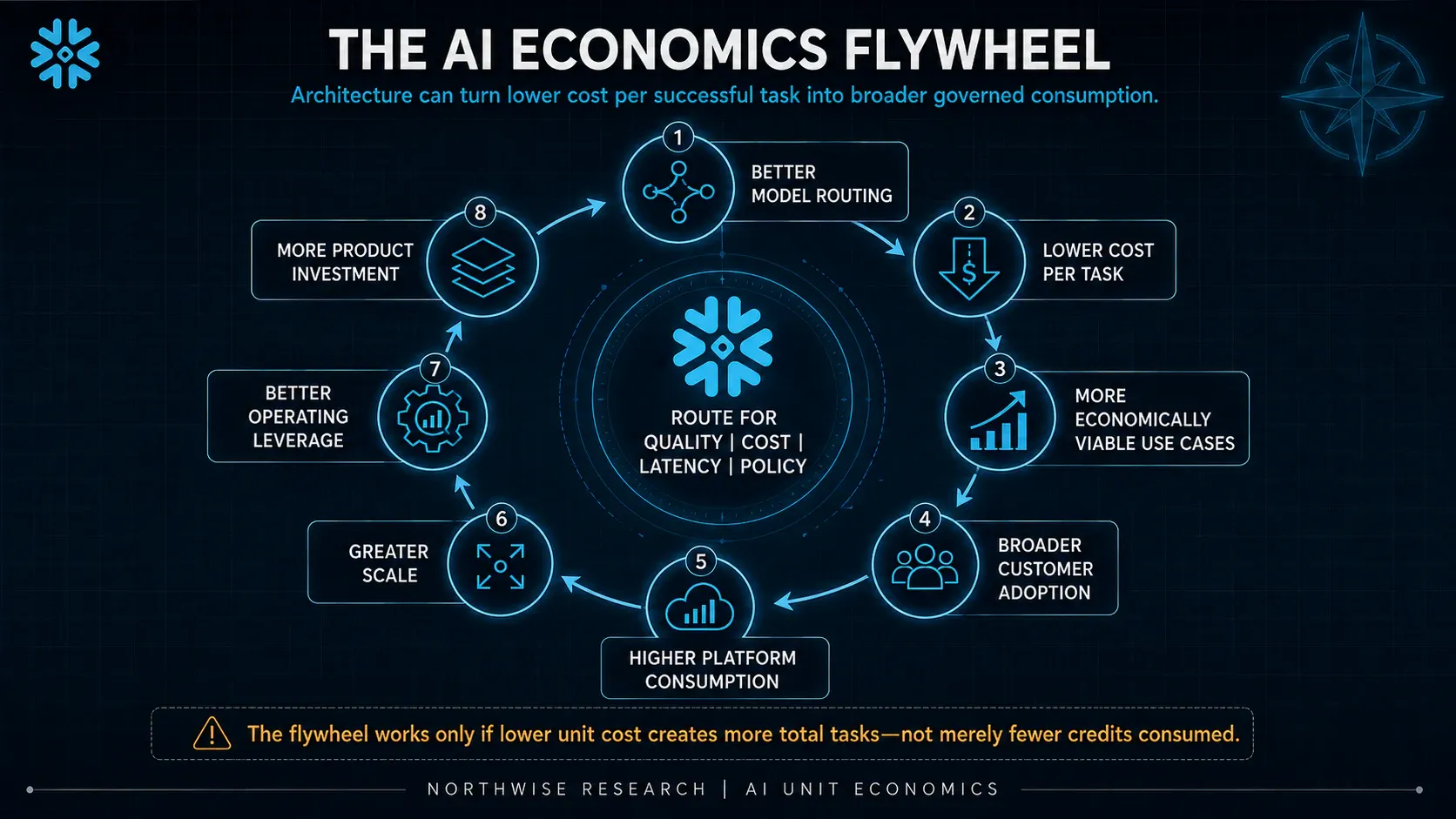
There is no automatic rule that efficiency produces more revenue. A simple illustration shows the requirement. If a task becomes 20% cheaper, customers must run 25% more tasks merely to keep spending unchanged. Running 30% more would increase spending by 4%. The useful question is whether the platform is making enough additional work affordable and practical to exceed that break-even point.
This is also where agents could have a larger effect than ordinary employee adoption. An assistant waits for someone to ask a question. An event-driven workflow can respond when a shipment is delayed, a transaction is flagged, or a new document arrives. Existing software already automates plenty of work; AI broadens the range of tasks that can involve interpreting language, searching less structured information, and choosing a next step. The commercial opportunity comes from that broader applicability, not from the assumption that every agent will run continuously at maximum intensity.
We incorporate both workload expansion and optimization in the forecast. Ignoring either would misrepresent the business.
3. What the Latest Results Tell Us
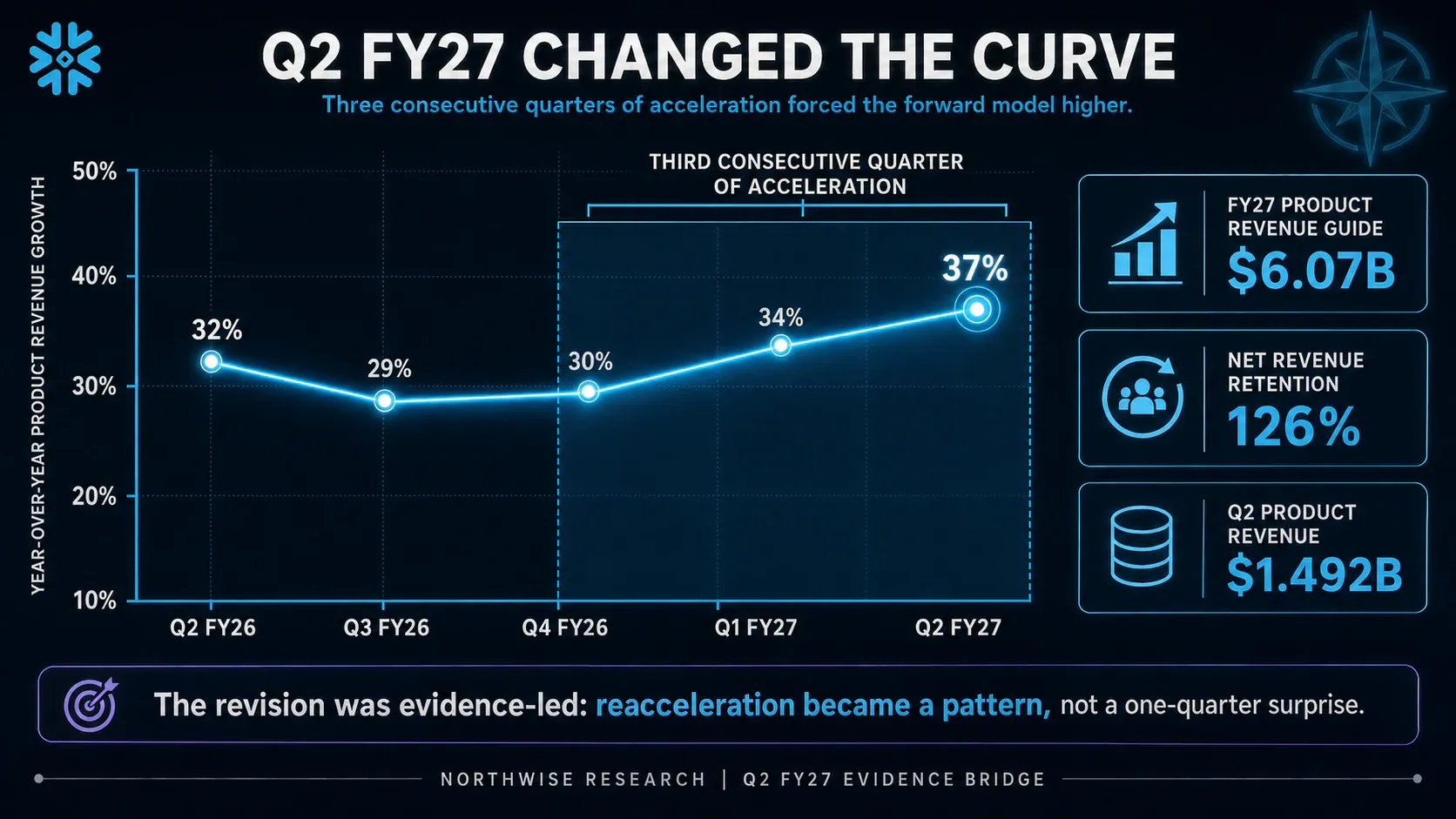
Snowflake’s quarterly product growth has moved from 29% to 30%, 34%, and then 37%. The latest quarter added $157.532 million of product revenue sequentially, following a $107.698 million increase in Q1. The acceleration is occurring on a larger base, and it is accompanied by continued expansion among large customers.
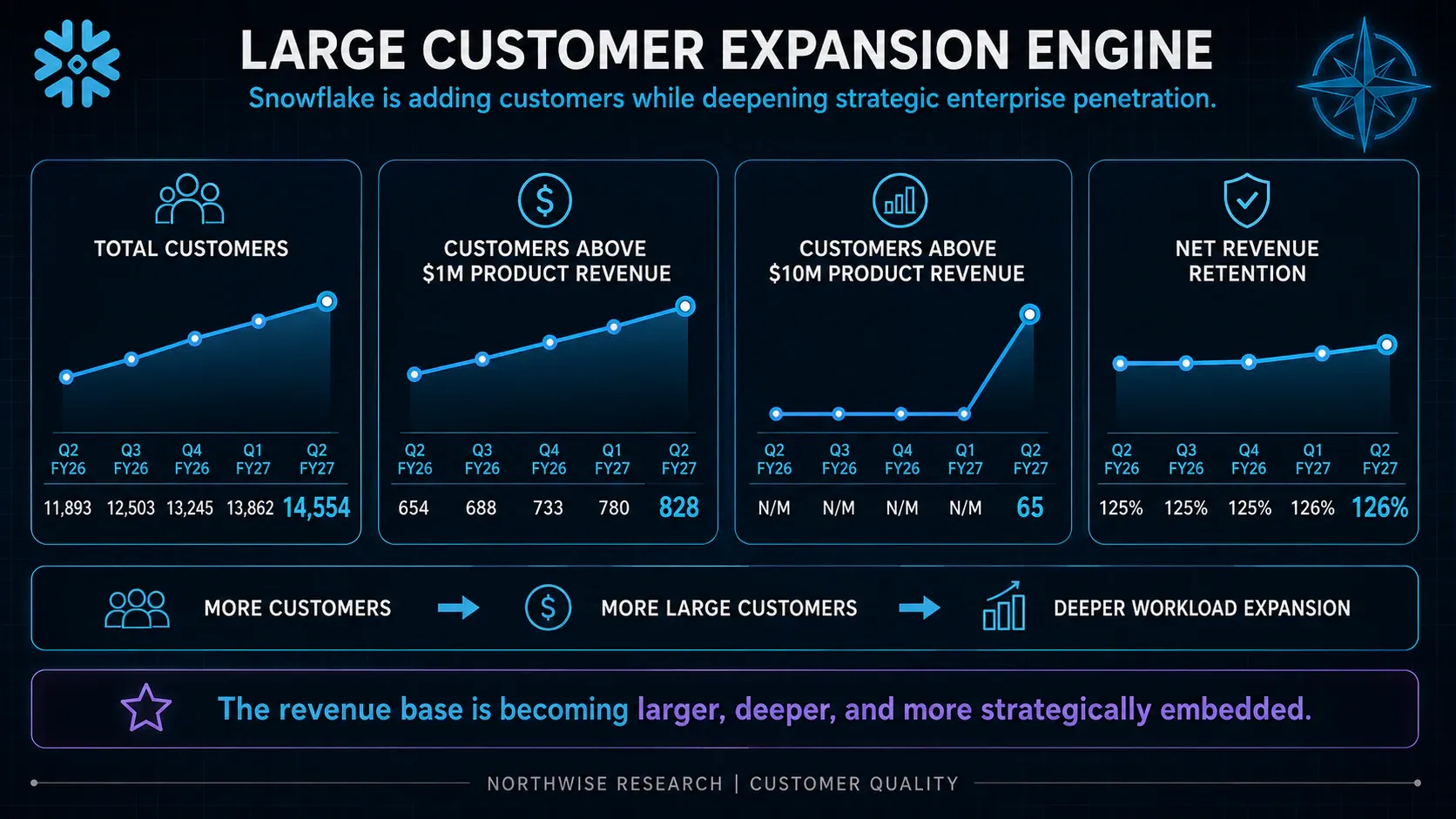
Operating measure | Q2 FY26 | Q3 FY26 | Q4 FY26 | Q1 FY27 | Q2 FY27 |
|---|---|---|---|---|---|
Product revenue, $B | 1.090496 | 1.158377 | 1.226631 | 1.334329 | 1.491861 |
Product-revenue growth | 32% | 29% | 30% | 34% | 37% |
Total revenue, $B | 1.144969 | 1.212909 | 1.283994 | 1.390951 | 1.546793 |
Net revenue retention | 125% | 125% | 125% | 126% | 126% |
Customers above $1M in trailing product revenue | 654 | 688 | 733 | 780 | 828 |
Total customers | 11,893 | 12,503 | 13,245 | 13,862 | 14,554 |
Source: Snowflake’s Q2 FY27 investor presentation. Historical customer figures reflect the company’s reporting definitions and adjustments.
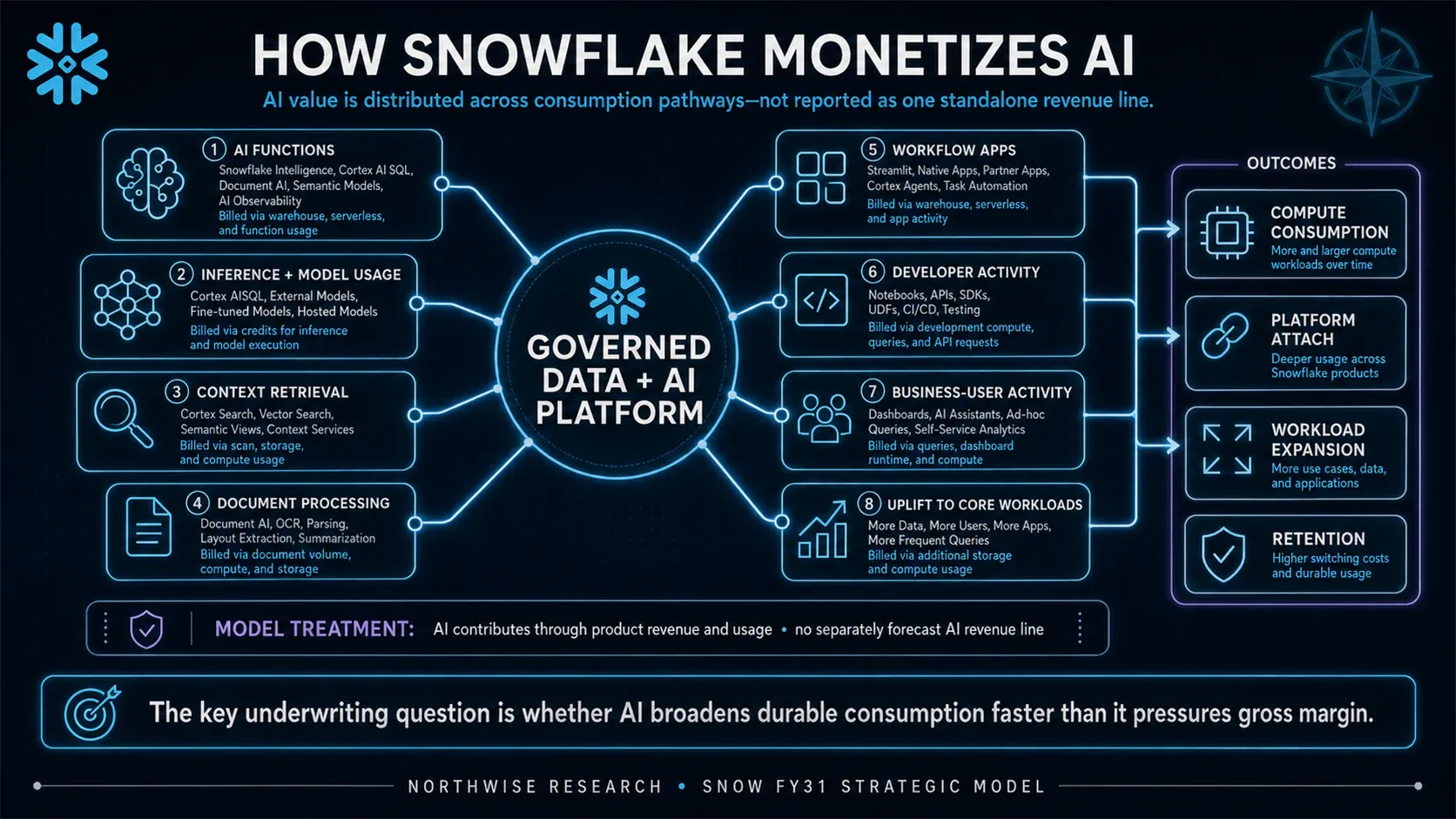
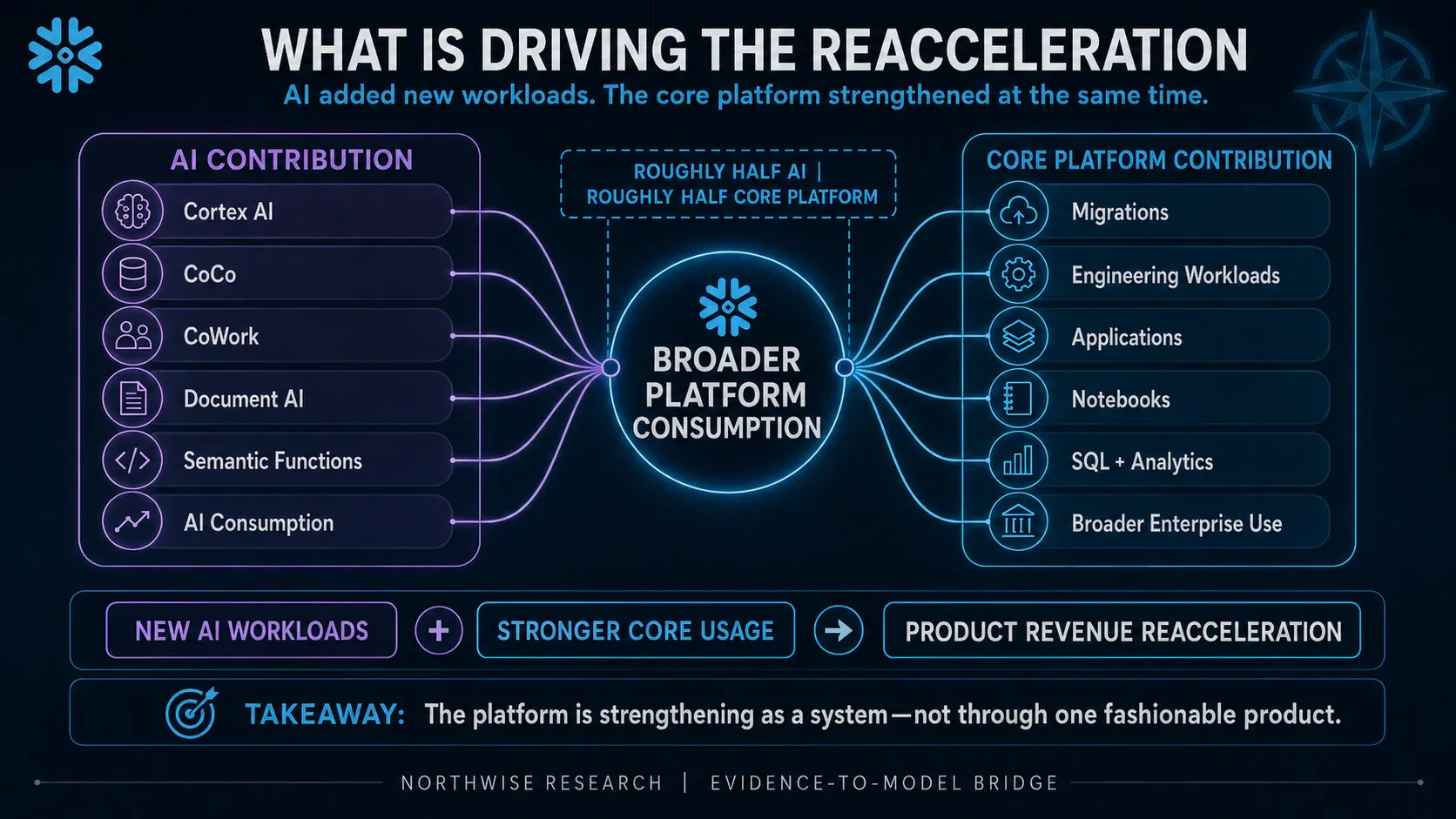
Management attributed approximately half of the recent acceleration to AI products, with the rest coming from migrations and other core activity. That is an explanation of the change in the growth rate, not a disclosure that AI produces half of Snowflake’s revenue. The distinction prevents a fairly spectacular modeling error. Snowflake has a broadening collection of AI revenue sources, but it has not disclosed a sufficiently complete product breakdown to support a separate, audited-looking AI segment in our forecast.
The customer evidence is useful because it tests whether the quarter depended on a narrow pocket of spending. Snowflake added 692 customers, with net additions increasing 32% year over year. It added 48 accounts above $1 million of trailing product revenue and finished with 65 above $10 million. Fourteen new Global 2000 customers brought that count to 829. Net revenue retention held at 126%, meaning the measured existing-customer cohort expanded its spending substantially, including the effect of customers whose consumption declined.
These measures describe different things. Total customer additions indicate that distribution is still expanding. The large-account thresholds show greater depth. Retention captures net spending behavior within an existing cohort. Together they make a stronger case than any one measure alone, particularly alongside management’s statement that AI-native companies remain a relatively small part of the business. We are more comfortable extending growth when established enterprises are migrating and expanding than when a handful of newly funded customers account for most of the increase.
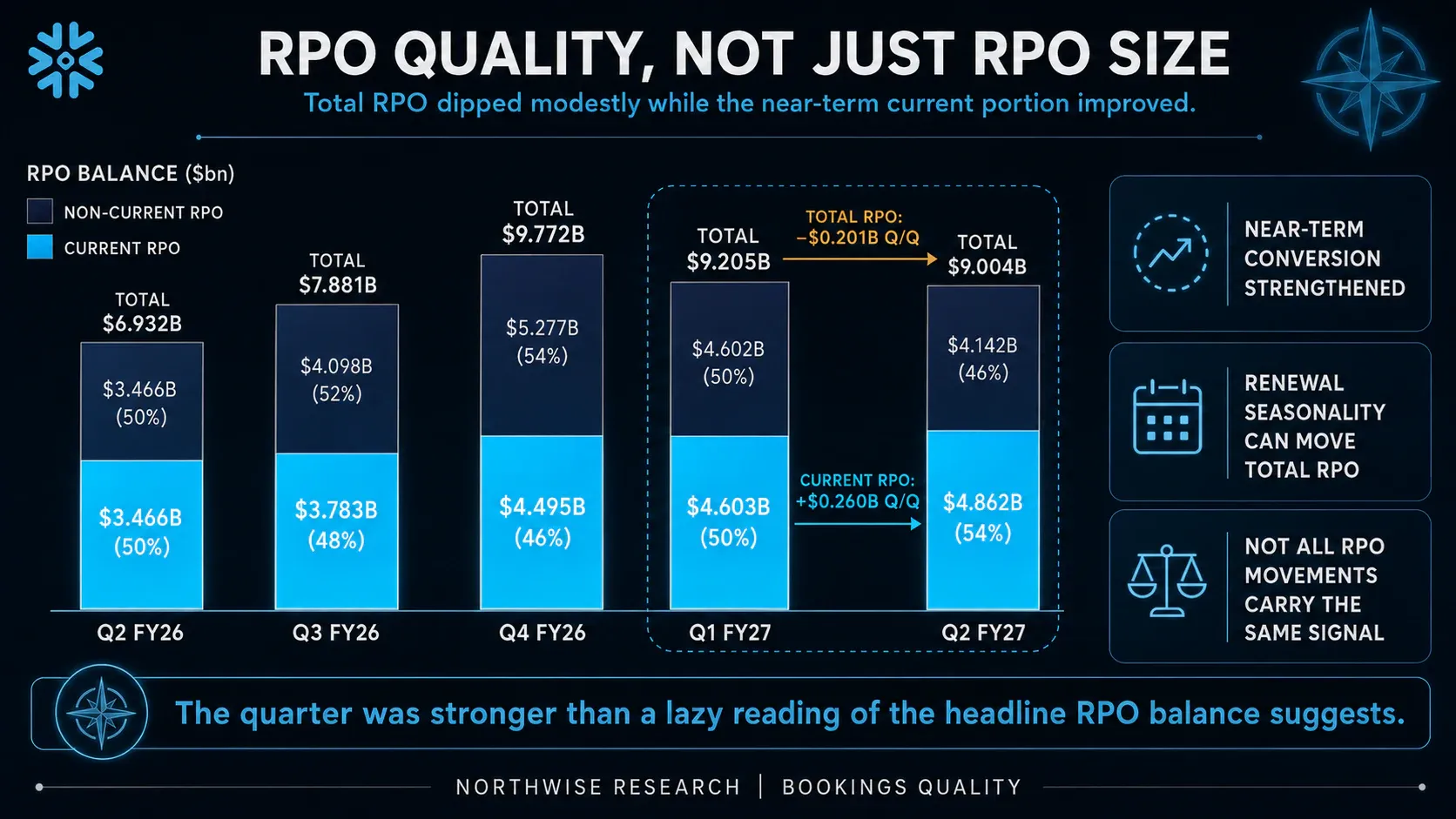
Contract commitments require a little more work to interpret. Total remaining performance obligations, or RPO, declined from $9.205 billion in Q1 to $9.004 billion in Q2. RPO is contracted revenue that has not yet been recognized; it is neither cash nor a complete forecast of future consumption. The share expected to convert within twelve months increased from 50% to 54%, improving the near-term picture despite the decline in the headline balance.
RPO measure | Q4 FY26 | Q1 FY27 | Q2 FY27 |
|---|---|---|---|
Total RPO, $B | 9.772 | 9.205 | 9.004 |
Expected within twelve months | 46% | 50% | 54% |
Approximate current portion, $B | 4.495 | 4.603 | 4.862 |
The current portions are our calculations using rounded company percentages. Management described growth in its current-RPO estimate as approximately 42% year over year and said renewals are increasingly concentrated in Q4. The rounded public figures do not reproduce that growth rate exactly.
We read the combination as stronger near-term demand, not weakening demand disguised by a revenue beat. That conclusion will need to survive the important year-end renewal period.
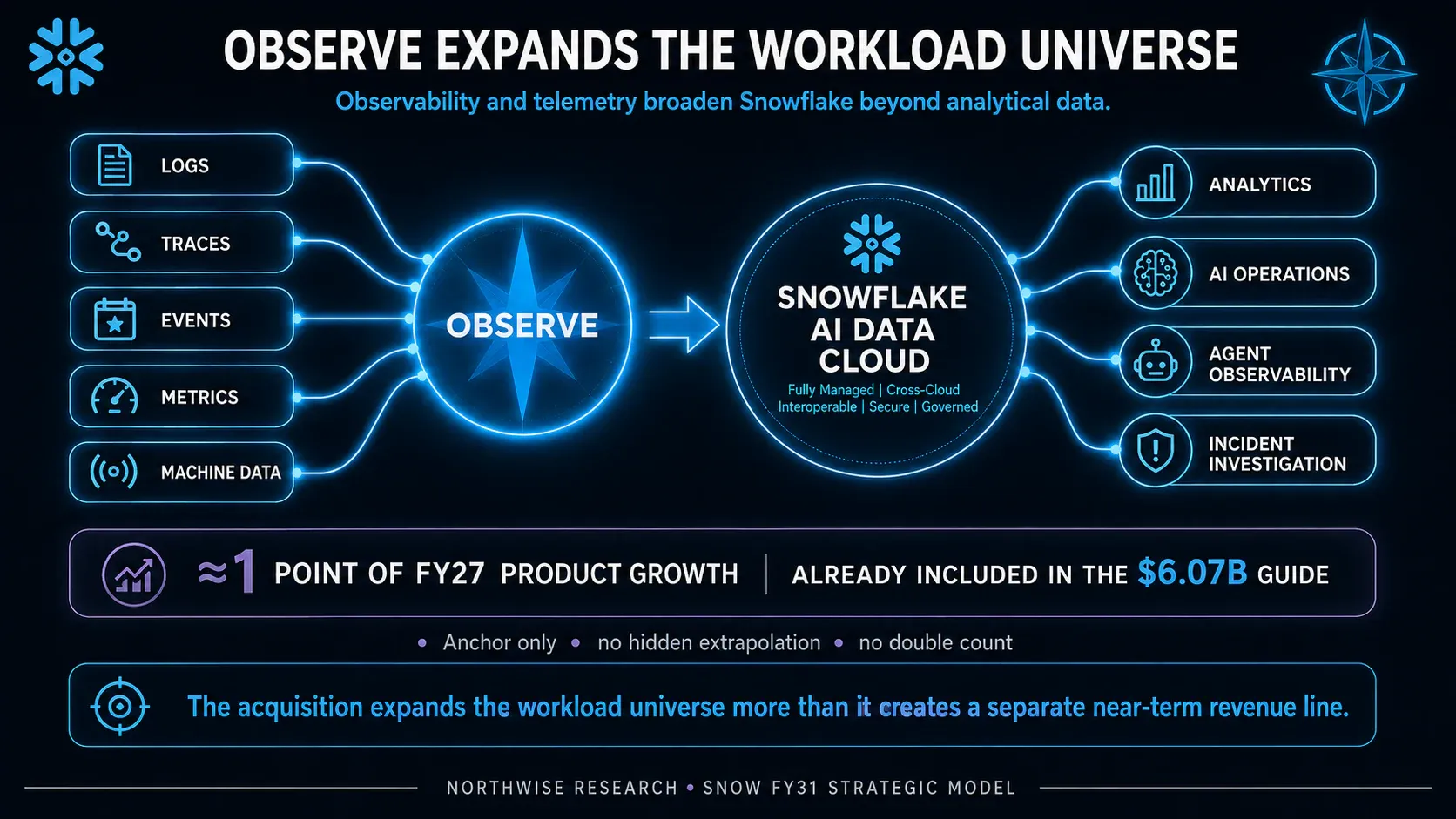
The full-year guide also keeps the latest quarter in perspective. Snowflake expects $6.070 billion of FY27 product revenue, with approximately one percentage point of growth supplied by Observe. Q3 guidance is $1.588 billion to $1.593 billion. Subtracting the first-half results and the Q3 midpoint from the full-year total leaves $1.653310 billion for Q4, implying approximately 34.78% year-over-year growth. Management is therefore allowing some deceleration rather than projecting the latest 37% rate indefinitely.
Our Base case stays close to current growth for considerably longer. That is a Northwise judgment about the expanding business, not a claim that management has guided to our FY31 result.
4. CoCo, CoWork, and the People Using the Platform
The most immediate opportunity for AI inside Snowflake may be the amount of unfinished work its customers already have.
Data engineering is full of projects that are commercially sensible but expensive to complete. Old systems contain undocumented logic. Pipelines break when a source changes. A migration requires checking that thousands of rewritten operations still produce the right answers. Teams have to maintain the existing environment while building its replacement. An assistant that understands the platform and the customer’s data context can reduce that burden without requiring the customer to invent a new business use for AI.
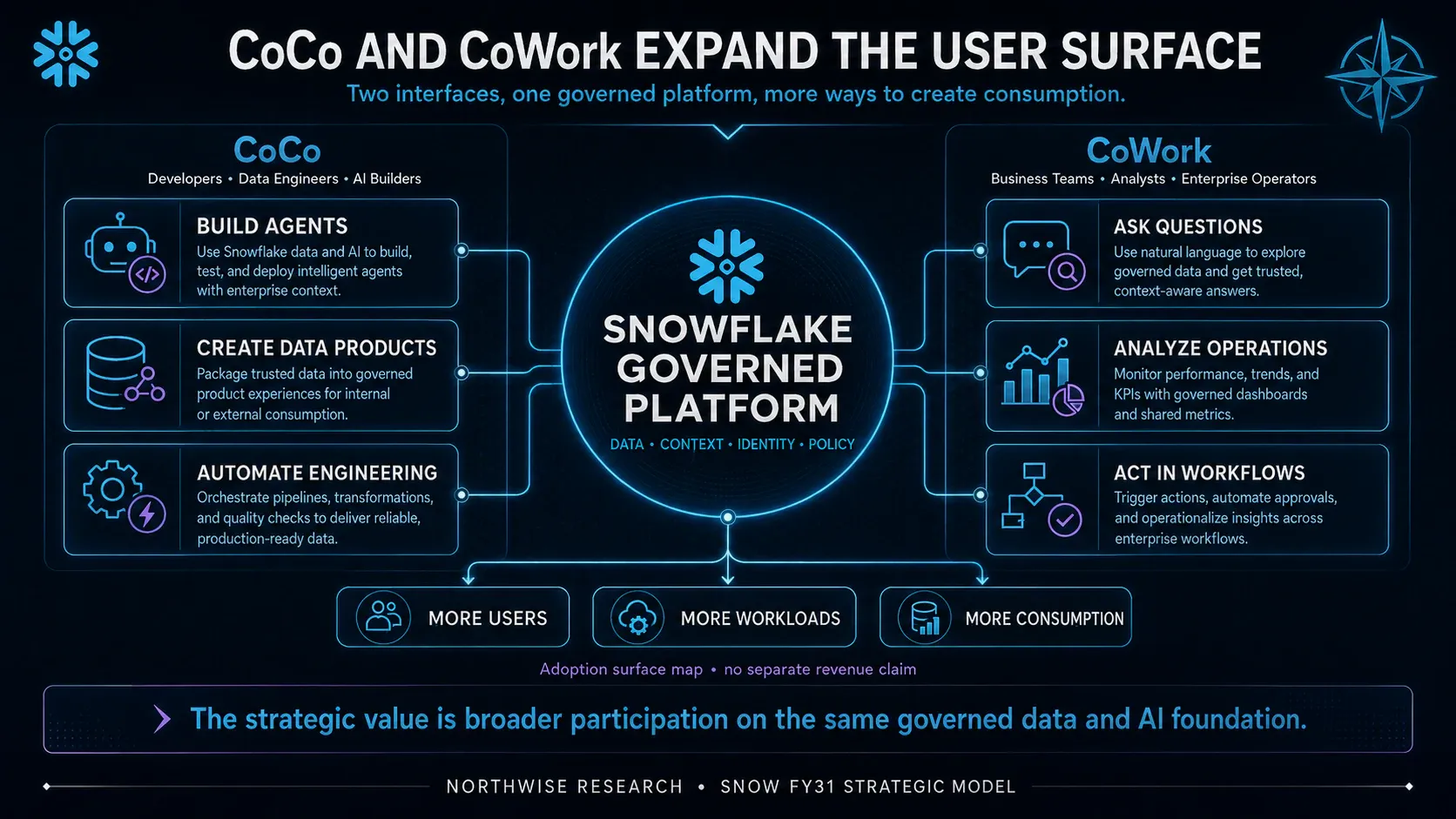
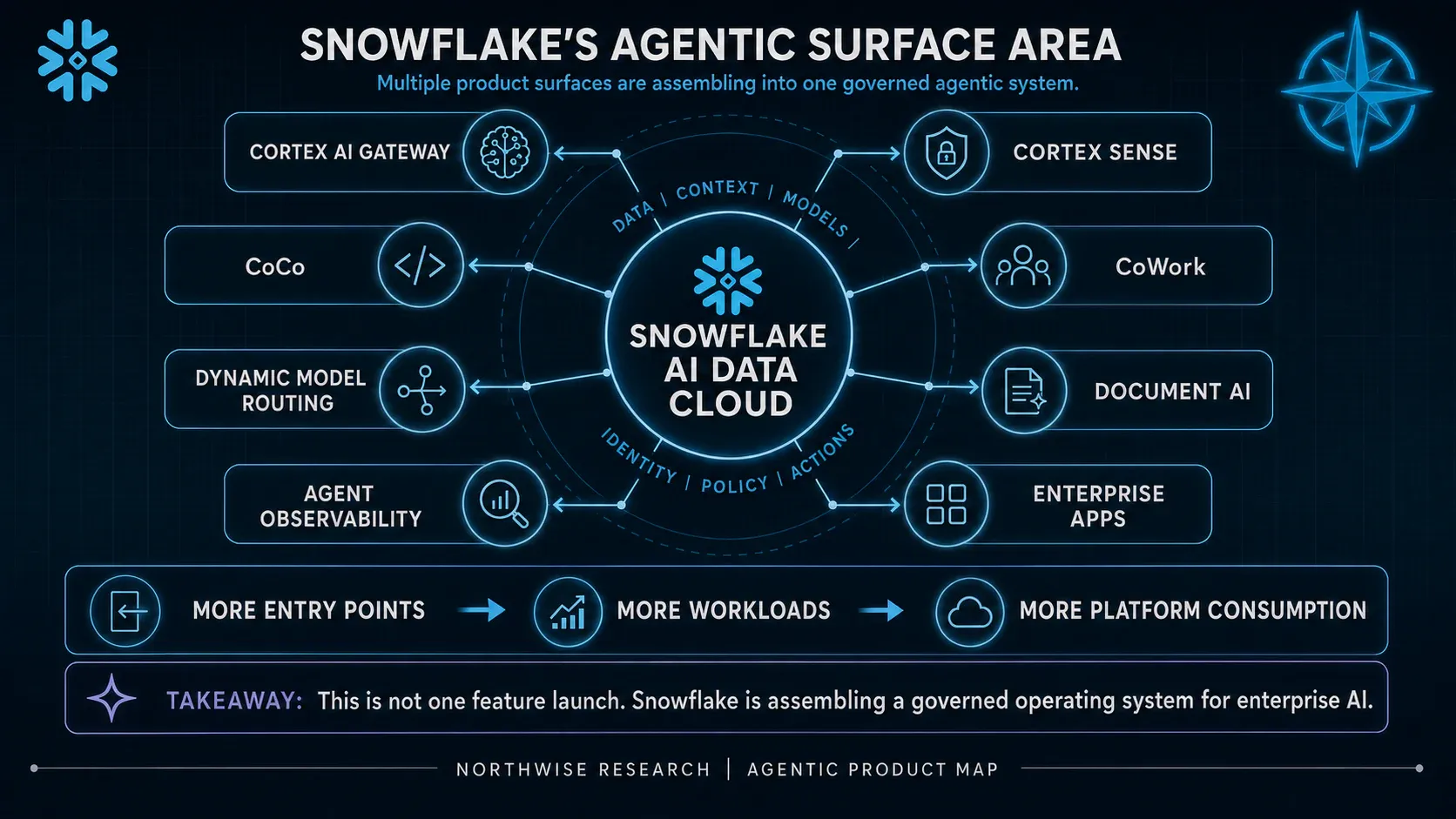
CoCo is aimed directly at these builders. It assists with coding, migration, troubleshooting, pipelines, and optimization. Snowflake reported more than 9,100 accounts using it, with more than 2,000 added during Q2. At Sayari, engineers are using CoCo during a 12-billion-record migration. At 1Password, management says the product helped move key data pipelines into Snowflake quickly. These are company-reported customer examples, but they concern work that leads naturally into recurring platform use.
The surrounding developer products explain why CoCo can matter beyond its own consumption. Snowpark lets developers use languages such as Python for processing and application work close to the data. Notebooks support analysis and experimentation. Snowpark Container Services runs packaged software workloads. Streamlit gives teams a way to turn analytical work into an interactive application. Hybrid Tables address transactional use cases within the broader platform. These products give an engineering team somewhere to put the code and applications that become easier to build.
For a data scientist, the attraction is access to governed data alongside feature preparation, model development, and evaluation. For an application developer, it is the ability to build where the relevant records already reside. For the engineer responsible for keeping the environment running, better troubleshooting and cost management may be the most valuable functions. There is no reason to assume every persona uses the same product or generates the same economics.
CoWork reaches a different group. Its conversational interface allows business users to work with enterprise information without first learning the structure of the database. Snowflake reported 5,800 CoWork accounts, up nearly 11% sequentially. Indeed has introduced both CoWork and CoCo across its data teams, while management says adoption is bringing new lines of business into existing customer relationships.
A finance or procurement team does not necessarily need a new reporting platform. It may need an easier way to ask the second and third questions that occur after looking at the report it already has. Why did this supplier’s delivery performance deteriorate? Which contracts contain a particular clause? What changed in the customer accounts that stopped ordering? Giving users a practical way to pursue those questions can generate activity that previously never reached the data team’s priority list.
The adoption counts are encouraging but should not be treated as distinct paying enterprises or a uniform rate of penetration across the customer base. Account definitions and usage measures differ from Snowflake’s customer counts. More importantly, management has not yet supplied the cohort economics needed to say that adopting CoWork increases spending by a specific percentage. We use the reported breadth of adoption as evidence for a larger opportunity, while the actual revenue forecast remains an explicit assumption.
The early commercial logic is persuasive. CoCo helps more work get built; CoWork helps more people use what has been built. Snowflake can sell both into relationships it already has.
5. The Information Traditional Analytics Could Not Reach
An analytical database is very good at working with records that have already been organized. It can total sales, group transactions, compare periods, and calculate ratios. Much of the explanation behind those numbers is stored less conveniently.
A support call can explain why a customer stopped buying. A maintenance note can explain why a machine keeps failing. An insurance file can contain the details that determine whether a claim is covered. Contracts, scanned documents, transcripts, technical manuals, and correspondence all contain potentially valuable information, but using them at scale has historically required considerable human work.
Snowflake’s Cortex products bring AI processing into that environment. Cortex AISQL makes semantic operations available through SQL workflows. Document-processing capabilities extract information from material that does not arrive as a clean table. Cortex Search and vector-based retrieval help find relevant content by meaning rather than relying only on exact word matches. The outputs can then be used alongside conventional enterprise data.
This is a meaningful extension of what a customer can ask the platform to do. An insurer could combine claims records with policy language and adjuster notes. A manufacturer could connect parts failures with written maintenance histories. A retailer could compare returns with the explanations customers give support staff. These are examples of the kinds of work the architecture makes possible, not a claim that Snowflake has disclosed each as a scaled customer deployment.
The economic attraction is the introduction of information that was previously too expensive to use routinely. The limitation is that interpreting it costs more and introduces errors that ordinary arithmetic does not.
A model can extract the wrong term from a contract. A search system can retrieve a superseded document. A summary can omit an exception that changes the answer. Fixing those problems requires evaluation, source references, version control, and sometimes human review. Enterprises will not value every additional model call equally. They will pay for a process that improves the result after those costs are included.
AI also creates records of its own activity. Retrieval results, model outputs, tool calls, evaluations, and execution histories may need to be stored and examined. An automated system handling a recurring business task can therefore generate both the original processing work and the monitoring required to keep it reliable. Our view is that this expands the workload available to data platforms, although the amount Snowflake captures will depend on where customers choose to run each part.
We have not added a separate “unstructured data” revenue line. The opportunity contributes to our AI-related growth assumptions. Treating every new capability as an independent business would count overlapping consumption several times.
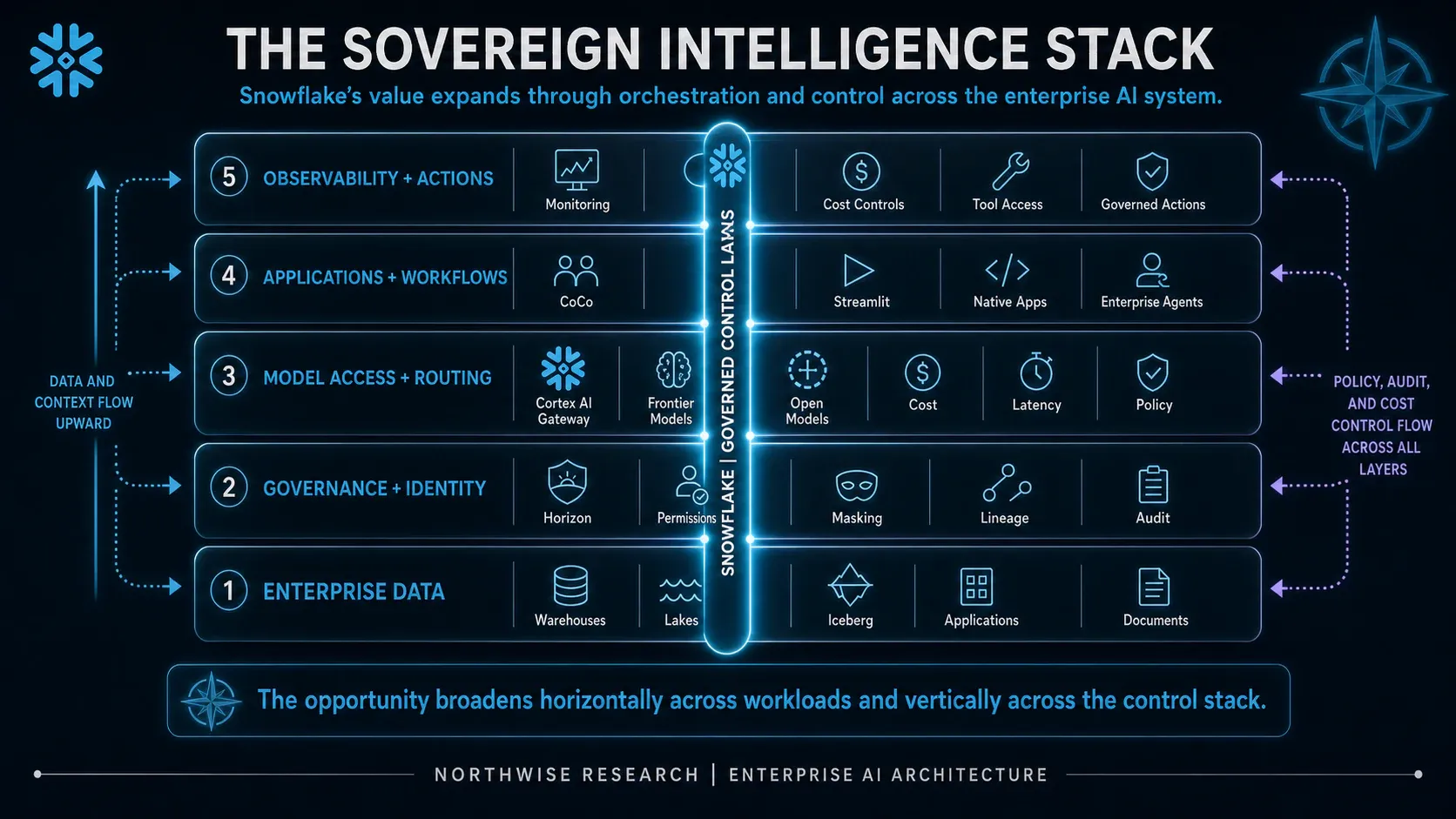
6. Giving Agents Context, Permissions, and Tools
An enterprise agent needs more than access to a capable model. It needs a reliable account of the business it is working in.
A company may define an active customer differently for billing, sales compensation, and product analytics. A model choosing the wrong definition can produce a convincing answer that is useless for the decision at hand. Cortex Sense is intended to capture business definitions and institutional knowledge and supply that context when an agent answers. This addresses a practical problem that becomes more important as less technical employees interact directly with the platform.
Permissions create another set of requirements. Snowflake Horizon brings together governance capabilities such as access controls, masking, lineage, and auditing. Lineage records how information was produced and transformed, which helps a user trace an answer back to its sources. These controls already matter for analytics. They become more consequential when software can combine records across systems or take an action based on the result.
There is a substantial difference between showing an employee a summary and allowing a system to send an email, open a ticket, or change a business record. The action needs an authorized identity, a permitted tool, appropriate scope, and a record of what happened. Some tasks should stop for human approval. Others can operate within narrow rules. A broad promise of governance is not enough; the controls have to work at the point where the software uses the information.
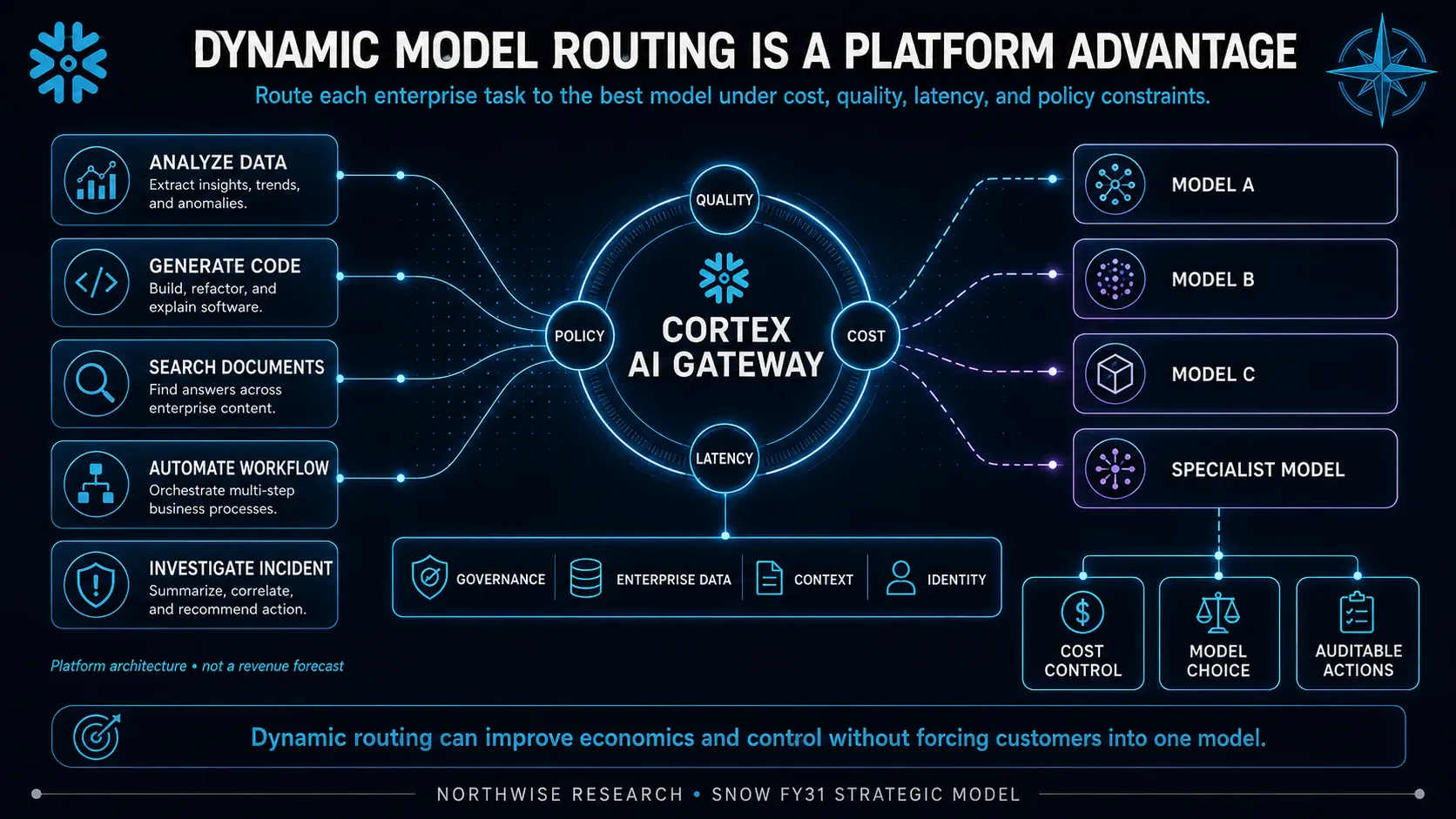
Cortex AI Gateway and the Natoma integration extend Snowflake in that direction. Management describes the gateway as routing work among models according to customer policies and performance data, with cost and governance controls included. Natoma connects agents to tools and actions, including email, Slack, and Jira. Snowflake is also expanding agent observability so customers can inspect performance, activity, and cost.
Together, these functions explain the company’s control-plane ambition. It wants to coordinate the data, context, model, tools, and permissions used to complete a task. For an enterprise, buying that coordination from an established platform can be easier than maintaining a different set of connections and controls for every development team.
We see a credible opportunity here because Snowflake already has a role in the customer’s security and data architecture. We do not assume that role automatically expands to every agent the customer builds. Applications may bring their own controls. Databricks, Microsoft, Palantir, and specialist vendors are competing for the same responsibility. A customer can also use Snowflake as a source of data while managing the agent elsewhere.
“Sovereign intelligence,” in our usage, describes the enterprise’s ability to control how its information is used. It should not be read as a guarantee that every workload remains inside one legal jurisdiction or that every model has identical deployment conditions. Cloud region, service configuration, permissions, and contractual terms still matter.
7. The Bargain Snowflake Is Making With Open Data
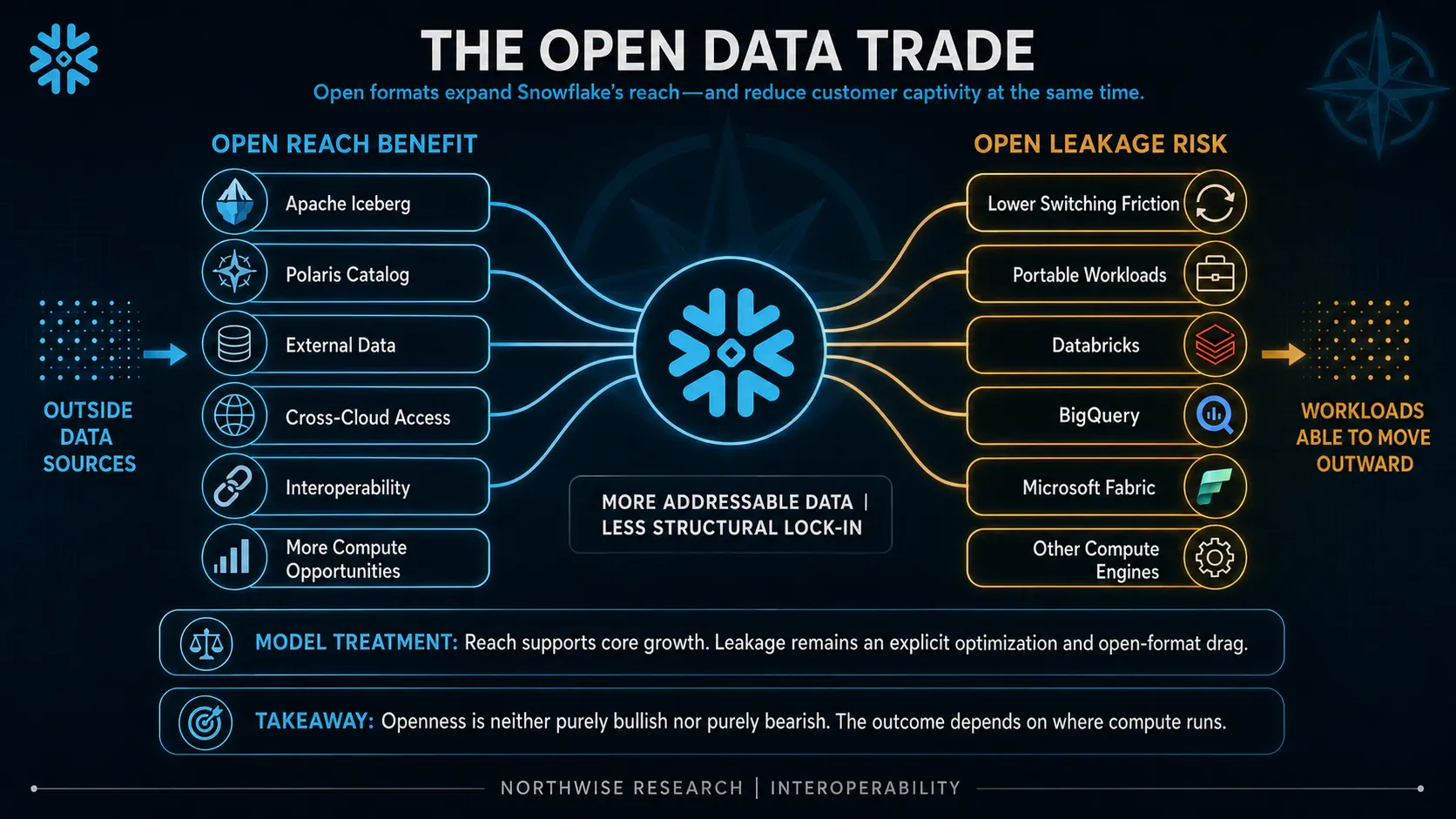
Snowflake is widening its product scope at the same time that open formats are making the underlying data more portable.
Apache Iceberg is an open table format that allows compatible computing engines to work with the same organized data. Catalogs such as Polaris provide the metadata needed to find and manage those tables. External volumes allow Snowflake to access information stored outside its native storage environment. These capabilities matter because large enterprises rarely have a practical route to moving every dataset into a single proprietary system.
The optimistic interpretation is straightforward: Snowflake can sell computing over information that might never have been moved into its warehouse. It can remove a major objection during procurement and make itself useful within an architecture the customer has already chosen.
The opposing argument is equally concrete. A customer that can use the same tables with several engines has more bargaining power. It can compare performance, shift selected workloads, and avoid making another vendor choice every time it moves data. Snowflake must continue offering enough convenience, performance, governance, or application value to justify the bill.
Our view favors participation in the open environment. The addressable data estate is larger, and resisting interoperability would make Snowflake easier to exclude from future architecture decisions. But the long-term moat cannot depend primarily on the difficulty of escaping a storage format.
There are still costs to switching. Data pipelines have dependencies, applications expect particular behavior, access policies need to be reproduced, and staff know the tools they use. Open tables reduce one source of friction without making an established production environment interchangeable overnight. That gives Snowflake time to compete, not permission to stop improving.
The forecast includes an explicit drag from optimization and open-format pressure. It also assumes Snowflake wins additional work from the expanded reach. Those assumptions are assessed together because openness can affect both sides of the consumption equation.
8. Applications Built Around the Customer’s Data
Snowflake’s application strategy addresses a familiar problem in enterprise software: the useful new tool wants access to information the customer is reluctant to export.
A vendor selling a financial-risk application may need transaction records, counterparties, exposure data, and internal policies. A retailer’s merchandising tool may need pricing, inventory, sales, and customer information. Connecting each application to each source can create another set of copies, credentials, pipelines, and security reviews. Snowflake’s Native App Framework and associated development tools offer a way to bring more of that functionality into the environment where the customer already governs the data.
This is commercially attractive for both sides. A developer can offer useful functionality without asking the customer to rebuild the entire data connection. Snowflake can gain consumption from applications written by somebody else. The customer can add capabilities around an existing investment rather than commissioning every tool internally.
Marketplace provides a distribution mechanism for data products and applications. Snowflake reported 4,105 Marketplace listings at the end of Q2, up 21% year over year. Listings indicate that the ecosystem is expanding; they do not disclose the amount customers spend on those products or the share of that spending retained by Snowflake.
We therefore give the ecosystem a specific role in the forecast. It can help attract workloads, make the platform more useful, and improve retention. We do not value it as a mature application store with an assumed fee stream that has not been disclosed.
There is also an execution requirement that a diagram of an ecosystem can hide. Developers need a sufficiently large market, workable distribution, and a reason to support the platform. Enterprise buyers need applications they can trust and a procurement process that does not erase the convenience. Snowflake has the ingredients for this business, but third-party participation must become customer activity before it becomes an important financial contributor.
9. Clean Rooms, Advertising, and Collaboration
Some valuable data relationships cross company boundaries. An advertiser wants to know whether its campaign reached customers who subsequently purchased. A retailer wants to measure the performance of a supplier’s promotion. A media company wants to compare audiences across distribution channels. Each participant has useful information and reasons not to hand over all its underlying customer records.
A data clean room creates a controlled way to perform permitted analysis across those datasets. Snowflake’s clean-room work, including the Samooha technology it acquired and its relationship with OpenAP, applies its governance and collaboration capabilities to this market. The product is relevant to audience analysis, advertising measurement, retail media, and cross-publisher workflows.
The opportunity is broader than advertising, but advertising makes the incentives easy to understand. The participants want a common answer without surrendering control of their own data. A neutral environment can be valuable when neither party wants the other to become the custodian of the combined information.
Snowflake earns from the data work required to support the collaboration. It is not selling the advertiser’s media inventory, and it should not be assigned the economics of a large advertising platform merely because its software helps measure a campaign.
The company reported that 43% of customers had at least one stable data-sharing relationship under its defined metric. That measure requires recurring activity, making it more informative than a count of dormant connections. It supports the idea that Snowflake has become part of intercompany data exchange, although it does not establish a separate high-margin collaboration business of a particular size.
Clean rooms also face powerful alternatives. Large advertising and cloud platforms operate their own tools, and campaign activation may occur outside Snowflake even when the analysis happens inside it. We regard this as an additional route to platform consumption, with the potential to become more important as AI helps users explore and coordinate those relationships.
10. AWS, Model Providers, and the Cost of Independence
Snowflake’s independence is a product characteristic, not freedom from suppliers.
The company relies on cloud infrastructure to deliver its service and on a combination of external and internally developed models for AI capabilities. That arrangement avoids the need to finance a physical cloud or compete directly in frontier-model training. It also means a substantial part of the cost structure belongs to companies with their own bargaining power.
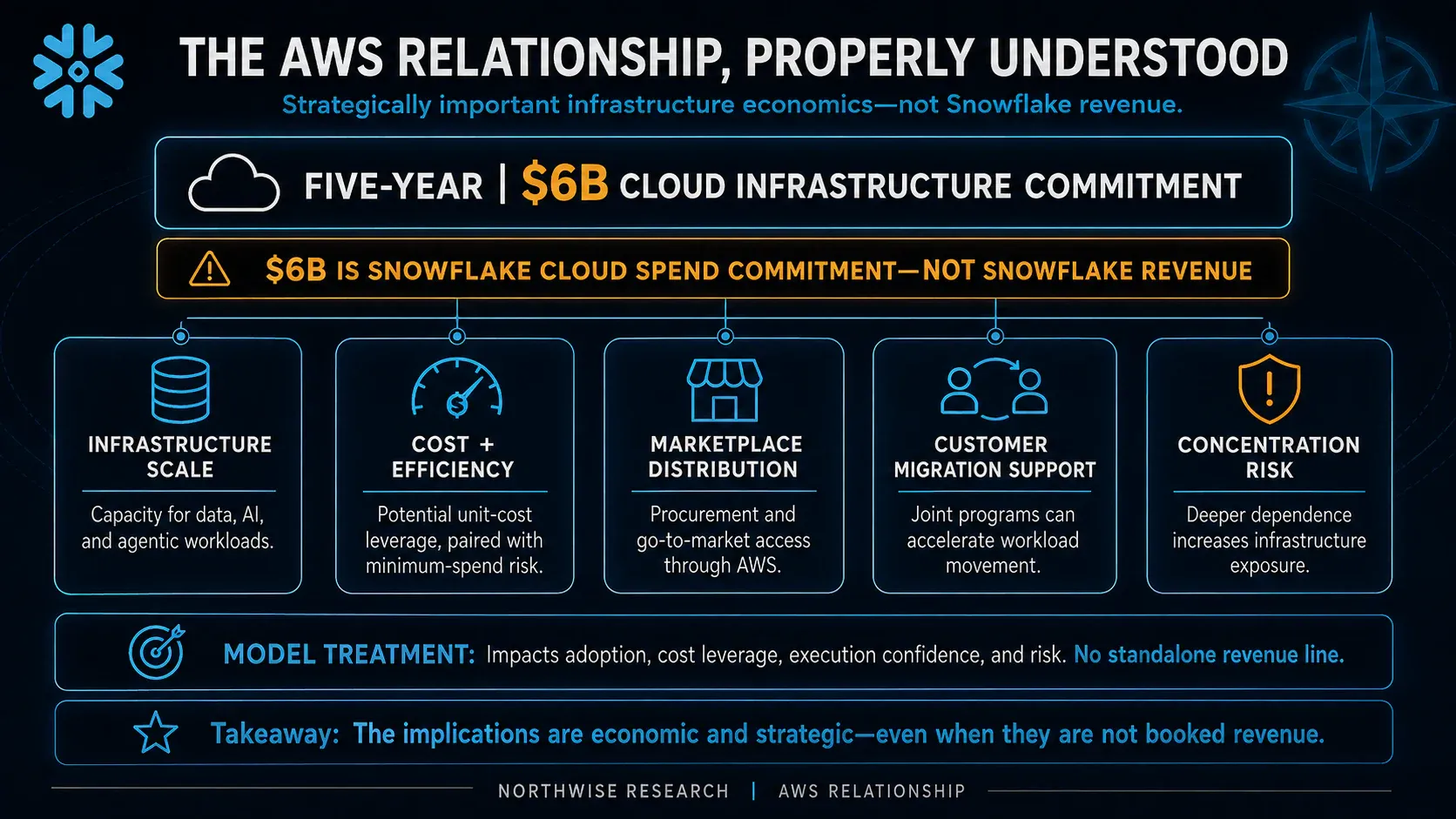
The expanded AWS agreement is the largest visible commitment. Snowflake has committed $6 billion of Graviton compute and AI spending over five years. The collaboration also includes migrations, customer programs, and distribution through AWS Marketplace, where Snowflake has surpassed $7 billion in lifetime sales. The $6 billion is a purchasing commitment by Snowflake, not revenue owed to it. (Snowflake)
We view the agreement as support for the infrastructure and commercial program behind the growth forecast. Greater purchasing scale can help with capacity, efficiency, and terms, while Marketplace reduces procurement friction for customers already buying through AWS. However, the savings have to appear in the economics; the size of a commitment alone tells us little about its profitability. AWS remains both an important supplier and a competitor through its own data and AI services.
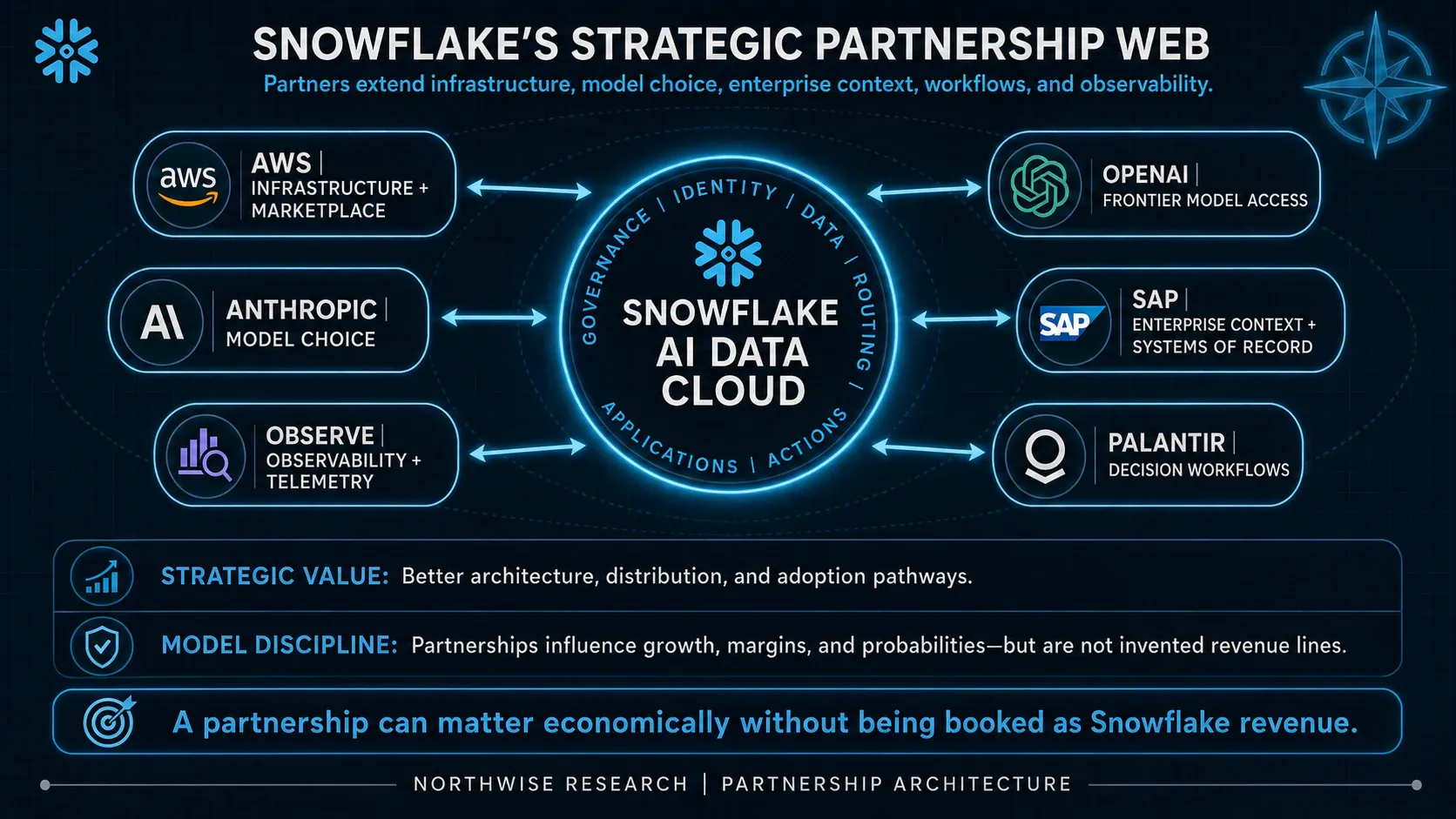
The relationships with model providers address a different problem. Snowflake’s multiyear OpenAI partnership was announced at $200 million, and its Anthropic relationship gives customers access to Claude within the broader platform. These relationships improve the available product and support enterprise adoption. They are nonexclusive, and we assign neither an invented Snowflake revenue schedule.
Model choice becomes valuable when the technology changes quickly. A customer does not want a business process permanently tied to the pricing or performance of the model selected when the project began. Some tasks warrant a more expensive frontier model. Others can be completed accurately by a smaller or more specialized alternative. Snowflake can potentially manage those choices across an enterprise rather than leaving each team to negotiate and maintain its own arrangement.
Management says the economics differ when Snowflake runs open-model inference itself, creating room for optimization. It also sees interest in post-training, where a model is adapted to a narrower task or a customer’s business context. Snowflake’s Arctic work is focused on specialized functions such as document processing and embeddings, rather than attempting to match the frontier laboratories across every capability.
That is a sensible use of the company’s position. It can improve the cost and accuracy of common enterprise operations without owning the largest general-purpose model.
Dynamic routing connects this technical flexibility to the commercial model. A lower cost per successful task may improve Snowflake’s margin, reduce the customer’s bill, or make a previously uneconomic workload viable. The mix of those outcomes will determine the financial benefit. Our Bull case requires greater task volume and better unit economics together; it does not assume every efficiency gain accrues to Snowflake.
11. SAP, Palantir, and the Fight for Business Context
The records that explain how a company operates are often controlled by software vendors with established customer relationships of their own.
SAP is particularly relevant because its systems contain finance, procurement, inventory, planning, and supply-chain information. Snowflake’s integration gives it access to more of that operational context. An AI system examining working capital or supplier risk becomes more useful when it can relate analytical data to the records defining the actual obligations and transactions.
The attraction for Snowflake is access to an important part of the enterprise without requiring the customer to replace its system of record. The attraction for the customer is the ability to combine that information with data from other applications and departments.
SAP is not a passive source of records, though. It has its own interest in delivering analytics and AI to the customers who already run their businesses on its software. Snowflake needs to add enough value through cross-system analysis, governance, and model flexibility to remain an attractive complement. The integration broadens its opportunity; it does not transfer ownership of the customer relationship.
Palantir raises the corresponding issue closer to the decision itself. Its ontology and operational applications organize data around business objects, relationships, and actions. Snowflake can supply a governed data foundation beneath that work. The combination can be useful in complex environments, but the visible application may retain the greater pricing power and customer attention. Our earlier research treated this as a complementary relationship with a real division of value, and we retain that interpretation.
This distinction matters to the agentic thesis. Being involved in a workflow does not mean collecting every dollar spent on it. Snowflake’s strongest route is to make itself useful across several systems and interfaces so that customers have a reason to maintain a common data and governance environment. Its own business-user and agent products can then compete for more of the work above that foundation.
12. Databricks, Microsoft, and the Competitive Reality
Databricks is the strongest reason not to treat Snowflake’s opportunity as an uncontested market.
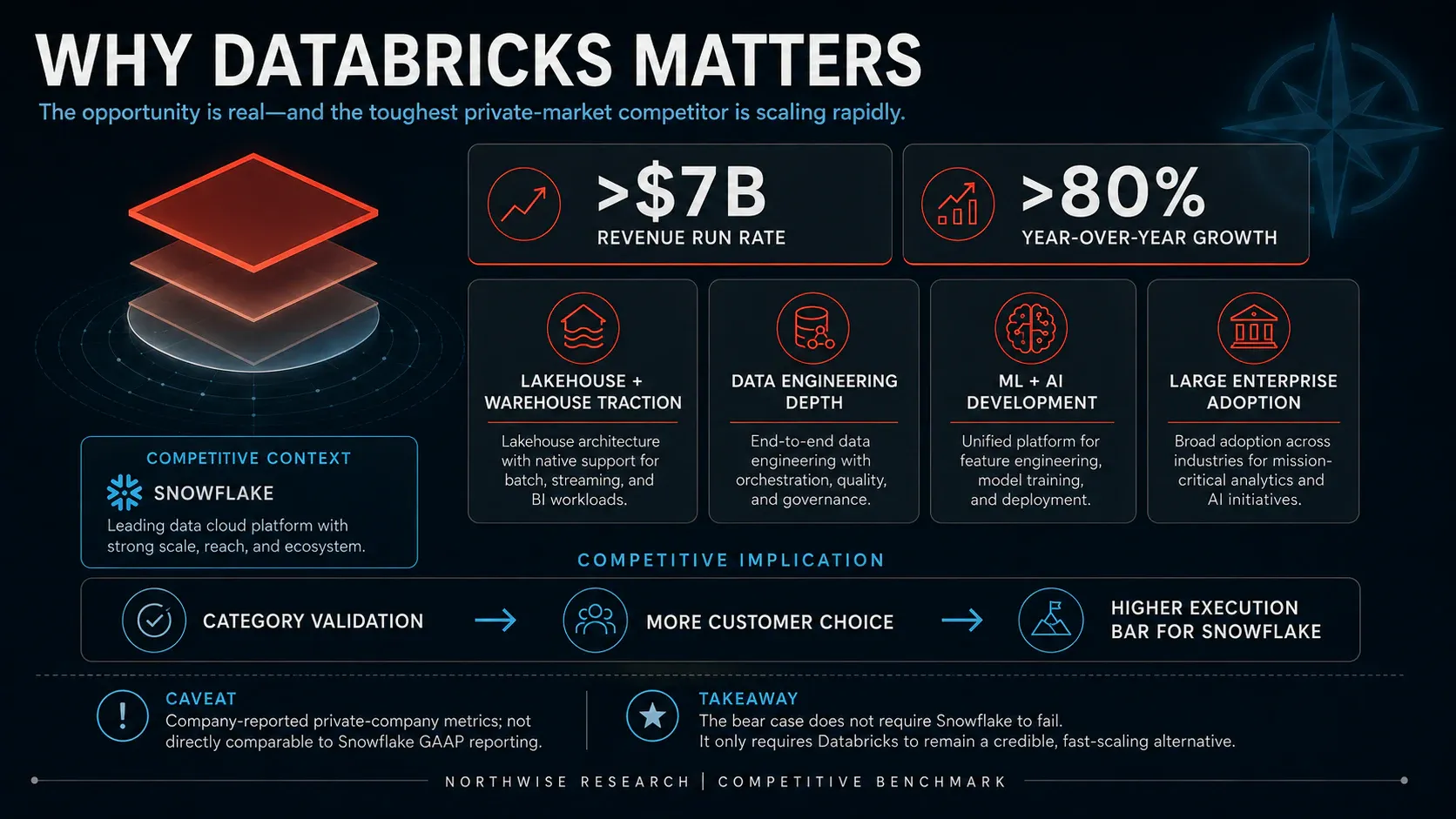
Its August 2026 update reported a revenue run rate above $7 billion, growth exceeding 80%, and positive adjusted free cash flow over the preceding twelve months. Its data-warehousing product exceeded a $1.5 billion run rate, growing more than 100%. The company also reported more than 1,000 customers consuming at annualized rates above $1 million and more than 100 above $10 million. These are private-company, company-reported run-rate measures, not direct equivalents to Snowflake’s recognized revenue and trailing-spend thresholds. (Databricks)
The figures still establish scale. More importantly, Databricks is investing in the same broad functions that make Snowflake’s strategy attractive. Lakebase addresses operational data for applications and agents, Genie reaches business users, and Unity AI Gateway addresses model governance and cost. The competitive comparison has moved well beyond whether a warehouse or a lakehouse is the better architectural label. (Databricks)
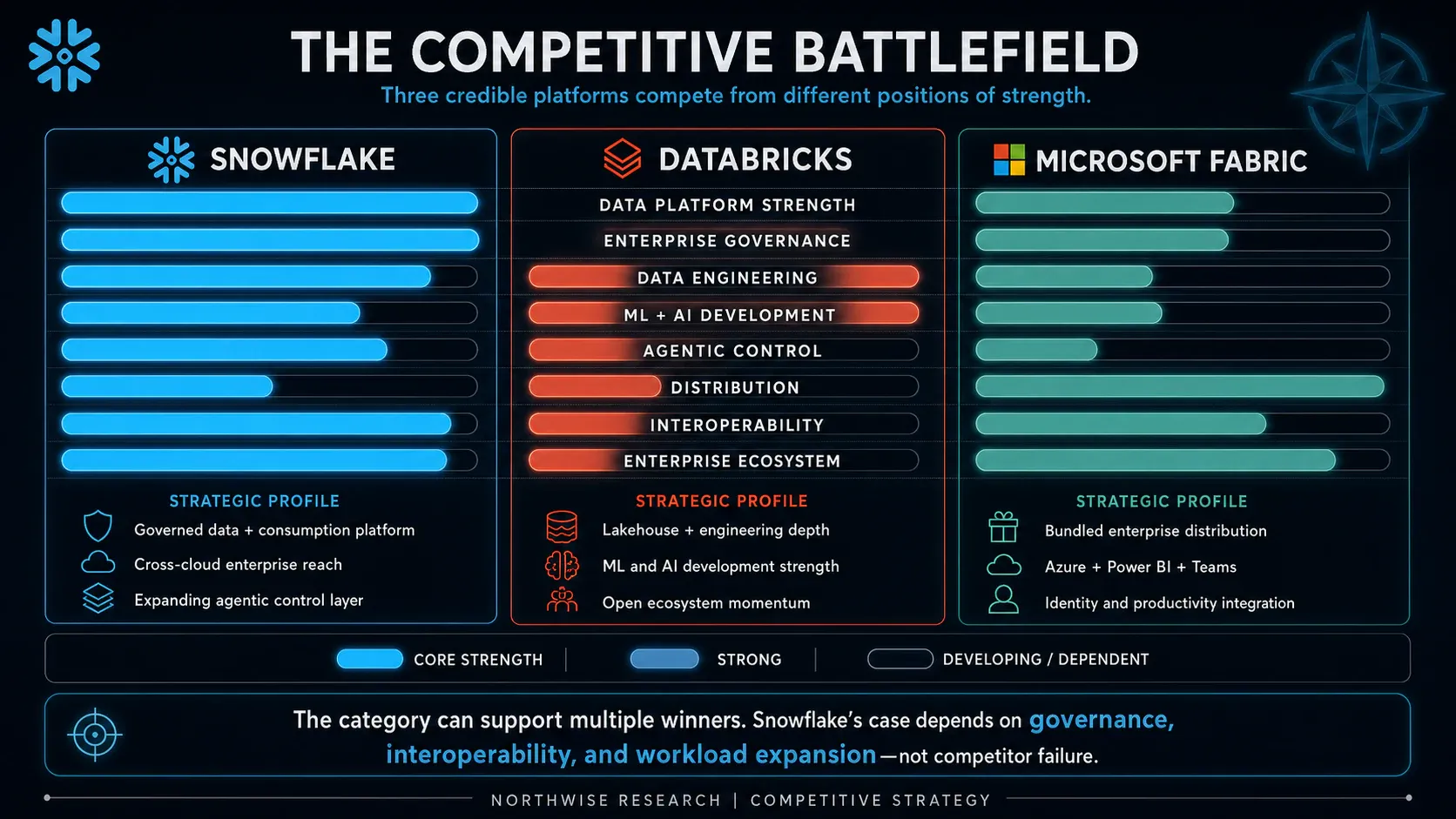
Databricks’ established credibility with data engineers and machine-learning teams gives it access to the people building many of the new workloads. Snowflake’s managed platform, enterprise analytics relationships, governance, and collaboration capabilities give it a substantial position from which to expand. Our assessment is that the installed bases and areas of strength are converging as both companies broaden their products.
We do not read Databricks’ growth as evidence that Snowflake’s latest results are misleading. The category can support several large companies if enterprise data work expands as we expect. But a growing category does not settle how profitable each participant becomes. Competitive pricing, overlapping functionality, and the cost of keeping developers engaged can absorb part of the benefit.
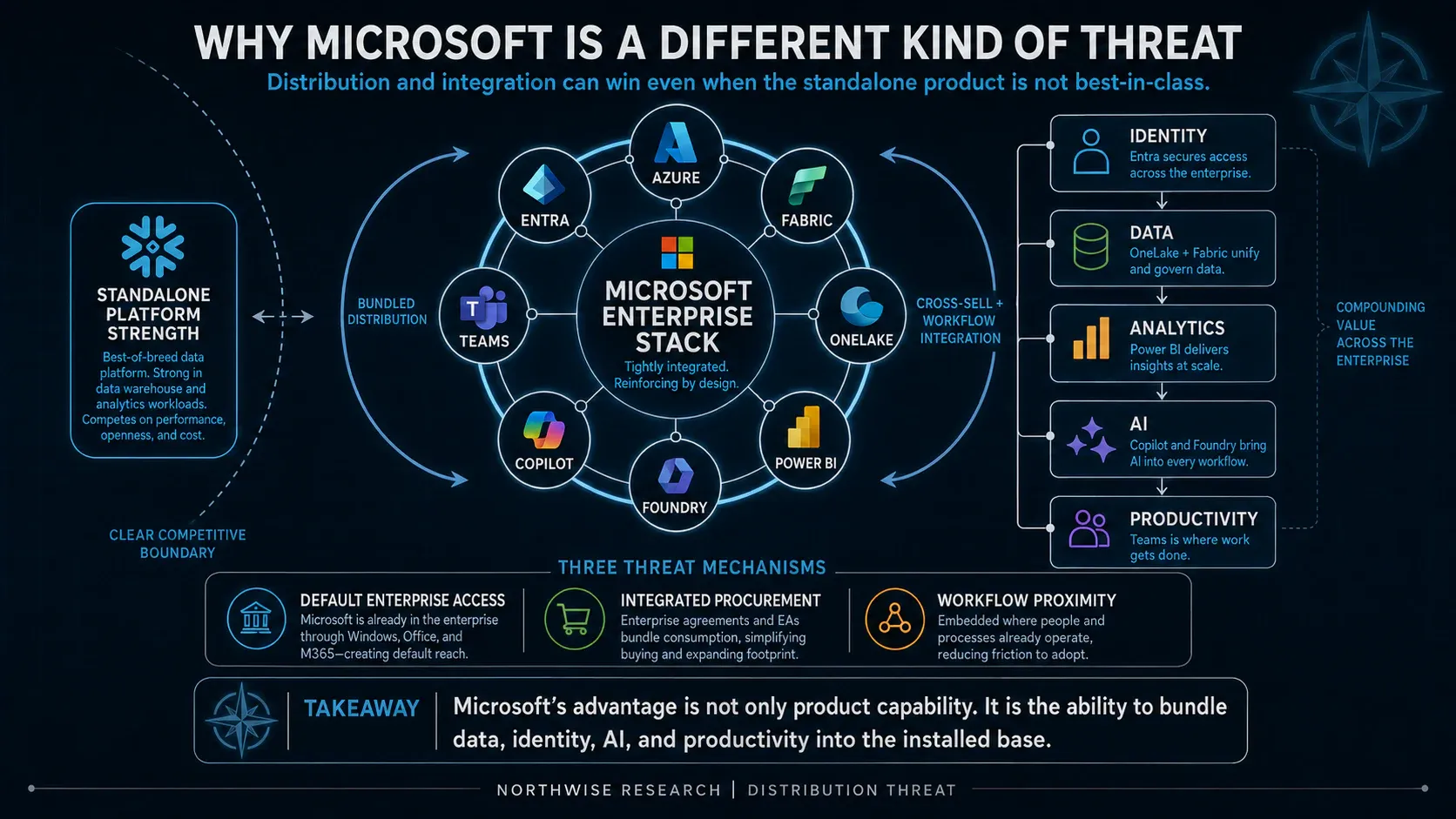
Microsoft makes the contest more complicated because it can bring infrastructure, identity, business intelligence, productivity software, and procurement into the same buying decision. Its expanded Databricks relationship extends into the 2030s and includes integration across OneLake, Power BI, Purview, Foundry, Microsoft 365, Teams, and Copilot. (Source)
For an enterprise already committed to Microsoft, a reasonably capable integrated offering can be attractive even when a standalone product is better at a particular task. Existing contracts and employee access matter. So does the ability to avoid another security review, another identity configuration, and another vendor relationship.
Our view is that Snowflake’s cross-cloud approach remains valuable to large organizations with mixed infrastructure and a desire to preserve choice. It needs to combine that flexibility with a product that is easier to use and economically competitive. Neutrality on its own is not enough to justify a premium.
Other vendors create pressure at particular points. Google BigQuery and AWS’s native services operate close to their respective cloud infrastructure. Oracle has an established database and application base. MongoDB is relevant to operational applications that may run AI directly over their own data rather than through an analytical warehouse. Palantir can own the operational interface. Datadog and other specialists are relevant competitors as Observe takes Snowflake further into telemetry and observability.
The resulting Bear case is commercially plausible without requiring Snowflake to disappear. The company can remain important to enterprise data while a greater share of incremental spending goes to developers, model providers, cloud services, and applications outside its platform. It can also win the workloads and earn less on each one.
We believe Snowflake will capture a substantial share because its customer expansion and paid product adoption provide direct evidence of relevance. The forecast nevertheless keeps competition active through the entire period. There is no year in which Databricks stops improving or Microsoft loses its distribution advantage.
13. Ramaswamy’s Expansion and the Cost of Running It
Snowflake’s leadership transition changed the emphasis of the business without removing the need for the enterprise sales discipline that built it.
Frank Slootman helped establish the commercial organization and large-customer relationships. Sridhar Ramaswamy, whose background includes Google and the AI search company Neeva, has pushed the platform further into search, natural-language interfaces, developers, models, and agents. The strategic fit is clear: Snowflake already has a substantial data franchise, and the next phase depends on making that information useful in more ways.
The operating challenge is integration. A growing product catalog can make a platform more valuable, or it can make the purchasing decision harder and the support burden larger. Customers need the products to work together, the sales organization needs to understand which ones solve a particular problem, and the company needs to keep maintaining the mature services while expanding into new ones.
Management reported more than 330 capabilities reaching general availability during the first half, up 35% year over year. It also reported an 89% increase in deployed customer projects and a 43% increase in projects won per account executive. Those are useful indications of activity and sales productivity, although they do not establish the size or profitability of every deployment.
The historical financial record shows the distance between product success and the profitability we forecast.
Financial measure, $B unless stated | FY24 | FY25 | FY26 |
|---|---|---|---|
Product revenue | 2.666849 | 3.462422 | 4.472317 |
Total revenue | 2.806489 | 3.626396 | 4.683946 |
Non-GAAP operating income | 0.229710 | 0.231723 | 0.489718 |
Adjusted free cash flow | 0.810185 | 0.941526 | 1.192670 |
Adjusted FCF margin, reported | 29% | 26% | 25% |
Stock-compensation-related charges | 1.229523 | 1.564293 | 1.710685 |
The compensation-related figures include associated employer payroll-tax items in Snowflake’s reconciliation.
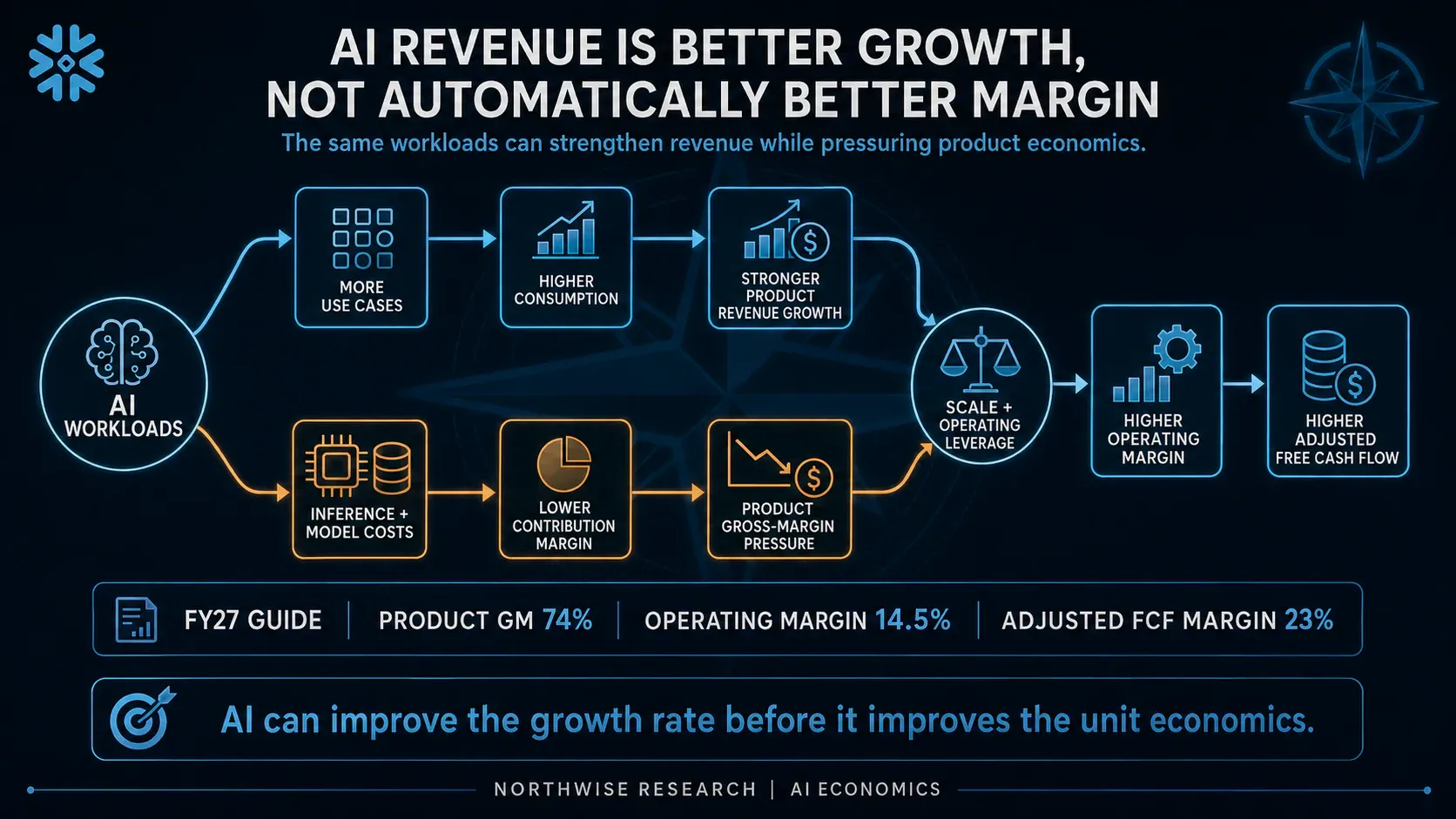
The latest quarter offers a better picture of expense leverage. Q2 non-GAAP operating income reached $236.985 million, or approximately 15.3% of revenue, while non-GAAP product gross margin was approximately 74.7%. Management lowered the full-year product gross-margin outlook to 74% because the faster-growing AI mix carries lower contribution margins, but raised operating-margin guidance from 13.5% to 14.5%.
The explanation is largely below the gross-profit line. Snowflake added 334 employees in the first half, including 173 from Observe, compared with 935 in the prior-year period. Revenue accelerated while the organization grew more slowly. Management also described using its own AI products in sales, finance, and marketing. Its long-range planning process, for example, moved from a three-person team and more than 50 spreadsheets to one analyst and a series of models. These are management-reported operating examples rather than independently audited savings, but they help explain the company’s approach to headcount.
Our margin forecast depends more on this expense leverage than on restoring historical product gross margins. AI can remain more expensive to serve than traditional analytics while producing attractive incremental profit if the rest of the organization scales efficiently.
Cash conversion adds another layer. Snowflake defines free cash flow as operating cash flow less capital expenditure and capitalized software development costs. Its adjusted measure also accounts for specified payroll-tax cash movements associated with employee stock transactions. Annual advance billing contributes to substantial quarterly variation: Q2 adjusted FCF was $92.303 million, compared with $782.212 million in Q4 FY26. Neither is a sensible standalone annual run rate.
The FY27 adjusted FCF-margin guide remains 23%, below the annual margins of the preceding three years. Our later forecast assumes that this margin rises materially. That improvement has to come from sustained operating progress and cash conversion; it cannot be inferred merely from the latest revenue beat.
14. How We Forecast Snowflake Through FY31
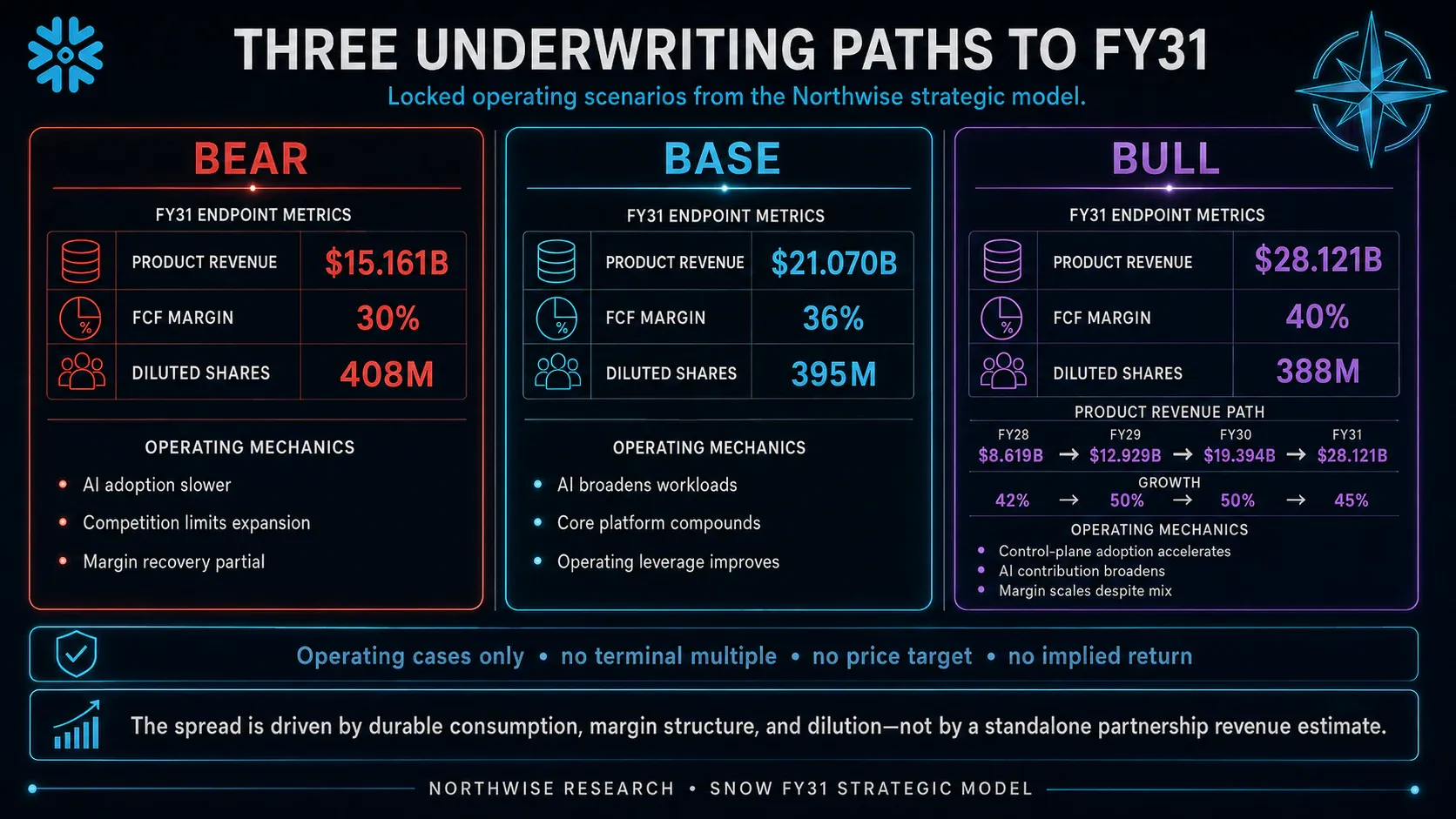
The revised model uses three operating outcomes: Bear, Base, and Bull. All begin with the same FY27 product-revenue guidance of $6.070 billion. We add $220 million of services and other revenue, producing $6.290 billion in total revenue. Management’s 23% adjusted FCF-margin guide then yields $1.446700 billion of adjusted free cash flow.
The common starting assumptions also include 74% non-GAAP product gross margin, 14.5% non-GAAP operating margin, and 380 million diluted shares. We use management’s non-GAAP weighted-average share guidance as the initial valuation denominator, not as a forecast of period-end basic shares. FY31 ends January 31, 2031 and covers nearly all of calendar 2030.
Our central product-revenue forecast rises from the earlier model’s $16 billion to $21.069830 billion. The increase reflects both the stronger starting point and our assessment that newer workloads can sustain growth for longer. The current model also uses total revenue as the denominator for operating and FCF margins and an annual share bridge rather than relying on a terminal share-count assumption.
The growth decomposition makes the commercial judgment explicit.
Contribution to product growth | FY28 | FY29 | FY30 | FY31 |
|---|---|---|---|---|
Bear: core and migrations | 20% | 17% | 14% | 12% |
Bear: AI and agentic activity | 12% | 12% | 12% | 12% |
Bear: optimization and open formats | (2%) | (2%) | (2%) | (2%) |
Bear: total growth | 30% | 27% | 24% | 22% |
Base: core and migrations | 20% | 18% | 16% | 14% |
Base: AI and agentic activity | 18% | 22% | 23% | 23% |
Base: optimization and open formats | (2%) | (2%) | (2%) | (2%) |
Base: total growth | 36% | 38% | 37% | 35% |
Bull: core and migrations | 21% | 19% | 17% | 15% |
Bull: AI and agentic activity | 24% | 34% | 36% | 34% |
Bull: optimization and open formats | (3%) | (3%) | (3%) | (4%) |
Bull: total growth | 42% | 50% | 50% | 45% |
Each contribution is expressed as a percentage of the preceding year’s product revenue. These are Northwise assumptions, not Snowflake-reported segments.
The AI contribution includes the effect on core-platform consumption. A migration accelerated by CoCo can create ordinary warehouse revenue, so labeling all of that revenue as a separate AI product would be misleading. We also do not multiply the entire revenue base by NRR and then add the contributions above. Retention already contains expansion from the same workloads.
There is no additional revenue from undisclosed future acquisitions. Observe is inside the starting guidance and is not added again. Similarly, the model does not create independent revenue windfalls for partnerships, Marketplace, clean rooms, or an eventual control-plane monopoly.
Bull includes the largest optimization allowance. A world with faster innovation should also produce greater savings per operation. That outcome requires sufficiently strong demand to overcome the efficiency gains.
The full operating model is available to Premium members in the workbook download below. Revenue, margins, dilution, and capital allocation are exposed as separate assumptions so readers can change the parts of the forecast they disagree with.
15. Bear Case: Competitive Equilibrium
Bear receives a 20% probability.
Snowflake remains a substantial enterprise platform, but the new AI budget is divided more widely than we expect. Databricks retains a stronger position with builders. Microsoft attracts business users through its integrated offering. Customers continue using Snowflake for important data work while choosing other suppliers for a larger share of models, applications, and agent coordination.
The core business still grows. Migrations continue, existing customers expand, and AI contributes useful revenue. The limitation is that optimization and competition prevent the company from sustaining its current trajectory. Product growth falls from 30% in FY28 to 22% in FY31, while AI-serving costs and pricing pressure push product gross margin down to 72%.
Bear operating forecast | FY27 | FY28 | FY29 | FY30 | FY31 |
|---|---|---|---|---|---|
Product revenue, $B | 6.070000 | 7.891000 | 10.021570 | 12.426747 | 15.160631 |
Product growth | 36% | 30% | 27% | 24% | 22% |
Services and other, $B | 0.220000 | 0.250000 | 0.280000 | 0.310000 | 0.350000 |
Total revenue, $B | 6.290000 | 8.141000 | 10.301570 | 12.736747 | 15.510631 |
Product gross margin | 74.0% | 73.2% | 72.5% | 72.0% | 72.0% |
Non-GAAP operating margin | 14.5% | 17.0% | 20.0% | 23.0% | 25.0% |
Adjusted FCF margin | 23% | 25% | 27% | 29% | 30% |
Adjusted FCF, $B | 1.446700 | 2.035250 | 2.781424 | 3.693657 | 4.653189 |
Diluted shares, millions | 380 | 388 | 396 | 402 | 408 |
Adjusted FCF per share | $3.807105 | $5.245490 | $7.023798 | $9.188200 | $11.404876 |
FY27 growth is management’s reported guide; the dollar anchor is $6.070 billion.
Product revenue compounds at approximately 25.71% from FY27 through FY31. That may look strong for a Bear case, but a business can produce impressive growth and disappoint investors who paid for a more profitable outcome. We see little reason to make the central downside forecast assume the disappearance of an established platform with current expansion of this scale.
Operating leverage continues despite the weaker product economics. By FY31, the company generates $4.653189 billion of adjusted FCF, but dilution carries the denominator to 408 million shares. This is a successful company with less attractive shareholder economics than the central thesis anticipates.
It is not a floor on possible results. A severe security failure, prolonged spending contraction, or greater loss of relevance could produce a worse outcome.
16. Base Case: Governed AI Standard
Base receives a 55% probability and represents our most likely outcome.
Snowflake becomes one of the established environments enterprises use for governed AI work. CoCo helps more projects reach production, CoWork broadens participation, and applications and agents generate activity over the data already connected to the platform. Customers continue using several vendors, but Snowflake retains enough of the computing and coordination to expand its role.
The important assumption is the persistence of growth. Product revenue compounds at approximately 36.50% from FY27 through FY31, with annual growth remaining in the mid-to-high 30s. That is not the natural result of an unchanged warehouse business becoming larger. It requires the mix of work to broaden as the original business slows.
Our decomposition makes that transition visible. Core and migration contributions decline from 20% to 14% of the preceding year’s revenue. AI-related activity rises enough to offset the reduction. The company therefore reaches $21.069830 billion of product revenue without relying on future acquisitions or a separately assumed Marketplace business.
Base operating forecast | FY27 | FY28 | FY29 | FY30 | FY31 |
|---|---|---|---|---|---|
Product revenue, $B | 6.070000 | 8.255200 | 11.392176 | 15.607281 | 21.069830 |
Product growth | 36% | 36% | 38% | 37% | 35% |
Services and other, $B | 0.220000 | 0.260000 | 0.300000 | 0.350000 | 0.400000 |
Total revenue, $B | 6.290000 | 8.515200 | 11.692176 | 15.957281 | 21.469830 |
Product gross margin | 74.0% | 73.5% | 73.0% | 73.0% | 73.5% |
Non-GAAP operating margin | 14.5% | 19.0% | 24.0% | 28.0% | 31.0% |
Adjusted FCF margin | 23% | 27% | 31% | 34% | 36% |
Adjusted FCF, $B | 1.446700 | 2.299104 | 3.624575 | 5.425476 | 7.729139 |
Diluted shares, millions | 380 | 385 | 389 | 392 | 395 |
Adjusted FCF per share | $3.807105 | $5.971699 | $9.317672 | $13.840499 | $19.567440 |
The margin assumptions are as important as the revenue. Product gross margin declines to 73% before recovering to 73.5%, remaining below Snowflake’s earlier highs. Non-GAAP operating margin reaches 31% because revenue grows faster than the expense base. Adjusted FCF margin rises to 36%, producing $7.729139 billion of cash flow before the repurchase analysis discussed below.
That cash margin is a forecast, not a company target. It assumes the benefits of scale are not consumed by a permanently expanding support burden, deteriorating billing terms, or greater reinvestment than the scenario allows. The model applies an explicit cash-conversion margin rather than pretending to forecast every tax and working-capital item through FY31.
We place the greatest weight here because the commercial mechanism is already appearing in results: broader paid adoption, stronger core activity, large-customer expansion, and expense leverage. The forecast extends those developments over several years. Its success depends on the newer workloads becoming a normal part of enterprise operations rather than a short investment cycle.
17. Bull Case: Agentic Consumption Platform
Bull receives a 25% probability.
In this outcome, agents become a major category of enterprise computing. Deployment moves beyond individual assistants into recurring workflows across finance, procurement, sales, operations, support, and security. Snowflake supplies a meaningful portion of the context, model routing, tools, governance, and underlying computing required to operate them.
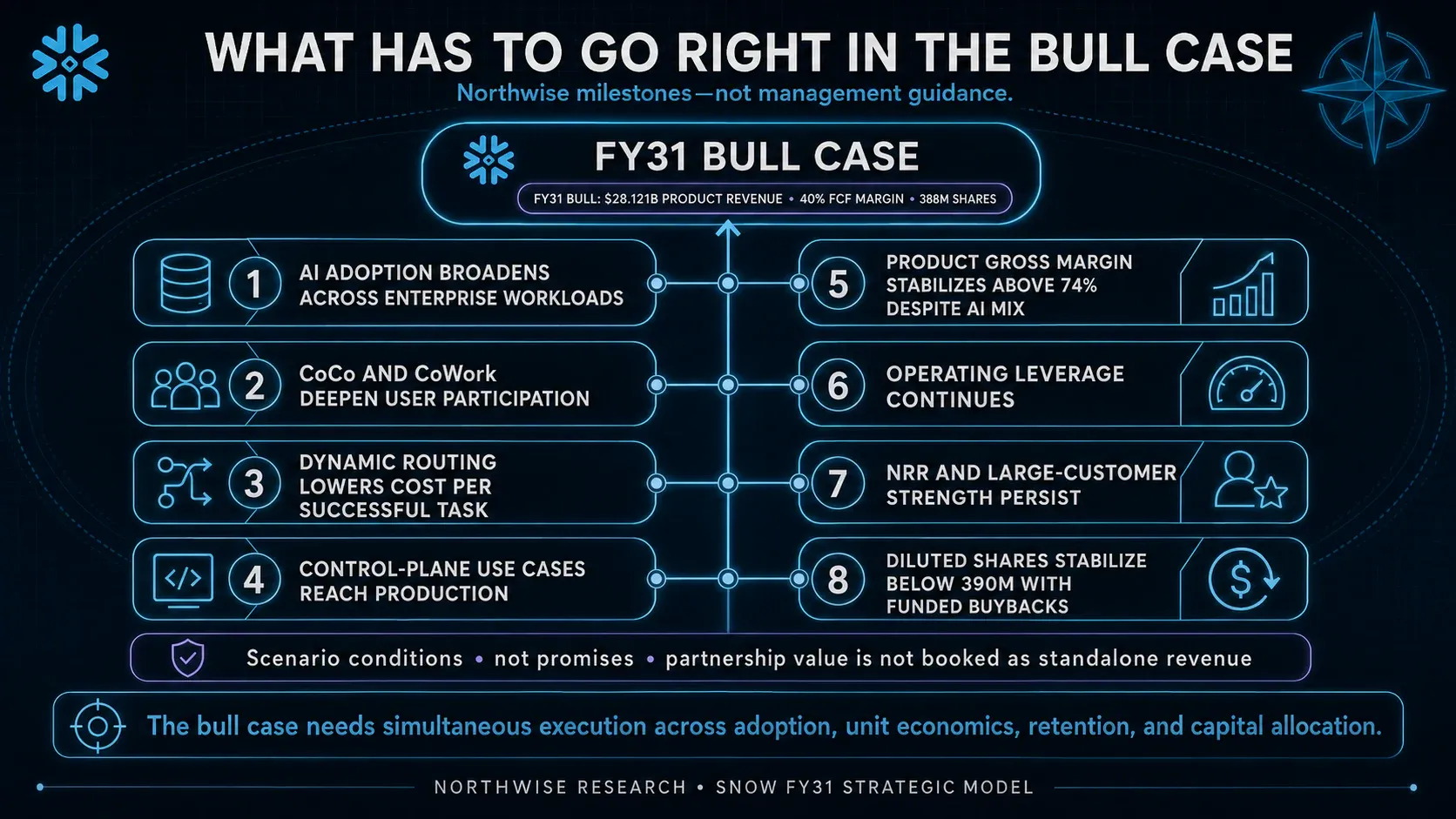
This is a considerably more demanding forecast than maintaining current growth. Product revenue grows 42% in FY28, 50% in FY29 and FY30, and 45% in FY31. The resulting four-year compound rate is 46.71%.
Bull operating forecast | FY27 | FY28 | FY29 | FY30 | FY31 |
|---|---|---|---|---|---|
Product revenue, $B | 6.070000 | 8.619400 | 12.929100 | 19.393650 | 28.120793 |
Product growth | 36% | 42% | 50% | 50% | 45% |
Services and other, $B | 0.220000 | 0.270000 | 0.330000 | 0.410000 | 0.500000 |
Total revenue, $B | 6.290000 | 8.889400 | 13.259100 | 19.803650 | 28.620793 |
Product gross margin | 74.0% | 73.5% | 73.5% | 74.0% | 74.5% |
Non-GAAP operating margin | 14.5% | 21.0% | 27.0% | 32.0% | 36.0% |
Adjusted FCF margin | 23% | 29% | 34% | 38% | 40% |
Adjusted FCF, $B | 1.446700 | 2.577926 | 4.508094 | 7.525387 | 11.448317 |
Diluted shares, millions | 380 | 383 | 385 | 387 | 388 |
Adjusted FCF per share | $3.807105 | $6.730877 | $11.709335 | $19.445444 | $29.505972 |
The path needs evidence to arrive in sequence. FY28 should show more AI work becoming recurring production activity. By FY29, adoption needs to be broadening across departments within large customers, with the core platform benefiting alongside the newer products. By FY30, better routing and model economics need to be visible in product margins, while operating leverage continues and dilution stays close to the forecast. Product announcements alone would not support this trajectory.
The 74.5% terminal product gross margin requires genuine improvement in the cost of serving AI. Specialized models need to handle more tasks economically, infrastructure efficiency needs to improve, and customers must value Snowflake’s integrated offering enough for the company to retain attractive pricing. The 40% adjusted FCF margin then requires further leverage below gross profit.
We have removed the previous ultra cases. Bull already assumes an exceptional expansion, and another outcome above it would contribute more apparent upside than the available evidence can justify.
For scale, the model’s $460 billion FY31 market reference comes from management’s addressable-market estimate. Bear, Base, and Bull product revenue represent approximately 3.30%, 4.58%, and 6.11% of it. That is a useful check that the scenarios do not require a monopoly. It is not a reason to believe them: the estimate can overlap categories and include spending Snowflake will never capture.
18. Stock Compensation and the Diluted Share Count
Snowflake’s Q2 non-GAAP operating profit was $236.985 million. Its GAAP operating result was a loss of $262.967 million. Stock-compensation-related charges accounted for $456.363 million of the reconciliation, with acquired-intangible amortization and other adjustments supplying much of the rest. The compensation-related figure includes associated employer payroll-tax items.
These are different views of the same business. The adjusted result helps show operating progress, while the GAAP result records costs that do not disappear because they are excluded from management’s preferred measure. For shareholders, the practical question is how the equity awards affect ownership and how much cash must be spent to contain that effect.
Our model does not assume a declining share count. Even Bull ends above the 380 million starting denominator.
Share movement, millions | FY28 | FY29 | FY30 | FY31 |
|---|---|---|---|---|
Bear: beginning shares | 380 | 388 | 396 | 402 |
Gross equity issuance | 12 | 12 | 11 | 10 |
Incremental net convertible dilution | 2 | 2 | 1 | 1 |
Shares repurchased | (6) | (6) | (6) | (5) |
Bear: ending shares | 388 | 396 | 402 | 408 |
Base: beginning shares | 380 | 385 | 389 | 392 |
Gross equity issuance | 10 | 9 | 8 | 7 |
Incremental net convertible dilution | 2 | 1 | 1 | 0 |
Shares repurchased | (7) | (6) | (6) | (4) |
Base: ending shares | 385 | 389 | 392 | 395 |
Bull: beginning shares | 380 | 383 | 385 | 387 |
Gross equity issuance | 8 | 7 | 6 | 5 |
Incremental net convertible dilution | 1 | 1 | 0 | 0 |
Shares repurchased | (6) | (6) | (4) | (4) |
Bull: ending shares | 383 | 385 | 387 | 388 |
The convertible assumptions need particular care. Snowflake’s non-GAAP diluted methodology already incorporates potential dilution from its 2027 and 2029 notes and the estimated offset from capped calls. The 380 million starting point therefore already contains a conversion estimate. Our subsequent rows are incremental scenario allowances, not a second addition of every share underlying the notes. They are not a complete instrument-by-instrument settlement forecast.
The capped calls can reduce dilution under specified conditions, but they do not remove all dilution at every stock price. Actual cash and share settlement will affect both the denominator and the cash available for other purposes. That uncertainty is one reason we do not add today’s cash balance to the terminal valuation.
We also carry a separate, illustrative bridge from non-GAAP to GAAP operating margin.
Compensation and margin assumptions | FY27 | FY28 | FY29 | FY30 | FY31 |
|---|---|---|---|---|---|
Bear: modeled SBC as % of revenue | 29% | 25% | 22% | 19% | 16% |
Base: modeled SBC as % of revenue | 29% | 23% | 19% | 15% | 12% |
Bull: modeled SBC as % of revenue | 29% | 21% | 16% | 12% | 9% |
Other adjustment allowance | 2.0% | 1.8% | 1.7% | 1.6% | 1.5% |
Bear: illustrative GAAP operating margin | (16.5%) | (9.8%) | (3.7%) | 2.4% | 7.5% |
Base: illustrative GAAP operating margin | (16.5%) | (5.8%) | 3.3% | 11.4% | 17.5% |
Bull: illustrative GAAP operating margin | (16.5%) | (1.8%) | 9.3% | 18.4% | 25.5% |
The bridge is a directional check, not a full GAAP income statement or an earnings-per-share forecast. Expense recognition and share issuance occur on different schedules, so the compensation percentage and issuance rows are separate assumptions rather than a complete award-level reconciliation.
Management’s objective is GAAP profitability in Q4 FY28. That is a quarterly milestone and can coexist with a full-year loss in the same fiscal year. Our forecast assumes a more profitable business emerges over time, with the excluded compensation burden becoming materially smaller relative to revenue.
19. Cash After Repurchases
The share bridge requires actual capital allocation. Snowflake cannot retire millions of shares by declaring that stock compensation is falling as a percentage of revenue.
Repurchase assumption | FY28 | FY29 | FY30 | FY31 |
|---|---|---|---|---|
Bear: average purchase price | $325 | $325 | $300 | $275 |
Bear: cash used, $B | 1.950 | 1.950 | 1.800 | 1.375 |
Base: average purchase price | $400 | $475 | $550 | $625 |
Base: cash used, $B | 2.800 | 2.850 | 3.300 | 2.500 |
Bull: average purchase price | $450 | $650 | $850 | $1,000 |
Bull: cash used, $B | 2.700 | 3.900 | 3.400 | 4.000 |
These are Northwise capital-allocation assumptions, not announced repurchase commitments or interim stock-price targets. They establish what the modeled share reduction costs.
Higher stock prices make dilution more expensive to offset. Bull uses $14 billion for repurchases across FY28 through FY31 and retires fewer shares than Base, which uses $11.45 billion. The stronger operating result helps fund the program, but the stock’s success itself raises the cost per share.
The early years are less comfortable. Base’s FY28 buybacks consume $2.800 billion against $2.299104 billion of adjusted FCF. Maintaining that schedule requires accumulated cash or another source of funding. Snowflake reported $4.3 billion in cash and investments at Q2, but the balance also supports financial obligations, acquisitions, and business flexibility. It cannot all be assigned to buybacks and then counted again as surplus value.
We use two cash-flow diagnostics. The first subtracts the modeled repurchases. The second estimates what would remain if Snowflake instead repurchased enough shares to offset all modeled gross issuance and incremental net convertible dilution at the same average prices. We call the second measure dilution-neutral FCF.
Shareholder cash diagnostic, $B | FY28 | FY29 | FY30 | FY31 |
|---|---|---|---|---|
Bear: after modeled repurchases | 0.085250 | 0.831424 | 1.893657 | 3.278189 |
Bear: dilution-neutral alternative | (2.514750) | (1.768576) | 0.093657 | 1.628189 |
Base: after modeled repurchases | (0.500896) | 0.774575 | 2.125476 | 5.229139 |
Base: dilution-neutral alternative | (2.500896) | (1.125425) | 0.475476 | 3.354139 |
Bull: after modeled repurchases | (0.122074) | 0.608094 | 4.125387 | 7.448317 |
Bull: dilution-neutral alternative | (1.472074) | (0.691906) | 2.425387 | 6.448317 |
The dilution-neutral calculation is an alternative to the actual repurchase schedule, not an additional deduction. It is also not a company-reported measure.
The negative early figures show how much of the current cash-generation story still depends on allowing some dilution. By FY31, Base produces $7.729139 billion of adjusted FCF, $5.229139 billion after its modeled buybacks, or $3.354139 billion under the hypothetical dilution-neutral alternative. Those are very different amounts, and each answers a different question.
Across FY27 through FY31, adjusted FCF totals $14.610220 billion in Bear, $20.524993 billion in Base, and $27.506424 billion in Bull. Subtracting the explicit FY28–FY31 buyback schedules leaves $7.535220 billion, $9.074993 billion, and $13.506424 billion.
Those totals are not ending-cash forecasts. The detailed capital-allocation schedule starts in FY28, and the FY27 guidance anchor does not imply the absence of share transactions that year. The model also does not forecast every acquisition payment or debt-settlement choice. What it establishes is the scale of cash generation required to support the per-share outcomes.
20. What Would Change Our View
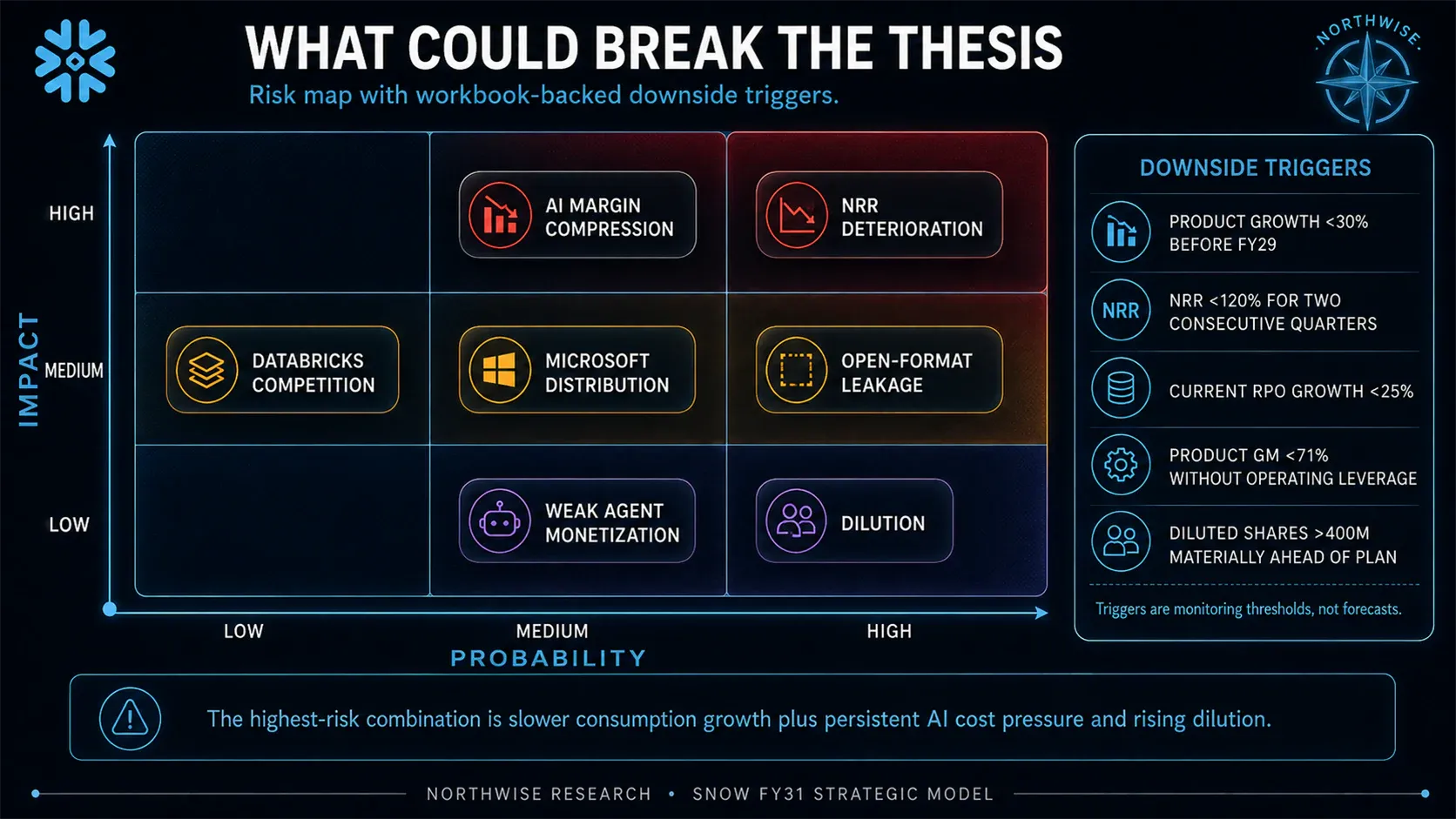
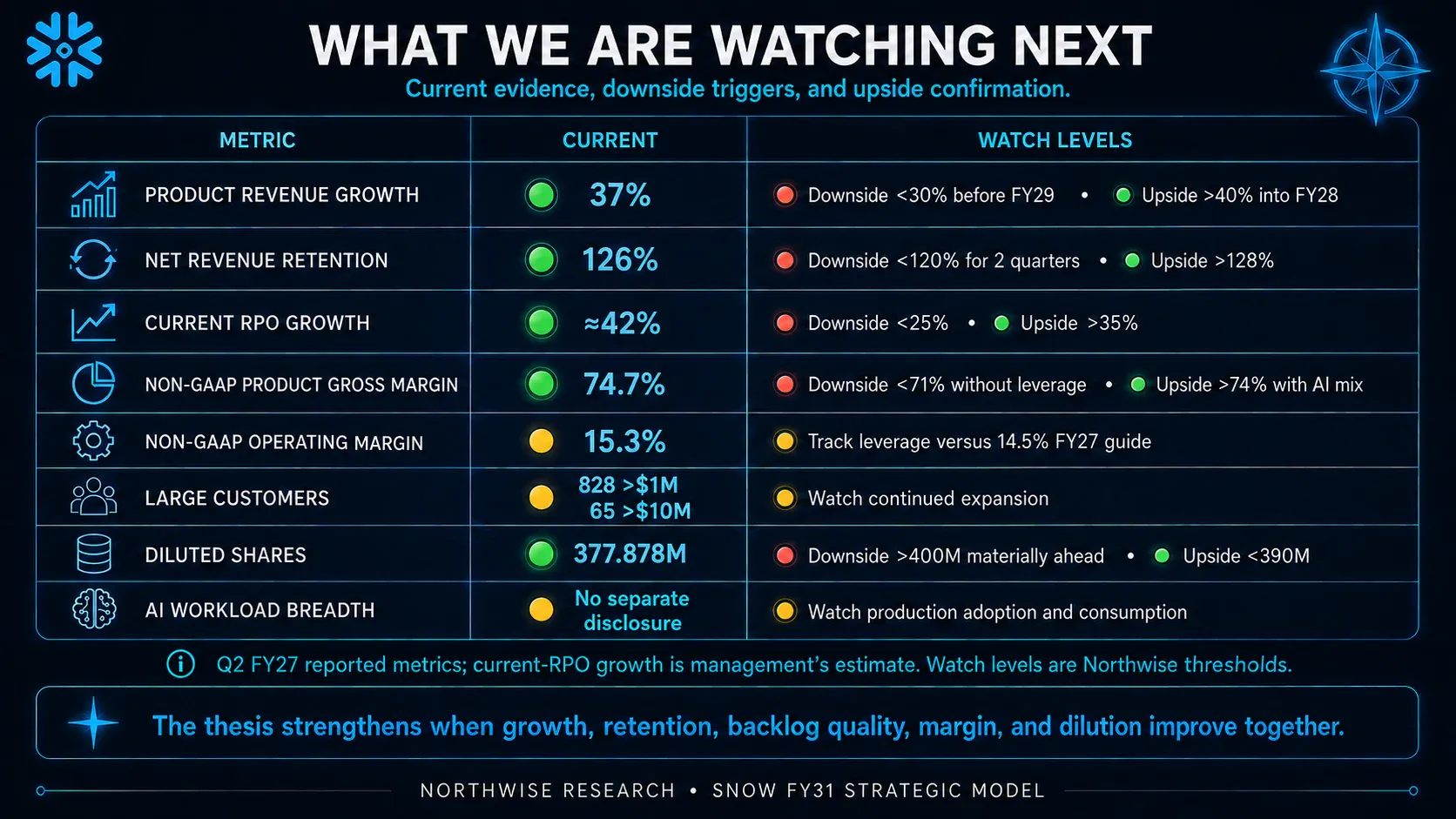
We would reconsider the revenue path if product growth fell below 30% before FY29 without a convincing temporary explanation. The Base case assumes AI-related activity becomes large enough to offset slower growth in established workloads. A quick return to the low 20s would indicate that the mechanism is weaker, later, or less economically valuable than we expect.
The most useful new disclosure would connect product adoption to recurring consumption. CoCo and CoWork account counts show reach. A clearer view of production usage and customer-cohort spending would help distinguish trial activity from durable expansion. A rapidly growing disclosed AI revenue base would strengthen the forecast, especially if customers adopting those products also continued adding ordinary data workloads.
Margins will determine how much that growth is worth. We can accept product gross-margin pressure while operating leverage and customer economics improve. A decline below 71% without sufficient expense leverage would require lower cash-flow assumptions. The same would be true if billing terms became materially less favorable or the company needed substantially more staff and support spending to keep the product portfolio functioning.
Customer depth provides an independent check. NRR below 120% for two consecutive quarters, slowing additions to the large-customer base, and current-RPO growth below 25% would collectively weaken the expansion thesis. Conversely, sustained product growth above 40% into FY28, NRR above 128% with broad participation, and continued strong near-term commitments would support a higher probability for Bull.
These are Northwise monitoring thresholds, not management targets or automatic trading rules. We would evaluate the cause as well as the number.
Security and implementation remain central to the business. More capable agents create more consequential failure modes, particularly when they can act across systems. A problem with access, data quality, or tool permissions can damage trust even if the underlying model performs well. Snowflake’s governance position is an advantage only while customers believe the company can maintain it across a broader set of services.
We also need the share count to remain consistent with the capital-allocation assumptions. Revenue meeting the forecast would not excuse dilution moving materially above it. The company can trade one funding choice for another, but the cash and ownership consequences still belong in the model.
Our preferred outcome remains Base. Snowflake has an established commercial foundation, customers are expanding, and its newer tools address practical constraints on using enterprise data. The larger forecast comes from those developments. The valuation that follows determines whether the stock offers enough return to justify relying on them.
Northwise Premium: The Snowflake Valuation and Action Framework
The research and operating forecast above are free, including the revenue paths, margins, share-count assumptions, and capital-allocation schedules.
Northwise Premium translates those outcomes into scenario values, expected returns, and the entry prices that meet our investment requirements.
Unlock the Snowflake Valuation and Action Framework
Northwise Premium
Choose how to continue with Northwise
Join Northwise Premium
Unlock the rest of this report, its complete valuation, the downloadable model, portfolios, and action framework.
Join Northwise PremiumCreate a Free Account
Continue across Free Northwise research, follow companies, save reports, and receive updates.
Create a Free Account
Snowflake Sovereign Intelligence Thesis
Snow stock forecast 2030: Snowflake is evolving from a cloud data warehouse into a governed AI data platform as enterprise AI drives rising data consumption.

Nebius Asset-Light Business Model: The Cloud Someone Else Pays to Build
How Nebius can earn cloud fees on partner-owned GPUs. Explore owner economics, Palantir, cash flow and our 2030 asset-light scenarios in this free report.

NVDA Stock Forecast 2030: Where the Next Wave of Growth Comes From
NVDA stock forecast 2030: examine AI demand, competition, cash flow and financing risk, with Premium valuation scenarios and an editable NVIDIA model.
Northwise Portfolios
See how the research becomes real decisions
Reader discussion
Discuss the research
Premium access is required to join this report's discussion.
Join Northwise Premium
No comments yet. Start a thoughtful discussion.