
Oscar Stock Forecast 2030

Oscar has positioned itself as a tech-forward player in the healthcare insurance industry. See our Oscar Stock Forecast 2030 here.
In this article
Oscar Stock Forecast 2030: OSCR is Undervalued ACA or Not
Tech-Enabled Oscar is Positioned to Win in the Healthcare Insurance Industry
What does Oscar do?

Oscar Health is a U.S.-based company that operates at the intersection of health insurance and technology. Founded in 2012, it set out to challenge traditional insurers by building a fully integrated, digital-first platform that puts the member experience front and center.
Rather than simply acting as a payer, Oscar operates like a healthcare technology company: its proprietary systems power everything from claims and billing to engagement, care coordination, and virtual care.
Oscar primarily serves the individual and small‑group markets, especially under the Affordable Care Act (ACA), offering health plans that emphasize simplicity, transparency, and accessibility.

Through its mobile app, members can book telehealth visits, access care guides, manage prescriptions, and view personalized health insights, making health insurance feel more like a consumer product than a maze of paperwork.
But Oscar doesn’t just insure people, it also licenses its technology to other players in the healthcare ecosystem under its “+Oscar” brand.
This means the company has a dual business model: it both underwrites risk and sells software. That gives it an edge because as it scales, the technology becomes more valuable, and so does its reach.
What makes Oscar special is its relentless focus on the customer journey and its ability to combine risk-bearing insurance with scalable tech infrastructure. By doing so, it aims to lower costs, make care more accessible, and build loyalty in a notoriously difficult market.
That said, its model still hinges on managing the delicate balance of medical cost trends, regulatory risk, and scaling its platform business.
The health insurance industry is not for the faint of heart.
Oscar Health faces a number of significant challenges that cast uncertainty over its business model and growth trajectory. At the center of these challenges is its dependence on the Affordable Care Act (ACA) marketplace and the subsidies that support it.

A large portion of Oscar’s membership comes from individuals who rely on enhanced premium tax credits, which are scheduled to expire after 2025 unless extended by legislation.
Any reduction or elimination of these subsidies could drive many enrollees to drop coverage or switch to other plans, materially shrinking Oscar’s risk pool and undermining its revenue base.
The company is also exposed to the inherent volatility of risk-adjustment payments and cost-sharing reduction programs, which can fluctuate based on regulatory changes and audit findings, creating additional financial uncertainty. Political dynamics further amplify this risk, as changes in federal or state policy could affect both subsidies and program requirements.
Alongside policy-related risks, Oscar faces pressure on its margins. Rising medical costs have already pushed its medical loss ratio to levels that leave little room for error, and adverse selection among its ACA population may further increase claims expenses.
If Oscar misprices risk or experiences higher-than-expected utilization, the company’s already thin margins could compress sharply, threatening its path to sustainable profitability. Even attempts to offset these costs through premium increases risk reducing membership if competitors offer more attractive pricing.
Competition is another persistent headwind. Oscar’s niche, digital-first approach differentiates it from traditional insurers, but it competes with well-capitalized incumbents like UnitedHealth, Centene, and regional Blue plans that have broader provider networks, scale advantages, and regulatory experience.
These incumbents are also investing heavily in technology and telehealth, potentially eroding Oscar’s digital edge. Oscar’s geographic footprint is limited to select states, which restricts scale benefits and makes it more vulnerable to regional competition or policy changes.
Operational execution adds another layer of risk. Customer acquisition is costly, and Oscar must continually demonstrate the value of its “tech-first” approach to retain and grow membership. Its digital platform, including the +Oscar suite designed for other insurers, has faced implementation challenges, and delays or underperformance could hinder diversification efforts.
The company’s profitability, while achieved in 2024, remains fragile; even modest swings in claims experience, enrollment, or regulatory costs could strain cash flow and force additional investment to sustain growth.
Macro-level risks further complicate the picture. Healthcare inflation continues to push up the cost of services, hospitalizations, and pharmaceuticals, all of which can increase claims costs beyond Oscar’s projections.
Enrollment patterns in the ACA marketplace are inherently volatile, influenced by economic conditions, policy changes, and consumer behavior, making revenue streams less predictable. Regulatory scrutiny, particularly regarding risk adjustment and program integrity, requires continuous compliance and operational vigilance, and any misstep could carry both financial and reputational consequences.
ACA benefits are likely to be extended for Oscar
Oscar Health faces a number of formidable headwinds, from policy uncertainty to margin pressures and intense competition, yet the company possesses a set of strategic advantages that allow it to navigate and (at Northwise we believe) overpower these challenges. Central to this resilience is the likelihood for extensions of the Affordable Care Act subsidies.
While not guaranteed, legislative momentum and political alignment suggest that some level of ACA support is likely to persist, helping to stabilize Oscar’s core membership base and revenue.
Coupled with this, the company’s management has cultivated unique connections within the Trump administration, providing insight into policy developments that can influence ACA enrollment, subsidy structures, or marketplace dynamics.
These relationships give Oscar a rare degree of foresight and adaptability, allowing it to anticipate and respond to regulatory shifts more nimbly than many competitors.
Oscar Does not Need an ACA Extension
Based on Oscar Health’s Q3 2025 results and commentary, the company’s positioning to remain profitable, even if ACA support is reduced, becomes clearer. The quarter highlighted several mechanisms through which Oscar can absorb headwinds and maintain momentum.
In Q3, total revenue reached $2.986 billion, up from $2.423 billion year-over-year, driven primarily by membership growth in the individual and small group markets. Management noted that while the medical loss ratio (MLR) rose to 88.5% from 84.6% last year, reflecting higher average morbidity and a $130 million increase in net risk adjustment transfers, favorable prior period and intra-year development partially offset this pressure. (Oscar Q3 2025 Press Release)
Despite the elevated MLR, the SG&A expense ratio improved to 17.5% from 19.0%, reflecting greater fixed cost leverage and disciplined cost management.
This demonstrates that Oscar is actively controlling operating expenses, providing a margin buffer that allows the company to absorb cost pressures even if enrollment dynamics or subsidy support weaken.
Management emphasized that “disciplined pricing and geographic expansion position us to profitably grow market share, and we are confident in our ability to expand margins and return to profitability in 2026.”
Oscar’s guidance for the full year 2025 reinforces this view. The company targets a total revenue of $12.0–$12.2 billion, an MLR of 86–87%, and a loss from operations of $200–$300 million, with SG&A projected at 17.1–17.6%.
These figures reflect management’s confidence that disciplined underwriting, pricing adjustments, and cost control can offset rising medical claims and potential reductions in ACA subsidies.
Importantly, Oscar is also expanding into higher-margin, less ACA-dependent segments. Management highlighted growth in ICHRA offerings and the +Oscar technology platform as strategic levers that diversify revenue streams.
By offering employer-focused ICHRA plans and licensing its tech solutions, Oscar reduces reliance on the ACA individual market while improving the overall mix of profitable business lines. This diversification, combined with scale and operational efficiency, positions the company to maintain growth and move toward profitability even in adverse scenarios.
In short, Q3 demonstrates that Oscar’s approach, disciplined underwriting, careful cost management, strategic product diversification, and scale, provides a credible path to profitability next year, allowing the company to withstand ACA-related uncertainty and broader market pressures.
Oscar’s Technological Advantages and Cost Structure
Oscar Health’s technological advantage is a core pillar of its ability to navigate and even overpower the challenges facing the business. At the heart of this advantage is its digital-first platform, which integrates care navigation, telehealth services, and intuitive member interfaces.
By guiding members seamlessly through the healthcare system, from finding providers to managing claims, Oscar reduces administrative friction that traditionally burdens both patients and insurers.
This streamlined experience not only improves member satisfaction and retention but also lowers operational costs, as fewer manual processes and call center interventions are required to manage member needs.
Beyond serving its own membership, Oscar has developed the +Oscar platform, which is designed to provide technology solutions for other insurers.

This creates a diversified revenue stream that is not directly tied to ACA enrollment, offering a form of insulation against policy shifts or subsidy reductions. By monetizing its technology capabilities, Oscar can leverage its digital infrastructure at scale, generating incremental revenue while simultaneously reinforcing its operational expertise.
The +Oscar platform allows other insurers to adopt Oscar’s advanced care coordination, data analytics, and member engagement tools, effectively turning its tech stack into a marketable product.
This technological edge also serves as a competitive moat. Larger incumbents, despite their scale, are often slower to innovate due to legacy systems, entrenched processes, and organizational inertia.
Oscar’s nimble, tech-driven approach allows it to iterate quickly, integrate new features, and respond to member feedback in ways that traditional insurers struggle to match.
This flexibility not only enhances operational efficiency but also strengthens the company’s brand as a “consumer-first” insurer, which is increasingly important in a marketplace where ease of use, transparency, and digital engagement influence enrollment and retention.
In essence, Oscar’s technology does more than improve efficiency, it creates a structural advantage that amplifies the company’s ability to withstand competitive pressures, manage costs, and sustain growth even in a volatile regulatory environment.
The OSCR Bull Thesis
Collectively, the likely continuation of ACA support, strategic political connections, technological differentiation, operational discipline, and a strong consumer brand equip Oscar with the tools to overpower the headwinds that might threaten its business. These “secret weapons” allow the comp
OSCR Stock 2030 Forecasting
Baseline: Industry‑Average
To develop an Oscar Stock Forecast 2030, let’s start with what we’ll assume as the “industry average” for U.S. health insurance / managed care, circa now → 2030:
- Revenue CAGR: Let’s assume ~ 8% per year, which is in line with mature health insurers (given premium growth, modest membership growth, inflation, etc.).
- Profit margins: Net margin around 3–4%, reflecting a more normalized, stable health‑insurance profitability environment. (Some insurers are facing compression, but this is a long-term normalized assumption.)
- P/E multiple: Let’s assume an average P/E of 14× for established insurers, roughly in line with peers / historical averages. (This is consistent with what some analysts reference as a mid‑teens multiple for the U.S. insurance sector.)
Oscar Health: Current Position (Q3 2025)
Revenue growth: Oscar’s total revenue for Q3 2025 was $2.99 B, up ~23% year-over-year. Membership continues to scale, reaching ~2.12 million individual and small group members, representing ~32% growth versus Q3 2024.
Margins: The medical loss ratio (MLR) was elevated at 88.5%, up from 84.6% a year ago, reflecting higher average morbidity and risk adjustment accruals. SG&A expense ratio improved to 17.5% of revenue, down from 19.0% in Q3 2024, demonstrating operational leverage as the company scales.
Profitability: Oscar remains unprofitable on both an operating and net basis. Operating loss for Q3 2025 was $129.3 M, while net loss was $137.5 M (–$0.53 per share). Adjusted EBITDA was –$101.5 M.
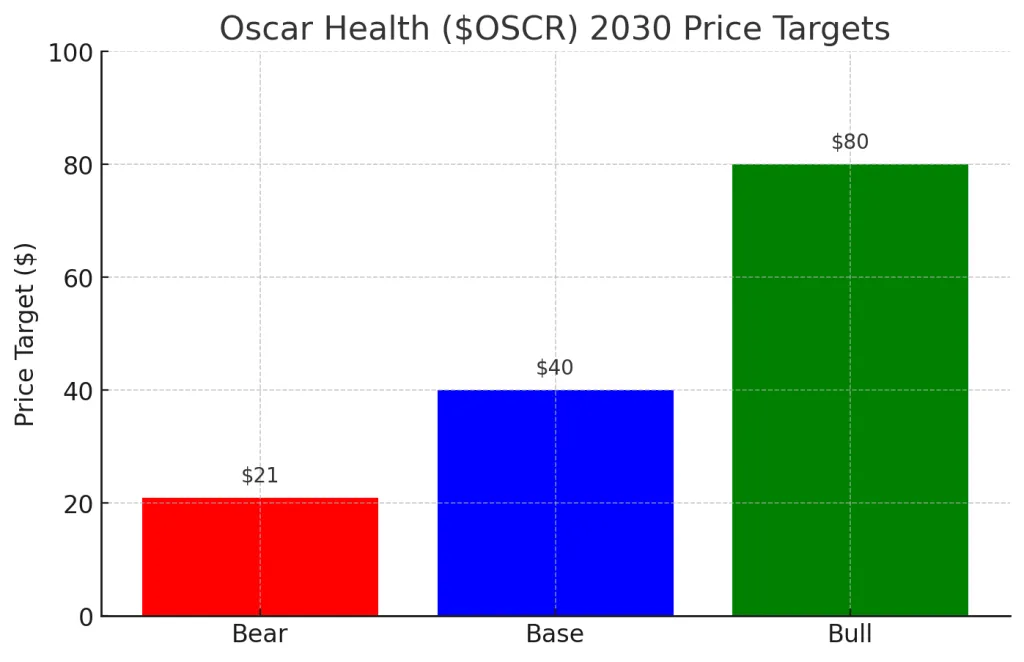
Bear, Base, and Bull Oscar Stock Forecast 2030:
A) Bear Case
In the bear scenario, the ACA is not extended or significantly weakened. Oscar faces slower membership growth, pressure on premiums, and higher risk. Its growth normalizes to the industry average, ~8% revenue CAGR. Margins modestly outperform peers, with net margin around 4%. The stock trades at the typical industry P/E of 14×.
Projection (2030): With these assumptions, EPS might reach ~$1.50/share by 2030. At 14× P/E, this implies a share price of ~$21.
Bear target: ~$20–22 per share (30% upside from the writing of this article).
B) Base Case
In the base case, the ACA is extended, allowing Oscar to continue serving the individual marketplace. Its tech-first, data-driven model drives revenue CAGR ~13% (5% above the industry average). Operational efficiency improves, SG&A leverage benefits margins, and net margin reaches ~5.5%. The market values Oscar at a modest premium to peers, around 16× P/E.
Projection (2030): EPS could reach ~$2.50/share by 2030. At 16× P/E, the implied share price is ~$40.
Base target: ~$38–42 per share (150% upside from the writing of this article).
C) Bull Case
In the bull scenario, ACA continues, and Oscar’s model fully scales. Revenue CAGR reaches ~18% (10% above industry), supported by strong membership growth, tech-enabled retention, and potential expansion into new insurance verticals. Margins are significantly better than peers, with net margin ~7.5%. The market awards a higher P/E of 20× due to growth and profitability.
Projection (2030): EPS could reach ~$4.00/share by 2030. At 20× P/E, the implied share price is ~$80.
Bull target: ~$75–85 per share (400% upside from the writing of this article).
Is Oscar Stock a Buy?
Oscar Health offers what Northwise believes to be a moderate-risk, high-reward opportunity. The company is not immune to near-term pain, but that pain is at least partially self-inflicted (through aggressive growth and risk repositioning), and management is making moves to contain it.
If policy tailwinds (ACA subsidy extension) materialize as we expect, and if underwriting normalizes, Oscar could very well swing from a cost-heavy growth mode into a more sustainable and profitable one.
For a long-term investor willing to ride through volatility, Oscar represents one of the more asymmetric long plays in the insurance-tech space: scaled, digitally enabled, growth-oriented, and uniquely exposed to both regulatory upside and business model optionality.

Celsius Stock Analysis: The Shelf Reset and the Second Growth Curve
Celsius stock analysis of the shelf reset, Alani growth, Pepsi economics and cash flow, with a 2030 model and a Premium valuation and entry-price framework.

Meta AI Spending: The Customer Is Already Here
Can Meta turn AI spending into shareholder returns? We model advertising, Muse, hardware, capital costs and cash flow through 2030, with a full valuation.

IREN Stock Dilution: Can the Build Reach Shareholders?
IREN stock analysis of AI growth, funding and dilution through 2030. Read our full valuation, 27 scenarios and price zones free. Excel model is Premium.
Northwise Portfolios
See how the research becomes real decisions
Reader discussion
Discuss the research
Create a Free account to join the discussion with a display name.
Create a Free Account
No comments yet. Start a thoughtful discussion.