
NVDA Stock Forecast 2030: Where the Next Wave of Growth Comes From

NVDA stock forecast 2030: examine AI demand, competition, cash flow and financing risk, with Premium valuation scenarios and an editable NVIDIA model.
In this article
NVIDIA no longer sells chips so much as entire AI factories, and the buyers of those factories now stretch far beyond the hyperscalers. Our work on the companies doing the buying points to a larger and longer buildout than the market is pricing, along with a sharper competitive fight and a growing financing role that every shareholder should understand.
In February, we published a model of Nebius that had the company reaching roughly 2.65 gigawatts of connected capacity by 2029. Four months later, contracted power had already passed 3.5 gigawatts, NVIDIA had invested $2 billion in the company, and Meta had signed an agreement worth up to $27 billion. We tore the model down and rebuilt it from the physical layer up.
The capital plan told the story. Our February work implied roughly $69 billion of Nebius spending from 2026 through 2029. The June rebuild carried $175 billion from 2026 through 2030. Our current owned-growth model carries $274.9 billion from 2026 through 2030, excluding partner-owned and replacement spending.
The same pattern has repeated across the AI infrastructure companies we cover. Each time we go back to the site maps, the contracts, and the funding stacks, the equipment bill gets bigger. A large share of every one of those bills lands in one place: NVIDIA's income statement.
This forecast reads the AI buildout from the supplier's side of the invoice. Before we get to the numbers, it helps to see the whole company clearly, since most of the debate about NVIDIA comes down to which parts of it people are looking at.
The Company in One Picture
NVIDIA reported $96.2 billion of revenue in the second quarter of fiscal 2027, more than double the year before, and guided the next quarter to $108 billion, plus or minus 2%, per its Q2 release. Data Center produced $89.0 billion of that quarter. Gaming, professional graphics, automotive, and robotics, reported within Edge Computing, produced $7.2 billion, about 7.5% of quarterly revenue. Data Center now dominates the business.
Gross margin ran at 75%, and roughly two-thirds of every revenue dollar reached operating profit. Hardware companies rarely look like this. NVIDIA earns software-like margins on physical equipment, and the question of how long it can keep doing so sits underneath every serious debate about the stock.
The company now reports Data Center revenue in two groups. Hyperscale covers the largest cloud and internet companies. AI Clouds, Industrial & Enterprise, or ACIE, captures a broad channel serving independent AI clouds, sovereign projects and enterprises. Its end demand also includes frontier labs and hyperscalers renting through those clouds. Buyer groups and reporting categories are different classifications.
In the second quarter, Hyperscale produced $48.7 billion and ACIE $40.3 billion, per the CFO commentary. ACIE grew 25% from the prior quarter and 138% from the year before. Management now expects the non-hyperscale side to reach about half of Data Center revenue.
The split is the single most important fact for anyone new to the company. Nearly half of NVIDIA's largest business already comes from customers who sit outside the hyperscaler spending totals most investors track.
Two Desks, One Invoice
Sit in on most investment conversations about AI infrastructure and you will hear two arguments that rarely meet.
At one desk, investors ask how CoreWeave, Nebius, and IREN will finance their next wave of data centers. At another, they ask how NVIDIA can keep growing when Microsoft, Amazon, Alphabet, and Meta are already spending at record levels and designing their own chips. The first group worries the buyers are overextended. The second worries the buyers are running out, or leaving.
Both conversations are about the same invoice. The equipment bill that creates a financing problem for a cloud operator is a revenue line for its supplier, and the two debates belong together.
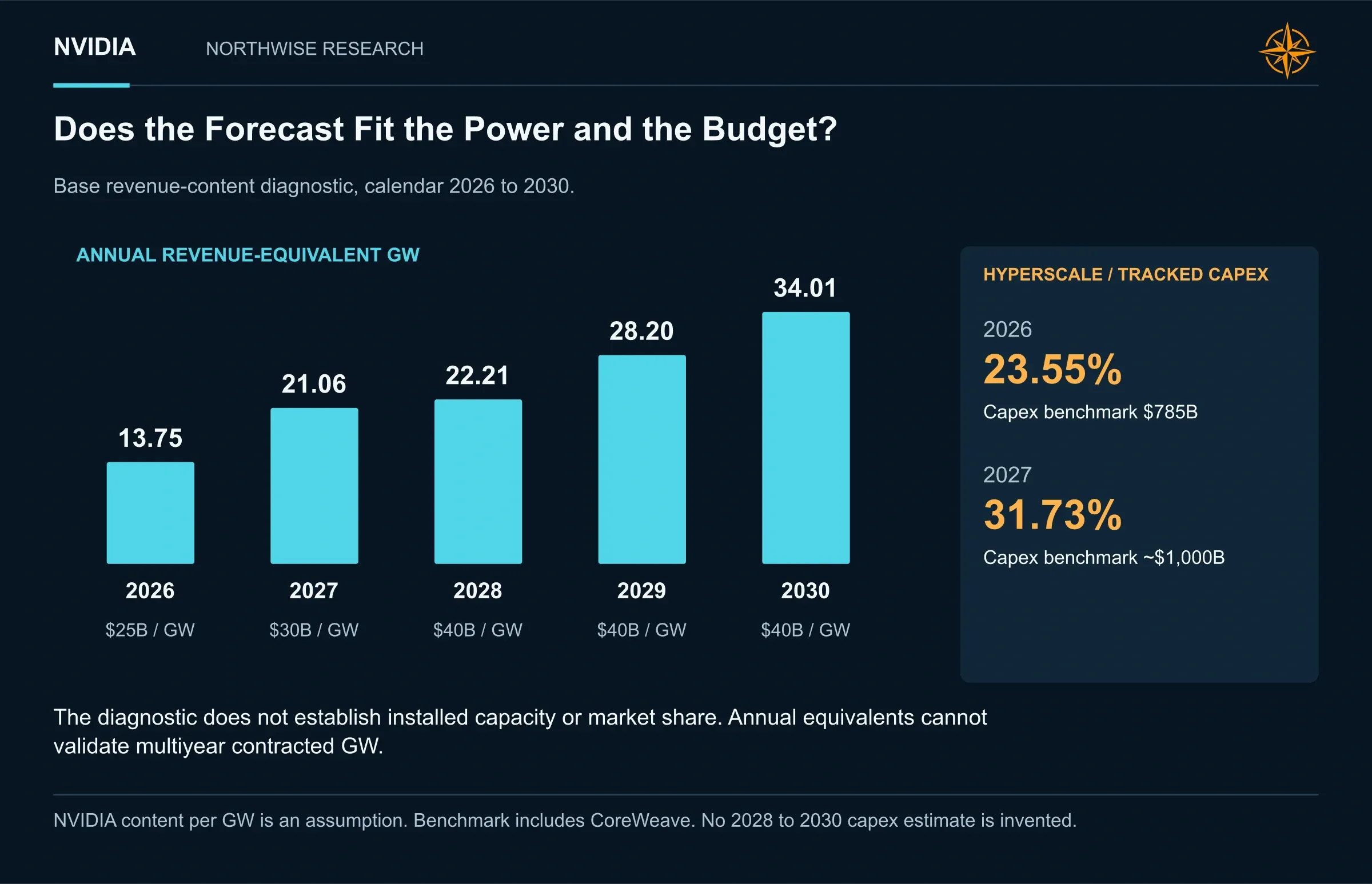
The Street mostly prices NVIDIA from the top down. It totals the capital budgets of the largest clouds, applies a share for NVIDIA, and asks how much higher the total can go. Moody's, for instance, tracks spending at Microsoft, Amazon, Meta, Alphabet, Oracle, and CoreWeave at roughly $785 billion in 2026, closing in on $1 trillion in 2027. Those are enormous numbers, and they still leave out most of the independent clouds, sovereign projects, and enterprise buyers we model.
The top-down frame also tends to run behind. Before NVIDIA's August earnings call, the average analyst expected about 44% revenue growth in fiscal 2028. Management then guided to roughly 70%, and our own fiscal 2027 estimate of $409.8 billion already sat above the roughly $396 billion consensus cited at the time.
None of that surprised us. Our CoreWeave model, published in August, already had capital spending rising from $33.0 billion in 2026 to $44.1 billion in 2027. Our June Nebius rebuild had 2027 spending climbing 58% from 2026. The buyers were telling us the year ahead would be bigger than consensus assumed before NVIDIA said so itself.
Our view is direct. The purchasing base for NVIDIA's equipment is broader, deeper, and longer-lived than a hyperscaler spending screen can capture, and NVIDIA is capturing more of every dollar spent inside each data center. We believe the shares are undervalued as a result.
We hold that view alongside a clear-eyed reading of the risk. The largest buyers are building credible alternatives, NVIDIA is increasingly helping to finance its own demand, and large hardware buildouts have often included periods when customers stopped to digest what they bought. The harder question is how much of NVIDIA's extraordinary profitability survives an expansion this large, including the downturn that will probably interrupt it.
What Modeling AMD Taught Us About NVIDIA
We came to NVIDIA by way of its competition.
We began buying and modeling AMD below $100 a few years ago, when most investors still treated it as a perennial second place. Our thesis was simple: in a supply-constrained AI market, the largest buyers would pay to have a credible second supplier, and AMD had rebuilt itself into one. The thesis has served us well, and we still hold it.
Years inside the second-source argument also gave us an unusually clear view of the incumbent. Every hyperscaler wants an alternative to NVIDIA. Almost none of them can afford to stop buying from NVIDIA while the market grows this fast. Customers diversify at the margin, and so far the margin has grown more slowly than the market.
The AMD and NVIDIA bull cases rest on the same fact. The buildout is large enough for more than one supplier to win big, and we think investors who frame AI hardware as a zero-sum fight misread both stocks.
The Stack, Layer by Layer
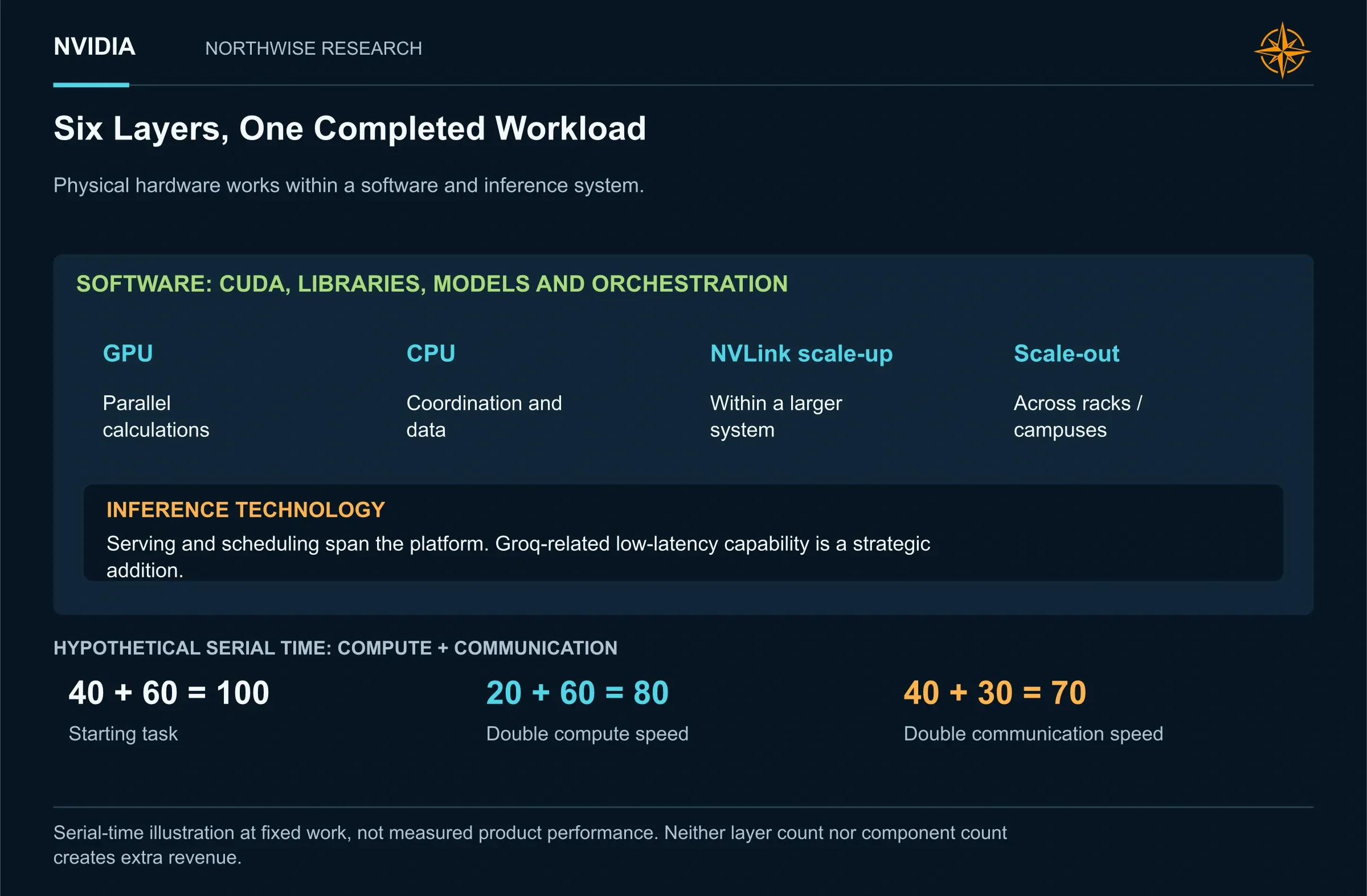
Ask a data center operator what they are buying and the honest answer is finished work, delivered reliably at a cost their customer will pay. Getting there takes far more than a fast processor, and NVIDIA's strategy over the past five years has been to sell nearly every layer in between.
A useful way to see the company is as a stack of six layers, each with its own competitors and its own evidence. We walk through them in order, from the chip outward, and note where the evidence has moved our view.
Layer One: The Accelerator
The graphics processor, or GPU, is still the engine. It performs enormous numbers of calculations in parallel, which is exactly what training and running AI models requires.
NVIDIA moves to a new architecture roughly every year. Blackwell carried the current cycle, and its successor, Rubin, began production shipments in early August. On the August 26 earnings call, management said every major hyperscaler, AI cloud, and system maker had placed orders, expected Vera Rubin to reach about 20% of Data Center revenue in the third quarter, and called it the fastest product ramp in company history.
Rubin combines HBM4 memory with changes across the CPU, accelerator and networking platform, per NVIDIA's platform announcement. The system roadmap matters more to our forecast than a single peak-compute specification. Future generations still have to arrive on time and deliver attractive economics in customer workloads.
Our read is that the annual cadence is itself a competitive weapon. A rival that matches NVIDIA's current chip ships into a market that is already moving to the next one, and every operator we model plans capacity around NVIDIA's roadmap dates. The risk sits in execution: each new generation brings a harder manufacturing ramp, and a delay of even a quarter moves billions of dollars of revenue.
Layer Two: The CPU
AI systems still need conventional processors to coordinate work, move data, and run the software around the model. NVIDIA used to leave that business to Intel and AMD. It now sells its own Arm-based CPUs, Grace and its successor Vera.
The evidence here has surprised us. Grace revenue passed $5 billion over the trailing 12 months, Vera is in full production with shipments to Oracle, AWS, and SpaceX AI, and management expects CPU revenue to more than double in fiscal 2028. In February, Meta announced the first large-scale Grace-only deployment, using NVIDIA CPUs for ordinary production applications with no GPU attached.
NVIDIA has also hedged the other way. It invested $5 billion in Intel in 2025, with the two companies building custom x86 processors that connect directly to NVIDIA's platform. Customers can choose either instruction set and still land inside NVIDIA's system.
We treat the CPU as a meaningful second product line, though a small one relative to the accelerator. Its larger value is strategic. A customer that buys the CPU, the GPU, and the connections between them from one vendor gets a system engineered as a whole, and that customer becomes harder to pull apart one component at a time.
Layer Three: Scale-Up, Where Chips Become One Machine
Modern AI models are too large for a single chip. NVLink is NVIDIA's high-speed connection that lets 72 GPUs in a rack behave like one giant processor, sharing memory and splitting work with very little delay.
We think this is the most underappreciated layer in the stack. On the call, Jensen Huang put it simply: "the vast majority of the world's data centers will just be Vera Rubin and NVLink 72." The rack, not the chip, has become the unit customers buy.
NVIDIA has also opened the door to outsiders. Through NVLink Fusion, custom accelerators from partners such as Marvell can plug into NVIDIA's interconnect and rack design. A hyperscaler that designs its own chip can still buy NVIDIA's connective tissue around it, so losing a socket no longer means losing the system.
The competing answer comes from an industry group backing an open standard called UALink, and from Broadcom's Ethernet-based scale-up switches. Both are real. Neither has yet shipped at the scale NVLink already runs, and in our view the gap here is wider than the gap in raw chip performance.
Layer Four: Scale-Out Networking
Racks then have to talk to each other across a building, and increasingly across campuses. NVIDIA sells two families of networking for this: InfiniBand, the high-performance standard it acquired with Mellanox, and Spectrum-X, an Ethernet platform tuned for AI traffic.
This is where the evidence has moved fastest. Networking revenue hit a record in the second quarter, and Spectrum-X revenue grew 2.6 times from a year earlier. Meta adopted Spectrum-X across its infrastructure and is folding the switches into its own open networking system, a notable win inside a company known for building its own hardware.
The next step replaces copper and pluggable optics with light. NVIDIA's co-packaged optics switches build the optical connection directly into the switch package, cutting power per link at a time when every saved watt can be handed back to compute.
Broadcom is the serious rival in this layer. Its Tomahawk switches power the networks around Google's TPUs and most other custom-chip clusters, and its AI networking revenue reached $4.5 billion last quarter. We model networking growing to about a quarter of NVIDIA's Data Center revenue by fiscal 2031, roughly $339 billion of calendar 2030 sales. On its own, that business would rank among the largest in semiconductors.
Layer Five: The Inference Engine
Training builds a model's capabilities. Inference puts them to work, every time a user asks a question or an agent completes a task, and it is becoming the larger and more varied workload.
NVIDIA has moved aggressively here. In December 2025 it entered a non-exclusive license for Groq's inference technology, with Groq's founder and other team members joining NVIDIA. The relationship adds specialized low-latency inference capability while Groq remains a separate company.
On the August 26 call, management said Groq 3 LPX was in full production, expected volume shipments later in fiscal Q3, and named Nebius as the first adopter. These were management's production and shipment statements at that date. The discussion positioned Groq as an option for high-interactivity services around the broader NVIDIA platform.
Our read is that the Groq deal tells investors where NVIDIA sees its vulnerability. Inference-specific chips are exactly where custom silicon competes best, and NVIDIA chose to buy a leading answer instead of waiting to see whether its general-purpose platform would be enough. We think it was the right decision, and the pricing data from the neoclouds we cover will tell us within a year whether it worked.
Layer Six: Software and Models
CUDA, NVIDIA's programming platform, is the reason most AI code runs on NVIDIA first. Around it sit libraries for nearly every scientific and industrial field, inference software that schedules work across thousands of GPUs, and NVIDIA's own open Nemotron models, now available on Amazon Bedrock.
Huang told investors he is "fairly certain" NVIDIA is the only platform that runs every frontier model, closed or open. In his conversation with Dwarkesh Patel, he described NVIDIA's strategy as supplying the hardest parts of the platform and partnering for the rest, reaching customers through many clouds instead of owning one.
We do not value that software as a separate company bolted onto the hardware. Its value shows up as higher utilization, stickier customers, firmer pricing, and repeat purchases, all of which already sit inside our forecast.
The honest caveat is that the software moat is narrowing at the very top of the market. The largest labs employ engineers who can write directly for Google's TPUs, Amazon's Trainium, or AMD's ROCm, and they are doing so. CUDA's advantage is strongest everywhere else, with thousands of companies that lack those engineering teams, and that is exactly the part of the market we expect to grow fastest.
What the Evidence Says About Each Layer
Layer | What NVIDIA sells | Main competition | Recent evidence | Our read |
|---|---|---|---|---|
Accelerator | Blackwell, Rubin GPUs | AMD Instinct, Google TPU, Amazon Trainium, Broadcom XPUs | Rubin shipping since August; orders from every major buyer | Leader, with execution risk on each annual ramp |
CPU | Grace, Vera | Intel, AMD, in-house Arm chips | Grace above $5B trailing; Meta Grace-only deployment | Growing second line; strategic glue |
Scale-up | NVLink 72, NVLink Fusion | UALink, Broadcom scale-up Ethernet | Rack now the unit of purchase | Widest moat in the stack |
Scale-out | Spectrum-X, InfiniBand, photonics | Broadcom Tomahawk, Arista | Spectrum-X up 2.6x; Meta adoption | Fastest-improving layer |
Inference | Groq 3 LPX, NVLink systems | Custom inference chips, TPU 8i | August call: LPX in production; Nebius named first adopter | Defensive move made early |
Software | CUDA, libraries, Nemotron | ROCm, JAX on TPU, in-house stacks | Runs every frontier model | Strong broadly, thinner at the very top |
More Revenue From Every Scarce Megawatt
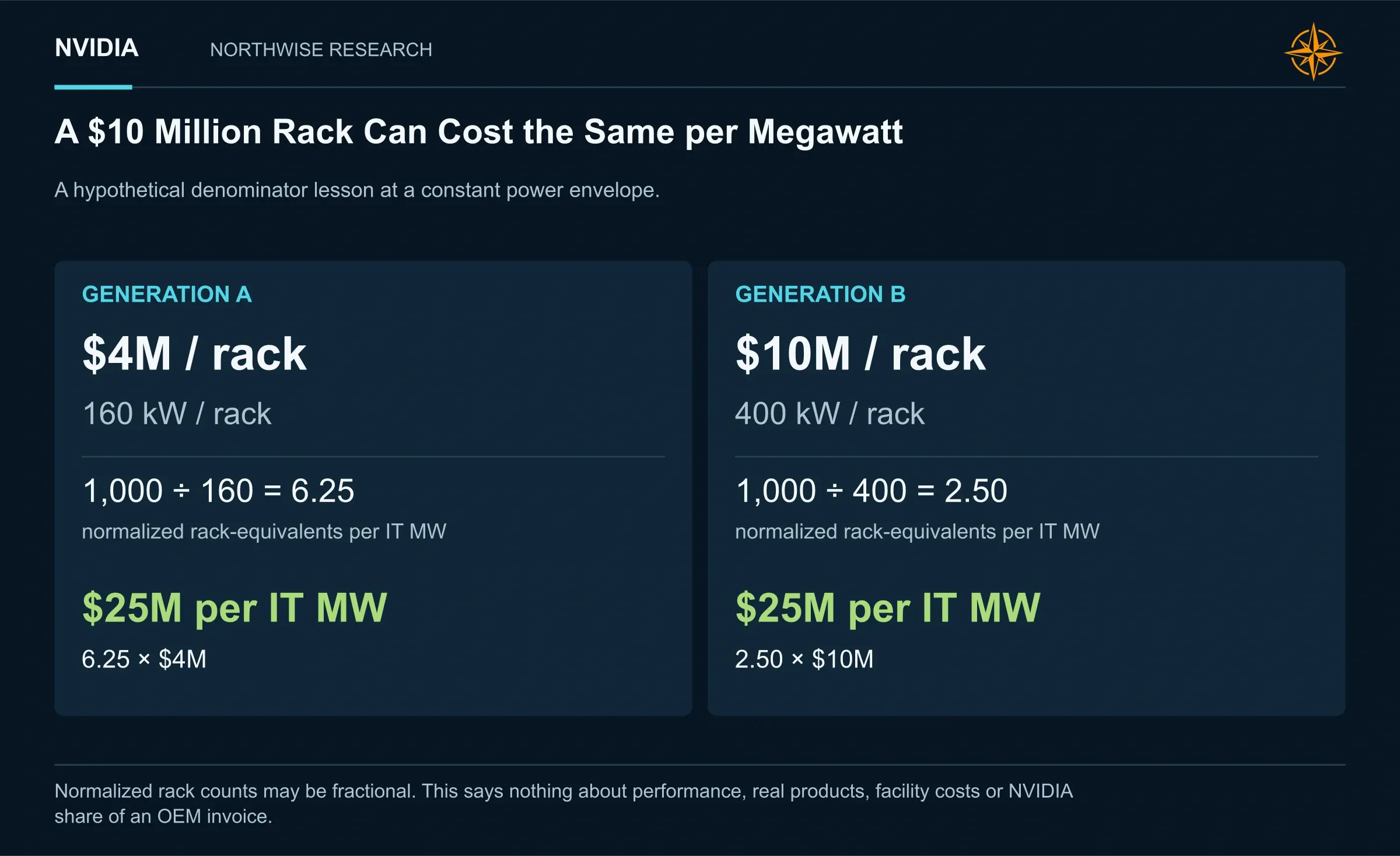
The binding constraint on AI infrastructure today is power, and that changes the arithmetic of NVIDIA's growth.
When megawatts are scarce, an operator cannot simply add racks. It can fill each megawatt with more capable and more expensive equipment. Management has put NVIDIA's revenue opportunity at roughly $18 billion per gigawatt for Hopper, $25 billion for Blackwell, and $40 billion for Vera Rubin, so the same power allocation now produces more than twice the NVIDIA revenue it did two generations ago.
Our Nebius work shows what that looks like on a real cost sheet. In our 2030 Base case, compute, networking, and storage account for $37.69 million of a $58.24 million all-in build cost per incremental active megawatt. Nearly two-thirds of the cost of a new AI data center is the equipment inside it, and a large share of that equipment carries NVIDIA's name.
Each layer of the stack above is a way to claim more of that equipment budget. The long debate over the selling price of a single accelerator misses most of this, since customers pay to complete work across a system, and NVIDIA's share of the system is rising.
Who Buys, and Why: The Market in Four Lanes
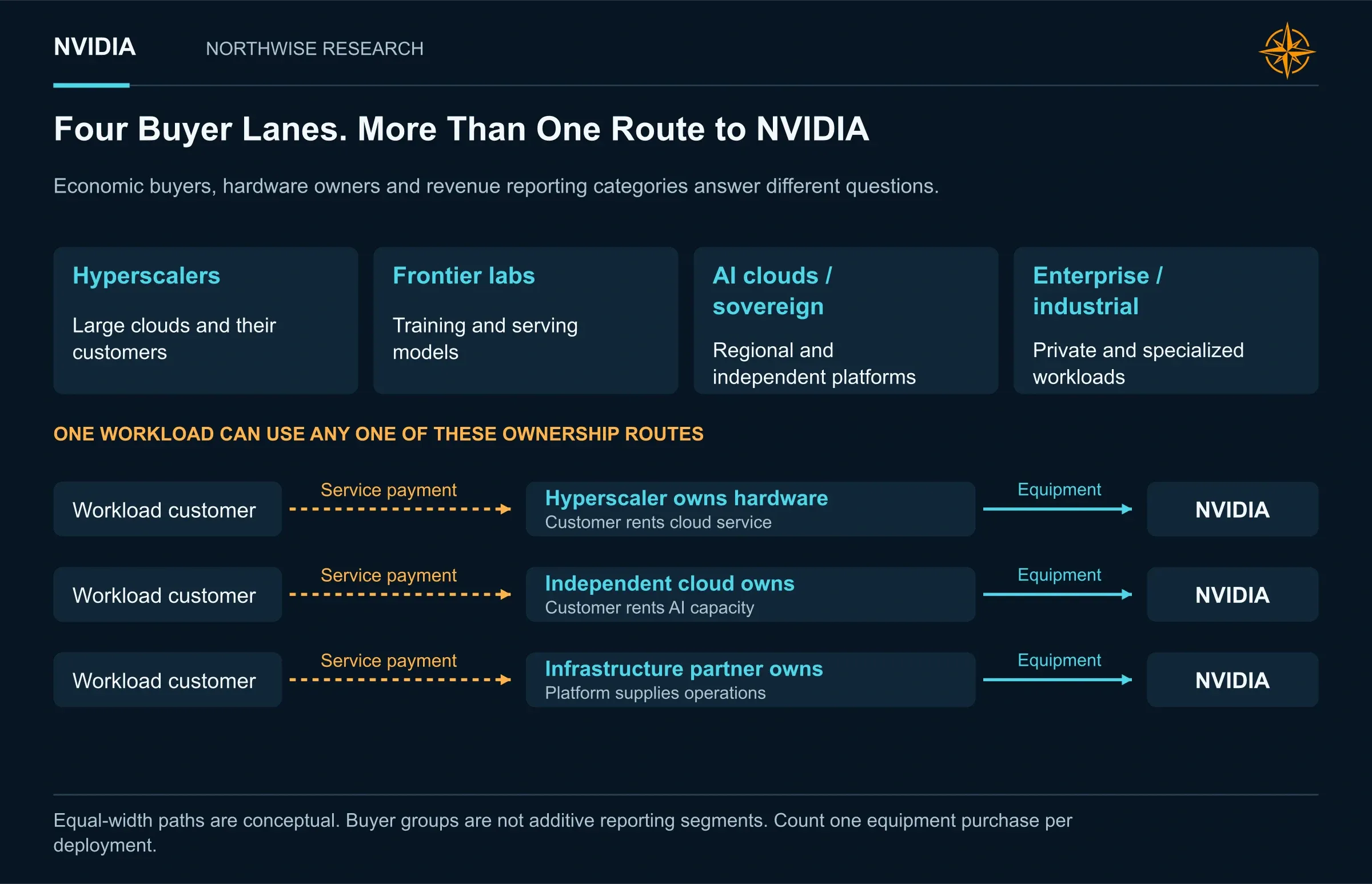
NVIDIA's customers fall into four groups, and each buys for different reasons, on different timelines, with different alternatives. Understanding the lanes explains why the company can lose ground in one and still grow quickly overall.
The first lane is the hyperscalers: Microsoft, Amazon, Alphabet, Meta, and Oracle. They are the largest buyers in absolute dollars and the most capable of building their own chips. NVIDIA's position here rests on breadth. Its systems run every model their cloud customers want to rent, and this year's expansions show that even the companies with the strongest in-house programs keep buying at scale: Meta signed a multiyear deal covering millions of GPUs, and AWS plans roughly 2 million additional NVIDIA GPUs through the second quarter of fiscal 2029.
The second lane is the frontier labs: OpenAI, Anthropic, xAI, and a handful of others. Management expects them to contribute roughly a quarter of the business next year. They are also the most aggressive multi-sourcers in the market, which we cover in detail below.
The third lane is the independent AI clouds and sovereign buyers, where NVIDIA's position is strongest. These operators sell general-purpose capacity to many customers and cannot afford to bet on a chip that only some workloads support. Sovereign business sold through regional clouds grew 35% from the prior quarter and more than tripled from the year before, with partners from India and Malaysia to Japan and Korea.
The fourth lane is enterprise and industrial: banks, drugmakers, carmakers, and manufacturers building private AI systems, plus the robotics and automotive demand in our Edge segment. It is the smallest lane today and the one where CUDA's head start matters most, since few of these buyers will ever write low-level code for a custom chip.
The Buyers the Spending Screen Misses
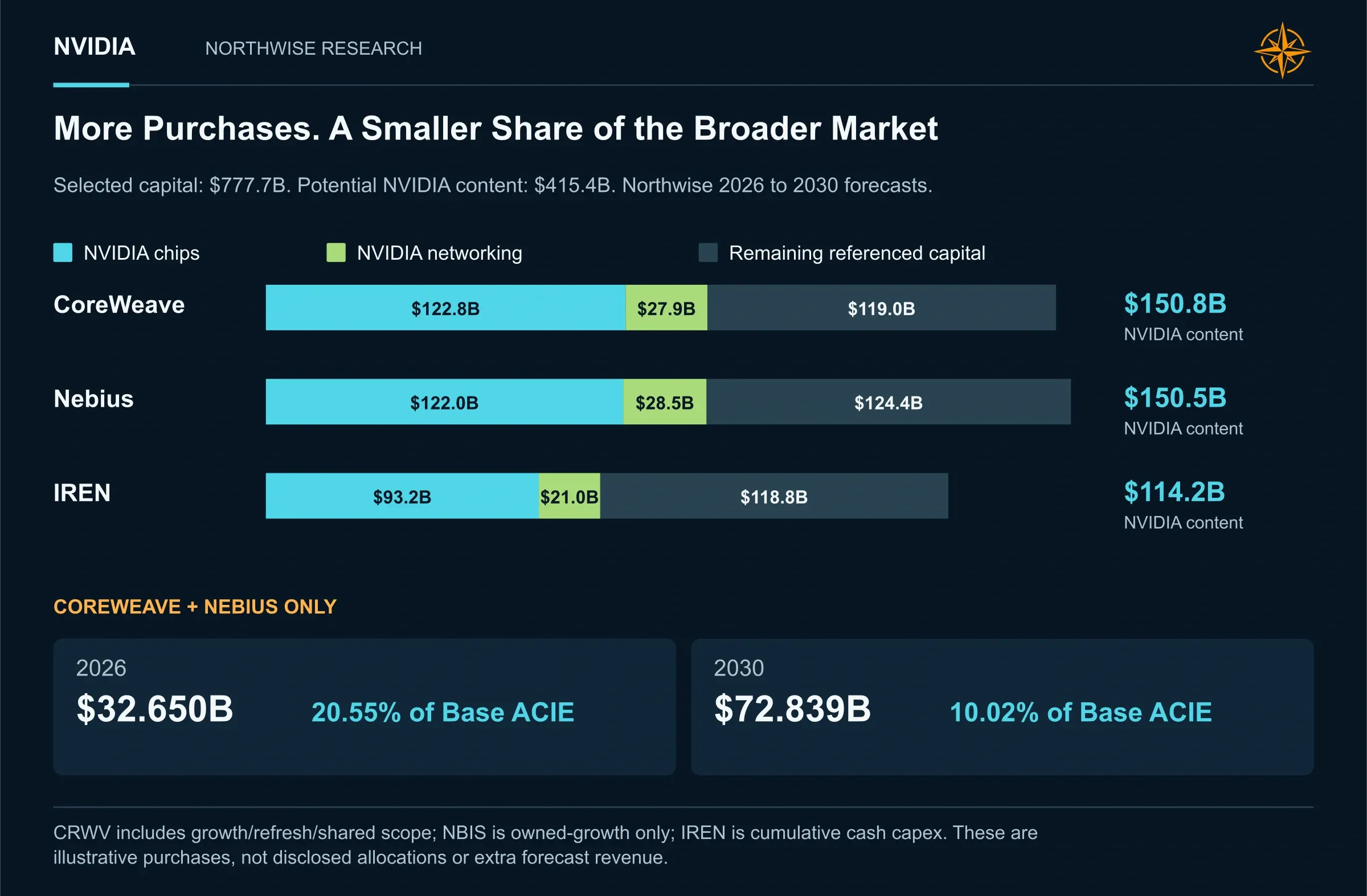
The third lane is the part of the market we know best. Over the past year, we have modeled the neoclouds site by site: what capacity gets energized, what equipment fills it, how customer contracts support the borrowing, and what is left for shareholders after the capital is raised. Converting those forecasts into NVIDIA purchases gives us a picture no top-down screen can.
Northwise forecasts, cumulative 2026 to 2030 | Capital spending | NVIDIA chips | NVIDIA networking | Potential NVIDIA purchases |
|---|---|---|---|---|
CoreWeave | $269.8B | $122.8B | $27.9B | $150.8B |
Nebius | $274.9B | $122.0B | $28.5B | $150.5B |
IREN | $233.0B | $93.2B | $21.0B | $114.2B |
Combined | $777.7B | $338.0B | $77.4B | $415.4B |
Three companies that were barely AI clouds a few years ago could buy more than $415 billion of NVIDIA equipment over five years. The total strips out land, power, buildings, cooling, and every piece of non-NVIDIA equipment.
The ramp is steep. Our Nebius schedule runs $25.0 billion in 2026, then $52.6 billion, $63.2 billion, $68.2 billion, and $65.9 billion through 2030. The 2026 figure sits at the top of management's raised $20 billion to $25 billion guidance, and the 2027 jump reflects gigawatt-scale sites in Missouri and Pennsylvania that were nowhere in our own February model.
CoreWeave and Nebius alone account for about 20% of our Base ACIE revenue in 2026, easing to about 10% by 2030 as the rest of the lane outgrows them. Behind them sit Nscale, Crusoe, Lambda, sovereign projects, and enterprise buyers we track and left out of the table.
We hold one caution firmly. A GPU bought by an independent cloud often ends up serving a hyperscaler or a frontier lab, so a longer list of buyers does not make end demand fully diversified. The spending map is broader than the Street assumes. The cycle underneath it is still one cycle.
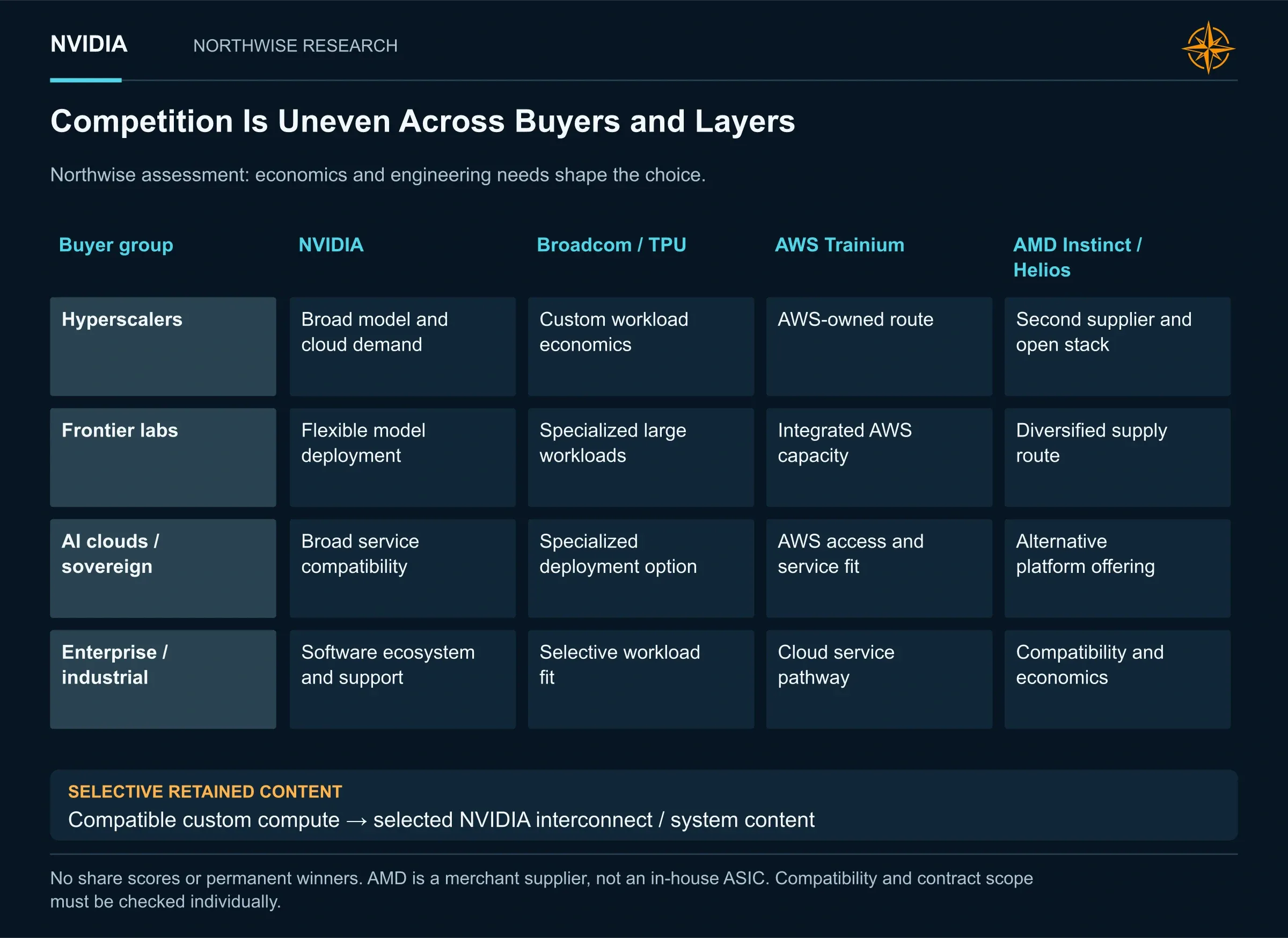
Competition Has Found Its Lanes
For most of the past three years, the competitive threat to NVIDIA was mostly a promise. In 2026 it became a set of signed contracts, and anyone holding the stock should understand exactly where.
Broadcom is the largest of these rivals, though it rarely gets described that way. It designs custom accelerators, which it calls XPUs, for companies that want their own chips. In September, its AI revenue reached $16.7 billion for the quarter, more than triple the year before, and management laid out a remarkable customer schedule.
Google's TPUs sit at the center of that competitive route. Broadcom supplies custom accelerator and networking capabilities to customers designing around their own workloads. The relevant comparison is the economics of a particular deployment, including software conversion, utilization and access to capacity. We do not add overlapping multiyear capacity announcements into an annual demand estimate.
Amazon's Trainium is the second front. Amazon reported a chips-business annual revenue run rate above $20 billion, a measure that includes Graviton and Nitro as well as Trainium. Anthropic has announced an agreement for up to 5 gigawatts of AWS capacity. The wider chips-business figure should not be read as Trainium-only sales.
AMD is the third. It announced Helios production in July, and its October 5 update described customers testing systems at their own sites and preparing larger deployments. Its OpenAI arrangement covers 6 gigawatts, with initial MI450 capacity planned from the second half of 2026, as described in AMD's annual filing. AMD also announced up to 2 gigawatts for Anthropic and up to $5 billion of equity investment. These are separate supply and financing commitments, not evidence that all capacity is already serving workloads.
Put those contracts side by side and a pattern emerges. The frontier labs are the most diversified buyers in the market by a wide margin. Anthropic alone has arrangements with Google, Amazon, AMD, and NVIDIA at the same time, most of them measured in gigawatts.
The evidence shapes our view in three ways. First, the competition is winning a specific lane: the very largest labs and clouds running a small number of enormous, well-understood workloads, where custom silicon's cost advantage is greatest and the engineering talent to use it already exists. We expect NVIDIA's share of that lane to fall over our forecast period, and our Base case assumes it does.
Second, we judge NVIDIA's position stronger in broad-service AI clouds, sovereign projects and enterprises, although competition remains present in each. Independent clouds, sovereign buyers, and enterprises need a platform that runs everything, from every vendor's model, on software their teams already know. Huang made the distinction directly on the call, describing custom chips as tied to one cloud or one service and NVIDIA as a platform available in any cloud. Our forecast puts most of NVIDIA's growth in those lanes, with ACIE overtaking Hyperscale by 2028.
Third, even a lane where NVIDIA loses share can keep growing in dollars. Anthropic's NVIDIA arrangement of up to 1 gigawatt illustrates how a customer can diversify suppliers while still supporting substantial NVIDIA demand. Management's per-GW content estimates provide a scale reference; multiplying them by announced capacity does not establish a contracted order value or its timing.
Competition's sharpest effect shows up in price. A buyer with a credible alternative negotiates harder, and our Bear case lets gross margin slide to about 65% when the buildout pauses and that leverage finally gets used.
Partnerships, and NVIDIA as Financier
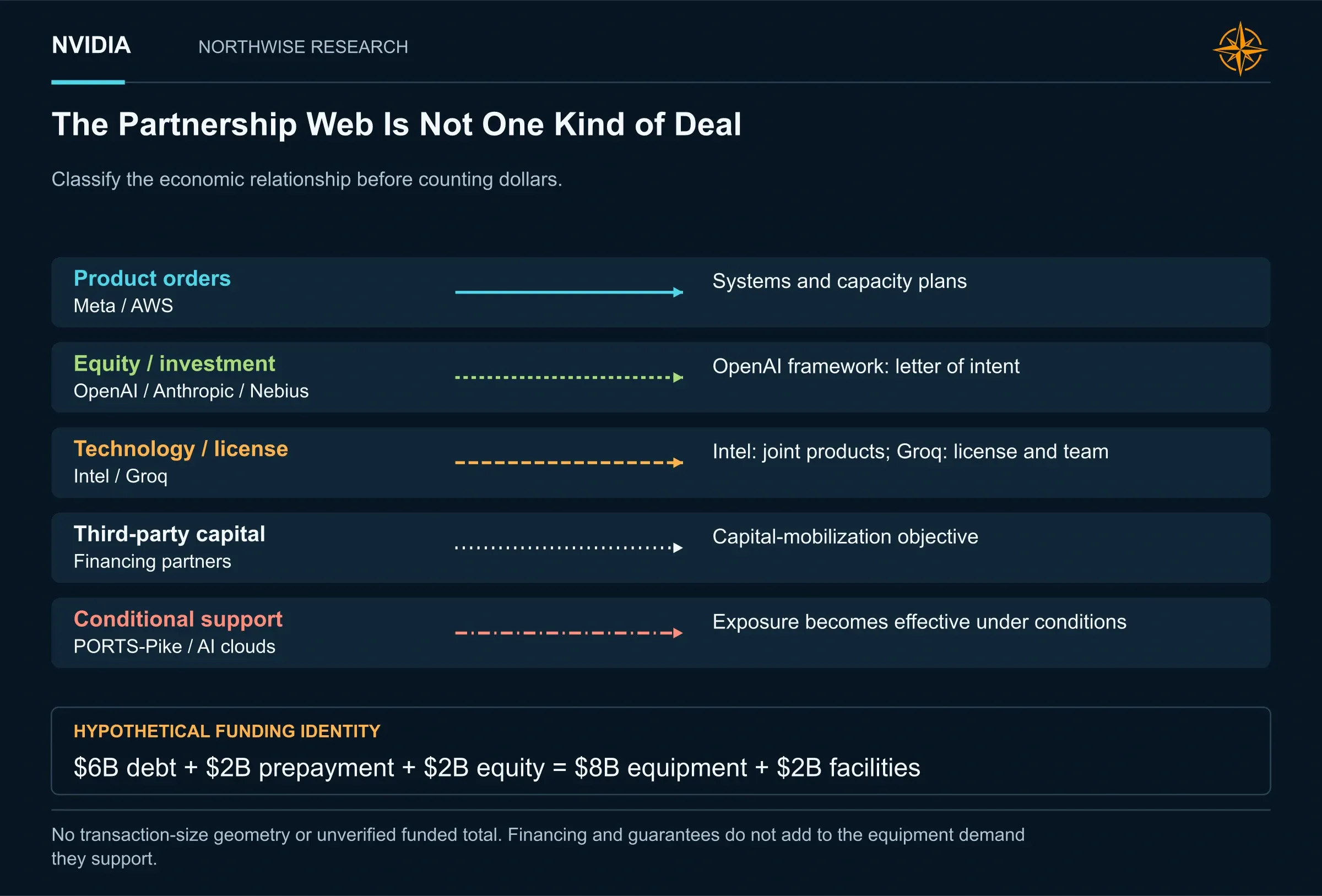
NVIDIA has spent the past year weaving itself into its customers' balance sheets. Anyone new to the company needs to understand how far this has gone, and anyone who already owns it needs a view on whether it adds risk or reduces it.
The list is long. In 2025, NVIDIA and OpenAI signed a letter of intent for at least 10 gigawatts of NVIDIA systems and up to $100 billion of NVIDIA investment, and OpenAI's commitments now total about 12 gigawatts through 2030. NVIDIA committed up to $10 billion to Anthropic and said on August 26 that it had invested nearly $50 billion across frontier labs, on top of stakes in customers such as Nebius and partners such as Intel.
The financing reaches past equity. NVIDIA's partnerships with Apollo, BlackRock, Blackstone, Brookfield, Goldman Sachs, and KKR aim to mobilize more than $500 billion of third-party capital. Under the PORTS-Pike arrangement around the Portsmouth, Ohio campus that OpenAI will use, NVIDIA disclosed conditional support capped at $105 billion, activated in stages as capacity enters service, per its 10-Q. It is providing credit support for nearly 2 gigawatts for another lab, and with some neoclouds it guarantees part of a facility's capacity in exchange for a share of revenue above a floor.
Management's position is clear: "We're not making loans." Bears call the arrangement circular, a supplier financing the demand it reports.
Our neocloud work makes us more cautious here than the typical NVIDIA bull. We have spent the past year modeling funding stacks: customer prepayments, delayed-draw term loans, asset-backed facilities, convertibles, and equity as the last resort. The companies buying NVIDIA's equipment are leaning hard on every source of capital available, and increasingly one of those sources is NVIDIA.
We also think the bears overstate it. A well-powered site can host several generations of equipment, and locking up scarce power for its own ecosystem is a rational use of the most profitable balance sheet in the industry. The largest recent commitments, from Meta and AWS, came with no disclosed NVIDIA financing.
The honest position lives in three details: whether end customers generate durable revenue, whether other tenants could absorb the capacity if one failed, and how much independent capital actually arrives. We carry investments, support costs, and an expected loss on guarantees separately from equipment revenue, and in our Bear case those losses rise sharply during a digestion year.
One Company's Problem Is Another Company's Revenue
Our CoreWeave forecast, published in August under the title "Can CoreWeave Outgrow Its Debt?", reached an uncomfortable conclusion for CoreWeave shareholders. Across 2026 through 2030, the company spends about $269.8 billion building its platform against about $227.9 billion of cumulative revenue, roughly $1.18 of capital for every dollar it earns.
For CoreWeave's equity, that gap is the central risk. Even in our weaker case, CoreWeave still spends $246.7 billion, only 8% less than Base, since most of the commitments are signed before a slowdown would become visible.
Turn the same table around and it reads very differently. Spending that is front-loaded, contract-backed, and hard to cancel is exactly what a supplier wants to see. The financing strain we flag for CoreWeave shareholders is, from NVIDIA's chair, a large and relatively durable order book.
The asymmetry sits at the heart of our NVIDIA thesis. The neocloud investor carries the funding risk, the depreciation, and the dilution, and the supplier collects at the invoice. If those buyers hit a financing wall, orders pause and the pause lands on NVIDIA's revenue line within quarters, which is the mechanism behind the digestion year in our Bear case.
Counting Equipment Once
Our neocloud work taught us to be ruthless about one thing: financing announcements make it very easy to count the same equipment several times.
Picture an operator buying $8 billion of computing equipment inside a $2 billion facility, funded with a $6 billion loan, $2 billion of customer prepayments and $2 billion of sponsor equity. The project is $10 billion. The loan and the prepayment explain where the money came from, and neither adds a dollar of demand.
Partner-owned structures add another layer. Nebius's infrastructure-partnership model lets partners finance and own hardware while Nebius supplies the platform and the customers. When an operator turns capital-light, the NVIDIA systems still get bought, on someone else's balance sheet.
We assign no dollar figure to that partner-owned opportunity, or to the sovereign route opened by Nebius's partnership with Palantir. Both extend the routes covered by our selected purchasing illustration. They are not separate revenue amounts added to the core forecast.
Inference Is the Demand the Market Has Not Priced
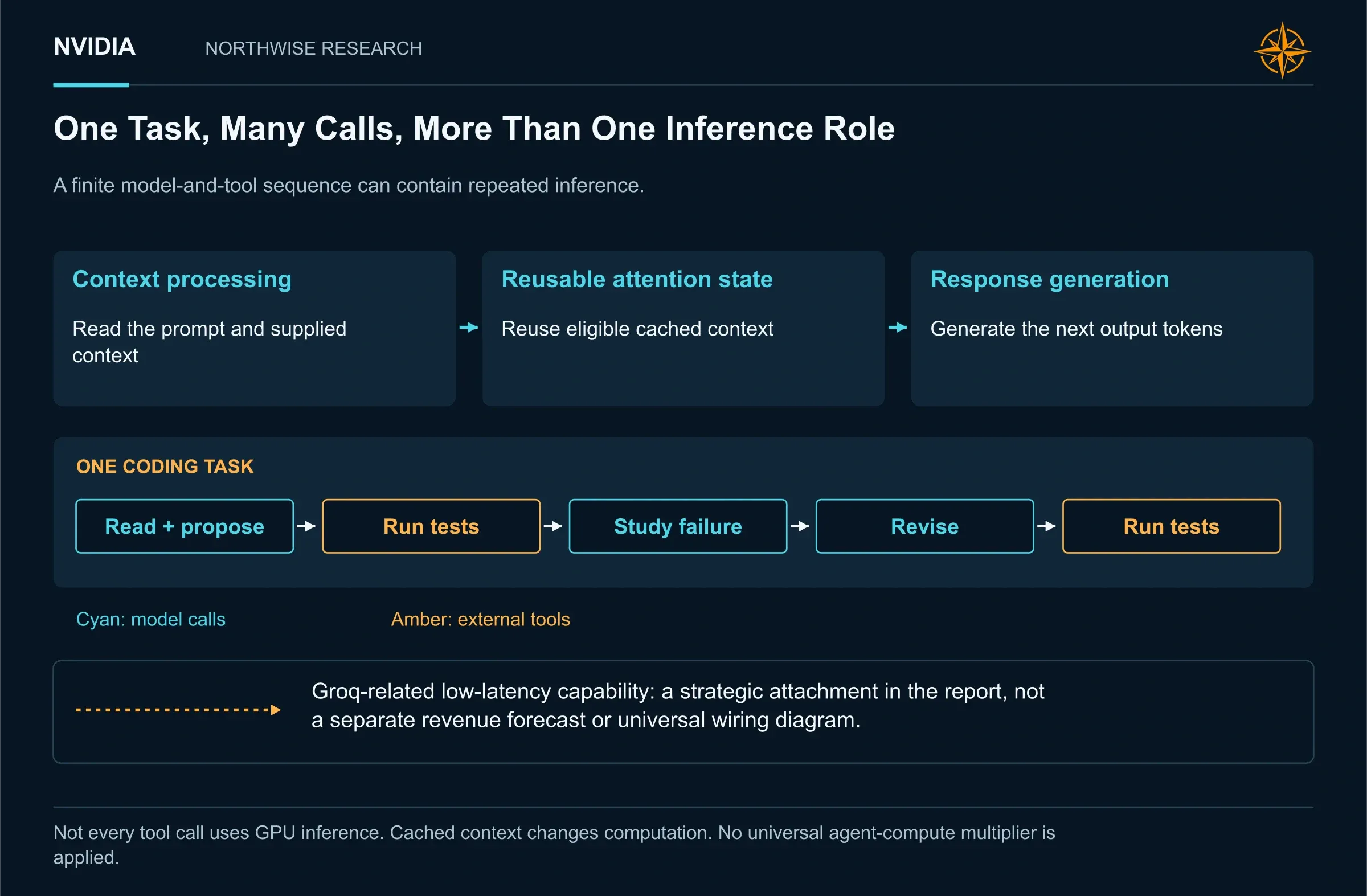
Consider a coding assistant fixing a bug. It reads the repository, proposes a change, runs the tests, studies the failure, revises, and tests again. The customer sees one finished task, and behind it the data center serves a chain of model calls.
Huang estimated on August 26 that agents could use roughly 15 to 100 times the compute of a human user, depending on the task. This is a management estimate, not a universal workload benchmark or a multiplier applied to our model. As AI moves from answering questions to completing jobs, the computation behind each user multiplies.
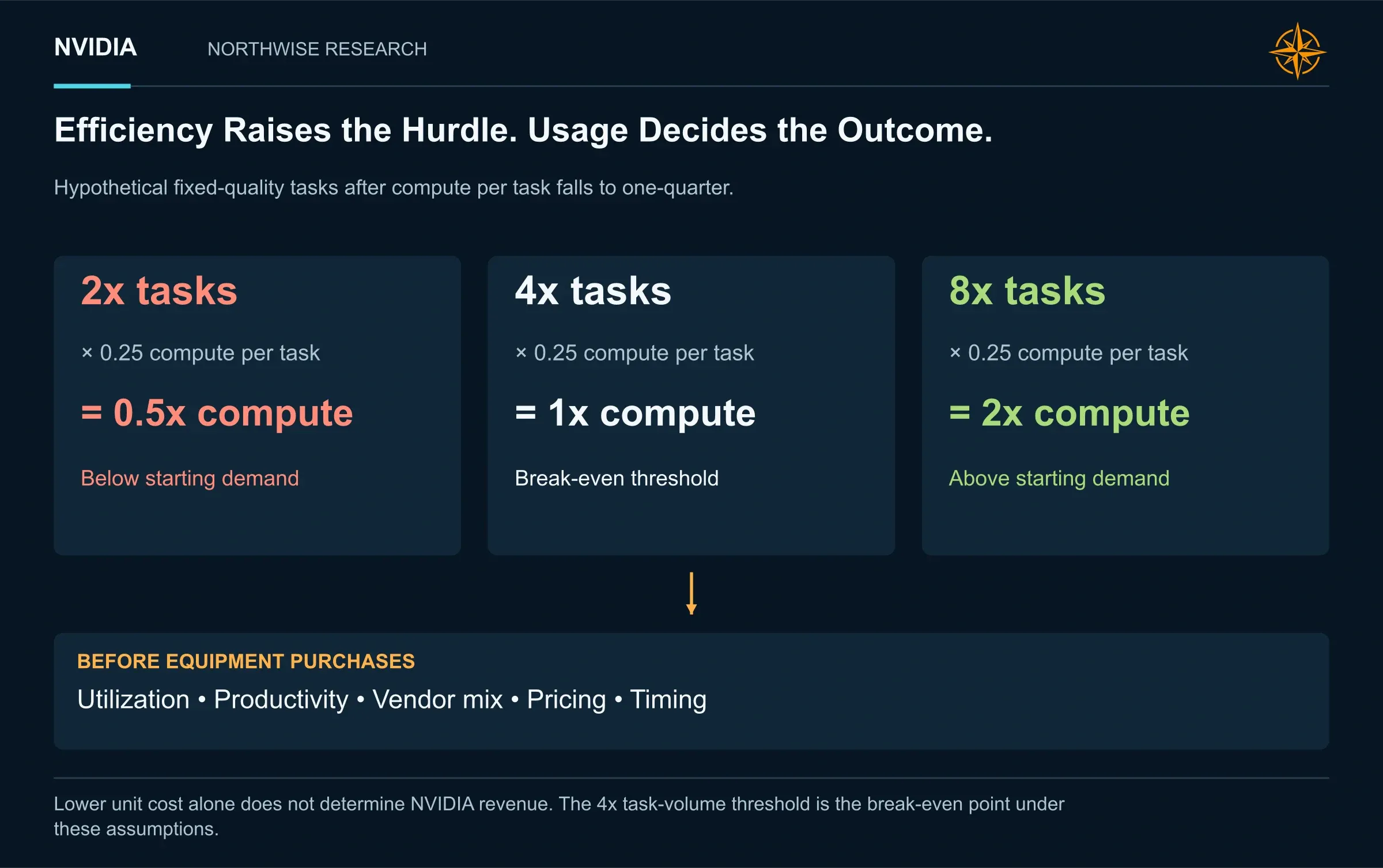
The bear response is efficiency: cheaper models need less hardware. Efficiency is real, and it cuts both ways, since every drop in the cost of a task makes more tasks worth automating. We side with demand, and the operators we cover support that so far: Nebius has contracted more than 3.5 gigawatts of power against 800 megawatts to 1 gigawatt it expects to have connected this year.
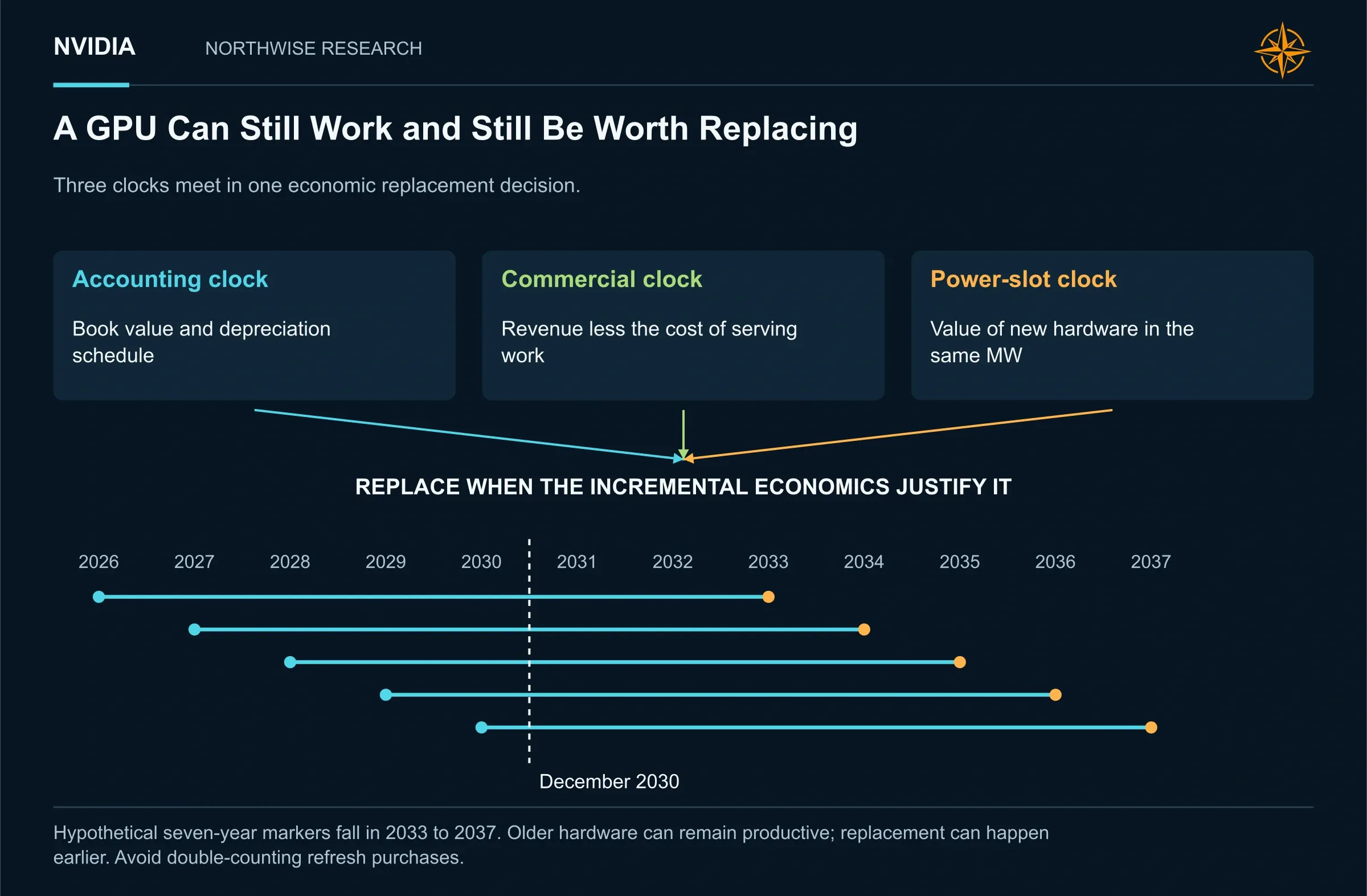
Older hardware points the same way. On its fiscal 2026 year-end call, NVIDIA described continuing demand for Hopper and even Ampere capacity, and our operator models agree that older GPUs keep earning well after the next generation arrives. Power is what forces upgrades: in a scarce power slot, an older machine may earn a fraction of what new equipment would earn from the same megawatt, and with power this tight, operators upgrade well before the depreciation schedule says they should.
Taking Management's 70% at Face Value
The headline from the August earnings call was a preliminary expectation of roughly 70% revenue growth in fiscal 2028, described as supply-constrained. Management also reset gross margin expectations to 71% to 72% in the fourth quarter and 72% to 73% for fiscal 2028, citing what it called extreme memory pricing, with price increases to customers taking effect early next year.
Plenty of investors treat a number like that as too good to use and quietly park it in a bull case. We think that is a mistake.
Supply-constrained means demand exceeds what NVIDIA can ship, and our buyer models say the same thing from the other end. All three of our cases land within 10 points of the guide for fiscal 2028. They part ways afterward.
NVIDIA fiscal year | Base revenue | Annual growth | Basis |
|---|---|---|---|
FY2027 | $409.8B | 89.8% | Reported quarters, guidance, and our estimate for the remainder |
FY2028 | $696.7B | 70.0% | Management's growth outlook |
FY2029 | $941.9B | 35.2% | Northwise forecast |
FY2030 | $1,193.2B | 26.7% | Northwise forecast |
FY2031 | $1,430.5B | 19.9% | Northwise forecast |
The Base case halves growth in fiscal 2029 and keeps slowing every year after, landing below 20% by fiscal 2031. NVIDIA's fiscal year ends in late January, so fiscal 2028 corresponds closely to calendar 2027, and the rest of our analysis uses calendar years.
The forward forecast assumes no additional China Data Center compute revenue. Reported historical revenue remains in the model. NVIDIA shipped some H200 systems to China under U.S. licenses last quarter, under 1% of Data Center revenue, and management said there is no China data center compute revenue in its outlook. We exclude it in every case, which leaves any reopening as upside we do not pay for.
Testing the Forecast Against Gigawatts and Budgets
A forecast this large has to survive two plain questions: how much physical capacity does it require, and who pays for it? We built a capacity cross-check into the model to answer both.
Divide allocated Data Center revenue by the assumed NVIDIA content per gigawatt and the Base case implies about 13.75 annual revenue-equivalent GW in 2026 and 34.01 in 2030. This is a revenue-content diagnostic, not measured installed or commissioned capacity. The 2026 channel subtotal excludes unallocated Data Center revenue. Multiyear contracted power and planned campus capacity cannot directly validate this annual series. Equipment mix, delivery timing, replacement cycles and commissioning still have to reconcile.
The budget question is tighter, and it is where competition bites. In 2026, our Hyperscale revenue equals about 24% of the spending benchmark attributed to Moody's for Microsoft, Amazon, Meta, Alphabet, Oracle and CoreWeave. In 2027 it rises to about 32% against a budget approaching $1 trillion.
For both to hold, NVIDIA has to win a larger share of each hyperscaler dollar as Rubin's richer content arrives, or hyperscaler budgets have to come in above current forecasts. Custom silicon pushes against the first. We think the content gain still wins in 2027, given that every major hyperscaler has ordered Rubin, and we flag this ratio as the single most important number for shareholders to watch over the next 12 months.
Some items are deliberately left out of the valuation. Groq-based inference revenue, standalone software, and unshipped demand from a supply-constrained fiscal 2028 are not counted separately, and the pending Hugging Face acquisition adds about $11.9 billion of cost and no revenue. Each could add value. None currently has evidence strong enough to carry a probability.
Cash, Buybacks, and What Actually Drives the Share Price
Extraordinary earnings still need careful translation into cash, and the latest quarter was a reminder.
Receivables stretched to about 60 days of sales from 45, as NVIDIA extended payment terms to large customers, and quarterly operating cash flow fell from roughly $50.3 billion to $24.1 billion. NVIDIA also disclosed roughly $279 billion of supply and capacity commitments, with memory a major driver. Our Base case assumes partial normalization, with receivable days easing to 50 by fiscal 2031, and in the Bear case receivables stretch past 70 days and inventory climbs to 150 days in the digestion year.
Then there is the buyback. On September 28, NVIDIA announced an additional $150 billion of repurchase authority and said it expects to complete the program by the end of fiscal 2028. We model $249.3 billion of purchases through fiscal 2028, and after that assume NVIDIA returns about 70% of its post-investment cash. That future payout rate is a Northwise assumption.
Base capital allocation, calendar years | 2026 | 2027 | 2028 | 2029 | 2030 |
|---|---|---|---|---|---|
Repurchases, including excise tax | $89.0B | $186.8B | $296.3B | $357.4B | $406.3B |
Dividends | $16.5B | $28.0B | $33.1B | $38.5B | $45.5B |
Year-end diluted shares | 24.01B | 23.47B | 22.88B | 22.34B | 21.84B |
Cash and liquid debt securities | $47.7B | $116.9B | $249.5B | $442.1B | $696.6B |
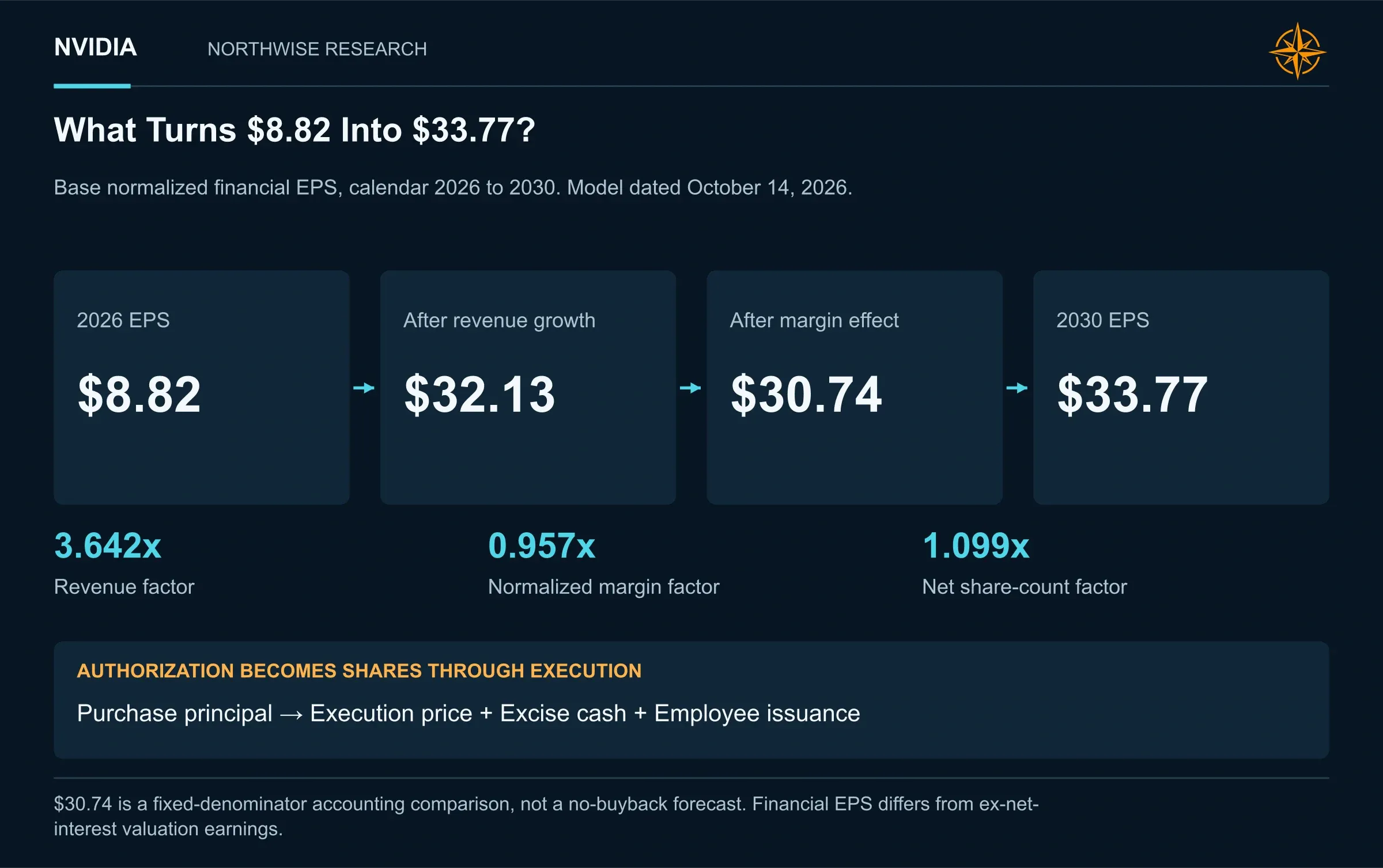
Here is the number that surprised us most. The Base case spends about $1.34 trillion on buybacks from 2026 through 2030, and the diluted share count falls only about 9.1%, as rising share prices and continuing employee issuance absorb most of it.
For shareholders, the buyback is a sideshow. Nearly all of NVIDIA's per-share growth in our forecast comes from a far larger profit pool, and an investor who owns NVIDIA for the buyback owns it for the wrong reason.
The Operating Forecast Through 2030
Put the pieces together and our Base case reaches $1.42 trillion of revenue in calendar 2030, about 3.6 times our 2026 estimate and a compound growth rate near 38%.
Base financial forecast, calendar years | 2026 | 2027 | 2028 | 2029 | 2030 |
|---|---|---|---|---|---|
Revenue | $389.3B | $666.5B | $930.5B | $1,177.5B | $1,417.8B |
Revenue growth | n/a | 71.2% | 39.6% | 26.5% | 20.4% |
Gross margin | 73.9% | 72.4% | 73.0% | 73.0% | 72.1% |
Operating income | $253.9B | $431.0B | $608.3B | $774.3B | $913.9B |
Operating margin | 65.2% | 64.7% | 65.4% | 65.8% | 64.5% |
Normalized net income | $214.0B | $355.5B | $497.7B | $628.5B | $745.6B |
Normalized diluted EPS | $8.82 | $14.97 | $21.47 | $27.81 | $33.77 |
Operating cash flow | $161.3B | $329.9B | $506.2B | $639.8B | $764.6B |
NVIDIA's own capital spending | $11.1B | $14.0B | $18.2B | $22.7B | $27.7B |
Free cash flow before strategic investments | $150.2B | $315.9B | $488.0B | $617.1B | $736.9B |
The mix shift is the headline inside the headline. Hyperscale and ACIE revenue run nearly even in 2027, and from 2028 onward ACIE pulls ahead, reaching about $726.9 billion in 2030 against $633.6 billion for Hyperscale and $57.2 billion for Edge.
This is where our view and the competitive evidence meet. The lane where custom silicon is winning grows more slowly in our forecast, and the lanes where NVIDIA's platform advantage is widest become its largest market within two years.
The margins are bold. A 64.5% operating margin and a roughly 52.6% normalized net margin in 2030 assume NVIDIA holds most of its pricing power through several product transitions, with core research and development climbing to $70.5 billion by fiscal 2031. We think it can, in a world without a major pause, given a full-stack product, a supply-constrained market, and customers who cannot afford to stop buying.
Three Ways the Next Five Years Can Go
Our scenarios move growth, margins, cash conversion, and capital allocation together, and each is built to answer a specific question.
Calendar 2030 | Bear | Base | Bull |
|---|---|---|---|
Revenue | $642.4B | $1,417.8B | $1,902.1B |
Revenue growth in 2030 | 3.7% | 20.4% | 29.1% |
Gross margin | 64.5% | 72.1% | 73.5% |
Operating margin | 50.1% | 64.5% | 66.3% |
Normalized net income | $260.4B | $745.6B | $1,038.4B |
Normalized diluted EPS | $11.94 | $33.77 | $46.97 |
Free cash flow before strategic investments | $268.4B | $736.9B | $1,011.1B |
Year-end diluted shares | 21.57B | 21.84B | 21.80B |
The Bear case asks what happens if this buildout follows the pattern of every one before it. NVIDIA meets most of its guidance, with fiscal 2028 growth of 60%, and then customers pause. Revenue falls about 13% in calendar 2029, with ACIE buyers cutting hardest as financing tightens, gross margin drops to about 65% as buyers with alternatives finally use them, and receivables and inventory swell.
Even that path leaves NVIDIA with about $642 billion of revenue and a 50% operating margin in 2030, larger and more profitable than it is today. It is still a painful outcome for shareholders, since earnings peak in 2028 and then fall back by about a fifth.
Normalized EPS | 2026 | 2027 | 2028 | 2029 | 2030 |
|---|---|---|---|---|---|
Bear | $8.62 | $13.36 | $14.78 | $11.74 | $11.94 |
Base | $8.82 | $14.97 | $21.47 | $27.81 | $33.77 |
Bull | $9.01 | $16.48 | $25.82 | $35.68 | $46.97 |
The Bull case pairs 80% growth in fiscal 2028 with a longer runway and better economics, which is roughly what our neocloud capital schedules imply if they arrive on time and never pause. Its upside comes from the business itself, with no help from a richer multiple.
The Bear path is our representative downside scenario, spanning the logic of a mild stall and a sharper correction. It is not an empirically measured conditional average. A deeper bust, closer to the 2001 networking collapse, would fall outside it, and we test that kind of disruption separately.
What Would Change Our View
Four signals would tell us the most, and we will be watching each through the operators we already cover.
The first is the hyperscale share. If NVIDIA's Hyperscale revenue stops rising as a share of the largest clouds' spending through 2027, custom silicon is winning faster than our Base case allows.
The second is whether the broader purchasing base turns into profitable usage. Rising ACIE revenue alongside healthy utilization at the neoclouds supports the thesis. ACIE growth that leans on ever more generous NVIDIA financing, without durable end-customer economics, is the early warning for the digestion path.
The third is margin quality. Ordinary compression is already in our numbers, but a sustained loss of pricing power, especially if networking also loses ground to Broadcom, would challenge a much larger part of the forecast.
The fourth is cash conversion through product transitions. Revenue can stay impressive while the economics of funding it deteriorate, and we would see that first in receivables, in inventory, and in the funding stacks of the companies we model.
None of these requires AI to disappoint. The strongest bear case is one in which the technology succeeds, too much capital chases it too quickly, the largest buyers bring more of the work in-house, and shareholders end up paying a premium for profits that arrive later and smaller than they hoped.
We take that case seriously, and we still come down on the other side. The evidence from the buyers points to a larger, broader, and longer buildout than the market is pricing, even after allowing for serious competition and a pause along the way.
Northwise Premium
Everything above describes what NVIDIA is, where it competes, what could interrupt it, and why we think the market is underestimating it. The premium section puts a price on that view: per-share values for each scenario, the probabilities behind them, required-return entry prices, the Northwise rating, what the work means for current shareholders, and the stress tests that would change our conclusion.
Premium members also receive the complete, editable NVIDIA 2030 model, including linked financial statements for all three cases, annual valuations, the dividend-inclusive return ladder, the neocloud purchasing illustration, the capacity cross-check, and live stress controls.
Northwise Premium
Choose how to continue with Northwise
Join Northwise Premium
Unlock the rest of this report, its complete valuation, the downloadable model, portfolios, and action framework.
Join Northwise PremiumCreate a Free Account
Continue across Free Northwise research, follow companies, save reports, and receive updates.
Create a Free Account
NVDA vs AMD
NVDA vs AMD explained through NVIDIA’s AI factory strategy, showing how system-level design matters as GPU performance gaps narrow.
NVDA Stock Forecast 2030
NVDA Stock Forecast 2030 explores infrastructure dominance, valuation upside, and why its $3T+ market cap may still be undervalued.
ASTS Stock Forecast 2030: The Capacity Behind the Coverage
ASTS stock forecast 2030: explore AST SpaceMobile capacity, carrier economics, financing and competition, with Premium scenarios and an editable model.
Northwise Portfolios
See how the research becomes real decisions
Reader discussion
Discuss the research
Premium access is required to join this report's discussion.
Join Northwise Premium
No comments yet. Start a thoughtful discussion.