
NOW Stock Forecast 2030
NOW Stock Forecast 2030 exploring ServiceNow’s AI control layer thesis, scenario modeling, risks, SBC dilution, and long-term valuation outlook
In this article
A full breakdown of ServiceNow’s business model, AI positioning, and our Now stock forecast 2030 framework, with a focus on what actually drives long-term value.
Executive Summary
ServiceNow has been pulled lower with the rest of the SaaS complex as the market processes what AI does to enterprise software economics. The fear is straightforward. If AI compresses seat-based pricing, replaces routine task automation, and introduces new orchestration layers controlled by hyperscalers or model providers, the established workflow vendors lose pricing power and growth durability at the same time.
That fear is not unreasonable. It also may be misapplied to ServiceNow specifically.
The question this report works through is whether ServiceNow’s position inside large enterprises makes it more like a casualty of AI or more like a beneficiary. The answer depends on what AI does to enterprise complexity, and on whether ServiceNow can convert its existing role as a workflow platform into something closer to a governance and orchestration layer for AI-driven operations.
We work through the business as it actually operates today, then build a 2030 scenario model anchored on real numbers, and only then turn to valuation, weighting, and positioning.
Table of Contents
- Orientation: What ServiceNow Actually Is
1.1 The Workflow Layer, Not Generic SaaS
1.2 Why This Matters for Forecasting
1.3 The Market Setup - ServiceNow’s Business Model
2.1 Subscription Revenue and Contract Visibility
2.2 Expansion Inside Existing Customers
2.3 Workflow Density as the Core Metric - The AI Debate: Threat or Acceleration
3.1 The Real Bear Case for AI
3.2 Why the Bear Case Is Not Absurd
3.3 Why ServiceNow May Be Different
3.4 The Key Fork in the Road - ServiceNow as the AI Control Tower
4.1 Enterprises Cannot Let Agents Run Wild
4.2 What ServiceNow Already Controls
4.3 From Workflow Platform to AI Governance Layer
4.4 Why This Supports the Ultra Bull Case - Platform Stickiness and Switching Reality
5.1 Embedded Process Infrastructure
5.2 Connected Across Systems
5.3 Institutional Lock-In
5.4 Why AI Could Increase Stickiness - Leadership and Execution
6.1 Bill McDermott and Enterprise Platform Selling
6.2 Why Leadership Matters in This Thesis
6.3 Strengths and Limitations - Financial Foundation
7.1 Revenue Growth and Forward Visibility
7.2 Margin Structure and Free Cash Flow
7.3 Why This Is a Controlled Compounder - Stock-Based Compensation and Dilution
8.1 SBC Is Still Material
8.2 Why SBC Matters More at Scale
8.3 Buybacks as Dilution Control
8.4 Dilution Sensitivity
8.5 What Investors Should Watch - 2030 Scenario Model
9.1 Model Starting Point
9.2 Key Model Drivers
9.3 Bear Case
9.4 Base Case
9.5 Bull Case
9.6 Ultra Bull Case
9.7 Scenario Table - Risk Matrix
10.1 Disintermediation Risk
10.2 Fragmentation Versus Consolidation
10.3 Pricing Compression
10.4 Over-Automation Resistance
10.5 Execution Risk
10.6 Macro and Budget Risk
10.7 SBC and Dilution Risk
10.8 Risk Synthesis - Scenario Price Targets
11.1 From EPS to 2030 Price Targets
11.2 Scenario Price Target Ranges
11.3 What the Price Target Table Shows - Present Value Analysis
12.1 Why Discount Rates Matter
12.2 Present Value by Scenario
12.3 What the PV Table Shows - Probability Weighting and Discounted Fair Value
13.1 Probability Weighting
13.2 Weighted 2030 Price Target
13.3 Discounted Fair Value Today - The Northwise View
14.1 What the Market May Be Mispricing
14.2 Why the Opportunity Exists
14.3 What We Are Watching - Northwise Positioning
15.1 Entry Framework
15.2 Portfolio Role - What Would Break the Thesis
16.1 AI Workflows Move Outside ServiceNow
16.2 Net Retention Compresses More Than Expected
16.3 SBC Remains Structurally High
16.4 ServiceNow Fails to Become the Agentic Control Layer
16.5 Margins Fail to Expand - Actionable Price Ranges
- Final Assessment
18.1 The Core Judgment
18.2 The Final Northwise Synthesis
1. Orientation: What ServiceNow Actually Is
1.1 The Workflow Layer, Not Generic SaaS
ServiceNow began as an IT service management product and has evolved into a broader workflow platform. It routes, approves, escalates, and documents work across IT, HR, security, customer service, finance, and other operational domains. The platform sits between enterprise systems and the people who run them, governing how requests, incidents, approvals, and tasks move through an organization.
Calling it SaaS is technically correct and analytically thin. ServiceNow’s economic identity comes from how deeply it embeds inside the operating procedures of large enterprises, not from a per-seat license model.
1.2 Why This Matters for Forecasting
Forecasting ServiceNow with generic SaaS assumptions produces a misleading picture. The relevant variables are workflow density per customer, module attach rates, retention inside the largest accounts, contract duration, and whether the platform expands beyond IT into broader enterprise process domains.
Treating it as a seat business understates the way revenue compounds inside accounts that already use it. Treating it as a generic AI loser ignores the question of whether AI raises or lowers the demand for the kind of control ServiceNow already provides.
1.3 The Market Setup
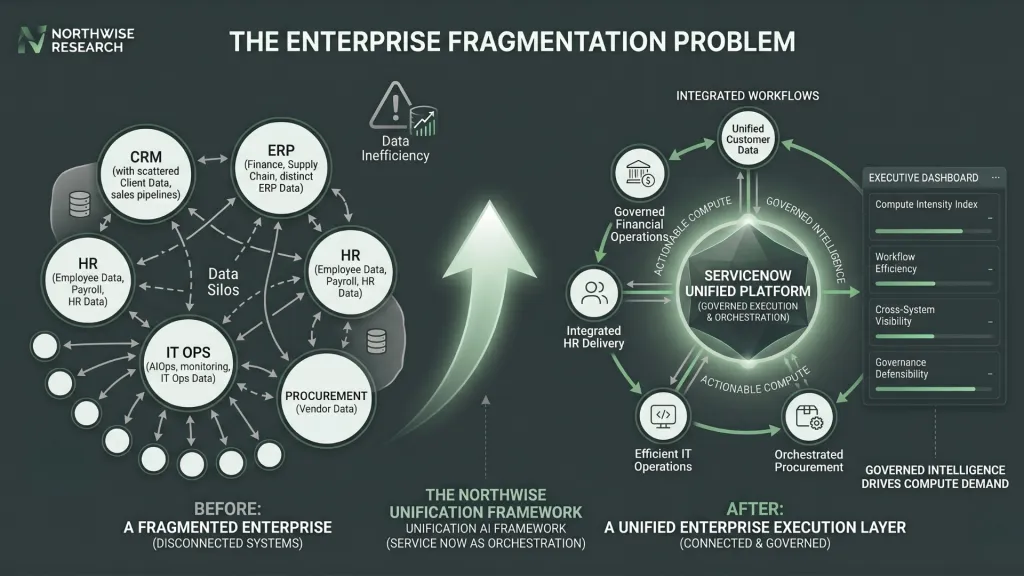
Enterprise software valuations have compressed across the board. The narrative driving the compression is that AI commoditizes software functionality, reduces seat counts through automation, and introduces new abstraction layers that route around incumbents.
For ServiceNow specifically, the question narrows. Does AI weaken a workflow control platform that already governs approvals, audit trails, and cross-system task execution, or does AI raise the importance of that role? The free section of this report works through that question structurally before the model assigns probabilities to the answers.
2. ServiceNow’s Business Model
2.1 Subscription Revenue and Contract Visibility
ServiceNow runs almost entirely on multi-year subscription contracts. Q1 2026 subscription revenue grew 22% year over year, and the company guided FY2026 subscription revenue to roughly $15.74B to $15.78B. Total revenue in 2026 lands near $16.2B once professional services are included.
The most useful forward indicator is remaining performance obligations, or RPO, which sat near $27.7B at the end of Q1 2026, up 25% year over year. Current RPO, the portion expected to be recognized within twelve months, gives a near-term revenue floor that is difficult to replicate with any orchestration product that does not yet have enterprise contracts in place.
Forward visibility of this kind reduces the model’s sensitivity to short-term demand swings. It also raises the importance of what happens at renewal, since the multi-year structure delays the impact of any AI-driven displacement until contracts come up for review.
2.2 Expansion Inside Existing Customers
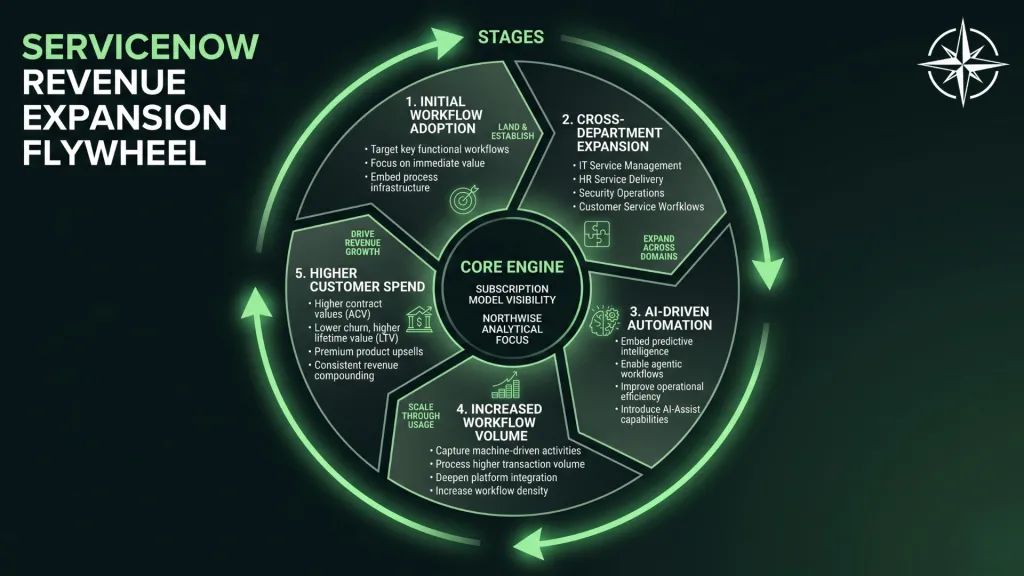
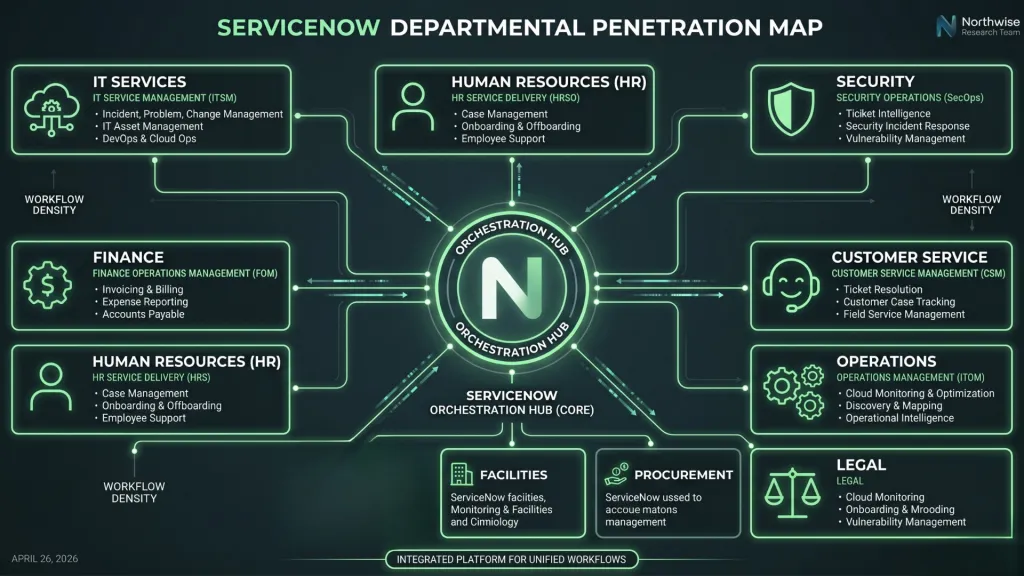
Most of ServiceNow’s growth comes from existing customers buying more. The platform lands inside an IT department, then expands into HR service delivery, security operations, customer service workflows, and increasingly into broader operational domains. Net retention has historically run well above 100%, with the strongest cohorts running materially higher.
The expansion vector matters more than gross customer additions because the largest enterprises are already on the platform. Growth from here is mostly a function of how many additional workflows each large account routes through ServiceNow.
2.3 Workflow Density as the Core Metric
The cleanest way to think about ServiceNow’s growth trajectory is workflow density. The product of customer count, modules adopted, and operational volume routed through each module produces total platform activity.
If workflow density rises, revenue rises with it, even when seat counts stay flat or fall. If workflow density compresses, revenue suffers regardless of how many enterprises remain customers. AI changes the inputs to this equation in ways that are not yet settled, and the rest of this report works through how the variables move under different scenarios.
3. The AI Debate: Threat or Acceleration
3.1 The Real Bear Case for AI
The strongest version of the AI bear case for ServiceNow is not that AI replaces ServiceNow directly. It is that AI changes where workflow logic lives.
If AI agents handle task routing inside hyperscaler platforms, if model providers ship orchestration layers tied to their own APIs, or if internal enterprise agent frameworks become trusted enough to run process logic without a separate workflow product, then ServiceNow’s role compresses. The platform might continue to exist, with revenue holding up through long contracts, while losing its position as the place where new automation gets built.
That trajectory does not require an immediate revenue collapse. It requires a slow erosion of ServiceNow’s relevance to new enterprise initiatives, with growth gradually fading toward the rate of overall IT budget expansion.
3.2 Why the Bear Case Is Not Absurd
AI moves fast. Capabilities that did not exist eighteen months ago now exist, and capabilities that exist today will be displaced by capabilities that exist eighteen months from now. Forecasting any enterprise software company three to five years out involves accepting that some of the underlying assumptions about how work gets coordinated will be wrong.
Honest analysis requires giving the bear case real weight. The probability that AI fragments rather than consolidates workflow infrastructure is non-trivial.
3.3 Why ServiceNow May Be Different
The optimistic case starts from a different premise. AI does not reduce enterprise complexity. It increases it.
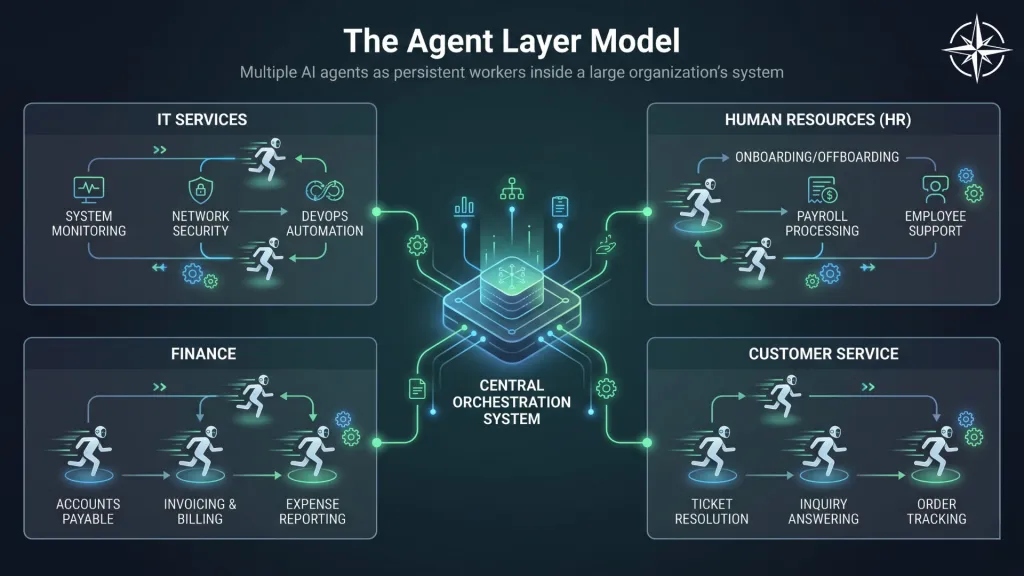
More agents acting on systems means more events generated, more exceptions raised, more permissions to enforce, more audit trails to maintain, and more cross-system coordination required. Every AI deployment inside a regulated enterprise creates a governance surface that did not exist before. Models hallucinate, agents take wrong actions, and tools get used incorrectly. The enterprise response to those failure modes is not less governance. It is more.
ServiceNow already governs the workflows that surround enterprise systems. Extending that governance to cover AI-initiated actions is a smaller leap than building an enterprise-grade governance layer from scratch.
3.4 The Key Fork in the Road
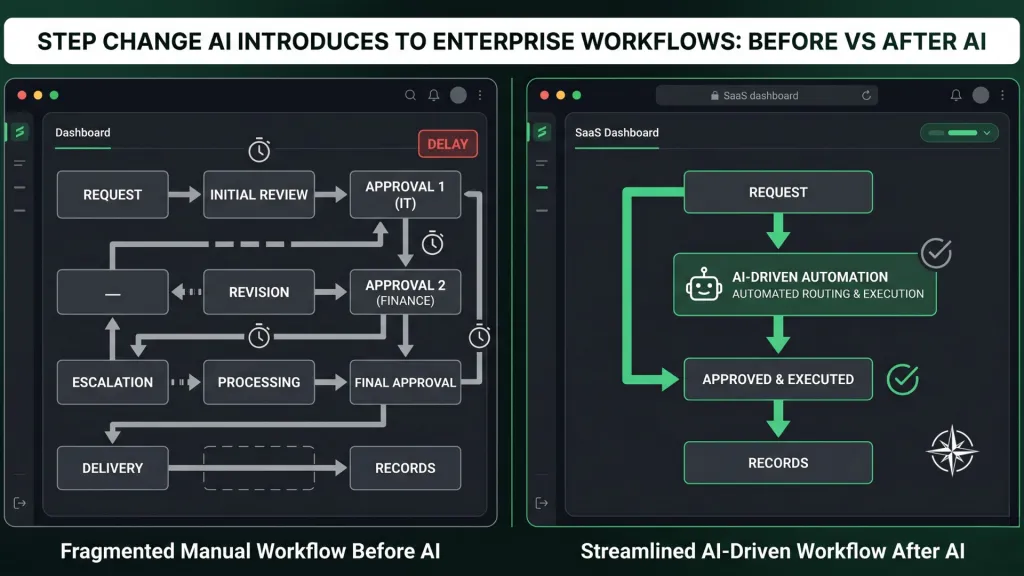
The forecasting question reduces to a single fork. Does AI reduce the volume and complexity of work routed through enterprise systems, or does it expand it?
If AI reduces workflow volume through pure automation that bypasses existing systems, ServiceNow’s relevance fades. If AI increases workflow volume by generating more activity that needs to be routed, approved, audited, and reconciled, ServiceNow’s position strengthens. The model needs to hold both possibilities, which is why the scenario range is wide.
4. ServiceNow as the AI Control Tower
4.1 Enterprises Cannot Let Agents Run Wild
Large regulated organizations cannot allow AI agents to act freely across their systems. The legal, compliance, security, and operational consequences of unbounded agent action are too severe to ignore. CIOs, CFOs, general counsel, and chief risk officers all need answers to the same set of questions before AI agents are given meaningful authority over enterprise processes.
Those questions include who authorized this action, what data did the agent access, what permissions did it use, what downstream systems were affected, what the rollback path is if the action turns out to be wrong, and how the audit trail would hold up under regulatory review. None of those questions are answered by the model itself. They are answered by whatever governance system surrounds the model.
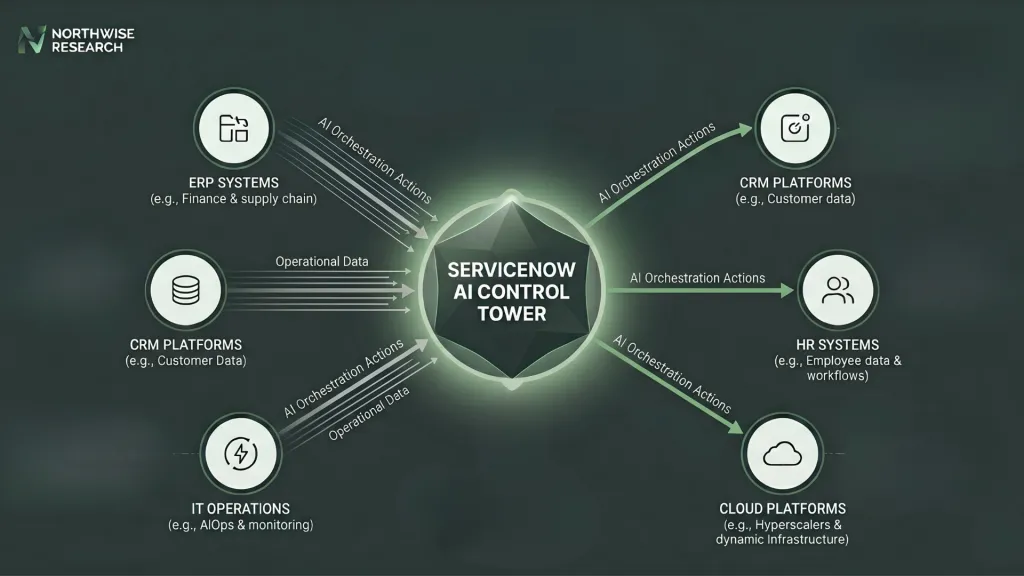
The enterprise need is for a control layer that sits between AI agents and the systems they act on. Without that layer, AI deployment inside regulated organizations stalls at the proof-of-concept stage.
4.2 What ServiceNow Already Controls
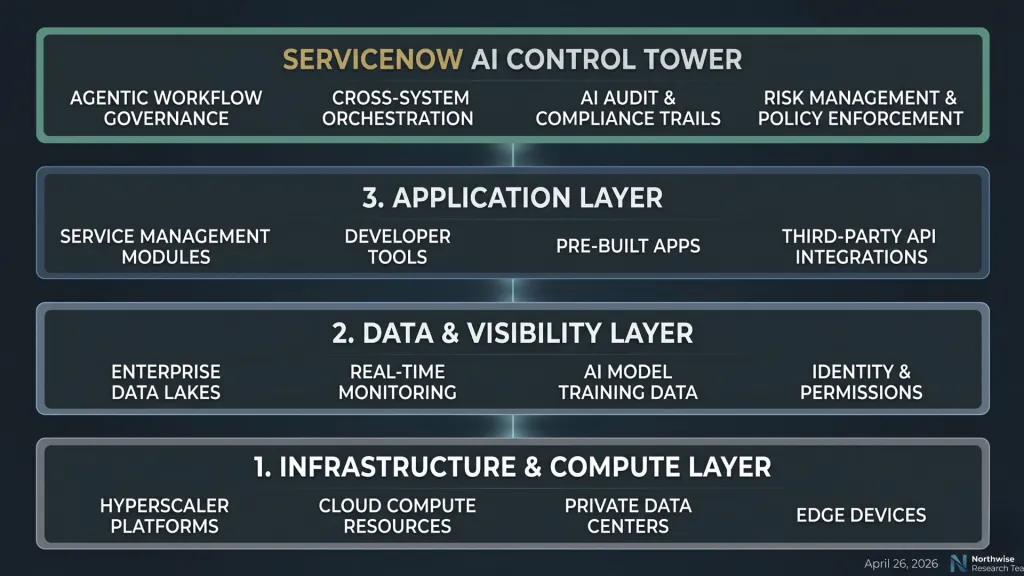
ServiceNow already manages approvals, ticket routing, incident response, change management, identity-linked actions, cross-system task execution, and audit trails. The platform is built around the idea that enterprise actions need authorization, documentation, and traceability.
Each of those capabilities maps directly to what an AI governance layer needs to provide. The platform does not need to be reinvented to govern agent actions. It needs to be extended.
4.3 From Workflow Platform to AI Governance Layer
The path from where ServiceNow is now to a position as an AI control layer runs through three things. First, agents need to be able to trigger workflows that run through ServiceNow’s approval and routing logic. Second, ServiceNow needs to maintain the audit and identity context for agent actions in a form that satisfies regulated industry requirements. Third, the platform needs to expose orchestration primitives that other AI systems can call into when they need a governed action executed.
ServiceNow has been building toward this with its Now Assist and agentic capability work. Whether the execution matches the strategic logic is one of the open questions, and the report returns to it in the risk section and in the paid section’s judgment.
4.4 Why This Supports the Ultra Bull Case
If AI agents become a meaningful source of enterprise work, and if ServiceNow becomes the system that governs how that work is authorized and executed, the company captures a category of demand that did not exist before. The ultra bull scenario depends on this outcome. The base and bull scenarios depend on partial versions of it. The bear scenario assumes the control layer forms somewhere else, or fragments across multiple vendors none of which is ServiceNow.
The phrase that captures the strategic position cleanly is that ServiceNow is not competing to build the best AI models. It is positioning itself as the system enterprises may rely on to make AI behave like enterprise software instead of experimental code.
5. Platform Stickiness and Switching Reality
5.1 Embedded Process Infrastructure
ServiceNow ends up embedded in operating routines. Once an organization runs incident management, change approvals, HR service delivery, or security operations through the platform, the workflows themselves become tied to ServiceNow’s data model and routing logic. New employees are trained on it. Compliance procedures reference it. Audit reports cite ticket numbers that live in it.
Replacing ServiceNow at that point is closer to a reorganization of how work moves through the company than to a vendor switch.
5.2 Connected Across Systems
The platform connects to ERP, CRM, identity systems, security tools, HR systems, cloud infrastructure, and a long list of internal applications. Each integration represents a piece of operational plumbing that has been configured, tested, and maintained over time. Stripping out the platform requires replacing the integrations, retraining the people who depend on them, and revalidating the compliance and audit processes that reference them.
5.3 Institutional Lock-In
The lock-in is organizational rather than technical. Process documentation references ServiceNow workflows. Auditors expect the audit trail to come out of ServiceNow. Internal training assumes the platform exists. Replacement involves rewriting all of that, not just installing different software.
This kind of stickiness slows down displacement even if a technically superior product appears, because the cost of switching is not measured in license fees. It is measured in operational disruption.
5.4 Why AI Could Increase Stickiness
If AI raises the volume of activity that flows through enterprise systems, the cost of switching the workflow platform rises with it. More integrations, more agent actions to govern, more audit events, and more exception handling all increase the operational surface that depends on ServiceNow continuing to work. Each additional workflow added during the AI deployment cycle deepens the platform’s position.
The pushback to acknowledge is that orchestration could move elsewhere despite the lock-in. Hyperscalers, AI-native startups, or internal enterprise agent frameworks could become the control layer for new AI-driven workflows, leaving ServiceNow with the pre-AI workload while the AI-driven workload accumulates outside it. That outcome is the central risk and the core driver of the bear case.
6. Leadership and Execution
6.1 Bill McDermott and Enterprise Platform Selling
Bill McDermott came into ServiceNow with two decades of enterprise software leadership at SAP, including a long run as CEO. The relevance is less about his biography and more about what kind of company ServiceNow needs at its current scale.
The opportunity in front of ServiceNow is platform consolidation inside large enterprises. Capturing it requires C-suite relationships, multi-domain land-and-expand execution, and the ability to position the platform as a strategic decision rather than a departmental tool. McDermott’s career was built on exactly that. The ServiceNow narrative under his leadership has been calibrated to enterprise budget holders rather than to technology buyers.
6.2 Why Leadership Matters in This Thesis
Selling AI control and orchestration to a regulated enterprise is a CFO and chief risk officer conversation as much as it is a CIO conversation. The platform’s value proposition has to be communicated in terms of risk reduction, audit defensibility, and operational reliability, not just productivity gains.
That style of selling favors an executive team that can hold C-suite conversations across multiple functions and convert platform breadth into budget authority. ServiceNow’s GTM motion under McDermott reflects this orientation.
6.3 Strengths and Limitations
The strengths are clear. GTM execution remains among the best in enterprise software. Large deal capability is high. The platform narrative is coherent and resonates with enterprise buyers.
The limitations are equally real. ServiceNow is not an AI-native company. It is integrating AI into a platform that was built before the current cycle, which means execution has to happen on top of a complex existing product. There is also a recurring risk in enterprise software where the narrative gets ahead of product capability. Investors should watch for evidence that AI features are being adopted and used rather than only being demonstrated and announced.
7. Financial Foundation
7.1 Revenue Growth and Forward Visibility
Subscription revenue is forecast to land near $15.74B to $15.78B in FY2026, with Q1 2026 subscription growth of 22% setting the baseline. Total revenue including professional services lands near $16.2B. RPO of roughly $27.7B, up 25%, gives forward visibility that materially exceeds current-year revenue.
The combination of high RPO coverage, multi-year contracts, and net retention well above 100% produces unusual durability for a company of this size and growth rate.
7.2 Margin Structure and Free Cash Flow
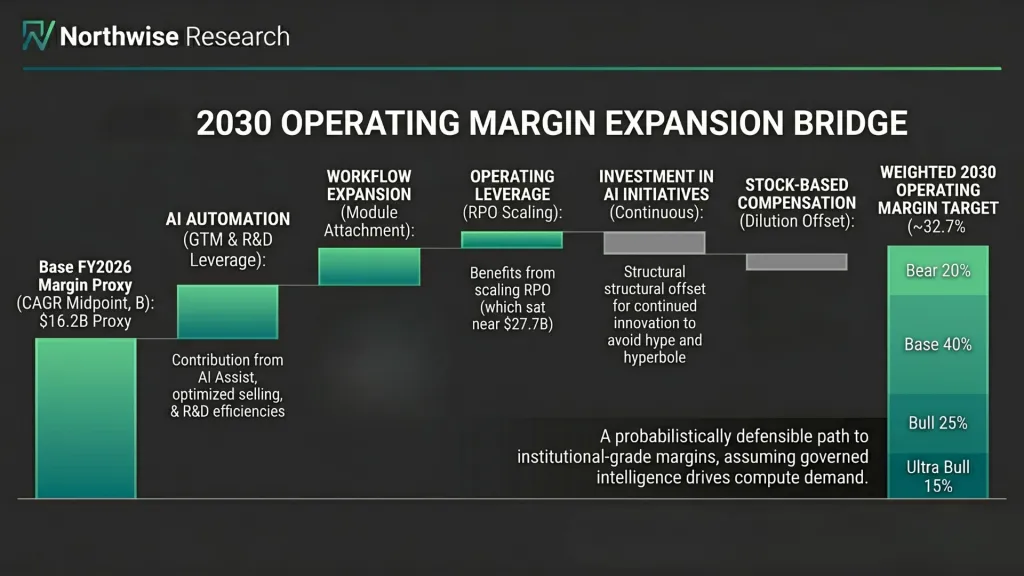
ServiceNow has room for further operating leverage. The cost structure carries meaningful R&D investment, ongoing GTM spend to support the enterprise sales motion, and partner ecosystem investment. Each of those line items can grow more slowly than revenue once the AI product cycle stabilizes, which produces operating margin expansion over time.
Free cash flow conversion is strong by SaaS standards, although the reported numbers benefit from working capital dynamics tied to the multi-year subscription model. The underlying cash generation profile is durable, but stock-based compensation distorts the gap between GAAP operating income and economic profit, and that gap has to be modeled directly rather than glossed over.
7.3 Why This Is a Controlled Compounder
ServiceNow fits the profile of a controlled compounder. It is a mature platform with high retention, durable forward visibility, expanding margins, and a credible expansion vector into a new category of enterprise demand if the AI control layer thesis plays out. The company is not a hypergrowth name and the model should not treat it as one. The opportunity, if it exists, is in durable compounding extended by AI optionality, not in a step-function revaluation.
8. Stock-Based Compensation and Dilution
8.1 SBC Is Still Material
Stock-based compensation at ServiceNow has been running at meaningful absolute levels, though as a percentage of revenue it has declined steadily.
- $1.60 billion in 2023 (approximately 17.9% of $8.97 billion revenue)
- $1.746 billion in 2024 (approximately 15.9% of $10.98 billion revenue)
- $1.955 billion in 2025 (approximately 14.7% of $13.28 billion revenue).
FY2026 guidance assumes SBC near 15% of total revenue, which represents a continued improvement from earlier years, although the absolute dollar amount (roughly $2.4 billion on the $16.2 billion total-revenue base) remains material.
8.2 Why SBC Matters More at Scale
Early in a company’s life, SBC functions as a growth investment that aligns employees with shareholders and conserves cash. At ServiceNow’s scale, that framing breaks down. The company is mature, generating substantial cash, and competing for AI talent in a market where compensation packages have moved up sharply. SBC is now a recurring economic cost, and the relevant question is how much per-share value gets created after that cost is paid.
Treating SBC as non-cash and ignoring it produces an inflated picture of underlying profitability. The model in this report treats SBC as a real cost embedded in the operating margin assumptions and reflects share count as the primary mechanism through which it shows up in per-share value.
8.3 Buybacks as Dilution Control
ServiceNow repurchased 20.1M shares in Q1 2026, including an accelerated repurchase. FY2026 diluted share guidance sits near 1.04B. The repurchase activity is meaningful, but it should be treated primarily as dilution control until share count is observed to decline materially over a sustained period.
Buybacks that simply offset SBC issuance prevent dilution, which is valuable, but they do not produce the per-share leverage that buybacks create when they reduce share count net of issuance. The thesis upgrade from controlled compounder to per-share compounder requires the latter, and the data does not yet show it.
8.4 Dilution Sensitivity
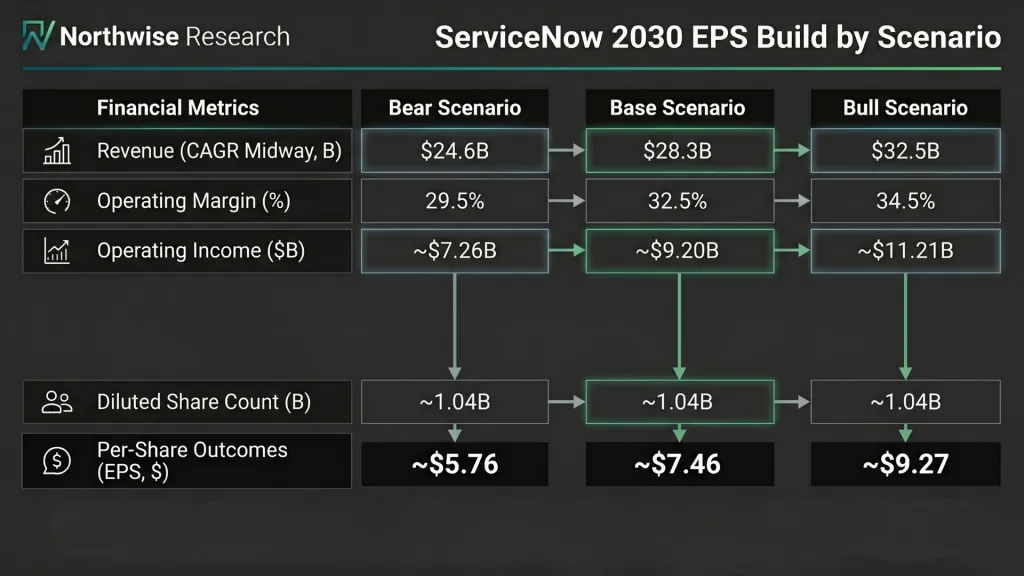
The table below holds the four 2030 scenario net income outcomes constant and varies share count to show how sensitive EPS is to dilution outcomes. The base scenario of 1.04B shares aligns with FY2026 guidance.
Net Share Change by 2030 | Share Count | Bear EPS | Base EPS | Bull EPS | Ultra Bull EPS |
|---|---|---|---|---|---|
-5% | 0.99B | $5.95 | $7.55 | $9.19 | $12.61 |
0% | 1.04B | $5.65 | $7.17 | $8.73 | $11.98 |
+5% | 1.09B | $5.38 | $6.83 | $8.31 | $11.41 |
+10% | 1.14B | $5.14 | $6.52 | $7.93 | $10.89 |
+15% | 1.20B | $4.91 | $6.24 | $7.59 | $10.42 |
At +10% net dilution, EPS is roughly 9% lower than the flat-share case across all scenarios. At +15%, the gap widens to roughly 13%. The model can absorb modest dilution. Sustained SBC pressure that drives share count materially higher cuts into per-share value creation in a way that compounds with the discount rate during present value analysis.
8.5 What Investors Should Watch
The relevant signals are SBC as a percentage of revenue, absolute SBC dollars, share count trajectory year over year, and the ratio of buybacks to SBC issuance. A company that grows revenue and operating margin while letting share count drift higher produces less per-share value than the headline numbers suggest.
9. Now Stock Forecast 2030 Scenario Model
9.1 Model Starting Point
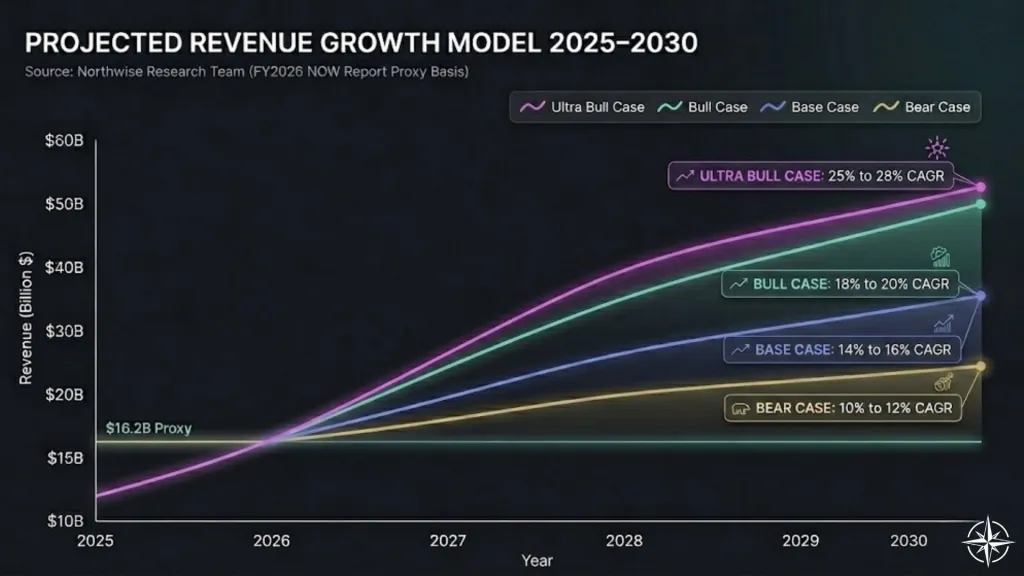
The model uses a 2026 total revenue proxy of $16.2B as the base. Net income conversion is set at roughly 81% of operating income on a tax-adjusted basis. The valuation year is 2030, which gives a four-year forward horizon from 2026.
9.2 Key Model Drivers
The four drivers that move the 2030 outcome are revenue CAGR from 2026 to 2030, operating margin at the end of the period, share count at 2030, and the multiple applied to 2030 EPS. The sensitivity table in the prior section shows how share count alone shifts the outcome. The scenario table below incorporates margin and growth alongside it.
9.3 Bear Case
Revenue CAGR runs at 10% to 12%, producing 2030 revenue of $23.7B to $25.5B. Operating margin sits at 29% to 30%. ServiceNow remains relevant but matures into a slower-growth enterprise software utility. AI commoditizes some workflow automation, point solutions proliferate, and net retention drifts lower. SBC pressure continues, dilution offsets a portion of buyback activity, and share count drifts modestly higher. EPS lands at $5.46 to $6.07.
9.4 Base Case
Revenue CAGR runs at 14% to 16%, producing 2030 revenue of $27.4B to $29.3B. Operating margin reaches 32% to 33% as scale leverage offsets continued AI investment. ServiceNow continues platform expansion across IT, HR, security, customer service, and broader enterprise workflows. AI is helpful but not transformational. Margins expand, buybacks mostly offset SBC dilution, and EPS lands at $7.09 to $7.84.
9.5 Bull Case
Revenue CAGR runs at 18% to 20%, producing 2030 revenue of $31.4B to $33.6B. Operating margin reaches 34% to 35%. AI increases workflow intensity. Customers adopt more modules, automation expands inside accounts, and ServiceNow becomes more deeply embedded as the system of coordination between humans, software, and agents. Growth runs above the mature SaaS peer group. EPS lands at $8.83 to $9.72.
9.6 Ultra Bull Case
Revenue CAGR runs at 25% to 28%, producing 2030 revenue of $39.6B to $43.5B. Operating margin reaches 36% to 38%. AI fundamentally expands the addressable market. ServiceNow becomes the control tower for agentic enterprise operations, capturing a category of machine-driven workflow demand that did not exist before. EPS lands at $12.01 to $13.94.
This scenario assumes that ServiceNow captures meaningful share of a new layer of enterprise activity rather than only monetizing traditional human workflows. The probability assigned to it should reflect both the size of the prize and the difficulty of the execution required to capture it.
9.7 Scenario Table
Scenario | Revenue CAGR | 2030 Revenue | Operating Margin | 2030 EPS |
|---|---|---|---|---|
Bear | 10% to 12% | $23.7B to $25.5B | 29% to 30% | $5.46 to $6.07 |
Base | 14% to 16% | $27.4B to $29.3B | 32% to 33% | $7.09 to $7.84 |
Bull | 18% to 20% | $31.4B to $33.6B | 34% to 35% | $8.83 to $9.72 |
Ultra Bull | 25% to 28% | $39.6B to $43.5B | 36% to 38% | $12.01 to $13.94 |
10. Risk Matrix
10.1 Disintermediation Risk
The central bear case is that AI-native workflow tools, hyperscaler orchestration layers, or internal enterprise agent frameworks bypass ServiceNow as the place where new automation gets built. Existing contracts continue to generate revenue, but new AI-driven workflows accumulate outside the platform. Over a multi-year horizon, this trajectory compresses growth and weakens the strategic position even without an immediate revenue impact.
10.2 Fragmentation Versus Consolidation
The thesis assumes enterprises consolidate AI-driven workflows onto trusted platforms. The alternative is fragmentation into specialized tools by domain, with no single platform capturing the AI control role. In a fragmented outcome, ServiceNow holds its existing share but does not capture the new demand category that drives the bull and ultra bull cases.
10.3 Pricing Compression
AI may increase value delivered while simultaneously commoditizing the underlying automation features. If customers come to expect AI workflow automation as a standard feature rather than a premium upgrade, ServiceNow’s ability to monetize it through pricing weakens. The platform expands functionally without expanding revenue per customer at the rate the bull case requires.
10.4 Over-Automation Resistance
Enterprises may decline to grant agents broad authority over operational systems. Security, legal, compliance, and operational caution slow agent adoption, and the agentic workflow category that drives the ultra bull case takes longer to develop than the bullish narrative implies. The bear case does not require AI to fail. It only requires AI deployment to remain conservative inside large regulated organizations.
10.5 Execution Risk
ServiceNow has to integrate AI deeply into a complex existing platform rather than build from a clean AI-native starting point. If the product execution lags, the company risks becoming the legacy workflow layer underneath a newer AI control system rather than evolving into the control system itself. This risk depends heavily on the next two to three years of product delivery.
10.6 Macro and Budget Risk
ServiceNow remains tied to enterprise IT budgets. If software budgets tighten, digital transformation pauses, or large implementations get delayed, growth compresses regardless of how the AI thesis develops. Multi-year contracts cushion the immediate impact, but renewal cycles eventually reflect the slower environment.
10.7 SBC and Dilution Risk
Even if revenue and operating income grow as the base or bull case implies, sustained SBC at high absolute levels combined with insufficient buyback activity weakens per-share value creation. The dilution sensitivity table shows how meaningful the impact can be at the EPS line, and the present value analysis in the paid section compounds that effect through the discount rate.
10.8 Risk Synthesis
ServiceNow’s opportunity is conditional. If AI raises the volume and complexity of enterprise workflow activity, the platform’s role strengthens. If AI decentralizes workflow logic and weakens platform layers, the role compresses. The honest framing is that the future of AI inside large enterprises is hard to forecast more than one to two years out with confidence, and the model should respect that uncertainty rather than collapse it into a single point estimate.
The free section has built the model. What remains is the discipline that turns the model into a position. Scenario price targets, present value calculations, probability weighting, and Northwise positioning are worked through in the premium sections.
Northwise Premium
Choose how to continue with Northwise
Join Northwise Premium
Unlock the rest of this report, its complete valuation, the downloadable model, portfolios, and action framework.
Join Northwise PremiumCreate a Free Account
Continue across Free Northwise research, follow companies, save reports, and receive updates.
Create a Free Account
Celsius Stock Analysis: The Shelf Reset and the Second Growth Curve
Celsius stock analysis of the shelf reset, Alani growth, Pepsi economics and cash flow, with a 2030 model and a Premium valuation and entry-price framework.

Meta AI Spending: The Customer Is Already Here
Can Meta turn AI spending into shareholder returns? We model advertising, Muse, hardware, capital costs and cash flow through 2030, with a full valuation.

IREN Stock Dilution: Can the Build Reach Shareholders?
IREN stock analysis of AI growth, funding and dilution through 2030. Read our full valuation, 27 scenarios and price zones free. Excel model is Premium.
Northwise Portfolios
See how the research becomes real decisions
Reader discussion
Discuss the research
Premium access is required to join this report's discussion.
Join Northwise Premium
No comments yet. Start a thoughtful discussion.