
Nike Stock Forecast 2030

Nike Stock Forecast 2030: Why unwinding Nike Digital, rebuilding wholesale, and disciplined execution could reset growth and margins this decade.
In this article
Nike Stock Forecast 2030: The Market Is Underestimating the Best Brand on Earth
Nike’s biggest mistake was trying to become a digital platform. The unwind is painful, intentional, and exactly why the brand is setting up for a premium re-rating by 2030.
Executive Summary
Nike enters this cycle burdened by the perception that its best years are behind it. Revenue volatility, margin compression, and a prolonged drawdown in digital performance have combined to produce a narrative of structural decline. That narrative mistakes transition costs for terminal weakness.
Our view is narrower and more mechanical. Nike did not lose brand relevance. It misallocated power within its operating system by prioritizing direct digital control over the wholesale ecosystem that historically scaled its brand, its volume, and its cultural presence. The consequences of that decision are now visible in shrinking digital revenue, strained partner relationships, and near-term margin pressure. The market is interpreting these outcomes as evidence of deterioration. We interpret them as evidence of correction.

The central claim of this forecast is simple. Nike’s attempt to become a digital platform was a strategic error. The unwind of that strategy is not a retreat. It is the prerequisite for stabilization. As digital exposure is reduced, wholesale relationships are repaired, inventory discipline returns, and capital allocation regains coherence, Nike’s core business begins to look structurally stronger, not weaker.
We do not assume a rapid rebound. The path through stabilization is uneven by design. Growth remains muted in the near term as the system rebalances. Offense follows only after repair is complete. Under experienced leadership, we expect Nike to re-enter a phase of modest but durable growth, supported by cleaner supply chains, a refocused product portfolio, and a global brand whose pricing power the market continues to undervalue.
By 2030, our base case reflects a Nike that is no longer attempting to dominate distribution, but one that has reasserted control over execution. Revenue growth reaccelerates to 6%, operating margins normalize toward mid-teens levels, free cash flow scales meaningfully, and a premium valuation multiple becomes justified once again. The opportunity is not in calling the bottom. It is in recognizing that the unwind itself is the inflection.
The sections that follow build this case sequentially, beginning with the core strategic mistake that set this cycle in motion and why its reversal is the foundation of the long-term upside.
The Core Mistake: Why NIKE Digital Was a Strategic Error
Nike’s most consequential decision over the past decade was not a product miss, a marketing failure, or a loss of cultural relevance. It was the deliberate attempt to reposition the company from a global sports brand with unrivaled distribution leverage into a digitally controlled, vertically integrated platform.
At the surface level, the logic appeared sound. Direct digital channels promised higher gross margins, cleaner consumer data, and tighter control over brand presentation. During a period of stimulus-driven demand and compressed supply chains, the strategy produced short-term financial validation. That validation proved fragile.

The error was not that Nike invested in digital commerce. It was that digital control became a strategic priority rather than a supporting function. As digital took precedence, wholesale partners were deprioritized, allocation tightened, and long-standing retail relationships were strained. Shelf presence declined. Floor space shifted toward competitors that were willing to meet retailers where demand actually materialized. The system that had historically amplified Nike’s scale began to work against it.
This shift altered incentives throughout the organization. Inventory decisions were increasingly optimized for owned channels rather than ecosystem health. Product cadence skewed toward digital launch cycles rather than broad-based retail absorption. When demand normalized and digital traffic weakened, Nike found itself holding inventory risk it previously outsourced to partners, while competitors benefitted from expanded physical visibility and retailer advocacy.
The consequences were cumulative rather than immediate. Wholesale partners did not exit overnight. They reallocated attention gradually. Marketing energy followed foot traffic. Competing brands filled the vacuum not due to superior global scale, but due to better alignment with the retail environment Nike had stepped back from. The decline in digital performance that followed was not the cause of Nike’s challenges. It was the signal that the system had become unbalanced.
Crucially, this was not a brand problem. Consumer recognition, cultural relevance, and athletic credibility remained intact. What deteriorated was distribution gravity. Nike attempted to centralize control in a business that historically compounded through decentralization, partner leverage, and global shelf dominance.

Understanding this distinction is essential. If Nike’s struggles were rooted in brand decay, the outlook would warrant permanent multiple compression. If they were rooted in strategic misalignment, the unwind becomes constructive. The market continues to conflate the two. This forecast is built on the view that they are not the same.
The next section addresses the implication of this conclusion. If NIKE Digital was a strategic error, then declining digital revenue is not inherently bearish. Under the right framework, it is the mechanism through which the broader system stabilizes.
Why the Unwind Is Bullish, Not Bearish
If NIKE Digital was a strategic overreach, then its contraction should not be evaluated through a conventional growth lens. Declining digital revenue is uncomfortable optically, but it is consistent with a system correcting excess centralization rather than one losing relevance. The market continues to treat digital deceleration as evidence of erosion. We treat it as evidence of rebalancing.
That rebalancing is already visible in reported results. In North America, NIKE Digital revenue declined 12% year over year in Q1 FY26 and accelerated to a 16% decline in Q2 FY26. In Greater China, the contraction has been more severe, with NIKE Digital down 27% in Q1 and 36% in Q2. These declines are often cited as proof of structural weakness. In our view, they are the mechanical consequence of Nike pulling back from promotional intensity, narrowing digital assortments, and allowing demand to re-route through the broader retail ecosystem.
As digital exposure is reduced, several second-order effects begin to emerge. Wholesale partners regain confidence in allocation stability and product access. Inventory risk migrates back toward the channel layer best positioned to absorb it. Product launches are designed for broad absorption rather than narrow digital drops. The result is not immediate growth, but improved system resilience.
Wholesale performance illustrates this shift. In North America, wholesale revenue grew 11% in Q1 FY26 and accelerated to 24% growth in Q2 FY26, even as NIKE Direct declined. This divergence is not accidental. It reflects renewed shelf presence, improved partner economics, and a reallocation of volume toward channels that historically scaled Nike’s brand more effectively than owned digital platforms.
This transition necessarily compresses reported margins in the near term. Digital channels carry higher gross margins when demand is abundant and traffic is cheap. They become margin dilutive when promotions rise and conversion deteriorates.
Nike’s gross margin declined 320 basis points in Q1 FY26 and 300 basis points in Q2 FY26, driven in part by digital markdowns, inventory clean-up, and higher product costs. Management has been explicit that excluding tariff-related impacts, underlying margin dynamics are improving. The unwind forces Nike to accept lower headline margins temporarily in exchange for restoring pricing discipline across the ecosystem.
Wholesale reacceleration should be understood in this context. It is not a fallback. It is the restoration of Nike’s historical distribution engine. Physical retail remains where volume, discovery, and brand reinforcement intersect at global scale. As Nike cedes control it never needed to exert, shelf presence expands and marketing efficiency improves. Competitors benefited from this dynamic during Nike’s retreat. Nike benefits as it reverses course.
Importantly, the unwind does not imply abandonment of digital infrastructure. Digital remains a launch, data, and engagement layer. What changes is its role. It shifts from being the axis around which the business rotates to a supporting function within a broader system. That distinction matters. Digital does not need to grow rapidly to add value. It needs to stop distorting incentives.
The market struggles with this framing because it is conditioned to equate digital exposure with structural advantage. That assumption holds in businesses where distribution is inherently centralized. It breaks down in categories where scale is amplified through partners. Nike belongs firmly in the latter. Its competitive advantage has always been reach, not control.
This is why stabilization appears counterintuitive. Reported digital weakness coexists with improving wholesale momentum. Margin pressure persists alongside cleaner inventory. Growth looks muted while earnings power quietly resets. The system improves before the numbers do.
The sections that follow move from mechanism to measurement. We outline how this rebalanced structure translates into a clearer operating profile, a defined stabilization phase, and a path toward renewed offense as execution replaces experimentation.
Nike’s Enduring Advantage: Brand, Scale, and Global Reach
Nike’s current valuation reflects skepticism about execution. It does not reflect skepticism about the brand itself. That distinction matters, and it is often lost in periods of transition.
Brand strength is not an abstract concept in Nike’s case. It is observable in pricing resilience, category leadership, and global relevance that persists even when distribution strategy falters. Over multiple decades, Nike has demonstrated an ability to command premium pricing across geographies, age cohorts, and sport categories. That capability did not disappear during the digital overreach. It was obscured by it.
Scale compounds this advantage. Nike operates at a level of global penetration that very few consumer brands can replicate. Its products are embedded across professional sport, grassroots athletics, and everyday training environments worldwide. That reach creates a feedback loop between visibility, demand, and cultural relevance that competitors struggle to match. When distribution is aligned with this reality, scale becomes an accelerant rather than a burden.

Importantly, Nike’s scale is not confined to any single channel. The brand has historically thrived by allowing demand to express itself across wholesale partners, owned retail, and selective direct engagement. Attempts to centralize that demand through digital channels narrowed the surface area through which the brand could express its full potential. As that constraint is relaxed, the underlying advantage reasserts itself.
Global reach further differentiates Nike from peers that rely on regional strength or narrow category focus. Even amid uneven performance across markets, Nike retains the ability to rebalance growth geographically over time. Weakness in one region does not impair the entire system. This flexibility is a function of brand recognition, supply chain depth, and partner infrastructure built over decades.
The market often discounts this advantage during periods of margin compression, treating Nike as if it were a conventional apparel company subject to fashion cycles and promotional pressure. That framing mischaracterizes the business. Nike is not dependent on trend velocity to sustain relevance. It is embedded in sport itself. That positioning provides durability even when execution missteps temporarily dampen financial performance.
This is why valuation compression has historically been limited, even during challenging periods. The brand’s ability to generate cash flow across cycles constrains downside outcomes. When execution improves, the same attributes enable rapid normalization without requiring structural change.
The next phase of this forecast builds on that foundation. Enduring advantage alone does not produce growth. It creates the conditions under which disciplined leadership can convert stability into offense. The transition from reset to execution determines whether Nike’s scale remains latent or becomes additive once again.
From Reset to Offense: The Elliott Hill Effect
Nike’s ability to transition from stabilization to growth hinges less on strategic reinvention than on execution quality. At the scale Nike operates, marginal decisions compound quickly. Small misalignments propagate across the system. Conversely, disciplined execution restores coherence without requiring structural change. This is where leadership matters.
Elliott Hill’s return does not represent a new strategic vision. It represents institutional continuity. His tenure at Nike spans multiple operating cycles, distribution models, and competitive landscapes. He understands which levers drive sustainable growth and which create short-term optical improvements at the expense of system health. That distinction is central to this phase of the reset.

Under Hill, the emphasis shifts away from experimentation toward operational fluency. Product pipelines are managed with an understanding of retail absorption rather than digital launch theatrics. Category investment is guided by repeatability, not novelty. Capital allocation favors durability over narrative appeal. These choices do not produce immediate acceleration. They reduce execution error.
This matters because Nike’s offense does not depend on discovering new demand. Demand already exists. The challenge is converting that demand efficiently across a global system. During the digital overreach, decision-making became increasingly centralized and rigid. That rigidity amplified mistakes. The current reset decentralizes execution back toward categories, regions, and partners better positioned to respond to real-time demand signals.
The early evidence of this shift appears in wholesale re-engagement and inventory normalization rather than headline growth. Those outcomes are often dismissed as defensive. They are, in fact, prerequisites for offense. A system burdened by excess inventory, strained partnerships, and misaligned incentives cannot scale growth without margin erosion. Repair precedes acceleration.
Hill’s influence is most visible in what Nike is no longer attempting. The company is not chasing digital dominance. It is not optimizing for headline margins disconnected from volume. It is not forcing distribution through owned channels at the expense of reach. These absences reduce volatility and improve predictability, even as they dampen near-term excitement.
Offense, in this framework, emerges gradually. As product cycles normalize, supply chains stabilize, and partners regain confidence, incremental growth opportunities compound. Category wins scale more efficiently. Geographic imbalances are absorbed more smoothly. Capital returns become a lever rather than a constraint.
This forecast assigns execution credit selectively. We do not assume flawless outcomes. We assume fewer self-inflicted errors. At Nike’s scale, that alone is sufficient to alter the growth trajectory over time. The next section translates this leadership shift into explicit operating assumptions, outlining how stabilization gives way to modest but durable growth through 2030.
Nike Stock Forecast 2030: One Business, Three Interpretations
Our scenario analysis does not assume three different businesses. It assumes one underlying operating reality, with valuation outcomes driven by differing levels of confidence in Nike’s durability and execution.
The operating model outlined above reflects our base case view of Nike’s business through 2030. Under this framework, Nike reaches approximately $59–60B in revenue by FY30, with growth reaccelerating to 6%, operating margins normalizing toward ~15%, and annual free cash flow scaling to roughly $7.5–8.0B.
Earnings power under these assumptions supports FY30 EPS in the ~$7.25–7.75 range, driven by margin recovery, disciplined capital allocation, and modest share count reduction.
We do not vary those operating assumptions across scenarios. What varies is how the market chooses to value that earnings stream.
This distinction matters. Historically, Nike’s downside has been driven less by fundamental collapse than by shifts in narrative and confidence. The brand’s global relevance, pricing power, and cash flow generation have constrained operating downside across cycles. When sentiment deteriorates, valuation compresses. When execution stabilizes, valuation recovers. The dispersion lives in the multiple, not the income statement.
Under this framework, the bear, base, and bull cases reflect alternative market interpretations of the same business rather than divergent operating paths.
Bear Case: Stabilization Without Conviction
In the bear case, skepticism persists. Investors acknowledge stabilization but remain unconvinced that growth durability has returned. China uncertainty lingers. Digital contraction continues to dominate the narrative. Nike is treated as a mature franchise rather than a reaccelerating global leader. Applying a high-teens multiple (17–19x) to $7.25–7.75 of FY30 earnings implies valuation outcomes that remain constrained, but still consistent with Nike’s historical brand floor.
Base Case: Normalization and Re-Rating
In the base case, normalization is recognized. The market accepts that Nike has exited its reset phase and re-entered a stable growth trajectory. Execution under experienced leadership reduces volatility. Cash flow visibility improves. Capital returns regain credibility. Applying a low-to-mid 20s multiple (22–25x) to base-case earnings reflects Nike once again being valued as a premium global consumer franchise rather than a structurally impaired retailer.
Bull Case: Durability Rewarded
In the bull case, durability is rewarded. Growth sustains into FY30, margins continue to expand within historical bounds, and execution consistency reduces perceived risk. Nike demonstrates that it can grow without digital dominance while maintaining pricing power at scale. Applying an upper-20s multiple (26–30x) reflects scarcity value and long-duration cash flow confidence rather than speculative exuberance.
This approach is deliberate. It avoids overstating downside by modeling a collapse that contradicts Nike’s historical behavior. It avoids overstating upside by assuming structural reinvention. It treats valuation as a function of confidence in execution, not a referendum on brand relevance.
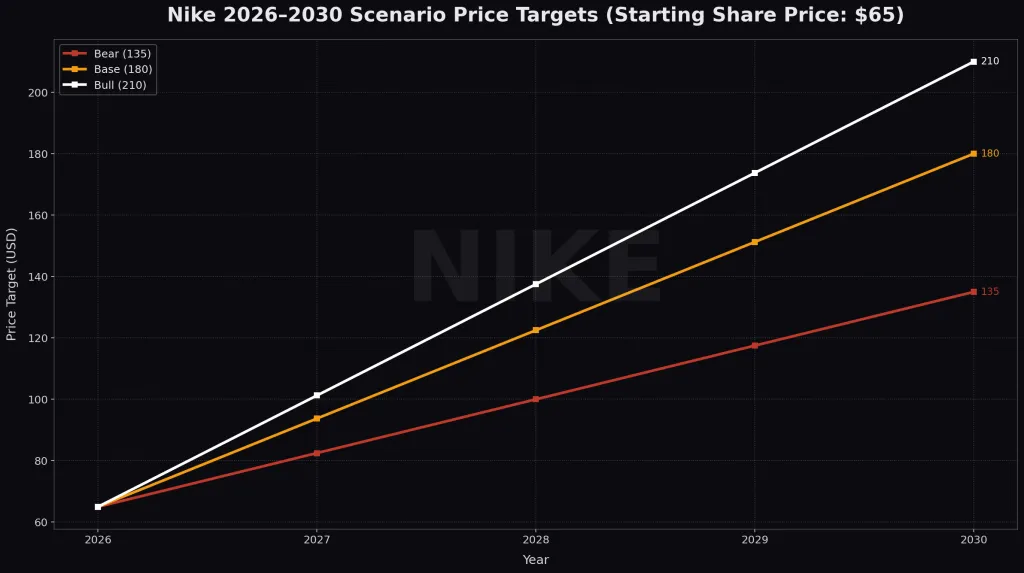
The implication is straightforward. The opportunity in Nike is not predicated on forecasting a different company. It is predicated on recognizing when the market’s interpretation of the same company shifts. The final section outlines what must occur for that confidence to reprice over time.
Risks and What Would Break the Thesis
This forecast is not predicated on flawless execution. It is predicated on fewer self-inflicted errors and a rebalanced operating system. The risks below outline where that assumption could fail and how failure would manifest structurally rather than episodically.
The most significant risk remains execution drift. The unwind of NIKE Digital restores balance only if discipline persists. A renewed attempt to reassert channel control, chase margin optics, or centralize demand prematurely would reintroduce the same distortions that defined the prior cycle. The system does not tolerate partial reversals. Either distribution is aligned with ecosystem reality or it is not.
Wholesale momentum represents a second constraint. The thesis assumes that improved partner economics translate into sustained shelf presence and reorder behavior. If wholesale engagement proves transient or promotional intensity reaccelerates across retail, the signal would be clear. Nike would be absorbing volume without restoring pricing discipline. That outcome would cap margin recovery and weaken earnings quality even if revenue stabilizes.
China remains unresolved. This forecast does not require a rapid recovery, but it does assume containment. Persistent contraction driven by structural demand impairment rather than transition noise would reduce global growth optionality and compress confidence in the long-duration cash flow profile. The risk is not regional exposure. It is prolonged uncertainty without visibility.
Cost structure rigidity also matters. Tariff absorption, supply chain adjustments, and sourcing diversification introduce execution complexity. If cost pressures prove less manageable than expected, margin normalization slows. The model remains intact under modest deviation. It breaks if costs rise faster than pricing power can absorb across cycles.
Finally, capital allocation discipline is non-negotiable. The operating model assumes buybacks, dividends, and reinvestment are sequenced conservatively. Aggressive financial engineering or opportunistic expansion during stabilization would undermine confidence in management judgment. Nike’s advantage is durability, not leverage.
What would invalidate the thesis is not volatility. It is a reversion to misalignment. If Nike resumes optimizing for control over reach, optics over system health, or speed over absorption, the valuation framework collapses. In that scenario, premium multiples would no longer be justified, regardless of brand strength.
The absence of these failures is not a guarantee of upside. It is the condition under which Nike’s structural advantages can reassert themselves. The final section addresses what must occur for that recognition to materialize over time.
The Conclusion of Our Nike Stock 2030 Forecast
Nike enters the latter half of this decade in an unusual position. The brand remains globally dominant, yet confidence in its execution is impaired. The operating system is stabilizing, yet reported results continue to reflect transition costs. The market is attempting to price an endpoint before the system has finished rebalancing.
This tension defines the opportunity.
The setup into 2030 is not predicated on acceleration in the near term. It is predicated on sequencing. Repair precedes stabilization. Stabilization precedes offense. Each phase compresses volatility differently, and none can be skipped without consequence. The current period sits between repair and stabilization, where progress is least visible and skepticism is highest.
What changes over time is not demand. Demand already exists. What changes is efficiency. As inventory remains clean, wholesale confidence compounds, and digital distortion fades, earnings quality improves quietly. Cash flow becomes more predictable. Capital allocation regains credibility. The business begins to behave like a mature global franchise again rather than a company in strategic flux.
Reacceleration, when it arrives, does not announce itself through narrative shifts. It appears in margins that expand without promotional support, in growth that persists without channel heroics, and in valuation multiples that rise as volatility compresses. The market responds not to ambition, but to consistency.
By 2030, our base case reflects a Nike that has exited its experimental phase and reasserted control over execution rather than distribution. Growth has resumed at a modest but durable rate. Margins have normalized within historical bounds. Free cash flow supports both reinvestment and capital return. The brand commands a premium valuation not due to dominance, but due to durability.
The mispricing today is not rooted in ignorance of Nike’s brand. It is rooted in impatience with the path required to restore system balance. The unwind of NIKE Digital is being interpreted as erosion rather than correction. That interpretation will persist until the system proves otherwise.
This forecast does not attempt to call the moment of recognition. It defines the conditions under which recognition becomes inevitable. The opportunity lies in understanding the sequence before it is visible in consensus estimates.
Nike does not need to become something new to justify a premium valuation. It needs to stop working against itself. Once that condition holds, the market’s interpretation follows.
Is Nike Stock a Buy? The Comeback Has to Earn Its Keep
Is Nike stock a buy? We examine its recovery, margins, cash flow and risks, with three operating scenarios and a detailed valuation for Premium members.
Nike Stock Dividend Thesis 2025
Nike stock dividend offers steady yield and brand resilience. Here's why we're long NKE as a value anchor in a volatile market.

Celsius Stock Analysis: The Shelf Reset and the Second Growth Curve
Celsius stock analysis of the shelf reset, Alani growth, Pepsi economics and cash flow, with a 2030 model and a Premium valuation and entry-price framework.
Northwise Portfolios
See how the research becomes real decisions
Reader discussion
Discuss the research
Create a Free account to join the discussion with a display name.
Create a Free Account
No comments yet. Start a thoughtful discussion.