
JD.com 2030 Strategic Forecast

Our probability-weighted JD.com 2030 strategic forecast examining core durability, capital, buybacks, and why time drives long-term value.
In this article

JD.com 2030 Strategic Forecast: Valuation, Durability, and Time Arbitrage
A probability-weighted assessment of JD’s core economics, capital allocation, and long-term optionality at a price that assumes persistent failure.
Executive Summary
JD.com is widely treated as a structurally impaired China e-commerce company: capital-intensive, margin-constrained, exposed to regulatory risk, and distracted by lossmaking investments in food delivery and automation. That framing explains sentiment. It does not explain price.
At approximately $29 per share, JD is valued as though uncertainty is permanent, capital is misallocated beyond recovery, and the core business is no longer capable of compounding value. This report evaluates whether those assumptions hold when the business is examined as it exists today, rather than as the market remembers it or fears it may become.
The core finding is straightforward. JD’s underlying retail and logistics operations remain profitable, cash-generative, and operationally resilient. Segment mix has shifted meaningfully toward higher-quality service revenue, logistics monetization, and frequency-driven consumption categories, while core retail margins have expanded despite aggressive investment elsewhere. Losses at the consolidated level are the result of discretionary capital deployment, not structural deterioration in the base business.
JD’s current investment posture, particularly in food delivery and warehouse automation, introduces uncertainty but does not eliminate flexibility. These initiatives are elective, scalable, and reversible. They do not require success to justify the current valuation, and failure would not impair JD’s ability to generate cash, execute buybacks, or retrench to a more conservative operating model.
Robotics and automation are treated in this analysis as optional upside rather than a prerequisite for the thesis. Evidence to date suggests internal deployment is real and cost-motivated, but the valuation case does not depend on JD becoming a robotics company. Similarly, food delivery is assessed not as a growth story, but as a capital allocation question with bounded downside and asymmetric potential if unit economics stabilize.
From a valuation perspective, JD trades at a level where modest assumptions produce substantial long-term value. Even conservative 2030 outcomes, when combined with ongoing share repurchases, result in per-share value materially above today’s price. The upside scenario does not require a resurgence in China sentiment or heroic execution. It requires only that JD remain rational.
This report presents a probability-weighted view of JD’s 2030 value across bear, base, and bull scenarios, incorporating capital allocation discipline, buyback economics, and macro-political context. The conclusion is not that JD will dominate the future of commerce, but that the market has priced the company as though time no longer works in its favor. At this valuation, time is the asset.
Table of Contents
- The Market’s View of JD Today
1.1 Why JD Is Still Priced for Structural Decline
1.2 The Exhaustion Trade in China Tech - Understanding the Business as It Exists Today
2.1 Revenue Composition and Segment Mix
2.2 Core Retail Economics and Durability
2.3 Logistics as Infrastructure, Not Expense
2.4 Cash Generation and Balance Sheet Reality - Capital Allocation and the Nature of JD’s Investments
3.1 Which Investments Are Elective vs Structural
3.2 Reversibility, Scale Control, and Capital Discipline
3.3 Buybacks as the Dominant Capital Return Mechanism - Food Delivery: Strategic Error or Misunderstood Lever
4.1 Why JD Entered Food Despite Industry Economics
4.2 Unit Economics, Loss Trajectory, and Optional Retreat
4.3 What Food Delivery Actually Needs to Achieve - Robotics and Automation: Reality Check
5.1 Internal Deployment vs External Commercialization
5.2 Evidence of Cost Savings and Operational Impact
5.3 Why Robotics Is Optional Upside, Not Core Assumption - Valuation: When Price Overwhelms Uncertainty
6.1 Current Valuation Anchors and What They Imply
6.2 Margin of Safety at $29.45
6.3 Buyback Math and Per-Share Compounding - 2030 Outcomes: A Probability-Weighted View
7.1 Bear Case: Capital Misallocation and Stagnation
7.2 Base Case: Rational Retrenchment and Normalization
7.3 Bull Case: Optionality Converts to Earnings Power
7.4 Probability-Weighted 2030 Value - Macro and Political Context
8.1 Beijing’s Incentives and Market Credibility
8.2 Regulatory Tolerance vs Regulatory Risk
8.3 China Exposure as Risk and Asset - What Would Break the Thesis
9.1 Structural Deterioration in Core Retail
9.2 Permanent Capital Misallocation
9.3 Policy or Governance Failure - Final Assessment: JD as a Time-Arbitrage Investment
1. The Market’s View of JD Today
1.1 Why JD Is Still Priced for Structural Decline
JD’s current valuation reflects a market that has stopped distinguishing between uncertainty and impairment. At roughly $29 per share, the stock trades as though its earnings power has been permanently compromised, its capital base misallocated beyond recovery, and its strategic direction irreversibly muddled by loss-making initiatives.
This pricing embeds several assumptions simultaneously. First, that China’s consumer recovery remains structurally weak and insufficient to support durable retail growth. Second, that competition from lower-cost platforms has eroded JD’s ability to earn acceptable margins over time. Third, that management’s recent investment decisions represent a departure from discipline rather than a cyclical or elective posture.

None of these assumptions are irrational in isolation. Together, however, they imply a degree of terminal decline that is difficult to reconcile with the company’s current operating profile. JD is valued closer to a melting ice cube than a mature infrastructure business undergoing an investment phase. The market is not merely skeptical of growth. It is skeptical of endurance.
This distinction matters. A business priced for low growth can still compound value through cash generation and capital returns. A business priced for structural decay cannot. JD is currently priced as the latter.
1.2 The Exhaustion Trade in China Tech
JD’s valuation cannot be separated from broader China tech sentiment. Over the past several years, repeated regulatory interventions, policy opacity, and geopolitical tension have conditioned global investors to treat Chinese equities as inherently unstable. Capital outflows, benchmark exclusions, and persistent multiple compression have reinforced a reflexive aversion to the entire complex.
In this environment, differentiation has collapsed. Companies with fundamentally different balance sheets, governance structures, and capital allocation frameworks trade within a narrow band of pessimism. JD is grouped with platform peers whose economics rely on advertising arbitrage, merchant take rates, or discretionary consumer demand, despite operating a materially different model centered on owned logistics and direct sales.
This dynamic has produced what amounts to an exhaustion trade. Many investors no longer require incremental negative data to remain underweight. The burden of proof has inverted. Chinese companies are now required to demonstrate not just improvement, but permanence, before valuation relief is considered.
JD sits squarely inside this framework. Its recent investments are interpreted through a lens already primed for skepticism. Losses are seen as confirmation rather than context. Optionality is dismissed as distraction. The result is a stock price that reflects fatigue rather than analysis.
This backdrop does not imply that the market is wrong about risk. It implies that risk has been indiscriminately priced, without sufficient attention to magnitude, reversibility, or time.
2. Understanding the Business as It Exists Today
2.1 Revenue Composition and Segment Mix
JD’s consolidated financials obscure an important internal shift. While headline profitability has been pressured by investment activity, the underlying revenue mix has continued to move toward higher-quality, more defensible streams.
In 2025, consolidated revenue growth remained in the mid-teens despite persistent concerns around Chinese consumption. More importantly, service revenue consistently outgrew product revenue, reflecting increased monetization of JD’s logistics network, third-party merchant services, and advertising inventory. This shift matters because service revenue carries structurally higher margins and lower working capital intensity than first-party retail sales.

Within retail, growth has increasingly been driven by general merchandise and daily consumption categories, rather than legacy electronics alone. These categories exhibit higher purchase frequency, tighter integration with logistics, and greater opportunity for ecosystem monetization. The result is not just top-line resilience, but improving revenue quality beneath the surface.
This composition undermines the notion that JD remains dependent on low-margin electronics cycles. The business is gradually reallocating toward repeat usage, services, and infrastructure-based revenue streams that behave differently across economic cycles.
2.2 Core Retail Economics and Durability
Despite aggressive investment elsewhere, JD Retail margins expanded during 2025. This occurred in an environment characterized by price competition, promotional intensity, and consumer caution, conditions under which margin expansion is typically difficult to achieve.
The driver has been operational efficiency rather than pricing power. Inventory turnover improved, fulfillment density increased, and technology-driven cost controls offset external pressure. These gains indicate that JD’s core retail engine is not merely stable, but increasingly optimized.
Crucially, this margin performance suggests that the base business is capable of self-funding. Retail profitability has been sufficient to absorb discretionary losses without impairing balance sheet integrity. That distinction separates investment from distress reminder.
2.3 Logistics as Infrastructure, Not Expense
JD Logistics has transitioned from an internal cost center into a standalone economic asset. External customer revenue now represents a growing share of logistics activity, with margins that continue to improve as utilization increases.
This evolution changes how logistics should be valued. Rather than a fixed drag on retail margins, logistics functions as shared infrastructure, amortized across internal volume and third-party demand. As density increases, incremental revenue becomes more profitable, not less.

The implication is subtle but important. JD’s historical logistics investment was front-loaded. The marginal economics today are materially different from those of the build-out phase. Scale now works in JD’s favor.
2.4 Cash Generation and Balance Sheet Reality
JD enters the latter half of the decade with substantial liquidity and no structural funding pressure. While free cash flow declined during peak investment periods, this contraction reflects elevated capital deployment rather than deterioration in operating cash generation.
The balance sheet provides optionality. Management retains the ability to slow investment, prioritize profitability, or accelerate capital returns without accessing external capital markets. This flexibility is a critical input to any long-term valuation, particularly in a volatile macro environment.
In other words, JD controls its own timeline. The company is not reliant on favorable market conditions to remain solvent or strategic.
2.5 JD Health: The High-Margin Ecosystem Anchor
The market’s preoccupation with the "price wars" of core retail often overlooks the most significant driver of JD’s consolidated margin expansion: JD Health. JD.com maintains a ~67% controlling stake in the entity, which has evolved from a pharmaceutical retailer into China’s largest integrated online healthcare platform.
The strategic importance of JD Health to the 2030 thesis is defined by three structural advantages:
- Margin Accretion and Service Revenue: JD Health operates with non-GAAP net margins approaching 10%, nearly double the ceiling of the core retail business. Its growth is the primary engine behind the shift toward "Service Revenue," acting as a structural hedge against the lower-margin electronics cycle. This high-margin contribution is the "quality of earnings" anchor that the current consolidated multiple fails to capture.
- Infrastructure Synergy: JD Health represents the highest-value application of JD’s logistics moat. By utilizing JD’s specialized cold-chain network, now covering over 300 cities, the platform has commoditized 30-minute pharmaceutical delivery and at-home testing. This creates a high-frequency, non-discretionary "sticky" habit that mirrors the strategic intent of food delivery but with vastly superior unit economics.
- Operational Scalability through AI: Unlike traditional healthcare providers, JD Health’s scale is decoupled from professional headcount. As of late 2025, AI-assisted triage and consultation tools handle the majority of initial patient volume (averaging 500,000+ daily consultations). This automation is not a speculative "optionality" play; it is a realized cost-containment mechanism that supports the durability of the subsidiary's margins.
From a valuation perspective, JD Health serves as a "hidden" floor. At current market prices, JD’s majority stake is valued at approximately $12–14 billion. When this "look-through" value is combined with the company's $28 billion net cash position, the implied valuation of the remaining retail and logistics empire becomes a clear mismatch between narrative and reality.
3. Capital Allocation and the Nature of JD’s Investments
3.1 Which Investments Are Elective vs Structural
A central error in the market’s interpretation of JD is the assumption that recent losses reflect structural weakness rather than deliberate choice. This confusion stems from treating all investment spending as equally necessary. It is not.
JD’s capital deployment since 2024 can be separated into two categories. Structural investments relate to the maintenance and incremental improvement of the core retail and logistics system. These include warehousing upgrades, automation within existing fulfillment centers, and technology systems required to sustain service levels at scale. These investments are non-negotiable for a business operating JD’s model.
Elective investments are different. Food delivery expansion, accelerated robotics research, international experimentation, and ecosystem adjacencies fall into this category. They are pursued because management believes the long-term payoff may be attractive, not because the core business requires them to survive.
This distinction matters because elective investments can be resized, paused, or abandoned without impairing JD’s ability to operate profitably. The market currently prices JD as though these initiatives are mandatory and permanent. They are neither.
3.2 Reversibility, Scale Control, and Capital Discipline
JD’s investment posture retains an unusual degree of reversibility for a company of its size. Most initiatives are being scaled incrementally rather than through irreversible fixed commitments. Fulfillment infrastructure is modular. Food delivery expansion is geographically selective. Robotics deployment is concentrated internally rather than built around external contractual obligations.
This design preserves control. Management can observe unit economics in real time and adjust capital intensity accordingly. Losses, where they exist, are not locked in through long-duration contracts or regulatory mandates. They reflect tempo, not compulsion.
The balance sheet reinforces this flexibility. With substantial liquidity and limited refinancing risk, JD is not forced to pursue growth at any cost. Capital discipline is not theoretical. It is enabled by structure.
3.3 Buybacks as the Dominant Capital Return Mechanism
JD’s share repurchase activity provides the most concrete signal of how management views the current valuation. Unlike discretionary growth initiatives, buybacks represent an irreversible commitment of capital and therefore offer a clearer read on internal expectations.
In August 2024, JD authorized a US$5.0 billion share repurchase program running through August 2027. By September 30, 2025, the company had already deployed approximately US$1.5 billion under this authorization, repurchasing roughly 80.9 million Class A shares, equivalent to 40.4 million ADS. Management disclosed that these repurchases reduced ordinary shares outstanding by approximately 2.8% relative to year-end 2024 levels.
This activity occurred alongside continued investment in food delivery, logistics automation, and international expansion. The coexistence of buybacks and elevated investment spending is instructive. It indicates that management does not view current losses as structurally binding or as a threat to balance sheet stability. If investment initiatives were existential rather than elective, capital would be conserved rather than returned.
From a per-share perspective, the implications are meaningful even under conservative assumptions. Repurchases executed at depressed valuation levels mechanically raise long-term earnings power per share, particularly if conducted during periods of temporarily compressed margins. At current prices, buybacks do not require operational improvement to create value. They require only balance sheet durability and time.
The dividend policy, while present, is economically secondary. JD pays a modest annual cash dividend, but its scale does not materially affect valuation outcomes or capital allocation flexibility. Share repurchases remain the dominant mechanism through which management expresses confidence in intrinsic value.
Taken together, JD’s capital return behavior suggests a company that views its current market price as disconnected from underlying earning capacity. This does not imply certainty about future growth. It implies conviction that the downside is overstated relative to the capital being deployed.
4. Food Delivery: Strategic Error or Misunderstood Lever
4.1 Why JD Entered Food Despite Industry Economics
JD’s decision to enter food delivery is best understood as a frequency and utilization problem, not a margin expansion strategy. The core JD app historically revolved around low-frequency, high-ticket purchases. Food delivery, by contrast, introduces daily engagement and materially increases app open rates.
The strategic rationale was shaped by assets JD already controlled. JD operates one of the densest urban logistics networks in China, with a large employed courier base and substantial idle capacity outside peak retail periods. Unlike pure-play delivery platforms, JD did not need to build a fleet from scratch. It needed to increase utilization.
This framing distinguishes JD’s approach from incumbents such as Meituan and Ele.me, whose models depend on merchant commissions and dedicated rider networks. JD’s objective was not to win a subsidy war indefinitely, but to test whether incremental frequency could be layered onto an existing cost base without permanently impairing returns.
4.2 Unit Economics, Loss Trajectory, and Optional Retreat
The market’s skepticism toward JD’s food initiative is rooted in visible losses, particularly during 2025. Those losses are real, but their scale and trajectory are more important than their existence.

During peak investment periods in mid-2025, industry estimates placed JD Food Delivery’s loss per order at roughly RMB 8. By the third quarter of 2025, that figure had narrowed into a range closer to RMB 3–5 per order, reflecting improvements in routing efficiency, rider utilization, and order density. While still negative, the direction of travel is important. Losses compressed even as order volumes continued to grow.
From a financial standpoint, food delivery sat within JD’s “New Businesses” segment, which posted operating losses exceeding 100% of segment revenue in Q3 2025. This headline number is often cited as evidence of recklessness. In reality, it reflects deliberate front-loaded spending rather than structural unit economics. Marketing and fulfillment expenses rose sharply during rollout phases, but these costs are discretionary and geographically scalable.
Crucially, JD retains the ability to slow or halt expansion without impairing its core retail operations. There are no long-duration merchant guarantees, no platform-level take-rate dependencies, and no capital commitments that would force continued losses. The option to retreat remains intact.
4.3 What Food Delivery Actually Needs to Achieve
For food delivery to justify its existence within JD, it does not need to become a dominant profit center.
First, it must reach operating breakeven at the city level, even if margins remain modest. Management commentary and sequential data suggest this is plausible in mature markets once subsidy intensity declines.
Second, it must improve overall ecosystem economics. Evidence from late 2025 indicated that food delivery users exhibited higher engagement across the broader JD platform, including increased purchases in fast-moving consumer goods and household categories. Even small lifts in cross-category spending materially improve customer lifetime value when acquisition costs are already sunk.
Third, it must avoid becoming a permanent drain on capital. At current scale, food delivery losses are measurable but bounded relative to JD’s cash position, which stood above RMB 200 billion entering late 2025. This gives management flexibility to continue experimentation without jeopardizing balance sheet strength.
Seen through this lens, food delivery is not a binary bet. It is a controlled experiment with asymmetric outcomes. Failure would be manageable. Moderate success would meaningfully enhance engagement economics. Full success is not required for the broader thesis to hold.
5. Robotics and Automation: Identifying the Reality
Robotics and automation represent one of the most misunderstood components of JD’s investment profile. In market narratives, these initiatives are often framed as speculative, futuristic, or distracting. In reality, they sit closer to operational hygiene than transformational reinvention.
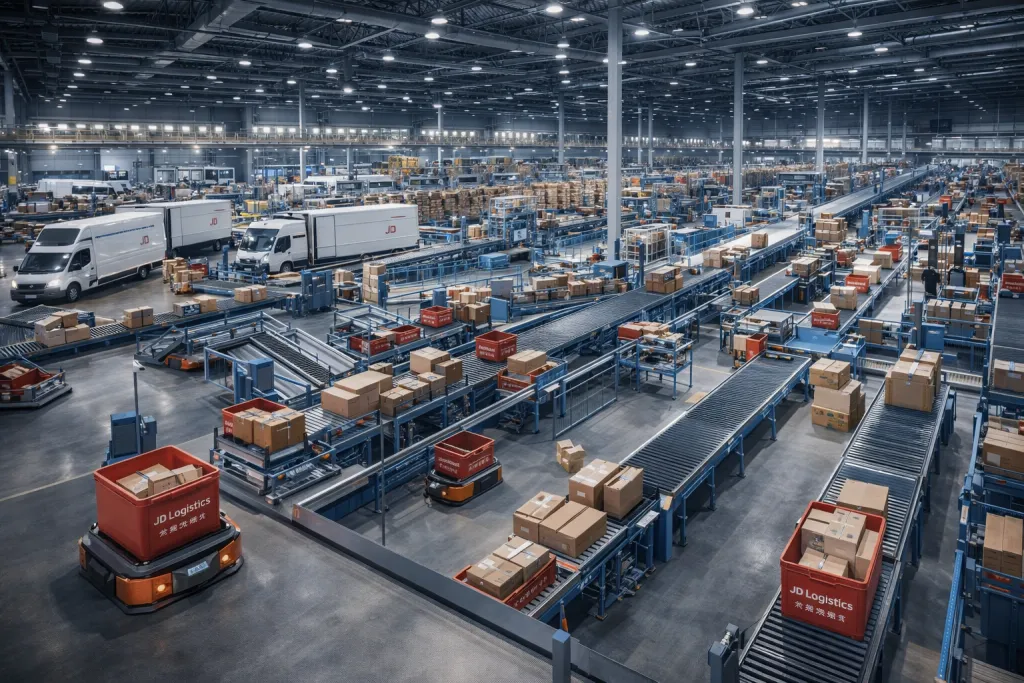
The valuation case for JD does not require robotics to succeed. The purpose of this section is not to argue that automation will redefine JD’s identity, but to determine whether it meaningfully alters cost structure, optionality, or downside risk.
5.1 Internal Deployment: Cost Containment, Not Reinvention
JD has been automating its logistics network for over a decade. This predates recent interest in humanoid robotics and reflects a long-standing effort to manage labor intensity at scale.
By 2025, JD Logistics had deployed automated sorting, handling, and warehousing systems across its major fulfillment centers, with automation penetration exceeding 70% in core sorting workflows. These systems include automated guided vehicles, goods-to-person picking, high-density racking, and integrated sorting lines. The objective is throughput stability and labor substitution, not headline innovation.
The economic impact is incremental. JD does not disclose explicit labor savings or payback periods, and there is no evidence of a step-function margin expansion attributable to automation. What is observable is durability. Despite rising wage pressure and heavy investment elsewhere, JD Logistics maintained positive operating margins, approximately 2% to 3% through 2025, while revenue grew over 20% year over year.
That outcome would be difficult to sustain without some degree of structural cost control. Automation, in this context, acts as a stabilizer rather than a growth engine. It caps downside rather than creates upside.
5.2 Externalization Through Logistics, Not Hardware Sales
Where the market often misreads JD’s strategy is in conflating robotics with direct technology commercialization. JD is not currently attempting to sell robotics systems as standalone products. Instead, it externalizes automation indirectly through JD Logistics.
As logistics utilization increases, JD is increasingly providing warehousing, fulfillment, and cross-border supply chain services to third-party customers. In 2025, external customer revenue represented a growing share of JD Logistics activity, particularly in international markets.

Overseas warehouses in regions such as the Middle East and Europe were explicitly positioned as third-party service hubs, supporting Chinese brands expanding abroad and local enterprises seeking integrated logistics solutions. These facilities are not experimental. They are operating assets serving external demand.
JD does not need to monetize robotics directly for automation to matter financially. The value is realized through higher utilization, better asset amortization, and improved margins on logistics services sold externally. Robotics, in this sense, enhances the attractiveness of JD Logistics as infrastructure rather than creating a new product category.
5.3 Strategic Robotics Investments as Optionality
JD’s minority investments in robotics and embodied AI companies should be interpreted as long-dated options.
The company has taken stakes in several early-stage firms focused on manipulation, mobility, and warehouse-relevant robotics. These investments are small relative to JD’s balance sheet and are not embedded in guidance, margin targets, or capital return assumptions.
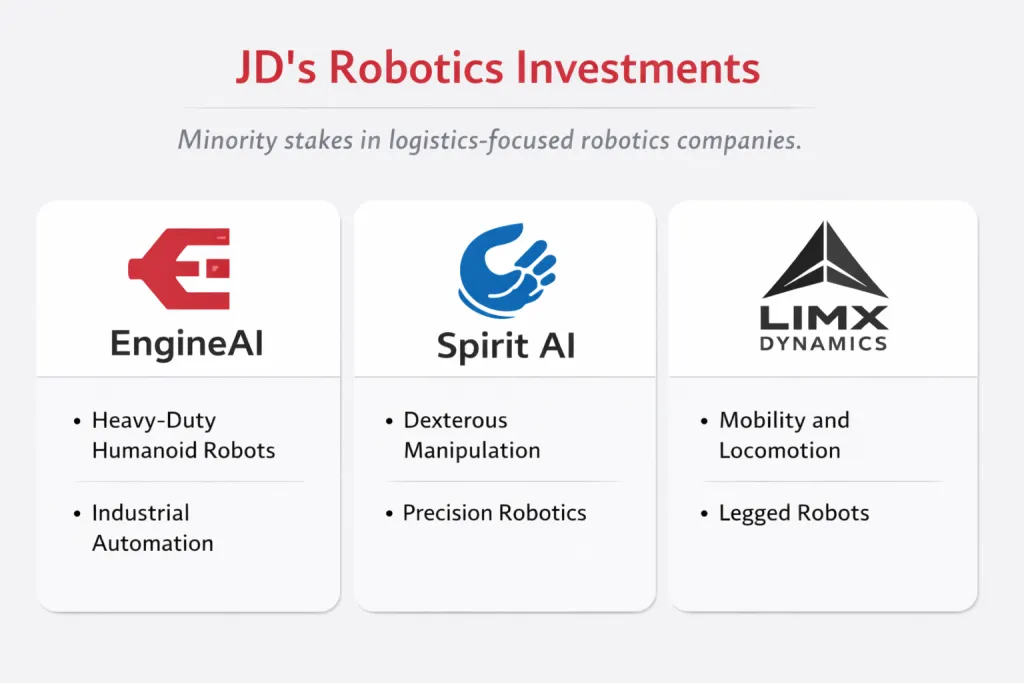
Their purpose is access and learning. JD is positioning itself close to the development curve of technologies that may eventually reduce reliance on human labor in complex warehouse environments. If these technologies mature and become cost-effective, JD benefits first through internal deployment. If they do not, the financial downside is limited.
There is no evidence today that these investments materially affect JD’s earnings power. They do not need to.
5.4 What Automation Changes and What It Does Not
Automation does not transform JD into a technology company. It does not eliminate competitive pressure. It does not justify multiple expansion on its own.
What it does is reduce fragility. It limits labor-driven margin erosion. It supports logistics monetization. It increases the range of outcomes without worsening the downside.
In a stock priced as though time works against it, this distinction is important.
6. Valuation: When Price Overwhelms Uncertainty
6.1 Current Valuation Anchors and What They Imply
At approximately $29.45 per share, JD’s equity market capitalization sits around $45–47 billion, depending on ADS count. Against this, JD entered late 2025 with over RMB 200 billion in cash and short-term investments, equivalent to roughly $28–29 billion.
After adjusting for net cash, the implied enterprise value of the business falls closer to $18–20 billion.
Furthermore, when one strips out the $13B market value of the JD Health stake, the residual Enterprise Value for the core retail business, generating over $150B in annual revenue, sits at roughly $5B. This implies an EV/Sales multiple of ~0.03x for the world’s most sophisticated logistics network.
That enterprise value is being asked to represent:
- A national-scale first-party retail platform
- A profitable and growing third-party logistics business
- Ownership stakes in JD Logistics, JD Health, and other ecosystem assets
- A core retail operation that remained profitable through an aggressive investment cycle
On trailing results, JD generated approximately RMB 12–15 billion in free cash flow during 2025, down from prior years due to elevated discretionary spending. Even at this depressed level, the equity trades at a mid-single-digit free cash flow yield on enterprise value, despite margins being intentionally suppressed.
In other words, the market is not pricing JD as a business temporarily investing. It is pricing JD as a business whose earnings power is permanently impaired.
6.2 Margin of Safety at $29.45
To justify the current price, one must assume some combination of the following persists indefinitely:
- Consolidated operating margins fail to recover above low-single-digit levels
- Logistics remains structurally low-margin despite rising external utilization
- Capital allocation discipline deteriorates rather than normalizes
- Buybacks slow materially or stop altogether
This is a demanding set of assumptions given observed behavior.
JD Retail alone delivered operating margins approaching 6% during 2025, even as the group absorbed losses elsewhere. That implies the core business retains meaningful earnings capacity if discretionary investments are scaled back. JD Logistics, meanwhile, sustained positive operating margins while growing revenue over 20% year over year, suggesting improving unit economics rather than deterioration.
At the current valuation, even a no-growth outcome is tolerable. If JD merely stabilizes consolidated margins around 2.5–3% on a revenue base north of RMB 1.5 trillion by the end of the decade, normalized operating income would exceed what the market presently discounts. No heroic execution is required. The bar is low.
That is the margin of safety. The stock does not need JD to win. It only needs JD not to fail in the specific ways the market assumes.
6.3 Buyback Math and Per-Share Compounding
Buybacks are where valuation stops being theoretical.
JD authorized a $5.0 billion repurchase program through August 2027. By September 2025, approximately $1.5 billion had already been deployed, retiring roughly 2.8% of outstanding shares in under a year. At prices near $30, each additional $1 billion spent reduces the share count by roughly 3%.
If JD continues repurchasing shares at even $1.0–1.5 billion per year, the share count declines materially over a five-year horizon. Importantly, this compounding occurs regardless of whether earnings grow. Flat earnings plus a shrinking denominator still produce rising per-share value.
This is the arithmetic the market is ignoring. At depressed prices, buybacks do not require confidence in growth. They require only balance sheet durability and time. JD has both.
The dividend exists but remains immaterial. The yield is modest and does not meaningfully influence valuation outcomes. Capital return is expressed almost entirely through repurchases, which is rational at current prices.
The implication is uncomfortable for a market anchored to near-term uncertainty. If JD simply remains solvent, disciplined, and boring, the per-share outcome five years out is unlikely to resemble the current quote.
7. JD 2030 Outcomes: A Probability-Weighted View
This section frames three end-of-decade outcomes that differ only on execution quality and capital discipline. None assume a China boom, a technological breakthrough, or a narrative re-rating. The variance comes from margins, buybacks, and restraint.
Northwise Premium
Choose how to continue with Northwise
Join Northwise Premium
Unlock the rest of this report, its complete valuation, the downloadable model, portfolios, and action framework.
Join Northwise PremiumCreate a Free Account
Continue across Free Northwise research, follow companies, save reports, and receive updates.
Create a Free Account
Celsius Stock Analysis: The Shelf Reset and the Second Growth Curve
Celsius stock analysis of the shelf reset, Alani growth, Pepsi economics and cash flow, with a 2030 model and a Premium valuation and entry-price framework.

Meta AI Spending: The Customer Is Already Here
Can Meta turn AI spending into shareholder returns? We model advertising, Muse, hardware, capital costs and cash flow through 2030, with a full valuation.

IREN Stock Dilution: Can the Build Reach Shareholders?
IREN stock analysis of AI growth, funding and dilution through 2030. Read our full valuation, 27 scenarios and price zones free. Excel model is Premium.
Northwise Portfolios
See how the research becomes real decisions
Reader discussion
Discuss the research
Premium access is required to join this report's discussion.
Join Northwise Premium
No comments yet. Start a thoughtful discussion.