
Duolingo Stock Forecast

Duolingo stock forecast for 2025: We examine whether DUOL is overvalued or fairly priced based on growth, margins, and platform expansion.
In this article
Duolingo Stock Forecast: Is DUOL Overvalued?
Why flawless execution is the floor, and platform leverage is the wildcard.
Valuation Meets Expectation
At over $23 billion in market cap and a forward P/E north of 180, Duolingo is no longer the underestimated underdog of education technology. It is priced with precision, reflecting operational discipline and a platform that compounds user engagement and monetization.
In this Duolingo stock forecast, we unpack whether the current valuation is excessive or accurately reflects a company operating at an unusually high level.
The challenge with a stock like Duolingo is not recognizing the strength of its business model or the growth it has already demonstrated. It’s about whether the premium currently placed on the stock is a reasonable bet on the future.
Beneath the playful interface is a highly disciplined operating model, one that is beginning to convert daily habit into significant margin. Duolingo is shifting from a single-product story into a multi-vertical platform. The price already reflects that transition. Now it’s about execution.
A Brief History: From CAPTCHA to Language Empire
Duolingo was founded in 2011 by Luis von Ahn, the inventor of CAPTCHA and reCAPTCHA, and Severin Hacker. Their original idea was to provide free access to language learning by monetizing translation tasks.
That concept quickly evolved. The company became a sticky consumer education platform, built on gamification, constant iteration, and behavioral loops.
Duolingo went public in 2021. Initially, it traded sideways. Investors saw a beloved brand with unclear margins and slow monetization.

That view began to shift in 2023 and accelerated in 2024, when the company:
- Surpassed 10 million paid subscribers
- Expanded beyond language with Math, Music, and Chess
- Achieved GAAP profitability and consistent EBITDA growth
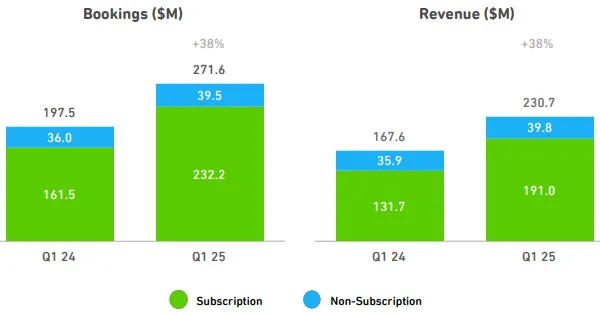
As of Q1 2025, Duolingo is the most downloaded education app globally. It has 46.6 million daily active users and $230 million in quarterly revenue. More importantly, it is generating meaningful cash flow while steadily scaling its subscription offerings.
The CEO: Luis von Ahn and the Discipline of a Builder
Very few founders are still in the seat 14 years later. Fewer still bring Luis von Ahn’s blend of technical credibility, product intuition, and measured execution. As CEO, he is key to our Duolingo stock forecast and has:
- Deliberately delayed monetization to improve long-term retention
- Refused to rely on advertising as a primary revenue stream
- Anchored the user experience in trust, identity, and accessibility
His fingerprints are everywhere. From viral campaigns like Dead Duo to end-of-lesson animations that fuel daily engagement, Duolingo’s growth comes from a strong product core. Von Ahn’s approach to leadership prioritizes infrastructure over hype. Duolingo Max, the AI-powered premium tier, was tested carefully and rolled out without fanfare.
Cost-optimization work around generative AI began well before public scrutiny. Founder equity is already set through 2031, with no further grants planned.
Von Ahn’s strategy has always focused on doing the unsexy things that scale. That includes refining Duolingo’s internal testing systems and sustaining a culture of measured experimentation. The company is built for longevity.
Duolingo Is No Longer Misunderstood, It’s Priced for Perfection
Duolingo trades at a trailing P/E of approximately 250 and a forward P/E of approximately 180. That is not the multiple of a niche app. It is a valuation for a consumer platform with network effects and high retention.
To justify that valuation and meet our Duolingo stock forecast, Duolingo needs to:
- Maintain 25–30% annual revenue growth
- Hold EBITDA margins above 27%
- Reach 20–25% net income margins
- Expand successfully beyond language into parallel education markets
These expectations are not far-fetched. They are already in motion:
- Q1 2025 revenue grew 38% year-over-year
- Paid subscribers increased by 40% to 10.3 million
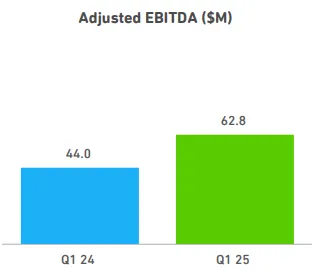
- Adjusted EBITDA margin hit 27.2%
- Free cash flow was $103 million on 44.6% margin
The business is executing well. The market sees that. This is not cheap, but it is priced based on real fundamentals.
Future Plans: From Language to Learning Platform
Duolingo’s long-term goal is not just to lead in language learning. It is to become a broad platform for consumer education. The company is already moving in that direction and is the cornerstone of our Duolingo stock forecast
Math: Building the Foundation of Applied Learning
Math is a natural extension. It fits Duolingo’s model of short, repeatable content. It builds confidence and is already in high demand among both kids and adults. The company is testing how it can bring the same emotional attachment and sense of progress to a subject that often intimidates learners.

Duolingo hopes to become a go-to math supplement, particularly for early education. If it succeeds, it could open the door to a broader K-12 learning pathway.
Music: Turning Learning into Rhythm and Play
Launched in 2024, Duolingo Music teaches pitch recognition, notation, and rhythm. Lessons are short and gamified. The structure mimics language learning and leans into the same habit-forming techniques. Music is a high-engagement category, and Duolingo is trying to own the entry-level experience.
This vertical could allow the company to reach learners seeking creative and emotional outlets, complementing the more academic structure of language or math.
Chess: Strategic Thinking in Bite-Sized Sessions
Duolingo’s Chess curriculum launched in early 2025. It is focused on teaching tactics and long-term strategy through daily puzzles and challenges. Learners play against familiar characters in short games. It is less about becoming a grandmaster and more about reinforcing critical thinking.

This subject allows Duolingo to build brand depth and capture interest from older or more advanced users. It fits well with the company’s focus on cognitive training.
Each of these verticals builds on Duolingo’s core loop: habit, identity, and progression. They share backend infrastructure and benefit from AI-powered content delivery. None of them need to be massive to add value. Even modest success across several of them could create meaningful leverage.
Why This Premium Comes with a Fragile Contract
Being priced for perfection has its advantages, but it comes with fragility. Any slip in execution could have outsized consequences for the stock’s multiple. Investors are betting not just on Duolingo’s ability to grow, but to do so without deviation.
Here is what could go wrong:
- ARPU stalls as subscriber growth outpaces monetization.
- New verticals fail to retain or engage users at scale.
- Habit loops weaken due to feature fatigue or app redesign missteps.
- Generative AI costs rise faster than expected, especially if infrastructure demands increase with new products.
The company is executing well today. But this valuation assumes continued flawless delivery across all fronts, user growth, retention, product expansion, and operating leverage. In this kind of setup, even a modest slowdown in any of these areas could result in a meaningful drawdown. High expectations leave no room for execution drift, this is paramount to our Duolingo stock forecast.
There is also risk at the brand level. Duolingo’s identity is built around trust, accessibility, and fun. If monetization becomes too aggressive, or premium features compromise the free user experience, the company could see a backlash that weakens its growth engine.
The Market Still Misunderstands Duolingo’s Model
Many still view Duolingo as an EdTech stock, a company built around educational content. That lens misses the full picture. Duolingo operates more like a consumer engagement platform than a course provider. Its success is less about curriculum and more about identity, habit, and retention.
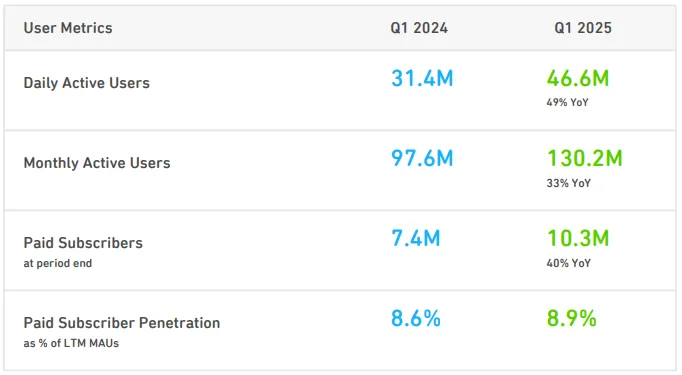
- It has 46.6 million daily active users engaging for minutes per session, multiple times a day.
- Paid users generate 83% of revenue, and most of them stick for months.
- Gross margins were 71.1% as of Q1 2025, down slightly due to generative AI costs.
- The company spends relatively little on marketing due to word-of-mouth and brand-driven growth.
The Birdbrain engine, which powers real-time personalization and lesson sequencing, gives Duolingo a unique product moat. It allows the company to optimize each user’s journey, creating the illusion of a one-on-one tutor at scale. That drives satisfaction and retention, not just completion.
More broadly, Duolingo is building behavioral infrastructure. It creates systems where users invest emotionally and return habitually. That’s a different game than curriculum delivery. The market often struggles to model this because it exists between traditional categories.
The longer Duolingo retains users across multiple subjects, the more it compounds trust and optionality. A user who completes Spanish today may try music or math tomorrow. The company isn’t just teaching, it is building a cross-category learning habit inside a single interface.
A Valuation That’s Fair for a Narrow Path of Greatness
Duolingo’s current market cap of around $23 billion reflects extremely high expectations. If it continues to grow revenue at 25% annually and reaches 25% net margins, it could generate $750 million in net income by 2030.
At a valuation multiple between 30 and 50 times 2030 earnings, our Duolingo stock forecast supports a long-term 5 year valuation range between $22 billion and $37 billion.
That math validates today’s share price, but it does not offer much room for error. The company needs to scale effectively, launch new verticals that stick, and maintain industry-leading margins. Not many consumer companies have done all three at once, especially while preserving brand equity and global relevance.
Yet if Duolingo delivers, the upside could go beyond that range. Strong cash generation could justify higher multiples. Expansion into certification, childhood education, or professional upskilling could create entirely new revenue layers. If Duolingo becomes a “Netflix for learning,” as some investors hope, it won’t be bound by a typical EdTech valuation framework and it will likely outperform our somewhat conservative Duolingo stock forecast.
The fair value range assumes what is known today. The real optionality lies in what the company hasn’t monetized yet.
The Northwise Take
Duolingo is not a misunderstood underdog, and it is not a speculative moonshot. It is a platform executing well, priced accordingly. The risk for investors is not about whether the company can grow. It is whether it can grow fast enough, for long enough, without breaking its loop.
This is a stock that demands conviction in systems, in leadership, infrastructure, and discipline. It is not for the passive holder looking for a discount. It is for someone who understands how product loops and identity formation create real business leverage.
For long-term investors willing to watch closely and size accordingly, Duolingo may offer something rare: a consumer company that compounds by doing simple things well, and by staying focused while others overreach.
Our Duolingo Stock Forecast does see DUOL as valued fairly, albeit optimistically today. It allows room for 100% upside (at a 30-50 price multiple of 2030 earnings), if the company continues to execute perfectly.

Duolingo Stock Analysis
Duolingo stock analysis examining the valuation, competitive risks, AI disruption, and why DUOL may be a value trap rather than a long-term buy.

Celsius Stock Analysis: The Shelf Reset and the Second Growth Curve
Celsius stock analysis of the shelf reset, Alani growth, Pepsi economics and cash flow, with a 2030 model and a Premium valuation and entry-price framework.

Meta AI Spending: The Customer Is Already Here
Can Meta turn AI spending into shareholder returns? We model advertising, Muse, hardware, capital costs and cash flow through 2030, with a full valuation.
Northwise Portfolios
See how the research becomes real decisions
Reader discussion
Discuss the research
Create a Free account to join the discussion with a display name.
Create a Free Account
No comments yet. Start a thoughtful discussion.