
Duolingo Stock Analysis

Duolingo stock analysis examining the valuation, competitive risks, AI disruption, and why DUOL may be a value trap rather than a long-term buy.
In this article
Duolingo Stock Analysis: The Valuation Reset
Why the world’s most popular language app may be a value trap rather than a buying opportunity
Is Duolingo Stock a Buy?
There are moments when a market darling becomes a cautionary tale. Duolingo reached that moment somewhere between its $540 all-time high and its current $132 price tag. The 75.6% drawdown is not just noise. It is the market repricing a business that once traded on narrative rather than defensibility.
Founded in 2011 by Luis von Ahn (the creator of CAPTCHA) and Severin Hacker, Duolingo grew from a Pittsburgh-based startup into the world’s most popular education platform.
The company gamifies language learning through a dopamine-driven engagement loop, with its mascot Duo the Owl serving as both brand ambassador and cultural phenomenon.
Revenue is concentrated in subscriptions, which account for 81% of total revenue, with advertising and the Duolingo English Test contributing the remainder. The company has expanded beyond language learning into chess, math, and music, positioning itself as a broader education platform rather than a single-category app.
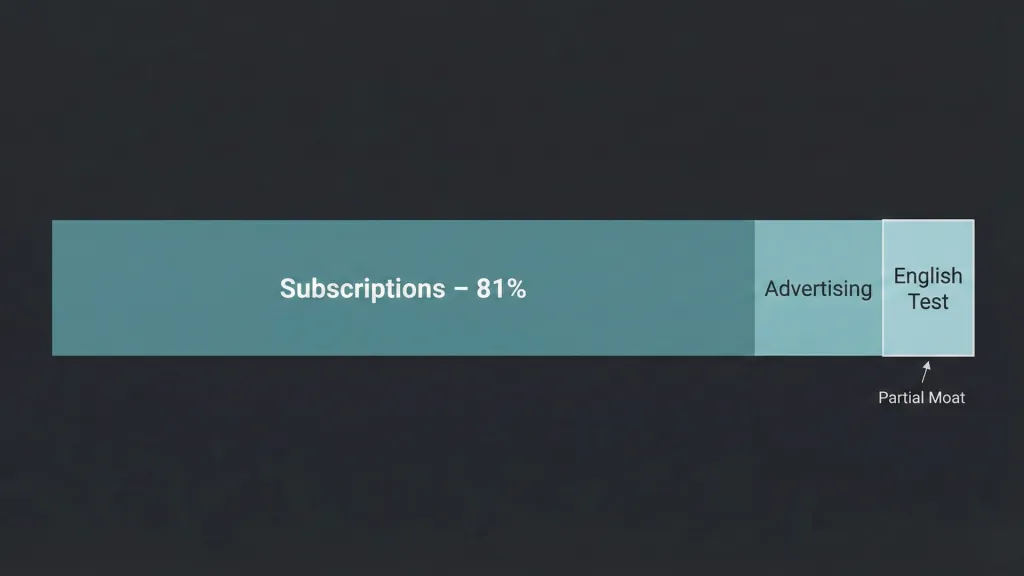
The Duolingo English Test represents one of the more defensible parts of the business model. With acceptance at over 6,000 programs worldwide, it creates a niche revenue stream that could theoretically compete with established testing giants like Kaplan or Princeton Review. Whether it can scale meaningfully against entrenched incumbents remains an open question.
The Valuation Reset
From an all-time high of $540.68 per share in May 2025 to the current price of $131.93, the total drawdown stands at 75.6%. This is not the company’s first collapse. In 2022, the stock fell roughly 70%, from around $200 in late 2021 to a low near $64 in mid-2022.

That recovery phase gave bulls confidence that Duolingo could execute its way back to premium valuations. The current slide is deeper in both absolute dollar terms and percentage from peak, suggesting something more structural than cyclical sentiment.
This matters because the first drawdown occurred during broad risk-off conditions. The second is happening while the company is still growing users and revenue. The distinction is meaningful.
What Triggered the Collapse in DUOL
Four forces converged to break investor conviction.
CFO Departure
Matt Skaruppa’s announcement that he would step down effective February 2026 removed one of the key architects of Duolingo’s profitability transition. CFO changes matter more for companies still proving out their business model than for mature compounders. Duolingo falls into the former category.
Growth vs. Profit Tradeoff
CEO Luis von Ahn signaled that the company would prioritize aggressive AI investment and product development over short-term margin expansion. This is a defensible strategic choice if the investments produce durable competitive advantages.
The concern is whether Duolingo’s AI spending creates moats or simply keeps the company from falling behind faster-moving platforms.
Decelerating User Growth
Daily Active User growth slowed to roughly 30% year-over-year. In isolation, this is a strong number. For a stock priced at $500+ per share, it represented a miss against expectations. Growth deceleration matters more when valuation assumes sustained acceleration.
Insider Selling
Co-founders and executives conducted major sell-offs throughout late 2025. These transactions occurred between $170 and $320 per share. This preceded the latest leg down to $130.
Insider selling does not always signal structural problems, but the timing and scale raised questions about what management believed the business was worth.
The Metrics Look Compelling Until You Examine the Moat
At a PE of 17x, a PEG of 0.71, and an FCF yield of 7.3%, Duolingo appears statistically cheap. The balance sheet reinforces this view, with roughly $1.01 billion in cash and equivalents and virtually no debt. The company has the financial resources to execute its AI roadmap without dilution or financing constraints.
The problem is not the metrics. It is what the metrics are valuing.
The Competitive Threat Is Not What It Seems
Google recently released live translation features that bring real-time language translation directly into headphones and hardware. For users who learn languages as a means to an end: travel, business, communication, the value proposition of spending 500 days building a Duolingo streak diminishes rapidly when translation is instant and embedded.
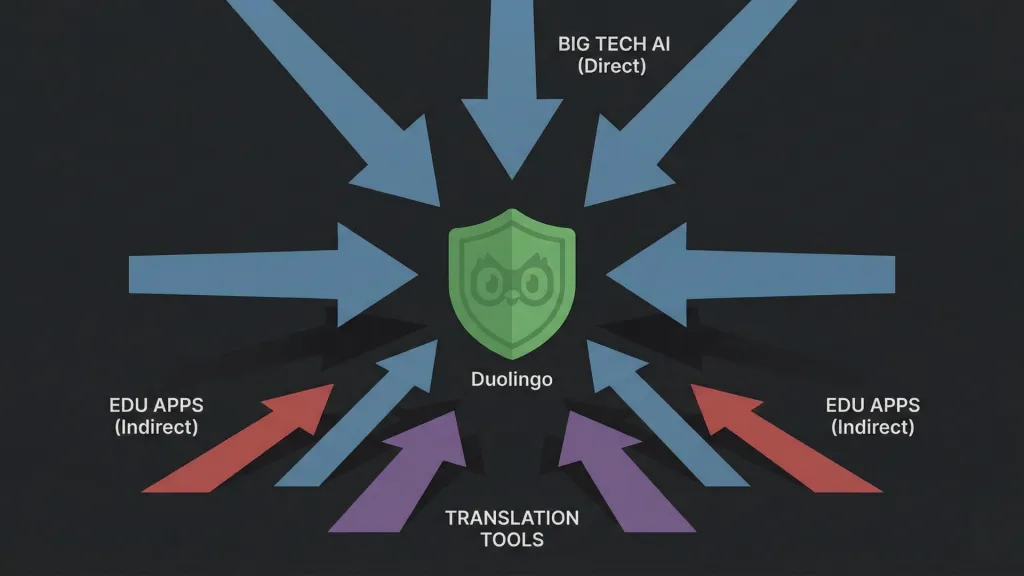
Duolingo relies on OpenAI’s GPT-4o to power its premium “Max” tier. If Google or Apple integrates superior learning tools directly into the OS or provides them free as part of device ecosystems, Duolingo’s $30-per-month subscription faces structural pricing pressure.
The company does not control the AI layer it depends on, and it competes against
platforms that can bundle language tools at zero marginal cost.
The Bull Case Depends on Habit, Not Utility
Bulls argue that Duolingo is not an education app competing with Google Translate. It is a gaming app competing with Instagram, TikTok, and Candy Crush. The moat is behavioral, not functional. Duolingo’s ability to hijack dopamine systems and build daily engagement habits is what keeps users returning, regardless of whether they are learning efficiently.

This framing is more accurate than comparing Duolingo to traditional education software. The question is whether behavioral engagement alone can sustain pricing power and user growth when the underlying utility is being commoditized by platforms with vastly larger distribution and resources.
AI Is Moving Faster Than Duolingo Can Build Defensibility
On January 29, 2026, Google DeepMind unveiled Genie 3, a world-generation AI model capable of creating interactive, playable 2D and 3D environments from text prompts or images.
The relevance to Duolingo is not direct competition, but it clarifies the pace at which AI-native experiences are being generated by well-resourced platforms.
At the current rate of AI innovation, Duolingo’s true moat becomes its brand.
Branding is valuable, but it is also the most fragile form of competitive advantage
when the product experience can be replicated or exceeded by platforms with better AI infrastructure.
The Northwise View: Value Trap, Not Value Play
Despite solid fundamentals, there is simply no durable moat capable of defending this business over the next decade. The stock is more accurately framed as a value trap than an undervalued compounder.
Duolingo could manufacture an unlikely turnaround, but we believe there are better opportunities in the market to deploy capital with less risk than in DUOL.
Our Duolingo Stock Analysis conclusion is that this is a stock that makes more sense to trade around sentiment than to hold through structural headwinds.
Premium Northwise Reports

Duolingo Stock Forecast
Duolingo stock forecast for 2025: We examine whether DUOL is overvalued or fairly priced based on growth, margins, and platform expansion.

Celsius Stock Analysis: The Shelf Reset and the Second Growth Curve
Celsius stock analysis of the shelf reset, Alani growth, Pepsi economics and cash flow, with a 2030 model and a Premium valuation and entry-price framework.

Meta AI Spending: The Customer Is Already Here
Can Meta turn AI spending into shareholder returns? We model advertising, Muse, hardware, capital costs and cash flow through 2030, with a full valuation.
Northwise Portfolios
See how the research becomes real decisions
Reader discussion
Discuss the research
Create a Free account to join the discussion with a display name.
Create a Free Account
No comments yet. Start a thoughtful discussion.