
Coin Stock Forecast 2030

Coin stock forecast 2030 reveals why Coinbase’s risk-reward has flipped, projecting 370% upside as ARR and institutional scale accelerate.
In this article
Coin Stock Forecast 2030: The Infrastructure of Digital Finance
How Coinbase’s evolution into derivatives, custody, and recurring services reshapes its investment outlook.
Executive Summary: Coin Stock Forecast 2030
Our updated coin stock forecast 2030 evaluates Coinbase’s transformation from a transactional exchange into a multi-layered financial infrastructure company. Following its Q3 2025 results, we believe Coinbase has entered a new growth phase defined by recurring revenue, institutional scale, and operational discipline.
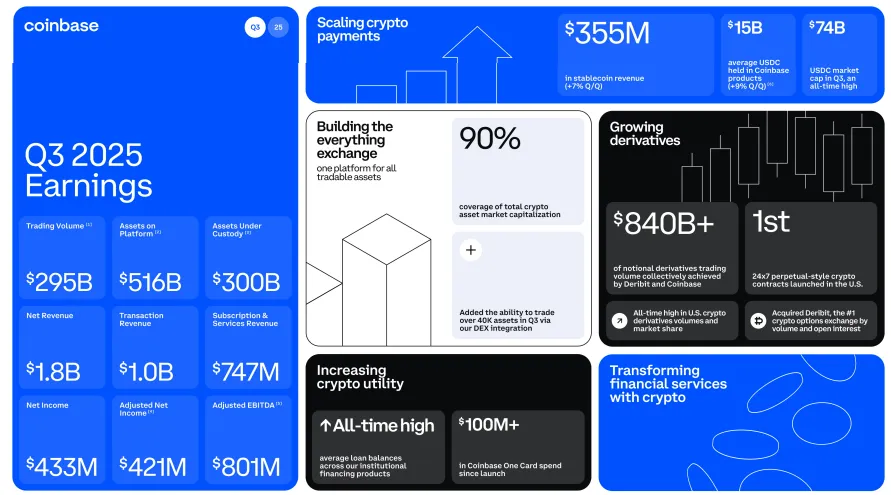
Q3 revenue rose to approximately $1.9 billion, up 55 percent year over year. Subscriptions and services grew 34 percent, reaching an annualized run rate near $3 billion. Management reaffirmed its focus on “building durable, recurring revenue streams through custody, derivatives, and subscriptions.” Transaction-based income remains healthy but is no longer the sole driver of performance.

Our revised model projects 17–25 percent annual revenue growth through 2030 and net margins expanding toward 25–30 percent as services overtake trading as the dominant revenue line. Based on those assumptions, our coin stock forecast 2030 implies an intrinsic range of $327 to $1,353 per share, with a base case of $706 and roughly 21 percent annualized compounding potential.
Coinbase’s fundamentals have strengthened even as the stock retraced after Q3. We believe the selloff reflects near-term yield compression rather than any deterioration in its structural thesis.
Our Original Coinbase Thesis
This article builds upon our original Coinbase Stock Price Prediction 2030 analysis. In that piece, we viewed Coinbase as a neutral opportunity rather than a buy. Valuation was rich, earnings visibility limited, and the regulatory path unclear.
Since then, the company has delivered greater transparency, disciplined cost control, and expanding recurring revenue. With Q3’s results, clearer regulatory footing, and growing institutional adoption, we now see a meaningfully improved risk-reward setup. Coinbase is beginning to resemble a regulated infrastructure provider, not a cyclical exchange.
What’s Changed Since Our Original Thesis
Several developments over the past year have reshaped Coinbase’s trajectory:
- Revenue acceleration: Q3 2025 revenue reached $1.9 billion, up 55 percent year over year.
- Recurring services: Subscriptions and services rose to nearly $750 million in the quarter, driven by staking, custody, and blockchain rewards.
- Derivatives expansion: Management confirmed that “the integration of Deribit and Echo will strengthen our derivatives and institutional product suite and drive sustained profitability.”
- Opex control: Total operating expenses increased by only $100 million quarter over quarter, half from acquisitions and half from headcount growth.
- Institutional adoption: Coinbase Prime continues to attract clients from traditional finance, with partnerships announced alongside Citi and JPMorgan.
As CEO Brian Armstrong noted,
“Our focus remains on execution and durable growth. We’re not optimizing for one quarter but for the next decade of digital finance.”
Why the Market is Wrong About Coinbase
Investors reacted sharply to Q3’s reported decline in stablecoin yield revenue. This was a misunderstanding of the business model shift. Coinbase adjusted fee structures and on-platform USDC balances to improve the sustainability of earnings.
The company stated clearly,
“Our on-platform USDC balances continue to grow even as yields normalize, reflecting user confidence and transaction quality.”
By raising fees on stablecoin pairs, Coinbase traded temporary volume for higher-quality flow. This pivot improves long-term economics and reduces dependence on volatile interest income.
Yield normalization is not erosion. It’s evidence that Coinbase is building a predictable, institutionally credible revenue mix rather than chasing cyclical spreads.
Coinbase Revenues: Exchange, Stablecoins, and Payments
Coinbase’s core engine remains its global trading ecosystem, but it’s now engineered for profitability, not just scale. The exchange, brokerage, and payment businesses collectively anchor the company’s transaction flow and funding base.
- Exchange strength: Q3 transaction revenue exceeded $1 billion, supported by an 80 percent year-over-year rise in derivatives volume.
- Stablecoins: On-platform USDC balances surpassed $15 billion, while off-platform balances declined. The company’s decision to increase stablecoin trading fees reflects a more disciplined pricing strategy.
- Payments: Coinbase continues to expand B2B payment integrations. The company emphasized that “our payments initiatives are focused on enabling businesses to send and receive digital assets seamlessly rather than competing with retail payment networks.”
These operational shifts mark a move toward higher-margin, service-oriented flows. Coinbase’s trading foundation remains vital, but its design is changing from volume-driven to value-driven.
Coinbase Stock: Custody, Derivatives, and Base
Coinbase’s evolution beyond exchange activity is accelerating. The combination of custody, derivatives, and on-chain infrastructure is establishing a genuine moat.
Custody and Institutional Services: Coinbase Custody now secures assets for some of the world’s largest asset managers. Institutional inflows rose substantially through Coinbase Prime during 2025. “We continue to see strong institutional demand, especially for custody and collateral management,” management reported.
Derivatives Expansion: The acquisition and integration of Deribit and Echo create a unified derivatives platform under Coinbase’s compliance umbrella. This deepens institutional liquidity and opens new fee lines that are less sensitive to retail volume cycles.
Base and On-Chain Growth: Base, Coinbase’s Layer-2 network, has quickly become a key funnel for on-chain activity. Users executing through decentralized apps still generate fees and custody opportunities within Coinbase’s ecosystem. The firm described Base as “a strategic bridge between centralized trust and decentralized innovation.”
Together, these segments form a vertically integrated infrastructure layer that rivals traditional exchanges in design and resilience.
Coin Stock Forecast 2030
Metric | Value |
|---|---|
Revenue CAGR (2025→2030) | +21 % |
2030 Revenue | $19.5 B |
Net Margin (2030) | 25 % |
Net Income | $4.9 B |
Diluted Shares | 290 M |
EPS (2030) | $16.8 |
Justified P/E | 42× |
2030 Target Price | $706 / share |
Scenario | Revenue CAGR | EPS (2030) | P/E (2030) | Target Price ($) |
|---|---|---|---|---|
Bear | 17 % | 10.9 | 30× | 327 |
Base | 21 % | 16.8 | 42× | 706 |
Bull | 25 % | 24.6 | 55× | 1,353 |
Our updated coin stock forecast 2030 projects a 21 percent compound annual revenue growth rate through 2030, with EPS compounding at approximately 28 percent annually. The base case of $706 per share implies nearly 370 percent upside from current levels.
Valuation and Long-Term Potential: The Path to 2030
Coinbase is transitioning from an exchange multiple to an infrastructure multiple. The stock once traded like a high-beta proxy for Bitcoin. That era is ending. With over half of projected 2030 revenue coming from recurring sources, Coinbase deserves a valuation closer to a fintech or exchange hybrid.
Our model assumes a 25 percent net margin by 2030, consistent with mature exchange peers, and a 42× earnings multiple based on 21 percent revenue CAGR and 28 percent EPS CAGR.
For perspective, if crypto volumes and institutional adoption exceed expectations, the bull case ($1,353) would still price Coinbase at roughly 55× 2030 earnings, in line with growth peers like Robinhood and Block during expansionary cycles.
Coinbase’s profitability is no longer speculative. It is a function of execution and product mix. The company’s cost discipline, recurring revenue, and compliance lead combine to create an asymmetric setup for long-term investors.
Coinbase Catalyst 2025–2030
Catalyst | Impact |
|---|---|
Regulatory Clarity (CLARITY and GENIUS Acts) | Defines digital asset frameworks and supports broader institutional participation. |
Derivatives and Institutional Scaling | Integration of Deribit and Echo expands fee base and stabilizes earnings. |
Subscription and Services Growth | Custody, staking, and blockchain rewards drive recurring margin expansion. |
Operating Leverage Post-2026 | Opex growth slows; efficiency improves. |
Global Expansion through Base and Custody | Builds international footprint with regulated infrastructure advantage. |
Risks and Mitigations
Risk | Description | Mitigation |
|---|---|---|
Regulatory Volatility | Rule changes could affect specific products or geographies. | Coinbase’s proactive compliance and licensing reduce exposure. |
Crypto Market Cyclicality | Trading volumes remain correlated with crypto asset prices. | Recurring services and derivatives balance cyclicality. |
Competition Risk | Rising global exchanges and DeFi platforms. | Brand trust, custody relationships, and compliance create differentiation. |
Bottom Line: Is Coinbase a Buy?
Coinbase now looks less like a trading venue and more like the financial backbone of digital assets. Its balance sheet strength, recurring revenue, and global regulatory standing give it structural endurance rare in this space.
We did not view Coinbase as a buy in our previous thesis, but with earnings visibility improving, derivatives integrated, and regulation advancing, the long-term risk-reward has turned compelling. The stock’s multiple has compressed while its fundamentals have expanded, creating a favorable setup for long-term investors.
Our coin stock forecast 2030 points to a company capable of compounding value over the next decade through durable profitability and expanding market share in the crypto economy.

Coinbase Stock Price Prediction 2030
Coinbase Stock Price Prediction 2030: From stablecoins to Web3 infrastructure, Coinbase is quietly becoming the backbone of the financial system.

Celsius Stock Analysis: The Shelf Reset and the Second Growth Curve
Celsius stock analysis of the shelf reset, Alani growth, Pepsi economics and cash flow, with a 2030 model and a Premium valuation and entry-price framework.

Meta AI Spending: The Customer Is Already Here
Can Meta turn AI spending into shareholder returns? We model advertising, Muse, hardware, capital costs and cash flow through 2030, with a full valuation.
Northwise Portfolios
See how the research becomes real decisions
Reader discussion
Discuss the research
Create a Free account to join the discussion with a display name.
Create a Free Account
No comments yet. Start a thoughtful discussion.