
CELH Stock Forecast 2030
CELH Stock Forecast 2030 covering Celsius, Alani Nu, Rockstar, Pepsi distribution, Costco risk, and international growth model.
In this article
A premium valuation framework for Celsius Holdings stock through 2030, built around the transformation from single-brand energy company into a Pepsi-backed multi-brand platform, with discipline applied to North America maturity, private-label risk, acquisition complexity, and the gap between Celsius today and Monster as the category benchmark.
1. The Core Debate of Our CELH Stock Forecast
1.1 What Celsius Is Becoming
Celsius is moving into a different category of business than the one many investors still associate with the name. The old framing centered on a single high-growth energy brand riding a fitness-adjacent consumer wave. The current one is increasingly about whether the company can compound earnings across a multi-brand platform that now includes Celsius, Alani Nu, and the U.S. and Canada rights to Rockstar, all routed through one of the most powerful beverage distribution systems in the country.
That distinction shapes the entire report. Celsius already controls something the market cares about: a category-relevant brand portfolio, deep Pepsi distribution leverage, and a position inside one of the few consumer categories still expanding meaningfully each year. In a market where most consumer staples businesses are negotiating against demographic headwinds and private-label encroachment, that combination can be enough to create real equity value even when the headline growth rate begins to normalize.
The company, then, is best understood as a multi-brand energy platform attempting to convert distribution leverage and portfolio breadth into durable earnings power at a moment when the category itself still rewards expansion. That is a good place to be for a period of time. It also leaves an obvious follow-up question hanging in the air: how durable does this position remain once North America matures, once Costco's private-label entry tests brand pricing power, and once the most-favorable acquisition synergies have already been booked?
1.2 What the Market Is Debating
The debate around Celsius is more interesting than the usual growth-stock argument. Most serious investors can already see the transformation. They can see the Q1 2026 revenue growth, the Alani Nu contribution, the expanded Pepsi ownership, the international ramp, and the possibility that the combined portfolio remains relevant across a wider set of consumer occasions than the original Celsius brand alone ever could. The argument starts once that surface-level agreement ends.
One camp sees a company that has converted itself from a fragile single-brand story into something much closer to a Monster-style portfolio operator. In that view, Celsius does not need to recreate every part of the Monster playbook to generate substantial value. It needs to keep filling distribution, integrate Alani cleanly, stabilize Rockstar, and use Pepsi's system to push the platform into more international markets while the category remains favorable.
Another camp sees a business whose recent strengths may prove more transitional than durable. Distribution gains matter. Portfolio breadth matters. Pepsi support matters. Still, over a long enough horizon, North America energy growth must eventually normalize, Costco's Kirkland Signature entry can compress channel economics, Alani's influencer-led momentum can fade, and Rockstar can remain shelf complexity rather than a successful turnaround. If those pressures arrive faster than international growth can offset them, the market may eventually treat Celsius as a mature beverage operator rather than a long-duration compounder.
That is the real argument. It is less about whether Celsius is a real business today and more about what kind of business it becomes once the easiest part of the platform-building phase is behind it.
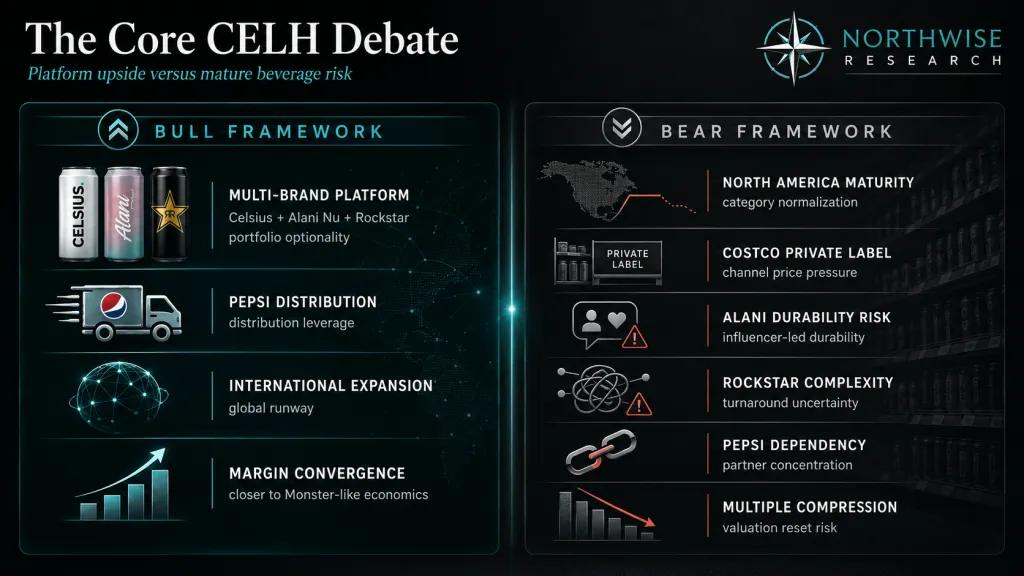
1.3 Why the Near-Term Case Is Easier to Underwrite Than the Long-Term One
The near-term case is easier to support due to its ingredients being visible. Q1 2026 revenue grew 138% year over year to $782.6M with adjusted EPS of $0.41. Alani contributed roughly $368M in the quarter, Rockstar added about $67M, and international grew 55% off a small base. Pepsi has just expanded its ownership to roughly 11% through a $585M preferred investment. The category itself remains alive, with Monster posting nearly 27% revenue growth in Q1 2026 and international sales surging almost 45%. Those are not the conditions of a fading consumer story.
That kind of setup lends itself to a straightforward thesis. If Celsius can integrate Alani cleanly, stabilize Rockstar, hold core Celsius scanner velocity, and push international from 5% of revenue toward something more meaningful, the equity can work well from here. Those are demanding conditions, though they are still conditions an investor can analyze with some discipline.
The long-term case is murkier. Once the easy distribution synergies have been booked and the comparison base hardens, the market is likely to care more about what the platform looks like at maturity. North America energy is not infinite. Private-label pressure tends to compress margins on functional caffeine over time. Alani's durability outside its core demographic is unproven over a full cycle. Rockstar has been a difficult brand to repair, and Pepsi itself tried and failed to do so before selling the U.S. and Canada rights along. The later years ask a different kind of question than the next few do. The next few ask whether Celsius can integrate and execute. The later years ask what the platform actually earns once the integration story is behind it.
1.4 The Central Question
That is the center of the report.
The question is not whether Celsius has built a real platform. It has. The question is whether that platform can be translated into durable per-share value once category maturity, private-label compression, acquisition accounting noise, and the gap between Celsius and Monster as a global operator are all allowed into the room. In other words, the company has already earned the market's attention. The harder task is earning an outcome where the platform's scale produces Monster-like economics over time without requiring Monster-like dominance to do so.
That framing matters for one reason above all others: this is a story where revenue alone can mislead. Reported revenue can rise sharply from acquisitions and distribution shifts while underlying brand velocity does something quieter. GAAP EPS can swing meaningfully on transition-related accounting that does not reflect steady-state earnings power. Even normalized earnings can disappoint if margin convergence toward Monster stalls below the level the multiple has already priced in.
The model behind this report was built around exactly that tension. It assumes the category remains healthy enough through 2030 to support continued growth across the portfolio, while also forcing the analysis to absorb the burden of private-label pressure, Pepsi dependency, integration risk, and margin convergence below Monster rather than equal to it.
That leaves a cleaner way to state the opportunity. Celsius does not need to become Monster for the stock to work. It needs to make enough operational and strategic progress over the next several years to earn a Monster-discounted multiple on a substantially larger earnings base, then preserve enough of that value at the shareholder level before private-label pressure and category normalization tighten the environment. That gap between platform success and shareholder success is where this report spends most of its time. It is also where the stock becomes interesting.
Table of Contents
1. The Core Debate of Our CELH Stock Forecast
1.1 What Celsius Is Becoming
1.2 What the Market Is Debating
1.3 Why the Near-Term Case Is Easier to Underwrite Than the Long-Term One
1.4 The Central Question
2. The Historical Crucible
2.1 From Forgotten Functional Beverage to Category Disruptor
2.2 The Costco Delisting Era and Survival Phase
2.3 The Nasdaq Return and Distribution Breakthrough
2.4 The Pepsi Inflection
2.5 From Celsius to Celsius Holdings
3. The Energy Drink Category
3.1 Why Energy Drinks Keep Taking Beverage Share
3.2 Monster, Red Bull, Celsius, Alani Nu, Ghost, C4, and Rockstar
3.3 The Better-for-You Energy Segment
3.4 Category Growth Versus Brand Share Risk
3.5 Why Monster Is the Correct Benchmark
4. Monster as the Ceiling Comp
4.1 Monster’s Growth at Scale
4.2 Monster’s Margin Structure
4.3 Monster’s Historical Multiple at a Similar Growth Stage
4.4 Why Celsius Deserves a Discount
4.5 What Celsius Can Borrow From the Monster Playbook
5. The Celsius Platform Today
5.1 Core Celsius
5.2 Alani Nu
5.3 Rockstar U.S. and Canada
5.4 International Celsius
5.5 Portfolio Fit Across Consumer Segments
5.6 Why This Is Now a Platform Story
6. The Pepsi Relationship
6.1 Pepsi’s Original 2022 Investment
6.2 Pepsi’s Expanded 2025 Investment
6.3 Pepsi as Distributor, Strategic Partner, and Governance Actor
6.4 Benefits of the Pepsi System
6.5 Risks of Pepsi Dependency
6.6 Inventory Timing and Reported Revenue Volatility
6.7 Why Pepsi Can Accelerate the Platform Without Removing Execution Risk
7. Alani Nu and the Acquisition Layer
7.1 Why Celsius Bought Alani Nu
7.2 Alani’s Consumer Positioning
7.3 Alani’s Early Financial Contribution
7.4 Distribution Transition and Pepsi Reimbursement Mechanics
7.5 GAAP EPS Distortion Versus Normalized Earnings
7.6 Durability Risk in Influencer-Driven Brands
8. Rockstar: Optionality or Distraction
8.1 Rockstar’s History and Former Category Position
8.2 Pepsi’s Rockstar Ownership and Brand Fatigue
8.3 What Celsius Actually Acquired
8.4 Why Rockstar Still Has Upside
8.5 Why Rockstar Should Not Anchor the Base Case
8.6 The Turnaround Question: Taste, Packaging, Velocity, and Shelf Relevance
9. International Expansion
9.1 Why International Is the Largest Upside Variable
9.2 Monster’s International Mix as Proof of Category Portability
9.3 Celsius International Today
9.4 What Must Happen for International to Matter by 2030
9.5 Why International Belongs as an Upside Overlay, Not the Base Case
10. Management and Incentives
10.1 John Fieldly’s Turnaround Role
10.2 Leadership Through the Survival Phase
10.3 Operating Style and Acquisition Discipline
10.4 Executive Ownership and Compensation Alignment
10.5 What Management Must Prove Next
11. Financial Foundation and Model Architecture
11.1 Current Revenue Baseline
11.2 Brand-Level Revenue Bridge
11.3 Gross Margin Framework
11.4 Normalized Net Margin Framework
11.5 Share Count and Preferred Stock Treatment
11.6 Why EPS Must Be Normalized
11.7 Model Inputs and Operating Assumptions
12. Risk Assessment
12.1 Costco and Private-Label Energy Risk
12.2 Pepsi Dependency
12.3 Alani Durability Risk
12.4 Rockstar Turnaround Risk
12.5 North America Maturity Risk
12.6 International Execution Risk
12.7 Margin Pressure From Freight, Aluminum, Promotions, and Mix
12.8 Inventory Distortion and Scanner Data Risk
12.9 Multiple Compression Risk
12.10 What Would Break the Model
13. Scenario Analysis
13.1 Scenario Design Philosophy
13.2 Bear Case Operating Assumptions
13.3 Base Case Operating Assumptions
13.4 Bull Case Operating Assumptions
13.5 International Breakout Case
13.6 EPS Construction by Scenario
14. Valuation Framework
14.1 Multiple Selection Logic
14.2 Monster Comp and Celsius Discount
14.3 Scenario Price Targets
14.4 Probability Weighting
14.5 Weighted 2030 Fair Value
15. Present Value and Valuation Zones
15.1 Discount Rate Framework
15.2 Present Value at 10%, 12%, 15%, and 18%
15.3 Strong Buy Zone
15.4 Accumulate Zone
15.5 Hold Zone
15.6 Trim Zone
15.7 Sell Zone
16. Northwise Portfolio Positioning
16.1 Current Northwise Exposure
16.2 Role Within the Portfolio
16.3 Position Sizing Philosophy
16.4 What Would Cause Us to Add
16.5 What Would Cause Us to Reduce
17. Final Assessment
17.1 The Long-Term Case
17.2 What Must Go Right
17.3 What the Market May Be Missing
17.4 What Would Break the Thesis
17.5 Final Northwise Judgment
2. The Historical Crucible
2.1 From Forgotten Functional Beverage to Category Disruptor
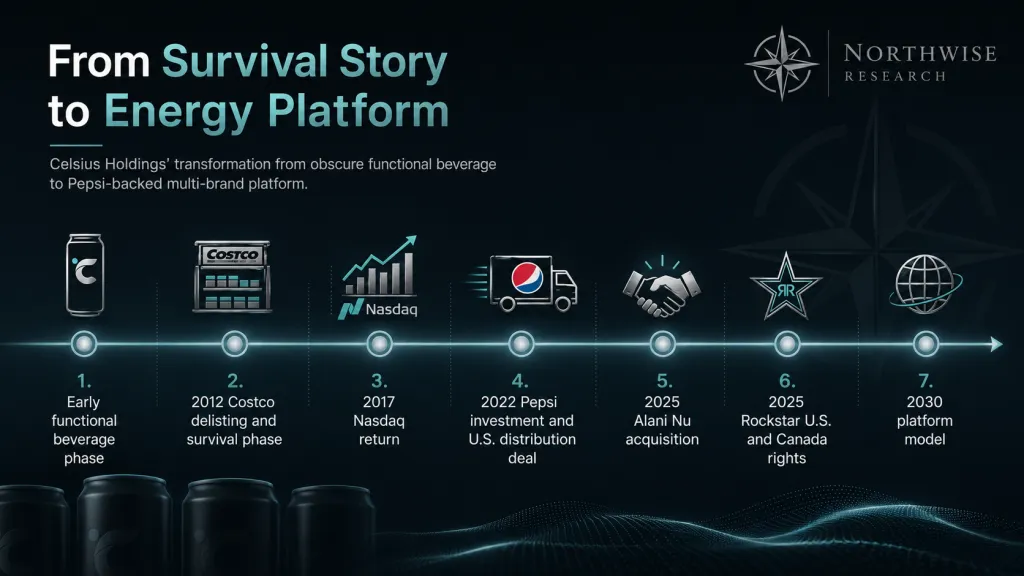
Celsius did not arrive at this position cleanly. The company spent most of its first decade as an obscure functional beverage with strong marketing claims, weak retail traction, and an unstable financial base. The early product was positioned as a calorie-burning drink rather than a mainstream energy brand, which produced a narrow consumer wedge and an even narrower distribution map.
That history matters here. The current investment debate sometimes treats Celsius as if it appeared fully formed during the 2020 to 2024 period. The company that exists today is the result of a long survival arc, several near-failures, and a brand repositioning that eventually allowed Celsius to participate in the better-for-you energy wave rather than continue fighting for shelf space as a marginal supplement product.
That survival period shaped the operating culture more than most outside observers recognize. A company that has been delisted, repositioned, and reformulated tends to retain a certain discipline around distribution, costs, and partnerships, even after the growth phase begins. We will come back to that in the management section.
2.2 The Costco Delisting Era and Survival Phase
The 2012 Costco delisting is one of the most useful reference points in the entire Celsius story. The company's then-leadership has discussed it as one of the scariest moments in the brand's history. Celsius had built a meaningful portion of its early scale through Costco, and losing that placement removed both revenue and credibility in a single decision.
That period forced a reset. The company rebuilt distribution through smaller and more patient channels, including Publix, HEB, Amazon, and eventually a wider grocery footprint. It also reinforced an institutional memory around club-channel concentration that is worth holding onto as a reader. The current debate about Costco's Kirkland Signature energy launch sits on top of an organization that has lived through a much sharper version of Costco-driven volatility before. That does not eliminate the risk. It does shape how management is likely to respond to it.
2.3 The Nasdaq Return and Distribution Breakthrough
Celsius was delisted from Nasdaq before returning in 2017. That return marked the beginning of the modern phase of the business, in which the brand began catching the better-for-you energy wave and a younger demographic shift toward functional caffeine. Revenue moved from a small base into the early hundreds of millions over the following years, then into the billion-dollar range as Pepsi distribution arrived.
The distribution breakthrough mattered for two reasons. The first is obvious: scale begets scale in consumer beverages, and shelf presence is a precondition for brand velocity. The second is less obvious. The breakthrough also gave the company the credibility to negotiate a partnership with Pepsi rather than another mid-tier distributor, which set up the modern strategic architecture.
2.4 The Pepsi Inflection
The 2022 Pepsi investment was the most important strategic event in the company's history. Pepsi committed $550M for an 8.5% minority stake and became the primary U.S. distribution partner for Celsius. That decision compressed years of incremental distribution work into a single agreement and unlocked a much larger national footprint.
It also changed the equity story. A brand routed through Pepsi's direct-store-delivery system is not the same kind of business as a brand routed through a patchwork of regional distributors. The economics, retail relationships, and category planning all become more sophisticated. The cost is dependency. Once a brand's distribution sits inside the Pepsi system, the partner's decisions on inventory, promotions, and category strategy materially affect reported results.
That trade-off has been visible in real time. Periods of strong sell-through have at times coincided with weaker shipments to Pepsi as the partner optimized inventory levels. The market often reads those quarters as deceleration even when consumer demand remains healthier than the headline reflects. That gap between sell-in and sell-through is one of the persistent analytical complications in valuing Celsius today.
2.5 From Celsius to Celsius Holdings
The acquisitions of Alani Nu in February 2025 and the U.S. and Canada Rockstar rights in 2025 completed the transition from a single-brand growth company into a multi-brand platform. The corporate parent had always been Celsius Holdings, but the substance of that name only became real once the company began operating multiple brands across overlapping consumer occasions.
That transition is the analytical pivot point of this report. The pre-2025 version of Celsius is properly valued as a single-brand high-growth beverage company. The post-2025 version requires a different framework. It needs to be evaluated as a portfolio operator with Pepsi distribution leverage, acquired brand integration risk, and a longer runway in international markets that the original Celsius brand was never going to access on its own.
3. The Energy Drink Category
3.1 Why Energy Drinks Keep Taking Beverage Share
Energy drinks have continued to take share inside the broader beverage category for more than a decade. The category benefits from a structural set of consumer tailwinds that do not appear to be fading. Younger consumers buy functional caffeine at higher rates than prior generations bought traditional soft drinks. The category includes both stimulant and wellness positioning, which allows it to absorb consumers who would have rejected legacy carbonated soft drinks on health grounds.
The category is also unusual in beverages for its pricing discipline. Energy drink unit prices are higher than soda, often substantially so, and that price spread has held up well across multiple periods of broader beverage promotional intensity. That suggests the category sells something closer to a need-state product than a discretionary refreshment, which gives the major brands more pricing power than most consumer staples categories enjoy today.
3.2 The Major Brands
Monster and Red Bull remain the dominant global brands, with Monster particularly strong in the U.S. through its long Coca-Cola distribution relationship. Celsius, Alani Nu, Ghost, C4, and the various Rockstar variants sit beneath them, with each brand carrying different consumer positioning. Celsius emphasizes fitness-adjacent functional energy. Alani leans into wellness and lifestyle. Ghost targets gaming and supplement-adjacent consumers. C4 sits closer to pre-workout. Rockstar has historically occupied the legacy stimulant lane that Monster and Red Bull share, which is partly why repositioning it has been difficult.
The category structure matters here. Celsius and Alani sit primarily in the better-for-you segment, which is a real and growing pocket inside energy. That segment supports premium pricing, lower sugar formulations, and the lifestyle positioning that Pepsi, Coca-Cola, and the smaller brands all compete inside. Rockstar's traditional positioning sits closer to the older energy bucket, which has been losing share to better-for-you alternatives over the past several years.
3.3 The Better-for-You Energy Segment
The better-for-you segment is the part of the category where Celsius has the cleanest competitive position. The segment grew faster than the overall category for most of the past five years and supports stronger pricing economics. Celsius and Alani together give the platform two of the most relevant brands inside that segment, with somewhat different consumer profiles. The combination is closer to a category portfolio than two redundant SKUs.
That positioning has a cost. The better-for-you segment is also the part of the category most exposed to private-label entry. The product is simpler to formulate at a Kirkland-acceptable quality level than legacy energy. The consumer is more price-aware than the traditional Monster or Red Bull buyer. The shelf space at Costco and similar retailers is more concentrated, which gives a private-label entrant disproportionate visibility once it arrives. Those dynamics tie directly into the Costco discussion later in the report.
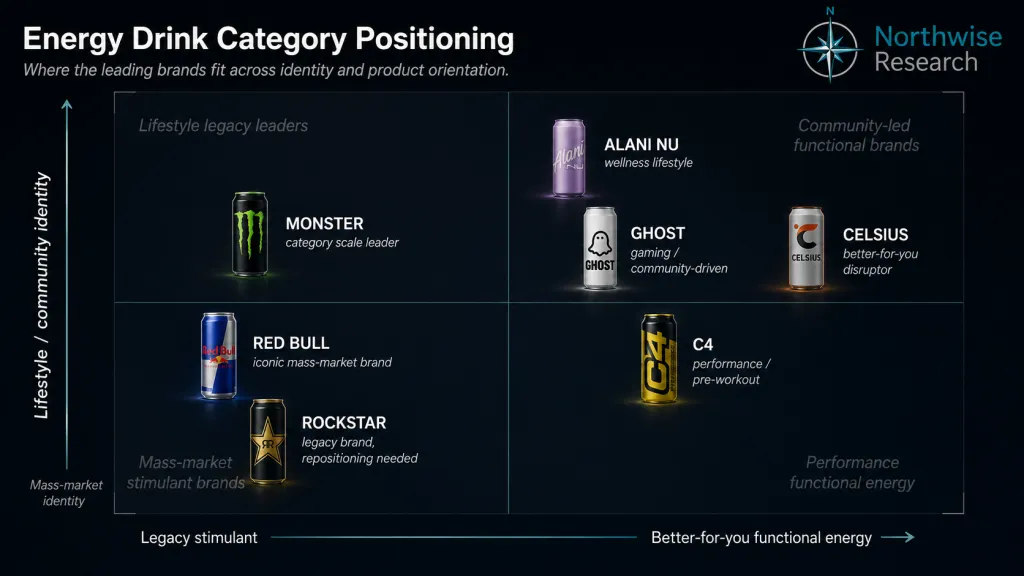
3.4 Category Growth Versus Brand Share Risk
The most important framing inside the category is the distinction between category growth and brand share. Energy drink category growth has remained strong, but individual brand share is much more volatile than category-level numbers suggest. Celsius gained share rapidly through the 2021 to 2024 period, then gave some of it back as Alani, Ghost, and other better-for-you brands accelerated. Monster has continued growing in absolute terms while ceding small amounts of U.S. share to faster-growing competitors and then offsetting that with international expansion.
That structure is useful for the model. The category itself supports growth assumptions that are higher than most consumer staples categories can credibly support. The brand share assumptions need to be more disciplined, given that the same dynamic that allowed Celsius to take share quickly also allows newer brands to do the same. A model that assumes both rapid category growth and steady share gains across every Celsius Holdings brand is asking for outcomes that the category itself has rarely produced over a five-year horizon.
3.5 Why Monster Is the Correct Benchmark
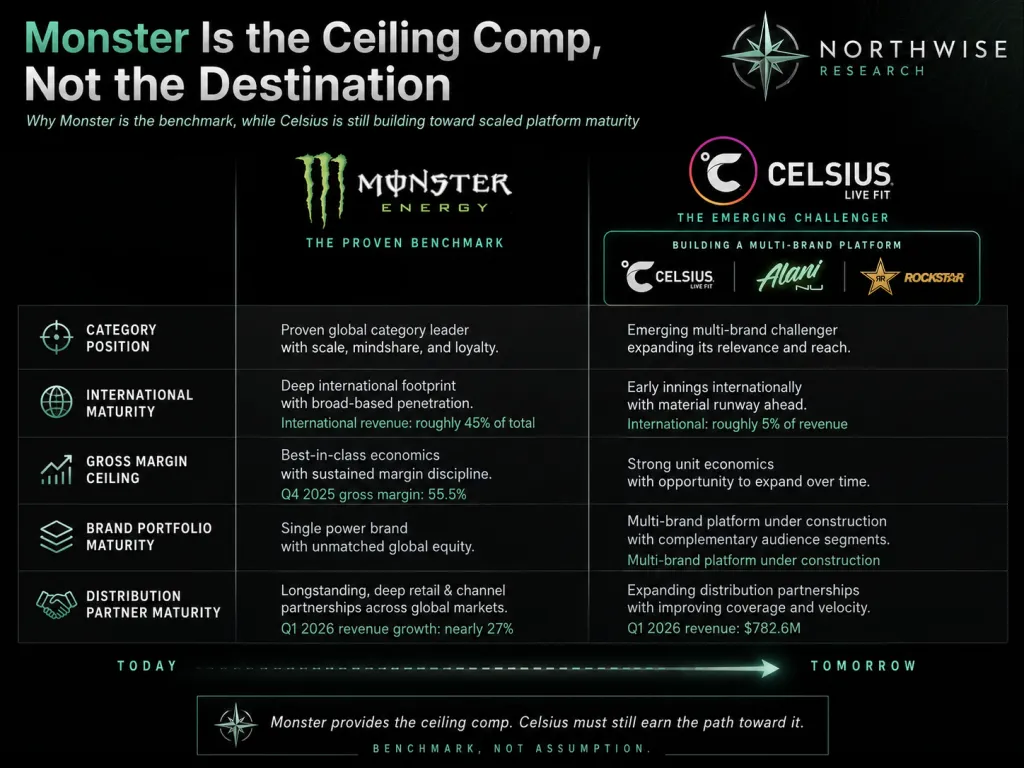
Monster is the right benchmark for this report for two reasons. First, Monster is the closest public-market analog to what Celsius is trying to become. It operates a multi-brand energy portfolio routed through a major beverage distribution partner, generates Monster-leading category margins, and has demonstrated international portability of energy brands at scale. Second, Monster's historical valuation through its own scaled growth phase provides a clean multiple reference that a 20%-plus EPS compounder in energy can earn.
Monster's recent results show category strength remains intact. Q4 2025 net sales rose 17.6% to $2.13B with a 55.5% gross margin. Q1 2026 revenue rose nearly 27% to $2.35B, with international revenue jumping almost 45% to more than $1B, representing about 45% of total revenue. From 2010 to 2018, Monster's revenue rose from $1.30B to $3.81B and net income from $212M to $993M, implying roughly 14% revenue and 21% net income compound annual growth. Monster's market capitalization sat near $29.9B in late 2018 against 2017 net income of $821M and 2018 net income of $993M, implying a trailing P/E somewhere between 30x and the mid-30s during that scaled growth period.
That history is the multiple anchor for this report. Celsius does not deserve to trade at Monster's earnings multiple today, but a compounder of similar growth quality with a disciplined integration path can credibly earn a multiple inside Monster's historical scaled-growth range, with a discount applied for the durability questions still in front of it.
4. Monster as the Ceiling Comp
4.1 Monster's Growth at Scale
Monster's relevance to this report is not just that it competes with Celsius. It is that Monster has already done the thing Celsius is trying to do. The company built one brand into category dominance, layered on a second-tier brand portfolio over time, transitioned its distribution into a global beverage partner's system, and scaled internationally to the point where overseas markets now generate roughly half of revenue.
The growth at Monster's current scale is the most informative part of the comparison. A company generating more than $9B in annualized revenue and still posting 17% to 27% quarterly growth is not a maturing consumer staples business. It is a category-leading platform participating in a category that itself remains growing. That backdrop matters for any forecast that assumes Celsius can compound through 2030 without the category itself running out of room.
4.2 Monster's Margin Structure
Monster's gross margin sits in the 54% to 56% range in recent quarters. That margin reflects a mature distribution structure, decades of procurement scale, manufacturing efficiency, and a brand portfolio that can absorb input cost pressure through pricing. It is the practical ceiling for what a scaled energy company can earn at the gross level.
Celsius today operates several hundred basis points below that ceiling. The path to closing some of the gap is real but not automatic. Pepsi distribution helps. Acquisition synergies help. Scale across Celsius, Alani, and Rockstar should help. Private-label pricing pressure, promotional intensity, freight cost volatility, aluminum costs, and the cost of supporting Rockstar's repositioning all push the other way. The model treats Celsius as moving toward Monster-like economics across the period without ever reaching them.
4.3 Monster's Historical Multiple
The most useful multiple reference for Celsius is Monster's own multiple during its scaled growth period. In late 2018, with trailing net income near $1B and growth still running in the high teens to low 20s, Monster traded at roughly a 30x to mid-30s P/E. The market was paying a premium for a category-leading energy compounder with proven international scale and category-leading margins.
That precedent matters due to the question it answers, one that comes up repeatedly with Celsius. The skeptical view often anchors on a generic beverage multiple in the 15x to 22x range, implying that energy is just another packaged consumer category. The historical evidence suggests something different. A scaled energy operator with category-leading margins, proven international expansion, and durable growth has earned a multiple meaningfully higher than the generic staples comp set during its scaled growth phase. Celsius will not earn the full Monster multiple inside this forecast window. It can credibly earn a multiple that is high enough to make the model work, particularly if margin convergence and platform durability prove out.
4.4 Why Celsius Deserves a Discount
The discount to Monster is not a minor technical adjustment. It reflects several real differences that should hold across the forecast period.
Monster has decades of proven category dominance. Celsius has the better-for-you segment leadership but does not yet have the same category control across the full energy space. Monster's international business is roughly 45% of revenue. Celsius's is about 5%. Monster's brand portfolio has been integrated and refined over multiple decades. Celsius is still inside the acquisition integration phase, with Alani and Rockstar both unproven inside the new platform structure. Monster's relationship with Coca-Cola has matured into something close to a stable equilibrium. Celsius's relationship with Pepsi is younger, includes recent governance changes, and still carries inventory-timing volatility in reported results.
The discount to Monster should compress over time if Celsius executes well, but it should not disappear. The bear, base, and bull cases all carry Monster discounts of varying severity. The international breakout case is the only path in which Celsius begins to approach Monster's multiple framework, and even there the model holds the multiple below peak Monster levels.
4.5 What Celsius Can Borrow From the Monster Playbook
The Monster playbook offers Celsius several practical lessons that the report assumes management understands. International expansion has to follow the right distribution partner rather than be forced through ill-fitting channels. A second-tier brand portfolio (Reign, Bang, Predator, others on Monster's side) extends category occupancy without diluting the flagship brand if managed carefully. Promotional discipline is the underrated determinant of long-run margins in energy, more important than any single input cost.
The risk to Celsius is the reverse of the playbook. International expansion that runs ahead of distribution support tends to fail. A second-tier portfolio that competes with the flagship rather than extending category occupancy can destroy share. Promotional intensity that responds aggressively to private-label entry can compress margins permanently if the playbook becomes reactive rather than disciplined. Each of those failure modes is visible in the broader beverage history, and each is a real risk inside the Celsius forecast.
5. The Celsius Platform Today
5.1 Core Celsius
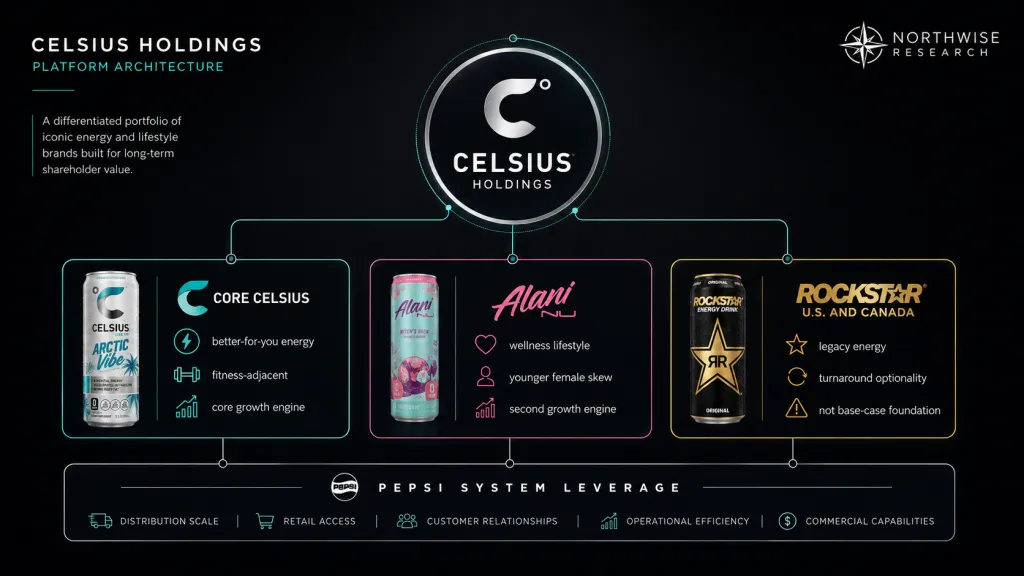
Core Celsius remains the largest single brand inside the portfolio and the primary driver of consolidated economics. The brand sits in the better-for-you energy segment with a fitness-adjacent identity, zero-sugar positioning, and a flavor profile that has resonated particularly well with younger and female consumers compared with legacy energy brands.
The most important debate inside the core brand is whether scanner velocity continues to grow at a pace that justifies the model's revenue assumptions. North America is the more mature market for the brand. The convenience channel has been a meaningful tailwind, the grocery channel has been steady, and the club channel has been strong but is now exposed to private-label competition. The brand's social media presence remains active, and the consumer cohort it built during the 2021 to 2024 phase continues to age into higher purchasing power. That is a stronger base than the more skeptical readings of the stock currently imply, though it does not justify assuming the original growth rate is repeatable.
5.2 Alani Nu
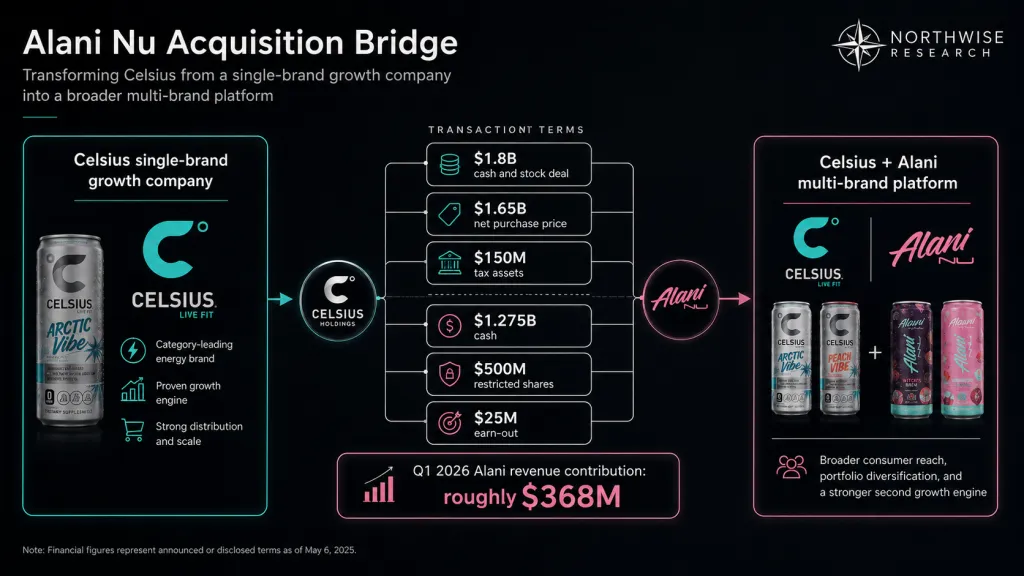
Alani Nu is the most important acquisition in the company's history and the largest swing factor inside the base case. The brand was acquired in February 2025 for a $1.8B cash and stock deal that included a $1.65B net purchase price plus $150M in tax assets, $1.275B in cash, a $25M earn-out, and $500M in newly issued restricted Celsius shares. The combined Celsius and Alani platform was expected to generate roughly $2B in annual sales at closing.
The brand's contribution has been larger than expected. Alani contributed roughly $368M of revenue in Q1 2026 and approximately $370M in Q4 2025, which makes it a meaningful share of consolidated revenue rather than a side acquisition. That growth has come from a wellness-leaning, female-skewing consumer base that the core Celsius brand was less optimized to capture.
The risk inside Alani is durability. The brand has benefited from influencer-driven momentum, an active social presence, and a flavor pipeline that has so far kept the consumer engaged. Influencer-led growth is harder to underwrite at scale than distribution-led growth, given that the rate of new consumer acquisition tends to fade once the early adopter wave saturates. The model holds Alani as a meaningful contributor across all cases but does not assume it continues compounding at the early acquisition pace indefinitely.
5.3 Rockstar U.S. and Canada
Celsius did not acquire Rockstar globally. The company acquired the U.S. and Canada brand rights from Pepsi, while Pepsi retains international ownership. That detail matters for the model and for how the brand should be understood strategically.
Rockstar's history complicates the turnaround discussion. Pepsi acquired the brand for roughly $4B in 2020 and spent several years attempting to reposition it through reformulations, packaging redesigns, and shelf placement changes. The brand lost cultural relevance during that period and ceded share to better-for-you competitors faster than Pepsi could repair it. Selling the U.S. and Canada rights to Celsius reflected, among other things, an acknowledgment that the brand fit better inside a more focused energy operator than inside Pepsi's much wider beverage portfolio.
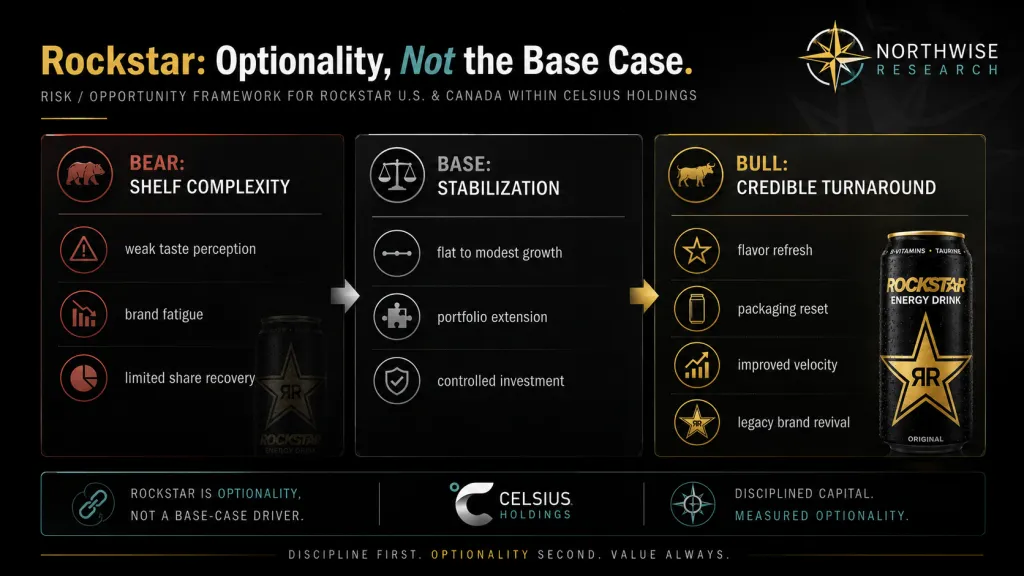
The base case treats Rockstar as flat to modestly improving. The bull case assumes Celsius successfully refreshes the brand and uses it to extend portfolio reach into a slightly different consumer segment. The bear case treats Rockstar as ongoing shelf complexity without meaningful turnaround. The brand is optionality, not foundation, and the report should be honest about that distinction. There is one piece of leadership context worth noting here, which is covered in the management section: the executive who led Rockstar's integration into Pepsi is now Celsius's President and COO.
5.4 International Celsius
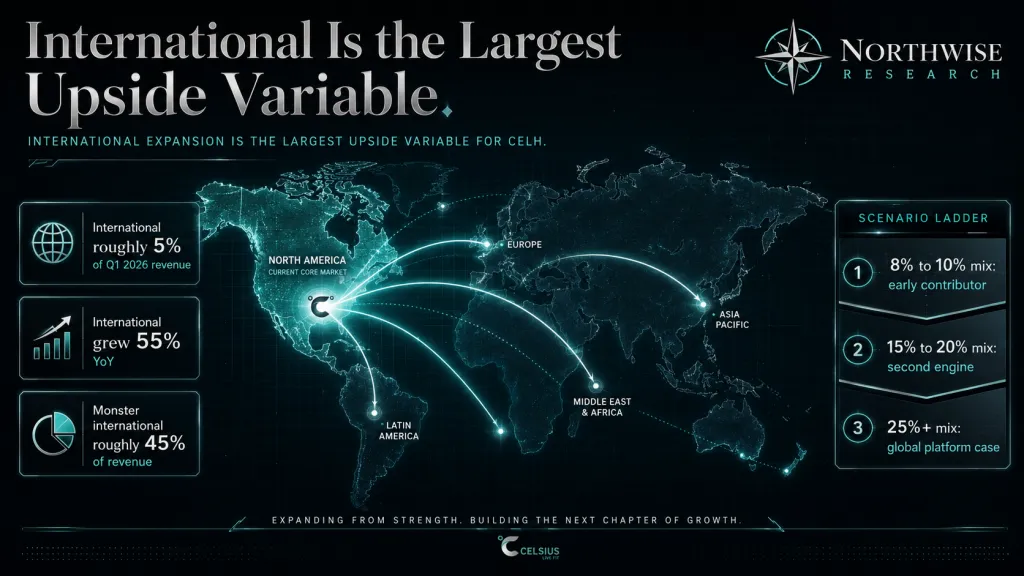
International remains small in absolute terms. The segment grew 55% in Q1 2026 but still represented only about 5% of total revenue. That is meaningful as a directional signal and immaterial as a base of operations. The model does not assume international becomes a major contributor inside the bear or base case, but it does include an upside overlay where international becomes a real second growth engine.
The Monster comparison is informative here. Monster moved international from a marginal segment into roughly half of revenue over a multi-decade arc. Celsius will not replicate that path inside a four-year forecast window, but it can credibly move international from 5% of revenue toward something in the 8% to 20% range depending on execution and distribution support. The international breakout case assumes a path closer to the upper end of that range, which is the conditional path on which the highest scenario price targets depend.
5.5 Portfolio Fit Across Consumer Segments
The combined portfolio covers more consumer occasions than the original Celsius brand alone could reach. Celsius leans into fitness-adjacent functional energy. Alani sits in wellness and lifestyle. Rockstar U.S. and Canada offers legacy stimulant positioning. Together, the platform participates in a wider slice of the energy category than any single brand inside it, which is a meaningful structural advantage if managed without cannibalization.
The risk is cannibalization. Two of the three brands sit close enough in consumer mindshare that promotional decisions, shelf placements, and marketing budgets need to be coordinated carefully. Mismanagement could turn the portfolio into internal share trade rather than category expansion. The model assumes coordination is imperfect but not destructive. The bear case assumes more cannibalization than the base case, which is one reason the bear margin assumptions decline meaningfully.
5.6 Why This Is Now a Platform Story
The word platform gets used loosely in consumer staples, so it is worth defining what the term means here. A platform business in beverages has three characteristics: it operates multiple brands that share distribution and procurement infrastructure, it can extend that infrastructure to new brands without rebuilding from scratch, and it earns higher returns on incremental brands than a single-brand operator could achieve.
Celsius now meets all three criteria, though the third is still being proven. Pepsi distribution is the shared infrastructure. Alani and Rockstar are the two acquired brands tested inside it. The economics of those two additions are the test of whether the platform model actually produces incremental returns or whether it simply produces more revenue at lower returns. The model assumes the platform earns incremental returns, but with margins that converge toward Monster rather than equal Monster. That is the practical definition of a successful but not perfect platform outcome.
6. The Pepsi Relationship
6.1 Pepsi's Original 2022 Investment
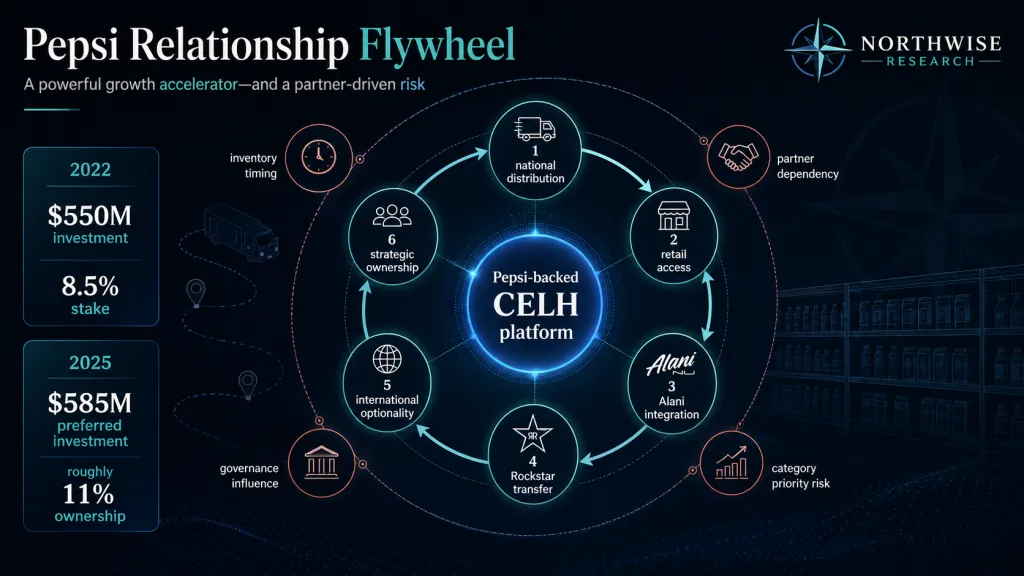
Pepsi's original investment in Celsius came in August 2022. The deal involved $550M for an 8.5% minority stake along with the assignment of U.S. distribution to Pepsi's direct-store-delivery network. That single agreement changed the strategic identity of the company. Before the deal, Celsius was a strong brand with patchy distribution. After it, Celsius was a Pepsi-distributed national brand with a much higher ceiling on retail penetration.
The pricing of that original deal also matters. Pepsi acquired its stake at a meaningful discount to where Celsius eventually traded during the 2023 to 2024 phase, which means the partnership produced strong economics for Pepsi independent of the distribution synergies. That tends to be true of strategic beverage investments more broadly. The category is hard to disrupt, so the established players are often willing to pay for early stakes in fast-growing brands when those stakes also lock in distribution rights.
6.2 Pepsi's Expanded 2025 Investment
Pepsi expanded its position in August 2025 with a $585M investment in newly issued convertible preferred stock, lifting its ownership to roughly 11%. The expanded deal was structurally important for three reasons. It integrated Alani into Pepsi's U.S. and Canada distribution network. It included the transfer of the U.S. and Canada Rockstar rights to Celsius. And it expanded Pepsi's board nomination rights, giving the partner more structural influence over the platform's direction.
The expanded ownership did several things at once. It deepened the strategic alignment between the two companies. It gave Pepsi a clearer financial stake in Celsius's success. It also concentrated the relationship's importance further, which becomes a risk if priorities diverge. That trade-off, between deeper alignment and deeper dependency, is the central tension in the relationship.
6.3 Pepsi as Distributor, Strategic Partner, and Governance Actor
The Pepsi relationship now operates across three layers. Pepsi is the primary distributor for the U.S. and Canada platform. Pepsi is the strategic partner whose category planning and retail relationships affect Celsius's shelf positioning. Pepsi is also a governance actor whose ownership stake and board representation influence corporate-level decisions.
Each layer carries different implications. The distribution layer affects unit economics directly. The strategic layer affects competitive positioning. The governance layer affects capital allocation, M&A discipline, and management oversight. The model treats each layer as a net positive but with associated risks. Distribution is a powerful accelerator subject to inventory-timing volatility. Strategic partnership is a credibility signal subject to changes in Pepsi's own category priorities. Governance influence is alignment-inducing subject to friction if shareholder and Pepsi interests diverge on specific decisions.
6.4 Benefits of the Pepsi System
The benefits of routing distribution through Pepsi are concrete. National convenience-store penetration improved sharply after the 2022 deal. Grocery placement broadened. Foodservice and college campus opportunities became available at scale. Alani's integration into the same system has accelerated its trajectory faster than would have been possible inside a smaller distribution network. International market entry is materially easier with a partner that already operates in those geographies.
Those benefits are real, and they remain a core part of the bull case. The risk is not that the benefits go away. The risk is that the benefits are already mostly priced in by the time the next round of integration concludes, leaving the equity dependent on operational execution that is harder to forecast than distribution-driven growth.
6.5 Risks of Pepsi Dependency
The dependency risks are equally concrete. Pepsi can adjust inventory levels to optimize its own working capital, which can create reported revenue volatility even when consumer sell-through remains stable. Pepsi has other beverage priorities, including its own energy SKUs and partner brands, and those priorities can affect shelf advocacy and promotional support. Pepsi's category planning decisions can affect retail positioning in ways that benefit some Celsius Holdings brands more than others. The governance influence creates the possibility of slow-moving disagreements over portfolio decisions, capital allocation, or M&A.
The model does not treat these risks as catastrophic. It does treat them as structural. Pepsi dependency is one of the reasons Celsius deserves a discount to Monster's multiple framework even in scenarios where execution is strong. A business that depends heavily on a single distribution partner is structurally less resilient than a business with a diversified distribution base, regardless of how attractive the current partnership is.
6.6 Inventory Timing and Reported Revenue Volatility
Inventory timing has been a persistent analytical complication. There have been periods in the recent history where Celsius reported revenue weakness driven by Pepsi reducing orders to optimize inventory, while underlying consumer sell-through remained healthier than the headline implied. The market often reads these quarters as deceleration rather than inventory normalization, which produces sharper stock moves than the underlying business warrants.
The analytical fix is to triangulate between shipment data and scanner data rather than relying on the reported revenue number in isolation. That is harder than it sounds, given that scanner data captures only the tracked channels and misses meaningful pieces of the platform's footprint. Still, the discipline matters. A reader who only tracks reported revenue will misread the business in either direction during inventory transitions.
6.7 Why Pepsi Can Accelerate the Platform Without Removing Execution Risk
The cleanest framing for the Pepsi relationship is that it raises the platform's ceiling without removing the platform's execution risk. Pepsi makes more outcomes possible. Pepsi does not make any specific outcome guaranteed. Celsius still has to execute brand management, integration discipline, promotional strategy, and category planning at a level that justifies the distribution leverage Pepsi has already provided.
That distinction matters for the model. The bull case assumes execution quality remains high enough to capture the available platform upside. The base case assumes execution quality is solid but imperfect. The bear case assumes execution friction compresses what should have been a strong outcome. In all three cases, Pepsi is the same partner with the same capabilities. The variable is what Celsius does with the access Pepsi provides.
7. Alani Nu and the Acquisition Layer
7.1 Why Celsius Bought Alani Nu
The strategic logic of the Alani acquisition is straightforward. Single-brand growth companies in beverages face a structural ceiling once they reach the limits of their consumer segment. Adding a complementary brand with a different consumer profile extends the runway. Alani's wellness and lifestyle positioning sat close enough to Celsius's fitness-adjacent identity to share distribution infrastructure but far enough away to capture a different consumer base.
That logic is supported by Monster's own history. The company built scale on its flagship brand, then layered on additional energy brands over time to extend category occupancy without diluting the original positioning. Celsius is attempting a similar path on a faster timeline, with the difference being that the acquired brand arrived as an established business rather than being grown from inside the company.
7.2 Alani's Consumer Positioning
Alani's positioning skews younger and more female than the core Celsius brand. The product line includes energy drinks, hydration, protein, and adjacent wellness categories, with packaging and marketing built around lifestyle moments rather than fitness performance. That positioning has proven durable across the early integration period, with Q1 2026 contribution of roughly $368M demonstrating that the brand has not lost meaningful momentum inside the new ownership structure.
The strategic risk is positioning drift. A brand that is repositioned too quickly inside a larger company can lose the cultural specificity that made it relevant in the first place. The model assumes management understands this risk and protects Alani's identity, particularly during the period in which Pepsi distribution integration could create pressure to standardize marketing approaches across the portfolio.
7.3 Alani's Early Financial Contribution
The financial contribution has been substantial. Alani contributed roughly $368M of revenue in Q1 2026 and approximately $370M in Q4 2025, which makes it one of the largest brand acquisitions in recent beverage history measured by post-deal contribution. That pace exceeded most analyst expectations at the time of the acquisition announcement and helped explain part of the 138% year-over-year revenue growth in the most recent quarter.
The interpretive complication is that quarter-on-quarter Alani contribution is being affected by Pepsi distribution integration, which created both inventory build effects and promotional support that may not be repeatable at the same intensity going forward. The model uses a flattened path for Alani contribution across the forecast period rather than extrapolating the early integration trajectory, on the view that integration-driven growth eventually normalizes into category-driven growth.
7.4 Distribution Transition and Pepsi Reimbursement Mechanics
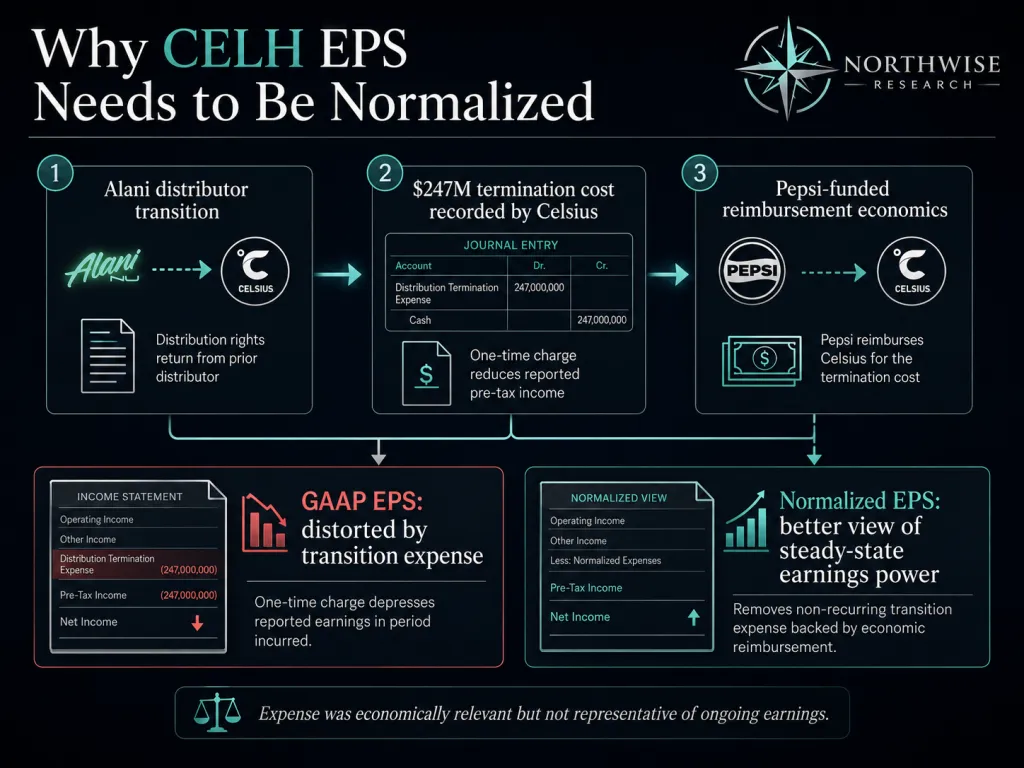
The distribution transition has produced one of the more confusing accounting features in recent Celsius results. The company incurred a $247M distributor termination cost in Q3 2025 tied to moving Alani Nu into Pepsi's network. The expense was funded by Pepsi but fully accounted for in Celsius's GAAP earnings, which produced a surprise net loss for the quarter while adjusted EPS remained at $0.42.
The right way to read that quarter is that the GAAP number understated the economic reality of the business. The cash flow was funded by Pepsi, the termination unlocked a more attractive long-run distribution structure, and the underlying brand performance remained intact. The wrong way to read it is to treat the GAAP loss as evidence of deteriorating fundamentals. The accounting did not match the economics during the transition period.
7.5 GAAP EPS Distortion Versus Normalized Earnings
The broader analytical point is that valuation needs to use normalized earnings during this transition period. GAAP EPS has been distorted by acquisition-related expenses, distribution transition costs, and integration charges that do not reflect steady-state earnings power. Using a GAAP-only P/E screen on Celsius during 2025 and early 2026 produces a misleading picture of the business.
The model uses normalized net margin assumptions rather than GAAP net margin, with a path that converges toward Monster-like economics over time without reaching them. That approach gives a cleaner view of underlying earnings power and avoids the distortions caused by integration accounting. Investors who track GAAP EPS exclusively will continue to be surprised by quarterly volatility that has more to do with accounting than with operating reality.
7.6 Durability Risk in Influencer-Driven Brands
Alani's growth has been driven in part by influencer marketing, social media presence, and community engagement around its core consumer. That growth model is more efficient than traditional advertising at acquiring early consumers, but it is harder to underwrite at scale across multiple years. Influencer-driven brands tend to compound rapidly during the early adopter phase and then face a more difficult test once the broader consumer base has to be reached through traditional category-building mechanics.
The model holds Alani's growth at an attractive but moderating pace across the forecast period. It does not assume the brand fades, but it does not assume the early acquisition growth rate continues indefinitely either. That middle path is the most defensible assumption given the limited operating history of the brand inside the new platform structure.
8. Rockstar: Optionality or Distraction
8.1 Rockstar's History and Former Category Position
Rockstar was one of the major legacy energy brands during the category's early scale phase. It competed directly with Monster and Red Bull during a period when the energy category was dominated by traditional stimulant positioning rather than the better-for-you wave that later emerged. At its peak, Rockstar carried meaningful share, particularly in convenience-store distribution where energy purchasing skews most heavily.
The brand began losing relevance as the category evolved. Consumer preference shifted toward cleaner formulations, more functional positioning, and lighter caffeine profiles. Rockstar's identity was tied to the older energy moment, which made repositioning difficult. By the time better-for-you brands began taking meaningful share, Rockstar's cultural footprint had narrowed substantially.
8.2 Pepsi's Rockstar Ownership and Brand Fatigue
Pepsi acquired Rockstar in 2020 for roughly $4B. The strategic logic at the time was that Pepsi needed a stronger energy presence to compete with Coca-Cola's Monster partnership, and Rockstar was the largest available asset that fit inside Pepsi's distribution system. The execution challenge proved larger than expected. Pepsi spent several years on reformulations, packaging redesigns, and category repositioning without producing a durable share recovery.
That history matters for two reasons. First, it demonstrates that Rockstar is a genuinely difficult brand to repair, which should temper enthusiasm about a quick turnaround under Celsius ownership. Second, it suggests that Pepsi's decision to sell the U.S. and Canada rights reflected, at least in part, an acknowledgment that the brand fit better inside a more focused energy operator. That is consistent with how complex brand portfolios tend to evolve in beverages, with assets moving toward operators best positioned to focus on them.
8.3 What Celsius Actually Acquired
Celsius acquired the U.S. and Canada brand rights to Rockstar from Pepsi in 2025. Pepsi retains international ownership of the brand, which means the Celsius platform has access to the most economically relevant geography for energy drinks but does not have global brand control. That structure is workable but creates coordination complexity, particularly if Celsius eventually wants to push the platform's other brands into markets where Pepsi still owns Rockstar.
The acquired Rockstar business contributed roughly $67M in Q1 2026, which is a meaningful absolute number but a small share of consolidated revenue. The brand is not yet a major financial contributor at the platform level, which is one reason the model treats it as optionality rather than a foundational contributor.
8.4 Why Rockstar Still Has Upside
There are reasons to believe Rockstar can produce meaningful upside inside the Celsius platform. The brand still carries broad consumer recognition. Convenience-store shelf space for legacy energy brands remains valuable. Celsius's focus on energy specifically, rather than the broader Pepsi beverage portfolio, may allow more concentrated brand attention than the asset received during the Pepsi ownership period. The acquired distribution support and platform integration could allow targeted repositioning at a lower marketing cost than rebuilding from a standing start.
There is one specific factor that deserves explicit mention. Eric Hanson, the President and COO of Celsius effective March 2025, led Rockstar's integration into Pepsi after the $4B acquisition. He is now the senior operating executive responsible for managing the brand inside Celsius. That is an unusual setup. The executive who oversaw the brand during Pepsi's difficult repositioning phase is now leading its operation inside the new platform. That can be read two ways. It could mean management has the deepest possible institutional knowledge of what worked and what failed inside Pepsi. It could also mean the platform is repeating an approach that has not produced a successful turnaround before. The model gives Rockstar credit for the first reading inside the bull case and discount inside the bear case.
8.5 Why Rockstar Should Not Anchor the Base Case
Rockstar should not anchor the base case for one reason: there is no evidence yet that the brand can be turned around at scale inside any ownership structure. Pepsi tried for several years and did not succeed. Celsius is now attempting the same task with a smaller marketing budget and a more focused operating mandate. That combination is more favorable than Pepsi's setup, but it is not enough to justify treating the turnaround as the base assumption.
The base case treats Rockstar as flat to modestly improving across the forecast period, contributing meaningful absolute revenue without driving the model's outcomes. That treatment recognizes the brand's existing scale without assuming a recovery that has not yet been demonstrated.
8.6 The Turnaround Question
The Rockstar turnaround depends on a small set of variables that will become visible over the next several years. Taste reformulation is the first. The brand's flavor profile has not aged well against better-for-you alternatives, and meaningful share recovery probably requires updates that align the product with current consumer preferences. Packaging refresh is the second, with the goal of reducing the cultural distance between Rockstar's current identity and the lifestyle positioning that the broader category has adopted. Shelf-velocity recovery is the third, which depends on whether retailers see enough incremental scan data to maintain shelf space rather than reallocate it to other energy brands.
None of those variables are guaranteed. All three are observable. Investors who want to monitor the turnaround can track scanner data, retail shelf space, and management commentary on Rockstar specifically. The model assumes a modest improvement across these variables in the base case and a meaningful improvement in the bull case, with the bear case assuming the brand remains shelf complexity without becoming a financial contributor of any significance.
9. International Expansion
9.1 Why International Is the Largest Upside Variable
International expansion is the single largest upside variable in the model. The reasons are visible in the Monster comparison. Monster moved international from a marginal segment into roughly 45% of revenue over time. Celsius is starting from approximately 5% of revenue in international, with 55% growth in Q1 2026 demonstrating that the segment can compound rapidly off a small base.
If international becomes meaningful, the entire valuation framework shifts. The model carries an international breakout case that assumes international reaches 20% to 25% or more of revenue by 2030. That outcome is not the base case, but it is plausible enough to deserve explicit scenario treatment rather than being buried as a generic source of optionality.
9.2 Monster's International Mix as Proof of Category Portability
The most important fact about energy drink international expansion is that it works. Monster has demonstrated that energy brands can travel globally when distribution, pricing, packaging, and local market execution are managed carefully. The category is not culturally limited to the U.S., and the consumer behaviors that drive U.S. energy purchasing tend to exist in similar forms in most developed and emerging markets.
That portability is the precondition for any meaningful international scenario in the Celsius model. If the category itself did not travel, the international breakout case would not be credible. Because the category does travel, the open question is whether Celsius and Alani can execute the international playbook with the same discipline that allowed Monster to do so.
9.3 Celsius International Today
Celsius international today is a collection of early-stage markets with growing distribution and limited consolidated visibility into market-by-market performance. The segment's 55% Q1 2026 growth is encouraging but comes off a small base, which makes it more useful as a directional signal than as a quantitative anchor. The international footprint includes selected European markets and other geographies where Pepsi's distribution can be leveraged to accelerate launches.
The base case assumes international stays small relative to North America. The international breakout case assumes the platform's combined brands prove travel-friendly enough that Pepsi's global distribution network can scale the segment to the mid-teens or higher as a share of revenue by 2030. Between those two paths, the actual outcome will depend on how aggressively Pepsi prioritizes Celsius and Alani inside its international markets relative to other portfolio priorities.
9.4 What Must Happen for International to Matter by 2030
Several things have to go right for international to become material by 2030. Distribution partnerships need to extend to markets large enough to move the consolidated number, which means moving beyond early footprints into key European and Asian geographies. Brand positioning has to translate across cultures without losing the consumer identity that drove growth in the U.S. Pricing has to be set at levels that match local category economics rather than being imported from the U.S. directly. Local marketing has to be tailored enough to drive trial without burning capital at uneconomic levels.
Those are demanding conditions. They are also the same conditions Monster managed over two decades. The model gives Celsius credit for being able to compress the timeline somewhat due to the global beverage distribution infrastructure being more developed today than it was during Monster's international scale-up. The compression is partial, not total, which is why the international breakout case still requires several years of disciplined execution rather than instant scale.
9.5 Why International Belongs as an Upside Overlay, Not the Base Case
International belongs as an upside overlay rather than the base case for a simple reason. The historical base rate of international scale in beverages, even with strong distribution partners, is mixed. Brands that succeed internationally tend to take a long time to do so. Brands that fail tend to fail in ways that consume meaningful capital before being recognized.
That base rate suggests the right modeling discipline is to assume international remains a steady but moderate contributor in the base case while reserving the breakout outcome for a separate scenario with explicit lower probability. That structure preserves the upside in the framework without letting heroic assumptions leak into the base case where they would distort the most-likely outcome.
10. Management and Incentives
10.1 John Fieldly's Turnaround Role
John Fieldly joined Celsius as CFO in January 2012 during the most difficult period in the company's history. He became CEO in April 2018 and Chairman in August 2021. His tenure spans the survival phase, the Nasdaq return, the Pepsi partnership, and now the multi-brand platform construction. That arc gives him institutional knowledge of every major strategic decision the company has made over the past 14 years.
Fieldly has discussed the 2012 Costco delisting as one of the scariest moments in the brand's history. The fact that the same executive who lived through that experience is now leading the company through a new period of Costco-related risk via Kirkland Signature's category entry is worth noting. Institutional memory does not eliminate risk, but it tends to produce more measured responses to channel pressure than an executive seeing it for the first time would manage.
10.2 Leadership Through the Survival Phase
The survival phase produced an operating culture worth understanding. A company that has been delisted, repositioned, and rebuilt tends to retain certain habits even after the growth phase begins. Cost discipline tends to be tighter than peers. Distribution decisions tend to weigh durability more heavily than absolute scale. Partnership management tends to favor strategic depth over breadth. Those habits are not universal protections, but they tend to produce slightly more durable outcomes in difficult periods than peers without the same survival experience.
That cultural inheritance is one of the underappreciated factors in the Celsius story. The current management team is not running a company that has only known growth. It is running a company that has lived through several near-failures and remembers them. That tends to matter at the margin when category dynamics shift.
10.3 Operating Style and Acquisition Discipline
Fieldly's operating style has emphasized partnership building rather than going-it-alone scale. The Pepsi relationship is the clearest example. The Alani acquisition is another, with the deal structured around continuing relationships with the founders and the Congo Brands principals rather than a clean separation. The Rockstar acquisition similarly preserved alignment with Pepsi rather than rupturing the distribution relationship.
That style has produced strong outcomes during the platform-building phase. It also creates dependencies. A company that prefers partnership-driven scale tends to be more exposed to partner-related risks than a company that prefers internal scale. The trade-off has worked well so far, but it is a real feature of how the company operates and deserves to be tracked.
10.4 Executive Ownership and Compensation Items
Fieldly directly held 929,065 shares of Celsius common stock following a routine RSU tax withholding event in May 2026. That stake represents a meaningful equity position rather than purely option-based compensation, which aligns the CEO's incentives with shareholders directly rather than through option-driven asymmetric upside alone.
The compensation structure includes performance stock units with future vesting events tied to operational and TSR metrics, with a notable PSU and kicker event scheduled for March 2027. The 2024 compensation cycle included substantial option exercises, which is worth monitoring through Form 4 filings as those exercises can create selling pressure around vest and exercise dates. The 2022 Say-on-Pay vote was 59.9%, which prompted compensation program adjustments in the following years to better align pay with performance.
A reader can take two views of the structure. The first is that the equity stake plus PSU framework creates meaningful alignment with long-term shareholder outcomes. The second is that the compensation history has involved enough complexity to warrant continued monitoring rather than passive acceptance. Both views are defensible, and the model treats management alignment as a moderate positive rather than a strong positive while leaving room for adjustment as future proxy disclosures become available.
10.5 Eric Hanson as President and COO
Eric Hanson was appointed President and COO effective March 24, 2025, in a newly created role reporting to Fieldly. His background is unusually relevant to the platform's current strategic position. He spent nearly three decades at PepsiCo, most recently as Senior Vice President of Strategic Partnerships, where he worked directly with Celsius, Keurig Dr Pepper, and Tropicana. Before that, he served as Senior Vice President of Energy Drinks at Pepsi, where he led the integration of Rockstar into the Pepsi system after the $4B acquisition.
That background carries both promise and complication. The promise is institutional depth. The executive responsible for Celsius's operational integration is the same executive who managed the Pepsi-Celsius relationship from the partner's side, which should reduce friction around distribution and category coordination. He also brings the most relevant possible knowledge of what worked and what failed during Pepsi's attempted Rockstar repositioning, which is directly applicable to the Celsius-owned U.S. and Canada Rockstar business now.
The complication is that the Pepsi Rockstar repositioning did not produce a successful turnaround during Hanson's tenure leading it. That history can be read as a strong negative indicator about Rockstar's prospects under any ownership, or as a useful learning experience that informs a better approach the second time around. The model carries the second reading inside the bull case and the first reading inside the bear case. A reader should hold both possibilities open until the brand's trajectory inside Celsius becomes visible.
10.6 What Management Must Prove Next
The next several years will test management on a specific set of variables. Alani integration discipline is the first, with the goal of preserving the brand's identity inside the Pepsi distribution system. Rockstar revival or graceful stabilization is the second, with the bar set at producing a credible answer either way rather than allowing the asset to drift. International execution is the third, with the test being whether Pepsi's global distribution can be translated into category-relevant Celsius and Alani positioning rather than just incremental shipping volume. Margin convergence toward Monster is the fourth, with the bar being meaningful structural improvement rather than periodic noise.
Each of those tests is observable. Each will produce data points across the forecast period that allow the thesis to be updated rather than relying on the model's current assumptions alone. The platform-building phase is largely complete. The operating phase is what the next several years will judge.
11. Financial Foundation and Model Architecture
11.1 Current Revenue Baseline
Q1 2026 revenue was $782.6M, up 138% year over year, with adjusted EPS of $0.41. Alani contributed roughly $368M, Rockstar contributed approximately $67M, and international grew 55% off a small base. Q4 2025 revenue was $721.6M, up roughly 117%, with Alani contributing approximately $370M.
Those numbers cannot be annualized linearly. The Q1 print captures a peak phase of Pepsi distribution integration, Alani contribution growth, and Rockstar inclusion that is unlikely to repeat at the same rate across the full year. A flatter view of full-year 2026 revenue produces a more useful baseline.
The model uses 2026 full-year revenue baselines of $3.35B to $3.55B depending on scenario. That range reflects continuing contribution from the expanded portfolio, Pepsi distribution support across both Celsius and Alani, Rockstar's full-year inclusion, and continued category growth, while applying enough discipline to avoid extrapolating Q1's 138% growth rate forward.
11.2 Brand-Level Revenue Bridge
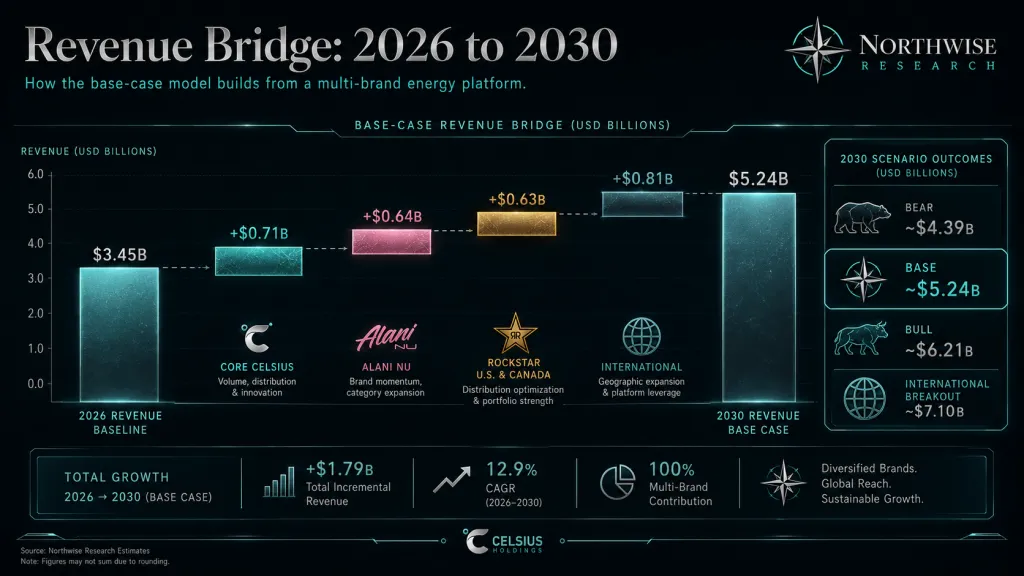
The 2026 baseline can be roughly disaggregated. Core Celsius North America contributes the largest single share but with growth normalizing from the original brand's earlier trajectory. Alani contributes a substantial share, with the early-integration acceleration moderating across the year as Pepsi distribution effects flatten. Rockstar U.S. and Canada contributes meaningful absolute revenue but a smaller share of the consolidated base. International remains at roughly 5% of revenue with high growth off a small base.
That brand structure matters for the forward forecast. The largest growth contributors over the 2026 to 2030 window are likely to be a moderately growing core Celsius, a Alani that compounds at a healthy but moderating rate, an international segment that grows quickly off a small base, and a Rockstar that either turns around modestly or stays flat. The bear case shifts each of those assumptions downward and adds margin pressure. The bull case shifts them upward without going past Monster-level outcomes.
11.3 Gross Margin Framework
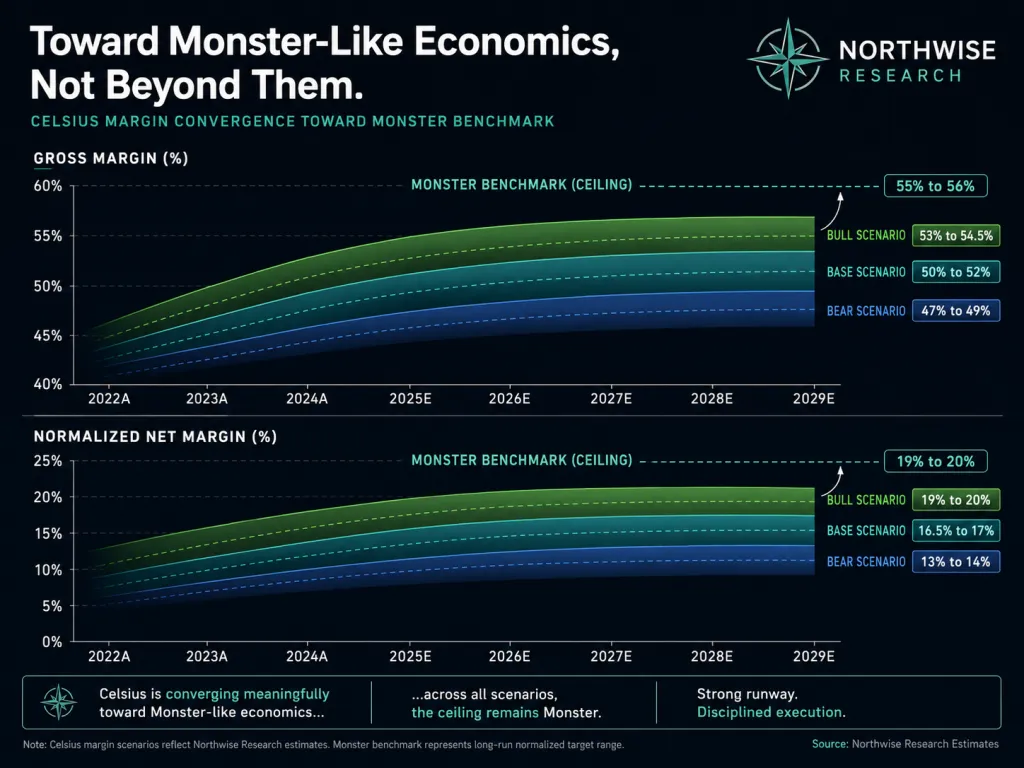
Monster's gross margin in recent quarters has been roughly 55% to 56%. Celsius today operates several hundred basis points below that ceiling. The model treats the gross margin trajectory as a convergence story across the forecast period.
The bear case assumes gross margin sits in the 47% to 49% range, reflecting promotional pressure from private-label entry, freight and aluminum cost volatility, integration drag, and a less favorable mix from Rockstar. The base case assumes 50% to 52%, reflecting meaningful structural improvement from scale and platform integration while staying below Monster. The bull case assumes 53% to 54.5%, reflecting near-Monster economics with the remaining gap closed by mix and procurement scale. The international breakout case assumes the upper end of the bull range with additional support from international mix.
11.4 Normalized Net Margin Framework
Normalized net margin assumptions are tied to the gross margin path but reflect additional operating leverage from scale. Monster has historically run normalized net margins in the high teens to low 20s during its scaled growth phase. The model treats Celsius as moving toward that range without reaching it.
The bear case assumes normalized net margin of 13% to 14%. The base case assumes 16.5% to 17%. The bull case assumes 19% to 20%. The international breakout case assumes 20% to 22%. Those figures sit below the Monster ceiling in all scenarios except the international breakout, where they approach but do not exceed Monster's structural margin level.
11.5 Share Count and Preferred Stock Treatment
The current diluted share count framework needs to account for the preferred stock issued to Pepsi in the 2025 expansion. The $585M of newly issued convertible preferred stock converts into common at terms set in the agreement, which need to be incorporated into any diluted share count assumption. Equity-based compensation continues to produce modest annual issuance offset to varying degrees by buyback activity.
The model uses 2030 diluted share counts of 265M in the bear case, 258M in the base case, 252M in the bull case, and 250M in the international breakout case. Those figures reflect different assumptions about buyback capacity, additional issuance, and the timing of preferred conversion across scenarios. The bear case assumes more dilution from limited buyback capacity. The bull and breakout cases assume stronger cash generation supports more share absorption.
Those share count assumptions should be treated as working estimates rather than precise targets, and a reader monitoring the thesis should track quarterly diluted share counts, preferred conversion mechanics, and any buyback activity to refine the model over time.
11.6 Why EPS Must Be Normalized
The most important modeling discipline in Celsius today is using normalized EPS rather than GAAP EPS for valuation purposes. GAAP EPS has been distorted by integration-related charges, the Pepsi-funded Alani distributor termination cost of $247M in Q3 2025, and other transition items that do not reflect steady-state earnings.
A reader who values Celsius on a GAAP earnings basis during this transition period will systematically underestimate the underlying earnings power. A reader who ignores the GAAP charges entirely will overestimate it, since some of them reflect real economic costs even if Pepsi-funded. The right discipline is to use normalized EPS as the valuation anchor while monitoring GAAP EPS for new charges that may signal ongoing integration friction rather than one-time transition expense.
11.7 Model Inputs and Operating Assumptions
The model architecture moves from revenue baseline through revenue CAGR to 2030 revenue, then applies normalized net margin to derive normalized net income, then divides by diluted shares to produce normalized 2030 EPS. The path is explicit and auditable, with every step visible rather than buried inside an aggregated output.
The full operating assumptions and scenario outputs are developed in the scenario analysis section below. Those assumptions are demanding without being heroic. They sit close enough to Monster's historical scaled-growth trajectory to be supported by category precedent, while remaining disciplined enough to absorb the additional execution risks specific to Celsius's current platform-building phase.
12. Risk Assessment
12.1 Costco and Private-Label Energy Risk
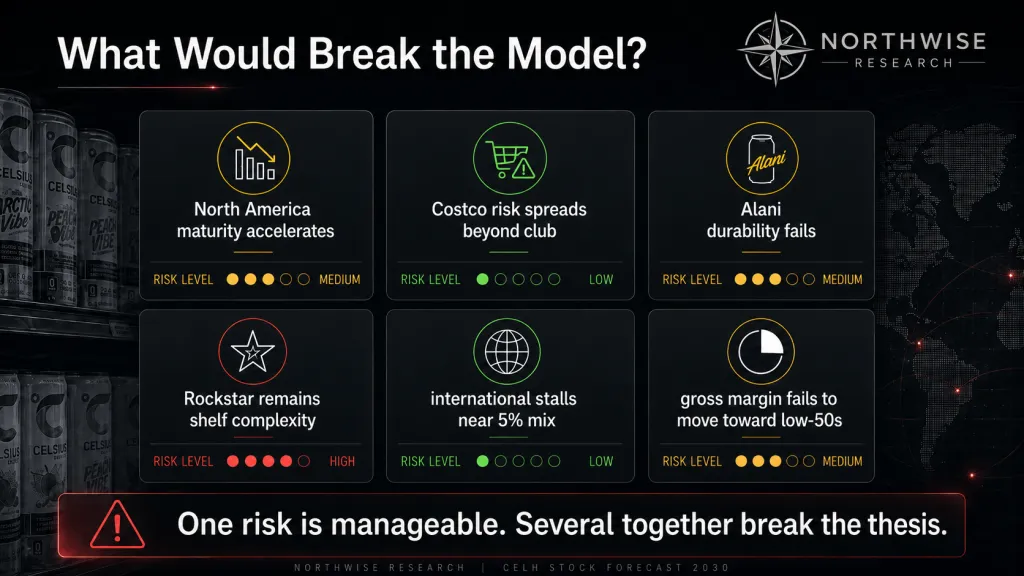
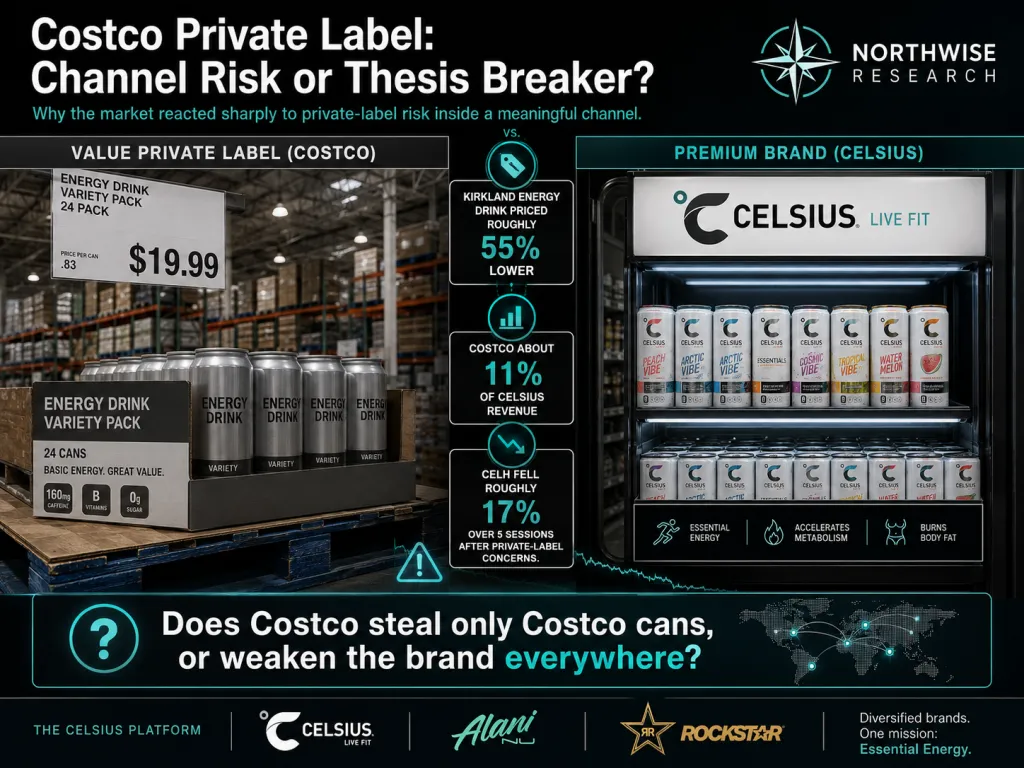
The Costco Kirkland Signature energy drink launch is the most-discussed near-term risk facing the platform. The product launched at roughly 55% below comparable better-for-you energy drinks, with packaging and flavor positioning close enough to Celsius to draw the comparison directly. Costco accounts for approximately 11% of Celsius revenue, which makes the channel exposure meaningful even before considering broader pricing implications.
The risk is not only the channel itself. The deeper concern is that Kirkland's pricing creates a lower anchor for the better-for-you energy category overall. Costco is unusual among private-label operators for the quality of its execution and the strength of its consumer perception. A successful Kirkland product can pressure pricing across the category, not just inside the Costco channel itself. The five-session 17% stock decline that followed the launch announcement reflects the market's recognition of that broader risk.
The mitigating factor is brand strength. Costco can pressure price and volume inside the club channel. It probably cannot replicate the full Celsius brand loop across convenience stores, grocery, Amazon, gyms, universities, social media, vending, and the international markets where Celsius is building presence. The relevant question is whether Kirkland's effect remains contained to the Costco channel or whether it spreads into broader scanner data across other retailers. The model assigns a moderate probability to the second outcome through the bear case and the broader probability weighting.
12.2 Pepsi Dependency
Pepsi dependency is a structural rather than acute risk. The relationship is currently aligned, but the platform's reliance on a single distribution partner means that any future divergence in priorities could affect reported results disproportionately. Pepsi's own beverage portfolio includes brands that compete with Celsius and Alani at the category level, and decisions about category strategy, shelf placement, and promotional support are made inside an organization with broader priorities than Celsius alone.
The risk is not that Pepsi becomes adversarial. The risk is that Pepsi's prioritization of Celsius shifts at the margin, and even modest shifts can affect reported revenue meaningfully given the platform's distribution concentration.
12.3 Alani Durability Risk
Alani's durability is the second-largest swing factor in the model after international. The brand has compounded rapidly during the integration period, but influencer-driven growth typically tests its durability once the early adopter wave saturates. The brand needs to convert from a high-momentum acquisition into a steady-state portfolio brand without losing the cultural identity that produced its initial trajectory.
The base case assumes the brand transitions cleanly. The bear case assumes Alani decelerates more sharply than expected and contributes less to consolidated growth across the back half of the forecast period. The bull case assumes Alani sustains an attractive growth rate without significant deceleration.
12.4 Rockstar Turnaround Risk
Rockstar's turnaround risk is asymmetric. The brand contributes meaningful absolute revenue but represents a smaller share of the consolidated platform. A successful turnaround would be additive without being transformational. A failed turnaround leaves shelf complexity, marketing distraction, and an asset that may need to be written down at some future date.
The base case treats Rockstar as flat to modestly improving. The bear case treats it as ongoing complexity. The bull case treats it as a successful repositioning that adds meaningful portfolio value. The model assigns enough weight to the moderate outcome that the brand neither makes nor breaks the overall thesis.
12.5 North America Maturity Risk
North America energy growth has been remarkable for a decade, but no consumer category sustains accelerated growth indefinitely. The risk is not that the category stops growing. The risk is that growth normalizes faster than the platform's distribution and acquisition tailwinds can compensate for. That dynamic would compress reported growth meaningfully while underlying brand health remains intact.
The model treats North America growth as moderating across the forecast period rather than continuing at the recent pace. That assumption is built into all four scenarios but with different severity. The bear case assumes more aggressive normalization than the base case.
12.6 International Execution Risk
International expansion can fail in several ways. Distribution partnerships can underperform expectations. Brand positioning can fail to translate culturally. Pricing can be set incorrectly. Local marketing can burn capital without producing sustainable consumer acquisition. Each of those risks is observable and recoverable, but they tend to compound when multiple markets are pursued simultaneously.
The base case does not depend on international success. The international breakout case does. That separation protects the base-case thesis from being unduly dependent on a high-variance outcome.
12.7 Margin Pressure From Freight, Aluminum, Promotions, and Mix
Several structural cost variables can pressure margins independent of revenue performance. Freight costs are volatile and can compress gross margins meaningfully in any given quarter. Aluminum costs affect can packaging directly and have shown meaningful variability over the past several years. Promotional intensity in response to private-label entry can compress margins durably if the response becomes a structural feature of the competitive environment rather than a one-time defense. Mix shifts toward lower-margin SKUs or channels can compress reported margins even with stable underlying economics.
The model builds in moderate margin pressure across all scenarios. The bear case assumes more severe pressure. The bull case assumes margins continue improving despite these variables.
12.8 Inventory Distortion and Scanner Data Risk
Inventory distortion in reported revenue is a recurring analytical complication. Pepsi's inventory optimization decisions can produce reported revenue weakness even when underlying scanner data shows healthy consumer demand. The reverse can also occur: reported revenue can outpace scanner data during inventory builds. Readers who track only one of the two will misread the business in either direction.
The risk is that the market mis-prices the stock based on reported revenue alone. That mis-pricing tends to create entry and exit opportunities for readers willing to triangulate between shipment data, scanner data, and channel-level commentary.
12.9 Multiple Compression Risk
Multiple compression is a real risk that does not depend on operating performance. A scaled energy compounder can produce strong operating results and still see the stock underperform if the market reassigns the category multiple downward. That outcome would not invalidate the underlying thesis but would compress per-share returns meaningfully.
The model carries multiple compression risk through the bear case's lower multiple assumptions and through the discount applied to Monster's framework across all scenarios. A reader should monitor where the broader energy and consumer staples categories trade as a sanity check on the multiple assumptions used here.
12.10 What Would Break the Model
The model breaks if several risks materialize together. North America maturity arriving faster than expected, combined with Alani durability falling short of base-case assumptions, combined with Kirkland's effects spreading meaningfully beyond the Costco channel, and combined with international failing to scale, would produce an outcome below even the bear case. None of those four conditions individually breaks the thesis. The combination would.
That structure is useful for monitoring. A reader can track each of the four variables separately and update probability weighting as evidence accumulates. The thesis works on the assumption that no more than two of the four go meaningfully wrong inside the forecast window.
Northwise Premium
Choose how to continue with Northwise
Join Northwise Premium
Unlock the rest of this report, its complete valuation, the downloadable model, portfolios, and action framework.
Join Northwise PremiumCreate a Free Account
Continue across Free Northwise research, follow companies, save reports, and receive updates.
Create a Free Account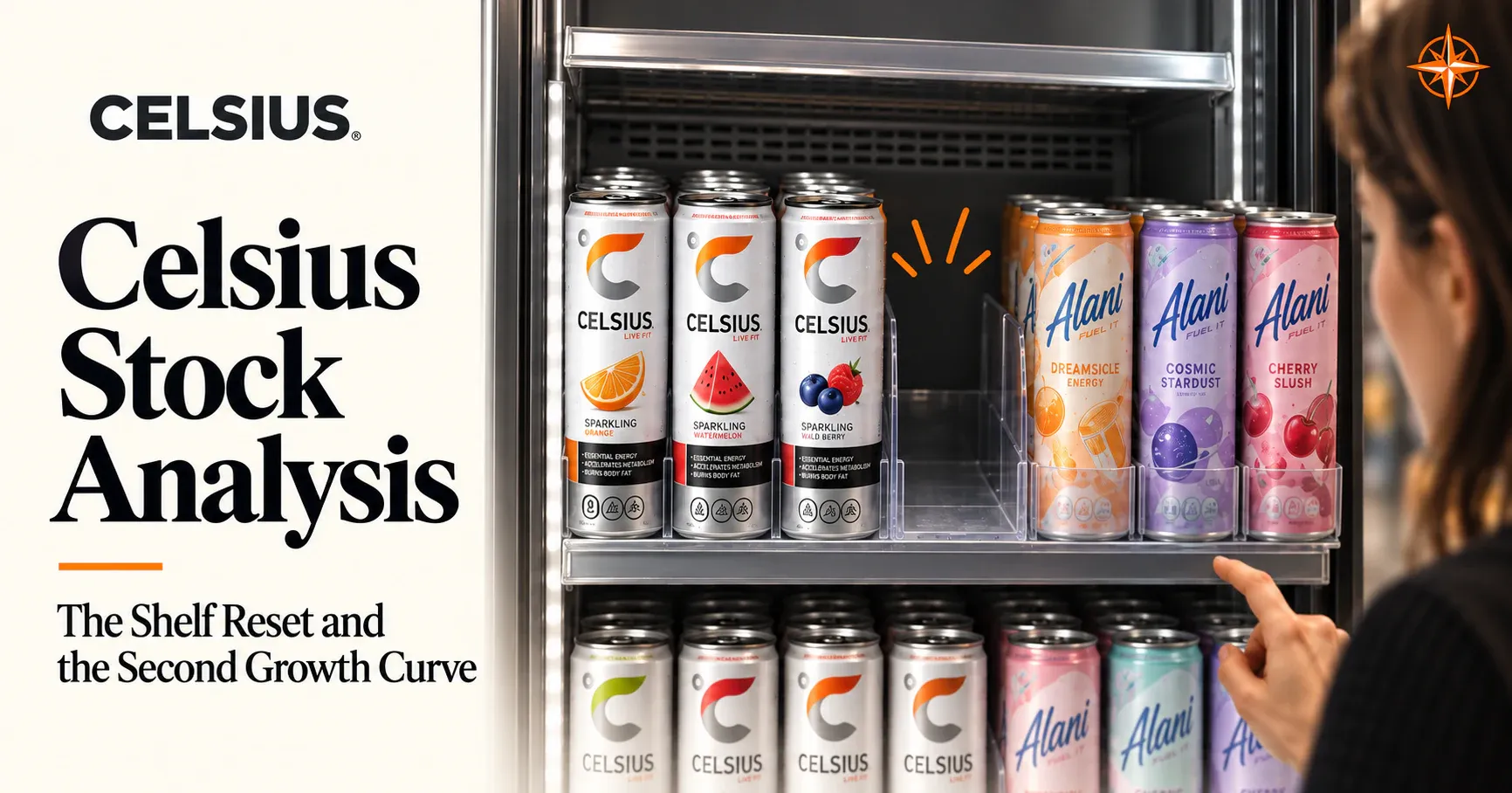
Celsius Stock Analysis: The Shelf Reset and the Second Growth Curve
Celsius stock analysis of the shelf reset, Alani growth, Pepsi economics and cash flow, with a 2030 model and a Premium valuation and entry-price framework.

Meta AI Spending: The Customer Is Already Here
Can Meta turn AI spending into shareholder returns? We model advertising, Muse, hardware, capital costs and cash flow through 2030, with a full valuation.

IREN Stock Dilution: Can the Build Reach Shareholders?
IREN stock analysis of AI growth, funding and dilution through 2030. Read our full valuation, 27 scenarios and price zones free. Excel model is Premium.
Northwise Portfolios
See how the research becomes real decisions
Reader discussion
Discuss the research
Premium access is required to join this report's discussion.
Join Northwise Premium
No comments yet. Start a thoughtful discussion.