
ADBE Stock Forecast 2030

A probability-weighted ADBE Stock Forecast focused on AI monetization, workflow dominance, margin expansion, and long-term capital return.
In this article
ADBE Stock Forecast 2030: Workflow Power, AI Monetization, and Capital Return
A probability-weighted analysis of Adobe’s transition from growth narrative to workflow-driven compounding through 2030.
1. Executive Summary
Adobe Inc. enters the 2026 to 2030 period as a business in transition, though not in decline. The company has moved beyond the growth dynamics that defined the creator economy expansion and into a phase where value creation is driven by workflow depth, recurring revenue, margin discipline, and capital return. This report evaluates Adobe on those terms, using a probability-weighted framework that reflects how the business is likely to operate over the next several years rather than how it was perceived in prior cycles.
The market has increasingly treated generative AI as a force that compresses value at the application layer, assuming that lower barriers to creation weaken pricing power and erode competitive moats. This analysis takes the opposite view. As generative capability becomes more widespread, the value of orchestration, governance, and integration rises. Adobe is positioning itself as the workflow layer through which generative models are accessed, monetized, and trusted inside professional and enterprise environments. That positioning supports slower but more durable revenue growth and stronger per-share outcomes over time.
Financially, Adobe’s performance contradicts narratives centered on obsolescence. FY2025 results show continued ARR expansion, strong backlog visibility, operating margins near the upper end of large-cap software peers, and more than $10B in operating cash flow. Capital return has become a defining feature of the equity story, with aggressive share repurchases materially reducing share count and amplifying EPS growth even as headline revenue growth normalizes.
Looking forward, the modeling framework evaluates three scenarios through 2030. In the bear case, Adobe compounds more slowly but remains structurally intact, producing positive long-term returns. In the base case, the business behaves as a high-quality compounder, with steady ARR growth, margin expansion, and sustained capital return driving meaningful per-share value creation. The bull case captures upside tied to stronger-than-expected consumption-based monetization and deeper enterprise adoption without requiring market share gains or dominance in AI model development.
Across scenarios, downside appears bounded by durability and cash generation, while upside expands under reasonable execution assumptions. The probability-weighted expected value points to substantial long-term appreciation from current levels, driven by structure rather than speculative re-rating.
This report concludes with a clear Northwise stance on valuation, positioning, and entry price. For investors willing to think beyond near-term narratives and focus on workflow economics, Adobe represents a case study in how mature software platforms can continue compounding through discipline, embeddedness, and capital return rather than growth acceleration alone.
Table of Contents
- Executive Summary
- Purpose and Scope of This Forecast
2.1 What This Report Is and Is Not
2.2 Time Horizon, Assumptions, and Methodology - Adobe at the 2026 Inflection Point
3.1 From Creator Economy Growth to Workflow Infrastructure
3.2 Why the Market Narrative Has Broken
3.3 What Actually Matters Going Forward - Macro and Industry Context (2026–2030)
4.1 The Rotation From AI Capex to Application Monetization
4.2 The Efficiency Economy and Content Compression
4.3 Interest Rates, Duration, and Cash Flow Valuation - Financial Reality Check: Adobe Today
5.1 FY2025 Actuals and Business Momentum
5.2 ARR, RPO, and Revenue Visibility
5.3 Capital Return and Share Count Dynamics
5.4 FY2026 Guidance in Context - Product and Technology Strategy: Defense Over Hype
6.1 Workflow Dominance vs Model Competition
6.2 Firefly Monetization and Consumption Economics
6.3 Enterprise Trust, IP Protection, and Firefly Foundry
6.4 Agentic Workflows and the Marketing OS Direction - Competitive Landscape and Market Structure
7.1 Canva and the Bifurcation of the Creative Market
7.2 Generative AI Startups and Orchestration Limits
7.3 Why Adobe Aggregates Rather Than Competes - Strategic Optionality and Adjacencies
8.1 Why Strategy, Intent, and Measurement Matter
8.2 Semrush as Optionality, Not a Base-Case Requirement
8.3 Distribution Effects vs Revenue Effects - Modeling Framework and Scenario Construction (2026–2030)
9.1 Revenue Growth Assumptions by Scenario
9.2 Margin Expansion and Operating Leverage
9.3 Capital Return Assumptions and Share Reduction
9.4 What Breaks the Model - 2030 Financial Outcomes by Scenario
10.1 Bear Case Economics
10.2 Base Case Economics
10.3 Bull Case Economics - Valuation Framework and Terminal Assumptions
11.1 Why Traditional SaaS Multiples Fail Here
11.2 Terminal Multiple Selection by Scenario
11.3 Interpreting Long-Duration Equity Risk - 2030 Price Targets and Probability Weighting
12.1 Scenario-Level Price Targets
12.2 Probability Weighting Rationale
12.3 Expected Value and Asymmetry - The Northwise View: Positioning, Pricing, and Conviction
13.1 Where We Would Buy Adobe
13.2 How We Would Size the Position
13.3 What Would Change Our Mind - Conclusion: Adobe as a Workflow Compounder
14.1 What This Model Ultimately Shows
14.2 Why the Opportunity Exists
14.3 Closing Perspective
2. Purpose and Scope of This Forecast
2.1 What This Report Is and Is Not
This report is a forward-looking strategic and valuation framework for Adobe Inc. through 2030. It is designed to evaluate the company as it exists today and as it is likely to operate over the next several years, not to revisit the conditions that defined Adobe during the peak years of the creator economy expansion.
This is not a revision log, update note, or reconciliation exercise against prior Northwise coverage. Earlier free analysis informed the foundation of this work, but the modeling, assumptions, and conclusions here stand on their own. The inputs reflect materially updated financial data, evolving product monetization mechanics, and a market environment that has shifted from growth scarcity to capital discipline.
The intent is to assess durability, not momentum. Adobe is examined as a mature platform business with embedded workflows, contractual revenue, and meaningful capital return capacity. Growth remains part of the story, but it is no longer the organizing principle of the valuation.
2.2 Time Horizon, Assumptions, and Methodology
This forecast operates on a 2026 to 2030 time horizon and uses scenario analysis rather than single-point estimates. Outcomes are framed across bear, base, and bull cases, each tied to explicit assumptions around revenue growth, margin evolution, share count reduction, and terminal valuation.
The model prioritizes economic reality over narrative consistency. Reported financials, backlog indicators, and management guidance anchor near-term assumptions. Longer-term projections reflect structural drivers such as pricing power, enterprise contract depth, consumption-based monetization, and capital allocation behavior.
Uncertainty is treated as an input rather than a flaw. Where visibility declines, probabilities are assigned rather than conclusions forced. If execution falls short of assumptions, that shortfall is noted directly rather than smoothed over.
This report does not attempt to forecast quarterly performance, product release timing, or short-term market sentiment. The objective is to determine whether Adobe can compound intrinsic value over a multi-year period under realistic operating conditions, and what that implies for long-term shareholders at various entry prices.
3. Adobe at the 2026 Inflection Point
3.1 From Creator Economy Growth to Workflow Infrastructure
Adobe enters 2026 as a different company than the one the market learned to associate with the creator economy boom. The last cycle was defined by seat expansion, individual creators, and small team adoption layered on top of a subscription transition that was still being digested. That phase delivered strong growth, but it also shaped expectations that are no longer the right reference point.
The business today is anchored less in creator count expansion and more in workflow density. Adobe’s tools sit inside professional and enterprise environments where content production is continuous, iterative, and increasingly integrated into broader marketing, design, and communications systems. Value accrues through usage, not discovery.
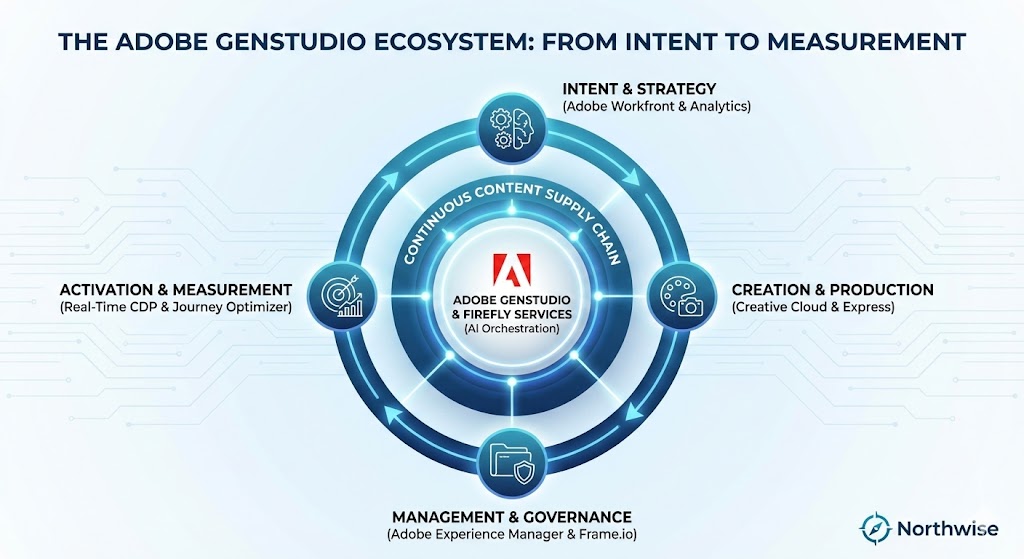
This shift changes how growth should be interpreted. Revenue expansion is no longer driven by new user acquisition alone. It is driven by deeper penetration of existing workflows, higher output per user, and incremental monetization layered onto already embedded tools. The economic profile that results is steadier, less narrative-driven, and more dependent on execution discipline.
3.2 Why the Market Narrative Has Broken
Market perception has struggled to adapt to this transition. Adobe is still frequently framed through a lens built for a prior phase, where growth durability depended on creator enthusiasm and where generative AI is assumed to weaken pricing power by lowering barriers to creation.
That framing misses the role Adobe plays inside production environments where speed, consistency, legal certainty, and integration matter more than raw generation quality. In these settings, creativity is not a one-off act. It is a process that must scale across teams, brands, and channels without introducing risk.
As generative tools proliferate, the value of orchestration increases. The market has largely treated generation and workflow as interchangeable. They are not. The result has been a disconnect between Adobe’s operating performance and the assumptions implied by its valuation.
3.3 What Actually Matters Going Forward
Looking ahead, Adobe’s trajectory is determined by a narrower set of variables than headline narratives suggest. The first is pricing power within core workflows, particularly where time savings translate directly into economic value for customers. The second is the effectiveness of consumption-based monetization layered onto subscription foundations. The third is the company’s ability to continue returning capital at scale without impairing product investment.
These factors do not require Adobe to dominate AI model development or redefine creativity. They require the company to remain indispensable inside the workflows where content is produced, governed, and deployed at scale.
If that condition holds, the business behaves less like a discretionary software provider and more like infrastructure embedded in the operating fabric of modern enterprises. That distinction frames the analysis that follows.
4. Macro and Industry Context (2026–2030)
4.1 The Rotation From AI Capex to Application Monetization
The early phase of the AI cycle was dominated by infrastructure buildout. Capital flowed toward data centers, accelerators, networking, and power as enterprises and hyperscalers raced to secure capacity. That phase shaped market attention and investor narratives, but it was never the end state.
As the cycle matures, value begins to migrate up the stack. Compute alone does not generate returns. It must be translated into tools that change how work is done, how output is produced, and how organizations operate at scale. By 2026, the emphasis shifts from experimentation to deployment, from proof-of-concept to production.
Adobe sits squarely in this transition. It does not monetize AI by selling access to raw models. It monetizes AI by embedding generative capability inside workflows that already exist and already generate economic value. As spending rotates away from capacity accumulation and toward application-level return on investment, software platforms that can convert compute into measurable productivity gains become increasingly relevant.
4.2 The Efficiency Economy and Content Compression
Demand for content continues to expand across channels, formats, and geographies. Personalization expectations are rising, not falling. At the same time, budgets and headcount are constrained. The response has been a broad push toward efficiency rather than scale.
In this environment, AI functions as a compression mechanism. Time per output declines. Iteration cycles shorten. The number of variants produced per campaign increases without a proportional increase in labor. The economic value is not the generation itself. It is the reduction in friction across the production process.
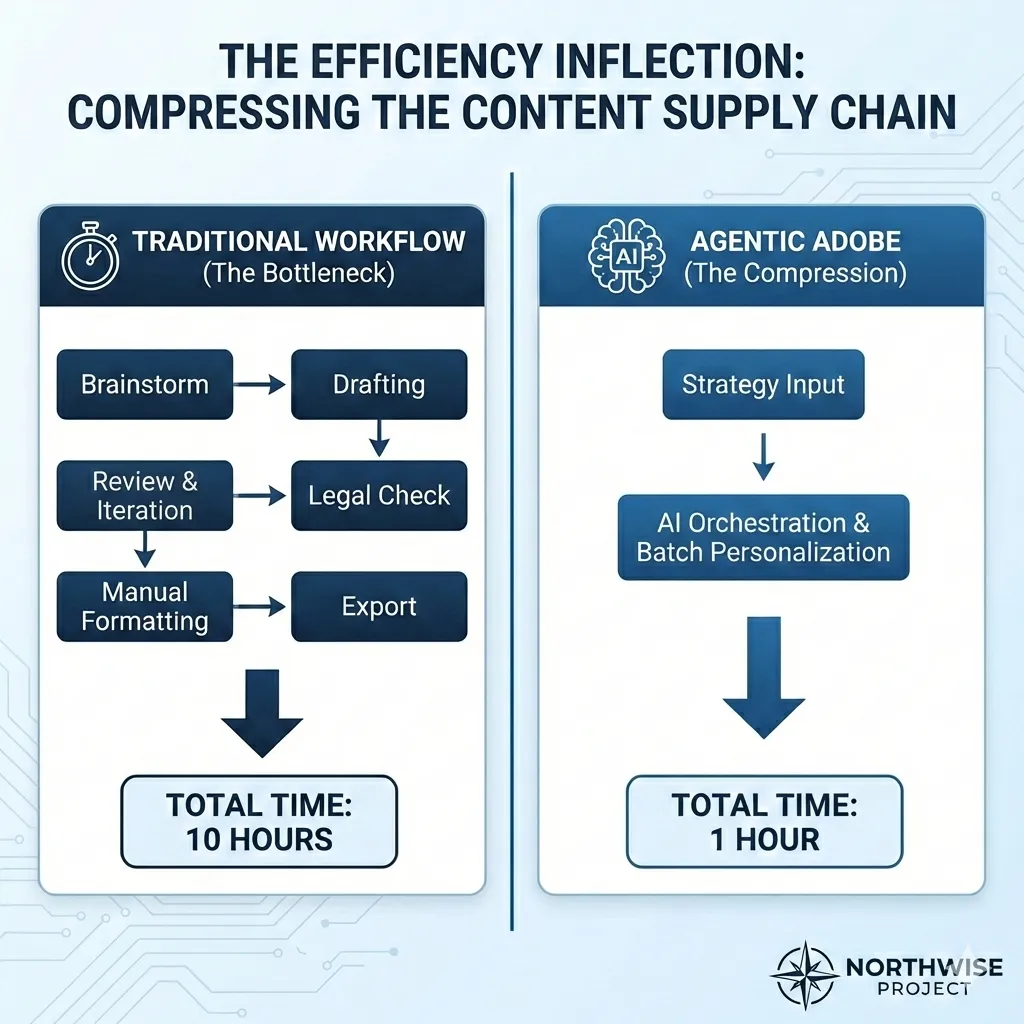
Adobe’s tools are positioned within this shift. They are not discretionary creative add-ons. They increasingly serve as productivity infrastructure for marketing, design, and communications teams tasked with doing more with fixed resources. That role supports durable demand even as growth rates normalize.
4.3 Interest Rates, Duration, and Cash Flow Valuation
Macro conditions also shape how Adobe should be valued. A more stable rate environment improves the relative attractiveness of long-duration cash flows, particularly those backed by recurring revenue and strong margins. Adobe’s free cash flow profile places it closer to the upper end of software durability rather than the growth-at-all-costs category that dominated prior cycles.
As capital becomes more selective, businesses that can self-fund investment while returning meaningful capital to shareholders are re-rated on different terms. Valuation becomes less about revenue multiples and more about the sustainability of cash generation over time.
This backdrop does not eliminate risk, but it reframes it. The question shifts from whether growth reaccelerates to whether the cash flow engine remains intact. For Adobe, that distinction is central to the analysis that follows.
5. Financial Reality Check: Adobe Today
5.1 FY2025 Actuals and Business Momentum
Adobe exits FY2025 with financial characteristics that look nothing like a business in structural decline. Revenue growth has moderated from prior-cycle peaks, but profitability, cash generation, and operating discipline have continued to strengthen.
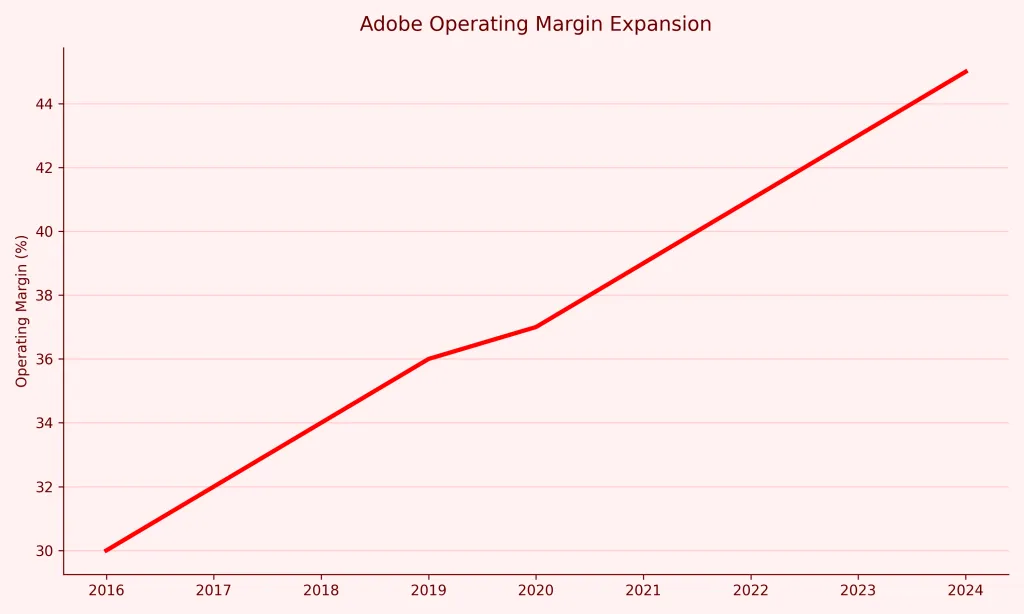
Revenue reached $23.77B for the year, reflecting low double-digit growth off a much larger base. Non-GAAP EPS grew faster at $20.94, supported by margin expansion rather than financial engineering. Operating margins near 45% place Adobe at the high end of large-cap software peers and signal a business that has already absorbed the bulk of its scaling costs.
Operating cash flow exceeded $10B, reinforcing the distinction between headline growth narratives and economic reality. Adobe is not stretching to fund its strategy. It is producing excess capital while investing in product and returning cash to shareholders at scale.
5.2 ARR, RPO, and Revenue Visibility
The durability of Adobe’s revenue base is visible in its recurring metrics. Digital Media ARR reached $19.20B, growing at roughly 11.5%, while total ARR exited FY2025 at $25.20B and stepped up to $25.66B entering FY2026 following foreign exchange revaluation.
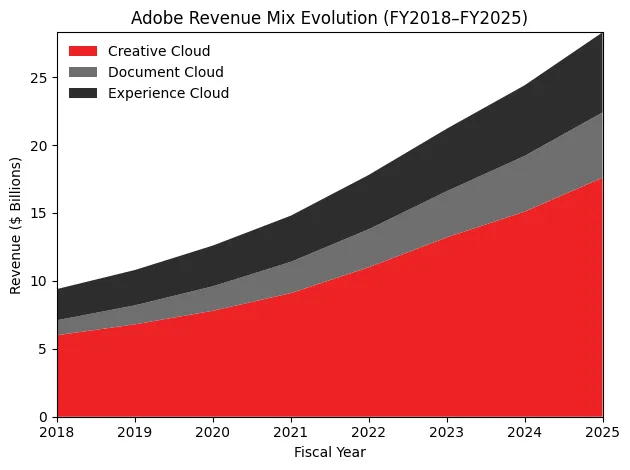
Remaining Performance Obligations totaled $22.52B, up 13% year over year, with current RPO representing approximately 65% of the total. This structure provides forward visibility that is inconsistent with the market’s implied assumption of near-term erosion.
These figures reflect committed demand inside professional and enterprise environments rather than discretionary creator spending. Contracts continue to extend in duration and scope, reinforcing the idea that Adobe’s tools remain embedded in production workflows that are not easily displaced.
5.3 Capital Return and Share Count Dynamics
Capital return has become a defining feature of Adobe’s equity story. During FY2025, the company repurchased approximately $12B of stock, reducing diluted share count by more than 6% in a single year.
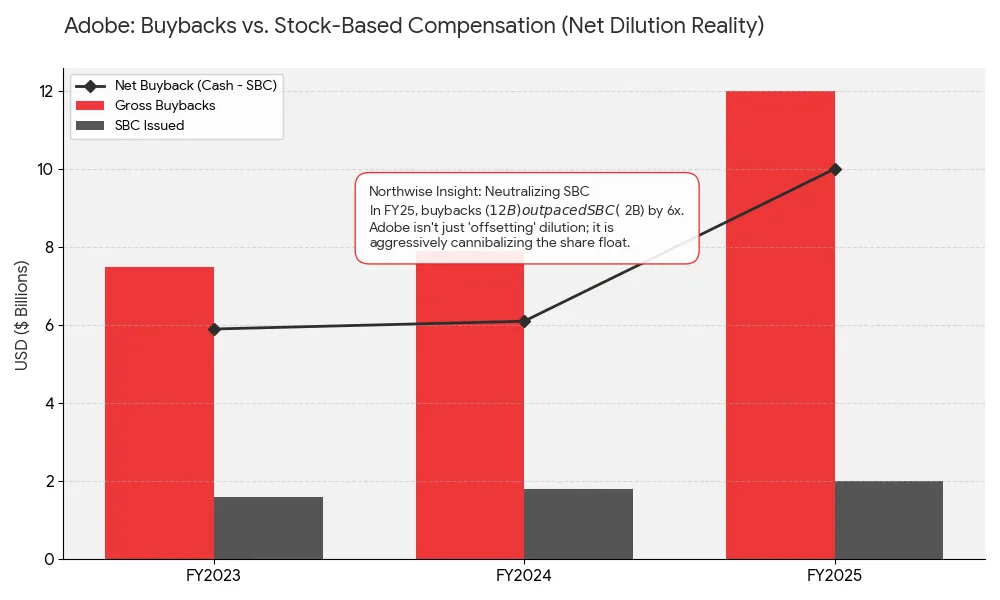
This level of buyback activity is not opportunistic. It reflects confidence in long-term cash generation and a willingness to allocate capital aggressively when valuation dislocations appear. Over a multi-year horizon, share count reduction materially alters per-share outcomes, particularly in scenarios where revenue growth remains steady rather than accelerating.
The implication is straightforward. Even modest operating growth can translate into outsized EPS growth when paired with sustained buybacks. This dynamic underpins the asymmetry in the valuation scenarios that follow.
5.4 FY2026 Guidance in Context
Management’s FY2026 guidance reinforces this picture rather than challenging it. Revenue is expected to approach $26.0B at the midpoint, with non-GAAP EPS around $23.40. Ending ARR growth near 10% implies continued normalization without signaling deterioration.
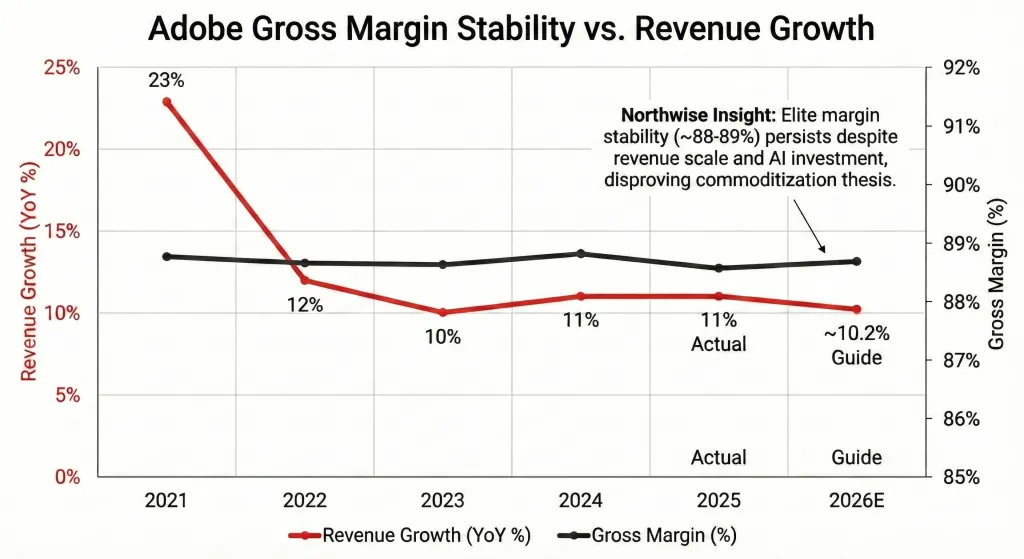
Diluted shares are projected to fall toward approximately 403M, extending the capital return trend. Importantly, these targets are set against a backdrop of continued product investment and expanding AI-related capabilities.
Taken together, Adobe’s reported performance and forward guidance directly contradict narratives centered on obsolescence or demand collapse. The company is not shrinking. It is recalibrating into a phase where efficiency, cash flow, and capital discipline matter more than headline growth acceleration.
The next section turns to how product and technology strategy supports this financial profile without relying on speculative AI positioning.
6. Product and Technology Strategy: Defense Over Hype
6.1 Workflow Dominance vs Model Competition
Adobe’s product strategy over the last two years has been widely misunderstood. The company is often evaluated as if it were attempting to compete directly with foundation model providers or to defend itself against them. That framing assumes that value accrues at the model layer. Adobe’s actions suggest the opposite assumption.
The company has positioned itself as the interface layer where generative capability is accessed, shaped, governed, and deployed. Firefly video tools embedded directly into Premiere Pro timelines, Generative Extend, and object-level masking features are not designed to showcase novelty. They are designed to remove friction from existing workflows where professionals already spend time and money.
This distinction matters. Models can improve, swap, or commoditize without undermining the value of the workflow they serve. By hosting third-party models inside Adobe tools, the company converts potential competitors into inputs. Control shifts away from raw generation and toward orchestration, consistency, and integration.
6.2 Firefly Monetization and Consumption Economics
Firefly’s role in the business is best understood through monetization mechanics rather than feature sets. The introduction of consumption-based credits layered onto subscription plans changes how incremental value is captured. Instead of relying solely on seat expansion or price increases, Adobe monetizes output volume and usage intensity.
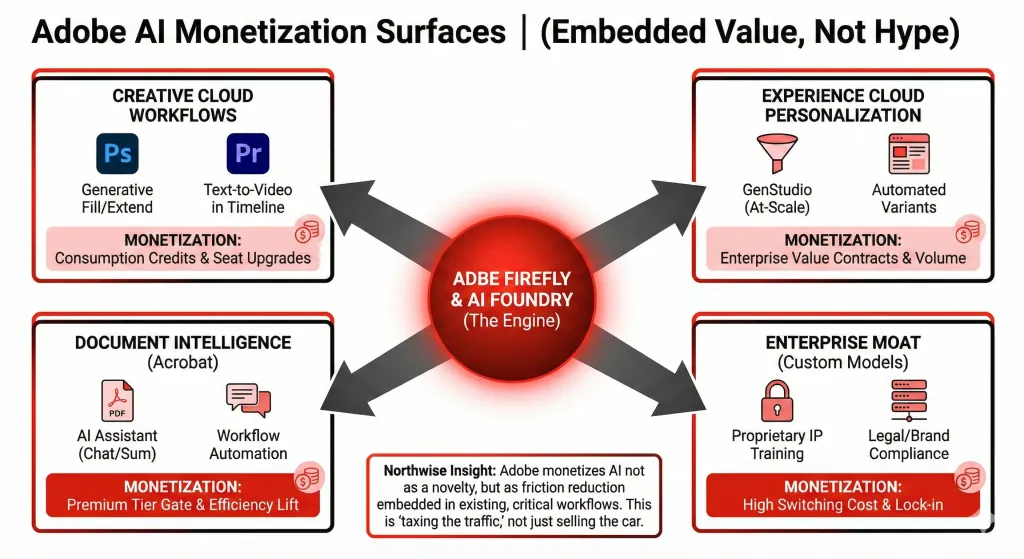
This structure aligns incentives. Customers benefit from faster production and higher throughput. Adobe participates economically in that efficiency gain without forcing disruptive pricing changes. Over time, consumption-based monetization introduces a variable revenue component that scales with customer success rather than customer count.
The relevance is not limited to growth. Consumption models tend to carry high incremental margins once the underlying platform is built. As usage increases inside already embedded workflows, contribution margins expand without requiring proportional increases in sales or support infrastructure.
6.3 Enterprise Trust, IP Protection, and Firefly Foundry
Enterprise adoption introduces constraints that generative-first startups often underestimate. Legal exposure, brand consistency, copyright risk, and data governance are not edge cases. They are gating factors.
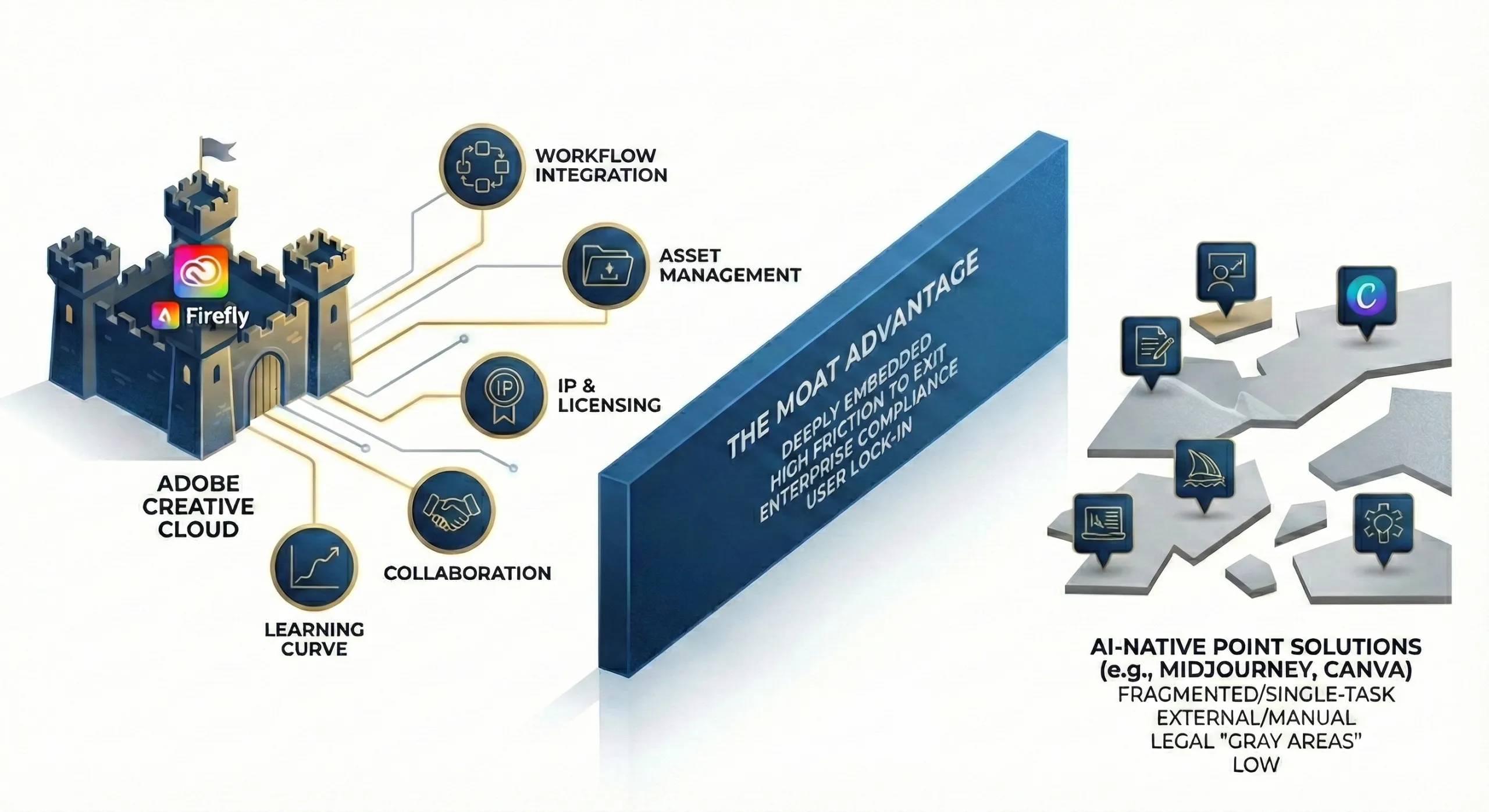
Firefly Foundry addresses these constraints directly by allowing enterprises to train and deploy models on proprietary content within controlled environments. This capability does not exist to chase headlines. It exists to solve problems that block adoption at scale.
The result is a moat defined less by creativity and more by trust. Switching costs rise when generative tools are embedded inside systems that manage rights, approvals, and compliance. For large customers, this layer becomes inseparable from the production process itself.
6.4 Agentic Workflows and the Marketing OS Direction
Adobe’s longer-term product direction extends beyond creation into execution. Agentic workflows tied to campaign deployment, iteration, and measurement push the platform closer to a marketing operating system rather than a collection of creative tools.
Projects like Moonlight signal this trajectory without forcing it into near-term revenue expectations. The strategic value lies in closing the loop between intent, creation, deployment, and optimization. When those stages operate inside a single platform, data gravity and workflow inertia increase.
This direction does not require Adobe to redefine its identity. It builds outward from existing strengths. As execution and orchestration layers mature, Adobe’s relevance shifts further away from discretionary tooling and toward infrastructure embedded in how organizations communicate at scale.
The competitive implications of this positioning are addressed next.
7. Competitive Landscape and Market Structure
7.1 Canva and the Bifurcation of the Creative Market
Canva’s success is real and should not be dismissed. It has lowered the barrier to entry for design and enabled a large cohort of non-professional users to produce acceptable creative output quickly. That expansion, however, has reshaped the market rather than compressed it.
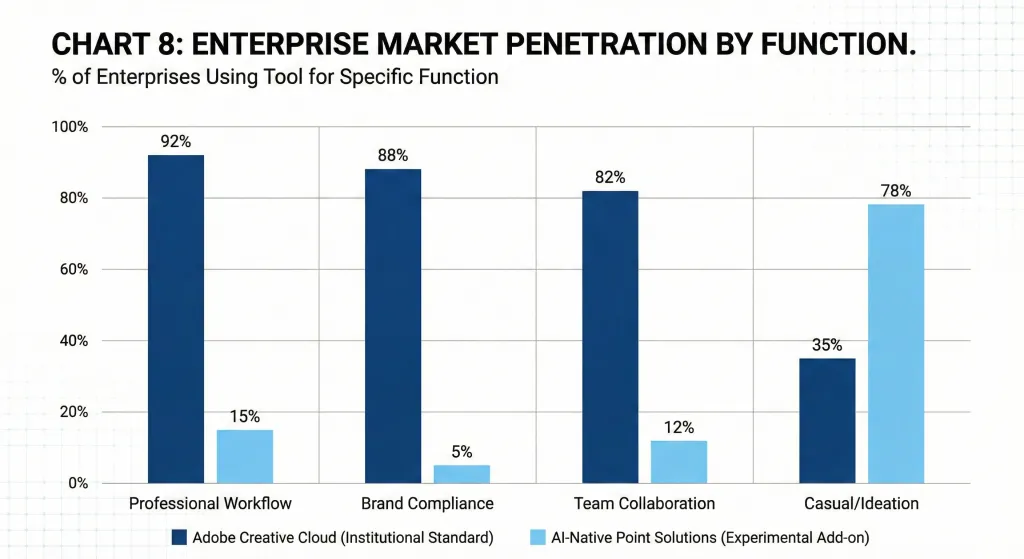
The creative software landscape is increasingly bifurcated. On one end sit high-volume, low-complexity use cases where speed and accessibility dominate. On the other sit professional and enterprise workflows where precision, collaboration, governance, and integration matter more than ease of entry.
Adobe operates almost entirely in the latter category. Canva’s growth does not erode Adobe’s core economics because the overlap in customer needs is limited. The risk is not substitution. It is misclassification, where distinct markets are treated as interchangeable in valuation frameworks.
7.2 Generative AI Startups and Orchestration Limits
Generative AI startups have demonstrated impressive capabilities at the point of creation. They excel at producing assets quickly and at low marginal cost. What they largely lack is the infrastructure required to manage those assets once created.
Professional environments require version control, rights management, brand enforcement, collaboration across teams, and integration with downstream systems. These requirements are not solved by better generation alone. They require orchestration.
Adobe aggregates generative capability into an existing system that already performs these functions. Startups compete at the margin of novelty. Adobe competes at the level of production continuity. That difference defines the boundary between experimentation and deployment.
7.3 Why Adobe Aggregates Rather Than Competes
Adobe’s strategic posture is not to displace emerging tools but to absorb them. By integrating third-party models and allowing customers to access multiple generative engines inside a single workflow, Adobe positions itself as the control plane rather than the source of innovation.
This aggregation model benefits from scale. As more tools, models, and workflows converge inside the platform, switching costs increase and fragmentation decreases. Customers gain flexibility without losing consistency.
The competitive advantage that results is quiet but durable. Adobe does not need to outpace every new entrant. It needs to remain the environment where work is finalized, governed, and delivered. That role defines the company’s position in the creative and marketing stack and frames the optionality explored in the next section.
8. Strategic Optionality and Adjacencies
8.1 Why Strategy, Intent, and Measurement Matter
As creative production becomes faster and more automated, differentiation shifts upstream and downstream. The bottleneck is no longer the act of creation itself. It is deciding what to create, how to deploy it, and how to measure its effectiveness across channels.
Adobe already owns the center of the workflow where assets are produced and refined. The next layer of value sits around intent formation and performance feedback. When these functions remain disconnected from creation, organizations lose time, signal clarity, and institutional memory.
Strategic adjacency in this context is not about chasing incremental revenue streams. It is about reducing friction across the full lifecycle of marketing and communication. The tighter that loop becomes, the harder the platform is to displace.
8.2 Semrush as Optionality, Not a Base-Case Requirement
Semrush represents a useful illustration of this optionality. Its strength lies in understanding intent, search behavior, and competitive positioning before content is created. Integrated thoughtfully, this capability expands Adobe’s relevance earlier in the decision process without altering its core identity.

This potential is not embedded in base-case growth assumptions. It does not need to materialize for the core thesis to hold. The value lies in insulation and distribution rather than immediate revenue contribution. Enterprise customers benefit when insight, execution, and measurement operate within a single ecosystem.
Treating this as optionality preserves modeling discipline while acknowledging that strategic moves can shift long-term durability even if they do not meaningfully change near-term financials.
8.3 Distribution Effects vs Revenue Effects
Strategic adjacencies often influence outcomes indirectly. They improve retention, deepen contract scope, and raise the cost of switching without always showing up as discrete line items. These effects compound quietly over time.
For Adobe, expanding upstream and downstream strengthens its position as a system rather than a toolset. Revenue growth may remain within guided ranges, but multiple durability improves as the platform becomes more embedded in decision-making processes.
This distinction matters for valuation. Optionality that shifts the distribution of outcomes without altering the midpoint can still enhance long-term asymmetry. That framework informs how scenarios are constructed in the modeling section that follows.
9. Modeling Framework and Scenario Construction (2026–2030)
9.1 Revenue Growth Assumptions by Scenario
The revenue model is constructed around normalization rather than reacceleration. Adobe is modeled as a large, mature platform where growth is driven by workflow expansion, incremental monetization, and contract depth rather than user count expansion.
Northwise Premium
Choose how to continue with Northwise
Join Northwise Premium
Unlock the rest of this report, its complete valuation, the downloadable model, portfolios, and action framework.
Join Northwise PremiumCreate a Free Account
Continue across Free Northwise research, follow companies, save reports, and receive updates.
Create a Free Account
Celsius Stock Analysis: The Shelf Reset and the Second Growth Curve
Celsius stock analysis of the shelf reset, Alani growth, Pepsi economics and cash flow, with a 2030 model and a Premium valuation and entry-price framework.

Meta AI Spending: The Customer Is Already Here
Can Meta turn AI spending into shareholder returns? We model advertising, Muse, hardware, capital costs and cash flow through 2030, with a full valuation.

IREN Stock Dilution: Can the Build Reach Shareholders?
IREN stock analysis of AI growth, funding and dilution through 2030. Read our full valuation, 27 scenarios and price zones free. Excel model is Premium.
Northwise Portfolios
See how the research becomes real decisions
Reader discussion
Discuss the research
Premium access is required to join this report's discussion.
Join Northwise Premium
No comments yet. Start a thoughtful discussion.