NBIS Stock Vineland NJ Data Center

NBIS Stock Vineland NJ Data Center analysis covering power independence, time-to-power economics, local approvals, and risks in U.S. expansion
A full length analysis of how the NBIS Stock Vineland NJ Data Center compresses time-to-power, clears local approvals, and sets the template for larger builds
NBIS Stock Vineland NJ Data Center Site Overview
The Vineland, New Jersey facility represents Nebius’s first major U.S. AI data center deployment and functions as the company’s near-term operational anchor in North America. It is not the company’s first U.S. footprint, but it is the first site designed from the outset to support sustained, hyperscale AI workloads rather than incremental or experimental capacity.
Vineland sits at the intersection of three constraints that increasingly define AI infrastructure economics: power availability, deployment speed, and proximity to demand. While future U.S. campuses such as Independence, Missouri are expected to exceed Vineland in total planned megawatt capacity, Vineland is the site where Nebius is currently proving that its infrastructure model can execute under U.S. regulatory, political, and grid conditions.
The role of the site within the broader Nebius network is therefore practical rather than aspirational. Vineland is the delivery engine for near-term U.S. capacity, the financing reference point for contract-backed expansion, and the operational template that will inform larger builds now moving through earlier development stages.
From a portfolio perspective, Vineland concentrates execution. It carries higher political and community exposure than Nordic sites, higher power complexity than smaller U.S. deployments, and higher revenue sensitivity than later-stage campuses that will benefit from lessons learned here. That concentration is intentional. Nebius is using Vineland to compress time-to-power and establish U.S. credibility before scaling further.
Attribute | Detail |
|---|---|
Location | Vineland, New Jersey |
Facility size | Roughly 2.6 million square feet at full vision, with early components phased smaller |
Target power capacity | 300 to 400 MW |
Deployment status | Partial operations live (initial data rooms, roughly 2 MW); construction ongoing toward roughly 300 MW by year-end 2026 |
Power model | Behind-the-meter on-site generation via Bloom Energy solid oxide fuel cells, with a limited local grid tie; energy plan pending final approval |
Primary function | First major U.S. AI factory |
Strategic role | Near-term U.S. anchor and execution template |
Network position | Precedes larger planned U.S. campuses |
As of the first half of 2026, the site has moved from groundwork into partial operation. The initial data center building is partially live, with at least three data rooms running and roughly 2 MW drawing power, while construction across the broader campus was described as nearing the halfway mark in early 2026. Full operation at roughly 300 MW remains the year-end 2026 goal, subject to the power and expansion approvals discussed later in this analysis. Early operation is the more important signal here. It demonstrates that capacity can be brought online quickly, even as the larger buildout still depends on pending permits.
This positioning explains why Vineland matters even as larger sites move into planning. The site is not intended to define Nebius’s ultimate U.S. scale. It is intended to demonstrate that scale can be delivered quickly, reliably, and economically in the most constrained market the company operates in today.
Why NBIS Chose Vineland, New Jersey
The selection of Vineland reflects a pragmatic tradeoff rather than a symbolic one. Nebius did not choose the site for brand visibility or long-term civic alignment. It chose Vineland because it sits inside a narrow overlap where latency, land availability, permitting flexibility, and power optionality intersect under U.S. constraints.
From a network perspective, Vineland offers proximity to two of the most latency-sensitive corridors in the country. The site sits within practical fiber distance of both the New York City and Philadelphia metro regions, placing it close enough to serve real-time inference workloads, financial services, and enterprise AI demand without incurring the latency penalties associated with more remote, power-rich locations in Texas or the Midwest. This matters for workloads where milliseconds translate directly into economic value.
Equally important is what Vineland is not. It is not Northern Virginia. While the Ashburn corridor remains the densest concentration of data center capacity in the United States, it is also one of the most constrained. Land pricing, zoning friction, grid congestion, and community resistance have all escalated sharply. For a project targeting hundreds of megawatts on an accelerated timeline, those constraints dominate economics and scheduling. Vineland offered a materially lower-friction alternative while remaining close enough to the same demand centers.
Land characteristics further narrowed the choice set. The Vineland parcel was already scarred by decades of industrial extraction and had passed through multiple failed redevelopment attempts. That history reduced displacement risk and simplified rezoning relative to greenfield or residential-adjacent sites. The city had already demonstrated willingness to amend ordinances to expand allowable uses, culminating in approvals that made hyperscale development viable within a compressed window.
Finally, Vineland allowed Nebius to decouple location choice from grid readiness. In many U.S. markets, site selection is effectively subordinate to utility timelines. Vineland’s zoning posture and parcel scale made an on-site power strategy feasible, allowing Nebius to prioritize time-to-power over grid alignment. That capability is foundational to why this site was selected ahead of other East Coast candidates.
Factor | Vineland Advantage |
|---|---|
Latency | Close to NYC and Philadelphia demand corridors |
Land availability | Large, industrially degraded parcel |
Zoning flexibility | Ordinance amendments enabled hyperscale use |
Permitting velocity | Planning approvals achieved on accelerated timeline |
Grid dependence | Reducible via on-site power generation |
Comparative markets | Lower friction than Northern Virginia |
Vineland was therefore chosen less as an ideal location and more as a workable one under real-world constraints. It offered enough proximity to demand, enough regulatory flexibility, and enough physical scale to support a power-first deployment model. That combination explains why Nebius treated the site as a near-term execution priority rather than waiting for cleaner, slower alternatives to mature.
From Sand Mining to AI Infrastructure
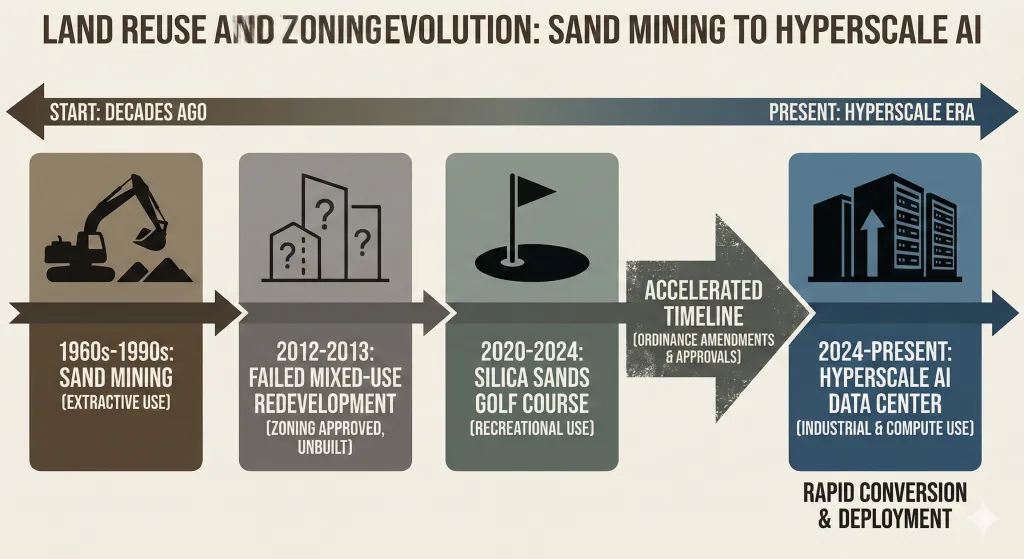
The Vineland site emerged through a long redevelopment arc that left the land underutilized yet structurally adaptable. Its current role as a hyperscale AI campus is the outcome of industrial legacy, municipal pressure to repurpose stranded land, and a regulatory environment willing to accommodate capital-intensive reuse.
From the 1960s through the 1990s, the parcel supported sand mining operations that defined much of South Jersey’s extractive economy. These activities altered the landscape and limited conventional residential or commercial reuse. The land remained large, environmentally impacted, and difficult to reposition within standard development models.
During the early 2010s, the City of Vineland approved zoning variances intended to attract mixed-use development, including medical offices, athletic facilities, and entertainment venues. These initiatives advanced through planning stages but failed to translate into construction. Capital requirements outpaced projected returns, leaving the site idle.
In 2020, municipal strategy shifted toward recreational reuse. Ordinance 2020-49 enabled outdoor amusement uses, leading to the development of the Silica Sands Golf Course. The nine-hole facility opened as a public complement to the nearby Trout National private club and remained operational through late 2024.
The transition to hyperscale infrastructure followed a compressed timeline. In 2023, Ordinance 2023-51 expanded permissible land uses to include heavier industrial development. In August 2024, the Planning Board approved Resolution 6652, authorizing a 2.6 million square foot data center campus under NEP Real Estate and DataOne. Site activity accelerated quickly. By early 2025, the golf course was dismantled and construction began on foundations designed to support high-density AI workloads.
This sequence compressed decades of stalled redevelopment into a narrow approval window. The site’s industrial history reduced displacement risk, while ordinance amendments provided the legal pathway for rapid conversion. Together, these factors allowed capital to flow directly into construction rather than prolonged entitlement processes.
Period | Development Phase |
|---|---|
1960s-1990s | Sand mining operations |
2012-2013 | Mixed-use redevelopment approvals |
2020 | Ordinance 2020-49 enables outdoor amusement |
2020-2024 | Silica Sands Golf Course operational |
2023 | Ordinance 2023-51 expands industrial uses |
August 2024 | Planning Board Resolution 6652 approved |
Early 2025 | Golf course removed, data center construction begins |
The pace of this transition shaped what followed. Land and zoning moved quickly into place, shifting attention to the next constraint governing AI infrastructure deployment in the United States.
Time-to-Power as the Binding Constraint
For hyperscale AI deployments in the United States, power availability determines deployment timing more than capital, demand, or land. Vineland was designed explicitly around this constraint. The site’s architecture reflects an effort to compress time-to-power in a region where grid-based solutions often extend beyond commercially viable timelines.
Within the PJM Interconnection footprint, large-load projects routinely encounter multi-year delays tied to transmission upgrades, substation construction, and high-voltage transformer procurement. Projects seeking 200 MW or more face particularly long sequencing cycles, as utility planning must align with regional reliability studies and capital approvals. These timelines move independently of customer demand and contract commitments.
For Nebius, full grid dependency would have introduced misalignment between capacity delivery and revenue realization. Vineland’s role as a near-term U.S. anchor required a power solution that could be deployed on a construction schedule rather than a utility schedule. The site’s zoning posture and parcel scale enabled that choice by allowing primary power generation to occur on-site.
By pursuing a predominantly on-site configuration, Nebius shifted the critical path away from interconnection queues and toward equipment delivery, fuel logistics, and on-site construction. Those variables remain capital-intensive, but they are controllable. The model is best described as hybrid rather than fully islanded, with the majority of power generated on-site and a minority share drawn from local utilities, and that tradeoff still allowed Vineland to move forward while other East Coast projects of similar scale remained constrained by grid readiness.
The implication is structural rather than situational. Vineland exists as an execution response to a national bottleneck. It demonstrates how AI infrastructure can be deployed inside constrained power markets by internalizing most generation rather than waiting for external capacity to materialize.
Constraint | Deployment Impact |
|---|---|
PJM interconnection queues | Multi-year timelines for large-load projects |
Transmission upgrades | Required for incremental capacity above local limits |
Substation construction | Long permitting and build cycles |
High-voltage transformers | Extended manufacturing lead times |
Utility sequencing | External dependency misaligned with AI demand |
Resolving most of the time-to-power problem internally allowed Nebius to align deployment timing with customer commitments and financing structures. That alignment explains why Vineland advanced ahead of other East Coast locations with similar demand profiles but slower power pathways.
With the power timeline addressed, the next question becomes how that power is generated, stabilized, and scaled at industrial levels.
Vineland Power Economics and Cost Structure
The decision to generate most power on-site at Vineland reshapes the site’s operating economics as much as its deployment timeline. For high-density AI workloads, electricity cost and reliability compound over long-duration training runs, making power pricing a structural input rather than a marginal line item.
The on-site configuration allows Nebius to bypass much of the industrial grid tariff and demand-charge exposure common within the PJM region. The site retains a limited local utility tie, including Vineland Municipal Utilities and Atlantic City Electric, but the bulk of supply is generated behind the meter. Vineland was originally designed around natural gas combustion through medium-speed reciprocating engines operating at steady-state loads, a design that delivered roughly 50% electrical efficiency and a predictable marginal cost insulated from short-term grid volatility. That combustion design has since been superseded by the Bloom Energy fuel cell agreement covered in the next section, which changes the generation technology while preserving the behind-the-meter logic.
The original engine design implied estimated fuel costs near $0.0568 per kWh at the natural gas pricing prevailing when the system was specified. That figure remains a useful reference point for the cost of on-site generation, though the shift to solid oxide fuel cells alters the conversion economics, since fuel cells extract more electricity per unit of gas through an electrochemical process rather than combustion. For AI workloads that run continuously and draw power at sustained density, the predictability of behind-the-meter supply carries as much weight as absolute price.
Reliability further reinforces the economic case. The on-site system is engineered for high availability, exceeding typical grid service levels in many U.S. markets. For large training runs, interruptions introduce restart costs, wasted compute cycles, and scheduling inefficiencies that compound quickly at scale. Vineland’s power architecture reduces those losses by minimizing exposure to upstream grid events.
The structure also supports incremental scaling. Power capacity is added in parallel with compute deployment, allowing capital to track contracted demand rather than front-running utilization. This sequencing lowers idle capacity risk and improves capital efficiency during the ramp phase.
Attribute | Vineland On-Site Generation |
|---|---|
Generation technology | Bloom solid oxide fuel cells (supersedes the original reciprocating-engine design) |
Supply model | Behind-the-meter on-site, with a limited local grid tie |
Reference fuel cost (original engine design) | Roughly $0.0568 per kWh |
Pricing volatility | Low, fuel-linked |
Availability target | High, designed above typical grid levels |
Demand charges | Limited under predominantly on-site supply |
Scaling model | Modular, phase-aligned |
Exposure | Fuel supply, fuel cell deployment cadence, and energy-plan approval |
This cost structure supports Nebius’s positioning in the premium GPU market. Lower and more predictable power input costs translate into pricing flexibility for long-duration workloads while preserving margin under sustained utilization. For customers committing to multi-year capacity, that stability matters more than short-term discounts.
The generation technology itself is now in transition, which is the subject of the next section.
The Bloom Energy Agreement and the Shift to Fuel Cells
In May 2026, Nebius signed a 10-year master agreement with Bloom Energy worth up to $2.6 billion in service fees, structured across three ten-year phases. Under the agreement, Bloom installs, operates, and maintains its solid oxide fuel cell systems on-site, and Nebius purchases the resulting power. The first project covers 328 MW of installed capacity, roughly 250 MW on a guaranteed basis, and is targeted to come online during 2026.
The technology choice matters for a site like Vineland. Solid oxide fuel cells convert natural gas to electricity through an electrochemical reaction rather than combustion, which raises efficiency, lowers emissions, and reduces water use relative to reciprocating engines or gas turbines. The systems are modular, can be commissioned on accelerated timelines, and face a lighter permitting burden than combustion generation. They can also run on hydrogen or biogas, which preserves a path toward lower-carbon operation over time.
Nebius described the first deployment as replacing the previously planned combustion-based generation at its first U.S. site. The company did not name that site in the announcement, but the case for Vineland is strong enough that we treat it as the home of the initial Bloom phase. Vineland is Nebius’s first major U.S. deployment, it was engineered around medium-speed reciprocating gas engines, and the 328 MW first phase aligns closely with Vineland’s 300 to 400 MW target. The description of the deal, a fuel cell system replacing planned reciprocating engines at the first U.S. site, matches Vineland and no other site in the portfolio.
If the fuel-cell pivot proceeds at Vineland as the evidence indicates, it reshapes two of the site’s friction points. It lightens the combustion air-permitting burden that drew NJDEP scrutiny, since non-combustion fuel cells are reviewed differently from reciprocating engines. And it reduces the emissions and, to a degree, the water concerns that anchored local opposition. It does not remove execution risk. Fuel cell deployment at this scale is itself a delivery program with equipment, commissioning, and supply considerations, and the economics now carry a long-dated service-fee commitment to Bloom rather than only fuel and maintenance costs under Nebius’s direct control.
Some local descriptions of the plant still reference the earlier engine design and a pending liquefied natural gas component, which reflects how recently the agreement was signed and the lag in local energy-plan filings catching up. We read the engines as the superseded original plan and the Bloom fuel cells as the generation path going forward. The energy plan still needs to clear local approval, and we will track that step, but we treat the fuel cell design as the operative one for Vineland.
AI Factory Design and Density Profile
Vineland is designed as an AI factory rather than a conventional enterprise data center. The distinction is structural. The facility is optimized for sustained, high-density GPU workloads that push far beyond the thermal and electrical assumptions embedded in legacy cloud infrastructure.
At the rack level, Vineland is engineered to support power densities that routinely exceed 100 kW per rack. This density reflects the deployment profile of modern AI training and inference clusters built around Nvidia’s latest architectures. Traditional air-cooled data centers are not suited to this operating regime. Heat generation scales nonlinearly with compute intensity, and airflow constraints quickly become the binding limit.
To address this, the Vineland site incorporates direct liquid cooling at the rack level. Coolant is circulated through closed-loop manifolds that interface directly with GPU cold plates, allowing heat to be removed at the source rather than dispersed into the ambient environment. This approach supports higher sustained utilization, tighter thermal tolerances, and more predictable performance under load.
The cooling design also aligns with the site’s power architecture. Stable power delivery allows cooling systems to operate within narrow operating bands rather than cycling aggressively in response to load volatility. That coordination reduces mechanical stress and improves overall system efficiency across long-duration training runs.
From a layout perspective, the facility favors modular data hall construction. Compute, power, and cooling capacity scale together in discrete increments. This modularity supports phased deployment without forcing architectural compromises at later stages. It also simplifies future retrofits as chip architectures evolve and rack-level requirements change.
Attribute | Vineland Configuration |
|---|---|
Rack power density | 100+ kW per rack |
Cooling method | Direct liquid cooling |
Thermal removal | Rack-level, closed-loop |
Data hall design | Modular |
Target workload | AI training and inference |
Utilization profile | Sustained, high-duty cycle |
This design positions Vineland to support workloads that remain impractical in most legacy cloud environments. High-density racks, liquid cooling, and synchronized power delivery allow the facility to operate closer to hardware limits without sacrificing reliability.
The design also creates optionality. As GPU architectures evolve, the constraint shifts from facility capacity to upgrade cadence. Vineland’s density-first layout reduces the friction associated with future transitions, preserving relevance across multiple hardware generations.
With the physical infrastructure in place, the next layer of differentiation moves up the stack.
Proprietary Software Stack and Cluster Orchestration
The physical buildout at Vineland only captures part of the system Nebius is deploying. The facility is designed to operate as an integrated compute environment where hardware density, power delivery, and software orchestration are tightly coupled. That integration is what allows the site to function as a scalable AI factory rather than a collection of leased racks.
Nebius operates its infrastructure through a proprietary software layer referred to internally as Aether. This platform sits above the hardware and abstracts cluster management for customers running large-scale training and inference workloads. Aether handles scheduling, orchestration, and resource allocation across thousands of GPUs, integrating established frameworks such as Kubernetes and Slurm into a unified control plane.
The practical effect is higher sustained utilization. Large AI clusters tend to suffer from fragmentation, idle resources, and scheduling inefficiencies when orchestration is handled piecemeal. By standardizing the environment, Nebius reduces setup friction and shortens the time between capacity delivery and productive compute. For customers, this shifts attention away from infrastructure management and toward model development.
Vineland’s scale amplifies the importance of this layer. As cluster size increases, small inefficiencies compound. Orchestration failures or suboptimal scheduling at the rack level propagate across the facility, eroding effective capacity. Aether is designed to operate across heterogeneous hardware configurations while maintaining predictable performance and availability.
The software layer also supports inference workloads alongside training. Vineland is configured to host both sustained training runs and production inference environments within the same physical footprint. Standardized deployment environments allow workloads to move between phases without requiring reconfiguration at the infrastructure level, improving asset utilization over time.
From an operational standpoint, this approach reinforces Vineland’s role as a delivery site rather than an experimental platform. The combination of standardized software, modular hardware, and predictable power allows Nebius to contract capacity with defined service characteristics rather than bespoke configurations.
With infrastructure and orchestration aligned, the next layer of analysis shifts to demand anchoring and execution visibility.
Microsoft as an Anchor, Not the Thesis
The Vineland site’s commercial visibility is shaped by the presence of a large anchor customer, yet the strategic importance of that relationship lies in its financial mechanics rather than its narrative appeal. Microsoft’s commitment provides demand certainty that accelerates deployment and supports financing, without defining the long-term purpose of the facility itself.
The agreement, estimated in the range of $17 billion to $19.4 billion, secures dedicated GPU capacity over a multi-year horizon and establishes baseline utilization for the initial phases of the site. This matters structurally. Large-scale AI infrastructure requires heavy upfront capital expenditure, and the ability to contract capacity before full buildout reduces both balance sheet strain and execution risk.
For Vineland, anchor-backed demand aligns power deployment, hardware delivery, and data hall activation under a single utilization curve.
The contract also improves access to capital. Predictable cash flows tied to long-duration commitments allow Nebius to finance expansion through debt instruments secured against contracted revenue rather than relying exclusively on equity issuance. That financing structure shortens the gap between construction and revenue recognition, reinforcing the site’s role as a near-term delivery engine.
At the same time, concentration introduces sensitivity. Capacity tied to a small number of large customers compresses diversification in early phases. Delays in power delivery, hardware availability, or site readiness would directly affect revenue timing. Vineland absorbs that risk deliberately, functioning as the execution proof point before broader customer distribution expands across additional sites.
What matters for this analysis is not the identity of the anchor but the function it serves. The agreement validates demand for high-density AI capacity, supports accelerated deployment, and anchors utilization during ramp. It does not alter the underlying economics of the site or the logic of its design.
As Vineland progresses through expansion phases, anchor demand transitions from a financing enabler to a utilization baseline. That shift clarifies where the remaining risks reside.
Local Government Process and Political Resolution
The speed at which Vineland moved from approval to construction placed the project directly into the public and political sphere. The scale of the facility, combined with on-site power generation and tax incentives, concentrated local scrutiny even as construction progressed.
Planning approvals moved first. The Vineland Planning Board approved the amended site plan in August 2024 under Resolution 6652, authorizing a data center campus exceeding 2.6 million square feet. Subsequent amendments expanded the plan to include on-site power generation buildings, aligning zoning approvals with the on-site power strategy required for deployment. These actions established the legal foundation for construction and power installation to proceed in parallel.
Financial arrangements followed. In late 2025, Vineland City Council considered and ultimately approved a revolving loan to DataOne tied to infrastructure development. The more contentious step came in January 2026, when the council introduced Ordinance 2026-3 authorizing five-year Payment in Lieu of Taxes agreements. The ordinance advanced through public readings and hearings amid resident opposition focused on environmental impact, transparency, and school funding implications.
Community engagement occurred alongside these votes. DataOne representatives hosted a public town hall at the Landis Theater in January 2026 to address concerns around emissions, water use, and economic benefits. While opposition remained vocal, the formal approval process continued without interruption.
On January 27, 2026, Vineland City Council voted unanimously to adopt the PILOT ordinance. With that vote, the tax framework cleared. The agreements await final execution, yet the legislative path for that component is established.
The power and expansion approvals have moved more slowly. The hearing covering the second phase and the on-site energy plan was postponed from its original spring date to May 28, 2026, and as of late May the energy plan still lacked final approval and was described as on hold. Several second-phase planning elements, including additional buildings and power infrastructure, were delayed at the developer’s request. The result is a split picture, with tax and initial site approvals in place while the approvals governing full power scaling and expansion remain open.
Date | Action | Outcome |
|---|---|---|
August 2024 | Planning Board Resolution 6652 | Site plan approved |
July 2025 | Site amendment | Power generation buildings added |
December 2025 | Revolving loan approval | Financing support authorized |
January 13, 2026 | Ordinance 2026-3 introduced | PILOT framework proposed |
January 21, 2026 | Public town hall | Community concerns addressed |
January 27, 2026 | City Council vote | PILOT ordinance approved 5-0 |
May 28, 2026 | Energy plan hearing | Postponed from spring; plan on hold, no final approval |
The resolution of the tax framework matters for execution timing rather than narrative closure. Opposition persists, and scrutiny will continue as operations scale. What has changed is partial procedural certainty. Vineland now operates within an approved tax and initial-site framework, allowing early construction and capacity delivery to proceed, while full power scaling and expansion remain dependent on the pending energy-plan approval.
With local approvals partly in place, the remaining sources of uncertainty shift toward power-plan permitting and operational execution.
Environmental and Community Friction
The Vineland project advanced quickly, but its scale and power profile ensured that environmental and community concerns would persist alongside construction. These frictions do not halt deployment, yet they shape the long-term operating context in which the site must function, and they intensified through the first half of 2026.
Water usage represents one visible point of tension. The facility sits above the Kirkwood-Cohansey aquifer, a critical freshwater resource for South Jersey agriculture and wetlands. While much of Vineland’s compute cooling relies on direct liquid cooling in closed loops, on-site power generation introduces additional water demand tied to heat rejection and mechanical cooling. Environmental groups have raised concerns that sustained withdrawals could stress local hydrology during peak operating periods. DataOne has responded that water use is limited, citing roughly 20 million gallons per year and pointing to atmospheric water generation as a way to minimize aquifer draw.
Air quality formed a second axis of opposition. The original on-site power design relied on natural gas combustion through medium-speed engines, and community groups and environmental justice organizations focused on emissions of nitrogen oxides and related pollutants, particularly given Vineland’s demographic profile and existing industrial load. The May 2026 Bloom Energy agreement changes this picture materially. Solid oxide fuel cells generate power without combustion, which lowers emissions and water use relative to the engines they replace, and the shift removes much of the combustion-emissions basis for the original objections.
Noise has become a more prominent concern through 2026. Residents reported a persistent low-frequency hum tied to construction and early operations, and the Cumberland County Health Department opened an investigation. DataOne reportedly acquired a majority of nearby homes to reduce proximity friction, a step that addresses some complaints while drawing its own scrutiny.
Economic tradeoffs have further sharpened local debate. The PILOT framework directs payments to the municipal general fund rather than traditional property tax channels, reducing pass-through to county services and school districts. Estimates cited during council hearings suggested annual shortfalls for local schools relative to full taxation, while permanent job creation tied to the facility remains limited once construction concludes. Opposition grew visible enough that a rally in March 2026 drew more than 100 attendees, though construction continued.
Area | Core Issue |
|---|---|
Water resources | Aquifer drawdown and long-term sustainability, with developer citing roughly 20 million gallons per year |
Air quality | Combustion-emissions concern largely addressed by the shift to non-combustion fuel cells |
Noise | Low-frequency hum under county health investigation |
Environmental justice | Cumulative impact on an already burdened area |
Public finance | School and county revenue displacement under PILOT |
Employment | Limited permanent workforce post-construction |
From an execution standpoint, these frictions alter oversight rather than momentum. Regulatory compliance, monitoring, and community engagement become ongoing operating requirements rather than gating items. Vineland’s approvals establish the legal basis for current operation, yet the site remains subject to scrutiny as capacity ramps and as the power plan moves through approval.
For Nebius, this context reinforces the role of Vineland as an execution test. The company is operating at the intersection of infrastructure urgency and local constraint, a balance that will recur across future U.S. deployments. How effectively Vineland manages these pressures will inform the risk profile of larger sites still moving through earlier stages.
With environmental and political dynamics mapped, the remaining analysis centers on execution concentration and financial exposure.
NJDEP Air Permitting and the Power Plan
Visibility into the New Jersey Department of Environmental Protection DocMiner portal revealed a series of technical deficiency notices issued against the Vineland site. These filings focused on the common control relationship between the DataOne facility and neighboring industrial holdings, with regulators examining the emissions profile of the entire parcel as a single source. This administrative friction contributed to localized volatility in investor sentiment earlier in 2026.
DataOne CEO Charles-Antoine Beyney responded to these concerns by hand-delivering a formal clarification letter on January 30, 2026. Management characterized the technical inquiries as a standard component of the New Jersey regulatory sequence and maintained that the project remained on its original timeline, with a stated target of 300 MW of total capacity within an aggressive construction window.
As of spring 2026, the air permit review had not reached a public resolution, and community groups continued to press for rejection or stricter scrutiny. The May 2026 Bloom Energy agreement bears directly on this process. Non-combustion fuel cells face a lighter emissions review than reciprocating engines, so the shift to Bloom systems at Vineland reduces the combustion air-permitting exposure described here. The energy plan covering on-site generation remained pending and on hold as of late May 2026, so the permitting path for full power scaling is not yet closed, even as the underlying technology now points away from combustion.
This accelerated buildout relies on the behind-the-meter power architecture. With the generation technology moving to Bloom fuel cells, the site can operate largely independent of the regional grid while carrying a lighter emissions profile than the original engine design implied. The current technical exchanges with NJDEP and the city are best read as steps toward final approval rather than as evidence of stoppage, while remaining a real source of timing risk for the larger phases.
Vineland Execution Risk Concentration
Vineland concentrates execution risk by design. As Nebius’s first major U.S. AI facility, the site carries a higher share of operational, financial, and delivery sensitivity than later campuses that will benefit from precedent and sequencing experience. Partial early operation is an encouraging proof point, but the slower path for full power scaling and expansion keeps the concentration thesis intact.
Power deployment sits at the center of that risk profile. While on-site generation removes most dependency on grid interconnection, it shifts reliance toward equipment procurement, installation cadence, and maintenance discipline. With the design moving to Bloom fuel cells, the binding variables become fuel cell delivery and commissioning, high-voltage switchgear, and supporting balance-of-plant equipment, all of which carry lead times and require coordinated commissioning. Delays at any stage would push back usable capacity and defer revenue tied to contracted delivery windows.
Hardware availability compounds this exposure. Vineland’s density profile assumes timely delivery of advanced GPU systems and supporting infrastructure. Slippage in hardware schedules would strand power and floor space temporarily, compressing utilization during ramp phases. At this scale, underutilization carries material cost, as fixed operating expenses accrue regardless of compute deployment.
Financial leverage further tightens tolerances. Capital expenditures for Vineland form a meaningful portion of Nebius’s near-term investment cycle. Debt financing secured against contracted cash flows improves capital efficiency, yet it also increases sensitivity to timing. The Bloom agreement layers a long-dated service-fee obligation onto the cost structure, trading upfront generation capital for a multi-decade power-purchase commitment. Revenue recognition delays extend the period over which carrying costs are absorbed without offsetting inflows.
Customer concentration adds another layer. Early phases of Vineland are anchored by a small number of large commitments. That structure simplifies utilization forecasting but amplifies exposure to delivery alignment. Capacity that misses contracted availability dates does not reprice easily in the short term, particularly for specialized AI workloads.
Risk Area | Sensitivity |
|---|---|
Power equipment delivery | Fuel cell deployment and commissioning cadence |
Energy-plan approval | Pending local approval for full power scaling |
Hardware availability | Utilization during early phases |
Capital intensity | Carrying costs during buildout |
Financing structure | Dependence on delivery schedules and the Bloom service-fee commitment |
Customer concentration | Limited short-term flexibility |
These risks are not unique to Vineland, yet they are concentrated here because of timing. The site functions as Nebius’s near-term proof of execution under U.S. conditions. Subsequent campuses will distribute these risks across a broader base of capacity and customer mix.
With those constraints acknowledged, Vineland’s position within the broader portfolio comes into focus.
Vineland’s Role in the Nebius Portfolio
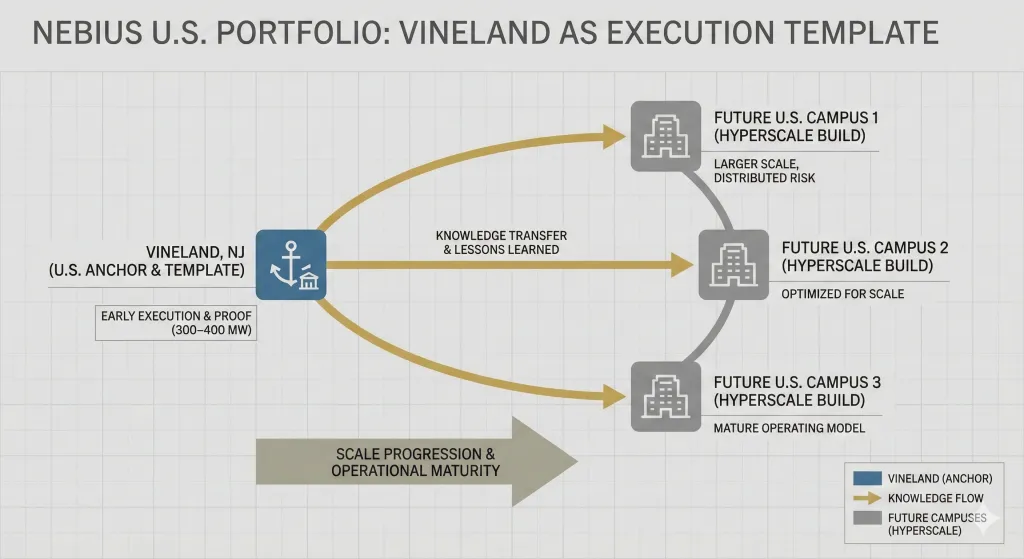
Within the Nebius network, Vineland functions as a convergence point rather than an endpoint. It anchors the company’s near-term U.S. capacity while informing how larger, more distributed deployments will be executed over the remainder of the decade.
Vineland carries a different mandate than Nebius’s Nordic sites. Facilities such as Mäntsälä emphasize energy efficiency, grid integration, and long-term operational stability within mature regulatory environments. Vineland emphasizes delivery speed, power autonomy, and deployment under constraint. The contrast is intentional. Together, these sites broaden Nebius’s operational envelope rather than duplicating the same model across regions.
Relative to future U.S. campuses, Vineland sits earlier in the sequencing curve. Planned sites with larger ultimate capacity will benefit from lessons learned here, particularly around on-site power integration, the move to fuel cells, permitting pathways, and community engagement. Vineland absorbs those complexities first, allowing later projects to optimize for scale rather than proof.
From a capital allocation perspective, Vineland concentrates early investment and early revenue. Its role is to convert contracted demand into operating cash flow quickly, supporting balance sheet flexibility as expansion accelerates. Over time, the site’s share of total capacity will decline even as its importance to operational knowledge remains.
Dimension | Vineland Function |
|---|---|
Geographic role | U.S. anchor |
Timing | Near-term delivery |
Power strategy | Behind-the-meter on-site generation via Bloom fuel cells |
Risk profile | Concentrated execution |
Knowledge transfer | Template for later sites |
Long-term share | Declining relative weight |
This positioning reframes how Vineland should be evaluated. Its success is measured by execution and learnings rather than absolute scale. The site establishes credibility in the U.S. market and reduces uncertainty for subsequent deployments that will carry larger capacity but lower relative execution risk.
With Vineland’s portfolio role defined, the final analytical step is identifying what conditions would materially alter this assessment.
What Would Alter Timelines
The Vineland site rests on a narrow set of assumptions tied to execution, power economics, and regulatory stability. Changes to any of these inputs would alter how the site contributes to Nebius’s broader portfolio.
Power cost and technology dynamics sit at the top of that list. The economics of on-site generation depend on fuel pricing, conversion efficiency, and emissions compliance remaining within modeled ranges. The move to Bloom fuel cells changes the cost profile from a fuel-and-maintenance model under direct control toward a long-dated service-fee arrangement, while improving conversion efficiency relative to the original engine design. Sustained increases in natural gas costs or new state-level charges applied to on-site generation would still pressure power economics.
Delivery timing represents a second sensitivity. Vineland’s value derives from synchronized deployment of power, hardware, and customer utilization. Slippage in fuel cell commissioning, cooling systems, or GPU delivery would push revenue recognition forward while fixed costs continue to accrue. At the current scale, even modest delays carry material impact during ramp phases.
Regulatory posture forms a third variable. While the tax framework and initial site approvals are in place, the energy plan governing full power scaling and LNG storage remains pending, and future rulemaking around emissions, water usage, or large-load data center taxation could increase operating complexity or cost. New Jersey has already begun examining the cumulative impact of hyperscale facilities. Any shift from monitoring to constraint would change the operating envelope.
Customer mix evolution also matters. Vineland’s early utilization is anchored by large commitments that support financing and deployment. Over time, diversification across additional customers improves resilience. A prolonged concentration beyond initial phases would increase sensitivity to contract-specific timing and renewal dynamics.
Variable | Directional Impact |
|---|---|
Fuel cost escalation | Pressure on power economics |
Power technology | Bloom fuel cells shift the cost profile toward long-dated service fees |
Equipment delivery delays | Deferred revenue and higher carry |
Energy-plan approval | Gating item for full power scaling |
Regulatory tightening | Increased operating cost |
Customer concentration | Utilization and renewal sensitivity |
The thesis around Vineland remains intact so long as power economics stay predictable, deployment timelines hold, and regulatory oversight remains stable. Partial early operation supports the time-to-power case, while the pending energy-plan approval keeps the execution-risk case live. Under steady conditions, the site fulfills its intended role as a near-term U.S. anchor and execution template.
The more important outcome lies beyond the site itself. Vineland reduces uncertainty around how Nebius builds, powers, and operates hyperscale AI infrastructure in constrained U.S. markets. That reduction in uncertainty carries forward into larger deployments still ahead.
Premium Northwise AI Infrastructure Reports
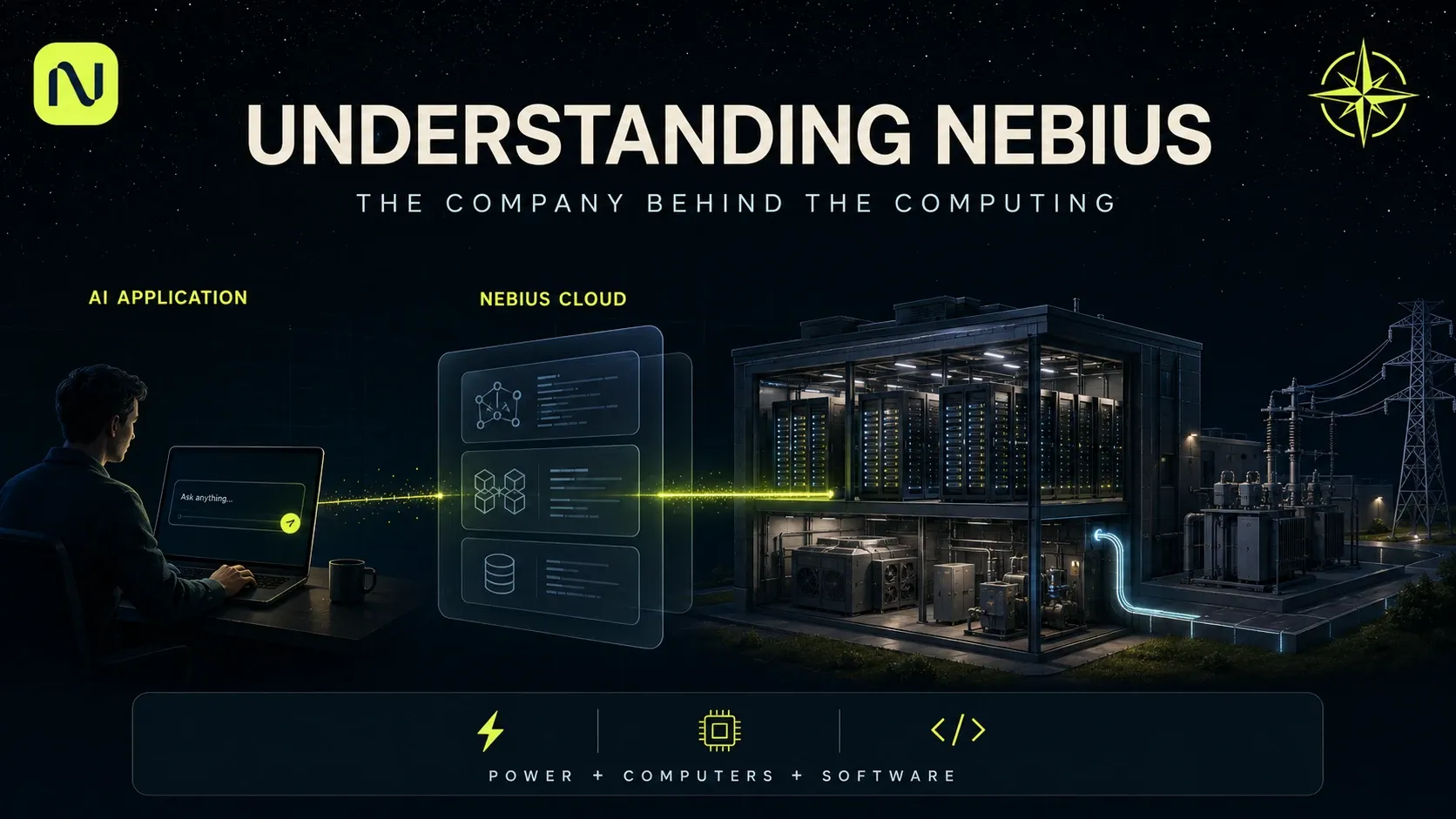
Understanding Nebius: A Complete Guide to the Company
Understand Nebius from the ground up: its AI cloud, competitors, subsidiaries, funding, and growth opportunities. A complete NBIS guide with 14 illustrations.
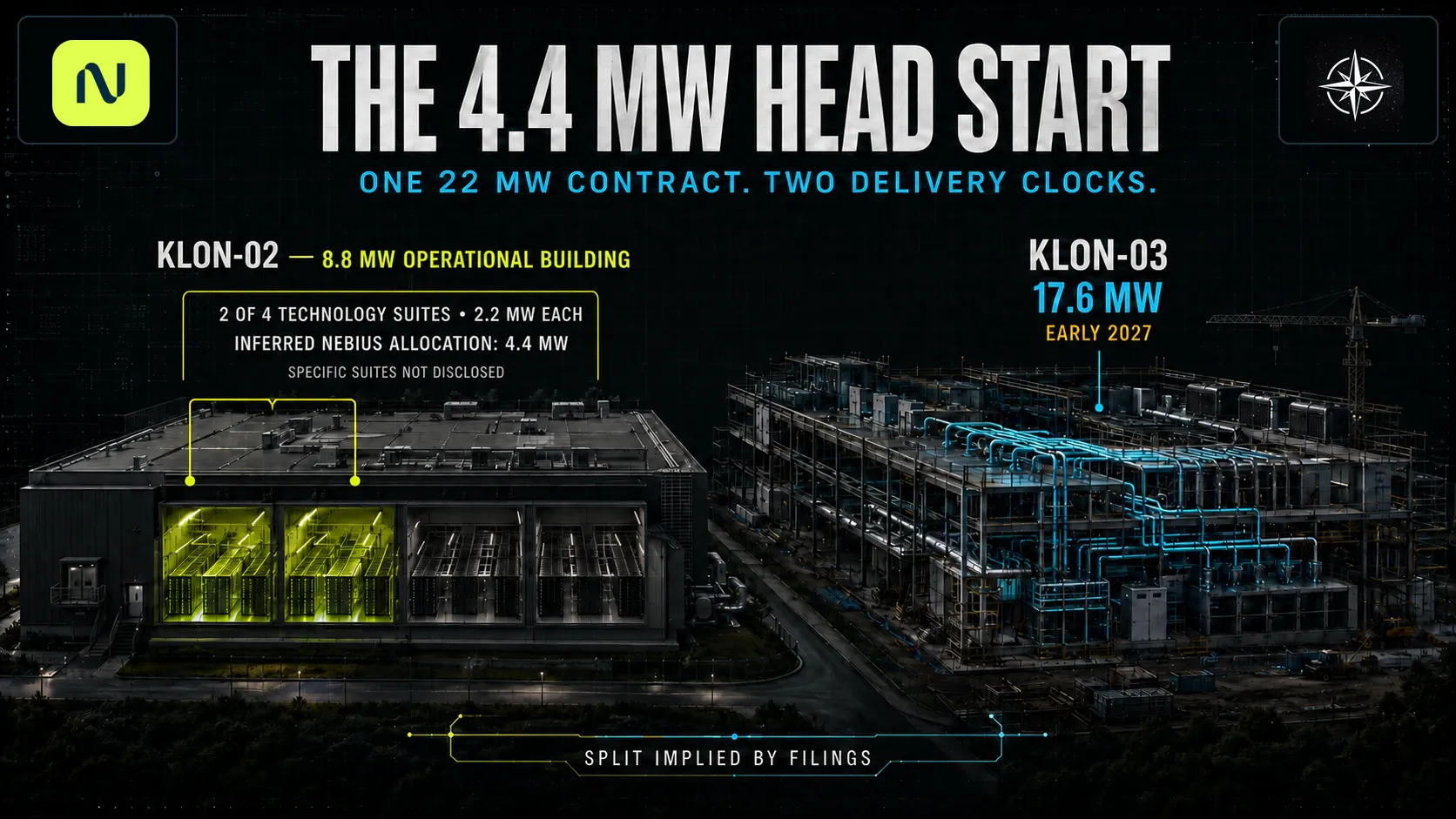
Nebius in Europe: Sovereign AI, UK Expansion and Harlow
How European AI sovereignty supports Nebius’s UK expansion, where Harlow fits, and what its potential 4.4 MW deployment could add to Q3 revenue and 2026 ARR.

NBIS Stock Forecast 2030: The Conversion Problem
A ground-up Nebius model rebuild after Q2 2026, covering AI factory economics, capital structure, valuation scenarios, and the NBIS stock forecast to 2030.
Northwise Portfolios
See how the research becomes real decisions
Reader discussion
Discuss the research
Create a Free account to join the discussion with a display name.
Create a Free Account
No comments yet. Start a thoughtful discussion.