
Jumia Algeria Exit

Jumia Algeria Exit Strategic Rationalization examines regulatory friction, tax reform, and structural barriers behind Algeria’s withdrawal.
In this article
A country-specific examination of how regulatory friction, fiscal policy, and structural payment barriers made Algeria incompatible with Jumia’s 2027 profitability roadmap and led to a full Jumia Algeria exit.
1. Algeria’s Shrinking Strategic Relevance
Algeria entered Jumia’s portfolio with the surface characteristics of a promising North African expansion. A population exceeding 45 million. Internet penetration at 76.9%. Mobile penetration above 112%. Real GDP growth of 4.1% in the first half of 2025. Inflation easing to 1.7% over the same period.
On paper, the inputs resembled a market approaching digital acceleration.
In practice, Algeria remained economically peripheral inside Jumia’s operating system.
By fiscal year 2025, Algeria accounted for just 2% of total group GMV, within a portfolio that generated $818.6 million in GMV and $188.9 million in revenue. When viewed through a capital allocation lens, the Algerian node carried limited scale relative to management bandwidth, regulatory exposure, and compliance burden.
The mismatch becomes clearer when placed alongside the broader restructuring arc.
Between FY 2024 and FY 2025:
Metric | FY 2024 | FY 2025 | YoY Change |
|---|---|---|---|
Group Revenue | $167.5M | $188.9M | +12.8% |
GMV | $720.6M | $818.6M | +13.6% |
Pre-Tax Loss | $97.6M | $60.1M | -38% |
Operating Loss | $66.0M | $63.2M | -4.2% |
Adjusted EBITDA Loss | $51.3M | $50.5M | -1.6% |
Fulfillment Cost per Order | ~$2.24 | $1.97 | -12% |
Headcount | ~2,160 | ~2,010 | -7% |
This financial tightening marked a shift in posture. Growth persisted, yet cost density improved. Fulfillment efficiency increased. Headcount declined. Pre-tax losses narrowed by 38% year over year.
The portfolio was being filtered.
Inside that filtration process, markets required one of two attributes: scale density or regulatory durability. Algeria offered neither in sufficient magnitude.
A 2% GMV contribution in a company pursuing adjusted EBITDA breakeven by Q4 2026 carries limited strategic leverage. Every management hour navigating regulatory escalation in Algiers represented time not deployed in Lagos, Cairo, Abidjan, or Nairobi. Capital allocation begins to resemble triage in these moments. The smallest bleeding limb receives attention only if recovery probability justifies the cost.
Algeria’s trajectory suggested increasing friction rather than compounding scale.
Nigeria delivered 50% GMV growth in Q4 2025 alone. Algeria remained structurally capped. When internal return on invested capital is compared across markets, incremental capital deployed into a dense logistics ecosystem with improving unit economics offers materially higher expected value than capital deployed into a jurisdiction layering new fiscal constraints onto thin marketplace margins.
Digital readiness did not translate into commercial momentum. E-commerce represented only 0.8% of GDP in 2023, a figure that underscores how shallow online transaction penetration remained relative to headline connectivity statistics.
High connectivity can resemble a well-built highway system. Without commercial traffic flowing across it, the infrastructure produces limited economic yield.
The 2022 leadership transition toward portfolio discipline sharpened this evaluation framework. Geographic presence ceased to function as a proxy for optionality. Each market required measurable contribution toward the 2027 profitability objective.
Algeria’s relative weight declined within that calculus.
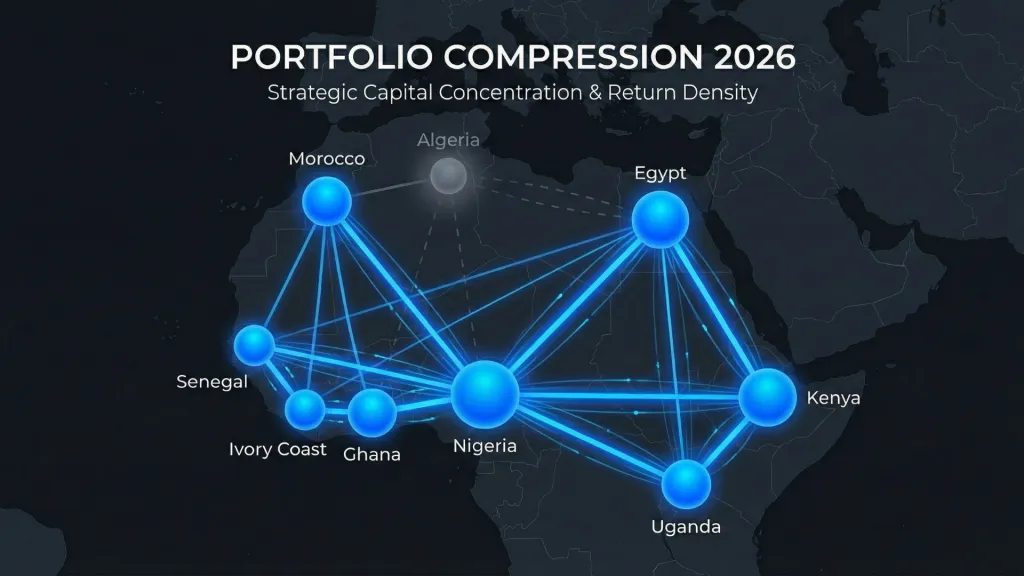
The exit decision, announced alongside FY 2025 results with operations scheduled to cease by Q1 2026, therefore reads less as retreat and more as compression. The operating nucleus narrowed to eight core markets: Nigeria, Egypt, Kenya, Morocco, Ivory Coast, Senegal, Ghana, and Uganda.
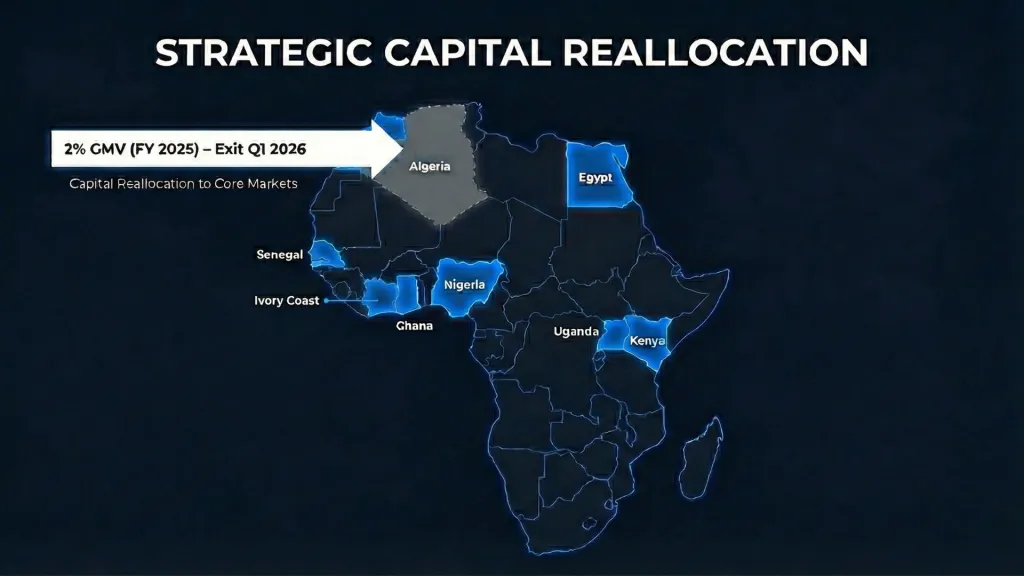
Algeria moved from potential pillar to statistical footnote.
In a restructuring phase defined by unit economics and regulatory sustainability, peripheral exposure carries disproportionate cost. The Algerian withdrawal represents the portfolio reaching internal coherence.
We can now move into the structural drivers that prevented Algeria from achieving density despite favorable digital indicators.
2. Digital Readiness Without Commercial Scale
Algeria presents a statistical paradox.
Internet penetration stands at 76.9%. Mobile penetration exceeds 112%. Nearly 20 million interbank cards circulate within the financial system. Real GDP expanded 4.1% in the first half of 2025. Inflation eased to 1.7% over the same period.
These indicators suggest the raw ingredients of a viable digital commerce environment.
Yet consumer behavior tells a different story.
In 2023, B2C e-commerce represented just 0.8% of GDP. For comparison, emerging e-commerce markets with comparable connectivity levels often sit multiple turns higher on the adoption curve. The Algerian digital consumer base remains connected, though transactionally conservative.
The core constraint is payment structure.
Despite widespread card issuance, approximately 90% of online transactions are conducted via cash on delivery (COD). For a marketplace operator, COD introduces friction at nearly every stage of the value chain.
A simplified comparison illustrates the structural difference:
Payment Structure | Operational Impact |
|---|---|
Digital Prepaid | Immediate cash flow, lower return rates, predictable working capital |
Cash on Delivery | Failed deliveries, higher reverse logistics, delayed cash cycle |
Under COD dominance:
- Delivery attempts convert at lower rates.
- Return frequency increases.
- Working capital becomes tied to physical movement rather than digital settlement.
- Fulfillment cost per successful order rises structurally.
Jumia reduced group fulfillment cost per order to $1.97 in FY 2025, down 12% year over year. Sustaining this efficiency requires density, predictability, and lower return rates. Algeria’s COD-heavy environment constrained that optimization loop.
Payment friction compounds into logistics inefficiency.
When 9 out of 10 orders require physical cash exchange at the doorstep, delivery resembles a negotiation rather than a transaction. Each failed attempt introduces incremental cost. Each refusal resets inventory back into the system. The marketplace model thrives on velocity; COD slows velocity into something closer to manual throughput.
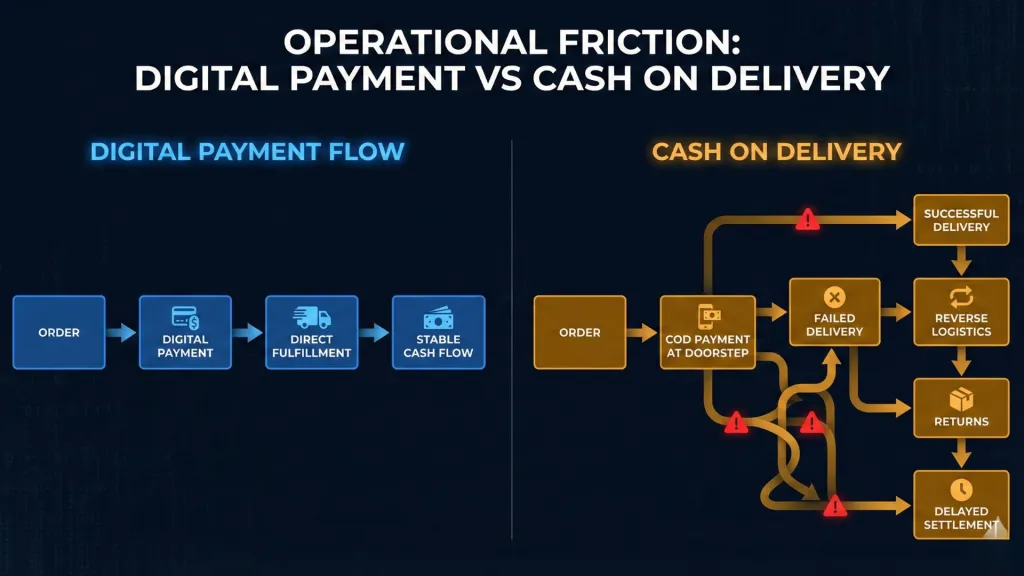
Digital readiness without behavioral adoption resembles fiber optic cables running through a city where most commerce still settles in cash. Infrastructure exists. Commercial migration lags.
Card penetration figures alone therefore overstate transactional maturity. Card ownership does not equate to card usage for e-commerce. Cultural payment preferences, trust dynamics, and informal economic structures anchor behavior more deeply than connectivity statistics.
This divergence limited Algeria’s path toward scale density.
In markets where digital payments gain traction, repurchase rates improve and logistics costs amortize across repeat behavior. In COD-dominant markets, every order must stand on its own economic footing. That structure compresses take-rate leverage and complicates advertising monetization, both of which are critical to long-term profitability targets.
The result was a ceiling on operational compounding.
Algeria possessed connectivity and demographic potential. What it lacked was transactional momentum capable of converting those inputs into sustainable marketplace economics.
3. The 51/49 Ownership Constraint and Capital Control Risk
Algeria’s commercial framework contains structural features that extend beyond consumer behavior. Even if transactional adoption accelerated, the corporate architecture required to operate inside the country imposed its own constraints.
At the center sits the reinstated 51/49 ownership rule for companies engaged in importing goods for resale.
Under this requirement, an Algerian partner must hold at least 51% of the company’s capital, leaving foreign operators capped at 49%. For a marketplace platform whose value is derived from centralized technology, capital allocation discipline, and operational standardization, majority local ownership introduces structural friction.
Control over strategy, capital deployment, and long-term reinvestment becomes shared by statute rather than aligned purely by incentive.
This structure affects more than governance optics. It influences:
- Dividend policy and capital repatriation
- Strategic reinvestment decisions
- Inventory financing arrangements
- Corporate restructuring flexibility
In a portfolio undergoing active rationalization, flexibility carries measurable value. Algeria’s ownership regime reduced that flexibility at precisely the moment Jumia was compressing its geographic footprint.
Currency controls compounded the constraint.
The Algerian dinar (DZD) remains subject to strict capital movement limitations. Exchange of DZD outside the national territory is illegal. Profit repatriation requires regulatory clearance. Foreign exchange access is managed to preserve national reserves.
For a multinational marketplace, these controls introduce several layers of risk:
Capital Constraint | Operational Effect |
|---|---|
FX conversion limits | Delayed repatriation of earnings |
Centralized FX allocation | Planning uncertainty for imports |
Restricted external settlement | Friction in paying international suppliers |
Marketplace economics depend on velocity. Inventory must flow. Payments must clear. Supplier relationships must remain predictable. Currency controls slow these cycles and create mismatch risk between local revenue and international obligations.
In markets where take rates range between 10% and 15%, margin compression from regulatory friction can quickly erode profitability. When layered atop ownership restrictions and capital flow barriers, the operating model begins to resemble a constrained subsidiary rather than a scalable node inside a continental platform.
Strategic optionality declines under these conditions.
In an environment where Jumia reduced headcount by approximately 7% year over year and narrowed pre-tax losses by 38%, each market required structural alignment with capital discipline. Algeria’s framework introduced legal and monetary guardrails that restricted both agility and return visibility.
These constraints alone would not necessarily mandate withdrawal. Many global operators navigate minority ownership regimes. What made Algeria distinctive was the cumulative layering of ownership limits, currency rigidity, and increasingly interventionist trade policy.
The result was a market that demanded disproportionate management energy relative to its 2% GMV contribution.
Capital allocation ultimately rewards density and predictability. Algeria offered demographic scale but regulatory fragmentation. In a portfolio calibrated toward 2027 profitability, that asymmetry became increasingly difficult to justify.
The next layer of friction emerges within the import regime itself, where operational mechanics collided directly with marketplace dynamics.
4. The Import Forecast Programme (PPI) Bottleneck
Marketplace economics rely on flexibility. Inventory flows shift daily. Consumer demand changes weekly. Sellers react in real time to pricing, seasonality, and competitor activity.
Algeria’s import regime required the opposite posture.
Beginning in the second half of 2025, the Ministry of Foreign Trade introduced tighter enforcement around the Import Forecast Programme (Programme Prévisionnel d’Importation, PPI). Under this framework, economic operators must submit a detailed import forecast to the Ministry before initiating banking domiciliation or opening letters of credit.
The structure requires:
- A forward-looking declaration of product categories and quantities
- Precise HS code alignment between forecast and final invoices
- Management of the process through a single designated bank
- Administrative validation before shipment clearance
Any mismatch between the forecasted quantities and actual imports can trigger delays, administrative rejection, or suspension of the transaction.
For a traditional importer operating on seasonal cycles, this introduces friction.
For a digital marketplace connecting thousands of third-party sellers, the structure becomes systemically incompatible.
Jumia’s model is built around dynamic assortment. Sellers adjust SKUs based on demand signals. Cross-border sourcing strategies depend on responsiveness. Inventory refresh cycles can compress into weeks rather than quarters.
The PPI regime requires inventory predictability months in advance.
The mismatch can be framed operationally:
Marketplace Dynamic | PPI Requirement | Resulting Friction |
|---|---|---|
Real-time SKU changes | Pre-declared forecast | Inventory rigidity |
Variable seller volumes | Fixed import declarations | Supply bottlenecks |
Rapid price arbitrage | Administrative validation | Slower replenishment |
Multi-seller ecosystem | Centralized banking channel | Operational congestion |
Customs clearance timelines further amplified the constraint. Import processing delays could extend from weeks into multiple months depending on documentation accuracy and administrative backlog.
In high-velocity commerce, time functions as inventory.
When shipments stall at port, working capital remains locked. Pricing becomes less competitive. Consumer trust erodes. Sellers reduce participation. Marketplace flywheels depend on liquidity; regulatory queues slow that liquidity into something closer to batch processing.
The Yiwu sourcing strategy, designed to shorten supply chains and reduce cost of goods sold through direct manufacturer relationships in China, required precisely the sort of frictionless import channel that Algeria’s regime constrained.
Customs duties ranging from 0% to 30% on CIF value, combined with a 19% standard VAT, further elevated landed costs. In price-sensitive categories, even modest duty differentials shift competitiveness relative to informal or cross-border gray market channels.
The PPI structure therefore acted less as an administrative inconvenience and more as a structural choke point. Forecast rigidity collides directly with algorithm-driven inventory flow. A marketplace thrives on elasticity. The PPI framework formalized rigidity.
Within a portfolio focused on improving fulfillment efficiency to $1.97 per order and tightening cash burn to $4.7 million per quarter, incremental supply chain friction in a 2% GMV market became increasingly difficult to rationalize.
Regulatory architecture began to outweigh demographic potential.
The next development would escalate the pressure from operational friction into direct profitability impairment.
5. The 2026 Finance Law: Structural Profitability Destruction
Operational friction constrains scale. Fiscal structure determines viability.
Algeria’s 2026 Finance Law, signed in December 2025, shifted the equation from administrative burden to structural impairment. Several provisions materially altered the economics of operating as a foreign digital platform inside the country.
The most consequential changes centered on taxation mechanics and intra-group cost treatment.
5.1 Article 14 and the 30% Gross Withholding Tax
Prior to the 2026 Finance Law, foreign companies without a permanent professional establishment in Algeria could elect to be taxed under the real profit regime. This allowed taxation on net income instead of gross revenue.
Article 14 removed that option.
Under the revised framework, qualifying foreign companies became subject to a 30% withholding tax on gross income.
For a traditional importer earning margin on physical resale, gross taxation compresses margins. For a marketplace platform operating on commission-based take rates, the effect becomes severe.
Jumia’s marketplace take rate typically ranges between 10% and 15% of gross merchandise value. A 30% tax on gross income creates a scenario where tax liability exceeds commission revenue generated from each transaction.
A simplified illustration demonstrates the distortion:
Transaction Value | Jumia Take Rate (12%) | Gross Commission | 30% Gross Withholding | Residual Before Costs |
|---|---|---|---|---|
$100 | 12% | $12 | $30 | Negative before logistics |
Even before layering logistics, marketing, and payment processing costs, the tax structure alone overwhelms the commission model.
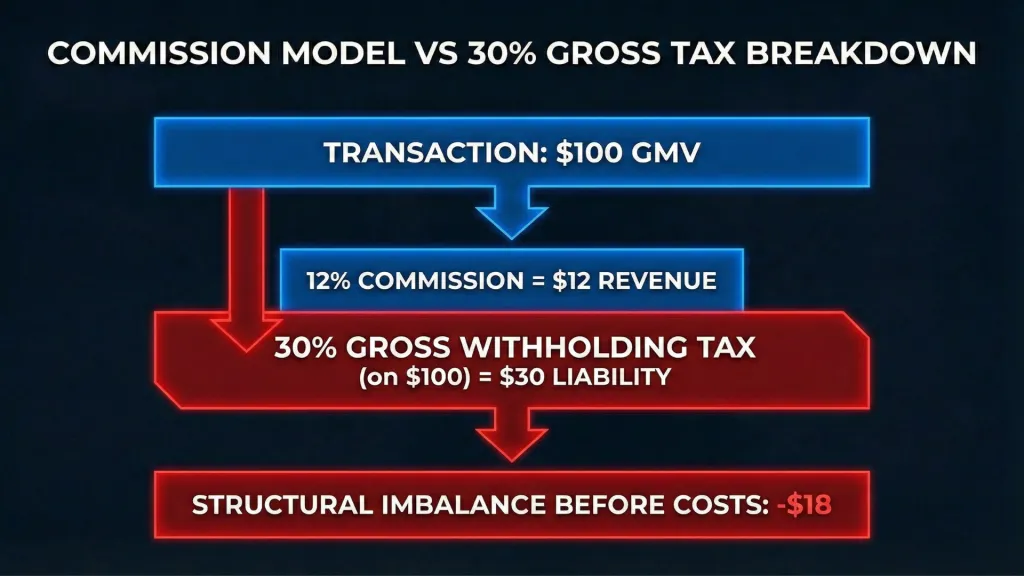
Marketplace economics depend on spread between commission revenue and fulfillment plus overhead costs. Article 14 inverts that spread.
The fiscal framework shifts from margin compression to margin inversion.
5.2 Article 16 and Intra-Group Charge Restrictions
Jumia operates with centralized technology, administrative, and shared service hubs in markets such as Egypt, Portugal, and Nigeria. These hubs allocate costs across operating subsidiaries through intra-group charges.
Article 16 of the 2026 Finance Law disallowed the deduction of intra-group charges for royalties, fees, commissions, or interest payments to parent or affiliated entities, unless tied strictly to third-party reimbursements.
This provision introduced two distortions.
First, the Algerian subsidiary could no longer deduct legitimate centralized technology and support costs.
Second, the local taxable base became inflated relative to economic profit.
The subsidiary would be taxed as though it operated independently with minimal shared infrastructure costs, despite relying on centralized technology platforms and continental logistics architecture.
For a digital marketplace whose cost structure is inherently shared, this tax treatment separated fiscal calculation from economic reality.
5.3 Enhanced IT Certification and Audit Scrutiny
Article 74 introduced additional compliance burdens. Taxpayers must provide certification from their IT system suppliers attesting to the integrity, security, and archival immutability of accounting data.
Tax authorities received expanded access rights to accounting IT systems.
For a technology-driven marketplace, the incremental compliance load extends beyond documentation. It includes system validation procedures, legal oversight, accounting review cycles, and heightened audit exposure.
Compliance cost rarely appears in headline tax rates. It manifests in slower decision cycles and higher fixed administrative expense.
Fiscal Summary: Compounding Pressure
When layered together, the 2026 Finance Law provisions created cumulative stress:
Provision | Structural Impact |
|---|---|
30% gross withholding tax | Commission model impairment |
Disallowed intra-group deductions | Artificial profit inflation |
IT certification requirements | Higher compliance cost |
Expanded audit authority | Increased regulatory exposure |
Each element introduces friction. Together they reshape the profitability boundary.
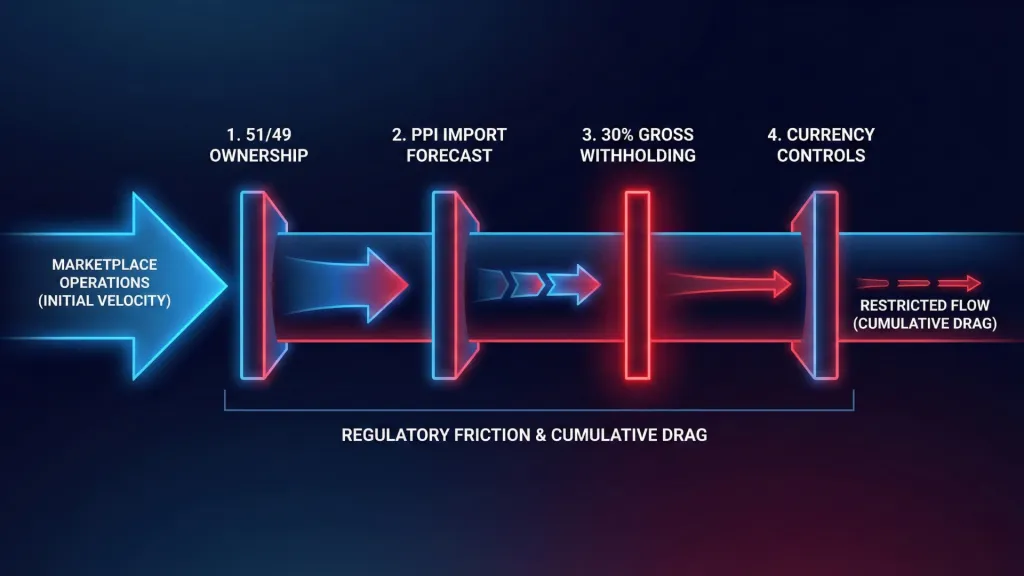
In a market representing 2% of group GMV, absorbing structural fiscal inversion to preserve presence carries limited strategic justification. The Algerian subsidiary would operate under a tax architecture misaligned with platform economics, inside an import regime misaligned with dynamic inventory flow, and within a capital control environment misaligned with multinational cash management.
The Finance Law served as the decisive accelerant.
Operational challenges can be addressed through efficiency gains. A tax structure that overrides commission margins alters the underlying equation.
6. Why Algeria Could Not Support the Yiwu Sourcing Strategy
By 2025, Jumia’s competitive response to Chinese fast-commerce expansion took tangible form. The opening of a sourcing office in Yiwu, China, one of the largest wholesale trade hubs globally, marked a shift toward direct manufacturer procurement.
The objective was straightforward: compress cost of goods sold, bypass intermediaries, and expand assortment breadth at price points capable of competing with Temu and Shein.
The early results were measurable. In Q4 2025, items sold by international sellers, primarily China-based, surged 82% year over year.
The Yiwu strategy depends on three structural conditions:
- Predictable import clearance
- Manageable customs and VAT layering
- Low friction in cross-border payment settlement
Algeria offered none of these in sufficient alignment.
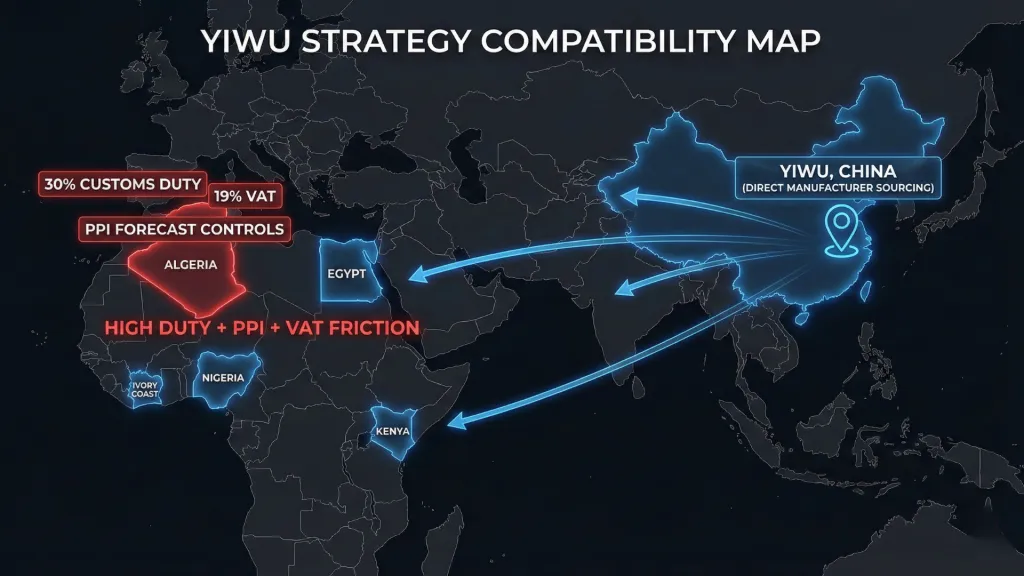
Customs duties range from 0% to 30% of CIF value, layered with a 19% standard VAT. In price-sensitive categories such as apparel, electronics accessories, and small household goods, landed cost inflation of even 5% to 10% can eliminate price competitiveness. At 30% duty plus VAT, the pricing envelope compresses sharply.
The structure can be framed numerically:
CIF Value | Customs Duty (30%) | Subtotal | VAT (19%) | Final Landed Cost |
|---|---|---|---|---|
$100 | $30 | $130 | $24.70 | $154.70 |
A product with a $100 factory-level cost becomes nearly $155 before logistics margin, platform commission, or last-mile delivery.
Yiwu sourcing is built on tight cost spreads. The margin architecture requires frictionless scaling across markets with moderate import barriers. Algeria’s import substitution policies and elevated duties widened the cost base before the marketplace model could capture commission revenue.
Policy direction further constrained alignment.
Algeria’s import substitution framework aims to preserve foreign exchange reserves and stimulate domestic production. While strategically coherent at a national level, it conflicts with a cross-border marketplace model that depends on high-velocity inbound goods.
The dynamic resembles attempting to accelerate a supply chain through a series of checkpoints designed to slow it down.
Beyond cost layering, the Import Forecast Programme added forecast rigidity to a sourcing strategy built on flexibility. The Yiwu office allows rapid assortment shifts based on demand data. Algeria required pre-declared quantities and centralized banking channels.
This friction matters more in an environment where Chinese platforms allocate significant marketing capital across African markets. Temu deployed approximately $2 billion in advertising globally, accelerating customer acquisition and price anchoring.
Competitive comparison clarifies the structural divergence:
Competitive Factor | Jumia (Yiwu Strategy) | Chinese Fast-Commerce Platforms |
|---|---|---|
Sourcing | Direct manufacturer via Yiwu | In-house manufacturer networks |
Logistics | Continental last-mile density | Cross-border air freight hubs |
Payment | COD plus JumiaPay | Digital-first settlement |
Pricing Model | Commission marketplace | High-volume direct retail |
In markets such as Nigeria or Ivory Coast, Jumia can leverage logistics density and growing digital payments adoption to offset pricing pressure. Algeria’s regulatory drag neutralized those advantages.
Yiwu sourcing requires velocity. Algeria institutionalized friction.
When capital and inventory must be allocated selectively across a shrinking portfolio, priority flows toward markets capable of absorbing cross-border supply at scale. Algeria’s structure limited that absorption.
The sourcing strategy, designed as a defensive and margin-expanding tool, found limited operational compatibility inside the Algerian framework.
The next consideration centers on the financial mechanics of exit and how the withdrawal reshapes the path to breakeven.
7. Exit Costs and Short-Term Financial Impacts
The withdrawal from Algeria will be finalized in Q1 2026. Strategic clarity does not eliminate short-term cost.
Management indicated that the first quarter of 2026 will reflect non-recurring charges associated with winding down local operations. These costs fall into three primary categories:
- Employee severance
- Lease termination and facility exit fees
- Asset liquidation and inventory clearance
Algeria’s workforce was modest relative to core markets, yet severance obligations represent immediate cash outflow. Lease agreements for warehouses and office space require negotiated termination or contractual payout. Physical assets, including equipment and unsold inventory, must be disposed of at book value or written down.
These charges compress reported earnings in the near term.
However, liquidity positioning entering 2026 provides context. Jumia ended FY 2025 with $77.8 million in liquidity. Quarterly cash burn declined to $4.7 million, representing a 70% sequential reduction.
The directional improvement in cash burn is material.
At $4.7 million per quarter, annualized cash usage approximates $18.8 million. With $77.8 million in liquidity, the company maintains multiple years of operational runway under current burn conditions, even before accounting for further cost compression from market exits.
The Algeria withdrawal therefore creates a temporary accounting headwind while structurally reducing recurring operating exposure.
The impact also interacts with 2026 guidance.
Jumia expects GMV growth of 27% to 32% year over year in 2026, adjusted for perimeter effects from exiting Algeria, South Africa, and Tunisia. Adjusted EBITDA loss is projected to narrow to a range of $25 million to $30 million for full-year 2026.
The profitability roadmap is structured as follows:
Target Milestone | Timeline | Financial Objective |
|---|---|---|
Adjusted EBITDA Breakeven | Q4 2026 | $0 Adjusted EBITDA |
Positive Operating Cash Flow | Q4 2026 | Net positive operating cash |
Full-Year Profitability | 2027 | Net income positive |
Removing Algeria trims revenue at the margin, given its 2% GMV contribution, while reducing regulatory and compliance cost exposure. The perimeter effect therefore modestly lowers top-line scale while improving structural clarity.
Exit costs function as a one-time compression event. Recurring regulatory overhead and fiscal distortion disappear from the forward model.
In capital allocation terms, the withdrawal resembles a pruning decision. Short-term shock to the income statement creates long-term efficiency across the portfolio.
The more significant question concerns redeployment. Freed management attention and capital must now compound inside markets capable of delivering scale density and improving unit economics.
8. Capital Reallocation to the Operating Nucleus
Exiting a market only improves outcomes if the released capital compounds more efficiently elsewhere.
Algeria represented 2% of GMV in FY 2025. The opportunity cost of retaining management focus, regulatory negotiation bandwidth, and working capital inside that 2% must be weighed against the incremental return achievable in higher-density markets.
Jumia’s operating nucleus now consists of eight core geographies: Nigeria, Egypt, Kenya, Morocco, Ivory Coast, Senegal, Ghana, and Uganda. Each serves a distinct role inside the continental model.
Nigeria: Volume and Logistics Density
Nigeria remains the structural center of gravity.
In Q4 2025, Nigeria delivered 50% GMV growth, materially outpacing group averages. The company centralized operations into a 30,000-square-meter integrated warehouse in Lagos, increasing fulfillment efficiency and improving inventory turnover.
Approximately 61% of Nigerian orders now originate from secondary cities, reflecting successful upcountry penetration. Higher order density allows fixed logistics infrastructure to amortize across greater volume, reducing marginal fulfillment cost.
When group fulfillment cost per order declined to $1.97 in FY 2025, that improvement was anchored in markets capable of achieving density. Nigeria is the primary contributor to that trajectory.
Incremental capital deployed into densification in Lagos or secondary hubs carries compounding operational leverage.
Egypt: Technology and Marketplace Stabilization
Egypt serves as both a consumer marketplace and the regional technology core.
Following the strategic pivot away from corporate B2B sales, Egypt’s consumer GMV expanded 37% by year-end 2025, despite headline revenue volatility earlier in the year. Cairo hosts critical engineering functions that power the broader platform, creating cost-sharing efficiency across markets.
Investment in Egypt enhances both local performance and continental software infrastructure. Capital deployed here scales beyond national boundaries.
Kenya: Payment Transition Laboratory
Kenya remains the most advanced payment environment in the portfolio due to deep M-Pesa penetration. Digital settlement reduces reliance on COD, lowering return rates and shortening cash conversion cycles.
Markets that migrate toward digital-first payment structures experience improvement in repurchase rates and operating leverage. Kenya functions as a blueprint for reducing cash dependency across West and East Africa.
Redirected capital can accelerate payment adoption initiatives and logistics integration in this environment.
Ivory Coast: Efficiency Benchmark
Ivory Coast operates under the euro-pegged CFA franc, providing macro stability relative to many regional peers. The market utilizes more than 350 pickup stations, enabling asset-light last-mile distribution.
Management frequently references Ivory Coast as an efficiency benchmark within the portfolio. High order density combined with currency stability creates predictable unit economics.
Reallocation toward this cluster supports structural margin improvement.
Portfolio Compression and Return Density
The capital logic becomes visible when summarized:
Market | Strategic Role | Capital Leverage Potential |
|---|---|---|
Nigeria | Volume engine | High fixed-cost amortization |
Egypt | Tech hub + consumer growth | Cross-market scalability |
Kenya | Digital payment adoption | Lower fulfillment friction |
Ivory Coast | Efficiency benchmark | Stable margin profile |
Algeria consumed regulatory negotiation capacity, compliance cost, and working capital within a framework where take-rate economics faced structural distortion. The operating nucleus concentrates resources in markets aligned with profitability milestones targeted for 2026 and 2027.
Geographic compression increases return density.
Management bandwidth, a finite asset, now flows toward markets with scalable logistics infrastructure, improving payment adoption, and fiscal regimes compatible with commission-based models.
The portfolio begins to resemble a network optimized for compounding rather than coverage.
The final layer concerns how investors interpreted this compression and what the market reaction signals about confidence in the 2027 roadmap.
9. Investor Reaction to the Jumia Algeria Exit
The announcement of FY 2025 results and the Algeria exit produced an immediate reaction in the equity market.
On the day of release, Jumia’s share price declined 15.8%, closing at $10.33. The magnitude of the move reflected short-term earnings sensitivity and investor recalibration of the profitability timeline.
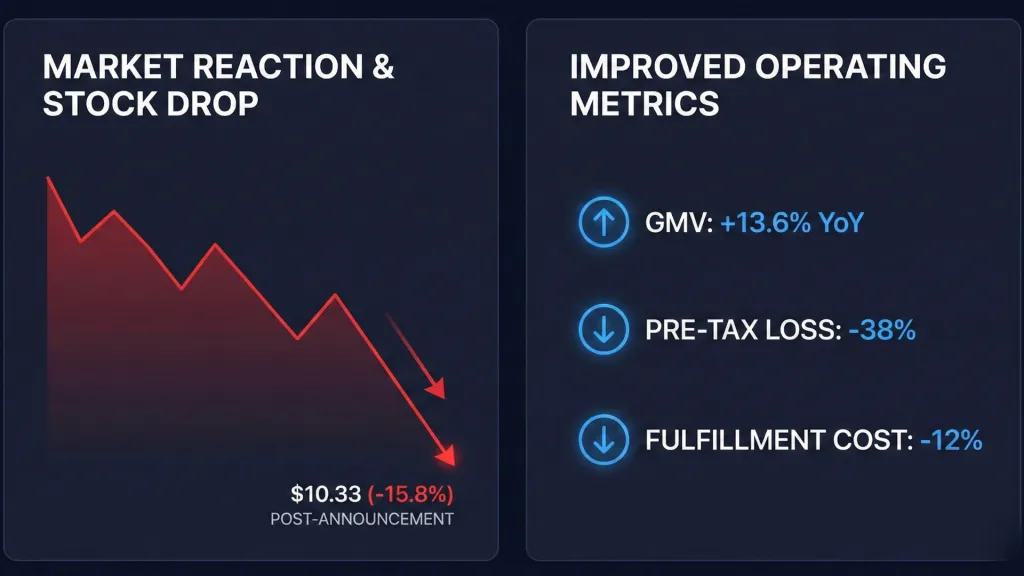
Revenue grew 12.8% year over year to $188.9 million. GMV expanded 13.6% to $818.6 million. Pre-tax loss narrowed by 38%, falling from $97.6 million to $60.1 million. Fulfillment cost per order declined to $1.97, representing a 12% improvement.
These metrics pointed toward structural tightening.
The sell-off therefore reflected expectation adjustment rather than operational deterioration. Some investors anticipated a more aggressive acceleration toward breakeven given the improvement in cash burn and revenue growth.
Analyst positioning remained broadly constructive.
Analyst | Rating | Price Target (USD) |
|---|---|---|
Craig Hallum | Buy | $18.00 |
Benchmark | Buy | $18.00 |
Cantor Fitzgerald | Buy | $16.00 |
Weiss Ratings | Sell | N/A |
Consensus | Moderate Buy | $16.50 |
Fair value estimates ranged from $6.32 to $46.28, highlighting dispersion in assumptions regarding execution and competitive durability.
The Algeria exit plays into that dispersion.
For one cohort, geographic contraction signals shrinking ambition. For another, portfolio filtration signals capital discipline and margin protection.
The market reaction suggests that profitability timing remains the dominant valuation driver. Management reiterated guidance targeting:
- Adjusted EBITDA breakeven in Q4 2026
- Positive operating cash flow in Q4 2026
- Full-year profitability in 2027
The Algeria withdrawal removes regulatory uncertainty from forward modeling. It also reduces headline GMV in the short term due to perimeter effects.
Equity markets frequently discount scale contraction faster than they reward efficiency expansion. Over time, margin stability and cash flow generation tend to carry greater valuation weight than geographic breadth.
The Algeria exit functions as a signal to institutional investors that management prioritizes structural viability over symbolic presence.
Whether that signal converts into sustained multiple expansion depends on execution inside the operating nucleus. The compression strategy sets the stage. Performance in Nigeria, Egypt, Kenya, and Ivory Coast determines the outcome.
The final section addresses the broader strategic meaning of the Algeria withdrawal inside Jumia’s continental model.
10. The Strategic Meaning of the Algeria Exit
Algeria’s withdrawal marks the closing chapter of Jumia’s expansion-era logic.
During the early years, geographic presence functioned as strategic currency. Each new market carried narrative weight. Footprint implied ambition. Optionality implied future scale.
The post-2022 restructuring era replaced that framework with filtration.
By FY 2025, group GMV reached $818.6 million, revenue climbed to $188.9 million, and pre-tax loss narrowed by 38% year over year. Fulfillment cost per order fell to $1.97. Quarterly cash burn compressed to $4.7 million. Liquidity stood at $77.8 million.
These figures describe a company tightening its operating envelope.
Inside that envelope, markets must satisfy three conditions:
- Regulatory compatibility with a commission-based marketplace
- Import structures that support dynamic inventory flow
- Payment behavior capable of compounding logistics density
Algeria failed to meet these thresholds simultaneously.
The 30% gross withholding tax under Article 14 inverted marketplace economics. Article 16 inflated taxable bases through intra-group deduction limits. The PPI regime constrained supply elasticity. Customs duties and VAT layered additional cost pressure. COD dominance limited payment velocity.
Each constraint alone introduces friction. In combination, they reshape the structural boundary of profitability.
The decision to withdraw before fiscal drag deepened reflects portfolio maturation. Capital now concentrates in eight core markets with clearer paths to adjusted EBITDA breakeven in Q4 2026 and full-year profitability in 2027.
Geographic contraction in this context resembles pruning a growth tree. Removing branches that absorb nutrients without producing yield strengthens the remaining structure.
Continental ambition remains intact. The path shifts from breadth to density.
Nigeria’s logistics consolidation, Egypt’s consumer marketplace stabilization, Kenya’s digital payment penetration, and Ivory Coast’s efficiency profile now anchor the model. The Yiwu sourcing office channels cross-border inventory toward jurisdictions capable of absorbing it at scale.
Algeria becomes an example of regulatory incompatibility rather than strategic retreat.
For investors evaluating Jumia’s trajectory, the exit clarifies management’s capital allocation philosophy. Symbolic presence yields to economic alignment. Narrative scale yields to return density.
The continental model narrows. The profitability target remains.
In that narrowing lies the signal.

Jumia Stock Forecast 2030: The Business Beyond Breakeven
Explore Northwise’s Jumia stock forecast for 2030: country growth, unit economics, cash flow, dilution and three valuation scenarios, with a financial model.
Where Will Jumia Expand Next?
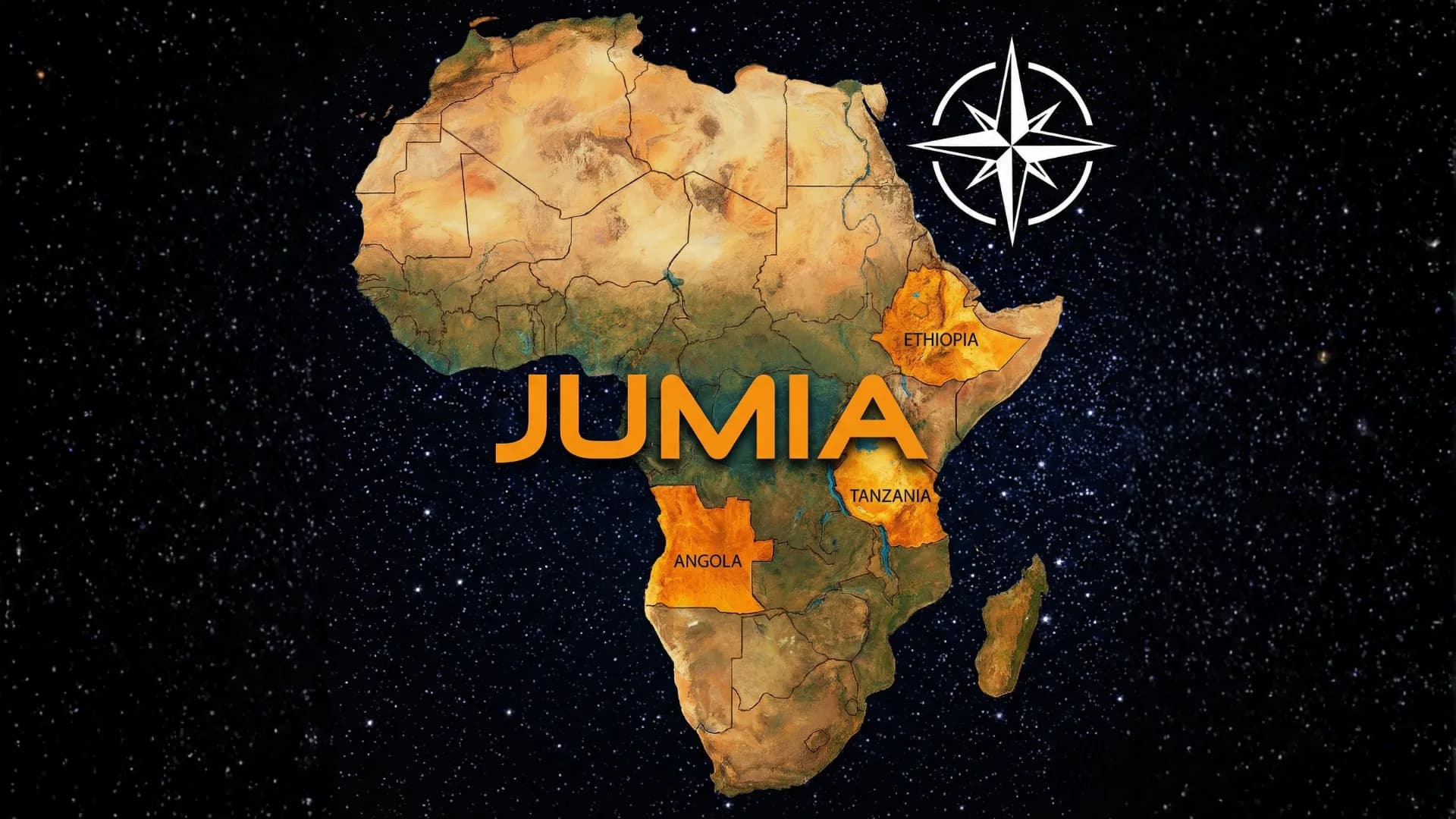
Where will Jumia expand next after profitability? We examine Tanzania, Angola, and Ethiopia as post-2027 growth options.

Jumia Uganda
Jumia Uganda: a growing revenue contribution from a smaller base, customer retention and the economics of expanding delivery coverage.
Northwise Portfolios
See how the research becomes real decisions
Reader discussion
Discuss the research
Create a Free account to join the discussion with a display name.
Create a Free Account
No comments yet. Start a thoughtful discussion.