
Hims Stock Forecast 2030

Hims stock forecast 2030 with a realistic analysis of growth, revenue drivers, margins, risks, and long-term valuation scenarios.
In this article
Hims Stock Forecast 2030: The Future of Consumer Healthcare
A deep analysis of how Hims is reshaping the economics of modern care and what that means for long-term valuation.
Understanding Hims into 2026: A Company Outgrowing Its Own Reputation
Hims has never fit neatly into the categories analysts place around healthcare companies. For years it was dismissed as a direct to consumer brand selling treatments for hair loss and erectile dysfunction.
The narrative obscured the broader truth. While investors debated the sustainability of early-stage demand, the company quietly built a scaled healthcare platform that now serves more than 2.4 million active subscribers and generates an annualized revenue run rate near 2.4 billion dollars.

What changed was not consumer taste but the structure of the healthcare system itself. High deductible insurance pushed millions of people into out-of-pocket spending. Appointment wait times grew longer.
The cost of care became unpredictable. Against this backdrop Hims offered fixed pricing, asynchronous provider access, and discreet treatment pathways. What began as convenience gradually evolved into a more trusted model of care for many conditions.
By late 2025 Hims had proven it could grow and remain profitable. It demonstrated operating leverage, produced positive free cash flow, and expanded its gross margin profile through vertical integration. These shifts were not captured in the early market narrative, but they now form the foundation of any credible long-term forecast.
Why Consumer Healthcare Is Changing and Why Hims Is Positioned to Scale
The U.S. healthcare system is undergoing a steady transition from insurance-driven expectations to consumer-driven realities. A large share of care now falls within high deductible thresholds, meaning patients pay out of pocket until their deductibles are met. This structure places a premium on transparency and ease of use. People want to know what something costs and how long it will take.
Traditional healthcare has struggled to adapt. Appointment slots are scarce. Billing remains opaque. Follow-up is inconsistent. The patient experience often feels fragmented, especially for conditions that do not require continuous specialist engagement.

Hims fits into this environment by offering care pathways that feel familiar to consumers. Intake is digital. Pricing is predictable. Providers respond quickly. Medications arrive without delays. For a generation accustomed to intuitive digital services, this model feels practical rather than disruptive. The shift is not driven by novelty. It is driven by alignment with consumer expectations.
This alignment shapes the Hims stock forecast for 2030. It means the company operates in a market where demand is defined not only by clinical need but by user experience.
How Hims Makes Money and Why Subscribers Drive the Model
Hims earns the majority of its revenue from recurring monthly subscriptions. Each subscriber contributes a predictable stream of revenue based on the treatments they receive. The company tracks monthly online revenue per subscriber, which reflects the average amount each user spends on the platform per month.
This measure is important because it captures two dynamics. The first is the number of conditions a subscriber treats. The second is the specific treatment category and associated dosing.
A subscriber who treats hair loss and dermatology will spend more than one who treats a single condition. A subscriber enrolled in metabolic care will have a different spending profile than one treating a simpler condition.
The long-term value of the platform increases when subscribers treat multiple conditions. Retention improves. Monthly spending increases. And acquisition costs, which are often cited in bearish arguments, become less relevant when multiplied across several categories.
This is why subscriber count and monthly revenue per subscriber are the two central components of any long-range model. They determine the slope of revenue growth far more than any single product vertical.
The Growth Engines That Shape the Hims Stock Forecast 2030
Forecasting requires an understanding of the forces driving the business forward. These forces extend beyond any single category and reflect structural shifts in how people receive care.
Personalized Compounding and Vertical Integration
The acquisition of MedisourceRx created in-house capacity for sterile drug production. This allows Hims to offer customized dosages and formulations that traditional pharmacies do not provide.
It improves margin structure, strengthens supply reliability, and enhances quality control. Personalized compounding is not a temporary advantage. It is a long-term differentiator in categories where standardized dosing is often imperfect.
Women’s Health and the Menopause Market
Menopause and perimenopause remain significantly underserved. Many practitioners receive limited training in these areas, leaving millions of women to navigate symptoms without structured support.

Hims is building dedicated treatment pathways for these conditions with a focus on continuity and personalization. Because these conditions often require multi-year engagement, women’s health has the potential to become one of the most durable verticals within the company.
International Expansion Through ZAVA
The ZAVA acquisition accelerates the company’s presence across the United Kingdom and European Union member states. Many of these markets have not yet adopted subscription-based telehealth at scale.
Hims is applying a model that already works in the United States to geographies where consumer expectations are shifting toward convenience and direct access. Europe will not redefine the company by 2030, but it will contribute meaningful incremental growth.
Diagnostics and the Future of Preventive Care
Trybe Labs extends the company’s reach into diagnostics and longevity-focused care. This positions Hims to support preventive health rather than purely reactive treatment.
Diagnostic insights allow the platform to personalize treatment across more categories and support long-term adherence. Over time, diagnostics will likely become a foundational part of how Hims manages chronic conditions for its subscribers.
Revenue Outlook and the Road to 2030
Hims’ revenue model scales through a simple formula: total subscribers multiplied by their average monthly spend multiplied by twelve months. Subscribers sit at approximately 2.47 million today.
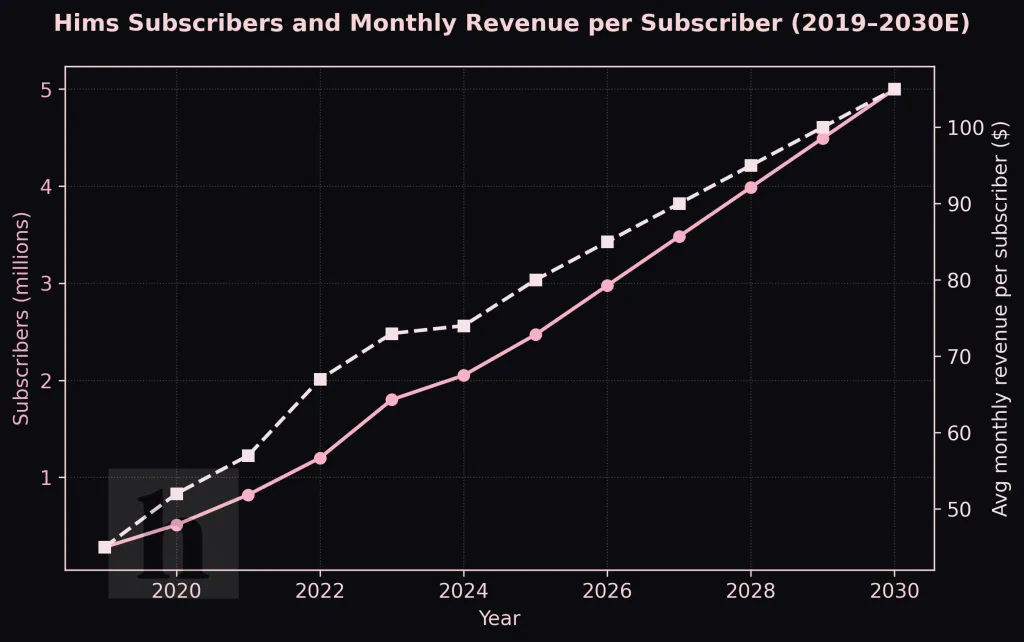
Base Case Estimates
Monthly revenue per subscriber is near 80 dollars. If subscriber growth remains steady and monthly spending increases through multi-category adoption and new vertical expansion, revenue expands naturally.
The scenarios below reflect how different economic, regulatory, and operational conditions may influence these two variables. They do not attempt to predict exact outcomes. Instead, they provide realistic paths the company may follow.
Hims Stock Forecast 2030: Three Scenarios Based on Realistic Growth Paths
The future cannot be predicted precisely, but it can be mapped. The following scenarios illustrate different outcomes based on varying assumptions in subscriber growth, spending per subscriber, and margin structure.
Hims Bear Case 2030: A Regulated Slowdown with Steady Underlying Growth
Subscribers in 2030: 3.6 to 4.0 million
Annual subscriber growth: 8 to 10 percent
Average monthly revenue per subscriber: 88 to 93 dollars
Revenue in 2030: 3.9 to 4.3 billion dollars
Operating margin: 8 percent
Earnings per share: 1.30 to 1.45 dollars
Price target range: 19 to 26 dollars
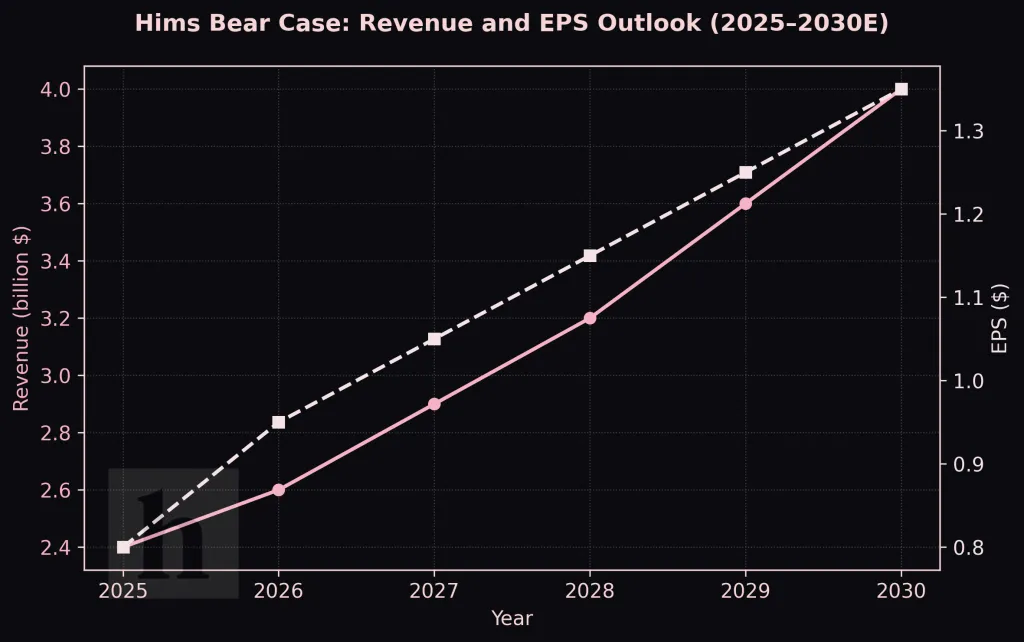
This path assumes stricter regulatory guidance on compounded medications, particularly GLP one treatments. The category remains viable but requires additional oversight and documentation. International expansion proceeds cautiously.
The women’s health vertical grows but does not fully mature. Marketing efficiency remains pressured by competitive dynamics. Revenue still grows at a double-digit pace, reflecting the resilience of the subscription model, but the valuation remains compressed.
Hims Base Case 2030: A Multi Vertical Platform with Durable Growth
Subscribers in 2030: 4.8 to 5.2 million
Annual subscriber growth: 14 to 16 percent
Average monthly revenue per subscriber: 102 to 108 dollars
Revenue in 2030: 6.0 to 6.6 billion dollars
Operating margin: 13 percent
Earnings per share: 3.25 to 3.55 dollars
Price target range: 72 to 92 dollars
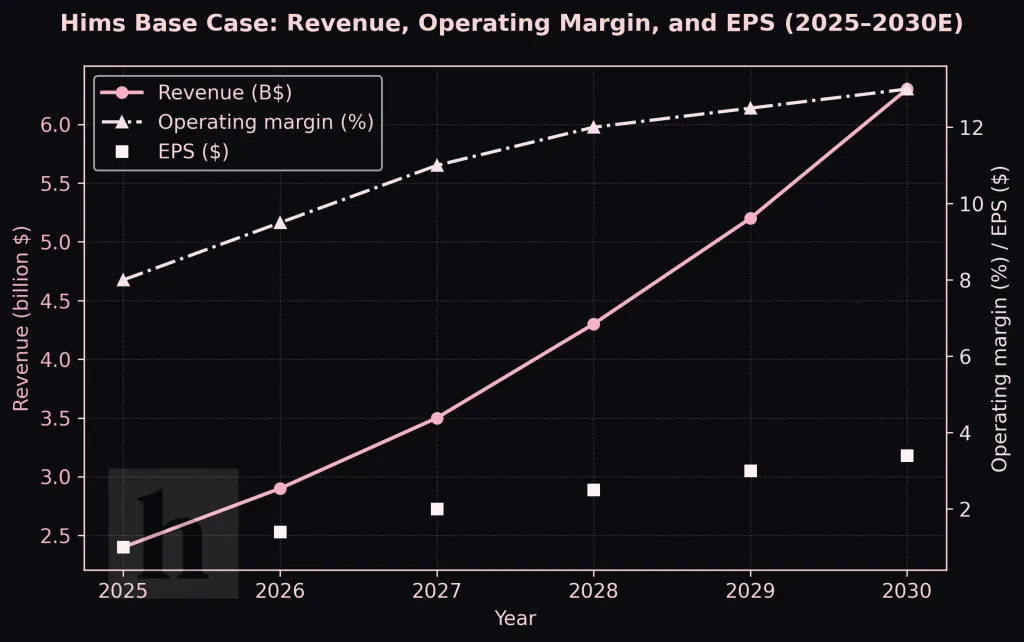
The base case assumes the company continues to execute on its current strategy. Personalized compounding provides stable support rather than outsized contribution. Women’s health becomes a major vertical with high retention. Diagnostics and preventive care strengthen the link between treatment and long-term management.
Marketing efficiency improves through higher multi-condition adoption. Europe contributes steady growth. Under these assumptions Hims behaves like a scaled consumer healthcare platform with sustainable mid-teens growth.
Bull Case 2030: The Consumer Healthcare Operating System
Subscribers in 2030: 6.1 to 7.5 million
Annual subscriber growth: 20 to 24 percent
Average monthly revenue per subscriber: 118 to 130 dollars
Revenue in 2030: 9.2 to 11.3 billion dollars
Operating margin: 20 percent
Earnings per share: 7.70 to 9.45 dollars
Price target range: 216 to 331 dollars
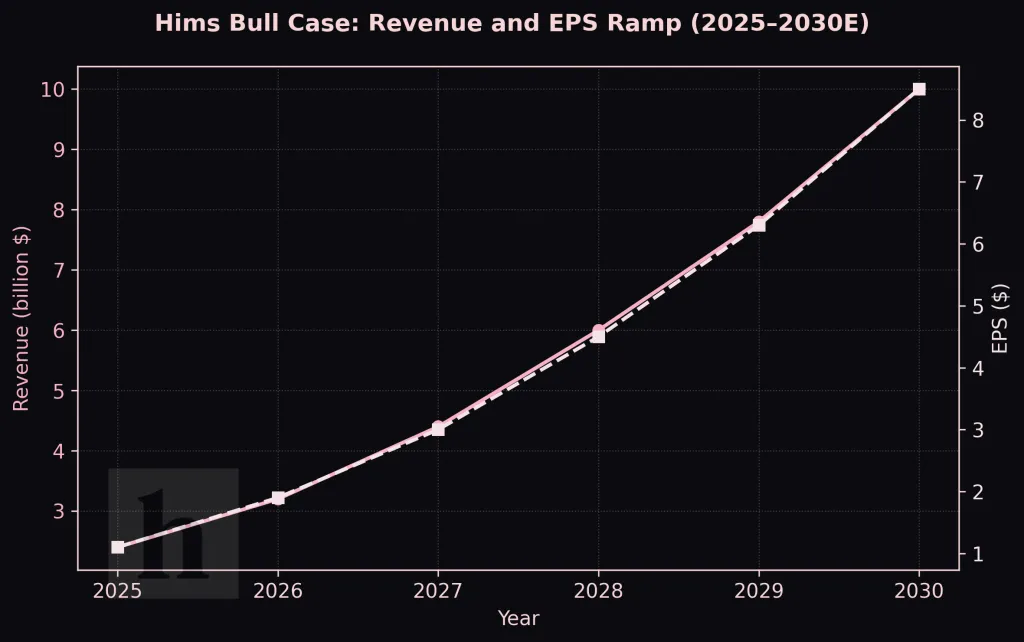
The bull case assumes the platform becomes the default care pathway for millions of younger and middle-aged consumers. Personalized compounding remains both lawful and desirable. Women’s health scales rapidly. Diagnostics and longevity create high-value recurring revenue.
Multi-condition care becomes standard. Europe accelerates growth rather than stabilizing it. Healthcare policy evolves in ways that reduce the effective cost of subscription-based care. Under this scenario Hims develops into a consumer-oriented healthcare operating system with significant margin expansion.
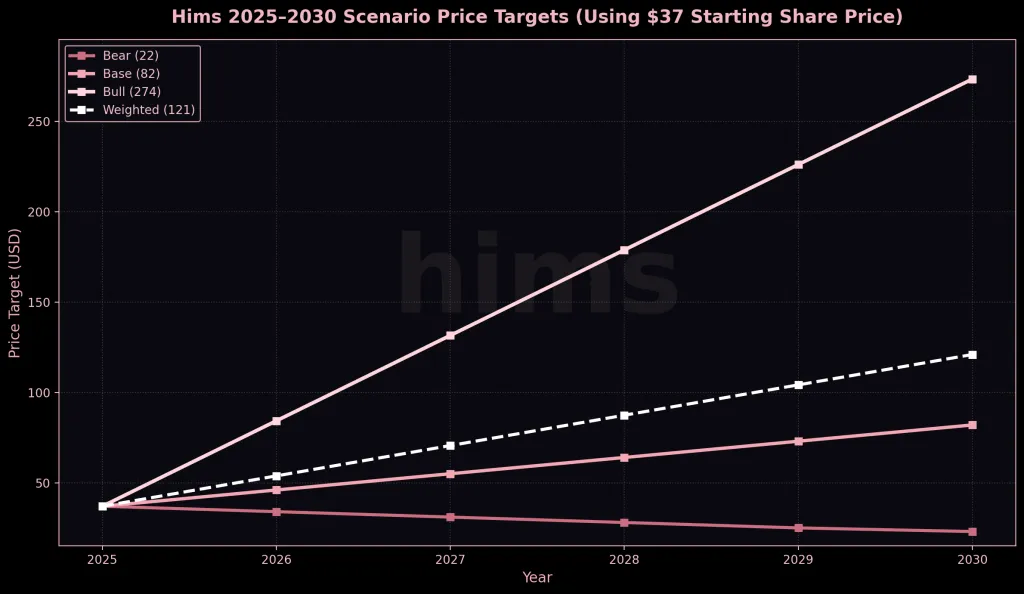
Probability Matrix and Weighted 2030 Price Target
The three scenarios above outline the full range of plausible outcomes for Hims & Hers by 2030. The next step is assigning explicit probabilities to each path and translating those outcomes into a single probability-weighted view.
This framework does not attempt to predict precision. It forces accountability around what must go right, what could break, and where the center of gravity actually sits based on the thesis.
Scenario | Probability | 2030 Price Target |
|---|---|---|
Bear Case | 15% | $19–$26 |
Base Case | 60% | $72–$92 |
Bull Case | 25% | $216–$331 |
Why these probabilities fit the thesis
The Bear Case (15%) requires multiple adverse outcomes occurring together. Regulatory pressure would need to materially impair flexibility, brand trust would need to erode, and operating leverage would need to stall despite a still-growing subscriber base. That outcome is possible, but it is not the path implied by current execution or by the structure of the business described above.
The Base Case (60%) represents the most likely trajectory. Hims continues scaling as a profitable, multi-vertical consumer healthcare platform, with weight loss acting as a meaningful but not dominant contributor. Subscriber growth, improving retention, expanding care categories, and disciplined marketing efficiency drive steady margin expansion. This case does not rely on extraordinary assumptions. It relies on continued execution.
The Bull Case (25%) reflects a world where Hims successfully extends consumer trust across weight loss, mental health, women’s health, primary care, and diagnostics, while maintaining operating leverage. In this outcome, the company is increasingly viewed as a category-defining consumer healthcare platform rather than a narrow telehealth provider, and valuation expands accordingly. This is not a certainty, but it is a real and coherent upside path based on the platform dynamics outlined in the article.
Probability-Weighted Outcome
Using the established price target ranges from each case, the probability-weighted outcome is as follows:
- Weighted low end: approximately $100
- Weighted high end: approximately $142
Probability-weighted 2030 fair value: ~$100–$142, with a midpoint near $120.
How to Interpret This Framework
The most important takeaway is not the exact number.
The base case alone supports meaningful upside relative to where the market has historically anchored the stock. The bull case meaningfully shifts the distribution, but it is not required for the thesis to work. The downside exists, but it requires multiple structural breaks that are not currently evident.
Overall, Hims remains in an extremely favorable position. Overwhelmingly the odds point to a sustained breakout to the upside, and multiple scenarios where investors could see 3-10x upside potential over a compressed timeline.
That asymmetry is the opportunity.
Risks That Could Affect the Hims Stock Forecast 2030
No forecast is complete without acknowledging risk. The most significant external risk remains regulatory clarity around compounded medications. A sudden and restrictive shift in guidance would disrupt a meaningful portion of revenue. Reputational risk also matters.
Any quality issue within compounding could undermine trust. Competition from large technology and retail companies can create pricing pressure in commoditized categories. Broad market volatility may also affect valuation multiples regardless of company performance.
These risks are real. They shape outcomes, but they do not erase the structural drivers supporting long-term growth. The subscription model provides a foundation of stability, and diversification across categories reduces reliance on any single vertical.
Final Perspective on the Hims Stock Forecast 2030
Hims is growing during a period when consumer expectations and healthcare realities are moving toward one another. The company recognized early that patients wanted transparent pricing, immediate access, and personalized care.
It built a platform that now supports millions of people across a wide range of conditions. The future will not be defined solely by GLP ones or any single vertical. It will be defined by the platform’s ability to support multiple conditions for each subscriber through personalized and preventive care pathways.
The bear case is modest but constructive. The base case is financially strong. The bull case is transformational.
Hims is not guaranteed to become the leading consumer healthcare platform of the next decade. But it has positioned itself in a segment of healthcare where consumer behavior, technology, and access dynamics are moving steadily in its direction. That alignment is rare. It is also the core of the long-term thesis.

Hims Stock Forecast
Explore our Hims stock forecast for 2025. We cover GLP-1 access, platform execution, and why we believe Hims is built to stay.

Celsius Stock Analysis: The Shelf Reset and the Second Growth Curve
Celsius stock analysis of the shelf reset, Alani growth, Pepsi economics and cash flow, with a 2030 model and a Premium valuation and entry-price framework.

Meta AI Spending: The Customer Is Already Here
Can Meta turn AI spending into shareholder returns? We model advertising, Muse, hardware, capital costs and cash flow through 2030, with a full valuation.
Northwise Portfolios
See how the research becomes real decisions
Reader discussion
Discuss the research
Create a Free account to join the discussion with a display name.
Create a Free Account
No comments yet. Start a thoughtful discussion.